Mayor of London announces solar and energy efficiency projects funded by ‘Green New Deal’
Business Green 19th Nov 2020, A host of green projects in London are set to benefit from £10m in funding
announced yesterday as part of the capital’s ‘Green New Deal Fund’, which
the Mayor of London claims could create up to 1,000 new jobs. Announced
yesterday, Sadiq Khan said the first tranche of £10m in funding would be
invested in green projects such as solar panel installations and home
energy efficiency improvements, targeting inequalities exacerbated by the
Covid-19 pandemic such as fuel poverty by helping to improve energy
efficiency, cut energy bills, and improve living conditions.
https://www.businessgreen.com/news/4023653/mayor-london-ploughs-gbp10m-green-deal-projects
Cheap and effective, but solar energy is omitted from UK govt’s 10 point plan
 Energyst 19th Nov 2020, Despite being the most cost-effective electricity generating technology for
the foreseeable future according to the Government’s own forecasts, solar
was noticeably absent from the Prime Minister’s announcement, which is
largely a repackaging of policies already announced earlier this year.
While the Government has yet to make its ambitions for UK solar clear there
is lively activity taking place in other parts of the public sector. The
City of London has announced a new 15-year Power Purchase Agreement (PPA)
with developer Voltalia, which will see a 50MW solar park built in Dorset
to supply the City with clean power. STA chief executive Chris Hewett said,
“It is disappointing that Number 10 has yet to grasp the opportunity
presented by solar in the UK. Not only is it set to be the cheapest power
source for years to come, it also provides good jobs and business
opportunities up and down the country.
https://theenergyst.com/uk-solar-industry-body-criticises-lack-of-support-in-ten-point-green-plan/
Book review: The Case for Degrowth
 Book review: The Case for Degrowth, Jeremy Williams, The Earthbound Report , 16 Nov 20, “…………. What are the objectives of degrowth? It’s not shrinking the economy for the sake of it. The aim is to get GDP growth out of the driving seat and then steer towards “what really matters: not GDP, but the health and wellbeing of our people and our planet.”
Or there’s the alternative, which is to stop taking growth as the primary measure of progress and get on with delivering what people need. So many political directions open up when GDP growth takes a back seat and we get on with delivering what people need more directly.
In fact, downsizing in the rich world may be a key enabler of flourishing elsewhere. “There is no technological or policy fix that can generalize to nine billion people the material standard of living currently enjoyed by a minority at high cost to others.” Instead, “high-consumption nations and people must degrow to free space for low-consumption ones.”
- A Green New Deal
- universal incomes and services
- policies to reclaim the commons
- shorter working hours
- public finance that supports the first four
Being a short book, it no doubt opens up lots of other questions that the authors don’t cover, though the frequently asked questions at the end captures many of them. Perhaps the one that still sticks out for me is the word ‘degrowth’ itself. In my opinion it doesn’t capture the positivity of a vision for qualitative progress, for improvement rather than enlargement. I know it’s an old debate. We had it when founding the Postgrowth Institute ten years ago, and it doesn’t feel resolved today.
Still, The Case for Degrowth is a brief and straightforward explainer, and a good starting point for anyone who wants to get their head around the degrowth movement and what it wants to acheive.
- You can get The Case for Degrowth from Earthbound Books UK or my US store. It’s powered by Bookshop.com and supports your local book store as well as this blog.
- More recommended degrowth books here. https://wordpress.com/read/feeds/95197302/posts/3025203412
Super power: Here’s how to get to 100pct wind, solar and storage by 2030 — RenewEconomy

Deep disruption: New report from futurist Tony Seba and RethinkX says transition to 100pct renewables possible by 2030, and the “super” surplus of wind and solar can be used to power transport and industry. The post Super power: Here’s how to get to 100pct wind, solar and storage by 2030 appeared first on RenewEconomy.
Super power: Here’s how to get to 100pct wind, solar and storage by 2030 — RenewEconomy
A team led by renowned Stanford University futurist Tony Seba says most of
the world can transition to 100 per cent wind, solar and storage
electricity grids within the coming decade, in what they describe as the
fastest, deepest and most profound disruptions ever seen in the energy
industry.
The RethinkX team led by Seba, one of the few analysts to
correctly forecast the plunging cost of solar over the last decade,
predicts that the disruption caused solar, wind and lithium-ion battery
storage, or SWB, will be similar to the digital disruption of information
technology. “Just as computers and the Internet slashed the marginal cost
of information and opened the door to hundreds of new business models that
collectively have had a transformative impact upon the global economy, so
too will SWB slash the marginal cost of electricity and create a plethora
of opportunities for innovation and entrepreneurship.”
“Our analysis
shows that 100% clean electricity from the combination of solar, wind, and
batteries (SWB) is both physically possible and economically affordable
across the entire continental United States as well as the overwhelming
majority of other populated regions of the world by 2030.
“Adoption of
SWB is growing exponentially worldwide and disruption is now inevitable
because by 2030 they will offer the cheapest electricity option for most
regions. Coal, gas, and nuclear power assets will become stranded during
the 2020s, and no new investment in these technologies is rational from
this point forward.”
The analysis from Seba and the RethinkX team is just
the latest of a series of important reports that have been released in
recent weeks and months that look at the pace of technology change, the
energy transition and climate goals.
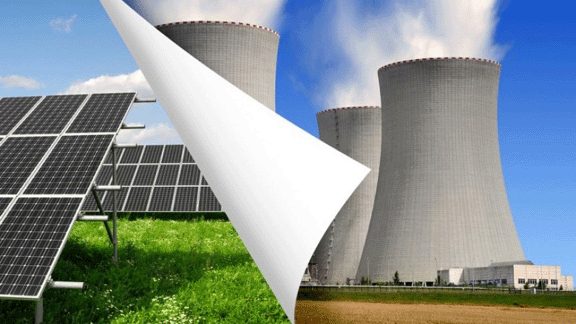
Every dollar wasted on nuclear power is a dollar not invested in clean energy
|
Every dollar wasted on nuclear is a dollar not invested in renewables, https://wordpress.com/read/feeds/72759838/posts/2985336306 By Tim Judson and Luis Hestres, 25 Oct 20, We’ve known for a long time that nuclear energy is a false solution to climate change. Not only are the health and environmental impacts of nuclear power intolerable, but it also gobbles up investments we should be making in clean and safe renewable energy. Now, a new study by researchers at the University of Sussex in the UK brings us the latest and most robust evidence of these facts. The study, published last week in Nature Energy, considers three hypotheses: Firstly, that emissions decline the more a country adopts nuclear power; secondly, that emissions decline the more a country adopts renewables; and thirdly, that nuclear and renewables are ‘mutually exclusive’ options that tend to crowd each other out at an energy system level. The hypotheses were tested against 25 years’ worth of electricity-production and emissions data from 123 countries. The result? Investment in nuclear is mostly negatively correlated with decreases in carbon emissions, while investment in renewables was positively correlated with such decreases across the board. In other words, countries that invested in nuclear didn’t see emission reductions but countries that invested in renewables did. The only exceptions were higher per-capita GDP countries, which saw some decreases in emissions while investing in nuclear—but countries with lower per-capita GDP didn’t. But this last finding didn’t take into account the costs associated with nuclear waste storage and cleanup, the dangers of nuclear accidents, or the fact that those reductions might have been deeper if renewables had been chosen. The finding that investments in nuclear and renewables tend to crowd each other out means that countries that invest more in nuclear tend to invest less in renewables, and vice versa. This refutes the ‘all of the above’ option, or what we call ‘refuse to choose’. Every dollar that a country wastes in nuclear is a dollar it doesn’t invest in renewable energy, which has a better chance of achieving deeper emission reductions at a lower cost and without the dangers associated with nuclear energy. To refuse to choose is to choose nuclear, to the detriment of the fight against climate change and the health and safety of people and the environment. This study has major implications for climate and energy policy in the US and around the world. In June 2020, the USCAN Climate Action Network made a big splash by publishing the Vision for Equitable Climate Action. Not only is VECA the most comprehensive and detailed policy agenda put out by the climate movement, it is rooted in principles of racial and economic equity and justice, developed by more than 170 people from over 100 organizations. It is also the first major climate movement agenda to explicitly call for a phaseout of nuclear power. Along with other recent climate justice agendas, from the Equitable and Just National Climate Platform and the People’s Orientation to a Regenerative Economy to the THRIVE Agenda and the Feminist Green New Deal, VECA is part of a broad shift toward transformative solutions to the climate crisis, calling for a rapid, just and equitable transition to 100% renewable energy. Moderate climate organizations have reacted with hesitation and resistance, skeptical that transformative change is too risky, or not supported by the science. And nuclear power has been one of the central sticking points, with some insisting that it plays too big a role in our energy supply. But now the science is in, and it shows nuclear is out. And the Vision for Equitable Climate Action and the anti-nuclear and climate justice movements have it right. The Sussex study confirms what NIRS, Beyond Nuclear and others have been saying for a long time: on top of being too dirty and too dangerous, nuclear power is simply too expensive and too time-consuming to compete with renewables as an alternative to decarbonize the global economy. So, what about the Green New Deal? While opponents of the GND complain about its potential $2 trillion cost, this year has proven that’s just playing politics. With the $2.5 trillion COVID-19 relief bill Congress passed in April, it’s clear that, when the country truly knows we are facing a crisis and our elected officials are forced to deal with it, we can find the political will and the money to do what is needed. If we can find $2.5 trillion in a few weeks to bootstrap our economy and support people through the pandemic for a few months, the Green New Deal is a bargain. For $2 trillion over 10 years, we can not only literally save the world, but build a just, equitable, sustainable new economy with healthy communities, good, union jobs, and real economic security. But at the same time, as with COVID, we don’t have time to waste on things that aren’t going to work, and nuclear power is now exhibit #1. It would be better to spend our money on creating thousands of jobs cleaning up and revitalizing the hundreds of communities impacted by nuclear power, and coming up with environmentally just and scientifically proven ways to isolate radioactive waste. When it comes to the climate crisis, we have to be bold, visionary, and ambitious, and we have to put equity and justice first. That alone is reason enough to make sure the Green New Deal prioritizes a phaseout of nuclear power through a just transition for workers and communities. Tim Judson is the Executive Director of Nuclear Information and Resource Service. Luis Hestres, PhD., is the Digital Strategist at Nuclear Information and Resource Service. |
|
USA: Millions of jobs in clean energy and infrastructure – analysis finds.
“We don’t have to choose between a strong economy or a healthy environment—we can have both,” says an EPI data analyst. Common Dreams, byJessica Corbett, staff writer – 20 Oct 20, Pursuing trade and industrial policies that boost U.S. exports and eliminate the trade deficit while investing $2 trillion over four years in the nation’s infrastructure, clean energy, and energy efficiency improvements could support 6.9 to 12.9 million “good jobs” annually by 2024, according to an analysis published Tuesday.
Queensland, Australia to get the ‘world’s greenest city’
Renew Economy 21st Oct 2020, French energy giant Engie backs Greater Springfield development, aiming to be ‘world’s greenest city’, with zero emissions transport plan. The post Energy giant Engie supercharges green city development with support for EVs, hydrogen transport appeared first on RenewEconomy.
A new city being developed in south-east Queensland aiming to become one of
the world’s greenest is set to get a boost, with a new roadmap launched with the backing of one of the world’s largest energy companies.
Greater Springfield, which is located around 30km south-west of Brisbane and has
grown to a population of 45,000 has released a new master plan that will see electric vehicle charging infrastructure and a hydrogen fuelled bus network rolled out, in an effort to create the ‘world’s greenest city’ by 2038.
The city is one of Australia’s largest privately funded city developments, including a mix of residential and business districts, and has attracted a campus of the University of Southern Queensland.
Energy giant Engie supercharges green city development with support for EVs, hydrogen transport — RenewEconomy
The very genuine promise of cheap electricity – solar power
 Nuclear power never delivered on its promise, but will solar? John Quiggin, Canberra Times, 19 Oct 20,

The International Energy Agency attracted attention recently when executive director Fatih Birol declared that solar would be “the new king of electricity markets.” Long known for its conservative view of renewables, the IEA’s latest Global Energy Review marked a radical change. Instead of growing slowly over time, solar (along with wind and other renewables) is now seen as meeting all new electricity demand, with coal set for a sharp decline. …….
The prospect of electricity this cheap might seem counter-intuitive to anyone whose model of investment analysis is based on concepts like “present value” and payback periods. But in the world of zero real interest rates that now appears to be upon us, such concepts are no longer relevant. Governments can, and should, invest in projects whenever the total benefits exceed the costs, regardless of how those benefits are spread over time.
- John Quiggin is a Professor of Economics at the University of Queensland and a columnist with Inside Story, where this article also appears. https://www.canberratimes.com.au/story/6974708/energy-that-is-too-cheap-to-meter/
Britain’s zero emissions policy will bring many 1000s of jobs, investing in green infrastructure
help to achieve Boris Johnson’s national renewal mission, a report
published today says. Investment in green infrastructure and technologies
will prevent long-term scarring of the labour market in the wake of the
Covid-19 crisis, the report by the London School of Economics adds.
this summer to “build back better, build back greener, build back
faster” after GDP collapsed by a record 19.8 per cent as a result of a
national lockdown.
government investment would create the maximum number of jobs while also
helping to achieve the UK’s commitment of carbon neutrality, including
renewable energy infrastructure, electric vehicle production and home
energy efficiency retrofits. The UK was the world’s first major economy
to enshrine in law a commitment to reach net zero carbon emissions by 2050.
https://www.thetimes.co.uk/edition/business/net-zero-goal-will-be-ally-of-recovery-w09wcx7hn
China’s world-leading push for solar and wind energy
capacity each year than any other country, with over 760GW installed so
far. By contrast, the EU has only managed 500GW, the USA 250 GW.
capacity additions in China are expected to fall by over 16% to 19 GW from
2020 to 2021, given the Chinese government’s decision to end subsidies,
say analysts Wood Mackenzie.
250 GW of wind capacity to be added, with repowering opportunities onshore
and growth potential offshore. Indeed, some see the latter booming
dramatically. So, while wind subsidies will fall by 3.2%, wind capacity
will still grow, and PV solar seem likely to do even better: incentives for
PV will rise by 14%, with some seeing solar as the major growth area longer
term, helping China get 62% of its power from non-fossil sources by 2030.
https://renewextraweekly.blogspot.com/2020/10/china-renewables-to-expand-even-more.html
Solar energy is here with a vengeance – look at South Australia
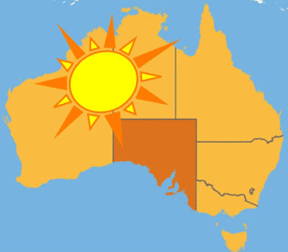 Forbes 17th Oct 2020, Anyone who follows developments in the energy sector will know that solar energy is no longer just the future but the present. According to thebInternational Energy Agency’s World Energy Outlook 2020, photovoltaic solar energy is already the cheapest source of electricity in history.
As a result, solar panels can now be fitted anywhere, covering water canals in India, on canopies over Germany’s autobahns, or on school roofs in the United States. When the economic variables of a technology change in this way, creating an oversized electricity generation grid based on solar and wind is the logical alternative, and whoever does not do so will be relegated to less efficient and, above all, dirtier energy sources.
https://www.forbes.com/sites/enriquedans/2020/10/17/what-is-happening-with-solarenergy/amp
/
Study shows that renewable energy is clearly better that nuclear at cutting greenhouse emissions
25-Year Study of Nuclear vs Renewables Says One Is Clearly Better at Cutting Emissions, Science Alert, DAVID NIELD 11 OCTOBER 2020Nuclear power is often promoted as one of the best ways to reduce our reliance on fossil fuels to generate the electricity we need, but new research suggests that going all-in on renewables such as wind and solar might be a better approach to seriously reducing the levels of carbon dioxide in the atmosphere.
Based on an analysis of 123 countries over a quarter of a century, the adoption of nuclear power did not achieve the significant reduction in national carbon emissions that renewables did – and in some developing nations, nuclear programmes actually pushed carbon emissions higher.
The study also finds that nuclear power and renewable power don’t mix well when they’re tried together: they tend to crowd each other out, locking in energy infrastructure that’s specific to their mode of power production.
Given nuclear isn’t exactly zero carbon, it risks setting nations on a path of relatively higher emissions than if they went straight to renewables….
It’s important to note that the study looked specifically at data from 1999-2014, so it excludes more recent innovations in nuclear power and renewables, and the scientists themselves say they have found a correlation, rather than cause and effect. But it’s an interesting trend that needs further investigation.
“The evidence clearly points to nuclear being the least effective of the two broad carbon emissions abatement strategies, and coupled with its tendency not to co-exist well with its renewable alternative, this raises serious doubts about the wisdom of prioritising investment in nuclear over renewable energy,” says Benjamin Sovacool, a professor of energy policy at the University of Sussex in the UK.
“Countries planning large-scale investments in new nuclear power are risking suppression of greater climate benefits from alternative renewable energy investments.”
The researchers suggest the tighter regulations and longer lead times associated with nuclear power are responsible for some of the statistics explored here, while the large-scale development that nuclear requires tends to leave less room for renewable projects that work on a smaller scale.
There are also broader considerations to weigh up – nuclear and renewables will be two factors among many in the policies put together by governments when it comes to reducing carbon emissions.
Plus, given the time frame, a lot of the nuclear power plants covered by this study are likely to have been getting towards the end of their lifespans, which means more energy is required to maintain them.
Whatever the ins and outs of the nuclear policies, the study does show a clear link between greater adoption of renewable projects and lower carbon emissions overall.
The study authors propose that by cutting out nuclear altogether, these renewable gains could be even greater.
This paper exposes the irrationality of arguing for nuclear investment based on a ‘do everything’ argument,” says researcher for technology policy Andrew Stirling at the University of Sussex.
“Our findings show not only that nuclear investments around the world tend on balance to be less effective than renewable investments at carbon emissions mitigation, but that tensions between these two strategies can further erode the effectiveness of averting climate disruption.”………..
it is astonishing how clear and consistent the results are across different time frames and country sets,” says Patrick Schmid, from the ISM International School of Management in Germany.
“In certain large country samples the relationship between renewable electricity and CO2-emissions is up to seven times stronger than the corresponding relationship for nuclear.”
The research has been published in Nature Energy. https://www.sciencealert.com/here-s-why-nuclear-won-t-cut-it-if-we-want-to-drop-carbon-as-quickly-as-possible
Offshore Wind Energy, Not Nuclear, Is the Future

|
Offshore Wind Energy, Not Nuclear, Is the Future, Jacobin, WILLIAM WESTGARD-CRUICE, 12 Oct 20,
States across Europe and East Asia are closing nuclear reactors and replacing much of their electricity-generating capacity with offshore wind energy. Socialists should embrace the growth of this industry — and use green reindustrialization to fight for well-paid, stable jobs. his month, the Netherlands will celebrate the completion of the Borssele 1 and 2 offshore wind farms, located twenty-two kilometers off the coast of the Dutch province of Zeeland. In the sleepy village where the transmission cables come ashore, a relic from the late 1960s hums away, awaiting its decommissioning. That’s because Borssele also has a nuclear power station — the Netherlands’ last remaining such facility, scheduled to be taken off-line in 2033. Just over a decade ago, plans had been drawn up for a second, perhaps even a third, reactor on site. The abortive expansion project was scrapped partly as a consequence of popular opposition, in the aftermath of the Fukushima disaster. But what was ultimately decisive was the law of value as identified by Karl Marx. With the declining cost of renewable energy, nuclear power simply does not make economic sense — even for capitalists, never mind socialists. Many of the fervent debates within the Left concerning nuclear power have been strikingly unproductive for one simple reason. Nuclear advocates, woefully ill-informed about the frontiers of renewable energy development, tend to avoid discussing the actual dynamics of inter-capitalist competition in the electricity sector. But with many capitalist enterprises and states ditching nuclear and pushing forward with offshore wind, it is essential for socialists to better understand the latter — and begin to engage with it strategically. ecent years have seen several prominent figures within the environmental movement and democratic-socialist left embrace nuclear power. They distance themselves from their (former) comrades’ quasi-religious technophobia, but erroneously call for a program of “people’s fission” that would supposedly solve the climate crisis in one fell swoop. This stance elides many of the real dangers of atomic energy, particularly in a country like the United States, where corruption is endemic and state regulatory capacities are weak. Whatever the politics and intentions of this varied bunch may be, left-of-center nuclear advocates all end up achieving the same thing — running interference for the fossil fuel industry, by casting doubt on the possibility of a renewable civilization…….. Rather than reciting the fossil fuel industry’s propaganda about the intermittency of renewables in order to advance the pet project of nuclear power, democratic socialists ought to focus on promoting the expansion of renewable energy while striving for the industry’s democratization through the workplace and political struggle. Several advanced capitalist states, Denmark and Portugal in particular, are moving decisively toward 100 percent renewable electricity, and they are doing so largely by investing in offshore wind. Even France, whose 1980s program of atomic autarky is routinely touted by nuclear advocates, is aiming to close several reactors over the next decade and a half, replacing much of its electricity generating capacity with offshore wind energy. South Korea, although it continues to promote nuclear power abroad for the benefit of the country’s chaebol, has pledged to phase out many of its own nuclear power plants while aggressively promoting offshore wind energy through a coordinated industrial policy. t is no wonder that Denmark, Portugal, and South Korea — not to mention Japan, China, and Taiwan — are so keen on offshore wind. While certainly intermittent, offshore wind is significantly less so than onshore wind or solar. Furthermore, offshore wind development does not imply the type of land-use conflicts that often accompany the construction of solar and wind farms in rural areas……….. Despite being hampered by the Trump administration, the US offshore wind industry is beginning to take off. Meanwhile, the nuclear energy industry is in complete shambles, gobbling up $9 billion just to move some dirt around. The question is not whether socialists should promote nuclear power or renewable energy, but how quickly renewables will displace fossil fuels and on what terms. …….. https://www.jacobinmag.com/2020/10/offshore-wind-energy-just-transition-nuclear |
|
Nuclear and renewables – mutually exclusive: renewables better for climate action
 Comparative impact of nuclear and renewables on CO2 emissions, By Philippe Gauthier, Resilience.org October 9, 2020 Countries which are heavily invested in nuclear energy remain higher CO2 emitters, on average, than countries which have invested at the same level in renewable energy. This is the main finding of a study recently published in the journal Nature Energy. The results also tend to confirm the hypothesis that it is difficult to commit both to nuclear and renewables due to a systemic incompatibility between these two approaches.
The work aimed to assess three hypotheses. The first is that the greater a country’s nuclear power generation capabilities, the lower its greenhouse gas emissions are. The second is that the greater a country’s renewable energy generation capabilities, the lower its emissions are. The third is that nuclear and renewables coexist uneasily within a national energy system and that the dominance of either delays or prevents the adoption of the other………….
Explanatory factors
What explains these rather unfavorable results for nuclear power? Data collected by the researchers shows that, on average, the delivery time is 90 months for nuclear projects, compared to 40 months for solar and wind projects. Only hydropower has longer lead times. Nuclear and hydropower projects are more prone to delays and cost overruns than smaller-scale renewable projects, which yield low carbon energy more quickly.
Renewables are also associated with a positive learning curve whereby each completed project decreases the costs and increases the performance of subsequent projects. In comparison, nuclear power exhibits a negative learning curve. The study specifically cites the case of France, where each new generation of reactors has involved increased costs or lower performance. The tightening of safety measures after each major accident (Three Mile Island, Chernobyl, Fukushima) has greatly contributed to these increased costs in every country.
The study concludes that renewables have a demonstrable record of reducing greenhouse gas emissions. Nuclear power has a more mixed record, due to the different nature of the energy systems in which it operates. Finally, the results tend to confirm the hypothesis of mutual exclusion already widely noted in the scientific literature. According to the researchers, countries that think they can obtain emission reductions by investing in nuclear energy may actually be forgoing even greater reductions that could be achieved by renewables.
Source:
Benjamin K. Sovacool et al. Differences in carbon emissions reduction between countries pursuing renewable electricity versus nuclear power, in Nature Energy, October 5, 2020 https://www.nature.com/articles/s41560-020-00696-3.epdf?
China’s plan for dramatic switch to climate action and renewable energy
|
|
|
1 This Month

of the week – Shut Down Drone Warfare!


Tell the Ukrainian Government to Drop Prosecution of Peace Activist Yurii Sheliazhenko

Petition to revoke the licensing of the Near Surface Nuclear Disposal Facility (NSDF) at Chalk River. https://www.ourcommons.ca/petitions/en/Petition/Details?Petition=e-7247
To see nuclear-related stories in greater depth and intensity – go to https://nuclearinformation.wordpress.com
-
Archives
- April 2026 (68)
- March 2026 (251)
- February 2026 (268)
- January 2026 (308)
- December 2025 (358)
- November 2025 (359)
- October 2025 (376)
- September 2025 (257)
- August 2025 (319)
- July 2025 (230)
- June 2025 (348)
- May 2025 (261)
-
Categories
- 1
- 1 NUCLEAR ISSUES
- business and costs
- climate change
- culture and arts
- ENERGY
- environment
- health
- history
- indigenous issues
- Legal
- marketing of nuclear
- media
- opposition to nuclear
- PERSONAL STORIES
- politics
- politics international
- Religion and ethics
- safety
- secrets,lies and civil liberties
- spinbuster
- technology
- Uranium
- wastes
- weapons and war
- Women
- 2 WORLD
- ACTION
- AFRICA
- Atrocities
- AUSTRALIA
- Christina's notes
- Christina's themes
- culture and arts
- Events
- Fuk 2022
- Fuk 2023
- Fukushima 2017
- Fukushima 2018
- fukushima 2019
- Fukushima 2020
- Fukushima 2021
- general
- global warming
- Humour (God we need it)
- Nuclear
- RARE EARTHS
- Reference
- resources – print
- Resources -audiovicual
- Weekly Newsletter
- World
- World Nuclear
- YouTube
-
RSS
Entries RSS
Comments RSS
 nuclear-news