Lies in Texas, as Republicans blame renewable energy for cold weather traumas
|
Pressenza 19th Feb 2021, Forget Ted Cruz, What’s Really Missing in Texas Is the Green New Deal. While Republican Sen. Ted Cruz of Texas is under fire for fleeing to Cancún for a vacation as his constituents endure devastating power outages as well as food and water shortages due to rare winter weather, climate campaigners are pointing to the compounding crises in the Lone Star state as proof of the need for a Green New Deal.
As dozens of people have died and millions have spent days without electricity, some right-wing news outlets and lawmakers—including GOP Texas Gov. Greg Abbott, who’s facing calls to step down—have lied about the state’s power problems, blaming renewable energy, even though the outages are largely tied to issues with gas, coal, and nuclear facilities. Abbott even claimed Tuesday on Fox News that “this shows how the Green New Deal would be a deadly
deal for the United States of America.” |
On nuclear power as climate solution, Bill Gates shows alarming ignorance
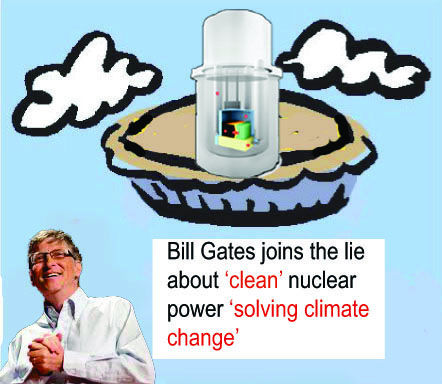
David Lowry’s Blog 16th Feb 2021 The multi-billionaire Bill Gates, founder of Microsoft, in his new book, “How to Avoid a Climate Disaster”, is sceptical of the Green New Deal.(Allen Lane/Penguin) published on 16 February. Gates secured much pre-publication publicity for his new tome, including an interview in the Guardian Weekend Magazine, which wrote “Of the Green New Deal, the proposal backed by Alexandria Ocasio-Cortez [the Congresswoman who has promoted the merits of the GND in the US] that raises the goal of carbon neutrality in a decade, he is flatly dismissive, with Gates telling the interviewer. “Well, it’s a fairytale. It’s like saying vaccines don’t work – that’s a form of science denialism. Why peddle fantasies to people?”
Gates also opined: “I’m not a survivalist.” Instead his version of survivalism is to fund innovation, the reporter noted. “I’m putting money into carbon capture and nuclear fission” Gates told her. (Bill Gates: ‘Carbon neutrality in a decade is a fairytale. Why peddle fantasies?’, Guardian, 13 February 2021; https://www.theguardian.com/technology/2021/feb/15/bill-gates-carbon-neutrality-in-a-decade-is-a-fairytale-why-peddle-fantasies)
Indeed, his book is laced with positive, if inaccurate, mentions of nuclear power. For example, he asserts on page 84, in a section on “Making Carbon-Free Electricity”, uns der a sub-section titled ‘ Nuclear Fission’ he writes: “”Here’s the one sentence case for nuclear power: It’s the only carbon-free energy sources that can reliably deliver power day and night, through every season.”
Natural gas, not renewable energy, was most responsibe for Texas power failure in freezing conditions
Why is Texas suffering power blackouts during the winter freeze?
The oil- and gas-rich state is experiencing what officials call a ‘total failure’ of its electricity infrastructure Guardian, Lauren Aratani, Thu 18 Feb 2021 “…...Did renewable energy play a role in the grid’s malfunction?
While Republicans have been blaming frozen wind turbines for the state’s blackouts, officials and experts say that malfunctions in natural gas operations played the largest role in the power crisis.
Ercot said all of its sources of power, including those from renewable sources, were affected by the freezing temperatures. The state largely relies on natural gas for its power supply, though some comes from wind turbines and less from coal and nuclear sources.
Natural gas can handle the state’s high temperatures in the summer, but extreme cold weather makes it difficult for the gas to flow to power plants and heat homes. Michael Webber, an energy resources professor at the University of Texas Austin, told the Texas Tribune that “gas is failing in the most spectacular fashion right now”.
With the climate crisis likely to trigger more freak weather events like the one Texas is suffering it is noteworthy that there are places that experience frigidly cold weather that rely heavily on wind turbines and manage to have electricity in the winter. In Iowa, a state which sees freezing temperatures more often than Texas, nearly 40% of electricity is generated by wind turbines……. https://www.theguardian.com/us-news/2021/feb/18/why-is-texas-suffering-power-blackouts-during-the-winter-freeze
In Texas freezing temperatures, the major power loss was from coal, gas, nuclear facilities, not renewables
major power failures across Texas as increased demand for heating has overwhelmed the energy grid. Supplies of both electricity and gas have been intermittent, with the authorities saying they need to “safely manage the balance of supply and demand on the grid” to avoid another major power cut.
Green energy sources are not to blame for the winter storm power blackouts in Texas.
Green energy sources are not to blame for the winter storm Uri power
blackouts in Texas, experts say. More than 4.2 million people were left
without power after a rare cold front brought record-breaking freezing
conditions to the state. Fox News host Tucker Carlson, among others, has
tried to point the finger at renewable energy sources such as wind turbines
for the rolling blackouts seen in the state.
Independent 16th Feb 2021
The electricity outages suffered by millions of Texans amid frigid
temperatures sweeping across the United States have been seized upon by
conservative commentators presenting a false narrative that renewable power
was to blame.
Guardian 17th Feb 2021
Solar sails for space voyages
 Nuclear Rockets to Mars?, BY KARL GROSSMAN– CounterPunch, 16 Feb 21,”………. As for rocket propulsion in the vacuum of space, it doesn’t take much conventional chemical propulsion to move a spacecraft—and fast.
And there was a comprehensive story in New Scientist magazine this past October on “The new age of sail,” as it was headlined. The subhead: “We are on the cusp of a new type of space travel that can take us to places no rocket could ever visit.”
The article began by relating 17th Century astronomer Johanne Kepler observing comets and seeing “that their tails always pointed away from the sun, no matter which direction they were traveling. To Kepler, it meant only one thing: the comet tails were being blown from the sun.”
Indeed, “the sun produces a wind in space” and “it can be harnessed,” said the piece. “First, there are particles of light streaming from the sun constantly, each carrying a tiny bit of momentum. Second, there is a flow of charged particles, mostly protons and electrons, also moving outwards from the sun. We call the charged particles the solar wind, but both streams are blowing a gale”—that’s in the vacuum of space.
Japan launched its Ikaros spacecraft in 2010—sailing in space using the energy from the sun. The LightSail 2 mission of The Planetary Society was launched in 2019—and it’s still up in space, flying with the sun’s energy.
New systems using solar power are being developed – past the current use of thin-film such as Mylar for solar sails.
The New Scientist article spoke of scientists “who want to use these new techniques to set a course for worlds currently far beyond our reach—namely the planets orbiting our nearest star, Alpha Centauri.”……. more https://www.counterpunch.org/2021/02/16/nuclear-rockets-to-mars/
Fukushima to Triple Wind Power Generation
|
Fukushima to Triple Wind Power Generation https://www.nippon.com/en/news/yjj2021020801101/ Feb 8, 2021 Tokyo, (Jiji Press)–Japan’s industry ministry announced a plan on Monday to triple wind power generation in Fukushima Prefecture to 360 megawatts in fiscal 2024 from four years before.The plan highlighted the use of renewable energy as a pillar of efforts to accelerate the recovery of the northeastern prefecture from the March 2011 nuclear accident.
Under the plan, the Fukushima and national governments aim to construct an industrial complex running solely on renewable energy sourced within the prefecture, by fiscal 2030. The national government will provide financing to build some 30 kilometers out of the over 80 kilometers of a grid that will supply electricity in the prefecture from renewable sources. All 10 nuclear reactors in the prefecture are set to be decommissioned, following the triple meltdown at Tokyo Electric Power Company Holdings Inc.’s <9501> disaster-hit Fukushima No. 1 nuclear plant. |
|
Why nuclear power is a bad way to balance renewable energy
Why nuclear power is a bad way to balance renewable energy https://100percentrenewableuk.org/why-nuclear-power-is-a-bad-way-to-balance-renewable-energy
David Toke, Ian Fairlie and Herbert Eppel from 100percentrenewableuk discuss how nuclear power effectively switches off wind and solar power and how a 100percent renewable energy system is much better for the UK than one involving nuclear power
The Government, backed by a lot of public policy reports paid for by pro-nuclear interests, constantly pushes out the view that nuclear power is ‘essential’ to balancing wind and solar power.
But what they never mention is the massive waste of renewables that occurs in such a scenario.
Under the scenarios planned by the Government nuclear power is paid very high prices to generate power even when there is excess electricity, which pushes renewables to close down.
The Government also refuses to undertake serious investigations of how a system that uses excess renewables to create short and long term storage is a much better way of organising our energy needs rather than wasting more money on building nuclear power statitons.
If you agree the aims of 100percentrenewableuk please join the discussion via our email group.
Hydrogen from wind and solar systems could be the ultimate solution to the planet’s pollution problem.
latest claim to fame, two spinoffs of German tech conglomerate Siemens are
joining forces to advance green hydrogen technology by building
wind-to-hydrogen systems to help decarbonize the global economy.
element can be an energy carrier, it can be used to store energy and it can
be used in fuel cells to power vehicles. Green hydrogen is a particularly
attractive option because its production comes from hydrolyzing water using
electricity produced by renewable systems, meaning it has a much lower
carbon footprint than gas- or coal-sourced hydrogen.
pollution problem.
https://oilprice.com/Energy/Energy-General/German-Tech-Giant-Places-Major-Bet-On-Green-Hydrogen.html
Nuclear power, too inflexible, is in conflict with sustainable development goals.
|
Can nuclear power and renewables mix on electricity grids? By Nuclear Engineering International 06 Jan 2021 ”………..a new paper from the Science Policy Research Unit (SPRU), a research group at the UK’s Brighton University, argues that a nuclear power programme is in conflict with sustainable development goals.
Launching the paper, Differences in carbon emissions reduction between countries pursuing renewable electricity versus nuclear power, the SPRU group said that countries with large national nuclear programmes do not tend to show significantly lower carbon emissions. It claims the study shows that nuclear and renewable energy programmes do not tend to co-exist well in low-carbon energy systems because they crowd each other out. …… the researchers claim that an expanding nuclear programme is no guarantee of reduced carbon emissions – unlike increasing commitment to renewables. The authors found little support for the suggestion that countries with a large investment in nuclear invested less in renewables. But they said in a challenge to scenarios like that of the IEA, that “strong claims in favour of particular technologies” are “underevidenced”……… The International Energy Agency concluded in a report last year that global nuclear power development is moving too slowly to allow the world to meet its Sustainable Development Scenarios Over the COVID months, NGESO found that it had a power surplus to manage. It had to artificially increase demand, by paying neighbouring countries to accept power via interconnectors (against market prices). It also used innovative approaches, including inviting users to be paid to increase demand. Both were necessary, along with paying some renewable sources to switch off and ensuring pumped storage plants were working in “pump” mode, in order to bring demand up to exceed low-carbon supply enough to allow it to call up thermal generation (gas and biomas) to provide stability. What was nuclear’s role in this period? It too has large rotating machinery and it can provide inertia. But, although the system operator maintains frequency across the entire network, voltage support has to be localised. What is more, the amount of fast-acting reserves that the system operator is legally required to hold in readiness depends on the size of the largest system in-feed. Sizewell B, at 1200 megawatts (MW) the GB system’s largest infeed, all at one site, was simply too large for the best operation of the system with volumes down by some 20%. In the end, NGESO negotiated a one off, fixed term contract with EDF to reduce output from Sizewell B by half to 625MW. According to reports, the four-month deal would involve payment from NGESO (and eventually customers) to EDF of between £34m and £46m, depending on market power prices. That is a significant proportion of the additional balancing costs incurred between March and July 2020, which totalled £718m – 39% higher than NGESO would normally expect costs to be in this period, according to regulator Ofgem. The arrangement helped give NGESO what it called “footroom” to call on the thermal plant to meet system needs, but it was an inflexible option. In contrast other measures to provide footroom, inviting small generators to turn down, brought forward over 1 gigawatts (GW) of response across a wide area. Participants could be called upon with just a few hours notice from the system operator. That result should sound a warning for nuclear operators that argue they are flexible. The nuclear industry will have to do a lot of convincing if it wants to become the low-carbon companion to renewables. https://www.nsenergybusiness.com/news/nuclear-renewables-electricity-grids/?fbclid=IwAR1el0Rra5_ir2etNYpo_yz9MAqg2Fm-ekwy4Pjff3ACdiQtflTrN2oysks |
|
For the USA, despite the “Green Nuclear Deal” propaganda, solar power islooking a whole lot better.
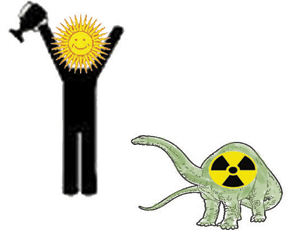 Nuclear vs Solar: The Race For Renewable Dominance , Oil Price By Alex Kimani – Nov 11, 2020
“……….. the main sticking point to the promotion of thorium as a cleaner nuclear fuel is that it remains unproven on a commercial scale. Thorium MSRs (Molten Salt Reactors) have been in development since the 1960s by the United States, China, Russia, and France, yet nothing much ever came of them. Further, only about 50 of the world’s 440 reactors can currently be configured to run on thorium.
…… Unfortunately, practical nuclear fusion remains a long-shot and could be decades away from becoming a commercial reality.
We simply don’t have the luxury of time.
Further, nuclear power in the U.S. faces an uncertain future. ……………
Solar rising
Whereas the nuclear sector comeback has its work cut out for it, solar power has clearly been on the ascendancy thanks in large part to falling costs.
Nuclear advocates have pointed to rising electricity costs in California as the reason why other states should think twice before adopting its model. Environmental Progress has reported that between 2011 and 2018, power costs in the Golden State increased by 27.9% compared to a 4% national average. This period coincided with a period when California has been aggressively ramping up its renewable generation capacity. Renewable sources currently account for ~30% of California’s electricity generation with an aim to double that by 2030 and hit 100% by 2045.
But that’s being a bit disingenuous because it fails to capture just how much solar costs have fallen over the timeframe.
According to the Solar Energy Industries Association (SEIA), solar installation costs have dropped by more than 70% over the past decade, opening up vast new markets and systems nationwide. The organization says prices as of Q2 2020 dropped to their lowest levels in history across all market segments, with utility-scale prices ranging from $16/MWh – $35/MWh, thus making it competitive with all other forms of generation. Meanwhile, costs for the average-sized residential system were cut in half from a pre-incentive price of $40,000 in 2010 to roughly $20,000 today.
And no, renewables are not to blame for California’s blackouts.
……………..Strongly Bullish
Despite these challenges, the solar sector remains strongly bullish.
Indeed, S&P Platts says that the shift to renewable energy is likely to continue full steam ahead regardless of fed policies noting that the energy transition has “clearly been moving forward on a regional basis,” despite lacking clear endorsement at the federal level under Trump.
It remains to be seen whether nuclear energy can command the same level of support. https://oilprice.com/Alternative-Energy/Nuclear-Power/Nuclear-vs-Solar-The-Race-For-Renewable-Dominance.html
Grid flexibility a better choice than nuclear – could save UK $millions

Christina Macpherson’s websites & blogs
When even a right wing news medium like Forbes start questioning the ”wisdom” of nuclear development , that industry must be getting worried.
Ditch Nuclear And Save $860 Million With Grid Flexibility, U.K. Told, Forbes, David Vetter Senior Contributor, 30 Nov 2,
The U.K. could save money, reduce the risk of blackouts and more quickly achieve its carbon-cutting goals by abandoning plans to build more nuclear power facilities and instead invest in a flexible electricity grid, new analysis has found.
According to the report from Finnish energy tech firm Wärtsilä, the U.K. would stand to save $860 million per year if, instead of new nuclear power, the government backed grid flexibility measures, such as battery storage and thermal generation. That equates to a saving of about $33 dollars per British household per year. Crucially, the analysis revealed that even if energy generation was to remain the same as it is today, Britain could increase renewables’ share of that generation to 62% simply by adding more flexibility (renewables currently account for around 47% of electricity used, according to the government).
The Wärtsilä report is timely because, in a ten-point plan released earlier this month, prime minister Boris Johnson promised an additional $684 million for the nuclear sector, and the building of new large and small nuclear power stations. Notably, grid flexibility was not mentioned in the plan.
The report also raises questions about the necessity of the 3.2 gigawatt Hinkley Point C nuclear power station, under development in Somerset, southwest England, which has been dogged by controversy and delays since its inception. In addition to coming with all the usual challenges associated with nuclear fission—not least the storage of radioactive waste—the project is at least $3.6 billion over budget and has been the target of numerous lawsuits and both local and international complaints.
Speaking to Forbes.com, Ville Rimali, growth and development director at Wärtsilä Energy, explained why his firm determined that grid flexibility is a preferable alternative to nuclear, as Britain looks for a pathway to achieve net zero carbon emissions by 2050.
“Flexibility unlocks more renewable energy by balancing the intermittency of wind and solar power to ensure the power supply always matches demand,” Rimali said. “For example, when more power is generated than needed, you can store the surplus in batteries to be used later. The alternative is paying renewables to switch off, which is expensive and inefficient.”
“It’s a bit like running a bath where the volume of water and the size of the plug keep changing,” he explained. “The smaller the bathtub, the more likely the water is to overflow or run out. Flexibility is like having a bigger bathtub—you can pour more water in, without the risk of running out or overflowing.” ………
investing in nuclear power could, according to Wärtsilä, entrench an inflexible grid while making renewables such as solar and wind less cost-effective.
“New nuclear sites will rely heavily on government subsidies, negatively impact market prices and ultimately weaken the business case for renewables and flexibility,” Rimali said……… https://www.forbes.com/sites/davidrvetter/2020/11/30/ditch-nuclear-and-save-860-million-with-grid-flexibility-uk-told/?sh=2733622b1975
The global energy revolution

RethinkX 25th Nov 2020, We are on the cusp of the fastest, deepest, most profound disruption of the energy sector in over a century. Like most disruptions, this one is being driven by the convergence of several key technologies whose costs and capabilities have been improving on consistent and predictable trajectories – namely, solar photovoltaic power, wind power, and lithium-ion battery energy storage.
Our analysis shows that 100% clean electricity from the combination of solar, wind, and batteries (SWB) is both physically possible and economically affordable across the entire continental United States as well as the overwhelming majority of other populated regions of the world by 2030.
Adoption of SWB is growing exponentially worldwide and disruption is now inevitable because by 2030 they will offer the cheapest electricity option for most regions. Coal, gas, and nuclear power assets will become stranded during the 2020s, and no new investment in these technologies is rational from this point forward.
Ontario could get clean renewable energy from neighbouring provinces, with no need for nuclear power
 With nuclear power plants approaching end of life, what’s next in Ontario? Barrie Today, Peter Bursztyn 25 Nov 20, ‘Two decades is just enough time for major new electricity generation projects to go through the planning and permitting process, get built, and come on line,’ says reader With nuclear power plants approaching end of life, what’s next in Ontario? Barrie Today, Peter Bursztyn 25 Nov 20, ‘Two decades is just enough time for major new electricity generation projects to go through the planning and permitting process, get built, and come on line,’ says reader
……. When Hydro Quebec’s grand James Bay hydroelectricity project was built, many of the dams were constructed with space to accept more turbine units than are now installed.
In other words, these dams spill a great deal of water which could instead flow through a turbine to generate power. Taken as a whole, James Bay is one of the world’s largest power generation projects. Its capacity is 15,527 megawatts, the equivalent of 16 nuclear power plants. In 1971, when the project began, the Canadian government tried to persuade Quebec to choose nuclear power instead. With hindsight, Quebec was wise to choose hydroelectricity. Ontario, which did not have similar hydroelectric resources, built Unfortunately, we found nuclear to be a costly method of producing electricity; expensive enough that much of the debt incurred to build Ontario’s nuclear “fleet” still remains on the province’s books a half-century on. We never managed to pay it off……. our fleet of nuclear power plants is coming to the end of its design life. Over the coming two decades, most of our nuclear fleet will begin to wink out. We know that we cannot replace them with new nuclear units; they are simply too costly. The last Liberal government called for tenders to build nuclear plants, but insisted the bidders had to be responsible for cost over-runs. As a result, two of the three potential builders dropped out. The third offered to build, but refused to accept responsibility for cost escalation. The nuclear plan was quietly dropped……….. Ontario cannot generate enough renewable, carbon-free electricity to replace our current nuclear output within our own borders. (It is worth saying that nuclear power is not renewable.) Fortunately, our neighbouring provinces — Manitoba and Quebec — have the potential to generate considerably more than they currently use. Many of Quebec’s already completed dams have space in their turbine halls for more units. Quebec could “drop in” about 13,000 MW of generation. This is roughly equal to Ontario’s nuclear capacity, and not all of our nuclear units are running at any one time. Quebec has also surveyed other potential hydroelectric sites, both to the south and to the north of the James Bay project. More hydroelectric power could be exploited in northeast Quebec. Our western neighbour, Manitoba, has a number of sites with hydroelectric generation potential on the Nelson River near major existing power stations. There is also untapped potential hydroelectric power available to the southeast of Lake Winnipeg, even closer to Ontario. ………. Although the wind doesn’t blow continuously, expanding wind generation would reduce the amount of electricity Alberta needs to purchase from B.C. Since hydro power can be ramped up very rapidly, it would also reduce or even eliminate the need for gas-fired generation to meet demand peaks. Of course, the same applies to Ontario. We are a country blessed with a great deal of hydroelectric potential. Inexpensive, carbon-free electricity generation is within our grasp. All it needs is vision and leadership. https://www.barrietoday.com/letters-to-the-editor/letter-with-nuclear-power-plants-approaching-end-of-life-whats-next-in-ontario-2902273 |
|
UK could save £660m through to 2030 by scrapping Sizewell nuclear plan, switcing to flexible eneegy technologies
 Edie 23rd Nov 2020, If the UK government were to back renewable generation and flexible energy technologies like battery storage instead of a new nuclear plant, some £660m could be saved through to 2030, a new analysis has concluded. Edie 23rd Nov 2020, If the UK government were to back renewable generation and flexible energy technologies like battery storage instead of a new nuclear plant, some £660m could be saved through to 2030, a new analysis has concluded.The publication of the paper, by Wärtsilä Energy, comes shortly after the UK Government confirmed plans to back small nuclear projects with more than £525m of funding over the next year. A proportion is expected to go to Rolls-Royce. In the same week, EDF confirmed plans to move the Hinkley B nuclear plant into decommissioning by the end of 2022.
By Wärtsilä Energy’s calculations, the UK could invest in adding 7GW of flexible energy capacity through utility-scale battery storage, advanced flexible gas plants and technologies like vehicle-to-grid (V2G) by 2030, if it scrapped plans for Sizewell C nuclear power station. This would enable the UK to reach 62% clean power in the energy mix, mitigating two million tonnes of CO2e emissions annually from 2030.
…..green groups including Greenpeace have argued that the risk of radioactive waste releases and weapons proliferation should not be ignored and that the Government would be better off investing in green hydrogen and geothermal power.
|
1 This Month

of the week – Shut Down Drone Warfare!


Tell the Ukrainian Government to Drop Prosecution of Peace Activist Yurii Sheliazhenko

Petition to revoke the licensing of the Near Surface Nuclear Disposal Facility (NSDF) at Chalk River. https://www.ourcommons.ca/petitions/en/Petition/Details?Petition=e-7247
To see nuclear-related stories in greater depth and intensity – go to https://nuclearinformation.wordpress.com
-
Archives
- April 2026 (68)
- March 2026 (251)
- February 2026 (268)
- January 2026 (308)
- December 2025 (358)
- November 2025 (359)
- October 2025 (376)
- September 2025 (257)
- August 2025 (319)
- July 2025 (230)
- June 2025 (348)
- May 2025 (261)
-
Categories
- 1
- 1 NUCLEAR ISSUES
- business and costs
- climate change
- culture and arts
- ENERGY
- environment
- health
- history
- indigenous issues
- Legal
- marketing of nuclear
- media
- opposition to nuclear
- PERSONAL STORIES
- politics
- politics international
- Religion and ethics
- safety
- secrets,lies and civil liberties
- spinbuster
- technology
- Uranium
- wastes
- weapons and war
- Women
- 2 WORLD
- ACTION
- AFRICA
- Atrocities
- AUSTRALIA
- Christina's notes
- Christina's themes
- culture and arts
- Events
- Fuk 2022
- Fuk 2023
- Fukushima 2017
- Fukushima 2018
- fukushima 2019
- Fukushima 2020
- Fukushima 2021
- general
- global warming
- Humour (God we need it)
- Nuclear
- RARE EARTHS
- Reference
- resources – print
- Resources -audiovicual
- Weekly Newsletter
- World
- World Nuclear
- YouTube
-
RSS
Entries RSS
Comments RSS
 nuclear-news