Finance for renewable energy
The lessons learned from scaling up wind and solar technologies from an
expensive niche option to arguably the cheapest option for new electricity
generation can act as a framework for the continued growth of the energy
transition and its expansion to emerging economies. This is the conclusion
from a new report published this week by the International Renewable Energy
Agency (IRENA) launched in partnership with the Indian G20 Presidency
entitled “Low-Cost Energy Transition Finance”. The report focuses on
the need for low-cost finance to support the development of newer renewable
energy technologies such as green hydrogen, energy storage, and offshore
wind in both emerging market economies and advanced economies.
Renew Economy 17th May 2023
Germany’s Nuclear Energy Phase-Out, Explained

NIRS, May 8, 2023
On April 15, 2023 utilities in Germany shut down the country’s three
last remaining nuclear power plants. These closures mark the successful
planned phase-out of German nuclear energy from the nation’s grid. What does this mean for Germany? What lessons should the U.S. take away from the
German energy transition?
Germany’s Energiewende (“energytransition”) is an overarching policy commitment to achieve a low-carbon, nuclear-free economy and transition to renewable energy. While the recently completed phase-out of nuclear power is a major milestone for Germany’s energy transition, it was by no means a perfect process nor is the current
energy system in Germany a perfect example to follow.
But, Germany’s transition shows that an energy policy grounded in environmental values works – and the earlier climate policy is implemented, the sooner the
climate policy goals can be realized. Above all, the German energy
transition shows the tremendous power of active citizenry, organized social
movements, and activism to transform policy and successfully demand change.
more https://www.nirs.org/germanys-nuclear-energy-phase-out-explained/
Bristol solar farm connects directly to the grid.
A solar farm near Bristol has become the UK’s first to connect directly to
the national grid, opening a way to unblocking bottlenecks in renewable
energy schemes.
To date, the hundreds of solar farms and 1.2 million homes
with rooftop solar panels have been connected to the electricity grid’s
equivalent of A-roads, called distribution networks. However, the 50MW
Larks Green solar farm, capable of powering 17,000 homes, has instead been
connected to the transmission network, the motorways of the electricity
system.
Solar power is the cheapest electricity technology in many
countries and the fastest-growing electricity source globally. Solar
industry figures said that years-long delays were normal to enable projects
to start producing clean electricity. Some developers are routinely being
told they will have to wait until the 2030s, and in one case a company was
told it would have to wait until 2037. Ministers recently promised to
introduce reforms to speed up connections, but are yet to provide details.
On Thursday a cross-party group of MPs wrote to the government telling it
to work with energy networks, including National Grid ESO, to “unblock
the pipeline of delays”. “There is potential for solar energy to have a
bright future in the UK, but a dark cloud of delays for the industry
hinders the ability to meet its full potential,” said Philip Dunne,
chairman of the environmental audit committee.
Times 4th May 2023
https://www.thetimes.co.uk/article/first-solar-farm-connects-directly-to-national-grid-6nx7qjx5s
Chart of the day: Germany produces 40GW of solar for first time
Germany has passed through the 40GW mark for solar production for the first
time. The new benchmark was reached at 12.30pm local time on May 4. It
shows that solar output was more than six times bigger than any other
source at the time, and accounted for nearly two thirds of the total
64.6GW, of which around 1.3GW was being exported to other countries. Brown
coal generation was the second biggest at that time, followed by biomass
and onshore wind.
Renew Economy 5th May 2023
Great Lakes wind power – now is the time
Investing in Great Lakes wind power can help Ontario obtain 100% of its new
electricity supply from renewables.
Clean Air Alliance 17th April 2023
EDF Q1 revenues rise but nuclear output declines
PARIS, April 28 (Reuters) more https://www.reuters.com/business/energy/edf-says-q1-revenues-rise-nuclear-output-down-2023-04-28/ Reporting by Benjamin Mallet, editing by Silvia Aloisi – French nuclear power giant EDF (EDF.PA) said first-quarter like-for-like sales rose by 34.6% to 47.8 billion euros ($52.64 billion) thanks to higher electricity and gas prices, though it reported a fall in nuclear output due to reactor outages and strikes in France.
Reporting by Benjamin Mallet, editing by Silvia Aloisi
“This decrease is explained by a lower nuclear fleet availability, mainly due to outages for the controls and repairs on the pipes affected by the stress corrosion phenomenon, and to the impacts of social movements,” EDF said in a statement.
The group, which is in the process of being fully nationalised, confirmed its estimate of nuclear output in France for 2023 in a range of 300-330TWh.
Nuclear production fell to a 34-year low last year due to a record number of reactor outages at EDF, turning France into a net importer of electricity for the first time since 1980.
Russia’s political and economic winner – its nuclear exports to Western countries
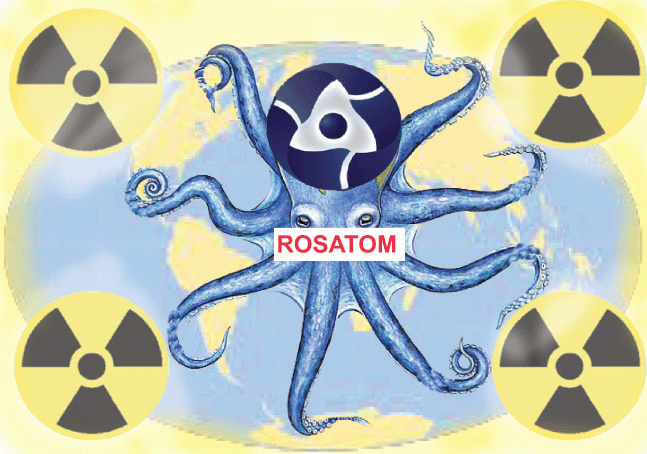
West scrambles as Putin reveals his energy war trump card. Kremlin has
spread its tentacles through the US and Europe – and countries are
struggling to fight back. In an effort to punish Vladimir Putin, western
governments have hit Russia’s energy industry with a barrage of punishing
sanctions since his invasion of Ukraine.
But one sector has conspicuously
escaped their ire so far: nuclear power. Since the conflict erupted,
Russian nuclear exports are actually thought to have increased while those
of coal, oil and gas have been squeezed.
Meanwhile, despite the key role it
has played in Moscow’s takeover of the Zaporizhzhia nuclear power plant
in Enerhodar, eastern Ukraine, state monopoly Rosatom remains untouched by
western sanctions.
The reason, say experts, is the complicated nature of
nuclear supply chains – from the supply of uranium to the construction of
reactors – and the dominant role Russia currently plays in many of them.
Through its global nuclear network, Moscow can exert political and economic
pressure on friends and foes alike, the White House has warned. A new
partnership between the UK, the US, Canada, Japan and France aims to change
this. Together the five countries want to squeeze Russia’s share of
nuclear exports and “ensure Putin, nor anyone like him, can ever think
they can hold the world to ransom over their energy again,” said Grant
Shapps, the Energy Security Secretary. The group aims to become independent
from Moscow and help other countries do the same, the agreement says.
Telegraph 24th April 2023
Renewable Energy Is Charging Ahead.

Renewable energy has seen considerable
growth in recent years, but there is a long way to go to achieve a clean
energy future that averts the worst effects of the climate crisis. The
window is quickly closing on our ability to meet the goal of the 2015 Paris
climate agreement: keeping global temperature rise well below two degrees
Celsius by the end of the century.
The latest report from the
Intergovernmental Panel on Climate Change (IPCC) stressed that the world
needs fast and deep emissions cuts to meet that goal and eventually reach
net zero emissions by 2050. Switching to renewable forms of power
generation, such as solar, wind and hydropower, will be a key component of
that effort. “The target is very ambitious,” says Heymi Bahar, a senior
energy analyst at the International Energy Agency.
And every year that goes
by without major climate action, “we are basically losing the carbon
[budget] that is left, and we need to go faster in a more expansive way. In
that sense, most of the job, according to our models, needs to be done in
the coming seven years,” Bahar says.
Globally, renewables account for
about one third of electricity generation—and that share is rising. In
2022 renewable generation capacity grew by a record 295 gigawatts,
according to the International Renewable Energy Agency (IRENA). Further,
renewables accounted for more than 80 percent of all added power capacity
last year, the agency reported. Last year renewables produced more
electricity than coal-powered plants for the first time in the U.S. Wind
and solar now produce about 14 percent of the country’s electricity, up
from virtually nothing just 25 years ago. The U.S. Energy Information
Administration expects that more than half of electric generation capacity
added to the nation’s grid in 2023 will be from solar energy.
The main reason renewable energy has grown so much in recent years is a dramatic
decline in the expense of generating solar and wind power. The cost of
solar photovoltaic cells has dropped a stunning 90 percent over the past
decade, partly because of ramped-up manufacturing—particularly in
China—Bahar says. Government subsidies in countries such as the U.S. also
helped renewables grow in the early years, as did policies making
commitments to renewable adoption, says Inês Azevedo, an associate
professor in the department of energy science and engineering at Stanford
University.* For example, many U.S. states set standards for how much of
their electricity needs should be met with renewable energy by a particular
year.
Scientific American 21st April 2023
https://www.scientificamerican.com/article/renewable-energy-is-charging-ahead/
Earth Day 2023: A Newly Post-Nuclear Germany vs. California’s Reactor Relapse
Germany’s initiative calls out California’s backpedaling.
BY HARVEY WASSERMAN , APRIL 22, 2023
This year’s Earth Day marks a massive green energy triumph in Germany that stands in stark contrast to a bitter nuclear challenge in California.
A wide range of estimates put the two regions at a virtual tie for the world’s fourth and fifth-largest economies.
They also share a leading growth industry—renewable energy, with unprecedented investments in wind, solar, batteries, and efficiency.
But when it comes to atomic power, they are headed in very different directions.
On April 15, Germany claimed a huge global landmark by becoming one of the world’s wealthiest nations to renounce atomic power.
The decision dates back to 2011, when Germany’s powerful Green movement led a national demonstration aiming to shut the seventeen atomic reactors that, at the time, provided around a quarter of the nation’s electricity.
Before the rally took place, four reactors blew up in Fukushima, Japan, sending huge clouds of radioactive fallout into the air and ocean.
Germany’s then-Chancellor Angela Merkel—who has a Ph.D. in quantum chemistry—ordered eight reactors immediately shut, and soon announced a plan to shut the remaining nine by December 31, 2022.
This energiewende, or “energy transition,” substitutes wind, solar, battery storage, and increased efficiency for nuclear power reactors, moving Germany toward full reliance on renewables. Germany, since then, has invested billions in the renewables sector, transitioning whole towns to locally-owned rooftop solar and corporate wind power pumped in from large turbines in the North Sea.
The shutdown of the final three reactors was delayed by nearly four months due to natural gas shortages caused by the Russian war in Ukraine.
It was also complicated by a major atomic breakdown in neighboring France. Heavily reliant on nuclear power, France’s more than fifty standard-design reactors succumbed to a wide range of problems, including generic structural flaws and warming rivers too hot to cool their super-heated radioactive cores. In 2022, with more than half its fleet of reactors under repair, France made up for the energy shortfall by importing power from Germany, much of it fired by the burning of coal.
This prompted the nuclear industry to criticize Germany’s plan by pointing to a rise in the country’s CO2 emissions from burning increased quantities of coal, failing to note that much of that power was being exported to France to compensate for its own shuttered reactors.
California, whose economy may now be slightly larger than Germany’s, has taken an opposite route.
Two of its last four reactors—at San Onofre, between Los Angeles and San Diego—were shuttered in 2012 and closed permanently in 2013 after flaws were found in the turbines and other components.
In 2016, a deal was reached to shut the Golden State’s last two reactors, located at Diablo Canyon, nine miles west of San Luis Obispo. In the 1970s and 1980s, thousands of protestors were arrested at Diablo Canyon, more than at any other American nuclear plant.
The 2016 shutdown deal involved another energiewende, based on blueprints to replace Diablo’s power with a huge influx of new wind, solar, battery, and efficiency installations. The agreement was approved by the California state legislature, Pacific Gas & Electric (PG&E), the federal Nuclear Regulatory Commission (NRC) and the state Public Utilities Commission. It was signed by then-Governor Jerry Brown, then-Lieutenant-Governor Gavin Newsom, and a wide range of local governments, unions, and environmental groups, all of whom assumed the state would thus be nuke-free once Unit Two was shut in 2025—the date its original forty-year license would expire.
But along the way, the state experienced two close calls with partial blackouts. During both incidents, Newsom, now the governor, asked consumers to dial back their energy use. Ironically, independent battery capacity—mostly controlled by individual owners—helped the state stay lit.
But Newsom reversed course and now argues that California must keep Diablo open. Infuriating the national safe energy movement, Newsom rammed through the legislature a $1.4 billion midnight bailout for PG&E, to be funded by all of the state’s consumers, including many who live hundreds of miles from the plant, and receive no energy from it at all.
The Biden Administration also kicked in $1.1 billion, money that safe energy advocates angrily argue would be far better spent on renewables.
In 2019 a statewide petition signed by Hollywood’s Jane Fonda, Martin Sheen, Lily Tomlin, Eric Roberts, and some 2,500 other Californians demanded that Newsom facilitate an independent inspection. Nearing forty years of age, both Diablo reactors suffer a wide range of structural and age-related defects.
They are also surrounded by at least a dozen known earthquake faults, sitting just forty-five miles from the infamous San Andreas fault. Former NRC site inspector Michael Peck, who was stationed at Diablo for five years, has warned it might not survive a major earthquake, for which its owner, PG&E, has little or no private insurance. The state has never made public any plans to evacuate Los Angeles or other heavily populated areas in the event of an accident.
Newsom has also supported moves by state regulators to severely slash compensation paid by utilities to solar panel owners who feed their excess energy into the grid. While 1,500 workers are stationed at Diablo, some 70,000 work in the state’s solar industry, which angrily charges that Newsom’s pro-nuclear, anti-green positions are crippling the state’s top job creator.
Indeed, the irony of these twin economies heading in opposite energy directions is hard to ignore. In the 1970s, much of America’s early anti-nuclear movement was inspired by mass demonstrations led by German Greens (with the slogan “Atomkraft? Nein, danke!”). Both movements succeeded in massively moving their communities toward a renewable future.
But at this critical moment, Germany appears to be moving beyond nuclear power, while California clings to a hugely controversial technology it had once planned to transcend.
16% of France’s power supply blocked amid protest – as nuclear reactor maintenance disrupted
16% of France’s power supply blocked amid protest – as nuclear reactor
maintenance disrupted. Around 16% of the country’s total power production
was disrupted, according to data from grid operator RTE, as thousands
continue to protest against President Macron’s pension reforms.
Sky News 11th April 2023
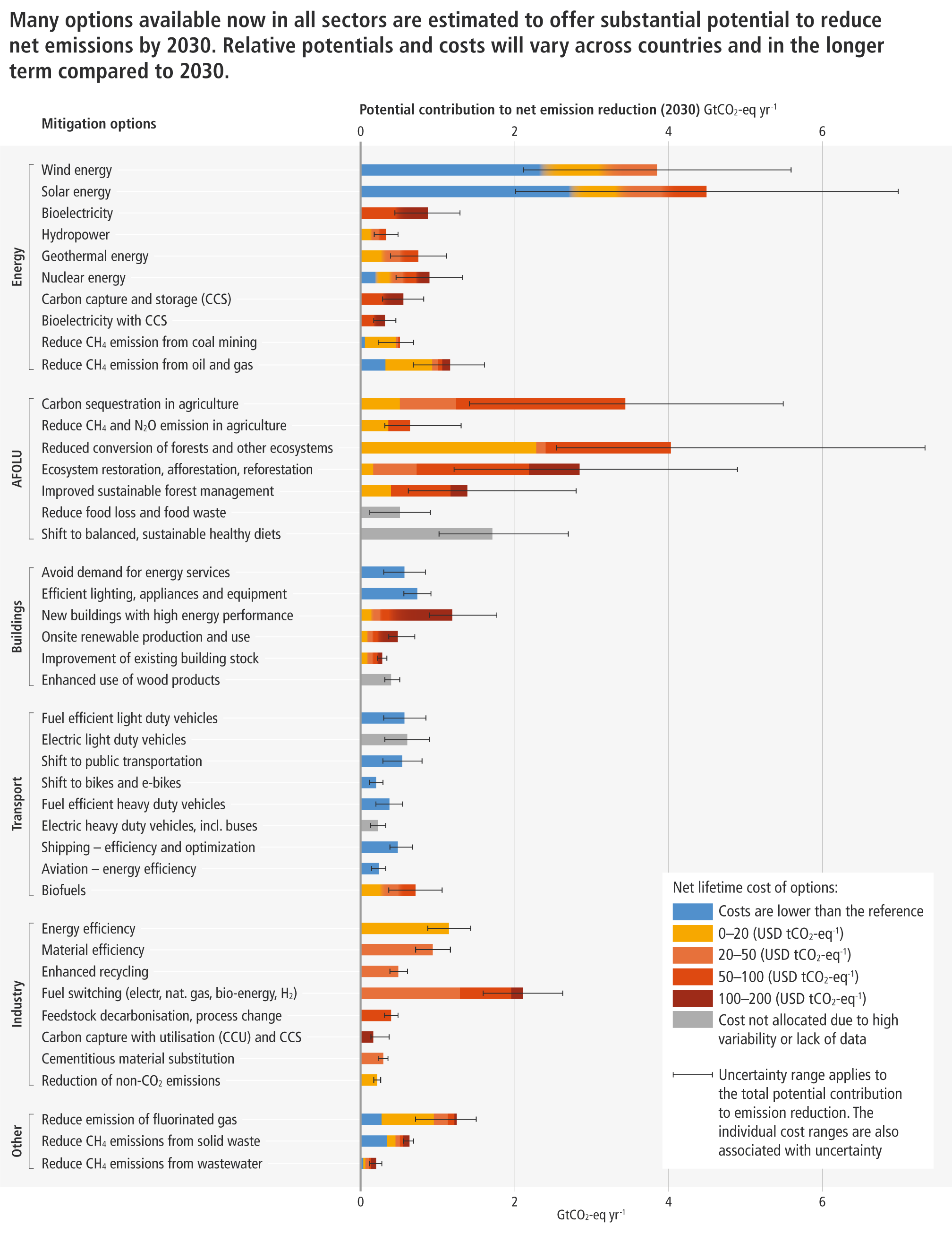
IPCC report shows the winners in energy transition – wind and solar, and the losers – nuclear power and carbon capture.
Guardian Down to Earth newsletter. Tucked away in the recent (and
devastating) landmark report from the Intergovernmental Panel on Climate
Change (IPCC) is a chart that provides the road map for an escape from
catastrophe.
It assesses with extraordinary clarity the potential for
emissions cuts of more than 40 options. You can view it here. The
simplicity of the chart is deceptive. It was compiled by a team of the
world’s best scientists, based on 175 studies. Its power is amplified by
the fact that it was signed off by all of the world’s governments, from
the cleanest and greenest to the darkest petrostates.
So what does it show?
First, solar and wind power are by far the best option, with the potential
to cut a staggering 8bn tonnes from annual CO2 emissions by 2030. That is
equivalent to the combined emissions of the US and European Union today.
Even more startling is that most of that potential can be achieved at lower
cost than just continuing with today’s electricity systems.
Just as important as the winners in this analysis are the losers. Nuclear power and
carbon capture and storage (CCS) each have just 10% of the potential of
wind and solar, and at far higher cost. The same applies to bioenergy –
burning wood or crops for electricity. It’s no wonder that the UK’s
energy strategy, published last week, received significant criticism: it
goes heavy on nuclear and CCS, while ignoring onshore wind.
IPCC (accessed) 7th April 2023
Renewable energy overtakes nuclear power as the EU’s largest source of primary energy production.
Renewables were the main source of European energy production in 2021,
according to the statistical office of the EU. A Eurostat report suggests
renewable energy has overtaken nuclear power as the largest source of
primary energy production in the European Union. Data shows that in 2021,
renewables made up nearly 41% of the EU’s total energy production, with
solid fuels, natural gas, crude oil and other sources accounting for the
rest.
Energy Live News 4th April 2023
China on track to triple its terawatt-scale wind and solar target.
The research arm of American banking giant Goldman Sachs has concluded
that China is currently on track to generate almost three times more power
from wind turbines and solar panels than the government has targeted.
According to a report published by Goldman Sachs in late March, combined
capacity from China’s solar and wind energy sector will reach 3.3
terawatts (TW) by 2030. This far outstrips the Chinese government’s
current target of 1.2TWh. The conclusion from the report is that, with such
an accelerated pace for wind and solar deployment, China could become
energy self-sufficient by 2060.
Renew Economy 5th April 2023
Renewable generation surpassed coal and nuclear in the U.S. electric power sector in 2022
Last year, the U.S. electric power sector produced 4,090 million megawatthours (MWh) of electric power. In 2022, generation from renewable sources—wind, solar, hydro, biomass, and geothermal—surpassed coal-fired generation in the electric power sector for the first time. Renewable generation surpassed nuclear generation for the first time in 2021 and continued to provide more electricity than nuclear generation last year………………………………………….. more https://www.eia.gov/todayinenergy/detail.php?id=55960
Taiwan phasing out nuclear power
Taiwan is buying more LNG for delivery over the next year as it closed a
nuclear reactor and is set to phase out nuclear power generation by 2025.
Taiwan’s CPC Corp bought via a tender this week at least 10 cargoes of
LNG to be delivered between May this year and March next year, traders
familiar with the deals told Bloomberg on Friday. The LNG purchases are
also part of Taiwan’s strategy to procure more gas to offset the decline
in nuclear power generation, according to the traders.
This week, Unit 2 of
Taiwan’s Kuosheng nuclear power plant was taken offline and will be
decommissioned following the expiry of its 40-year operating license. There
are now two remaining nuclear reactors operating in Taiwan at the Maanshan
nuclear power plant. Those reactors are expected to be shut down in 2024
and 2025.
Oil Price 17th March 2023
https://oilprice.com/Energy/Natural-Gas/Taiwan-Looks-To-Replace-Nuclear-Power-With-LNG.html
1 This Month

of the week – Shut Down Drone Warfare!


Tell the Ukrainian Government to Drop Prosecution of Peace Activist Yurii Sheliazhenko

Petition to revoke the licensing of the Near Surface Nuclear Disposal Facility (NSDF) at Chalk River. https://www.ourcommons.ca/petitions/en/Petition/Details?Petition=e-7247
To see nuclear-related stories in greater depth and intensity – go to https://nuclearinformation.wordpress.com
-
Archives
- March 2026 (251)
- February 2026 (268)
- January 2026 (308)
- December 2025 (358)
- November 2025 (359)
- October 2025 (376)
- September 2025 (257)
- August 2025 (319)
- July 2025 (230)
- June 2025 (348)
- May 2025 (261)
- April 2025 (305)
-
Categories
- 1
- 1 NUCLEAR ISSUES
- business and costs
- climate change
- culture and arts
- ENERGY
- environment
- health
- history
- indigenous issues
- Legal
- marketing of nuclear
- media
- opposition to nuclear
- PERSONAL STORIES
- politics
- politics international
- Religion and ethics
- safety
- secrets,lies and civil liberties
- spinbuster
- technology
- Uranium
- wastes
- weapons and war
- Women
- 2 WORLD
- ACTION
- AFRICA
- Atrocities
- AUSTRALIA
- Christina's notes
- Christina's themes
- culture and arts
- Events
- Fuk 2022
- Fuk 2023
- Fukushima 2017
- Fukushima 2018
- fukushima 2019
- Fukushima 2020
- Fukushima 2021
- general
- global warming
- Humour (God we need it)
- Nuclear
- RARE EARTHS
- Reference
- resources – print
- Resources -audiovicual
- Weekly Newsletter
- World
- World Nuclear
- YouTube
-
RSS
Entries RSS
Comments RSS
 nuclear-news