Blade hub idea for old n-plant site
A NEW wind turbine recycling site at Chapelcross could bring up to 80 jobs to the area
A cross party group of local MSPs recently wrote to the Scottish
Government to make the case for land at the former nuclear site becoming
the site of a planned specialist blade facility for the decommissioning,
and recycling, of old wind turbine blades.
Colin Smyth, Oliver Mundell,
Emma Harper and Finlay Carson all signed the letter which was sent to
Cabinet Secretary Neil Gray MSP. And Mr Smyth also raised the issue in a
Scottish Parliament debate last week on the green economy, when he
criticised the fact that although Dumfries and Galloway had more windfarms
per head of population than anywhere else in Scotland, few of the jobs from
the renewable industry were based in the region.
In September, Scotland’s
wind energy industry signed the Onshore Wind Sector Agreement with the
Scottish Government. It commits the industry, the Scottish Government and
its agencies to delivering a recycling hub in Scotland to support supply
chains to reuse and refurbish parts from windfarms. Speaking in the
debating chamber, Mr Smyth said: “Using the former nuclear power station
would be a visible example of a just transition in action, and it would fit
in with the Government’s commitment to the Borderlands inclusive growth
deal, with its pledge to make Chapelcross a focal point for clean energy.
DNG24 3rd Feb 2024
Microsoft Looks to Nuclear to Fuel AI Plans, (with help from nuclear front group Terra Praxis)

Microsoft goes nuclear to deal with energy influx due to the meteoritic rise of its AI platforms.
tech.co by Abby Ward, January 25, 2024,
Microsoft is looking to fuel its future AI plans with nuclear, according to a recent moves by the company.
AI notoriously requires huge amounts of energy on a daily basis, and with more and more of us using it, and companies investing heavily in the technology, the scramble for power is ramping up.
With Microsoft throwing its weight (and money) behind AI, including huge investments in OpenAI, it seems nuclear power could be the key to its success………………………………
Due to the explosive arrival of AI, consuming a whopping four times more power than cloud servers, Microsoft appears to be preparing for this increased demand to power their data centers as they continue to accelerate their growth plans in the AI arena.
Among other signs that Microsoft will be looking to nuclear power to plan for the shortfall in energy is the appointment of a Director of Nuclear Development Acceleration last week.
Data Center Energy Shortfall
Data centers, the things that physically store and share applications and data, require an enormous amount of energy to run……………………
To put the size of the problem into perspective, McKinsey wrote that a hyperscaler’s data center can use as much power as 80,000 households do.
In the same article, McKinsey forecasted that the power needed to facilitate US data centers are set to jump from 17 gigawatts (GW) in 2022 to 35 GW by 2030………………………………………

A recent collaboration between Microsoft and Terra Praxis, a non-profit advocating for repurposing old coal plants into SMR facilities, further underlines the company’s nuclear ambitions. According to reports from Data Center Dynamics, together, they developed a generative AI model to streamline the lengthy and costly nuclear regulatory process, showcasing Microsoft’s commitment to making nuclear power a viable option for its data centers…………………………………..
Microsoft’s foray into nuclear power is bound to raise eyebrows and concerns about safety and waste disposal will need to be addressed in due course………………………………
https://tech.co/news/microsoft-nuclear-fuel-a
Nuclear goes backwards, again, as wind and solar enjoy another year of record growth.

Jim Green 21 January 2024, https://reneweconomy.com.au/nuclear-goes-backwards-again-as-wind-and-solar-enjoy-another-year-of-record-growth/
The nuclear renaissance of the late-2000s was a bust due to the Fukushima disaster and catastrophic cost overruns with reactor projects. The latest renaissance is heading the same way, i.e. nowhere. Nuclear power went backwards last year.
There were five reactor start-ups and five permanent closures in 2023 with a net loss of 1.7 gigawatts (GW) of capacity. There were just six reactor construction starts in 2023, five of them in China.
Due to the ageing of the reactor fleet, the International Atomic Energy Agency (IAEA) anticipates the closure of 10 reactors (10 GW) per year from 2018 to 2050.
Thus the industry needs an annual average of 10 reactor construction starts, and 10 reactor startups (grid connections), just to maintain its current output. Over the past decade (2014-23), construction starts have averaged 6.1 and reactor startups have averaged 6.7.
The number of operable power reactors is 407 to 413 depending on the definition of operability, well down from the 2002 peak of 438.
Nuclear power’s share of global electricity generation has fallen to 9.2 percent, its lowest share in four decades and little more than half of its peak of 17.5 percent in 1996.
Over the two decades 2004-2023, there were 102 power reactor startups and 104 closures worldwide: 49 startups in China with no closures; and a net decline of 51 reactors in the rest of the world.
In China, there were five reactor construction starts in 2023 and just one reactor startup. Put another way, there was just one reactor construction start outside China in 2023. So much for the hype about a new nuclear renaissance.
Small modular reactors and ‘advanced’ nuclear power
Small modular reactors (SMRs) are the subject of endless hype but there were no SMR construction starts or startups last year. The biggest SMR news in 2023 was NuScale Power’s decision to abandon its flagship project in Idaho despite securing astronomical subsidies amounting to around US$4 billion (A$6.1 billion) from the US government.
The pro-nuclear Breakthrough Institute noted in a November 2023 article that efforts to commercialise a new generation of ‘advanced’ nuclear reactors “are simply not on track” and it warned nuclear advocates not to “whistle past this graveyard”:
It wrote:
“The NuScale announcement follows several other setbacks for advanced reactors. Last month, X-Energy, another promising SMR company, announced that it was canceling plans to go public. This week, it was forced to lay off about 100 staff.
“In early 2022, Oklo’s first license application was summarily rejected by the Nuclear Regulatory Commission before the agency had even commenced a technical review of Oklo’s Aurora reactor.
The nuclear renaissance of the late-2000s was a bust due to the Fukushima disaster and catastrophic cost overruns with reactor projects. The latest renaissance is heading the same way, i.e. nowhere. Nuclear power went backwards last year.
There were five reactor start-ups and five permanent closures in 2023 with a net loss of 1.7 gigawatts (GW) of capacity. There were just six reactor construction starts in 2023, five of them in China.
Due to the ageing of the reactor fleet, the International Atomic Energy Agency (IAEA) anticipates the closure of 10 reactors (10 GW) per year from 2018 to 2050.
Thus the industry needs an annual average of 10 reactor construction starts, and 10 reactor startups (grid connections), just to maintain its current output. Over the past decade (2014-23), construction starts have averaged 6.1 and reactor startups have averaged 6.7.
The number of operable power reactors is 407 to 413 depending on the definition of operability, well down from the 2002 peak of 438.
Nuclear power’s share of global electricity generation has fallen to 9.2 percent, its lowest share in four decades and little more than half of its peak of 17.5 percent in 1996.
Over the two decades 2004-2023, there were 102 power reactor startups and 104 closures worldwide: 49 startups in China with no closures; and a net decline of 51 reactors in the rest of the world.
In China, there were five reactor construction starts in 2023 and just one reactor startup. Put another way, there was just one reactor construction start outside China in 2023. So much for the hype about a new nuclear renaissance.
Nuclear decline vs. record renewables growth
The International Energy Agency (IEA) has just released its ‘Renewables 2023’ report and it makes for a striking contrast with the nuclear industry’s malaise.
Nuclear power suffered a net loss of 1.7 GW capacity in 2023, whereas renewable capacity additions amounted to a record 507 GW, almost 50 percent higher than 2022. This is the 22nd year in a row that renewable capacity additions set a new record, the IEA states. Solar PV alone accounted for three-quarters of renewable capacity additions worldwide in 2023.
Nuclear power accounts for a declining share of share of global electricity generation (currently 9.2 percent) whereas renewables have grown to 30.2 percent. The IEA expects renewables to reach 42 percent by 2028 thanks to a projected 3,700 GW of new capacity over the next five years in the IEA’s ‘main case’.
The IEA states that the world is on course to add more renewable capacity in the next five years than has been installed since the first commercial renewable energy power plant was built more than 100 years ago.
Solar and wind combined have already surpassed nuclear power generation and the IEA notes that over the next five years, several other milestones will likely be achieved:
— In 2025, renewables surpass coal-fired electricity generation to become the largest source of electricity generation
— In 2025, wind surpasses nuclear electricity generation
— In 2026, solar PV surpasses nuclear electricity generation
— In 2028, renewable energy sources account for over 42 percent of global electricity generation, with the share of wind and solar PV doubling to 25 percent
Tripling renewables
The IEA states in its ‘Renewables 2023’ report that:
“Prior to the COP28 climate change conference in Dubai, the International Energy Agency (IEA) urged governments to support five pillars for action by 2030, among them the goal of tripling global renewable power capacity. Several of the IEA priorities were reflected in the Global Stocktake text agreed by the 198 governments at COP28, including the goals of tripling renewables and doubling the annual rate of energy efficiency improvements every year to 2030. Tripling global renewable capacity in the power sector from 2022 levels by 2030 would take it above 11 000 GW, in line with IEA’s Net Zero Emissions by 2050 (NZE) Scenario.
“Under existing policies and market conditions, global renewable capacity is forecast to reach 7300 GW by 2028. This growth trajectory would see global capacity increase to 2.5 times its current level by 2030, falling short of the tripling goal.”
In the IEA’s ‘accelerated case’, 4,500 GW of new renewable capacity will be added over the next five years (compared to 3,700 GW in the ‘main case’), nearing the tripling goal.
Tripling nuclear?
The goal of tripling renewables by 2030 is a stretch but it is not impossible. Conversely, the ‘pledge’ signed by just 22 nations at COP28 to triple nuclear power by 2050 appears absurd.
The Labor federal government signed Australia up to the renewables pledge but not the nuclear pledge. The Coalition wants to do the opposite, and also opposes the Labor government’s target of 82 per cent renewable power supply by 2030.
One of the lies being peddled by the Coalition is that nuclear power capacity could increase by 80 percent over the next 30 years. That is based on a ‘high case’ scenario from the IAEA. However the IAEA’s ‘low case’ scenario — ignored by the Coalition — is for another 30 years of stagnation.
So should we go with the IAEA’s high or low scenarios, or split the difference perhaps?
According to a report by the IAEA itself, the Agency’s ‘high’ forecasts have consistently proven to be ridiculous and even its ‘low’ forecasts are too high — by 13 percent on average.
Nuclear power won’t increase by 80 percent by 2050 and it certainly won’t triple; indeed it will struggle to maintain current output given the ageing of the reactor fleet and recent experience with construction projects.
Comparing nuclear and renewables in China
China’s nuclear program added only 1.2 GW capacity in 2023 while wind and solar combined added 278 GW. Michael Barnard noted in CleanTechnica that allowing for capacity factors, the nuclear additions amount to about 7 terrawatt-hours (TWh) of new low carbon generation per year, while wind and solar between them will contribute about 427 TWh annually, over 60 times more than nuclear.
Barnard commented:
“One of the things that western nuclear proponents claim is that governments have over-regulated nuclear compared to wind and solar, and China’s regulatory regime for nuclear is clearly not the USA’s or the UK’s. They claim that fears of radiation have created massive and unfair headwinds, and China has a very different balancing act on public health and public health perceptions than the west. They claim that environmentalists have stopped nuclear development in the west, and while there are vastly more protests in China than most westerners realize, governmental strategic programs are much less susceptible to public hostility.
“And finally, western nuclear proponents complain that NIMBYs block nuclear expansion, and public sentiment and NIMBYism is much less powerful in China with its Confucian, much more top down governance system.
“China’s central government has a 30 year track record of building massive infrastructure programs, so it’s not like it is missing any skills there. China has a nuclear weapons program, so the alignment of commercial nuclear generation with military strategic aims is in hand too. China has a strong willingness to finance strategic infrastructure with long-running state debt, so there are no headwinds there either.
“Yet China can’t scale its nuclear program at all. It peaked in 2018 with 7 reactors with a capacity of 8.2 GW. For the five years since then then it’s been averaging 2.3 GW of new nuclear capacity, and last year only added 1.2 GW …”
Dr. Jim Green is the national nuclear campaigner with Friends of the Earth Australia and a member of the Nuclear Consulting Group.
Fuel problems for nuclear power, as the industry continues to languish in the doldrums

Slow and expensive. Yet despite the drive to reduce carbon emissions, nuclear has been languishing in the doldrums. The adoption of small HALEU reactors has, if anything, slowed. The first company with approval, NuScale, cancelled a power plant for Utah in November after costs surged. ‘Costs have kept growing for small modular reactors,’ says Bunn. Solar, wind and natural gas are really, really cheap right now. That’s nuclear’s biggest problem – it’s expensive.’
renewables are outmuscling nuclear. ‘Renewables provided something like 90% of all new electricity capacity [in 2023]
the risk sea level rises and storm surges pose to nuclear power plants at coastal sites. ‘The most recent Intergovernmental Panel on Climate Change report [2023] stated that renewables were ten times better than nuclear at CO2 mitigation,’
Nuclear power expansion plans highlight fuel bottlenecks, BY ANTHONY KING 17 JANUARY 2024, https://www.chemistryworld.com/news/nuclear-power-expansion-plans-highlight-fuel-bottlenecks/4018795.article
Nuclear energy shuffled into the spotlight in December with a declaration at the COP28 climate meeting to triple its capacity by 2050. The declaration lauded the role of nuclear energy in achieving global net-zero greenhouse gas emissions by 2050.
Yet many industry watchers doubt this ambition can be achieved. ‘If I was a betting man, I would give ten-to-one odds against this happening,’ says Matthew Bunn, a professor of energy and foreign policy at Harvard University, US. Not enough new reactors are being built.
Meanwhile, the supply of fuel for nuclear reactors is complicated by a reliance on Russia at various points in the supply chain and often a lack of profit for commercial companies involved, which compete against state-backed enterprises in Russia and China.
Read more: Fuel problems for nuclear power, as the industry continues to languish in the doldrumsUranium is not the main constraint on the supply of nuclear fuel. ‘There’s plenty of uranium in the world,’ says Bunn. Everyone knows how many nuclear reactors are operating, and how much uranium they need. ‘So you would expect prices to be pretty darn stable,’ he explains. ‘That expectation would be wrong.’
Price surge
The price of uranium rose sharply towards $90 (£70) per pound in the second half of 2023, having hovered around $20/lb in 2017, and risen to over $40/lb after the Russian invasion of Ukraine in 2022. The main drivers ‘are rising demand coupled with a lack of sufficient supply response,’ says Jonathan Hinze, president of UxC, a market research firm for the nuclear industry.
Kazakhstan is the world’s largest miner of uranium, with around 40% of total production. While some additional mines are expected there, ‘we really need to see more new mines in places like Canada, Australia and Africa,’ says Hinze.
Mining is only the start. The supply chain runs from a mine through three more steps; each is a market onto itself. Uranium is mined and milled into uranium oxide (U3O8), then shipped to facilities for conversion into uranium hexafluoride gas (UF6), in preparation for enrichment.
Mined uranium is 99.2% U-238 and just 0.7% U-235. Enrichment plants use thousands of centrifuges to enrich U-235 to about 5%, as needed in a typical power plant. But enrichment brings in geopolitics. ‘Unfortunately, concentrating it to 3-5% for a commercial reactor uses exactly the same technology as concentrating it to 90% for a nuclear bomb, and it is an exponentially accelerating process,’ says Bunn.
After enrichment, UF6 is converted to uranium dioxide (UO2) and fabricated into fuel pellets and rods, designed for specific reactor types. The format required depends on who built the reactor, whether it’s a French, US, Chinese or Russia design. A pressurized water reactor generating 1GW of electricity, for example, might contain over 50,000 fuel rods with over 18 million pellets.
Conversion constraints
Kazakhstan is a behemoth in mining, with 13 active mines producing almost 19,500 metric tonnes in 2020. Australia produced 6200 tonnes, Namibia 5400 tonnes and Canada 3800 tonnes. But the Kazakhs rely on Russia for processing uranium into UF6, with Russia holding almost 40% of global conversion market, ahead of China and Canada, with France some way behind.
‘Conversion is extremely constrained at the moment given recent plant outages and other operational challenges,’ according to Hinze. ‘The move by the West and other markets to reduce or eliminate reliance on Russia means that other producers must ramp up capacities to make up for the loss of Russian supplies.’
Unsurprisingly, Russia also holds a significant share of the enrichment stage, with 46% market share in 2018. The state company Tenex supplied 30% of enrichment services to EU utilities in 2019, according to a recent report from the Center on Global Energy Policy at Columbia University in New York, US.
‘Russia is fairly important in the conversion market, but doesn’t have to be,’ says Bunn. There is under-used conversion capacity in several other countries. ‘[But] Russia is hugely important in the enrichment market.’ Enrichment is tougher to change, and is partly a legacy of the Cold War, when Russia ran huge facilities for its civil and military nuclear industry.
Even the US imports enriched uranium from Russia, which started with a programme dubbed ‘megatons to megawatts’ that saw large amounts of highly enriched weapons-grade uranium converted into fuel for US power plants. This ran from 1993 to 2013 and is viewed as one of the world’s most successful non-proliferation endeavours.
The US government privatised its enrichment facilities, creating the United States Enrichment Enterprise in 1992, reborn as Centrus in 2014 following bankruptcy. Meanwhile, Soviet uranium processing facilities continued operating. ‘They had these huge enrichment plants with not much to do, so they offered low prices and got a lot of business,’ says Bunn. ‘Because Russian enrichment was cheap, we all got dependent on Russia.’
Rosatom (Russia) is the biggest enrichment services provider, followed by Urenco (UK, Netherlands, Germany and US) and Orano (France). ‘Urenco, for example, did not expand its capacity, because there was no profit incentive,’ says Bunn. ‘The market was oversupplied with enriched uranium.’
Changes are afoot. In October 2023, Orano said it plans to increase its enrichment capacity in the south of France by nearly 30%, to reduce the dependence of its customers on Russian supplies.
Chinese demand
China, however, has built up substantial conversion and enrichment capacity, exceeding its civilian needs. ‘The Chinese have been expanding their capacity like gangbusters because these are state-owned companies. They don’t have to worry about the profit situation,’ says Bunn. ‘They worry about cut-offs of foreign supply and being self-reliant.’
Some of this enriched uranium will be used to produce weapons, some may be exported. For uranium, China has adopted a three-market strategy: investing in domestic uranium mines, buying mines overseas to send uranium back to China, and buying supplies on international markets.
Between 2010 and 2020, China built 36 new nuclear reactors, according to the International Atomic Energy Agency. The building of nuclear power plants in China has slowed more recently, says Bunn: ‘They’ve built a heck load of electricity plants and have more electricity than they need.’ Another drag is that new plants can attract public opposition and the Chinese authorities take protests into account when evaluating the performance of local government officials, Bunn adds.
While Western powers discuss moving away from an overreliance on Russia for conversion and enrichment, they are loath to swap for dependence on China. ‘The world outside of Russia and China is quickly moving away from supplies from these nations,’ says Hinze. ‘However, these moves mean that costs of nuclear fuel are rising and supply chains are becoming tighter.’
Russian reactor reliance
Russia has also been also a major exporter of reactors in recent decades. There are Russian reactors operating in Russia, Ukraine, Hungary, Czechia and Slovakia and elsewhere. More are being built, for example in Turkey, Hungary, Bangladesh and Slovakia. ‘Russia even offers build and operate contracts, where they will come and build you a reactor without you paying a penny,’ says Bunn. ‘They’ll operate the reactor and make the money back on electricity sales over the decades.’ Russia will also take back spent fuel. It’s state company, Rosatom, has large projects with Iran, South Africa and Egypt, among others.
This can render countries reliant on Russia for the operation and/or maintenance of their reactors. And, since each type of plant requires specific fuel assemblies, Russian-designed reactors traditionally use Russian-made fuel. ‘Russia is going to be a big player in nuclear markets for a long time in the future,’ Bunn predicts.
A recent analysis examined Russia’s nuclear energy diplomacy in the context of the war in Ukraine. Since Rosatom is fully owned by the Russian state, it can be used to exert political pressure and project power globally. ‘For most Western-aligned states, it will be inconceivable to enter into any type of new dependence or even non-dependent cooperation with Russia in the nuclear energy sector,’ the authors note.
Nonetheless, alternatives are emerging. In September 2023, US nuclear services provider Westinghouse delivered the first fuel assemblies for Russian-designed reactors in Ukraine from a fabrication facility in Sweden. Ukraine praised the move as the end of the Russian monopoly in this section of the nuclear fuel market.
‘The key question now is how fast Westinghouse can scale up, given that there’s a bunch of countries with Russian-designed plants,’ says Bunn. Others, too, are moving to support domestic fuel supply. Saparro 5 is a group of five nations (Canada, Japan, France, the UK, and the US) that aims to establish a resilient uranium supply market free from Russian influence ‘and the potential to be subject to political leverage by other countries’. It announced plans at COP28 to jointly invest at least $4.2 billion to boost enrichment and conversion capacity over the next three years.
Meanwhile, there are efforts in the US Congress to formally ban all Russian uranium imports by 2028. One sticking point of such efforts has been HALEU (high-assay low-enriched uranium), which is enriched with uranium-235 to between 5% and 20%. ‘Until the Russian invasion of Ukraine, Russia was the only place with a plant licensed to produce material above 5% enrichment,’ says Bunn. The UK’s Civil Nuclear Roadmap, announced on 11 January, promises up to £300 million of investment specifically to develop HALEU fuel production, ‘with the first plant aiming to be operational early in the next decade’.
Advanced reactors, including in the US, are being developed to run on such fuel. These reactors would be ‘smaller, more flexible and less expensive to build and operate,’ according to the US Department of Energy. In the US, Centrus Energy says it is pioneering HALEU to power existing and future reactors. Bunn says the company is well positioned now to seek additional subsidies from the US government to expand its enrichment capacity.
Slow and expensive
Yet despite the drive to reduce carbon emissions, nuclear has been languishing in the doldrums. The adoption of small HALEU reactors has, if anything, slowed. The first company with approval, NuScale, cancelled a power plant for Utah in November after costs surged. ‘Costs have kept growing for small modular reactors,’ says Bunn. Solar, wind and natural gas are really, really cheap right now. That’s nuclear’s biggest problem – it’s expensive.’
Others too say that renewables are outmuscling nuclear. ‘Renewables provided something like 90% of all new electricity capacity [in 2023], and that’s because of the very great difference in cost,’ says Paul Dorfman, chair of the nonprofit Nuclear Consulting Group and visiting fellow at the University of Sussex, UK. ‘And in the context of climate change, nuclear plants take too long.’ He cites UK government findings that it takes up to 17 years for a nuclear reactor to be readied for operation.
A 2021 report authored by Dorfman also warns of the risk sea level rises and storm surges pose to nuclear power plants at coastal sites. ‘The most recent Intergovernmental Panel on Climate Change report [2023] stated that renewables were ten times better than nuclear at CO2 mitigation,’ Dorfman adds. ‘It is clear renewables will do the heavy lifting and nuclear is marginal, if not problematic.’
In the decade before the Fukushima nuclear incident in Japan in March 2011, on average about 3GW of nuclear power generation was being added each year. To meet the COP28 target, factoring in how long it will take to build the plants, ‘we’d have to build on the order of 30-50GW every year from now to 2050,’ says Bunn. ‘That means convincing people that nuclear energy is ten times more attractive than it was before Fukushima. That’s a heavy lift.’
An Unprecedented Momentum for Renewables
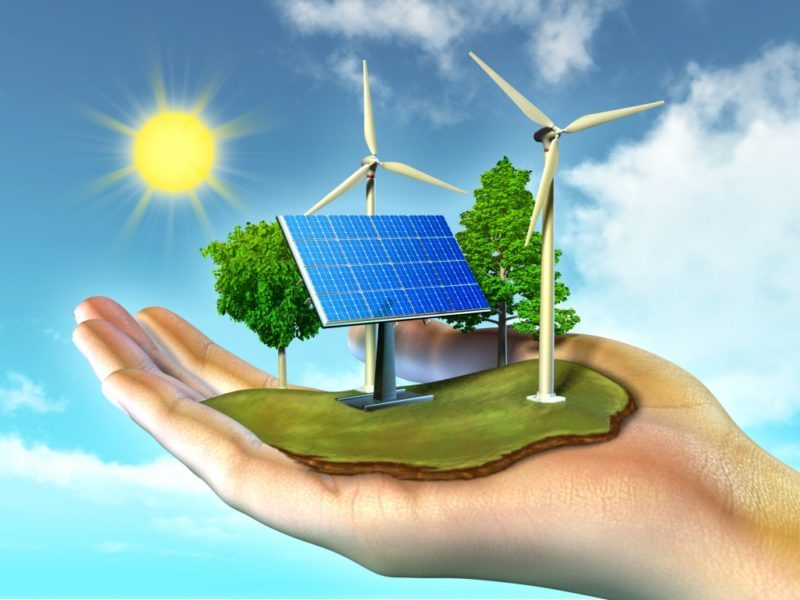
The success of renewables is not only a story of records and data on energy progress.
It is a story of a pivotal shift in the global energy priorities, culminating in the monumental acknowledgement by the governments around the world at COP28 that tripling renewables and doubling energy efficiency by 2030 is the most effective way to stay on the 1.5°C pathway.
This review of the latest achievements in renewable energy expansion shows that renewables remain resilient through multiple crises. The renewable-based energy transition offers a solution to the climate crisis and energy security concerns whilst delivering positive socio-economic impacts for communities and societies.
Still, are the current records enough to achieve the climate goals and a sustainable future for all?
IEA: Global renewable capacity grows over 50% YoY in 2023
George Heynes, Current News, 12 Jan 24
The International Energy Agency (IEA) has released a new report revealing that 50% more renewable capacity was added globally in 2023 than in 2022, but financing remains an issue.
As the globe hurtles towards impending net zero targets – and with the recently signed pledge by 118 countries to triple renewables by 2030 at the recent COP28 summit in Dubai – the recent release of the IEA’s Renewables 2023 report will be welcome. But the publication does include some key challenges that must be addressed to bolster net zero efforts.
Crucially, the standout figure from this year’s document is that global annual renewable capacity additions increased to 510GW in 2023. This represents the fastest growth rate that has been witnessed in the past two decades.
Now this should serve as huge praise to all throughout the global renewable value chain who have worked tirelessly to bolster the energy transition and maintain the Paris Agreement’s legislation to keep global warming increase well below 2°C with a target to limit it to 1.5°C.
Turning our attention to GB, the nation has seen its renewable capacity bolstered significantly over the past year and saw various wind generation records broken. The result saw low-carbon energy sources contribute 51% of the electricity used by Britain with fossil fuels having made up 33% of GBs electricity mix across 2023. Carbon Brief attributed the decline of fossil fuels to two factors: renewables increasing sixfold (by 113TWh) from 2008, and reduced electricity demand, which decreased by 21% (83TWh) since 2008.
Of the renewable energy sources added, solar PV accounted for three-quarters of additions worldwide with China being where the largest growth occurred. For readers wanting to learn more about solar across 2023, our sister site PV-Tech provided its own analysis to the IEA report.
China also saw huge growth in its wind sector with additions having risen by 66% year-on-year. This staggering total has seen the nation become the largest developer of wind in the world, something that could come as a blow to the UK with its offshore wind pipeline having dropped below China over the course of 2023……………………………………..
The need to support emerging and developing economies
Another crucial aspect of the IEA report is its view into the global race to net zero. As referenced by the organisation, G20 countries account for almost 90% of global renewable power capacity today meaning that much must be done to support emerging and developing economies and countries as they transition away fossil fuels……………………..
An eye to the future
The IEA referenced various major milestones that could be achieved by 2028. Firstly, should the current trajectory continue at its rate, the globe could well bring online more renewable capacity between 2023 and 2028 than has been installed since the first commercial renewable power plant was built more than 100 years ago.
Indeed, this showcases the opportunity and collective movement to ensure net zero targets are met. However, this may not be enough. As mentioned previously, more time and resources must be allocated to support developing countries in their own net zero journeys to ensure that the Paris Agreement targets are met and maintained.
Other key milestones include:
- In 2024, wind and solar PV together generate more electricity than hydropower.
- In 2025, renewables surpass coal to become the largest source of electricity generation.
- Wind and solar PV each surpass nuclear electricity generation in 2025 and 2026 respectively.
- In 2028, renewable energy sources account for over 42% of global electricity generation, with the share of wind and solar PV doubling to 25%.
With the push to bolster renewable generation capacity expected to ramp up further into the decade, it will be interesting to see how the UK government manages its expectations and is able to take a global leadership role in the fight for net zero. https://www.current-news.co.uk/iea-global-renewable-capacity-grows-over-50-yoy-in-2023/
Nuclear Continues To Lag Far Behind Renewables In China Deployments
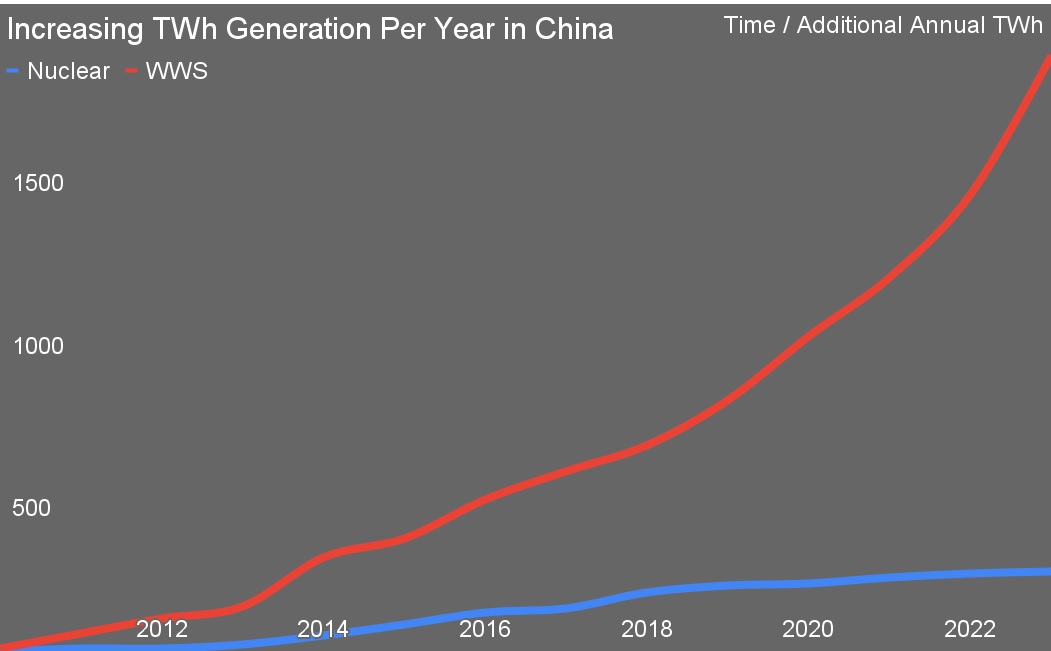
China can’t scale its nuclear program at all. It peaked in 2018 with 7 reactors with a capacity of 8.2 GW. For the five years since then then it’s been averaging 2.3 GW of new nuclear capacity, and last year only added 1.2 GW between a new GW scale reactor and a 200 MW small modular nuclear reactor.
Michael Barnard 13 Jan 24, https://cleantechnica.com/2024/01/12/nuclear-continues-to-lag-far-behind-renewables-in-china-deployments/
Since 2014 I’ve been tracking the natural experiment in China regarding the ability to scale nuclear generation vs renewables. My hypothesis was that the modularity and manufacturability of wind and solar especially meant that it would be much easier for them to scale up to massive sizes.
That hypothesis was strongly confirmed when I first published the results in 2019, and again in 2021 and 2022 when I updated them. In what is becoming a dog bites man annual article, here are the 2023 results. Once again, China’s nuclear program barely added any capacity, only 1.2 GW, while wind and solar between them added about 278 GW. Even with the capacity factor difference, the nuclear additions only mean about 7 TWh of new low carbon generation per year, while wind and solar between them will contributed about 427 TWh annually, over 60 times as much low carbon electricity.
As a note, there were no new hydroelectric dams commissioned in China, so that continued acceleration of deployment is solely due to wind and solar. That’s going to change when the absurdly massive Tibetan Yarlung Tsangpo river dam is commissioned, likely in the mid 2030s. That dam will generate three times the energy annually as the Three Gorges Dam, making it by far the biggest dam in the world by every measure.
A few points. First, what’s a natural experiment? It’s something which is occurring outside of a laboratory or research setting in the real world that coincidentally controls for a bunch of variables so that you can make a useful comparison. An often referenced example was of a specific region where half was without electricity for a few months. Researchers posited that the blackout region would have seen more pregnancies starting in that period, and sure enough, that’s what they found.
So why is China a natural experiment for scalability of wind and solar? Well, it controls for a bunch of variables. Both programs were national strategic energy programs run top down. I started the comparison in 2010 because the nuclear program had been running for about 15 years by then and the renewables program for five years, so both were mature enough to have worked out the growing pains.
One of the things that western nuclear proponents claim is that governments have over-regulated nuclear compared to wind and solar, and China’s regulatory regime for nuclear is clearly not the USA’s or the UK’s. They claim that fears of radiation have created massive and unfair headwinds, and China has a very different balancing act on public health and public health perceptions than the west. They claim that environmentalists have stopped nuclear development in the west, and while there are vastly more protests in China than most westerners realize, governmental strategic programs are much less susceptible to public hostility. And finally, western nuclear proponents complain that NIMBYs block nuclear expansion, and public sentiment and NIMBYism is much less powerful in China with its Confucian, much more top down governance system.
China’s central government has a 30 year track record of building massive infrastructure programs, so it’s not like it is missing any skills there. China has a nuclear weapons program, so the alignment of commercial nuclear generation with military strategic aims is in hand too. China has a strong willingness to finance strategic infrastructure with long-running state debt, so there are no headwinds there either.
Yet China can’t scale its nuclear program at all. It peaked in 2018 with 7 reactors with a capacity of 8.2 GW. For the five years since then then it’s been averaging 2.3 GW of new nuclear capacity, and last year only added 1.2 GW between a new GW scale reactor and a 200 MW small modular nuclear reactor.
So what’s going on? As I noted late in 2023, nuclear energy and free market capitalism aren’t compatible, but China isn’t capitalist, according to a lot of westerners. But it very definitely is a market and export capitalist economy, albeit with more state intervention and ownership, and the nuclear program is suffering as a result. That lone small modular reactor is a clear signal of that.
Unplanned nuclear power outages are reducing UK’s electricity output
Unplanned outages at Hartlepool nuclear power plant’s two 620-MW reactors
are set to last until Feb. 4 and Feb. 6, UK operator EDF Energy said in
transparency notes Jan. 8. Production at the County Durham site in
northeast England had ceased Jan. 6 “for maintenance activities”, EDF
Energy said. No further details were available.
The outage at Hartlepool
compounds UK nuclear problems in the new year after an unplanned outage at
Heysham nuclear plant Dec. 29 took another 585-MW reactor out of service.
Failure of a steam valve at reactor 1 at Heysham 1 saw reactor 2 taken
offline for inspections. Reactor 1 is due back Jan. 24, EDF data showed.
An inspection of similar valves at reactor 2 at Heysham 1, meanwhile, is
expected to keep the unit offline until Jan. 16. Meanwhile, reactor 7 at
Heysham 2 has been offline since early December for planned refueling, due
back Jan. 27, with only reactor 8 (624 MW) currently online at the
Lancashire site on the northwest coast of England.
S&P Global 8th Jan 2024
Utility scale solar farms contribute to bird diversity
New research has shown that solar parks can play a positive role in promoting bird diversity in the agricultural landscape of Central Europe. The scientists said solar farms offer food availability and nesting sites.
JANUARY 9, 2024 LIOR KAHANA, PV Magazine
A European group of researchers has conducted a study on the impact of solar parks on birds in a Central European agricultural landscape. They surveyed 32 solar park plots and 32 adjacent control plots in Slovakia during a single breeding season.
“We selected ground-mounted photovoltaic power plants with an area of at least 2 hectares,” the researchers explained. “All of the studied solar parks had fixed-tilt solar racks, one of which also had panels mounted on biaxial trackers, and were developed at least eight years earlier. Seventeen solar parks were developed on arable land, and 15 parks were developed on grassland.”…………………………………………………………………..
According to the research group, bird species richness, diversity, and invertebrate-eater species richness and abundance were higher in the solar parks than in the control plots. Among the reasons provided by the research group is the food availability for insectivorous birds, as the PV panels attract various species of water-seeking aquatic insects.
“As food availability and accessibility is low in winter, it can be assumed that solar parks can have a positive impact on farmland birds outside the breeding season, as they can serve as stopover, foraging and roosting sites during migration and wintering as the ground under the solar panels can remain snow-free in winter,” the academics explained……………………………..
They presented their analysis in the study “Solar parks can enhance bird diversity in the agricultural landscape,” published in the Journal of Environmental Management. The research was a collaborative work of scientists from Slovakia’s Slovak Academy of Sciences, Gemer-Malohont Museum, Comenius University in Bratislava, Catholic University in Ružomberok, Slovak Ornithological Society/BirdLife Slovakia, and Belgium’s University of Antwerp. https://www.pv-magazine.com/2024/01/09/utility-scale-solar-farms-contribute-to-bird-diversity/
Reducing energy demand- technologies are available, scalable and affordable today

Economic growth relies in part on affordable and reliable energy. Demand
for energy is set to rise by up to a third between now and 2050 to support
a global economy that will be twice as large and a population of 2bn more
people. This surge in population and productivity will be most concentrated
in emerging markets, which makes the energy transition even more
challenging.
We have to change the very nature of our energy system, from a
predominantly fossil fuel-based economy to one based on low-carbon energy
sources. Crucially, we must do so while ensuring energy remains affordable
and secure for all.
The conversation has concentrated on the supply-side.
Governments and energy companies are rightly focusing on how to increase
the supply of low-carbon energy sources and boost transmission
infrastructure. Despite this, we are nowhere near reaching our climate
goals. And there is another side of this debate that has received far less
attention.
Energy supply is critical, but what about energy demand? Demand
is something everybody — individuals, businesses and governments alike
— can take action on. By reducing the intensity of our energy demand (by
one definition, the energy used per unit of gross domestic product
generated) we can do more with less.
But we are not doing nearly enough on
this front. The International Energy Agency estimates that the world needs
to improve energy intensity by more than 4 per cent a year between 2020 and
2030, and almost 3 per cent annually thereafter, to reach net zero by 2050.
Last year, we only managed 1.3 per cent.
First, we need to find ways to save energy.
For instance, artificial intelligence innovations in heating,
ventilation and air conditioning of offices could achieve a 25 per cent
drop in consumption. Second, we need to focus on energy efficiency: using
less energy to perform the same task or produce the same product. For
instance, retrofitting buildings can reduce energy consumption by 45 per
cent. Finally, we have to find value chain collaborations. That means
different businesses along the value chain working together to drive change
in the wider energy system. Recovering heat from industrial plants, for
example, could reduce energy consumption by around 25 per cent, as seen in
the use of waste heat from sulphuric acid production in Sweden. These
technologies are available, scalable and affordable today.
FT 7th Jan 2024
https://www.ft.com/content/bc2ba5ae-ac4c-4ea8-b7b2-160c5b8aaaa1
‘The potential is extraordinary’: Business action on energy efficiency could save $2tr a year, new research claims

Business Green Michael Holder, 08 January 2024
World Economic Forum and PwC report sets out host of energy efficiency actions it claims are ‘doable today, at attractive returns with no need for new technology’
A suite of “doable today” business actions that would slash demand for energy could unlock annual savings of at least $2tr a year across the global economy, while helping to boost growth, save companies cash, unlock competitive advantages, and reduce greenhouse gas emissions.
That is the conclusion of major new research published today and backed by over 120 CEOs of global corporates, which sets out a host of near-term actions businesses can take to reduce energy demand across their buildings, infrastructure, and transport use.
Drawn up by consulting giant PwC in collaboration with the World Economic Forum (WEF), the research contends that if cost effective energy efficiency measures were taken by companies by the end of the current decade, and better supported by effective policy frameworks, it could unlock a major acceleration in the net zero transition.
The research, which comes ahead of next week’s annual global WEF meeting in Davos, Switzerland, argues “the potential of demand-side action is extraordinary”, and details a host of measures it claims are “doable today, at attractive returns with no need for new technology”.
Recommended measures include retrofitting buildings with insulation and other efficiency and green energy measures, electrifying transport systems, and harnessing artificial intelligence to optimise factory-line design to unlock efficiencies. The report also recommends deeper collaboration between businesses across value chains in order to unlock further efficiencies, as well as “industrial clustering” to share clean energy sources and maximise the benefits of efficiency initiatives.
The research argues energy efficiency measures remain an “under-addressed” component of the net zero transition, which can deliver substantial energy and emissions savings.
It claims proven measures could deliver a short-term, cost-efficient reduction in energy demand of almost a third – 31 per cent – shared across the buildings, industry, and transport sectors, and avoid the need to construct almost 3,000 extra power stations.
Moreover, these efforts would support the UAE Consensus agreed at COP28 in Dubai last month, which saw hundreds of nations commit to tripling renewable energy capacity and doubling the rate of energy efficiency improvements worldwide by 2030…………………………………………………………………………………..
today’s report warns that awareness among companies of the potential for energy efficiency to benefit their business, achieve cost savings, and support emissions reduction efforts remains low, as it called for more supportive government policy to help drive progress.
As many as 47 per cent of CEOs on the WEF’s International Business Council surveyed for the report cited a lack of supportive regulation as a barrier to effort to reduce energy demand.
Chair of the Council Ana Botín, who is group executive chair at Spanish banking giant Santander, said businesses had a “vital role to play” in slashing energy demand worldwide, and stressed that firms could do so without decreasing economic output.
“Reducing the amount of energy needed to manufacture products and deliver services is something we can act on now,” she said. “Although progress is being made, there is a lot more to be done, and the fact is that our energy demand continues to rise at unsustainable rates.
“It is crucial, therefore that we work together with governments and regulators across both developed and developing markets to help accelerate progress on this issue.” https://www.businessgreen.com/news/4161032/potential-extraordinary-business-action-energy-efficiency-save-usd2tr-research-claims
Germany’s coal power production drops to lowest level in 60 years in2023 after nuclear exit
Germany’s coal power production drops to lowest level in 60 years in
2023 after nuclear exit. Germany’s lignite power production fell to the
lowest level since 1963 last year, while hard coal power production even
dropped to the lowest level since 1955, an analysis by research institute
Fraunhofer ISE has found.
The country’s entire coal-fired power
production fell by almost one third (48 TWh), cutting coal’s share of
total net power generation to 26 per cent. Meanwhile, the country sourced
nearly 60 percent (59.7%) of its net power production from renewables,
which generated a total of 260 terawatt hours (TWh), an increase of 7.2
percent compared to 2022. With an increase of more than 17 TWh, output from
wind turbines grew particularly strong, according to the institute’s
annual energy review.
Renew Economy 4th Jan 2024
Nuclear weapons test treaty fears sink plans for major wind farm
UK Ministry of Defence objected to 315MW array over fears nuclear monitoring station would be affected by vibrations
5 January 2024 By Cosmo Sanderson , Recharge,
The UK’s obligations to monitor nuclear weapons testing have helped scupper a proposal for a Scottish wind farm over fears it could affect a nearby monitoring station.
The Scottish government rejected a proposal from British developer Community Windpower for a planned 315MW array made up of 45 turbines near the border with England last month.
The reasons for this included the potential impact of the wind farm on the nearby Eskdalemuir Seismic Array, a seismological monitoring station that forms part of the UK’s obligations under a multilateral treaty to ban nuclear weapons testing…………..(Subscribers only) more https://www.rechargenews.com/wind/nuclear-weapons-test-treaty-fears-sink-plans-for-major-wind-farm/2-1-1579329
More than half of eligible schools enlist in new solar scheme in Ireland
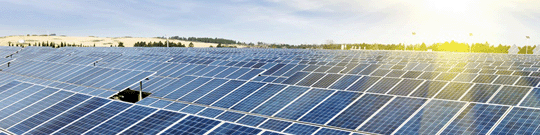
More than half of eligible schools enlist in new solar scheme in Ireland.
Ireland’s Department of Education says that just over 900 schools out of
1,600 eligible facilities have signed up to participate in the
government’s first round of the Solar for Schools Programme, a nationally
funded scheme to cover the costs of 6 kW roof-mounted solar installations.
Panels would be connected to the electricity grid, leading to €1,200
($1,310) to €1,600 per annum in savings, according to the government.
Schools from 11 districts could sign up in the first application round
which opened in mid-November and is expected to reach completion in May
this year.
PV Magazine 2nd Jan 2024
UK Nuclear Output Slumps to 42-Year Low
- More reactors are due to be decommissioned in a few years
- EDF has warned of delays to its new Hinkley Point plant
Bloomberg, By Rachel Morison, January 3, 2024
Power output from the UK’s nuclear power plants slumped to the lowest in more than four decades last year, potentially increasing a reliance on fossil fuels that will make it more difficult to reach the nation’s net zero emissions target.
Output shrank to about 37 terawatt-hours after two stations closed, dropping below 40 terawatt-hours for the first time since the early 1980s, according to data from the government and the UK unit of Electricite de France SA. …the country’s current fleet of five nuclear plants scheduled to shrink to just three by the end of 2026,…
The UK, which has a target to reach net zero emission by the middle of this century, wants to build as much as 24 gigawatts of new nuclear capacity by that time. The government is due to publish a roadmap on how it intends to achieve that ambitious target.
But construction takes many years and is often beset by cost overruns and delays. To reach the goal, developers would need to add 16 gigawatts in the next decade at a cost of more than £150 billion ($190 billion), according to estimates from Aurora Energy Research.
“With revenues materializing around a decade after the Final Investment Decision, this generally makes nuclear a very different investment case to banks compared to other low-carbon generation technologies, one which fewer lenders are willing to consider,” said Ashutosh Padelkar, senior associate at Aurora. “It would be extremely challenging if not impossible to deliver 24 gigawatts of nuclear capacity by 2050 without the government taking most of the burden.”…………
Most of the current atomic fleet is reaching the end of it’s operating life. EDF has spent about £7.5 billion on life extensions and maintenance since 2009, when it acquired the current fleet.
EDF’s Hinkley Point C is the first project to be constructed in more than three decades. Startup of its two reactors is due in 2027 and 2028, though the utility has warned that may be pushed back by more than a year. https://www.bloomberg.com/news/articles/2024-01-03/uk-nuclear-output-slumps-to-42-year-low-in-threat-to-net-zero?embedded-checkout=true
1 This Month
To see nuclear-related stories in greater depth and intensity – go to https://nuclearinformation.wordpress.com/
12 February – Webinar The Big Push: New Nuclear Projects in Canada
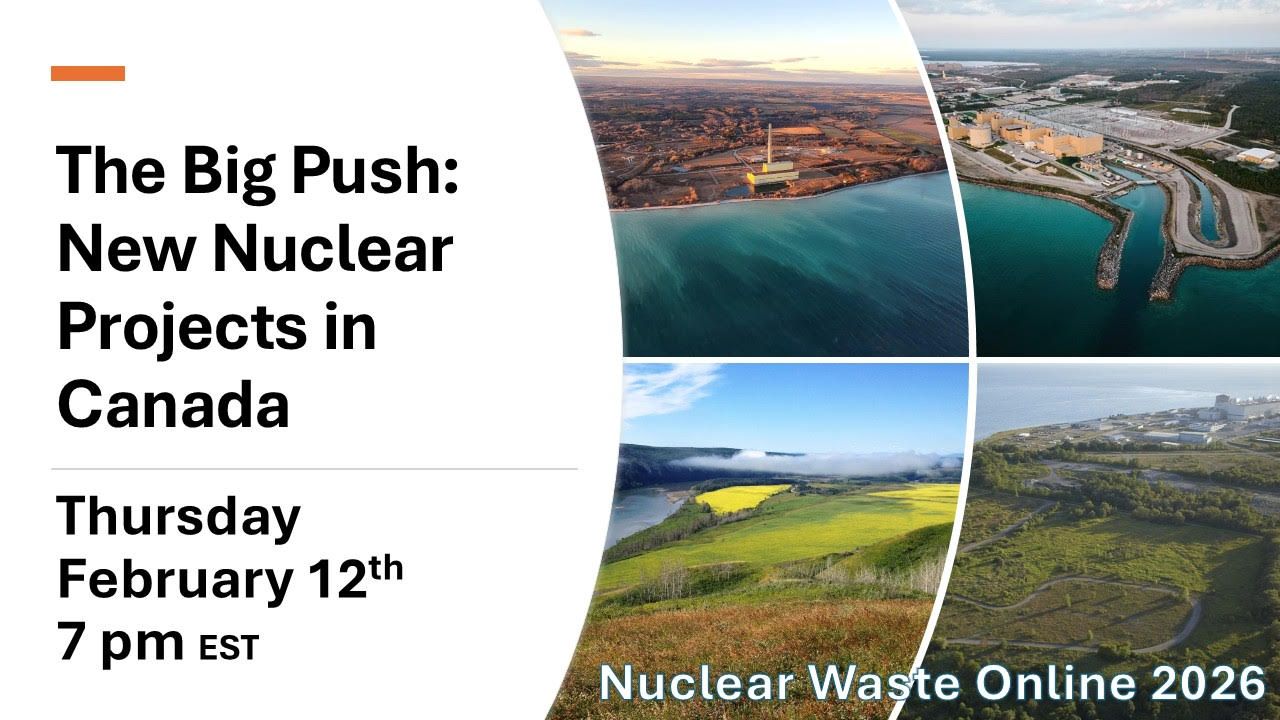
Thursday, February 12, 7 pm Eastern | 2nd of 4 sessions in the 2026 Nuclear Waste Online webinar series
Join a webinar on the push for new nuclear generation in Canada. Go to Northwatch.org to register or use the registration link https://us02web.zoom.us/webinar/register/WN_ZfWOf1GITqSRIZX8CB-A9w
-
Archives
- February 2026 (127)
- January 2026 (308)
- December 2025 (358)
- November 2025 (359)
- October 2025 (376)
- September 2025 (258)
- August 2025 (319)
- July 2025 (230)
- June 2025 (348)
- May 2025 (261)
- April 2025 (305)
- March 2025 (319)
-
Categories
- 1
- 1 NUCLEAR ISSUES
- business and costs
- climate change
- culture and arts
- ENERGY
- environment
- health
- history
- indigenous issues
- Legal
- marketing of nuclear
- media
- opposition to nuclear
- PERSONAL STORIES
- politics
- politics international
- Religion and ethics
- safety
- secrets,lies and civil liberties
- spinbuster
- technology
- Uranium
- wastes
- weapons and war
- Women
- 2 WORLD
- ACTION
- AFRICA
- Atrocities
- AUSTRALIA
- Christina's notes
- Christina's themes
- culture and arts
- Events
- Fuk 2022
- Fuk 2023
- Fukushima 2017
- Fukushima 2018
- fukushima 2019
- Fukushima 2020
- Fukushima 2021
- general
- global warming
- Humour (God we need it)
- Nuclear
- RARE EARTHS
- Reference
- resources – print
- Resources -audiovicual
- Weekly Newsletter
- World
- World Nuclear
- YouTube
-
RSS
Entries RSS
Comments RSS
 nuclear-news