South African renewable energy investment by Google
Google Is Investing in the Next Hotspot for Renewable Energy: South Africa By Todd Woody, Quartz | National Journal 30 May 13, There’s a place where a developer can propose, finance and build a big solar power project in a matter of months. That place is notCalifornia, Germany or China. It’s South Africa. And the country’s embrace of renewable energy has attracted investors like Google, which today said it is helping finance a 96 megawatt (MW)photovoltaic power plant in the Northern Cape province.
South Africa had “the highest growth in clean energy investment in the world last year,” Rick Needham, Google’s director of energy and sustainability, noted in a blog post about the Jasper Power Project. Google has put more than $1 billion into renewable energy, but this is only its second overseas venture. (The company put $5 million into a German photovoltaic power plant in 2011.) The search giant’s stake in Jasper is relatively small—103 million rand, or $12 million of the $260 million total cost—but the solar power station will be one of Africa’s largest, supplying enough electricity to power 30,000 homes.
Latest from Quartz: South Africa aims to install 20,000 MW of renewable energy over the next 15 years. That’s attracted SolarReserve, a California-based startup, which is developing the Jasper project as well as two other 75 MW photovoltaic power plants. …… http://news.yahoo.com/google-investing-next-hotspot-renewable-energy-south-africa-132603943.html
Good evidence for a high renewable energy future
power industry structure includes hefty and durable fossil fuel subsidies, which amount to $1.9 trillion per year or more, according to a report from the International Monetary Fund earlier this year. Those fossil fuel subsidies far outweighed the smaller and more transient subsidies offered to renewables, according to the International Energy Agency’s World Energy Outlook 2012.
Is a high renewables future really possible? REneweconomy, By Peter Bronski 27 May 2013“……..Renewables’ track record shows that they continue to outpace skeptics’ expectations. “People thought that maybe renewables would get to two percent. When they did that, people said maybe five percent. Then 10 percent,” says Hutch Hutchinson, managing director at RMI. “Renewables have been fighting and scratching the entire way. Now, there’s good analytical evidence that with some creativity and customary levels of reinvestment in our energy system, we can get to a high renewables future.” Continue reading
Nuclear phaseout proving to be a success in Germany
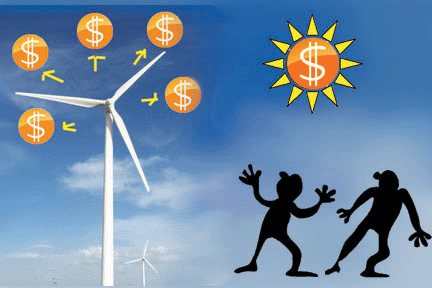
 We can let fission fizzle out in a renewable world, New Scientist, 20 May 2013 by Jochen Flasbarth If Germany can phase out nuclear power and still thrive, why would other nations pursue a uranium-fuelled future? AT THE start of this year Germany officially entered the Dark Ages again – at least according to its state weather service. A mere 22.5 hours of sunshine were recorded in January – a 60-year low. Despite this, the country’s power supply, which has a world leading input from solar panels, firmly stood its ground, even without the eight nuclear reactors that were switched off in 2011.There was sufficient energy for charging smartphones, running dishwashers and the like – and enough for slightly more essential things such as industry or life-support systems in hospitals. And people in need of a fake tan could easily get one.
Such good news probably did not go down well with the pro-nuclear lobby. Grim and cold spells of this type had been their favourite doomsday scenario. Talk of a Stromlücke, or electricity gap, made headlines after the 2011 decision to shut nearly half of Germany’s 17 reactors in the wake of Japan’s Fukushima disaster.
The fear ran rampant that, without a nuclear backbone, blackouts might push German industry out of business – or at least out of the country. This proved groundless. Continue reading
Germany meeting the challenges of intermittent renewable energy
We can let fission fizzle out in a renewable world, New Scientist, 20 May 2013 by Jochen Flasbarth“……One of the most pressing challenges of a 100 per cent renewable world is how best to use energy sources that by their very nature do not run constantly. Your average German wind turbine operates for 1600 hours of the year. Equally, there are times when wind turbines or solar panels produce too much electricity. How to store this excess? This can be done conventionally by pumping water to fill a reservoir during the day, and using it to produce hydroelectric power at night.
More sophisticated is power-to-gas: carbon dioxide and water are combined in a series of steps to produce methane. Renewables will supply the electricity and the methane can be fed into the gas network to heat homes, fuel cars or generate electricity. The technology has yet to mature. But firms such asAudi are trying to get it off the ground commercially.
Another challenge is to transport power from the wind-rich north to the more populous southern and central Germany. That will mean building hundreds of kilometres of new power lines. Opposition is predicted. But this could be tackled by offering locals a financial share in mid-scale, private solar power installations or wind farms.
A quick word on prices: the financial support for renewables has taken some flak. Critics argue that ladling out money for solar panels has overheated the market and created too much capacity at too high a price. But this can be dealt with. Cuts to payments to panel owners for the electricity they generate, the feed-in tariff, have been made, more will follow. To put things in perspective: under the present system the average German is expected to pay €5 a month towards the feed-in tariff. This is a sound investment in clean technology, protecting us from the spiralling prices of conventional energy.
In a recent study we showed that in 2030, renewable electricity on average will cost 7.6 cents per kilowatt hour; electricity from gas or coal-fired power plants will probably be 9 cents. Onshore wind turbines already match prices of some fossil fuels…… http://www.newscientist.com/article/mg21829170.200-we-can-let-fission-fizzle-out-in-a-renewable-world.html

As costs keep falling, solar energy at same price as grid, in 102 countries
Graph of the Day: Solar grid parity in 102 countries http://reneweconomy.com.au/2013/graph-of-the-day-solar-grid-parity-in-102-countries-39133 By Giles Parkinson on 24 May 2013 Here’s an interesting graph used by Suntech’s Stuart Wenham (sourced from Applied Materials) during a presentation at the Solar 2013 conference in Melbourne on Thursday. It highlights the extent of “grid parity” for solar PV across the world – it is now in 102 countries.
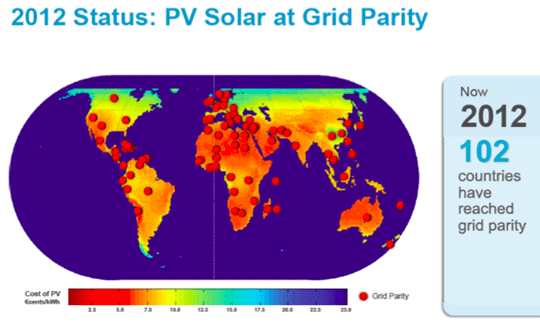
This definition of “grid parity” is the cost of rooftop solar versus the cost of electricity sourced from the grid – this is sometimes known as “socket parity”. Most of the countries – though not all – are those with good solar resources and relatively high electricity pricesAustralia reached “socket parity” several years ago.
Wenham says that solar PV will fall a further 50 per cent in costs up to 2020 – see our story today. He says that solar PV at a utility level will also challenge fossil fuels – as it already does in those with high gas and diesel costs, and will offer the cheapest avenue to countries which have little electricity infrastructure.
VIDEO: Award for solar wheelchair design
 VIDEO Solar Powered Wheelchair Wins Award http://www.energymatters.com.au/index.php?main_page=news_article&article_id=3758 25 May 13 A team from University of Virginia’s School of Engineering and Applied Science recently won first place in a 2012 World Cerebral Palsy Day competition for their solar powered wheelchair design.
We first reported on solar wheelchairs back in 2010, when Haidar Taleb had just begun a journey to take him across the United Arab Emirates.
Inspired by roofs on convertible cars, the lightweight solar panels on the U.Va. team’s wheelchair are retractable and don’t significantly add to its length, width, height or weight when stored. A system of hinges on both sides of the chair controls the deployment of the solar panels. The three panels have a conversion efficiency of 15% and a capacity of 160 watts. When fully deployed, the custom solar panels cover an area of over one square meter. The wheelchair can operate for more than 4.5 hours at a speed of 8 kilometres per hour on a fully charged lead acid deep cycle battery, a range increase of more than 40 percent over batteries alone. At a speed of 1.6 km/h and suitable light exposure, the wheelchair and can run “indefinitely”; without needing to utilise battery power.
Built with lightweight materials, while the system may look fragile, it has been designed to operate under conditions more extreme than would be experienced in normal use. The panels and retractable mechanisms account for less than 15% of the completed wheelchair’s unoccupied weight.
Anyone with enough physical dexterity to use a joystick can operate the chair; including retracting and deploying the solar panels. In addition to standard features common to this type of wheelchair, USB power outlets are provided that can power a wide range of small devices.
In a wonderful display of generosity, the team will use their prize money to perform some final tweaks to the chair give it the individual in Turkey who submitted the initial suggestion for a solar-powered wheelchair.
The remaining prize money will be returned to United Cerebral Palsy in support of future World CP Day competitions.
Russia’s renewable energy subsidy program
Russia Approves Subsidy Program to Boost Renewable-Energy Output http://www.bloomberg.com/news/2013-05-24/russia-approves-subsidy-program-to-boost-renewable-energy-output.html By Marc Roca – May 23, 2013 Russia approved an incentive program to boost renewable-energy production, targeting almost 6 gigawatts of new capacity by 2020 and its first solar parks.
The government yesterday signed a decree that includes measures to support wind, photovoltaic and small hydropower projects across the country, Dmitry Babanskiy, a spokesman for the Energy Ministry, said today by e-mail.
The measures will increase the proportion of renewable energy to 2.5 percent of power generation by 2020 from 0.8 percent now, he said.
Germany’s post-nuclear vision is working, a practical transition to renewables
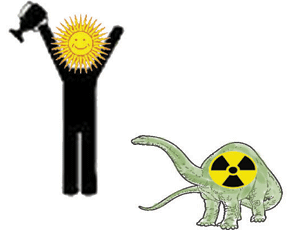 the sudden shutdown of seven nuclear power plants had no detrimental effect on security of supply, and was compensated for within the German energy infrastructure
Nuclear futures: renewables blossom in Germany’s post-nuclear vision .http://theconversation.com/nuclear-futures-renewables-blossom-in-germanys-post-nuclear-vision-14364 Erik Gawel, Sebastian Strunz 22 May 2013, When the Fukushima Daiichi nuclear power plant in Japan was hit by a tsunami in March 2011, the disaster had a profound effect on German energy policy. Chancellor Angela Merkel reasoned that “Fukushima has forever changed the way we define risk in Germany.”
Three days after the news of meltdown in three of Fukushima’s reactors, Chancellor Merkel drew a line under German nuclear power. The seven oldest nuclear power plants in Germany were immediately taken off the grid, and two months later the government made this permanent. The remaining German nuclear power plants, it was decided, would be shut down by 2022.
This decision was a spectacular policy U-turn, as the same conservative government had only recently overturned an earlier attempt to ban nuclear power in Germany. In 2010, Chancellor Merkel’s coalition had argued that nuclear power was a “bridge technology” ecessary to pave the way towards a carbon-free energy system. The prolonged use of nuclear power would be indispensable in order to guarantee security of supply, it was claimed.
This raises two questions: did removing seven power plants endanger the security of supply to the German national grid? And what convincing long-term strategy is there in place to manage the shift to carbon-free energy without nuclear power? Continue reading
Large scale batteries for renewable energy storage now growing in use
 Large Scale Energy Storage Roundup http://www.energymatters.com.au/index.php?main_page=news_article&article_id=3755 23 May 13,
As the world increasingly moves towards renewable energy; it will need many individual energy storage locations distributed across the grid to address issues of variability in electricity production. The idea of a battery being a relatively small device or a series of small boxes cobbled together with wiring is changing fast. Batteries capable of storing huge amounts of energy are being developed using all sort of materials and technologies.
The following are just a few we’ve reported on in the past; some of which are have now been deployed in commercial applications: Continue reading
European countries can save €45bn by co-operative renewable energy
 Siemens: Europe can save €45bn by optimising renewable energy generation 22 May 2013 http://www.renewableenergyfocus.com/view/32558/siemens-europe-can-save-45bn-by-optimising-renewable-energy-generation/ Siemens – which is hosting six Round Table discussions around the globe to discuss levers for optimising energy systems worldwide – says if regional characteristics were given higher priority when investments were made in renewable energy installations, Europe could save billions of Euros. The European energy system is inefficient to the point of damaging the continent’s competitiveness, it adds.
The company estimates that building and expanding renewable energy installations in the wrong locations is costing Europe around €45bn in unnecessary investment – the preliminary findings come via an ongoing studySiemens is conducting with the Technical University of Munich to examine energy systems worldwide. Significantly, the €45bn figure includes associated extension of the power grid.
In Germany alone, the potential savings are possible on a magnitude of 4-5 times the annual investment in solar and wind power plant construction, the firm says. The crux, according to Siemens, lies in the choice of location: installations must be built at the sites in Europe that offer the highest power yields. Continue reading
Renewable energy – Germany’s impressive export of electricity
Germany Continues to Export Power Despite Nuclear Exit http://climatecrocks.com/2013/05/21/germany-continues-to-export-power-despite-nuclear-exit/ Climate Denial Crock of the Week with Peter Sinclair May 21, 2013
They said it couldn’t happen. They keep trying to trash the EnergieWende – Germany’s planet-leading transformation to renewable energy. But the pesky Germans keep perking along. Wall Street Journal:
FRANKFURT–Germany exported more electricity than it imported for the seventh consecutive year in 2012, despite an accelerated exit from nuclear-power generation that included the immediate and permanent shut-down of nearly half of the country’s atomic reactors in 2011.
Germany exported about 22.8 terrawatt-hours of electricity more than it imported in 2012, the Federal Statistics Office, Destatis, said Tuesday in a written statement.
The main destinations for German-produced electricity were the Netherlands, Switzerland and Austria, said the statistics office, citing data supplied by Germany’s four power transmission grid operators. The main sources of power imports into Germany were France, Denmark and the Czech Republic, it said.
The statistics office didn’t provide any reasons for the continued power exports, despite the fact that Germany shut down eight of 17 nuclear reactors in the wake of the Fukushima disaster in Japan in March 2011.
The rapid expansion of solar- and wind-power installations are seen as the main reason for continued German electricity exports, as well as the erosion of wholesale power prices under which many of Europe’s utilities are presently suffering.
A top market for solar energy – Japan
Japan emerges as solar beacon, SMH May 22, 2013 – ”……The country’s generous solar feed-in tariff continues to bolster demand: Japan Asia Group’s plans are moving ahead to develop 500 megawatts of solar projects over the next three years, Tetsuo Yamashita, chairman of the company, said at a meeting with analysts on 16 May. It has 24 solar plants already developed in Europe, but may trim its business in that region, Yamashita said. Japan Asia received a 1.6 billion yen loan for five solar projects in its home country from Shinsei Bank and Mitsubishi UFJ Lease & Finance Company, it said in a statement in March.
The preceding day, Eurus Energy Holdings announced plans to build a 115MW solar power station in northern Japan. The aim is to start construction of the 49 billion yen ($US480 billion) project this July and to begin running the station in November 2015. Eurus is a venture between Toyota Tsusho Corporation and Tokyo Electric Power Company (Tepco).
And on 14 May, Nippon Paper Industries said that its joint venture with Mitsubishi will begin construction on a 21MW solar power station in western Japan this autumn. The plant is expected to start selling electricity to Shikoku Electric Power in H2 2014.
Demand for solar power is increasing for non-residential projects, according to data released by the Ministry of Economy, Trade and Industry on 17 May. Approved applications for non-residential solar projects jumped to 11GW by the end of February from just under 6GW at the end of January.
The start of the feed-in tariff last year helped Sharp to reduce losses at its solar unit in the Asian country: global solar sales climbed 16 per cent to 260 billion yen ($US2.54 billion) last fiscal year, mainly driven by an increase in residential demand in Japan, the company said. Sharp’s operating losses fell to 4.4 billion yen ($US43 billion) for the 12 months ended 31 March compared with 21.9 billion yen ($US210 billion) the previous year….. Japan is forecast to install 6-9.4GW of solar capacity this year under its feed-in tariff, according to Bloomberg New Energy Finance. This could make it the second-largest – or even the top – solar market in theworld
Renewable energy could be boosted by Compressed Air Storage
Compressed Air Storage Could Boost U.S. Renewable Energy Uptake http://www.energymatters.com.au/index.php?main_page=news_article&article_id=3752 21 May 13, New U.S. research into storing energy in underground caverns in the form of compressed air could lead to improved uptake of utility scale wind power in America’s Northwest.
A study by the Department of Energy’s Pacific Northwest National Laboratory and Bonneville Power Administration has found that compressed air energy storage (CAES) has the capacity to store wind power for up to 85,000 homes in two specific geologic areas of inland Washington and Oregon.
CAES storage helps solve the problem of intermittency in renewable energy generation. When the wind powers turbines, or the sun shines on a solar power plant, electricity is abundant and must be stored for later use.
CAES works by using excess energy from a power plant to pump compressed air deep into an underground storage structure such as porous rock, where it remains until needed. The pressurised air is then released back to the surface where it drives a turbine to generate electricity for the grid, thus providing a constant flow of energy.
Study manager for the BPA, Steve Knudsen, believes that with 13 percent of the Northwest’s power supply coming from wind energy sources, CAES technology will become a valuable tool in helping the states meet Renewable Portfolio Standards, which require 20 to 30 percent of all electricity come from variable sources such as wind and the sun.
There are just two CAES plants in the world and both are man-made, one in Alabama and one in Germany. The PNNL/BPA research looked instead for natural geologic formations in Oregon and Washington, finding seams of porous volcanic basalt rock, 450 metres below the surface and at least 10 metres thick.
So far two promising locations have been identified. One is the Columbia Hills Site in Oregon, which is near a natural gas pipeline and could be paired with a CAES system to provide up to 40 days of continual energy storage. The other is the Yakima Minerals Site, which would use geothermal power and CAES technology in a hybrid power plant and utilising geothermal energy to cool the facility’s air compressors, increasing their efficiency.
Germany continues move to clean energy, though it is not easy
 Germany grapples with nuclear energy phaseout The Local Germany’s energy transition project – in which nuclear power will be phased out and replaced with energy from renewable sources – is facing the challenges of cheap coal, unresolved energy storage and an out-of-date electricity grid. 20 May 13 “…The hard-to-predict flow of renewable energies compared to fossil or nuclear power is one of the many challenges of the energy transition which Chancellor Angela Merkel rang in following Japan’s 2011 Fukushima nuclear disaster.
The goal is to be nuclear-free by 2022 and to combat pollution and climate change by boosting the share of clean and safe renewables to 80 percent by 2050.
Across Germany, solar panels, made popular by state subsidies and falling unit prices, now cover many home roofs and stretches of farmland.
New laws have allowed home owners to sell excess power back into the grid, while other incentives promote home insulation and other efficiency gains.
Germany’s solar power capacity has risen exponentially to reach a current level of about 30 gigawatts. Another 25 to 30 gigawatts come from wind farms across vast
stretches of Germany’s flat, coastal north and offshore parks in the North and Baltic seas.
Merkel, a physicist by training, said last week that, under optimal conditions, the total now falls just shy of Germany’s usual demand of 65 to 70 gigawatts Continue reading
Japan set to become a top solar energy market in 2013
 Goldman Sachs eyes Japan renewable energy investments http://www.eco-business.com/news/goldman-sachs-eyes-japan-renewable-energy-investments/ 20 May 13,
Goldman Sachs Group Inc. (GS) plans to invest as much as 50 billion yen ($487 million) in renewable energy projects in Japan in the next five years, tapping demand for electricity produced from solar and wind-power generators.
The Wall Street firm also plans to take as much as 250 billion yen of bank loans and project-financing over the same period to move ahead with projects that would cost a total of 300 billion yen, Hiroko Matsumoto, a Tokyo-based spokeswoman for Goldman, said by telephone. The Nikkei newspaper reported the plan earlier today.
Japan began offering incentives in July through feed-in tariffs to encourage renewables after the Fukushima nuclear-plant crisis stemming from the March 11, 2011 earthquake and tsunami. Japan has been forced to slash its reliance on atomic power generation since Fukushima.
“We believe that we can leverage our global expertise in investing in renewable energy in places such as the US and India, to help expand Japan’s renewable power capabilities,” Ankur Sahu, co-head of the merchant banking division in the Asia-Pacific, said by e-mail.
Goldman Sachs formed the Japan Renewable Energy Co. unit in August to plan, design and operate power plants run on sun, wind, fuel cells and biomass fuels, it said on its website.
Investor attraction
Renewable energy has attracted interest from investors ranging from billionaire Masayoshi Son’s Softbank Corp. and financial-services company Orix Corp. to the country’s biggest banks led by Mizuho Financial Group Inc.
Japan will probably become the largest solar market in the world after China this year, according to data compiled by Bloomberg.
Commercial and utility-scale projects will boost solar installations to a range of 6.1 gigawatts to 9.4 gigawatts in 2013, exceeding an earlier forecast of 3.2 gigawatts to 4 gigawatts, Bloomberg New Energy Finance said in April.
Companies that stand to benefit include Kyocera Corp., Sharp Corp. and Suntech Power Japan Corp., all of which make and sell solar panels for residential and industrial use.
1 This Month
26 September – International Day for the Total Elimination of Nuclear Weapons





PLEASE OPPOSE HR 8255 AND S.3639 – bills would accelerate satellite deployment, with no environmental review or safeguards – https://ncstd5li.quorum.us/campaign/169331/
To see nuclear-related stories in greater depth and intensity – go to https://nuclearinformation.wordpress.com
-
Archives
- September 2026 (305)
- August 2026 (330)
- July 2026 (355)
- June 2026 (287)
- May 2026 (306)
- April 2026 (356)
- March 2026 (251)
- February 2026 (267)
- January 2026 (308)
- December 2025 (358)
- November 2025 (359)
- October 2025 (375)
-
Categories
- 1
- 1 NUCLEAR ISSUES
- business and costs
- climate change
- culture and arts
- ENERGY
- environment
- health
- history
- indigenous issues
- Legal
- marketing of nuclear
- media
- opposition to nuclear
- PERSONAL STORIES
- politics
- politics international
- Religion and ethics
- safety
- secrets,lies and civil liberties
- spinbuster
- technology
- Uranium
- wastes
- weapons and war
- Women
- 2 WORLD
- ACTION
- AFRICA
- Atrocities
- AUSTRALIA
- Christina's notes
- Christina's themes
- culture and arts
- Events
- Fuk 2022
- Fuk 2023
- Fukushima 2017
- Fukushima 2018
- fukushima 2019
- Fukushima 2020
- Fukushima 2021
- general
- global warming
- Humour (God we need it)
- Nuclear
- RARE EARTHS
- Reference
- resources – print
- Resources -audiovicual
- Weekly Newsletter
- World
- World Nuclear
- YouTube
-
RSS
Entries RSS
Comments RSS

