Nuclear industry in decline- World Nuclear Industry Status Report 2013,
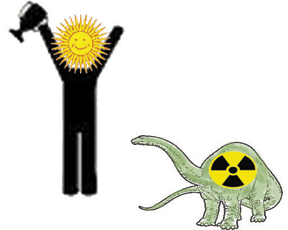
 Report: Renewable energy overtaking declining nuclear http://www.pv-tech.org/news/solar_overtakes_nuclear_in_global_energy_output 12 July 13, Only 1.2GW of nuclear generation capacity was installed last year globally compared to 32GW of solar, according to a report proclaiming the end of the “nuclear renaissance”.
The World Nuclear Industry Status Report 2013, published yesterday, was written by numerous academics and independent energy consultants as a “reality check” on global use of nuclear energy.
It claims that with global electricity generation from nuclear decreasing “historically” by 7% last year, nuclear power is in decline as a power source compared to renewable energies.
The report singled out solar and wind as energy forms that were beginning to rival nuclear. It said that 80% of those it surveyed thought renewables would be able to compete with major power and utilities sectors, and that “all forms of solar will not need subsidies to compete” by 2030.
The largest investment in renewable energy was in utility-scale renewable energy parks, and second was in rooftop solar PV installations. Continue reading
Wind farm development going ahead in Fukushima
Wind farm takes shape off Fukushima as Japan seeks non-nuclear energy http://www.euronews.com/2013/07/12/wind-farm-takes-shape-off-fukushima-as-japan-seeks-non-nuclear-energy/ The first phase is complete of a plan to build the world’s largest offshore wind farm near the Fukushima nuclear plant that was crippled by an earthquake and tsunami in March 2011.
The first turbine has been delivered to the area and the facility is due to become operational in October.
It is part of plans by Fukushima Prefecture to ditch nuclear energy and move towards total reliance on renewable sources over the next 25 years.
By 2020 scores of giant turbines 200 metres high should produce twice as much power as the world’s current biggest offshore windfarm at Greater Gabbard off the UK’s Suffolk coast.
“First and foremost, we want to make this a symbol of Fukushima’s recovery. Secondly, this floating wind farm concept is the ace up our sleeves for the next stage of renewable energy development,” said Keisuke Murakami, Head of New and Renewable Energy at the Economy, Trade and Industry Ministry. There have been concerns about radioactive water leaking into the sea from Fukushima, and official accounts have given conflicting evidence over whether fish are safe to eat.
The disaster all but shut down Japan’s nuclear industry, forcing the country to rely heavily on imported gas.
It is hoped that wind turbines will be more resistant to earthquakes, typhoons and tsunamis.
Renewable energy, energy efficiency drive by NATO armed forces
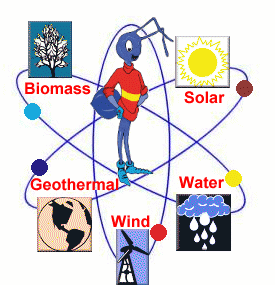 NATO Armed Forces Embrace Renewable Energy BRUSSELS, Belgium, July 11, 2013 (ENS) – The 28 member countries of the North Atlantic Treaty Organization are reducing the energy footprint of their defenseoperations as a priority, top NATO officials said this week.
NATO as a military and political organization, as well as individual allies, are working with alternative energy sources and developing multinational “smart energy” projects……. The DoD is seeking to develop solar,
wind, geothermal and other distributed energy sources on its bases both to reduce their $4 billion-a-year energy bill and to make them less dependent on the commercial electricity grid. Such on-site energy generation, together with energy storage and so-called smart-microgrid technology, would allow a military base to maintain its critical operations “off-grid” for weeks or months if the grid is disrupted, the DOD says…….. Continue reading
Global renewable energy investment has risen rapidly in 2013
 Rise in global clean energy investment Renewable Energy Focus 12 July 2013 Global investment in clean energy in Q2 was up 22% from Q1, due to upturn in the financing of wind and solar projects and a 170% surge in equity funding for specialist companies on public markets.
The investment rose to US$53.1 bn, led by the US, which saw investment jump 155% compared to a weak first quarter, to reach US$9.5 bn, and China (up 63% at US$13.8 bn) and South Africa (up from almost nothing in Q1 to US$2.8 bn in Q2).
China was the largest investor in clean energy in Q2, followed by the US. Third on the list was Japan, Continue reading
Impressive graphs tell the success story of Germany’s renewable energy
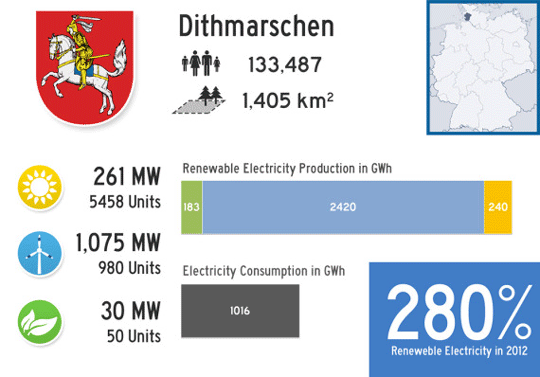
 I highly recommend this article. It shows with several excellent graphs, just how successful German counties are being in developing renewable energy and energy efficiency. The example below is of just one county
One of the most important details being missed by most of those common limited observations is the fact that the renewable energy success of the last decade was mainly driven by some pioneering regions, counties, and municipalities. Those local communities moved forward with conviction, while many others have remained dormant willingly or hindered by state governments that blocked investments by passing arbitrary anti-renewable regulations in favor of conventional power companies.
To showcase what we know about what is at least possible, here are the top 3 out of 295 Landkreise (Counties / administrative districts) in terms of the renewable share in their regional power mix. Most of their success is based on investments during the last 10–15 years based on technology that is now outdated
Germany: 100% renewable energy and beyond http://reneweconomy.com.au/2013/germany-100-renewable-energy-and-beyond-78310 By CleanTechnica on 8 July 2013 While many countries still discuss whether or not a 100% renewable energy system – or “just” a 100% renewable electricity supply – is even theoretically possible, Germans seem no longer bothered by such unscientific doubts. To make matters “worse,” some of them (including myself) are even convinced that a transition to a 100% renewable energy system can and should be accomplished within only a few decades’ time.
Some people might find this different perception of the problems we face to overcome the energy crisis of the 21st century so puzzling that they would rather choose to believe that the Germans have simply gone mad. Luckily, nothing could be further from the truth, and I’ve got a few nice examples that might explain the German mindset……
Another popular myth among so called “professional journalists” is that what is happening in Germany is due to on some kind of “big government” program. Obviously, this domestic narrative-driven reporting is not very interested in looking at important details that could explain the big picture. Continue reading
Solar powered plane’s successful flight across America
 Solar-Powered Plane Lands At JFK in a Sweeping Victory For Renewable Energy http://www.policymic.com/articles/53209/solar-powered-plane-lands-at-jfk-in-a-sweeping-victory-for-renewable-energy Maggie O’Neil , 7 July 13, Last night, at approximately 11:09 PM, co-pilots Bertrand Piccard and André Borschberg safely landed at JFK International Airport on a plane operated by nothing but solar energy.
New York was the final destination of a transcontinental journey that began in San Francisco, followed by Phoenix, then Dallas, then St. Louis, and then Washington, D.C. Continue reading
China moves fast towards renewable energy, slows down nuclear program

 Solar, wind power gain over nuclear power in China, says German official South China Morning Post, Joyce Man in Berlin 8 July 13, German official says solar and wind generation is reaching the market faster than nuclear power under Beijing’s latest five-year plan China’s thinking has shifted increasingly towards renewable energy, which is reaching the market faster than nuclear power, a German environment official has said.
“If you analyse the last 10 years, the thinking in China has shifted more and more towards renewables. I see that renewables are getting to the markets quicker than expected and nuclear energy is getting to the markets slower than expected,” said Karsten Sach, deputy director general for European and international environment policy at the German Ministry for the Environment, Nature Conservation and Nuclear Safety. He was speaking to the South China Morning Post in Berlin.
Sach emphasised the importance of wind and solar energy: “If you read Chinese projections a decade ago on how nuclear and renewables would develop over the next decade, you would have seen nuclear far ahead of renewables. If you look at what happened and the projections of what will happen in the most recent five-year plan, you see renewables in front of nuclear.
“That’s just the facts and those are sometimes ignored. I don’t comment on Chinese policy. I just see [China is] doing much more on renewables than on nuclear. It’s a very welcome decision, but China has to make its own decision,” the German official said.
Sach said China recognised renewables would form a world market in the future. He said the country understood it could deliver energy in a socially beneficial way, without air pollution, and create jobs in remote areas………. http://www.scmp.com/news/china/article/1277560/solar-wind-power-gain-over-nuclear-power-china-says-german-official
California’s enthusiastic moves to renewable energy
California finds clean energy’s magic ingredient: Ambition REneweconomy, By Giles Parkinson on 8 July 2013 “……There is no talk of repealing or diluting the carbon price, and its renewable energy target is 33 per cent by 2020 …….. Some time in the next couple of years the California legislature in Sacramento is likely to move the bar even higher, to 40 or even 45 per cent (by 2025 or 2030).
Edward Randolph, the energy director from the California Public Utilities Commission, which oversees the investor-owned utilities in the state, says constantly raising that level of ambition has proved extremely successful.
“A lot of people argued against the 33 per cent target saying it was too difficult, but the legislature said ‘no, we’re going to set broad and ambitious goals and let the engineers figure out how to do it,” Randolph tells RenewEconomy in an interview in his San Francisco office last week.
“And quite frankly I think that has been the right way of doing it, saying ‘this is what we are going to do, you guys go figure it out’. That’s worked really well and that’s why I’m certain that in the next year or so the legislators will come back and say we ready to move to 40 per cent or 45 per cent. They don’t wait for us to get to the goal. Once they start seeing progress, they move the goals. And I honestly think it works.”
It’s not stopping there. The office of Democrat governor Jerry Brown, who apparently loves solar, has mandated 3,000MW of rooftop solar by 2017, has a program to encourage “self generation” in other technologies (such as fuel cells), and is looking at taking leadership in the electricity storage market, pushing for a mandated 1GW of storage to be installed by 2020. All these targets are over and above the renewable energy target, known here as Renewable Portfolio Standard. Continue reading
Saudi Arabia set to become – well – the Saudi Arabia of Solar Energy
Saudi Arabia Pushes Renewable Energy Programs, Wants to Become Solar-Powered Efficient and Capable by 2032 http://au.ibtimes.com/articles/486391/20130704/saudi-arabia-renewable-energy-solar-power.htm#.UdiSeztwo6I By Esther Tanquintic-Misa | July 4, 2013
Saudi Arabia has started to aggressively push forward its renewable energy programmes by installing 70 stations across the oil-rich nation that will measure the potential for energy production from sun, wind and geothermal sources. The kingdom targets to become solar-powered efficient and capable by 2032.
Ten of these stations have been put up. They will collect all weather and air data to show renewable energy sources in all parts of the kingdom. Researchers will then be able to access the data through a Web site, relaying information such as solar radiation and wind speed. Essentially, the findings will provide potential investors with guidance on where to build renewable-energy related plants. Saudi Arabia wants to attract about $109 billion to be able to create a solar industry that will help give off one-third of its electricity requirements by 2032, or about 41,000 megawatts.
Saudi Arabia targets to install 23.9 GW of renewable power capacity by 2020 and then 54.1 GW by 2032.Incidentally, countries in the Gulf region are turning more their focus toward clean renewable sources of energy for their power generation. Collectively, they target solar energy one of the region’s main sources of energy by 2017.
Apart from Saudi Arabia, Qatar and Kuwait have started aggressive planning towards renewable energy programs. Qatar targets to source 10 per cent of the electricity and energy used in water desalination from solar energy by 2018, while Kuwait wants to obtain 10 per cent of its power requirements from renewable energy sources by 2020.
Overall, some $155 billion worth solar power installation projects are in the pipeline for the entire Gulf region. These projects can give off more than 84 GW of power.
Solar energy storage in a big way, in Nevada
 Solar towers and storage – about to change the energy game? http://reneweconomy.com.au/2013/solar-towers-and-storage-about-to-change-the-energy-game-91721, By Giles Parkinson on 4 July 2013 The 110MW Crescent Dunes Solar Energy Plant, a concentrated solar power project due to be completed in Nevada early next year, will not just be the largest solar power tower plant with fully integrated energy storage built – it could also challenge the way the world thinks about renewable energy. Or even energy sources in general.
The $1 billion Crescent Dunes project near Tonopah in the Central Nevada Desert, some 300kms north of Las Vegas, was developed by the Santa Monica-based SolarReserve and features the company’s market leading molten salt power tower technology with fully integrated energy storage.
What makes it unique and a potential game changer in the electricity industry is the flexibility and dispatchability of its power, meaning that it can deliver electricity whenever it is needed by customers; and its cost, which already beats diesel, is competitive with new build coal and gas generation.
The Crescent Dunes facility will have 10 hours of molten salt storage, which on average will allow it to deliver 110MW of baseload capacity to Las Vegas between the hours of 12 noon and midnight each day, when the city needs it most to power the lights and air conditioning of its casinos and entertainment palaces. It has signed a 25-year power contract with NV Energy, Nevada’s largest utility, to do that. Continue reading
Japan’s wind energy systems to increase, with off shore turbines
What is not well known is that Japan has considerable wind power, and that its string of wind turbines continued to function throughout the 2011 tsunami disaster.
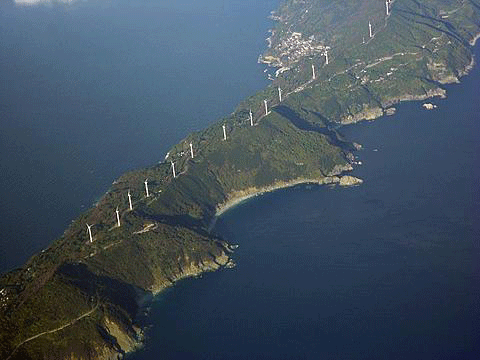
Work starts on Fukushima floating project Wind Power Monthly 25 June 2013 by Martin Foster, JAPAN: Installation of wind turbines in the testing phase of the biggest offshore floating project to date will finally get under way this week, 20 kilometres off the coast of Fukushima. Two 2MW downwind floating turbines are scheduled to be towed from shipyards belonging to Mitsui Engineering and Shipbuilding in Chiba prefecture to Onahama port on 28 June, according to a new schedule released by Takeshi Ishihara a civil engineering professor at the University of Tokyo and technical adviser to the project…….
The cable is scheduled to be loaded on ship, laid and sunk in the seabed from the end of July until the end of August. It is planned to connect the cable some time in the month of August, with the project due to start generating power in mid-September.
The massive floating wind farm project, which is being developed by an 11-entity consortium lead by Marubeni Corporation, may eventually see 132 floating turbines come on line. It has been named Fukushima Mirai, literally the future of Fukushima, and has been planned as part of post-nuclear disaster recovery efforts in the area.
The project fulfils a ten-year dream for Ishihara.
“I feel that we have taken the first real step towards finally realising the dream I have embraced for the past ten years. I am really pleased,” he told Windpower Monthly. http://www.windpowermonthly.com/article/1187536/work-starts-fukushima-floating-project
A new way to store solar energy efficiently?
Australian Invention Could Revolutionise Solar Energy Storage July 13, ANU researchers have developed a material that can store large amounts of power rapidly – and with very little energy loss. Based on the mineral rutile, it is a ‘dielectric’ material; which are used in the construction of capacitors.The researchers say their material is superior to current capacitors in energy absorption, is cheaper to manufacture and can function effectively in a massive temperature range: -190°C to 180°C. Continue reading
Renewable energy to exceed gas and nuclear, says IAE
IEA: Renewables To Exceed Natural Gas, Nuclear Energy By 2016, Energy Collective 26 June 13 Natural gas is widely considered the bridge to take us from fossil fuel dependence to a clean energy future – but that bridge may be a lot shorter than anyone could have predicted. The International Energy Agency (IEA) predicts power generation from renewable sources will exceed natural gas and be twice the contribution from nuclear energy globally by 2016 – just three short years from now.
IEA’s second-annual Medium-Term Renewable Energy Market Report (MTRMR) forecasts renewable generation will grow 40% in the next five years despite difficult economic conditions.
Wind And Solar Power The Renewables Charge
Renewable energy is now the fastest-growing sector of the global power market, and will represent 25% of all energy generation worldwide by 2018, up from 20% in 2011. In addition, renewable electricity generation is expected to reach 6,850 terawatt-hours (TWh) and total installed renewable capacity should hit 2,350 gigawatts (GW), both by 2018.
Wind and solar photovoltaic generation is powering this jump, and non-hydro renewable power will double from 4% of gross generation in 2011 to 8% in 2018. IEA cites two main drivers for their incredible outlook: accelerating investment and deployment, and growing cost competitiveness versus fossil fuels.
Strongest Growth In Developing Countries
Even though government funding has been inconsistent, private investment has remained strong, especially in developing economies. Rural electrification, energy poverty, and rising demand have been major challenges for policymakers in these countries, and renewables have become an increasingly attractive option for diverse and non-polluting power…….http://theenergycollective.com/silviomarcacci/242601/iea-renewables-will-exceed-natural-gas-and-nuclear-2016
Much more powerful solar cells on the way
Solar Cells That Could Produce More Power Than Uranium http://www.energymatters.com.au/index.php?main_page=news_article&article_id=3814 27 June 13 New research from the Massachusetts Institute of Technology into graphene, one of the thinnest and most conductive photovoltaic materials in existence, could lead to the production of highly efficient solar panels that, weight-for-weight, could be capable of producing more energy than reactor-grade uranium.
In a paper published in the journal Nano Letters, MIT scientists describe the stacking of two atom-thick nanomaterials, graphene and molybdenum disulfide, to create a one-nanometre (billionth of a metre) thick solar cell capable of converting sunlight to energy at two percent efficiency.
Lead author of the research, Jeffrey Grossman, the Carl Richard Soderberg Associate Professor of Power Engineering at MIT, says while this is a very low number compared to conventional photovoltaic efficiencies, the solar cell is so thin that pound-for-pound the new material produces up to 1,000 times more power than current solar technology. Continue reading
Exelon tries (unsuccessfully) to blame wind energy for nuclear power’s commercial failures
 Exelon Still Blaming Wind PTC For Nuclear Challenges, Exelon Still Wrong About It Think Progress, By Adam James, Guest Blogger on Jun 27, 2013 Exelon recently shelved plans to expand nuclear capacity at their LaSalle and Limerick plants, taking a $100 million hit and once again reverting to the tired old strategy of blaming subsidized wind. The specific target of their ire is the Production Tax Credit (PTC). For wind, that is, not the one that they happily collect for nuclear.
Exelon is (again) wrong about the PTC, as anyone who read our last post already knows.
First, let’s look at the big picture. Wind power has been a tremendous boon for North America. Costs have fallen 90 percent since 1992, the domestic content of wind turbines has dramatically risen, and 75,000 people are employed in the industry. This growth is directly tied to the continued extension of the Production Tax Credit. Wind power is cheap and carbon free, making it good for consumers and the climate alike.
However, Exelon has decided that wind power is bad for their business. The argument they’ve been making is that because wind can collect tax credits for producing energy at times when demand for electricity is very low, electricity prices become negative as the generator pays consumers to take electricity. This hurts their other generators, like nuclear plants, who then have to sell at a loss. Buried in the story about Limerick and LaSalle is a very important point though: negative prices didn’t occur once in springtime.
We debunked this tale before, but I’ll recap the highlights here:……http://thinkprogress.org/climate/2013/06/27/2210711/exelon-still-blaming-wind-ptc-for-nuclear-challenges-exelon-still-wrong-about-it/?mobile=nc
1 This Month
26 September – International Day for the Total Elimination of Nuclear Weapons





PLEASE OPPOSE HR 8255 AND S.3639 – bills would accelerate satellite deployment, with no environmental review or safeguards – https://ncstd5li.quorum.us/campaign/169331/
To see nuclear-related stories in greater depth and intensity – go to https://nuclearinformation.wordpress.com
-
Archives
- September 2026 (305)
- August 2026 (330)
- July 2026 (355)
- June 2026 (287)
- May 2026 (306)
- April 2026 (356)
- March 2026 (251)
- February 2026 (267)
- January 2026 (308)
- December 2025 (358)
- November 2025 (359)
- October 2025 (375)
-
Categories
- 1
- 1 NUCLEAR ISSUES
- business and costs
- climate change
- culture and arts
- ENERGY
- environment
- health
- history
- indigenous issues
- Legal
- marketing of nuclear
- media
- opposition to nuclear
- PERSONAL STORIES
- politics
- politics international
- Religion and ethics
- safety
- secrets,lies and civil liberties
- spinbuster
- technology
- Uranium
- wastes
- weapons and war
- Women
- 2 WORLD
- ACTION
- AFRICA
- Atrocities
- AUSTRALIA
- Christina's notes
- Christina's themes
- culture and arts
- Events
- Fuk 2022
- Fuk 2023
- Fukushima 2017
- Fukushima 2018
- fukushima 2019
- Fukushima 2020
- Fukushima 2021
- general
- global warming
- Humour (God we need it)
- Nuclear
- RARE EARTHS
- Reference
- resources – print
- Resources -audiovicual
- Weekly Newsletter
- World
- World Nuclear
- YouTube
-
RSS
Entries RSS
Comments RSS

