Google invests $1 billion, in its plan for 100% renewable energy
 Google wants to run on 100% renewable energy Here are 3 reasons the company may want clean and sustainable power sources.MSN Money, By The Week 16 Nov 13.This week, Google (GOOG -0.16%) announced in a blog post a new $80 million investment in solar energy in California and Arizona, bringing its total investments in renewable energy since 2010 to over $1 billion.
It’s just the latest step in an ongoing project by Google to keep at the forefront of the green energy industry. Continue reading
Record production of renewable energy in Denmark and Germany
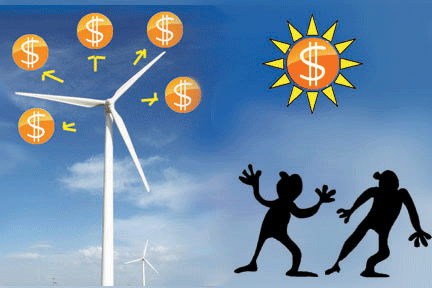 Renewable Energy Generation Hits All Time Highs in Denmark and Germany Permaculture Magazine | Friday, 15th November 2013 Denmark’s and Germany’s wind and solar electricity generation is peaking, covering much of their countries’ need, setting the trend for renewable energy systems that do not cost the Earth. In the last month, solar and wind energy has been reaching record breaking figures in some countries in Europe.
 On November 4th this year, Denmark’s wind turbines covered 122% of the countries demand for electricity.
“This is the highest registered figure so far,” says Preben Maegaard, director of the Nordic Folkcenter for Renewable Energy.
 A month before on October 3rd, Germany’s renewable energy peaked at 59.1% with a combination of solar and wind. Across the entire day, 36% of total electricity generation was achieved, with solar contributing 11% at 20.5 gigawatts at its peak.
“It was around midday on October 3, which just happened to be Germany’s annual Reunification Day holiday, when the sun was at its fullest and the significant peak was reached. Over the entire day, 36.4% of total electricity generation was achieved with solar and wind power; solar panels contributed 11.2% on their own. At its peak, solar accounted for 20.5 gigawatts.
“Although the electrical grid withstood the large amount of renewable energy flowing to it, you’ll be pleased to know that electricity prices also dived. A drop in demand from big, conventional power plants led the electricity price index at 2:00pm to 2.75 cents per kilowatt hour. The index covers Germany, Austria, France, and Switzerland.
“So there you have it. A country as large and industrialized as Germany can and did operate successfully, albeit on a national holiday, using a large percentage of renewable energy. And this is only the beginning,” comments Jim Winstead.
These surges not only showed that renewable energy can supply energy needs, but neither power grids broke down under the surge…..http://www.permaculture.co.uk/news/1511134008/renewable-energy-generation-hits-all-time-highs-denmark-and-germany
South Africa’s speedy connection – solar energy to the grid

 South African solar plant connects to the grid three months ahead of schedule, Renewable Energy Magazine, Robin Whitlock Friday, 15 November 2013 The 75MW Kalkbult solar plant will generate 135 million kilowatt hours per year and displace 115,000 tons of greenhouse gas emissions A solar plant built by Scatech Solar in cooperation with local partners has become the first utility-scale renewable energy facility to supply electricity to South African public utility Eskom after connecting to the country’s electricity grid three months ahead of schedule.
The 75MW Kalkbult solar PV plant near Petrusville in the Northern Cape, was officially opened on Tuesday 12thNovember. It will generate 135 million kilowatt hours per year, equivalent to the annual electricity consumption of 33,000 households. The plant covers 105 hectares of a working sheep farm and consists of 312,000 solar panels linked to inverters, transformers and a high-voltage sub-station. More than 600 people were employed during its construction, many from the local community…….
The plant is among 47 solar, wind and mini-hydro projects awarded 20-year electricity generation contracts under the South African government’s Renewable Energy Independent Power Producer Procurement Programme (REIPPPP), introduced three years ago by the Department of Energy. Total investment in the programme is estimated at R74 billion which will climb above R100 billion following the government’s acceptance of 17 new bids. The aim of the programme is to help the country combat climate change by reducing its current near-total dependence on coal-based electricity and accompanying high level of greenhouse gas emissions. The Kalbult plant is intended to displace annual greenhouse gas emissions of 115,000 tons.
The project will also add momentum to the country’s Green Economy Accord signed three years ago with the aim of creating 300,000 new jobs in renewable energy generation, energy efficiency, biofuel production, manufacturing in support of green projects and natural resource conservation and rehabilitation. http://www.renewableenergymagazine.com/article/south-african-solar-plant-connects-to-the-20131115
Solar energy for Ghana
Renewables get big boost as 50MW solar plant to be built Ghana Web 15 Nov 13 Ghana’s energy stock will receive 50 megawatts (MW) of solar power by 2015 as Scatec Solar, a Norwegian energy company, plans to build Africa’s second-largest solar power plant through its local partner Scatec Solar Ghana.
The project will cost about €70million and will be sited in the northern part of the country. “We are in discussion with ECG, the main off-taker, and we hope to progress with those discussions. So far everything is going well. We have had engagement with the Energy Commission and the Public Utilities Regulatory Commission (PURC), and we think that with all the efforts from these various institutions Scatec Solar will come onstream as planned,” Fred Nuerte Nuer, Director of Scatec Solar Ghana, said.
When completed, the project will become the first large utilities-scale solar power plant in West Africa and the second-largest in Africa, after the company unveiled a 75MW solar plant in South Africa early this week……
Middle East and North Africa (Mena) solar energy to take off
Mena solar energy market gears for growth Most of demand expected to originate from Turkey and Saudi Arabia Gulf news, By Sarah Diaa, Staff Reporter November 15, 2013 Dubai: With an expected combined output of 10 gigawatts by 2017, the Middle East and North Africa (Mena) solar energy sector is gearing for significant growth, experts said.
“As of April 2013, there were 106 renewable energy projects in the pipeline in the region, totalling more than 7.5 gigawatts of new electric generation capacity. This is in addition to 10 major projects set to go ahead in the UAE, Kuwait, Oman, Egypt, Jordan, and Morocco,” Director of Informa Energy Group, Anita Mathews said.
She added that 2012 saw new investments in the region totalling $2.9 billion (Dh10.6 billion), an increase of almost 40 per cent compared to 2011.
“An increasing number of countries in the Middle East are keen to invest in the region’s thriving solar industry and with renewable energy sources in abundance — particularly solar power — the region is gradually tapping these resources to pave the way for a new market,” Mathews said.
She expected the majority of demand for solar energy to originate from Turkey, and Saudi Arabia, with the latter leading the way towards the region’s first gigawatt scale solar market by 2015.
Early stage
“The UAE is close, after Turkey and Saudi Arabia, and actually the whole Middle East has plans for solar energy. In terms of capacity as in how much install capacity there is, these two countries are in the lead,” Mathews said…….
The second edition of Solar Middle East, an exhibition for solar industry professionals, will be held from February 11-13 next year at the Dubai International Exhibition Centre. http://gulfnews.com/business/general/mena-solar-energy-market-gears-for-growth-1.1255473
Energy efficiency versus nuclear power – it’s really a no brainer!
When New York City announced the switch, to conserve electricity and constrain costs, a writer at Forbes raised a question of great importance for the nation’s energy vision: “Can LED bulbs make nuclear plants obsolete?”
Nuclear plants take decades to “come online” and produce electricity. The bulbs can be installed overnight.
Energy efficiency or more nuclear power? http://www.heraldandtribune.com/Detail.php?Cat=OPED&ID=61156 12 Nov 13, By Frances Lamberts
The outgoing mayor of New York City last month announced a very smart decision concerning street lighting and municipal energy use. As the NY Post reported, in a “mammoth project” every one of the city’s 250,000 streetlights will be changed to energy-saving LED lamps.
The upfront cost is said to be $79 million and the resulting, yearly electricity and maintenance cost savings $14 million. The LEDs’ 20-year life expectancy being more than triple that of the current bulbs and their electricity draw dramatically lower, the payback of nearly $150 million made the decision “a no-brainer,” Mayor Bloomberg said.

As a local example, 21 years after installation, in some lesser-used areas in my home, the energy-saving bulbs of an earlier technology period are still burning brightly. Continue reading
Mark Z. Jacobson’s plan for a renewable energy powered USA
If this seems too big to comprehend, let’s look at the state level. Jacobson has worked with research teams to develop plans for New York and California, and he hopes to do one for each state in the country.
The California plan aims for “all new energy powered with WWS by 2020, 80-85 percent of existing energy replaced by 2030, and 100 percent replaced by 2050.”
When it comes to New York, the biggest difference from California is a little less concentrated solar and much more offshore wind. This is their New York plan:……..

 We Have the Renewable Energy We Need to Power the World—So What’s Stopping Us?A leading researcher says we have enough wind and solar to power the world. Are we willing to do what’s necessary to transform our society Alter Net, Tara Lohan November 8, 2013 |The environment is one bad news story after another The Pacific Ocean is warming at a rate faster than anything seen in the last 10,000 years and we may have the warmest Arctic in the last 120,000 years. We’re told to brace for more and worse droughts, floods, heat waves, and storms. Coastal communities may disappear from rising seas, entire island nations are going under. If that all weren’t bad enough, there is a global wine shortage.
The bright side is that we aren’t being blindsided by an unknown enemy: Our relentless burning of fossil fuels is the big thing pushing us toward the brink. So it would figure that a solution to get us out of this mess would be pretty obvious.
That’s why it’s great that there are people like Mark Z. Jacobson, a professor of civil and environmental engineering at Stanford University. While it is one thing to say we want to stop burning fossil fuels, Jacobson (and a team of researchers) are telling us how to do it.
Jacobson was recently on the “David Letterman Show,” where he proclaimed that we have enough wind and solar to power the world…… Continue reading
Financial innovation will be the next big step in solar energy
The Next Big Innovation in Renewable Energy Won’t Be Technological It will be financial. The Atlantic,TODD WOODY NOV 11 2013, Silicon Valley solar company SolarCity last week quietly did something that could revolutionize renewable energy in the United States. No, the company did not invent a radically more efficient or cheaper photovoltaic panel. Rather, it announced it plans to sell $54 million in asset-backed securities.
And that is a very big deal, even if the dollar amount of the notes on offer is rather small. That’s because the assets backing the securities are leases for some of the rooftop solar systems it has installed on homes across the country. Hundreds of millions of dollars in solar leases have been signed in the U.S. in recent years. If those leases can be bundled and sold to pension funds and other investors, “solar securitization” could open up a potentially huge new pool of capital that could be tapped to finance the expansion of renewable energy as federal and state tax breaks for renewable energy begin to expire. For homeowners and businesses, solar securitization could translate into cheaper electricity. A SolarCity spokesman declined to comment on the securities offering.
Much of the innovation responsible for the solar industry’s explosive growth has been financial rather than technological. Half the U.S.’s solar capacity, for instance, was installed just in 2012. Driving those sales was the ability of homeowners to avoid the five-figure cost of a photovoltaic system by leasing it for a monthly payment that often is lower than what they’d pay their local utility. Anywhere between 75 and 90 percent of all solar systems are now leased as a result……..HTTP://WWW.THEATLANTIC.COM/TECHNOLOGY/ARCHIVE/2013/11/THE-NEXT-BIG-INNOVATION-IN-RENEWABLE-ENERGY-WONT-BE-TECHNOLOGICAL/281345/
USA slowly heading in right direction on renewable energy
We Have the Renewable Energy We Need to Power the World—So What’s Stopping Us?Alter Net, Tara Lohan November 8, 2013
“………The Biggest Hurdle Jacobson recently said on the “David Letterman Show,” “There is no technological or economic limitation to solving these problems; it’s a social and political issue, primarily.”……
The Washington Post published the results of a new Pew poll that found only Tea Partiers still cling to anti-science views about climate change; 25 percent of Tea Party Republicans believe in climate change, compared to 61 percent of non-Tea Party Republicans and 84 percent of Democrats.
Despite an outlier (yet vocal) conservative fringe, we’re slowly headed in the right direction. Time is of the essence. Can the change happen quickly enough?
“I think in some sectors it will naturally evolve very quickly like electric cars because they’re so efficient,” said Jacobson. “In other sectors, if we don’t push faster, then they’re just going to change really modestly or not fast enough. I’m pretty optimistic that once people understand what’s going on with the problems, in terms of climate, pollution, energy security, and once they understand there are technical solutions available and the economic solution is available, they will galvanize around those solutions.”
All the finger pointing can’t just be aimed at our elected officials—there has to be broad public support…….. Renewable projects should still be subject to environmental review, but barring that, it’s no longer acceptable to say that wind turbines or solar panels are too ugly to look at, especially by people who get electricity from coal, oil and gas yet share none of the burden of its extraction or burning.
When we talk about powering our future with renewable energy we have to understand that we’re still talking about impacts—but we have to weigh those against the impacts of continuing to power our world with ever more extreme methods of fossil fuel extraction.
This isn’t simply a matter of changing how we get energy. It means shifting the power dynamic in this country (and across the world), and literally putting power back in the hands of individual people and communities.
At this point, Mark Jacobson’s optimistic goal of 100 percent renewables by 2030 or even 2050 looks out of reach. But what if we aimed for 50 percent for starters, and focused our economy on resilience instead of endless growth? The right wing might kick and scream, but I doubt the world would come to an end. If we keep burning fossil fuels, however, our fate isn’t likely to be very pleasant http://www.alternet.org/environment/are-you-ready-100-percent-renewable-energy
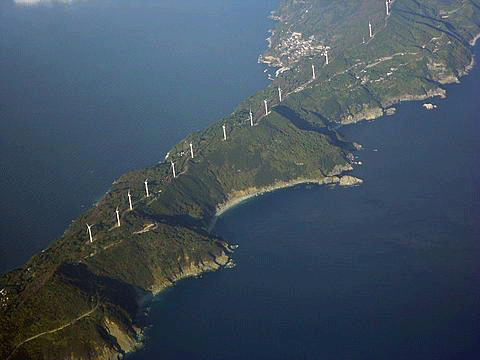
Japan’s wind energy now supplied from both on and offshore
Solar power with diesel backup – a financial boon to mining sites
Of the 400 operating mine sites in Australia, 170 are either off-grid or connected to a smaller distribution network and needing to supply their own electricity. Natural gas and diesel dominate as fuel supplies for electricity generation and other energy uses. Rising prices of both of these fuels are leading mining companies to consider alternatives.
In South Africa, reliability of electricity supply has been a major issue for the mining sector, with electricity shortages in 2008 severely impacting operations and financial performance at a number of mine sites. The South African Government is addressing electricity supply issues through a renewable energy procurement programme….
Renewable energy, and in particular solar photovoltaic (PV), can offer significant benefits to mining companies. The unit cost of energy from solar PV is now below $US200/MWh in many locations compared to typical diesel generation costs of around $US300/MWh. This provides an opportunity for mining companies to reduce energy costs by reducing diesel consumption and maintenance costs with solar generation, particularly at sites with high day-time loads. The diesel engines are retained for night-time generation and as backup to the solar panels. Their operating life is also extended through lower annual operating hours.
Mining operations are strongly influenced by international commodity prices and operational focus can change rapidly in response to market signals. Diesel generators support this flexibility through their modularity and ability to be relocated to other sites if required. Solar modules also offer a degree of flexibility. With simple foundation systems and electrical reticulation, solar installations can theoretically be redeployed to other sites if mining operations need to close down. Recent trends in lease financing of solar modules provide further alignment with mining operations.
As panel prices continue to decrease and panel efficiency continues to increase, expect to see greater focus on renewable energy as a strategic consideration for mining operations. http://sourceable.net/grid-renewables-mining-energy-price-certainty/
Renewable energy future will shift balance of power between nations
How renewables will shift the balance of power REnewecomy, By Rick Bosman & Daniel Scholten on 5 November 2013 “……..We basically ask ‘what if renewable energy would power the contemporary world?’ and then explore what political concerns may be expected to arise between energy producer, consumer, and transit countries. …….
Geographical and Technical Characteristics of Renewable Energy
Our thought experiment starts by focusing on the geographical and technical characteristics of renewable sources and accompanying infrastructures and how they might shape a renewable energy system. Five important observations stand out in this regard:
-
First and foremost, the availability of renewable sources of energy, especially that of wind and solar, far outstrips that of fossil fuels and uranium Continue reading
Japanese government lags on developing renewable energy
Viewpoint: Japan dawdles on a clear energy policy, The Spec.com Viewpoint: The Japan Times (excerpt), 4 Nov 13 Uncertainties hang over Japan’s energy policy 40 years after the global panic over oil supplies shocked the nation and prodded it to diversify into nuclear power. This reliance on nuclear power came to a halt following the March 2011 triple meltdowns at Tokyo Electric Power Co.’s Fukushima No. 1 nuclear power plant. The government has yet to set a new direction.
While dismissing the idea of nuclear power phase-out as unrealistic and “irresponsible,” Prime Minister Shinzo Abe has said his administration will try to “reduce as much as possible” Japan’s reliance on nuclear power. But little progress has been made toward this goal and the prime minister appears to consider nuclear energy to be a key part of his administration’s economic growth strategy.
The government is in the process of crafting a new medium- to long-term energy plan by the end of this year. In working out the plan, it should set a clear timeline to end Japan’s reliance on nuclear power while making serious efforts to expand renewable energy resources as much as possible……..
Diversification of energy supply remains a major challenge. Japan still relies on imports from the Middle East for more than 80 per cent of its oil. Renewable energy sources such as wind and solar power still account for only a tiny portion of Japan’s power needs. Japanese companies must make strenuous efforts to further improve energy-saving technologies and the government should vigorously promote renewable energy sources. These efforts will help create the basis for building a stable economy. http://www.thespec.com/opinion-story/4190255-viewpoint-japan-dawdles-on-a-clear-energy-policy/
Big corporations increasingly investing in renewable energy
 Why corporations like Microsoft are investing in renewable energy Microsoft joins the growing ranks of firms – including Walmart, Google and Ikea – that are investing in renewable energy. Do these deals make good business sense? Ucilia Wang theguardian.com, Tuesday 5 November 2013 In a move that underlines the growing appeal of corporate investment in renewable energy, Microsoft announced Monday that it will power one of its data centers with electricity from a Texas wind farm.
The software giant has agreed to buy all of the output from the 110MW wind farm for 20 years. The project, to be built by RES Americas, will send electricity into a local grid that serves a Microsoft data center in San Antonio. Construction is set to start next year and be completed in 2015……..
as the wind and solar markets grow, thanks in large part to federal and state tax breaks and other subsidies, the cost of building and owning renewable-energy projects – along with the price of renewable energy – has steeply declined. The average long-term price for wind power to US utilities plummeted to $40 per megawatt-hour, in 2012 contracts, from $70 per megawatt-hour in 2009, according to Lawrence Berkeley National Laboratory report.
Meanwhile, the marketing benefit of investing in renewables remains strong. Buying wind power or owning wind farms, for example, represents a deeper commitment to fighting climate change than simply buying credits. ….. Continue reading
Germany’s grid copes with Renewable energy load – 59% of all energy produced
Germany Reaches 59% Renewable Energy Peak, Power Grid Doesn’t Blow Up http://www.the9billion.com/2013/10/30/germany-59-percent-renewable-energy-peak/ by JOHN JOHNSTON on 10/30/2013 Earlier this month on a very sunny and windy day, Germany managed to hit a peak of 59.1% renewable power generation, and what’s more, the heavily industrialized county’s power grid did not explode, Greentechmedia has pointed out. t was around midday on October 3, which just happened to be Germany’s annual Reunification Day holiday, when the sun was at its fullest and the significant peak was reached. Over the entire day, 36.4% of total electricity generation was achieved with solar and wind power; solar panels contributed 11.2% on their own. At its peak, solar accounted for 20.5 gigawatts.
Although the electrical grid withstood the large amount of renewable energy flowing to it, you’ll be pleased to know that electricity prices also dived. A drop in demand from big, conventional power plants led the electricity price index at 2:00pm to 2.75 cents per kilowatt hour. The index covers Germany, Austria, France, and Switzerland.

So there you have it. A country and large and industrialized as Germany can and did operate successfully, albeit on a national holiday, using a large percentage of renewable energy. And this is only the beginning.
1 This Month
26 September – International Day for the Total Elimination of Nuclear Weapons





PLEASE OPPOSE HR 8255 AND S.3639 – bills would accelerate satellite deployment, with no environmental review or safeguards – https://ncstd5li.quorum.us/campaign/169331/
To see nuclear-related stories in greater depth and intensity – go to https://nuclearinformation.wordpress.com
-
Archives
- September 2026 (291)
- August 2026 (330)
- July 2026 (355)
- June 2026 (287)
- May 2026 (306)
- April 2026 (356)
- March 2026 (251)
- February 2026 (267)
- January 2026 (308)
- December 2025 (358)
- November 2025 (359)
- October 2025 (375)
-
Categories
- 1
- 1 NUCLEAR ISSUES
- business and costs
- climate change
- culture and arts
- ENERGY
- environment
- health
- history
- indigenous issues
- Legal
- marketing of nuclear
- media
- opposition to nuclear
- PERSONAL STORIES
- politics
- politics international
- Religion and ethics
- safety
- secrets,lies and civil liberties
- spinbuster
- technology
- Uranium
- wastes
- weapons and war
- Women
- 2 WORLD
- ACTION
- AFRICA
- Atrocities
- AUSTRALIA
- Christina's notes
- Christina's themes
- culture and arts
- Events
- Fuk 2022
- Fuk 2023
- Fukushima 2017
- Fukushima 2018
- fukushima 2019
- Fukushima 2020
- Fukushima 2021
- general
- global warming
- Humour (God we need it)
- Nuclear
- RARE EARTHS
- Reference
- resources – print
- Resources -audiovicual
- Weekly Newsletter
- World
- World Nuclear
- YouTube
-
RSS
Entries RSS
Comments RSS

