$4billion boost to renewable energy and energy efficiency in USA

 US Plans New $4 Billion Renewables Support Program http://www.energymatters.com.au/index.php?main_page=news_article&article_id=4266 17 April 14 The USA’s Department of Energy (DoE) has issued a draft loan guarantee solicitation for renewable energy and energy efficiency projects that could make as much as USD $4 billion in loan guarantees available.
“Through our existing renewable energy loan guarantees, the Department’s Loan Programs Office helped launch the U.S. utility-scale solar industry and other clean energy technologies that are now contributing to our clean energy portfolio,” said Secretary Ernest Moniz. “We want to replicate that success by focusing on technologies that are on the edge of commercial-scale deployment today.”
The five key technology areas of interest to the DoE are : advanced grid integration and storage; drop-in biofuels; waste-to-energy; enhancement of existing facilities and efficiency improvements.
The Department’s Loan Programs Office has been no slouch in supporting renewables and energy efficiency; with more than $30 billion in loans, loan guarantees, and commitments supporting dozens of projects throughout the nation.
Among the beneficiary projects was the Caithness Shepherds Flat wind project, an 845 MW wind farm located in eastern Oregon. The Department of Energy provided a $1.3 billion partial loan guarantee that was crucial to the project’s success. Another project to benefit was the Agua Caliente Solar project, a 290-megawatt solar panel based power station Yuma County, Arizona. The Department of Energy provided a USD $967 million loan guarantee for this project.
Before the latest program is rolled out, the Department is inviting public comment; which will be considered in defining the scope of the final solicitation. The draft solicitation can be viewed here.
The DoE’s Loan Programs enables the body to work with private companies and financiers to mitigate the financing risks associated with clean energy projects, “and thereby encourage their development on a broader and much-needed scale.”
Germany’s renewable energy output lowers European electricity prices

 Electricity Prices Fall In Europe As German Renewable Energy Output Increases http://www.triplepundit.com/2014/04/electricity-prices-fall-europe-german-renewable-energy-increases/ Gina-Marie Cheeseman | Tuesday April 15th, 2014 For the fifth consecutive month, electricity prices in countries neighboring Germany have decreased, recently released Platts data reveals, due in large part to increased solar and wind generation in Germany.
The Platts Continental Power Index (CONT), described as a “demand-weighted base load average of day-ahead contracts assessed in Germany, Switzerland, France, Belgium and the Netherlands,” dropped steadily in early 2014. The index decreased to €35.06 (or about $48.50) per megawatt hour in March, an 18 percent drop from February. Overall, the index is down by more than 39 percent since peaking at €50.50/MWh in November of last year.
“A mid-March surge in German wind output followed seven days of peak solar output, which rose above 20 gigawatts (GW) to a new monthly record of 23 GW on March 20,” Andreas Franke, Platts managing editor of European power and gas said in a news release.
“German power prices for March 16 delivery turned negative as wind power output rose above 24 GW combined with stronger solar production,” Franke continued. “Further along the curve, German year-ahead power prices fell below €34/MWh in March for the first time in more than nine years as the price CO2 fell drastically and coal prices retreated.”
Germany currently gets about 25 percent of its electricity from renewable energy, and the goal is to increase that number to at least 80 percent by 2050. German wind and solar output for the first three months of 2014 increased by 40 percent — or 6.5 terawatt-hours — compared with last year, according to the Platts data. Wind power increased 31 percent from the first quarter of 2013, while solar power increased 74 percent from more than a year earlier. Germany’s combined wind and solar portfolio is more than 70 gigawatts, making them the country’s largest sources of power when measured by installed capacity.

Data for the past three years from the Fraunhofer Institute shows that wind and solar power generation increased, while energy generation from natural gas fired power plants decreased significantly. Solar and wind power generation in Germany in 2013 increased by 36 percent in export surplus from 2012 levels. Photovoltaic power also increased by 44 percent from 2011 to 2012.
Reuters reported last week that German Chancellor Angela Merkel’s cabinet approved a reform measure for the country’s renewable energy law. The reform measure “will slow the growth of green energy…and force new investors in green power to take some risk,” according to Reuters. The German government wants to keep electricity affordable while allowing the renewable energy sector to grow. And growth in renewables is something that the government wants. Under the reform measure, the government wants to increase renewable energy generation to 40 to 45 percent of total electricity production by 2025 and 55 to 60 percent by 2035.
Renewable energy an effective, relatively cheap, weapon against global warming
UN Touts Ambitious (But Cheap) Investment in Renewable Energy Epoch Times, By Jeremy Hance, news.mongabay.com | April 15, 2014 The world is warming rapidly due to greenhouse gas emissions, threatening everything from our food supply to our ecosystems, but the solution may be surprisingly cheap, according to the third and final reportfrom the Intergovernmental Panel on Climate Change (IPCC). The report recommends a rapid and aggressive switch from fossil fuel-based energy to renewables. While this isn’t exactly surprising, the new report finds that an ambitious green revolution would shave only 2-4 percent off total economic growth over the century, a figure that doesn’t take into account the economic benefits of shifting to clean energies.
“There is a clear message from science: To avoid dangerous interference with the climate system, we need to move away from business as usual,” Ottmar Edenhofer, a co-chair of the IPCC’s Working Group III, said. The IPCC’s Working Group III was responsible for the new report, which focuses on climate change mitigation; the first report explored the science behind current warming, while the second reported on the impacts.
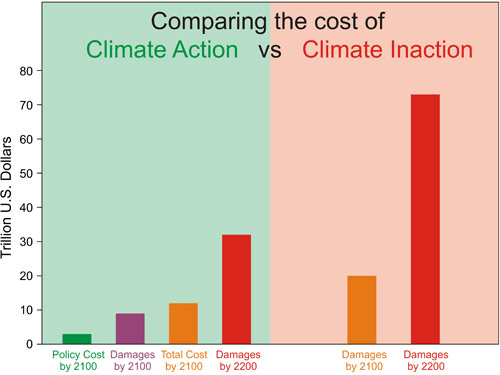
The new report finds that global society must more than triple investment in green energies by 2050 in order to have a reasonable chance of keeping temperatures from rising more than two degrees Celsius above pre-industrial levels, a goal agreed on by the world’s governments. However such a revolution–which would need to cut emissions to near zero by 2100–need not break the bank as some critics of climate change action have warned in the past.
“It is actually affordable to do it and people are not going to have to sacrifice their aspirations about improved standards of living,” co-chair Jim Skea told the Guardian. “It is not a hair-shirt change of lifestyle at all that is being envisaged and there is space for poorer countries to develop too.” According to the report, ambitious mitigation of climate change would reduce global economic growth–set at around 1.6 to 3 percent–by just 0.06 percent over the century. Moreover this analysis doesn’t take into effect the economic pluses of clean energy, such as reduced air and water pollution, new jobs, increased efficiency, and greater stability for energy prices.
“The loss in consumption is relatively modest,” the chairman of the IPCC, Rajendra Pachauri, told the Associated Press.
The report finds that this shift would reduce profits for the coal and oil industries, though may not hurt gas in the near-term; in fact, fossil fuel investments would need to drop by around $30 billion annually. Not surprisingly, lobbying from the powerful fossil fuel industry has proven one of the largest obstacles to governments taking bolder action on greenhouse gas emissions……..
according to the IPCC, the bulk of emissions reductions must come from a sped-up and scaled-up clean energy revolution and a phase-out of fossil fuels.
The IPCC, the world’s global authority on the science of climate change, releases new reports every six years meant to guide current negotiations over the global crisis. Nations are set to sign a new treaty on tackling global climate change in 2015….http://www.theepochtimes.com/n3/621996-un-touts-ambitious-but-cheap-investment-in-renewable-energy/?photo=2
South Africa’s growth in renewable energy
Africa: South Africa to Procure Still More Renewable Energy http://allafrica.com/stories/201404151599.html15 APRIL 2014 South Africa’s Department of Energy is to increase the amount of energy it will be procuring under the third window of its renewable energy programme for independent power producers, Energy Minister Ben Martins announced on Tuesday.
In November, the department signed agreements with 17 new preferred bidders in the third round of the programme, following the signing off of 47 projects in the first and second rounds, bringing to 64 the total number of renewable energy projects approved by the government since December 2011.
Once they are all operational, the 64 projects – representing foreign and domestic investment of over R100-billion – will add around 3 900 megawatts (MW) of wind, solar photovoltaic and concentrating solar power to South Africa’s energy mix.
On Tuesday, Martins said in a statement that this department would be allocating additional megawatts to the third window of the programme, thus including additional bidders, due to the increasingly competitive pricing offered by the round three bids.
Business Day reported in November that the average price offered for power generated from wind – which received the bulk of the third-round allocation – had dropped from R11.43 per kilowatt hour (kWh) in the first round to R6.65/kWh in the third round.
“The department will, in this regard, follow due procurement process to include additional bidders under window 3,” Martins said, giving no further specifics.
He added that submissions for the fourth window of the programme, which entails the procurement of a further 1 000 MW of renewable energy, was on track to close in August. The programme has five windows altogether.
While renewable energy accounted for less than 1% of South Africa’s energy mix in 2012, this is expected to reach 12% by 2020. According to research released in October by analysts Frost & Sullivan, this would place South Africa in the “global top 15 countries” with regard to the implementation of renewable energy projects.
Announcing the latest 17 preferred bidders in November, Martins noted that South Africa was currently rated as the 12th most attractive investment destination for renewable energy.
“This bodes very well for South Africa, as the programme has achieved international acclaim for fairness, transparency and certainty of programme,” Martins said, adding that there had been a progressive increase in the local content and job creation numbers offered by the bidders.
The department’s director-general, Nelly Magubane, said that some bidders had exceeded the local content requirement of no less than 40%, with some indicating that their projects would involve up to 56% local content.
Martins said the energy sector was expected to play a major role in creating green sector jobs, developing skills and transferring technology into South Africa’s economy.
Employment boost for South Africa due to renewable energy projects
Green energy IPPs create 14 000 jobs http://www.iol.co.za/business/companies/green-energy-ipps-create-14-000-jobs-1.1675332 April 14 2014 Independent power producers (IPPs) using renewable energy had created about 14 000 jobs over the past three years, Energy Minister Ben Martins said on Friday. “One of the imperatives of government is to ensure that all departments assist in job creation. Through the independent power producers programme, more than 14 000 have been created,” Martins said following a summit with 61 IPPs. “At the meeting, we acknowledged and expressed appreciation of the fact that to date more than R100 billion has been invested into this particular sector.” IPPs are entities which either own and or operate facilities that generate electric power. They then sell the power to a utility, central government buyer or to end users. The meeting was also attended by representatives of the Development Bank of Southern Africa, Eskom and the Public Investment Corporation. Diplomats representing Denmark, Spain, Germany, Norway, and the UK were also present at the Pretoria meeting. Martins said the IPP project had brought significant direct foreign investment. – Sapa
Fukushima Renewable Energy Institute opened
 Fukushima embracing renewable energy research http://japandailypress.com/fukushima-embracing-renewable-energy-research-1047080/ Apr 10, 2014 John Hofilena Fukushima, the area in Japan which felt the brunt of what is now one of the world’s worst nuclear crisis since Chernobyl, is now hopefully turning over a new leaf amidst the struggle to rebuild and start the process of renewing that which was destroyed by the Great East Japan Earthquake and tsunami. It is now giving renewable energy a chance. On April 1, Japan’s National Institute of Advanced Industrial Science and Technology has just launched a renewable energy research and development center in Koriyama, Fukushima Prefecture.
The Fukushima Renewable Energy Institute, as it is called, opens three years after the Fukushima nuclear power plant suffered catastrophic meltdowns after the massive earthquake and tsunami that hit east Japan in March 2011. Much of Japan took a negative view of nuclear power starting from that time, and it is a testament to that negativity that 48 of Japan’s commercial nuclear reactors are offline at the moment. In the meantime, renewable energy sources such as solar and wind power have been in vogue in Japan. All of Japan’s renewable power sources are supplemental to fossil fuel-driven thermal energy at this point, but the situation may start to change.
Fukushima’s new R&D center will be at the center of a major project to develop the world’s most advanced energy technologies and make renewable energy Japan’s primary power source. Aside from the two new buildings, a solar power and wind power generation facilities also sit within the site. Major Japanese technology companies such as Hitachi, Sharp and Panasonic have jumped into the project and will conduct R&D at the center. The goal of the center is to develop state-of-the-art renewable technologies for implementation in various areas of the country. These new technologies will include new solar power innovations that improve energy conversion efficiency and a wind power generation system using laser lights — all of it exciting for Japan if all goes according to plan.
Japan’s energy efficiency success
 How Japan Replaced Half Its Nuclear Capacity With Efficiency https://www.greentechmedia.com/articles/read/how-japan-replaced-half-its-nuclear-capacity-with-efficiency
 Is new coal really necessary in Japan? Lauri Myllyvirta and Justin Guay April 10, 2014 After the Tohoku earthquake in March 2011, Japan was in a seemingly impossible situation. A tremendous amount of conventional generation capacity, including the entire nuclear fleet, was unavailable, and the country faced the risk of power cuts during summer consumption peaks.
But miraculously, or seemingly so, in just a few short weeks Japan managed to avert the rolling power cuts that many believed inevitable. Even more impressive, the Japanese have turned these emergency measures into lasting solutions.
So how’d they do it without forcing people back to the Stone Age? Japan overcame this daunting task by tapping the cheapest and most widely available source of energy: energy efficiency and conservation. Much of the electricity savings were initially driven by a popular movement known as “Setsuden” (“saving electricity”). This movement emerged to encourage people and companies to conserve energy and prevent rolling power cuts. Simple measures such as increasing temperatures in homes and offices, “thinning” lighting by removing some of the bulbs and tubes, shutting down big screens and cutting exterior lighting enabled Japan to dramatically reduce power demand almost overnight (albeit at the cost of a small amount of personal comfort).
In addition to these measures, the dress code in offices was eased to reduce the need for AC, while commercial facilities were audited to identify potential savings.
These temporary measures have proven to have long-term impact. Continue reading
IKEA to produce nearly twice as much energy as it needs, from Illinois Wind Farm
Ikea’s Wind Farm to Produce More Energy Than Total US Footprint http://www.sustainablebusiness.com/index.cfm/go/news.display/id/25640 SustainableBusiness.com News, 10 April 14, Ikea has bought its first US wind farm, as it steadily moves toward running its stores completely on renewable energy.
At 98 megawatts (MW), Illinois’ Hoopeston Wind Farm is the companies biggest, single renewable energy investment to date. Currently under construction, it comes online early next year.
Impressively, it will produce 165% of the electricity consumed by all of IKEA US – 38 stores, five distribution centers, two service centers and one factory).
Located about 110 miles south of Chicago, the project will consist of 49 Vestas 2 MW wind turbines. “This investment is great for jobs, great for energy security, and
great for our business. Importantly, it’s great for the future of our
climate,” says Steve Howard, Chief Sustainability Officer of Ikea Group.
“We are committed to renewable energy and to running our business in a way that minimizes our carbon emissions, not only because of the environmental impact, but because it makes good financial sense,” says Rob Olson, Chief Financial Officer of IKEA US. “We invest in our own renewable energy sources so that we can control our exposure to fluctuating electricity costs and continue providing great value to our
customers.”
Apex Clean Energy is building the wind farm and will manage it after it comes online. “This project is an opportunity for Apex to work with a new type of investor and partner to expand wind energy development in this country,” says Mark Goodwin, President of Apex.
Worldwide, Ikea owns 206 wind turbines through its wind farm
investments in nine countries: US, Canada, UK, Ireland, Denmark, Sweden, France, Germany and Poland.
Ikea is also very active in solar. In the US, 90% of its buildings have rooftop systems, for a total of 38 MW across 20 states. A Colorado store incorporates geothermal and another is planned for a Kansas City-area store that opens this Fall.
And in Britain, Ikea will sell solar systems at all its stores in addition to furniture and housewares.
The company is investing $2 billion in wind and solar by 2015 and has invested $55 million over the past few years on efficiency upgrades. Worldwide, renewables provide 37% of the its total energy footprint right now – 305 stores in 26 countries.
Ikea’s goal is to generate as much renewable energy as the total energy it consumes by 2020.
Last year, corporate leaders added over 445 MW of solar on 1000 buildings in 30 states, up 48% from 2012. Ikea came in 5th place for total solar installed, after Walmart, Costco, Kohl’s and Apple.
Energy use could drop by 73% with Energy Efficiency
Japan Replaced Half Its Nuclear Power With Energy Efficiency. Could The U.S. Do Something Similar? Climate Progress,
BY ARI PHILLIPS ON APRIL 10, 2014
“………Several years ago a team of researchers at Cambridge University estimated that the world could save 73 percent of its energy through efficiency measures. Changes like using thicker building installation, installing triple-paned windows, and lowering washing machine temperatures could help demand-side efficiency efforts supplant the slower pace of supply-side implementation of clean energy sources.

The U.S. residential sector consumes about 37 percent of the total electricity production in the country, at a per-household rate of more than double the U.K. does. Andrew Tarantola at Gizmodo recently published a thorough breakdown of why we’re so much more inefficient than our British counterparts:
It’s not just clothes dryers and A/C units. British appliances are also quickly outpacing their U.S. counterparts in terms of efficiency. In the U.K., chest freezers now consume 66 percent less energy than they did in 1990, upright freezers use 59 percent less, and new freezers use 55 percent less. Similarly, wet appliances like dishwashers and washing machines consume 39 percent and 32 percent less power, respectively, than they did in the 1990s.
U.S. appliances, while certainly more efficient than they were in the 1990s, cannot match these gains. Energy Star certified refrigerators, for example, only have to be 15 percent more efficient than non-qualified models or 20 percent more efficient than models that simply meet the federal minimum energy efficiency standard.
We live in bigger houses, we use more air conditioning and, a surprisingly significant factor — our cable boxes are always on. According to Gizmodo, a cable box and standalone DVR can use as much as 446 kilowatt hours a year, far more than those in the U.K. which go into sleep mode for the two-thirds of the day they’re not being used. However at a certain point the issue is not energy efficient options, but a will to utilize them. Studies have shown that when services get less expensive via gains in efficiency, Americans use more of them, offsetting much of the electricity savings. It took a natural disaster of epic proportions in Japan to change habits. What will it take here?http://thinkprogress.org/climate/2014/04/10/3425406/japan-energy-efficiency-replacement/
Every USA State could move to 100% renewable energy
 Visualizing What Would Happen If Every State Transitioned To Renewable Energy, Co-Exist, 10 April 14 Imagine a world where we could get past the politics and have clean energy. These maps show what that would mean for each state. Just for a minute, forget the administrative headache and upfront costs of switching entire states–or even countries–to 100% renewable energy. How would a world of renewable energy-powered homes and businesses be different? If Michigan switched to wind, water, and solar, the state would see annual energy savings of $4,300 per person, 64,300 long-term construction jobs, and 46,200 operations jobs. Health costs would drop dramatically. It’s a similar story throughout the U.S.
In a new interactive map, The Solutions Project shows off all the potential upsides of a country operating solely on renewables. An organization made up of prominent scientists, business leaders, and cultural ambassadors (like actor Mark Ruffalo), the Solutions Project aims to explain the benefits of transitioning to renewables from both a business and science perspective.
Ruffalo, the most public-facing leader of the Solutions Project–and a long-time environmental advocate–first became interested in creating a comprehensive renewable energy plan because of frustrations about the way people talk about the energy space, focusing more on problems than potential fixes……..
The Solutions Project is doing more than just nice-looking maps and infographics. According to Jacobson, the group is building renewable energy transition plans for each state, identifying the states most likely to adopt those plans, and then talking to relevant policymakers. In California, there is a measure inside the Democratic Party to integrate that state’s renewable energy plan into the party platform. “We’re just getting off the ground in terms of implementation,” says Jacobson.
Check out the interactive renewable energy map here. http://www.fastcoexist.com/3027734/visualized/visualizing-what-would-happen-if-every-state-transitioned-to-renewable-energy
Europe can have an integrated, competitive, energy market , with renewables
Only renewables can create an integrated, competitive EU energy market http://www.euractiv.com/sections/energy/only-renewables-can-create-integrated-competitive-eu-energy-market-301456 , 9 April 14 The European Commission’s state aid decision on 9 April has put renewable energy support schemes in the firing line, and threatened attainment of the 2030 climate and energy goals, even though renewable energy has created – and not obstructed – competition, writes Martin Schoenberg.
Martin Schoenberg is head of policy atClimate Change Capital, an environmental asset manager and advisor.
Is there really a contradiction between national-level state intervention to promote renewable energy and the internal market for energy? Depends on how you look at it. I would argue there is not. Continue reading
A solar energy powerhouse is developing fast: it’s Chile
Chile An Emerging Solar PV Powerhouse http://www.energymatters.com.au/index.php?main_page=news_article&article_id=4257 Chile installed 150MW of solar panels in the first quarter of this year and has a further 380MW of PV under construction.
According to GTM Research’s Latin America PV Playbook, Q2 2014; the 150MW tally is triple the amount that any Latin American country has ever installed in a single quarter.
A major contributor to the impressive first quarter total was SunEdison’s 50.7 MW San Andres solar farm; the largest merchant solar plant in Latin America to date. SunEdison recently announced it has sold a majority stake in the facility to a group of investors.
GTM Research forecasts Chile will install 244 megawatts of PV this year; some of which support the nation’s energy-hungry mining industry. Last year, Chile’s renewable energy capacity jumped 40 percent to just over one gigawatt. The nation’s renewable energy target demands utilities source 20 percent of their power from renewable sources – excluding hydro – by 2025.
GTM Research considers Latin America to be the “global frontier” for unsubsidized solar markets.
“With high insolation levels and growing demand, it is positioned to be one of the most attractive regions on the planet for solar development.”
Chile has a population of more than 17 million. According to Wikipedia, its electricity generation sector relies mainly on hydro-electric power (33% of installed capacity as of May, 2012), oil (13%), gas (30%) and coal (20%). Much of its fossil fuel is imported.
The nation’s newly elected president, Michelle Bachelet, this week announced a proposed carbon tax. Under the proposal, thermal power plants with a generation capacity of at least 50 megawatts will pay a tax of $5 per metric tonne of carbon dioxide emitted. The carbon tax would be the first to be implemented in South America.
The world will be changed by China’s renewable energy revolution
 China’s Renewable Energy Revolution Has Global Implications, Clean Technica John Mathews and Hao Tan, 8 April 14, China’s renewable energy revolution is powering ahead, with the year 2013 marking an important inflection point where the scales tipped more towards electric power generated from water, wind and solar than from fossil fuels and nuclear. This means that its energy security is being enhanced, while carbon emissions from the power sector can be expected to soon start to fall.
China’s energy revolution, which underpins its transformation into the world’s largest manufacturing system (the new “workshop of the world”), continues to astonish all observers, and terrify some. China is known widely as the world’s largest user and producer of coal, and the world’s largest emitter of carbon dioxide and other greenhouse gases. This is true. Less noticed has been the fact that China is also building the world’s largest renewable energy system – which by 2013 stood at just over 1 trillion kilowatt-hours – already nearly as large as the combined total of electrical energy produced by the power systems of France and Germany.1
The energy landscape continues to give the clearest indication of the trends in industrial dynamics and prospects for the future. China is powering ahead with renewables while at the same time it expands its reliance on fossil fuels; the US by contrast is further locking in its dependence on fossil fuels. The distinction is critical………
We need to sketch in the background to China’s energy revolution, so that the enormity of its commitment to renewables may be appreciated. ……. While coal for thermal power continues to rise, the overall consumption of coal appears to be ‘capped’ at 3,500 million tonnes – a desperate measure taken no doubt in response to the blackening skies and poisoning of water and air
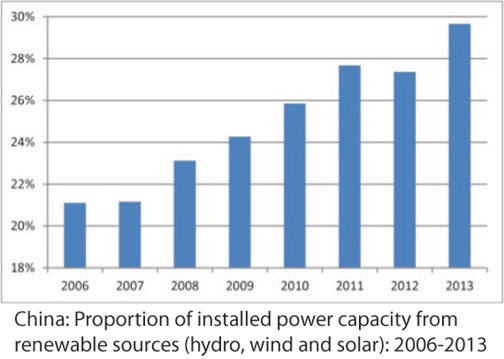
In just the space of eight years, China has become the world’s most important generator of wind power, with the world’s largest capacity and the largest addition of new power capacity in the year 2013. The increase in all three sources of renewables – hydro, wind and solar PV – is shown in Fig. 3, in terms of the proportion of power generated by renewables and its relentless rise (apart from a dip in 2012, following world recession in 2011).
The proportion reached by 2013, of close to 30% of electrical energy generated from renewable sources (hydro, wind and solar), is what gives China its international influence in renewables – and it demonstrates a relentless trend towards greater reliance on manufacturing systems for production of, e.g. wind turbines and solar cells, as opposed to the reliance elsewhere on alternative fossil fuels such as coal seam gas and shale oil…….
The sharp rise in renewables reflects particularly the new commitment to wind power – and it looks set to continue through industrial logistic dynamics. We will develop an argument below for the significance of this date……….
3. Investment trends
Expenditure in building new power generating infrastructure can reveal more than data on capacity and generating additions. The CEC has released investment data for 2013, which reveal the following trends. In terms of investment, China spent more on its grid in 2013 than on new power generation facilities………The significance of this is that China is spending on infrastructure to accommodate more renewable power facilities, as well as on the facilities themselves. Of the new generation facilities, investment in new energy sources accounted for more than 40% of the total investment in new power generation facilities…….
Thus our conclusion that in 2013, China’s leading edge of change in its electric power system is now more “green” than “black”. We have demonstrated above that this is unambiguously so in terms of capacity added and in terms of investment, while in terms of new generation of electrical energy thermal still marginally outranks renewables (180 billion kWh generated to 160 billion kWh)………
at the leading edge, for the year 2013 alone, China added 94 GW of new capacity, of which 55.3 GW came from renewables (59%), and just 36.5 GW (or 39%) came from thermal sources – a dramatic reversal of past trends;…….
our analysis that China’s carbon emissions are set to peak and then to fall – and fall faster than in the US or in Europe……..http://cleantechnica.com/2014/04/08/chinas-renewable-energy-revolution-global-implications/
Solar energy growing, solar prices falling
 There are more and more places across the globe where renewable energy is being installed without any subsidy, or the renewables are being installed because they’re cheaper than the available fossil fuel technology,
Cheap Solar Power Is Fueling Global Renewable Energy Growth: Report http://www.huffingtonpost.com/2014/04/07/solar-power-renewable-energy-growth_n_5107150.html 7 April 14
The share of total global electricity production generated by renewable energy is climbing, mainly because solar photovoltaic systems are becoming less expensive, according to a report released Monday by the United Nations Environment Programme and Bloomberg New Energy Finance.
Wind, solar and other renewables, excluding hydropower, were 8.5 percent of total global electric power generation last year, up from 7.8 percent in 2012, the report says. Continue reading
China’s motives in developing renewable energy
China is serious in its pursuit of renewables, because it seems to believe that its future prosperity depends on building the industries that produce power – complementing its activities in searching for fossil fuels supplies all around the world. There is a lesson here for all other developing countries, and notably for India and Brazil. And not only developing countries.
China’s Renewable Energy Revolution Has Global Implications, Clean Technica John Mathews and Hao Tan, 8 April 14, “……The motives Finally, we need to ask what are the motives for China’s dramatic shift to a renewables trajectory? The common assumption is that it is concern over climate change (global warming) that drives the shift. Important as this motive is, we believe it is the least likely of the explanations for China’s shift. We believe the more plausible explanation for China’s new trajectory – and for the determination with which it is being pursued – is energy security and industrial development. Continue reading
1 This Month

petition to oppose the rapid increase of space-military industry threatening Jeju Island and the region.
[Petition by April 19th (KST)] Stop the joint military-Hanwha Systems-Jeju Provincial Government Sea Launch!

Chernobyl: The Lost Tapes – A good documentary on Chernobyl on SBS available On Demand for the next 3 weeks– https://www.sbs.com.au/ondemand/tv-program/chernobyl-the-lost-tapes/2352741955560

of the week–London Campaign for Nuclear Disarmament

Tell the Ukrainian Government to Drop Prosecution of Peace Activist Yurii Sheliazhenko
To see nuclear-related stories in greater depth and intensity – go to https://nuclearinformation.wordpress.com
-
Archives
- April 2026 (194)
- March 2026 (251)
- February 2026 (268)
- January 2026 (308)
- December 2025 (358)
- November 2025 (359)
- October 2025 (376)
- September 2025 (257)
- August 2025 (319)
- July 2025 (230)
- June 2025 (348)
- May 2025 (261)
-
Categories
- 1
- 1 NUCLEAR ISSUES
- business and costs
- climate change
- culture and arts
- ENERGY
- environment
- health
- history
- indigenous issues
- Legal
- marketing of nuclear
- media
- opposition to nuclear
- PERSONAL STORIES
- politics
- politics international
- Religion and ethics
- safety
- secrets,lies and civil liberties
- spinbuster
- technology
- Uranium
- wastes
- weapons and war
- Women
- 2 WORLD
- ACTION
- AFRICA
- Atrocities
- AUSTRALIA
- Christina's notes
- Christina's themes
- culture and arts
- Events
- Fuk 2022
- Fuk 2023
- Fukushima 2017
- Fukushima 2018
- fukushima 2019
- Fukushima 2020
- Fukushima 2021
- general
- global warming
- Humour (God we need it)
- Nuclear
- RARE EARTHS
- Reference
- resources – print
- Resources -audiovicual
- Weekly Newsletter
- World
- World Nuclear
- YouTube
-
RSS
Entries RSS
Comments RSS
 nuclear-news