Pope Francis comes out for renewable energy: fossil fuel industries should be nervous
How Pope Francis could tip the balance against fossil fuels http://reneweconomy.com.au/2014/how-pope-francis-could-tip-the-balance-against-fossil-fuels-63601 By Giles Parkinson on 23 December 2014 Six years ago, Pope Benedict XVI installed more than 1,000 solar panels on the Vatican’s audience hall, helping him earn him the sobriquet of the “Green Pope.
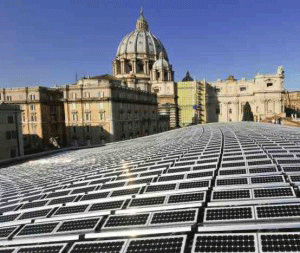 Some time in the next few months, his successor Pope Francis may just go one step further. His actions could tip the balance against fossil fuels, as the world’s wealthiest institution takes on the world’s most powerful industry.
The signs have been building. In November, the Pope sent a letter to Australian Prime Minister Tony Abbott urging him to address climate change and sustainability at the G20 summit – something Abbott had pointedly refused to do.
At Lima, the Pope sent another letter urging diplomats to agree on a strong deal to tackle climate change as UN negotiations drew to a close. In a message to Peru’s environment minister, Manuel Pulgar Vidal, who led the discussions in Lima, Francis warned that “the time to find global solutions is running out.”
A group of Catholic Bishops went one step further, calling for an end to fossil fuel use, citing climate change’s threat to the global poor as the lodestar of their concern. The document, signed by bishops from all continents, insisted on limiting global temperature rise to 1.5°C relative to pre-industrial levels — a considerably more ambitious goal than the 2°C ceiling that’s generally agreed on as the threshold beyond which climate change becomes truly dangerous.
They also called for the building of “new models of development and lifestyles that are both climate compatible” and can “bring people out of poverty.” Specifically, they said: “Central to this is to put an end to the fossil fuel era, phasing out fossil fuel emissions and phasing in 100 per cent renewables with sustainable energy access for all.”
There is growing speculation within church circles that this view is held at the highest level. Pope Francis wants the image of the Catholic Church to evolve beyond that of a huge multi-national corporation, to its origins as a social and humanitarian based organisation.
As he showed in his extraordinary speech this week to the priests, Pope Francis is very much his own man, not of the establishment.
Francis told the bishops and cardinals who run the Curia – the central administration of the Roman Catholic Church – that their careerism, scheming and greed had infected them with “spiritual Alzheimer’s”.
It was Benedict, though, who put the wheels in motion. The solar panels on the audience hall were enough to power the lighting, heating and cooling of a portion of the entire Vatican state. According to this National Geographic article, he authorised the Vatican’s bank to purchase carbon credits by funding a Hungarian forest, thus making the Catholic city the only fully carbon neutral nation-state.
Several years later, he unveiled a new hybrid Popemobile that would be partially electric. Francis went a step further, commissioning Osram to install 7,000 LED lights in the Sistine Chapel, cutting energy consumption by 90 per cent. It is now being extended to other Vatican museums.
But how much further could Pope Francis go? There is speculation that in his Encyclical, due in April, or even in a New Year’s speech, he could call for dramatic reform by the Catholic church. It would be similar, but bolder and more practical, than the Ecological Conversion address of Pope John Paul II in 2001.
This could include divestment. No one knows how much the Catholic Church has in its funds. It is likely to be hundreds of billions. The Uniting Church in Australia has voted to divest from fossil fuels. In July, the World Council of Churches, an umbrella group representing over half a billion Christians, announced its plans to fully divest from fossil fuels.
The SMH reports that in the same month, the Anglican Church of Australia passed a motion encouraging its diocese to divest. It noted then than a global campaign for the Vatican to divest had just been launched. Ironically, the Vatican’s finances are now controlled by Cardinal George Pell, the former archbishop of Sydney who is a noted climate science denier.
There is speculation that the Pope could emulate the bishops’ call for 100 per cent renewables. What he could do is repeat and enhance the efforts to install solar and lighting at the Vatican across the church’s global assets. In effect, he could follow in the footsteps of other corporate giants – such as Google, Apple and Ikea – and set a goal of 100 per cent renewables for his own church, or corporate entity.
The Catholic Church is not just the largest private employer in Australia (and other countries), with some 180,000 employees, it is also one of the biggest energy consumers – with a combined annual bill that runs into the billions of dollars from schools, aged care centres, churches, parish centres and hospitals.
A series of initiatives that encouraged energy efficiency, the installation of solar systems – schools would be perfect for this because usage matches solar output – and also battery storage would have a profound impact on the incumbent energy system, hastening the inevitable transition to decentralised energy grid.
Not only will this encourage and facilitate a much higher overall adoption of renewables, it will also likely result in cheaper energy for all consumers. Major network providers in Australia see this as inevitable, and are already installing – without subsidies – battery storage instead of upgrading grids,and talking of renewables-based micro-grids instead of relying on the old centralised model.
In the US, the combined energy consumption of Catholic organisations – schools, hospitals, aged care, churches, seminaries and the like, would run into the tens of billions. In Europe, the same again.
But if the Pope’s criticism of the Curia was greeted by stunned silence in the Vatican, it is unlikely that any move towards divestment or a massive uptake of renewables would be greeted in the same way.
The fossil fuel industry is certainly worried. Rio Tinto CEO Sam Walsh, who has repeatedly told everyone that the future is coal, took part in a “day of reflection” at the Vatican in September last year. It was ostensibly billed as a chance for mining companies to get “Christian ethical input” to their conversations about the future of their industry. Others saw it as a lobbying exercise.
More recently, the AFR reports, Walsh and other CEOs of major fossil fuel companies took part in an “Ecumenical Day of Reflection on Mining” at Lambeth Palace, the seat of the Church of England, another massive institution – both in terms of funds, and energy consumption.
77% Of New US Electricity Generating Capacity was in wind and solar, In November
 Wind & Solar = 77% Of New US Electricity Generating Capacity In November Clean Technica December 23rd, 2014 by Joshua S Hill “……. I have included an estimate of non-utility-scale solar (i.e., residential and commercial solar) in the numbers below……The United States Federal Energy Regulatory Commission’s (FERC) Office of Energy Projects released its monthly “Energy Infrastructure Update” on Tuesday, and the big winners from the month of November seem to be wind and solar, which combined added up to over 70% of all new electrical generating capacity placed into service during the month. If you add in our estimate for non-utility-scale solar, the market share of solar and wind rises to 77%.
And as Ken Bossong, Executive Director of the SUN DAY Campaign, says, this is a good thing:
“With only one month left in 2014, it has become a horse race between natural gas and renewable energy as to which will dominate new electrical generation for the year. Regardless of the winner, it is apparent that coal, oil, and nuclear will be left behind in the dust.”……… https://cleantechnica.com/2014/12/23/wind-solar-account-70-new-us-generating-capacity-november/
Renewable energy has now gained political clout, in USA States
Renewable energy companies use new clout in statehouses, Phys Org, Dec 24, 2014 by Jeffrey Stinson, Stateline.org “……..Green energy industries have become mainstream businesses with the political clout to match the fossil fuel industry and big electric utilities in many statehouses, and they are using that influence to defend the renewable energy standards in place in 31 states and the District of Columbia.
Green industry is creating jobs, providing lease payments to landowners and taxes for local government in many states. Companies like Siemens and GE are highly invested in green energy. And many state lawmakers don’t want to see the economic benefits shrink or disappear.
Wind represents about $118 billion in private investment in the U.S. economy and sustains about 73,000 jobs, according to the American Wind Energy Association. About $17.3 billion a year is invested in new wind farms.
The solar industry, meanwhile, employs about 143,000 people and pumps nearly $20 billion a year into the economy, according to the Solar Energy Industries Association.
The economic impact of the fossil fuel industry is much larger, but Tom Plant of the Center for the New Energy Economy at Colorado State University noted that green energy has “become mainstream … and a pretty significant component of economies of the states.”………
In addition to states with mandatory standards, seven – Alaska, Indiana, North Dakota, Oklahoma, South Dakota, Utah and Virginia – have voluntary goals.
Combined with federal and state green energy tax breaks, state renewable portfolios have been instrumental in building the renewable sector. They “drive demand,” said Susan Sloan, vice president for state policy at the American Wind Energy Association.
Technological advancement is making green energy more economically competitive compared to fossil fuel, especially coal………..
Wind, solar and other alternative sources are increasingly popular with the public compared to fossil fuels, polls indicate. And many companies want to demonstrate they’re in favor of environmentally friendly policies……….
Wind has become “a big cash crop” for Kansas farmers, she said, with wind farms providing about $16 million a year in lease payments to landowners. Local government receives about $10 million a year in lieu of tax payments from them, which is good revenue for rural counties……….. http://phys.org/news/2014-12-renewable-energy-companies-clout-statehouses.html#jCp
Solar panels installed in a big way in Philippines business centres
Businessmen tap the power of the sun, Manila Standard, By Alena Mae S. Flores | Dec. 20, 2014 Solar technology is now shining in the Philippines, as some businessmen began to install solar panels on rooftops of schools, office buildings and even shopping malls, seven years after the passage of Republic Act No. 9513, or the Renewable Energy Law. This year alone, the industry saw a significant number of solar rooftop projects installed, a feat that has not been immediately felt after the passage of the law, which promotes the use of renewable energy resources such as solar, wind and mini-hydro projects.
Energy Secretary Carlos Jericho Petilla expects renewable energy projects including solar rooftop installations to pick up next year, heralding the golden age of renewable energy in the country. Petilla says solar rooftop capacity will continue to increase in 2015, amid the strong interest from schools, commercial and industrial projects and even government offices.

“You can never tell how many institutions are going to be included because it depends on the size of each project. Because of so many interests for solar technology at the moment, some of them are already moving on their own even without our initiative,” Petilla says.
The European Chamber of Commerce of the Philippines estimates the potential market for solar rooftop projects at $450 million yearly, based on 50,000 households or a tenth of the half a million constructions yearly, with average solar panel installations of 2 kilowatts each.
Solar rooftop installations are expected to reach 2.5 megawatts by end-2014, as more homeowners and enterprises realize the opportunities to save money and mitigate climate change by harnessing sunlight to power homes and offices.
ECCP says with the continued drop in system prices, solar energy is approaching grid parity, opening the way for more solar rooftop installations.
“Vast installation of solar panels on rooftops of households, commercial buildings and industrial facilities could help safeguard the country’s energy security over the long term. Rooftop solar panels could be a viable solution for the Philippines given its high solar irradiation level,” ECCP says.
The Philippine Solar Power Alliance earlier estimated that the country has an untapped solar rooftop potential of about 300 MW.
One company, Propmech Corp., recently installed a solar-rooftop project at St. Scholastica’s College in Manila that will enable the school to save as much as 20 percent in electricity cost.
“We are prioritizing schools for solar projects because of the reason they more open to the public than private companies, other institutions can freely go to them to learn about solar panels,” Petilla says.
St. Scholastica’s joins the rank of other schools such as Manuel L. Quezon University, Mapua Institute of Technology and La Consolaction College-Manila, in utilizing renewable energy.
St. Scholastica’s St. Cecilla’s Hall has been turned into a 96-kilowatt solar power plant that can generate 38.88 percent of the hall’s daily energy needs. The amount will greatly reduce St. Scholastica’s monthly electricity expenses…………….
Solar applications have also long been used as off-grid solutions in rural and remote areas in the country.
Solar systems can also power basic necessities such as lighting, water pumping, communications and a variety of livelihood activities that immediately improve the lives of Filipinos in areas where electricity from the grid is not readily available. http://manilastandardtoday.com/2014/12/20/businessmen-tap-the-power-of-the-sun/
At COP 20 in Lima: The Buzz about Renewable Energy Union of Concerned Scientists, Rachel Cleetus, senior climate economist, Climate and Energy“…..at the annual United Nations climate talks, or COP 20. Even as negotiators labor over “non-papers” and “elements of draft negotiating text,” the real buzz here is about the incredible opportunity to drive down global emissions by investing in renewable energy and energy efficiency. What makes this a particularly exciting time is that the costs of renewable energy are falling dramatically. The clean energy transition has never been more affordable – or, frankly, more urgently needed.
Global progress on renewable energy
Renewable energy is growing by leaps and bounds worldwide. In 2013, renewables accounted for more than 56 percent of net additions to global power capacity. Recent data from Bloomberg New Energy Finance (BNEF) shows that global clean energy investment in the first three quarters of 2014 added up to $175 billion, 16 percent higher than in the same period of 2013.
This post is part of a series on theUN Climate Change Conference in Lima (COP 20).
Solar energy, in particular, has experienced tremendous growth. In 2013, for the first time, global growth in solar photovoltaic (PV) outpaced new wind capacity. Annual growth in global solar PV capacity has averaged almost 55 percent over the past five years.
Recent news stories have highlighted that investment banks are also increasingly recognizing the financial benefits of investments in renewable energy. For example, Goldman Sachs has committed to $40 billion in existing and planned renewables investments, including in BrightSource Energy, which designed the solar thermal system for Ivanpah, the largest solar plant in the world.
However, to scale up clean energy even more rapidly to help meet climate goals, we need strong policy support, such as renewable energy and energy efficiency standards and incentives; investments in transmission infrastructure to integrate higher levels of renewable energy; investments in research and development; and a price on carbon. The rapid growth of renewables, their falling costs, and the urgent need to reduce carbon emissions makes a weak extension of the production tax credit by the U.S. Congress —an effective federal incentive that supports business development of wind and other renewable energy sources— seem all the more misguided.
The dramatically falling costs of renewable energy
Renewable energy costs are falling worldwide. In the U.S., for example, the national average cost of wind power has dropped more than 60 percent since 2009, making it competitive with new fossil fuel plants in many regions. Solar PV system costs fell by about40 percent from 2008 to 2012 and by another 15 percent in 2013.
Looking ahead, the two trends of improved technologies and reduced costs are expected to continue, according to research from BNEF, the International Renewable Energy Agency (IRENA), and the National Renewable Energy Laboratory (NREL), U.S. Department of Energy.
A race to the top
In a joint climate announcement with the U.S., China set a goal of achieving a 20 percent share of non-fossil energy in total primary energy by 2030. Renewable Energy Prospects: China, a recent report from IRENA and the China Renewable Energy Centre, shows that China can meet and exceed that goal affordably. The analysis shows that China can increase its renewable share of energy from 13 to 26 percent by 2030, and the share of renewables in the power sector to 40 percent by 2030. This pathway would also help deliver tremendous public health benefits to a country plagued by pollution from its dependence on coal-fired power.
The U.S. has announced a draft Clean Power Plan to limit carbon emissions from power plants, the single largest source of those emissions in the country. Analysis by UCS shows that the draft plan can be strengthened to raise emission reductions from 30 to 40 percent below 2005 levels by 2030 simply by increasing the contribution from renewable energy. Other elements of the President’s Climate Action Plan, including increasing fuel economy standards and implementing methane regulations, can cut emissions further.
What’s also striking is that the top two countries competing neck and neck in renewable energy deployment are China and the United States, also the world’s two biggest carbon emitters currently. Germany, Spain, Italy, and India round out the list of the top six countries in terms of non-hydro renewable energy capacity.
While all major emitting countries clearly can and should do more, these are promising times for catalyzing ambitious global climate action.
Renewable energy and energy efficiency are essential to meet climate goals
A number of global research efforts are underway to show the feasibility and affordability of deep cuts in emissions. IRENA has recently launched the ReMap 2030 project to analyze global pathways for doubling the share of renewable energy in the world’s energy mix by 2030. The Deep Decarbonization Pathways project, a joint initiative of the Sustainable Development Solutions Network (SDSN) and the Institute for Sustainable Development and International Relations (IDDRI), shows how individual countries can contribute to a global goal of limiting temperature increases to no more than 2°C. The IEA’s World Energy Outlook also provides analysis to back a 450ppm CO2equivalent global pathway.
The common theme of all these reports, written by experts from all over the world, is thatit is feasible to jump start a clean energy transition and that we cannot achieve our climate goals without a very ambitious ramp-up in renewable energy and energy efficiency.
What’s more, many studies are also pointing out that this transition is affordable and beneficial for the global economy and for public health….. http://blog.ucsusa.org/at-cop-20-in-lima-the-buzz-about-renewable-energy-756
Small solar appliance makes drinking water clean
 All It Takes For The Desolenator To Make Clean Drinking Water Is A Little Sunlight Fast Coexist, 21 Dec 14 Polluted or salty water becomes drinking water for a small family.Turning saltwater into clean drinking water is usually an expensive and energy-intensive process—a new desalination plant under construction in San Diego has a price tag of $1 billion, and smaller devices can cost as much as $30,000. But a new solar-powered device could make the process affordable for the millions of people around the world who don’t have running water.
“Other devices produce more water, but they are significantly more expensive, and they require quite a bit of maintenance and consumables,” says Desolenator‘s CEO William Janssen. “On the other side you have the solar still, the traditional solution—but that unit only produces half a gallon of water per day. Our solution can produce 3 to 4 gallons a day, enough for drinking and cooking.”
It’s designed for the hundreds of millions of people around the world who lack easy access to drinking water but happen to live near polluted rivers, lakes, or coastlines.
“If you look around the equatorial belt of the world, there are many countries that are very densely populated where water resources are very stressed,” says Janssen. “It will get worse—by 2025, close to 3 billion people will deal with water scarcity daily. We want to give them something that’s an affordable, family-sized device.”…………..http://www.fastcoexist.com/3039870/all-it-takes-for-the-desolenator-to-make-clean-drinking-water-is-a-little-sunlight#1
No wonder the nuclear lobby is in panic mode: renewables are winning worldwide
 All over the world, renewables are beating nuclear David Elliott, 18 Dec 2014, The Ecologist http://www.theecologist.org/blogs_and_comments/commentators/2681228/all_over_the_world_renewables_are_beating_nuclear.html
As flagship nuclear projects run into long delays and huge cost overruns, solar and wind power are falling in price, writes David Elliott. Renewables already supply twice as much power as nuclear. It’s just too bad the nuclear-fixated UK government hasn’t noticed.
Renewables are winning out just about everywhere. They now supply over 19% of global primary energy and 22% of global electricity. Nuclear is at 11% and falling. Continue reading
UK’s latest Energy Trend’s Report contradicts David Cameron’s anti -wind claims

 Record renewable generation disproves Cameron’s attack on onshore wind. Edie.net
In light of these figures, clean energy trade association RenewableUK claims that David Cameron was wrong to attack onshore wind earlier this week, when he claimed that the public was “fed up” with onshore windfarms and said the country did not need any more subsidised turbines on land now that the energy source was capable of providing 10% of UK energy.
“Their understanding of the importance of generating clean power from home-grown sources stands in sharp contrast to the misguided and quite frankly ignorant comments by the Prime Minister earlier this week, when he wrongly suggested that people are fed up with wind.”
Less energy
According to a BBC article, the average person in the UK uses 10% less electricity than five years ago ……..http://www.edie.net/news/6/Cameron-was-wrong-to-attack-onshore-wind–says-RenewableUK/
Investment banks downgrading centralised energy, as decentralised solar and wind get cheaper
 Nuclear damages attempts to tackle climate change nuClear News Dec 14
Nuclear power discourages local business: UK local councils consider renewable energy
Lives saved by renewable-energy powered vehicles
 Renewable energy-powered vehicles can save lives http://economictimes.indiatimes.com/industry/auto/news/auto-technology/renewable-energy-powered-vehicles-can-save-lives/articleshow/45533794.cmsBy IANS | 16 Dec, 2014,NEW YORK: Driving vehicles that use electricity from renewable energy instead of gasoline could reduce the resulting deaths due to air pollution by 70 percent, says a study.
Switching from gasoline to those fuels would increase the number of resulting deaths due to air pollution by 80 percent or more.
“These findings demonstrate the importance of clean electricity, such as from natural gas or renewable sources of energy, in substantially reducing the negative health impacts of transportation,” said study co-author Chris Tessum from University of Minnesota, US.
Air pollution increases rates of heart attack, stroke, and respiratory disease.
The researchers estimated how concentrations of two important pollutants – particulate matter and ground-level ozone – change as a result of using various options for powering vehicles. They looked at liquid biofuels, diesel, compressed natural gas, and electricity from a range of conventional and renewable sources.
“Our work highlights the importance of looking at the full life cycle of energy production and use, not just at what comes out of tail pipes,” co-author of the study Jason Hill pointed out.
The study was published in the journal Proceedings of the National Academy of Sciences.
UK farmers could generate renewable energy better and sooner than nuclear power could
Hinkley Point C – A Review of the Year, nuClear News Dec 14 “……..Meanwhile a new report from Forum for the Future, Nottingham Trent University and Farmers’ Weekly estimates that UK farms could have a generating capacity of 20GW by 2020 compared with Hinkley’s 3.2GW capacity which won’t be available until 2023 at the very earliest. (30)China getting control of UK’s wind industry, as well as its nuclear?
 Chinese nuclear group to buy UK wind farms, Ft.com Chris Adams, Energy Editor 14 Dec 14 China’s biggest nuclear power generator is preparing to enter Europe’s renewable energy market, snapping up three UK wind farms from French utility EDF in a signal of its intent to build a global generating business.
The move by state-owned China General Nuclear Corporation (CGN), set to be announced on Monday, would be its first big acquisition of onshore wind generating capacity in the west………
The agreement with EDF could help smooth talks on a bigger deal to build Britain’s first nuclear power plant in a generation, at Hinkley Point in Somerset………
The Chinese group will pay EDF more than £100m, analysts estimate, for an 80 per cent stake in the sites. Together, the sites generate more than 70 megawatts of electricity — enough to serve nearly 40,000 homes.
EDF will retain a 20 per cent stake in the three wind farms and continue to operate the turbines. It will also buy the electricity generated……….
The deal’s timing is significant: it comes as EDF, one of the Britain’s “big six” energy suppliers, looks to finalise agreement with possible investors, including CGN and China National Nuclear Corporation, on the financing of Hinkley Point C, the new nuclear power plant expected to cost £24.5bn.
The Chinese companies have been pushing for a bigger role in the plant’s construction and want a substantial share of the supply contracts, a demand that has complicated negotiations.
They also want ownership of another nuclear site, at Bradwell in Essex, with the aim of building their own reactor. Discussions over that have been a stumbling block. EDF is aiming to make a final investment decision early next year.http://www.ft.com/intl/cms/s/0/db8c9540-838f-11e4-9a9a-00144feabdc0.html#axzz3LzcYrpGa
Community solar projects poised to include large scale systems
 A community solar program, an alternative to rooftop solar panel systems, allows customers, investors and utilities — or a combination — to build large solar panel arrays on neutral sites to share power generation and cost savings. ………….
Energy Co. are expected to propose new community solar projects starting in 2015, although officials for the two largest utilities in Michigan say they can’t yet be precise on the amount of renewable energy they will generate.
 In a filing with the Michigan Public Service Commission in late November, Jackson-based Consumers Energy said it intends to submit an amended renewable-energy plan to the commission by Jan. 23. The filing proposes up to 10 megawatts over three years through unspecified community solar pilot projects.
Detroit-based DTE, which had its two-year renewable-energy plan approved last December, is also expected to submit a community solar plan in 2015, following a commission-ordered solar work group report.
This year, DTE has been studying how to add large-scale community solar to its blend of renewable-energy projects. Depending on customer demand, DTE could add more than 22 megawatts of energy in community solar projects over the next few years, said David Harwood, DTE’s director of renewable energy.
Earlier this year, the commission work group report said DTE and Consumers easily could double their collective 28-megawatt solar power customer programs by at least 50 megawatts over the next 18 months.
The work group suggested DTE and Consumers could do so by expanding their customer-owned solar projects and add community solar for customers unable to participate in rooftop solar.
A community solar program, an alternative to rooftop solar panel systems, allows customers, investors and utilities — or a combination — to build large solar panel arrays on neutral sites to share power generation and cost savings. ………….
Jay Greene: (313) 446-0325, jgreene@crain.com. Twitter: @jaybgreene
Recommended renewable energy stocks for investment in 2015
 3 Best Renewable Energy Stocks for 2015 Nasdaq By Motley Fool, December 14, 2014 We’re halfway through the 2010’s and renewable energy is no longer an uneconomical pipe dream conjured up by wishful thinkers. Wind energy, solar energy, and first-generation biofuels for blendstock applications are all competitive with incumbents in their respective markets — and the economics will only improve throughout the remainder of the decade. It may take
another several decades for each technology group to steal a substantial market share, but advances in wind turbines, rooftop solar, and efficient fuel production processes promise to add competition to fossil fuel projects. We’ve asked some of our top energy analysts which renewable energy stocks they’re eying for 2015. Here’s what they’re focusing on……..http://www.nasdaq.com/article/3-best-renewable-energy-stocks-for-2015-cm423026
1 This Month
Chernobyl: The Lost Tapes – A good documentary on Chernobyl on SBS available On Demand for the next 3 weeks– https://www.sbs.com.au/ondemand/tv-program/chernobyl-the-lost-tapes/2352741955560

of the week–London Campaign for Nuclear Disarmament

Tell the Ukrainian Government to Drop Prosecution of Peace Activist Yurii Sheliazhenko
To see nuclear-related stories in greater depth and intensity – go to https://nuclearinformation.wordpress.com
-
Archives
- April 2026 (152)
- March 2026 (251)
- February 2026 (268)
- January 2026 (308)
- December 2025 (358)
- November 2025 (359)
- October 2025 (376)
- September 2025 (257)
- August 2025 (319)
- July 2025 (230)
- June 2025 (348)
- May 2025 (261)
-
Categories
- 1
- 1 NUCLEAR ISSUES
- business and costs
- climate change
- culture and arts
- ENERGY
- environment
- health
- history
- indigenous issues
- Legal
- marketing of nuclear
- media
- opposition to nuclear
- PERSONAL STORIES
- politics
- politics international
- Religion and ethics
- safety
- secrets,lies and civil liberties
- spinbuster
- technology
- Uranium
- wastes
- weapons and war
- Women
- 2 WORLD
- ACTION
- AFRICA
- Atrocities
- AUSTRALIA
- Christina's notes
- Christina's themes
- culture and arts
- Events
- Fuk 2022
- Fuk 2023
- Fukushima 2017
- Fukushima 2018
- fukushima 2019
- Fukushima 2020
- Fukushima 2021
- general
- global warming
- Humour (God we need it)
- Nuclear
- RARE EARTHS
- Reference
- resources – print
- Resources -audiovicual
- Weekly Newsletter
- World
- World Nuclear
- YouTube
-
RSS
Entries RSS
Comments RSS
 nuclear-news