We’ve Forgotton The Potential Horrors of What a Nuclear Winter Would Be Like

The results revealed 3.2 percent of UK respondents and 7.5 percent of US respondents had heard about the consequences of a nuclear war from contemporary media or culture.
In the event of a nuclear attack on Ukraine from Russia, nearly one in five people involved in the study supported retaliation with nuclear weapons. For those who had seen the infographics ahead of time, that figure dropped by 13 percent in the UK and 16 percent in the US – showing how education makes a difference in public opinion.
15 February 2023, By DAVID NIELD https://www.sciencealert.com/weve-forgotton-the-potential-horrors-of-what-a-nuclear-winter-would-be-like—
Under the shadow of the Cold War, many in the world feared the impending prospect of a nuclear winter. According to a new report, our focus has since drifted from its horrors, leaving us with a general lack of awareness that could be dangerous for the future of humankind.
It goes without saying that the threat of a nuclear blast is no trivial event. Decades of pop culture have left society with a relatively strong association between global calamity and atomic weapons.
But the exact details on exactly what we might expect from such an escalating conflict have become hazy in the past few decades.
The facts themselves are fairly clear. Besides the many millions who would be killed directly from the blasts, climate models predict the debris resulting from nuclear war would block out much of our sunlight for up to a decade. The consequences for survivors would be devastating: a decline in global temperature, followed by widespread crop failure, and then mass starvation.
In spite of this dark threat, just a small percentage of today’s population claim to be well informed about the precise consequences of a nuclear war – and many of those people are relying on outdated information spread amid the political tensions between superpowers in the 1980s.
“In 2023 we find ourselves facing a risk of nuclear conflict greater than we’ve seen since the early eighties,” says Paul Ingram, a global risk researcher and diplomacy expert at the Centre for the Study of Existential Risk (CSER) run by the University of Cambridge in the UK. Ingram is the sole author of the report, which has not been peer reviewed.
“Yet there is little in the way of public knowledge or debate of the unimaginably dire long-term consequences of nuclear war for the planet and global populations.”
An online poll of 1,500 people in the UK and 1,500 people in the US was used to prepare the new report. The participants were quizzed on how much they know about a potential nuclear winter, and where they had got their information from. The survey allowed multiple sources to be picked, so they’re not mutually exclusive.
The results revealed 3.2 percent of UK respondents and 7.5 percent of US respondents had heard about the consequences of a nuclear war from contemporary media or culture. A greater fraction of people said their recollection of information spread in the 1980s, during a period of increasing hostility in the US-Soviet Union Cold War, informed their views of the risk of a nuclear winter. Unsurprisingly, few people relied on recent academic papers.
Using hypothetical news reports as a prompt, Ingram also looked at how people would want their governments to respond in the event of a nuclear strike. Half of those surveyed were shown infographics on the effects of nuclear winter before they answered, while the other half were not.
In the event of a nuclear attack on Ukraine from Russia, nearly one in five people involved in the study supported retaliation with nuclear weapons. For those who had seen the infographics ahead of time, that figure dropped by 13 percent in the UK and 16 percent in the US – showing how education makes a difference in public opinion.
“There is an urgent need for public education within all nuclear-armed states that is informed by the latest research,” says Ingram. “We need to collectively reduce the temptation that leaders of nuclear-armed states might have to threaten or even use such weapons in support of military operations.”
The nuclear winter infographics used by the researchers were published in a 2022 peer-reviewed study. The smallest nuclear war theorized involved 100 nukes of 15 kilotons each (about the same size used on Hiroshima), which represents just 0.1 percent of the total combined nuclear arsenal of Russia and the US.
That ‘small’ war would lead to 27 million direct fatalities and 225 million additional deaths from starvation, scientists calculate. At the top end of the scale, all-out nuclear war, we’re looking at 400 million direct deaths and more than 5 billion people dying of starvation because of the consequences of nuclear war.
With so many factors to consider, estimates differ when it comes to the impact of a nuclear war – but even the best case scenarios will clearly be unimaginably terrible. What this report shows is that a big part of avoiding the self-destruction of our species is in raising awareness of what we might be about to do to ourselves.
“Ideas of nuclear winter are predominantly a lingering cultural memory, as if it is the stuff of history, rather than a horribly contemporary risk,” says Ingram.
The report is available to read in full online at the Centre for the Study of Existential Risk.
Twin threats to the Marshallese — Beyond Nuclear International

Art reflects trauma of nuclear testing and climate change
Twin threats to the Marshallese — Beyond Nuclear International
Youth activists paint pictures of their forgotten history and perilous present
From Reverse The Trend and the Marshallese Educational Initiative
Last summer, Reverse The Trend and Marshallese Educational Initiative showcased a series of paintings by Marshallese youth that reflect the twin existential threats of nuclear testing and climate change as part of the Amnesia Atómica Exhibit in New York City’s Times Square.
The paintings expose the trauma experienced by youth living in diaspora in the United States who are learning about the ongoing biological, ecological, and cultural consequences of US nuclear testing on their homelands — a history not taught in US schools.
Joining other youth from affected communities and using art as activism, Marshallese youth are reversing the trend and engaging leaders and their communities to act on these twin threats.
The Amnesia Atómica exposition centered around artist Pedro Reyes’s ZERO NUKES, a 30-foot-tall inflatable sculpture serving as a beacon to bring experts, political leaders, and engaged citizens together to address the nuclear threat.
It was commissioned by the Bulletin of the Atomic Scientists, which focuses on three main areas—nuclear risk, climate change, and disruptive technologies—and equips the public, policymakers, and scientists with the information needed to reduce man-made threats to our existence.
The sculpture was designed to serve as a central platform for a series of public programs and events to spotlight the voices of activists, artists, scientists, and community organizations in the anti-nuclear field, and drive conversations around non-proliferation and disarmament.
Amnesia Atómica was curated by Pedro Alonzo, who specializes in ambitious artworks in public spaces.
We are also sharing our documentary, “A Journey Home.” The film is based on a community poem written by six Marshallese students — ranging from high school to undergraduate — living in Springdale, Arkansas. It is a reflection on the many meanings of home: as Arkansas, as the Marshall Islands, and as Earth that needs to be protected and cultivated for the next generation…………more https://beyondnuclearinternational.org/2023/02/05/twin-threats-to-the-marshallese/—
The dirty secret of US nuclear energy
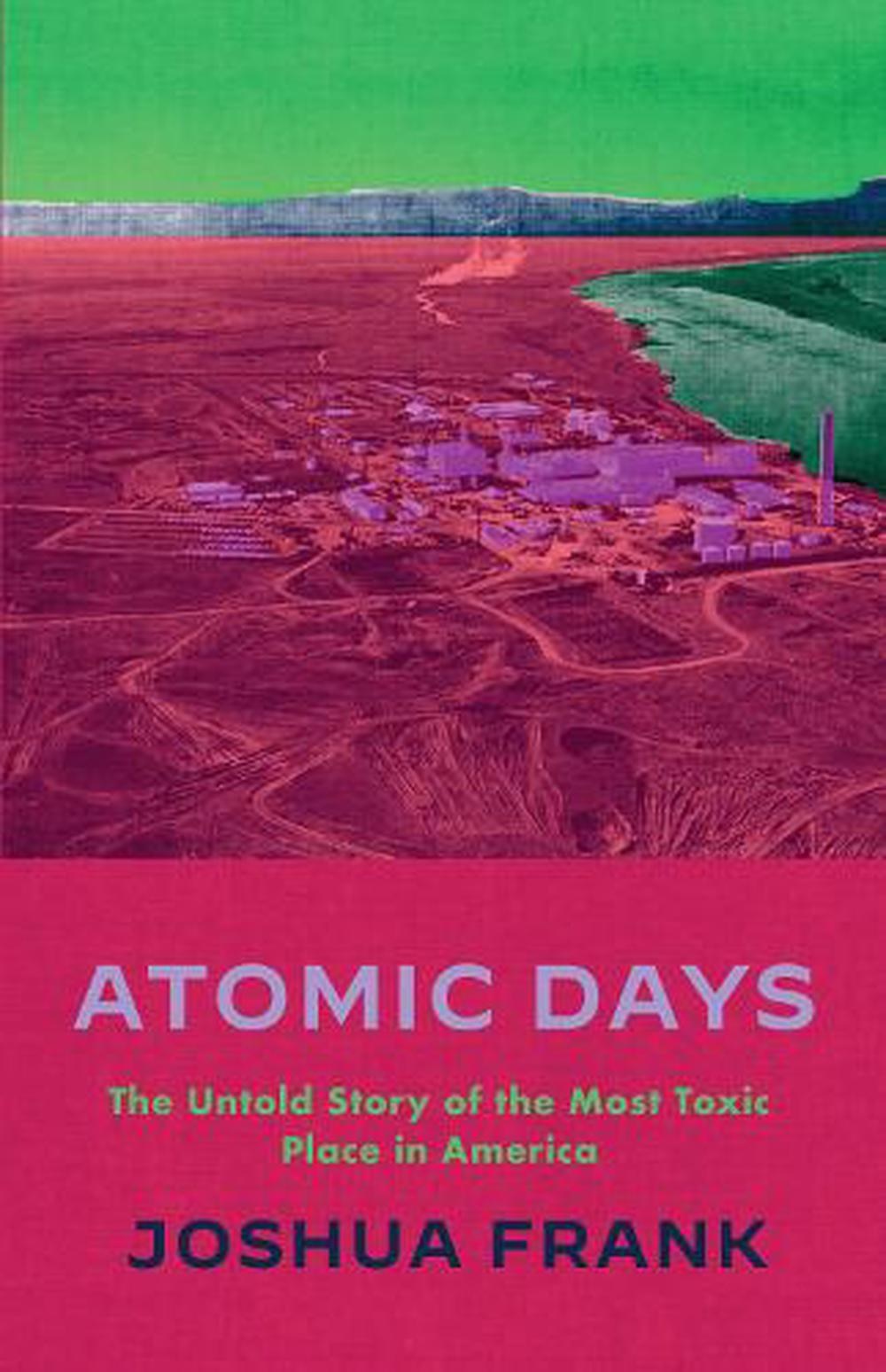
JOHN GREEN recommends an exposé of dangerous malpractice at the oldest and largest nuclear site in the US
Atomic Days: The Untold Story of the Most Toxic Place in America
By Joshua Frank
A DESCRIPTION of Hanford in Washington state — the place where the US stores much of its plutonium waste — sounds like something out of a dystopian novel by Kurt Vonnegut.
The town of Richland, a stone’s throw from Hanford’s boundary fence and where many of the workers’ families live, is an odd place. No rich mineral deposits, no surrounding agricultural landscape, no ski slopes or well-heeled tourists.
Richland was established by the atom bomb project and celebrates that history. The local pub is called Atomic Ale Brewpub. It showcases beers like Plutonium Porter, half-life Hefeweizen and Atom Bustin’ IPA.
The local school coat of arms boasts an exploding mushroom cloud. There is “a fervent mystifying patriotism” running deep in Richland, says Frank. The town also boasts more PhDs than any similar sized town in the state but voted overwhelmingly for Trump in recent elections.
Hanford’s B reactor has been designated a National Historic Landmark and was the first full scale plutonium production plant in the world. Those acting as guides do not appear to reflect on its legacy or suggest, perhaps, a moment of silence for the victims of nuclear bombs; for them it is a reason to rejoice at the ingenuity and superiority of the US war machine
Atomic Days reads at times like a political thriller, involving government lying and cover-ups, corruption, private-sector rapaciousness, spying on union “troublemakers” or anyone concerned about health and safety, and even the attempted murder of a whistleblower. There is no transparency and little accountability.
Many Hanford workers and their families have suffered serious illness as a result of radioactive contamination, from hyperthyroidism to miscarriages, disabilities and cancers, and numbers of unexplained deaths.
All this has been largely ignored by the national media, despite the fact that Hanford poses not only a danger to local people but to the whole country.
While focusing on Hanford, Frank encompasses the nuclear story on a global scale, from the US army injecting unsuspecting human guinea-pigs with plutonium in the 1940s, to the bombing of Hiroshima and Nagasaki, Chernobyl, Fukushima and the air crash over Spain involving nuclear weapons, to the legacy of nuclear bomb testing.
During the Cold War, the project expanded to include nine nuclear reactors and five large plutonium processing complexes, the last of which was decommissioned in 1987.
Once home to the US largest plutonium production site, the Hanford Nuclear complex is laced with 56 million gallons of radioactive waste. There have been numerous releases of radioactive isotopes into the ground water and into the atmosphere, but it has all been shrouded in secrecy. Today, the EPA has designated Hanford the most toxic place in America; it is also the most expensive environmental clean-up job the world has ever seen, with a soaring price tag of £553 billion.

At present, Hanford’s radioactive waste is stored in 177 waste tanks, 149 of them with just a single wall. The facility sits over a huge aquifer, above which 53 million gallons of radioactive and chemically hazardous waste are stored in leaky underground tanks.
These tanks are well past their life expectancy and full of boiling radioactive gunk. They are leaking, infecting groundwater supplies and threatening the nearby Columbia River. It also sits on around 750,000 cubic metres of buried solid waste, spent nuclear fuel and leftover plutonium.
The threat of an explosive accident at Hanford is all too real and could be more catastrophic than Chernobyl. There have already been numerous accidents, mostly unregistered and unknown to the public. It is one of the most radioactive wastelands on Earth.
It used to be home to several indigenous groups who once fished in the fish-rich Columbia River and hunted the deer and other animals in the surrounding woods. They were resettled from their ancestral lands once the US government determined to use the land to build the biggest plutonium production plant and waste dump in the country.
Frank’s chilling account should certainly disabuse the illusions of anyone out there who still views nuclear energy as a means of producing clean energy and saving the planet.
Joshua Frank is co-editor of the radical magazine, Counterpunch.
MIND OF THE MACHINE Chilling AI predicts what nuclear war would look like with attacks on London, Moscow and Washington
https://www.the-sun.com/news/7027327/artificial-intelligence-nuclear-war-prediction/ Henry Holloway, Dec 31 2022
ARTIFICIAL intelligence has offered a horrifying vision of what the world faces in nuclear armageddon and World War 3.
Responding to prompts such as “nuclear bomb”, “war” and “apocalypse” – the AI tool produced a series of truly grim pictures which could offer a glimpse into the future.
Pictures show devastated cityscapes burning with what could be nuclear fire and grim looking soldiers amongst the ruins.
Mushroom clouds rise over desolate landscapes – including one seen looming beside the US Capitol building in Washington DC.
Strange looking machines rumble in what the AI envisioned could be the weapons of the future
And lone figures walk amongst eerie, unrecognisable hellscapes when the AI was asked who it thinks could be the “last man on earth”.
Huge fireballs are seen descending towards burning cities in what could be a nuclear attack.
Soldiers walk amongst ruined landscapes as aircraft, appearing to be giant quadcopter drones fly overhead.
And when asked about what could happen to London, it produced what appears to be an image of Big Ben and the Houses of Parliament.
And another image shows what could be Oxford or Regent Street utterly deserted as its left in total ruin.
Other images show a horde of hopeless looking people stood amongst the ruins of an unidentified city.
Piles of rubble surround them as they hunker beneath the ruins of what may have once been a skyscraper.
And one chilling image shows the Washington Monument – two of them – with a mushroom cloud rising around them.
Massive vehicles are also seen hauling huge missiles in the AI generated images.
Enormous tank-like machines are also seen in the pictures.
Could this really be what the world will look like during a nuclear apocalypse and World War 3?
The AI system of course just responds to the limited prompts given to it rather than world events, but right now the talk of Armageddon has been compared to the height of the Cold War.
ART OF THE FUTURE
AI system NightCafe Creator was used to produce the images – and its one of many new tools showing the boundaries of computer tech.
It works by simply offering a few words as a prompt before the system then produces a piece of “art”.
The system was invented by Angus Russell and takes its name from the famous Vincent Van Gogh painting the The Night Cafe.
It uses machine learning and a neural network to put together pictures based on the prompts offered to it by humans.
AI generated art has caused controversy as some systems are allowing users to actually sell their pieces.
v
Russia’s former southern capital renounces its past: How Ukraine is destroying its heritage

Rt.com 27 Nov 22, Ukraine is turning into a significantly more homogeneous and far less culturally diverse country.
In recent years, Ukraine has become the battleground for a ‘war of monuments’ waged among various political forces. In 2014, the process reached a peak during the mass demolition of statues of Vladimir Lenin and other Soviet politicians. These events fundamentally changed the symbolism and policy of the country’s historical memory, paving the way to a reality in which any public speech must now be accompanied by the words ‘Glory to Ukraine! Glory to the heroes!’
This was the slogan of Stepan Bandera’s World War Two nationalist movement, which collaborated with Adolf Hitler’s Nazis and took part in the Holocaust.
Although Ukrainian President Vladimir Zelensky’s team initially tried to ‘reset’ the historical memory policy, radical nationalism got the upper hand in this symbolic battle. Following the start of Russia’s military operation, this year, the so-called ‘decommunization’ policy became openly known as ‘de-Russification’ – even with over half of the population officially recognized as Russian-speaking.
Memory wars
After Russian troops entered Ukraine in February, many locals projected their hatred of Moscow onto objects of cultural and historical heritage that were in any way linked to the Russian Empire or the Soviet Union. Meanwhile, politicians actively supported such sentiment, using it as a cheap way to boost their personal ratings.
Over the past months, the number of initiatives aimed at the cultural and historical ‘de-Russification’ of Ukraine have ballooned. Examples abound. The Kiev City Council recently renamed 11 streets having any reference to Russia (Lomonosov, Magnitogorsk, and Belomorskaya streets, among others). It also completely excluded the Russian language from the curricula of the capital’s kindergartens and schools.
The decision was supported by 64 out of 120 deputies. Vadim Vasilchuk, head of the Standing Committee on Education, Science, Family, Youth and Sports of the body, commented that teaching Russian in the current situation is “inappropriate.” In fact, Kiev’s educational institutions stopped teaching the language in any shape or form (including as electives) at the beginning of the academic year.
Meanwhile, other Ukrainian cities saw a wave of ‘de-Pushkinization’ sweep through. In November, monuments to the great Russian poet were toppled in Kharkov and Zhitomir, while the monument in Odessa was painted over with the inscription ‘Get out!’ In Kiev, one of the oldest monuments to the bard had been taken down a few weeks earlier.
The demolition of monuments to Russian and Soviet statesmen has continued as well. The Ukrainian Ministry of Culture’s expert council on ‘overcoming the consequences of Russification and totalitarianism’ decided to demolish monuments to Soviet military commanders Nikolay Vatutin and Nikolay Shchors (even though Leonid Kravchuk – a student at the time and later the first president of Ukraine – posed for the Shchors monument).
A memorial to Soviet soldiers erected on May 8, 1970 on the 25th anniversary of victory in WWII was demolished in Uzhgorod in November. The decision dates back to October 13. In its place, Kiev proposed a memorial to the soldiers of the 128th separate mountain assault brigade of the Armed Forces of Ukraine – a military unit that took an active part in the Donbass war unleashed by Kiev in 2014.
The story of one monument
Perhaps the most dramatic case of ‘de-Russification’ unfolded in the port city of Odessa. The city’s history dates back to the end of the 18th century, when the Russian Empire colonized the northern Black Sea region. In November, Odessa’s mayor, Gennady Trukhanov, announced the impending demolition of one of the historical city symbols – a monument to its founders that shows Catherine the Great and her associates, thanks to whom the city became the southern capital of the Russian Empire by the end of the 19th century………………………………………………………………….
How has this become possible? When Ukraine gained independence following the collapse of the Soviet Union, its political (electoral) geography acquired stable borders and became integrated into the self-consciousness of the country’s two parts. In fact, several population groups with powerful national identities emerged at the time: Ukrainian-speaking (mostly living in the western and central regions, and professing a purely ethnic narrative), Russian-speaking (mostly living in the center, south and east, for whom Russians were not ‘strangers’ or ‘enemies’), and actual Russians.
These groups, particularly the Ukrainian speakers and Russian speakers, long had their own heritage, language, and political representation. Recall the Orange Revolution of 2004 or the Euromaidan of 2014, during which the ‘pro-Ukrainian’ part of society opposed the ‘pro-Russian’ leader Viktor Yanukovych. Who, in reality, had spent years negotiating with the EU about eventual Ukrainian membership. ………………………………………….
A few years ago, residents of Ukraine’s south and east spoke Russian while recognizing themselves as Ukrainians. Now, the Russian language and its cultural and historical symbols are undergoing irreversible changes and becoming a marker of political affiliation – namely, of being pro-Russian.
Conscious of this, the authorities are striving to gain control over historical heritage and memory policies and expect to win this battle for public opinion. The current southern and eastern regions are turning into a testing ground for experimental nation-building. Their political self-determination fully depends on the historical memory and language policies. Meanwhile, nationalism offers all the necessary tools for constructing a cohesive socio-political community. That is why such a striking ‘de-Russification’ initiative as the demolition of the monument to Catherine the Great in Odessa will not be the last.
For many years, the main political and cultural debate in Ukrainian society has revolved around the question of preserving or eradicating its Russian and Soviet cultural heritage. In the present situation of armed conflict, supporters of the latter skillfully use public outrage to achieve their aims. Should the process continue (and there’s little reason to think it won’t), in a few years Ukraine will turn into a significantly more homogeneous and far less culturally diverse country – one that has willingly renounced a major part of its heritage.
By Alexander Nepogodin, an Odessa-born political journalist, expert on Russia and the former Soviet Union. https://www.rt.com/russia/566917-ukraine-is-losing-heritage/—
World BEYOND War Volunteers to Reproduce “Offensive” Peace Mural
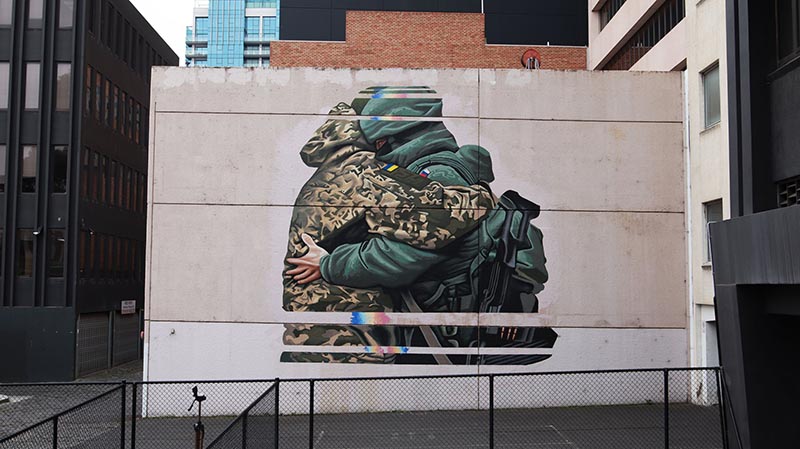
https://worldbeyondwar.org/world-beyond-war-volunteers-to-reproduce-offensive-peace-mural/By David Swanson, World BEYOND War, September 14, 2022
A talented artist in Melbourne, Australia, has been in the news for painting a mural of Ukrainian and Russian soldiers hugging — and then for taking it down because people were offended. The artist, Peter ‘CTO’ Seaton, has been quoted as saying he was raising funds for our organization, World BEYOND War. We want to not only thank him for that but offer to put the mural up elsewhere.
Here is a small sampling of the reporting on this story:
SBS News: “‘Utterly offensive’: Australia’s Ukrainian community furious over mural of Russian soldier embrace”
The Guardian: “Ukraine’s ambassador to Australia calls for removal of ‘offensive’ mural of Russian and Ukrainian soldiers”
Sydney Morning Herald: “Artist to paint over ‘utterly offensive’ Melbourne mural after Ukrainian community anger”
The Independent: “Australian artist takes down mural of hugging Ukraine and Russia soldiers after huge backlash”
Sky News: “Melbourne mural of Ukrainian and Russian soldiers hugging painted over after backlash”
Newsweek: “Artist Defends ‘Offensive’ Mural of Ukrainian and Russian Troops Hugging”
The Telegraph: “Other wars: Editorial on Peter Seaton’s anti-war mural & its repercussion”
Here is the artwork on Seaton’s website. The website says: “Peace before Pieces: Mural painted on Kingsway close to the Melbourne CBD. Focusing on a peaceful resolution between the Ukraine and Russia. Sooner or later the continued escalation of conflicts created by Politicians will be the death of our beloved planet.” We couldn’t agree more.
World BEYOND War has funds donated to us specifically for putting up billboards. We would like to offer, should Seaton find it acceptable and helpful, to put this image up on billboards in Brussels, Moscow, and Washington. We would like to help with reaching out to muralists to put it up elsewhere. And we would like to put it on yard signs that individuals can display around the world.
Our interest is not in offending anyone. We believe that even in the depths of misery, despair, anger, and revenge people are sometimes capable of imagining a better way. We’re aware that soldiers try to kill their enemies, not hug them. We’re aware that each side believes that all the evil is commited by the other side. We’re aware that each side typically believes total triumph is eternally imminent. But we believe that wars must end with the making of peace and that the sooner this is done the better. We believe that reconciliation is something to aspire to, and that it is tragic to find ourselves in a world in which even picturing it is deemed — not just unliklely, but — somehow offensive.
World BEYOND War is a global nonviolent movement to end war and establish a just and sustainable peace. World BEYOND War was founded on January 1st, 2014, when co-founders David Hartsough and David Swanson set out to create a global movement to abolish the institution of war itself, not just the “war of the day.” If war is ever to be abolished, then it must be taken off the table as a viable option. Just as there is no such thing as “good” or necessary slavery, there is no such thing as a “good” or necessary war. Both institutions are abhorrent and never acceptable, no matter the circumstances. So, if we can’t use war to resolve international conflicts, what can we do? Finding a way to transition to a global security system that is supported by international law, diplomacy, collaboration, and human rights, and defending those things with nonviolent action rather than the threat of violence, is the heart of WBW. Our work includes education that dispels myths, like “War is natural” or “We have always had war,” and shows people not only that war should be abolished, but also that it actually can be. Our work includes all variety of nonviolent activism that moves the world in the direction of ending all war.
The cost of Ukraine’s de-Russification
the burgeoning de-Russification in Ukraine is one of the issues that needs a cool-headed examination. The process of removing Russian cultural and linguistic influence from the country is not an easy — or necessarily equitable — thing to do, when around a quarter of Ukrainians still identify as Russian speakers.
The country’s insistence on its right to exist as separate from Russia is understandable, but expunging Russian cultural and linguistic influence risks future trouble.
Politico. BY JAMIE DETTMER, AUGUST 29, 2022
Wars transform nations and people — leaving them, whether victorious or vanquished, “all changed, changed utterly,” as Irish writer W.B. Yeats noted.
Yeats was writing about the armed insurrection against British rule in Ireland during April 1916. The uprising had lasted just six days, but Ireland would never be the same.
Ukraine’s ongoing epic defense of its national identity, territorial integrity and sovereignty has already lasted six months, and there is no end in sight. It has left widespread devastation, with towns and buildings wrecked, families traumatized and uprooted, livelihoods upended and lives lost and mourned.
But there’s another transformation underway — and it’s in Ukrainian hearts.
Being told endlessly that they don’t exist has led to the understandable Ukrainian reaction of insisting on their existence, and their right to exist as separate from Russia. This is leading them to try and expunge Russian cultural and linguistic influence on their country. But how they do so, and to what degree, is fraught with future danger.
In a March 2014 speech marking the annexation of Crimea, Russian President Vladimir Putin had declared that Russians and Ukrainians “are one people. Kiev is the mother of Russian cities. Ancient Rus’ is our common source and we cannot live without each other.”
But, although the two nations are ensnared by history, the full-scale war he launched in February has only demonstrated the opposite, and has made it much more difficult for them to live with each other.
Indeed, for a nation that Putin has argued doesn’t exist, Ukraine has been kicking up a storm, and is now taking the fight well behind military frontlines, brazenly crossing the border into Russia and occupied Crimea, disrupting Russian supply lines and logistics, leaving the Kremlin to fall back on preposterous lies to explain explosions witnessed by vacationing Russians…………………
Ukrainians’ firmer sense of nationhood and identity, fueled by fury at what is befalling them, risks becoming less inclusive and more Russian-hating. How could it be otherwise?
……………. the burgeoning de-Russification in Ukraine is one of the issues that needs a cool-headed examination. The process of removing Russian cultural and linguistic influence from the country is not an easy — or necessarily equitable — thing to do, when around a quarter of Ukrainians still identify as Russian speakers.
……………………………… In January, Human Rights Watch also raised concerns about the lack of protections for Russian speakers in a new state language law that entered into force this year. The law requires print media outlets registered in Ukraine to publish only in the Ukrainian language, or to provide an accompanying Ukrainian version, or equivalent in content, volume and method of print, when publishing in another language. But while exceptions were made for other minority languages, such as English and official European Union languages, there were none provided for Russian.
………………….. in June, the Ukrainian parliament passed a set of new laws banning the distribution of Russian books printed overseas, and the playing or performance of Russian music by post-Soviet era artists, further seeking to distance the country from Russian culture.
But through the often tragic twists and turns of Ukraine’s tangled history, and the cultural imperialism of Russian czars and communist autocrats, Ukrainian and Russian culture are inextricably linked and have contributed to each other’s shaping — for good or ill.
…………………. there are risks in rejecting all things Russian……………..
In his independence day speech this week, Zelenskyy vowed Kyiv’s forces will retake Russian-occupied Crimea. But if that day comes, how will Kyiv approach de-Russification? Will it still insist on the use of the Ukrainian language in most aspects of public life on a peninsula where 65 percent of the population are ethnic Russian?
As Ukraine goes about trying to win this war, it also needs to think about how it will win the peace. https://www.politico.eu/article/the-cost-of-ukraines-de-russification/
Hiroshima man’s anime sheds light on Fukushima nuclear project
THE ASAHI SHIMBUN 27 May 22, Hiroshima resident Hidenobu Fukumoto was astonished when he learned there was once a plan to build a nuclear power plant in his hometown, the first city devastated by a nuclear bomb.
He discovered the shocking news by chance while visiting Fukushima Prefecture, which suffered its own nuclear disaster in 2011, as a “kamishibai” picture card show artist.
“I was stunned,” said Fukumoto, who has produced about 170 kamishibai titles based on the accounts of residents affected by the disaster. “I decided to face up to the new fact about Hiroshima I discovered during my visits to Fukushima.”Hiroshima resident Hidenobu Fukumoto was astonished when he learned there was once a plan to build a nuclear power plant in his hometown, the first city devastated by a nuclear bomb.
He discovered the shocking news by chance while visiting Fukushima Prefecture, which suffered its own nuclear disaster in 2011, as a “kamishibai” picture card show artist.
“I was stunned,” said Fukumoto, who has produced about 170 kamishibai titles based on the accounts of residents affected by the disaster. “I decided to face up to the new fact about Hiroshima I discovered during my visits to Fukushima.”
The anime, titled “Fukushima Genpatsu Hajimari Monogatari: Toge” (The prologue to the Fukushima nuclear power plant: Mountain pass), portrays a man in his 60s who was born in 1949 in Okuma, a town in Fukushima Prefecture that co-hosts the now-stricken plant.
When Japan’s economy begins booming following the period of postwar poverty, the protagonist enters a university in Tokyo and enjoys his college life.
The story illustrates the major events leading up to the construction of the nuclear plant in Fukushima Prefecture at a time when people in Japan were suddenly blessed with material wealth.
The anime, titled “Fukushima Genpatsu Hajimari Monogatari: Toge” (The prologue to the Fukushima nuclear power plant: Mountain pass), portrays a man in his 60s who was born in 1949 in Okuma, a town in Fukushima Prefecture that co-hosts the now-stricken plant.
When Japan’s economy begins booming following the period of postwar poverty, the protagonist enters a university in Tokyo and enjoys his college life.
The story illustrates the major events leading up to the construction of the nuclear plant in Fukushima Prefecture at a time when people in Japan were suddenly blessed with material wealth.
Another scene shows young people in Fukushima leaving their hometown to seek jobs, while long-term residents are split over whether the prefecture should host a nuclear plant.
When the protagonist eventually returns home in Okuma and sees a massive nuclear plant standing in the town, he is left speechless.
The anime then fast-forwards to 2011, when the Great East Japan Earthquake and tsunami triggered the triple meltdown at the plant.
“The move to promote atomic power prevailed globally under the pretext of the peaceful use of nuclear energy, overshadowing even the destruction of Hiroshima brought on by the atomic bomb,” the protagonist said while living as an evacuee at the end of the story. “Ordinary people like us could do nothing about it.”………………………………………….
STORY HITS HOME
Fukumoto’s kamishibai project has struck a chord with many Fukushima residents who experienced the nuclear disaster…………………………………
Kinue Ishii, 70, who also performs kamishibai with Oka as a member of a storytelling group, said people can think deeply about the nuclear accident by learning why the nuclear plant was built in Fukushima.
“I want people to imagine themselves becoming victims of a nuclear accident by watching this anime,” Ishii said.
Hisai Yashima, 56, another member of the storytelling group, said she hopes the anime will help raise awareness of what led to the construction of the nuclear plant because people from outside Fukushima often ask her why the prefecture approved the plan.
The package of an anime DVD and a 16-page, A4-size picture book costs 2,000 yen ($16). For more details, visit the production committee’s website: https://matimonogatari.iinaa.net) (Japanese only).
(This article was compiled from reports by Miki Morimoto and Yusuke Noda.) https://www.asahi.com/ajw/articles/14604129
Forgetting the apocalypse: why our nuclear fears faded – and why that’s dangerous
The horrors of Hiroshima and Nagasaki made the whole world afraid of the atomic bomb – even those who might launch one. Today that fear has mostly passed out of living memory, and with it we may have lost a crucial safeguard,
Guardian, by Daniel Immerwahr 13 May, 22”…………………. what had happened in Hiroshima, and three days later in Nagasaki, could happen anywhere.
The thought proved impossible to shake, especially as, within the year, on-the-ground accounts emerged. Reports came of flesh bubbling, of melted eyes, of a terrifying sickness afflicting even those who’d avoided the blast. “All the scientists are frightened – frightened for their lives,” a Nobel-winning chemist confessed in 1946. Despite scientists’ hopes that the weapons would be retired, in the coming decades they proliferated, with nuclear states testing ever-more-powerful devices on Pacific atolls, the Algerian desert and the Kazakh steppe.
The fear – the pervasive, enduring fear – that characterised the cold war is hard to appreciate today. It wasn’t only powerless city-dwellers who were terrified (“select and fortify a room in which to shelter”, the UK government grimly advised). Leaders themselves were shaken. It was “insane”, US president John F Kennedy felt, that “two men, sitting on the opposite sides of the world, should be able to decide to bring an end to civilisation”. Yet everyone knowingly lived with that insanity for decades…………..
………. The memory of nuclear war, once vivid, is quietly vanishing. ……..
Except that the threat of nuclear war, as Vladimir Putin is reminding the world, has not gone away.
……….. Yet many of Putin’s adversaries seem either unconvinced or, worse, unbothered by his threats. Boris Johnson has flatly dismissed the idea that Russia may use a nuclear weapon. Three former Nato supreme allied commanders have proposed a no-fly zone over Ukraine. This would almost certainly entail direct military conflict between Nato and Russia, and possibly trigger the world’s first all-out war between nuclear states. Still, social media boils over with calls to action, and a poll found that more than a third of US respondents wanted their military to intervene “even if it risks a nuclear conflict”.
Nuclear norms are fraying elsewhere, too. Nine countries collectively hold some 10,000 warheads, and six of those countries are increasing their inventories. Current and recent leaders such as Kim Jong-un, Narendra Modi and Donald Trump have, like Putin, spoken brazenly of firing their weapons……………..
Leaders have talked tough before. But now their talk seems less tethered to reality. This is the first decade when not a single head of a nuclear state can remember Hiroshima.
Does that matter? We’ve seen in other contexts what happens when our experience of a risk attenuates. In rich countries, the waning memory of preventable diseases has fed the anti-vaccination movement. “People have become complacent,” notes epidemiologist Peter Salk, whose father, Jonas Salk, invented the polio vaccine. Not having lived through a polio epidemic, parents are rejecting vaccines to the point where measles and whooping cough are coming back and many have needlessly died of Covid-19.
That is the danger with nuclear war. Using declassified documents, historians now understand how close we came, multiple times, to seeing the missiles fired. In those heartstopping moments, a visceral understanding of what nuclear war entailed helped keep the launch keys from turning. It’s precisely that visceral understanding that’s missing today. We’re entering an age with nuclear weapons but no nuclear memory. Without fanfare, without even noticing, we may have lost a guardrail keeping us from catastrophe.
……………….The US occupation authorities in Japan had censored details of the bomb’s aftermath. But, without consulting the censors, the American writer John Hersey published in the New Yorker one of the most important long-form works of journalism ever written, a graphic account of the bombing. Born to missionaries in China, Hersey was unusually sympathetic to Asian perspectives. His Hiroshima article rejected the bomber’s-eye view and instead told the stories of six survivors.
For many readers, this was the first time they registered that Hiroshima wasn’t a “Japanese army base”, as US president Harry Truman had described it when announcing the bombing, but a city of civilians – doctors, seamstresses, factory workers – who had watched loved ones die. Nor did they die cleanly, vaporised in the puff of a mushroom cloud. Hersey profiled a Methodist pastor, Kiyoshi Tanimoto, who raced to the aid of his ailing but very much still-living neighbours. As Tanimoto grasped one woman, “her skin slipped off in huge, glove-pieces”. Tanimoto “was so sickened by this that he had to sit down for a minute”, wrote Hersey. “He had to keep consciously repeating to himself, ‘These are human beings.’”
Hersey’s contemporaries understood the significance of these accounts. The New Yorker dedicated its full issue to Hersey’s article, and within an hour sold out its entire newsstand print run of 300,000 (plus another 200,000 copies to subscribers). Knopf published it as a book, which eventually sold millions. The text was reprinted in newspapers from France to China, the Netherlands to Bolivia. The massive ABC radio network broadcast Hersey’s text – with no commercials, music or sound effects – over four consecutive evenings. “No other publication in the American 20th century,” the journalism historian Kathy Roberts Forde has written, “was so widely circulated, republished, discussed, and venerated.”
Tanimoto, boosted to celebrity by Hersey’s reporting, made speaking tours of the US. By the end of 1949, he had visited 256 cities. Like Einstein, he pleaded for world government.
Rising tensions between Washington and Moscow erased the possibility of global government. Still, they didn’t change the fact: across the west, leading thinkers felt nuclear weapons to be so dangerous that they required, in Churchill’s words, remoulding “the relationships of all men of all nations” so that “international bodies by supreme authority may give peace on earth and justice among men”.
……………………………………… Maybe one could dismiss the fallout shelters as theatre and the films as fiction. But then there were the bomb tests – great belches of radioactivity that previewed the otherworldly dangers of nuclear weapons. By 1980, the nuclear powers had run 528 atmospheric tests, raising mushroom clouds everywhere from the Pacific atoll of Kiritimati to the Chinese desert. A widely publicised 1961 study of 61,000 baby teeth collected in St Louis showed that children born after the first hydrogen bombs were tested had markedly higher levels of the carcinogen strontium-90, a byproduct of the tests, despite being some 1,500km away from the closest test site.
Unsurprisingly, nuclear tests stoked resistance. In 1954, a detonation by the US at Bikini Atoll in the Pacific got out of hand, irradiating the inhabited atoll of Rongelap and an unfortunate Japanese tuna fishing boat. When the boat’s sickened crew returned to Japan, pandemonium erupted. Petitions describing Japan as “thrice victimised by nuclear bombs” and calling for a ban collected tens of millions of signatures. Ishiro Honda, a film director who’d seen the Hiroshima damage firsthand, made a wildly popular film about a monster, Gojira, awakened by the nuclear testing. Emitting “high levels of H-bomb radiation”, Gojira attacks a fishing boat and then breathes fire on a Japanese city.
………………….. Hiroshima occupied a similar place in public memory to Auschwitz, the other avatar of the unspeakable. The resemblance ran deep. Both terms identified specific events within the broader violence of the second world war – highlighting the Jews among Hitler’s victims, and the atomic bomb victims among the many Japanese who were bombed – and marked them as morally distinct. Both Hiroshima and Auschwitz had been the site of “holocausts” (indeed, early writers more often used that term to describe atomic war than European genocide). And both Hiroshima and Auschwitz sent forth a new type of personage: the “survivor”, a hallowed individual who had borne witness to a historically unique horror. What Elie Wiesel did to raise the stature of Europe’s survivors, Tanimoto did for Japan’s. In their hands, Hiroshima and Auschwitz shared a message: never forget, never again
.…………The whole idea is to kill the bastards,” said US general Thomas Power, when presented in 1960 with a nuclear plan designed to minimise casualties. “Look. At the end of the war, if there are two Americans and one Russian, we win.” This is the man who led the US Strategic Air Command – responsible for its nuclear bombs and missiles – during the Cuban missile crisis.
Generals like Power, tasked with winning wars, pressed often for pre-emptive strikes……………………..
Today, knowledge of the Holocaust is kept alive by more than 100 museums and memorials, including in such unexpected countries as Cuba, Indonesia and Taiwan. But there is no comparable memory industry outside of Japan to remind people of nuclear war.
The result is a profound generational split, evident in nearly every family in a nuclear state……………
the dispelling of dread has made it hard for many to take nuclear war seriously…………
With nuclear threats far from mind, voters seem more tolerant of reckless politicians. ……..
Nor is it only Trump. The nine nuclear states have had an impressive string of norm-breakers among their recent leaders, including Trump, Vladimir Putin, Narendra Modi, Kim Jong-un and Benjamin Netanyahu. With such erratic men talking wildly and tearing up rulebooks, it’s plausible that one of them might be provoked to break the ultimate norm: don’t start a nuclear war.
………… how guided are leaders by such fears? In the past 20 years, the US has pulled out of the 2015 nuclear deal with Iran and two of the three main treaties restraining its arms race with Russia (the third is in bad shape). Meanwhile, China has been developing aggressive new weapons……… India’s its prime minister, Modi, declared. India has the “mother of nuclear bombs” ……
The cost of the shredded norms and torn-up treaties may be paid in Ukraine. Russia invested heavily in its nuclear arsenal after the cold war; it now has the world’s largest. The worse the war in Ukraine goes, the more Putin might be tempted to reach for a tactical nuclear weapon to signal his resolve.
……………… we can’t drive nuclear war to extinction by ignoring it. Instead, we must dismantle arsenals, strengthen treaties and reinforce antinuclear norms. Right now, we’re doing the opposite. And we’re doing it just at the time when those who have most effectively testified to nuclear war’s horrors – the survivors – are entering their 90s. Our nuclear consciousness is badly atrophied. We’re left with a world full of nuclear weapons but emptying of people who understand their consequences. https://www.theguardian.com/world/2022/may/12/forgetting-the-apocalypse-why-our-nuclear-fears-faded-and-why-thats-dangerous
Militarism in the USA on the rise, with the Ukraine war

The U.S. public largely endorses these policies, with a majority approving of or wishing to increase weaponry shipments. (Further, a remarkable 35 percent favor direct military action — “even if it risks nuclear conflict with Russia,”
Antiwar Groups Protest Defense Industry Profiteering in Ukraine, Tyler Walicek, Truthout, 3 May 22, The war of aggression that Russia has perpetrated in Ukraine has rightly generated widespread condemnation, both among Russia’s Western critics and the world at large. On the war’s obvious heinousness, almost all of the U.S. political spectrum is in agreement. However, opinions as to the appropriate Western response proceed from vastly different premises.
The predominant left position is, on the whole, resolutely antiwar. U.S. activists of all stripes have been rolling out ambitious organizing efforts in the hopes of nudging the conflict towards diplomacy and an eventual ceasefire. Given the considerable death toll and the millions of refugees the war has produced — to say nothing of the threat of conventional or nuclear escalation — the matter is an urgent one.
In the process of organizing opposition, there has, of course, been much in the way of internal debate among various left factions. More contentious dimensions include the question of arming Ukrainians, the comparative moral weighting of nonviolence and self-defense, and the degree of culpability that should be attributed to NATO for its demonstrable role in decades of ratcheting tensions.
Whatever their perspective on the circumstances, organizers from left-liberals to communists are calling upon the means of protest at their disposal, from media initiatives to global rallies to demonstrations at the thresholds of the military-industrial complex. To mount an effective confrontation with the U.S. empire and defense industry and influence a far-flung conflict is a daunting prospect. Yet despite the historic scale of the challenge, coalitions of antiwar activists are striving to realize their vision of the end of imperial aggression — perpetrated by Russia and the U.S. alike.
Defaulting to Militarism
Antiwar organizers generally share a conviction that diplomacy should take precedence in resolving the Russia-Ukraine conflict. The vast majority are vehemently opposed to any form of active U.S. military intervention — a prudent stance for those who wish to avoid a hot war with a nuclear power. Unsurprisingly, the same cannot be said for the U.S. political establishment, which has seized upon the opportunity to vilify Russia, seemingly eager to court a clash between the two deteriorating superpowers. Right-wing war fervor, always simmering below the surface, has boiled over; Republican jingoists (and a number of foolhardy op-eds in major media) espoused everything from a no-fly zone to refusing to rule out the deployment of U.S. ground troops.
These lawmakers’ martial fantasies are more than a little cavalier about the potential for Great Power conflict. Comparatively less reckless centrists, for their part, mostly favor a two-pronged approach: the imposition of devastating punitive sanctions on Russia and the delivery of vast amounts of weaponry to Ukrainian forces — stopping short of outright U.S. military intervention.
Democrats have leaped to snipe at the right by demonstrating who can demand the larger flood of weaponry, while leveraging the conflict for all manner of political purposes. By any measure, it has been a field day for fawning, ham-fisted propagandists like noted stenographer Bret Stephens. (“The U.S. stands up to bullies!”) Both parties are unequivocal in their shared support for an overflowing bounty of war materiel and other assistance. As of this writing, the White House is requesting a stunning $33 billion for Ukraine. The number keeps climbing.
The U.S. public largely endorses these policies, with a majority approving of or wishing to increase weaponry shipments. (Further, a remarkable 35 percent favor direct military action — “even if it risks nuclear conflict with Russia,” speaking poorly of their aptitude in risk assessment.) NATO has held out against calls to impose a no-fly zone; at least the military alliance sees the wisdom in avoiding a shooting war with Russian forces.
The shooting will instead be done by Ukrainian hands with plentiful Western arms — very much to the benefit of the U.S. defense industry. It is no coincidence that we see such an eagerness to fortify Ukraine among the government and media. Not only is the state keen to see Russia battered and chastened, but conflict and arms deals, as ever, mean profit.
Antiwar activists perceive the inundation of Ukraine with armaments as yet another round of war profiteering — one that risks precluding diplomatic solutions. As Ukrainian President Volodymyr Zelenskyy petitions the world to arm Ukraine and intervene militarily, antiwar groups, in contrast, have spoken out in strident opposition to the staggering influx of Western arms, as well as the Cold-War style bellicosity that U.S. power has again taken up with gusto.
Antiwar Coalitions in Action
In the meantime, large-scale real-world protests against the war have erupted on numerous fronts — both within Russia and Ukraine and across the globe. Progressive, pacifist and anti-imperialist groups in the U.S. are no exception, having mobilized their considerable institutional resources to voice their own opposition. Given the unlikelihood of influencing the actions of the Russian government, they’ve targeted the realm in which they are mostly likely to have an impact — namely, U.S. policy. Because of its deep entanglements in the war, the U.S. response could easily be a critical determining factor on the outcome: either negotiation, drawdown and eventual peace, or escalation and sustained bloodshed………………….. https://truthout.org/articles/antiwar-groups-protest-defense-industry-profiteering-in-ukraine/?eType=EmailBlastContent&eId=77e07376-4f26-4746-9b6e-12d42fb0f129
The nuclear future and the dread factor
The nuclear future and the dread factor, Cape Cod Times, Brent Harold, Columnist 31 Jan 22, ”………………… The struggle over the nuclear future is still on. The movement to overcome public dread and get nuclear back on track is hot in the U.S, fueled by the idea that only nuclear power will slow climate change and the self-fulfilling prophecy that even a concerted commitment to solar, wind and water will never get the job done.
(The nuclear power optimists who dismiss those they see as irrationally fearful of nuclear technology are themselves irrational pessimists when it comes to the less fear-inspiring technologies of solar, wind, hydro and — often overlooked — conservation.)
Whether nuclear power ends up playing a large role in the energy future depends on how we as a society end up answering the questions: What should be the role, if any, of human feelings about this or any technology? Should we overcome and suppress fear of nukes and let technology decisions be decided by the for-profit industry? Perhaps turn the decision over to AI?
Or, should we, on the contrary, listen to and respect that fear? Should we in fact insist that judgments about this and any technology be based at least in part on the feelings — instinctual, commonsensical — of the vulnerable creatures we are? https://www.capecodtimes.com/story/opinion/2022/01/31/criticism-over-proposal-dump-radioactive-water-into-cape-cod-bay/9240645002/
Horrors of Hiroshima, a reminder nuclear weapons remain global threat
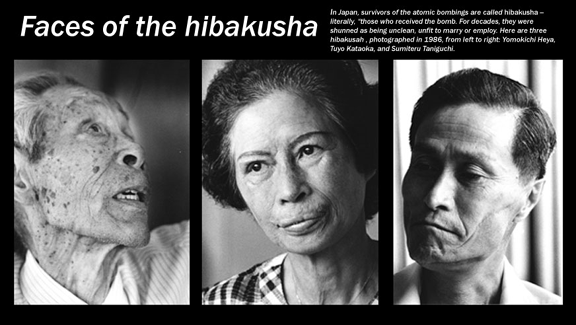
UN News, 15 January 2022, Peace and Security, Despite the annihilation of two major Japanese cities in 1945, atomic bombs have not been relegated to the pages of history books, but continue to be developed today – with increasingly more power to destroy than they had when unleashed on Hiroshima and Nagasaki back in 1945.
Those first nuclear weapons deployed by the United States, indiscriminately killed tens of thousands of non-combatants but also left indelible scars for the immediate survivors, that they, their children and grandchildren still carry today.
“The Red Cross hospital was full of dead bodies. The death of a human is a solemn and sad thing, but I didn’t have the time to think about it because I had to collect their bones and dispose of their bodies”, a then 25-year-old woman said in a recorded testimony, 1.5 km from Hiroshima’s ground zero.
“This was truly a living hell, I thought, and the cruel sights still stay in my mind”
To highlight the tireless work of the survivors, known in Japanese as the hibakusha, the UN’s Office for Disarmament Affairs, created an exhibition at UN Headquarters in New York which has just come to a close, entitled: Three Quarters of a Century After Hiroshima and Nagasaki: The Hibakusha—Brave Survivors Working for a Nuclear-Free World.
It vividly brings to life the devastation and havoc wreaked by those first atomic bombs (A-bombs), and their successor weapons, the more powerful hydrogen bombs (H-bombs) which began testing in the 1950s
Quest to save humanity
In the aftermath of the bombings in Japan, the hibakusha, conducted intense investigations with the aim of preventing history from repeating itself.
With an average age of 83 today, the dwindling band continue to share their stories and findings with supporters at home and abroad, “to sav[ing] humanity…through the lessons learned from our experiences, while at the same time saving ourselves”, they say, in the booklet No More Hibakusha -Message to the World, which accompanies the exhibit.
Recounting the day in Hiroshima that 11 members of her family slept together in an air raid shelter, a then 19-year-old woman spoke of how three small children died during the night, while calling for water.
“The next morning, we carried their bodies out of the shelter, but their faces were so swollen and black that we couldn’t tell them apart, so laid them out on the ground according to height and decided their identities according to their size”.
These brave survivors testify that peace cannot be achieved ever, through the use of nuclear weapons.
‘Absolute evil’
A group of elderly hibakusha, called Nihon Hidankyo, have dedicated their lives to achieving a non-proliferation treaty, which they hope will ultimately lead to a total ban on nuclear weapons.
“On an overcrowded train on the Hakushima line, I fainted for a while, holding in my arms my eldest daughter of one year and six months. I regained my senses at her cries and found no-one else was on the train”, a 34-year-old woman testifies in the booklet. She was located just two kilometres from the Hiroshima epicentre.
Fleeing to her relatives in Hesaka, at age 24 another woman remembers that “people, with the skin dangling down, were stumbling along. They fell down with a thud and died one after another”, adding, “still now I often have nightmares about this, and people say, ‘it’s neurosis’”.
One man who entered Hiroshima after the bomb recalled in the exhibition, “that dreadful scene – I cannot forget even after many decades”.
A woman who was 25 years-old at the time, said, “when I went outside, it was dark as night. Then it got brighter and brighter, and I could see burnt people crying and running about in utter confusion. It was hell…I found my neighbour trapped under a fallen concrete wall…Only half of his face was showing. He was burned alive”.Uniting for peace
The steadfast conviction of the Hidankyo remains: “Nuclear weapons are absolute evil that cannot coexist with humans. There is no choice but to abolish them”.
In August 1956, the survivors of the 1945 atomic bombs in Hiroshima on 6 August and Nagasaki three days later, formed the “Japan Confederation of A and H-Bomb Sufferers Organizations”.
Encouraged by the movement to ban the atomic bomb that was triggered by the Daigo Fukuryu Maru disaster – when 23 men in a Japanese tuna fishing boat were contaminated by nuclear fallout from a hydrogen bomb test at Bikini Atoll in 1954 – they have not wavered in their efforts to prevent others from becoming nuclear victims.
“We have reassured our will to save humanity from its crisis through the lessons learned from our experiences, while at the same time saving ourselves”, they declared at the formation meeting.
The spirit of the declaration, in which their own sufferings are linked to the task of preventing the hardship that they continue to carry, resonates still in the movement today…………………………………………….
The hibakusha became more and more vocal in the suffering that was inflicted upon them, hoping that it could help create a road map towards the abolition of nuclear weapons.
In oral testimonies, they shared their experiences both during and after the bombings and sent written messages to the NPT Review Conference in 2010 appealing to the world.
In July 2017, the Treaty on the Prohibition of Nuclear Weapons (TPNW), which complements the NPT, was adopted and came into force last year on 22 January……………………
the UN is committed to ensuring their testimonies live on, as a warning to each new generation.
The Hibakusha are a living reminder that nuclear weapons pose an existential threat and that the only guarantee against their use is their total elimination”, Mr. Guterres stated. “This goal continues to be the highest disarmament priority of the United Nations, as it has been since the first resolution adopted by the General Assembly in 1946”.
While the Tenth Review Conference of the NPT, which had been scheduled for January, has been postponed on account of the COVID-19 pandemic, he continued to urge world leaders to “draw on the spirit of the Hibakusha” by putting aside their differences and taking “bold steps towards achieving the collective goal of the elimination of nuclear weapons”. https://news.un.org/en/story/2022/01/1109602
Can Santa Fe survive as a nuclear weapons suburb?
 | |||


Will Santa Fe “fold up,” democratically and spiritually, when this new “Manhattan” fully appears? Is the faith of that man of peace, St. Francis — the very name of this city — obsolete to political leaders in the city and the state?
Can Santa Fe survive as a nuclear weapons suburb? https://www.santafenewmexican.com/opinion/my_view/can-santa-fe-survive-as-a-nuclear-weapons-suburb/article_b6ab8ce8-7556-11ec-b47a-57273af4ebbc.html, By Greg Mello, 16 Jan 22,
Many Santa Feans understand that Los Alamos National Laboratory, the most lavishly funded nuclear weapons facility in the world, has embarked on a new mission: making plutonium warhead cores (“pits”) on an industrial scale, to involve 4,000 full-time personnel and 24/7 operations.
It’s among the dirtiest and most dangerous missions in the nuclear weapons complex, not seen at LANL since the 1940s. It’s centered in an old facility built for research and development, now to be driven far beyond its original capacity.
LANL predicts it will spend $18 billion to start up production over this decade. In constant dollars, this is 15-fold what the Manhattan Project spent in New Mexico — indeed it dwarfs the cost of every other project in New Mexico history.
The pits will cost at least $50 million apiece, 200 times their weight in gold. A single LANL pit, assuming all goes well, will cost as much as the combined annual salaries of 1,000 New Mexico teachers, or the equipment for 5,000 residential solar systems. A major reason our society is failing is because it is kept on a war footing.
This huge program has nothing to do with national security, except in the negative sense. It is not needed to maintain any stockpile weapon. As military planners say, it’s (very) “early to need” and there are now perfectly sound, cheaper plans to do without LANL’s production should something go wrong. Why wait?
After extensive analysis under both the Obama and Trump administrations, the National Nuclear Security Administration in 2017 firmly rejected what is now LANL’s pit plan. The New Mexico delegation fought back, enlisting congressional hawks to help blackmail the Trump administration into building an unheard-of two pit factories. Up to now, a barely functioning Congress has gone along with the game. Time will tell just how long this scam holds up.
LANL’s pit production, for all its cost and danger, just isn’t enough to support any foreseeable U.S. stockpile. If LANL is a pit factory, there will be two.
What about Santa Fe, then?
On July 18, 1945, Harry Truman wrote in his diary, “Believe [Japan] will fold up before Russia comes in. I am sure they will when Manhattan appears over their homeland.”
Will Santa Fe “fold up,” democratically and spiritually, when this new “Manhattan” fully appears? Is the faith of that man of peace, St. Francis — the very name of this city — obsolete to political leaders in the city and the state?
What exactly would Santa Fe stand for or mean if nuclear weapons — the ultimate in human disposability — became its main tangible product? When our schools and community colleges direct our young people into LANL’s “pipeline” of plutonium minions? Or do you suppose their potential for creativity, compassion and wisdom could be better developed in other ways, as the region faces the towering crises of the 21st century?
Can Santa Fe survive as a nuclear weapons suburb? It certainly can, as a kind of nuclear “Pottersville” — a sprawling, increasingly ugly “city” with growing inequality, a vacuum where shared ideals should be, with no real urban center or shared human purposes, its most cherished traditions washed away by too much money given to too few people doing “work” society doesn’t need or want. It would be a city divided against itself to be sure, with plenty of poverty, human tragedy and crime.
Santa Fe could be a city that aims for justice and peace, where the obligation of respect binding us together is fostered, where the potential of every child is honored. Those political values are incompatible with manufacturing more nuclear weapons.
Greg Mello is executive director of the Los Alamos Study Group.
Sydney Poitier film ”The Bedford Incident” was based on true nuclear war near misses.
Sidney Poitier’s Most Frightening Role Was as the Conscience of Nuclear War DEN OF GEEK, By Tony Sokol|January 11, 2022
The Bedford Incident is one of the most underrated nuclear nightmare movies, and one of Sidney Poitier’s least known classics………………..One of Poitier’s greatest roles is as a costar, not only taking second billing to Richard Widmark in The Bedford Incident (1965), but to the premise of the movie itself: World War III in the Atomic Age. It may sound like a sci-fi setup, but the science was not fiction.
Poitier, who won the Best Actor Oscar in 1964 for Lilies of the Field, plays magazine reporter Ben Munceford in The Bedford Incident. The Cold War thriller isn’t as well-known as Stanley Kubrick’s Dr. Strangelove or: How I learned to Stop Worrying and Love the Bomb or Sidney Lumet’s Fail-Safe, but it is as chilling as any apocalyptic vision ever put on screen.
The Bedford Incident was directed by James B. Harris, who had been Kubrick’s producer until he turned Peter George’s 1958 novel Red Alert into the over-the-top farce of Dr. Strangelove. Harris was terrified of a nuclear standoff, and saw Mark Rascovich’s 1963 book The Bedford Incident as a powerful celluloid deterrent……………..
Historical Close Calls with Nuclear War
Part of the reason The Bedford Incident so successfully plays into the terrors of global atomic warfare is because it is so meticulously crafted. It is not a fast-paced film. It is a realistic enactment told in a leisurely fashion so all the details can be put in their proper place, like the machinery of a submarine. This tinge of cinematic verité underscores what is so frightening about the movie. Complete global devastation can be triggered in the course of ordinary actions.
But the main reason The Bedford Incident is the stuff of recurring nuclear nightmares is because it is based on real incidents.
During the Cold War, U.S. Navy captains were trained to presume any Russian sub they encountered was equipped with nuclear torpedoes. A single Soviet nuclear ballistic submarine could carry over a dozen Intercontinental Ballistic Missiles armed with hydrogen bombs capable of destroying cities.
In August 1957, the USS Gudgeon was monitoring Russia’s Pacific naval base, Vladivostok, when it triggered an alert on Soviet radio channels. Eight destroyers set out in pursuit. After the sub’s captain, Lt. Cmdr. Norman B. ”Buzz” Bessac, failed to lose the ships by ordering the sub to “go quiet,” the Gudgeon dived 200 feet beneath the surface, well under periscope depth. Russian destroyers dropped depth charges. The Gudgeon shot decoys from its garbage tube, and submerged past the 700-feet maximum depth the ship was designed for to escape sonar.
The hold-down lasted over 30 hours before the sub requested backup from U.S. 7th Fleet headquarters in Japan. When the Gudgeon finally surfaced, its torpedo tubes were at the ready. After accepting the nautical intrusion as a navigational miscalculation, the Soviet ships allowed the Gudgeon to sail.
The second incident happened at the peak of the Cuban Missile Crisis. In October 1962, U.S. Navy destroyers in the Atlantic Ocean pursued the Soviet submarine B-59, which was armed with a T-5 nuclear torpedo. When the sub failed to surface, the destroyers dropped depth charges. The submarine captain was set to launch the T-5 but flotilla commander Vasili Arkhipov overruled the decision, and the standoff was handled diplomatically. The U.S. didn’t learn the submarine had nuclear capability until after the fall of the Soviet Union…………………………………………………
The Bedford Incident, distributed by Columbia Pictures but filmed at Shepperton Studios in the U.K., was made without Navy cooperation. It reflected the changing attitudes toward the military. It was co-produced by Widmark, who infused his Capt. Finlander with elements of Senator Barry Goldwater, the 1964 Republican presidential candidate voted most likely to start a nuclear war in the infamous “Daisy Girl” commercial. Commodore Wolfgang Schrepke (Eric Portman), a former Nazi U-boat commander onboard as a NATO attaché, says Finlander is “frightening.”…………………………………
In the pantheon of apocalyptic cinema, The Bedford Incident is highly regarded, but sadly underseen. It is more frightening than more epic doomsday films because it shows how realistically simple it could be to trigger armageddon. Poitier brings the universal appeal of unreasoning terror by playing the ineffective everyman. If he can’t stop the madness, none of us can. https://www.denofgeek.com/movies/sidney-poitier-frightening-role-nuclear-war/
Greta Thunberg mocks world leaders’ words at Youth4Climate
The Swedish climate activist, Greta Thunberg, used her speech at the Youth4Climate conference in Milan to mock the words of world leaders, including UK PM Boris Johnson. The 18-year-old used soundbites from Mr Johnson, such as “expensive bunny hugging” and “build back better”, to highlight what she called the “empty words and promises” of politicians.
Later in the speech, she urged people not to give up hope, saying that change is “not only possible, but urgently necessary”. Many countries have announced ambitious targets to reduce their emissions to tackle climate change.
Analysts say some recent announcements, such as China’s statement that it would not build any more coal plants overseas and the US, EU and others pledging to cut methane emissions by 30% by 2030, are signs that progress is being made. But they caution that some major challenges remain.
The UK, for example, has pledged to cut 78% of its emissions by 2035, from a 1990 baseline. But the government’s current plans are projected to deliver less than a quarter of the cuts needed to meet the goal.
BBC 28th Sept 2021
https://www.bbc.co.uk/news/av/world-58726531
1 This Month

of the week – Shut Down Drone Warfare!


Tell the Ukrainian Government to Drop Prosecution of Peace Activist Yurii Sheliazhenko

Petition to revoke the licensing of the Near Surface Nuclear Disposal Facility (NSDF) at Chalk River. https://www.ourcommons.ca/petitions/en/Petition/Details?Petition=e-7247
To see nuclear-related stories in greater depth and intensity – go to https://nuclearinformation.wordpress.com
-
Archives
- March 2026 (237)
- February 2026 (268)
- January 2026 (308)
- December 2025 (358)
- November 2025 (359)
- October 2025 (376)
- September 2025 (257)
- August 2025 (319)
- July 2025 (230)
- June 2025 (348)
- May 2025 (261)
- April 2025 (305)
-
Categories
- 1
- 1 NUCLEAR ISSUES
- business and costs
- climate change
- culture and arts
- ENERGY
- environment
- health
- history
- indigenous issues
- Legal
- marketing of nuclear
- media
- opposition to nuclear
- PERSONAL STORIES
- politics
- politics international
- Religion and ethics
- safety
- secrets,lies and civil liberties
- spinbuster
- technology
- Uranium
- wastes
- weapons and war
- Women
- 2 WORLD
- ACTION
- AFRICA
- Atrocities
- AUSTRALIA
- Christina's notes
- Christina's themes
- culture and arts
- Events
- Fuk 2022
- Fuk 2023
- Fukushima 2017
- Fukushima 2018
- fukushima 2019
- Fukushima 2020
- Fukushima 2021
- general
- global warming
- Humour (God we need it)
- Nuclear
- RARE EARTHS
- Reference
- resources – print
- Resources -audiovicual
- Weekly Newsletter
- World
- World Nuclear
- YouTube
-
RSS
Entries RSS
Comments RSS
 nuclear-news