Trump Breaks Europe Over His Knee: Unprecedented Optics of White House ‘Losers’ Gathering’

The end of Europe as a serious political power.
Simplicius, Aug 20, 2025
The troupe arrived to “daddy’s” DC office for their official dressing down. If nothing else, we must marvel at the fact that the meeting produced some of the most remarkable political optics, perhaps, in history:
Has there ever been anything like this? The entire pantheon of the European ruling class reduced to sniveling children in their school principal’s office. No one can deny that Trump has succeeded in veritably ‘breaking Europe over his knee’. There is no coming back from this turning point moment, the optics simply cannot be redeemed.
But even snide ridicule aside, objectively speaking, we must point to how absolutely defeated and low-energy the delegation looked……………
Hands in pockets, looks of mild confusion or disinterest, vacant eyes, and that bizarre ‘dead-space’ atmosphere like a “TV tuned to a dead station” (hat tip Mr. Gibson). It’s clear that no one wants to be there, and everyone knows the artificial charade looks and feels forced. The real punchline comes at the 1:00 mark where it becomes eminently obvious the entire hollow exercise is nothing more than an ego-stroke for the cunning Ringmaster himself, as he bids his abject pupils to veer their gaze at the carefully-situated artwork presiding over the gilded humiliation ritual.
Volumes could be written on the implications of such a low point in European influence. But we’ll suffice with concluding that it’s clear the matter of the Ukrainian conflict’s resolution is of such existential importance to the behind-the-scenes cabal which writes the Euro-puppets’ orders, that this cabal is willing to risk everything, including politically sacrificing its “compradors” posing as elected leaders.
It’s pointless to even granularize it, but there were many small moments of humiliation in the meeting: from Trump’s seeming non-recognition of Finland’s president—unable to find him despite his sitting directly across from him—to Trump humbling Ursula, who came armed with a prescripted spiel about Russians kidnapping Ukrainian children; Trump slapped her silent by pointing out they had convened to talk about something else entirely, i.e. your propaganda is irrelevant and unwanted here.
It should also be noted that Trump did not greet a single one of the European messengers personally as they arrived, having a chaperone escort them like children from the White House playground instead. It was in sharp contrast to the pomp and ceremony of the Putin visit. This, of course, is by design, with Trump effectively showing the craven European compradors their subordinate place as part of his slow restructuring of the world order; Trump respects only power—mealy and servile leaders repulse him and earn his boot-print on their foreheads.
So what did the meeting actually accomplish, other than raising Trump’s prestige and smothering inconvenient media narratives from the news cycle?
What we saw was another rehash of the same routine as in Alaska: talks are held, major “progress” announced, yet no concrete details or evidence is provided. In this case, the big achievement is said to be the agreement on a meeting between Putin and Zelensky, followed by a “trilat” as Trump calls it. The problem is, there is zero evidence the Russian side has agreed to any such thing.
Firstly, press outlets blared that Trump “phoned Putin” in the midst of his meeting with the Europeans—Trump himself promptly shot this down:
I post this example to again illustrate just how much disinfo noise is clogging the airwaves around this issue. And this contextualizes the remainder of the analysis, surrounding what Russia may or may not have agreed to. You see, just as easily as mainstream outlets lied about Trump’s call, they may be doing so about the now-circulating claims that Putin has “agreed to” meet with Zelensky.
The Russians have been playing things extremely close to their chests, even more than usual. It appears they have adopted a strategy of deliberate strategic ambiguity in order to give Trump the license he needs to play his game against the Europeans—and Ukraine—while the Russians sit back and watch.
In this case, in confirming Trump’s attempt to get Putin and Zelensky to sit down together, Putin aide Ushakov very subtly modified the language to state that Putin and Trump discussed raising the level of “negotiators” and mentioned the possibility of Russia studying this proposal—as I wrote on X:
An interestingly evasive word-salad as non-answer in customary “Politburo-speak”. He doesn’t really confirm anything other than Trump and Putin discussed “raising the level of negotiators” between Russia and Ukraine (specifically omitting what level that would be). And in fact, he didn’t even say raising the level itself was discussed but rather the possibility of “studying” this proposal. It seems Russia for now continues to play strategic ambiguity to give Trump the arm space he needs to “work” on the Europeans and Zelensky.
In this case, in confirming Trump’s attempt to get Putin and Zelensky to sit down together, Putin aide Ushakov very subtly modified the language to state that Putin and Trump discussed raising the level of “negotiators” and mentioned the possibility of Russia studying this proposal—as I wrote on X:
An interestingly evasive word-salad as non-answer in customary “Politburo-speak”. He doesn’t really confirm anything other than Trump and Putin discussed “raising the level of negotiators” between Russia and Ukraine (specifically omitting what level that would be). And in fact, he didn’t even say raising the level itself was discussed but rather the possibility of “studying” this proposal. It seems Russia for now continues to play strategic ambiguity to give Trump the arm space he needs to “work” on the Europeans and Zelensky.
……………………………………………………………………………………………………………………………. https://simplicius76.substack.com/p/trump-breaks-europe-over-his-knee?utm_source=post-email-title&publication_id=1351274&post_id=171393118&utm_campaign=email-post-title&isFreemail=false&r=191n6&triedRedirect=true&utm_medium=email
Patrick Lawrence: Yes, It’s a Genocide

By Patrick Lawrence / ScheerPost, August 4, 2025
Correct nomenclature, as I have long argued, is essential for our understanding of things, people, events. Unless we name something properly we will not know how to judge it or what the right course of action may be in response to what it does. This is why our public discourse is so mixed up in the matter of what to call things: Naming something rightly is powerful; so is naming something wrongly, or refusing to name it all.
We are now urged — and required by law in many jurisdictions — to accept a definition of “antisemitism” that is beyond preposterous. With the assistance of various committees and Jewish groups, the International Holocaust Remembrance Alliance has crafted a “working definition” of this term that, to sum up its many clauses, makes criticism of Israel or Zionism antisemitic. This is an absurd misnomer — purposeful and very consequential.
Roughly three dozen states now accept the IHRA definition; as Chris Hedges reported this week, New Jersey is currently debating a law to this effect. An increasing number of institutions, notably but not only universities, are also using the IHRA definition. As Hedges asserts in the above-linked piece, this is a straight-out attack on free speech. Taking the IHRA definition to its logical conclusion, we are headed in the direction of thought control.
There are other cases — many, indeed — wherein the accepted nomenclature is critical. If you do not call the United States an empire you won’t be able to see why and how it has become, for some decades now, the No. 1 most violent, destructive and disruptive force in global affairs. And since we are not supposed to see any such thing, you cannot call the United States an empire and expect to be taken seriously in what is quaintly known as — another misnomer — polite company.
We come now to the question of Israel’s terror campaign in Gaza (and its escalating terror campaign in the West Bank). What shall we call these daily depravities? Do we or do we not witness a genocide?
If there is a more contentious case of getting the name right, I cannot think of it. Call Israel’s assault on Gaza a genocide and you will understand the Zionist state one way and there will be legal ramifications; reject this term and you are wading around in “the right to defend itself” and other such notions — all of them as flimsy as that IHRA definition of antisemitism — and there will be no legal ramifications. It amounts to enabling justice or apologizing for limitless impunity.
I have never found the world to be very honest with itself. And it has been grossly dishonest since the autumn of 2023. For maybe 21 of these past 22 months, many people have insisted that Israel’s daily barbarities against the Palestinian people amount to a genocide. But the Gaza crisis has brought populations across the West face to face with their political impotence. In the seats of global power and among the media that serve them, Israel’s military aggressions and abuses of international law have gone unnamed. The consequences of this refusal can be measured any number of ways. The deaths of at least 60,000 Palestinians — and we can count this a conservative figure — are one of them.
Whether or not Israel is guilty of conducting a genocide should not be a question as the reality of its conduct enters its 22nd month. But it has been made a question, and at last this question-that-is-not-a-question begins to lose its power, its utility as a curtain drawn over Israel’s atrocities. This marks a significant advance, needless to say, in the right direction.
I have never found The New York Times to be very honest with itself, either. But when the once-but-no-longer newspaper of record takes to publishing opinion pieces (plural as of this week) that forthrightly accuse the Israelis not only of genocide but of genocidal intent, it is safe to conclude something of significance is in the hot summer winds.
We must be careful not to overstate what may come of a now-evident shift of opinion on Israel in high places — what and when. But in my read we are amid a sea change, a prelude to concerted action — legal, diplomatic, political, economic — against the Zionist regime.
Let us begin at the beginning. …………………………………………………………………………………………………………………………………………………………………………………………………
Authentic justice, to put this point briefly, is not near. But the honest naming of things brings the end of Israel’s barbarism nearer. Let us not miss which way those summer winds are blowing. They blow in the right direction. And we can expect more gusts. https://scheerpost.com/2025/08/04/patrick-lawrence-yes-its-a-genocide/
‘Completely & Totally Obliterated’
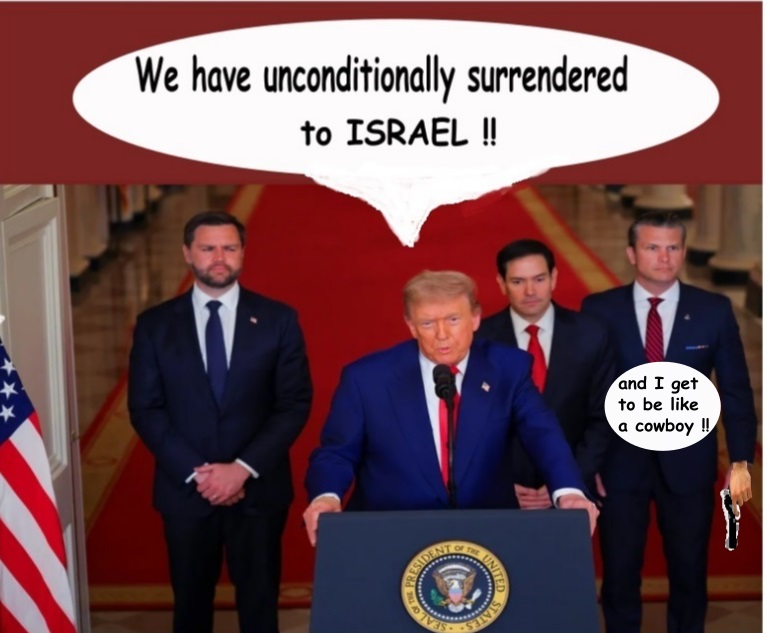
“Iran’s key nuclear enrichment facilities have been completely and totally obliterated,” Trump declared Saturday evening.
It is certainly unclear how “the Jewish state” will take it if Iran’s nuclear program has been damaged but remains extant.
The Iraq invasion and the bombing of Iran are acts of desperation — the conduct of a wounded, uncertain nation that went on the defensive when the Twin Towers went down and history arrived on its shores.
By Patrick Lawrence, Consortium News, 23 June 25, https://consortiumnews.com/2025/06/23/patrick-lawrence-completely-totally-obliterated/
I have heard many unhinged speeches by American presidents over the years, but — no risk of exaggeration here — Donald Trump’s as he declared “a spectacular military success” after seven B–2 bombers attacked three nuclear sites in Iran Saturday night is the barmiest of my lifetime.
“The nuclear threat posed by the world’s No. 1 state sponsor of terror?” “The bully of the Middle East?” There was this by way of a plunge into the crowded precincts of American paranoia:
“They have been killing our people, blowing off their arms, blowing off their legs with roadside bombs. That was their specialty. We lost over a thousand people and hundreds of thousands throughout the Middle East and around the world have died as a direct result of their hate.”
And for the good people out in Peoria, a decisive majority of whom, the polls say, oppose American aggression against the Islamic Republic: “I want to just say, we love you, God, and we love our great military.”
Let me remind readers, as rhetoric this base makes it easy to forget: The speaker of these words is the 47th president of the United States. Yes, the commander-in-chief.
It is difficult to take Trump’s four minutes in front of the microphone late Saturday evening the slightest bit seriously. But we must, precisely because what Trump had to say to his nation was so utterly unserious.
Donald Trump, to put this point another way, turns out to be worse than Donald Trump.
It is natural, for those with some sense of history to compare Trump’s my-God-and-my-military talk with the more craven moments of the McCarthyist 1950s, or with the John Birchers. I say it is more useful to think of that famous remark Karl Rove made during an interview conducted by Ron Suskind a year and seven months after the Bush II regime invaded Iraq.
“Faith, Certainty and the Presidency of George W. Bush” was published in The New York Times Sunday Magazine in October 2004. Suskind identifies Rove, then an adviser to the Bush White House, as “the aide,” but it was soon enough known it was he Suskind had interviewed.
The memorable passage in the Suskind piece is this:
“Guys like me were ‘in what we call the reality-based community,’ which he defined as people who ‘believe that solutions emerge from your judicious study of discernible reality.’ … ‘That’s not the way the world really works anymore,’ he continued. ‘We’re an empire now, and when we act, we create our own reality. And while you’re studying that reality — judiciously, as you will — we’ll act again, creating other new realities, which you can study too, and that’s how things will sort out. We’re history’s actors … and you, all of you, will be left to just study what we do.”
America had by then given Iraqis and the rest of the world a bitter display of what results when a nation purports to conjure realities to its liking. Trump now takes on the same preposterous project, as the ungrounded language cited above indicates.
Bush II failed extravagantly in Iraq, and Trump’s new adventure cannot but come to the same fate.
Creating reality, as if the irreducible foundations of cognition and logic are mere irritants to be set aside, may look like the very zenith of hubristic power. It is not.
The Iraq invasion and the bombing of Iran are to be read as acts of desperation — the conduct of a wounded, uncertain nation that assumed the defensive crouch when the Twin Towers went down in 2001 and history arrived on its shores — history, that process America all along thought was the burden of others.
We must bear this always in mind. Desperation is the mulch wherein recklessness germinates.
“Iran’s key nuclear enrichment facilities have been completely and totally obliterated,” Trump declared Saturday evening. Does this remind you of anything?
Maybe Bush II’s ridiculous appearance, in a bomber jacket no less after landing on board, to declare on an aircraft carrier off San Diego a few days after the Iraq invasion began, “Mission accomplished?” An infamous bit of staging,
We are already well down from “completely and totally.” By Sunday morning the Pentagon was trading in “severe damage,” catch-all vocabulary such that there is no telling what it means.
Casting further doubt on the state of matters, a digital publication called Amwaj.media reported Sunday afternoon that Washington had advised Tehran in advance of its intent to bomb and indicated the limits of its targeting. Citing “a high-ranking Iranian political source,” Amwaj said this source “also confirmed that the targeted sites were evacuated, with ‘most’ of Iran’s stockpile of enriched uranium kept in secure locations.”
Amwaj.media has its head office in Britain and publishes news and comment on West Asia in Arabic, Farsi and English. I cannot verify this report, but I am not at all inclined to discount it. It conforms, certainly, with the Trump regime’s vigorous efforts to stress that it does not seek a full-out war with the Islamic Republic.
“We have no idea where this war will go,” The New York Times declared in the headline atop an opinion piece published in its Sunday editions. “It may appear like a tactical victory less than four hours after the bombs began to fall,” W.J. Hennigan writes, “but projecting any sense of finality about this ordeal is wildly premature.”
This is so by way of facts on the ground, as the expression goes. It is certainly unclear how “the Jewish state” will take it if Iran’s nuclear program has been damaged but remains extant. The Zionist fanatics who started all this seem willing to settle for nothing short of Trump’s “completely and totally.”
But I see finality aplenty when I turn the weekend’s events 180° and consider them from this perspective. Whatever the destruction at Fordow, Isfahan and Natanz by way of the “bunker busters” those B–2s dropped, the damage the Trump regime has done to itself and the nation it pretends to govern is nearly too extravagant to reckon.
Remember “Nous sommes tous Américains,” that celebrated headline atop an editorial Le Monde published shortly after the Sept. 11, 2001, attacks? I did not then think the United States had enjoyed the world’s approval so unreservedly for decades.
The slide began two years later, with Bush II’s wanton, unquestionably illegal invasion of Iraq. The policy cliques could not since have squandered the residual good will of the postwar decades more efficiently had they tried.
It was not a question of trying, of course. It has been a question since 2001 of those planning and executing U.S. policy simply not giving a damn what the rest of the world thinks — or wanting even to know what the rest of the world thinks.
Trump just decisively clarified the point, in my judgment. Nothing other than power matters to the Americans now. If this has been true since 2001, Trump makes clear there is no turning back from this: Power is all the United States has left to give the world — or impose upon it.
“There’s no military in the world that could have done what we did tonight, not even close,” Trump declared triumphantly Saturday night. “There has never been a military that could do what took place just a little while ago.”
What a thing to boast of. So hopelessly out of sync with the 21st century. No, no other military could have done what the American did at the weekend, and no other military would ever be sent on such a mission.
I cannot imagine what some metric of global good will toward America would register now that Trump has led the United States into what looks like another war. If “completely and totally obliterated” were on the dial, the needle would be close.
As widely reported, Trump colluded with the Israelis to deceive Tehran with the suggestion that talks toward a diplomatic settlement of the nuclear question would proceed in Oman two Sundays ago. And as the Iranians prepared for another round of negotiations, Israel launched its attacks the preceding Friday.
Sucker-punching. This now seems part of America’s diplomatic repertoire.
It is hard to believe any American administration would be this craven, but Trump did the same thing again when he stated last week he would take two weeks to give diplomacy a last chance. It was a matter of a few days before the B–2s flew.
When Seymour Hersh predicted this in “What I have been told is coming in Iran,” published in his Substack newsletter last Friday, I confess I thought Sy’s neck was out a touch too far this time. I leave readers to finish the thought.
The Washington policy cliques have been more or less indifferent to statecraft for decades. Diplomacy is for the weak nations, the powerful having no need of it, former U.N. chief Boutros Boutros Ghali wrote insightfully in his memoirs. Trump just burned the bridges diplomats are supposed to build — all of them.
Who — the Russians, the Chinese, the Africans, the Latin Americans, the Europeans, the East Asians, the Indians — who will engage the Americans diplomatically any longer but with deep suspicions, deep reservations, and a profound reluctance to trust? Not to mention a well of contempt.
This is grave far beyond the Iranians, in my view. Contrary to appearances these past 25 years, diplomacy is an essential 21st century technology. B–2s and bunker busters do not seem so to me. High-technology weaponry is deployed at an ever-rising cost.
Incessant breaches of international law, cavalier abuses of the sovereignty of other nations: This will go on for who knows how long. But Trump and his people and the neoconservatives who appear to control them just went some distance destroying all possibility that the U.S. might participate in the making of a new world order.
This matters nil in Washington now, but such an order materializes as we speak, and the day will come when this foreclosed prospect will be up for regret.
I read something else in Trump’s Saturday night speech. To me it was the culmination of weeks of irrationality, a frenzy of it that led — just as the Israelis hoped it would — to senseless attacks with no logical justification.
There seems to me another kind of finality to what Trump just did. He has destroyed — completely and totally, I fear to say — rational thought as the basis of action in the name of what historians of our time will record as a rear-guard defense of raw power.
A late-phase imperium cannot do what Trump just did and then return to sound deliberations, measured policy, sophisticated statecraft. I do not now see a path to any such return.
America has long been — since 2001, again — on the way into an era of unreality, as we may as well call it. Trump just gave the nation a final shove and slammed the door behind it, to put my point another way.
When the bunker busters fell Saturday night the Trump regime created a reality all right. Look at it. Take a hard look. This is essential if some new direction is to be discovered.
Patrick Lawrence, a correspondent abroad for many years, chiefly for the International Herald Tribune, is a columnist, essayist, lecturer and author, most recently of Journalists and Their Shadows, available from Clarity Press or via Amazon. Other books include Time No Longer: Americans After the American Century. His Twitter account, @thefloutist, has been permanently censored.
Weaponized Stupidity – How Nonsense Became a Strategy of Control

Most people speak to convey meaning. Trump speaks to obliterate it.
If you say something smart, you get a headline. If you say something unhinged, you get the news cycle.
Trump doesn’t need reality. He needs confusion.
Closer to the Edge, Jun 20, 2025, https://www.closertotheedge.net/p/weaponized-stupidity?utm_source=post-email-title&publication_id=3721088&post_id=166334561&utm_campaign=email-post-title&isFreemail=true&r=8cf96&triedRedirect=true&utm_medium=email
Weaponized stupidity is not a mistake. It’s not a blunder. It’s not a man fumbling for words or getting lost mid-sentence. It is a system — carefully constructed, viciously effective, and designed to collapse the very idea of shared reality. It is not the absence of intelligence. It is the performance of incoherence, deliberately crafted to overwhelm logic, disarm the listener, and leave nothing standing but power. Donald Trump didn’t stumble into this style. He perfected it. He refined stupidity into a political force multiplier, and he’s been using it to dominate American life like a man attacking a chessboard with a leaf blower.
This is not a speaking style. It’s not charisma. It’s not even lying in the traditional sense. It’s noise deployed at scale — a full-spectrum assault on language itself. He doesn’t say things to be understood. He says them to make understanding feel impossible. His goal is not to persuade, but to wear you down. To batter your brain with so many contradictions, fragments, slogans, and unfinished thoughts that eventually you stop trying to follow the logic and just let the volume carry you. It’s not debate. It’s verbal arson.
He opens his mouth and unleashes a slurry of slogans, invented anecdotes, half-remembered headlines, imaginary phone calls, and personal grievances that contradict themselves before they finish. This is not a glitch. This is the operating system. When Trump speaks, it’s like watching someone argue with a fog machine. By the time you try to fact-check the first sentence, he’s already five tangents deep into blaming Germany for interest rates, praising a guy who may not exist, and claiming a large man cried on a tarmac. None of it makes sense. All of it dominates the room.
That’s the point.
Weaponized stupidity works because it breaks the social contract of communication. Most people speak to convey meaning. Trump speaks to obliterate it. The more incoherent he is, the more difficult it becomes to pin him down, rebut his statements, or even quote him accurately. He becomes impossible to refute — not because he’s right, but because he’s made language itself an unreliable witness.
And it’s not just his supporters who fall for it. The press chases it. The opposition tries to decode it. Cable hosts waste entire segments “breaking it down” like it’s a riddle instead of what it actually is: a bullshit tsunami designed to overwhelm your brain with raw sewage. The more absurd the content, the more media oxygen it sucks up. If you say something smart, you get a headline. If you say something unhinged, you get the news cycle.
The brilliance of the strategy — the real black magic — is that it rewires the audience. It makes people associate clarity with elitism. If someone speaks with precision and intellect, they must be hiding something. But if someone speaks like a drunk uncle trapped in a drive-thru speaker, well, that guy must be “real.” It inverts trust. It turns confusion into proof of authenticity. The dumber it sounds, the more believable it feels.
And it doesn’t just muddy the truth. It exhausts the will to pursue it. The goal isn’t to convince you. It’s to make you give up. When someone contradicts themselves twelve times in sixty seconds, it’s not a debate — it’s a stress test on your mental endurance. Most people tap out. They shrug. They say, “That’s just how he talks.” And in that moment — that shrug, that surrender — he wins. He’s not smarter. He’s just louder, longer, and willing to be more shameless than anyone else in the room.
What makes it so infuriating is that it works. It works on a press trained to pull quotes. It works on a public trained to skim headlines. It works on institutions still pretending we’re operating in a shared reality. But Trump doesn’t need reality. He needs confusion. He needs volume. He needs the kind of language that melts truth into a puddle of vibes, slogans, and Twitter threads arguing about what he “really meant.”
And here’s the final twist of the knife: he’s branded the chaos. He calls it “the weave.” He thinks it’s genius. And in a sick way, it is. Because it’s not just gibberish — it’s tactical gibberish. A Trojan horse of stupidity that carries a payload of unchecked power.
So no, this isn’t harmless. This isn’t just a “different communication style.” This is a weaponized breakdown of language, designed to eliminate the very conditions under which democracy can function. If nothing makes sense, nothing can be challenged. If every sentence is nonsense, there’s no way to hold the speaker accountable. And when people finally stop asking questions — not because they got answers, but because they got tired — then the mission is complete.
This is not mere stupidity. This is stupidity deployed with intent. It’s not a bug. It’s the whole goddamn platform. And unless we start naming it, dragging it into the light, and ripping off its camouflage of “authenticity,” we’re going to keep losing to a man who governs like a malfunctioning game show host and commands like a foghorn with a grudge.
We are not being beaten by brilliance.
We are being beaten by weaponized nonsense delivered at scale.
And if we keep mistaking it for comedy, we’ll laugh all the way into the abyss.
Zelensky Offers to Broker Peace Between Musk and Trump

KYIV (The Borowitz Report) 7 June 25
—In a bold attempt at high-stakes diplomacy, Ukrainian President Volodymyr Zelenskyy offered on Friday to broker a peace deal between Elon Musk and Donald J. Trump.
“It is time for the fighting to stop,” Zelenskyy said to Musk and Trump. “And I am willing to make the ultimate sacrifice: sitting in the same room as the two of you.”
Addressing Trump, the Ukrainian declared, “Mr. President, Elon gave you 250 million dollars, and you haven’t said ‘thank you’ once.”
Your move: Gamers join nuke industry in planning future atomic disasters
NFLA 1st April 2025
Following a £2.8 million investment made by Sellafield to transform a Whitehaven furniture department store into a high-tech digital and gaming hub[i], today nuclear industry bosses have announced that they are teaming up with Digital Gaming Content PHD students to embrace a new gaming genre – Atomic Disaster Gaming.
Under Project ‘Atomquake’, the students will be invited to participate in multiple team scenarios in which unprecedented catastrophes will be mapped out which place Cumbria’s population and environment in grave peril.
One such scenario relates to the possible location of a Geological Disposal Facility in West Cumbria in which the work of multiple giant boring machines tunnelling mass voids under the sea alongside the Sellafield site trigger earthquakes along the long-dormant Lake District Boundary Fault Zone.
Another envisages the ongoing leaks from Magnox silos contributing to the liquification of the Sellafield site.
Frightening stuff, and in parts true.
But if you were questioning the entire veracity of our story, you would be right to do so – please take account of the date.
In outlining this tale, we tip our hat to acknowledge software developers, Rebellion Developments, who have just released ‘Atomfall’, an acclaimed action game set in an alternate 1960s Cumbria, where radiation from the 1957 Windscale Fire has blanketed much of Northern England making it a contaminated quarantine zone. In the game, participants in the online world take on player characters who are engaged in a battle for survival.
The disaster outlined in ‘Atomfall’ almost came to pass, so, as life sometime imitates art, who is to say whether, in whole or in part, our innocent April Fool’s Day tale may one day also become our future reality.
(The NFLAs wish to thank Marianne Birkby from Radiation Free Lakeland for her contribution to this article and for the illustration she has kindly provided to accompany it)………………………………………………….https://www.nuclearpolicy.info/news/your-move-gamers-join-nuke-industry-in-planning-future-atomic-disasters/
How the Arts Play a Role in the Fight for Nuclear Disarmament

conversations surrounding nuclear weapons have been largely absent from the cultural zeitgeist. The Atomic Age, also known as the period of time between the detonation of the first atomic bombs in 1945 and the end of the Cold War in 1991, was saturated with pop culture that dealt heavily with themes of nuclear fallout.
UNITED NATIONS, Mar 6 2025 (IPS) -By Oritro Karim, https://www.ipsnews.net/2025/03/arts-play-role-fight-nuclear-disarmament/?utm_source=rss&utm_medium=rss&utm_campaign=arts-play-role-fight-nuclear-disarmament
This week countries and communities converge in New York for the 3rd Meeting of State Parties on the Treaty for the Prohibition of Nuclear Weapons (TPNW), with multiple side events to address the social, political and cultural impact of nuclear abolition across different sectors.
On March 5, the Permanent Mission of Mexico to the United Nations held an event called Fábulas Atómicas – Artists Against the Bomb in collaboration with Mexican artist Pedro Reyes, in which the relationship between the arts and the use of nuclear weapons was discussed. Throughout the last century, the arts have been used to provide cultural commentary on the threats that nuclear weapons pose to humanity.
“Using art for disarmament can take many different forms. I started by transforming gun parts into musical instruments, for instance taking a rifle and transforming it into a flute…What is the principle of a nuclear weapon? I thought it was possible to make a chain reaction that could be a creative force rather than a destructive force. That is how Artists Against the Bomb was born,” said Reyes.
Since 1952, the United Nations Disarmament Commission (UNDC) has continuously stressed the importance of international peace and disarmament. With geopolitical tensions on the rise and world superpowers such as Russia, North Korea, and the United States wielding more atomic weapons than ever before, the threat of nuclear proliferation is the highest it has been in decades.
“The bilateral and regional security arrangements that underwrote global peace and stability for decades are unravelling before our eyes. Trust is sinking, while uncertainty, insecurity, impunity and military spending are all rising. Others are expanding their inventories of nuclear weapons and materials. Some continue to rattle the nuclear sabre as a means of coercion. We see signs of new arms races including in outer space,” said United Nations (UN) Secretary-General António Guterres at the UN Conference on Disarmament in Geneva.
Despite this, conversations surrounding nuclear weapons have been largely absent from the cultural zeitgeist. The Atomic Age, also known as the period of time between the detonation of the first atomic bombs in 1945 and the end of the Cold War in 1991, was saturated with pop culture that dealt heavily with themes of nuclear fallout.
Since the late 1980s, projects began to shift away from these themes. Reyes highlighted the importance of art in relation to cultural commentary surrounding nuclear weapons by saying, “The end of the 80s made it seem like the cold war was over. To a certain extent, people born after 1989 had not been exposed to cultural materials…With the nuclear testing ban, there haven’t been any nuclear detonations since around 1999. There’s a saying called ‘out of sight out of mind’. The threat became somewhat invisible. It is our job to use culture to bring awareness to this issue through culture by provoking rage and fear.”
Reyes adds that the current undersaturation of the nuclear weapons issue in pop culture helps to facilitate conversations as the public has become wary of discussing issues that dominate culture today. “There is no fatigue about the subject. There’s a certain fatigue surrounding projects that have been strongly discussed in the past twenty years. Nuclear weapons are an issue that we have not spoken out about enough in recent times. We need to take advantage of this lack of fatigue,” he said.
The Nuclear Art movement rose in 1945, shortly after the United States’ detonation of two atomic bombs in Hiroshima and Nagasaki, Japan. At this time, the majority of the American public were unaware of the scale of destruction that had occurred in Japan.
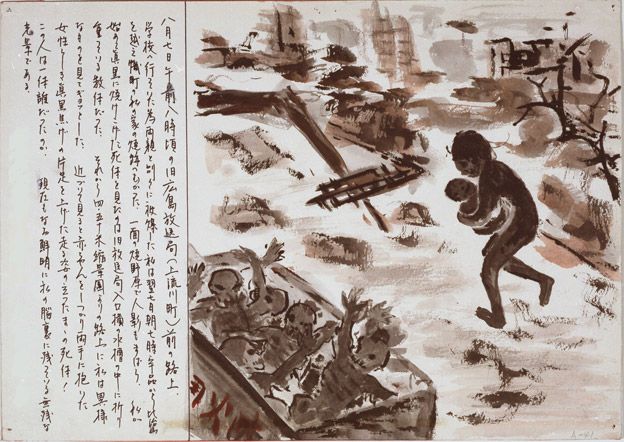
Japanese photographers that had survived the attacks such as Yoshito Masushige (Hiroshima) and Yosuke Yamahata (Nagasaki), as well as American photographers such as Wayne Miller and Joe O’Donnell, published photos of the aftermath, which were classified by the United States government for decades. Much of the world instead relied on artwork that visualized the devastation.
Contemporary artists and corporations alike began incorporating themes of atomic weapons and nuclear fallout in their work shortly after the bombings in Japan. This movement grew more prominent after the 1962 Cuban Missile Crisis, which is considered to be the closest the world has ever come to nuclear warfare.
Western art pieces, such as Charles Bittinger’s 1946 painting, Atomic Bomb Atomic Bomb Mushroom Cloud, brought the now well-known mushroom cloud imagery into public consciousness in the United States. Other examples include U.S. military artist Standish Brackus’s pieces Still Life (1946) and At the Red Cross Hospital (1945), which depicted the wide scale destruction that nuclear weapons inflict on civilian infrastructure and the human body, respectively.

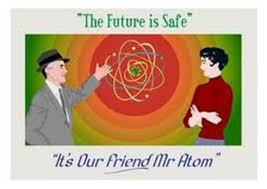
Additionally, Nuclear Art also became a fixture in Western propaganda. In 1957, the Walt Disney Company released an episode of Disneyland titled Our Friend the Atom, which highlighted the ways atomic weapons can be used for peace, falling in line with the themes of Dwight D. Eisenhower’s Atoms for Peace speech at the UN General Assembly in 1953.
In the early 1950s, blockbuster films from both American and Japanese studios led to a widening public consciousness surrounding nuclear weapons. Science-fiction films such as The Beast from 20,000 Fathoms (1953) and Godzilla (1959) highlighted the unintended biological consequences of nuclear fallout.
However, On the Beach (1959) marked a pivotal shift in the depiction of nuclear fallout by explicitly marking humans as responsible for a deliberate detonation that led to a societal collapse. Stanley Kubrick’s Dr. Strangelove (1964) expanded on these themes by using absurdism to emphasize humanity’s role in nuclear proliferation.
Most recently, Christopher Nolan’s Oppenheimer (2023) brought nuclear weapons into the public consciousness once more, particularly in the West, There have been critiques on if modern artists are depicting these themes effectively. Reyes told an IPS correspondent that the arts have the ability to sway audiences in either direction. Certain representations of nuclear weapons in pop culture can be classified as either “above the cloud” or “under the cloud”.
“Films like Oppenheimer show the overwhelming power of science and the moral conflict of atomic bombs but never show the victims or consequences. Films like that are almost pro-bomb because they fail to humanize these conflicts. Other films show what’s really at stake. It’s important to be able to identify which side cultural productions are on,” said Reyes.
It is crucial for contemporary artists to depict the correct messages in their work to achieve any substantial cultural progress in nuclear disarmament. Pop culture must continue to show the true extent of the dangers that nuclear weapons pose.
“We have to be very clear in arguing that nobody can win a nuclear war,” said Reyes. “And that’s why it’s very important to show the consequences. It has been normalized through video games and other mediums that make them seem not as problematic as they are. It’s our job to do a lot of explaining and find entertaining ways for people to understand.”
IPS UN Bureau Report
Why Welsh speakers oppose Wylfa nuclear plant
Letter David Thomas: I was dismayed to see your article (Report, February
8), blithely dismissing the impact of the planned Wylfa Newydd nuclear
power station on Welsh-speaking communities. You parrot the view of the
nuclear industry that nothing should stand in the way of the bulldozers,
with little regard for the wider picture here in Wales.
The valid concerns
of Welsh-speaking communities are deemed illegitimate by the nuclear
industry, and Welsh speakers’ interests are portrayed as akin to those of
bats and newts — as unnecessary “blockers” to progress.
The ongoing survival of the Welsh language is nothing short of a miracle in the face of
the linguistic, economic and political hegemony of our English neighbour.
To dismiss linguistic and cultural concerns that the Wylfa Newydd plan
might entail is to dismiss the very existence of Wales as a linguistic and
cultural entity.
The Welsh government has committed to a target of having
1mn Welsh speakers by 2050. This plan has been ratified on repeated
occasions by the Welsh electorate, and surveys show that an overwhelming
majority of the Welsh population are well disposed to the language, even
among groups of non Welsh speakers.
We might also question why Ynys Môn
(Anglesey) is perceived as a suitable site for a new nuclear power plant.
Wales is already a net exporter of energy, yet Welsh consumers pay more for
electricity than the vast majority of their English counterparts.
Possibilities for renewables in the form of onshore and offshore wind and
tidal energy appear promising, yet attempts to pioneer tidal power in Wales
have been blocked by successive UK governments.
FT 12th Feb 2025
https://www.ft.com/content/3c9045c5-8cb4-4db3-bdf1-734b7cd789bf
Pentagon Warns China Developing Love, The Greatest Weapon Of All
https://theonion.com/pentagon-warns-china-developing-love-the-greatest-weapon-of-all/ January 27, 2025
ARLINGTON, VA—In a high-level alert that revealed a geo-political rival of the United States could soon become the first nation capable of wielding the most powerful force in the universe, the Pentagon warned Friday that China was actively developing love, the greatest weapon of all.
The alert, issued to the American public and top U.S. allies, stated that China had made significant advances in love, a transcendent source of strength that ultimately triumphs over any defenses an enemy might try to erect against it. Weapons experts confirmed that if it were unleashed, the all-consuming feeling could strike the hearts of billions throughout Asia and the Pacific, even reaching the West Coast of the United States.
“Our assessments indicate love is stronger than any technology possessed by the U.S. military,” said Defense Secretary Lloyd Austin, pledging to work with Japan, South Korea, Australia, and other regional partners to stop China from harnessing the invincible cosmic force that always emerges victorious. “Intelligence estimates suggest the program is in its final stages, so we must act quickly or love will overwhelm us and we will feel compelled to surrender to it.”
“If China succeeds, it will have the power to remake the global order by spreading universal love and understanding to every corner of the world,” Austin added.
Nations have vied for years to develop love, knowing it would provide their arsenals with a weapon that could overcome anyone or anything it encountered. According to sources within the Pentagon who spoke on condition of anonymity, the Defense Department’s own 10-year, $750 billion effort has failed to produce an abundance of love, bringing it no closer than it was a decade ago to equipping the military with a profound sense of devotion to one’s fellow human beings.
China is believed to have put similar resources into its far more successful program, with surveillance reports indicating that by 2030 the nation will have obtained an emotion that can create a profound sense of oneness with the universe. Previously, U.S. military analysts had questioned whether China possessed the emotional vulnerability necessary to develop love, believing it was still several decades away from acquiring a feeling so expansive it knows no bounds and flows outward into every aspect of existence.
In 2019, the U.N. issued sanctions after it found evidence of China’s intent to open itself up to love’s embrace, but inspectors reportedly underestimated just how quickly the smallest seed of tenderness could flourish into a garden of eternal love. Today, international observers expressed concerns that if the weapon were used, the world would see a fallout of hundreds or even thousands of years in which love would endure all things.
“It is clearly a show of strength by China to love like its heart has never been broken,” said Daniel Feng, an expert on Sino-American relations at Georgetown University, noting that China’s ultimate goal was to assert its right as a sovereign nation to love freely and unselfishly by letting go of fears and expectations. “Quite frankly, no one can escape the power of love, and China knows it. By putting their hearts on the line, they are signaling that at any given moment they could shower the United States with a love so fierce it would leave their international rival unrecognizable afterward.”
“So what should the Pentagon do now?” he continued. “With new theories suggesting it has the potential to be far, far stronger than love, America’s best strategy may be developing the technology to harness the power of mild annoyance.”
Philosophy Against Nuclear Power

It is now clear that the residents of Fukushima are far from some voluntarist subjects but rather a people who live under constant subjection. The installation of nuclear power plants was not democratically decided, neither did it bring any halt to the historical subjection. Rather, nuclear power plants worsened the subjection by reproducing subjection. It should be clear that the one who bears the responsibility is the “village” (TEPCO, the government, etc.) rather than the victims.
How many times we should suffer from this “blindness to nuclear apocalypse” in order to realize that nuclear power is just a technology against humanity?
New Bloom, Shen Yun-Yen, 12/29/2024
Yoshiyuki SATO and Takumi TAGUCHI, Datsugenpatsu no tetsugaku (Philosophy for Abandoning Nuclear Power), Jimbun Shoin, 2016.
THE NUCLEAR BOMB certainly posed a serious problem for contemporary philosophy. From Heidegger to Arendt to Marcuse, philosophy in the mid-20th century struggled to deal with this all-annihilating artificial production. Unfortunately, most of these philosophers did not analyze the complex relationships between nuclear technology, capital, state, etc.
………………………………………………………….. ……………….Fortunately, two philosophers, Yoshiyuki Sato and Takumi Taguchi, accept the difficult challenge of philosophizing nuclear power. In their joint work Datsugenpatsu no tetsugaku, they argue at the outset that neither “pure philosophy” nor “philosophy as usual” will ever constitute an effective critique of nuclear power (13-4). What we need, according to Sato and Taguchi, is a Datsugenpatsu no tetsugaku, which can be translated as either a philosophy of abandoning nuclear power, or simply philosophy for abandoning nuclear power…………………………………………………..
The book is divided into four parts, each with three chapters, and a conclusion. The first part deals with the identity of kaku (nuclear weapons) and genpatsu (nuclear power plants); the second an ideology critique; the third a historico-politico-economic critique of the development of nuclear power; the fourth part attempts to consider nuclear power a public hazard; lastly, the conclusion provides a vision for a society without nuclear power.
1.
Even after the Fukushima catastrophe, many philosophers continued to philosophize the phenomenon as usual, or, to borrow a phrase from Adorno, touting the “jargon of authenticity.” It’s just weak. Ontology alone will never constitute a critique of nuclear power. Rather than providing a sound critique, these sorts of philosophy books seemed to reaffirm the ontological inability of philosophy when faced with nuclear catastrophe.
Fortunately, two philosophers, Yoshiyuki Sato and Takumi Taguchi, accept the difficult challenge of philosophizing nuclear power. In their joint work Datsugenpatsu no tetsugaku, they argue at the outset that neither “pure philosophy” nor “philosophy as usual” will ever constitute an effective critique of nuclear power (13-4). What we need, according to Sato and Taguchi, is a Datsugenpatsu no tetsugaku, which can be translated as either a philosophy of abandoning nuclear power, or simply philosophy for abandoning nuclear power. Each translation carries different connotations. “A philosophy of abandoning nuclear power” seems to make philosophy a means for abandoning nuclear power, while the other seems to be a sublation of “philosophy as usual.” The logic is actually clear: nuclear power serves as a medium for philosophy to sublate itself.
Like Marx, who philosophically criticized philosophy by incorporating political economy and history into philosophy, Sato and Taguchi incorporate different fields of thought in order to critique nuclear technology and renew philosophy. They not only bring Günther Ander, Foucault, Judith Butler, Montesquieu, etc. together and interpret their th
2.
THE BOOK OPENS with a warning: our stubborn “blindness” to the repetition of nuclear catastrophes. In 1945, nuclear bombs were dropped in Hiroshima and Nagasaki, which made philosopher Günther Anders argue that “Hiroshima is everywhere,” that is, regardless of location, we were already living in an age where indiscriminate annihilation became possible, and irreversible. In 1954, the US conducted nuclear testing (H-Bomb) at Bikini Atoll, and the “ashes of death” fell all over the place, which led to the death of several Japanese fishermen fishing nearby. In the same year, Günther Anders lamented that, after Hiroshima and Nagasaki, we still suffered from the “apocalypse-blindness” to nuclear weapons. In 1979, the year of the Three Mile Island accident, Anders reasserted his arguments, and noted that nuclear plants served but a masquerade of nuclear weapons. And then there was Chernobyl (1986), which made Anders change his argument from “Hiroshima is everywhere” to “Chernobyl is everywhere.”
As Japanese philosophers, that is, philosophers from a country where nuclear tragedies happen most frequently (Hiroshima, Nagasaki, Bikini, Tokaimura, Fukushima), Sato and Taguchi clearly understand that Fukushima is not something “accidental” (sōteigai), as many commentators and government officials claim to be, but a repetition of the above-listed catastrophes (29). They also critique the fake distinction of the “civil use” and “military use” of nuclear power by drawing on the works of critical scientists such as Takagi Jinzaburo.
For Sato and Taguchi, the identity between nuclear weapons and nuclear power plants is established historically, that is, nuclear power plants share every feature of the Manhattan Project, from the principle of secrecy, the concentration of capital, the state-centrism, to its technical principles and, perhaps most importantly, the subordination of scientific development to the ends of the state.
Indeed, scientific knowledge is never innocent, which is why Sato and Taguchi employ a Foucauldian analysis of power-knowledge in order to critique the interrelationship between the two. The state decides who is allowed to participate the project, what to research, how much money an experiment needs, etc., without public scrutiny. This is why nuclear technology is a product of the “state-industrial-knowledge complex” (56).
3
IF IN THE context of the U.S., the symbol of the “state-industrial-knowledge complex” is the Manhattan Project, in Japan it’s the “nuclear village” (genshiryoku-mura). The “village” is not a physical location but a principle of exclusion (murahachibu), that is, whoever holds opinions different from them will be excluded. As an entity of highly concentrated power, its impact should not be underrated.
…………………………………………..This top-down, exploitative, discriminatory system exists throughout the history of modern Japan, that is, from Meiji to the present. It is true that in the post-war occupied period, the main condition of getting back Japan’s sovereignty is to democratize the state. However, it is also true that, under the shadow of the Cold War, both the US and the Japanese government did not care much about democratization. The result is that former Class A war criminal suspect Nobusuke Kishi not only became the Prime Minister of Japan (1957-60) and President of the LDP (1957-60), but also played an important role in supporting the “village.” It is no wonder that Sato and Taguchi repetitively argue that nuclear development in Japan serves both economic and military ends, and that as long as this system exists, claims about the “democracy” or democratization of Japan will never make sense.
4
THE VILLAGE DECIDES everything, including what’s to be done after the Fukushima catastrophe. First of all, given the identity of the “military use” and “civil use” of nuclear power, the authors argue quite convincingly that the impact of a nuclear catastrophe can only be compared to that of a war (34-7). That is, nuclear power plants’ disasters often produce effects analogous to those of war. From Chernobyl to Fukushima, whenever a nuclear disaster happens, there are always numerous refugees, lands that are no longer inhabitable, and almost unbearable economic costs.
After the catastrophe of Fukushima, there are many issues that remain unresolved even to today. However, the village’s attitude remains the same. The basic tone is denial and ideological. ………… In the case of the Fukushima catastrophe, the village (including scientists and doctors) decides to abandon certain populations in order to reduce economic costs (102). That is, because “electricity provision is necessary,” the village decides to make hundreds of thousands of residents (or refugees) continue to live under constant radioactive exposure (142).
The village has always been trying to promote an unscientific view of an “acceptable amount of radioactive exposure,” intentionally ignoring many scientists’ strong objections against this hypothesis. Hence, when there are lands still heavily polluted, the government policy asks many refugees to go back to their hometowns out of a deliberate calculation of cost-effectiveness. Without the intertwining of “scientific knowledge” and state power, this operation would not have been possible.
Sato and Taguchi go further to claim that, this sort of calculation is one of the reasons of the catastrophe. As a country where earthquakes happen extremely frequent, Japan’s earthquake studies have always been famous in the field. Long before the Fukushima tragedy took place, many specialists had already warned of a possible earthquake, tsunami, and nuclear disaster due to earthquake and tsunami. However, the village did not take action to prevent such a scenario from happening because the economic costs are just too high (138). It’s just not worth it.
After the Fukushima catastrophe, the village did not repent of its inaction. As for them, these warnings are not voiced from “specialists,” and this is the main reason why they will never take them seriously (134). As the authors point out, the so-called specialist is nothing but those who support the principle of the village (136).
5
……………………………………………………………………………..For the authors, the process of subjection begins with the above-mentioned policy, or the “long-distance electricity provision system.” The state chose certain regions to develop nuclear power plants because the regions were economically poor (as a result of systematic discrimination). The nuclear power plants, however, are more like drug addiction rather than hope. After conducting a rigorous economic analysis, Sato and Taguchi show that the more the regions attach to the nuclear economy, the more they become poorer, since this is nothing but a core-peripheral exploitative system (201-2)………………………………
It is now clear that the residents of Fukushima are far from some voluntarist subjects but rather a people who live under constant subjection. The installation of nuclear power plants was not democratically decided, neither did it bring any halt to the historical subjection. Rather, nuclear power plants worsened the subjection by reproducing subjection. It should be clear that the one who bears the responsibility is the “village” (TEPCO, the government, etc.) rather than the victims.
The Fukushima catastrophe makes the subjection clear, while also provides an opportunity to halt the subjection, according to the authors. That is, as an “event,” it changes the mindset of many of the residents and citizens. Many people chose to live without nuclear power (216), and one court decision even made clear that the lives of residents are above economic prosperity (87).
Seizing the opportunity to formulate a possible future against nuclear power, Sato and Taguchi argue that, firstly, nuclear power is entirely irresponsible for future generations, an idea they take from Hans Jonas (406). The reason is actually quite scientific: nuclear power cannot function without producing radioactive waste, which is inconceivable to be really “disposed.” The profit-seeking mindset of this generation will definitely do harm to next generations, if the world still exists.
Secondly, they argue that the government should formulate a system of referendum, as a way of practicing democracy (442-3). Given that the nuclear village almost always monopolizes any decisions regarding nuclear power, a referendum constitutes a way of abolishing the undemocratic structures of the state-industrial-knowledge complex.
Thirdly, the government, and every citizen, should take renewable energy seriously, and implement concrete policies to facilitate the transition from nuclear energy and highly polluting energies to renewable clean energy. They also go further to propose that energy provision should be taken as a common, rather than some private property monopolized by the “village” (448-50).
It is clear that, as for Sato and Taguchi, nuclear power is not just a feature of the Japanese state. Nuclear power, through its interconnections with capital, knowledge, science, etc., defines the state. A state defined by nuclear power, governed by the nuclear village, is necessarily unscientific, undemocratic, and irresponsible. Abandoning nuclear power, therefore, amounts to restructuring the state. If the Japanese government has always been touting its formal democracy, what the authors call for is a movement of democratizing democracy.
6
……………………………………………………………What I feel most bizarre is the fact that the Japanese government still tries to reopen the nuclear power plants, with little objection from the majority of the Japanese citizens. How many times we should suffer from this “blindness to nuclear apocalypse” in order to realize that nuclear power is just a technology against humanity?
Fukushima triggered a new round of anti-nuclear movements in Taiwan, with the final result of a zero-nuclear policy that will soon be implemented in 2025. When I discuss the recent development of the nuclear village with my Taiwanese friends who have all witnessed, through television, the Fukushima nuclear catastrophe, their reaction is always the same: What the fuck? Did the Japanese suffer from collective amnesia?
I would say yes.
But Sato and Taguchi demonstrate how this collective amnesia is produced rather than natural. Without the official ideology (the so-called “safety myth”) and the support from pseudo-scientific communities, this amnesia would not have been possible. Speaking of “collective amnesia,” one couldn’t help but think of issues regarding war responsibility and post-war responsibility. But, again, only a radical democratization can help the country to really face its past wrongs. https://newbloommag.net/2024/12/29/philosophy-nuclear-power/
The Atom & Us: Min-Kyoo Kim

“These people not only died in a moment of unfathomable violence; they were almost erased from memory altogether.”
Meandering over the pebbles, Vicki Lesley, Nov 16, 2024
Welcome to ‘The Atom & Us’, a new series of interviews in which I will be spotlighting the work and thought contributions of some of the incredibly interesting individuals I’ve been privileged to get to know through making & distributing my own nuclear history film, ‘The Atom: A Love Affair‘.
…………………………………… it’s my absolute pleasure to introduce you to my first contributor in the series:
Min-Kyoo Kim
…………………………………………………………….. Is there an event or experience from your personal involvement with nuclear that particularly stands out in your memory and why?
After finishing my Master’s, I went travelling in Korea. It was in a local museum in Busan, in the south-east of the country, that I first learned that tens of thousands of Koreans – alongside Chinese and other East Asians, as colonised subjects of Japan – had been killed in the atomic bombings in Hiroshima and Nagasaki. These people not only died in a moment of unfathomable violence; they were almost erased from memory altogether.
This, I think, is the horrifying character of nuclear weapons; under the spectacle of the mushroom cloud lies a multitude of stories yet to be told, injustices yet to be redressed. Crucially, it’s not just the bombs themselves – it’s the untold legacies of extracting radioactive material in places like Congo, or the consequences of tests conducted on Indigenous territories around the globe, that demand our attention.
Why do you personally find it a compelling topic?
I have two answers, one academic and one more personal and political.
Regarding my research, I’ve been interested in how eye-witness testimonies of nuclear explosions focus on the blinding effects of the atomic flash. The very impossibility of perceiving this violence obviously poses a challenge to the medium of film and photography. For me, this blinding effect of the bomb also enacts a metaphor for how mainstream culture and politics tend to forget the other myriad forms of violence associated with nuclear proliferation, as in the cases I outlined in the previous answer.
Then, there’s the personal/ political answer, which is altogether simpler: I believe in a world without nuclear weapons. Now, like any stressed PhD student, I find myself asking what my work actually means, if anything. It’s why I’ve so appreciated meeting other scholars, activists and artists working in this area; the opportunity to share knowledge, not only with each other but with the wider public, is something that keeps me going.
Why do you think it has always been such a polarising issue and do you have any thoughts on if/how the discourse can be expanded to move beyond a simplistic pro- or anti- binary opposition?
I do believe – simplistically – that there is no moral justification for nuclear weapons. According to the Bulletin of Atomic Scientists, the Doomsday Clock is closer to Midnight (the symbolic hour of apocalypse) than at any previous point, so as far as I’m concerned, there is no time for ambiguity.
The real complexity of the discourse is when we talk about nuclear power in the civil sphere. It would seem that nuclear power is indispensable to any hopes of a future with clean, renewable energy.
I would just bear in mind, at the same time, that the boundaries between civil and military uses of nuclear power are blurred, and that these infrastructures can be appropriated for either purpose: the case of the Windscale fire in 1957, in the U.K., was an early example, while EDF recently announced that they would produce radioactive material for France’s nuclear weapons programme………………………………………………………………………………………………………………………………………………………….
…………………………………………………………………………………more https://vickilesley.substack.com/p/the-atom-and-us-min-kyoo-kim?utm_source=post-email-title&publication_id=2042878&post_id=151644494&utm_campaign=email-post-title&isFreemail=true&r=1ise1&triedRedirect=true&utm_medium=email
Patrick Lawrence: Zionists in Amsterdam
Western print and broadcast media purposefully falsified all representations of these events to turn reality upside down
November 14, 2024 By Patrick Lawrence / Consortium News, more https://consortiumnews.com/2024/11/12/patrick-lawrence-zionists-in-amsterdam/
In the annals of “anti–Semitism,” if not anti–Semitism in its un-weaponized form, the events before, during, and since an ill-fated soccer match in Amsterdam last week merit a prominent entry.
We find in these chaotic days a picture in miniature of the sickness that has overtaken “the Jewish state,” the shameless apology those purporting to lead the Western post-democracies make for the straight-out barbarities of Zionist zealots, and the full-frontal disinformation spread by corporate and state-funded media as they pose as the first line of defense against disinformation.
It’s a three-fer, then, the whole banana in one place and at one time —all of this in the cause of the Zionist regime as it prosecutes its yearlong genocide in Gaza and sets about expanding its campaign of murder and destruction across West Asia.
Bad enough that planeloads of freak-show Israeli extremists arrived in Amsterdam last week for a match between Maccabi Tel Aviv and Ajax, the famous Dutch side, and instantly set about terrorizing the city in the name of Zionist chauvinism.
Worse were the authorities, starting but not ending with Amsterdam’s mayor and the Dutch foreign and prime ministers, recasting what was bound to follow as anti–Semitism, a 21st century pogrom, and so on down the list of hyperbolic absurdities.
Worst — and I indeed count this worst for its consequences — Western print and broadcast media purposefully falsified all representations of these events to turn reality upside down: Wall-to-wall, the criminals became the innocents in the news accounts, the victimizers became victims, and the victims became condemnable, anti–Semitic menaces to human decency.
See what I mean? Violence, lies, distortion, inverted reality: Two days in Amsterdam last week look now like one of those 16th century paintings the Dutch called “world landscapes,” wherein the whole of the earth is depicted in a compact panorama.
What happened in one Dutch city is the world as we have it since the Zionist regime began its limitlessly barbaric assault on the Palestinians of Gaza, the Western powers blessed it, and Western media determined to hide it from view.
Language is the instrument of my trade, and there must be words adequate to these depravities and corruptions. There must, there must. But the only one I know that matches the task at this point is “No!” Bear with me, please, as I struggle to find others.
It has been long and well documented that the Zionist ideologues who have fashioned a national consciousness among Israelis have systematically cultivated a presumption of Jewish superiority and — the contradiction here is only apparent — a corresponding belief that the rest of humanity detests Jews and the world is in consequence a dangerous place.
This project, wherein Old Testament tales of Jewish barbarities are routinely invoked, predates World War II by many decades; since 1945, as is plain to anyone who looks honestly, the Holocaust has been fully instrumentalized in this cause.
Systematic Indoctrination
I recall video footage shot in Jerusalem during the crisis at al–Aqsa Mosque in May 2021. It showed young Israelis, the girls in prim blue-and-white school uniforms, leaping up and down in a sort of blissed-out frenzy shouting “Kill all Arabs!” and other such obscenities.
What in hell? I wondered. Zionism is racism, yes, but how did it sink to this level of crudity? I should have understood. I did not know then the extent to which the minds of Israelis and Zionists the world over have been mutilated.
Two films — maybe there are more — explain the systematized indoctrination that produced the outcome at al–Aqsa.
Defamation is a cleverly done documentary from 2009 that follows adolescent students as they are brainwashed, during a summer sojourn in Europe, to fear a world that hates them.
Israelism, released last year, shows how American Jews are similarly instructed in Hebrew school — and how the eyes of many of these victims are opening to the frauds and racist cruelties of Zionist ideology.
You can watch Defamation here and Israelism here. These films are brilliant and brave.
And there is a straight line from the purposefully inculcated xenophobia and paranoia they depict to the scene on Jerusalem’s streets during the crisis at al–Aqsa and now — my point here — to the repulsive mobs of Israeli soccer fans in Amsterdam last week.
These are people, hundreds of them, who began their provocative aggressions as soon as they disembarked at Schiphol, Amsterdam’s airport.
The video and reported record shows them marching through the streets in what amounts to a rampage, tearing down Palestinian flags displayed on house fronts, vandalizing a taxicab with its driver (Moroccan) inside, attacking local people with pipes and clubs, chanting obscene, probably criminal slogans — “Kill the Arabs,” “Fuck you Palestine,” “There are no schools in Gaza because there are no children left,” “Let the IDF fuck the Arabs,” and on and on in this line.
The last is a reference to recent protests in Israel in defense of Israel Defense Forces soldiers found to have gang-raped Palestinian prisoners. Violent demonstrators, among them members of the Netanyahu cabinet, thought sodomizing Palestinians held in what amount to torture camps, should be made legal.
Numerous videos and news reports detail the horrific conduct of these repellent punks and the to-be-expected response from local people.
Here is one published last Friday in Middle East Eye. Here is a nine-minute video from Owen Jones, The Guardian columnist who has had a lot of things wrong over the years but has this story very right. Here is an exceptionally pithy commentary in MEE by the estimable Jonathan Cook.
On Sunday The Grayzone published the excellent video reporting of a young Dutch journalist-in-the-making that records Israelis attacking a contingent of uniformed Amsterdam police officers.
We can dispense with the ridiculous thought that these are football hooligans of the common variety and do not represent ordinary Israelis. Out of the question.
Owen Jones put out a second video Sunday, this one 17 minutes, that includes within it a video of the scene when the Israelis who went to Amsterdam arrived home. It is another raving paroxysm of racist delirium.
Let us take good care to understand these people and what they signify.
Sickness of a Nation
One, we see in them the sickness of a nation. Amsterdam showed this to the world in real-time video, reports on “X” and various other social media platforms.
I do not know when the apartheid state can be said to have succumbed to a perfectly diagnosable case of collective psychosis, but this is its condition now and it should be treated as such. Israel as now constituted, and arguably from the start, I mean to say, is not an acceptable presence in the community of nations.
See, for easy reference, the international community’s long, eventually successful ostracization of South Africa under the old apartheid regime. The time has come.
Two, it is one thing to indulge in deranged eruptions of hatred toward Palestinians and Arabs generally within the (internationally recognized) borders of an hysterical state.
Let us invoke the principle of noninterference in the affairs of others, even if these affairs amount to crazed ravings, and leave Israel’s freakish majority to itself. Gaza, and the Occupied Territories are, of course, another matter.
The Amsterdam events were something else. They were effectively an attempt to transport the extreme to which Israel has taken a premodern, even primitive ideology into a modern milieu and tell the world it must accept it.
This is what makes the mess in Amsterdam significant. And it is why it is important that it turned out to be, indeed, a mess.
Israeli terror did badly when it put its show on the road in the Netherlands last week. Ajax trounced Maccabi Tel Aviv 5 to zip. Zionism’s score was no better.
To consider this another way, listen carefully to all the racist chants. What were the Zionist deplorables who flew to Amsterdam saying?
In my read they were terrorists asserting that Israeli terror has a legitimate place in what we call Western civilization. They demanded acceptance. And why shouldn’t they try this on, given the Western powers’ unequivocal endorsement of all the state-sponsored barbarism?
The lesson here: It falls to those not of high office but of high principle to defend, in the streets or elsewhere, the remnants of the humane in the Western post-democracies.
Finally, let us not forget that in almost all cases history records, victimizers are also victims.
In this case, to praise gang rape and the slaughter of children amounts to an inverted, perverted admission that one’s psyche has been grotesquely disfigured at the hands of manipulating ideologues desperate to make a nation out of a diaspora that, as various Jews have argued over the years, ought to have remained a diaspora.
As to those who counter-demonstrated as these damaged people ripped through Amsterdam’s streets, it has been de rigueur this past week to include in one’s thoughts and observations some variation of, “There is no excuse for violence in response to the Israelis’ conduct.”
I go back to that important word mentioned above, “No!” The violence of those protesting the Israeli racists as they exported their nation’s terror to Europe, and the extent of this violence cannot be measured and so not known, is perfectly understandable in my view.
We are talking about a city — one with a large Muslim population, as the Israelis surely knew — that was confronted with a manifestation of evil that is nearly as pure as it gets. And those subjected to this viciously aggressive display are to be criticized because they did not respond as angelic pacifists?
I am simply not on for this. It has long seemed to me that we in the West, to dilate the lens briefly, have a very peculiar attitude toward violence given we live under regimes whose policies at home as well as abroad begin and end with violence or the threat of it. But I will leave this topic for another time.
For now, this: However many Muslims were among those countering the Israelis in Amsterdam’s streets, and we cannot know this either, they are absolutely correct to read the small-time terrorists who arrived last week as manifestations of a global system that, in its centuries of racist ideology, has violently made of them its victims.
Israeli officials ran all the miles their legs could carry them as they cast the Amsterdam events as another demonstration of a rampant wave of anti–Semitism sweeping across the globe. “It was a pogrom!” “It was another Kristallnacht!”
And among my favorites in this line for its faux desolation, this from Issac Herzog, the Israeli president: “I had hoped we would never again see these things.”
This kind of stuff is altogether predictable. Zionist officials long ago lost the privilege of being taken seriously.
Dishonesty Exposed
It is the responses of Dutch officials, and soon enough others in Europe, Britain and the U.S., I take seriously indeed. Their dishonesty — pervasive, distant from reality — has consequences running to free speech, all manner of other democratic rights, and popular opposition to terrorist Israel’s gross offenses to our shared humanity.
As is now well-reported in many independent media, in the early aftermath of last week’s chaos Dutch officials and others — among them the egregious Ursula von der Leyen, president of the E.U. Commission — assiduously erased the provocations of the Israeli mobs, turning them into the innocent victims of Jew-hating urban marauders.
This narrative is now more or less in ruins. But there is no indication that officials at any level are prepared to self-correct in light of now-established facts.
“What happened over the past few days is a toxic cocktail of antisemitism, hooligan behavior and anger over the war in Palestine and Israel and other countries in the Middle East.” That is Femke Halsema, Amsterdam’s mayor, diagnosing last week’s events as quoted in The New York Times’ Tuesday editions.
Once again, “No!” There is no equivalence among the three items on Halsema’s list.
The “war in Palestine and Israel” — what does this mean, while I am at it? — is by a long way the main event. Thuggery and anti–Semitism, and I will get to the latter shortly, are of passing importance in any honest evaluation of last week’s chaos.
Dick Schoof, the Dutch premier, asserted that many or most of those so far arrested — 60-odd at this point, and who knows how true this is — were of “a migration background.” He added, “We have an integration problem. This is an expression of that.”
We are now dismissing last week’s events as unimportant, symptoms of the Netherlands’ social problems, nothing more than the resentments of brown people? “No!” once more. This is not an integration problem. It is a Zionism problem.
It was inevitable that the riot of Zionist excess the Netanyahu government set in motion a year ago last month would spill well beyond Gaza and the rest of West Asia, given the Western powers’ enthusiasm for it.
Amsterdam can be reasonably interpreted as merely a chicken come home to roost.
Dick Schoof will not get anywhere near addressing this reality. Dick Schoof is what I mean when I suggest that leadership in the Western post-democracies, artful dodgers all, is hopeless. As we must all face, there is no getting any sense or decency out of them.
It is likely — once again, we have no confirmation of this — that there were declared anti–Semites among those who countered the Israeli soccer fans in Amsterdam’s streets.
One cannot condone this, of course, but neither can one take these people, however many their number, as defining of the last week’s events, and neither can we neglect to put their presence in context.
Israel is Judaism and Judaism is Israel: This has long been the Zionist state’s refrain — and the Netanyahu regime’s incessant refrain since it began its assault on Gaza on Oct. 8, 2023.
The identification is, of course, key to the Israelis’ way of protecting themselves against criticism. Attack Israel and you attack the Jewish faith: You are an anti–Semite.
One of the responsibilities of those who oppose Israeli barbarism now is to reject this false congruence as a trap set by Zionist propagandists. This is not so easy for many people.
However many anti–Semites were on Amsterdam’s streets last week, it is likely some did not think this question through sufficiently to refuse the bait. To succumb to anti–Semitic sentiments at this point is to serve, in upside-down fashion, the Israeli cause.
It is years since various government departments, universities, and other entities operating in the public sphere have endorsed the equivalence of opposition to Israel and anti–Semitism.
This is well-enough known. Since the Gaza crisis and the demonstrations across the Western post-democracies, this project has accelerated markedly.
Official responses to the Amsterdam events seem to me disturbing in that they suggest the erasure of this vital distinction now appears to be more or less complete. This is a war not only of words but also of individual and democratic rights in the post-democracies.
Let us not, let us never allow this preposterous conflation to pass without vigorous objection. Voices raised in opposition to Zionist terrorism — at this point to the Zionist state, indeed — are too important to let the charge of anti–Semitism silence them.
Mainstream media across the Western world, as has now been well-exposed, have made an ungodly mess of their coverage of the Amsterdam events — and so of themselves.
By all appearance they complacently assumed they could control the narrative, chiefly by obscuring the chronology of events, and maintain their simply disgusting defense of Israel’s genocide and the freakery abroad among its citizens.
Stories with bold-faced lies, lies of omission, accurate broadcast news segments published and pulled as “not up to our standards”: You had all of this as events unfolded. Those videos Owen Jones put out, linked above, give a good inventory of these derelictions.
As the days went by, it was very fine to see independent media force the corporate press and state-funded broadcasters such as the BBC to run for cover. This has to go down among the most revelatory, embarrassing occasions in the long decline of the mainstream.
I salute all those independent practitioners who got this work done.
The Neue Zürcher Zeitung, the big Swiss daily, published a piece in its Tuesday editions to this effect:
“The reconstruction of events in Amsterdam reveals a differentiated picture: The scenes surrounding the Champions League match between Ajax Amsterdam and Maccabi Tel Aviv went around the world, with top politicians outdoing each other in condemning the anti–Semitic incidents. However, amateur videos show a differentiated picture of the escalation. Maccabi fans were also violent before the anti–Israeli hunts.”
Plenty of blur remains but here you see how the major media in the West are trying to climb out of the hole they dug for themselves without being seen to be climbing. This is likely to prove as far they will go in the direction of honesty.
My favorite in this line involves one of those amateurs the NZZ mentions. In its first-day story from Amsterdam, the Times included a brief, indistinct video showing, it said without equivocation, a gang of Dutch people running down a Maccabi Tel Aviv fan along an Amsterdam street.
“Verified by The New York Times” it assured readers with all that faux authority to which the once-but-no-longer newspaper of record no longer has any claim.
The video made the rounds among mainstream media. And in days following, its maker protested that all those reproducing it had turned it on its head: It was Israeli crazies chasing down a Dutch person. Her name turned out to be Annet de Graaf, and Annet de Graaf went public to demand retractions and apologies.
So far as I know she has had one, from Tagesschau, Evening News, in Germany.
And then this, from a piece in The New York Times Sunday. At this point our friends on Eighth Avenue appear a touch desperate to obscure all the false reporting published in previous days:
“A video taken after midnight by a teenage Dutch YouTube personality and verified by The Times shows a group of men, many wearing Maccabi fan colors, picking up pipes and boards from a construction site, then chasing and beating a man. The incident was also captured in a video shot by a photographer, Annet de Graaf.”
Punks. Joe Kahn, the Times’ executive editor, is a punk to let his foreign desk pull this stunt. This is the same video it published several days earlier with the roles of victim and victimizers reversed.
Zionist Israel lost, lost big in Amsterdam. The horror it has made of itself is now plain for the world to see. The apologist pols, already hanging on for dear life in the post-democracies, lost. Mainstream media lost.
Annnet de Graaf, all the Annnet de Graafs — they won. They spoke the word and spoke for many. They said, “No!”
Trump Puts An Appropriately Ugly Face On A Very Ugly Empire
Caitlin Johnstone, Nov 09, 2024, https://www.caitlinjohnst.one/p/trump-puts-an-appropriately-ugly?utm_source=post-email-title&publication_id=82124&post_id=151402607&utm_campaign=email-post-title&isFreemail=true&r=1ise1&triedRedirect=true&utm_medium=email
The only thing I like about Trump is exactly what so many empire managers hate about him: he gives the game away. He says the quiet parts out loud. He’s the only president who’ll openly boast that US troops are in Syria to keep the oil or lament that they failed to take the oil from Venezuela, or just come right out and tell everyone he’s bought and owned by Zionist oligarchs.
Trump is the opposite of Obama, who was very skillful at putting a pretty face on the evil empire. Trump puts a very ugly face on a very ugly thing. He is a much more honest face to have on the empire. A crude, stupid plutocrat who is owned by other plutocrats is the perfect representative of that tyrannical power structure.
The propaganda machine has been spinning its head off trying to frame soccer brawls in Amsterdam as a horrifying “pogrom” against Jewish people because the side instigating the violence were supporters of team Maccabi Tel Aviv who flew in from Israel.
Video evidence shows far right Israeli hooligans terrorizing the streets of Amsterdam, chanting “Fuck the Arabs”, starting fights, beating people, tearing down Palestinian flags, attacking a cab driver, and singing “Let the IDF win and fuck the Arabs! Why is school out in Gaza? There are no children left there!”
In the face of all this evidence of atrocious behavior by Israeli soccer fans, The New York Times ran a story with the headline “Antisemitic Attacks Prompt Emergency Flights for Israeli Soccer Fans”. The Wall Street Journal ran with “Antisemitic Attacks in Amsterdam Prompt Tight Security at Jewish Sites”. “Pogroms have returned to Europe, and the ‘anti-racist’ Left are silent,” says The Telegraph.
Meanwhile the Daily Mail sports section ran with a headline more in line with what people actually saw: “Israeli football hooligans tear down Palestine flags in Amsterdam as taxi drivers ‘fight back’ in night of chaos ahead of Maccabi Tel Aviv’s visit to Ajax”
Leaders of western nations like the US, UK, Canada and France joined the Dutch king in framing these soccer brawls and hooliganism as a historic mass-scale hate crime against Jews, while Israeli officials have been melodramatically shrieking like their hair is on fire.
These exhausting victim-LARPing freaks. Stop playing sports with Israel. Stop holding sporting events which could lead to the deranged members of a genocidal apartheid state showing up in your community stirring up violence and hate so they can cry victim and say you holocausted them.
Another thing that sucks about the fake “antisemitism” crisis that the western political-media class are pretending to believe in is that it will probably become a kind of self-fulfilling prophecy which creates real hatred of Jewish people.
You can’t keep telling everyone over and over and over again that Jews and Israel are one and the same and that any criticism of one is always necessarily an attack on the other while the state of Israel is murdering children by the tens of thousands without contributing to unfair prejudice against Jewish people everywhere. Israel is exacerbating this effect by insisting its actions represent all Jews and are done in defense of Judaism while committing genocidal atrocities under a Star of David flag.
If you understand the truth that modern Israel is a settler-colonialist project of the western empire which uses the Jewish religion as an excuse to inflict violence and tyranny in a crucial geostrategic region, then you understand that there’s no real connection between modern Israel and the Jews you encounter in your community. Sure a majority of western Jews buy into the empire’s lies and support Israel, but a majority of the westerners of all faiths buy into the empire’s lies about its wars and official enemies and all its other propaganda too. This is just what it looks like when you live in a highly propagandized society which is structured to psychologically manipulate people into consenting to nonstop military violence.
Once you understand this, you see that blaming ordinary Jews in your society for the actions of the state of Israel makes about as much sense as blaming ordinary Muslims for the actions of the Saudi royals — but most people don’t understand this. It takes a lot of learning and close examination, and most people haven’t reached that level of lucidity in our confusing information landscape which is distorted by lies and propaganda.
So when they see a self-evidently evil thing being done and hear their leaders and pundits telling them over and over again that if you hate what you’re seeing then you necessarily hate Jewish people, what understanding do you think they’re going to form in their minds?
Greater hatred and prejudice looks like a fairly inevitable consequence of this messaging from where I’m sitting. And it will all be the fault of the western pundits and politicians who are aggressively promulgating this message throughout our society right now in an effort to stomp out criticism of an active genocide.
The garment-rending emotional reaction to the US election results compared to the apathy on Gaza over the last year tells you that liberals don’t see Palestinians as human beings. They’ll deny it, but it’s true. Their emotions show you much more than their words ever will. This is who they are.
Ignore their words and watch their actions. It works with politicians, it works with entire governments, and it works with individuals too. If you see someone flailing around on the ground because their genocidal candidate lost after spending a year walking around functioning perfectly fine throughout a year of genocide, that tells you something about them that their words would never tell you.
People are always much more honest with their actions than their words, because words can spin narratives and actions cannot. If you’re ever unsure of someone’s true motivations and where they really stand, don’t ask them, just watch them. They’ll tell you eventually, with their actions and not their words.
TODAY. The Trump period and the use of language
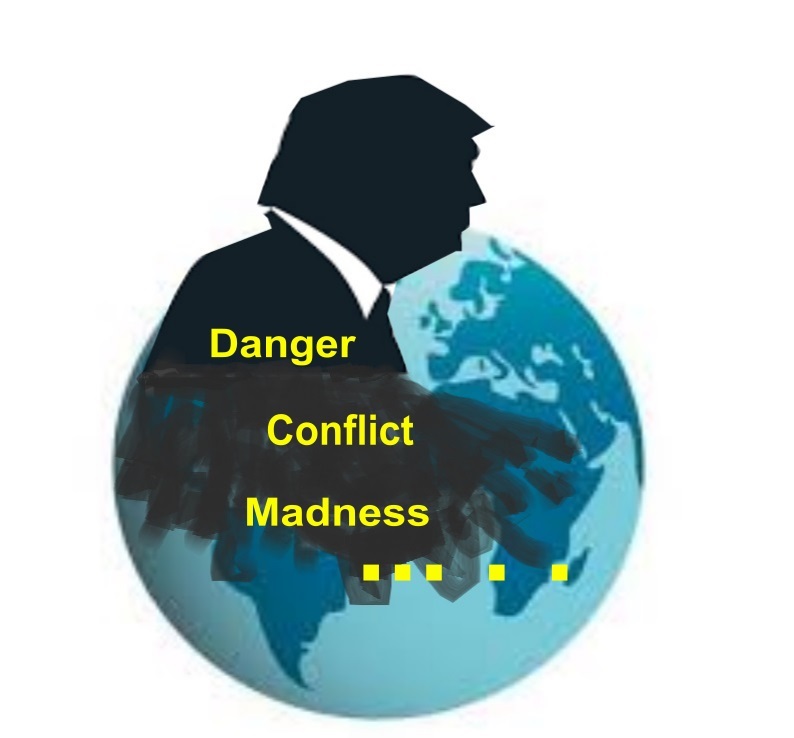
I struggle to think about what language to use.
Today, Caitlin Johnstone writes “The Evil Warmongering Zionist Won” – (No Not That One, The Other One)
I read her article, and agree with every word. But do some readers find this title a “turnoff”? I did, because I was brung up to believe that quieter, less emotive language was the way to go. Now, I’m not sure.
The people of world’s greatest power have elected a foul-mouthed, misogynist, deluded megalomaniac who is a convicted felon, strongly supported by another deluded billionaire megalomaniac the ketamine-and-Mars addled Elon Musk. Trump is surrounded by yes-mean of no integrity whatsoever, and promoted by billionaires of no integrity.
How did it happen?
How did they put it over not only the disgruntled poor of the USA, but many others – to believe that if times are bad now – this despicable sociopath could magically put things right?
By now, some of my very limited reading public will have turned away – because of my use of language. But I’m not as “bad” as Caitlin. Trouble is – we’re actually telling the truth.
It is going to be very hard now, for all of us to weave our way through all the commentaries – all made more difficult by the tsunami of social media, of the ‘respectable mainstream media’ and of AI.
I wish that I could give wonderful advice on how to assess the truth or otherwise, of what we read, see and hear. But there are people of integrity out there, and it is our job to find them and listen to them – and indeed , to avoid emotive language (when possible).
The Mainstream Western Worldview Pretends The Global South Does Not Exist
Caitlin Johnstone, Nov 04, 2024
Mainstream western politics and culture pretend the rest of the world does not exist. The mainstream western worldview shrinks the earth down to US-aligned countries and acts as though the billions of people who live in the global south do not share a planet with us.
You really see this illustrated in US presidential election season, when debates will feature five or six minutes on “foreign policy” with the remaining two hours dedicated to “domestic policy” and culture war wedge issues despite the the White House’s relationship with foreign countries having orders of magnitude more significant real-world consequences. Americans discuss election results as though the whole thing revolves around them and their feelings and how much more convenient or inconvenient the next president might make their lives, while Europeans discuss what the results might mean for NATO expenses and trade agreements. The fact that the next US president will be committing genocide, starving people with economic sanctions and increasing Washington’s stranglehold on earth’s population by any amount of violence and tyranny necessary barely ever enters into the conversation.
Whenever you hear western officials talking about how “the international community” views a particular issue, they’re almost always talking about the US, Canada, Europe, Australia, and maybe a few US-aligned Asian countries like Japan and South Korea — while pretending the rest of the world just isn’t there.
You see it in politics, but you see it throughout our culture too. In our movies, our shows, our conversations, our thoughts. We don’t really think about all the exploitative imperialist extraction of resources and labor that makes our lifestyles possible, even though it directly affects damn near every waking moment of our lives. You wouldn’t be reading this sentence right now had not this exact dynamic led to a highly complex electronic device making its way into your field of vision.
We just conduct ourselves from moment to moment like this relationship isn’t happening. It’s as though we’re all walking around with living people strapped to our feet like slippers, but we’re just laughing and talking about the weather and celebrities and how we’re feeling about this and that without ever acknowledging the existence of the human beings we’re standing on top of.
The global south is omitted from our thinking and our conversations in this way all the time, leaving us in this fractured, redacted mental universe where we pretend we’re the only people living in this rapidly shrinking world. Our lives are no less significant or valuable than those of people in Africa or Asia, but we live as though they don’t exist, even when their labor may affect our moment to moment reality far more than the white-skinned person we’re paying attention to in this instant.
This is going to have to change if we’re to become a conscious species and create a healthy world together. Our perception of the world is going to have to reflect the actual world, not just the small cloistered segment which exists within the confines of western civilization. We’re going to have to start thinking about humanity as a whole and stop living the lie that we are not intimately interconnected with the lives on every populated continent.
Until we open up our worldview and begin taking into account the needs and struggles of our fellow human beings around the world, it will be like we’re at a dinner party that’s being waited on by slaves. We’re all looking at each other and talking about our lives and our families as the slaves clear our plates and refill our drinks, never acknowledging them or discussing the fact that they’re being kept as material property and forced to do what they’re doing to avoid punishment and torture. Until we demand their freedom and invite them to come and dine with us, we’re going to be in a highly dysfunctional and abusive relationship with them, and nothing will ever feel quite right — because it won’t be
1 This Month

of the week – Shut Down Drone Warfare!


Tell the Ukrainian Government to Drop Prosecution of Peace Activist Yurii Sheliazhenko

Petition to revoke the licensing of the Near Surface Nuclear Disposal Facility (NSDF) at Chalk River. https://www.ourcommons.ca/petitions/en/Petition/Details?Petition=e-7247
To see nuclear-related stories in greater depth and intensity – go to https://nuclearinformation.wordpress.com
-
Archives
- March 2026 (237)
- February 2026 (268)
- January 2026 (308)
- December 2025 (358)
- November 2025 (359)
- October 2025 (376)
- September 2025 (257)
- August 2025 (319)
- July 2025 (230)
- June 2025 (348)
- May 2025 (261)
- April 2025 (305)
-
Categories
- 1
- 1 NUCLEAR ISSUES
- business and costs
- climate change
- culture and arts
- ENERGY
- environment
- health
- history
- indigenous issues
- Legal
- marketing of nuclear
- media
- opposition to nuclear
- PERSONAL STORIES
- politics
- politics international
- Religion and ethics
- safety
- secrets,lies and civil liberties
- spinbuster
- technology
- Uranium
- wastes
- weapons and war
- Women
- 2 WORLD
- ACTION
- AFRICA
- Atrocities
- AUSTRALIA
- Christina's notes
- Christina's themes
- culture and arts
- Events
- Fuk 2022
- Fuk 2023
- Fukushima 2017
- Fukushima 2018
- fukushima 2019
- Fukushima 2020
- Fukushima 2021
- general
- global warming
- Humour (God we need it)
- Nuclear
- RARE EARTHS
- Reference
- resources – print
- Resources -audiovicual
- Weekly Newsletter
- World
- World Nuclear
- YouTube
-
RSS
Entries RSS
Comments RSS
 nuclear-news