To protect our planet – we need to transform, not grow, the economy

“So, we have to get away from our obsession with economic growth – we really need to start managing our economies in a way that protects our climate and natural resources, even if this means less, no or even negative growth.”
Overconsumption and growth economy key drivers of environmental crises https://www.eurekalert.org/pub_releases/2020-06/uons-oag061820.php
21 June, 20, , Scientists’ warning on affluence, UNIVERSITY OF NEW SOUTH WALES, A group of researchers, led by a UNSW sustainability scientist, have reviewed existing academic discussions on the link between wealth, economy and associated impacts, reaching a clear conclusion: technology will only get us so far when working towards sustainability – we need far-reaching lifestyle changes and different economic paradigms.
In their review, published today in Nature Communications and entitled Scientists’ Warning on Affluence, the researchers have summarised the available evidence, identifying possible solution approaches.
“Recent scientists’ warnings have done a great job at describing the many perils our natural world is facing through crises in climate, biodiversity and food systems, to name but a few,” says lead author Professor Tommy Wiedmann from UNSW Engineering.
“However, none of these warnings has explicitly considered the role of growth-oriented economies and the pursuit of affluence. In our scientists’ warning, we identify the underlying forces of overconsumption and spell out the measures that are needed to tackle the overwhelming ‘power’ of consumption and the economic growth paradigm – that’s the gap we fill.
“The key conclusion from our review is that we cannot rely on technology alone to solve existential environmental problems – like climate change, biodiversity loss and pollution – but that we also have to change our affluent lifestyles and reduce overconsumption, in combination with structural change.”
During the past 40 years, worldwide wealth growth has continuously outpaced any efficiency gains.
“Technology can help us to consume more efficiently, i.e. to save energy and resources, but these technological improvements cannot keep pace with our ever-increasing levels of consumption,” Prof Wiedmann says.
Reducing overconsumption in the world’s richest
Co-author Julia Steinberger, Professor of Ecological Economics at the University of Leeds, says affluence is often portrayed as something to aspire to.
“But our paper has shown that it’s actually dangerous and leads to planetary-scale destruction. To protect ourselves from the worsening climate crisis, we must reduce inequality and challenge the notion that riches, and those who possess them, are inherently good.”
In fact, the researchers say the world’s affluent citizens are responsible for most environmental impacts and are central to any future prospect of retreating to safer conditions.
“Consumption of affluent households worldwide is by far the strongest determinant – and the strongest accelerator – of increased global environmental and social impacts,” co-author Lorenz Keysser from ETH Zurich says.
“Current discussions on how to address the ecological crises within science, policy making and social movements need to recognize the responsibility of the most affluent for these crises.”
The researchers say overconsumption and affluence need to be addressed through lifestyle changes.
“It’s hardly ever acknowledged, but any transition towards sustainability can only be effective if technological advancements are complemented by far-reaching lifestyle changes,” says co-author Manfred Lenzen, Professor of Sustainability Research at the University of Sydney.
“I am often asked to explain this issue at social gatherings. Usually I say that what we see or associate with our current environmental issues (cars, power, planes) is just the tip of our personal iceberg. It’s all the stuff we consume and the environmental destruction embodied in that stuff that forms the iceberg’s submerged part. Unfortunately, once we understand this, the implications for our lifestyle are often so confronting that denial kicks in.”
No level of growth is sustainable
However, the scientists say responsibility for change doesn’t just sit with individuals – broader structural changes are needed.
“Individuals’ attempts at such lifestyle transitions may be doomed to fail, because existing societies, economies and cultures incentivise consumption expansion,” Prof Wiedmann says.
A change in economic paradigms is therefore sorely needed.
“The structural imperative for growth in competitive market economies leads to decision makers being locked into bolstering economic growth, and inhibiting necessary societal changes,” Prof Wiedmann says.
“So, we have to get away from our obsession with economic growth – we really need to start managing our economies in a way that protects our climate and natural resources, even if this means less, no or even negative growth.
“In Australia, this discussion isn’t happening at all – economic growth is the one and only mantra preached by both main political parties. It’s very different in New Zealand – their Wellbeing Budget 2019 is one example of how government investment can be directed in a more sustainable direction, by transforming the economy rather than growing it.”
The researchers say that “green growth” or “sustainable growth” is a myth.
“As long as there is growth – both economically and in population – technology cannot keep up with reducing impacts, the overall environmental impacts with only increase,” Prof Wiedmann says.
One way to enforce these lifestyle changes could be to reduce overconsumption by the super-rich, e.g. through taxation policies.
“‘Degrowth’ proponents go a step further and suggest a more radical social change that leads away from capitalism to other forms of economic and social governance,” Prof Wiedmann says.
“Policies may include, for example, eco-taxes, green investments, wealth redistribution through taxation and a maximum income, a guaranteed basic income and reduced working hours.”
Modelling an alternative future
Prof Wiedmann’s team now wants to model scenarios for sustainable transformations – that means exploring different pathways of development with a computer model to see what we need to do to achieve the best possible outcome.
“We have already started doing this with a recent piece of research that showed a fairer, greener and more prosperous Australia is possible – so long as political leaders don’t focus just on economic growth.
“We hope that this review shows a different perspective on what matters, and supports us in overcoming deeply entrenched views on how humans have to dominate nature, and on how our economies have to grow ever more. We can’t keep behaving as if we had a spare planet available.”
Pacific leaders fear climate change campaign will ‘lose momentum’ amid COVID-19 pandemic
Pacific leaders fear climate change campaign will ‘lose momentum’ amid COVID-19 pandemic, ABC, By foreign affairs reporter Melissa Clarke 19 June 20
Key points:
- Pacific leaders do not want the coronavirus pandemic to distract from work on climate change
- Nations in the Pacific are concerned environmental impacts of climate change will ruin their tourism industry
- Leaders are calling on Australia to not forget about emissions reduction commitments
Senior political leaders from both the Fijian and Samoan governments have raised concerns that climate change is being overlooked while global leaders and the media focus on the coronavirus.
The Fijian Government, which has been a strong critic of Australia for not doing more to reduce carbon emissions, has said the urgency for addressing climate change has not abated.
“It may appear that climate change has taken a back seat, but it cannot and should not,” Fiji’s Attorney-General Aiyaz Sayed-Khaiyum said.
Coronavirus update: Follow all the latest news in our daily wrap.Taking part in an online forum hosted by the Australian National University (ANU) on Thursday, Mr Sayed-Khaiyum said the impacts of climate change were being felt every day by Fijians.
“Climate change is a reality and we cannot lift our foot off the pedal,” he said.
Pacific nations regard climate change as an existential threat, with changing weather systems affecting sea levels, fish stocks, water quality and the frequency of severe weather events.
Samoa’s Deputy Prime Minister Fiame Naomi Mata’afa, speaking on the same forum, said it is important attention isn’t diverted from climate change.
“We’re talking about a pandemic, but… climate change impacts us in all aspects of our lives, including health as well.”……..
Pacific Island nations have been trying to get all countries to agree to register more ambitious emissions reductions targets under the Paris Agreement on climate change.
Ms Mata’afa is concerned their campaign could “lose momentum” during the pandemic and appealed for Australia’s help.
“I think it is very important for Australia, as a member of the Pacific [Islands] Forum, that it comes in strongly as one of our larger members, with the Pacific and the message: to ensure that the 1.5 [degree] objective that we’ve been advocating for and that we raise the global ambition in regards to [cutting] emissions.”
Pacific nations have previously expressed their disappointment that Australia has not fully embraced their calls for more global action……… https://www.abc.net.au/news/2020-06-18/pacific-leaders-fear-coronavirus-distraction-climate-change/12371182
Pandemic is important, yes, but 2020 looks to be the hottest year on record
2020 likely to be the warmest year on record globally, BY JEFF BERARDELLI, CBS NEWS, JUNE 15, 2020, While the public’s attention is consumed by concern over the global pandemic and protests against social injustices, the chronic condition of climate change continues to escalate. In fact, it’s becoming more and more likely that 2020 will be the hottest year globally since records have been kept, dating back to the late 1800s.
Reviews of temperatures for May 2020 have now been reported by four standard-bearer climate data organizations including NASA, NOAA, Berkeley Earth and the European agency Copernicus.
The unanimous conclusion: Last month was the warmest May on record globally, with the caveat from NOAA that it was a virtual tie with May 2016.
According to NOAA, one of the few places on Earth to be cooler than average in May was much of Canada and the eastern United States. But that did little to counteract 2020’s overall warmth.
For the year to date, both NASA and Berkeley Earth rank 2020 as the second warmest globally, a shade behind 2016. This is particularly impressive considering in 2016 there was a Super El Niño. In El Niño years the tropical Pacific Ocean releases copious heat into the atmosphere and record warm years are expected. This year there is no El Niño.
In addition, we are currently at the bottom of the 11-year solar minimum, a time when incoming energy from the sun decreases. This is further proof that solar minimums don’t have a substantial impact on climate.
To put this into perspective, the world’s five warmest years on record have all occurred since 2015, with 2020 highly likely to continue that trend. ………. https://www.cbsnews.com/news/warmest-year-on-record-2020-likely/
Siberia’s alarming prolonged heat wave
Climate crisis: alarm at record-breaking heatwave in  Siberia https://www.theguardian.com/environment/2020/jun/17/climate-crisis-alarm-at-record-breaking-heatwave-in-siberia
Thu 18 Jun 2020 A prolonged heatwave in Siberia is “undoubtedly alarming”, climate scientists have said. The freak temperatures have been linked to wildfires, a huge oil spill and a plague of tree-eating moths.
On a global scale, the Siberian heat is helping push the world towards its hottest year on record in 2020, despite a temporary dip in carbon emissions owing to the coronavirus pandemic.
Temperatures in the polar regions are rising fastest because ocean currents carry heat towards the poles and reflective ice and snow is melting away.
Russian towns in the Arctic circle have recorded extraordinary temperatures, with Nizhnyaya Pesha hitting 30C on 9 June and Khatanga, which usually has daytime temperatures of around 0C at this time of year, hitting 25C on 22 May. The previous record was 12C.
In May, surface temperatures in parts of Siberia were up to 10C above average, according to the EU’s Copernicus Climate Change Service (C3S). Martin Stendel, of the Danish Meteorological Institute, said the abnormal May temperatures seen in north-west Siberia would be likely to happen just once in 100,000 years without human-caused global heating.
Freja Vamborg, a senior scientist at C3S, said: “It is undoubtedly an alarming sign, but not only May was unusually warm in Siberia. The whole of winter and spring had repeated periods of higher-than-average surface air temperatures.
“Although the planet as a whole is warming, this isn’t happening evenly. Western Siberia stands out as a region that shows more of a warming trend with higher variations in temperature. So to some extent large temperature anomalies are not unexpected. However, what is unusual is how long the warmer-than-average anomalies have persisted for.”
Marina Makarova, the chief meteorologist at Russia’s Rosgidromet weather service, said: “This winter was the hottest in Siberia since records began 130 years ago. Average temperatures were up to 6C higher than the seasonal norms.”
Robert Rohde, the lead scientist at the Berkeley Earth project, said Russia as a whole had experienced record high temperatures in 2020, with the average from January to May 5.3C above the 1951-1980 average. “[This is a] new record by a massive 1.9C,” he said.
In December, Russia’s president, Vladimir Putin, commented on the unusual heat: “Some of our cities were built north of the Arctic Circle, on the permafrost. If it begins to thaw, you can imagine what consequences it would have. It’s very serious.”
Thawing permafrost was at least partly to blame for a spill of diesel fuel in Siberia this month that led Putin to declare a state of emergency. The supports of the storage tank suddenly sank, according to its operators; green groups said ageing and poorly maintained infrastructure was also to blame.
Wildfires have raged across hundreds of thousands of hectares of Siberia’s forests. Farmers often light fires in the spring to clear vegetation, and a combination of high temperatures and strong winds has caused some fires to burn out of control.
Swarms of the Siberian silk moth, whose larvae eat at conifer trees, have grown rapidly in the rising temperatures. “In all my long career, I’ve never seen moths so huge and growing so quickly,” Vladimir Soldatov, a moth expert, told AFP.
He warned of “tragic consequences” for forests, with the larvae stripping trees of their needles and making them more susceptible to fires.
Covid-19 pandemic – ‘fire drill’ for effects of climate crisis


|
Covid-19 pandemic is ‘fire drill’ for effects of climate crisis, says UN official, Tue 16 Jun 2020 “The overall problem is that we are not sustainable in the ways we are living and producing on the planet today,” said Lise Kingo, the executive director of the UN Global Compact, under which businesses sign up to principles of environmental protection and social justice. “The only way forward is to create a world that leaves no one behind.”She said there were “very, very clear connections” between the Covid-19 and climate crises, and the Black Lives Matter protests around the world, which she said had helped to reveal deep-seated inequalities and “endemic and structural racism”.
“We have seen illustrated to everyone that social inequality issues are part of the sustainable development agenda,” Kingo said. ….. The UN secretary general, António Guterres, said building a fairer society would be essential to the world’s health, as well as to saving the planet from climate breakdown and ecological destruction. “Today, the fabric of society and the wellbeing of people hinge on our ability to build a fair globalisation,” he told the two-day UN Global Compact virtual conference of business leaders, which started on Monday……. https://www.theguardian.com/environment/2020/jun/15/covid-19-pandemic-is-fire-drill-for-effects-of-climate-crisis-says-un-official
|
|
Climate predictions not serious enough – new research on clouds

Climate worst-case scenarios may not go far enough, cloud data shows https://www.theguardian.com/environment/2020/jun/13/climate-worst-case-scenarios-clouds-scientists-global-heating Modelling suggests climate is considerably more sensitive to carbon emissions than thought, Jonathan Watts Sat 13 Jun 2020 Worst-case global heating scenarios may need to be revised upwards in light of a better understanding of the role of clouds, scientists have said.Recent modelling data suggests the climate is considerably more sensitive to carbon emissions than previously believed, and experts said the projections had the potential to be “incredibly alarming”, though they stressed further research would be needed to validate the new numbers.
Modelling results from more than 20 institutions are being compiled for the sixth assessment by the United Nations Intergovernmental Panel on Climate Change, which is due to be released next year.
Compared with the last assessment in 2014, 25% of them show a sharp upward shift from 3C to 5C in climate sensitivity – the amount of warming projected from a doubling of atmospheric carbon dioxide from the preindustrial level of 280 parts per million. This has shocked many veteran observers, because assumptions about climate sensitivity have been relatively unchanged since the 1980s.
“That is a very deep concern,” Johan Rockström, the director of the Potsdam Institute for Climate Impact Research, said. “Climate sensitivity is the holy grail of climate science. It is the prime indicator of climate risk. For 40 years, it has been around 3C. Now, we are suddenly starting to see big climate models on the best supercomputers showing things could be worse than we thought.”
He said climate sensitivity above 5C would reduce the scope for human action to reduce the worst impacts of global heating. “We would have no more space for a soft landing of 1.5C [above preindustrial levels]. The best we could aim for is 2C,” he said.
Worst-case projections in excess of 5C have been generated by several of the world’s leading climate research bodies, including the UK Met Office’s Hadley Centre and the EU’s Community Earth System Model
Timothy Palmer, a professor in climate physics at Oxford University and a member of the Met Office’s advisory board, said the high figure initially made scientists nervous. “It was way outside previous estimates. People asked whether there was a bug in the code,” he said. “But it boiled down to relatively small changes in the way clouds are represented in the models.”
The role of clouds is one of the most uncertain areas in climate science because they are hard to measure and, depending on altitude, droplet temperature and other factors, can play either a warming or a cooling role. For decades, this has been the focus of fierce academic disputes.
Previous IPCC reports tended to assume that clouds would have a neutral impact because the warming and cooling feedbacks would cancel each other out. But in the past year and a half, a body of evidence has been growing showing that the net effect will be warming. This is based on finer resolution computer models and advanced cloud microphysics.
“Clouds will determine humanity’s fate – whether climate is an existential threat or an inconvenience that we will learn to live with,” said Palmer. “Most recent models suggest clouds will make matters worse.”
In a recent paper in the journal Nature, Palmer explains how the new Hadley Centre model that produced the 5+C figure on climate sensitivity was tested by assessing its accuracy in forecasting short-term weather. This testing technique had exposed flaws in previous models, but in the latest case, the results reinforced the estimates. “The results are not reassuring – they support the estimates,” he wrote. He is calling for other models to be tested in a similar way.
“It’s really important. The message to the government and public is, you have to take this high climate sensitivity seriously. [We] must get emissions down as quickly as we can,” he said.
The IPCC is expected to include the 5+C climate sensitivity figure in its next report on the range of possible outcomes. Scientists caution that this is a work in progress and that doubts remain because such a high figure does not fit with historical records.
Catherine Senior, head of understanding climate change at the Met Office Hadley Centre, said more studies and more data were needed to fully understand the role of clouds and aerosols.
“This figure has the potential to be incredibly alarming if it is right,” she said. “But as a scientist, my first response is: why has the model done that? We are still in the stage of evaluating the processes driving the different response.”
While acknowledging the continued uncertainty, Rockström said climate models might still be underestimating the problem because they did not fully take into account tipping points in the biosphere.
“The more we learn, the more fragile the Earth system seems to be and the faster we need to move,” he said. “It gives even stronger argument to step out of this Covid-19 crisis and move full speed towards decarbonising the economy.”
Post-pandemic packages could green up our energy systems for environmental and economic benefit.

message was a grim, possibly self-serving, prediction, that sun, wind and water power would only ever meet four per cent of the country’s needs.
Climate helped by Europe’s fast-growing mini-forests
Fast-growing mini-forests spring up in Europe to aid climate
Miyawaki forests are denser and said to be more biodiverse than other kinds of woods, Guardian, Hannah Lewis, Sat 13 Jun 2020 Tiny, dense forests are springing up around Europe as part of a movement aimed at restoring biodiversity and fighting the climate crisis.
Often sited in schoolyards or alongside roads, the forests can be as small as a tennis court. They are based on the work of the Japanese botanist Akira Miyawaki, who has planted more than 1,000 such forests in Japan, Malaysia and elsewhere.
Advocates for the method say the miniature forests grow 10 times faster and become 30 times denser and 100 times more biodiverse than those planted by conventional methods. This result is achieved by planting saplings close together, three per square metre, using native varieties adapted to local conditions. A wide variety of species – ideally 30 or more – are planted to recreate the layers of a natural forest.
Scientists say such ecosystems are key to meeting climate goals, estimating that natural forests can store 40 times more carbon than single-species plantations. The Miyawaki forests are designed to regenerate land in far less time than the 70-plus years it takes a forest to recover on its own.
“This is a great thing to do,” said Eric Dinerstein, a wildlife scientist who co-authored a recent paper calling for half of the Earth’s surface to be protected or managed for nature conservation to avoid catastrophic climate change. “So this could be another aspect for suburban and urban areas, to create wildlife corridors through contiguous ribbons of mini-forest.”
The mini-forests could attract migratory songbirds, Dinerstein said. “Songbirds are made from caterpillars and adult insects, and even small pockets of forests, if planted with native species, could become a nutritious fast-food fly-in site for hungry birds.”……. https://www.theguardian.com/environment/2020/jun/13/fast-growing-mini-forests-spring-up-in-europe-to-aid-climate
Global heating to bring more frequent, more extreme, ocean waves
 EXTREME WAVES SET TO BE BIGGER AND MORE FREQUENT
As the planet warms, researchers are warning that the frequency and magnitude of extreme wave events may rise by around 10 per cent by the end of century, increasing flood risks. Pursuit, By Dr Alberto Meucci and Professor Ian Young University of Melbourne, 13 June 20
When most of us think about what climate change will do to our coastlines we tend to focus on how sea-levels are rising as the polar ice caps melt and the oceans warm. But that is only part of the story.
What many don’t realise is that at the same time as sea levels are rising, storms are increasing in magnitude and frequency, resulting in larger ocean waves. These waves increase coastal erosion and the risk of flooding.
Our new research suggests that by the end of the century the magnitude of extreme wave events will have increased by up to 10 per cent over extensive ocean regions, and the frequency of storms that generate extreme waves will have increased by five to 10 per year.
This may not sound like a big increase, but it means that almost 60 per cent of the world’s coastline will experience larger and more frequent extreme waves.
At a time when 290 million people already live below the 100-year flood level (that is, they live below levels where there is at least a one per cent probability of flooding every year), an increase in the risk of extreme wave events may be catastrophic, as larger and more frequent storms will cause more flooding and coastline erosion.
Extremes are defined as unexpected, unusual and sometimes unseasonal events. Like extreme floods, extreme waves are classified by the frequency with which they tend to occur, and this frequency drives the design requirements for ocean structures or coastal defences. For example, defences may be designed to cope with a 100-year wave event.
Extreme ocean waves generated by strong surface winds can reach heights of over 20 meters at the high latitudes of the globe – that’s as high as four double-decker buses stacked on top of each other.
But the surface winds that drive wave heights are in turn driven by the climate system, and so are subject to climate change. A warming planet is causing stronger and more frequent storm winds which in turn trigger larger and more frequent extreme waves, and the 100-year events may begin to occur every 50 or even 20 years.
Estimating the probability of occurrence of extreme waves is challenging, let alone estimating how their frequency and magnitude may change in the future. This is due to the small number of ocean observations available.
The buoys and offshore platforms scientists use to observe ocean movements are sparsely distributed, and satellite measurements are limited in how often they sample a single location.
But advances in computing technology and the modelling of data, allows us to simulate the Earth’s changing climate under different wind conditions, recreating thousands of simulated storms to evaluate the magnitude and frequency of extreme events.
Our research used a unique statistical ensemble approach, where we pooled data from an unprecedented collection of thousands of modelled ocean wave extremes to estimate future extreme events. These extremes were derived from global wave models based on wind forces generated from seven different global climate models.
The vast amount of modelled ocean extremes generated allowed us to apply an ensemble statistical analysis that reduces the uncertainty around the estimation of future projections of extremes. …….. Co-authors of the research are: Dr Mark Hemer, CSIRO, Oceans and Atmosphere, Hobart Australia; Professor Roshanka Ranasinghe, Department of Water Science and Engineering, IHE-Delft, Netherlands; and Ebru Kirezci, University of Melbourne
Grave climate risks to Sizewell C nuclear project – all too close to the sea
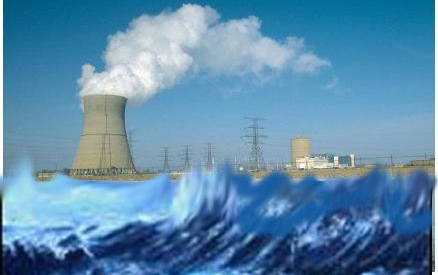  Times 10th June 2020, As if big nuclear power plants weren’t already toxic enough. To the usual Times 10th June 2020, As if big nuclear power plants weren’t already toxic enough. To the usuallist — exploding costs, endless delays, ruinously pricey electricity and a vast clean-up bill — Sizewell C brings another joy. And not just that it’s being partly built by CGN of China: odd reward for the crackdown on Hong Kong. No, it’s that Sizewell C is in a “dangerous location”. Or so says Nick Scarr from the Nuclear Consulting Group, a collection of academics and experts. The consulting engineer has examined the plans from France’s EDF and CGN to build the 3,200MW nuke on the Suffolk coast from the perspective of coastal erosion and climate change. And, assuming he’sright, his paper is alarming — unless you’re relaxed about the risk of the plant being encircled by sea.
Sizewell C will be bigger and closer to the sea than the site’s existing reactors. Mr Scarr takes issue with EDF claims that it’ll be effectively protected by the offshore Sizewell-Dunwich bank and a coralline crag, so creating a “natural wave break”. He points to studies showing waves are getting through in storms, while at the Sizewell C site the crag is more gravelly than desired.
With decommissioning of the plant not due until 2150, Mr Scarr believes EDF and CGN are paying far too little attention to forecasts from the Met Office and the Intergovernmental Panel on Climate Change. Not least the notion that once-a-century “extreme sea level events”, are “projected to occur much more frequently by 2050”. He says the once in 10,000 year flood risk that “EDF trumpets” is “just 0.71m above the historical 1953 flood level”. This is only Mr Scarr’s opinion, but he says his paper has been “approved” by Professor Andrew Plater of Liverpool
University: a leading coastal geomorphologist. So what’s EDF’s
response? Well, it reckons Mr Scarr’s analysis of the effects of the sandbank and crag is both confused and wrong. It also says it has evaluated
the likely effect of climate change. “The design of the power station, including its sea defence and the raised platform it will be built on, will protect Sizewell C from flooding,” EDF insists. It says it’ll take an “adaptive approach”, raising the sea defences “during the lifetime of Sizewell C if needed”. Mr Scarr says such an approach only works for
construction projects such as painting the Forth Bridge every year, not sea defences for a nuclear plant. Indeed, he reckons it’s “clear evidence” that the location cannot “offer the criteria necessary for long-term safety of the project”. https://www.thetimes.co.uk/edition/business/sizewell-c-debate-turns-a-bit-salty-gvvzhp7rf |
Seeking ways to remove carbon from the air
|
Entrepreneurs tasked with removing carbon pollution from the air https://www.yaleclimateconnections.org/2020/06/entrepreneurs-tasked-with-removing-carbon-pollution-from-the-air/
‘Visionary leaders and entrepreneurs can really have a hand in scaling these carbon removal solutions.’ Carbon emissions from power plants, transportation, and industry cause global warming. But reducing that pollution may not be enough to avoid the worst effects of climate change. Some scientists say the world must also remove carbon that’s already in the atmosphere.Giana Amador is cofounder of the nonprofit Carbon180. She says that a number of industries already have strategies to soak up carbon pollution. “We can farm in ways that store more carbon in the soil. We can plant more trees,” she says. “And there are also technologies that are basically big fans that use chemical reactions to capture carbon directly from the air and separate that out into a pure stream of CO2 that can then be either sequestered underground or used in products like cements and plastics.” But to meet climate goals, these solutions need to scale up dramatically. To help, Amador’s nonprofit has started a fellowship. It helps entrepreneurs launch businesses that – within a decade – can remove a billion tons of carbon dioxide from the atmosphere each year. “We think that visionary leaders and entrepreneurs can really have a hand in scaling these carbon removal solutions,” Amador says. |
|
Nuclear power plants in the path of oncoming Cyclone Nisarga
 Concerns raised over nuclear and chemical plants in Concerns raised over nuclear and chemical plants in  Maharashtra as cyclone Nisarga heads towards the state Opindia, 2 June, 2020, OpIndia Staff As the Cyclone Nisarga is heading towards the coasts of Maharashtra, a huge concern has been expressed regarding the nuclear and chemical plants that may come in its direct path. Expectedly, the cyclone will enter the coasts late Tuesday night or early Wednesday. Maharashtra as cyclone Nisarga heads towards the state Opindia, 2 June, 2020, OpIndia Staff As the Cyclone Nisarga is heading towards the coasts of Maharashtra, a huge concern has been expressed regarding the nuclear and chemical plants that may come in its direct path. Expectedly, the cyclone will enter the coasts late Tuesday night or early Wednesday.
Chief Minister Uddhav Thackeray while updating about the cyclone said, “Care is being taken to prevent power outages. Precautions are being taken at chemical units and nuclear power plants in Palghar and Raigad.” Maharashtra posses a string of chemical and nuclear plants. In Palghar, the oldest Tarapur Atomic Power Plant complex and other power units are present while Mumbai has the BARC set up and Raigad houses power, petroleum, chemicals, and other major industries besides the Mumbai port trust, the Jawaharlal Nehru Post trust and vital installations of the navy. People living in non-pucca houses have been shifted to safer shelters for them and slum dwellers have been asked to vacate for their own safety. As per reports, 50 patients were shifted from the Bandra Kurla complex COVID-19 hospital to the Goregaon NESCO hospital. Rescue operations underway…….. The Indian Meteorological Department announced that depression in the Arabian Sea may develop into a cyclonic storm in the next 12 hours and further intensify into a severe cyclonic storm within 24 hours. The deep depression – ‘Cyclone Nisarga’, which is headed towards the coasts in Maharashtra and Gujarat, is likely to hit the western coast on Wednesday……. https://www.opindia.com/2020/06/cyclone-nisarga-creates-concerns-for-nuclear-and-chemical-plants-maharashtra/ |
|
Climate Experts Predict ‘Grim Future’ For Nuclear Power
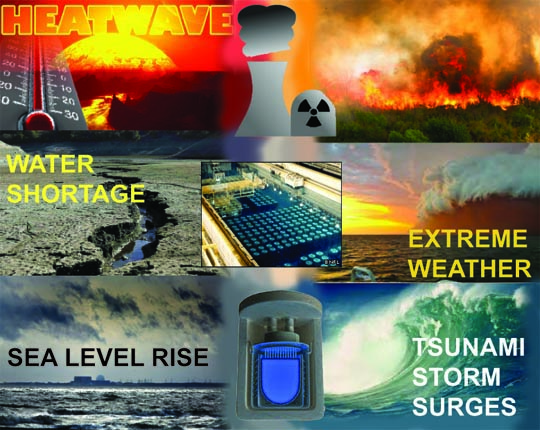
Climate Experts Predict ‘Grim Future’ For Nuclear Power
The result of research into black swans – called “Synthesising Unprecedented Coastal Conditions: Extreme Storm Surges” aka SUCCESS – was presented at the meeting. It was important to conduct this research, the academic said, because “the storm surge of 5th December 2013 caused sea levels in many parts of the country that were the highest ever recorded and begs the obvious question – could they have been worse?”
All in all, the presentations and discussions at the meeting would not have been particularly welcome to the ONR, whose job it is to make sure nuclear power stations are built to standards that guarantee public safety. In a statement to VICE, an ONR spokesperson said “ONR requires that nuclear new build sites are able to withstand extreme natural hazards, by designing against a one in 10,000 year event. Sites must identify these external hazards, which include the impact of climate change, and demonstrate that they are adequately protected against them throughout the lifetime of the facility.”
Time that journalists reported on the threat of global heating to the nuclear industry
 Really? Not a mention of the ill effects that climate change has on nuclear power, nor the fact that it, and the uranium mining that feeds it, are highly water guzzling.
Therefore most nuclear reactors are sited near the sea, or near rivers and estuaries.
They have to cut back or even shut down in very hot weather. They are vulnerable to sea level rise, and extreme events – flooding, hurricanes, wildfires.
Far from nuclear power combatting climate change, it’ds the other way around.
As for Small Modular Nuclear Reactors working against climate change, you would need literally millions of them to be quickly operating around the world, to have any effect on global heating. Time that you journalists told the whole story, not just the nuclear lobby’s version
Global ‘hot spots’. Australia very vulnerable to droughts, as planet heats
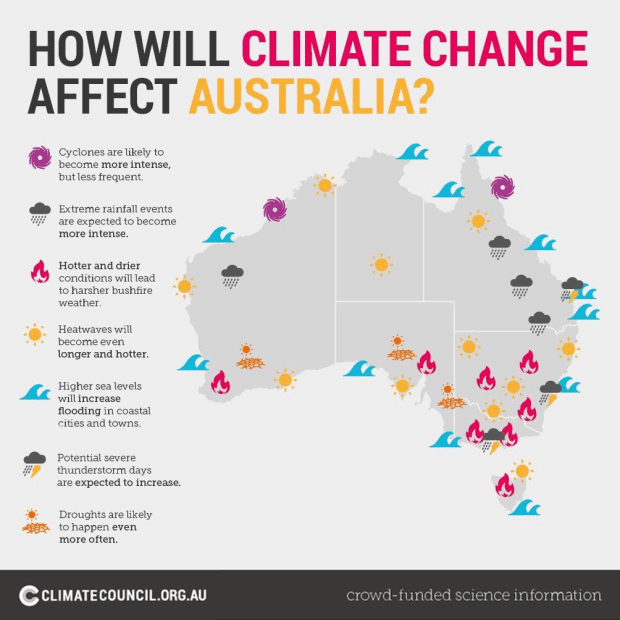
Australia among global ‘hot spots’ as droughts worsen in warming world, The Age, By Peter Hannam, June 1, 2020 The world’s major food baskets will experience more extreme droughts than previously forecast as greenhouse gases rise, with southern Australia among the worst-hit, climate projections show.
Scientists at the Australian National University and the University of NSW made the findings after running the latest generation of climate models used by the Intergovernmental Panel on Climate Change (IPCC). Future drought changes were larger and more consistent, the researchers found.
“Australia is one of the hot spots along with the Amazon and the Mediterranean, especially,” said Anna Ukkola, a research fellow at the ARC Centre of Excellence for Climate Extremes and lead author of the paper published in Geophysical Research Letters.
For southern Australia, the shift to longer, more frequent and more intense droughts up to 2100 will be due to greater variability in rainfall rather than a reduction in average rainfall. For the Amazon, both mean rain and variability changes…….
One reason for the prediction of worse droughts is that the latest models assume the climate will respond more than previously understood to increased atmospheric levels of carbon dioxide and other greenhouse gases.
Australia’s vulnerability to big shifts in annual rainfall already challenge the country’s farming sector, while also leaving much of the country’s south more at risk of bad bushfire seasons – such as last summer’s – as forests dry out.
The CSIRO has long forecast a large reduction in stream flows in the Murray-Darling Basin, for instance, as reduced cool-season rainfall combines with higher temperatures. Such a trend appears to have already begun.
While a more moderate emissions trajectory will still produce more intense, frequent and longer lasting droughts in most of the world’s mid-latitude regions than current conditions, the shift will be less than if carbon emissions remain near the top of forecasts. ……..https://www.theage.com.au/environment/climate-change/australia-among-global-hot-spots-as-droughts-worsen-in-warming-world-20200601-p54ydh.html
1 This Month
19 February – VIRTUAL EVENT-Decision Time: AI and Our Nuclear Arsenal
12:45 p.m. Central / 1:45 p.m. Eastern
To see nuclear-related stories in greater depth and intensity – go to https://nuclearinformation.wordpress.com
-
Archives
- February 2026 (181)
- January 2026 (308)
- December 2025 (358)
- November 2025 (359)
- October 2025 (376)
- September 2025 (258)
- August 2025 (319)
- July 2025 (230)
- June 2025 (348)
- May 2025 (261)
- April 2025 (305)
- March 2025 (319)
-
Categories
- 1
- 1 NUCLEAR ISSUES
- business and costs
- climate change
- culture and arts
- ENERGY
- environment
- health
- history
- indigenous issues
- Legal
- marketing of nuclear
- media
- opposition to nuclear
- PERSONAL STORIES
- politics
- politics international
- Religion and ethics
- safety
- secrets,lies and civil liberties
- spinbuster
- technology
- Uranium
- wastes
- weapons and war
- Women
- 2 WORLD
- ACTION
- AFRICA
- Atrocities
- AUSTRALIA
- Christina's notes
- Christina's themes
- culture and arts
- Events
- Fuk 2022
- Fuk 2023
- Fukushima 2017
- Fukushima 2018
- fukushima 2019
- Fukushima 2020
- Fukushima 2021
- general
- global warming
- Humour (God we need it)
- Nuclear
- RARE EARTHS
- Reference
- resources – print
- Resources -audiovicual
- Weekly Newsletter
- World
- World Nuclear
- YouTube
-
RSS
Entries RSS
Comments RSS
 nuclear-news