You can have four more years of Trump, or you can have a habitable planet. But you can’t have both.
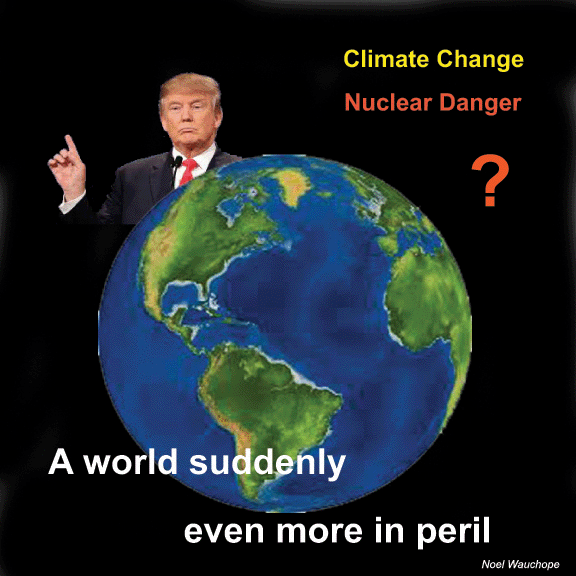 Climate Apocalypse Now, Maybe it’s just a failure of human imagination to understand what is coming, Rolling Stone, By JEFF GOODELL 28 Aug 20
And, of course, we are fucking it up. We are heating up the planet so fast that large parts of it will be uninhabitable by the end of the century. We are amping up storms like Hurricane Laura — it is the strongest storm to hit the Louisiana coast since 1856 — and turning the Gulf Coast into a shooting gallery — which city is going to get hit next? New Orleans? Houston? Tampa? Miami? They are all living on borrowed time. And it’s not just the hurricanes: As Greenland melts and Antarctica falls into the Southern Ocean, they will be swamped by rising seas, as will virtually every other low-lying city in the world. The rich will huddle behind sea walls; the poor will flee or drown.
We are mowing down rainforests, destroying the lungs of the planet, and pushing animals — and the viruses they carry — into new places, increasing the risks of spillover into humans. You think Covid-19, with a fatality rate of about one percent (depending on risk group), is bad? Wait until a Nipah virus, with a fatality rate of 50 percent or higher, morphs in a way that allows asymptomatic transmission. ………..
Maybe it’s a failure of human imagination to understand what is coming. Maybe it’s a failure of democracy and the media (including writers like myself). After all, at this vital turning point in the climate crisis, at a moment when most scientists agree is the last chance to save a stable climate, America elected a president who sees science as a church for losers, and who believes the climate crisis is a hoax perpetuated by the Chinese. ……
Maybe the real message that Mother Nature is sending with these storms and fires in the midst of the Republican National Convention is not to Trump, but to us. And it says this: You can have four more years of Trump, or you can have a habitable planet. But you can’t have both. https://www.rollingstone.com/politics/political-commentary/hurricane-laura-california-wildfire-climate-crisis-jeff-goodell-1050746/
Nuclear and gas industries desperate to win EU endorsement AND FUNDING, as clean and green

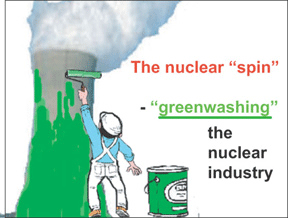
 Gas and nuclear industries fight to the end for ‘green’ EU investment label, Kate Abnett, Simon Jessop, BRUSSELS/LONDON (Reuters) 26 Aug 20 – The gas and nuclear industries have ramped up lobbying to secure last-ditch changes to European rules defining which investments are sustainable, fearing that exclusion from a new “green” list could deprive them of billions of dollars of funding. Gas and nuclear industries fight to the end for ‘green’ EU investment label, Kate Abnett, Simon Jessop, BRUSSELS/LONDON (Reuters) 26 Aug 20 – The gas and nuclear industries have ramped up lobbying to secure last-ditch changes to European rules defining which investments are sustainable, fearing that exclusion from a new “green” list could deprive them of billions of dollars of funding. The climate section of the EU’s Sustainable Finance Taxonomy is due to be finalised this year and it could prove crucial as nuclear power and most natural gas plants and pipelines were excluded from a provisional list published in March. By forcing providers of financial products to disclose which investments meet climate criteria from the end of 2021, the new EU green finance rules are designed to channel cash towards projects that support the bloc’s climate goals. In the four months since the rules were published, gas and nuclear industry representatives held 52 meetings – in person or virtually – with EU officials, according to EU logs analysed by non-profit Reclaim Finance and shared exclusively with Reuters.
Overall, industry representatives have held a total of 310 meetings with EU policymakers since the start of 2018, according to the data based on transparency filings published by July 8. Nuclear groups in particular have stepped up their lobbying, Of the 36 meetings they’ve held over the past two-and-a-half years, 10 have taken place since March. Brussels is facing calls to use the rules to guarantee spending from its 750 billion euro ($888 billion) COVID-19 recovery fund goes to green projects. The money starts flowing in 2021, meaning any delay to the rules could thwart this plan.
NEED TO BREAK FREE’Climate campaigners urged the EU not to bow to pressure from the oil and gas industry as the stakes were too high. “If EU institutions and member states are serious about building a sustainable Europe that confronts the climate emergency, they need to break free from fossil-fuel lobbyists,” said Paul Schreiber, a campaigner at Reclaim Finance. One of the main gripes of both energy industries is that they were locked out of the group of finance experts that came up with the proposals released in March. A new EU sustainable finance platform will take over as the European Commission’s advisor on taxonomy next month – and both industries are jostling to be included on the panel. ……
Nuclear industry groups say the energy deserves a sustainable label, based on its low carbon emissions and existing secure waste disposal sites. They fear that if nuclear isn’t deemed sustainable, the cost of capital for power plants will rise – a concern for an industry where flagship projects, such as Britain’s Hinkley Point C reactor, are struggling with spiralling costs. To help get the message across, several nuclear lobby groups enlisted the help of the public, tweeting to encourage responses to an EU consultation in April on the proposed rules – and suggesting what to write. That helped generate 126 responses to the EU consultation from concerned citizens asking for nuclear power to be termed sustainable – nearly a third of all the responses received, according to InfluenceMap analysis. The expert finance group was split on how to brand nuclear power and the Commission has now asked its scientific arm to report on the issue next year. Lobby groups told Reuters they were confident nuclear power would ultimately be considered sustainable, but they want the energy section of the taxonomy delayed until the report is done…….. Reporting by Simon Jessop in London and Kate Abnett in Brussels; Editing by David Clarke https://www.reuters.com/article/us-europe-finance-lobbying-analysis/gas-and-nuclear-industries-fight-to-the-end-for-green-eu-investment-label-idUSKBN25L0GA |
|
Major holes in ozone hole treaty must be addressed to avert stronger climate change
 Experts reveal major holes in international ozone treaty https://www.eurekalert.org/pub_releases/2020-08/uos-erm082520.php – 26-AUG-2020
Major holes in ozone hole treaty must be addressed to avert stronger climate change and serious risks to human health, experts warn
A new paper, co-authored by a University of Sussex scientist, has revealed major holes in an international treaty designed to help repair the ozone layer, putting human health at risk and increasing the speed of climate change.
Evidence amassed by scientists in the 1970s and 1980s showed that the depletion of the ozone layer in the stratosphere was one of the first truly global threats to humanity.
Chemicals produced through economic activity were slowly drifting to the upper atmosphere where they were destroying the ozone layer, which plays an indispensable role in protecting humanity and ecosystems by absorbing harmful ultraviolet radiation from the sun.
In 1987, countries signed up to a treaty to take reparative action, known as the ‘Montreal Protocol on Substances that Deplete the Ozone Layer, which was eventually ratified by all 197 UN member states.’
But in a paper published today in Nature Communications, experts have flagged major gaps in the treaty which must be addressed if the ozone layer is to be repaired and avert the risks posed to human health and the climate.
Professor Joseph Alcamo, Director of the Sussex Sustainability Research Programme and former Chief Scientist at UNEP, said: “The Montreal Protocol and its amendments have no doubt been an effective worldwide effort to control the toughest substances depleting the ozone. But our paper shows that the treaty has developed too many gaps to fully repair the ozone layer. It’s time to plug the holes in the ozone hole treaty.”
Professor Alcamo, along with lead author Professor Susan Solomon of Massachusetts Institute of Technology (MIT) and co-author Professor A. R. Ravishankara of Colorado State University, have identified several ‘gaps’ which consist of ozone depleting substances not covered in the treaty.
These include:
- Unaccounted for new sources of CFC and HFC emissions recently detected in the atmosphere.
- Leakages of ozone depleting substances from old air conditioners, refrigerators and insulating foams.
- Inadvertent releases of ozone-depleting gases from some manufacturing processes.
- Emissions of the ozone-depleting gas, nitrous oxide, stemming mostly from agricultural activities.
The authors have called for a range of solutions to plug the gaps including:
- A toughening of compliance with the treaty by using provisions that are already part of the Montreal Protocol.
- Boosting the effectiveness of the treaty by adding in regular environmental monitoring of ozone-depleting substances.
- Controlling the emissions of substances that have slipped through the treaty up to now, including nitrous oxide emissions from agriculture, and ozone-depleting substances leaking from old refrigerators and other equipment.
- In addition, because ozone-depleting substances and their substitutes contribute significantly to global warming, the authors urge a faster phasing out of all of these substances as a way of combatting climate change.
The ozone layer absorbs harmful ultraviolet radiation from the sun but this protective layer is slowly destroyed by industrial gases that slowly drift up from the earth’s surface including CFCs (chlorofluorocarbons) contained in refrigerants, foaming agents and, earlier, propellants in aerosol sprays.
Discovery of the ‘ozone hole’ above high latitudes in the 1980s provided final evidence of the importance of ozone depletion.
By 1985, countries had signed the Vienna Convention, which pledged to reduce CFCs and other ozone-depleting substances. Two years later, they signed the Montreal Protocol that laid out a plan of action.
During his time as the first Chief Scientist of UNEP, which hosts the Secretariat of the Montreal Protocol, Professor Alcamo coordinated groups of scientists in producing policy-oriented reports that addressed emerging ozone depletion issues.
UNEP reports that 98% of the chemicals targeted for removal in the Montreal Protocol had been phased out by 2009, avoiding hundreds of millions of cases of skin cancer and tens of millions of cases of cataracts. However, this new paper shows that some important sources were not targeted by the Protocol – and urgently need to be now.
Professor Alcamo said: “Since most ozone-depleting gases and their current substitutes are also potent greenhouse gases, it’s time to use the Montreal Protocol to draw down these gases even faster to help avoid dangerous global warming.
“We won’t be able to reach the global Sustainable Development Goals by 2030 without closing the gaps in the ozone treaty. It’s hard to imagine, for example, how the global health and climate goals could be reached without drastically drawing down all ozone-depleting gases and their substitutes. If we fail, humanity will have to face a higher risk of skin cancers and more rapid climate change.”
Sizewell nuclear plant to take 20 years to build, emitting 5.7 million tonnes of carbon dioxide


|
|
Times 25th Aug 2020 A proposed new nuclear plant in Suffolk could take six years to offset the greenhouse gas
emissions generated in its construction, EDF has admitted. The French energy group estimates that 5.7 million tonnes
of carbon dioxide will be emitted in the nine to twelve years that it will take to build the Sizewell C plant. It argues
that this is “small in comparison to the savings that would be achieved once the power station becomes operational,
when the station will be displacing more carbon-intensive energy from the national grid”.
In publicity material, EDF claims that Sizewell C will “save nine million tonnes of carbon dioxide emissions for every
year of its operation”, based on it replacing gas-fired power plants. However, in planning documents it admits that
the actual savings may be far lower. By the time that the proposed plant is built, Britain’s power mix is expected to
be far greener, as more wind and solar farms are built.
Alison Downes, of Stop Sizewell C, said this meant that it would be 2040 before the plant was “making a positive
contribution to the UK’s net zero targets . . . EDF’s revelation that it will be 20 years before Sizewell C is built and has
paid off the carbon from its construction exposes what a hopeless — as well as expensive and risky — solution it is to
our urgent climate crisis.” National Grid has said that it plans to be able to run Britain’s power network with entirely
“zero carbon” electricity by 2025 whenever there is sufficient renewable generation to do so — well before Sizewell
|
Gas is not a transition fuel to a safe climate. That ship has sailed
Gas is not a transition fuel to a safe climate. That ship has sailed, https://www.theage.com.au/environment/climate-change/gas-is-not-a-transition-fuel-to-a-safe-climate-that-ship-has-sailed-20200826-p55pec.html, Penny Sackett, 27 Aug 20
Australia’s chief scientist from 2008 to 2011 If gas-fired electricity emissions can be lower than that from coal-fired plants, should Australia expand its fossil gas industry as a means of combating climate change? The answer is a clear no if we want to avoid the worst climate change outcomes.
Science has repeatedly demonstrated that the most important action to limit global warming to well below 2 degrees is to begin to reduce all fossil fuel consumption – coal, yes, but oil and gas too – in this decade.
The primary difficulty is the large mismatch between what is required to meet that stated climate goal of the Paris Agreement and what nations have actually pledged to do. Worse still, the current policies of many countries, Australia included, would increase their national production of fossil fuels, increasing emissions above their own weak pledges.
This so-called “production gap” is the subject of a recent multi-institutional, multi-national report led by the Swedish Environment Institute. Its analysis shows that governments are planning to produce about 50 per cent more fossil fuels by 2030 than would be consistent with a 2-degree pathway and 120 per cent more than would be consistent with a 1.5-degree pathway. This means that plans for fossil fuel development or extension that are already on the table must be shelved to hold warming to the Paris target range.
Consistent with other research, the report demonstrates that to have a 66 per cent chance of holding warming to well below 2 degrees, coal, oil and gas production must all decline significantly in the next decade. That is why increasing gas development to displace coal is no longer a viable approach to maintaining a reasonably safe climate.
Over the past 30 years, coal-to-gas “fuel-switching” has played a role in reducing emissions in the United States and Britain. However, the latest information from the US Energy Information Administration shows that the US energy grid has decreased its emissions from a shift to non-fossil fuel sources by almost as much as a shift to gas. Despite the shale boom, non-carbon energy sources have now overtaken any other single source of fossil fuel in supplying energy to the US grid.
In Britain, renewables played a large role in reducing emissions in the electricity grid. Between 2006 and 2016, the renewables share of electricity production rose from 2 per cent to 25 per cent, even excluding large hydro. While the 1990’s “dash for gas” was responsible for the largest cumulative amount of avoided greenhouse emissions in Britain since 1990, the situation is different now. In 2017, the transition to renewable energy was the largest driver in its electricity sector’s emission reductions. In second place was lower electricity demand (think what we could do with energy efficiency in Australia), while coal-to-gas switching came in third.
The world we live in has already changed dramatically with global average temperatures now 1.1 degrees above pre-industrial levels. Cyclones and storm surges are more intense. Droughts are more damaging. Fire seasons are longer and bushfires more fierce. Billions of animals died in last year’s Australian bushfires alone. Entire species are becoming extinct at rates far above normal. The point of no return may have already passed for Arctic sea ice – in 15 years, globes in schoolrooms may show white ice at only one pole.
At 2 degrees of warming, heatwaves would be even more severe and more deadly to humans, animals and agriculture. Sydney and Melbourne would need to brace for 50-degree days. The fire weather that produced Australia’s Black Summer would become at least four times more likely, the amount of water available to feed dams and rivers in NSW would be reduced by 30 per cent from what was typical mid last century, and coral reefs around the world would almost certainly be eliminated.
We have all the tools to avoid that future of 2 degrees of warming. What has been lacking is coherent, science-based action that does not add yet more fuel to the climate fire. Today, when the enormous human, economic and ecological costs of even 1.1 degrees of warming are so clear, when prices of renewable energy have plummeted, and several non-fossil energy storage options are available, gas is not a transition fuel to a safe climate. That ship has sailed.
Planned and rapid coal-to-renewables switching is now the responsible path. Gas will have a role in the near term, certainly, but the science is clear. The role of gas needs to be a significantly declining one, not a growing one, if we are to avoid the worst of climate change so that Australia’s future is safe, sustainable and competitively modern.
Penny Sackett was Australia’s chief scientist between 2008 and 2011. She is an honorary professor at the Climate Change Institute, Australian National University.
Extreme weather – derecho storm brings about early closure of Duane Arnold nuclear plant
 Duane Arnold nuclear plant decommissioning early after damage from the derecho
by Rebecca Kopelman, Tuesday, August 25th 2020 https://cbs2iowa.com/news/local/duane-arnold-nuclear-plant-
Iowa (Iowa’s News Now) — The Duane Arnold Energy Center is beginning their decommissioning process after the August 10th derecho.
The energy center is the only nuclear power plant in Iowa. It was set to be decommissioned at the end of October, but will be closing due to the damage.
This is a statement from NextEra Energy Resources:
“After conducting a complete assessment of the damage caused by recent severe weather, NextEra Energy Resources has made the decision not to restart the reactor at Duane Arnold Energy Center. The strong storms that hit the area on Aug. 10 caused extensive damage to Duane Arnold’s cooling towers, and our evaluation found that replacing those towers before the site’s previously-scheduled decommissioning on Oct. 30, 2020, was not feasible.
As we have done since we announced the decommissioning of Duane Arnold in 2018, we will continue to work with all our employees to minimize the impact of this situation on them and their families.”
The storms damaged the cooling towers which are used to produce electricity to cool steam after it exits the turbine.The cooling towers are not required to cool critical nuclear components. There was also damage to the outside of the building. None of the damage impacted safety systems or critical components.
Nearly 90% of young people want real action on climate change

Young people send strong climate message, Pro Bono Maggie Coggan | 24 August 20,
Nearly 90 per cent of young people say they feel unprepared for future climate disasters and want politicians to give them a bigger voice on climate change, a new report finds.
Conducted in the wake of the catastrophic summer bushfire season, the new Australian Institute for Disaster Resilience and World Vision Australia research found that despite hazards such as bushfires, floods, drought and tropical cyclones posing a greater threat, young people said they were more likely to learn about earthquakes at school.
This left 88 per cent of survey respondents feeling unprepared and unable to protect themselves and their communities, even though nearly two-thirds (64 per cent) had experienced at least three events such as bushfires, heatwaves and drought in the past three years.
“We anticipate that we will experience personal impacts from natural hazards in the future, whether we are living in capital cities, regional centres, or rural areas,” respondents said.
“The 2020 bushfires demonstrated that you need not live in the bush to be affected by a bushfire. We are experiencing these persistent worries while having to contend with life, school, growing up and everything else that comes with being a young person in Australia.”
It is the most comprehensive consultation of children and young people on climate change, disasters, and disaster-resilience in the country, with 1,500 people participating in the online survey, supported by UNICEF Australia, Plan International, Save the Children, Oaktree and Australian Red Cross.
Young people concerned, but not heard ………… A full copy of the report can be found here. https://probonoaustralia.com.au/news/2020/08/young-people-send-strong-climate-message/
Ice melting at a surprisingly fast rate underneath Shirase Glacier Tongue in East Antarctica
 East Antarctic melting hotspot identified
- https://www.sciencedaily.com/releases/2020/08/200824092000.htm

- August 24, 2020
- Source:
- Hokkaido University
- Summary:
- Ice is melting at a surprisingly fast rate underneath Shirase Glacier Tongue in East Antarctica due to the continuing influx of warm seawater into the Lützow-Holm Bay.
-
Hokkaido University scientists have identified an atypical hotspot of sub-glacier melting in East Antarctica. Their findings, published in the journal Nature Communications, could further understandings and predictions of sea level rise caused by mass loss of ice sheets from the southernmost continent.
The 58th Japanese Antarctic Research Expedition had a very rare opportunity to conduct ship-based observations near the tip of East Antarctic Shirase Glacier when large areas of heavy sea ice broke up, giving them access to the frozen Lützow-Holm Bay into which the glacier protrudes.
“Our data suggests that the ice directly beneath the Shirase Glacier Tongue is melting at a rate of 7-16 meters per year,” says Assistant Professor Daisuke Hirano of Hokkaido University’s Institute of Low Temperature Science. “This is equal to or perhaps even surpasses the melting rate underneath the Totten Ice Shelf, which was thought to be experiencing the highest melting rate in East Antarctica, at a rate of 10-11 meters per year.”
- The Antarctic ice sheet, most of which is in East Antarctica, is Earth’s largest freshwater reservoir. If it all melts, it could lead to a 60-meter rise in global sea levels. Current predictions estimate global sea levels will rise one meter by 2100 and more than 15 meters by 2500. Thus, it is very important for scientists to have a clear understanding of how Antarctic continental ice is melting, and to more accurately predict sea level fluctuations.
Most studies of ocean-ice interaction have been conducted on the ice shelves in West Antarctica. Ice shelves in East Antarctica have received much less attention, because it has been thought that the water cavities underneath most of them are cold, protecting them from melting.
- During the research expedition, Daisuke Hirano and collaborators collected data on water temperature, salinity and oxygen levels from 31 points in the area between January and February 2017. They combined this information with data on the area’s currents and wind, ice radar measurements, and computer modelling to understand ocean circulation underneath the Shirase Glacier Tongue at the glacier’s inland base.
The scientists’ data suggests the melting is occurring as a result of deep, warm water flowing inwards towards the base of the Shirase Glacier Tongue. The warm water moves along a deep underwater ocean trough and then flows upwards along the tongue’s base, warming and melting the ice. The warm waters carrying the melted ice then flow outwards, mixing with the glacial meltwater.
The team found this melting occurs year-round, but is affected by easterly, alongshore winds that vary seasonally. When the winds diminish in the summer, the influx of the deep warm water increases, speeding up the melting rate.
“We plan to incorporate this and future data into our computer models, which will help us develop more accurate predictions of sea level fluctuations and climate change,” says Daisuke Hirano.
Gas is not transition energy we were promised, new research suggests
Gas is not transition energy we were promised, new research suggests, SMH, By Nick O’Malley, August 24, 2020 — The good news about natural gas is that when it is burnt it creates between 40 and 50 per cent less carbon dioxide than coal would to create the same amount of energy.This is why it has been embraced by some climate activists and governments as a useful energy source to replace coal and oil while renewable energy technologies catch up with global energy demand.
But the good news ends there, and there is a lot more to the story.
Before it is burnt natural gas is mostly made up of methane, and methane is estimated to be about 28 times more potent a greenhouse gas than carbon dioxide over a 100-year period.
Over a 20-year period – about the time scientists believe we have to try to prevent the worst impacts of global warming – it is up to 80 times more potent at warming the planet than carbon dioxide.
The United States’ Environmental Protection Agency estimates that for every cubic metre of methane extracted by the US oil and gas industry, 1.4 per cent escapes into the atmosphere as so-called fugitive emissions.
But more recent research suggests this estimate is drastically low, and that, in fact, the industry in the US is leaking 13 million metric tonnes of methane a year, or 2.3 per cent.
It is not yet clear how much fugitive methane is released by the Australian gas industry, but new technologies now allow scientists to accurately measure it and the data is expected to be published in the coming months.
The US Environmental Defence Fund estimated that, in America, if just 3 per cent of methane escapes, gas is no cleaner an energy source than coal……. https://www.smh.com.au/environment/climate-change/gas-is-not-transition-energy-we-were-promised-new-research-suggests-20200824-p55ovg.html
Scientists conduct first in situ radiation measurements 21 km in the air over Tibetan Plateau
Scientists conduct first in situ radiation measurements 21 km in the air over Tibetan Plateau https://phys.org/news/2020-08-scientists-situ-km-air-tibetan.html by Li Yuan, Chinese Academy of Sciences, 24 Aug, 20, Radiation variations over the Tibetan Plateau (TP) are crucial for global climate and regional ecological environment. Previous radiation studies over the TP were widely based on ground and satellite measurements of the radiation budget at the surface and at the top of the atmosphere.
In situ vertical radiation measurements from the surface up to the upper troposphere and lower stratosphere (UTLS), about 10 to 22 km in altitude, are rare over the TP or even over a large territory of China.
Dr. Zhang Jinqiang from the Institute of Atmospheric Physics (IAP) of the Chinese Academy of Sciences (CAS), in collaboration with scientists from the Aerospace Information Research Institute of CAS, developed a balloon-based measurement system to measure stratospheric radiation
This original system, for the first time, provides in situ measurements of multiwavelength radiation profiles from the surface up to the UTLS over the TP. Using this system, scientists can study how and why radiation profiles vary over the TP during the Asian summer monsoon period.
The observation campaigns were conducted three times in the summer of 2018 and 2019, of which the longest flight observation lasted more than 30 hours and achieved a breakthrough of diurnal radiation variation in the UTLS.
According to the team, the stratospheric balloon-based radiation profiles, combined with simultaneous operational radiosondes, ground measurements, satellite retrievals and radiative transfer model simulations, are valuable because the data can be used to study radiation variations and the radiative forcings of clouds and aerosols over the TP during the Asian summer monsoon period. The radiation retrievals from the radiative transfer model simulations and satellite observations are also validated.
“The results of these campaigns can improve our understanding of radiation properties in the UTLS and help us better comprehend the thermal conditions associated with clouds and aerosols over the TP during the Asian summer monsoon period,” said Zhang.
Their findings were published in Environmental Research Letters, Journal of Environmental Sciences and Atmospheric Pollution Research.
2020 Is Proving Another Disastrous Year For Our Earth’s Climate
 2020 Is Proving Another Disastrous Year For Our Earth’s Climate 2020 Is Proving Another Disastrous Year For Our Earth’s ClimateThe year already has been marked by rising global temperatures, Arctic ice melts and intensifying wildfires and storms. Huff Post, 22 Aug 20, By Nina Golgowski Record-breaking heat, melting ice caps, raging wildfires and a particularly grim hurricane forecast may have taken a backseat in news cycles dominated by politics and a health pandemic, but that doesn’t mean these climate phenomena have gone away. The year still has more than four months to go, but 2020 already has proven itself to be another eventful one in terms of natural disasters, rising global temperatures and threatening environmental outlooks.
Here’s a look at just some of the anomalies we’ve faced so far in 2020. Record-Breaking Heat The year is expected to rank among the five warmest on record for the planet, according to a July report by a National Oceanic Atmospheric Administration office, which said a 75% chance exists it ends up being the hottest or second hottest. During the first seven months of the year, the Earth’s global land and ocean surface temperature set its second-highest heat record. The temperature of 58.79 degrees Fahrenheit (14.88 Celsius) was only .007 of a degree less than the record set in 2016. July also saw the global temperature rise 1.66 degrees Fahrenheit (0.92 of a degree Celcius) above the 20th-century average, tying it with 2016 as the second-hottest July on record. It was just .02-degree short of 2019′s record rise in July of 1.71-degree Fahrenheit (0.95 of a degree Celcius).
The Northern Hemisphere, meanwhile, saw the highest ever recorded combined land and ocean surface average temperature in July, with the mercury rising 2.12 degrees Fahrenheit (1.18 degree Celcius) above average. This combined temperature surpassed July 2019 by 0.14 of a degree Fahrenheit (0.08 of a degree Celcius)……… https://www.huffingtonpost.com.au/entry/2020-another-disastrous-year-for-our-earth_n_5f3d8b59c5b66346157fd6e2?ri18n=true |
|
Nuclear power is not compatible with the fundamental tenets of a Green New Deal.


Nuclear power in the Green New Deal? https://beyondnuclearinternational.org/2020/08/23/nuclear-in-the-green-new-deal/ August 23, 2020 by beyondnuclearinternational By M.V. Ramana and Schyler Edmunston
Over the last few years, there has been a growing interest in a Green New Deal and there are many versions proposed in different countries. At the same time, there has also been criticism of these proposals on many counts, including the fact that they typically don’t include nuclear energy.
This criticism misses a basic point: a Green New Deal is, by its very definition, much more than an emissions reduction plan. As we argue below, the other attributes that characterize Green New Deals, rule out nuclear energy as an option.
Like the original New Deal of U.S. president Franklin D. Roosevelt in the 1930s, all Green New Deal proposals emphasize the creation of new jobs. Canada’s New Democratic Party version, for example, calls for “a New Deal for Climate Action and Good Jobs.”
Nuclear power is not a good job creator. One widely cited study found that for each gigawatt-hour of electricity generated, solar energy leads to six times as many jobs as nuclear power. This is compounded by the fact that solar power plants are far cheaper to build and maintain than nuclear reactors.
Green New Deal proposals also demand rapid emissions reduction; one spokesperson for the Pact for a Green New Deal talked of “a 50 per cent reduction in greenhouse gas emissions by 2030.” It takes, on average, a decade to build a nuclear plant and another 10 years before that to do the necessary planning, license procurement, and, most importantly, obtain the billions of dollars needed to finance construction. Therefore, it is impossible to scale up nuclear power fast enough to reduce emissions at the rate required to meet tight climate targets.
Last but not least, Green New Deal proposals emphasize ethics and equity. The Pact for a Green New Deal, for example, wants to ensure that the necessary energy transition “is socially just and doesn’t hurt those at the bottom of the economic ladder; and that it respects Indigenous rights.” It is precisely those groups that have been hurt most by the nuclear fuel chain.
Around the world, the uranium that fuels nuclear plants has predominantly been mined from traditional lands of Indigenous peoples, whether we are talking about Canada, India, the United States, or Australia. There is ample evidence of devastating health consequences from the production of uranium, for example, on the Navajo and the Lakota nations.
The nuclear industry’s plans for the disposal of radioactive waste streams produced by nuclear reactors also disproportionately target areas with high proportions of Indigenous populations, and has rightly been termed nuclear colonialism.
Nuclear waste, by its nature, raises difficult challenges for any effort to base energy policy on justice. The hazardous components of these wastes stay radioactive for hundreds of thousands of years, and no method can ensure safety for that long a period of time. There is inherent injustice in forcing future generations to deal with these radioactive products spreading into underground sources of water, when they do not benefit from nuclear electricity in any way.
One set of technologies that is widely seen as being necessary to confront climate change are renewables, especially solar and wind power. Because they are dependent on the sun shining and the wind blowing, some suggest that nuclear energy has to be part of the mix in order to ensure that electricity is available when needed.
This is not true and research has shown that it is possible for even Ontario, the Canadian province most dependent on nuclear energy, to phase out nuclear power and reduce emissions, while meeting electricity needs reliably.
Further, existing nuclear facilities, do not have the necessary flexibility to integrate well with the rapidly variable outputs from wind and solar power. Therefore, they inhibit ambitious climate agendas — a realization that informed the decision in California to close the Diablo Canyon nuclear plant.
In short, nuclear power is not compatible with the fundamental tenets of a Green New Deal.
M.V. Ramana is professor, Simons Chair in Disarmament, Global and Human Security, and director of the Liu Institute for Global Issues at the School of Public Policy and Global Affairs, the University of British Columbia.
Schyler Edmundson is a recent graduate from the Master of Public Policy and Global Affairs program at the University of British Columbia.
This article first appeared in The Star (Toronto) as part of a pro-con debate on nuclear power’s inclusion in a Green New Deal. The “against” argument here is republished with kind permission of The Star op-ed page editor.
The climate crisis. Don’t blame the IPCC – at least they warned us
The Observer view on the climate catastrophe facing Earth,
Thirty years ago we were warned. Now is our last chance to listen,
The scientists had been charged by the IPCC, which had been set up two years earlier, with establishing whether climate change was a real prospect and, if it was, to look at the main drivers of that threat. They concluded, in a report released in August 1990, that the menace was real and that coal, gas and oil would be the principal causes of global heating. Unless controls were imposed on their consumption, temperature rises of 0.3C a decade would be occurring in the 21st century, bringing havoc in their wake.
Three decades later, it is clear that we have recklessly ignored that warning. Fossil fuels still supply 80% of the world’s energy, carbon dioxide levels in the atmosphere continue to rise and global temperatures are still increasing. According to Met Office statistics, there was a 0.14C increase in global temperatures in the decade that followed publication of the first assessment report. This was then followed by a 0.2C increase in each of the following two decades. The world could easily heat by 3C by the end of the century at this rate, warn scientists.
The impact on the world will, by then, be catastrophic. As the Observer reveals this week, our overheating planet has already lost a staggering 28tn tonnes of ice from its ice sheets and glaciers, triggering sea level rises that are now accelerating at a rate that matches the worst-case scenario predictions of the IPCC………..
we should be careful when apportioning blame for the world’s failure to act over climate change. It is the government members of the IPCC who are at fault for ignoring their own scientists’ warnings. They have allowed lobbying by the fossil fuel industry to play havoc with attempts to limit carbon emissions, while nations such as Canada, Saudi Arabia and the United States have blocked all attempts to limit global fossil fuel consumption.
By contrast, the IPCC has at least made the world aware of the impending crisis, a task of considerable complexity. Getting scientific experts from 195 nations to agree anything can be likened to the herding of a similar number of bad-tempered cats.
Thanks to the IPCC, we are at least aware of the problem that now faces our world. We know exactly how much fossil fuel we have left to burn if we want to limit global temperature rises to a relatively safe rise of 1.5C. Individual nations have until next year – at the United Nations climate change conference in November – to announce how they will achieve those reductions in oil, gas and coal burning in order to make that target possible and to halt global heating. It is an achievable aspiration even at this late date. We still have hope, in other words………
Staggering loss of ice from Greenland
Independent 22nd Aug 2020, High temperatures saw Greenland lose enough ice to cover the US state of
California in more than four feet of water in 2019 alone, a study which suggests the island lost a million tonnes of ice for every minute of the year has said.
After two years in which the land masses’ summer ice melt had been negligible, satellite measurements have suggested an excessively hot 2019 saw the loss of 586 billion tons of ice melt from the island. The loss represents more than 532 trillion litres of water according to a study published in Communications Earth & Environment – equivalent to 212.8 million olympic-sized swimming pools over the course of 2019, or seven for every second of the year.
Heat from the ocean’s interior contributes to loss of Arctic sea ice
|
Arctic ocean moorings shed light on winter sea ice loss https://www.eurekalert.org/pub_releases/2020-08/uoaf-aom082120.php UNIVERSITY OF ALASKA FAIRBANK The eastern Arctic Ocean’s winter ice grew less than half as much as normal during the past decade, due to the growing influence of heat from the ocean’s interior, researchers have found.The finding came from an international study led by the University of Alaska Fairbanks and Finnish Meteorological Institute. The study, published in the Journal of Climate, used data collected by ocean moorings in the Eurasian Basin of the Arctic Ocean from 2003-2018.
The moorings measured the heat released from the ocean interior to the upper ocean and sea ice during winter. In 2016-2018, the estimated heat flux was about 10 watts per square meter, which is enough to prevent 80-90 centimeters (almost 3 feet) of sea ice from forming each year. Previous heat flux measurements were about half of that much. “In the past, when weighing the contribution of atmosphere and ocean to melting sea ice in the Eurasian Basin, the atmosphere led,” said Igor Polyakov, an oceanographer at UAF’s International Arctic Research Center and FMI. “Now for the first time, ocean leads. That’s a big change.” Typically, across much of the Arctic a thick layer of cold fresher water, known as a halocline, isolates the heat associated with the intruding Atlantic water from the sea surface and from sea ice. This new study shows that an abnormal influx of salty warm water from the Atlantic Ocean is weakening and thinning the halocline, allowing more mixing. According to the new study, warm water of Atlantic origin is now moving much closer to the surface. “The normal position of the upper boundary of this water in this region was about 150 meters. Now this water is at 80 meters,” explained Polyakov. A natural winter process increases this mixing. As sea water freezes, the salt is expelled from ice into the water. This brine-enriched water is heavier and sinks. In the absence of a strong halocline, the cold salty water mixes much more efficiently with the shallower, warm Atlantic water. This heat is then transferred upward to the bottom of sea ice, limiting the amount of ice that can form during winter. “These new results show the growing and spreading influence of heat associated with Atlantic water entering the Arctic Ocean,” added Tom Rippeth, a collaborator from Bangor University. “They also suggest a new feedback mechanism is contributing to accelerating sea ice loss.” Polyakov and his team hypothesize that the ocean’s ability to control winter ice growth creates feedback that speeds overall sea ice loss in the Arctic. In this feedback, both declining sea ice and the weakening halocline barrier cause the ocean’s interior to release heat to the surface, resulting in further sea ice loss. The mechanism augments the well-known ice-albedo feedback — which occurs when the atmosphere melts sea ice, causing open water, which in turn absorbs more heat, melting more sea ice. When these two feedback mechanisms combine, they accelerate sea ice decline. The ocean heat feedback limits sea ice growth in winter, while the ice-albedo feedback more easily melts the thinner ice in summer. “As they start working together, the coupling between the atmosphere, ice and ocean becomes very strong, much stronger than it was before,” said Polyakov. “Together they can maintain a very fast rate of ice melt in the Arctic.” Polyakov and Rippeth collaborated on a second, associated study showing how this new coupling between the ocean, ice and atmosphere is responsible for stronger currents in the eastern Arctic Ocean. According to that research, between 2004-2018 the currents in the upper 164 feet of the ocean doubled in strength. Loss of sea ice, making surface waters more susceptible to the effects of wind, appears to be one of the factors contributing to the increase. The stronger currents create more turbulence, which increases the amount of mixing, known as shear, that occurs between surface waters and the deeper ocean. As described earlier, ocean mixing contributes to a feedback mechanism that further accelerates sea ice decline. Accelerated currents have practical implications in the Arctic. Ship captains need accurate maps of currents for navigation. Since currents move sea ice, oil and gas extraction activities also need information about currents. ### This second study was described in a scientific paper published in the Geophysical Research Letters. Additional co-authors for these papers include Ilker Fer, Matthew Alkire, Till Baumann, Eddy Carmack, Randi Ingvaldsen, Vladimir Ivanov, Markus Janout, Sigrid Lind, Laurie Padman, Andrey Pnyushkov and Robert Rember. |
|
1 This Month
19 February – VIRTUAL EVENT-Decision Time: AI and Our Nuclear Arsenal
12:45 p.m. Central / 1:45 p.m. Eastern
To see nuclear-related stories in greater depth and intensity – go to https://nuclearinformation.wordpress.com

-
Archives
- February 2026 (181)
- January 2026 (308)
- December 2025 (358)
- November 2025 (359)
- October 2025 (376)
- September 2025 (258)
- August 2025 (319)
- July 2025 (230)
- June 2025 (348)
- May 2025 (261)
- April 2025 (305)
- March 2025 (319)
-
Categories
- 1
- 1 NUCLEAR ISSUES
- business and costs
- climate change
- culture and arts
- ENERGY
- environment
- health
- history
- indigenous issues
- Legal
- marketing of nuclear
- media
- opposition to nuclear
- PERSONAL STORIES
- politics
- politics international
- Religion and ethics
- safety
- secrets,lies and civil liberties
- spinbuster
- technology
- Uranium
- wastes
- weapons and war
- Women
- 2 WORLD
- ACTION
- AFRICA
- Atrocities
- AUSTRALIA
- Christina's notes
- Christina's themes
- culture and arts
- Events
- Fuk 2022
- Fuk 2023
- Fukushima 2017
- Fukushima 2018
- fukushima 2019
- Fukushima 2020
- Fukushima 2021
- general
- global warming
- Humour (God we need it)
- Nuclear
- RARE EARTHS
- Reference
- resources – print
- Resources -audiovicual
- Weekly Newsletter
- World
- World Nuclear
- YouTube
-
RSS
Entries RSS
Comments RSS
 nuclear-news