Greenpeace warns European Commission on nuclear energy classification.

Greenpeace warns European Commission on nuclear energy classification
Move follows scientific expert group’s conclusion that ‘the fuel qualifies as sustainable’ under green investments, Irish Times, 5 Apr 21,
Kevin O’Sullivan Environment & Science Editor, Greenpeace Europe has warned the European Commission against reinstating nuclear power on the list of activities deemed sustainable by the European Union.
The call was made after the commission’s scientific expert group, the Joint Research Centre (JRC), was reported to have concluded “the fuel qualifies as sustainable” under green investments – notably in the context of making Europe net-zero in terms of its greenhouse gas emissions by 2050.
Greenpeace EU policy adviser Silvia Pastorelli said: “It’s become more and more clear that the nuclear industry cannot stand on its feet without massive funding and that is why they’re desperate for EU support, as nuclear power is too expensive and new projects are evaporating.”
In its report, the JRC “is dangerously optimistic about the renovation of operating nuclear power plants. Independent scientists have already told the EU that the unsustainable environmental hazard of nuclear waste is enough reason to drop the technology”, she said.
“Rather than let a dying industry swallow up vital funding, the European Commission should back real climate action, excluding all fake green ‘solutions’ like nuclear, gas and biomass,” Ms Pastorelli suggested.
In March 2020, the Technical Expert Group on Sustainable Finance established by the commission recommended excluding nuclear power from “the green taxonomy”; a European classification of low-carbon and transitional economic activities designed to guide investment.
Greenpeace noted, however, that after intense lobbying by pro-nuclear stakeholders, the commission asked the JRC to assess “the absence of significant environmental harm of nuclear power”, which it claimed is paving the way to the sector’s reinstatement on the list of activities deemed sustainable by the EU.
According to the environmental NGO, however, the JRC’s structural links with the Euratom treaty, its relations with the nuclear industry and the views expressed publicly by its members on nuclear energy “call into question the JRC’s ability to conduct an objective assessment of the sustainability of nuclear energy”.
The commission should have entrusted this study to an impartial structure and included civil society, it insisted. Two expert committees will scrutinise the JRC’s findings – which were leaked to Reuters – for three months before the commission takes a final decision.
Harm assessment
Achieving climate-neutrality requires compensating by 2050 not only any remaining CO2 but also any other GHG emissions, as set out in its “A Clean Planet for All” strategy, and confirmed by the European green deal.
To facilitate this, establishment of a framework to facilitate sustainable investment that provides appropriate definitions to companies and investors on which economic activities can be considered environmentally sustainable is required.
Given its extensive technical expertise on nuclear energy and technology, the JRC was asked to conduct this analysis and to draft a technical assessment report on the “do no significant harm” aspects of nuclear energy including long-term management of high-level radioactive waste and spent nuclear fuel…….
Brussels’ expert advisers last year were split over whether nuclear power deserved a green label, recognising that while it produces very low planet-warming emissions, more analysis was needed on the environmental impact of radioactive waste disposal………
EU countries are split over nuclear. France, Hungary and five other countries last month urged the commission to support nuclear in policies including the taxonomy. Other states including Austria, and some environmental groups, oppose the fuel, pointing to its hazardous waste and the delays and spiralling costs of recent projects.
“The nuclear industry is desperate for funds as nuclear power is too expensive and new projects are evaporating,” the Greenpeace adviser Silvia Pastorelli underlined…… https://www.irishtimes.com/news/environment/greenpeace-warns-european-commission-on-nuclear-energy-classification-1.4529442
The nuclear lobby’s lying propaganda on the run up to COP Climate Conference
Ya gotta admire the global spread and relentless persistence of the nuclear industry at every level. Whether it be aimed ast schoolkids or heads of state, – the message is just such a lie – that nuclear power is ”essential to fight climate change’‘
Never mind that nuclear power is itself very vulnerable to climate change (over-heating, rising sea leveles, storm surges, water shortages……)
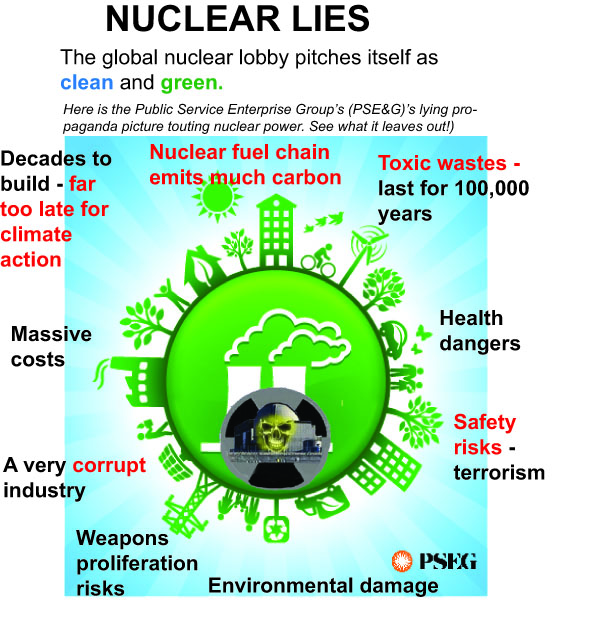
Anyway, today I was captivated by a charming, pretty, graphic, touted by the Public Service Enterprise Group, (PSE&G’) in an article extolling nuclear power, published by INSIDER NJ.
I just felt the need to make PSE&G’s picture honest.
Small modular reactors not the solution, says German nuclear authority
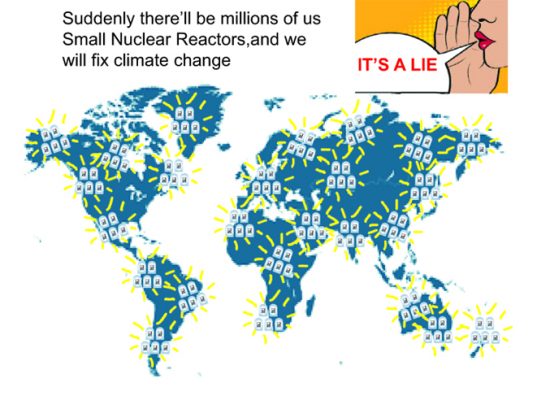
advanced reactor designs and can be operated with converted short-lived radioactive materials, solving the waste problem.
proliferation of weapons-grade materials and will probably never be as cheap as their advocates claim”, Michael Bauchmüller writes. The paper by the Institute for Applied Ecology (Öko-Institut) found that in order to replace the 400 or so large reactors today, “many thousands to tens of thousands of SMR plants” would have to be built. But this raises questions for proliferation, the spread of dangerous nuclear material.
https://reneweconomy.com.au/small-modular-reactors-not-the-solution-says-german-nuclear-authority/
‘Every euro invested in nuclear power makes the climate crisis worse’.

|
Deutsche Welle 11th March 2021, ‘Every euro invested in nuclear power makes the climate crisis worse’. Can nuclear energy help us meet climate goals? The editor of the World Nuclear Industry Status Report, Mycle Schneider, says no. Mycle Schneider:
Today we need to put the question of urgency first. It’s about how much we can reduce greenhouse gases and how quickly for every euro ($1.21) spent. So, it’s a combination between cost and feasibility, while doing it in the fastest possible way. And if we’re talking about the construction of new power plants, then nuclear power is simply excluded.
Not just because it is the most expensive form of electricity generation today, but, above all,
because it takes a long time to build reactors. In other words, every euro invested in new nuclear power plants makes the climate crisis worse because now this money cannot be used to invest in efficient climate protectionoptions. The world’s lowest price for solar power in currently in Portugal, at 1.1 cents per kilowatt hour. And we now have the first results from Spain with costs for wind and solar power at around 2.5 cents per kilowatt hour. These are below the basic operating costs of the vast majority of
nuclear power plants around the world. It would often even be affordordable to pay 1 – 1.5 cents per kilowatt hour for electricity storage in addition to the generation costs for wind and solar power and still be below the operating costs of nuclear power plants. And here we have to ask the same question: How many emissions can I avoid with one euro, one dollar or one yuan? https://www.dw.com/en/nuclear-climate-mycle-schneider-renewables-fukushima/a-56712368 |
|
Radionuclides from the nuclear industry increase wildfires, and greatly increase their danger

Radionuclides in trace amounts, in the environment, increase wild fires, 30 fold by making them hotter, bigger and, much more profuse. Radionuclides Increase the width and breadth of wildfires, like the huge 90,000 acre wildfire at Idaho National laboratory, where the area is saturated with radionuclides.
govt extends nuclear reactor licenses, deregulates their supervision further. The government does not mandate-shutting the old dangerous nuke, monsters down . They are so expensive and dangerous, with no place safe to store, their extinction level-hoards of hi level nuclear wast
Death Maybe Your Santa Claus But, Pyrophoricity is The Burning Deliverance. https://www.opednews.com/articles/30-years-too-late-by-Terra-Lowe-Danger_Fukushima_Nuclear-210301-909.html–By Terra Lowe , 3 Mar 21,
STP failure Texas nuclear plant was just 3 minutes away from going completely off-line during blackout – Raw Story – .rawstory.com PSYCHOTIC IRRATIONALITY AND STUPIDITY What have the massive gulf coast hurricanes Harvey, Maria, and others, taught me? Harvey taught that catastrophes occur in America and that they are not well managed.
There was the monster cold-spell and failure of the grid in Texas, with temps in the teens in Feb. Almost freezing to death. Many almost dying again of starvation, like during the hurricanes. Almost dying of thirst and, bacteria infested water. Texas is the rightwing devil of the south. Texas is where the South Texas Project nuclear reactors, at Bay city, lost backup . So close to melting down again, like they were during Hurricane Harvey. This occurred in the time, during the blackouts in Texas . There was no water in half of Texas. Even hospitals in Austin. Texas is a total failure, with the pandemic still going.
I write this diatribe-invective, appealing to the sense and sanity, of the American people and people in the WORLD. No one is listening 30 years too late. Its all 30 years too late. The nukeape countries are: Pronuke energy. Pronuclear weapons. Generals are attached at the hip, to nuclear power. Attached to the Nuclear military industrial complexes and stock markets. There are minnions of them in all nuke countries. In Nuke countrys like the USA , France, Russia, Canada .
Australias wildfires, are starting to burn again. Like all the huge wildfires, they are from hydrocarbon residue in soils, drought, global climate change, pryophoric radionuclides like uranium waste, in the soil.
There are MEGA recurring Firestorms and wildfires, that occur in areas where nuclear catastrophes occured in the forests around Fukushima and pripyat and other heavily contaminated areas.. The phenomenon is from the inherent pyrophoricity of the multiple radionuclides, deposited there by the nuclear explosions and meltdowns or dumping for the past 5 to 10 years. Unusual biannual Forest wildfires have b een recurring around Chernobyl for 30 years. Radionuclide wildfires have been raging at Fukushima, Chernobyl, Santa Susana , INL
Santa Susana had two meltdowns in the 1960s. The Woolsey wildfires there, are some of the worst wildfires in history. The Idaho National Laboratory had 2 nuclear reactor meltdowns, in 50 years.
The 2018 INL wildfires, burned 90,000 acres in and around the 50 reactor, Idaho National Laboratory site, spreading deadly radionulide death over the United States in the air.
INL is a 30 square mile area, chocked full of Radionuclide waste. The pyrophoricity of all radionuclides, the Uranium, plutonium, cesium 137 cobalt 60 strontium 90 americium, thorium 90 . Radium and Uranium, from fracking, from nuclear , from uranium mining, from oil refining and burning hydrocarbons.
Areas around Mayak and Hanford have perennial wildfires .
Depleted uranium is used in bullets, mortars, bombs, rockets because of it’s inherent pyrophoricty.
Areas around Los Alamos, have had perennial-massive wild fires for years from the plutonium and americium byproducts of nuclear bomb manufacturing, residue there. Wildfires will happen this year at Los Alamos. It is primed for it from the drought in nothern New Mexico. Primed for it, from climate change, drought and radionuclide pyrophoric catalysis. Plutonium burns, when exposed to air, like the rocky flats, plutonium pit factory fires in arvada in the 60s, 70s, and, 80s in Denver.
Plutonium, depleted uranium, uranium, Amerecium dust contamination, from plutonium pit manufacture, at Los Alamoa catalyze wildfires, there. Wildfire areas have grown since older wildfire, AROUND LOS ALAMOS.
WILDFIRES ARE GROWING. Wildfires engulfed half of Australia, half of the USA, a third of the Amazon in the past 3 years. Continue reading
Ominous news; Antarctic ice is melting at an accelerating rate
https://climatenewsnetwork.net/antarctic-warming-speed-up-alarms-researchers/
Elon Musk and Bill Gates: beware of gurus toting solutions to climate change.
https://www.onlineopinion.com.au/view.asp?article=21339–4 March 21, Elon Musk has grand plans to save the world. Bill Gates has just published his book How To Avoid a Climate Disaster. They both envisage tax-payer funding for their solutions. But beware of gurus toting the  solution to the planet’s crisis.
If you don’t think that our home planet is in an ecocidal crisis, then you’ve been blissfully unaware of global heating, over-population, biodiversity loss, waste crises, plastic pollution, overconsumption of energy, water shortages, deforestation, nuclear danger, space junk danger, perpetual nuclear war risk…….
Visionaries like Bill Gates and Elon Musk have brought extraordinary, and beneficial advances to our human society. On the way, they have become billionaires. And good luck to them. But their wealth and fame has made them all too ready to be seen as world leaders, and to see themselves as having the solutions to world problems. This can be problematic, as in effect, some of their solutions exacerbate the problems.
The future envisioned by both Bill Gates and Elon Musk has one huge blind spot. They both foresee ever-expanding energy use, and they plan for that – problems can be fixed with technology.
On a finite planet, endless energy use just cannot work. But the concept of enough is just not in their plans. If the human species does not take up the concept of enough, we could just become an extinct species. Technology could be used to reduce energy use, but that idea fades away as Gates, Musk, and other technocratic leaders see progress as being to have ever more exciting and energy-guzzling gimmicks and activities.
The digital revolution. It should be a benefit, enhancing our lives, and in many ways, it IS. But an energy price is paid in our unbridled use of digital technology. Every email, emoji, Facebook post, tweet, blogpost, Youtube, uses electricity. It’s not as if these actions just disappear ”into the cloud”. What a dishonest term that is! There is no such cloud. What there actually IS – is a host of vast areas of dirty great data” farms”. There’s another dishonest term. They’re not farms. They are soulless collections of great metal servers, using ever growing amounts of electricity, and of water, to keep them cool.
Then there’s the price at the end. It’s very hard to find out the details and the extent of toxic materials from digital technology, that are dumped in poor countries.
And, to be fair, companies like Apple, have made some efforts to reduce their ewaste.
However, planned obsolescence is rampant in the high tech world, resulting in the utter tragedy of ewaste pollution, – from discarded smartphones, laptops, computers, printers, TVs, fidbits, smart fridges, robots etc, the tragedy of the thousands of children working as waste-pickers in India and Africa, in slum conditions. E-waste includes many toxic materials such as lead, arsenic, cadmium, and mercury, that release dioxins. . ”With no health or environmental protections in the slum, the toxins contaminate the air, water, and the food consumed in the slum…….. The area is constantly covered in thick, toxic smoke from the burning of electrical cables that goes on all day and night,” – High-tech hell: new documentary brings Africa’s e-waste slum to life

Both Gates and Musk are enthusiasts for renewable energy, and in the climate crisis, they are to be applauded for their work in this direction. Yet, as with all kinds of digital technology, renewables should not be unlimited, and do have their downsides, both in the production (pollution from rare earths mining/processing), and in the final disposal, with toxic wastes, and components that are difficult to recycle. . The International Renewable Energy Agency (IRENA) estimates that solar panels produced 250,000 metric tonnes of waste in 2018 alone.
Bill Gates and Elon Musk do show their awareness of the planet’s grave environmental problems, but we don’t hear from them about energy conservation, or about moving away from the consumer society. Both talk quite enthusiastically about the great increase in energy use that we can expect. They complacently predict endless energy use, just as the nuclear lobby did in its glossy advertising film ”Pandora’s Promise”
Elon Musk now plans to put 24,000 satellites into space, and is well known for his dream of colonising Mars, and This idea has, of course, been taken up by many others, and there’s a sort of general public delight in space travel and interstellar rocketry. People seem oblivious to the fact that this will require huge amounts of energy, and that the space scientists already are turning away from clean solar power, to the far more dangerous source of nuclear fission. They’re also oblivious of the state of affairs in near space, where the trillions of bits of space debris pose dangers, floating about just like the plastic pollution in the oceans. Meanwhile the military planners in USA, Russia, China are already planning for nuclear weapons and war in space.
No surprise then that Elon Musk sees nuclear power as necessary – not just for his predicted need for much more electricity on Earth, but for this obsession with satellites and rockets.
Less well understood than his push for electric cars and Tesla technologies, is Elon Musk’s investment in the cryptocurrency, Bitcoin. Running Bitcoin demands enormous amounts of 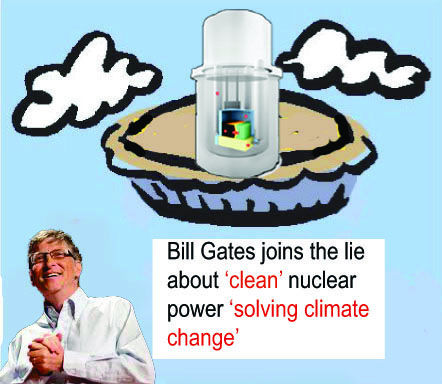 electricity, as Timothy Rooks explained recently.
Bill Gates, while motivated to help fight climate change, has also long been trying to make a success of his nuclear technology company Terra Power. The climate emergency presents him with the perfect opportunity to promote this, and especially, to get tax–payer funding to do it, as he suggests in his new book.
Wake up people! These two gurus have done some good stuff. But don’t let them manipulate us into dangerous territory – with nuclear technology, so connected with weaponry, and with its dangers, and the unsolved problem of radioactive trash. Sure, technology has got to be part of solving the planet’s crises. But we need much more imaginative leadership to steer our species away from infinite consumption and infinite energy use.
Nuclear power-not clean, not renewable – Bill Gates is wrong
Bill Gates is wrong about nuclear power http://english.hani.co.kr/arti/english_edition/english_editorials/984773.html
By Cho Chun-ho, professor of atmospheric sciences at Kyung Hee University Feb.28,2021 To prevent the climate crisis, we need to reorient our energy grids from fossil fuels to solar and wind power. Some argue we should also expand nuclear power, since nuclear plants don’t emit carbon dioxide.
Automobile accidents cause many fatalities, but people keep driving cars because of social inertia. But an accident at a nuclear plant would create damage on a scale that would exceed whatever benefits we derive from nuclear power.
As of 2018, cleanup from the disaster at the Fukushima nuclear plant had cost 236 trillion won (US$213.37 billion). But even that wasn’t enough to deal with the radioactive wastewater that Japan now intends to dump into the ocean. Most of that cost is being borne not by the company operating the nuclear plant but by taxpayers.
 There’s not a government on earth that can deal competently with an accident at a nuclear plant. Even Japan’s meticulously designed safety net was helpless before such an accident.
 Furthermore, the cost of generating nuclear power has gone up 26% in the past ten years. Part of that price hike results from the need to prevent previously unconsidered risks, such as the Fukushima accident. Another issue is that demand for nuclear reactors has been recently falling around the world, pushing nuclear power out of the market.
In the book “How to Avoid a Climate Disaster: The Solutions We Have and the Breakthroughs We Need,” Bill Gates argues that nuclear power is ideal for responding to climate disaster because it’s the only emissions-free source of energy that can be supplied continuously around the clock.
In 2020, a team of researchers led by Benjamin Sovacool, a professor at the University of Sussex, published a paper in the journal Nature Energy analyzing renewable energy and nuclear energy’s impact on reducing carbon dioxide emissions. The relationship between renewable energy and nuclear power is mutually exclusive: one tends to crowd out the other.
Over the past ten years, the cost of solar and wind power has fallen by 89% and 70%, respectively. That’s because renewables have been the focus of technological innovation, which has entailed a huge amount of investment.
In 2020, the International Energy Agency declared that solar power was the cheapest source of electricity. In countries that have focused investment on renewables, renewable energy holds an advantage in the market even when governments reduce or totally eliminate subsidies.
Solar and wind power accounted for 72% of power capacity added around the globe in 2019. As renewables’ share of the energy mix increases, nuclear power — which is inflexible because output cannot be adjusted — has become a headache for the energy regime.
Multinational firms such as Apple, Google and Microsoft are pushing their suppliers to provide parts that are completely made with renewable energy — which doesn’t include nuclear power.
Nuclear power may be a low-carbon source of energy, but it’s not renewable because of the nuclear waste it produces. We can’t have both nuclear power and renewable energy because they rely on different paradigms. So which one are we going to choose?
Is it wise for the Biden administration to fund Small Nuclear Reactors?

|
Climate change and ‘advanced nuclear’ solutions, The Hill, BY GREGORY JACZKO, — 02/23/21
Nuclear power is knocking on the government’s door offering solutions. The Biden platform answered by including so-called “advanced nuclear” in its list of climate options. The question now is will they wisely fund any such efforts?
While talk of advanced nuclear reactors is ubiquitous, a precise definition is elusive. Without a clear target in which to aim, government funds will not hit the mark. Advanced nuclear has become the catch-all for the knight-in-shining-armor reactors that promise to address issues that have kept nuclear a marginal electricity player since its inception. But we need more than this open-ended definition. The Biden administration should support projects only if they can compete with renewables and storage on deployment cost and speed, public safety, waste disposal, operational flexibility and global security. There are none today.
The only advanced nuclear technologies close to realization are called small modular reactors. These reactors are smaller than traditional reactors and are self-contained. These features allow companies to manufacture most of the reactor in a factory and ship it to a plant site. This concept evokes images of smart phones rolling out of factories by the billions — each design identical and mass produced. Their small size reduces the amount of radiation that can be released to the environment, greatly reducing — but not eliminating — safety to a plant’s community….
Yet the economic competitiveness of small modular reactors appears weak. Shrinking the size of a traditional reactor and splitting it among many modules increases the cost of the electricity it produces. It is the same reason airlines fly large capacity jets instead of private jets. You maximize the revenue per area of the aircraft hull. Proponents argue mass production will overcome this problem with fleet-wide economies of scale and construction efficiencies. Only wide scale adoption of the technology would deliver those benefits and there is no obvious market to support that today.
Moreover, the nuclear industry always promises better, faster and cheaper yet it fails to deliver. ……
Small modular designs are only promising to be cheaper than traditional reactors. Current estimates show they are more expensive than renewables, like wind and solar, even with storage and without subsidies. Small reactors have a long way to go to be competitive. Dramatic cost decreases for high-volume energy storage, which address the intermittency of some renewables, make the competitive case for any form of nuclear even tougher.
Even if everything else was lined up perfectly, nuclear has little time to catch up. After reentering the Paris Agreement, the U.S. will again strive to achieve drastic reductions in greenhouse gas emissions (GHG) within the next 10 years. Even in the most optimistic scenario, we won’t see even a handful of small modular nuclear reactors in the U.S. until 2029 or 2030, which means a large-scale impact would come far after the climate tipping point.
What about the other factors like proliferation resistance and waste disposal? For those criteria, small modular reactors offer no advantages over their traditional reactor cousins. Even if the cost factors are addressed, proliferation concerns and waste management will be hurdles.
Most importantly, no small modular reactors have been deployed yet in the United States, despite government efforts. In 2011, the Department of Energy (DOE) offered $400 million grants to support two small modular reactor designs. After providing tens of millions, only one design is still under development. That company originally planned to build a 12-module plant at the Idaho National Laboratory.
Predictably, this project is in trouble. Electricity customers have committed to purchase just a small fraction of the power produced annually by that plant, which now is likely to be scaled down, diminishing the economies of scale from mass production. It will not operate until at least 2030, years behind schedule and too late to help deal with the problem forecast in the best climate models. Despite these challenges, the federal government agreed in concept to a $1.4 billion direct subsidy over 10 years for the project. Without this cash infusion, the project will not meet its already disputed targets for price competitiveness. Such largesse is part of the billions Congress and the Trump administration committed to other advanced reactor concepts, none of which are close to deployment. To avoid wasting money on advanced nuclear reactors, the Biden administration must establish clear metrics for advanced nuclear reactors and apply them rigorously. Only ideas that can meet the pressing timetable of climate demands and electricity market realities deserve a serious look. My list is a good place to start. If advanced reactors cannot meet these metrics, they should not receive funding. Proponents of nuclear power will certainly say that living up to my list is an arduous task. Perhaps it is, but the future of our planet hangs in the balance. That is more important than the profits of an industry. Dr. Gregory Jaczko was the chairman of the U.S. Nuclear Regulatory Commission from 2009 to 2012 and currently develops clean energy projects and teaches at Princeton University. https://thehill.com/opinion/energy-environment/539991-climate-change-and-advanced-nuclear-solutions |
|
Dr Helen Caldicott: the truth about nuclear power — neither clean nor green.
|
By Helen Caldicott | 26 February 2021, While nuclear power is considered clean by many, there are several harmful and long-lasting consequences resulting from its use, writes Dr Helen Caldicott.
AN ENORMOUS AMOUNT of fossil fuel is used to mine and mill uranium, to enrich and fashion the nuclear fuel rods, to build the enormous concrete reactor, let alone decommission the radioactive mausoleum at the end of its active life of 40-60 years. Finally, but not least, to transport millions of tons of intensely radioactive waste to some as-yet-to-be-constructed storage site in the U.S. to be kept isolated from the ecosphere for one million years according to the U.S. Environmental Protection Agency. We all know to our detriment that the combustion of oil, gas and coal creates CO2, the main global warming gas. According to a definitive study by Jan Willem Storm van Leeuwen and Philip Smith titled ‘Nuclear Power: the Energy Balance’, the use of nuclear power causes, at the end of the road, approximately one third as much CO2 as gas-fired electricity production. The rich uranium ores required for this reduction are limited and the remaining poorer ores in reactors would produce more CO2 than burning fossil fuels directly. Nuclear reactors are best understood as complicated expensive and inefficient gas burners. Setting aside the above energetic costs and accepting the nuclear industry’s claim that it is clean and green, and assuming a 2% growth in global demand, all present-day reactors – 440 – would have to be replaced by new ones. Half the electricity growth would be provided by nuclear power and half the world’s coal fire plants replaced by nuclear plants requiring the construction over 50 years of 2,000 to 3,000 1,000-megawatt reactors — one per week for 50 years. The International Atomic Energy Agency estimates already there are 370,000 tons of high-level radioactive waste in the world awaiting disposal, containing over 100 radioactive elements such as:
Dr John Gofman MD, the discoverer of uranium-233, estimated that if 400 reactors operated for 25 years at 99 per cent perfect containment, caesium loss would be equivalent to 16 Chernobyls. A half-life is multiplied by ten or 20 to give the total dangerous radiological life. There is no containment that lasts 100 years let alone one million. As these radioactive elements inevitably escape and leak into the environment, they will concentrate at each step of the food chain tens to hundreds of times, for instance through algae, then crustaceans, then small fish, then big fish, then us. They are tasteless, invisible and odourless. Once deposited in human or animal organs, they irradiate a small volume of cells over many years inducing mutation of regulatory genes which control the rate of cell division, thus inducing uncontrolled cell division which is cancer. Leukemia takes five to ten years to appear post contamination, solid cancers 15 to 80 years. Genetic abnormalities will take generations to manifest. Animals and plants are similarly affected. In effect, by creating more and more nuclear waste, we humans will be inducing random compulsory genetic engineering for the rest of time. That’s what clean, green nuclear power means. You can follow Dr Caldicott on Twitter @DrHCaldicott. Click here for Dr Caldicott’s complete curriculum vitae. |
|

Why is the media fawning over nuclear businessman Bill Gates?
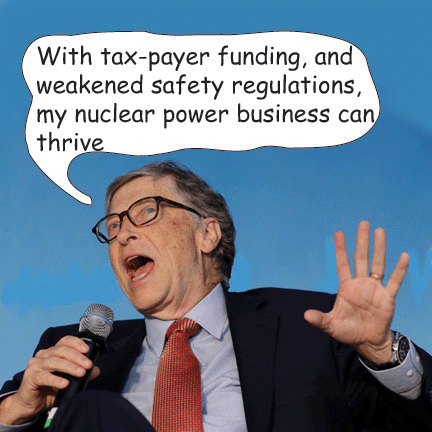
In a much-publicised interview he did on 60 Minutes Gates hyped up “advanced nuclear” fusion, SMRs and all the other tech marvels he is promoting. His interviewer, Anderson Cooper, completely ignorant of the subject, lapped it up, and failed to point out that none of these are proven technologies.
|
Why Bill Gates can’t save the world, The Fifth Estate, BY DAVID THORPE / 23 FEBRUARY 2021 Why don’t these billionaire philanthropists like Gates just stop their foundations and pay their fair share of taxes?
The media everywhere has been fawning over Bill Gates and his new book, How To Avoid A Climate Disaster. But should we really be listening to the world’s third wealthiest man for advice? If his suggestions and plans of action were wise and useful then maybe… Microsoft founder Bill Gates has an estimated net worth of $129 billion. His incalculable possessions, hugely destructive habits, and the massive investments of his opaque charitable trust, do everything to contradict his message that he’s the man with the plan to solve climate change. The fundamental point is that the richer you are, the bigger your ecological footprint. There’s no escaping it. The Gates’ fossil footprint……..Among the many $22.34 billion investments of Bill & Melinda Gates Foundation Trust, most of them are decidedly not in low carbon enterprises:
This is just scratching the surface. Journalist Tim Schwab, who has made it a mission to investigate Gate’s wealth and influence, has discovered his investments in fossil fuel companies: Gates claims to have divested from fossil fuel companies in 2019, but his foundation’s tax filing from that year shows millions of dollars in direct investments in companies like Exxon, Chevron, and Japan Petroleum Exploration. Billions more are invested in fossil-fuel-dependent industries like airlines, heavy machinery and automobiles. There’s a $1.6 billion stake in Caterpillar, for example, which makes diesel-guzzling plant used in mining. He is chairman of TerraPower, a nuclear reactor design company which has put no energy into the power grid. In October 2020, the United States Department of Energy gave TerraPower a grant of $400 million rising to $4 billion over the next seven years towards building a demonstration reactor. For reasons like this, Schwab calls Gates’ book “a long-winded advertisement for his investments”. Gates uses it to appeal to the US government to become a co-investor in TerraPower. The blind spotWhat is astonishing is the uncritical attitude of the media to Gates’ outpourings. The Financial Times last Saturday devoted the front page and a half of its Life & Arts supplement, to his “Green Manifesto”, without comment or criticism: it was free advertorial. Who else would get this treatment? Not long into the piece Gates pontificates, “The problem is simple. We can’t afford to release more greenhouse gasses.” Naturally, he doesn’t include himself in this “we” because if he did he would have to completely change his behaviour and lifestyle, something that he seems incapable of doing. This massive blind spot to his vision is also a blind spot to the media. The vast majority is in denial about his wealth. We want someone to come and lead us to salvation from the dire future we appear to be heading for. Of course, it should be a rich white man! Who else? But just as an alcoholic can’t rely on a whiskey distillery for a cure, we shouldn’t put our faith in the super-rich – because they are a huge part of this problem. Like most of the industrial-business sector, Gates imagines that the solution to climate change is technological. It can never be just that, it’s system change, it’s behavioural. In a much-publicised interview he did on 60 Minutes Gates hyped up “advanced nuclear” fusion, SMRs and all the other tech marvels he is promoting. His interviewer, Anderson Cooper, completely ignorant of the subject, lapped it up, and failed to point out that none of these are proven technologies. Gates the philanthropistBeing one of the top philanthropists in the USA, having donated billions to charity, gives Gates a powerful platform for his views. He sits on world stages amongst experts in the field who have been either democratically elected or appointed because they are experts. What is Gates’ experience or qualifications to talk about climate change? Charles Dickens used his writings to attack injustice in Victorian times. He was especially scathing of rich individuals who styled themselves as philanthropists but whose charitable acts did more to serve their own vanity than deserving causes. Nowhere is this better exemplified than in his novel Bleak House, where he puts in the mouth of one character the following aphorism: “There were two classes of charitable people; one, the people who did a little and made a great deal of noise; the other, the people who did a great deal and made no noise at all.” He satirises the former with Mrs Jellyby and Mrs Pardiggle, both of whom practice philanthropy – but at the expense of others. For both, philanthropy is more of a profession than born of genuine motivations to help. Philanthropy has become Gates’ profession, and his motivation is to assuage his guilt at the size of his wealth and ecological footprint, and to wield power. Dickens would have a field day. Can it be a coincidence that his charitable donations and investments in finding vaccines for the coronavirus, have seen his personal fortune rise $20 billion dollars as a result. That’s not philanthropy, it’s profiteering. Tim Schwab again, in the above article, quotes Anthony Rogers-Wright, director of environmental justice for the New York Lawyers for the Public Interest, as saying “These billionaires, the best they could do, some would say, would be to be stop their foundations and pay their fair share of taxes”. He observes how new tax revenues could help fund democratically devised solutions. “If Gates really wants to be effective and in a way that lifts up equity, he should be really listening to people who are being impacted the most and scaling up their solutions, rather than coming in with a parachute and with an air of white saviour-ism that actually in some cases causes more harm than good.” Christine Nobiss, founder of the indigenous people’s Great Plains Action Society, claims that Bill Gates has become the largest farmland owner in the United States. He owns nearly 100,000 hectares and is not farming it regeneratively or even sustainably. “He’s basically participating in the never-ending cycle of colonisation,” Nobiss says. The world’s most frequent flyer?Flying is one of the worst things you can do for the climate change, right? In a 2019 study of 10 celebrities and their flying habits, Celebrities, air travel, and social norms, Gates came top with the most emissions, beating Jennifer Lopez, Paris Hilton, and Oprah Winfrey. No wonder he would like the sustainable aviation fuel he dreams of in his book, and a neat way of offsetting all his carbon guilt. Let’s face it, would you rely on McDonald’s to make the world go vegan, or Putin to bring world peace? So why listen to Bill Gates, a man with a carbon footprint the size of a small country? Then there is the question of climate justice. In his book he never questions the political systems and economic models that result in climate change’s greatest impacts being on the poor and people of colour. There would be only one way for him to escape these financial conflicts of interest: let him lead by example. Let him give away all his money to the world’s poor with no strings attached. Let him live in a small apartment on $100 a week. Let him see the world from the point of view of a climate refugee – and say nothing about it. When he’s done all that, I’ll follow him. https://www.thefifthestate.com.au/urbanism/climate-change-news/why-bill-gates-cant-save-the-world-and-why-these-billionaire-philanthropists-might-do-best-to-simply-pay-fair-share-of-taxes/ |
|
New books on climate change; Michael Mann versus (nuclear promoter) Bill Gates.

Bill Gates’s faith in a technological fix for climate change is typical of privileged men who think they can swoop in and solve the problems others have spent decades trying to fix.
 Alongside Gates’s book comes The New Climate War, by Michael Mann, a well-known American climate scientist. Mann is the genuine article. He started in the field in the early 1990s as a graduate student at Yale University and has never left it. He is less than convinced by Gates’s relatively late conversion to the climate cause.Gates is a classic example of a “first-time climate dude”, believes Mann. This phenomenon is “the tendency for members of a particular, privileged demographic group (primarily middle-aged, almost exclusively white men) to think they can just swoop in… and solve the great problems that others have spent decades unable to crack”. The result is a mess, “consisting of fatally bad takes and misguided framing couched in deeply condescending mansplaining”.
Bill Gates’undemocratic approach to climate crisis
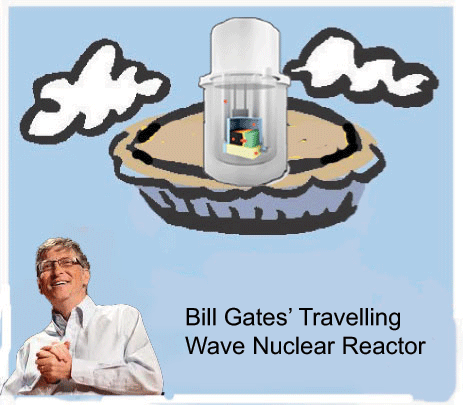 The Nation 16th Feb 2021, Tim Schwab: Gates proceeds from a precarious position, not just because of his thin credentials, untested solutions, and stunning financial conflicts of interest, but because his undemocratic assertion of power—no one appointed or elected him as the world’s new climate czar—comes at precisely the time when democratic institutions have become essential to solving climate change.
https://www.thenation.com/article/environment/bill-gates-climate-book/
Nuclear lobby planning to take over the U.N Climate Change Conference

Meet the Young Generation Network and its group of nuclear schills who will lead the attempted nuclear takeover of the 26th UN Climate Change Conference of the Parties (COP26) in Glasgow on 1 – 12 November 2021.
Just by chance? They all happen to be ambitious young people who hope to have a big career in the nuclear industry. Well, you can’t blame them for that. But let’s be wary of their advice on nuclear power as the solution for global heating.
Arun Khuttan. End States Engineer at Magnox Ltd.UKAlice Cunha da Silva. Latin America Nuclear Leader | Westinghouse Electric Company.
Hannah Paterson, Technology Manager at Sellafield Ltd UK
Matthew Mairinger Technical Engineer with Ontario Power Generation, Canada
Miguel Trenkel-Lopez Assistant Engineer at Magnox Ltd,Bristol, UK
Saralyn Thomas Formerly at AREVAnuclear company, now at Abbott Risk Consulting (ARC) Risk Management consultancy services to the Nuclear Industry
Vicki Dingwall of EDF nuclear company
On nuclear power as climate solution, Bill Gates shows alarming ignorance
David Lowry’s Blog 16th Feb 2021 The multi-billionaire Bill Gates, founder of Microsoft, in his new book, “How to Avoid a Climate Disaster”, is sceptical of the Green New Deal.(Allen Lane/Penguin) published on 16 February. Gates secured much pre-publication publicity for his new tome, including an interview in the Guardian Weekend Magazine, which wrote “Of the Green New Deal, the proposal backed by Alexandria Ocasio-Cortez [the Congresswoman who has promoted the merits of the GND in the US] that raises the goal of carbon neutrality in a decade, he is flatly dismissive, with Gates telling the interviewer. “Well, it’s a fairytale. It’s like saying vaccines don’t work – that’s a form of science denialism. Why peddle fantasies to people?”
Gates also opined: “I’m not a survivalist.” Instead his version of survivalism is to fund innovation, the reporter noted. “I’m putting money into carbon capture and nuclear fission” Gates told her. (Bill Gates: ‘Carbon neutrality in a decade is a fairytale. Why peddle fantasies?’, Guardian, 13 February 2021; https://www.theguardian.com/technology/2021/feb/15/bill-gates-carbon-neutrality-in-a-decade-is-a-fairytale-why-peddle-fantasies)
Indeed, his book is laced with positive, if inaccurate, mentions of nuclear power. For example, he asserts on page 84, in a section on “Making Carbon-Free Electricity”, uns der a sub-section titled ‘ Nuclear Fission’ he writes: “”Here’s the one sentence case for nuclear power: It’s the only carbon-free energy sources that can reliably deliver power day and night, through every season.”
1 This Month
19 February – VIRTUAL EVENT-Decision Time: AI and Our Nuclear Arsenal
12:45 p.m. Central / 1:45 p.m. Eastern
To see nuclear-related stories in greater depth and intensity – go to https://nuclearinformation.wordpress.com

-
Archives
- February 2026 (181)
- January 2026 (308)
- December 2025 (358)
- November 2025 (359)
- October 2025 (376)
- September 2025 (258)
- August 2025 (319)
- July 2025 (230)
- June 2025 (348)
- May 2025 (261)
- April 2025 (305)
- March 2025 (319)
-
Categories
- 1
- 1 NUCLEAR ISSUES
- business and costs
- climate change
- culture and arts
- ENERGY
- environment
- health
- history
- indigenous issues
- Legal
- marketing of nuclear
- media
- opposition to nuclear
- PERSONAL STORIES
- politics
- politics international
- Religion and ethics
- safety
- secrets,lies and civil liberties
- spinbuster
- technology
- Uranium
- wastes
- weapons and war
- Women
- 2 WORLD
- ACTION
- AFRICA
- Atrocities
- AUSTRALIA
- Christina's notes
- Christina's themes
- culture and arts
- Events
- Fuk 2022
- Fuk 2023
- Fukushima 2017
- Fukushima 2018
- fukushima 2019
- Fukushima 2020
- Fukushima 2021
- general
- global warming
- Humour (God we need it)
- Nuclear
- RARE EARTHS
- Reference
- resources – print
- Resources -audiovicual
- Weekly Newsletter
- World
- World Nuclear
- YouTube
-
RSS
Entries RSS
Comments RSS
 nuclear-news