Nuclear: EDF extends the shutdown of four reactors for several weeks. (Translation)
The energy company announced on Thursday that reactors 1, 3 and 4 of the Cattenom power plant, as well as reactor 1 of Penly, will only be reconnected to the electricity network between November and January. An announcement related to the stress corrosion problem detected since last fall on several units.
By Les Echos
Posted on August 25, 2022 at 5:55 PMUpdated on August 25, 2022 at 6:04 p.m.
France will have to do without at least four nuclear reactors until the beginning of winter. This Thursday, EDF announced the extension, for several weeks, of the shutdown of units affected by the problem of stress corrosion detected for the first time in the fall of 2021.
According to the new provisional timetable published by the energy company, reactors 1 and 4 of the Cattenom power plant, in Moselle, will be reconnected to the electricity network on November 1 and 14 respectively . Reactor number 3 will resume service on December 11, while unit number 1 of the Penly power plant (Seine-Maritime) will not be reconnected until January 23……… (subscribers only) https://www.lesechos.fr/industrie-services/energie-environnement/nucleaire-edf-prolonge-pour-plusieurs-semaines-larret-de-quatre-reacteurs-1783781#utm_source=newsletter&utm_medium=email&utm_campaign=nl_lec_18h&utm_content=20220825&xtor=EPR-5020-%5B20220825
Pakistan’s desperate plight after monster flooding
Pakistan is appealing for further international assistance after floods
wreaked havoc across the country. The US, UK, United Arab Emirates and
others have contributed to a monsoon disaster appeal but more funds are
needed, an interior ministry official told the BBC. More than 1,000 people
have died and millions have been displaced since June, Salman Sufi said. He
said Pakistan’s government was doing everything in its power to help
people.
BBC 28th Aug 2022
How the USA climate bill will promote the nuclear industry.

What the climate bill does for the nuclear industry, CNBC, Catherine Clifford, AUG 23 20222
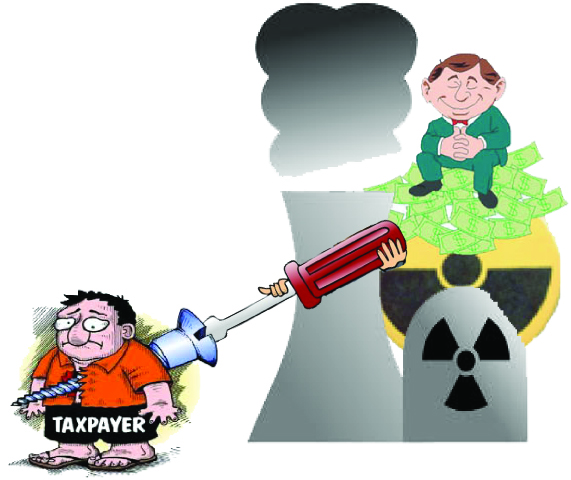
Production tax credit for existing nuclear power plants
Production tax credit for advanced nuclear power plants
Investment tax credit for new nuclear power plants
“………………………………………Production tax credit for existing nuclear power plants, Starting in 2024 and running through 2032, utilities will be able to get a credit of $15 per megawatt-hour for electricity produced by existing nuclear plants. If the price of power rises above $25 per megawatt-hour, then the credit will gradually decrease, but it doesn’t phase out completely until energy prices reach around $44 per megawatt-hour, explained Matthew Crozat, the executive director of strategy and policy at the Nuclear Energy Institute, a Washington, D.C.-based trade group.
“Every plant is different and some plants have a different revenue model but we can say that this credit will offer a reprieve from the low revenues that had forced more than a dozen reactors to close,” Crozat told CNBC.
To be eligible for the full $15 per megawatt-hour base tax credit, a nuclear power plant operator has to pay workers operating and doing maintenance on the power plant “prevailing wage requirements,” according to the Nuclear Energy Institute.
Production tax credit for advanced nuclear power plants
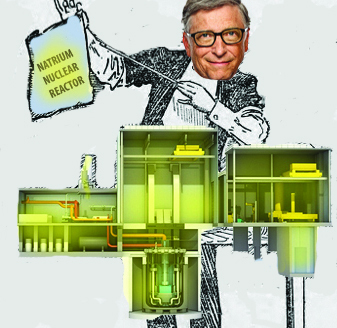
Several companies in the United States are working to commercialize new nuclear power plant designs that are meant to be safer and with a smaller capacity, making them ideally cheaper to build and maintain as well.
For example, Bill Gates’ nuclear innovation company, TerraPower, is developing a couple of advanced reactor designs, one of which is going to be built at a retiring coal facility in Wyoming as part of a demonstration program in partnership with the U.S. government.
Advanced nuclear reactors could benefit from the IRA by way of the Clean Electricity Production Tax Credit, a technology-agnostic production credit, which can be applied toward emissions-free power generation that goes online after 2025. The clean energy production credit is for at least $25 per megawatt-hour for the first ten years the plant is in operation, adjusted for inflation. The credit phases out in 2032 or when carbon emissions coming from electricity have fallen by 75% below the level of 2022, according to the Nuclear Energy Institute. The tax credit is increased by 10% for locating the zero-emissions power source where a coal plant previously lived.
Worth noting, there’s another Advanced Nuclear Production Tax Credit already on the books. That tax credit was established in the Energy Policy Act of 2005 and is for $18 per megawatt-hour for the first eight years that a nuclear power plant is operating, provided the nuclear power plant had not begun construction when the 2005 bill was signed into law, Crozat told CNBC. The third reactor unit of the Vogtle Power plant being constructed in Georgia will be the first power plant to take advantage of the 2005 Advanced Nuclear Production Tax Credit, according to Crozat.
A company can not take advantage of both tax credits — it has to pick. Going forward, the tax credits in the IRA just signed into law will be more attractive. “Since the new production tax credit has been indexed to inflation and last for two additional years, it will be considerably more valuable than the older version,” Crozat told CNBC.
Investment tax credit for new nuclear power plants
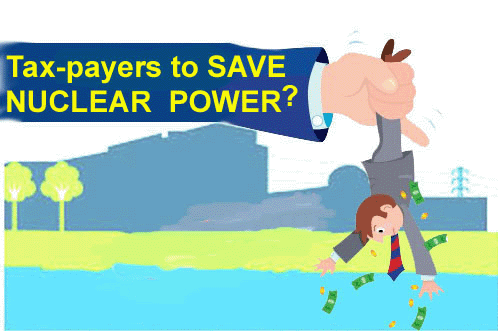
New nuclear power plants are eligible for claiming an Investment Tax Credit made available through the new law for facilities that generate energy with zero emissions and that go into service in 2025 or after.
The investment tax credit allows a nuclear power plant to get a tax credit for 30% of what was invested in building the zero-emissions energy production facility, which includes nuclear power plants, according to the Nuclear Energy Institute.
The investment tax credit is increased by 10% for locating the zero-emissions power source where a coal plant previously lived. It starts to phase when carbon emissions from the sector are 75% lower than 2022 levels.
Money to spur innovation

The law includes $700 million that will go towards the research and development of high-assay low enrichment uranium (HALEU) fuel sources in the United States through 2026, according to the Bipartisan Policy Center, a Washington DC-based think tank. That’s important because the advanced, next-generation reactors which are currently being developed by 20 companies in the United States, according to the U.S. Department of Energy, depend on HALEU fuel to operate.
The existing fleet of nuclear power reactors in the United States operate on uranium that has been enriched up to 5%. HALEU fuel has been enriched between 5% and 20%. Many advanced reactor designs are smaller builds than conventional nuclear reactors and so to make a nuclear reactor smaller, they need to get more power from smaller quantities of fuel, the Department of Energy says.
“Right now, the only commercially available source of HALEU is from the Russian Federation and the support for HALEU in the IRA signals an understanding that the federal government is needed to jumpstart domestic enrichment capabilities to support the coming wave of new nuclear technologies,” Rampal told CNBC.
It’s also just the first step, Rampal said. The nuclear industry needs multiple billions of dollars to invest in HALEU production over the next ten years, he told CNBC.
The IRA also includes $150 million for the Office of Nuclear Energy through 2027, according to the Bipartisan Policy Center. That money is for the Department of Energy to invest in its nuclear innovation research at its network of National Laboratories. ……………………………………..
Tax credits for making component parts
The IRA includes a manufacturing production provision that allows for a tax credit for component parts produced and sold after 2022, according to a summary of the benefits of the IRA for the nuclear industry from the law firm Morgan Lewis. https://www.cnbc.com/2022/08/22/what-the-climate-bill-does-for-the-nuclear-industry.html
China’s record-breaking heatwave, threatening water resources
The southwestern Chinese regions of Chonqging and Sichuan were battling
fires on Tuesday as they awaited a long-anticipated drop in temperatures
over the next week, but the country’s important autumn harvest remained
under serious threat. Officials warned this month that temperatures were
rising faster in China than in the rest of the world and a record-breaking
heatwave has raised concern about its ability to adapt to rapid climate
change and conserve already scarce water resources.
Reuters 23rd Aug 2022
Terrifying nuclear bomb prediction as world tensions rise
As the prospect of nuclear war rises, experts have made a terrifying prediction about what this means for Australia.
news.com.au Jamie Seidel@JamieSeidel, August 16, 2022
It’s been 77 years since the destruction of Hiroshima and Nagasaki. It’s been 33 years since the Berlin Wall’s fall and the Cold War’s end.
But the bomb is back.
Russian President Vladimir Putin is making thinly veiled threats. China’s embarking on a massive nuclear weapon-building campaign. And the menace of atomic annihilation coming out of North Korea is so common as to become background noise.
Has the world forgotten how close these weapons can bring us to extinction?
A new study in the science journal Nature Foodhas built upon recent lessons from Australia’s and Canada’s catastrophic 2019-20 forest fires to anticipate the impact of nuclear detonation on global food production.
Estimates place the amount of smoke produced by the recent fires as up to 1 teragram (1 trillion grams). Heavier soot ejecta was up to 0.02Tg. Both quickly encompassed the globe – lingering in the sky for months afterwards.
This adds confidence to our simulations that predict the same process would occur after a nuclear war,” reads the research published today (Tuesday, August 16) in Nature Food, from lead author Lili Xia of Rutgers University, along with contributors including Dr Ryan Heneghan of the Queensland University of Technology.
The study’s not without immediate relevance.
The bomb is back……………..
UN Secretary-General Antonio Guterres warned that “humanity is just one misunderstanding, one miscalculation away from nuclear annihilation”. Ukraine. Asia. The Middle East. The Koreas. All are experiencing heightened levels of nuclear threats.
With 13,000 nuclear weapons sitting in stockpiles worldwide, the secretary-general warned delegates “the risks of proliferation are growing and guardrails to prevent escalation are weakening”.
“Future generations are counting on your commitment to step back from the abyss.
“This is our moment to meet this fundamental test and lift the cloud of nuclear annihilation once and for all.”
Such a war would reach far beyond the battlefield.
We’re seeing that right now.
The fighting between Russia and Ukraine has disrupted more than 20 per cent of global grain exports – threatening famine in Africa and the Middle East while causing prices to soar globally.
Even a “small” nuclear exchange between Pakistan and India would have catastrophic implications. The handful of weapons both nations possess would kill some 52 million people instantly. They would also eject more than 16 teragrams (16 trillion grams) of soot into the stratosphere.
National borders will not constrain this. Instead, the soot will quickly be picked up by high-altitude jet streams and circle the world.
The result would be a global famine killing an additional 926,000,000 people within two years.
Australia, however, appears to get off relatively lightly. At least at first.
Food for thought
The study, Global food insecurity and famine from … nuclear war soot injection, examines the implications of wars scaling up from 100 warhead detonations through to 4400.
Only Australia and some other southern hemisphere nations would potentially avert starvation.
And that may include the worst-case “all-out exchange” scenario.
Some 360 million would die in the initial blasts. Two years later, an additional five billion would be dead of hunger…………………………… more https://www.news.com.au/technology/innovation/military/terrifying-nuclear-bomb-prediction-as-world-tensions-rise/news-story/938f4ed66c8f38b8b9cbbb2147500400
Digital damage: Is your online life polluting planet?

https://www.miragenews.com/digital-damage-is-your-online-life-polluting-840709/ Macquarie University/The Lighthouse Dr Jessica McLean is a Senior Lecturer in Human Geography in the Macquarie School of Social Sciences. 22 Aug 22
Shorter emails, camera-off Zoom calls and deleting old photos could reduce our digital carbon footprints – but sustainability expert Dr Jessica McLean says this is too big for individuals, and governments and organisations need to take responsibility.
Swapping digital meetings, shopping and even exercise classes for their in-person alternatives can substantially reduce greenhouse gas emissions by avoiding transport-related pollution, but the environmental impact of our digital lives is also surprisingly high, says Human Geographer Dr Jessica McLean.
We don’t often think about the various infrastructures required to do simple things like send an email or hold our photos – these digital things are stored in data centres that are often out of sight, out of mind,” says McLean, who is a Senior Lecturer in Human Geography at Macquarie University’s School of Social Sciences.
“If we think about it at all, we usually expect these services to be continual and think that there isn’t really a limit on those digital practices,” she says.
However, digital activity has a surprisingly high environmental impact, says McLean, who has recently published a book on the topic.
Along with the greenhouse gas emissions from substantial energy use by our personal computers, data centres and communication equipment, this impact also includes the water use and land impact from mining, building and distributing the metals and other materials that make up our vast global digital infrastructure.
High-impact digital activities
Many researchers have attempted to calculate the individual carbon footprints of various technologies, and these often focus on the energy used by servers, home wi-fi and computers and even a tiny share of the carbon emitted to construct data centre buildings.
Some of our greenhouse-gassiest digital activities include:
Emails: Professor Mike Berners-Lee calculated that a short email sent phone-to-phone over wifi equates to 0.3 grams of CO2, a short email sent laptop-to-laptop emits 17g of CO2 and a long email with attachment sent from laptop could produce 50g of CO2.- Digital hoarding: Data transfer and storage of thousands of photo, audio and video files, messages, emails and documents in an average US data centre emits around 0.2 tons of CO2 each year, for every 100 gigabyte of storage.
- Binge-watching in High Definition: Just one hour of HD streaming a day emits 160kg of CO2 each year – but swap to Standard Definition video quality and that drops to around 8kg of CO2 annually.
Using super-computers: Australian astronomers each produce 15 kilotonnes of CO2 a year from super-computer work – more than their combined emissions from operating observatories, taking international flights and powering office buildings. However Dutch astronomers produce about 4 per cent of these emissions, as Netherlands national supercomputer uses 100 per cent renewable energy.- Artificial Intelligence: Training a large AI model emits 315 times more carbon than a round-the-world flight.
Beyond the individual
Deconstructing the many and varied impacts of our increasingly digital lives can be overwhelming.
Talking heads: Just one hour of videoconferencing can emit up to 1kg of CO2.
“There’s a lot to take in, and many of these figures will change depending on things like the use of renewable energy that is being taken up by some digital corporations and many individuals,” says McLean.
“This highlights the complexity of this challenge, showing that understanding and addressing digital sustainability goes beyond individual responsibilities, and is more fittingly held by governments and corporations.”
She says that the onus should be on governments to regulate a greater transparency on how digital corporations use energy, and to require regular reporting on sustainability targets.
Big tech continues to produce smartphones that are not designed to last.
“Most device manufacturers subscribe to a ‘planned obsolescence’ paradigm, rather than circular economy – for example, big tech continues to produce smartphones that are not designed to last.”
McLean’s recent research with Dr Sophia Maalsen (University of Sydney) and Dr Lisa Lake (UTS) found that while university students, staff and affiliates were concerned about the sustainability of digital technologies, there was a big gap between their intentions and actual practices of sustainability in their everyday digital lives.
“People expressed concern for the sustainability of their digital technologies, but they had limited opportunities to do anything substantive about this issue,” she says.
Digital ‘solutionism’ the wrong approach
Concepts like the paperless office, remote work and virtual conferences often come with a promise of lower environmental impacts – but McLean says these can be examples of ‘digital solutionism’.
E-harm: Digital activity has a surprisingly high environmental impact, says Dr Jessica McLean, who has recently published a book on the topic.
“It’s time to question whether being digital is always the most sustainable solution,” she says.
McLean says that our society is becoming increasingly entangled in the digital via the exponential growth of intensely data driven activities and devices, from the Internet of Things to Big Data and AI.
However, she points out that this digital immersion isn’t universal.
“There are uneven patterns and gaps in these digital affordances, both within Australia and across the Global South,” she says.
Her book, Changing Digital Geographies, explores alternatives to our current exponential digital growth, and its impact on our natural world.
“There are many alternatives for how we live digitally, from making decisions about what’s ‘good enough’ to changing the whole digital lifecycle and the way it is regulated,” she says.
“Individuals cannot be expected to resolve these issues, governments need to regulate and corporations need to act, to improve our digital future and make it sustainable.”
Islanders in Latin America face relocation, because of climate change.
Some 2,000 islanders in Guna Yala will become one of the first indigenous
communities in Latin America to relocate because of climate change.
Islander Magdalena Martínez, who has campaigned for new housing on the
mainland, tells the BBC how she feels about leaving the island she grew up
on.
The Panama government estimates all islands of the Guna people could be
under water by 2050, based on forecasts by an independent group of
scientists, although others think the islands may not all be submerged
until the end of the century.
BBC 20th Aug 2022
UK nuclear to be branded green to lure investors
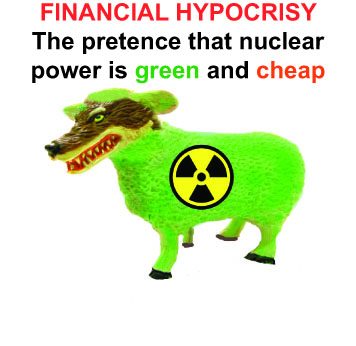
Treasury may classify reactors as eco-friendly to win pension fund backing for Sizewell C. The Government is set to rebrand nuclear power as green energy to lure reluctant investors to get behind Sizewell C.
Nuclear power is included in a draft report from the Treasury laying out which energy sources are classed as eco-friendly, a sources told The Mail on Sunday. This may clear the way for big City investors, including pension funds, to invest in nuclear power, such as the planned £20billion power station on the Suffolk
coast.
Mail on Sunday 14th Aug 2022
How even small nuclear war would kill billions in apocalyptic famine
https://www.9news.com.au/national/even-small-nuclear-war-would-kill-billions-from-famine/0aadd094-e5be-471f-8278-b8bf485f759a By Mark Saunokonoko • Senior Journalist Aug 16, 2022,
Australia may be the best place in the world to shelter if nuclear war broke out, a study has predicted, although an “influx of refugees” from Asia and other regions would likely rush the country to try and survive the atomic holocaust.
Various apocalypse scenarios showed even a small nuclear war would cause devastating climate chaos, plunging the world into mass famine and starving billions to death.
The study estimated more than 2 billion people would die from a contained nuclear war between India and Pakistan, while more than 5 billion around the world would perish inside two years if the US and Russia launched thousands of nukes at each other.
Nuclear strikes on major cities and industrial areas would unleash massive firestorms, the peer-reviewed study said, injecting soot into the atmosphere, blocking sunlight from reaching the Earth’s surface and severely limiting food production.
Such catastrophic “soot loadings” would cause at least 10-15 years of disruption to global climate, researchers said.
As land and ocean food production faltered, and in the face of worsening hunger, the study said food exporting countries such as Australia would hunker down and hoard supplies.
“Wherever there’s scarcity, you start to see more conflicts,” Dr Ryan Heneghan, a co-author of the study from Queensland University of Technology, told 9news.com.au.
“Whether that makes Australia a (post-nuclear war) target, I don’t know.”
Being a food exporter and its location in the southern hemisphere, away from likely conflict zones, were the key factors that meant Australia was able to weather a nuclear catastrophe better than most, Heneghan said, with New Zealand not far behind.
“Australia has some resilience if there were drops in food productivity because of changes in climate caused by a nuclear war,” he said.
“We already produce more than enough food for our population.”
But waves of migrants would inevitably put “pressures” on any Australian stockpiles.
One factor not included in the models, but which could seriously affect Australia’s ability to cope, was the country’s lack of domestic fuel supplies, Heneghan said.
“Australia isn’t energy independent.
“So we would probably have shortages of fuel.”
Australia, the planet’s sixth largest country after Russia, Canada, China, the US and Brazil, would face huge challenges trying to transport food from agricultural heartlands into big, densely populated urban centres, he said.
“Even though we might make enough food, we might not be able to move it to where it needs to go,” he said, calling that a “big caveat” to the study’s models.
Researchers modelled the impacts of six atmospheric soot-injection scenarios, based on one week of nuclear war, on crop and fish supplies and other livestock and food production.
Even if humans reduced food waste reduction and began to eat crops grown primarily as animal feed and biofuel, researchers predicted livestock and aquatic food production could not compensate for reduced crop output in most nations.
Any nuclear weapon detonation that produces more than 5 teragrams (5 trillion grams) of soot, such as 100 warheads fired between India and Pakistan, would likely cause mass food shortages in almost all countries, the study said.
A nuclear war between the US and Russia could send more than 150 teragrams of soot into the stratosphere.
The bushfires that swept across Australia in 2019-20 generated 0.3 – 1 teragrams of smoke, which swirled around the world and lingered for many months.
Climate change: Drought highlights dangers for electricity supplies from nuclear, hydro, fossil, and solar sources
BBC, By Matt McGrath, Environment correspondent, 14 Aug 22,
The ongoing drought in the UK and Europe is putting electricity generation under pressure, say experts.
Electricity from hydropower – which uses water to generate power – has dropped by 20% overall.
And nuclear facilities, which are cooled using river water, have been restricted.
There are fears that the shortfalls are a taste of what will happen in the coming winter.
hat will happen in the coming winter.
In the UK, high temperatures are hitting energy output from fossil, nuclear and solar sources.
That is because the technology in power plants and solar panels work much less well in high temperatures………………………………………………………………………………..
The exceptionally hot weather is also hitting nuclear power production, especially in France. Around half of the 56 reactors in the fleet are offline, with several affected by a systemic issue with corrosion.
Those reactors that are working are often cooled with water from rivers that are now running low, while temperatures are running high.
“Once the water in the rivers is very low and very hot, basically you have to stop cooling down nuclear power plants. That’s because the water that’s released is dangerous for fish and other species in the rivers,” said Prof Sonia Seneviratne, from ETH Zurich.
The French government is now allowing some facilities to release very warm water back into the rivers, as a temporary measure.
It underlines the stresses the heat is putting on energy production. France is now making up the shortfall in electricity by importing from the UK among others.
Analysts say this is putting additional pressure on the UK system – at a time when the very warm weather is hitting production from gas and nuclear facilities.
It’s more difficult to cool the plants in the warmer weather, explains Kathryn Porter, an energy consultant with Watt-Logic.
“Solar panels also experience quite a significant drop off above 25C. Everything just works less well when it’s hot,” she adds……………. more https://www.bbc.com/news/science-environment-62524551
Further cuts in output predicted, from France’s nuclear reactors as heat wave continues.
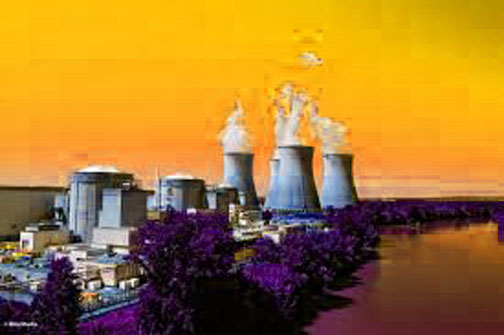
State owned French energy major EDF is reducing output at nuclear power
stations on the Rhône and Garonne rivers as heatwaves push up river
temperatures, restricting its ability to use river water to cool the
plants. EDF, which is Europe’s biggest producer of nuclear energy, has
said it would extend output cuts at several NPPs on the two rivers as the
hot spell continues, but that a minimum level of output, 400 MW, would be
maintained.
Further cuts in output are likely in the near future at nuclear
power plants Tricastin (3.6 GW), St Alban (2.6 GW, but now at 700 MW) and
Golfech (2.7 GW) owing to high temperatures in the Rhône and Garonne
rivers. EDF started imposing production restrictions in mid-July at
Tricastin, St Alban and Bugey on the Rhône and Blayais at the mouth of the
Garonne as temperature rose to unusually high levels.
Modern Power Systems 9th Aug 2022
https://www.modernpowersystems.com/news/newsedf-cuts-output-from-nuclear-generation-9915875
Sizewell C nuclear station approval faces legal challenge
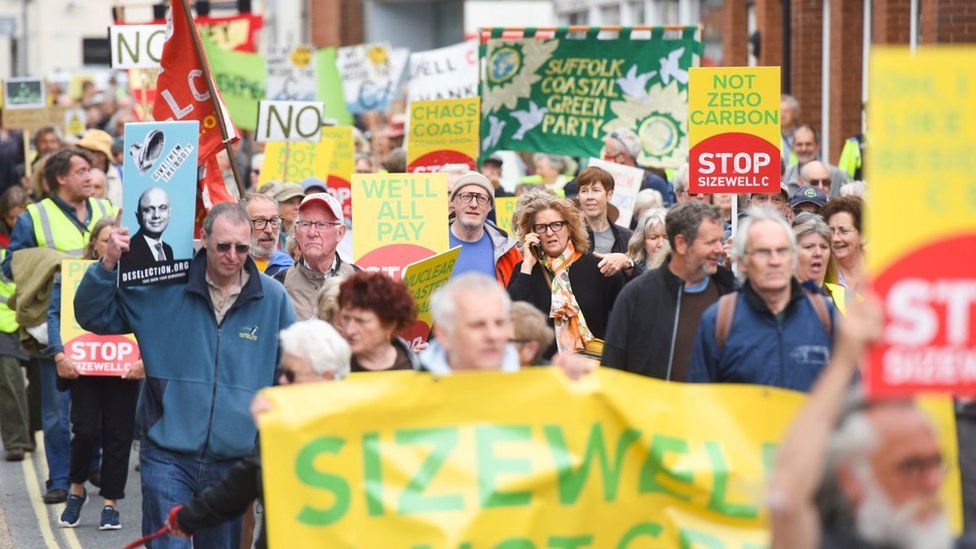
Campaigners have begun a legal challenge against the government’s decision to give the Sizewell C nuclear power station the go-ahead amid warnings that UK nuclear plants will be on the frontline of climate breakdown.

Citing the threat to water supplies in an area officially designated as seriously water stressed, the threats to coastal areas from climate change and environmental damage, the challenge is the first step in a judicial review of the planning consent.
The business secretary, Kwasi Kwarteng, overruled the independent Planning Inspectorate to grant permission for the new nuclear reactor in Suffolk in July. Kwarteng is pushing ahead with
government plans to approve one new nuclear reactor a year as part of an energy strategy that aims to bolster the UK’s nuclear capacity, with the hope that by 2050 up to 25% of projected energy demand will come from it.
But Sizewell C has faced stiff opposition from local campaigners, and environmental groups both for its cost and the environmental impact. In a letter to Kwarteng outlining their legal challenge Together Against Sizewell C (TASC) argues that the permission by the government for the plant was given unlawfully. Represented by Leigh Day solicitors and supported by Friends of the Earth, the group says there was a failure to assess the implications of the project as a whole, by ignoring the issue of whether a permanent water supply could be secured, a failure to assess the environmental impact of that project and the suggestion that the site would be clear of nuclear material by 2140, which was not upheld by evidence showing highly radioactive waste would have to be stored on site until a much later date.
The Planning Inspectorate had rejected the scheme saying “unless the outstanding water supply strategy can be resolved and sufficient information provided to enable the secretary of state to carry out his obligations under the Habitats Regulations, the case for an order granting development consent for the application is not made out”.
Pete Wilkinson, chair of TASC, said: “The case against Sizewell C is overwhelming, as has been carefully documented throughout the inquiry stage and was found by the planning inspector to have merit. “Even to consider building a £20bn-plus nuclear power plant without first securing a water supply is a measure of the fixation this government has for nuclear power and its panic in making progress towards an energy policy which is as unachievable as it is inappropriate for the 21st-century challenges we
face.”
Guardian 8th Aug 2022
Bad luck for the river environment – nuclear reactors allowed to release hotter water.
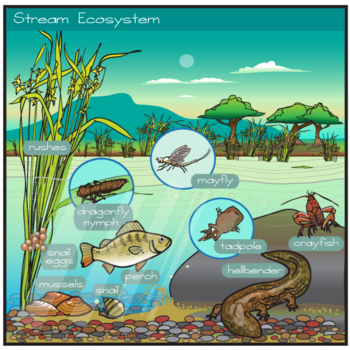
Heat wave: the State grants environmental exemptions to maintain the
activity of five nuclear power plants. These derogations will allow the
power stations to discharge warmer water than usual, which could have
negative effects on the environment.
The nuclear power plants of Blayais, Saint-Alban-Saint-Maurice, Golfech, Bugey and Tricastin will benefit until September 11 from environmental exemptions concerning the temperatures of
water discharge because of the high temperatures. With a downside: possible
negative effects on the environment.
France Info 6th Aug 2022
Climate Endgame: Risk of Human Extinction ‘Dangerously Underexplored’
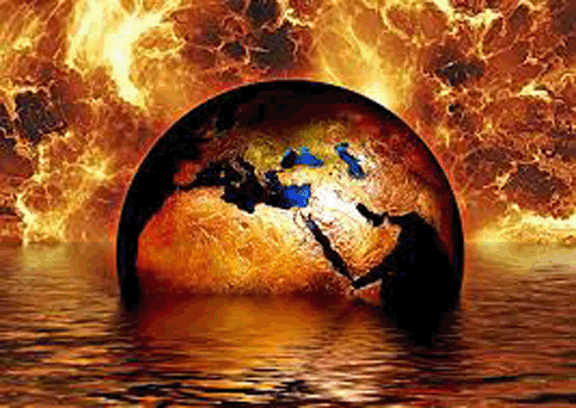
Reader Supported News, Damian Carrington/Guardian UK, 5 Aug 22,
Scientists say there are ample reasons to suspect global heating could lead to catastrophe
he risk of global societal collapse or human extinction has been “dangerously underexplored”, climate scientists have warned in an analysis.
They call such a catastrophe the “climate endgame”. Though it had a small chance of occurring, given the uncertainties in future emissions and the climate system, cataclysmic scenarios could not be ruled out, they said.
“Facing a future of accelerating climate change while blind to worst-case scenarios is naive risk management at best and fatally foolish at worst,” the scientists said, adding that there were “ample reasons” to suspect global heating could result in an apocalyptic disaster.
The international team of experts argue the world needs to start preparing for the possibility of the climate endgame. “Analysing the mechanisms for these extreme consequences could help galvanise action, improve resilience, and inform policy,” they said.
Explorations in the 1980s of the nuclear winter that would follow a nuclear war spurred public concern and disarmament efforts, the researchers said. The analysis proposes a research agenda, including what they call the “four horsemen” of the climate endgame: famine, extreme weather, war and disease.
They also called for the Intergovernmental Panel on Climate Change to produce a special report on the issue. The IPCC report on the impacts of just 1.5C of heating drove a “groundswell of public concern”, they said.
“There are plenty of reasons to believe climate change could become catastrophic, even at modest levels of warming,” said Dr Luke Kemp at the University of Cambridge’s Centre for the Study of Existential Risk, who led the analysis. “Climate change has played a role in every mass extinction event. It has helped fell empires and shaped history.
“Paths to disaster are not limited to the direct impacts of high temperatures, such as extreme weather events. Knock-on effects such as financial crises, conflict and new disease outbreaks could trigger other calamities.”
The analysis is published in the journal Proceedings of the National Academy of Sciences and was reviewed by a dozen scientists. It argues that the consequences of global heating beyond 3C have been underexamined, with few quantitative estimates of the total impacts. “We know least about the scenarios that matter most,” Kemp said.
A thorough risk assessment would consider how risks spread, interacted and amplified, but had not been attempted, the scientists said. “Yet this is how risk unfolds in the real world,” they said. “For example, a cyclone destroys electrical infrastructure, leaving a population vulnerable to an ensuing deadly heatwave.” The Covid pandemic underlined the need to examine rare but high-impact global risks, they added.
Particularly concerning are tipping points, where a small rise in global temperature results in a big change in the climate, such as huge carbon emissions from an Amazon rainforest suffering major droughts and fires. Tipping points could trigger others in a cascade and some remained little studied, they said, such as the abrupt loss of stratocumulus cloud decks that could cause an additional 8C of global warming.
The researchers warn that climate breakdown could exacerbate or trigger other catastrophic risks, such as international wars or infectious disease pandemics, and worsen existing vulnerabilities such as poverty, crop failures and lack of water. ……………………………….
more https://www.rsn.org/001/climate-endgame-risk-of-human-extinction-dangerously-underexplored.html—
Is Nuclear Winter Coming?
Consortium News 4 Aug 22
This Saturday, on the 77th anniversary of the first use of a nuclear weapon in Hiroshima, on Aug. 6, 1945, six scientists who were scoffed at in 1983 for determining the earth would suffer from a “nuclear winter” in the event of nuclear war, will be presented with the Future of Life Award.
The Future of Life Institute will celebrate the scientists who discovered and spread the word about the shocking scientific prediction of nuclear winter: that firestorms set off by a major nuclear war would envelop the earth in soot and smoke blocking sunlight for years, sending global temperature plunging, ruining ecosystems and agriculture and killing billions of people through famine.
The awards will be presented at an event beginning at 7 p.m. Saturday at Pioneer Works in Brooklyn, N.Y. (Information about attending free here). Consortium News will be covering the event.
Panel 1 – The Science
The first conversation, moderated by physician-scientist and Future of Life Institute Director Dr. Emilia Javorsky, features nuclear winter pioneers Alan Robock, Brian Toon and Richard Turco. What have new cutting-edge climate models revealed about the climate impact in the aftermath of a nuclear war? What do new agricultural models predict about survival rates in various countries? And what about the impact of a nuclear war confined to one country or one continent?
Panel 2 – The Communication
The second discussion, chaired by MIT professor and Future of Life Institute president Max Tegmark, will feature nuclear winter pioneers John Birks and Georgiy Stenchikov as well as Ann Druyan, the Award-winning American documentary producer and director who co-wrote Cosmos with her late husband Carl Sagan. This panel focuses on the fascinating story of how nuclear winter was initially discovered and communicated to the public, and how the science helped persuade Reagan and Gorbachev to back down from the nuclear brink, despite attempts to silence the discovery……………………………… more https://consortiumnews.com/2022/08/04/is-nuclear-winter-coming/
1 This Month



26 September – International Day for the Total Elimination of Nuclear Weapons


PLEASE OPPOSE HR 8255 AND S.3639 – bills would accelerate satellite deployment, with no environmental review or safeguards – https://ncstd5li.quorum.us/campaign/169331/
To see nuclear-related stories in greater depth and intensity – go to https://nuclearinformation.wordpress.com
-
Archives
- September 2026 (222)
- August 2026 (330)
- July 2026 (355)
- June 2026 (287)
- May 2026 (306)
- April 2026 (356)
- March 2026 (251)
- February 2026 (267)
- January 2026 (308)
- December 2025 (358)
- November 2025 (359)
- October 2025 (375)
-
Categories
- 1
- 1 NUCLEAR ISSUES
- business and costs
- climate change
- culture and arts
- ENERGY
- environment
- health
- history
- indigenous issues
- Legal
- marketing of nuclear
- media
- opposition to nuclear
- PERSONAL STORIES
- politics
- politics international
- Religion and ethics
- safety
- secrets,lies and civil liberties
- spinbuster
- technology
- Uranium
- wastes
- weapons and war
- Women
- 2 WORLD
- ACTION
- AFRICA
- Atrocities
- AUSTRALIA
- Christina's notes
- Christina's themes
- culture and arts
- Events
- Fuk 2022
- Fuk 2023
- Fukushima 2017
- Fukushima 2018
- fukushima 2019
- Fukushima 2020
- Fukushima 2021
- general
- global warming
- Humour (God we need it)
- Nuclear
- RARE EARTHS
- Reference
- resources – print
- Resources -audiovicual
- Weekly Newsletter
- World
- World Nuclear
- YouTube
-
RSS
Entries RSS
Comments RSS
 nuclear-news