Nuclear Delays, Cost Overruns Imperil UK’s Net-Zero Goals

For the first time, the department’s nuclear road map was honest about why Britain and France are still so keen on nuclear, as opposed to much cheaper renewables. The roadmap mentions 14 times the link between civil and military nuclear power and the need to strengthen ties between the two to reduce costs. This military link was consistently denied in the 1990s, and in the earlier years of this century.
February 12, 2024, Paul Brown, https://www.theenergymix.com/nuclear-delays-cost-overruns-imperil-uks-net-zero-goals/
Électricité de France (EDF), the owner of the biggest construction project in the world—the giant nuclear power plant under construction at Hinkley Point in the southwest of Britain—recently announced further cost increases and delays to its completion, adding to doubts that the United Kingdom can fulfill its legal pledges to reach net-zero carbon emissions by 2050.
The French government, which owns EDF, wants the UK to chip in billions of pounds to help bail the project out, but London says it has no obligation to do so. This is leading to tensions between the two governments, with French taxpayers objecting to paying for British nuclear power stations when their own nuclear industry is struggling with under-investment and a massive debt burden. It leads to doubts that a second power station of the same size, this time on the Suffolk coast in the east of England, will ever be built.
The overoptimistic miscalculations made by EDF mean the cost estimates for the Hinkley Point project have now doubled from the 2015 estimate of £18 billion (US$22.8 billion) to between £31 and £34 billion. But that makes the problem sound better than it is: the figures are calculated in 2015 prices, and the true cost with inflation is now said to be £46 billion (US$58 billion) and still rising.
EDF is faced with making up this funding gap when it is already deep in debt and needs vast capital reserves to modernize its own fleet of more than 50 reactors and start a promised new build program. Just before the French government re-nationalized the company last year, its debts were already a staggering €54.5 billion (US$59 billion)/
When the Hinkley Point power station was first planned, the company famously predicted that UK consumers would be cooking their Christmas turkeys on power from the station by 2017. That date has been revised several times, and stood at 2027 until the third week in January. Now it has slipped back in the best case to 2029, but more likely to 2031. As one commentator put it: “The turkeys would have died of natural causes by then.”
The problem is that both governments are relying on their nuclear industries for a large part of their emission reductions. Both have to reach net-zero targets by 2050. Hinkley Point would in theory be producing 7% of British electricity by 2030 as an interim target date, displacing existing gas stations. But Hinkley Point was only part of the net-zero plan—EDF is in partnership with the British government to build a second identical power plant at Sizewell, on the Suffolk coast.
Both Hinkley Point C and Sizewell C are twin European Pressurised Reactors (EPRs), designed by EDF. Each station is supposed to produce enough power to supply six million British homes. But it is a design that has proved difficult to construct. EDF started one in Flamanville in Normandy in 2009 which was expected to be running in 2013, but is still not complete. Yet the UK is intent on continuing to allow EDF to build four reactors of the same design in Britain.
The British government has so far sunk £2.5 billion into the Sizewell C project but is not making a final investment decision while it looks for private investors. Up to now, it has found no takers.
So while the future of this power station remains in doubt, the timetables are slipping badly, and even if it does go ahead not many would bet on it producing power before 2050.
One of the odd aspects of this situation is that, in an election year in Britain, there is no political debate about what looks like a serious crisis for the nuclear industry and the UK’s climate targets. The Labour party supports the building of nuclear power stations, too, and will not be drawn into debate for fear of antagonizing the trade unions in the sector that are strongly in favour of giant power stations.
Suffolk campaigners, however, are not so reticent. “Hinkley Point C and Sizewell C epitomise the definition of insanity—doing the same thing over and over and expecting a different result,” said Alison Downes of Stop Sizewell C. “EDF and its EPR reactors are an unmitigated disaster, and it stretches credulity that Sizewell C is affordable. Indeed the government seems too embarrassed to publish the cost of Sizewell C. It should cancel the project immediately instead of handing over scarce billions that could be used instead for renewables, energy efficiency, or—in this election year—schools and hospitals.”
Stop Sizewell C and a number of other groups are challenging the Conservative government in the courts over its failure to fulfill its legal obligations under its own law that bound the UK to reach net-zero by 2050. Further delays to the nuclear power station construction program may add to the campaigner’s case.
Last month, the UK government produced a new nuclear roadmap projecting a massive new build program to bolster the industry, both for these large reactors and dozens of small modular reactors. The Department for Energy Security & Net Zero (DESNZ) remains optimistic about the nuclear industry despite the delays, but said it would not be bailing out EDF.
Hinkley Point C “is not a government project,” the department said in a statement, so “any additional costs or schedule overruns are the responsibility of EDF and its partners and will in no way fall on (UK) taxpayers”.
For the first time, the department’s nuclear road map was honest about why Britain and France are still so keen on nuclear, as opposed to much cheaper renewables. The roadmap mentions 14 times the link between civil and military nuclear power and the need to strengthen ties between the two to reduce costs. This military link was consistently denied in the 1990s, and in the earlier years of this century.
While Labour, which has a massive lead in the opinion polls going into election year, refuses to engage in a nuclear debate, it does differ from the Conservatives on the role of renewables. The current government encourages offshore wind and some solar power but has effectively blocked onshore wind farms for nearly a decade. Since this is the cheapest form of electricity production in these windy islands, and the public overwhelmingly support onshore turbines, Labour says it will at least overturn this blocking policy.
Nuclear Illusions Hinder Climate Efforts as Costs Keep Rising

a long line of nuclear illusionists advocating grandiose goals for nuclear energy without any evidence to suggest they could be achieved, and much to suggest why they never will be.
“In recent years the nuclear industry seems to have quietly changed its business model from making and selling products to harvesting subsidies for fantasies”
the timelines will shrink, and the mirage will fade. Money will be wasted and global warming will continue.
The federal government also continues to fund efforts to develop “new” designs for smaller reactors that are proving far less economic than larger ones and will struggle to succeed. Two government showcase projects have already collapsed for lack of customer interest.
Stephanie Cooke, 12 Feb 2024 Energy Intelligence Group, Stephanie Cooke, Washington, https://www.energyintel.com/0000018d-7a5e-d1ef-a5cd-fe7e077c0000
The price tag for new nuclear plants just got a lot higher — at up to £46 billion ($58 billion) for two French reactors under construction in the UK — but don’t expect that to deter enthusiasm for nuclear energy. According to former US Energy Secretary Ernest Moniz, the world “will soon need to build the equivalent of about 50 large nuclear power reactors per year until 2050” to mitigate climate change. Moniz admits that’s a challenge, but nevertheless possible if nations “rethink how to build, regulate and finance nuclear technology.” Moniz comes from a long line of nuclear illusionists advocating grandiose goals for nuclear energy without any evidence to suggest they could be achieved, and much to suggest why they never will be.
In 1998, when the future of nuclear energy looked grim, a group of nuclear worthies convened in Paris for an International Conference on Preparing the Ground for Renewal of Nuclear Power. It was the fourth such attempt since the initial conference on the topic in 1979. In opening remarks later published, a former General Electric executive, Bertram Wolfe, proclaimed that “if one assumes nuclear energy will be needed to provide one-third of the world’s energy by the middle of the next century,” 100-200 new reactors per year would have to be added over the next 50 years.
Global warming was seen as a potential, though still-distant threat, but enough of one to argue for more nuclear energy as a “precautionary” measure against it, according to another speaker, Chauncey Starr, who had founded and presided over the US Electric Power Research Institute. Starr dismissed renewables as the “visionary goal” of an “anti-nuclear environmental community” embraced by politicians that “either suffer from the childlike innocence of the ignorant” or “knowingly engaged in political duplicity.” By 2060, hydro and renewables would “very optimistically” account for only 23% of worldwide electricity consumption, Starr predicted, and they would be heavily dependent on subsidies. He was off by several decades. That benchmark was surpassed in 2016, according to the 2023 BP Statistical Review of World Energy.
It was the nuclear crowd that suffered from ignorance, and illusionary ideas. One prominent industry executive at the time, Shelby Brewer, proclaimed in Paris that recent deregulation of US wholesale electricity markets would have “a positive impact on nuclear power” because utilities no longer subject to state regulated rates of return would be more likely to build new reactors. “Power generators will focus explicitly on price competitiveness, cost effectiveness and equity return — a new set of dynamics for the industry.” He wound up by declaring that “the salvation of US nuclear power lies with Adam Smith, not Uncle Sam.”
Real World Experience
In the real world, annual reactor construction starts worldwide since then were far from 200, 100 or even 50 — the highest number was 15 (in 2010). In the 14 years since, construction began on a total of 84 reactors of which 41 were in China, meaning that outside China, just three were started per year on average.
Deregulation was hardly the panacea Brewer predicted either. When reactors in US deregulated markets couldn’t compete against natural gas or renewables, operators were forced to turn to Uncle Sam for subsidies or shut down. Despite subsidies on offer for new nuclear power plants, only one was ever built — in the regulated state of Georgia — with ratepayers forced to foot the bill for financing and construction. The only other US reactor start-up, Watts Bar-2, was commissioned in 2016, but construction on that started in the 1980s, stopped, and then restarted.
The federal government also continues to fund efforts to develop “new” designs for smaller reactors that are proving far less economic than larger ones and will struggle to succeed. Two government showcase projects have already collapsed for lack of customer interest.
“In recent years the nuclear industry seems to have quietly changed its business model from making and selling products to harvesting subsidies for fantasies,” says Amory Lovins, adjunct professor of civil and environmental engineering at Stanford, and cofounder and chairman emeritus of RMI (formerly Rocky Mountain Institute). “A dollar astutely invested in influence campaigns, and sometimes corruption, seems to be able to yield on the order of $10-$100+ in subsidies — for as long as they last. So long as the band plays on, it looks like good work if you can get it.”
Compared with the industry’s past cheerleaders, Moniz appears relatively modest in what he proposes, and he admits that 50 reactors per year is a tall order, “two-thirds more than were built at nuclear power’s peak in the early 1980s.”
His ideas for overcoming the challenges are worn: A “new system” to “deliver standardized products rather than costly and risky one-off multidecade projects.” Including small modular reactors and advanced reactors, there are probably 100 or more designs around the globe in various stages of development. How do you standardize out of that? The only “new nuclear” in the West are the four multidecade projects in Finland, France, the US and UK — all exorbitantly over-budget and by definition economically highly risky. Of the six reactors in question, only two are generating power — one each in Finland and the US.
Airline Industry Model
Moniz looks to the airline industry for a model in the way nuclear plants could be built and regulated. Smaller reactors especially could be produced by “assembly-line methods” and new reactor designs certified by an “international body charged with issuing a single globally accepted generic certification for reactor designs.”
This overlooks the fact that the nuclear power industry is driven by geopolitics and its historic and symbiotic relationship with nuclear weapons. Competition is intense in reactor export markets, with supplier countries jealously guarding their areas of influence and seeking the means for continued influence over decades, as reactors are sited, built and then decommissioned.
The aviation industry is driven by real demand. People who want to fly don’t have alternatives to boarding an airplane; customers who need electricity have many other low-carbon options besides reactors. No airline wants a fatal crash, so it makes sense that pilots, especially if they’re flying to other countries, follow a universal set of norms, and that aviation authorities from several countries are often involved in certifying new aircraft designs.
“To ignore or pretend to ignore that there is so much difference is an insult to readers’ intelligence,” writes Yves Marignac of Institut negaWatt in an email. “To even consider the possibility that things could change so that the conditions for this international free, standardized, ‘orderbook’ approach can be met, furthermore in a timeframe that is consistent with objectives such as delivering on 50 large reactors per year soon, is wishful thinking pushed to a record high!”
Along with the announcement of Hinkley Point C’s massive cost increase came news that the first of two reactors wouldn’t be commissioned until at least 2029, and possibly as far out as 2031. This is not stopping plans for more nuclear power in both the UK and France, with London promising eight new reactors by 2050, and Paris calling for six reactors by 2035, with as many as eight more after that. These goals, billed as part of the “global solution” to climate change, are no more than a distant mirage.
As the two countries haggle over who pays the exorbitant costs at Hinkley Point C, the timelines will shrink, and the mirage will fade. Money will be wasted and global warming will continue. “The costlier and slower new reactors are, the less fossil fuel they can displace per dollar and per year, compared to a like investment in renewables and efficient use — thereby making climate change worse, not better,” argues Lovins. “Climate effectiveness requires that we count carbon, cost and speed — not just carbon.”
It’s time to close the curtain on illusionist theater in energy policy-making. It’s a show that’s long since run its course.
Stephanie Cooke is the former editor of Nuclear Intelligence Weekly and author of In Mortal Hands: A Cautionary History of the Nuclear Age. The views expressed in this article are those of the author.
Atlantic Ocean circulation nearing ‘devastating’ tipping point, study finds

Collapse in system of currents that helps regulate global climate would be at such speed that adaptation would be impossible
Jonathan Watts, 12 Feb 24,
https://www.theguardian.com/environment/2024/feb/09/atlantic-ocean-circulation-nearing-devastating-tipping-point-study-finds
The circulation of the Atlantic Ocean is heading towards a tipping point that is “bad news for the climate system and humanity”, a study has found.
The scientists behind the research said they were shocked at the forecast speed of collapse once the point is reached, although they said it was not yet possible to predict how soon that would happen.
Using computer models and past data, the researchers developed an early warning indicator for the breakdown of the Atlantic meridional overturning circulation (Amoc), a vast system of ocean currents that is a key component in global climate regulation.
They found Amoc is already on track towards an abrupt shift, which has not happened for more than 10,000 years and would have dire implications for large parts of the world.
Amoc, which encompasses part of the Gulf Stream and other powerful currents, is a marine conveyer belt that carries heat, carbon and nutrients from the tropics towards the Arctic Circle, where it cools and sinks into the deep ocean. This churning helps to distribute energy around the Earth and modulates the impact of human-caused global heating.
But the system is being eroded by the faster-than-expected melt-off of Greenland’s glaciers and Arctic ice sheets, which pours freshwater into the sea and obstructs the sinking of saltier, warmer water from the south.
Amoc has declined 15% since 1950 and is in its weakest state in more than a millennium, according to previous research that prompted speculation about an approaching collapse.
Until now there has been no consensus about how severe this will be. One study last year, based on changes in sea surface temperatures, suggested the tipping point could happen between 2025 and 2095. However, the UK Met Office said large, rapid changes in Amoc were “very unlikely” in the 21st century.
The new paper, published in Science Advances, has broken new ground by looking for warning signs in the salinity levels at the southern extent of the Atlantic Ocean between Cape Town and Buenos Aires. Simulating changes over a period of 2,000 years on computer models of the global climate, it found a slow decline can lead to a sudden collapse over less than 100 years, with calamitous consequences.
The paper said the results provided a “clear answer” about whether such an abrupt shift was possible: “This is bad news for the climate system and humanity as up till now one could think that Amoc tipping was only a theoretical concept and tipping would disappear as soon as the full climate system, with all its additional feedbacks, was considered.”
It also mapped some of the consequences of Amoc collapse. Sea levels in the Atlantic would rise by a metre in some regions, inundating many coastal cities. The wet and dry seasons in the Amazon would flip, potentially pushing the already weakened rainforest past its own tipping point. Temperatures around the world would fluctuate far more erratically. The southern hemisphere would become warmer. Europe would cool dramatically and have less rainfall. While this might sound appealing compared with the current heating trend, the changes would hit 10 times faster than now, making adaptation almost impossible.
“What surprised us was the rate at which tipping occurs,” said the paper’s lead author, René van Westen, of Utrecht University. “It will be devastating.”
He said there was not yet enough data to say whether this would occur in the next year or in the coming century, but when it happens, the changes are irreversible on human timescales.
In the meantime, the direction of travel is undoubtedly in an alarming direction.
“We are moving towards it. That is kind of scary,” van Westen said. “We need to take climate change much more seriously.”
REVIEW CONFERENCE: CLIMATE CRISIS – WHY NUCLEAR IS NOT HELPING
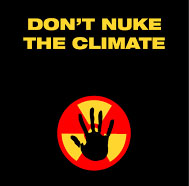
In October 2019, a conference was held by “Don’t Nuke the Climate” and GLOBAL 2000 against nuclear energy as a supposed climate savior.
Recently, the nuclear lobby has been trying to present itself as the “green” technology that can produce electricity for the energy transition in a “CO2-free and reliable” manner, thereby enabling the exit from dirty energy sources such as oil and coal. Entire conferences on “Atoms4Climate” are organized with this in mind. At the climate conferences, the nuclear lobby acts aggressively and advertises subsidies – only through subsidies can nuclear power be expanded and kept running.
It has long been clear that nuclear power cannot be part of the urgently needed climate protection measures. On the contrary. According to the independent scientists, tackling the climate crisis is about saving CO2 as quickly – and as cost-effectively – as possible.
Nuclear power cannot make a contribution here – it is the most expensive technology – and is far too complex and slow to build to be able to make any contribution at all in the period of the next ten years that is relevant to the climate crisis. The construction time alone of the few reactors that went into operation in recent years took more than 10 yearsexternal link, opens in a new tab, plus there were planning and approval times of another decade.
Even the basic argument of “CO2-free” nuclear power plants is untenable – nuclear power is not a climate saver: The uranium mining chain and the construction and operation of nuclear power plants cause far more greenhouse gas emissions than renewable energies, depending on the uranium content The ore releases between 88 and 146 grams of CO2 per kilowatt hour.
The conference
The international conference “Climate Crisis – Why nuclear is not helping”, organized by “Don’t Nuke the Climate” and GLOBAL 2000, took place in October 2019 at the same time as the first IAEA Nuclear Climate Conference. Over two days, facts and figures about nuclear energy were presented and strategies were discussed to keep outdated technology out of the fight against the climate crisis. Key questions were:
- Are the pro-nuclear energy arguments correct or influenced by outside sources?
- And can new technologies such as “Small Modular Reactors” improve the situation or are they uneconomical and not yet developed far enough?
The questions were developed in lectures and workshops and discussed in lively exchanges. The documents for reading the conference can be found below. The event was held in English, which is why most of the documents were written in English. You can download the program for reading here . The slides for the presentations (mostly in English) can be found here . We have collected photos of the event and a protest in front of the IAEA at the start here .
………………………………………………………………………………………………………………………… The international conference organized by “Don’t Nuke the Climate” and GLOBAL 2000 that took place at the same time as IAEA’s very first climate conference in Vienna in October 2019 has examined the hard evidence-base, the facts and figures – in order to prepare strategies to keep fresh money for the outdated technology that is nuclear. Key questions included: Whether those forecasts which support new nuclear are accurate – or are they unfairly biased? And whether any novel nuclear technology, such as Small Modular Reactors, are viable – or are they uneconomic and very far from deployment?
The program of the conference can be found here . All slides from the presentations are here , and pictures from the conference and the protest beforehand are collected here .
Role of nuclear and climate goals in IEA, IAEA, IPCC scenarios
Critical look at forecasts – Overestimated for nuclear and underestimated for renewables? Nuclear generation increases, on average by around 2.5 times by 2050 in the 89 mitigation scenarios considered by the IPCC. What the IPCC report also says about nuclear (leukemia, proliferation)
Speaker: Georg Günsberg, Strategy Consultant Climate and Energy Politics, Vienna
Presentation Major Energy Scenarios
Can we afford nuclear power to save us from global warming?
Speaker: Steve Thomas, University of Greenwich, UK
Presentation Cost Of Nuclear Power
Small Modular Reactors (SMRs): Findings from a key report by Paul Dorfman, MV Ramana and Sean Morris
Speaker: Paul Dorfman, The Energy Institute, University College London
Presentation of Small Modular Reactors
Operating a very old fleet of nuclear power plants
Is it the most realistic scenario? Can aging plants contribute to energy security and which additional risks will arise due to climate change phenomena?
Speaker: Oda Becker, Independent technical consultant, Hanover
Presentation of old nuclear plants
Propaganda versus reality of new generation of reactors (GEN IV)
Speaker: Christoph Pistner, Nuclear Engineering & Facility Safety, Ökologieinstitut Darmstadt
Presenting Reality New Reactors
Exclusive Presentation of the WNSIR 2019 by Mycle Schneider and the author of the special chapter on Nuclear Power and Climate Change by Amory Lovins RMI
For nuclear to be considered a viable option in managing the decline of the fossil fuel economy, new reactors must be economically viable and built on-time – however, practical experience demonstrates that nuclear is hugely expensive and very much behind schedule. Nuclear costs and risks mean that plants can only be built with vast state aid (public subsidies), including loan guarantees and long-term power purchase agreements.
Speaker: Mycle Schneider and Amory Lovins – via video conferencing with Q&A
Presentation Nuclear Power and Climate Change
Nuclear power powers the bomb
Speaker: Angelika Claußen, IPPNW president for Europe, Germany
Presentation Nuclear Powers Bombs
Nuclearization of Africa and the role of IAEA
Speaker: Makoma Lekalakala, Earthlife South Africa
Presenting Human Rights Issues
Billions for EURATOM (in German)
Speaker: Christoph Rasch
First results of working paper on climate crisis and NPP
Energiaklub Presentation of the first results about NPP safety and operation under climate crisis condition.
Speaker: Eszter Mátyás, CEU PhD
Presentation Climate and Paks NPP
Presentation Nuclear and Safety
The European Nuclear Power Risk Study 2019
Doctors study analyzes accident consequences based on real weather situations (France, Swiss NPP) and shows the high risks arising from severe nuclear accidents also for neighboring countries.
Speaker: Claudio Knüsli, IPPNW
The conference & workshop day were organized by the Don’t Nuke the Climate network of anti-nuclear organizations and networks from all over the globe, that work together to keep nuclear out of the climate agreements and the Paris agreement: The conference
was organized by Don’t Nuke the Climate Network of anti-nuclear organizations and networks from around the world working together to keep nuclear energy out of the climate agreements and the Paris Agreement:
…………………………………………………….. www.dont-nuke-the-climate.org/about-us https://www.global2000.at/news/nachlese-konferenz-climate-crisis-why-nuclear-not-helping
European Union now promoting the lie that nuclear power is “green”

Nuclear power officially labelled as ‘strategic’ for EU’s decarbonisation, By Paul Messad | EURACTIV.fr | translated by Anne-Sophie Gayet, 7 Feb 24
The Council of EU member states and the European Parliament agreed on Tuesday (6 February) to label nuclear power as a strategic technology for the EU’s decarbonisation, following months of intense negotiations in Brussels over the Net-Zero Industry Act (NZIA).
…………….. The agreement encompasses tried and tested nuclear technologies as well as future third and fourth generation ones, i.e. small modular reactors (SMRs) and advanced nuclear reactors (AMRs). Their fuel cycles are also included in the text.
“The message is clear: the EU recognises that we need nuclear power to achieve the objectives of the Green Deal,” the French MEP told Euractiv. https://www.euractiv.com/section/energy-environment/news/nuclear-power-officially-labelled-as-strategic-for-eus-decarbonisation/
Nuclear expert Mycle Schneider on the COP28 pledge to triple nuclear energy production: ‘Trumpism enters energy policy’.

The entire logic that has been built up for small modular reactors is with the background of climate change emergency. That’s the big problem we have………………… Climate change emergency contains the notion of urgency. And so we are talking about something where the time factor needs to kick in………………….. And if we are talking about SMRs picking up any kind of substantial amounts of generating capacity in the current market, if ever, we’re talking about the 2040s at the very earliest.
Now, we’re talking of tens of $billions that are going into subsidizing nuclear energy, especially as I said existing nuclear power plants.
The pledge was worded as a commitment “to work together to advance a global aspirational goal of tripling nuclear energy capacity from 2020 by 2050″………… “This pledge is completely, utterly unrealistic.”…………………….“It’s like Trumpism enters energy policy.”

The Bulletin, By François Diaz-Maurin | December 18, 2023
Last week, a group of independent energy consultants and analysts released the much-anticipated 2023 edition of the World Nuclear Industry Status Report 2023 (WNISR). In over 500 pages, the report provides a detailed assessment of the status and trends of the international nuclear industry, covering more than 40 countries. Now in its 18th edition, the report is known for its fact-based approach providing details on operation, construction, and decommissioning of the world’s nuclear reactors. Although it regularly points out failings of the nuclear industry, it has become a landmark study, widely read within the industry. Its release last week was covered by major energy and business news media, including Reuters (twice) and Bloomberg.
On December 2, the United States and 21 other countries pledged to triple the global nuclear energy capacity by 2050. The declaration, made during the UN climate summit of the 28th Conference of the Parties (COP28) in Dubai, United Arab Emirates, sought to recognize “the key role of nuclear energy in achieving global net-zero greenhouse gas emissions-carbon neutrality by or around mid-century and in keeping a 1.5-degree Celsius limit on temperature rise within reach.” The pledge was worded as a commitment “to work together to advance a global aspirational goal of tripling nuclear energy capacity from 2020 by 2050.” It was aspirational—and ambitious.
To discuss this pledge against the nuclear industry’s current trends and status, I sat down with Mycle Schneider, lead author of the World Nuclear Industry Status Report.
………… Diaz-Maurin: It’s undoubtedly a landmark report. With over 500 pages, it’s also massive. In a nutshell, what should our readers know about the main developments in the world nuclear industry over the past year?
Schneider: It really depends on from which angle you approach the issue. I think, overall, the mind-boggling fact is that the statistical outcome of this analysis is dramatically different from the perception that you can get when you open the newspapers or any kind of media reporting on nuclear power. Everybody gets the impression that this is kind of a blooming industry and people get the idea that there are nuclear power plants popping up all over the world.
But what we’ve seen is that some of the key indicators are showing a dramatic decline. In fact, the share of nuclear power in the world commercial electricity mix has been dropping by almost half since the middle of the 1990s. And the drop in 2022 was by 0.6 percentage points, which is the largest drop in a decade, since the post-Fukushima year 2012.
We have seen a four percent drop in electricity generation by nuclear power in 2022, which, if you take into account that China increased by three percent and if you look at the world, means that the drop was five percent outside China. So it’s significantly different from the perception you can get, and we can dig into some of the additional indicators. For example, constructions [of new reactors] give you an idea what the trends are and what the dynamic is in the industry. And so, when you look at constructions you realize that, since the construction start of Hinkley Point C in the United Kingdom in late 2019 until the middle of 2023, there were 28 construction starts of nuclear reactors in the world. Of these, 17 were in China and all 11 others were carried out by the Russian nuclear industry in various countries. There was no other construction start worldwide.
………………………………………………………………………………..The point is that we have had actually an increasing capacity that generates less. And, for obvious reasons, the most dramatic drop was in France. The French reactor performance has been in decline since 2015. That is, to me, one of the really remarkable outcomes in recent years. If you compare the year 2010 to 2022, in France, the drop [in electricity generated] was 129 terawatt hours. What happened is basically that, from 2015 onward, the trend line was toward a reducing electricity generation due to an accumulation of events, which are important to understand.
It’s not so much the stress corrosion cracking [in reactor vessels] that everybody has been talking about or another technical phenomenon that hit the French nuclear power plants worst, although it’s true it had a significant impact and was totally unexpected. So, it’s not an aging effect, although you do have aging effects on top of it because a lot of reactors are reaching 40 years and need to pass inspections and require refurbishment, etc. But you had climate effects in France too. And strikes also hit nuclear power plants. You don’t have that in other countries. So, it’s the accumulation of effects that explain the decline in electricity generation. This unplanned and chaotic drop in nuclear power generation in France compares with the loss of nuclear generation in Germany of 106 terawatt hours between 2010 and 2022, but in this case due to a planned and coordinated nuclear phaseout.
Diaz-Maurin: That is an interesting way to look at the data. What is the biggest risk of keeping existing reactors operating up to 80 years, as some suggest, or even more?
Schneider: Well, nobody knows. This has never been done. It’s like: “What’s the risk of keeping a car on the street for 50 years?” I don’t know. It’s not the way you do things, usually. First, I should say that we’re not looking at risk in that Status Report. This is not the subject of the report. But the lifetime extension of reactors raises the questions of nuclear safety—and security, which has always been a topic for the Bulletin.
If you have a reactor that has been designed in the 1970s, at the time nobody was talking or even thinking about drones or hacking, for example. People think of drones in general as a means to attack a nuclear power plant by X Y, Z. But in fact, what we’ve seen in the past are numerous drone flights over nuclear facilities. And so, there is the danger of sucking up information during those overflights. This raises security risks in another way. So, this idea of modernizing nuclear facilities continuously is obviously only possible to some degree. You can replace everything in a car, except for the body of the car. At some point, it’s not the same facility anymore. But you can’t do that with a nuclear power plant.
Diaz-Maurin: Talking about old facilities, Holtec International—the US-based company that specializes in nuclear waste management—say they want to restart the shutdown Palisades generating station in Michigan. Is it good news?
Schneider: To my knowledge, the only time that a closed nuclear power plant has been restarted was in Armenia, after the two units had been closed [in 1989] after a massive earthquake. We don’t have precise knowledge of the conditions of that restart, so I’m not so sure that this would be a good reference case. One has to understand that when a nuclear reactor is closed, it’s for some reason. It is not closed because [the utility] doesn’t like to do this anymore. In general, the most prominent reason [for closing reactors] over the past few years was poor economics.
This is, by the way, one of the key issues we’ve been looking at in the 2023 report: These entirely new massive subsidy programs in the US in particular didn’t exist [a year ago]. There were some limited programs on state level. Now these state support programs have been increased significantly and they are coupled in with federal programs, because the reactors are not competitive. So we’re talking really about a mechanism to keep these reactors online. That Palisades would restart is unique, in Western countries at least. For a plant that has been set to be decommissioned to restart, this has never been done. And, by the way, Holtec is not a nuclear operator. It is a firm that has specialized in nuclear decommissioning.
Now, that companies like Holtec can actually buy closed nuclear power plants and access their decommissioning funds with the promise to dismantle faster than would have been done otherwise, this is an entirely recent approach with absolutely no guarantee that it works. Under this scheme, there is no precedent where this has been done from A to Z. And obviously, there is the risk of financial default. For instance, it is unclear what happens if Holtec exhausts the funds before the decommissioning work is complete. Holtec’s level of liability is unclear to me prior to the taxpayer picking up the bill.
Diaz-Maurin: At Palisades, Holtec’s plan is to build two small modular reactors.
Schneider: Holtec is not a company that has any experience in operating—even less constructing—a nuclear power plant. So having no experience is not a good sign to begin with. Now, when it comes to SMRs—I call them “small miraculous reactors”—they are not existing in the Western world. One must be very clear about that. There are, worldwide, four [SMR] units that are in operation: two in China and two in Russia. And the actual construction history [for these reactors] is exactly the opposite to what was promised. The idea of small modular reactors was essentially to say: “We can build those fast. They are easy to build. They are cheap. It’s a modular production. They will be basically built in a factory and then assembled on site like Lego bricks.” That was the promise.
For the Russian project, the plant was planned for 3.7 years of construction. The reality was 12.7 years. In China, it took 10 years instead of five. And it’s not even only about delays. If you look at the load factors that were published by the Russian industry on the Power Reactor Information System (PRIS) of the IAEA, these SMRs have ridiculously low load factors, and we don’t understand the reasons why they don’t produce much. We know nothing about the Chinese operational record.
Diaz-Maurin: Last month, NuScale, the US-based company that develops America’s flagship SMR, lost its only customer, the Utah Associated Municipal Power System, a conglomerate of municipalities and utilities. This happened allegedly after a financial advisory firm reported on NuScale’s problems of financial viability. Have you followed this demise?
Schneider: Yes, of course. What happened there is that NuScale had promised in 2008 that it would start generating power by 2015. We are now in 2023 and they haven’t started construction of a single reactor. They have not even actually a certification license for the model that they’ve been promoting in the Utah municipal conglomerate. That’s because they have increased [the capacity of each module] from originally 40 megawatts to 77 megawatts.
Diaz-Maurin: Why is that? Is it a matter of economy of scale?
Schneider: Yes, of course. You need to build many modules if you want to get into economies of scale by number, if you don’t get into it by size. This is actually the entire history of nuclear power. So NuScale sought to increase the unit size in Utah. But then the deal with the municipalities collapsed after the new cost assessment in early 2023 showed that the six-module facility NuScale had planned would cost $9.3 billion, a huge increase over earlier estimates. It’s about $20,000 per kilowatt installed—almost twice as expensive as the most expensive [large-scale] EPR reactors in Europe.
Diaz-Maurin: Is it the same with the waste generated? Some analysts looking at the waste streams of SMRs conclude that smaller reactors will produce more radioactive materials per unit of kilowatt hour generated compared to larger reactors.
Schneider: That’s the MacFarlane and colleagues’ paper, which is pretty logical if you think about it. If you have a small quantity of nuclear material that irradiates other materials, then it’s proportionally more per installed megawatt than for a large reactor in which there is a larger core.
,………………Schneider: many technologies have been supported under the Inflation Reduction Act and many others will continue to receive significant support. But the problem here is different. The entire logic that has been built up for small modular reactors is with the background of climate change emergency. That’s the big problem we have.
Diaz-Maurin: Can you explain this?
Schneider: Climate change emergency contains the notion of urgency. And so we are talking about something where the time factor needs to kick in. If we look at how other reactor technologies have been introduced, a lot of them were supported by government funding, like the EPR in Europe or Westinghouse’s AP-1000 in the United States. Comparatively, the current status of SMR development—whether it’s NuScale, which is the most advanced, or others—corresponds to that of the middle of the 1990s [of the large light-water reactors]. The first EPR started electricity generation in 2022 and commercial operation only in 2023. And it’s the same with the AP-1000. By the way, both reactor types are not operating smoothly; they are still having some issues. So, considering the status of development, we’re not going to see any SMR generating power before the 2030s. It’s very clear: none. And if we are talking about SMRs picking up any kind of substantial amounts of generating capacity in the current market, if ever, we’re talking about the 2040s at the very earliest.
Diaz-Maurin: And that’s exactly where I want to turn the discussion now: nuclear and climate. At the COP28 last week in Dubai, 22 countries pledged to triple the global nuclear energy capacity of 2020 by 2050. What do these countries have in common when it comes to nuclear energy? In other words, why these 22 countries and not others?
Schneider: Most of them are countries that are already operating nuclear power plants and have their own interest in trying to drag money support, most of which by the way would go into their current fleets. Take EDF [France’s state-owned utility company], for example. Through the French government, EDF is lobbying like mad to get support from the European Union—European taxpayers’ money—for its current fleet. It’s not even for new construction, because the French know that they won’t do much until 2040 anyway. There is also another aspect that is related and that illustrates how this pledge is completely, utterly unrealistic.
The pledge to triple nuclear energy capacity is not to be discussed first in terms of pros or cons, but from the point of view of feasibility. And from this point of view, just looking at the numbers, it’s impossible. We are talking about a target date of 2050, which is 27 years from now. In terms of nuclear development, that’s tomorrow morning. If we look at what happened in the industry over the past 20 years since 2003, there have been 103 new nuclear reactors starting operation. But there have been also 110 that closed operation up until mid 2023. Overall, it’s a slightly negative balance. It’s not even positive. Now if you consider the fact that 50 of those new reactors that were connected to the grid were in China alone and that China closed none, the world outside China experienced a negative balance of 57 reactors over the past 20 years.
………………………………………….Now, if we look forward 27 years, if all the reactors that have lifetime extension licenses (or have other schemes that define longer operation) were to operate until the end of their license, 270 reactors will still be closed by 2050. This is very unlikely anyway because, empirically, reactors close much earlier: The average closing age over the past five years is approximately 43 years, and hardly any reactor reached the end of its license period. But even if they did, it would be 270 reactors closed in 27 years.
You don’t have to do math studies to know that it’s 10 per year. At some point it’s over. Just to replace those closing reactors, you’d have to start building, operating, grid connecting 10 reactors per year, starting next year. In the past two decades, the construction rate has been of five per year on average. So, you would need to double that construction rate only to maintain the status quo. Now, tripling again that rate, excuse me, there is just no sign there. I am not forecasting the future, but what the industry has been demonstrating yesterday and what is it is demonstrating today shows that it’s simply impossible, from an industrial point of view, to put this pledge into reality. To me, this pledge is very close to absurd, compared to what the industry has shown.
Diaz-Maurin: Based on your report, just to replace the closures, the nuclear industry would need to build and start operating one new reactor of an average size of 700-megawatt per month. And tripling the global capacity would require an additional 2.5 new reactors per month.
Schneider: Exactly; it’s a little less if you talk in terms of capacity. The capacity to be replaced by 2050 of those 270 units would be 230 gigawatts. Now, if small modular reactors were to be a significant contributor to this pledge, hundreds or even thousands of these things would need to be built to come anywhere near that objective. It’s impossible. We should come back to reality and discuss what’s actually feasible. Only then can we discuss what would be the pros and cons of a pledge.
But there was another pledge at the COP28, which is to triple the output of renewable energies by 2030. That’s seven years from now. To me, this pledge on renewable energy, if implemented, is the final nail in the coffin of the pledge on nuclear energy. It is very ambitious. Don’t underestimate that. Tripling renewables in seven years is phenomenally ambitious.
Diaz-Maurin: Is it feasible?
Schneider: Very difficult to say. But one important thing is that it’s not 22 countries. It’s over 100 countries that have already pledged their commitment to this objective. Also, a key player—if not the key player—is China. An important finding of our Status Report is that China generated for the first time in 2022 more power with solar energy than with nuclear energy. And this happened despite China being the only country to have been building [nuclear capacity] massively over the past 20 years. But still, the country is now generating more power with solar than with nuclear. The good news for the [renewable] pledge is that China is more or less on track with that tripling target. The rest of the world would have to speed up on renewables in a dramatic way to achieve this pledge. But at least China’s example shows that it’s feasible. That’s the interesting part. Because, on the contrary, there is no country—not even China—demonstrating that the nuclear pledge is possible.
Diaz-Maurin: If it’s not feasible, does the nuclear pledge impede other climate actions that are urgently needed then?
Schneider: That’s a good question. I think it’s a terrible signal, indeed. It’s like Trumpism enters energy policy: It’s a pledge that has nothing to do with reality, and it doesn’t matter. It is giving you the impression that it is feasible, that it is possible. And all that completely dilutes the attention and capital that are urgently needed to put schemes into place that work. And it doesn’t start with renewables, that’s very important to stress. It starts with sufficiency, efficiency, storage, and demand response. Only later comes renewable energy.
But these options are all on the table. They’re all demonstrated to be economic and competitive. That’s not the case with nuclear energy. It’s a pledge that has no realistic foundation that is taking away significant funding and focus. It used to be negligible funding. Up until a few years back, we were talking at most tens of millions of dollars. Now, we’re talking of tens of billions that are going into subsidizing nuclear energy, especially as I said existing nuclear power plants………………………………………………………………………………………………………………………………..
Schneider: What really has motivated most of my work over the past decades is that I can’t stand what you would call today “fake news.” All my work since the 1980s has been actually driven by the attempt to increase the level of information in—and having some kind of impact on—the decision-making process. To offer a service to civil society so it can take decisions based on facts, not beliefs. When I see what happens in terms of misinformation around nuclear power, it’s scary.
I think, today, the Status Report is probably more important than ever. Because there’s such an unbelievable amount of hype out there. It’s almost becoming an issue for psychologists. It has less and less to do with rationality because the numbers are clear. They are utterly clear: The cost figures are clear; the development is clear; the trend analysis is clear. So it is clear, but it doesn’t matter. It’s like the claim of stolen elections of Trump supporters. All court cases have shown that this was not the case. But, for half of the US population, it doesn’t matter. And I find this absolutely scary. When it comes to issues like nuclear power, it’s fundamental that decisions are made on the basis of facts.
Diaz-Maurin: Why is that?
Schneider: Because the stakes are incredibly high. First because of the capital involved. Researchers studying corruption cases know that the size of large projects’ contracts is a key driver for corruption. And the nuclear industry has been struggling with all kinds of mechanisms that are fraud yields. Financial corruption is only one issue.
Another is falsification. For a long time, we thought Japan Steel Works [JSW] was the absolute exemplary industry. Japanese factories used to build high quality and highly reliable key forged parts for nuclear power plants. It turns out, they have been falsifying quality-control documentation in hundreds of cases for decades. Corruption and falsification are two of the issues affecting the nuclear industry.
And, of course, the Bulletin has had a long focus on military issues related to nuclear energy. When we are talking about issues like SMRs, the key issue is not whether they are going to be safer or not, because there are not going to be many around anyway. So, safety is not the primary issue. But once you start signing cooperation agreements, it opens the valves to the proliferation of nuclear knowledge. And that is a big problem, because this knowledge can always be used in two ways: One is military for nuclear explosives, and the other is civilian for nuclear electricity and medical applications. Opening these valves on the basis of hype or false promise is a disaster. And the ones most actively opening these valves are the Russians. They are educating thousands of people from all around the world in nuclear materials and nuclear technology. In the United States, part of the thinking appears to say: “Oh, for God’s sake, better we train these people.” https://thebulletin.org/2023/12/nuclear-expert-mycle-schneider-on-the-cop28-pledge-to-triple-nuclear-energy-production-trumpism-enters-energy-policy/?utm_source=Newsletter&utm_medium=Email&utm_campaign=MondayNewsletter12182023&utm_content=NuclearRisk_TripleNuclear_11182023
Greta Thunberg was given ‘final warning’ before London arrest
Activist says ‘history’s judgment will not be gentle’ for those behind climate crisis after day in court on public order charges
Telegraph Reporters1 February 2024 •
Greta Thunberg was given a “final warning” before her arrest in London
during a climate demonstration last year, a court has heard. The
21-year-old from Sweden was arrested near the InterContinental Hotel in
Mayfair on Oct 17 last year as oil executives met inside for the Energy
Intelligence Forum. Thunberg, two Fossil Free London protesters and two
Greenpeace activists appeared at Westminster Magistrates’ Court on
Thursday for their trial after each pleading not guilty in November to
breaching Section 14 of the Public Order Act 1986. The court heard that
protesters started to gather near the hotel at around 7.30am and police
engaged with them about improving access for members of the public, which
had been made “impossible”.
Telegraph 1st Feb 2024
https://www.telegraph.co.uk/news/2024/02/01/greta-thunberg-given-final-warning-before-london-arrest
Small modular reactors may have climate benefits, but they can also be climate-vulnerable.
Sipri, 26 January 2024, Vitaly Fedchenko
“……………………………… large nuclear power plants have almost exclusively been built in industrialized countries.
More recently, a new class of small modular reactors (SMRs) for power generation have been gaining in popularity and are supposedly better suited for use in developing countries. SMRs hold the promise of driving progress towards universal access to modern energy sources and several other Sustainable Development Goals in a climate-friendly way. However, while they may not have a negative impact on future climate change, SMRs are not immune to the direct and indirect impacts of an already changing climate.
………………………….. dozens of states have expressed interest in building an SMR of some kind. According to data from the OECD’s Nuclear Energy Agency and the World Nuclear Association, at least 40 states are taking steps towards building an SMR on their territories.
The IAEA has counted at least 80 SMR designs. Most are intended to produce electricity for 60 years or more. With the time allowed for construction, decommissioning and potential extensions of operating life, it is conceivable that the lifetimes of future SMRs may approach 100 years or more.
The other side of the coin: SMRs and climate risks
A century is a long time. At any given location, political and societal changes are inevitable, many impossible to predict. …………………………………
Climate change and its direct and indirect effects, including on politics and security, also pose risks for nuclear power plants and other critical infrastructure. Direct effects include rapid-onset extreme weather events (such as storms and storm surges, heatwaves and flash floods) as well as slower-onset phenomena (such as sea-level rise, water scarcity, changes to rainfall or average temperatures). All of this can undermine the safe and secure functioning of nuclear facilities. For instance, drought—especially compounded by competing demands for water—could disrupt the cooling water supply to a reactor, potentially necessitating a shutdown, while floods or storms could damage critical systems.
A 2021 analysis of nuclear power plants’ vulnerability to such climate-linked effects is full of important insights. The study shows that the average frequency of climate-linked power outages at nuclear power plants globally has dramatically increased—from 0.2 outages per reactor-year in the 1990s to about 0.82 in 2000s, to 1.5 in 2010–19. It projects that energy losses due to climate change will continue to rise among the world’s nuclear power plants.
That study’s findings for the period 2010–19 suggest that, after hurricanes and typhoons (in the United States, South and South East Asia), the second largest climate-linked contributor to outages was increased ambient temperatures. Higher ambient temperatures can affect nuclear power plants in a variety of ways. For example, warmer temperatures can foster the rapid growth of algae or other biological material, which can in turn clog cooling water intakes, reducing production and even requiring the plant to shut down, particularly in warmer areas or reactors using seawater for cooling. High ambient temperatures can also make power generation less efficient. Many of the developing countries where electricity access is currently lowest (and thus where SMRs might have the greatest value in promoting development) already have relatively high ambient temperatures, which are likely to increase further.
… some of the states that have already announced interest in building SMRs are in areas highly exposed to the physical effects of climate change, including lower-middle income countries. Although the accident at the Fukushima Daiichi nuclear power plant in 2011 was caused by a natural disaster unrelated to climate change, it demonstrated that even in a wealthy, industrialized country like Japan, nuclear facilities can be vulnerable to extreme natural events.
Shock Horror! They’re letting some WOMEN into the Cop29 climate summit committee

Women added to Cop29 climate summit committee after backlash. Panel was
originally composed of 28 men, a move condemned as ‘regressive’ and
‘shocking’. The president of Azerbaijan has added 12 women to the
previously all-male organising committee for the Cop29 global climate
summit, which the country will host in December.
Guardian 19th Jan 2024
https://www.theguardian.com/environment/2024/jan/19/women-cop29-climate-summit-committee-backlash
A new ‘Cold War’ on a deadly hot planet?
China and the US must cut war-like posturing and face a world in desperate danger
By Tom Engelhardt, Tom Dispatch/Common Dreams
Tell me, what planet are we actually on? All these decades later, are we really involved in a “second” or “new” Cold War? It’s certainly true that, as late as the 1980s, the superpowers (or so they then liked to think of themselves), the United States and the Soviet Union, were still engaged in just such a Cold War, something that might have seemed almost positive at the time. After all, a “hot” one could have involved the use of the planet’s two great nuclear arsenals and the potential obliteration of just about everything.
But today? In case you haven’t noticed, the phrase “new Cold War” or “second Cold War” has indeed crept into our media vocabulary. (Check it out at Wikipedia.) Admittedly, unlike John F. Kennedy, Joe Biden has not actually spoken about bearing “the burden of a long, twilight struggle.” Still, the actions of his foreign policy crew — in spirit, like the president, distinctly old Cold Warriors — have helped make the very idea that we’re in a new version of just such a conflict part of everyday media chatter.
And yet, let’s stop and think about just what planet we’re actually on. In the wake of August 6 and August 9, 1945, when two atomic bombs destroyed the Japanese cities of Hiroshima and Nagasaki, there was little doubt about how “hot” a war between future nuclear-armed powers might get. And today, of course, we know that, if such a word can even be used in this context, a relatively modest nuclear conflict between, say, India and Pakistan might actually obliterate billions of us, in part by creating a — yes, brrr — “nuclear winter,” that would give the very phrase “cold” war a distinctly new meaning.
These days, despite an all too “hot” war in Ukraine in which the U.S. has, at least indirectly, faced off against the crew that replaced those Soviet cold warriors of yore, the new Cold War references are largely aimed at this country’s increasingly tense, ever more militarized relationship with China. Its focus is both the island of Taiwan and much of the rest of Asia. Worse yet, both countries seem driven to intensify that struggle.
In case you hadn’t noticed, Joe Biden made a symbolic and much-publicized stop in Vietnam (yes, Vietnam!) while returning from the September G20 summit meeting in India. There, he insisted that he didn’t “want to contain China” or halt its rise. He also demanded that it play by “the rules of the game” (and you know just whose rules and game that was). In the process, he functionally publicized his administration’s ongoing attempt to create an anti-China coalition extending from Japan and South Korea (only recently absorbed into a far deeper military relationship with this country), all the way to, yes, India itself.
And (yes, as well!) the Biden administration has upped military aid to Japan, Taiwan (including $85 million previously meant for Egypt), Australia (including a promise to supply it with its own nuclear attack submarines), and beyond. In the process, it’s also been reinforcing the American military position in the Pacific from Okinawa, Guam, and the Philippines to — yes again — Australia. Meanwhile, one four-star American general has even quite publicly predicted that a war between the U.S. and China is likely to break out by 2025, while urging his commanders to prepare for “the China fight”! Similarly, Director of National Intelligence Avril Haines has called China the “leading and most consequential threat to U.S. national security” and the Biden foreign policy team has been hard at work encircling — the Cold War phrase would have been “containing” — China, both diplomatically and militarily.
On the Chinese side, that country’s military has been similarly ramping up its air and naval activities around and ever closer to the island of Taiwan in an ominous fashion, even as it increases its military presence in places like the South China Sea (as has the U.S.). Oh, and just in case you hadn’t noticed, with a helping hand from Russia, Beijing is also putting more money and effort into expanding its already sizable nuclear arsenal.
Yes, this latest version of a Cold War is (to my mind at least) already a little too hot to handle. And yet, despite that reality, it couldn’t be more inappropriate to use the term “new Cold War” right now on a globe where a previously unimagined version of a hot war is staring us all, including most distinctly the United States and China, in the face.
As a start, keep in mind that the two great powers facing off so ominously against each other have long faced off no less ominously against the planet itself. After all, the United States remains the historically greatest greenhouse gas emitter of all time, while China is the greatest of the present moment (with the U.S. still in second place and Americans individually responsible for significantly more emissions than their Chinese counterparts). The results have been telling in both countries…………………………………………………………… more https://beyondnuclearinternational.org/2024/01/21/a-new-cold-war-on-a-deadly-hot-planet/
The Greenland ice cap is losing an average of 30m tonnes of ice an hour due to the climate crisis.

The Greenland ice cap is losing an average of 30m tonnes of ice an hour
due to the climate crisis, a study has revealed, which is 20% more than was
previously thought. Some scientists are concerned that this additional
source of freshwater pouring into the north Atlantic might mean a collapse
of the ocean currents called the Atlantic meridional overturning
circulation (Amoc) is closer to being triggered, with severe consequences
for humanity. Major ice loss from Greenland as a result of global heating
has been recorded for decades. The techniques employed to date, such as
measuring the height of the ice sheet or its weight via gravity data, are
good at determining the losses that end up in the ocean and drive up sea
level. However, they cannot account for the retreat of glaciers that
already lie mostly below sea level in the narrow fjords around the island.
In the study, satellite photos were analysed by scientists to determine the
end position of Greenland’s many glaciers every month from 1985 to 2022.
This showed large and widespread shortening and in total amounted to a
trillion tonnes of lost ice.
Guardian 17th Jan 2024
A new wave of climate denialism is on the rise
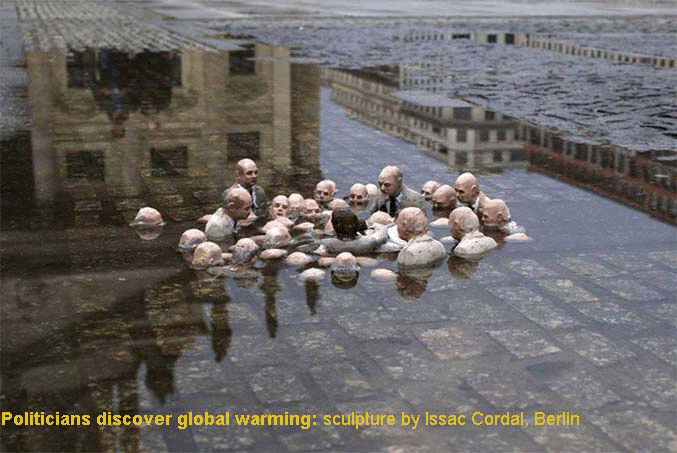
A new wave of denial about climate change is on the rise even as there is
greater acknowledgment of human-caused global warming, a study of more than
12,000 videos by a disinformation campaign group warns. The “new
denial” seeks to undermine confidence in green energy solutions, as well
as climate science and scientists, the research led by a group of academics
and the Center for Countering Digital Hate shows.
These forms of denial made up 70 per cent of falsehoods related to climate change in videos published on sites such as YouTube and X over a six-year period, said the
report, which was published on Tuesday. Videos that were identified as
containing climate denial claims received more than 325mn views in total,
based on research that used artificial intelligence tools to sort and
classify the assertions in content uploaded from 2018 to 2023.
The academics led by Travis Coan from the UK’s Exeter university found older
forms of denial about climate change had fallen to one-third of the
disinformation. Fewer instances highlighting cold weather or a coming ice
age were found, for example, as meteorological evidence of global warming
increased.
Instead, the majority of claims focused on three new main
categories: that the consequences of global warming were either harmless or
even beneficial; that climate science was unreliable; and that climate
solutions offered would not work — the most predominant theme. Examples
of this included that electric vehicles produce three times as much toxic
pollution as internal combustion engines when mining of the rare earth
materials involved in making the vehicle are taken into account. In fact,
the US Environmental Protection Authority and many scientists are clear
that over an EV’s lifetime the total greenhouse gas emissions are
typically lower even when accounting for manufacturing.
FT 16th Jan 2024
https://www.ft.com/content/aa369295-1805-414c-af99-3c7596df0847
Climate misinformation is mutating on YouTube – and the platform is
profiting. Researchers analysed thousands of hours of YouTube content from
the past six years and found that ‘old’ climate change denial is giving
way to a new type of misleading content intended to muddy the waters.
Independent 16th Jan 2024
State of the Climate: 2023 smashes records for surface temperature and ocean heat

Last year was the warmest since records began in the mid-1800s – and
likely for many thousands of years before. It was the first year in which
average global temperatures at the surface exceeded 1.5C above
pre-industrial levels in at least one global temperature dataset. Here,
Carbon Brief examines the latest data across the oceans, atmosphere,
cryosphere and surface temperature of the planet.
Carbon Brief 12th Jan 2024
Human ‘behavioural crisis’ at root of climate breakdown, say scientists

New paper claims unless demand for resources is reduced, many other innovations are just a sticking plaster
Record heat, record emissions, record fossil fuel consumption. One month
out from Cop28, the world is further than ever from reaching its collective
climate goals.
At the root of all these problems, according to recent
research, is the human “behavioural crisis”, a term coined by an
interdisciplinary team of scientists. “We’ve socially engineered
ourselves the way we geoengineered the planet,” says Joseph Merz, lead
author of a new paper which proposes that climate breakdown is a symptom of
ecological overshoot, which in turn is caused by the deliberate
exploitation of human behaviour.
“We need to become mindful of the way
we’re being manipulated,” says Merz, who is co-founder of the Merz
Institute, an organisation that researches the systemic causes of the
climate crisis and how to tackle them. Merz and colleagues believe that
most climate “solutions” proposed so far only tackle symptoms rather
than the root cause of the crisis. This, they say, leads to increasing
levels of the three “levers” of overshoot: consumption, waste and
population.
Guardian 13th Jan 2024
“The defense of nuclear power as a low-carbon energy weakens the European Union’s action against climate change”
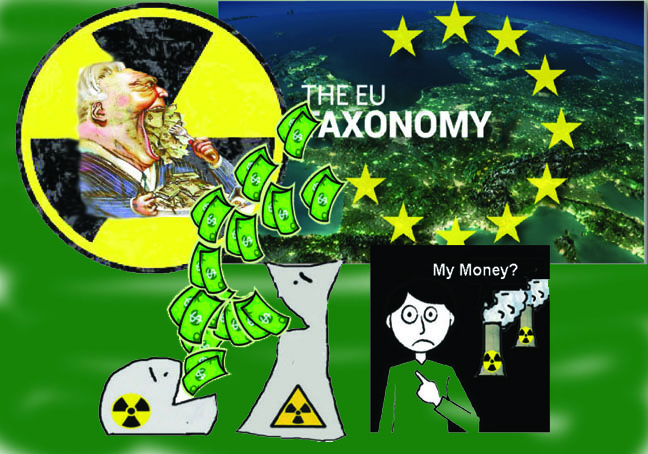
“The defense of nuclear power as a low-carbon energy weakens the
European Union’s action against climate change”.
The Renewable Energies for All association denounces, in a column in “Le Monde”, the
deleterious effects of the inclusion of nuclear power in the French and
European objectives for the deployment of renewable solutions.
Seeking to relaunch nuclear power whatever the cost, France is not only missing a
historic opportunity for a rapid and less costly transition to renewable
energies and decarbonization.
It weakens the climate ambition of theEuropean Union (EU). The reintegration of current nuclear production in Europe – 6% of its final energy – into the objective of 42.5% renewable
energies set by the RED III directive [Renewable Energy Directive III]
would create an accounting artifice and lead to vagueness strategic in a
field which nevertheless needs a long-term vision.
Le Monde 13th Jan 2024
1 This Month
To see nuclear-related stories in greater depth and intensity – go to https://nuclearinformation.wordpress.com
-
Archives
- February 2026 (127)
- January 2026 (308)
- December 2025 (358)
- November 2025 (359)
- October 2025 (376)
- September 2025 (258)
- August 2025 (319)
- July 2025 (230)
- June 2025 (348)
- May 2025 (261)
- April 2025 (305)
- March 2025 (319)
-
Categories
- 1
- 1 NUCLEAR ISSUES
- business and costs
- climate change
- culture and arts
- ENERGY
- environment
- health
- history
- indigenous issues
- Legal
- marketing of nuclear
- media
- opposition to nuclear
- PERSONAL STORIES
- politics
- politics international
- Religion and ethics
- safety
- secrets,lies and civil liberties
- spinbuster
- technology
- Uranium
- wastes
- weapons and war
- Women
- 2 WORLD
- ACTION
- AFRICA
- Atrocities
- AUSTRALIA
- Christina's notes
- Christina's themes
- culture and arts
- Events
- Fuk 2022
- Fuk 2023
- Fukushima 2017
- Fukushima 2018
- fukushima 2019
- Fukushima 2020
- Fukushima 2021
- general
- global warming
- Humour (God we need it)
- Nuclear
- RARE EARTHS
- Reference
- resources – print
- Resources -audiovicual
- Weekly Newsletter
- World
- World Nuclear
- YouTube
-
RSS
Entries RSS
Comments RSS
 nuclear-news