The 1.5C Climate Goal Is Dead. Why Is COP29 Still Talking About It?

The battle to keep global warming within 1.5 degrees Celsius has been a
rallying cry for climate action for nearly a decade. Now, with the planet
almost certain to blow past the target, diplomats and campaigners at the
COP29 summit have found themselves awkwardly clinging to a goal that no
longer makes sense.
The evidence has become harder and harder to ignore.
This year will once again be the hottest on record as greenhouse gas
emissions continue to soar and Earth will likely register an average
reading of 1.5C above pre-industrial levels for the first time.
A study released this month using a new technique for measuring the rise in
temperatures suggests the world was already 1.49C hotter at the end of
2023.
“1.5C has been deader than a doornail” for a while now, said Zeke
Hausfather, a climate scientist at Berkeley Earth. Many of his peers agree.
The United Nations has concluded that the world is on track to warm roughly
3.1C before the end of the century if nothing changes. That report was
released just before representatives from nearly 200 countries gathered in
Baku, Azerbaijan for the UN’s annual global climate conference, where
they have been mired in bitter negotiations over how to raise money to help
developing nations combat global warming.
Bloomberg 18th Nov 2024, https://www.bloomberg.com/news/features/2024-11-18/cop29-what-does-1-5c-s-failure-mean-for-climate-negotiations
Climate crisis to blame for dozens of ‘impossible’ heatwaves, studies reveal
At least 24 previously impossible heatwaves have struck communities across
the planet, a new assessment has shown, providing stark evidence of how
severely human-caused global heating is supercharging extreme weather.
The impossible heatwaves have taken lives across North America, Europe and
Asia, with scientific analyses showing that they would have had virtually
zero chance of happening without the extra heat trapped by fossil fuel
emissions.
Further studies have assessed how much worse global heating has
made the consequences of extreme weather, with shocking results. Millions
of people, and many thousands of newborn babies, would not have died
prematurely without the extra human-caused heat, according to the
estimates.
Guardian 18th Nov 2024, https://www.theguardian.com/environment/2024/nov/18/climate-crisis-to-blame-for-dozens-of-impossible-heatwaves-studies-reveal
‘The sixth great extinction is happening’, conservation expert warns. ‘Window of time to save climate is closing’

Dr Goodall says taking action to slow down the warming of our planet is
more urgent than ever. “We still have a window of time to start slowing
down climate change and loss of biodiversity,” Dr Goodall says. “But
it’s a window that’s closing.” Destruction of forests, and other wild
places, she points out, is intrinsically linked to the climate crisis.
“So much has changed in my lifetime,” she says, recalling that in the
forests of Tanzania where she began studying chimps more than 60 years ago,
“you used to be able to set your calendar by the timing of the two rainy
seasons”. “Now, sometimes it rains in the dry season, and sometimes
it’s dry in the wet season. It means the trees are fruiting at the wrong
time, which upsets the chimpanzees, and also the insects and the birds.”
BBC 17th Nov 2024, https://www.bbc.co.uk/news/articles/c93qvqx5y01o
COP 29 hosts accused of detaining climate defenders
Esme Stallard, Ilkin Hasanov, Climate and science reporter, BBC News,13 Nov 24
The Azerbaijani government is using COP29 to crack down on environmental
activists and other political opponents, according to human rights groups.
This is the third year in a row a country hosting the climate summit has
been accused of oppression and curtailing the legal right to protest.
Climate Action Network, a group of nearly 2,000 climate groups, told BBC
News the protection of civil society is crucial if countries want to see
progress on climate change. The Azerbaijani government rejects the claims
and says the government holds no political prisoners.
BBC 15th Nov 2024
https://www.bbc.co.uk/news/articles/cq52l95dd3vo
Almost 500 carbon capture lobbyists granted access to Cop29 climate summit
More lobbyists for the controversial technology were present this year, despite debate about its viability
Dharna Noor in Baku, 16 Nov 2024
https://www.theguardian.com/environment/2024/nov/16/500-carbon-capture-lobbyists-cop29-climate
At least 480 lobbyists working on carbon capture and storage (CCS) have been granted access to the UN climate summit, known as Cop29, the Guardian can reveal.
That is five more CCS lobbyists than were present at last year’s climate talks, despite the overall number of participants shrinking significantly from about 85,000 to about 70,000.
CCS lobbyists at Cop29 in Baku, Azerbaijan, outnumber the core national delegations from powerful nations including the US and Canada. Nearly half of the lobbyists were granted access as members of national delegations, affording them greater access to negotiations, including 55 who were invited as “guests” by the Azerbaijani government, which is hosting this year’s climate summit, and given what some at the conference are calling “red-carpet treatment.”
The figure, calculated by the Center for International Environmental Law (CIEL) and shared exclusively with the Guardian, comes amid concern from activists that the climate summit is too heavily featuring “false solutions”.
“We are witnessing fossil-fuel greenwashing by those attempting to delay the inevitable fossil fuels phase-out,” said Rachel Kennerley, a campaigner at CIEL. “This large presence of lobbyists is a confirmation that the carbon capture industry is working hard to promote the misguided CCS technology. But governments and companies simply cannot ‘clean’ their coal, oil, and gas by capturing and ‘managing’ emissions.”
On Friday, it was revealed that 1,773 coal, oil, and gas lobbyists have been granted access to the climate talks, including 132 invited by the host country, as the Guardian reported. Many CCS lobbyists granted access appear on the fossil fuel lobbyist list as well.
CCS has been heavily promoted at Cop29, and has also featured heavily in national decarbonisation plans submitted this week, including the UK’s and the UAE’s.
The oil and gas industry has long advocated for CCS. If it is treated as a primary vehicle for decarbonisation, it could allow companies to continue selling fossil fuels and thereby preserve their main business models.
But activists have long derided the technology, noting it does not yet exist at scale and doesn’t address the local harms of fossil fuel extraction, and that it can be dangerous. And despite its branding as a climate solution, it has so far mostly been used to recover carbon from oil wells and then inject it back underground to help squeeze more fuel from depleted fields – a process known as enhanced oil recovery.
The Intergovernmental Panel on Climate Change, the world’s leading climate authority, has said CCS – or CCUS, which includes carbon “utilisation” for fertiliser production or enhanced oil recovery – should play a role in global decarbonisation plans. But last year, the group’s leader said that over-reliance on the technologies could lead the world to surpass climate tipping points.
In 2022, the research organisation Institute for Energy Economics and Financial Analysis found underperforming carbon capture projects outnumbered successful ones by large margins. This year, they found the use of fossil fuels with carbon capture and storage is unlikely to be economically competitive with renewable-based solutions.
“The significant number of CCS lobbyists at Cop29 highlights the fossil fuel industry’s substantial investment in attempting to secure its future, despite the urgent need to phase out fossil fuels,” Kennerley said. “Investing in this expensive and unreliable technology will lock in fossil fuels and waste precious time and money that we cannot afford. Large-scale CCS transport and storage also comes with significant health and safety risks.”
Negotiators approved rules on the use of carbon markets on the first day of the negotiations this week. Carbon market rules fall under article 6 of the 2016 Paris climate agreement, and a subsection of article 6 allows for carbon credits to stem from emissions reductions and removals. CIEL is concerned that the subsection could open the door for the increased reliance on CCS. And the campaigners worry that lobbyists are pushing negotiators to enshrine rules that could boost financing for the technologies.
For the analysis, CIEL pored over the UN’s list of individuals registered to attend Cop29 and disclosed affiliations, totalling up all those who were involved in CCS and CCUS projects as per an International Energy Agency database, and other companies and organisations that have a public track record advocating for the technologies.
Fossil fuel industry documents released by a 2021 US congressional investigation suggest that oil bosses have long been aware of CCUS’s limitations – and its potential as a lifeline for fossil fuels.
Olivia Powis, CEO of the Carbon Capture & Storage Association said: “COP29 is an important opportunity for climate experts, business leaders and governments to address climate change and adopt technologies that reduce emissions.”
“To limit global warming to 1.5 degrees, as per the Paris Agreement, it is essential that we utilise all net zero transitional technologies available,” she said. “CCUS has an important role to play in the reduction of emissions levels through technologies that remove CO2 from the atmosphere, as well as reduce levels of CO2 in the atmosphere through the decarbonisation of industries such as chemicals and cement.”
The Guardian has also contacted the Global CCS Institute for comment.
**Evaluation of Nuclear as a Solution**
in evaluating solutions to global warming, air pollution, and energy
security, two important questions that arise are
(1) should new nuclear
electricity-producing plants be built to help solve these problems, and
(2)
should existing, aged nuclear plants be kept open as long as possible to
help solve the problems?
This section discusses these issues after nuclear
power is explained.
In sum, before accounting for waste storage or meltdown
damage costs, a new nuclear lant costs about 3 to 4 times that of a new
onshore wind farm, takes 7 to 21 years longer between planning and
operation than a wind farm, and produces nine to 37 times the emissions per
unit electricity generated as a wind farm.
Thus, funds spent on new nuclear
means much less electricity, a much longer wait, and a much more emissions
than the same funds spent on WWS. The Intergovernmental Panel on Climate
Change similarly concludes that the economic, social, and technical
feasibility of nuclear power have not improved over time.
Stanford University 30th Oct 2024, https://web.stanford.edu/group/efmh/jacobson/WWSStillNMN/SNMN-WhyNotNuclear.pdf
‘No sign’ of promised fossil fuel transition as emissions hit new high
There is “no sign” of the transition away from burning fossil fuels
that was pledged by the world’s nations a year ago, with 2024 on track to
set another new record for global carbon emissions.
The new data, released
at the UN’s Cop29 climate conference in Azerbaijan, indicates that the
planet-heating emissions from coal, oil and gas will rise by 0.8% in 2024.
In stark contrast, emissions have to fall by 43% by 2030 for the world to
have any chance of keeping to the 1.5C temperature target and limiting
“increasingly dramatic” climate impacts on people around the globe.
The world’s nations agreed at Cop28 in Dubai in 2023 to “transition away”
from fossil fuels, a decision hailed as a landmark given that none of the
previous 27 summits had called for restrictions on the primary cause of
global heating. On Monday, the Cop28 president, Sultan Al Jaber, told the
summit in Baku: “History will judge us by our actions, not by our
words.”
Guardian 13th Nov 2024, https://www.theguardian.com/environment/2024/nov/12/cancel-drilling-north-sea-oilfields-court-greenpeace-uplift-rosebank-jackdaw
Fossil Fuel Giants Paying Thousands to Sponsor COP29 Events
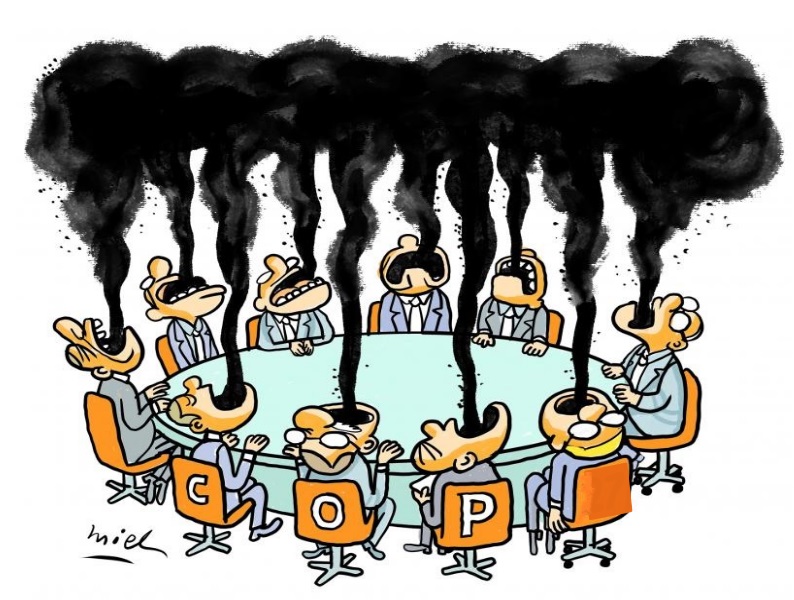
Oil and gas giants are paying tens of thousands of dollars in order to
sponsor events at this year’s flagship climate talks in Baku, Azerbaijan.
This year’s conference began on Monday (11 November). Over the course of
the 11-day summit, known as COP29, negotiators and leaders across the globe
will put in place commitments to address the climate crisis and assist the
worst-hit countries.
The International Emissions Trading Association
(IETA), a business lobby comprised of some of the world’s largest fossil
fuel producers and greenhouse gas emitters, is hosting a series of events
in its COP29 BusinessHub pavilion, sponsored by oil and gas giants
including Chevron, ExxonMobil, SOCAR, and TotalEnergies.
DeSmog 12th Nov 2024 https://www.desmog.com/2024/11/12/fossil-fuel-giants-paying-thousands-to-sponsor-cop29-events-baku/
This year has been masterclass in human destruction, UN chief tells Cop29
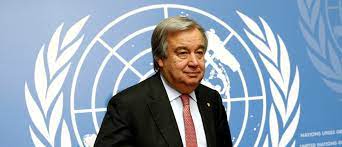
This year has been “a masterclass in human destruction”, the UN
secretary general has said as he reflected on extreme weather and record
temperatures around the world fuelled by climate breakdown.
António Guterres painted a stark portrait of the consequences of climate breakdown
that had arisen in recent months. “Families running for their lives
before the next hurricane strikes; workers and pilgrims collapsing in
insufferable heat; floods tearing through communities and tearing down
infrastructure; children going to bed hungry as droughts ravage crops,”
he said.
“All these disasters, and more, are being supercharged by
human-made climate change.” Guterres was addressing scores of world
leaders and high-ranking government officials from nearly 200 countries
gathered in Azerbaijan for the Cop29 UN climate summit. Over a fortnight of
talks, nations will try to find ways to raise the vast sums of money needed
to tackle the climate crisis. Developing countries want guarantees of $1tn
a year in funds by 2035 to help them cut greenhouse gas emissions and adapt
to the impacts of extreme weather.
Guardian 12th Nov 2024
TODAY. The International Atomic Energy Agency in full force with its lying propaganda, at COP 29, with at least 20 ‘Events”.
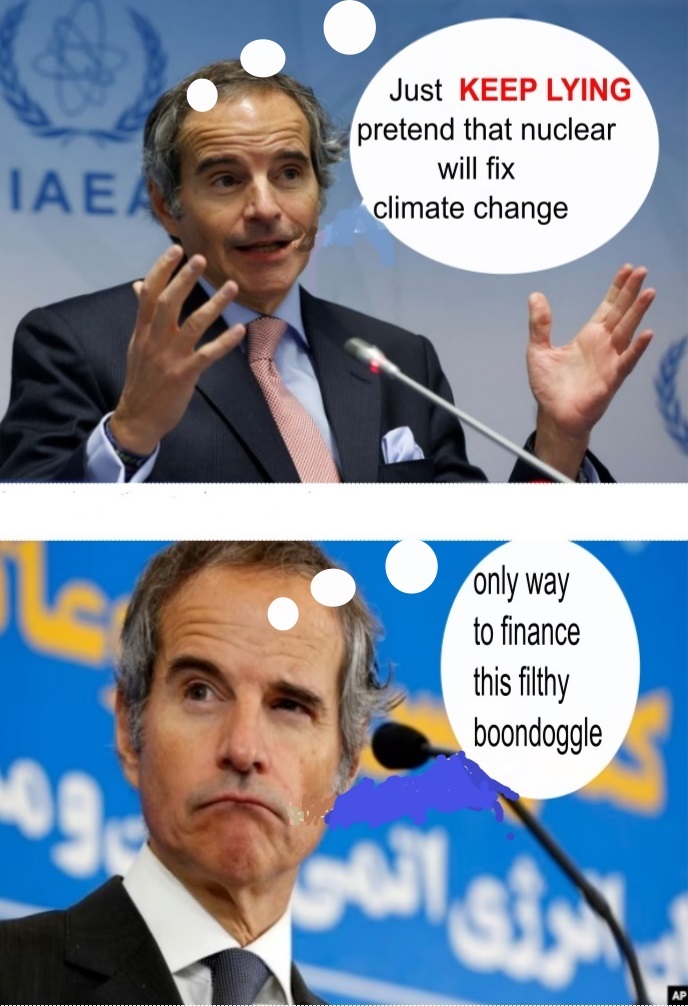
COP 29 will be a flop anyway – so I suppose that is some kind of twisted comfort – in that very few will trust the outcome of this hijacked UN Climate Summit
From IAEA website’s disgusting propaganda:
“ a rich programme of IAEA and partner events to showcase nuclear science and technology solutions for climate change “
“The IAEA is organizing a series of events on four thematic areas: energy, food, the ocean and water. “
“an informed debate on the tools and benefits offered by nuclear technology”
Hijacked by all the polluting industries, but the biggest liar of the lot is the IAEA – with their full knowledge that nuclear does nothing to fight climate change. And in fact – climate change effects will kill the nuclear industry,

Cop29 could change the financial climate for the world’s wealthy polluters
Jillian Ambrose, Energy correspondent. Guardian 10th Nov 2024, https://www.theguardian.com/environment/2024/nov/10/cop29-summit-financial-agenda-wealthy-polluters
This week’s summit will focus on paying for the costs of global heating – and much more money is needed.
About 50,000 government officials, policymakers, investors and campaigners will gather in Azerbaijan this week in the hope of answering a trillion-dollar question: how much money should go each year to helping developing countries cope with climate-related costs?
The aim of the UN’s Cop29 climate talks in Baku, which is being called the “climate finance Cop”, is to establish a new annual climate financing target to replace the current $100bn pledge, set in 2009, which expires at the end of this year. There is one clear consensus already: the existing climate finance available to developing countries is nowhere near enough to withstand worsening climate impacts. The ambition is too low, and in 15 years the annual target has been met in full only once, in 2022.
Campaigners have called for the governments of wealthier countries to contribute to a new collective quantified goal (NCQG) on climate finance. Forecasts of how much this will be vary but are typically $500bn to $1tn a year, or less than 1% of global GDP. Some estimates are as high as $5tn.
“Setting a more ambitious goal will be essential to helping vulnerable countries adopt clean energy and other low-carbon solutions and build resilience to worsening climate impacts,” said the World Resources Institute.
But who should pay? To date, the financial contributions that enable developing countries to pursue low-carbon growth and greater climate resilience have come from countries defined by the UN Framework Convention on Climate Change (UNFCCC) as “high income”. The list includes the UK, US, Japan and Germany. But in the 30 years since it was created, countries including China, India and South Korea have dramatically increased their economic might – and their carbon emissions.
It is likely that the talks will include calls to expand the list of countries contributing to climate financing. But even then the sums involved are too large for government spending budgets alone, according to delegates from many wealthy nations.
Instead, the talks aim to reform global climate lending to encourage more private capital to play a part. In an open letter last month, Stephanie Pfeifer, the head of the Institutional Investors Group on Climate Change, said many global investors were beginning to explore ways to unlock and mobilise capital.
“An ambitious finance goal that includes private capital can encourage greater ambition in developing countries’ targets [for helping to limit global warming] by building confidence in accessible funding for both mitigation and adaptation, with the latter being historically underfunded,” she said.
This approach is not without its critics. Climate and humanitarian NGOs have warned that loans, even on favourable term, place the financial burden of the climate crisis on already indebted developing nations, which bear the lowest responsibility for the climate crisis but face the greatest risks. These groups have called for polluting companies to pay their fair share.
“Climate finance is not about charity or generosity but responsibility and justice,” according to Debbie Hillier, a policy lead at the humanitarian NGO Mercy Corps. “It is based firmly on the principle of common but differentiated responsibilities and respective capabilities – those who contributed most to the climate crisis must bear the brunt of the solution.”
To this end, a new Climate Finance Action Fund (CFAF) will be under consideration. It aims to draw on voluntary contributions from fossil-fuel-producing countries and companies to support developing nations’ climate projects.
For polluters who would rather not pay, campaigners are calling for climate taxes. Billionaires and fossil fuel giants are in the crosshairs of environmental NGO 350.org, which plans to hold them accountable for their outsize impact on the planet in a new campaign. The group argues that funds generated through taxing the ultra-rich could be used both for domestic policies and programmes to lower carbon emissions, and for international climate finance to ensure “those most responsible for the climate crisis contribute to its solution”.
This approach is likely to prove popular with the public. Oxfam is scheduled to publish a report suggesting that the majority of the British public support higher taxes on private jets and superyachts to help tackle the climate crisis.
The survey, by YouGov, is also expected to show strong public support for increasing taxes on the wealthiest UK individuals to fund action, and hiking taxes on businesses in sectors that produce the most emissions.
The key to whatever form climate finance takes will be accountability – a meaningful climate finance target will mean nothing if the annual goal is never reached.
A ‘Cop of peace’? How can authoritarian, human rights-trashing Azerbaijan possibly host that?
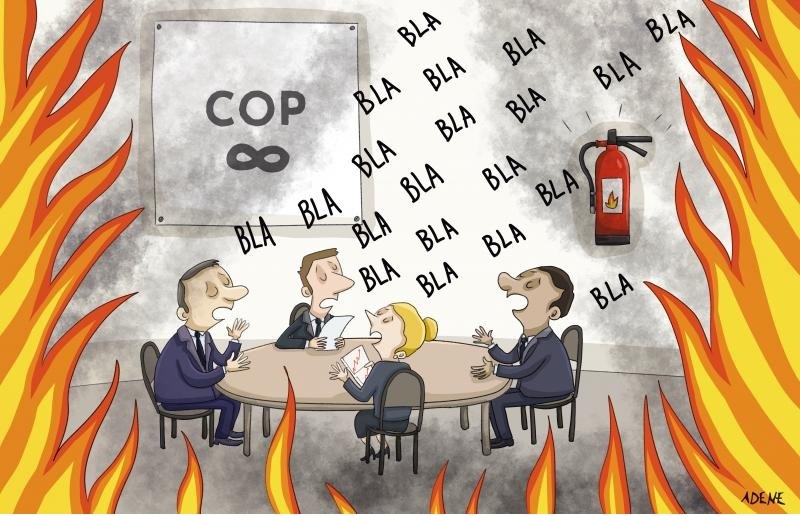
The ‘theme’ chosen for Cop29 must be some kind of dark joke. This summit, like those before it, is a mere act of greenwashing.
Greta Thunberg, Guardian, 11 Nov 24
During rapidly escalating climate and humanitarian crises, another authoritarian petrostate with no respect for human rights is hosting Cop29 – the UN’s latest annual climate summit that starts today and is being held after the re-election of a climate-denier US president.
Cop meetings have proven to be greenwashing conferences that legitimise countries’ failures to ensure a livable world and future and have also allowed authoritarian regimes like Azerbaijan and the two previous hosts – the United Arab Emirates and Egypt – to continue violating human rights.
Genocides, ecocides, famines, wars, colonialism, rising inequalities and an escalating climate collapse are all interconnected crises that reinforce each other and lead to unimaginable suffering. While humanitarian crises are unfolding in Palestine, Yemen, Afghanistan, Sudan, Congo, Kurdistan, Lebanon, Balochistan, Ukraine, Nagorno-Karabakh/Artsakh, and many, many other places, humanity is also breaching the 1.5C greenhouse gas emissions limit, with no signs of real reductions in sight. Instead, the opposite is taking place – last year, global emissions reached an all-time high. Heat records have been shattered, and this year is “virtually certain” to be the hottest year ever recorded, with unprecedented extreme weather events pushing the planet further into uncharted territory. The destabilisation of the biosphere and the natural ecosystems we depend on to survive is leading to untold human suffering and further accelerating the mass extinction of flora and fauna.
Azerbaijan’s entire economy is built on fossil fuels, with the state-owned oil company Socar’s oil and gas exports accounting for close to 90% of the country’s exports. Despite what it might claim, Azerbaijan has no ambition to take climate action. It is planning to expand fossil fuel production, which is completely incompatible with the 1.5C limit and the goals of the Paris agreement on climate change.
Many attenders of this year’s Cop are scared to criticise the Azerbaijan government. Human Rights Watch recently published a statement explaining how it couldn’t be certain that attenders’ rights to peacefully protest would be guaranteed. In addition, Azerbaijan land and sea borders will remain closed during Cop29, making it only possible to travel in and out of the country by air, which causes pollution and which many Azerbaijan citizens can’t afford. The reason given for closing borders at all Cops since the start of the Covid pandemic is to maintain “national security”, but I’ve heard many Azerbaijanis describe the situation as being “kept in a prison”.
The Azerbaijan regime is guilty of ethnic cleansing, humanitarian blockades and war crimes, as well as repressing its own population and cracking down on the country’s civil society. The independent watchdog Freedom House ranks the country as the least democratic state in Europe, with the regime actively targeting journalists, independent media outlets, political and civic activists, and human rights defenders. Azerbaijan also accounts for about 40% of Israel’s annual oil imports, thus fuelling the Israeli war machine and being complicit in the genocide in Palestine and Israel’s war crimes in Lebanon. The Azerbaijan-Israel ties are mutually beneficial as the majority of weapons used by Azerbaijan during the second Nagorno-Karabakh war and likely those used in the September 2023 military operation into the Karabakh region were imported from Israel.
The “Cop of peace” is one theme chosen for this year’s climate conference by the host, which wants to encourage states to observe a “Cop truce”. It is gut-wrenching, to say the least, to talk of global peace after the terrible human rights violations committed by Azerbaijan’s Aliyev regime against ethnic Armenians living in the Nagorno-Karabakh/Artsakh region. Furthermore, Azerbaijan is planning to greenwash its crimes against Armenians by building a “Green Energy Zone” on territories where the population has been ethnically cleansed.
How did this country get to host the climate summit? It was eastern Europe’s turn. But Russia vetoed EU member states, so the options were either Armenia or Azerbaijan. Armenia lifted its veto against Azerbaijan and supported its bid in exchange for a release of prisoners, although a large number of Armenian political prisoners are still being held. Last year, the regime critic Gubad Ibadoghlu was imprisoned after criticising Azerbaijan’s fossil fuel industry. Other political prisoners include peace activist Bahruz Samadov, ethnic minority researcher Iqbal Abilov, political activists Akif Gurbanov and Ruslan Izzatli and journalists.
The climate crisis is just as much about protecting human rights as it is about protecting the climate and biodiversity. You cannot claim to care about climate justice if you ignore the sufferings of oppressed and colonised people today. We cannot pick and choose whose human rights to care for, and who to leave behind. Climate justice means justice, safety and freedom for everyone.
During Cop29, the picture of Azerbaijan reported by the media will be a whitewashed and greenwashed version that the regime is desperate to portray. But make no mistake – it is a repressive state accused of ethnic cleansing.
We need immediate sanctions targeted against the regime and a halt to the import of Azerbaijani fossil fuels. Diplomatic pressure must also be put on the regime to release its Armenian hostages and all political prisoners – and ensure the right to a safe return for Armenians.
- Greta Thunberg is a Swedish activist and international climate crisis campaigner
Climate talks to open in shadow of Trump victory

World leaders are set to arrive at a big annual UN climate meeting hoping
to rein in rising global temperatures, which are making deadly events like
the recent floods in Spain far worse.
A key aim at this year’s meeting in
Azerbaijan is agreeing on how to get more cash to poorer countries to help
them curb their planet-warming gases and to help them cope with the growing
impacts of climate change.
But the US election victory of Donald Trump – a
known climate sceptic – as well as wars and cost of living crises are
proving a distraction, and some important leaders are not attending. Hosts
Azerbaijan are also under intense scrutiny over their human rights record,
as well as accusations they are using the meeting to line up fossil fuel
deals.
BBC 8th Nov 2024 https://www.bbc.co.uk/news/articles/c2k0zd2z53xo
Trump planning to withdraw from Paris climate agreement
Donald Trump is preparing to withdraw from the Paris climate agreement
when he returns to office in January. The president-elect’s team has
already prepared an executive order that would see the US leave the
international treaty, which commits countries to cutting their greenhouse
gas emissions.
More executive orders have been prepared for Mr Trump to
sign when he re-enters the White House that would shrink the size of
national monuments to allow more drilling and mining, The New York Times
reports. It is one of the first signs of how Mr Trump plans to undo the
legacy of Joe Biden, who has frequently touted his administration’s green
credentials and spent billions of dollars on renewable energy projects.
Telegraph 9th Nov 2024,
https://www.telegraph.co.uk/us/politics/2024/11/09/trump-planning-withdraw-from-paris-climate-agreement/
Donald Trump can’t stop global climate action. If we stick together, it’s the US that will lose out
Bill Hare, Guardian 7th Nov 2024, https://www.theguardian.com/commentisfree/2024/nov/07/donald-trump-cant-stop-global-climate-action-if-we-stick-together-its-the-us-that-will-lose-out
How damaging this presidency is to the planet depends very much on how other countries react. There’s no time to waste.
Donald Trump can’t stop global climate action. If we stick together, it’s the US that will lose out
Bill Hare
How damaging this presidency is to the planet depends very much on how other countries react. There’s no time to waste
Thu 7 Nov 2024 09.34 AEDTShare209
Donald Trump’s re-election to the White House is a major setback for climate action but ultimately it’s the US that could end up losing out, as the rest of the world will move forward without it.
The US is the world’s biggest economy and its second biggest emitter. Positive US engagement on climate has been crucial to landmark leaps forward, like getting the Paris agreement over the line, and just last year committing to transitioning away from fossil fuels.
The US missing in action in the latter half of this critical decade for climate action is nobody’s idea of a good outcome.
President-elect Trump has promised to leave the Paris agreement and reports have emerged that he could be thinking of pulling out of the underlying United Nations framework treaty on climate change. But we’ve been here before and the truth is that a second Trump presidency can’t stop climate action, just like his denial of human-induced climate change won’t spare the US from its impacts.
The energy transition is now well under way. The economics of renewable technologies are so attractive that they have become an energy juggernaut. Since the Paris agreement was signed in 2015, global investment in clean energy has increased by 60%.
Nearly US$2tn a year is now invested in clean energy projects, almost double that spent on new oil, gas and coal supply. Before the pandemic, this ratio was closer to 1:1. The US added 560 gigawatts of renewable capacity in 2023. That’s about six times the size of Australia’s entire electricity capacity, added in just one year.
Domestically, Joe Biden’s Inflation Reduction Act has set wheels in motion for climate investment that will be hard, and politically unpopular, to undo. Famously, no Republicans voted for the legislation but red states have been the main beneficiaries of the money, projects and jobs it has created. House Republicans have even pushed back against their peers to protect some of the act’s clean energy tax credits.
Climate impacts are accelerating in pace and scale that is untenable to ignore. Hurricanes Helene and Milton, supercharged by climate change, are expected to cost more than US$50bn. Fires in California, heatwaves in the sunbelt states, and flooding in the US South are wreaking huge damage on Americans. Last year a poll showed a majority of them feel that climate change is already causing serious effects.
None of this stops the day Trump re-enters the White House.
Internationally, we’ve been in this position before. In 2001 George W Bush quit the 1997 Kyoto deal. Last time Trump was in power, he left the Paris agreement, albeit for a short time. I don’t want to downplay the impacts of Trump, or the Project 2025 agenda to which he has been linked, but climate action didn’t stop then and it will not stop now.
Other players, notably China, are increasingly moving into a leadership position on the issue, because of the strategic policy and economic interests it advances. The European Union is moving ahead with its green economic development agenda despite a rightward shift in the balance of power across the EU27 – with action on the climate emergency driving the economic development needed for this region of 350 million people.
The US, if Trump does enact the changes he has campaigned on, will find itself falling behind on new technologies and markets.
How damaging the second Trump presidency is to climate action depends very much on how other countries react. If many follow Trump in either rolling back – or slowing down – their action, the damage will be severe, long-lasting and difficult to overcome.
On the other hand, if countries stick together and, as they should, deepen their commitments aligning with the Paris agreement’s 1.5C limit, the damage will be significant but not severe.
In Australia we’re on the frontline of climate impacts and damages. The Great Barrier Reef has suffered enormous damage with increasingly frequent bleaching. Forests in Western Australia have experienced browning and dieback at an unprecedented scale due to extended drought and heat.
We know that the climate crisis and its impacts on our neighbours is one of our most serious security threats – although it’s not one that our government wants to particularly talk about.
The Australian government, especially given its intention to host COP31, must play a strong diplomatic role to help ensure the fallout from the second Trump presidency is limited, and that international domestic action everywhere else continues to move ahead.
This requires leadership. The government must step up and work with other like-minded countries to bring together a coalition prepared to move forward on climate. And it needs to move forward itself.
There is no time to waste on this. COP29 starts in Baku in a few days and real leadership will be needed urgently to maintain the momentum needed to get agreement on the difficult issues that need to be solved to maintain action globally.
Bill Hare, a physicist and climate scientist, is the chief executive of Climate Analytics
1 This Month

26 September – International Day for the Total Elimination of Nuclear Weapons


PLEASE OPPOSE HR 8255 AND S.3639 – bills would accelerate satellite deployment, with no environmental review or safeguards – https://ncstd5li.quorum.us/campaign/169331/
To see nuclear-related stories in greater depth and intensity – go to https://nuclearinformation.wordpress.com
-
Archives
- September 2026 (206)
- August 2026 (330)
- July 2026 (355)
- June 2026 (287)
- May 2026 (306)
- April 2026 (356)
- March 2026 (251)
- February 2026 (267)
- January 2026 (308)
- December 2025 (358)
- November 2025 (359)
- October 2025 (375)
-
Categories
- 1
- 1 NUCLEAR ISSUES
- business and costs
- climate change
- culture and arts
- ENERGY
- environment
- health
- history
- indigenous issues
- Legal
- marketing of nuclear
- media
- opposition to nuclear
- PERSONAL STORIES
- politics
- politics international
- Religion and ethics
- safety
- secrets,lies and civil liberties
- spinbuster
- technology
- Uranium
- wastes
- weapons and war
- Women
- 2 WORLD
- ACTION
- AFRICA
- Atrocities
- AUSTRALIA
- Christina's notes
- Christina's themes
- culture and arts
- Events
- Fuk 2022
- Fuk 2023
- Fukushima 2017
- Fukushima 2018
- fukushima 2019
- Fukushima 2020
- Fukushima 2021
- general
- global warming
- Humour (God we need it)
- Nuclear
- RARE EARTHS
- Reference
- resources – print
- Resources -audiovicual
- Weekly Newsletter
- World
- World Nuclear
- YouTube
-
RSS
Entries RSS
Comments RSS
 nuclear-news