Swiss ruling could pave way for more climate activist cases.
The decision that Switzerland had failed in its duty to mitigate climate change raises
questions about the Strasbourg court overstepping the mark. Victory for a
group of Swiss women who challenged their government’s inaction over
climate change will encourage activists “to try their luck”, one City
law firm partner warns.
The European Court of Human Rights last week ruled
for the first time that signatory states to the convention are obliged to
protect their citizens from the effects of the evolving “climate
crisis”. The judges said that the Swiss government had failed to comply
with its duties to mitigate climate change, and that violated the right to
respect for private and family life.
Times 18th April 2024
Nuclear expert fears flooded radioactive dump sites in Siberia can threaten Arctic Ocean
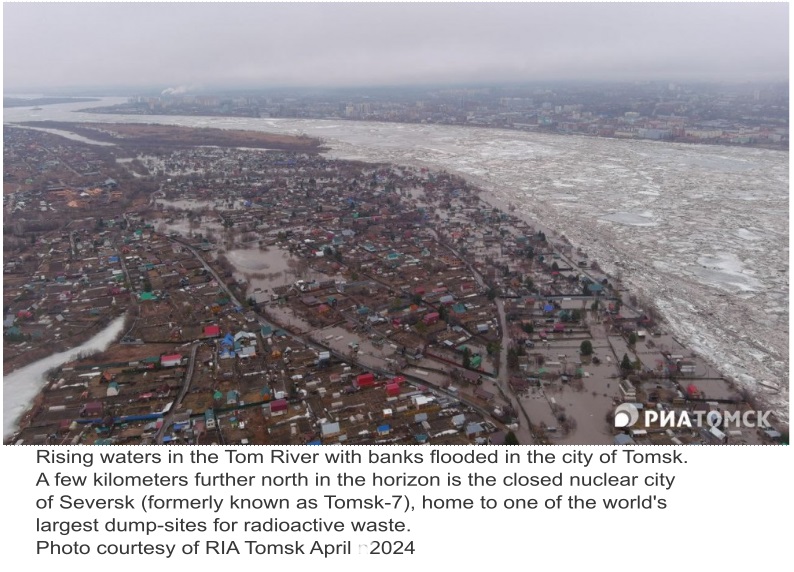
Floodwaters in Tomsk region threatens to submerge the river banks in Seversk where highly radioactive liquid waste from the Soviet Union’s nuclear weapons program for decades were injected into two unprotected underground reservoirs.
Water level on Monday continues to rise in the Tom River in Western Siberia.
The record floods are among the worst ever in the region and local emergency services help in evacuation of people living near tributaries of the Ob river system, including Tobol, Irtysh and Tom rivers.
Thousands of houses and tens of thousands of people live in the emergency zones, according to Kremlin information platform RIA Novosti. High snow falls in winter combined with swiftly rising spring temperatures and heavy rains are the reasons for the current extreme flood, Reuters reports.
Drone photos by RIA Tomsk shows how the swelling Tom River is inundating villages on the westside river banks. According to NEXTA news channel, water in Tom River has risen by nearly a meter over the day.
On the east side, a short 15 kilometers north of the city of Tomsk, is the closed city of Seversk. Until 1992, the secret city was code-named Tomsk-7 and was home to one of three production facilities for weapons-grade plutonium for the Soviet Union’s nuclear weapons program.
“There ain’t one single public message that Rosatom is monitoring the situation, that they have the situation under control,” says Aleksandr Nikitin, an exile nuclear safety expert working for the environmental foundation Bellona.
Nikitin was until the all-out war against Ukraine a member of Rosatom’s Public Council. The Council involved civic organizations and scientists in Russia and was aimed at raising public awareness of Rosatom’s core operations
“It’s surprising that there aren’t even simple statements like we have everything under control,” Nikitin adds.
According to the World Nuclear Association, the Siberian Chemical Combine in Seversk had five plutonium production reactors, an uranium enrichment plant and a processing plant for plutonium warheads. Although shut down, enormous amount of nuclear waste is still on site.
Most challenging are the liquid radioactive waste, both on the surface and pumped down in deep-well injections. The nuclear dump is likely Russia’s largest, by IAEA estimated to be 70 million cubic meters.
Widespread contamination in an area up to 28 kilometers came after a concrete cover blew off a reaction vessel at the plutonium extraction facility in 1993. The International Atomic Energy Agency (IAEA) listed it as a major radiological accident.
In 2000, a joint U.S.-Russian study found dangerous levels of radioactivity flowing into Russia’s Tom River from the Siberian Nuclear Combine.
Critics crumbled
Local environmentalists in Tomsk filed a lawsuit against the company in the late 1990s in an attempt to revoke a dumping permit for highly radioactive liquid waste down under. They feared for the city’s drinking water.
In Putin’s Russia, critical voices are gone. Environmental groups like Greenpeace, World Wide Fund for Nature, and Bellona are all listed as undesirable by law.
TV2 in Tomsk, known for its independent journalism and free debate since the early years after the breakup of the Soviet Union, got its broadcast shut down in 2014. After the start of the full-scale war in 2022, the reporters closed their YouTube producing newsroom and left Russia.
Aleksandr Nikitin is worried radioactivity could leak out to the river system under the current flood, but that information will not come before it is too late.
“Putin doesn’t give a fuck about these floods and other shitty lives of people in Russia.., he has a war and geopolitical goals of fighting the damned West,” Nikitin says.
For Rosatom, he adds, the logic is simple: “.. if you say that everything is under control, and then something happens, then you will have to answer for it.”
Nikitin says Rosatom is sure that in any case it will not bear any responsibility.
“Rosatom is today Putin’s “favorite child,” he explains.
It was Lavrenty Beria, director of Joseph Stalin’s secret police, who lead the establishment of the first plutonium production facilities east of the Ural mountains in the late 1940ties, early 1950ties. KGB and the Soviet nuclear establishment walked hand-in-hand for decades. What nowadays is Ulitsa Pervomayskaya (May 1st Street) in Seversk, was previously named Ulitsa Beria.
Arctic Ocean
A major concern for Aleksandr Nikitin and Bellona is that no one can exclude that leakages from a possible overflowed radioactive waste site could reach the Arctic Ocean.
Tom River is a tributary of the Ob which flows out in the Ob Bay and Kara Sea above the Arctic Circle.
During the years 1948-56, liquid radioactive waste from the Mayak reprocessing plant north of Chelyabinsk was discharged directly into the nearby river Techa which is connected to the river system Iset, Tobol, Irtysh and Ob. Especially Strontium-90, but also other isotopes, were carried by the water more than 2,000 kilometers downstream and measured in the Kara Sea, first time in 1951.
A joint Norwegian-Russian expedition to the Kara Sea in 1994 found traces of the same radionuclides, although in lower levels.
“Everything is now possible,” says Aleksandr Nikitin when seeing the photos of the flooded riverbanks of the Tom River.
“It all depends on the scale of leakages.”
“I’m sure the Siberian Chemical Combine sit quietly and wait. Hoping for it all to go over,” Nikitin says to the Barents Observer.
The climate crisis and nuclear weapons

It seems we haven’t the money to save the planet, but we can stump up any amount to fund nuclear death
NORTH EAST BYLINES, by Caroline Westgate, 15-04-2024
A massive and accelerating crisis faces all of us on Planet Earth: the climate is warming, and we will rapidly reach a point where the damage to our ecosystem will be irreversible. Dismayed by the political inertia which fails to address this emergency, increasing numbers of people are resorting to protest through nonviolent direct action.
International conferences regularly agree on aims but fail to implement action with the urgency and on the scale needed to challenge the hegemony of Big Oil. We are told that the money simply isn’t there.
But here in the UK there is one hugely costly project which, if it were cancelled, would release an income-stream which could be directed to the electorate’s real priorities: the climate crisis, the NHS, education and transport. I’m talking about Trident.
Nuclear weapons
I was five years old when America’s atomic bombs destroyed Hiroshima and Nagasaki. Those events ended WW2 but triggered the Cold War. When the Soviet Union, the UK, France and China acquired their own nuclear arsenals, the Cold War settled into a 35-year stalemate of Mutually Assured Destruction (appropriately dubbed MAD), in which it was assumed that a nuclear exchange would be prevented by a ‘balance of terror’.
But in the 1980s, NATO strategists dropped the MAD policy, because advances in military technology gave them the confidence that they could fight and win a nuclear war: their new nuclear-armed Cruise missiles could launch pre-emptive strikes, capable of destroying the Soviets’ nuclear weapons in their silos.
Ordinary people rapidly realised that this development posed an existential threat to millions of civilians on both sides of the Iron Curtain: we had all been conscripted as front-line troops, expendable pawns in NATO’s nuclear game. A re-energised peace movement vociferously opposed Cruise missiles when they arrived on British soil: they were totally under American control, but they made the UK a target.
Embrace the Base at Greenham Common
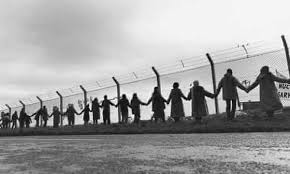
Greenham Common in Berkshire was one of the Cruise sites. In the summer of 1981, a small group of women from South Wales established a peace camp there. During the first winter of their protest they struggled to get any support or publicity. In conditions of great hardship, they kept the camp going. Their protest grew amid evictions, arrests, imprisonments, and physical attacks. One woman was killed. All of this was accompanied by often viciously mendacious press coverage.
In December 1982, I was one of 30,000 women who responded to an unsigned chain letter, inviting us to ‘Embrace the Base’. We joined hands and encircled Greenham’s 9-mile perimeter fence. We decorated it with objects of significance to us, transforming it into a nine mile work of art.
‘Embrace the Base’ was a high-profile event, but small-scale protests were frequently staged with daring, creativity and humour, either by the women who lived at the camp or by autonomous groups of women who travelled to Berkshire to carry out some anarchic plot of their own devising.
In September 1985, with a group of women from the North East, I made the 300-odd mile journey to Greenham again.
My group had hatched a plan to enter the base to access a small outbuilding on which they were going to paint anti-nuclear slogans, and I was there to support them. By that stage it was ludicrously easy to get through the fence because hundreds of women with bolt cutters had reduced it to shreds. The army kept patching it up, but their efforts were futile. The women from my group walked on to the base, slapped a lot of blue gloss paint on the wall of the outbuilding, then stood quietly, dripping brushes in hand, waiting to be arrested. A group of policemen duly arrived and handcuffed them. To my surprise, I was also arrested, even though I was outside the fence and hadn’t actually done anything wrong. We were all charged with criminal damage and summonsed to appear at Newbury Magistrates’ Court a few weeks later.
From the dock, I made a stirring speech to justify protesting at the base. It cut no ice whatsoever. I was found guilty of criminal damage and ordered to pay a fine and costs, which amounted to £67.75p. I refused to pay. The magistrates, who had seen it all before, wearily referred my case to my local court in Hexham. I knew that the length of time to be spent inside would be calculated pro rata from the amount of the fine I’d refused to pay. It worked out at less than a week in prison, which I felt confident I could cope with.
However, time wore on and nobody arrived to take me away. It was getting perilously near Christmas, when I really didn’t want to be away from my family. I enquired of the clerk to Hexham’s Magistrates when the law would come for me. He said:
“They don’t put people like you in prison. It’s much too expensive. We will contact your employer and put an Attachment of Earnings order on your salary.” I realised that my gesture of defiance would pointless if the only person who knew about it would be the wages clerk at County Hall. Since I was going to have to pay anyway, I decided to turn it into a stunt by making the payment on a novelty cheque……………………………………………………………………………………..
The carbon footprint of the UK military
All this is good for a laugh, but what it says about our priorities is far from funny. It is high time we looked at this issue from the perspective of the climate catastrophe, factoring-in what the military contributes to the UK’s carbon footprint. Dr Stuart Parkinson, of Scientists for Global Responsibility, calculates that the annual carbon footprint of the UK military is roughly equivalent to the carbon emissions of six million average cars. Trident must account for a sizeable proportion of that. Of course, the government omits all mention of those figures when it claims we are progressing nicely towards net zero.
The cost of Trident

We also need to challenge why we spend such colossal amounts of money on Trident, when there are so many urgent rival claims on the public purse. The arguments against the possession of nuclear weapons are as valid now as they were when I wrote my novelty cheque nearly forty years ago.
- the moral objection to threatening the deaths of countless numbers of people.
- nuclear weapons make their possessors a target.
- early-warning systems make it more likely that nuclear war will be triggered by accident.
- nuclear war will be followed by nuclear winter, causing ecocide and wrecking forever any chance of addressing climate change.
But let’s focus on the cost of Trident, which falls on the UK at a time when serious investment in public services is urgently needed on a huge scale. The figures bandied about are quoted not in millions but in billions. The difference between those two quantities is so vast it is hard to grasp, so try this analogy: a million seconds would last for about eleven days, but a billion seconds would last for 31 and a half years.
The Nuclear Information Service calculates the cost of Trident as £172 billion (including its new warheads and its running costs over its projected lifetime). That is a stupendous amount of money to lavish on maintaining the fiction that the UK is a world-class power. Neither the Tories nor Labour dares to question that expenditure. By contrast, Labour’s new idea for a Green Investment Fund (a mere £28 billion) was recently cancelled as unaffordable.
Apparently, we haven’t the money to save the planet, but we can stump up any amount to fund nuclear death.
Why are our priorities so badly skewed? https://northeastbylines.co.uk/the-climate-crisis-and-nuclear-weapons/
Coral bleaching: Fourth global mass stress episode underway – US scientists
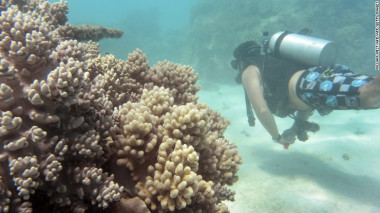
Coral around the world is turning white and even dying as recent record
ocean heat takes a devastating toll. It has triggered the fourth global
mass coral bleaching event, according to the US National Oceanic and
Atmospheric Administration (NOAA).
Bleaching happens when coral gets
stressed and turns white because the water it lives in is too hot. Coral
sustains ocean life, fishing, and creates trillions of dollars of revenue
annually.
Ocean heat records have been falling for months but this is the
first global evidence of how this episode is affecting sea life. The US
National Oceanic and Atmospheric Administration (NOAA) confirmed the mass
stress in all oceans (the Atlantic, Pacific and Indian Ocean) after weeks
of receiving reports from scientists globally. The bleached coral can look
beautiful in pictures but scientists that dive to examine the reefs say
that up close the coral is clearly ill and decaying.
BBC 15th April 2024
Nuclear energy ‘now an obstacle to delivering net zero’ – Greenpeace.
Nuclear energy has been touted as key to the global transition,
but concerns around costs and timescales have generated scepticism.
According to Greenpeace director of policy Doug Parr: “Nuclear power
can’t bridge the gap between anything and anything. It is too slow. It is
too expensive. It is a massive distraction.”
Speaking about the role of
nuclear energy in the UK’s transition, Parr tells Energy Monitor: “It
doesn’t help with the kind of grid system that we need, which is going to
be renewables heavy. I think the UK focus on nuclear power is now an
obstacle to delivering net zero because it is sucking up time, energy and
political bandwidth, which can be spent on more useful things.”
Parr argues that governments should be investing in more immediate solutions. He
points to investment in Sizewell C – the 3.2GW power station set to be
built in the English county of Suffolk – where construction is set to
commence this year. It is likely to take between nine and 12 years to
complete, but delays at Hinkley C (of which Sizewell C will be a close
copy) have stirred doubt.
“We will be putting a lot of money into
something like Sizewell C, when actually we will find that it is a white
elephant by the time it has opened,” he contends. “We will have spent
all that time, energy and effort, which could have been put into improving
our housing stock, improving our grid or improving the ability of electric
vehicles to meet the needs of people through a proper charging network –
things that would actually would deliver this decade, not in 15 years time.
So, we would cut a lot more carbon, we would get something done that is
useful and we wouldn’t have piles of messy radioactive waste that we
still don’t know what to do with.”
Energy Monitor 10th April 2024, https://www.energymonitor.ai/features/nuclear-energy-now-an-obstacle-to-delivering-net-zero-greenpeace/
Swiss women win landmark climate victory at European Court of Human Rights
Swiss women win landmark climate victory at European Court of Human
Rights. Court finds in favour of group of older Swiss women who claimed
inaction on the climate crisis by their government put them at greater risk
of death from heatwaves.
Independent 9th April 2024
BBC 9th April 2024
Nuclear regulator delinquent on climate

Fort Calhoun nuclear station – flooded 2019
“New reactors remain a mirage. But if they ever become operational, the climate extremes we are already seeing will be far worse. It is irresponsible for the NRC to claim that this is not a relevant safety concern for the agency.”
US government agency reprimands NRC for ignoring climate crisis impacts on reactor safety
https://beyondnuclearinternational.org/2024/04/07/nuclear-regulator-delinquent-on-climate/
The findings and recommendations of a new U.S. Government Accountability Office (GAO) report confirm what Beyond Nuclear has been litigating with the U.S. Nuclear Regulatory Commission (NRC): the agency cannot continue to ignore the safety impacts on nuclear power plants from the worsening climate crisis.
The GAO report is entitled NUCLEAR POWER PLANTS: NRC Should Take Actions to Fully Consider the Potential Effects of Climate Change. It criticizes the NRC for failing to conduct assessments for commercial U.S. nuclear power plants by projecting climate risks and incorporating adequate safety margins into both old and new designs.
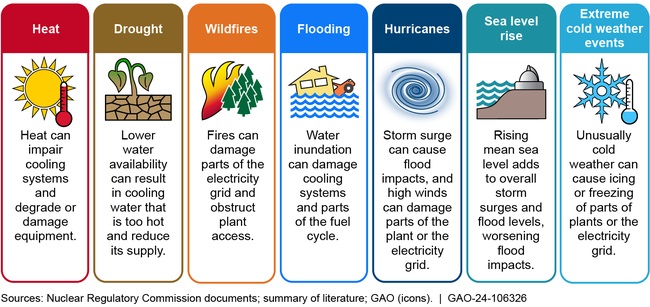
These risks include a worsening of natural hazards and encompass heat and cold, drought, wildfires, flooding, hurricanes, and sea-level rise, according to the GAO, all of which could seriously jeopardize the safe operation of the nation’s current fleet that is going through extreme license renewals — and any future new — nuclear reactors if not properly safeguarded.
“The NRC is proceeding with the extension of operating licenses for several vulnerable nuclear power plants without any climate change risk analysis,” said Paul Gunter, a policy analyst and spokesperson for Beyond Nuclear. “Worse, the NRC staff claim that preparing for the effects of the climate crisis is outside its scope.”
And yet, as Gunter points out, one of the candidates for license extension out to 2053 and 2054 is the two-unit Turkey Point nuclear power plant on the south Florida coast where sea-level rise is projected. Another is the three-unit Oconee nuclear power plant in South Carolina, also seeking a second 20-year extension that could see it operating for another 30 years.
“Oconee sits precariously downstream and 300 feet below the top of the water level in Lake Jocassee behind a rock-filled earthen dam that holds back more than one million acre-feet of water,” Gunter said. “We are already witnessing recurring extreme precipitation, including prolonged atmospheric rivers attributed to climate change. And yet, the NRC staff have argued that ‘The effects of climate change on Oconee Station SSCs [systems, structures and components] are outside the scope of the NRC staff’s license renewal environmental review’. This is not only disingenuous, but dangerous,” Gunter added.
Beyond Nuclear is preparing to file another legal intervention in the NRC’s Oconee license renewal proceeding on April 29, 2024.
Jeff Mitman, a retired NRC senior risk analyst and expert witness supporting Beyond Nuclear litigations points to a damning revelation in the GAO report, perhaps an NRC obfuscation to shield a vulnerable industry from costly safety retrofits caused by worsening climate change. GAO interviewed NRC staff who acknowledge that the agency is shying away from using site-specific climate change hazards data in its licensing analysis, they claim, because of the challenges presented by uncertainty. To that point, the GAO states:
“However, NRC regulations do not preclude NRC from using climate projections data, and new sources of reliable projected climate data are available to NRC. In 2023, the White House Office of Science and Technology Policy issued guidance to federal agencies on selecting and using climate data to assess risks and their potential impacts. This guide provides information on climate models and projections to help federal agencies understand exposure to current and future climate-related hazards and their potential impacts.
“Without incorporating the best available information into its licensing and oversight processes, it is unclear whether the safety margins for nuclear power plants established during the licensing period—in most cases over 40 years ago—are adequate to address the risks that climate change poses to plants.”
The GAO also points out that even closed and decommissioning nuclear power plants are vulnerable due to climate change-induced weather extremes. The report cites the closed Indian Point nuclear power plant in New York, where fire hazards are very high along with flooding risks, and Palisades in Michigan, also at risk of flooding and now looking to reopen. The hazards are represented by the highly radioactive waste inventories still on site.
Any planned new reactors, including the still-on-paper small modular reactor designs that would not materialize for likely another 20 years, must factor projected climate impacts into safety measures and environmental impact statements, Beyond Nuclear urged.
“New reactors remain a mirage,” Gunter said. “But if they ever become operational, the climate extremes we are already seeing will be far worse. It is irresponsible for the NRC to claim that this is not a relevant safety concern for the agency.”
Given the many examples of risk that the GAO uncovered through extensive interviews, the report concludes that the NRC is not doing enough to “fully consider potential climate change effects” projected three decades and farther into the future. As the GAO frames it, “NRC primarily uses historical data in its licensing and oversight processes rather than climate projections data.”
“It’s like the NRC is driving its nuclear power ambitions through the fog of uncertainty with its high beams on, blinded to what’s ahead,” said Gunter. “The GAO is rightly concerned that the NRC cannot serve public safety by viewing climate data only through its rear view mirror. There are simply too many unpredictable hazards now faced by an inherently dangerous industry,” he said.
U.S. Senators Tom Carper (D-Del) and Joe Manchin (D-W.Va), both devout supporters of nuclear power expansion, commissioned the GAO to look into the resilience of U.S. nuclear power stations to climate change.
The GAO responded with its expert findings on how climate change is expected to affect nuclear power plant operations and what actions the NRC has taken to address the risks that nuclear power faces from climate change. The GAO report provides three reasonable recommendations regarding what they found to be inadequate or missing in the NRC’s oversight and licensing process:
1) NRC should assess whether its licensing and oversight processes adequately address the potential for increased risks to nuclear power plants from climate change.
2) NRC should direct its staff to develop, finalize, and implement a plan to address any gaps identified in its assessment of existing processes.
3) NRC should direct its staff to develop and finalize guidance on incorporating climate projections data including what sources of climate projections data to use and when and how to use climate projections data.
Paul Gunter is the Director of Reactor Oversight at Beyond Nuclear.
‘Simply mind-boggling’: world record temperature jump in Antarctic raises fears of catastrophe
“Essentially, it is a vicious circle of warming oceans and melting of sea ice, though the root cause is humanity and its continuing burning of fossil fuels and its production of greenhouse gases,”
An unprecedented leap of 38.5C in the coldest place on Earth is a harbinger of a disaster for humans and the local ecosystem
Robin McKie Science editor, Sun 7 Apr 2024 , https://www.theguardian.com/environment/2024/apr/06/simply-mind-boggling-world-record-temperature-jump-in-antarctic-raises-fears-of-catastrophe
On 18 March, 2022, scientists at the Concordia research station on the east Antarctic plateau documented a remarkable event. They recorded the largest jump in temperature ever measured at a meteorological centre on Earth. According to their instruments, the region that day experienced a rise of 38.5C above its seasonal average: a world record.
This startling leap – in the coldest place on the planet – left polar researchers struggling for words to describe it. “It is simply mind-boggling,” said Prof Michael Meredith, science leader at the British Antarctic Survey. “In sub-zero temperatures such a massive leap is tolerable but if we had a 40C rise in the UK now that would take temperatures for a spring day to over 50C – and that would be deadly for the population.”
This amazement was shared by glaciologist Prof Martin Siegert, of the University of Exeter. “No one in our community thought that anything like this could ever happen. It is extraordinary and a real concern,” he told the Observer. “We are now having to wrestle with something that is completely unprecedented.”
Poleward winds, which previously made few inroads into the atmosphere above Antarctica, are now carrying more and more warm, moist air from lower latitudes – including Australia – deep into the continent, say scientists, and these have been blamed for the dramatic polar “heatwave” that hit Concordia. Exactly why these currents are now able to plunge so deep into the continent’s air space is not yet clear, however.
Nor has this huge temperature hike turned out to be an isolated event, scientists have discovered. For the past two years they have been inundated with rising numbers of reports of disturbing meteorological anomalies on the continent. Glaciers bordering the west Antarctic ice-sheet are losing mass to the ocean at an increasing rate, while levels of sea ice, which float on the oceans around the continent, have plunged dramatically, having remained stable for more than a century.https://interactive.guim.co.uk/uploader/embed/2024/04/archive-zip/giv-13425WC79HMmcEe8y/
These events have raised fears that the Antarctic, once thought to be too cold to experience the early impacts of global warming, is now succumbing dramatically and rapidly to the swelling levels of greenhouse gases that humans continue to pump into the atmosphere.
These dangers were highlighted by a team of scientists, led by Will Hobbs of the University of Tasmania, in a paper that was published last week in the Journal of Climate. After examining recent changes in sea ice coverage in Antarctica, the group concluded there had been an “abrupt critical transition” in the continent’s climate that could have repercussions for both local Antarctic ecosystems and the global climate system.
“The extreme lows in Antarctic sea ice have led researchers to suggest that a regime shift is under way in the Southern Ocean, and we found multiple lines of evidence that support such a shift to a new sea ice state,” said Hobbs.https://interactive.guim.co.uk/uploader/embed/2024/04/archive-2-zip/giv-13425x5sm3FJkGC7J/
The dramatic nature of this transformation was emphasised by Meredith. “Antarctic sea ice coverage actually increased slightly in the late 20th and early 21st century. However, in the middle of the last decade it fell off a cliff. It is a harbinger of the new ground with the Antarctic climate system, and that could be very troubling for the region and for the rest of the planet.”
The continent is now catching up with the Arctic, where the impacts of global warming have, until now, been the most intense experienced across the planet, added Siegert. “The Arctic is currently warming at four times the rate experienced by the rest of the planet. But the Antarctic has started to catch up, so that it is already warming twice as quickly as the planet overall.”
A key reason for the Arctic and Antarctic to be taking disproportionate hits from global warming is because the Earth’s oceans – warmed by fossil-fuel burning – are losing their sea ice at their polar extremities. The dark waters that used to lie below the ice are being exposed and solar radiation is no longer reflected back into space. Instead, it is being absorbed by the sea, further heating the oceans there.
“Essentially, it is a vicious circle of warming oceans and melting of sea ice, though the root cause is humanity and its continuing burning of fossil fuels and its production of greenhouse gases,” said Meredith. “This whole business has to be laid at our door.”
As to the consequences of this meteorological metamorphosis, these could be devastating, researchers warn. If all the ice on Antarctica were to melt, this would raise sea levels around the globe by more than 60 metres. Islands and coastal zones where much of the world’s population now have homes would be inundated.
Such an apocalypse is unlikely to occur for some time, however. Antarctica’s ice sheet covers 14m square kilometres (about 5.4m square miles), roughly the area of the United States and Mexico combined, and contains about 30m cubic kilometres (7.2m cubic miles) of ice – about 60% of the world’s fresh water. This vast covering hides a mountain range that is nearly as high as the Alps, so it will take a very long time for that to melt completely, say scientists.
Nevertheless, there is now a real danger that some significant sea level rises will occur in the next few decades as the ice sheets and glaciers of west Antarctica continue to shrink. These are being eroded at their bases by warming ocean water and could disintegrate in a few decades. If they disappear entirely, that would raise sea levels by 5m – sufficient to cause damage to coastal populations around the world. How quickly that will happen is difficult to assess. The Intergovernmental Panel on Climate Change has said that sea levels are likely to rise between 0.3m to 1.1m by the end of the century. Many experts now fear this is a dangerous underestimate. In the past, climate change deniers accused scientists of exaggerating the threat of global warming. However, the evidence that is now emerging from Antarctica and other parts of the world makes it very clear that scientists did not exaggerate. Indeed, they very probably underrated by a considerable degree the threat that now faces humanity.
“The picture is further confused in Antarctica because, historically, we have had problems getting data,” added Meredith. “We have never had the information about weather and ecosystem, compared with the data we get from the rest of the world, because the continent is so remote and so hostile. Our records are comparatively short and that means that the climate models we have created, although very capable, are based on sparse data. They cannot capture all of the physics, chemistry and biology. They can make predictions that are coherent but they cannot capture the sort of extremes that we’re now beginning to observe.”
The woes facing Antarctica are not merely of human concern, however. “We are already seeing serious ecological impacts that threaten to spread through the food chain,” said Prof Kate Hendry, a chemical oceanographer based at the British Antarctic Survey.
A critical example is provided by the algae which grow under and around sea ice in west Antarctica. This is starting to disappear, with very serious implications, added Hendry. Algae is eaten by krill, the tiny marine crustaceans that are one of the most abundant animals on Earth and which provide food for predators that include fish, penguins, seals and whales. “If krill starts to disappear in the wake of algae, then all sorts of disruption to the food chain will occur,” said Hendry.
The threat posed by the disappearance of krill goes deeper, however. They play a key role in limiting global warming. Algae absorb carbon dioxide. Krill then eat them and excrete it, the faeces sinking to the seabed and staying there. Decreased levels of algae and krill would then mean less carbon from the atmosphere would be deposited on the ocean floor and would instead remain near the sea surface, where it would return to the atmosphere.
“They act like a conveyor belt that takes carbon out of the atmosphere and carries it down to the deep ocean floor where it can be locked away. So if we start messing with that system, there could be all sorts of other knock-on effects for our attempts to cope with the impact of global warming,” added Hendry. “It is a scary scenario. Nevertheless that, unfortunately, is what we are now facing.”
Another victim of the sudden, catastrophic warming that has gripped the continent is its most famous resident: the emperor penguin. Last year the species, which is found only in Antarctica, suffered a catastrophic breeding failure because the platforms of sea ice on which they are born started to break up long before the young penguins could grow waterproof feathers.
“We have never seen emperor penguins fail to breed, at this scale, in a single season,” said Peter Fretwell, of the British Antarctic Survey. “The loss of sea ice in this region during the Antarctic summer made it very unlikely that displaced chicks would survive.”
Researchers say that the discovery of the loss of emperor penguins suggests that more than 90% of colonies will be wiped out by the end of the century, if global warming trends continue at their current disastrous rate. “The chicks cannot live on sea ice until they have fledged,” said Meredith. “After that, they can look after themselves. But the sea ice is breaking up before they reach that stage and mass drowning events are now happening. Colonies of penguins are being wiped out. And that’s a tragedy. This is an iconic species, one that is emblematic of Antarctica and the new vulnerability of its ecosystems.”
The crisis facing the continent has widespread implications. More than 40 nations are signatories of the Antarctic Treaty’s environmental protocol, which is supposed to shield it from a host of different threats, with habitat degradation being one of the most important. The fact that the continent is now undergoing alarming shifts in its ice covering, eco-systems and climate is a clear sign that this protection is no longer being provided.
“The cause of this ecological and meteorological change lies outside the continent,” added Siegert. “It is being caused because the rest of the world is continuing to emit vast amounts carbon dioxide.
“Nevertheless, there is a good case for arguing that if countries are knowingly polluting the atmosphere with greenhouse gases, and Antarctica is being affected as a consequence, then the treaty protocol is being breached by its signatories and their behaviour could be challenged on legal and political grounds. It should certainly make for some challenging meetings at the UN in the coming years.”
Heatwaves now last much longer than they did in the 1980s.

Heatwaves now last much longer than they did in the 1980s. A global
analysis of heatwaves over a span of 40 years shows that they are getting
more frequent, moving slower and lasting longer.
New Scientist 29th March 2024
Climate change requires kind of collective effort that British people made during Second World War – Anthony Seaton
We must all do our bit in the fight against climate change to avoid a global catastrophe
By Anthony Seaton 7th Apr 2024,
Climate change is the greatest threat to our way of life since 1939. Then
we responded when the Nazis threatened to invade. I recall the sirens,
burning buildings, queues, rationing, shared privations. Few remember this
today, and find it hard to contemplate the collective effort now required
to eliminate our dependence on fossil fuels and change our dietary habits.
We can all do something but, since 50 per cent of the annual global carbon
footprint is attributable to the world’s wealthiest one per cent
(roughly, anyone earning over £50,000), this applies most to those who can
afford it.
Scotsman 7th April 2024
Nuclear Power Plants: NRC Should Take Actions to Fully Consider the Potential Effects of Climate Change
GAO-24-106326 Apr 02, 2024
Climate change is likely to exacerbate natural hazards—such as floods and drought. The risks to nuclear power plants from such hazards include damage to systems and equipment that ensure safe operation.
The Nuclear Regulatory Commission’s oversight process includes addressing safety risks at these plants. However, NRC doesn’t fully consider potential increases in risk from climate change. For example, NRC mostly uses historical data to identify and assess safety risks, rather than data from future climate projections.
We recommended that NRC fully address climate risks to nuclear power plants.
What GAO Found
Climate change is expected to exacerbate natural hazards—including heat, drought, wildfires, flooding, hurricanes, and sea level rise. In addition, climate change may affect extreme cold weather events. Risks to nuclear power plants from these hazards include loss of offsite power, damage to systems and equipment, and diminished cooling capacity, potentially resulting in reduced operations or plant shutdowns.
The Nuclear Regulatory Commission (NRC) addresses risks to the safety of nuclear power plants, including risks from natural hazards, in its licensing and oversight processes. Following the tsunami that led to the 2011 accident at Japan’s Fukushima Dai-ichi nuclear power plant, NRC took additional actions to address risks from natural hazards. These include requiring safety margins in reactor designs, measures to prevent radioactive releases should a natural hazard event exceed what a plant was designed to withstand, and maintenance of backup equipment related to safety functions.
However, NRC’s actions to address risks from natural hazards do not fully consider potential climate change effects. For example, NRC primarily uses historical data in its licensing and oversight processes rather than climate projections data. NRC officials GAO interviewed said they believe their current processes provide an adequate margin of safety to address climate risks. However, NRC has not conducted an assessment to demonstrate that this is the case. Assessing its processes to determine whether they adequately address the potential for increased risks from climate change would help ensure NRC fully considers risks to existing and proposed plants. Specifically, identifying any gaps in its processes and developing a plan to address them, including by using climate projections data, would help ensure that NRC adopts a more comprehensive approach for assessing risks and is better able to fulfill its mission to protect public health and safety.
Why GAO Did This Study
NRC licenses and regulates the use of nuclear energy to provide reasonable assurance of adequate protection of public health and safety, to promote the common defense and security, and to protect the environment. Like all energy infrastructure, nuclear power plants can be affected by disruptions from natural hazards, some of which are likely to be exacerbated by climate change. Most commercial nuclear plants in the United States were built in the 1960s and 1970s, and weather patterns and climate-related risks to these plants have changed since their construction.
GAO was asked to review the climate resilience of energy infrastructure. This report examines (1) how climate change is expected to affect nuclear power plants and (2) NRC actions to address risks to nuclear power plants from climate change. GAO analyzed available federal data and reviewed regulations, agency documents, and relevant literature. GAO interviewed officials from federal agencies, including NRC, the Department of Energy, and the National Oceanic and Atmospheric Administration, and knowledgeable stakeholders from industry, academia, and nongovernmental organizations. GAO also conducted site visits to two plants.
Recommendations
GAO is making three recommendations, including that NRC assess whether its existing processes adequately address climate risks and develop and implement a plan to address any gaps identified. NRC said the recommendations are consistent with actions that are either underway or under development.
Recommendations for Executive Action
……………………………………………………………………………more https://www.gao.gov/products/gao-24-106326
Climate change and nuclear waste are a toxic stew

Building weapons and storing contaminated material safely is becoming harder
BY MARK GONGLOFF, BLOOMBERG, 4 Apr 24,
more https://www.japantimes.co.jp/commentary/2024/04/04/climate-change-nuclear-waste/
One of global warming’s more colorful dangers is the possibility that melting permafrost will revive prehistoric diseases and trigger horrific pandemics. But the more immediate candidates for a disastrous, climate-fueled comeback are newer and man-made.
A hotter and more chaotic atmosphere is making it harder to build nuclear weapons and store waste safely in an unhappy union of two of humanity’s biggest headaches. There’s little evidence we’re prepared for what could come next.
We got a stark reminder recently when one of the wildfires scorching the Texas Panhandle came perilously close to the Pantex nuclear-weapons facility just outside of Amarillo. The plant shut down briefly and workers scrambled to build a wildfire barrier — raising the question of why a nuclear-weapons facility in the parched Texas Panhandle didn’t already have a wildfire barrier.
Pantex builds and breaks down nuclear weapons and stores nuclear material on its 18,000-acre grounds in what is increasingly a tinderbox. Heavier-than-usual rainfall last year made undergrowth flourish in the Panhandle, creating more wildfire fuel. Then a freak winter heat wave fueled by hot, dry winds from Mexico made conditions perfect for the worst wildfires in Texas history.
This cycle — wetter wet seasons followed by hotter, drier dry seasons, leading to roaring wildfires — will become increasingly routine as the planet warms. The wildfire risk for Amarillo over the next 30 years ranges from “severe” to “extreme,” according to the climate-data group First Street Foundation. Such conditions will continue to threaten not only Pantex but nuclear sites around the world.
I am no J. Robert Oppenheimer, but I know enough about nuclear things to understand they do not mix well with fire. When the Rocky Flats Plant, a former nuclear weapons maker just outside of Denver, burned in 1957, it spewed plutonium and other radioactive dust across the city and its suburbs. Every wildfire that comes near nuclear material risks creating another Rocky Flats.
Consider Oppenheimer’s old stomping grounds, Los Alamos National Laboratory, which still builds nukes and stores waste in northern New Mexico. It’s also threatened by wildfires pretty often, most recently in 2000, 2011 and 2022. The 2000 fire burned a quarter of its land, though by some miracle it touched none of the nuclear material. Over the decades, the lab has moved most of its nuclear waste elsewhere and tried to bolster its fire protection. But a Department of Energy audit in 2021 found those steps were inadequate and there’s still more than enough waste at the facility to cause a serious environmental disaster.
Wildfires have also recently threatened the Idaho National Laboratory near Idaho Falls; the Santa Susana Field Laboratory outside of Los Angeles; and the Chernobyl cautionary tale in Ukraine (in 2020, before Vladimir Putin became its biggest threat). To name a few.
And then there are the many nuclear power plants that are also increasingly threatened by floods, hurricanes, wildfires and droughts. Most U.S. plants are unprepared for such disasters, according to the Nuclear Regulatory Commission, and about 60% of the country’s nuclear power capacity is directly threatened, according to the Army War College. Nuclear power could be a crucial part of a clean-energy transition, but not if it comes with a high risk of multiple Fukushima-like catastrophes.
That’s not all. Global warming could eventually thaw out nuclear waste the U.S. military buried deep in the ice in Greenland, a recent Government Accountability Office report pointed out. That same report warned rising sea levels could disturb and spread radioactive waste in the Marshall Islands, the site of dozens of Cold War bomb tests.
Worryingly, there is little evidence nuclear operations or governments are ready for such potential catastrophes, warns Nickolas Roth, senior director of nuclear materials security at the Nuclear Threat Initiative, a nonprofit group. He points to the COVID-19 pandemic as an example; few sites had planned for an extended crisis that made in-person management difficult. A rapidly changing climate makes such extended or serial crises more likely.
“We need to see more nuclear facilities developing resiliency mechanisms,” Roth told me. “Not just because of wildfires. We are entering an era where rapidly evolving risks are impacting nuclear operations.”
The first thing site managers can do is get nuclear waste to safer locations. That’s easier said than done; few places are exactly begging to import nuclear waste. But the time to look for alternatives was yesterday.
Operators can also help one another by freely sharing their experience and expertise, as Roth says happened during the pandemic. And they shouldn’t be left to fend for themselves. Some outfits are run by the U.S. government, but many others aren’t. All will need broad logistical and financial support to avoid disasters whose effects will reach across society.
Places like the Texas Panhandle face obvious climate risks, but we’re learning all the time there are no real safe havens when the atmosphere goes haywire. Everyone working with materials that could spoil the environment and human health for generations must get ready for the risks to come.
Nuclear regulators should weigh climate change risk to power plants, report says
A GAO report found the Nuclear Regulatory Commission needs to factor more risk from the impact of more extreme natural events in how it licenses the safety of power plants.
CARTEN CORDELL, Managing Editor, Government Executive, APRIL 2, 2024, https://www.govexec.com/management/2024/04/nuclear-regulators-should-weigh-climate-change-risk-power-plants-report-says/395412/
With the possibility of climate change driving more extreme weather events in areas where nuclear power plants operate, the Nuclear Regulatory Commission needs to incorporate those events into the safety planning of the facilities, a new report has found.
The Government Accountability Office said in an audit Tuesday that 75 operational and shuttered nuclear power plants in the U.S. reside in areas expected to be further impacted by climate change-driven weather events like drought, extreme heat and floods.
The NRC is tasked with developing the safety regulations and for licensing those power plants, with the agency mandating that nuclear facilities are designed to withstand earthquakes, tornadoes, hurricanes and floods without harm to the public, largely by ensuring that their reactors remain cooled through a series of redundancies.
The report noted that while the NRC issued new safety requirements following the 2011 accident at Japan’s Fukushima Dai-ichi nuclear power plant — where an earthquake-triggered tsunami caused the meltdown of three reactor cores —the agency does not factor climate projections data in its safety risk assessments, instead leaning on historical data to predict potential future risk.
“In such a case, NRC expects the event to occur only once in 10,000 to 10 million years, depending on the hazard,” the report said. “NRC officials we interviewed told us that they review regional climate projections information for some hazards but do not incorporate site-specific climate projections data, which include hazard assessments, design bases or determining the adequate safety margin for plants.”
The agency also doesn’t reevaluate natural hazard or climate-related events in its license renewal process, beyond a power plant’s initial 40-year licensing period, instead focusing on its aging impacts and retaining its original natural disaster risk-informed design.
The report noted that as of January, the NRC “had issued license renewals to 49 of the 54 operating nuclear power plants, meaning most plants are operating on the basis of assessments of natural hazard risk that are over 40 years old.”
The NRC inspection process also doesn’t factor in the climate projections, but agency officials told the GAO that other criteria such as the historical record of severe natural phenomena at a power plant site — known as conservatism — safety margins and multiple independent and redundant layers of defense “provide an adequate margin of safety to address climate risks to the safety of nuclear power plants.” However, GAO officials said that the NRC has done no assessment to affirm that assertion.
“According to NRC officials, using site-specific climate projections data for extreme hazard levels in nuclear power plant design and safety reviews is challenging because of the uncertainty associated with applying these data to specific sites” the report said. “However, NRC regulations do not preclude NRC from using climate projections data, and new sources of reliable projected climate data are available to NRC.”
The report also notes that since 2017, the agency uses an information system dubbed Process for the Ongoing Assessment of Natural Hazard Information to log and document historical hazard data and assess potential risk, including events driven by climate change.
But GAO officials said that the NRC has not developed new regulations as a result of the system, hasn’t used it to assess potential changes to all natural hazards and hasn’t comprehensively reviewed natural hazards on a regular basis.
“NRC conducts POANHI assessments for one hazard at a time, and the agency does not have a schedule for reviewing natural hazards beyond the assessment of seismic hazards currently underway,” the report said. “As such, POANHI is used to react to new hazard information or events when NRC staff become aware of them.”
GAO officials offered three recommendations, including assessing whether licensing and oversight processes address increased risk from climate change, that the NRC develop a plan to address gaps in its assessment process and that the agency finalize guidance incorporating climate projections data into its processes.
NRC officials said the recommendations were “consistent with actions that are either underway or under development,” but asserted that its conservatism and defense-in-depth processes provided reasonable assurance to natural hazards and potential climate change.
GAO officials said the agency “cannot fully consider potential climate change effects on plants without using the best available information—including climate projections data—in its licensing and oversight processes.”
Companies serious about climate change should boycott CoP 29

Jonathon Porritt, 3 Apr 24, https://www.jonathonporritt.com/companies-serious-about-climate-change-should-boycott-cop-29/—
At some point over the next couple of months, Chief Sustainability Officers will be making decisions and recommendations about this year’s CoP in Azerbaijan at the end of the year.
My advice to them: spare yourselves the hassle. Just don’t send anyone. And then tell the world why your company has decided to call time on the corrupt, preposterous pantomime that the entire CoP process has become.
Some considerations you might like to take into account:
Learn from experience. CoP 28 in Dubai was a disaster. Nothing substantive was agreed (and, please, never confuse verbiage with substance), and the deeply malign influence of the oil and oil and gas industry was fully “out” for all to see.Baku will be worse than Dubai – as the capital of an even more corrupt, even more misogynistic, and more autocratic petrostate than the UEA.Think about it carefully: just by being there, your company will be conferring credibility on a process that has comprehensively squandered whatever credibility it might once have had. “By your presence/absence shall your company be judged” – as it were!The notional benefits of being there for your own company will be marginal at best, and zero at worst, with a lot of performative blather masking the hydrocarbon horror story that lies behind.The “networking opportunities” that you’re no doubt factoring into your thoughts about this are just so many ephemeral blips on the road to climate meltdown.
So, do yourself (and your CEO and other Execs lining up for a bit of superficial CoP cred) a favour. You know that the gap between what the science tells us and the policy response to that science is getting wider, not narrower. You know CoP 29 will see that gap widen even further.
Be true to your privileged knowledge. Not many people understand how things really are as well as you do. Give the lie, once and for all, to the absurd proposition that any individual company – even one as “progressive ” and “responsible” as yours surely is – can make a blind bit of difference at this level as the politicians drive us ever closer to the abyss.
Looking forward to a lively debate with all you CSOs out there!
Nuclear energy cannot lead the global energy transition
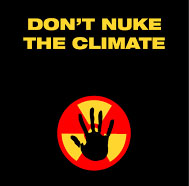
With nuclear energy, when things go wrong, they go very, very wrong
Masayoshi Iyoda, Campaigner in Japan for 350.org, 3 Apr 24, ore https://www.aljazeera.com/opinions/2024/4/3/nuclear-energy-cannot-lead-the-global-energy-transition
On March 11, 2011, a magnitude 9 earthquake and a subsequent 15-metre tsunami struck Japan, which triggered a nuclear disaster at TEPCO’s Fukushima Daiichi nuclear plant. Three of the six plant’s reactors were affected, resulting in meltdowns and the release of a significant amount of radioactive material into the environment.
Today, 13 years later, Japan is still experiencing the impacts of this disaster. Immediately after the earthquake struck, more than 160,000 people were evacuated. Of them, nearly 29,000 still remain displaced.
Disastrous health effects due to exposure to radioactivity are still a serious concern for many, and environmental impacts on land, water, agriculture, and fisheries are still visible. The cost of the damage, including victim compensation, has been astronomical; $7bn has been spent annually since 2011, and work continues.
Last year, Japan’s plan to start releasing more than a million tonnes of treated wastewater into the Pacific Ocean sparked anxiety and anger, including among community members who rely on fishing for their livelihoods, from Fukushima to Fiji.
Yet, Japan and the rest of the world appear not to have learned much from this devastating experience. On March 21, Belgium hosted the first Nuclear Energy Summit attended by high-level officials from across the globe, including Japanese Vice-Minister for Foreign Affairs Masahiro Komura. The event was meant to promote the development, expansion and funding of nuclear energy research and projects.

The summit came after more than 20 countries, including Japan, announced plans to triple nuclear energy capacity by 2050 at last year’s UN Climate Change Conference (COP28).
All of these developments go against growing evidence that nuclear energy is not an efficient and safe option for the energy transition away from fossil fuels.
Despite advancements in waste-storage technology, no foolproof method for handling nuclear waste has been devised and implemented yet. As nuclear power plants continue to create radioactive waste, the potential for leakage, accidents, and diversion to nuclear weapons still presents significant environmental, public health, and security risks.
Nuclear power is also the slowest low-carbon energy to deploy, is very costly and has the least impact in the short, medium and long term on decarbonising the energy mix. The latest Intergovernmental Panel on Climate Change (IPCC) report pointed out that nuclear energy’s potential and cost-effectiveness of emission reduction by 2030 was much smaller than that of solar and wind energy.
Large-scale energy technologies like nuclear power plants also require billions of dollars upfront, and take a decade to build due to stricter safety regulations. Even the deployment of small modular reactors (SMR) has a high price tag. Late last year, a flagship project by NuScale funded by the US government to the tune of hundreds of millions of dollars had to be abandoned due to rising costs.
In addition to that, according to a report released by Greenpeace in 2023, even in the most favourable scenario and with an equal investment amount, by 2050, the installation of a wind and solar power infrastructure would produce three times more cumulative electricity and emit four times less cumulative CO2 compared to a water nuclear reactor in the same period.
And the climate crisis is not just about CO2 emissions. It is about a whole range of environmental justice and democracy issues that need to be considered. And nuclear energy does not have a stellar record in this regard.
For instance, uranium mining – the initial step in nuclear energy production – has been linked to habitat destruction, soil and water contamination, and adverse health effects for communities near mining sites. The extraction and processing of uranium require vast amounts of energy, often derived from nonrenewable sources, further compromising the environmental credentials of nuclear power.
Nuclear energy also uses centralised technology, governance, and decision-making processes, concentrating the distribution of power in the hands of the few.
For an equitable energy transition, energy solutions need not only to be safe, but justly sourced and fairly implemented. While nuclear power plants require kilometres of pipelines, long-distance planning, and centralised management, the manufacturing and installation of solar panels and wind turbines is becoming more and more energy efficient and easier to deploy.
If implemented correctly, regulation and recycling programnes can address critical materials and end-of-life disposal concerns. Community-based solar and wind projects can create new jobs, stimulate local economies, and empower communities to take control of their energy future as opposed to contributing more money to the trillion-dollar fossil fuel industry.
Although the 2011 disaster in Fukushima may seem like a distant past, its effects today on the health of its environment, people and community are reminders that we must not be dangerously distracted with the so-called promises of nuclear energy.
We must not transition from one broken system to another.
Wealthy countries have an ethical historical responsibility to support global finance reform and provide ample funding for renewable energy in lower-income countries. To keep our world safe and fair, not only do we need to tax and phase out fossil fuels immediately, but it is essential that we power up with renewable energy, such as wind and solar, fast, widely, and equitably.
1 This Month
To see nuclear-related stories in greater depth and intensity – go to https://nuclearinformation.wordpress.com/
12 February – Webinar The Big Push: New Nuclear Projects in Canada
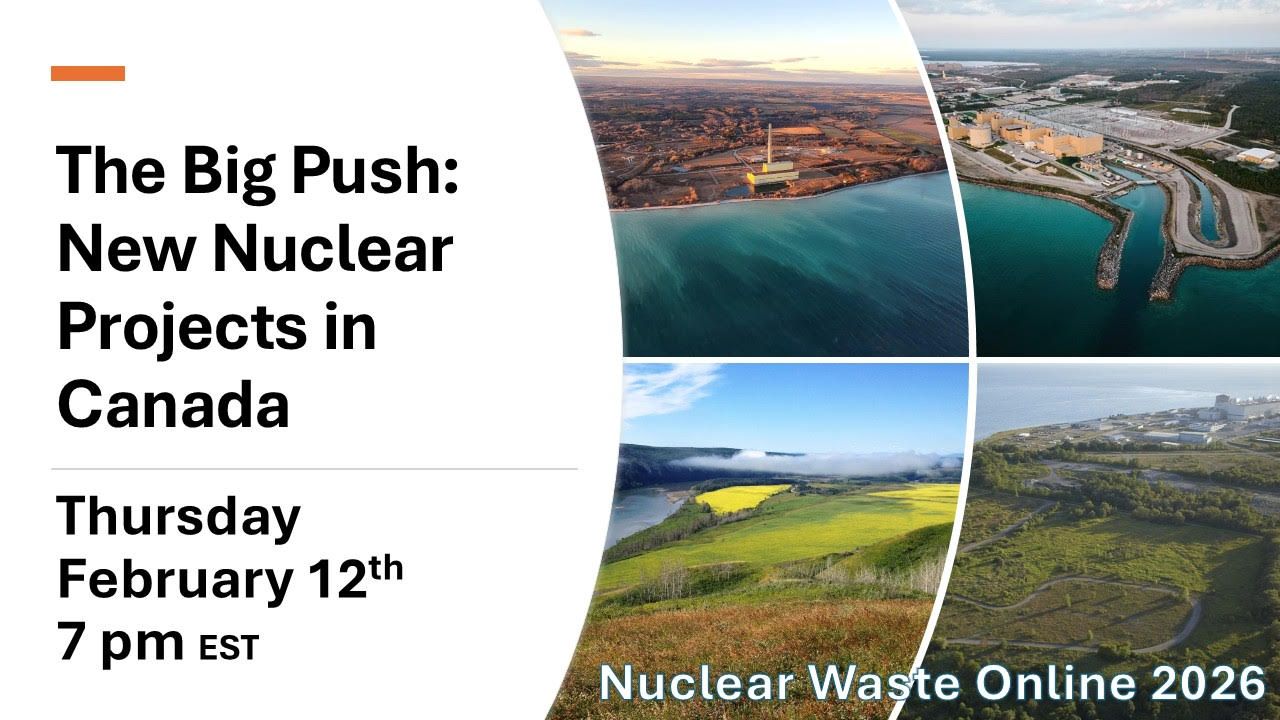
Thursday, February 12, 7 pm Eastern | 2nd of 4 sessions in the 2026 Nuclear Waste Online webinar series
Join a webinar on the push for new nuclear generation in Canada. Go to Northwatch.org to register or use the registration link https://us02web.zoom.us/webinar/register/WN_ZfWOf1GITqSRIZX8CB-A9w
-
Archives
- February 2026 (127)
- January 2026 (308)
- December 2025 (358)
- November 2025 (359)
- October 2025 (376)
- September 2025 (258)
- August 2025 (319)
- July 2025 (230)
- June 2025 (348)
- May 2025 (261)
- April 2025 (305)
- March 2025 (319)
-
Categories
- 1
- 1 NUCLEAR ISSUES
- business and costs
- climate change
- culture and arts
- ENERGY
- environment
- health
- history
- indigenous issues
- Legal
- marketing of nuclear
- media
- opposition to nuclear
- PERSONAL STORIES
- politics
- politics international
- Religion and ethics
- safety
- secrets,lies and civil liberties
- spinbuster
- technology
- Uranium
- wastes
- weapons and war
- Women
- 2 WORLD
- ACTION
- AFRICA
- Atrocities
- AUSTRALIA
- Christina's notes
- Christina's themes
- culture and arts
- Events
- Fuk 2022
- Fuk 2023
- Fukushima 2017
- Fukushima 2018
- fukushima 2019
- Fukushima 2020
- Fukushima 2021
- general
- global warming
- Humour (God we need it)
- Nuclear
- RARE EARTHS
- Reference
- resources – print
- Resources -audiovicual
- Weekly Newsletter
- World
- World Nuclear
- YouTube
-
RSS
Entries RSS
Comments RSS
 nuclear-news