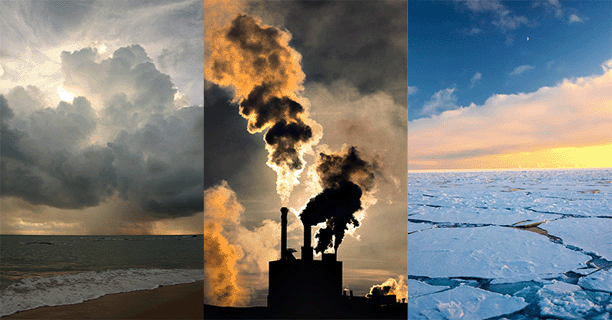
Earth is a planet in upheaval, say scientists, as the World Meteorological Organisation publishes analysis of recent heat highs and ice lows, Guardian, Damian Carrington, 20 Mar 17, The record-breaking heat that made 2016 the hottest year ever recorded has continued into 2017, pushing the world into “truly uncharted territory”, according to the World Meteorological Organisation.
The WMO’s assessment of the climate in 2016, published on Tuesday, reports unprecedented heat across the globe, exceptionally low ice at both poles and surging sea-level rise.
Global warming is largely being driven by emissions from human activities, but a strong El Niño – a natural climate cycle – added to the heat in 2016. The El Niño is now waning, but the extremes continue to be seen, with temperature records tumbling in the US in February and polar heatwaves pushing ice cover to new lows.
“Even without a strong El Niño in 2017, we are seeing other remarkable changes across the planet that are challenging the limits of our understanding of the climate system. We are now in truly uncharted territory,” said David Carlson, director of the WMO’s world climate research programme.
“Earth is a planet in upheaval due to human-caused changes in the atmosphere,” said Jeffrey Kargel, a glaciologist at the University of Arizona in the US. “In general, drastically changing conditions do not help civilisation, which thrives on stability.”
The WMO report was “startling”, said Prof David Reay, an emissions expert at the University of Edinburgh: “The need for concerted action on climate change has never been so stark nor the stakes so high.”
The new WMO assessment also prompted some scientists to criticise Donald Trump. “While the data show an ever increasing impact of human activities on the climate system, the Trump administration and senior Republicans in Congress continue to bury their heads in the sand,” said Prof Sir Robert Watson, a distinguished climate scientist at the UK’s University of East Anglia and a former head of the UN’s climate science panel.
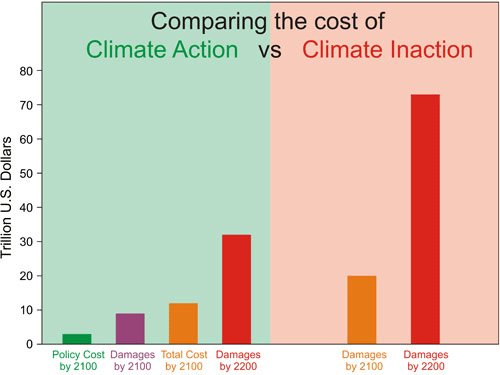
“Our children and grandchildren will look back on the climate deniers and ask how they could have sacrificed the planet for the sake of cheap fossil fuel energy, when the cost of inaction exceeds the cost of a transition to a low-carbon economy,” Watson said.
Trump is aiming to cut climate change research. But the WMO’s secretary-general Petteri Taalas said: “Continued investment in climate research and observations is vital if our scientific knowledge is to keep pace with the rapid rate of climate change.”
2016 saw the hottest global average among thermometer measurements stretching back to 1880. But scientific research indicates the world was last this warm about 115,000 years ago and that the planet has not experienced such high levels of carbon dioxide in the atmosphere for 4m years.
“Arctic ice conditions have been tracking at record low conditions since October, persisting for six consecutive months, something not seen before in the [four-decade] satellite data record,” said Prof Julienne Stroeve, at University College London in the UK. “Over in the southern hemisphere, the sea ice also broke new record lows in the seasonal maximum and minimum extents, leading to the least amount of global sea ice ever recorded.”
Emily Shuckburgh, at the British Antarctic Survey, said: “The Arctic may be remote, but changes that occur there directly affect us. The melting of the Greenland ice sheet is already contributing significantly to sea level rise, and new research is highlighting that the melting of Arctic sea ice can alter weather conditions across Europe, Asia and North America.”
Global sea level rise surged between November 2014 and February 2016, with the El Niño event helping the oceans rise by 15mm. That jump would have take five years under the steady rise seen in recent decades, as ice caps melt and oceans get warmer and expand in volume. Final data for 2016 sea level rise have yet to be published.
Climate change harms people most directly by increasing the risk of extreme weather events and the WMO report states that these raised risks can increasingly be calculated. For example, the Arctic heatwaves are made tens of times more likely and the soaring temperatures seen in Australia in February were made twice as likely.
“With levels of carbon dioxide in the atmosphere consistently breaking new records, the influence of human activities on the climate system has become more and more evident,” said Taalas.
Climate change makes weather extremes the new normal http://www.dw.com/en/climate-change-makes-weather-extremes-the-new-normal/a-38085847 On World Meteorological Day, DW provides an overview of how global warming is changing our lived experience of the climate. News of the hottest year, the wettest winter and suffocating summers are no longer a surprise. We’re getting used to extreme weather – and that’s worrying.
In 2016, Earth’s surface reached its warmest temperatures since 1880. It was the third year in a row to set a global record, as confirmed in the recently published World Meteorological Organization (WMO) Statement on the State of the Global Climate in 2016.
Not surprisingly, 2017 is also expected to follow the trend, even though February 2017 was slightly cooler than the same month last year.
During the 20th century, the average temperature on Earth increased by around 1.8 degree Fahrenheit (1 Celsius). That may not seem much. But for comparison, temperatures during the last ice age were only 5 to 9 degrees Fahrenheit cooler than today, according to NASA.
Small changes in temperature mean huge changes for the environment, and the Earth’s climate record shows such fluctuations have been extremely rare historically. Violent weather
Extreme weather events used to occur on average only once in 100 years, but climate change is increasing their frequency, the United States Environmental Protection Agency (EPA) warns. And people and ecosystems around the world are feeling the impact.
Hurricane Matthew had devastating consequences in Haiti and part of the United States. Severe droughts and floods in 2016 have affected millions of people around the world.
In May, Canada suffered its most damaging wildfire – and most costly natural disaster – ever. Some months later, the United States also experienced its most destructive wildfire in modern history.
Europe hasn’t escaped either. Scotland, Wales and Northern Ireland had their wettest winter on record. Intense flooding hit France and Germany during May and June 2016, while France had its driest July and August on record.
European natural wonders such as the Alps are also at risk. The mountainous area is heating up twice as fast as the global average, which could lead to fire seasons lasting 30 to 50 days longer by 2050.
In March 2017, much of Peru is under a state of emergency due to devastating floods.
While some of these events are directly related to human activity and climate change, some remain under question. Climate change to blame
The 2016 European Environmental Agency report on climate change impacts, stated that global climate change had significantly increased the probability of extreme climate events in Europe.
Despite a range of factors leading to extreme weather, the vast majority of scientists have no doubt that extreme weather is connected to climate change.
While climate change may not be directly be causing, such events it is to blame for the increasing frequency and strength with which they hit.
Referring to Peru’s recent floods, Mojib Latif, a professor of oceanology and climate dynamics at GEOMA (the Helmholtz Center for Ocean Research in Kiel, Germany), said El Nino events have indeed become more frequent and stronger in recent decades.
The extreme El Nino climate pattern corresponds to climate change models, he said. However, he emphasized, it is still unclear whether this will become a trend.
Peak temperatures influence precipitation rates: For every additional degree Celsius, precipitation rates can increase from 5 to 10 percent.
For scientists, the link between fossil fuel emissions and global warming that is contributing to extreme weather is also beyond question.
“With carbon dioxide reaching a record annual average concentration of 400 parts per million in the atmosphere, the influence of human activities on the climate system has become more and more evident,” Petteri Taalas, WMO secretary general, said in the report.
Disastrous consequences Drought has left millions of people – mainly in Africa – starving because crops have failed, while flooding has displaced thousands of communities in Southeast Asia, the WMO reports.
Agricultural production is at risk in countries affected by flooding – not to mention those hit by natural disasters such as hurricanes. That not only puts food security at risk, but has broader economic impacts.
For example, in Australia a threat to agricultural production could have major consequences, as it represents one of the main pillars of the country’s economy, the Australian Climate Council reported. Extreme weather events linked to global warming have reprecussions throughout society.
The Union of Concerned Scientists mentions, among others: public health impacts, infrastructural and economic costs, and the destruction of biodiversity.
In cooler climes such as Germany, an early spring might put a smile on many people’s faces. But its global consequences threaten to create a very bleak future.
Climate change played key role in Syrian civil war and helped Brexit, Al Gore says, http://www.sanluisobispo.com/news/nation-world/national/article140523093.htmlAn24 Mar 17, historic drought in Syria led to that nation’s civil war, which, in turn, helped Brexit pass in England, according to former United States Vice President Al Gore who explained his theory at a conference in London this week.
Gore, who has long argued that humans are causing climate change, won an Oscar for his climate-change documentary “An Inconvenient Truth.”
“From 2006 to 2010, 60 percent of the farms in Syria were destroyed and had to be abandoned. Eighty percent of the livestock were killed. The drought in the eastern Mediterranean is the worst ever recorded,” Gore said according to several press reports.
The drought, Gore says, forced more than a million Syrians into cities where they “collided” with refugees from the Iraq War, setting the stage for the Syrian Civil War. Gore said that WikiLeaks documents revealed internal conversations among the Syrian government.
“They were saying to one another, ‘We can’t handle this. There’s going to be a social explosion.’ There are other causes of the Syrian civil war,” Gore said, “but this was the principle one.”
That conflict, which began in July 2011, has killed more than 450,000 Syrians and displaced more than 12 million Syrians, according to Al-Jazeera. CNN reports more than 4.8 million Syrians have left the country due to the conflict, which started as a government crackdown in response to protests.
Many of those fleeing the country have migrated to Europe, creating crises in several European nations. That, Gore says, helped lead to Brexit. In June of 2016, citizens of the United Kingdom voted to leave the European Union. Many linked the ongoing refugee crisis to the vote to leave.
“It has unleashed with other factors this incredible flow of refugees into Europe, which is creating political instability in Europe,” Gore said, “and which contributed in some ways to the desire of some in the U.K., to say, ‘Wow, we’re not sure we want to be a part of that anymore.’ ”
The Trump administration does not share Gore’s views on human-caused climate change and has already rolled back numerous Obama-era environmental protections.
“Regarding the questions as to climate change, I think the President was fairly straightforward. We’re not spending money on that anymore. We consider that to be a waste of your money to go out and do that,” Mulvaney said.
US scientists launch world’s biggest solar geoengineering study Research programme will send aerosol injections into the earth’s upper atmosphere to study the risks and benefits of a future solar tech-fix for climate change, Guardian, Arthur Neslen, 24 Mar 17, US scientists are set to send aerosol injections 20km up into the earth’s stratosphere in the world’s biggest solar geoengineering programme to date, to study the potential of a future tech-fix for global warming.
The $20m (£16m) Harvard University project will launch within weeks and aims to establish whether the technology can safely simulate the atmospheric cooling effects of a volcanic eruption, if a last ditch bid to halt climate change is one day needed.
Scientists hope to complete two small-scale dispersals of first water and then calcium carbonate particles by 2022. Future tests could involve seeding the sky with aluminium oxide – or even diamonds.
“This is not the first or the only university study,” said Gernot Wagner, the project’s co-founder, “but it is most certainly the largest, and the most comprehensive.”
Janos Pasztor, Ban Ki-moon’s assistant climate chief at the UN who now leads a geoengineering governance initiative, said that the Harvard scientists would only disperse minimal amounts of compounds in their tests, under strict university controls.
“The real issue here is something much more challenging,” he said “What does moving experimentation from the lab into the atmosphere mean for the overall path towards eventual deployment?”
Geoengineering advocates stress that any attempt at a solar tech fix is years away and should be viewed as a compliment to – not a substitute for – aggressive emissions reductions action.
But the Harvard team, in a promotional video for the project, suggest a redirection of one percent of current climate mitigation funds to geoengineering research, and argue that the planet could be covered with a solar shield for as little as $10bn a year.
Some senior UN climate scientists view such developments with alarm, fearing a cash drain from proven mitigation technologies such as wind and solar energy, to ones carrying the potential for unintended disasters.
Kevin Trenberth, a lead author for the UN’s intergovernmental panel on climate change, said that despair at sluggish climate action, and the rise of Donald Trump were feeding the current tech trend.
“But solar geoengineering is not the answer,” he said. “Cutting incoming solar radiation affects the weather and hydrological cycle. It promotes drought. It destabilizes things and could cause wars. The side effects are many and our models are just not good enough to predict the outcomes”…….
critics of solar radiation management approach this as a call to redouble mitigation efforts and guard against the elevation of a questionable Plan B.
Sea-level rise poses ‘a serious threat’ to millions of Europeans, scientists warn. A new study spells out the threat of sea-level rise in coastal communities.The kind of devastating flooding that occurs once every century along Europe’s northern coastline could become an annual event if greenhouse gas emissions continue to climb, according to a recent study published in the journal Earth’s Future.
New analysis takes into account changes in sea-level rise, tides, waves, and storm surge over the 21st century and found that climate change could prompt extreme sea levels — the maximum levels seen during major storms, which produce massive flooding — to increase significantly along the European coastline by 2100.
This scenario will likely stress coastal protection structures beyond their capacity, leaving much of the European coastline vulnerable to dangerous flooding, according to study authors.
“Unless we take different protection measures, five million people will be exposed to coastal flooding on an annual basis,” said Michalis Vousdoukas, a coastal oceanographer at the Joint Research Centre of the European Commission and lead author of the study.
The study described the projected rise in extreme sea levels as “a serious threat” to coastal communities, noting, “their safety and resilience depends on the effectiveness of natural and man-made coastal flood protection.”
Kevin Trenberth, a scientist with the climate analysis section of the National Center for Atmospheric Research, who was not involved in this research, said the signs of extreme sea levels are already worrisome, not just in Europe, but in the United States as well. “Witness the sunshine flooding in Florida already, the flooding that shows up even with no storm on many streets any time there is a slightly high tide,” he said.
Sea level is going up because the ocean is warming and hence expanding, and because land ice — glaciers, etc. — are melting and putting more water into the ocean. But it is not the gradual rise that matters,” Trenberth said. “Rather, it is the storm surge on top of a high tide riding on top of the increase in sea level that crosses thresholds and causes things to break.”
Richard Alley, professor of geosciences at Pennsylvania State University, who also did not take part in this study, noted that the study didn’t consider the possible collapse of the West Antarctic ice sheet. “If that happens, then sea-level rise and impacts to coasts could be much higher than in this paper,” Alley said. “Rapid West Antarctic collapse could cause enough rise to make many of these other factors of secondary importance. So, the ‘worst case’ in this paper isn’t really the worst case.”
The new paper predicted that some regions could experience an even higher increase in the frequency of these extreme flooding events, specifically along the Mediterranean and the Black Sea, where the present day 100-year extreme sea level could occur as often as several times a year.
“The ‘worst case’ in this paper isn’t really the worst case.”
Information about the number of people at risk from flooding can be used to determine how large the social and economic impact of these events will be, said Marta Marcos, a researcher at the Mediterranean Institute for Advanced Studies in Spain, who was not involved in the new study. “In terms of adaptation strategies and policy-making, it is very relevant,” she said.
The researchers studied changes in extreme sea levels by 2100 under different greenhouse gas scenarios and considered how all these components — mean sea level, tides, waves, and storm surge — will be affected by climate change.
f emissions continue to rise unabated throughout this century, extreme sea levels along Europe’s coastlines could increase by more than 2.5 feet, on average, by 2100. Under a more moderate situation, where greenhouse gas emissions peak in 2040, 100-year extreme sea levels still could jump by nearly 2 feet, on average, by the end of the century — with flooding events occurring every few years — according to study’s authors.
In a related study appearing in Geophysical Research Letters, scientists found that if greenhouse gases continue to rise, there could be disturbing changes by the end of the century in the energy that waves carry to the coast.
In the southern hemisphere, extreme waves could carry up to 30 percent more energy by 2100, according to the study, meaning that stronger waves will become more frequent, and have a greater impact on the coast, said Lorenzo Mentaschi, a researcher at the Joint Research Centre and lead author of the study.
The new study attributed the changes in wave energy to the intensification of weather patterns, like El Niño. The new research will be provided to European Union policymakers. The data will also be made public so it can be used by scientists, engineers, and coastal managers.
Michael Mann, professor of atmospheric science at Pennsylvania State University, said the research once again underscored how climate change, “which has already increased the threat to our coastlines through a combination of sea-level rise and intensified coastal storms, will be catastrophic for coastal communities if we don’t reduce global carbon emissions.”
Marlene Cimons writes for Nexus Media, a syndicated newswire covering climate, energy, policy, art & culture.
ECONOMIC COST OF #CLIMATECHANGE ARE ‘MASSIVE’, JPratt27, 17 Mar 17Funding efforts to fight climate change is “a waste of your money,” the director of the Office of Management and Budget Mick Mulvaney said in a press conference today.
But Mulvaney is dangerously wrong: in fact, experts say that that the economic costs of climate change are so massive that delayed action, or inaction, is the most expensive policy option out there.
Mulvaney was defending President Trump’s proposed 2018 budget, which cuts funding for the Environmental Protection Agency by 31 percent — making good on Trump’s threat to dismantle the agency.
“Regarding the question as to climate change, the president was fairly straightforward,” Mulvaney said.
“‘We’re not spending money on that anymore.’”
That’s a really bad idea, for a couple of reasons.
But first, let’s get this out of the way: there is overwhelming evidence that climate change is real, and caused by carbon emissions.
Scientifically, the debate’s over and this is our fault — no matter how much Scott Pruitt or Ryan Zinke try to duck responsibility on behalf of humankind.
Sitting out on global warming is a bad deal for America
Second, there are big chunks of the US economy that depend on the global temperature staying put — like the agriculture and fish industries, for example. …….as global temperatures climb, severe droughts, extreme rain and snowfall, flooding, and heatwaves have already started to increase — making it a lot harder to grow crops no matter how much they love guzzling down that CO2.
Unchecked climate change will hit farmers where it hurts
We’ve started seeing some of the consequences of climate change on agriculture already, according to a government report: high temperatures in 2011 cost meat producers more than $1 billion dollars in what the EPA called “heat-related losses.” …..
Nationwide, The Risky Business Project estimates that anywhere from $66 billion to $106 billion of coastal real estate is probably going to hard to enjoy without a snorkel by the year 2100.
This is bad for more than just Mar-a-Lago: massive coastal flooding could also have major ripple effects on the economy, according to a report by government-sponsored mortgage company Freddie Mac.
Coastal businesses could relocate or simply go under, taking jobs with them.
Lenders and mortgage insurers could also suffer huge losses because, the report says, “It is less likely that borrowers will continue to make mortgage payments if their homes are literally underwater.”
It gets worse: “Non-economic losses may be substantial as some communities disappear or unravel. Social unrest may increase in the affected areas.”
“It is less likely that borrowers will continue to make mortgage payments if their homes are literally underwater.”
Big picture, global warming could cause the global economy to plummet — leading to a 23 percent drop in gross domestic product per person by the year 2100, according to a 2015 study published in Nature.
“We’re basically throwing away money by not addressing the issue,” Marshall Burke, an assistant professor at Stanford University, told TIME.
Even bankers agree — and they’re not known for being tree-huggers……….
waiting to start fighting global warming — or sitting out the fight altogether — is a bad deal for America’s future. Given President Trump’s claims about his business acumen, he, of all people, should see that.
World financial leaders have dropped a reference to financing climate change from their draft communique, says an official taking part in a meeting of finance ministers and central bankers of the Group of 20 leading economies.
At their last meeting in July 2016 in the Chinese city of Chengdu, the G20 financial leaders said they encouraged all signatories of the Paris Agreement on climate change to bring the deal into force as soon as possible.
“Climate change is out for the time being,” said the official, who asked not to be named.
US President Donald Trump has called global warming a “hoax” concocted by China to hurt US industry and vowed to unpick the Paris climate accord that is supposed to curb rising temperatures.
CO2 emissions from energy remain flat for third year running By New Scientist staff and Press Association, 17 March 2017
Carbon dioxide emissions from energy have not increased for three years in a row even as the global economy grew, says the International Energy Agency (IEA).
Global emissions from the energy sector were 32.1 billion tonnes in 2016, the same as the previous two years, while the economy grew 3.1 per cent, the agency says.
The IEA put the halt in growth down to growing renewable power generation, switches from coal to natural gas and improvements in energy efficiency.
The biggest drop was seen in the US, where carbon dioxide emissions fell 3 per cent, while the economy grew 1.6 per cent, following a surge in shale gas supplies and more renewable power that displaced coal.
US emissions are at their lowest level since 1992, while the economy has grown 80 per cent since that time.
“These three years of flat emissions in a growing global economy signal an emerging trend and that is certainly a cause for optimism, even if it is too soon to say that global emissions have definitely peaked,” says Fatih Birol, the IEA’s executive director…….
Trump’s budget is everything scientists have been fearing
The outline cuts at least $7 billion for research on climate change, diseases, and energy, VOX by Brian Resnick@B_resnickbrian@vox.com Mar 16, 2017, The top-line numbers of President Donald Trump’s budget proposal should give the nation’s scientists shivers. The administration doesn’t seem to think science should be a priority at all.
The blueprint released today is preliminary. The administration still needs to draft a full budget, which we won’t see until May. And ultimately, it’s up to Congress to decide who gets what.
But what’s important about this budget proposal is that it tells the public and Congress where the president’s concerns lie. And they don’t appear to be issues like climate change, disease treatment and prevention, or basic research funding for universities.
In all, we count up least $7 billion in reductions to science programs, including:
A $5.8 billion reduction in funding to the National Institutes of Health (18 percent of its total budget.) Most of the NIH’s budget goes to funding research in health care in universities across the country.
A $102 million cut to NASA’s Earth science programs, eliminating four NASA Earth science missions completely:
PACE — a program for measuring changes to ocean ecosystems by tracking concentrations of chlorophyll (what makes algae green) from space.
OCO-3 — a yet-to-be-launched space station module to track atmospheric carbon dioxide.
DSCOVR — the “deep space climate observatory,” which is partially run by NOAA. (The budget doesn’t mention if NOAA will retain this program.) DSCOVR is an early warning system for solar storms, and has capabilities to detect changes in levels of ozone and other pollutants in the atmosphere.
CLARREO Pathfinder — the “Climate Absolute Radiance and Refractivity Observatory.” It’s set to be launched in 2020 to amass highly accurate records of climate change on Earth so scientists can make more precise predictions about the future.
A $900 million reduction in the Energy Department’s basic science research. The Advanced Research Projects Agency-Energy — a $300 million program that provides grants for energy research — is wholly eliminated because “the private sector is better positioned to finance disruptive energy research.”
A $250 million cut in NOAA grants “and programs supporting coastal and marine management, research, and education including Sea Grant.”
The world’s oceans are storing up staggering amounts of heat — and it’s even more than we thought, by Chelsea Harvey, Energy & Enviornment, Washington Post, Mar 10, 2017 The world is getting warmer every year, thanks to climate change — but where exactly most of that heat is going may be a surprise.
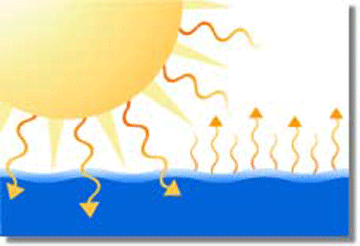
As a stunning early spring blooms across the United States, just weeks after scientists declared 2016 the hottest year on record , it’s easy to forget that all the extra warmth in the air accounts for only a fraction of the heat produced by greenhouse gas emissions. In fact, more than 90 percent of it gets stored in the ocean. And now, scientists think they’ve calculated just how much the ocean has warmed in the past few decades.
A new study, out Friday in the journal Science Advances, suggests that since 1960, a staggering 337 zetajoules of energy — that’s 337 followed by 21 zeros — has been added to the ocean in the form of heat. And most of it has occurred since 1980.
“The ocean is the memory of all of the past climate change,” said study co-author Kevin Trenberth , a senior scientist at the National Center for Atmospheric Research.
A new study provides a solid evidence for global warming https://www.eurekalert.org/pub_releases/2017-03/ioap-ans031317.php INSTITUTE OF ATMOSPHERIC PHYSICS, CHINESE ACADEMY OF SCIENCES Global warming is driven by the Earth’s energy imbalance (EEI): our planet traps more and more heat due to continuous increasing greenhouse gases. From the energy perspective, the global warming is actually ocean warming, since ocean stores more than 90% of the trapped heat. Therefore, ocean heat content (OHC) change is a fundamental indicator of global warming, thus direct measurement of OHC will provide a direct evidence for climate change.
Reliable assessment of historical OHC change is a key task in climate studies. OHC time series provided by independent international groups show large discrepancies for long-term trend, intra-seasonal, inter-annual and decadal variability, because there are many challenges in estimating historical OHC change.
“Firstly, one of the major ocean subsurface observations (i.e. XBT) contains systematic bias.” Said Dr. Lijing Cheng from the Institute of Atmospheric Physics, Chinese Academy of Science(IAP,CAS), also a lead author of a new study (Cheng et al. 2017) published in Science Advances, “Secondly, temperature observations at ocean subsurface are extremely sparse, especially before 2005, since they were mainly distributed along the major shipping routes in the Northern Hemisphere.”
During the recent decade, a new type of sensing device has been deployed (the Argo float system), which significantly increases the coverage of ocean data. However, there are still more than 60% of the ocean grids without any observations (if the global ocean is divided into 1 degree and 1 month grids). So a gap-filling method is required to make a “guess” for the temperature change in the ocean grids without observations. This “guess” is based on the spatial and temporal covariance of ocean temperature changes. In another word, the ocean changes at two locations are not completely independent; instead, they are correlated under physical rules. The gap-filling method works to utilize the correlation to reconstruction the missed information. The choice of different gap-filling methods is the major error source in global OHC calculation.
The study led by IAP, CAS, collaborated with NCAR, NOAA, and University of St. Thomas, made a major step to estimate historical OHC change. The new study applied an advanced XBT bias correction method, which is recommended according to an XBT community paper published in 2016 in Bulletin of the American Meteorological Society. This ensures that the observation bias is minimized. The key step made by the new study is the application of an advanced gap-filling method and a careful evaluation on the results. It is highlighted that this study uses the knowledge of recent well-observed ocean states, but subsample it using the sparse distribution of observations in the more distant past to show that the method produces startling good results since late 1950s.
This new work allows a more accurate assessment of how much heat has accumulated in the ocean (and Earth) system. The inferred ocean energy accumulation is larger than previous estimates, such as from the last Intergovernmental Panel on Climate Change Fifth Report (IPCC-AR5) in 2013. But it is consistent with the direct observations of Earth’s energy imbalance at top of atmospheresince late 1980s. This new look at OHC and EEI changes over time provides greater confidence than previously possible, and the data sets produced are a valuable resource for further climate change study.
Prof. Fan Wang, deputy director of Institute of Oceanography, Chinese Academy of Science, commented on the paper, “This study provided a new reconstruction on ocean subsurface temperature change since 1960 for 0-2000m depths, and assessed historical ocean energy budget more accurately. So it will be a valuable resource for future studies of oceanic variability and its climatic impacts on both regional and global scales”.
###
Established in February of 1928 (then called Institute of Meteorology of Academia Sinica), the Institute of Atmospheric Physics (IAP) was the very first and foremost research center carrying meteorological research in modern China. Today IAP has become a comprehensive atmospheric research institution, covering all aspects of atmospheric sciences.
The orientation and mission of IAP includes to study and explore the new laws of physical, chemical, biological and human processes happening in the Earth’s atmosphere and in the interactions between atmosphere and surrounding environment; provide advanced theories, methods and technologies regarding monitoring, forecast and control of weather, climate and environment; cultivate top talented persons in this discipline; and serve the sustainable economic and social development and national security.
CARBON DIOXIDE LEVELS RISING AT RECORD PACE. #AUSPOL #SCIENCE, JPratt 27 , 12 Mar 17
Carbon dioxide levels rose at record pace for 2nd straight year | National Oceanic and Atmospheric Administration
Carbon dioxide levels measured at NOAA’s Mauna Loa Baseline Atmospheric Observatory rose by 3 parts per million to 405.1 parts per million (ppm) in 2016, an increase that matched the record jump observed in 2015.
The two-year, 6-ppm surge in the greenhouse gas between 2015 and 2017 is unprecedented in the observatory’s 59-year record. And, it was a record fifth consecutive year that carbon dioxide (CO2) rose by 2 ppm or greater, said Pieter Tans, lead scientist of NOAA’s Global Greenhouse Gas Reference Network.
“The rate of CO2 growth over the last decade is 100 to 200 times faster than what the Earth experienced during the transition from the last Ice Age,” Tans said. “This is a real shock to the atmosphere.”
Globally averaged CO2 levels passed 400 ppm in 2015 — a 43-percent increase over pre-industrial levels. In February 2017, CO2 levels at Mauna Loa had already climbed to 406.42 ppm…..
NOAA has measured CO2 on site at the Mauna Loa observatory since 1974. To ensure accuracy, air samples from the mountaintop research site in Hawaii are shipped to NOAA’s Earth System Research Laboratory in Boulder, Colorado, for verification. The Scripps Institution of Oceanography, which first began sampling CO2 at Mauna Loa in 1956, also takes independent measurements onsite.
Emissions from fossil-fuel consumption have remained at historically high levels since 2011 and are the primary reason atmospheric CO2 levels are increasing at a dramatic rate, Tans said. This high growth rate of CO2 is also being observed at some 40 other sites in NOAA’s Global Greenhouse Gas Reference Network.
The greenhouse effect, explained
Carbon dioxide is one of several gases that are primarily responsible for trapping heat in the atmosphere. This “greenhouse effect” maintains temperatures suitable for life on Earth. Increasing CO2 levels trap additional heat in the atmosphere and the oceans, contributing to rising global average temperatures.
Atmospheric CO2 averaged about 280 ppm between about 10,000 years ago and the start of the Industrial Revolution around 1760.
NEW EPA boss says carbon dioxide not primary cause of climate change By New Scientist staff and Press Association, SHORT SHARP SCIENCE, 9 March 2017 The new chief of the US Environmental Protection Agency has said he does not believe that carbon dioxide is a primary contributor to global warming……..
Pruitt’s view is at odds with mainstream climate science, including NASA and the National Oceanic and Atmospheric Administration.
The planet’s average surface temperature has risen by about 2 degrees F since the late 19th century, “a change driven largely by increased carbon dioxide and other human-made emissions into the atmosphere”, the agencies said in a joint statement.
Environmental groups seized on Pruitt’s comments as evidence he is unfit for the office he holds.
“The arsonist is now in charge of the fire department, and he seems happy to let the climate crisis burn out of control,” said Sierra Club executive director Michael Brune.
Pruitt “is spewing corporate polluter talking points rather than fulfilling the EPA’s mission of protecting our air, our water, and our communities,” Brune said, noting that the EPA has a legal responsibility to address carbon pollution.
Senator Brian Schatz (Democrat, Hawaii) said the comments underscore that Pruitt is a “climate denier” and insisted politicians will stand up to him. “Anyone who denies over a century’s worth of established science and basic facts is unqualified to be the administrator of the EPA,” Schatz said in a statement.
Pruitt previously served as Oklahoma attorney general, where he rose to prominence as a leader in co-ordinated efforts by Republican attorneys general to challenge former president Barack Obama’s regulatory agenda.
This climate lawsuit could change everything. No wonder the Trump administration doesn’t want it going to trial, WP, By Chelsea HarveyMarch 9A groundbreaking climate lawsuit, brought against the federal government by 21 children, has been hailed by environmentalists as a bold new strategy to press for climate action in the United States. But the Trump administration, which has pledged to undo Barack Obama’s climate regulations, is doing its best to make sure the case doesn’t get far.
The Trump administration this week filed a motion to overturn a ruling by a federal judge back in November that cleared the lawsuit for trial — and filed a separate motion to delay trial preparation until that appeal is considered.
The lawsuit — the first of its kind — argues the federal government has violated the constitutional right of the 21 plaintiffs to a healthy climate system.
Environmental groups say the case — if it’s successful — could force even a reluctant government to reduce greenhouse gas emissions and take other measures to counter warming.
“It would be huge,” said Pat Gallagher, legal director at the Sierra Club, who is not involved in the case. “It would upend climate litigation, climate law, as we know it.”
The landmark lawsuit was originally filed during the Obama administration. The 21 plaintiffs, now between the ages of 9 and 20, claim the federal government has consistently engaged in activity that promotes fossil fuel production and greenhouse gas emissions, thereby worsening climate change. They argue this violates their constitutional right to life, liberty and property, as well the public trust doctrine, while holds that the government is responsible for the preservation of certain vital resources — in this case, a healthy climate system — for public use.
While legal experts are uncertain as to the lawsuit’s likelihood of success, few have disputed its pioneering nature. Similar cases have been brought on the state level, but this is the first against the federal government in the United States. And in November, the case cleared a major early hurdle when U.S. District Judge Ann Aiken denied motions filed by the Obama administration, as well as the fossil fuel industry, to have the lawsuit dismissed, ordering that it should proceed to trial.
The move allowed the case to join the ranks of climate lawsuits filed in other nations, which could upend the way environmental advocacy is conducted around the world. Just last year, a court in the Netherlands ordered the Dutch government to cut carbon emissions by a quarter within five years. Similar climate-related suits have been brought and won in Austria, Pakistan and South Africa.
Shortly after President Trump’s inauguration, the plaintiffs submitted a request that the Department of Justice preserve all documents that could be relevant to the lawsuit, including information on climate change, energy and emissions, and cease any destruction of such documents that may otherwise occur during the presidential transition. The request came just days after reports began to surface of climate information disappearing from White House and certain federal agency websites.