Nuclear war with North Korea ‘would be suicidal’, climate experts warn, Mashable BY ANDREW FREEDMAN, 10 Aug 17, It’s winter, 2018, in Iowa, five months after the last of the nuclear bombs detonated across megacities in northeast Asia, from Seoul to Tokyo to Shanghai. Radioactive fallout was the initial concern, but now something else is going awry: the weather.
American farmers accustomedto snow and cold during the winter would be forgiven for mistaking their corn and wheat fields for the Arctic tundra, as temperatures dip well below zero at night, and barely recover above 10 degrees Fahrenheit during the day, under a milky, leaden sky.
Forecasters say the corn and wheat harvest may be significantly shortened this year, and for the next several years. In fact, fears of a famine on an international scale are settling in.
This is what our world could look like just a few months to years after a regional nuclear war breaks out on the Korean Peninsula and spreads to include China and possibly Russia.
Whether from a deliberate strategy or a terrifying miscalculation, such a war could trigger a global climate catastrophe, experts warn, that is not being factored into leaders’ planning.
Such a war could cause the planet to cool by up to 10 degrees Celsius, or 18 degrees Fahrenheit, with larger regional swings and extremes, according to Owen Brian Toon, a scientist at the University of Colorado at Boulder. The amount of cooling could be far lower, depending on whether the conflict were more limited in scope.
Apocalyptic visions of a so-called global “nuclear winter” were popular during the Cold War when envisioning a U.S. conflict with the then-Soviet Union, but the odds of a regional nuclear war in recent times have jumped higher after President Donald Trump’s bellicose rhetoric toward North Korea on Tuesday. …….
It’s not just national security experts who are horrified by Trump’s words. Trump’s rhetoric, and history of openly considering using nuclear weapons, is also concerning to climate scientists.
Two researchers, in particular, are taking note of the North Korean threat: Alan Robock, of Rutgers University, and Toon. Robock and Toon are modern day Cassandras, having warned for decades about the potentially ruinous climate change consequences of a nuclear war, most recently focusing on regional conflicts.
Robock has conducted much of the research into the idea of a nuclear winter, whereby a global thermonuclear war vaults so much smoke into the upper atmosphere to block out the sun for years afterwards, causing temperatures to plunge and killing off vital crops and plant and animal species…….
Robock says most people, including high-ranking defense officials, are unaware that a nuclear war occurring halfway around the world from the U.S. could seriously harm the homeland, by altering the climate.
A new little ice age
Simulations in the 1980s, he said, found that temperatures would plunge so far after a U.S.-Soviet nuclear war that high temperatures in the summer temperatures would stay below freezing worldwide. ……..
The modern-day nuclear scenario that Robock, Toon and others have studied closely involves an exchange of nuclear weapons between India and Pakistan, with about 50 bombs of 15 kilotons each, which is less than half of those nations’ nuclear arsenals.
A 2007 study published in the journal Atmospheric Chemistry and Physics found that, if these weapons were aimed at the center of large cities, the direct fatalities would be “comparable to all of those worldwide in World War II.”
Such a war would induce massive firestorms in urban areas that could send up to 5 million tons of smoke high into the upper atmosphere, where tiny particles known as aerosols would scatter sunlight, preventing it from reaching the Earth’s surface.
This would turn the planet’s climate sharply colder, despite the effects of human-caused global warming, and impact areas far from the actual fighting. The global cooling from such a regional war could be near 1.25 degrees Celsius, or 2.25 degrees Fahrenheit, studies have shown.
Once in the stratosphere, the particles contributed by the smoke would stick around for a long time, Toon and Robock’s simulations show. Observations after volcanic eruptions and wildfires support the model simulations.
Stoddard believes flood insurance rates — which have been subsidized for years by governments — will be the so-called tipping point for homeowners in the U.S.
When rates are allowed to rise to a level that matches the actuarial risk of flooding, homeowners will find they cannot afford their flood insurance and will pressure elected officials to take action, he argued.
“Homeowners will find themselves underwater literally and figuratively,” Stoddard
Refugees of a different kind are being displaced by rising seas — and governments aren’t ready
Sea levels are on the rise, displacing entire populations and stirring fears for ‘climate refugees’ that must relocate.
A ‘tipping point’ is nearing as costs mount, and governments appear unprepared.
The impact is being felt as far away as Panama, and as close as Louisiana.
Increasingly, the phenomenon of rising sea levels has amplified fears over climate refugees — individuals forced to leave their homes due to changing environmental conditions in their respective homelands. Climate watchers estimate that at least 26 million people around the world have already been displaced, and that figure could balloon to 150 million by 2050, according to the Worldwatch Institute.
Relocating those populations costs vast sums of money, raising the question of who will cover those costs as sea levels continue their uptrend. The rise in global sea levels has accelerated since the 1990s amid rising temperatures, with a thaw of Greenland’s ice sheet pouring ever more water into the oceans, a team of international scientists reported last month.
In the U.S., the cost of climate change is expected to be steep. A Science study estimates that every one degree Celsius increase in global mean temperature will cost the U.S. 1.2 percent of its economic growth. Separately, a recent assessment by Lloyds estimated that flooding ranked high among the top five risks to global economic growth, and could cost upwards of $430 billion.
Mark Witte, a professor of public finance at Northwestern University, said climate relocation demonstrates a classic economic problem when it comes to addressing slow moving, long-term challenges. “We’re waiting for the tipping point,” Witte told CNBC recently. “We’re going to wait too long, and it’ll be a more expensive fix in the long term than if we just did something now.”……..
for people like 27-year-old Panama native Diwigdi Valiente, climate change is “not a fairy tale anymore.” In addition to washing away homes and schools on the inhabited islands, rising seas are set to engulf hundreds of Kuna-owned tourist beaches off the Caribbean coast, which locals use as their main source of revenue.
Valiente, part of an indigenous population called the Kuna, is one of tens of thousands of autonomous islanders who may need to relocate to the mainland within the next 20 years, as rising seas threaten to swallow their homes. Some Kuna are facing moves to the mainland even sooner than that as puddles of water form on the islands………
Panama’s government has pledged to help fund the Kuna’s relocation. However, according to Valiente, the effort is not moving quickly enough, and may not cover the full costs………
For millions of individuals living in low coastal areas across the world, and for the policymakers debating what to do and how to pay for it, climate change is no longer an abstract, far-off concept.
“We all thought this is something that was going to happen in 100 years or something,” said Valiente. “But it’s happening right now.”………
Louisiana, however, is just one recipient of federal aid. Other states haven’t been as fortunate, at least not yet.
Philip Stoddard, the mayor of South Miami, said he does not expect to see financial assistance from the federal government anytime soon — even though one in eight homes in Florida could be underwater by 2100, Zillow data states.………. Stoddard believes flood insurance rates — which have been subsidized for years by governments — will be the so-called tipping point for homeowners in the U.S.
When rates are allowed to rise to a level that matches the actuarial risk of flooding, homeowners will find they cannot afford their flood insurance and will pressure elected officials to take action, he argued.
More Climate Change Stories, Less Graphs And Maps, Marshall Shepherd , FORBES, 11 AUG 17 “…… On Thursday, the State of the Climate report was released. This report is an annual climate check-up led by the National Oceanic and Atmospheric Administration (NOAA) and distributed by the American Meteorological Society (AMS). Scientists from around the world contribute to the report. The report basically says the same thing that all recent reports say: Earth’s climate is warming, and that we are beginning to see impacts and trends across the globe……..The basic findings from the State of the Climate report, which diagnosed 2016, are summarized at NOAA’s website:
Greenhouse gases were the highest on record.
Global surface temperature was the highest on record.
Average sea surface temperature was the highest on record.
Global upper-ocean heat content neared record high.
Global sea level was the highest on record.
Arctic sea ice coverage was at or near record low.
Tropical cyclones (globally) were above-average overall.
These finding continue with a story that has emerged in report after report (at least those done carefully and credibly). There are opinion or grey literature (not peer-reviewed) efforts out there that say odd things and advance certain agendas. However, the message is pretty clear if you consume peer-reviewed science reported by National Academies, NASA, NOAA, National Climate Assessment, American Association for the Advancement of Science, IPCC, and the majority of published journal studies……
By now, we’ve all heard that 2016 was the hottest year on record, and that heat-trapping greenhouse gases hit their highest concentration ever, surpassing 400 parts per million for the first time in nearly 1 million years. But there are other climate change-related records that have flown more under the radar. Several of those records were highlighted Thursday in the annual State of the Climate report, released in the Bulletin of the American Meteorological Society:
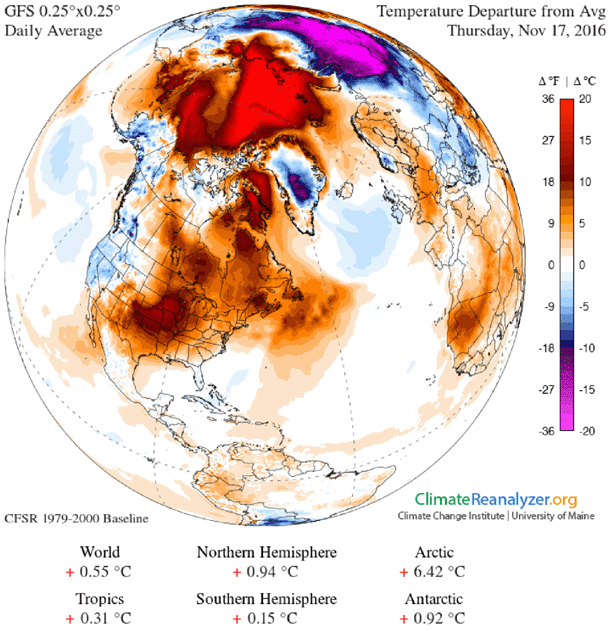
For example, during August, ice-free areas of the Barents Sea (north of Norway and Russia) were up to 20°F (11°C) above average, a figure that stunned climate scientists.
The Chukchi Sea off Alaska and the waters to the west of Greenland were 13°F to 14°F above average. Those warm waters were linked to the smallest annual winter peak in sea ice levels and the second lowest annual minimum.
The average land surface temperature for the Arctic was 3.6°F (2.0°C) above the 1981-2010 average — a 6.3°F (3.5°C) rise in temperatures since 1900. Record-high temperatures were measured below the surface of the permafrost, or permanently frozen ground, across the North Slope of Alaska.
“2016 was a year in the Arctic like we’ve never seen before,” Jeremy Mathis, director of the National Oceanic and Atmospheric Administration’s Arctic research program and an author of the report, said.
The rate of warming in the Arctic, which is happening at twice the rate of the rest of the globe, has major impacts on local ecosystems, but also further drives the warming of the planet, as the sea ice that would reflect the sun’s rays back to space is lost.
And for the 37th consecutive year, alpine glaciers retreated across the globe. These glaciers are a major source of water for local communities, and their loss has led to concerns about water security, particularly in places like Southeast Asia.
https://www.nirs.org/press/no-climate-money-nuclear-power/ International Coalition Says “NO!” To Nuclear Industry Attempts to Raid $100 Billion Global Climate FundTim Judson, NIRS +1 212-729-1169 (mobile) TimJ@nirs.org, Peer de Rijk, WISE-International, + 31 20 6126368, Director@wiseinternational.org, August 8, 2017 Gedelitz, Germany – An international coalition lead by organizations from nine countries launched a new campaign today–“Don’t Nuke the Climate”–to ensure nuclear power and other false climate solutions do not derail global efforts to reduce the extent of global warming. The coalition is mobilizing for the COP 23 global climate conference in November, where the nations of the world are meeting to make critical decisions on how to solve the problem of climate change. Specifically, the fate of $100 billion per year of investment is at stake the Green Climate Fund. Nuclear power companies are attempting to gain access to the fund to finance uneconomic power projects, which their own governments and the private sector will not or cannot fund.
The Paris Climate Agreement, signed by 195 countries, established a global consensus for the goal of limiting global warming to at most 2.0 C (3.8 F), with an ambition to go no higher than 1.5 C (2.7 F). The Paris Agreement’s targets are not arbitrary: a global average temperature rise of 1.5-2.0 C will still have enormous human, economic, and environmental impacts: sea-level rise, severe storms, drought and food shortages, resource conflicts, refugee crises, etc. Achieving these goals is literally a matter of life and death, but there is much uncertainty about the global community’s ability to reduce greenhouse gas emissions quickly enough to meet those goals.
The Don’t Nuke the Climate coalition is mobilizing for Bonn with the simple message: we can and must meet the goals of Paris–real, viable climate solutions are at hand–but not if we waste time and money on false solutions like nuclear power. The coalition mobilized in 2015 for the COP 21 climate conference in Paris, and grew to a total of 500 organizations worldwide supporting the “Don’t Nuke the Climate” call.
“We urgently need to tackle climate change. But we have to do this in a just way,” said Peer de Rijk, director of WISE-International. “This means we must actively exclude false solutions like nuclear power, as we otherwise will be thrown back in time and increase the environmental crisis.”
“Nuclear power is a serial human rights violator and its promotion will worsen the very climate justice problems the Green Climate Fund is supposed to solve,” said Tim Judson, executive director the Nuclear Information and Resource Service, based in the U.S.A. “Nuclear corporations target First Nations and Global South countries are for radioactive contamination and resource destruction, radiation has a disparate impact on women and girls, and these persistent pollutants are hazardous for hundreds of thousands of years, creating indiscriminate impacts on future generations. The Green Climate Fund must never be used to finance such violations of human rights and principles of climate justice,” Judson concluded.
The coalition is opposing intensified efforts by the nuclear power industry to gain access to financing for nuclear power projects through the Green Climate Fund (GCF). The GCF was founded through global climate talks in 2009, and the 2015 Global Climate Agreement set a target of $100 billion per year in financing to Global South countries for reducing greenhouse gas emissions (labeled “mitigation” measures) and infrastructure to withstand the impacts of climate change (labeled “adaptation” measures).
“South-Africa is in urgent need for robust climate action,” said Makoma Lekalakala That means money for adaptation but also clean, affordable, safe new energy for everyone. A choice for nuclear would only increase the financial burden put upon millions of South-Africans.”
“The Indian state often blocks international negotiations on climate citing the needs of its poor,” said Kumar Sundaram, director of Dianuke in India. “But that in reality is nothing more than the Indian elite and industries demanding for the right to be equally irresponsible with the climate. Domestically, the government policies are only widening the energy access gap and imposing nuclear, coal and big dam projects that threaten to destroy fragile ecologies and most vulnerable communities. It’s unfortunate that the Indian government’s climate policy reinforces the myth of nuclear power being safe and clean. India is standing on the wrong side of history in the post-Fukushima world – setting up world’s biggest, costliest and most unsafe imported nuclear plants by undermining safety and environmental clearance norms and brutalizing massive but peaceful grassroots. India cannot be allowed to be a liability-free market where the declining global nuclear lobby rehabilitates itself.”
Nuclear power’s economic failures are worsening, with major firms such as Westinghouse and Areva going bankrupt, reactors being shut down, and new reactors canceled due to excessive costs, chronic construction delays, and aging infrastructure. Without access to massive amounts of public dollars such as the GCF, the industry faces inevitable decline, and cannot compete against true climate solutions, such as solar, wind, and energy efficiency and conservation.
As a result of, the industry has intensified its lobbying effort since Paris, and now includes industry trade associations, such as Foratom; the International Atomic Energy Agency; major nuclear corporations, including Rosatom, Russia’s state-owned nuclear corporation, which is targeting developing nations for nuclear development; and nuclear professional organizations and front groups, including the World Nuclear Society and Nuclear for Climate.
“Nuclear is dying – without taxpayer subsidies,” said Reinhard Uhrig, Head of Campaigns for Global 2000, the Austrian affiliate of Friends of the Earth International. “It now promotes itself as ‘green’, carbon-free electricity (which it is not) to get at public money such as in the climate funds established to combat global warming in particular in the global south. We cannot let the nuclear lobby get away with this – no subsidies for nuclear!”
“Nuclear is too expensive and takes too long to build, and we need real climate solutions today,” said Vladimir Sliviak, executive director of Ecodefense, based in Russia. “The effective approach is developing renewable energy and energy efficiency. We don’t have money or time to spend on false solutions.”
The coalition is urging nations participating in the UNFCCC (United Nations Framework Convention on Climate Change) to prohibit the use of the Green Climate Fund on technologies that make the societal and environmental impacts of climate change worse, like nuclear power, so-called “clean” coal, large-scale hydro-power, hydraulic fracturing for natural gas and oil, food- and forest-based biomass, and REDD+ — which are broadly considered false solutions and frequently entail human rights violations.
“There is no acceptable solution worldwide for high level radioactive waste, the only consequence is to stop nuclear power right now,” said Kerstin Rudek from Bürgerinitiative Umweltschutz Lüchow-Dannenberg, based in Germany.
“It’s a shame that Germany failed to include the uranium enrichment facility in Gronau and the fuel element factory in Lingen in its nuclear phaseout policy. Both facilities export to nuclear power plant in Belgium and in France. Germany needs a complete nuclear phaseout and has to start immediately with phasing out coal as well.”
Organizations leading the “Don’t Nuke the Climate” coalition represent nine nations spanning four continents:
Global/International
World Information Service on Energy – International
International Physicians for the Prevention of Nuclear War
Independent 10th Aug 2017,The Trump administration has released a report confirming that 2016 was the
hottest year since records began. The National Oceanic and Atmospheric
Administration (NOAA), a leading environmental agency which is part of the
US federal government, found that global temperatures were warmer last year
than in 137 years of recordkeeping for a third consecutive year –
surpassing the previous record of 2015. http://www.independent.co.uk/environment/donald-trump-administration-report-2016-hottest-year-record-noaa-state-of-climate-a7886971.html
Independent 11th Aug 2017,The Government has been accused of undermining its own efforts to tackle
climate change after new research revealed it is investing twice as much in
fossil fuel projects overseas as it is in renewables.
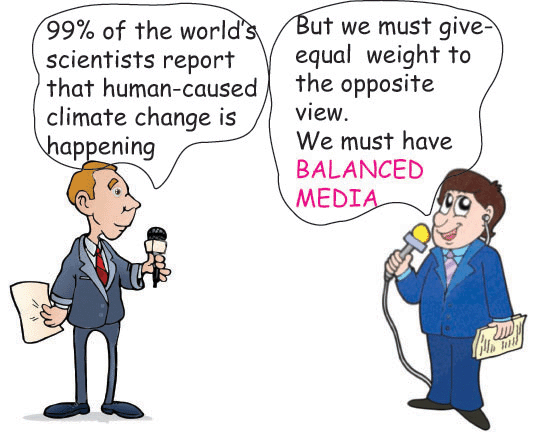
Independent 10th Aug 2017, The BBC has been criticised for inviting a climate change denier to come on
air and voice his belief that global warming isn’t happening. Science
broadcasters including Brian Cox and Jim al-Khalili criticised the decision
to bring on famous denialist Nigel Lawson, apparently to make sure that
there was a balanced debate.
Both pointed out that there is very little debate about global warming – an established fact on which almost every
mainstream scientist is agreed. Lord Lawson was able to make a number of
claims, which went mostly unchallenged. He said, for instance, that the
world had actually become colder over the last 10 years – despite the fact
that 2014, 2015 and 2016 have been the hottest years on record.
Guardian 10th Aug 2017,Norway’s plan to ramp up oil and gas production in the Arctic threatens
global efforts to tackle climate change, according to a new study.
The research says 12 gigatonnes of carbon could be added by exploration sites
in the Barents Sea and elsewhere over the next 50 years, which is 1.5 times
more than the Norwegian fields currently being tapped or under
construction.
The authors of the report from Oil Change International – an
NGO backed by Friends of the Earth, WWF and Greenpeace – say this
undermines the 2015 Paris agreement to cut worldwide emissions in order to
keep the planet’s temperature rise to between 1.5C and 2C.
Obama’s climate regulations could save the United States billions — but they face a precarious future under the Trump administration. NATASHA GEILING AUG 9, 2017 On Tuesday, the U.S. Court of Appeals for the District of Columbia Circuit agreed to extend a freeze in litigation over the Clean Power Plan, the signature domestic climate policy of the Obama administration and a primary target of the Trump administration’s regulatory rollback, dimming environmentalists’ hopes that the court could ultimately save the otherwise doomed policy.
The Clean Power Plan imposed the first-ever federal limits for carbon pollution from power plants, and when it was finalized in 2015, immediately drew opposition from a coalition of fossil fuel interests, utility groups, and conservative states. The coalition challenged the Clean Power Plan in court and the Supreme Court issued a stay on the rule in 2016, pending ongoing litigation in the case. The U.S. Court of Appeals for the District of Columbia Circuit heard oral arguments for the case beginning in September of 2016, and had seemed ready to issue a decision as early as spring of 2017.
That all changed, however, when President Donald Trump assumed office in January. Trump, who does not accept the scientific consensus on climate change, railed against the rule through his presidential campaign, pledging to undo the regulation as part of his vast rollback of Obama-era environmental policies. In late March, the Trump Justice Department asked the U.S. Court of Appeals for the District of Columbia not to render a decision in the case, arguing that it would be premature to rule on a regulation that the administration was in the process of undoing. The court agreed, at least in part, with the Trump administration, issuing a 60-day freeze in litigation in late-April.
Tuesday’s decision extends that stay for another two months, dashing hopes that the court could revive the rule either by ruling in favor of the regulation or remanding it to the EPA for modifications, rather than complete repeal and rewrite.
But in a concurring opinion, two judges included a stark rebuff to the idea that the EPA could rely on the court to delay the regulation — reminding the agency that the EPA’s 2009 endangerment finding, which relied on volumes of scientific evidence to classify carbon emissions as a public health threat, compels the agency to act to limit greenhouse gas emissions.
Combined with the existing stay of the rule from the Supreme Court, the two judges — both nominated by Democratic presidents — argued that the court’s extension of the pause in litigation amounted to “relieving EPA of its obligation to comply with that statutory duty for the indefinite future.”
Trump’s environmental assault met with immediate legal challenges
Environmental groups are ready to take Trump to court.
“We are in a race against time to protect our communities and families from the clear and present danger of climate pollution,” Tomás Carbonell, directory of regulator policy and senior attorney for Environmental Defense Fund, which is one of the groups defending the Clean Power Plan, said in a statement. “EDF, along with millions of concerned Americans, will keep working to ensure EPA complies with its legal obligations and acts to protect our nation from climate pollution.”
The court’s decision came just days after legal experts from Columbia University’s Sabin Center for Climate Change Law released new analysis looking at the economic benefits of Obama-era climate and environmental regulations, including the Clean Power Plan. According to the analysis, the total benefits of maintaining several Obama-era regulations on greenhouse gas emissions could reach almost $370 billion by 2030. The analysis found that some of the highest benefits came from implementing the Clean Power Plan, which could by itself could create $46 billion in economic benefits by 2030. Those benefits came from the estimated reduction in emissions, as well as greater efficiency and lower health costs as a result of declines in pollution. The analysis also estimated that the Clean Power Plan could create as many as 59,700 new jobs by 2020.
OVER THE next week or so, the Trump administration must decide whether to approve or suppress a major federal climate change report. Though scientists have signed off on its findings, including that the average U.S. temperature has spiked in the past several decades and that humans have almost certainly played a predominant role, President Trump and Environmental Protection Agency Administrator Scott Pruitt have indicated they simply do not believe the experts.
Even as the federal climate assessment has been under review, the warnings have grown starker.
A paper published last week in Nature Climate Change offered a harrowing view. International negotiators committed in Paris to keeping global temperature rise below 2 degrees Celsius, the point past which experts warn warming could be very dangerous. Analysts from the University of Washington and the University of California at Santa Barbara found that there is only a 5 percent chance the world will achieve that goal.
Instead of predicting how technology or policy might change, the researchers looked at how nations have done until now and inferred from those trends what will happen in the future. As economies expand, they emit more planet-warming carbon dioxide into the air. Fortunately, over time economies also produce more efficiently, using less fuel and therefore emitting less carbon dioxide for every widget assembled or mile driven. By projecting population growth, economic expansion and carbon efficiency into the future, the analysts came up with a rough guide to where the global temperature will be at the end of the century.
They found that there is a 90 percent chance the world will warm between 2 degrees and 4.9 degrees Celsius, with a median of 3.2 degrees. Though this avoids the most alarming scenarios scientists have previously considered, it also excludes the least concerning, finding virtually no chance the Earth will keep warming below the desirable level of 1.5 degrees Celsius.
How does this translate into the real world? Some other new research provides answers. Experts at the Massachusetts Institute of Technology and Loyola Marymount University in Los Angeles found that at 4.5 degrees of temperature rise by 2100, highly populated and impoverished swaths of South Asia would experience heat waves so extreme that human beings would not be able to survive without protection. At 2.25 degrees of warming, heat-wave temperatures in the region would be dangerous but not as deadly. Another new analysis from European Union researchers warned that deaths due to extreme weather across Europe could increase from about 3,000 per year to 152,000 annually if the Earth warmed 3 degrees by century’s end.
Each of these studies comes with caveats. For example, much of the risk would be averted with a strong global commitment to cutting carbon dioxide emissions, particularly if green technology became significantly cheaper, making it easier to decarbonize than in the past. Yet even if the breakthroughs do not come, or do not come fast enough, the latest research suggests it is neither unrealistic nor pointless to aim for the low end of the range of possible climate outcomes, even over 2 degrees, to at least limit the damage to the planet’s habitability. That path, however, requires leaders to admit there is a problem.
Super-heatwaves of 55°C to emerge if global warming continues http://www.enn.com/climate/article/52119 10 Aug 17, Heatwaves amplified by high humidity can reach above 40°C and may occur as often as every two years, leading to serious risks for human health. If global temperatures rise with 4°C, a new super heatwave of 55°C can hit regularly many parts of the world, including Europe.
A recently published study by the Joint Research Centre (JRC) – the European Commission’s science and knowledge service – analyses the interaction between humidity and heat. The novelty of this study is that it looks not only at temperature but also relative humidity to estimate the magnitude and impact of heat waves.
It finds out that the combinations of the two, and the resulting heatwaves, leave ever more people exposed to significant health risks, especially in East Asia and America’s East Coast.
Warm air combined with high humidity can be very dangerous as it prevents the human body from cooling down through sweating, leading to hyperthermia. As a result, if global warming trends continue, many more people are expected to suffer sun strokes, especially in densely populated areas of India, China and the US. Read more at European Commission, Joint Research Centre (JRC)
‘Unusual’ Greenland wildfires linked to peat, BBC News, By Matt McGrathEnvironment correspondent, 9 August 2017
New images have been released of wildfires that continue to burn close to the Greenland ice sheet, on the country’s west coast.Fires are rare on an island where 80% of the land is covered by ice up to 3km thick in places.
However, satellites have observed smoke and flames north-east of a town called Sisimiut since 31 July.
Experts believe at least two fires are burning in peat that may have dried out as temperatures have risen.
A song of fire and ice? Researchers say that across Greenland there is now less surface water than in the past, which could be making vegetation more susceptible to fire. The latest satellite images show a number of plumes. Police have warned hikers and tourists to stay away from the region because of the dangers posed by smoke. There are also concerns that the fire will damage grazing for reindeer.
Scientists believe that instead of shrubs or mosses, the likely source is fire in the peaty soil, which can only burn when dry.
“Usually when a wildfire is smouldering like that it’s because there’s a lot of ground-level fuel, carbon organic matter; that’s why I assume that it’s peat,” wildfire expert Prof Jessica McCarty from Miami University, US, told BBC News.
“The fire line is not moving, the fire is not progressing like we’d see in a forest fire, so that means it’s burning whatever fuel is on the ground.”
Prof McCarthy believes that melting permafrost is likely to have contributed to this outbreak. She referred to studies carried out in the region that showed degraded permafrost around the town of Sisimiut.
Locals say that what they call “soil fires” have happened before, especially in the last 20-30 years. Researchers have been busily examining the satellite record to look for evidence of previous outbreaks.
“The only record I found is the MODIS active fire record. It’s a satellite that measures the temperature of the surface and can locate hotspots from fire,” said Dr Stef Lhermitte from Delft University in the Netherlands.
“I think that fires have been there before but what’s different is that this fire is big, in Greenlandic terms; that is unusual. It’s the biggest one we have in the satellite record.”
Dr Lhermitte’s analysis suggest that the satellite has detected more fires in 2017 alone in Greenland than in the 15 years it has been operating. A previous large outbreak was seen in 2015…….http://www.bbc.com/news/science-environment-40877099
“Throughout the history of the church, people have always found ways to use God and scripture to justify empire, to justify oppression and exploitation,” Kyle Meyaard-Schaap, an organizer with a pro-environmental Christian group called Young Evangelicals for Climate Action (YECA), told me. “It’s a convenient theology to hold, especially when we are called to drastic, difficult action.”
How Fossil Fuel Money Made Climate Change Denial the Word of God Brendan O’Connor, Splinter , 8 Aug 17 In 2005,at its annual meeting in Washington, D.C., the National Association of Evangelicals was on the verge of doing something novel: affirming science. Specifically, the 30-million-member group, which represents 51 Christian denominations, was debating how to advance a new platform called “For the Health of a Nation.” The position paper—written the year before An Inconvenient Truth kick-started sense of public urgency around climate change—included a call for evangelicals to protect God’s creation, and to embrace the government’s help in doing so. The NAE’s board had already adopted it unanimously before presenting it to the membership for debate.
At the time, many in the evangelical movement were uncomfortable with its close ties to the Republican anti-environmental regulation agenda. That year, a group called the Evangelical Alliance of Scientists and Ethicists protested the GOP-led effort to rewrite the Endangered Species Act, and the NAE’s vice president of governmental affairs Richard Cizik pushed for the organization to endorse John McCain and Joe Lieberman’s cap-and-trade bill. “For the Health of a Nation,” which Cizik also pushed, was an opportunity to draw a bright line between their support of right-wing social positions on abortion and civil rights and a growing sentiment that God’s creation needed protection from industry……..
At the behest of a group called the Interfaith Stewardship Alliance, the board buckled, releasing a statement in February 2006 “recognizing the ongoing debate” on global warming and “the lack of consensus among the evangelical community on the issue.” Just days later, an outside group of 86 evangelical leaders, under the aegis of the Evangelical Climate Initiative, issued a “Call to Action” declaring that climate change was real and that “millions of people could die from it in this century.”
For his trouble, Cizik was targeted by a collection of hard right Christians, who petitioned the NAE board to muzzle him or force him to resign. “Cizik and others are using the global warming controversy to shift the emphasis away from the great moral issues of our time, notably the sanctity of human life, the integrity of marriage, and the teaching of sexual abstinence and morality to our children,” their letter read. It also implied that Cizik, who had worked for the NAE for nearly three decades, supported abortion, giving condoms to children, and infanticide…….
The NAE did eventually endorse climate action in 2015. But it was too late. By that time, a corps of right-wing Christians, funded by fossil-fuel interests, had hijacked the public and political machinery of the evangelical movement. They are now in the White House, where the anti-environmental agenda is dominated by Christian fundamentalists like EPA Commissioner Scott Pruitt while the more moderate views offormer ExxonMobil CEO Rex Tillerson are ignored. This is the story of how they did it.
At a town hall in Michigan last May, Republican Rep. Tim Walberg assured his constituents that, while the climate may be changing, they don’t need to be concerned. “As a Christian, I believe that there is a creator in God who is much bigger than us,” he told them. “And I’m confident that, if there’s a real problem, He can take care of it.”
This idea—that whatever happens in God’s creation happens with His blessing—has deep roots in the American evangelical community, especially among the elite fundamentalists who walk the halls of power in Washington, D.C. For years, an evangelical minister named Ralph Drollinger has held weekly Bible studies for members of Congress, preaching that social welfare programs are un-Christian and agitating for military action against Iran. (In December 2015, he expressed his desire to shape Donald Trump into a benevolent, Christian dictator.) Drollinger also teaches that climate change caused by humans is impossible in light of God’s covenant with Noah after the Flood: “To think that man can alter the earth’s ecosystem—when God remains omniscient, omnipresent and omnipotent in the current affairs of mankind—is to more than subtly espouse an ultra-hubristic, secular worldview relative to the supremacy and importance of man,” he wrote recently.
Conservative groups, funded by fossil fuel magnates, spend approximately one billion dollars every year interfering with public understanding of what is actually happening to our world. Most of that money—most of the fraction of it that can be tracked, anyway—goes to think tanks that produce policy papers and legislative proposals favorable to donors’ interests, super PACs that support politicians friendly to industry or oppose those who are not, or mercenary lobbyists and consultants, in some instances employing the same people who fought to suppress the science on smoking. In terms of impact, however, few investments can rival the return that the conservative donor class has gotten from the small cohort of evangelical theologians and scholars whose work has provided scriptural justifications for apocalyptic geopoliticsand economic rapaciousness.
“Throughout the history of the church, people have always found ways to use God and scripture to justify empire, to justify oppression and exploitation,” Kyle Meyaard-Schaap, an organizer with a pro-environmental Christian group called Young Evangelicals for Climate Action (YECA), told me. “It’s a convenient theology to hold, especially when we are called to drastic, difficult action.”
Many of these soothsayers are gathered together in an organization called the Cornwall Alliance—formerly known as the Interfaith Stewardship Alliance, the same group that mobilized against Cizik’s environmental proposal—a network with ties to politicians and secular think tanks across the conservative landscape. In 2013, Cornwall published an anti-environmentalist manifesto called Resisting the Green Dragon. “False prophets promise salvation if only we will destroy the means of maintaining our civilization. No more carbon, they say, or the world will end and blessings will cease,”it warns. “Pagans of all stripes now offer their rival views of salvation, all of which lead to death.” Members of the Cornwall Alliance and their ilk are not simply theoreticians but enforcers, stifling dissent in the wider American evangelical community, smothering environmentalist tendencies before they gain a following………
For almost 20 years, Beisner and members of the Cornwall Alliance have worked with establishment conservatives to bolster opposition to climate change: The Heartland Institute identifies him as a policy advisor on its web site, and he speaks regularly at the institute’s annual conference on climate change (though in an interview he curiously denied ever actually giving any policy advice to Heartland). The Heritage Foundation hosted the 2015 premierof Where the Grass is Greener, a documentary produced by the Cornwall Alliance. In May, Beisner and senior executives from Heartland, Heritage, and a slew of other billionaire-funded political entities like Americans for Prosperity and the Competitive Enterprise Institute sent a letter to Donald Trump urging him to withdraw from the Paris climate agreement and asking him to stop funding United Nations global warming programs.
Together, Cornwall, Heartland, and Heritage have been able to set the terms of the conservative conversation—evangelical or otherwise—about the climate. They determine what science is acceptable, which proposed solutions can be considered, and what the consequences of inaction might look like. “There’s a very strong connection between those institutions and the evangelical Right,” Rev. Hescox told me. “Their denial of the science—and really portraying this as a big government issue—is why there was so much pushback among evangelicals.”
The Cornwall Alliance, joined by scientists associated with organizations partly funded by ExxonMobil, continued hammering away at Christian groups that supported action on climate change. In 2008, it launched the bizarrely named “We Get It!” campaign, which targeted the Evangelical Climate Initiative and was endorsed by a slew of conservative organizations, including the Family Research Council and David Barton’s WallBuilders…..
Given that it is a relatively small operation with relatively low overhead, the money that the Cornwall Alliance receives is a vanishingly small fraction of the hundreds of millions spent by the Koch, the Mercer, or the DeVos families. (The Kochs are oil, coal, and gas scions; Robert Mercer is a hedge fund manager who, with his daughter Rebekah, fueled Trump’s rise; Education Secretary Betsy DeVos and her husband Dick are long-time Republican donors).
Their money flows through a multitude of nonprofits, front groups, and donor-advised funds. (A donor-advised fund is a kind of money-laundering service for philanthropists who don’t want anyone to know where their money is going: They make a contribution to the fund, and then tell the fund where to send the money; as a nonprofit, the fund has to disclose all of the grants that it makes, but it does not need to disclose its own donors, nor what direction those donors attached to their money.) Donors Trust, the “dark money ATM” of the conservative movement, contributed $1,001,500 to the James Partnership between 2009 and 2015; in most years, this constituted around half of the Partnership’s total revenue………
…….billions are paying off. Not only have the people who funded Cornwall successfully stopped the government from pursuing policies that might make the lives of people who are living with the consequences of climate change a little bit better, but under the Trump administration their lackeys are actively working to dismantle what little progress has been made. When Drollinger teaches that God’s covenant with Noah means that the consequences of climate change not only will not but in fact cannot be as devastating as scientists believe, he echoes a lengthy essay published by the Cornwall Alliance in 2009 that lays out the same argument. Typical of the organization’s style, it appears to the casual observer like any policy paper drawn up at one of D.C.’s many think tanks and nonprofits; in reality, the document blends quotations from scripture with pseudo-scientific data—citing, for example, the Mercer-funded Oregon Institute of Science and Medicine. During Pruitt’s confirmation hearing, Republican Sen. John Barrasso favorably cited Beisner and the Cornwall Alliance’s support for the Oklahoma attorney general……http://splinternews.com/how-fossil-fuel-money-made-climate-denial-the-word-of-g-1797466298
To Stop Global Warming, Should Humanity Dim the Sky? The world’s top geoengineering researchers met off the record to discuss the possibility in Maine last month. ROBINSON MEYER, The Atlantic AUG 7, 2017 Late last month, about 100 researchers from around the world gathered at Logan International Airport in Boston. A fleet of buses appeared to whisk them to a remote and luxurious ski resort in northeastern Maine.…….They had gathered to discuss how to provide humanity one last line of defense against catastrophic global warming: solar geoengineering.
The idea behind solar geoengineering is simple. For the last four decades, humanity has struggled to reduce the amount of greenhouse gas entering the atmosphere. We have decommissioned nuclear plants, introduced millions of new gasoline-burning cars to the roadway, and dawdled through treaty after treaty. Meanwhile, the concentration of carbon dioxide in the atmosphere has only risen.
It sure seems like we’ll need some more time to get our act together. So maybe we should toy with another variable: While we try to reduce the planet’s heat-trapping gas, maybe we can also try to reduce the amount of heat entering the atmosphere in the first place.
Interest in the technique has spiked recently. An administration hostile to climate mitigation has taken power in the United States, and some countries risk falling short of the promises they made under the Paris Agreement. It seems suddenly plausible that the industrialized world will not succeed in staving off two degrees of temperature rise.
Governments and private donors have opened their pockets in advance of that failure. This summer, China’s national Ministry of Science and Technology announced it will fund a 15-person, $3 million geoengineering research programat Beijing Normal University. It will join several government-funded teams working on the same problem in Germany as well.
This fall, Harvard University will also launch its own solar geoengineering research with $7.5 million in funding from private sources. Its leaders hope to eventually amass a budget of $20 million.
So the conference, organized by Gordon Research Conferences, was well-timed. It is thought to be the largest gathering of geoengineering scientists ever assembled, and its participants included almost every senior researcher in the field. It was held under the Chatham House rule, which proscribed attendees from disclosing who said what, but its agenda and attendees list are available online…….
There are several ways of holding off that warmth. They all involve bouncing sunlight back into space before it penetrates too far into the lower atmosphere. Over the past decade, scientists have discussed some different ways to do this: by brightening clouds over the ocean; by pushing cirrus clouds to form in the high atmosphere; or by spraying a reflective gas into the sky at high altitudes, mimicking the effect of a large volcanic eruption.
Last month’s meeting arrived at the consensus that this final technique—called stratospheric aerosol injection—is the best bet going forward. Researchers don’t see a technological impediment to developing seeding tools, seeing the few remaining problems as within the capability of any large aerospace company. There are plenty of natural precedents for stratospheric aerosols, too—volcanoes have gone off hundreds of time during human history—and they see it as the most reversible and easy to model.
“When you put particles in the stratosphere, it’s simpler to calculate what the effect would be on the energy budget and on the temperature,” said Storelvmo. “Anything that involves clouds generally becomes much more complicated.”
It also benefits from some built-in economies of scale. “With the physics [of stratospheric injection], you can have huge multipliers. You put one particle in the stratosphere and it can deflect trillions of photons,” said Ken Caldeira, a senior scientist at the Carnegie Institution for Science and a presenter at last month’s meeting.
This neat efficiency separates solar geoengineering from its sibling, “carbon geoengineering,” which aims to directly scrub the atmosphere of carbon dioxide and other heat-trapping gases. If perfected, carbon geoengineering could permanently solve the problem of global warming, but researchers consider the technological advances needed to accomplish it far-off, and the meeting didn’t address it……
Yet this makes the most feasible form of geoengineering (dimming the sun) only a stopgap—albeit a tentatively effective one. “Most of the climate models project that solar geoengineering could offset most climate change for most people most of the time. But in climate models, if something goes wrong, you can run the model again. In the real world you don’t have that option,” Caldeira said.
So much of the meeting was devoted to the natural follow-up question: What could go wrong?
The most glaring concerns are about how stratospheric aerosol injection could affect the water cycle, “whether it could induce droughts or floods or things like that,” said Storelvmo. Many researchers describe that as the riskiest aspect of solar geoengineering right now……
It’s also unclear how much solar geoengineering will be required to hold off the worst symptoms of climate change. Because the equator receives stronger, more frequent sunlight than the poles, stratospheric aerosols would chill the tropics more than they would the higher latitudes. This could trap wannabe geoengineers in a dosage dilemma.“If you’re interested in stopping ice sheets from melting, you can’t just make global temperature constant. You have to overcool it to reach the high latitudes,” said Robock.
A similar mechanism could create even nastier water-cycle problems. Stratospheric aerosols may cool the continents more than they cool the oceans, equalizing the normal pressure difference between land and sea—and, in turn, killing the seasonal monsoons of Asia and Africa. Food prices worldwide would skyrocket……
Other sessions at the conference focused on other unknowns about solar geoengineering beyond weather. Little research has been conducted into how ecosystems would respond to prolonged global dimming. Some researchers also worry that spraying sulfur dioxide into the high stratosphere could damage the ozone layer, though recent research has suggested this risk is smaller than once thought…….
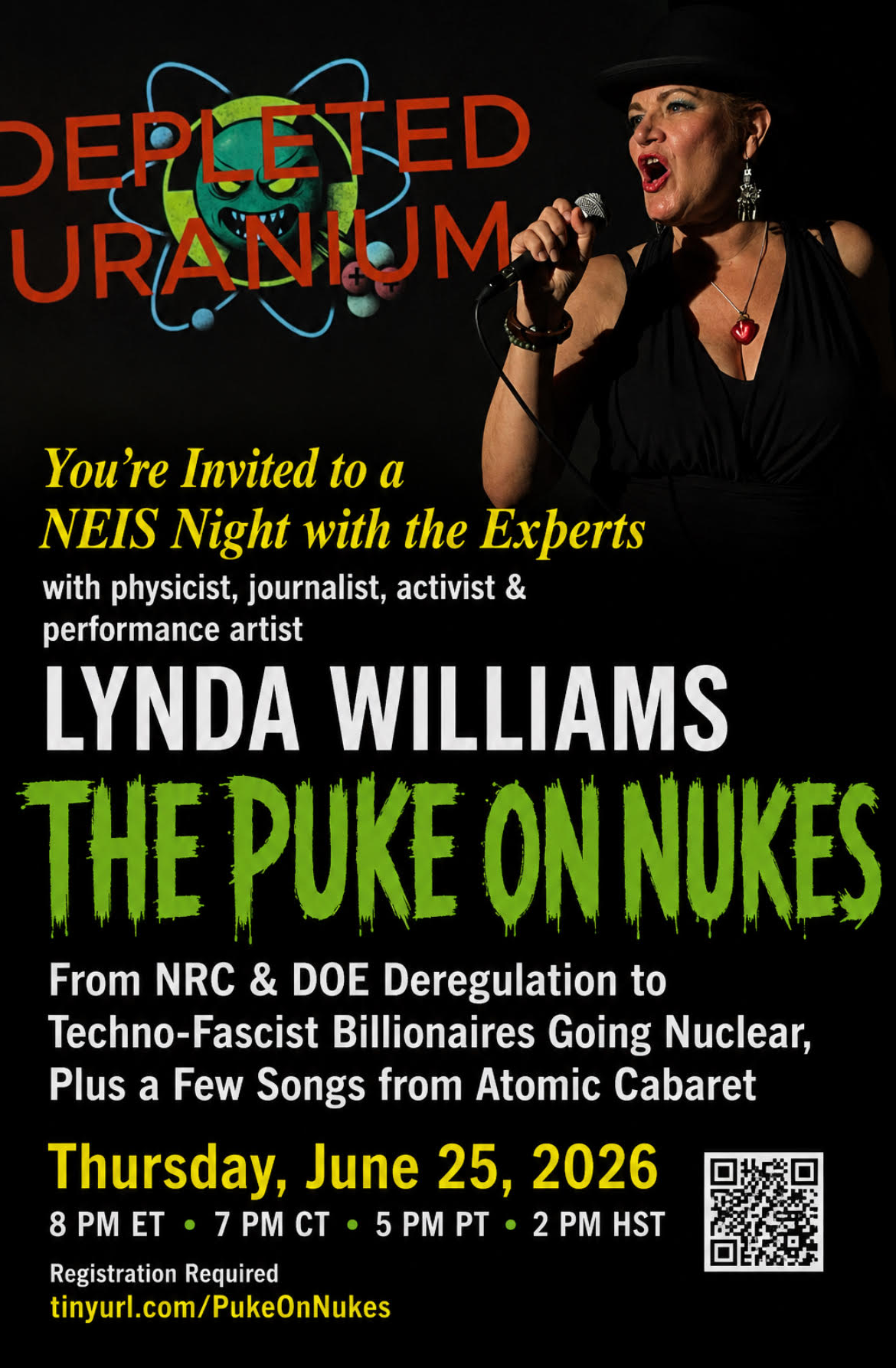
7pm Central Time (8pm ET, 6pm MT, 5pm PT) UTC – 5 From NRC & DOE Deregulation to Techno-Fascist Billionaires Going Nuclear, Plus a Few Songs from Atomic Cabaret REGISTER









 nuclear-news