‘Spiral of silence’: climate action is very popular, so why don’t people realise it?

Researchers find 89% of people around the world want more to be done, but
mistakenly assume their peers do not.
The Guardian is joining forces with
dozens of newsrooms around the world to launch the 89% project—and
highlight the fact that the vast majority of the world’s population wants
climate action. The illusion that climate action is not popular is global.
So imagine dispelling that myth: such a shift, experts say, could be a
gamechanger, pushing the world over a social tipping point into unstoppable
climate progress. Such a communication campaign, low-cost and scalable,
could be among the most powerful tools available to fight the climate
crisis, they say. Decades of psychological research indicates that
correcting such misunderstandings can change people’s views across a
swathe of issues, from participating in protests to voting for Donald
Trump.
Guardian 22nd April 2025
https://www.theguardian.com/environment/2025/apr/22/spiral-of-silence-climate-action-very-popular-why-dont-people-realise
Activate climate’s ‘silent majority’ to supercharge action, experts say
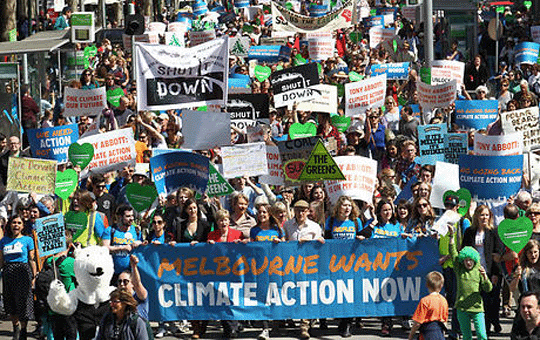
Making concerned people aware their views are far from alone could unlock the change so urgently needed.
‘Spiral of silence’: climate action is very popular, so why don’t people realise it? The Guardian is joining forces with dozens of newsrooms around the world to launch the 89% project—and highlight the fact that the vast majority of the world’s population wants climate action. Read more
Making people aware that their pro-climate view is, in
fact, by far the majority could unlock a social tipping point and push
leaders into the climate action so urgently needed, experts say. The data
comes from a global survey that interviewed 130,000 people across 125
countries and found 89% thought their national government “should do more
to fight global warming”. It also asked people if they would
“contribute 1% of their household income every month to fight global
warming” and what proportion of their fellow citizens they thought would
do the same. In almost all countries, people believed only a minority of
their fellow citizens would be willing to contribute. In reality, the
opposite was true: more than 50% of citizens were willing to contribute in
all but a few nations. The global average of those willing to contribute
was 69%. But the percentage that people thought would be willing was 43%.
The gap between perception and reality was as high as 40 percentage points
in some countries, from Greece to Gabon.
Damian Carrington Guardian 22nd April 2025, https://www.theguardian.com/environment/2025/apr/22/activate-climate-silent-majority-support-supercharge-action
Murder in Broad Daylight :REPORTING FROM THE CLIMATE WAR ZONE

April 16, 2025, by Radio Ecoshock [ includes audio]
Killer summer heat in Spring? Don’t worry. Donald Trump shoots the messengers. Closing down climate in NASA and NOAA, the news from Paul Voosen at the American Academy. The voice of Canadian weather and science David Phillips helps process the news. Plus a quick replay from Arjit Varki: denial as a basic function in the human mind.
Summer is two months early in Central Asia. The first 11 days in Turkmenistan, Uzbekistan, and Kazakhstan were all above 30 degrees C or 86 Fahrenheit. Just listen to the harsh heat wave hitting India’s capital Delhi and it’s 33 million people. Delhi has been over 40 degrees C (104 F) three days this month. The summer heat is yet to come!
Still don’t care? How about the first 100 degree day in Phoenix, already – a month earlier than usual. That’s a Spring heat wave over the whole U.S. Southwest.
No matter what weather you experienced, according to the Copernicus Climate Change Service and US NOAA, the world had the warmest January ever recorded. It was 1.75 degrees C above the pre-industrial level. Eighteen of the last nineteen months were over the alleged 1.5 degree safety line for climate change. We get the hottest months ever recorded on this planet, despite the La Nina conditions which normally cool things down. This is over-the-limit super heat.
Donald Trump got elected promising cheap gas at the pumps. He would turn the USA into an energy super-power. Off with protections and National Parks. Drill by the beaches, frack by the schools, do whatever you want. Because they are firing the regulators, scientists and the prosecutors who enforce anything related to pollution, the protection of nature, or climate change.
The Artificial Intelligence bro’s are scanning all government data to find anything related to climate change. They want to delete all that and fire the scientists who generate data on climate. Or just fire scientists generally. Who needs those egg-heads?
We need funeral music. The end of climate science in America is nigh. That’s not a fringe worry anymore, it is happening in real time.
REPORTING FROM THE CLIMATE WAR ZONE
Paul Voosen
Paul Voosen holds a master’s in science journalism from Columbia University. On April 11th, he filed this story at science.org, the publication of the American Association for the Advancement of Science. The title is: “Trump seeks to end climate research at premier U.S. climate agency – White House aims to end NOAA’s research office; NASA also targeted.”
I’m just going to pass this on, quoting from Voosen’s article:
“President Donald Trump’s administration is seeking to end nearly all of the climate research conducted by the U.S. National Oceanic and Atmospheric Agency (NOAA), one of the country’s premier climate science agencies, according to an internal budget document seen by Science. The document indicates the White House is ready to ask Congress to eliminate NOAA’s climate research centers and cut hundreds of federal and academic climate scientists who track and study human-driven global warming.
The administration is also preparing to ask for deep cuts to NASA’s science programs, according to media reports today.
The administration’s plan would “eliminate all funding for climate, weather, and ocean laboratories and cooperative institutes,” says the document, which reflects discussions between NOAA and the White House Office of Management and Budget (OMB) about the agency’s 2026 budget request. Currently, NOAA operates 10 research labs around the country. They include influential ocean research centers in Florida and Washington state; five atmospheric science labs in Boulder, Colorado, and Maryland; and a severe storm lab in Oklahoma. It also operates the Geophysical Fluid Dynamics Laboratory in New Jersey, the birthplace of weather and climate modeling, as well as a lab in Michigan devoted to the Great Lakes. The agency further funds cooperative institutes, which support a large collection of academic scientists who work closely with the NOAA labs.
The proposal would cut NOAA’s competitive climate research grants program, which awards roughly $70 million a year to academic scientists. It would end support for collecting regional climate data and information, often used by farmers and other industries. And it would terminate the agency’s National Oceanographic Partnership Program and college and aquaculture sea grant programs, which support a host of research efforts.
NOAA officials still have time to persuade OMB to alter the request, but NOAA sources said it is unlikely to substantially change. But this proposal is only the first stage of the budget process; Congress will have the final word in setting NOAA’s spending.
At NASA, science programs also face severe cuts, according to details first reported by Ars Technica. The White House is considering requesting a nearly 50% cut to NASA science’s office, down to an overall budget of $3.9 billion. According to Ars Technica, the plan calls for: “a two-thirds cut to astrophysics, down to $487 million; a greater than two-thirds cut to heliophysics, down to $455 million; a greater than 50 percent cut to Earth science, down to $1.033 billion; and a 30 percent cut to Planetary science, down to $1.929 billion.”
Such NASA cuts would require ending the operations of a huge host of earth science satellites. They could also result in the closure of NASA’s Goddard Space Flight Center in Maryland, which has thousands of employees and is one of the agency’s premier centers for earth science research. The cuts would also end plans for Mars Sample Return, the DAVINCI mission to Venus, and the Nancy Grace Roman Space Telescope, which is almost fully assembled.“
That is from Paul Voosen at science.org, with work from Eric Berger’s report April 11 at arstechnica.com on the NASA cuts.
Close the Goddard Space Flight Center? Forget new earth science satellites? Fire the biggest and possibly best climate science teams in the world? All this is deeply wrong.
IS IT THE FALL OF EMPIRE?
In the year 410, the Christian Father Saint Augustine kept a diary of his times. The German tribes known as “the Vandals” were storming across North Africa. They surrounded his ancient city of Carthage. Then he received impossible news: Rome itself was sacked. Augustine forsaw the ancient institutions of learning, government, and the arts crumbling away, leading to a long period now called “The Dark Ages”.
Are we there yet? I don’t think so. But we can smell burning institutions in America, once a light of Democracy for the world. Big name universities like Harvard, Princeton and Columbia are being defunded and told what to teach. Until now, the brightest students, scientists and scholars came to those universities to learn and spread their brilliance. They have all been sent home, abruptly, with no warning. They find an email announcing an immediate cut to funding, and told to self-deport.
One scientist I follow on Bluesky was fired in February, rehired a week ago, and then fired again. Others have watched five or ten years of research suddenly wiped out, along with their paychecks that paid the mortgage. Big black holes of data are opening up in America, formerly the largest depository of weather data and climate science.
In recent weeks I asked guests from Europe and Australia whether climate science can be maintained and go forward without NASA or NOAA. In today’s feature interview with the grand old man of Canadian weather and climate – I ask again. Twice. Because nobody, none of our guests, could take that seriously. After working this beat for decades, I see NASA and NOAA science in almost everything. The new deniers plan to kill that off.
On April 8th, Trump stands in front of some burly men who might be coal miners, looking strangely out of place in the Oval Office. He signed an Executive Order to boost the American coal industry. Trump wants a rash of new coal plants to fuel data farms for Artificial Intelligence. He’s dumping any incentives to buy electric cars, and removing any legislation requiring phasing out gas vehicles. The electric revolution is over along with all that other green crap, he says. The new Environmental Destruction Agency fired any investigators and dumped the pollution rules, so just go for it.
The new Orwellian Great Leader says: “There is no climate change – that was all a scam!” Don’t believe your lying eyes. Never mind the heat, and all those bodies overseas. But the disasters will come again, and again.
David Gelles writes about “Climate: Economic Disaster Warnings” for the New York Times, April 10. He notes a Morgan Stanley report expects the world to heat by 3 degrees Celsius. A U.N. Gap report also found the world likely to warm to 3.1 degrees C over preindustrial by the end of this century. That means flooding of cities like Rio, Shanghai and Miami, just to name a few. A February report from First Street, found the U.S. would lose $1.47 trillion in lost real estate values by 2055, just 30 years from now. 80,000 homes would be lost to floods in the next 15 years in New York City according to reporters Zaveri and Howard.
Günther Thallinger is a member of the supervisory board of Allianz SE, the giant Swiss insurer. He told the times:
“The math breaks down: the premiums required exceed what people or companies can pay,” he said. “This is already happening. Entire regions are becoming uninsurable.”
But the risks extend well beyond the insurance business, Thallinger said.
“This is not a one-off market adjustment,” he wrote in his post. “This is a systemic risk that threatens the very foundation of the financial sector. If insurance is no longer available, other financial services become unavailable too. A house that cannot be insured cannot be mortgaged. No bank will issue loans for uninsurable property. Credit markets freeze. This is a climate-induced credit crunch.”
- David Gelles in the New York Times April 10th.
You think the stock market is melting down now. Wait until the real world melts down too. You won’t have to wait long.
So let’s get to our feature guest with Canada’s take.
==================================
THE VOICE OF WEATHER & ENVIRONMENT
DAVID PHILLIPS…………………………………………………………………………………. https://www.ecoshock.org/2025/04/murder-in-broad-daylight.html
Nuclear Energy Means Climate Action Delay: O’Donnell and Winfield

Susan O’Donnell and Mark Winfield, https://www.theenergymix.com/nuclear-energy-means-climate-action-delay-odonnell-and-winfield/ 16 Apr 25
What is the best way for utilities to delay the transition from fossil fuels? Propose to build nuclear reactors.
Electricity utilities wanting to “decarbonize” have several options for replacing the fossil fuel (coal, oil and gas) plants on their grids: aim to increase energy efficiency and productivity; add new renewable energy and storage resources; consider adding carbon capture and storage (CCS); or propose to build new nuclear reactors.
By objective measures, building new nuclear power plants will cost more, take longer to deploy, and introduce catastrophic accident risks—relative to improving energy productivity, expanding renewables with energy storage, and developing distributed energy resources. CCS suffers from limits of appropriate geology, reduced plant efficiency, and high costs.
However, if the goal is to keep fossil fuel-fired plants operating as long as possible, promising to build more nuclear energy has definite appeal.
Reactor design, planning, and build times are notoriously long—usually measured in decades—with well-established patterns of significant “unexpected” delays. Delaying while waiting for the promised new nuclear builds or reactor refurbishments maintains the status quo, effectively kicking actual climate action well down the road.
The two Canadian provinces with operating nuclear power reactors, Ontario and New Brunswick, provide case studies in this strategy. Both provinces are investing in significant new fossil gas generating infrastructure while waiting for new reactor designs to be developed and then built.
In Ontario, greenhouse gas emissions from the electricity sector have already risen dramatically as fossil gas plants are run to replace out-of-service nuclear reactors, and the province proposes to add more gas-fired generating capacity to its system. After a nearly decade-long hiatus, it only recently proposed a feeble reengagement with renewable energy. New nuclear reactor builds at Darlington, Bruce, and now Wesleyville, with timelines stretching well into the 2030s and 40s, remain the centrepiece of its energy (and supposed) climate strategy.
New Brunswick’s NB Power plans to add 600 MW of new nuclear power at its Point Lepreau nuclear site on the Bay of Fundy. Calls to build renewables instead have been rebuffed. In 2018, the province invited two nuclear start-up companies to set up in Saint John and apply for federal funding. Despite generous support from federal and provincial taxpayers, the companies have been unable to attract matching private funds. The NB Power CEO recently said she is “unsure” if the ARC-100, the reactor design promoted in 2018 as the closest to commercialization, will be ready by “the late 2030s.”
Meanwhile, the government recently announced support for building a large fossil gas plant, the biggest power project in the province in more than a decade.
The reality is that the new nuclear reactors being pushed by proponents are largely “PowerPoint reactors”—unproven and unbuilt designs. The BWRX-300 reactor that Ontario Power Generation (OPG) is proposing for its Darlington site, for example, lacks a fully-developed design, including key elements like safety systems. The Canadian Nuclear Safety Commission (CNSC) still gave OPG a licence to build it, while the U.S. Nuclear Regulatory Commission is still reviewing the design and asking for more information.
Recent analyses from the U.S. Tennessee Valley Authority also suggest the cost of the reactors will be far higher than OPG has claimed, and the timeline to construction and completion by 2030 seems less and less likely.
The new Monark design for a CANDU reactor that AtkinsRéalis (formerly SNC Lavalin) is proposing for the Bruce Power nuclear site is even further behind the BWRX-300 in development. According to the CNSC, the Monark is at a “familiarization and planning” stage, with no date set for even the first, preliminary stage of the design review.
The Monark’s main competitor is the AP-1000 reactor by Westinghouse. In 2002, the company submitted the AP-1000 design for formal review by the U.S. Nuclear Regulatory Commission. Two reactors came online in 2023 and 2024 at the Vogtle plant in Georgia, more than two decades later and twice the original timeline. Prior to the Vogtle project, the last reactor to come online in the U.S. took more than five decades from the start of construction to supplying power to the grid.
The final cost of the recent Vogtle project, at US$36.8 billion, was more than twice the original budget. If the same cost profile is applied to Ontario’s nuclear expansion projects, the total bill to Ontario electricity ratepayers and taxpayers could exceed $350 billion.
Promising to build more nuclear power is a political path to climate action delay and a distraction from a sustainable and decarbonized energy system transition. There is a reason why the International Energy Agency predicts that despite new nuclear reactor builds, nuclear energy will provide only eight percent of electricity supplies globally by 2050. In the meantime, while renewables development continues to accelerate globally, Canadian utilities, detoured by nuclear and CCS ambitions, double down on fossil gas and drift further and further behind in the global energy revolution.
Dr. Susan O’Donnell is adjunct research professor and lead investigator of the CEDAR project at St. Thomas University in Fredericton. Dr. Mark Winfield is a professor at the Faculty of Environmental and Urban Change at York University in Toronto, and co-chair of the faculty’s Sustainable Energy Initiative.
.
Flood warnings as Europe named as the fastest-warming continent in the world
Europe has been named the fastest-warming continent in the world in a
UN-led annual report. The UN-led European State of the Climate 2024, which
included contributions from about 100 scientists and experts, found that
last year was the warmest on record for the continent as countries were hit
by clear climate change impacts, extreme weather and record temperatures.
Released on Tuesday by the UN World Meteorological Organisation (WMO) and
the Copernicus Climate Change Service (C3S), the report details a year of
extremes.
Independent 15th April 2025, https://www.independent.co.uk/climate-change/flooding-spain-global-warming-un-report-b2733121.html
The climate crisis has tripled the length of ocean heatwaves, study finds.
The climate crisis has tripled the length of ocean heatwaves, a study has
found, supercharging deadly storms and destroying critical ecosystems such
as kelp forests and coral reefs. Half of the marine heatwaves since 2000
would not have happened without global heating, which is caused by burning
fossil fuels.
The heatwaves have not only become more frequent but also
more intense: 1C warmer on average, but much hotter in some places, the
scientists said. The research is the first comprehensive assessment of the
impact of the climate crisis on heatwaves in the world’s oceans, and it
reveals profound changes.
Hotter oceans also soak up fewer of the carbon
dioxide emissions that are driving temperatures up. “Here in the
Mediterranean, we have some marine heatwaves that are 5C hotter,” said Dr
Marta Marcos at the Mediterranean Institute for Advanced Studies in
Mallorca, Spain, who led the study. “It’s horrible when you go
swimming. It looks like soup.”
Guardian 14th April 2025, https://www.theguardian.com/environment/2025/apr/14/climate-crisis-has-tripled-length-of-deadly-ocean-heatwaves-study-finds
How climate change could disrupt the construction and operations of US nuclear submarines

By Allie Maloney | April 14, 2025 https://thebulletin.org/2025/04/how-climate-change-could-disrupt-the-construction-and-operations-of-us-nuclear-submarines/ Allie Maloney is the Herbert Scoville Jr. Peace Fellow with the Nuclear Information Project at the Federation of American Scientists. Maloney holds two bachelor’s degrees in international affairs and political science from the University of Georgia. Previously, she was a Richard B. Russell Security Leadership Fellow at the University of Georgia’s Center for International Trade and Security.
The US Defense Department is currently in the midst of a multi-decade-long nuclear modernization effort that includes replacing all the nuclear submarines making up the sea leg of the US nuclear triad. The nuclear-armed and -powered submarines—which hold over half of deployed US nuclear warheads—are known for their “survivability,” thereby providing the United States with second-strike capability even after a surprise attack.
But climate change could make the US submarine force inoperable over the coming decades.
Rising sea levels and extreme weather events increasingly threaten the submarine force’s infrastructure, which is mainly located in at-risk flood areas. This vulnerability reveals the precarious state of nuclear weapons—which the Defense Department considers the “backbone of America’s national security”—to the threat of climate change.
Threat multiplier. The Navy plans to spend $130 billion on procuring new Columbia-class nuclear-powered ballistic missile submarines (SSBNs) over the next two decades to replace the current Ohio-class fleet. The delivery of the lead boat—the USS District of Columbia (SSBN-826)—has already been delayed by 12 to 16 months due to insufficient work instructions, low material availability, and disruptions from the COVID-19 pandemic. It is now only about halfway through construction. According to the Government Accountability Office, budget overruns are five to six times higher than estimates by the Navy and General Dynamics Electric Boat, the submarine’s building company. As the Pentagon spends more and more on modernizing its nuclear submarines, natural disasters are likely to disrupt supply chains and damage nuclear facilities, sinking costs further.
In recent years, the Defense Department has started to acknowledge climate change as a “threat multiplier”—albeit slowly. Acknowledging the billions of dollars climate change could cost the Navy in the future, the Pentagon now incorporates inclement weather disasters and other climate effects into military planning and base structures. However, during the first Trump administration, the Navy quietly ended the climate change task force put in place by the Obama administration, which taught naval leaders how to adapt to rising sea levels. As the new Trump administration wipes all mention of climate change and other environmental measures from federal agency websites, climate-related measures may also be halted despite being critical for the viability of naval missions.
Most of the naval construction and operations infrastructure for the United States’ ballistic missile submarines are located on the Pacific and Atlantic coasts. Due to sea level rise and increased inclement weather attributed to climate change, these facilities are becoming more vulnerable to flooding. The intensity and number of hurricanes in the North Atlantic region have increased since the 1980s and will continue to do so as ocean temperatures keep rising, further threatening coastal areas. These incidents are highly costly and disruptive to operations. According to a Congressional Research Service report, the Defense Department has 1,700 coastal military installations that could be impacted by sea level rise. In 2018, Tyndall Air Force Base in Florida suffered $4.7 billion in damages from Hurricane Michael.
Infrastructure at risk.……………………………………………………………………………………………………………………
Self-induced vulnerability. The Navy’s Final Environmental Assessment for the Columbia class submarines estimated that homeporting at Kings Bay, Georgia, would result in emissions of 998 metric tons of carbon dioxide equivalent. This is equivalent to 1,108,593 pounds of coal burned and the amount of carbon sequestered by 1,001 acres of US forests in one year. General Dynamic’s greenhouse gas emissions for 2023 were around 713,874 metric tons—over 700 times higher. While it had committed to reducing GHG emissions in 2019, the company’s emissions have increased since taking on several Pentagon contracts related to nuclear modernization.
The geophysical threats the nuclear deterrent faces show just how precarious these weapons are. As the United States builds new ships for national security, it also contributes to the sinking of its bases. A nuclear weapon buildup is vulnerable to changing environments and cannot save the United States from the looming threat of climate change.
Eco anxiety – environment doom.

I’m struggling to function under the weight of something I don’t know
how to manage any more — what I now understand is called eco-anxiety.
I think I’ve felt it for years, but lately it’s become overwhelming.
Every time I read the news — about rising temperatures, deforestation,
mass extinction, wildfires — I feel this flood of dread, guilt and
helplessness.
I recycle, use public transport and have tried to change my
lifestyle, but it never feels like enough. I can’t shake the feeling that
we’re heading for collapse and that anything I do is just a drop in a
rising ocean.
It’s got to the point where I find it hard to enjoy the
present. I feel anxious when buying food, travelling, or even thinking
about having children. Sometimes I wake up with a tight chest and a sense
of impending doom that I can’t explain.
I love this planet — and that
love is starting to feel like grief. I’ve tried talking about this with
friends but some tell me I’m “too sensitive” or “too negative”,
which just makes me feel more isolated. I don’t want to shut down, but
I’m tired. I want to be engaged but I need to find a way to live with
these feelings without falling apart.
Times 14th April 2025,
https://www.thetimes.com/life-style/health-fitness/article/eco-anxiety-environment-doom-tanya-byron-cjpgclvrz
Arctic sea ice hit a record low as global powers eye shipping routes

Arctic sea ice hit a record low for the end of the region’s winter last
month, in a stark sign of how climate change is opening up the North Pole
to a geopolitical race for military and energy exploration. March was the
fourth consecutive month in which sea ice reached a record low for that
calendar period, based on a 47-year satellite record, EU earth observation
agency Copernicus reported on Tuesday.
FT 10th April 2025 https://www.ft.com/content/f8083632-e6bc-45f5-8032-0ee60e263cf6
Climate crisis on track to destroy capitalism, warns top insurer.

Action urgently needed to save the conditions under which markets – and civilisation itself – can operate, says senior Allianz figure
The climate crisis is on track to destroy capitalism, a top insurer has
warned, with the vast cost of extreme weather impacts leaving the financial
sector unable to operate. The world is fast approaching temperature levels
where insurers will no longer be able to offer cover for many climate
risks, said Günther Thallinger, on the board of Allianz SE, one of the
world’s biggest insurance companies.
He said that without insurance,
which is already being pulled in some places, many other financial services
become unviable, from mortgages to investments. Global carbon emissions are
still rising and current policies will result in a rise in global
temperature between 2.2C and 3.4C above pre-industrial levels.
The damage at 3C will be so great that governments will be unable to provide financial
bailouts and it will be impossible to adapt to many climate impacts, said
Thallinger, who is also the chair of the German company’s investment
board and was previously CEO of Allianz Investment Management.
Guardian 3rd April 2025 https://www.theguardian.com/environment/2025/apr/03/climate-crisis-on-track-to-destroy-capitalism-warns-allianz-insurer
Global warming is ‘exposing’ new coastlines and islands as Arctic glaciers shrink .
Retreating glaciers created 2,500km of “new” coastline and 35
“new” islands in the Arctic between 2000 and 2020, according to a new
study. The research uses satellite images of more than 1,700 glaciers in
Greenland, Alaska, the Canadian Arctic, Russian Arctic, Iceland and
Svalbard.
The findings show that 85% of these glaciers retreated over
2000-20, revealing 123km of new coastline per year on average. The study,
published in Nature Climate Change, links the acceleration in glacier melt
to warmer ocean and air temperatures.
Carbon Brief 1st April 2025 https://www.carbonbrief.org/global-warming-is-exposing-new-coastlines-and-islands-as-arctic-glaciers-shrink/
Quakers condemn police raid on Westminster Meeting House
Quakers 28th March 2025, https://www.quaker.org.uk/news-and-events/news/quakers-condemn-police-raid-on-westminster-meeting-house
Police broke into a Quaker Meeting House last night (27 March) and arrested six young people holding a meeting over concerns for the climate and Gaza.
Quakers in Britain strongly condemned the violation of their place of worship which they say is a direct result of stricter protest laws removing virtually all routes to challenge the status quo.
Just before 7.15pm more than 20 uniformed police, some equipped with tasers, forced their way into Westminster Meeting House.
They broke open the front door without warning or ringing the bell first, searching the whole building and arresting six women attending the meeting in a hired room.
The Police, Crime, Sentencing and Courts Act 2022 and the Public Order Act 2023 have criminalised many forms of protest and allow police to halt actions deemed too disruptive.
Meanwhile, changes in judicial procedures limit protesters’ ability to defend their actions in court. All this means that there are fewer and fewer ways to speak truth to power.
Quakers support the right to nonviolent public protest, acting themselves from a deep moral imperative to stand up against injustice and for our planet.
Many have taken nonviolent direct action over the centuries from the abolition of slavery to women’s suffrage and prison reform.
Paul Parker, recording clerk for Quakers in Britain, said: “No-one has been arrested in a Quaker meeting house in living memory.
“This aggressive violation of our place of worship and the forceful removal of young people holding a protest group meeting clearly shows what happens when a society criminalises protest.
“Freedom of speech, assembly, and fair trials are an essential part of free public debate which underpins democracy.”
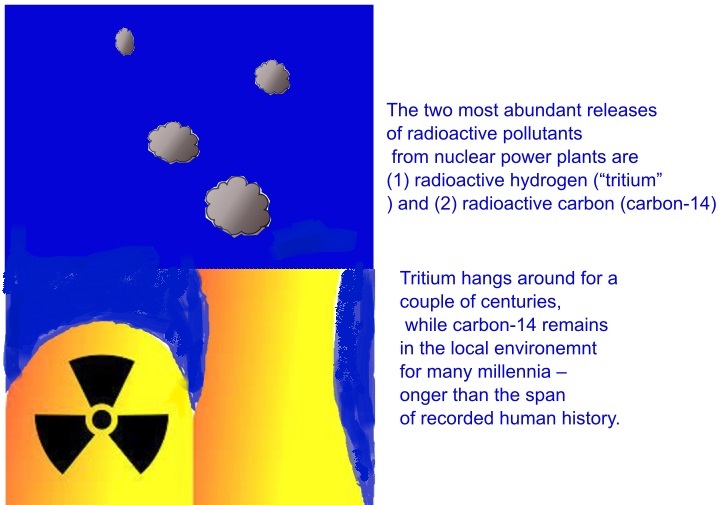
No Virginia, NUCLEAR REACTORS DO RELEASE carbon into the atmosphere
Gordon Edwards, 23 Mar 25
The two most abundant releases of radioactive pollutants from nuclear power plants are (1) radioactive hydrogen (“tritium”) and (2) radioactive carbon (carbon-14).Tritium hangs around for a couple of centuries, while carbon-14 remains in the local environemnt for many millennia – longer than the span of recorded human history.Both of these radioactive materials are “activation products” for the most part, created outside the nuclear fuel and therefore much easier to escape into the environment. Even without any fuel damage, a lot of tritium and a lot of carbon-14 is created by stray neutrons striking non-radioactive atoms outside the fuel assemblies.
Below I mention one way in which carbon-14 is created — when a neutron strikes a nitrogen atom. Another mechanism which is important in CANDU reactors is the collision of a stray neutron with an oxygen-13 atom (which is much more abundant in heavy water compared with ordinary light water).
Technically, radioactive carbon-14 is produced from non-radioactive nitrogen-14, making up about 78 percent of the air we breathe. When a neutron hits a nitrogen atom, a proton is given off and the result in radioactive carbon-14. It is the only radioactive isotope of carbon, just as hydrogen-3 (tritium) is the only radioactive isotope of hydrogen.Carbon and hydrogen are the basic building blocks of all organic molecules.
The half-life of carbon-14 is 5,700 years. The half-life of tritium is 12.3 years,
Very little if any radioactive carbon-14 comes from non-radioactive carbon directly.
Climate impacts may be starting to spiral, but a sub-1.5C world is ‘still possible’
Climate impacts may be starting to spiral, but a sub-1.5C world is ‘still
possible’. World Meteorological Organisation report shows CO2 in atmosphere
has reached its highest level in 800,000 years, but the world can still
avoid a climate catastrophe. Carbon dioxide in the Earth’s atmosphere has
reached its highest level in 800,000 years, with temperature records being
shattered, polar ice melting at unprecedented rates, and ocean
acidification worsening.
Business Green 19th March 2025, https://www.businessgreen.com/news-analysis/4411077/climate-impacts-starting-spiral-sub-5c-world
More than 150 ‘unprecedented’ climate disasters struck world in 2024, says UN
The devastating impacts of the climate crisis reached new heights in 2024,
with scores of unprecedented heatwaves, floods and storms across the globe,
according to the UN’s World Meteorological Organization. The WMO’s
report on 2024, the hottest year on record, sets out a trail of destruction
from extreme weather that took lives, demolished buildings and ravaged
vital crops.
More than 800,000 people were displaced and made homeless, the
highest yearly number since records began in 2008. The report lists 151
unprecedented extreme weather events in 2024, meaning they were worse than
any ever recorded in the region. Heatwaves in Japan left hundreds of
thousands of people struck down by heatstroke. Soaring temperatures during
heatwaves peaked at 49.9C at Carnarvon in Western Australia, 49.7C in the
city of Tabas in Iran, and 48.5C in a nationwide heatwave in Mali.
Guardian 19th March 2025, https://www.theguardian.com/environment/2025/mar/19/unprecedented-climate-disasters-extreme-weather-un-report
1 This Month

Protect Sazan Island from the Trump family! https://secure.avaaz.org/campaign/en/protect_sazan_island_from_the_trump_family_loc/?bqFCVab&v=174511&cl=22707147157&_checksum=5e9dde668860e8231c33699735e16a1fbf22ab2cb01da50c999fe8732b9775ef&utm_source=email&utm_medium=blast_email&utm_campaign=174511


Cuba Is Not a Failed State – It Is a Besieged State
PETITION: “Global Appeal to Endorse Palestinian Right of Return of Refugees”
To see nuclear-related stories in greater depth and intensity – go to https://nuclearinformation.wordpress.com
-
Archives
- June 2026 (129)
- May 2026 (306)
- April 2026 (356)
- March 2026 (251)
- February 2026 (268)
- January 2026 (308)
- December 2025 (358)
- November 2025 (359)
- October 2025 (376)
- September 2025 (257)
- August 2025 (319)
- July 2025 (230)
-
Categories
- 1
- 1 NUCLEAR ISSUES
- business and costs
- climate change
- culture and arts
- ENERGY
- environment
- health
- history
- indigenous issues
- Legal
- marketing of nuclear
- media
- opposition to nuclear
- PERSONAL STORIES
- politics
- politics international
- Religion and ethics
- safety
- secrets,lies and civil liberties
- spinbuster
- technology
- Uranium
- wastes
- weapons and war
- Women
- 2 WORLD
- ACTION
- AFRICA
- Atrocities
- AUSTRALIA
- Christina's notes
- Christina's themes
- culture and arts
- Events
- Fuk 2022
- Fuk 2023
- Fukushima 2017
- Fukushima 2018
- fukushima 2019
- Fukushima 2020
- Fukushima 2021
- general
- global warming
- Humour (God we need it)
- Nuclear
- RARE EARTHS
- Reference
- resources – print
- Resources -audiovicual
- Weekly Newsletter
- World
- World Nuclear
- YouTube
-
RSS
Entries RSS
Comments RSS
 nuclear-news