U.S. politicians want transparency about the radiation risks of the fire afflicted Santa Susana nuclear site.

 Public Risks from the Woolsey Fire and the Santa Susana Field Laboratory: A Letter to DTSC https://www.indybay.org/newsitems/2018/11/20/18819268.php, by Bradley Allen Nov 20th, 2018
CANDU reactors release WASTE HEAT as well as RADIOACTIVITY
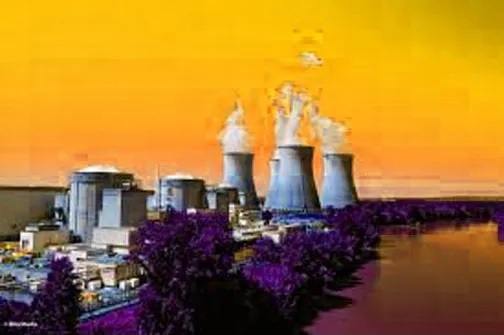
Inside a CANDU reactor there are three cooling circuits of water.
The “primary coolant” goes in a loop through the core of the reactor and it is filled with heavy water.
The “secondary coolant” goes in a loop through the “steam generator” (boiler) and it is made of ordinary “light” water.
The “tertiary coolant” is taken from the environment and returned to the environment at a hotter temperature Because it is used to “condense” the hot steam back into liquid water (all of it in the secondary loop).
Only 1/3 of the nuclear energy is turned into electrical energy. The other 2/3 is rejected back into the environment as “hot water” from the condenser. So 600 megawatts of electricity at Point Lepreau can only be achieved by dumping 1200 megawatts of heat into the environment.
However this has nothing to do with the use of heavy water.
The heavy water is all on the “nuclear side” of the generating station, not on the “conventional side” (where the Electricity is produced by using steam to turn the blades of a turbine to generate electricitiy.)
Beside the primary cooling loop being made of heavy water, the entire core of the reactor sits in a huge vessel called the “calandra” which is also filled with heavy water — this large inventory of heavy water is called the “moderator” and it is not used to cool the fuel, but simply to slow down (“moderate”) the speed of the neutrons
That are flying around inside the reactor core, splitting uranium atoms and releasing nuclear energy.
Heavy water molecules are a bit heavier than ordinary water molecules (H2O) because the hydrogen atoms (H) are twice as heavy as normal. These “heavy hydrogen” atoms are called DEUTERIUM (D). So heavy water is D2O instead of H2O. Deuterium is very hard to collect and so it is very expensive, but it is not radioactive. At Least, not to start with.
However, inside a CANDU reactor, some of those heavy hydrogen atoms D are transformed into radioactive Tritium atoms T. Tritium is a radioactive form of hydrogen. Each tritium atom T is three times heavier than a Normal hydrogen atom H, and these T atoms are UNSTABLE or RADIOACTIVE. That means they will all eventually “disintegrate” (explode) giving off harmful beta radiation.
Year after year, the concentration of tritium builds up higher and higher in the heavy water, and so in that sense the heavy water has become “radioactive”. It would be more correct to say that the heavy water has become radioactively contaminated by the build-up of tritium. Inevitable, some of that tritium gets out into the environment.
Tritium is released into the environment in the form of radioactive water molecules — as radioactive steam (Into the air) or radioactive liquid water (into the terrestrial environment.) Tritium is by far the biggest radioactive release from CANDU reactors into the environment, amounting to about 150-300 TRILLION becquerels per year from each operating CANDU reactor.
A becquerel denotes one radioactive disintegration every second, or 60 disintegrations each minute, 3600 disintegrations each hour, etc.) These “radioactive releases” are entirely separate from the “thermal (hot water) releases” discussed above.
Point Lepreau releases about 300 trillion becquerels of tritium annually. It is the worst tritium emitter in Canada.
LA wildfire damages set to cost record $135bn

The Los Angeles wildfires are on track to be among the costliest in US
history, with losses already expected to exceed $135bn (£109.7bn). In a
preliminary estimate, private forecaster Accuweather said it expected
losses of between $135bn-$150bn as the blazes rip through an area that is
home to some of the most expensive property in the US.
The insurance industry is also bracing for a major hit, with analysts from firms such as
Morningstar and JP Morgan forecasting insured losses of more than $8bn.
Fire authorities say more than 5,300 structures have been destroyed by the
Palisades blaze, while more than 5,000 structures have been destroyed by
the Eaton Fire.
BBC 9th Jan 2025, https://www.bbc.co.uk/news/articles/c07g73p4805o
World’s climate fight needs fundamental reform, UN expert says: ‘Some states are not acting in good faith’
Nina Lakhani, climate justice reporter, Guardian 7th Jan 2025
The international effort to avert climate catastrophe has become mired by misinformation and bad faith actors, and must be fundamentally reformed, according to a leading UN climate expert.
Elisa Morgera, the UN special rapporteur on climate change, said the annual UN climate summits and the consensus-based, state-driven process is dominated by powerful forces pushing false narratives and by tech fixes that divert attention from real, equitable solutions for the countries least responsible and most affected.
“The current climate regime was built in a way, maybe unconsciously, that locked in an ineffective approach that is blind to the disproportionate harms of climate change – and increasingly climate solutions – and the disproportionate benefits that the current situation is accruing to very few states and very few individuals,” said Morgera, in an exclusive interview with the Guardian.
“We can observe that some states are not acting in good faith in very clear ways, which is the basis of any international regime. There is widespread disregard for the rule of international law, and also a very clear pushback on the science, and shrinking of civil spaces at all levels. Basically, the truth is out of the conversation. That is the problem – there is no space at Cop for the truth,” said Morgera.
“Fundamental reform is possible, if there is a willingness by the states and the secretariat, but it’s hard to see that at the moment.”
Special rapporteurs are independent human rights experts appointed by the UN to investigate, report on and advise on specific themes or countries.
The annual UN climate summit, known as the conference of the parties, or Cop, is where states who are signed up to the principal climate treaty, the United Nations Framework Convention on Climate Change (UNFCCC), come together to make consensus-based decisions on climate action. The 2015 Paris agreement, negotiated at Cop21, requires all states to reduce greenhouse gas emissions to help curtail global heating.
But Cop has limited scope for Indigenous experts or ordinary people with lived experience and evidence of climate effects and culturally driven local solutions to participate in the negotiations in any meaningful way – which Morgera argues is among the major weaknesses that could be fixed.
She said: “The dominating assumption in the current process assumes that mass behavioral change is the solution, that this is as much a consumer issue as a production issue – which is a misrepresentation of the causes and the solutions. We’re still not looking at deep, systemic inequalities as the root causes, while also entrenching inequities and worsening negative human rights impacts of climate change – and climate solutions.”
Morgera, a professor of global environmental law at the University of Strathclyde in Glasgow, said: “This is not a blanket condemnation of the whole regime, but if the experiences and evidence of what climate change is doing around the world and how it is affecting people in differentiated ways is not made central to the decision-making, then it’s really hard to see how this process can meaningfully contribute.”
Open sessions should be the norm at Cop – and Indigenous people, UN agencies and others from civil society with different knowledge systems and evidence should be able to make textual suggestions for states to consider in real time, Morgera says. The UNFCCC could also ensure total transparency over corporate interests including the thousands of fossil-fuel, big ag and plastics lobbyists who participate in the annual climate summits, she argues.
After almost three decades, the UN climate summits have failed to come up with a meaningful, fair agreement or plan to transition away from oil, gas and coal – despite overwhelming scientific evidence that this must be done to avoid climate catastrophe. As fossil-fuel expansion continues apace, hopes of keeping global heating to below 1.5C above pre-industrialization levels have been all but crushed…………………………………………………………………………………………………………. https://www.theguardian.com/environment/ng-interactive/2025/jan/07/climate-change-reform-elisa-morgera
Climate crisis ‘wreaking havoc’ on Earth’s water cycle, report finds
Global heating is supercharging storms, floods and droughts, affecting entire ecosystems and billions of people
The climate crisis is “wreaking havoc” on the planet’s water cycle,
with ferocious floods and crippling droughts affecting billions of people,
a report has found.
Water is people’s most vital natural resource but
global heating is changing the way water moves around the Earth. The
analysis of water disasters in 2024, which was the hottest year on record,
found they had killed at least 8,700 people, driven 40 million from their
homes and caused economic damage of more than $550bn (£445bn).
Rising temperatures, caused by continued burning of fossil fuels, disrupt the
water cycle in multiple ways. Warmer air can hold more water vapour,
leading to more intense downpours. Warmer seas provide more energy to
hurricanes and typhoons, supercharging their destructive power. Global
heating can also increase drought by causing more evaporation from soil, as
well as shifting rainfall patterns.
Guardian 6th Jan 2025
https://www.theguardian.com/world/2025/jan/06/climate-crisis-wreaking-havoc-on-earths-water-cycle-report-finds
State of the Cryosphere Report 2024
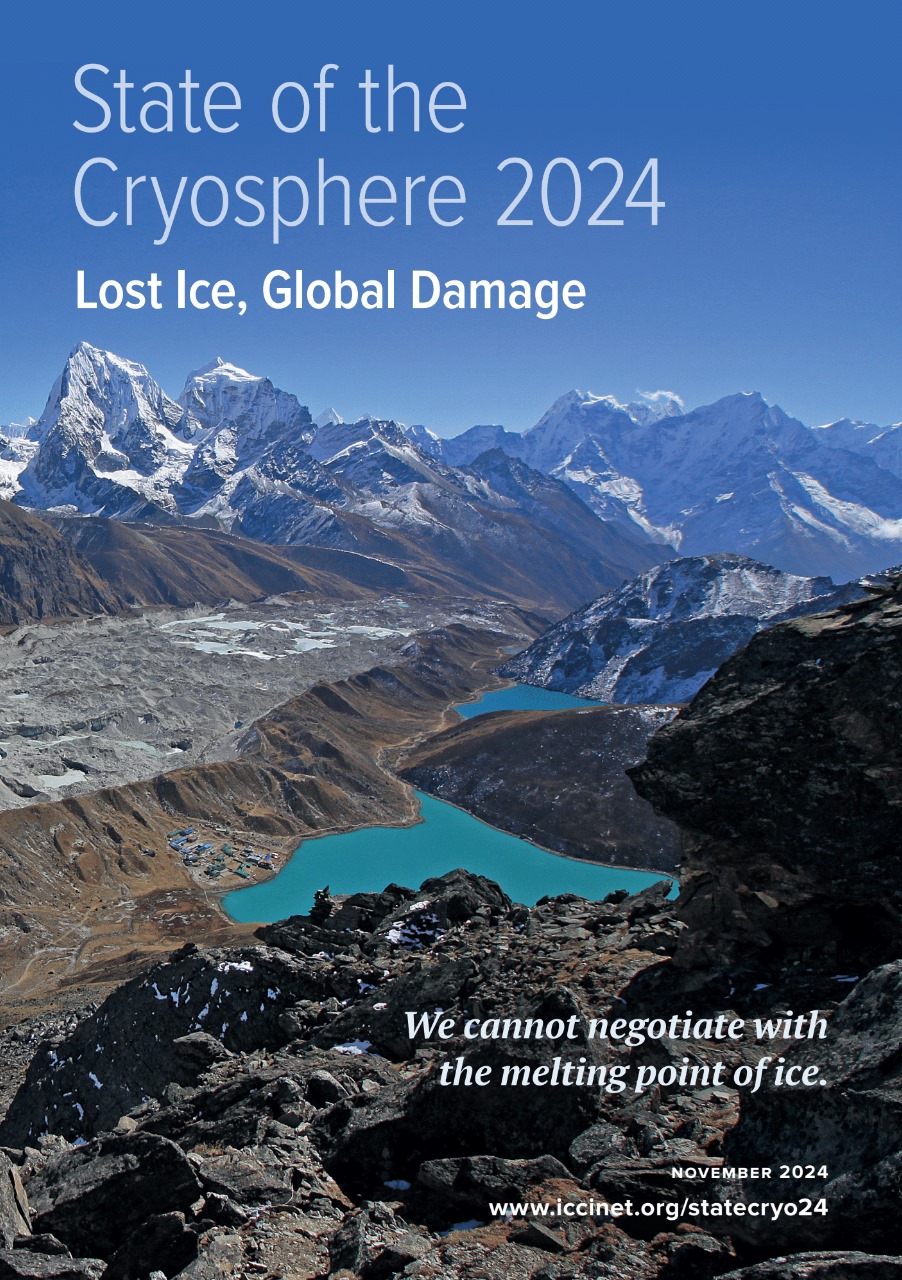
Lost Ice, Global Damage
In the State of the Cryosphere 2024 – Lost Ice, Global Damage report, over 50 leading cryosphere scientists warn of vastly higher impacts and costs to the global economy given accelerating losses in the world’s snow and ice regions. Current climate commitments, leading the world to well over 2°C of warming, would bring disastrous and irreversible consequences for billions of people from global ice loss.
Based on the most recent cryosphere science updates from 2024, the authors underscore that the costs of loss and damage will be even more extreme, with many regions experiencing sea-level rise or water resource loss well beyond adaptation limits in this century if our current level of emissions continues – leading towards a rise of 3°C or more. Mitigation will also become more costly due to feedbacks from thawing permafrost emissions and loss of sea ice.
For the first time, the report notes a growing scientific consensus that melting Greenland and Antarctic ice sheets, among other factors, may be slowing important ocean currents at both poles, with potentially dire consequences for a much colder northern Europe and greater sea-level rise along the U.S. East Coast.
Reviewed and supported by over 50 leading cryosphere scientists, this is the latest report in the State of the Cryosphere series, which takes the pulse of the cryosphere on an annual basis. The cryosphere is the name given to Earth’s snow and ice regions and ranges from ice sheets, glaciers, snow and permafrost to sea ice and the polar oceans – which are acidifying far more rapidly than warmer waters. The report describes how a combination of melting polar ice sheets, vanishing glaciers, and thawing permafrost will have rapid, irreversible, and disastrous impacts worldwide.
Energy efficiency, the forgotten tool for dealing with climate change

How to keep warm when budgets are squeezed.
Sub-zero temperatures are hitting the UK just as gas and electricity prices have risen for millions of households. Energy bills are about 50% higher than pre-Covid levels,
leaving many struggling to cover the cost alongside other financial
demands.
So what can you do to stay warm while keeping costs down? Before
having an argument between family or flatmates about the heating, try
touring the property to work out how to save energy. That may include
turning off radiators in unused rooms, switching lights off when they are
not needed, and not leaving electrical appliances on standby. Curtains
should be open during the day, then drawn at dusk. Manage your draughts by
putting a black bag with scrunched up paper up an unused chimney, or try
limiting other draughts around the home. You can easily make your own
draught excluders. Cold, hard floors can be covered by a rug if you have
one. Layer up with clothes, safely use a hot water bottle, and make sure
you have warm nightwear.
BBC 3rd Jan 2025
https://www.bbc.co.uk/news/articles/cd6084l4zx6o
TODAY. The polar playground for a suicidal species?
https://theaimn.net/the-polar-playground-for-a-suicidal-species/ 7 January 25
Where to begin on this mind-boggling story about epic changes on a very small planet?
Well, let’s begin on the fun part. The Australian Antarctic Program encourages some pretty innocuous recreational activities, plus of course, encouragement for tourists to come, and to learn about the polar world. So that’s OK, I suppose. But lately, in the news, there is growing concern that tourists, Australians in particular, are taking such a playful attitude to Antarctica, that they are risking their personal safety.
Interesting that the video above puts the blame on TikTok for encouraging the fun and danger. But tourism itself is good for increasing education about Antarctica. As long as individuals personally behave safely, that’s fine, isn’t it?
But what about planetary safety?
What Australians, and most of the world, learn about Antarctica, is that it’s pretty, and has penguins, Oh, and the ice is melting a bit, too. And that’s about it. The media does not trouble our complacent little minds with information about the thermohaline ocean circulation, the atmospheric circulation patterns, the carbon-sequestration of krill, the polar vortex…. Much too hard for us, in this cricket-tennis season.
Right now, Northern Europe and parts of the USA are experiencing extreme cold weather. No doubt some people would say that this disproves global heating, climate change. Alas, these extremes, emanating from the Arctic, by the polar vortex, are exacerbated by global heating. The polar vortex is a complex system, difficult to grasp, for the average news reader, so it is part of the whole poorly known, global climate system.
Antarctica is at the other end of the world – not connected to all this? Well, not if you ignore the global thermohaline circulation, among other things like sea level rise.
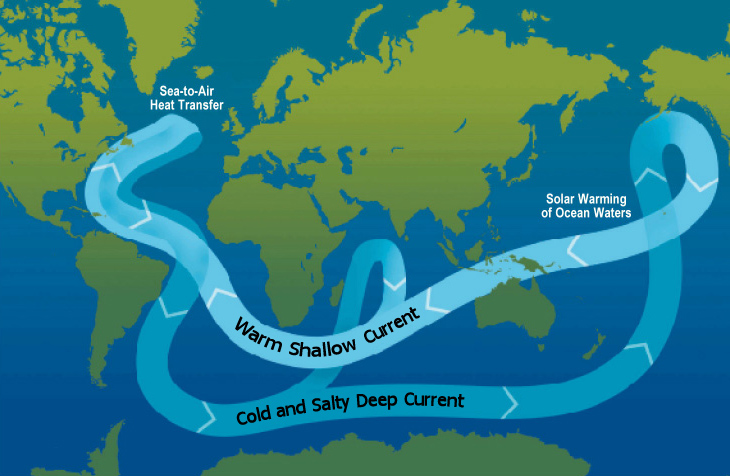
Global thermohaline circulation
Professor Elisabeth Leane, Professor of Antarctic Studies at the University of Tasmania says – What happens in Antarctica doesn’t stay in Antarctica. Its future will shape the future of the planet
Which brings me to the question of safety in relation to Antarctica – planetary, not just personal.
And here’s what the University of Tasmania says about it – Antarctica’s tipping points threaten global climate stability.
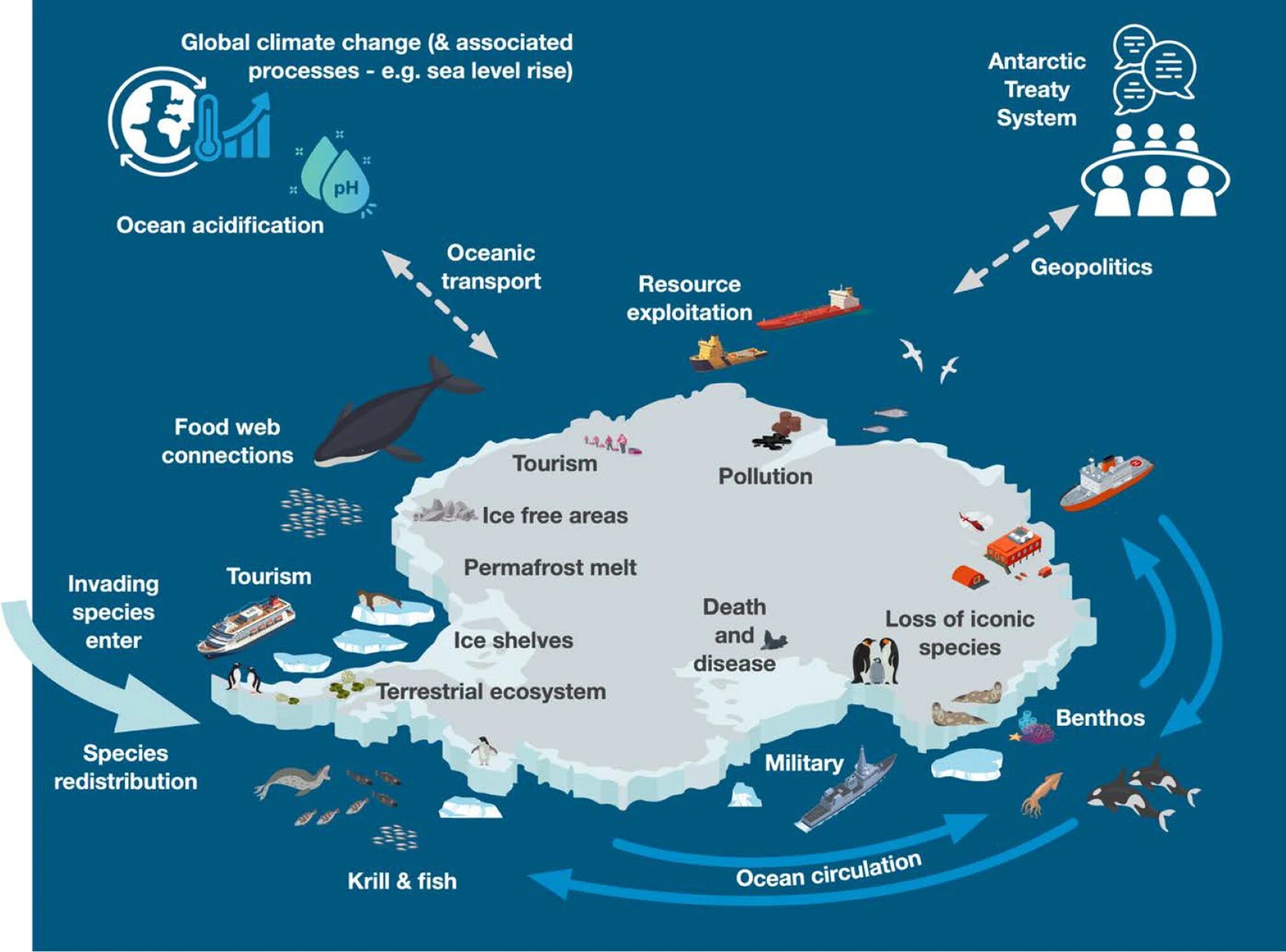
The map above is from the University of Tasmania’s report by international climate scientists . It identifies the various cascading tipping points and their interactions and pressures on the ecosystem.
For those who care about the climate change issue, and about Australia and the Antarctic, I would urge them to watch, and persist with, this brilliant report by climate researcher Paul Beckwith – https://www.youtube.com/watch?v=6WccDhnM8R8
Beckwith explains the potential tipping points identified by the study and their interrelationships , and adds the issue of sea ice loss. Critical issues are ice sheets, ocean acidification, ocean circulation, species redistribution, invasive species, permafrost melting, local pollution, chemical impacts, social impacts, local pollution and the Antarctic Treaty System. He goes on to explain with excellent graphics, the global thermohaline circulation, and then, in-depth, the records on sea ice, and then on to his detailed study on the tiny krill or light shrimp, and their global importance. Finally, Beckwith outlines the politics, the various national claims in the Antarctic Treaty System. The scientists’ conclusion – the urgent need for action on climate. Heavy stuff. Fascinating stuff. He finishes with a reminder of the unique role of that amazing critter the krill.
If you want a more concise discussion of the University of Tasmania’s December remarkable workshop of international marine scientists – go to Radio Ecoshock – World-changing Tipping Points – In Antarctica !
The “mainstream media” rarely covers climate change in any depth. For decades, the public has been informed very superficially on this life and death matter for our survival. The dedicated scientists produce their research results, but the media seem to find these too difficult, or too “political” to bother to report on them properly. The December 2024 “emergency summit” of international polar scientists in Tasmania barely got a mention in the Australian or international press.
You have to go to alternative media, to get any real insight into what is happening to the climate of our planet home. For decades now, Paul Beckwith has being producing his highly informative and wonderfully illustrated videos, on Youtube. Meanwhile Alex Smith has been doing the same sort of thing on radio and podcast, and print, – on Radio Ecoshock, which is heard in Australia on Community Radio 3CR.
In 2025, it is ever more urgent for people to wade through the morass of “social” media, and corporate media, and “alternative” media, to find the facts on climate change. Paul Beckwith and Radio Ecoshock are two examples of a rare and endangered human species – journalists who do their homework on climate change.
‘A snapshot of climate devastation’: Study claims 2024’s biggest climate disasters cost $200bn.
Ten costliest climate disasters of 2024 each caused more than $4bn in
damage, Christian Aid study finds. The 10 most costly climate disasters of
2024 collectively caused more than $200bn in damages, according to annual
analysis published today by Christian Aid. The charity’s annual assessment
of the 10 most expensive extreme weather events of the past 12 months
estimates every one of the biggest individual disasters this year caused
damages to the tune of more than $4bn each, with no part of the world
spared from such extreme weather events.
Moreover, given most estimates
totted by Christian Aid are based only on insured losses, the true
financial costs are likely to be even higher, while the human costs are
often uncounted for, the charity said. The report suggests the USA bore the
brunt of climate disaster costs in 2024, with October’s Hurricane Milton
the single biggest one-off event at $60bn in damage, while Hurricane Helene
– which struck the US, Cuba and Mexico in September – placed second with
$55bn damages.
Business Green 30th Dec 2024 https://www.businessgreen.com/news/4391020/snapshot-climate-devastation-study-claims-2024s-biggest-climate-disasters-cost-usd200bn
Skiing in France is slowly dying.
Skiing in France is slowly dying and many resorts are expected to close
down in a little over 20 years, industry experts have warned. Climate
change, ageing ski lifts and rising costs are driving smaller, mid-altitude
resorts out of business. Five shut down this year and 186 have gone out of
business since the 1950s, mostly in inexpensive ski areas with relatively
few runs that were popular with French families but never attracted large
numbers of foreign holidaymakers.
Times 29th Dec 2024 https://www.thetimes.com/world/europe/article/france-affordable-ski-slopes-shut-why-nqkb3qrk7
Scientists should break the ice
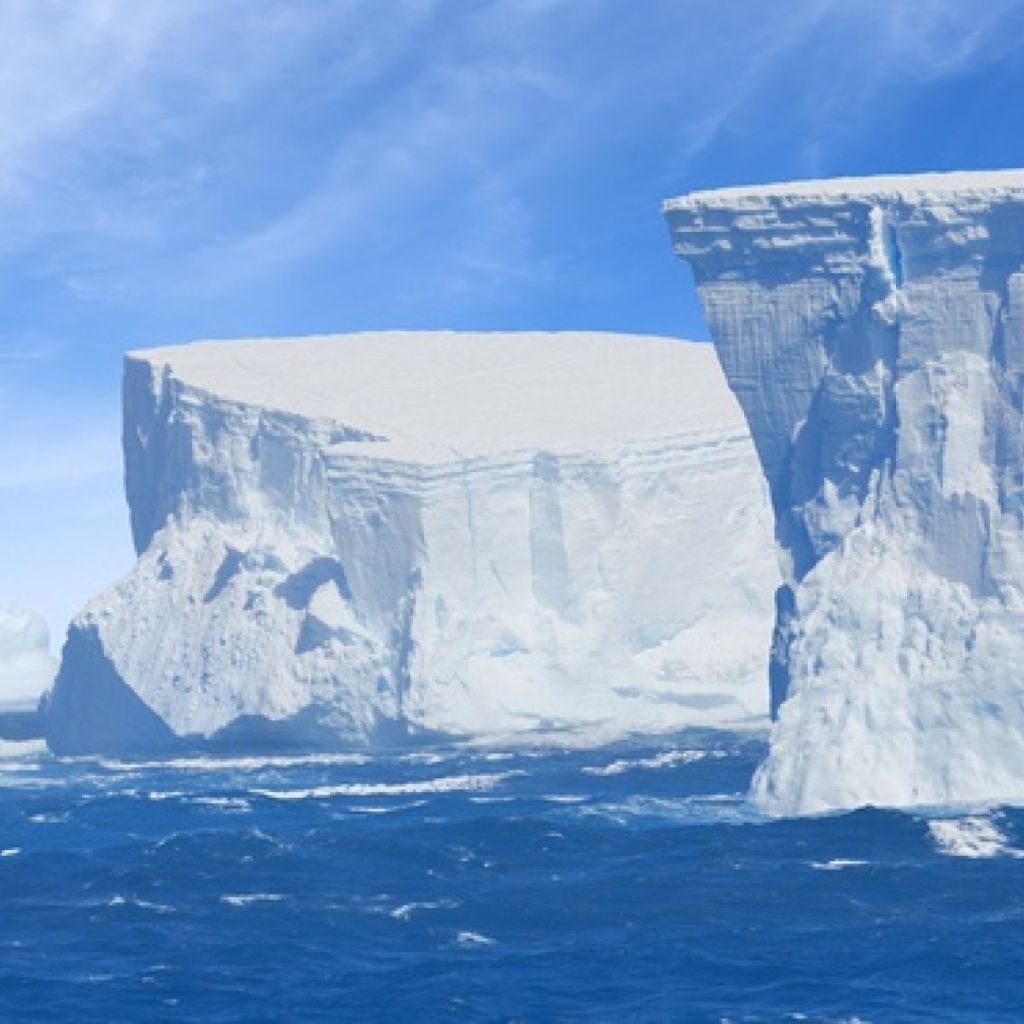
once the ice sheet slides into the ocean, there is no putting it back, even if all carbon emissions ended that day. The ice-sheet holds enough water to raise sea levels by 58 metres. Even if only half of it breaks off, it will be just a waiting game over just a few years for the ice to melt and for us to watch every coastal city on earth to be inundated. In our lifetime.
once the ice sheet slides into the ocean, there is no putting it back, even if all carbon emissions ended that day. The ice-sheet holds enough water to raise sea levels by 58 metres. Even if only half of it breaks off, it will be just a waiting game over just a few years for the ice to melt and for us to watch every coastal city on earth to be inundated. In our lifetime.
Crispin Hull, December 29, 2024
The 2024 award for the biggest disjoin between the importance of a story and the coverage it got must surely go to the science briefing on Antarctica and Sea-Level Rise published by the Australian Antarctic Program Partnership and the ARC Australian Centre for Excellence in Antarctic Science.
It came out in September. The ABC had some coverage, but it seemed to miss some essential points.
Here is what the new science tells us and how it is different from the older science.
The older science tells us that the amount of sea ice in Antarctica is shrinking, but not as badly as in the Arctic. Sea ice expands and contracts quite quickly according to air and sea temperature. So, a gradual reduction in sea ice will mean a gradual and comparatively small rise in sea levels.
This science should be moderately alarming, but the misinformationists in the fossil fuel industry can bat away public fears by saying not much is happening here and it will not happen in your lifetime, so carry on as usual.
This is standard stuff from fossil misinformationists: climate change is not happening, but if it is happening it is part of natural geologic forces and has nothing to do with human-generated carbon, and even if it is caused by human-generated carbon we can develop technologies to capture the carbon and safely store it away.
In short, they base their facts on their desired conclusion that they can continue to make profits from the emission of carbon until ecosystems and economies collapse. When it is too late.
Coming back to Antarctica, earlier science suggested that sea-ice contraction could be reversed if temperatures came down a bit. As it happens sea-ice is an important reflector of solar rays (and heat). Without the sea-ice you have dark ocean which absorbs the rays and increases the heat of the ocean. Nonetheless, it is still a probably reversible process.
Enter the new research. This is about the eastern Antarctic icesheet. Hitherto, this has given climate scientists much less cause for concern. This is because the eastern ice sheet has built up over land. It is anchored.
Unlike sea-ice it is not vulnerable to warmer water melting it.
Picture the land mass and a big thick ice sheet over it. The sea nibbles at the edge and even if the sea is a bit warmer it does not melt much ice. This is not like sea-ice where the warmer water is all around it melting it quickly. So, hitherto scientists have taken some climate solace in the fact that so much ice is safely tied up in the eastern Antarctic ice-sheet (more than 60 per cent of the world’s fresh water) and so will give us more time to slow and reverse the warming of the planet.
Enter the new research. Remove the image of a lump of land mass. Rather picture that the land mass has been forced down by the weight of the ice – heavier at the middle of the land mass and lighter at the edge.
The new science tells us that much of the eastern Antarctic ice-sheet is grounded below sea level. So, one the warmer sea waters get under it, the whole sheet becomes unstable and can slide into the ocean. And even if temperatures are made to fall, the tipping point would have been reached – the warmer sea would have run under the massive ice-sheet, undermining it and making its slide into the ocean inevitable.
And once the ice sheet slides into the ocean, there is no putting it back, even if all carbon emissions ended that day. The ice-sheet holds enough water to raise sea levels by 58 metres. Even if only half of it breaks off, it will be just a waiting game over just a few years for the ice to melt and for us to watch every coastal city on earth to be inundated. In our lifetime.
Once the ice sheet hits the ocean, it is the end of civilisation as we know it.
The ice cannot be put back.
The greater the potential damage the more you should do about it, even if you think the risk is small. This is why people go to a lot of effort to make their houses less exposed to bushfires and cyclones.
It may be that some billionaires might imagine they could set up doomsday retreats to avoid death, injury, and discomfort. They are dreaming. In those circumstances money means nothing and the profit-driven selfishness that drives unnecessarily extending the use of fossil fuel will be brushed aside by the maniac selfishness of those on a desperate if doomed survival mission.
Scientists must change stop their subdued, cautious approach to reporting climate change. It is understandable because scientists do not want to cause panic or unnecessary alarm. But the approach has just given the fossil industry endless free kicks. It is time for alarm and measured panic.
Scientists should stop being scared of publishing scary material in a scary way. It is time to tell people the reality of the biggest security, economic, and existential threat to humans on earth………………………. more http://www.crispinhull.com.au/2024/12/29/scientists-should-break-the-ice/?utm_source=mailpoet&utm_medium=email&utm_campaign=crispin-hull-column
‘We need to be prepared’: China adapts to era of extreme flooding

“The Chinese leadership tends to see the long game,” Li said. “To demonstrate their far-sight and to prevent further risks, more should be done to prepare for the impacts of climate change systematically.”
While some residents take to building houses in trees, officials recognise need for national response to climate disasters
Amy Hawkins , Guardian 24th Dec 2024, https://www.theguardian.com/world/2024/dec/24/we-need-to-be-prepared-china-adapts-to-era-of-extreme-flooding
Every summer, Dongting Hu, China’s second-largest freshwater lake, swells in size as flood water from the Yangtze River flows into its borders. Dams and dikes are erected around the lake’s edges to protect against flooding. But this year, not for the first time, they were overwhelmed.
For three days in early July, more than 800 rescue workers in Hunan province scrambled to block the breaches. One rupture alone took 100,000 cubic metres of rock to seal, according to Zhang Yingchun, a Hunan official. At least 7,000 people had to be evacuated. It was one of a series of disasters to hit China as the country grappled with a summer of extreme weather. By August, there had been 25 large floods, the biggest number since records began in 1998, reported state media.
Xi Jinping, China’s president, “urged all-out rescue and relief work” to safeguard the people affected by the flooding in Hunan, state media reported.
One of those people was Ren Benxin, an archaeologist who lives on a small, forested island in the upper tributaries of Dongting Hu. He calls his idyllic home Soultopia. As well as carrying out archaeological research, he provides accommodation for travellers and looks after the herd of stray cats and dogs that he has adopted over the years.
On 5 July, his home was flooded. “First, I rescued the animals. Then, I rescued the supplies,” he said. “It was the first time in 10 years that I’d experienced something like this.”
The wooden huts in Ren’s corner of the islet were nearly completely submerged in muddy water. Chickens used the remnants of destroyed buildings as rafts to avoid drowning. Ren traversed the island in a small plastic dinghy. One of his dogs, Eason, fell ill after drinking dirty flood water, and died a few days later.
“Two years ago, we had a severe drought, and this year it’s been floods. I think we need to be prepared for anything,” Ren said.
Experiences like Ren’s are becoming more common in China, as
global heating makes extreme weather events more likely, as well as undermining communities’ defences against those disasters.
Dongting Hu exemplifies these challenges. It was once China’s largest freshwater lake. But decades of agricultural development meant that huge swathes of its land were reclaimed for farming, reducing the lake’s storage capacity. Both droughts and floods are becoming more serious and severe.
At least six Chinese provinces experienced major flooding in 2024. As well as the floods in Hunan, heavy rainfall in Guangdong, China’s most populous province, forced more than 110,000 people to relocate. After years of treating weather disasters as isolated incidents that require a local response, Chinese officials are becoming increasingly aware of the need to adapt to extreme weather events on a national scale.
“The harsh reality is here: the lack of climate action will cost China and present a social security threat,” said Li Shuo, director of the China Climate Hub at the Asia Society Policy Institute.
At the Cop29 UN climate crisis conference in November, China published an action plan for climate adaptation, vowing to establish a technical platform to monitor and forecast extreme weather events and to share its knowledge of improving early warning mechanisms.
It marked a shift the country which has long acknowledged the science of the climate crisis, but has focused its environmental cleanup efforts on issues such as air pollution – rather than severe but relatively rare floods and droughts.
“The Chinese leadership tends to see the long game,” Li said. “To demonstrate their far-sight and to prevent further risks, more should be done to prepare for the impacts of climate change systematically.”
For flooding victims like Ren, an official recognition of – and compensation for – the damage wrought by the climate crisis cannot come soon enough. The repair work cost him more than 70,000 yuan (£7,600), although the authorities did send some relief workers to help.
For now, Ren is developing his own ways to adapt to climate breakdown. He shuns electrical appliances after his were destroyed in the flood, and uses wood burners for cooking and heating. He plans to build a new home suspended in trees, so as to be safe from floods.
“I think extreme weather is more frequent now. So I have to be prepared for anything. If I like the place, I’ll stay.”
Additional research by Chi-hui Lin and Jason Tzu Kuan Lu
World’s largest iceberg on the move again after months spinning on the spot
The iceberg is about three times the size of New York City and more than twice the size of Greater London
Rituparna Chatterjee, Independent 15th Dec 2024, https://www.independent.co.uk/climate-change/news/world-largest-iceberg-a23a-moving-antarctic-b2664564.html
The world’s largest iceberg is on the move again after decades of being grounded on the seafloor and more recently spinning on the spot, according to the British Antarctic Survey (BAS).
The mega A23a iceberg has broken free from its position north of the South Orkney Islands and is now drifting in the Southern Ocean, scientists said.
“It’s exciting to see A23a on the move again after periods of being stuck. We are interested to see if it will take the same route the other large icebergs that have calved off Antarctica have taken. And more importantly what impact this will have on the local ecosystem,” Dr Andrew Meijers, an oceanographer at the BAS, said.
The iceberg, known as A23a, split from the Antarctic’s Filchner Ice Shelf in 1986. But it became stuck to the ocean floor and had remained for many years in the Weddell Sea.
Scientists anticipate that A23a will continue its journey into the Southern Ocean following the Antarctic Circumpolar Current, which is likely to drive it towards the sub-Antarctic island of South Georgia. In that region it will encounter warmer water and is expected to break up into smaller icebergs and eventually melt.
Major report joins dots between world’s nature challenges
Helen Brigg,
Environment correspondent, BBC News @hbriggsjourno.bsky.social•@hbriggs BBC 17th Dec 2024
Climate change, nature loss and food insecurity are all inextricably
linked and dealing with them as separate issues won’t work, a major report
has warned. The review of scientific evidence by the Intergovernmental
Platform on Biodiversity and Ecosystem Services (IPBES), external found
governments are underestimating or ignoring the links between five key
areas – biodiversity, water, food, health and climate change. This “siloed”
approach has unintended consequences, such as damaging biodiversity through
tree-planting schemes, or polluting rivers while ramping up food
production, the report said. The latest assessment was approved by almost
150 countries meeting in Windhoek, Namibia.
BBC 17th Dec 2024
https://www.bbc.co.uk/news/articles/cwyxkz41knzo
France’s New Nuclear Power Plant Is a Ticking Bomb

Nuclear power plants are vulnerable to climate change, and the rampant rush to revive the nuclear power industry should be stopped.
President Emmanuel Macron’s ambitious plan to revive France’s nuclear energy industry aims for carbon neutrality by 2050. It highlights significant challenges, including climate risks to nuclear sites, such as the Gravelines plant, which faces flooding threats due to rising sea levels. Additionally, the article points to workforce shortages, economic inefficiencies, and geopolitical risks, such as France’s reliance on uranium from Niger, as critical obstacles.
By Rim Longmeng, December 13, 2024 , https://www.fairobserver.com/more/environment/climate-change-news/frances-new-nuclear-power-plant-is-a-ticking-bomb/
Despite Europe’s growing skepticism of nuclear technology in the wake of Fukushima, in 2021, French President Emmanuel Macron announced the revival of his country’s nuclear energy industry. Macron’s ambitious program aims to end the country’s dependence on fossil fuels and make France carbon neutral by 2050. The plan will require the construction of 14 new nuclear reactors. At first glance, Macron’s plans seem logical, as nuclear energy already accounts for 70% of France’s energy consumption, and cheap nuclear energy has been the backbone of the French economy since the 1970s. However, the populist tactics of the French leader are raising questions among the country’s population and experts, as the problems of the nuclear industry – which will inevitably arise soon – will be left for future generations to solve after Macron leaves office.
No room for improvisation in the face of climate risks
In its report October 3, 2024 Greenpeace harshly criticized the French government’s plans to build two new EPR2 nuclear reactors in northwestern France near Dunkirk due to the risk of flooding. The new units are scheduled to be operational by 2040, but the problem lies in the site chosen for construction. The chosen site is located in a region already at risk of flooding and will become increasingly vulnerable as climate change worsens.
The Gravelines nuclear power plant is currently the most powerful in Western Europe, already consisting of six 900 MW reactors. The French state-owned energy company EDF has promised to build two more reactors at the same plant on an 11-meter-high platform to protect from flooding. According to EDF experts, the NPP project will sufficiently resist climate challenges until 2070. However, this is only the middle of the plant’s lifespan, which is expected to last 60 years until 2100. Its dismantling is scheduled for the middle of the next century, and EDF promises to “adapt” the project to current climate conditions every 10 years after 2070.
It sounds reckless, as the UN Environment Programme warns of a temperature rise of up to +3.1°C in the coming decades, leading to sea level rise and a dramatic increase in extreme climate events. Have the French authorities already forgotten the devastating North Sea flood of 1953 and the numerous disasters in France in recent years? Even today, most of the area around the nuclear power plant is below sea level during high tides, and only protective structures built nearby, turning the NPP into a kind of “island,” have saved the region from disaster. Since 2022, the Gravelines Nuclear Power Station has been surrounded by a 3-kilometer-long protective wall, which costs EDF 35 million euros. How much more will EDF spend to ensure the nuclear plant’s safety, and what will happen if nature proves more potent than the fortifications built?
The EDF project documentation contains too many unanswered questions, which exist only thanks to Macron’s political patronage. The facts indicate that constructing new reactors poses an extreme danger to the local population and the environment. Nuclear power plants are vulnerable to climate change, and the rampant rush to revive the nuclear power industry should be stopped.
New Challenges for Macron’s Nuclear Renaissance
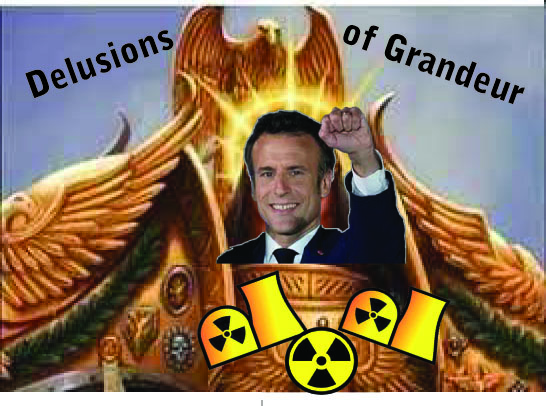
By announcing the revival of nuclear energy in the country, President Macron has formally taken a step toward reviving France’s economic, industrial and military power. However, the French economy is not yet ready to fully support such ambitious plans.
Macron’s ambitious plans to build 14 new nuclear power units will face a glaring shortage of qualified personnel. The French nuclear industry currently employs about 220 thousand people. To achieve Marcon’s objectives, the industry will need a significant influx of skilled workers, particularly in the workforce. By 2030, according to EDF estimates, their number needs to be at least doubled. The proposed construction timeline is also impressive. The first Gravelines unit with the EPR-2 reactor is expected to take only eight years to complete. It is worth mentioning the notorious Flamanville nuclear reactor in Normandy, which ended up costing 4 times its initial budget, reaching €13.2 billion, and was launched more than a decade behind schedule.
The Loss of African Uranium Deposits
France is particularly concerned about the exploitation of uranium from Niger and the potential consequences of losing its supply. For more than four decades, the Orano company, owned by the French state by 45%, has been developing uranium in African countries. Niger is one of the three largest suppliers of this valuable natural resource to France. However, the recent revocation of Orano’s uranium mining license in Niger has cast doubt on France’s energy independence. Representatives of the new Nigerien authorities have stated that uranium has been used to supply Europe with electricity for decades. Still, West Africa remains one of the poorest countries in the world and has not benefited much from exports. Additionally, the economic risks for the French nuclear industry include uranium prices that have reached historical highs, primarily due to European countries’ search for new energy suppliers after 2022.
According to Macron, promoting nuclear technologies in France should lead the country to complete independence from foreign energy supplies and secure France’s status as the flagship nuclear industry in the EU. The problem is that Macron knows it will not be up to him but to future generations of French politicians to address the problems mentioned above regarding his misleading nuclear policy.
[Tara Yarwais edited this piece.]
1 This Month


Website of the Week

New book – https://www.amazon.com/dp/1923372157?utm_source=substack&utm_medium=email
Now until to February 10, 2026 Radioactive waste storage in France: the debate is finally open! How to participate?
-
Archives
- January 2026 (127)
- December 2025 (358)
- November 2025 (359)
- October 2025 (377)
- September 2025 (258)
- August 2025 (319)
- July 2025 (230)
- June 2025 (348)
- May 2025 (261)
- April 2025 (305)
- March 2025 (319)
- February 2025 (234)
-
Categories
- 1
- 1 NUCLEAR ISSUES
- business and costs
- climate change
- culture and arts
- ENERGY
- environment
- health
- history
- indigenous issues
- Legal
- marketing of nuclear
- media
- opposition to nuclear
- PERSONAL STORIES
- politics
- politics international
- Religion and ethics
- safety
- secrets,lies and civil liberties
- spinbuster
- technology
- Uranium
- wastes
- weapons and war
- Women
- 2 WORLD
- ACTION
- AFRICA
- Atrocities
- AUSTRALIA
- Christina's notes
- Christina's themes
- culture and arts
- Events
- Fuk 2022
- Fuk 2023
- Fukushima 2017
- Fukushima 2018
- fukushima 2019
- Fukushima 2020
- Fukushima 2021
- general
- global warming
- Humour (God we need it)
- Nuclear
- RARE EARTHS
- Reference
- resources – print
- Resources -audiovicual
- Weekly Newsletter
- World
- World Nuclear
- YouTube
-
RSS
Entries RSS
Comments RSS
 nuclear-news