‘The Hell With It’: SpaceX CEO Musk Reverses Position On Funding Satellite Internet For Ukraine

https://www.rferl.org/a/musk-starlink-ukraine-funding-spacex/32084855.html 16 Oct 22
SpaceX CEO Elon Musk now says that his company will continue to pay for the Starlink satellite Internet service for Ukraine, a day after suggesting SpaceX could no longer afford it.
“The hell with it,” Musk said on Twitter. “Even though Starlink is still losing money & other companies are getting billions of taxpayer $, we’ll just keep funding ukraine govt for free.”
Musk activated Starlink, a network of more than 2,000 satellites orbiting the Earth and thousands of terminals on the ground, in late February after Internet services were disrupted because of Russia’s invasion of Ukraine.
Starlink has cost SpaceX $80 million thus far and the cost will exceed $100 million by end of year, Musk said on Twitter on October 7.
He told his more than 108 million Twitter followers on October 14 that SpaceX cannot fund the network “indefinitely” amid reports that he has asked the Pentagon to step in.
He issued the statement after CNN reported that SpaceX sent a letter to the Pentagon last month saying it could not continue to fund the Starlink service in Ukraine and that it may have to stop funding it unless the U.S. military gives the company tens of millions of dollars a month.
The Defense Department later confirmed that it received a request from Musk to take over funding for the satellite network. The official said the issue has been discussed in meetings and senior leaders are weighing the matter.
Low operating costs make the case for investing in utility-scale renewable projects
Renewables met 100% of global electricity demand growth during the first
half of 2022. So says the ‘Global Electricity Mid-Year Insights 2022’
from Ember, a global energy think tank. In fact, it says there was a 389
TWh increase in the demand for electricity in the first half of 2022
compared to the first half of 2021, whereas the rise in renewables supply
was actually a bit more – 416TWh.
That’s not surprising given that
renewables are getting so cheap- including in the UK, with wind and solar
the most prolificate new sources across world. However, that in turn may
create a bit of a problem for older renewables, set up under quite
lucrative subsidy schemes, based on now high gas prices, like the
Renewables Obligation in the UK. As I have noted in earlier posts, there is
pressure on them to switch to the more competitive CfD system. Certainly
the RO system is based on adding a subsidy to wholesale gas prices, so
something has to change, since gas prices are now so high. But there are
issues- will every supplier be happy to accept less earnings? They may drag
their feet.
The record-breaking run in power prices, particularly in
Europe, is creating a favorable investment case for solar and wind
projects, making it increasingly compelling to develop renewable assets
purely based on project economics. According to Norwegian consultancy
Rystad Energy, current spot prices in Germany, France, Italy, and the
United Kingdom would all result in payback of 12 months or less.
Considering the average monthly spot prices for August in these countries
were all well over €400/MWh and the relatively low operating costs of
renewables, investing in utility-scale projects appear to be a no-brainer.
Renew Extra 15th Oct 2022
https://renewextraweekly.blogspot.com/2022/10/renewable-booming-but-windfall-tax.html
U.S. tax-payers’ aid to Ukraine $67.5 billion – Taiwan will be the next beneficiary

Nothing But Welfare Queens: American Aid to Zelensky and Tsai Ing-wen
Libertarian Institute, by Patrick Macfarlane | Oct 13, 2022,
As it pertains to the American public, Ukraine’s response to the Russian invasion can be summed up with two words: “Zelensky demands.”
To date, Washington elites and their politicians have been happy to provide—at public expense—lining their own pockets in the process.
As of this writing, U.S. aid for Ukraine has reached approximately $67.5 billion, a figure greater than Russia’s entire 2021 military budget. According to the State Department, this support includes $15.2 billion in direct military assistance. The support comes although 60-70% of lethal aid never reaches the front lines, according to a now-redacted CBS interview with on-the-ground activists.
Not only is the American taxpayer supporting much of the Ukrainian military, it is also supporting the Ukrainian government. The same working class Americans who were deemed “nonessential” in 2020—who saw their businesses shuttered and burned down—now have to pay entitlement programs both at home and in Ukraine. As of September 30, 2022, the U.S. has provided $13 billion in “direct budget support,” which is ostensibly used;
…to pay government salaries, meet pension obligations, maintain hospitals and schools, and protect critical infrastructure[,] support continuity operations at the national, regional, and local levels, support for [sic] the health sector, agricultural production, civil society, [and enable] programs to hold Russia and its forces accountable for their actions in Ukraine.
Although American taxpayers have already matched Russia’s 2021 military budget, Ukrainian president Vlodomyr Zelensky only demands more. During a Tuesday phone call, President Biden reviewed Washington’s latest $625 million dole to Zelensky. It includes, inter alia, 4 additional High Mobility Artillery Rocket Systems (HIMARS), 16 155mm Howitzers, 75,000 155 mm artillery rounds, 500 precision-guided 155mm artillery rounds, 16 105mm Howitzers, 30,000 120 mm mortar rounds, and 200 MaxxPro Mine Resistant Ambush Protected Vehicles.
This latest boon notwithstanding, in the same phone call, Zelensky urged Biden to provide Ukraine with air defense systems that would be used to shoot down Russian planes.
………………… Republicans like Taylor-Greene, Gaetz, and Hawley understand the cost of empire: endless warfare, a decaying homefront, and a beclowned international reputation. They understand that a war between the U.S. and Russia will be unlike anything Americans have ever experienced. Although they cloak their condemnation of war with Russia in criticism of “weak Joe Biden,” they understand it is the West that provoked this conflict and seeks to prolong it “to the last Ukrainian.” They know that the conflict—even if it remains by-proxy—is a cost war-weary working class Americans do not want and cannot afford.
They must, then, realize that the same Washington elites waxing American fat off the Ukraine conflict are cultivating Taiwanese President Tsai Ing-wen as a Zelensky in-waiting.
Although U.S. military aid to Taiwan traditionally comes by way of arms sales, that may soon change. Senators Bob Menendez and Lindsey Graham have introduced the Taiwan Policy Act—a piece of legislation that would radically overhaul Sino-American relations.
In short, “the Taiwan Policy Act would give Taiwan $6.5 billion in military aid, give the island the benefits of being a ‘major non-NATO ally,’ expedite arms sales to Taipei, and require sanction in the event of Chinese aggression.” The bill would also authorize up to $2 billion in loans to Taiwan.
On September 14, the bill passed the Senate Foreign Relations Committee. Rather than passing it as a standalone piece of legislation, the bill’s supporters currently seek to incorporate “much” of the bill into the $817 billion 2023 National Defense Authorization Act. As of Wednesday, it is not clear exactly which provisions would be incorporated.
As above noted, the Taiwan Policy Act was introduced in the Senate on June 16, 2022 by Senators Bob Menendez and Lindsey Graham. Both Menendez and Graham are ardent supporters of Ukraine and Zelensky.
Graham met with Zelensky in July to hand deliver a plaque of his proposed Senate resolution to designate Russia as a State Sponsor of Terrorism. Since the Russian invasion, Graham has made regular appearances on Fox News whipping up lethal aid for Ukraine while calling for regime change in Moscow.
Menendez, as Chair of the Senate Foreign Relations Committee, has spearheaded Washington’s Ukraine support. In January, he began and continues to lead the comprehensive U.S. sanctions campaign against Russia. In March, Menendez lambasted Congressional Republicans, mainly Senator Rick Scott (R-FL), for undermining Ukraine aid. In May, Menendez, among others, introduced a Senate resolution approving the bids of Finland and Sweden to join NATO (something Josh Hawley correctly opposed).
On June 23 Menendez specifically invoked the 75th anniversary of the Marshall Plan to stoke support for Ukraine, but the Marshall Plan came after WWII, not during it, when similar support further involves the U.S. in the conflict.
Republicans opposing U.S. support for Ukraine should take note that both Menendez and Graham have repeatedly met with Taiwanese President Tsai Ing-wen to pledge American support for Taiwan. In their latest visit on April 15, 2022, president Ing-wen called Lindsey Graham a “pillar of strength for Taiwan in the U.S. Congress” and dubbed Menendez one of Taiwan’s “staunchest friends.”
In his meeting remarks, Graham likened U.S. support for Ukraine to its support for Taiwan, saying:……………………………………………….
Menendez echoed Graham’s sentiment in his own remarks, shedding light on Washington’s Ukrainian plans for Taiwan:…………………..
Menendez followed up these remarks with an op-ed in The New York Times, stating:…………………………
These remarks should terrify working class Americans. Essentially, Menendez is proposing a redoubling of military support for Taiwan—the same “preventive policy” which played a large role in provoking Putin to invade Ukraine. We simply cannot afford it.
The above-named Congressional Republicans were right to oppose aid to Ukraine. For those same reasons, they should oppose adding Tsai Ing-wen to the same dole as the entitled and ungrateful Zelensky. Like Rand Paul, they should oppose the Taiwan Policy Act in all its forms. https://libertarianinstitute.org/articles/nothing-but-welfare-queens-american-aid-to-zelensky-and-tsai-ing-wen/
The real war is, “people vs. the banks”
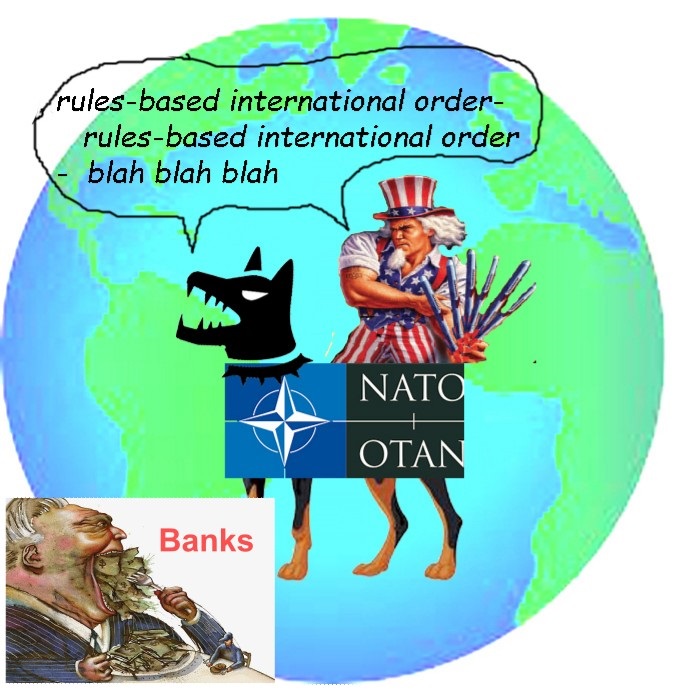
Things are not going well for the “rules-based” empire of lies
Alex Krainer’s TrendCompass Alex Krainer 12 Oct 22
Recessions, debt, energy crisis, inflation and wars… somehow it is all related, and it is related at a global level, impacting nearly all economies and markets. It all seems to be going rather badly for the “rules based global order,” or as some prefer to call it, “the empire of lies.”
Shock, after shock, after shock…
Last week, on Oct. 6, Kristalina Georgieva, IMF’s Managing Director gave a speech at the Georgetown University in Washington where she explained that the global economy, which was expected to recover strongly after the Covid 19 pandemic, experienced a “shock, after shock, after shock” instead, that it is now experiencing a “fundamental shift,” and that this shift could create a “dangerous new normal.” Georgieva thinks this can only be mitigated by “countries working together.”
We’re winning in Ukraine! Or maybe not.
Part of the problem is the “senseless war” in Ukraine. For weeks now, as the groupthink went, the war has turned in the west’s favor and Ukraine has been winning. Nobody even bothers pretending any more that this war is between Russia and Ukraine: it is now overtly discussed as the war between Russia and the collective west. NATO’s Secretary General Jens Stoltenberg made this plain in yesterday’s press conference: “If Putin wins, that is not only a big defeat for the Ukrainians, but it will be the defeat, and dangerous, for all of us.” But not to worry, said Stoltenberg, “Ukraine has the momentum,” and “President Putin is failing in Ukraine.”
Last week, US 4-star General Jack Keane went on Fox Business to boast about Bidden administration’s awesome “investment” in Ukraine: “We have a $6 trillion budget… we’ve invested, and I mean, invested, $66 billion in Ukraine this year and that is like, 1.1% [of the budget] … So for $66 billion what we’re getting is Ukraine doing the fighting, they are literally destroying the Russian Army on the battlefield.”
So apparently we’re winning and we can all relax – everything is awesome. Or maybe it isn’t. Last week, former US National Security Advisor, John Bolton published a revealing article that gives away a different mindset near the top of western command-and-control hierarchy. Bolton says that “the West still lacks a shared definition of ‘victory’ in Ukraine,” and that “everyone worries about the durability of Europe’s resolve…” But it was John Bolton’s Tweet promoting the article that was the most revealing:
John Bolton @AmbJohnBolton My new article’s headline is clear– “Putin must go: Now is the time for regime change in Russia.” There is no long-term prospect for achieving America’s critical, long-standing goal of peace and security in Europe without regime change in Russia.
What Bolton seems to be saying is that Putin has defeated the rules-based global order and that they can only reverse this defeat if they could remove Putin from power and replace him with some Juan Guaido who would hand them back their toys and their victory. Bolton then went on CBS to advocate for the assassination of Vladimir Putin………..
It’s the banks, not Vladimir Putin
So then, what would be the “fundamental shift,” and the “dangerous new normal” that IMF’s Georgieva is worried about? I believe that the worry is that the rules-based global order is falling into a profound economic, social and political crisis that could be long and very severe. And even while we are all encouraged to come together and hate on Russia and Vladimir Putin, that’s not where this crisis emanated from. Rather, it emanated from the fraudulent monetary system that’s largely shaped our rules-based global order and which has had an impressive track record of incentivizing forever wars and generating chronic crises.
Chronic crises, forever wars……………………………………
Rather than waging never-ending wars, blowing up bridges and pipelines or assassinating Vladimir Putin, western powers would do well to reform their monetary systems and embrace honest money. Even a miraculous military victory over Russia could only delay the day of reckoning, and the system would need to find a new enemy to fight more wars. That is a certainty. As Lord Acton said over a century ago, “The issue that has swept down the centuries and which will have to be fought sooner or later is the people versus the Banks.” The banks – not Russia nor Vladimir Putin!
P.S. I do not mean local banks and savings institutions but the international banking cartel and their Global Systemically Important Banks. https://alexkrainer.substack.com/p/the-real-war-is-people-vs-the-banks
Elon Musk Demands Pentagon Foot Starlink-Ukraine Bill After Being Told To ‘F**k Off’

Starlink is essential to the Ukrainian military, and one would suspect that the Pentagon would pick up the tab if US’ proxy war against Russia wants to be successful.
https://www.zerohedge.com/geopolitical/musk-cant-fund-starlink-ukraine-spacex-letter-reveals-request-pentagon-funding BY TYLER DURDEN, 15 Oct 22, Elon Musk’s SpaceX has been generous in providing free Starlink satellite internet terminals for Ukraine’s military to boost communication channels as the war enters its eighth month.
Musk recently tweeted the Ukrainian “operation has cost SpaceX $80 million and will exceed $100 million by the end of the year.” But those charitable donations of more than 20,000 Starlink terminals (and counting…) have just come to an abrupt end. CNN obtained a new letter that SpaceX sent the Pentagon, warning about the need for funding to maintain the service in the war-torn country, which costs upwards of $20 million per month (and most of it has been footed by SpaceX).
The letter continued with the need for the Pentagon to take over Starlink’s expenses. In the next 12 months, Starlink forecasted the service would cost upwards of $400 million.
“We are not in a position to further donate terminals to Ukraine, or fund the existing terminals for an indefinite period of time,” SpaceX’s director of government sales wrote in the letter.
Musk on Friday confirmed the letter as he responded to a Kyiv Post journalist on Twitter, saying he only followed the advice of a Ukrainian diplomat who told him to “F*** off.”
Musk also said: “Starlink is still losing money … goal is “not to go bankrupt.”
The letter comes after reports of widespread Starlink outages across Ukraine. The Financial Times reported that Ukrainian troops had experienced issues with their terminals.
CNN said, “sources familiar with the outages said they suddenly affected the entire frontline as it stood on September 30.” Starlink has been the primary communication link on the battlefield since Russia bombed the country’s infrastructure.
SpaceX’s request for funding or it would stop providing free access comes after Musk tweeteed about a controversial peace plan.
Starlink is essential to the Ukrainian military, and one would suspect that the Pentagon would pick up the tab if US’ proxy war against Russia wants to be successful.
Europe is still quietly importing Russian nuclear energy
CNBC, Sam Meredith @SMEREDITH19 14 Oct 22,
- Russia’s nuclear fuel industry remains conspicuously untouched by European sanctions more than seven months into the Kremlin’s war in Ukraine
- Despite eight rounds of sanctions, shipments of nuclear fuel to EU member states continue to make their way from Russia.
- Ariadna Rodrigo, EU sustainable finance manager at environmental group Greenpeace, told CNBC that it is “absolute madness” for the bloc to continue bankrolling the Kremlin by ignoring Russian nuclear trade.
………………………………………………. Russia’s energy influence goes beyond oil and gas
In April, a European Parliament resolution called for an “immediate” embargo on Russian imports of nuclear fuel and urged member states to stop working with Russia’s state-run nuclear giant Rosatom on existing and new projects.
But Russia is a dominant player in the global nuclear fuel market and any move to break the EU’s reliance on its services would likely be far from pain-free, particularly with Rosatom at the heart of Europe’s dependency……………
There are 18 Russian nuclear reactors in Europe, in countries including Finland, Slovakia, Hungary, Bulgaria and the Czech Republic. All of these reactors rely on Rosatom for the supply of nuclear fuel and other services.
Underlining the scale of Russia’s nuclear energy influence in some member states, even as the Kremlin’s onslaught in Ukraine continues, Hungary in late August announced the construction of two new nuclear reactors by Rosatom.
Moscow accounted for almost one-fifth (19.7%) of the EU’s uranium imports last year, according to the latest available data from the Euratom Supply Agency. Only Niger (24.3%) and former Soviet republic Kazakhstan (23%) were bigger suppliers of uranium to the bloc. https://www.cnbc.com/2022/10/14/ukraine-war-europe-is-still-quietly-importing-russian-nuclear-energy.html
Joshua Frank’s book Atomic Days shows the nuclear industry’s only real role – it is essential for the USA’s ‘permanent war economy’

As the atomic energy business is increasingly priced out of the electricity market by wind, solar, batteries, and increased efficiency and conservation, we will likely see the nuclear power industry increasingly admitting to what it always was — a necessary servant of the nuclear weapons industry.

Nuclear Power Isn’t Clean — It Creates Hellish Wastelands of Radioactive Sewage, Harvey Wasserman, Truthout October 12, 2022,
“……………………………..To put the nuclear power industry in a larger context, Frank guides us through the “permanent war economy” birthed during WWII, and discusses Franklin Roosevelt’s ambivalent relations with the “Malefactors of Great Wealth” who often stood in the way of making the U.S. the “Arsenal of Democracy,” and who once even plotted to kill him.
With the decision to build an A-Bomb, the giant Bechtel Corporation used the 120-square-mile reservation at Hanford to produce 103.5 metric tons of plutonium, perhaps the deadliest substance known to humanity.
But there was no effective solution for what might happen to the place in the aftermath. The Waste Treatment Plant meant to “vitrify” rad wastes into glass began construction in 2002, with plans to open in 2011. It has become, in both cost and area, “the largest single construction operation taking place anywhere in the United States,” now with an estimated price tag of $41 billion and a projected opening in 2036.
With “a string of bungled jobs under its belt,” Bechtel’s failed “Big Dig” in Boston — a much-vaunted tunnel from Logan Airport to downtown — reflected its work at Hanford when a collapse killed a 39-year-old woman and resulted in $357.1 million settlement exempting management from criminal prosecution.
As the U.S.’s fourth-largest privately held company, Bechtel spending $1.8 million on D.C. lobbying in 2019-20 was par for the course. The payback, Frank writes, comes in the tragic diseases suffered by Hanford workers like Abe Garza and Lawrence Rouse, usually amid terse, well-funded official denials. Researchers like Karen Wetterhahn and veterans like Victor Skaar have joined Vietnam victims of Agent Orange in being victimized by exposures they were repeatedly assured were “safe.” Whistleblowers like Ed Bricker were even subjected to intense spying and sabotage by close associates he was deceived into accepting as friends.
Meanwhile activists like Russell Jim of the Yakama Tribe began to force “an immeasurable amount of transparency” around the Hanford disaster. Their decades of hardcore community organizing came with a growing demand for accountability that has changed the political atmosphere surrounding the cleanup.
The debate has carried into the use of commercial atomic power.
Because of Hanford’s nuclear presence, five atomic reactors were constructed in Washington State, promising electricity that would be “too cheap to meter.”
But like the soaring costs of plutonium production and clean-up, the Washington Public Power System plunged into the biggest public bankruptcy in U.S. history, due to massive delays and cost overruns. Only one of the nukes now operates.
Sadly, some self-proclaimed climate activists have fallen into the atomic pit, arguing that in the face of the acute threat of climate change, nuclear power should be pursued as a way to lower emissions.
But they all ignore the big lesson Joshua Frank teaches us about Hanford: All the rhetoric in the world can’t cover for the physical realities of dealing with atomic radiation. And atomic fires burning at 571 degrees Fahrenheit will never cool the planet. The mines, the mills, the fuel fabrication, the reactors themselves, the waste dumps, all that horrendous multitrillion-dollar paraphernalia — they together comprise the most lethal and expensive technological failure in human history.

Many reactor promoters have long vehemently denied any connection between their “peaceful atom” and the scourge of war, but anti-nuclear activists have exposed the falsity of those claims. For example, the Campaign for Nuclear Disarmament, a British advocacy organization that opposes both nuclear weapons and the building of new nuclear power facilities, writes:
The civil nuclear power industry grew out of the atomic bomb programme in the 1940s and the 1950s. In Britain, the civil nuclear power programme was deliberately used as a cover for military activities…. The development of both the nuclear weapons and nuclear power industries is mutually beneficial. Scientists from Sussex University confirmed this once again in 2017, stating that the government is using the Hinkley Point C nuclear power station to subsidise Trident, Britain’s nuclear weapons system.
As the atomic energy business is increasingly priced out of the electricity market by wind, solar, batteries, and increased efficiency and conservation, we will likely see the nuclear power industry increasingly admitting to what it always was — a necessary servant of the nuclear weapons industry.
Fittingly, the only future for atomic reactors will be as a bottomless pit for ecological suicide and massive public subsidies — exactly like Hanford.
Indeed, for readers truly interested in the future of atomic energy, take a good look at how it plays in Joshua Frank’s Atomic Days. Then ask how soon we can cover the whole damn place with solar panels. https://truthout.org/articles/nuclear-power-isnt-clean-it-creates-hellish-wastelands-of-radioactive-sewage/
Georgia nuclear plant’s cost now forecast to top $30 billion
https://www.gpb.org/news/2022/05/09/georgia-nuclear-plants-cost-now-forecast-top-30-billion?fbclid=IwAR3OXo4tKdYJgJPMQxXjl_l4VnbN1cFZkTtiYE7KZ-NEPngOb5_FnB_GpRY May 9, 2022 Associated Press,
A nuclear power plant being built in Georgia is now projected to cost its owners more than $30 billion.
A financial report from one of the owners on Friday clearly pushed the cost of Plant Vogtle near Augusta past that milestone, bringing its total cost to $30.34 billion.
That amount doesn’t count the $3.68 billion that original contractor Westinghouse paid to the owners after going bankrupt, which would bring total spending to more than $34 billion.
Vogtle is the only nuclear plant under construction in the United States, and its costs could deter other utilities from building such plants, even though they generate electricity without releasing climate-changing carbon emissions.
The latest increase in the budget, by the Municipal Electric Authority of Georgia, wasn’t a surprise after lead owner Georgia Power Co. announced delays and $920 million in overruns on March 3. Georgia Power’s costs only cover the 45.7% of the plant it owns, meaning that the cooperatives and municipal utilities that own the majority of the two-reactor project later update their financial projections as well.
MEAG, which owns 22.7% of Vogtle and provides power to city-owned utilities, raised its total cost forecast, including capital spending and borrowing costs, to $7.8 billion from the previous level of $7.5 billion.
Oglethorpe Power Corp., which provides power to 38 cooperatives in Georgia, owns 30% of Vogtle. In March bumped up its cost projects by $250 million to $8.5 billion.
The city of Dalton, which owns 1.6%, estimated its cost at $240 million in 2021. It hasn’t released a public update.
The municipal utility in Jacksonville, Florida, as well as some other municipal utilities and cooperatives in Florida and Alabama are obligated to buy power from the plant.
When approved in 2012, the third and fourth reactors were estimated to cost $14 billion, with the first electricity being generated in 2016. Now the third reactor is set to begin operation in March 2023, and the fourth reactor is set to begin operation in December 2023.
Atlanta-based Southern Co., which owns Georgia Power, has been charging increasing shares of its cost overruns as shareholder losses, saying it’s unlikely that the Georgia Public Service Commission will approve adding amounts to the bills of Georgia Power’s 2.6 million customers. But Oglethorpe, MEAG and Dalton don’t have shareholders, meaning customers are fully exposed to overruns.
Georgia Power’s customers, as well as some Oglethorpe customers, are already paying the costs of Vogtle.
To protect themselves, the other owners signed an agreement with Georgia Power in 2018 specifying that if costs reach a certain point, the other owners can choose to freeze their costs at that level. In exchange for paying more of the costs, Georgia Power would own a larger share of the reactors.
Oglethorpe wants to freeze its costs at $8.1 billion, selling 2% of the reactor to Georgia Power in exchange for Georgia Power paying $400 million more in costs. MEAG also said Friday it wants to freeze its costs, but didn’t say how much it sought to shift to Georgia Power.
Southern has acknowledged it will have to pay at least $440 million more to cover what would have been other owners’ costs, and has said another $460 million is in dispute.
Georgia Power is disputing the cost threshold at which it must shoulder more of the burden and saying it shouldn’t have to pay the other owners’ share of extra costs stemming from COVID-19. The owners are in talks aimed at resolving their disagreements.
“Cost sharing is imminent, however, until the parties reach agreement, Oglethorpe will continue to pay its full share of the construction costs as billed by Georgia Power, but will do so under contractual protest,” Oglethorpe CEO Mike Smith said in March.
All the owners did vote to continue construction on Feb. 25. Also, the owners report that the U.S. Nuclear Regulatory Commission in March completed a follow-up inspection of wiring problems at the third reactor and signed off that problems it identified in November had been fixed, returning the reactor to its less intensive baseline inspection regime.
Growing the economy – but growth of what?

Michael Jacobs: Liz Truss dreams of growth – but even if she pulls it off, it won’t help Britain. Fifty years ago, the landmark report The Limits to Growth warned that, unless the composition of growth was
radically changed, its environmental impacts would lead to ecological and social collapse within 100 years.
Many of the projections made by The Limits to Growth have proved prescient. Yet it is also true that developed economies have been able to “uncouple” growth from some environmental
impacts. Over the past 20 years, the UK and others have notably seen rising GDP accompanied by falling greenhouse gas emissions.
Economists have described this as “green growth”, and many have argued that this, rather than growth per se, should be governments’ goal. Some environmentalists argue that environmental sustainability does not allow for any economic growth. Only the “degrowth” of western economies, they claim, is compatible with ecological salvation (and indeed, wellbeing). Others claim that GDP could still grow in a radically greener form. But in present circumstances this is a rather arcane dispute.
Both sides agree that some parts of the economy must degrow, notably the fossil fuel sector and fossil-intensive industries, while growth is clearly needed in others, such as renewable energy and the “care economy” of health, education, social care and childcare. The real question is therefore not “growth or
not?”, but “growth of what?”
Guardian 10th Oct 2022
https://www.theguardian.com/commentisfree/2022/oct/10/liz-truss-dreams-growth-income-stall-gdp
“Pure-play” clean-energy” Brookfield Renewable Partners goes dirty as it partners with Cameco and the nuclear industry

Brookfield Renewable operates one of the world’s largest publicly traded, pure-play renewable power platforms.
Westinghouse Electric, a US nuclear power company, is being bought by a
private equity-backed consortium in a $7.9bn deal four years after it
emerged from bankruptcy, as the war in Ukraine spurs fresh interest in an
industry that had fallen out of investor favour.
Brookfield Renewable Partners, one of the world’s largest clean energy investors, and Cameco,
a supplier of uranium fuel, are buying the company in a bet that climate
and energy security concerns will revive the nuclear sector’s fortunes.
They will purchase the group, which makes technology used in about half the
world’s roughly 440 nuclear reactors, from a separate division of
Brookfield Asset Management that runs its private equity investments. The
sale of Westinghouse represents a large windfall for Brookfield’s private
equity business. It invested $1bn in equity to acquire Westinghouse after
Toshiba, its former owner, put it into bankruptcy in 2017 amid large cost
overruns at projects in Georgia and South Carolina. It will receive roughly
$5.5bn through the sale and dividends.
FT 11th Oct 2022
https://www.ft.com/content/46df2aa9-0963-47a6-881c-f715a18a8527
‘Technology geriatrics’ will not ensure survival of nuclear power, says analyst
Comparing the 2021 trajectory of nuclear power with that of renewable energy, the authors of the report noted that investments in non-hydro renewables totaled $366 billion, which is 15 times more than the investments made for the construction of nuclear power plants, which reached 8.8 GW last year.
The latest World Nuclear Industry Status Report shows that nominal net nuclear generating capacity fell by 0.4 GW between 2020 and 2021, even though six new reactors were switched on throughout the world last year. This brought the share of nuclear power in the global electricity mix to below 10% for the first time in four decades.
https://www.pv-magazine.com/2022/10/07/technology-geriatrics-will-not-ensure-survival-of-nuclear-power-says-analyst/— OCTOBER 7, 2022 EMILIANO BELLINI
The current energy crisis, triggered by the pandemic and the war in Ukraine, seems to have given some oxygen to the global nuclear energy industry, with six new reactors going online last year. That compares to none in 2020 and six in 2019.
According to the latest annual edition of the World Nuclear Industry Status Report, published by French nuclear consultant Mycle Schneider, three of the six reactors are located in China and the other three are located in India, Pakistan and the United Arab Emirates.
“Last year was a bit better in terms of power generation and construction starts,” Schneider told pv magazine. “Six reactors came online in 2021 but the closure decision was taken for ten, two of which did not generate any power since 2018, so in our statistics, they are closed retroactively in 2018.”
He said this slight upward trend cannot be described as a global rebound.
“There were 10 construction starts in 2021, including six in China, and four built by Russia,which is double the five in 2020, including four in China and one by Russia. In the first half of 2022, there were three construction starts in the world, all in China,” he said. “So it looks as if China is increasing construction again. But it is much too early to call this a trend. And outside China, absolutely nothing is happening, except for the few Russian projects – and who knows what impact sanctions will have, even if the nuclear sector is so far excluded.”
Schneider acknowledged that there is huge pressure to extend lifetimes due to the current energy crisis. And there have been some results, like in Belgium and California, for example. But he also said this may not be enough to help the industry recover, with nominal net nuclear electricity generating capacity declining by more than 0.4 GW in the year leading up to 2021.
“Technology geriatrics cannot ensure nuclear power species’ survival,” he said.
In the report, Schneider and his team of experts revealed that there have been 98 startups and 105 closures of nuclear power plants over the past two decades.
“Of these, 50 startups were in China which did not close any reactors,” the team said. “Thus, outside China, there was a net decline by 57 units over the same period; net capacity dropped by 25 GW.”
Currently, there are 411 reactors operating across 33 countries. That’s four units less than last year, seven less than in 1989, and 27 less than the 2002 peak of 438.
“Nuclear production increased by 3.9% in 2021, but remained just below the 2019 level,” the report said. “China produced more nuclear electricity than France for the second year in a row and remains in second place – behind the United States – for the top nuclear power generators.”
Comparing the 2021 trajectory of nuclear power with that of renewable energy, the authors of the report noted that investments in non-hydro renewables totaled $366 billion, which is 15 times more than the investments made for the construction of nuclear power plants, which reached 8.8 GW last year.
The analysts cited recent figures from US-based Lazard showing that between 2009 and 2021, the levelized cost of energy of large-scale solar and wind fell by 90% and 72%, respectively, while that of nuclear power rose by 36%.
“In 2021, wind and solar alone reached a 10.2% share of power generation, the first time, they provided more than 10% of global power and surpassed the contribution of nuclear energy that fell to 9.8%,” they said. “The nuclear share is below 10% for the first time in four decades.”
The report also presents data on individual countries, potential emerging countries, the decommissioning of existing plants, and the current status of the small modular reactor technology. It also includes a chapter on the difficult decommissioning of the Fukushima reactor in Japan and a new section on the vulnerabilities of nuclear reactors during wars.
Maintenance on eight French nuclear reactors delayed by strike
https://www.reuters.com/markets/europe/maintenance-five-french-nuclear-reactors-delayed-over-strike-2022-10-12/ By Forrest Crellin, 12 Oct 22,
PARIS, (Reuters) – France’s FNME trade union said on Wednesday that some workers at EDF’s (EDF.PA) nuclear plants resumed their strike over salaries, delaying maintenance work on eight reactors as the union sent a message of support to striking refinery workers.
Reporting by Forrest Crellin; Editing by Tomasz Janowski and Elaine Hardcastle
Three of the Cruas nuclear plant’s reactors are affected by the strike, while two reactors at the Cattenom and Tricastin plants and one Bugey reactor have had their maintenance delayed by the strike, FNME said.
EDF nears cut-price deal for GE nuclear turbine unit with Russian contracts
French energy group renegotiates terms for business that also supplies Rosatom
Sarah White in Paris YESTERDAY 6 Print this page French power operator EDF has renegotiated a deal to buy a nuclear turbine maker from General Electric, cutting its offer price for a business seen as strategic for France’s atomic industry but that is exposed to the risk of sanctions because of orders from Russia’s Rosatom. State-controlled EDF, which is on the cusp of being fully renationalised, was encouraged into making a move on the turbine company by the French government in a deal announced by President Emmanuel Macron at the start of the year.
The acquisition was touted as a way of recovering French control of the technology as EDF gears up to build new reactors, while also securing the future of a large factory in eastern France at a time when GE was exploring asset sales and looking to cut jobs. But the business has since been caught up in the fallout from Russia’s invasion of Ukraine, even though its dealings with state-owned Rosatom, one of the world’s biggest nuclear plant developers, have not faced sanctions so far………………………. more https://www.ft.com/content/4e3f8a9e-e89c-47c9-9caa-b84825db1e70—
Nuclear share in energy generation falls to lowest in four decades-report
Nuclear share in energy generation falls to lowest in four decades-report | Reuters By Nina Chestney LONDON, Oct 5 (Reuters) – The share of nuclear power in global gross electricity generation fell below 10% last year to the lowest in around four decades, an industry report showed on Wednesday.
Nuclear energy generated 2,653 terawatt hours of electricity last year, accounting for 9.8% of global generation – the lowest since the 1980s, the annual World Nuclear Industry Status Report (WNISR) showed.
Proponents of nuclear say as a low-carbon power source it could be vital in helping countries meet climate targets, but several plants around the world are coming to the end of their life expectancies and many new ones have faced delays.
The most nuclear power in the world is generated in the United States, followed by China.
As of mid-2022, 411 reactors were operating in 33 countries, four less than a year earlier and 27 below a 2002 peak of 438.
The slow pace of new projects coming on stream has meant the average age of reactors is around 31 years old.
Out of 53 reactors under construction currently, at least half of the projects are delayed. Five new units became operational in the first half of this year, while eight closed last year.
Global investment in new nuclear construction projects last year was around $24 billion, accounting for 6.5% of total investment of $366 billion in non-hydro renewables projects.
Nuclear power is also losing ground to renewables in terms of cost as reactors are increasingly seen as less economical and slower to build.
The levelised cost of energy – which compares the total lifetime cost of building and running a plant to lifetime output – fell to $36 per megawatt hour (MWh) last year for solar photovoltaic from $359/MWh in 2009, while the cost for wind fell to $38/MWh from $135/MWh, the report showed.
However, nuclear power costs rose by 36% last year to $167/MWh from $123/MWh in 2009.
The great ratepayer robbery: how UK new nuclear rips off its customers

the taxpayer will be liable for the inevitable cost overruns and the RAB scheme itself makes it even less likely that developers will keep within the bounds of their agreements, thereby further increasing costs.
decision on Sizewell C as a stitched up deal behind closed doors, bringing extra cost to the consumer, producing unmanageable waste and squandering our capital on a white elephant scheme.
it is criminal that our time and money is wasted and all our futures thrown away on the back of this scam.
How new nuclear rips off its customers
By Linda Clare Rogers
A recent BBC documentary called Big Oil versus the World exposed the excellent job by oil companies in fending off what could have been an existential threat to their future, at the cost of one for the rest of us. The program revealed how the oil industry brought us near to catastrophe while knowingly lying about the role of fossil fuels in creating global warming.
There are vital lessons to be learned from this about the nuclear power industry. As with the oil industry, the nuclear industry continues to mislead us about the need for nuclear power to save the planet, in order to preserve itself. And, like the oil industry, it contributes to the catastrophe of global warming.
Nuclear power stations take too long to build to help mitigate the effects of global warming, and divert money from renewable power and other more immediate means of doing so.
To add insult to injury, we, as taxpayers, are now being asked to contribute to this catastrophe by paying for the building of yet more destructive nuclear power stations. The astronomical cost of nuclear power means that the industry itself can’t and won’t take on the economic risk.
Instead, money taken from our earnings and our benefits (in the U.K, low-income people on Universal Credit are not to be exempted), to set up new nuclear build, is meant to encourage other investors to take the risk in the future. This is before the plants are actually built.
The name of the UK government scheme , or, more accurately, scam, is the Regulated Asset Base model, known as RAB. (Editor’s note: In the U.S., a similar fleecing of ratepayers exists in some states, known as Construction Work In Progress or CWIP.)
In the introduction to RAB — the Ministerial Foreword to the Statement on Procedure and Criteria for Designation — we are told that the government will be taking one nuclear project to Final Investment Decision this parliament and two projects to Final investment Decision in the next parliament, including small modular reactors. The push for this scenario is undermining safety, fleecing the taxpayers at a time of economic crisis, and disregarding the real problems increasingly associated with nuclear power.
The Nuclear Energy Financing Act 2022 implements the nuclear RAB model and is meant to facilitate investment in the design, construction, commissioning and operation of new nuclear energy generation projects.
There are two criteria that government say have to be met in order that a new nuclear power project should receive RAB funding. But both of these criteria are largely meaningless:
Criterion one: the Secretary of State is of the opinion that the development of the relevant nuclear project is sufficiently advanced to justify the designation of the nuclear company in relation to the project, for instance, that the project has received a Development Consent Order (DCO).
Criterion two: the Secretary of State is of the opinion that designating the nuclear company in relation to the project is likely to result in value for money.
The government draft designation document for the two-reactor EDF project at Sizewell C in Suffolk, emphasizes these criteria. To fulfill the first, it is necessary that a DCO is approved, amongst other markers. The DCO contains evidence about the suitability of the proposed site for the project as well as the impact on the local community and its environment.
The Planning Inspectorate have advised that the DCO for Sizewell C be rejected. This in itself is really important news. Those of us who have been fighting against the building of Wylfa B, or Wylfa Newydd, are familiar with this scenario.
The Planning Inspectorate also advised the Secretary of State to reject the DCO application for Wylfa B. Many of the reasons were on similar grounds as those given for the rejection of the application for Sizewell C. The scheme broke habitat regulations and had detrimental impacts on biodiversity and the environment.
Notably, one of the main reasons for the advised rejection of the DCO for Sizewell C was the impact on the local water supply. We need only see what happened in France this past summer, with the shutdown of nuclear power stations due to the overheating of the rivers necessary for the cooling of the plants, to see that issues over water supply will only get worse as climate change gets worse.
So, for RAB funding to be designated, the DCO has to be granted. The Planning Inspectorate recommended it be rejected, and the government went ahead and passed it anyway. This is a profoundly dangerous decision and needs to be fought.
Hard on issuing the DCO will come the designation of RAB funding. The second criterion to allow for this will also be sure to pass: value for money for the taxpayer. The government explains that RAB will be eliminating significant compound interest on capital invested, thus saving us money. It makes the hopeful statement that, “the RAB model has the potential to reduce the financial cost for new nuclear projects, thereby reducing consumer bills while still preserving incentives for the private sector to complete nuclear projects to time and budget”.
Commentators have made it clear that the taxpayer will be liable for the inevitable cost overruns and the RAB scheme itself makes it even less likely that developers will keep within the bounds of their agreements, thereby further increasing costs.
The model has been criticized by two advisory bodies, the Climate Change Committee and the National Infrastructure Commission.
The draft document for the designation of RAB for Sizewell C would be laughable if it were not so serious in its implications and its precedent for further nuclear developments.
Under the heading —Results: Value for Money for Consumers — we are told, “this has been calculated by comparing the cost of the electricity system with and without Sizewell C….. The modelling compares the cost of an electricity system with a RAB funded Sizewell C against two different net zero compliant counterfactuals.” (These latter are the use of renewables and carbon capture and storage.)
It then provides a chart showing the costings and savings for the taxpayer. All that can be seen in each and every box are a row of the letter x. No figures at all.
When the chief executive of the Nuclear Industry Association, Tom Greatrex, was asked what he knew about the lack of figures available for the Sizewell C agreement on Radio 4, he could give no answer, but offered that RAB was a “different finance mechanism” that would allow for a very predictable price for electricity for a very long time.
This is another example of the nuclear industry and government getting together to present a false narrative: this one uses the present scandal of the cost of energy to persuade us that nuclear power can give us future security and control over future energy supplies.
It should be noted that Hitachi withdrew its application to build Wylfa Newydd for cost reasons, prior to the advised rejection of the DCO. The £5 billion offered by UK government to subsidize building that project was not enough for the Japanese company. This underlines how little risk developers are willing to take and how much risk government is happy to heap on us.
Another major issue with the RAB funding scheme is that, as government documents delicately put it, “the Secretary of State is aware that there could be a perception of a conflict of interest between his role in determining the DCO application for the Sizewell C project and his role in determining whether or not to designate the nuclear company. To avoid any perceived conflict of interest the Secretary of State will delegate the final decision on the DCO to another BEIS minister.”
Well that sorts that problem out then. Of course, while the taxpayer is paying for a nuclear project, it is unlikely to be halted by government. The overriding of the Planning Inspectorate findings against Sizewell C bears this out. How will the government not grant a Final Investment Decision, due next year?
Greenpeace has described the decision on Sizewell C as a stitched up deal behind closed doors, bringing extra cost to the consumer, producing unmanageable waste and squandering our capital on a white elephant scheme.
We say no to nuclear, no to RAB and will be looking to other allies and partners to fight this scheme. Maybe, like the Peace Tax 7, we can find ways to withhold our payments. Perhaps there are legal ways to stop the self -serving deceptions and corruption.
We need to keep calling out the UK government and the Welsh government on these deceptions. When so many people are in fuel poverty and it is so important that the best is made of our precious resources, it is criminal that our time and money is wasted and all our futures thrown away on the back of this scam.
Linda Clare Rogers is a member of People Against Wylfa B and CND Cymru.
1 This Month
Chernobyl: The Lost Tapes – A good documentary on Chernobyl on SBS available On Demand for the next 3 weeks– https://www.sbs.com.au/ondemand/tv-program/chernobyl-the-lost-tapes/2352741955560

of the week–London Campaign for Nuclear Disarmament

Tell the Ukrainian Government to Drop Prosecution of Peace Activist Yurii Sheliazhenko
To see nuclear-related stories in greater depth and intensity – go to https://nuclearinformation.wordpress.com
-
Archives
- April 2026 (152)
- March 2026 (251)
- February 2026 (268)
- January 2026 (308)
- December 2025 (358)
- November 2025 (359)
- October 2025 (376)
- September 2025 (257)
- August 2025 (319)
- July 2025 (230)
- June 2025 (348)
- May 2025 (261)
-
Categories
- 1
- 1 NUCLEAR ISSUES
- business and costs
- climate change
- culture and arts
- ENERGY
- environment
- health
- history
- indigenous issues
- Legal
- marketing of nuclear
- media
- opposition to nuclear
- PERSONAL STORIES
- politics
- politics international
- Religion and ethics
- safety
- secrets,lies and civil liberties
- spinbuster
- technology
- Uranium
- wastes
- weapons and war
- Women
- 2 WORLD
- ACTION
- AFRICA
- Atrocities
- AUSTRALIA
- Christina's notes
- Christina's themes
- culture and arts
- Events
- Fuk 2022
- Fuk 2023
- Fukushima 2017
- Fukushima 2018
- fukushima 2019
- Fukushima 2020
- Fukushima 2021
- general
- global warming
- Humour (God we need it)
- Nuclear
- RARE EARTHS
- Reference
- resources – print
- Resources -audiovicual
- Weekly Newsletter
- World
- World Nuclear
- YouTube
-
RSS
Entries RSS
Comments RSS
 nuclear-news