Hinkley nuclear site workers win after unofficial walkouts. “It’s a rank and file thing, it’s not the unions that are pushing for it,” said one Hinkley worker. Rank and file workers in construction are fighting significant battles on major projects this summer—and winning. Workers at Hinkley Point C nuclear power plant construction site in Somerset have launched effective, and unofficial, resistance as bosses prepare to bring in thousands of extra workers.
Of the 5504 billion CFA francs (US$ 5504 millions) in annual uranium revenues, Niger earns only 86 billion CFA francs and France quietly takes the 5418 billion CFA francs.
Niger mines 43,000 tonnes a year, selling for 43 million CFA francs a tonne (US$ 64 000) at 43,000 CFA francs a kilo (US$ 64). Niger’s uranium is listed on the stock market, more specifically on the Chicago exchange. A kilo of uranium dioxide sells for 128 million CFA francs(US$ 128 000), not forgetting that on the international market the cost of materials fluctuates.
On the basis of current figures (128 million CFA francs (US$128 000 X 43,000 tonnes = 5504 billion CFA francs (US$ 5504 millions), we realize that out of the 5504 billion CFA francs (US$ 5 504 millions), Niger will only be entitled to 86 billion CFA francs (US$ 86 millions) i.e. a shortfall of 5418 billion CFA francs (US$ 5418 millins) for the country of Niger.
Hinkley Point scaffolders begin industrial action over pay and shift patterns. Over 300 scaffolders working at Hinkley Point C near Burnham-On-Sea have begun unofficial strike action, voicing their concerns about pay rates and shift patterns at the site.
The scaffolders working for BYLOR began their protest on Wednesday and are now planning to take one day a week off work as a form of unofficial strike. Tensions have reportedly been escalating on site for some time, with workers expressing dissatisfaction over their current compensation package.
Every day, nuclear reactors emit radiation and heat, affecting the environment and contributing to climate change. In Ukraine, the threat of an apocalyptic event looms as six reactors and their fuel pools are in a precarious state. Requests for United Nations intervention have become increasingly desperate. Despite these dangers, proponents of a “nuclear renaissance” argue for more reactors to combat climate change.
However, the reality is that new reactors come with significant costs, and for the next six years, they are unlikely to produce any positive commercial or ecological impacts. The main reason for the lack of new reactors in the United States until at least 2030 is the exorbitant cost of construction.
There have been eight major construction failures in recent years in Europe and the U.S., showcasing the industry’s lack of progress. Reactor projects have gone over budget, experienced delays, and encountered numerous issues in execution, design, and labor disputes. For example, the VC Summer Nuclear Station in South Carolina wasted $10 billion and bankrupted Westinghouse due to a decade of faulty construction and mismanagement. Similarly, the Vogtle reactors in Georgia are seven years behind schedule and $20 billion over budget.
These failures highlight the industry’s inability to compete with renewable energy sources. The prices of renewables have significantly decreased and are now a fraction of the cost of nuclear power. Additionally, old-style nuclear reactors take a decade or more to build, offering no solutions in the immediate future.
To sustain the aging fleet of reactors, state and local governments have been providing financial support, which is risky and desperate. Billions of dollars have been pledged to nuclear energy plants in President Biden’s infrastructure bill alone. However, the average age of U.S. reactors is around 40, and they remain uninsured against catastrophic accidents despite promises made in the 1957 Price-Anderson Act. The potential costs of such accidents, as seen in Chernobyl and Fukushima, could reach trillions of dollars.
As these reactors age, their dangers and risks increase. Some plants are located near fault lines, others struggle with cooling their reactor cores due to hot rivers, and some face water scarcity issues. Furthermore, the owner of the Diablo Canyon plant in California, Pacific Gas & Electric, has a tarnished safety record and has admitted to manslaughter charges related to wildfires in the state.
In conclusion, the high costs, construction failures, and increasing risks associated with nuclear reactors make them an unsustainable and dangerous option. The future lies in renewable energy sources, which offer cheaper and safer alternatives to combat climate change.
The UK Government has announced a further £170 million investment in Sizewell C, with hopes that it will speed up preparations to enable construction on the new nuclear power station.
Late last year it was rumoured that Sizewell C could be on the chopping block as the UK Government scrambled to find cost savings, however now the Government is looking to spend a further £170 million to ensure construction can begin as soon as possible. That’s on top of the £700 million that’s already been pledged towards the construction of Sizewell C by the UK Government. The additional £170 million is set to be used to prepare the Sizewell C site for future construction, procure key components from the project’s supply chain, and expand its workforce.
The Automotive Transformation Fund, a Government initiative designed to make it easier for car manufacturers to build and develop electric vehicles in the UK, spent just 5 per cent of its initially allocated funding in the year to March 2023, according to Government documents seen by i.
The documents, published by the now defunct Department for Business, Energy and Industrial Strategy, show that £136m was moved for “investment in Sizewell C”, while another £10m was surrendered back to the Government altogether.
A later document from the replacement Department for Business and Trade said the money was reallocated “for a number of reasons” but did not specify why.
……………………………………An energy department spokesperson did not respond to i‘s questions about whether the money went towards buying out the Chinese government stake on the project.
Details on Sizewell C’s spending are closely guarded, but the project is expected to spend £912m this financial year, with construction yet to start.
…………………… some environmental groups argue that the UK’s nuclear projects have been plagued by delays and ballooning costs, and that there are better, less expensive options for delivering electricity more sustainably, including renewables.
While it might seem that delays and overruns at this level are unusual, in reality, they are just the most recent in a long history of wasteful spending on nuclear weapons programs.
Union of Concerned Scientists, Eryn MacDonald, August 2, 2023 |
The Congressional Budget Office (CBO) has released a new report on the projected cost of US nuclear weapons over the next ten years, from 2023 to 2032.
Before even reading the first line, I could have predicted two things about this report.
First, projected costs have risen considerably since the CBO released its previous report on this issue two years ago. This is par for the course for military programs in general (perhaps it might be less predictable if the Department of Defense ever managed to pass an audit—a routine requirement for every other part of government) and nuclear weapons are certainly no exception. And secondly, these costs are far higher than is necessary and do nothing to address the needs of most Americans for true human security. These lie in areas like food, housing, healthcare, or gun violence, none of which are improved by spending hundreds of billions on nuclear weapons each year.
To get to the actual numbers, CBO estimates that if the Department of Defense (DOD) and Department of Energy (DOE) carry out their current plans for nuclear forces, it will cost $756 billion from 2023 to 2032—just over $75 billion per year. This is 19% ($122 billion) higher than its previous estimate of $634 billion for the period from 2021-2030. Roughly half of this increase, about $60 billion, is unavoidable: some programs have progressed to more expensive stages of development and production since the last report—this accounts for about $34 billion—while inflation accounts for about $26 billion. But the remainder, $62 billion, is attributable to increases in program budget estimates ($49 billion) and the CBO’s estimate of additional costs based on historical cost growth ($13 billion).
Historical cost growth is the norm
Of CBO’s $756 billion projection, a remarkable $96 billion, or 13 percent, comes from their assumption that current DOD and DOE budget estimates are well below what the actual costs of the nuclear weapons now in development will turn out to be. Historically, this has certainly been true, with both agencies frequently underestimating final program costs, often by significant amounts. For example, since the previous version of this CBO report, DOD has increased its estimate for the total cost of the new Sentinel ICBM by $12 billion. In its report, CBO projects the final costs will rise even more.
In another glaring example of how out of control spending on nuclear weapons programs can get, the General Accounting Office (GAO) in January 2023 found that the National Nuclear Security Administration’s (NNSA’s) plans to develop the capacity to produce at least 80 plutonium pits (the explosive core of modern nuclear weapons) per year at two sites—Savannah River Site and Los Alamos National Laboratory—by 2030 “do not follow best practices and run the risk of cost increases and delays” and that “NNSA lacks both a comprehensive cost estimate and a schedule outlining all activities it needs to achieve this capability.”
The NNSA itself acknowledges that the project cannot be completed on the planned timeline or budget. An internal NNSA document puts the cost for producing 80 pits per year between $8.7 and $16.5 billion, a significant increase over the previous public estimate of $6.9 to $11.1 billion. It also says that the Savannah River Site plant, far from meeting a congressionally mandated deadline to produce at least 50 pits per year by 2030, will not produce any pits at all until 2036.
While it might seem that delays and overruns at this level are unusual, in reality, they are just the most recent in a long history of wasteful spending on nuclear weapons programs. In fact, the plan to produce pits at Savannah River developed after the NNSA project previously planned for the site, the Mixed Oxide Fuel Fabrication Facility, was abandoned following years of delays and cost overruns. By the time it was shut down, NNSA had already spent nearly $8 billion on the facility and estimated that it would need another nearly $50 billion to complete the project.
Unfortunately, similar examples of wasteful spending at both NNSA and DOD are all too easy to find.
Deceptive decrease on the SLCM-N
One category in which projected costs appear to decrease in this report is Tactical Nuclear Delivery Systems and Weapons, which sees a drop of $11 billion. This is deceptive, however, because it comes from eliminating any spending on the new nuclear-armed sea-launched cruise missile (SLCM-N). …………………………..
Even though President Biden wanted to cancel the program, the 2023 National Defense Authorization Act (NDAA) passed by the Democratically-controlled Congress last year included $25 million for DOD to begin work on the cruise missile and $20 million for NNSA to start on the nuclear warhead—known as the W80-4 ALT—that the cruise missile would carry…………………………..
The trend is clearly upward……………………………………………………………
The sky’s the limit?
Discouragingly, this trend may be about to get worse. If the New Strategic Arms Reduction Treaty (New START) between the US and Russia expires in 2026 without a replacement (which now seems like a best-case scenario, given Russia’s announcement in February 2023 that it is suspending the treaty and the US decision to halt data exchanges in response), it is anyone’s guess what the effect on plans for the US nuclear arsenal will be…………………………………………………………………………….
Holding the line, avoiding an arms race
It is difficult to describe the current situation as anything other than dire. Russia’s use of nuclear threats in the Ukraine war, along with a growing tendency in the US to categorize China as another peer competitor in the nuclear realm, has led to a renewed emphasis on nuclear weapons as central to US national security. This is despite the fact that these weapons are no more useful for military purposes than they have ever been, and do not address much more pressing human security needs. We must continue to urge the Biden administration and Congress not to buy into the dangerous idea that the US has no choice but to rely on nuclear weapons for security, and instead to hold the line against a new arms race. https://blog.ucsusa.org/emacdonald/the-skys-the-limit-on-nuclear-weapons-spending-but-what-does-it-really-get-us/
ATLANTA (AP) — The first American nuclear reactor to be built from scratch in decades is sending electricity reliably to the grid, but the cost of the Georgia power plant could discourage utilities from pursuing nuclear power as a path to a carbon-free future.
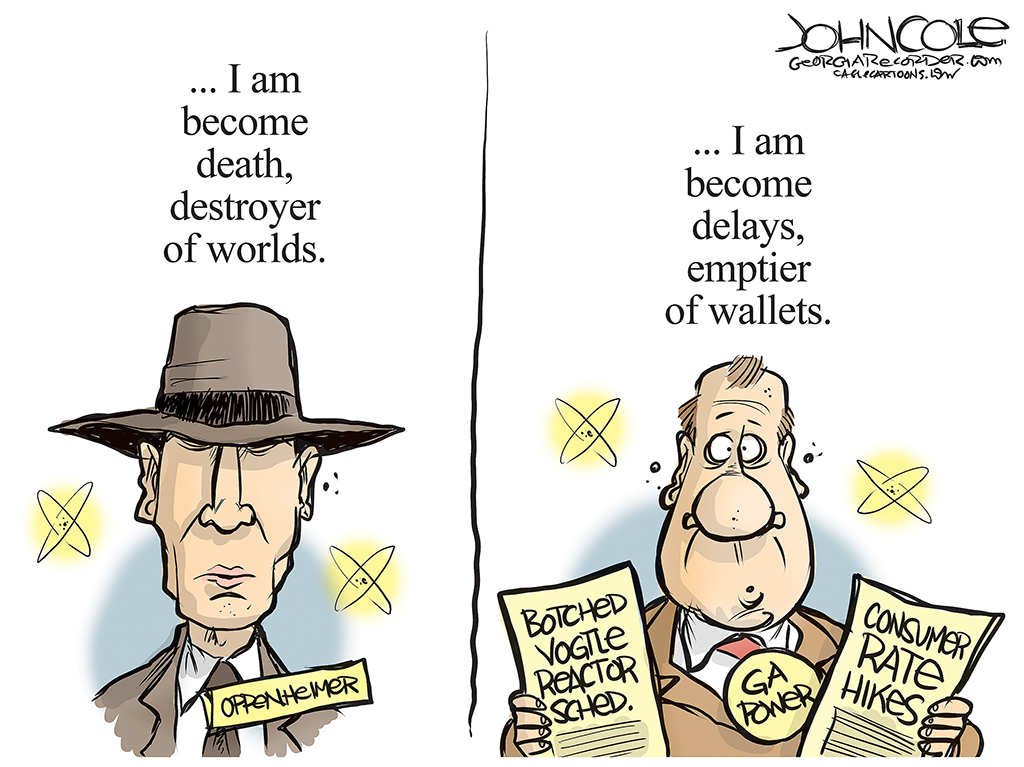
Georgia Power Co. announced Monday that Unit 3 at Plant Vogtle, southeast of Augusta, has completed testing and is now in commercial operation, seven years late and $17 billion over budget.
……………………………………………………. In Georgia, almost every electric customer will pay for Vogtle. Georgia Power currently owns 45.7% of the reactors. Smaller shares are owned by Oglethorpe Power Corp., which provides electricity to member-owned cooperatives, the Municipal Electric Authority of Georgia and the city of Dalton. Oglethorpe and MEAG plan to sell power to cooperatives and municipal utilities across Georgia, as well in Jacksonville, Florida, and parts of Alabama and the Florida Panhandle.
Georgia Power’s residential customers are projected to pay more than $926 apiece as part of an ongoing finance charge and elected public service commissioners have approved a rate increase. Residential customers will pay $4 more per month as soon as the third unit begins generating power. That could hit bills in August, two months after residential customers saw a $16-a-month increase to pay for higher fuel costs.
The high construction costs have wiped out any future benefit from low nuclear fuel costs in the future, experts have repeatedly testified before commissioners.
“The cost increases and schedule delays have completely eliminated any benefit on a life-cycle cost basis,” Tom Newsome, director of utility finance for the commission, testified Thursday in a Georgia Public Service Commission hearing examining spending.
The utility will face a fight from longtime opponents of the plant, many of whom note that power generated from solar and wind would be cheaper. They say letting Georgia Power make ratepayers pay for mistakes will unfairly bolster the utility’s profits.
“While capital-intensive and expensive projects may benefit Georgia Power’s shareholders who have enjoyed record profits throughout Vogtle’s beleaguered construction, they are not the least-cost option for Georgians who are feeling the sting of repeated bill increases,” Southern Environmental Law Center staff attorney Bob Sherrier said in a statement.
Commissioners will decide later who pays for the remainder of the costs of Vogtle, including the fourth reactor. Customers will pay for the share of spending that commissioners determine was prudent, while the company and its shareholders will have to pay for spending commissioners decide was wasteful.
Full report. See in particular paras 41 -44. “The Government should show how this offers value for money to taxpayers … So far, the Government has not published financial figures which allow the cost of this risk transfer to be known. The Government must publish figures, before signing contracts for new gigawatt-scale nuclear, which allow a proper assessment of value for money to be made, including setting out the level and potential cost of construction risk to be borne by the consumer or taxpayer …
The Government should publish details of how the estimated savings from using the RAB model for funding Sizewell C were calculated, and provide clarity for the funding structure, by publishing the Heads of Terms for the agreed RAB funding model for that project.”
Science, Innovation, Technology Committee 31st July 2023
Niger coup leader General Abdourahamane Tchiani, despite being EU’s largest supplier of uranium, halts uranium and gold export to France.
With immediate effect, the Republic of Niger under the leadership of General Abdourahamane Tchiani, and supported by the people of the Republic, announced the suspension of the export of uranium and gold to France on Sunday.
In parallel to the decision, protestors were surrounding the French Embassy in Niger calling for the end of French colonial practices repeating the slogan “Down with France!” and reaffirming their support to the coup leader, Tchiani…………………………………
It is also worth noting that Niger, according to the World Nuclear Association (WNA), is the world’s seventh-biggest producer of uranium. The WNA also confirms that Niger, in 2022, produced 2020 tU which would be considered just over 4% of world uranium output.
Currently, uranium production in Niger occurs mostly through a French majority-owned company called Orano which owns 63.4% of Société des Mines de l’Aïr (SOMAÏR). The remaining 36.66% of this is owned by Niger’s Société du Patrimoine des Mines du Niger, known as Sopamin.
In 2021, the European Union utilities purchased 2905 tU of Niger-produced uranium making Niger the leading uranium supplier vis-a-vis the EU.
Earlier, on July 28, Orano released a statement arguing that “the situation remains unstable” in Niger following the overthrowing of French ally and President of Niger Muhammed Bazoum. The company then added that it has “set up a crisis unit to prioritize the safety of its employees” and underscored that “this event to have any immediate impact on its activities in Niger or on the value of its assets.”….. https://english.almayadeen.net/news/Economy/niger-puts-an-end-to-uranium-and-gold-export-to-france
EDF flagged last year that the plants may start 15 months late. The reactors at Hinkley Point have been touted by the UK government as sparking a nuclear renaissance, boosting energy independence and reducing reliance on fossil fuels. But the work has been plagued by multiple holdups and cost overruns.
The increased risk of a 15-month delay is due to “performances on civil works and challenges on mechanical, electrical, heating, ventilation and air conditioning,” EDF said Thursday in an earnings presentation. “Progress is below the planned trajectory and action plans have been set.”
The reactors, costing as much as £32 billion ($41.5 billion), are due to start operating in 2027 and 2028. The ballooning budget has fueled controversy over the vast sums needed for new nuclear developments, even as other low-carbon technologies such as offshore wind have also faced inflationary pressures.
Hinkley Point’s setbacks come as EDF seeks to arrange financing for a second pair of atomic plants — at Sizewell in eastern England — that would use the same design. Delays and cost overruns may deter investors who also face increasing demands for capital from renewables, which provide swifter returns.
The debt-laden French utility has a 66.5% stake in Hinkley Point, while China General Nuclear Power Corp. owns the rest. As funding requirements now exceed contractual commitments, shareholders will be asked to provide additional equity voluntarily starting in the fourth quarter.
“The probability that CGN will not fund the project beyond its committed equity cap is high,” EDF said Thursday. “Financing solutions are being investigated, in the event that CGN does not allocate its voluntary equity.
“The only reason there’s a nuclear renaissance is because the federal government is throwing tens of billions of dollars at nuclear,” …….. “Investors aren’t interested.”
Opening of Georgia Power’s Vogtle unit 3 comes 7 years late and billions of dollars over budget.
The US nuclear energy industry has reached a watershed moment. Plant Vogtle unit 3 began delivering commercial electricity to the Georgia power grid, becoming the first nuclear reactor the country has built from scratch in more than three decades.
Unit 3 and a twin reactor to open in the coming months may also be the last. Years of delays and billions of dollars of cost overruns have made the megaproject as much a cautionary tale as a new chapter for atomic investment.
The 1,100-megawatt Vogtle unit 3 was initially supposed to enter service in 2016, however. Its start of operations was delayed once more in June after the company discovered a degraded seal in its main generator.
“It turns out nuclear construction is hard,” said Bob Sherrier, a staff attorney at the Southern Environmental Law Center, which challenged the project in court.
“Along the way the company kept ratcheting up the cost estimates, pushing back the deadlines a bit at a time. Every time it was raised just enough where it was still within the bounds of justification that it made sense to proceed. But they were wildly off in their estimates every single time.”
“The resurgence of America’s nuclear industry starts here in Georgia, where you’ve just got approval, for the first time in three decades, to build new nuclear reactors,” then-US energy secretary Steven Chu said as Vogtle was authorised in 2012.
The Georgia project was supposed to be the first among dozens of new reactors built across the country. But the renaissance floundered amid safety concerns after the 2011 Fukushima disaster in Japan coupled with plunging prices for natural gas, a competing generation fuel. In the end only four reactors moved ahead and two, Vogtle units 3 and 4, have been built. Unit 4 is scheduled to come online by early 2024.
Soaring costs at Vogtle, along with new reactors at the VC Summer nuclear project in South Carolina, forced engineering contractor Westinghouse into bankruptcy in 2017. While South Carolina utilities pulled the plug on their project, Georgia ploughed ahead.
The $14bn original cost of Vogtle units 3 and 4 has now ballooned to more than $30bn. The cost for Georgia Power, with a 45 per cent share of the project, will be about $15bn.
How the company’s costs are shared with its customers will be decided by the commission once unit 4 is operating: the law allows only costs deemed “prudent” to be passed on to ratepayers.
McDonald said the company should not expect an easy ride. “They are guilty until they prove themselves innocent,” he said.
Georgia Power, a division of New York-listed Southern Company, did not respond to multiple requests for an interview.
……………………………………… there are no other traditional large-scale light water reactors under way in the US. Critics say that investors have been turned off.
“The only reason there’s a nuclear renaissance is because the federal government is throwing tens of billions of dollars at nuclear,” said David Schlissel at the Institute for Energy Economics and Financial Analysis. “Investors aren’t interested.”
For Georgians, the more immediate concern is what the project means for utility bills. Georgia Watch, a consumer group, estimates ratepayers have already paid $900 extra since construction began to cover financing costs. Bills are set to rise by another $3.78, or 3 per cent, on average when unit 3 comes online.
But the ultimate impact will not be felt until unit 4 comes online and the PSC decides how much of the burden will be left for ratepayers to shoulder. Georgia Watch estimates the final increase will add anywhere between 10-13 per cent to bills……………… https://www.ft.com/content/5d8e0c6c-59c9-4b40-806f-604889dd5fb6
the average age of an operating U.S. reactor is now around 40. None are insured, despite assurances dating to the 1957 Price-Anderson Act that the reactor fleet would get private liability coverage by 1972.
the dangers escalate as the plants age. Meaningful estimates of the cost of a catastrophic accident are hard to come by, but after Chernobyl and Fukushima, the costs have soared into the trillions.
Nuclear power not only costs twice as much as wind and solar, it’s responsible for superheating our air and waterways.
Every day, as they burn with nuclear fission at some 571 degrees Fahrenheit, some 430 nuke reactors roast our Earth. They irradiate and superheat our air, rivers, lakes and oceans.
They also spew radioactive carbon, and emit more greenhouse gasses in the mining, milling, enrichment and fabrication processes that produce their fuel. Still more is emitted as they attempt to store their wastes.
Six big reactors and their fuel pools now threaten an apocalypse in Ukraine. Pleas for United Nations intervention are increasingly desperate.
But “nuclear renaissance” proponents say we need even more reactors to “combat climate change.”
However, these mythical new reactors have real costs — and for at least the next six years, they can produce nothing of positive commercial or ecological significance.
The primary reason there’s likely to be no new reactors in the U.S. until at least 2030 (if ever) is economic — the cost of construction is gargantuan.
Let’s consider eight recent major construction failures in Europe and the U.S.
Atomic plants were first constructed during the Manhattan Project that built the atomic bomb. Heralded as the “too cheap to meter” harbinger of an atomic age, the first commercial reactor came online at Shippingport, Pennsylvania, in 1958.
At VC Summer Nuclear Station in South Carolina, after a decade of site work marred by faulty construction, substandard materials, bad planning, labor strife, and more, two reactors were abandoned outright in 2017, wasting $10 billion while bankrupting Westinghouse.
In Hinkley, United Kingdom, two more reactors are also years late and could surpass $42 billion.
In Flamanville, France, a single reactor project begun in 2007 is still unfinished, years past its original promised completion date, and four times over its original cost estimate — with the price tag now beyond $14 billion.
Finland’s Olkiluoto has opened after 18 years of construction at around $12 billion in costs so far — three times the original promise.
All these reactor projects failed due to overly optimistic industry promises designed to attract investors, followed by poor execution, bad design, substandard components, labor strife, and more. Despite the industry hype, none of these eight reactors can ever compete with renewables, whose prices now range as low as a third to a quarter of nuclear — and are dropping.
With incalculable billions and a decade or more needed to build old-style big nuclear reactors, financial experts have long predicted that the necessary capital won’t be anywhere on the horizon.
Instead, the industry has been gouging state and local governments to keep the old reactors running, a desperate and dangerous toss of the dice.
Six billion dollars was pledged to nuclear energy plants in Biden’s infrastructure bill alone. A billion in federal dollars has been promised to keep California’s Diablo Canyon running, along with another billion from the state.
But the average age of an operating U.S. reactor is now around 40. None are insured, despite assurances dating to the 1957 Price-Anderson Act that the reactor fleet would get private liability coverage by 1972. Despite their immense inherent danger, only nominal company participation in a perfunctory insurance fund has been required for a license. Blanket coverage against a cataclysmic accident has not been a legal requirement to build or operate these reactors.
After six decades, reactor owners are still exempted from the costs of a catastrophic accident, and no nongovernmental insurance corporation has stepped in at an appropriate scale.
Yet the dangers escalate as the plants age. Meaningful estimates of the cost of a catastrophic accident are hard to come by, but after Chernobyl and Fukushima, the costs have soared into the trillions.
The oldest operating U.S. plant, at Nine Mile Point on Lake Huron, opened in 1969. Repeated near-disasters at Davis-Besse in Ohio include a hole eaten through a critical core component by boric acid that was missed because the owners refused to do required inspections. Monticello and Prairie Island in Minnesota threaten the entire Mississippi Valley. Critical intake pipes at South Texas recently froze, as its builders never anticipated the cold weather that hit it unexpectedly in 2021.
French and U.S. rivers are often too hot to cool reactor cores, forcing them to cut output or shut altogether.
Palo Verde in Arizona evaporates some 27,000 gallons of water per minute in a roasting desert. San Onofre in California was shut in 2012 because of leaking generators and now stores its high-level waste 100 feet from the ocean. Perry (Ohio) and North Anna (Virginia) have both been damaged by earthquakes.
Former Nuclear Regulatory Commission (NRC) site inspector Michael Peck has warned that Diablo Canyon in California should be closed because of the danger posed by seismic activity. Just 45 miles from the San Andreas Fault, Diablo was on its way to an orderly shut-down when Gov. Gavin Newsom strong-armed the state legislature and Public Utilities Commission to keep the embrittled, under-maintained reactors open despite their ability to blanket the state in terminal radioactivity. The NRC ignored Peck’s warning and he’s now gone from the Commission.
Diablo’s owner, Pacific Gas & Electric, has a blemished record when it comes to public safety — it has admitted to more than 80 counts of felony manslaughter due to the 2018 wildfires in California.
In Ukraine, of six reactors at Zaporizhzhia, five are in cold shut-down while one lingers on to power the place. But six shaky fuel pools contain apocalyptic quantities of radiation. Power supplies are in doubt, vital cooling water is threatened by a sabotaged dam, military attacks are possible, and site workers maintain the plant in a state of terror.
Like Zaporizhzhya, any operating reactor or fuel pool would be devastating targets for military or non-state terrorist attacks. The 9/11 masterminds reportedly toyed with hitting the Indian Point power plant north of New York City, irradiating the northeast. Any of the 90-plus decayed uninsured U.S. nukes are potential Chernobyls or Fukushimas. Deep concerns have been expressed by United Nations inspectors and many others. A public petition now asks that UN peacekeepers take over the Zaporizhzhya site.
So, taken in sum, “nuclear power” to date is defined by catastrophic fiscal failure and public risk. No new plants are under construction and efforts to keep the current fleet operating are fraught with uninsured danger.
In straight-up financial terms, the peaceful atom’s “too cheap to meter” promises can never compete in real terms with renewables, which won’t melt, explode, release mass quantities of radiation or create atomic wastes.
Projections for thorium, fusion, and other futuristic reactors also remain technically and fiscally vaporous. The fusion facility at ITTR in France has already burned through $65 billion.
And a reactor burning at 100 million degrees is as likely to cool the planet as Edward Teller’s fusion superbombs.
Which leaves us with the much-hyped small modular reactors (SMRs), now wallowing in deep delay and soaring prices. SMRs are theoretical nukes designed to be far smaller than today’s 1,000+ megawatt reactors, to be mass produced and buried throughout the country. Only one SMR developer, NuScale, has gotten significant preliminary licensing approval. Cost and delivery projections from Bill Gates’s TerraPower, X-Energy, and other prospective manufacturers are theoretical, with little concrete data to back up when they might be deployed and at what prices.
Projected prices at NuScale have soared from $58/megawatt-hour in 2017 to $89 now, nearly double the range of wind and solar. By 2030, SMR prices are likely to be triple or more. A recent piece by former NRC Chair Allison MacFarlane eviscerated the technology’s potential with a devastating analysis, referring to it primarily as a means of attracting government hand-outs and “stupid money.”
But with no big U.S. reactors being built while SMRs drown in red ink and tape, the industry still burns and irradiates the planet with about 430 aging reactors worldwide and 92 ancient ones here in the U.S. And the odds of an apocalypse at one or more of those old reactors grow with each day they age.
The pitfalls include unsolved problems of reactor waste, deteriorating infrastructure, a fast-retiring workforce, a diminishing ability of the industry to deliver on its promises, a minimum five-year gap before any small reactors could come into significant commercial production, the forever threats of war and terrorism, the killing power of radiation, and much more.
Meanwhile, renewables have long since blown past both nukes and coal in jobs, price, safety, efficiency, reliability, speed to build, and more.
As nuclear investments dry up, offshore wind, rooftop solar, “agri-voltaic” farmland and advanced efficiency are booming.
A pending transition from lithium to sodium may soon transform the battery industry. For reasons of cost, ecological impacts and resistance to mines on Indigenous lands, lithium-based batteries face serious challenges.
But with cheaper, more widely available sodium at their core, battery technologies are poised for a near-term Great Leap. Should that happen soon, the current storage challenges of the green power revolution could all but disappear.
Thus, we face the ultimate test: Can our species replace these failed, lethal nukes with safe and just forms of green power — or will we let this latest atomic con fry us all?
Critics blast the ever-extending timeline and bloated budget of Plant Vogtle’s expansion. Supporters say the Georgia project is part of a nuclear revival.
Georgia Power was set to reach a milestone last month and open the first of two long-awaited nuclear reactors at Plant Vogtle. Then came a delay — and more uncertainty.
Missed deadlines are a familiar refrain for the project near Augusta, Ga. The expansion is placing the country’s first major reactors built from scratch this century near two existing nuclear units brought online in the 1980s……………………….
The Vogtle expansion’s arrival is a huge moment for the U.S. electric industry that experts and officials expect to ripple well beyond eastern Georgia. Never mind that the two new nuclear gems Southern is scrambling to add to its crown were supposed to be up and running in 2016 and 2017. Or that their cost has more than doubled to over $30 billion.
………………………………… “Yes, we’ve had our challenges,” CEO Chris Womack said during the company’s annual meeting. “I’m confident that the state of Georgia and our customers, our company, the world, will be so proud of the work that we’ve done in bringing Vogtle online.”
Spokespeople for Southern and Georgia Power did not provide updates on future nuclear investment plans when asked last week by E&E News.
‘U.S. nuclear renaissance’
Vogtle’s steps toward completion come as the Georgia Public Service Commission plans to decide how much ratepayer costs should rise to cover the project’s overruns. And U.S. senators last week passed legislation that’s supportive of the nuclear industry.
………………….To help construct the expansion to Vogtle, the Department of Energy’s Loan Programs Office had issued $12 billion in loan guarantees to Georgia power providers. Its director, Jigar Shah, said in an interview that there were a lot of mistakes made and lessons learned……………………
Clean energy groups like the Southern Alliance for Clean Energy warn that the enormous costs of units 3 and 4 could fall on ratepayers, because monopoly utilities, they say, aren’t meaningfully regulated in the region.
“There is no nuclear power plant that we’re aware of that has ever come on in the Southeast on budget or on schedule,” Stephen Smith, the alliance’s executive director, said in an interview.
…………………..Challenges ranged from workforce constraints — the project required 9,000 builders, welders, electricians at the peak of construction — to what critics called a lack of meaningful regulation from public utility commissions to the Nuclear Regulatory Commission.
“It’s not that simple to manufacture these complex components and just stamp them together like Legos,” Lyman said.
Smith from the Southern Alliance for Clean Energy pointed to difficulties at a similar South Carolina nuclear project.
An attempt to add two AP1000s to South Carolina’s V.C. Summer nuclear plant fell through in 2017. The expansion was designed to be similar to Vogtle’s and had an estimated $9.8 billion cost. But its price quickly ballooned, and its construction timeline was pushed back years past scheduled operational dates of 2016 and 2019.
Even a relatively small slice of the Pentagon and Department of Energy nuclear budgets could create many more jobs if invested in green energy, sustainable infrastructure, education, or public health – anywhere from 9% to 250% more jobs, depending on the amount spent…..
Tom Dispatch, JULY 30, 2023
Yes, the atomic bombs dropped on Hiroshima on August 6 and Nagasaki on August 9, 1945, would kill staggering numbers of people and be an eerily (if all too grimly) appropriate ending to the war that started with the Japanese sneak attack on Pearl Harbor on December 7, 1941, and, by August 1945, had resulted in the saturation bombing of 64 Japanese cities.
The scientist who led the team responsible for creating the bombs that destroyed those two cities (and for the initial nuclear test in New Mexico that, as we only recently learned, spread fallout over 46 states, Canada, and Mexico), the 41-year-old J. Robert Oppenheimer, would later borrow a line from the Bhagavad Gita, the Hindu scriptures, to describe his mood at the time: “Now, I am become death, the destroyer of worlds.” And eerily enough, the use of the weapon that would prove to be the second way humanity found to destroy our planet — the first, climate change, was already in effect but not yet known — would find all too few in the U.S. government hesitant to use it at that time. As historian John Dower would put it in his memorable book Cultures of War,
“The policy makers, scientists, and military officers who had committed themselves to becoming death… never seriously considered not using their devastating new weapon. They did not talk about turning mothers into cinders or irradiating even the unborn. They brushed aside discussion of alternative targets, despite the urging of many lower-echelon scientists that they consider this. They gave little if any serious consideration to whether there should be ample pause after using the first nuclear weapon to give Japan’s frazzled leaders time to respond before a second bomb was dropped.”
They just did it, twice, and the world changed radically. Almost 80 years later, at a moment when a global leader is once again evidently considering the possible use of what are now called “tactical nuclear weapons” (but can be several times more powerful than the bombs that destroyed Hiroshima and Nagasaki), Oppenheimer is having his moment in the sun (or is it a blaze of atomic light?) in a film that, to the surprise of many, has hit the big time in an almost nuclear fashion. And as TomDispatch regular and Pentagon expert William Hartung reminds us while considering that three-hour odyssey of a film, what “Oppie” began then has by now become a full-scale nuclear-industrial complex on a planet where ultimate destruction, it often seems, always lurks just around the corner. Tom
The Profiteers of Armageddon
Oppenheimer and the Birth of the Nuclear-Industrial Complex
“…………………………………………………………………………………………………………………… A feature film on the genesis of nuclear weapons may not strike you as an obvious candidate for box-office blockbuster status. As Nolan’s teenage son said when his father told him he was thinking about making such a film, “Well, nobody really worries about nuclear weapons anymore. Are people going to be interested in that?” Nolan responded that, given what’s at stake, he worries about complacency and even denial when it comes to the global risks posed by the nuclear arsenals on this planet. “You’re normalizing killing tens of thousands of people. You’re creating moral equivalences, false equivalences with other types of conflict… [and so] accepting, normalizing… the danger.”
These days, unfortunately, you’re talking about anything but just tens of thousands of people dying in a nuclear face-off. A 2022 report by Ira Helfand and International Physicians for the Prevention of Nuclear War estimated that a “limited” nuclear war between India and Pakistan that used roughly 3% of the world’s 12,000-plus nuclear warheads would kill “hundreds of millions, perhaps even billions” of us. A full-scale nuclear war between the United States and Russia, the study suggests, could kill up to five (yes, five!) billion people within two years, essentially ending life as we know it on this planet in a “nuclear winter.”
Obviously, all too many of us don’t grasp the stakes involved in a nuclear conflict, thanks in part to “psychic numbing,” a concept regularly invoked by Robert Jay Lifton, author of Hiroshima in America: A History of Denial (co-authored with Greg Mitchell), among many other books. Lifton describes psychic numbing as “a diminished capacity or inclination to feel” prompted by “the completely unprecedented dimension of this revolution in technological destructiveness.”
Given the Nolan film’s focus on Oppenheimer’s story, some crucial issues related to the world’s nuclear dilemma are either dealt with only briefly or omitted altogether.
The staggering devastation caused by the bombings of Hiroshima and Nagasaki is suggested only indirectly without any striking visual evidence of the devastating human consequences of the use of those two weapons. Also largely ignored are the critical voices who then argued that there was no need to drop a bomb, no less two of them, on a Japan most of whose cities had already been devastated by U.S. fire-bombing to end the war…………………..
The film also fails to address the health impacts of the research, testing, and production of such weaponry, which to this day is still causing disease and death, even without another nuclear weapon ever being used in war. Victims of nuclear weapons development include people who were impacted by the fallout from U.S. nuclear testing in the Western United States and the Marshall Islands in the Western Pacific, uranium miners on Navajo lands, and many others. Speaking of the first nuclear test in Los Alamos, New Mexico, Tina Cordova of the Tularosa Basin Downwinders Consortium, which represents that state’s residents who suffered widespread cancers and high rates of infant mortality caused by radiation from that explosion, said “It’s an inconvenient truth… People just don’t want to reflect on the fact that American citizens were bombed at Trinity.”
Another crucially important issue has received almost no attention. Neither the film nor the discussion sparked by it has explored one of the most important reasons for the continued existence of nuclear weapons — the profits it yields the participants in America’s massive nuclear-industrial complex.
Once Oppenheimer and other concerned scientists and policymakers failed to convince the Truman administration to simply close Los Alamos and place nuclear weapons and the materials needed to develop them under international control — the only way, as they saw it, to head off a nuclear arms race with the Soviet Union — the drive to expand the nuclear weapons complex was on. Research and production of nuclear warheads and nuclear-armed bombers, missiles, and submarines quickly became a big business, whose beneficiaries have worked doggedly to limit any efforts at the reduction or elimination of nuclear arms.
The Manhattan Project and the Birth of the Nuclear-Industrial Complex
……………………………………………………. According to nuclear expert Stephen Schwartz, author ofAtomic Audit, the seminal work on the financing of U.S. nuclear weapons programs, through the end of 1945 the Manhattan Project cost nearly $38 billion in today’s dollars, while helping spawn an enterprise that has since cost taxpayers an almost unimaginable $12 trillionfor nuclear weapons and related programs. And the costs never end. The Nobel prize-winning International Campaign to Abolish Nuclear Weapons (ICAN) reports that the U.S. spent $43.7 billion on nuclear weapons last year alone, and a new Congressional Budget Office report suggests that another $756 billion will go into those deadly armaments in the next decade.
Private contractors now run the nuclear warhead complex and build nuclear delivery vehicles. They range from Raytheon, General Dynamics, and Lockheed Martin to lesser-known firms like BWX Technologies and Jacobs Engineering, all of which split billions of dollars in contracts from the Pentagon (for the production of nuclear delivery vehicles) and the Department of Energy (for nuclear warheads). To keep the gravy train running — ideally, in perpetuity — those contractors also spend millions lobbying decision-makers. Even universities have gotten into the act. Both the University of California and Texas A&M are part of the consortium that runs the Los Alamos nuclear weapons laboratory.
The American warhead complex is a vast enterprise with major facilities in California, Missouri, Nevada, New Mexico, South Carolina, Tennessee, and Texas. And nuclear-armed submarines, bombers, and missiles are produced or based in California, Connecticut, Georgia, Louisiana, North Dakota, Montana, Virginia, Washington state, and Wyoming. Add in nuclear subcontractors and most states host at least some nuclear-weapons-related activities.
And such beneficiaries of the nuclear weapons industry are far from silent when it comes to debating the future of nuclear spending and policy-making.
Profiteers of Armageddon: The Nuclear Weapons Lobby
The institutions and companies that build nuclear bombs, missiles, aircraft, and submarines, along with their allies in Congress, have played a disproportionate role in shaping U.S. nuclear policy and spending. They have typically opposed the U.S. ratification of a Comprehensive Nuclear Test Ban treaty; put strict limits on the ability of Congress to reduce either funding for or the deployment of intercontinental ballistic missiles (ICBMs); and pushed for weaponry like a proposed nuclear-armed, sea-launched cruise missile that even the Pentagon hasn’t requested, while funding think tanks that promote an ever more robust nuclear weapons force.
A case in point is the Senate ICBM Coalition (dubbed part of the “Dr. Strangelove Caucus” by Arms Control Association Director Daryl Kimball and other critics of nuclear arms). The ICBM Coalition consists of senators from states with major ICBM bases or ICBM research, maintenance, and production sites: Montana, North Dakota, Utah, and Wyoming. The sole Democrat in the group, Jon Tester (D-MT), is the chair of the powerful appropriations subcommittee of the Senate Appropriations Committee, where he can keep an eye on ICBM spending and advocate for it as needed.
The Senate ICBM Coalition is responsible for numerous measures aimed at protecting both the funding and deployment of such deadly missiles. ……………………….. That Coalition’s efforts are supplemented by persistent lobbying from a series of local coalitions of business and political leaders in those ICBM states. Most of them work closely with Northrop Grumman, the prime contractor for the new ICBM, dubbed the Sentinel and expected to cost at least $264 billion to develop, build, and maintain over its life span that is expected to exceed 60 years.
Of course, Northrop Grumman and its 12 major ICBM subcontractors have been busy pushing the Sentinel as well. They spend tens of millions of dollars on campaign contributions and lobbying annually, while employing former members of the government’s nuclear establishment to make their case to Congress and the executive branch. And those are hardly the only organizations or networks devoted to sustaining the nuclear arms race. You would have to include the Air Force Association and the obscurely named Submarine Industrial Base Council, among others.
The biggest point of leverage the nuclear weapons industry and the arms sector more broadly have over Congress is jobs. How strange then that the arms industry has generated diminishing job returns since the end of the Cold War. According to the National Defense Industrial Association, direct employment in the weapons industry has dropped from 3.2 million in the mid-1980s to about 1.1 million today.
Even a relatively small slice of the Pentagon and Department of Energy nuclear budgets could create many more jobs if invested in green energy, sustainable infrastructure, education, or public health – anywhere from 9% to 250% more jobs, depending on the amount spent. Given that the climate crisis is already well underway, such a shift would not only make this country more prosperous but the world safer by slowing the pace of climate-driven catastrophes and offering at least some protection against its worst manifestations.
A New Nuclear Reckoning?
Count on one thing: by itself, a movie focused on the origin of nuclear weapons, no matter how powerful, won’t force a new reckoning with the costs and consequences of America’s continued addiction to them. But a wide variety of peace, arms-control, health, and public-policy-focused groups are already building on the attention garnered by the film to engage in a public education campaign aimed at reviving a movement to control and eventually eliminate the nuclear danger.
Past experience — from the Campaign for Nuclear Disarmament that helped persuade Christopher Nolan to make Oppenheimer to the “Ban the Bomb” and Nuclear Freeze campaigns that stopped above-ground nuclear testing and helped turn President Ronald Reagan around on the nuclear issue — suggests that, given concerted public pressure, progress can be made on reining in the nuclear threat. The public education effort surrounding the Oppenheimer film is being taken up by groups like The Bulletin of the Atomic Scientists, the Federation of American Scientists, and the Council for a Livable World that were founded, at least in part, by Manhattan Project scientists who devoted their lives to trying to roll back the nuclear arms race; professional groups like the Union of Concerned Scientists and Physicians for Social Responsibility; anti-war groups like Peace Action and Win Without War; the Nobel Peace prize-winning International Campaign to Abolish Nuclear Weapons; nuclear policy groups like Global Zero and the Arms Control Association; advocates for Marshall Islanders, “downwinders,” and other victims of the nuclear complex; and faith-based groups like the Friends Committee on National Legislation. The Native American–led organization Tewa Women United has even created a website, “Oppenheimer — and the Other Side of the Story,” that focuses on “the Indigenous and land-based peoples who were displaced from our homelands, the poisoning and contamination of sacred lands and waters that continues to this day, and the ongoing devastating impact of nuclear colonization on our lives and livelihoods.”
On the global level, the 2021 entry into force of a nuclear ban treaty — officially known as the Treaty on the Prohibition of Nuclear Weapons — is a sign of hope, even if the nuclear weapons states have yet to join. The very existence of such a treaty does at least help delegitimize nuclear weaponry. It has even prompted dozens of major financial institutions to stop investing in the nuclear weapons industry, under pressure from campaigns like Don’t Bank on the Bomb.
In truth, the situation couldn’t be simpler: we need to abolish nuclear weapons before they abolish us. Hopefully, Oppenheimer will help prepare the ground for progress in that all too essential undertaking, beginning with a frank discussion of what’s now at stake. https://tomdispatch.com/the-profiteers-of-armageddon/








 nuclear-news