Georgia Power customers could see monthly bills rise $9 to pay for the Vogtle nuclear plant
Georgia Power customers could see monthly bills rise $9 to pay for the
Vogtle nuclear plant. Residential customers of Georgia’s largest electrical
utility could see their bills rise $9 more a month to pay for a new nuclear
power plant under a deal announced Wednesday. Georgia Power Co. said
customers would pay $7.56 billion more for Plant Vogtle construction costs
under the agreement with utility regulatory staff.
Daily Mail 31st Aug 2023
Nuclear is the new green. (Really?)

Funds-Europe, 1 Sept 23, Piyasi Mitra examines the debate around the role of nuclear energy in Europe’s sustainable future.
The global pursuit of a net-zero future is fraught with challenges and choices. Integrating natural gas and nuclear into sustainable portfolios could potentially speed up the process, but the European Commission’s recent classification of these resources as climate-friendly prompted scrutiny and debate. Alarmed by the emissions and potential risks, organisations such as Greenpeace, Client Earth and WWF launched legal actions. So, is nuclear the key to a sustainable energy future?
Serious business
The position of the European Commission (EC) is this: “The taxonomy is an essential part of the EU sustainable finance framework in the broader context of the European Green Deal. It helps guide and mobilise private investment to transition towards climate neutrality.”
………………. The EC also announced its intention “to adopt a complementary Climate Taxonomy Delegated Act for some energy sectors, notably nuclear and gas, where they can comply with the criteria for activities under the taxonomy regulation”
Opinions on the topic vary widely. A spokesperson for the German investment funds association, the BVI, says: “It would have been better not to include nuclear energy and gas in the taxonomy because they are contentious and jeopardise the credibility of the taxonomy as a universal measure of sustainability.”…………………………………………………………………………………………………………..
Challenges galore
All nuclear technologies share the same problem: cost. According to the International Energy Agency, about 25% of existing nuclear capacity in advanced economies is expected to shut down by 2025. On average, the nuclear fleet in developed economies – particularly in the US and the EU – is 35 years old, with most of these fleets nearing the end of their designed lifetimes, says Anthony Catachanas, CEO of Victory Hill Capital Partners. “The requirement for dealing with nuclear waste and decommissioning costs make it a less attractive investment proposition than other more sustainable energy sources.”
………………………………… A more practical technology is fusion. Nonetheless, the costs still need to be lowered as it will use the very expensive hydrogen molecule as feedstock, and the technology still needs to be proven.
………………… The costs associated with reactors, whether large or small scale, utilising fission technology are significantly prohibitive. “Besides, fission has a costly by-product in nuclear waste from an enriched uranium or plutonium process. Investing in this technology will be more difficult to explain to investors because the waste issue is unsustainable,” says Catachanas.
……………………………………………….environmental concerns about nuclear waste disposal and its impact on human health and biodiversity are real, and broader safety implications exist for people working and living near nuclear power plants.
……………………..Another drawback of nuclear power is that state or state-owned utilities are likely to remain the only suitable ownership models, says Joost Bergsma, CEO of infrastructure equity firm Glennmont Partners from Nuveen. He adds: “Nuclear does not immediately contain to solving Europe’s energy security issue, as the raw materials needed for nuclear energy generation often come from non-EU countries, and often countries with very different geopolitical agendas to ours.”
Renewables are a far more attractive option for fund managers, as they are cheaper than nuclear and fossil fuels and quick to build, says Bergsma. “Traditional renewables such as onshore and offshore wind and solar have proven reliability and are only growing more efficient. Beyond this, renewables hold the edge regarding public support and easy deployability.”…………… https://www.funds-europe.com/insights/nuclear-is-the-new-green—
New small nuclear reactor company merges with a dubious ‘special purpose acquisition’ company, -reactors for use by USA Air Force in Alaska
Nuclear power’s future is being disrupted. Investor interest in small
modular reactors is growing as demand for electricity is set to soar. Last
month Sam Altman, the (in)famous founder of OpenAI, posted a picture on
social media of an elegant A-frame wooden building in a verdant tropical
setting. It looks like a billionaire’s weekend pad. However, what the
image actually depicts is the putative design of a small modular (nuclear)
reactor invented by Oklo, a company that Altman has chaired since 2015.
And it was posted because Oklo has just merged with a special purpose
acquisition company created by Altman and Michael Klein, the Wall Street
dealmaker, valuing it at $850mn. That will make some observers wince. The
acronym “Spac” became toxic two years ago because the concept was badly
abused during the last credit bubble. Adding “nuclear” into the mix
risks making it doubly radioactive, in the public mind, given past
accidents at the Chernobyl and Fukushima plants (and current Russian
threats to Ukraine’s Zaporizhzhia plant).
Nevertheless, investors and
policymakers should pay attention. On Thursday the United States Air Force
announced plans to use Oklo’s reactor for the Eielson Air Force Base in
Alaska — seemingly the first potential use of commercial SMRs by the
Federal Government on American soil. …………………..
FT 31st Aug 2023
https://www.ft.com/content/0faade4f-d239-47ed-a041-f7a503fef500
New Brunswick Power has its head stuck in uranium

Tom McLean and Susan O’Donnell,, September 1, 2023 https://nbmediacoop.org/2023/09/01/commentary-nb-power-has-its-head-stuck-in-uranium/
NB Power seems to want to be a nuclear utility no matter how much it costs or whether or not the nuclear technology works because… well, just because. The utility’s 2023 Integrated Resource Plan (IRP) released in July states that small modular nuclear reactors (SMRs) are critical to developing a clean and cost-effective power grid in New Brunswick, although NB Power does not know when, or if, SMRs will become available or the cost.
Oh, and if the experimental SMRs are not available, the plan instead is to use wind and solar power, complemented by storage and biomass.
Why are renewables not the first choice for NB Power, given that wind and solar power costs are well known and very inexpensive, and storage cost is in free fall? The answer is not in the IRP.
In fact, the IRP suggests that SMRs are not critical since alternative pathways to a clean grid already exist without them. But NB Power wants to ignore that. The IRP states that integrating wind and solar instead, as an alternative to SMRs “… has not been studied in New Brunswick before.” Why has NB Power not undertaken this study?
Maybe because they won’t like the answer many researchers have already uncovered.
Wind, solar and storage are proven technologies with shrinking costs, and they outperform nuclear power on cost and reliability. Wind and solar are even predictable – meteorologists predict them every day with ample accuracy for power production.
With distributed generation, storage and inter-jurisdiction connections, New Brunswick can produce all its own power less expensively with renewables and without nuclear risk. The IRP’s poor assumptions about installed capacity, curtailment, storage, and use of interconnections are astounding. Properly deployed storage and interconnections significantly limit the amount of curtailment and required capacity. The IRP failed to note that interconnections provide both a source of capacity and a market for excess wind and solar production and, according to the previous 2020 IRP, the cheapest option for capacity is using interconnections.
Three years ago, the 2020 IRP showed the cost of the existing (non-experimental) NB Power nuclear plant at Point Lepreau as $117/MWh or 11.7¢ per kWh. NB Power currently sells power to residents at 12.27¢ per kWh. The cost of nuclear power has likely risen since 2020, meaning NB Power has either negligible returns or more likely, loses money on every nuclear kWh sold to New Brunswick households, and that cost does not even include the cost of transmission, distribution and administration. Is increasing the NB Power debt with every nuclear transaction the reasonable power cost Minister Holland has in mind when he talks about the expected costs of SMNR power?
Why is NB Power’s head stuck in uranium? Many jurisdictions have moved or are moving to a clean electrical grid with renewable power. For example, these countries are already managing higher penetrations of wind power than NB Power: Demark 55%; Ireland 33%; UK 25%; Germany 22%. The same for some US states: Maine 27%, South Dakota, 55%, Idaho 17%. The South Australia power grid broke records when it recently ran for over 10 days on 100% wind and solar power.
The 2023 IRP describes SMRs, a non-existing technology, as a critical piece of the future grid but ignores both existing storage technologies such as thermal storage for district heating and closed loop pumped storage hydro. If novel technology is desired, consider those coming to market in the next two years, such as 100-hour iron-air batteries at less than half the cost of lithium-ion batteries, and Canadian closed-loop geothermal technology currently in pilot.
The Point Lepreau nuclear generating station has matured into a big white elephant. Unplanned and intermittent shutdowns are a main reason NB Power loses money every year, and the original reactor build and refurbishment are responsible for three-quarters of the utility’s massive debt. Last year, NB Power applied for a 25-year licence renewal for the Lepreau reactor; the Canadian Nuclear Safety Commission instead gave it 10 years, citing the huge public interest (mostly negative), and mandated another licence review in 2027.
By then, the exorbitant costs of the speculative nuclear SMRs will be clear but New Brunswick needs to start now on a prudent pathway to a clean grid using renewable power. Will we continue to support blind faith in a speculative uranium-fuelled future, or will we go with renewable wind and sunshine? Minister Holland and NB Power would do well to start a re-think now about which way the wind is blowing.
Tom McLean is a retired software developer living in New Maryland. Dr. Susan O’Donnell is the lead researcher of the CEDAR project at St. Thomas University.
Ratepayers on the hook for costs of Georgia nuclear reactor project
Investor-owned Georgia Power will recover capital costs associated with the over-budgeted construction of two new nuclear reactors from ratepayers, according to a preliminary agreement announced Thursday.
Georgia Power and the Georgia Public Services Commission’s public interest advocacy staff agreed to a $7.56 billion cap on the amount of capital construction costs placed in the rate base to fund completion of a pair of nuclear reactors at Plant Vogtle in Waynesboro, Georgia.
The PSC said it was “a significant reduction” from the $10.19 billion the utility said it needs to …………………………………..(Subscribers only)
US Doubles Imports of Russian Uranium to Largest Amount Since 2005

– The United States bought 416 tonnes of uranium from Russia in the first half of 2023, which is 2.2 times bigger than in the same period last year and the largest amount since 2005, Sputnik has calculated using data of the US federal statistical system.
In the first six months of 2022, the US bought 188 tonnes of uranium from Russia, and 418 tonnes in January-July 2005.
Russia supplies the US only with uranium-235 enriched fuel, which is the country’s main “radioactive” imports. However, the analysis also took into account data on imports of natural and depleted uranium, which the US purchases from other countries.
The cost of imported Russian uranium amounted to $696.5 million, which is the highest value since 2002, the year when the US started to break data down by months. The cost of supplies increased 2.5 times year-over-year, and Russia’s share in US uranium imports grew by 13 percentage points to 32%.
The US also significantly increased its purchases of uranium from the United Kingdom in 2023 – by 28% to $383.1 million, bringing it to just under 18% of all imports. The most significant increase was observed in France’s exports, which stood at $319 million, 15% of total imports, in 2023 against $1.9 million a year earlier.
Nuclear discharge leading tourists to rethink travel plans
By Wang Xiaoyu | China Daily 2023-08-28
Japan’s move to discharge nuclear-contaminated water from the Fukushima Daiichi Nuclear Power Plant into the ocean from Thursday has prompted some Chinese tourists and tourism agencies to reconsider their travel plans to the country.
Japan is among the third batch of countries that are allowed group tourism from China following the easing of COVID-19 restrictions as announced by Chinese authorities on Aug 8. But growing enthusiasm for visiting Japan could be dampened by the wastewater release.
“I have received quite a number of inquiries on trips to Japan in recent weeks, but news of the nuclear-contaminated water will definitely affect tourism to the country,” Di Mingyang, an employee at a travel agency in Beijing, said on Sunday.
…………………………………………. In 2019, 9.59 million Chinese tourists visited Japan, accounting for 30 percent of its foreign travelers, according to Japanese newspaper Asahi Shimbun…………………………… more https://www.chinadaily.com.cn/a/202308/28/WS64ebe54ea31035260b81e760.html
Why the US and Europe Still Buy Russian Nuclear Fuel
Washington Post, Analysis by Jonathan Tirone | Bloomberg, August 27, 2023
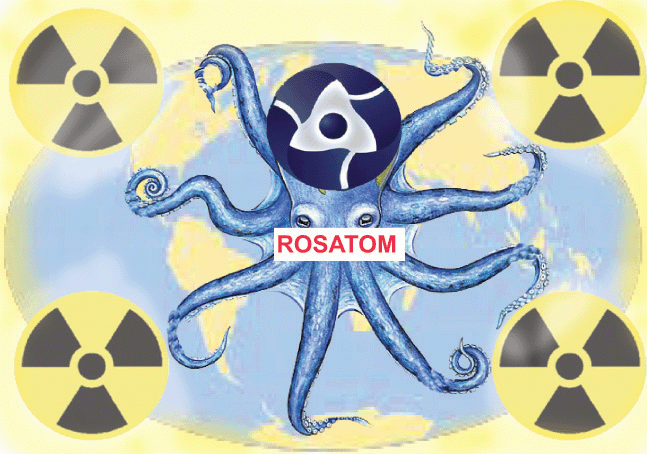
1The US and its European allies moved fast to choke exports of Russian oil, natural gas and coal after Vladimir Putin ordered troops into Ukraine. When it comes to atomic energy, however, Kremlin-controlled Rosatom Corp. continues to be the dominant source of fuel for the world’s nuclear power stations — supplying about half of global demand for enriched uranium. Western nations are racing to reconstitute their own processing capacity, much of which withered amid a growing aversion to nuclear power following Japan’s Fukushima meltdowns. But progress is likely to be slow.
………………………………………………………. Why is Russia so dominant?
Unlike Western companies in the nuclear business, Rosatom is involved in every part of the supply chain, from ore extraction to fuel enrichment and delivery. The company is as much an expression of the Kremlin’s geopolitical power as a profit-generating business. That state-level commitment has played to Russia’s advantage. When international investors turned away from nuclear power following the Fukushima accident in 2011, some Western companies involved in the fuel cycle, including Areva SA in France, the US Enrichment Co. and Westinghouse Electric Co., went bankrupt.
Russia stepped in, building market share not only among the world’s existing fleet of nuclear reactors, but by offering generous financing for new foreign projects. Today, Rosatom’s 330,000 workers provide fuel assemblies to scores of old reactors in eastern Europe and Russia, and is building 33 new power units in 10 countries, including China and India, that will be locked into fuel contracts for decades ahead.
3. Which countries are most dependent?
Former Soviet satellites in eastern Europe continue operating dozens of so-called VVER pressurized water reactors built during the Cold War era. Most of those aging units use Rosatom fuel and are already running on borrowed time, generating electricity beyond the initial period that regulators licensed them to operate. That means there’s little incentive for new companies to enter that market and compete against Russian supply. There are some exceptions. Westinghouse, after emerging from insolvency in 2018, signed contracts to fuel some of Ukraine’s VVER reactors. But even there, Ukraine continues to rely on Rosatom inventory and won’t be able to fully diversify away from Russia until later this decade. It’s a similar challenge from Bulgaria to the Czech Republic and Finland, where the search for alternative suppliers is expected to take years. In all, Russia covers about 30% of the European Union’s demand for enriched uranium.
4. How much is the US exposed?
Atomic trade between the countries grew in the aftermath of the Cold War under the so-called Megatons to Megawatts program, which converted 500 tons of Russian weapons-grade uranium into fuel suitable for US reactors. Russia continues to be a major provider of uranium mining, milling, conversion and enrichment services for US utilities, exposing US consumers to potential disruption. In 2022 it supplied about a quarter of the enriched uranium purchased by US nuclear power reactors, according to US government figures.
Most vulnerable is the provision of uranium enriched to higher levels, which is used by a new generation of so-called small modular reactors (SMRs) because it reduces the frequency of re-fueling. Rosatom currently supplies all the so-called HALEU, or high-assay-low-enriched uranium, to the US……………………………………………………………………. more https://www.washingtonpost.com/business/energy/2023/08/27/why-the-us-and-europe-still-buy-russian-nuclear-fuel/23474ddc-44cd-11ee-b76b-0b6e5e92090d_story.html
Seafood war looms after Japan releases nuclear plant water
China became the latest country to ban imports of all types of Japanese
seafood while South Korea has stopped taking fish caught or farmed from the
area around the now abandoned power plant.
Anti-Japanese sentiment is also
on the increase in South Korea. Several people were arrested after
attempting to storm the Japanese embassy in Seoul while hundreds have taken
to the capital’s streets in protest. Public concern remains high in South
Korea over the plan to release more than 1 million metric tons of treated
radioactive water.
Other Asian countries are expected to ban or restrict
Japanese seafood imports in the coming weeks. More than a million tonnes of
treated radioactive water is understood to be stored at the now inactive
power plant.
Fish Farmer 24th Aug 2023
China bans Japanese seafood after Fukushima wastewater release
Water containing radioactive tritium being pumped into Pacific via tunnel from Tepco plant, amid protests from China, South Korea and fishing communities
Guardian, Justin McCurry, 24 Aug 23
Japan has begun discharging more than 1m tonnes of tainted water into the Pacific Ocean from the wrecked Fukushima Daiichi nuclear power plant in a move that has move that prompted China to announce an immediate blanket ban on all seafood imports from Japan and sparked anger in nearby fishing communities.
The plant’s operator, Tokyo Electric Power (Tepco), pumped a small quantity of water from the plant on Thursday, two days after the plan was approved by Japan’s government.
Tepco said the release began at 1:03pm local time (0403 GMT) and it had not identified any abnormalities with the seawater pump or surrounding facilities. Live video showed engineers behind computer screens and an official saying – after a countdown – that the “valves near the seawater transport pumps are opening.”
Monitors from the UN atomic watchdog, which has endorsed the plan, were due to be on site for the procedure, while Tepco workers were scheduled to take water samples later on Thursday.
The discharge, which is expected to take 30 to 40 years, has caused anger in neighbouring countries and concern among fishers that it will destroy their industry as consumers steer clear of seafood caught in and around Fukushima.
On Thursday, China criticised the release, branding it “extremely selfish and irresponsible”.
“The ocean is the common property of all humanity, and forcibly starting the discharge of Fukushima’s nuclear wastewater into the ocean is an extremely selfish and irresponsible act that ignores international public interests,” Beijing’s foreign ministry said in a statement…………………
How to dispose of wastewater that has built up at the site on Japan’s north-east coast has proved a diplomatic headache for the government, despite support for its approach from the UN’s nuclear watchdog, the International Atomic Energy Agency (IAEA)…………………………
Critics of the discharge say a lack of long-term data means it is impossible to say with certainty that tritium poses no threat to human health or the marine environment. Greenpeace said the radiological risks had not been fully assessed, and that the biological impacts of tritium, carbon-14, strontium-90 and iodine-129 – which will be released as part of the discharge – “have been ignored”…………………………
Hong Kong’s chief executive, John Lee, said releasing the water into the ocean was “irresponsible”, adding that the city would activate import controls on Japanese seafood from regions including Fukushima and Tokyo from Thursday. The ban will cover live, frozen, refrigerated, and dried seafood, as well as sea salt and seaweed.
South Korea, once an outspoken critic of the plans, has said that it accepts the science behind the discharge, but has stopped short of publicly supporting Japan’s approach amid concerns over food safety among the South Korean public……………………
French Winter Power Twice as Pricey as Germany’s on Nuclear Woes

By Todd Gillespie, April 19, 2023 https://www.bloomberg.com/news/articles/2023-04-19/french-winter-power-twice-as-pricey-as-germany-s-on-nuclear-woes?leadSource=uverify%20wall#xj4y7vzkg
France’s weakened nuclear power output means the cost of its electricity for next winter is more than twice as expensive as Germany’s, as concerns over the health of the country’s reactors persist.
The “massive” gap of nearly €250 ($273) per megawatt-hour between French and German prices is because traders are pricing in more risk as they await updates on Electricite de France SA’s struggles with its aging atomic fleet, according to analysts at Engie SA’s EnergyScan. “No participants want to risk being short next winter,” they wrote.
French power for the first quarter of 2024 is trading at €416 per megawatt-hour, more than double Germany’s rate of €169. Normally a power exporter, France’s atomic generation has been gradually returning to service but still remains below historical averages.
France, which relies on nuclear energy for most of its electricity, is expected to remain heavily dependent on power imports during the winter months to meet its demand. Meanwhile, Germany closed its last nuclear plants Saturday after years of political tension over phasing out the technology, but is still very reliant on polluting coal-fired power.
French nuclear availability was at 62% on Wednesday, according to data compiled by Bloomberg. Nuclear output on Wednesday was above its level for this time last year after weeks of historic lows.
— With assistance by Josefine Fokuhl and Francois De Beaupuy
Georgia’s new nuclear reactors a cautionary tale

R Street, BY MARC HYDEN, AUG 21, 2023
Regulators and industry professionals have been gushing over the launch of Georgia’s newest nuclear reactor—Plant Vogtle’s Unit 3. It’s the first such reactor built in the United States in over three decades, and it is positioned to provide around 500,000 customers with clean energy for up to 80 years, which is something to celebrate.
Electric monopoly Georgia Power—who owns a nearly 50 percent stake in it—hailed the recent Vogtle construction as an “American energy success story.” While nuclear energy is impressive and there’s reason to be awestruck by Unit 3, the Vogtle project has been an absolute mess. It’s less of an American success story and more of a subsidized boondoggle that should serve as a cautionary tale for others.
In the early planning stages, a conglomerate of electric companies came together with plans to build two new nuclear reactors—units 3 and 4—and quickly obtained some attractive deals. The U.S. Department of Energy agreed to provide $12 billion in loan guarantees for the construction, the Georgia Public Service Commission greenlit the Vogtle plan, and in 2009, the state Legislature permitted Georgia Power to raise ratepayers’ bills to begin recouping the construction costs far in advance of the units’ completion.
Since Georgia has a monopoly system for electric companies, customers have little choice but to fork out the cash, and the utilities saw little risk and heralded the plan. The construction was intended as a clean energy investment in the future. Best of all, the units would supposedly be completed quickly and for a fair price. That’s where things began to fall apart.
Plant Vogtle’s construction could be best described by the Beach Boys’ lyric, “We’ll get there fast and then we’ll take it slow” because the only thing that happened relatively quickly were the sweetheart deals. Original estimates suggested that units 3 and 4 would be operational in 2016 and 2017, respectively, and the total project would cost around $14 billion. That’s a lot of money for captive ratepayers to bankroll, but that turned out to be more like a down payment. Cost overruns and persistent delays plagued Vogtle.
Construction began in 2009, but only by this summer did Unit 3 become operational for commercial use—7 years behind schedule. Meanwhile, Unit 4 isn’t expected to serve customers until later this year or next. Further, the running price tag for the project now exceeds $35 billion—more than double the original projection—but this was easily foreseeable.
Built in the late 1980s, Vogtle’s units 1 and 2 cost many billions more than estimated, and over 20 nuclear projects have been abandoned in the South since the 1970s for various reasons. Constructing massive nuclear reactors isn’t cheap, nor is it a simple task by any means, and just as anyone who watched the HBO series Chernobyl knows, you don’t want to rush through construction and cut corners……………………………………………………
If nuclear energy is in a resurgence, then Vogtle should serve as a cautionary tale for other states. Mega projects subsidized by the government and underwritten by electric monopolies’ captive ratepayers are fraught with problems. Rather than rushing to help finance massively wealthy energy companies’ nuclear ambitions, the government should reassess whether the actual—not estimated—costs and delays are worth it.
Governments love to act rashly, and asking them to proceed with caution might be futile in a changing world, which reminds me of another song lyric: “The more things change, the more they stay the same. https://www.rstreet.org/commentary/georgias-new-nuclear-reactors-a-cautionary-tale/
France and Russia co-operate on developing a plant in Russia for processing depleted uranium
The installation of equipment has begun at TVEL’s JSC Electrochemical Plant
(ECP) in Zelenogorsk in Russia’s Krasnoyarsk Region for W2-ECP, the
country’s second plant for the processing of depleted uranium hexafluoride.
The plant is part of a long-term project to manage and make use of depleted
uranium stocks in Russia. The plant, with a processing capacity of 10,000
tonnes per year, is being supplied by Orano Projets – the engineering arm
of France’s nuclear fuel cycle specialist Orano – under a EUR40 million
(USD44 million) contract signed in December 2019.
Under the terms of the contract, Orano will supply the equipment for the construction of the
deconversion facility, as well as providing technical assistance in its
installation and commissioning. The first equipment for the plant arrived
at the construction site in eastern Siberia from France in December 2021.
The project was originally expected to be completed in 2022. The W2-ECP
plant will accept deliveries of depleted uranium hexafluoride gas (DUF6 –
sometimes called DUHF) and deconvert these to uranium tetrafluoride, with
anhydrous hydrofluoric acid being produced as a by-product. Deconversion
transforms the toxic and somewhat corrosive gaseous DUF6 enrichment
tailings into a stable powdered oxide form fit for long-term storage,
transport or final disposal.
World Nuclear News 16th Aug 2023
https://www.world-nuclear-news.org/Articles/Construction-of-second-Russian-deconversion-plant
The nuclear industry needs to show it can deliver economically viable big reactors in time and on budget.

Power projects in the west are too often delayed and over budget
Ft.com THE EDITORIAL BOARD 18 Aug 23
A UK parliamentary committee recently urged the government to come up with a strategy, rather than vague targets, to more than triple nuclear generating capacity by 2050. In the US, the Vogtle 3 unit began delivering electricity to Georgia’s power grid — the first reactor the country has built from scratch in more than three decades. Yet the fact that Vogtle 3 and the coming unit 4 might also be among the last big US reactors to be built is a sign of the questions over such plants, despite their promise……………………………….
nuclear is much more expensive than renewables, whose cost has come down sharply, even when everything runs smoothly, which it rarely does. The challenge of safely storing nuclear waste has not been entirely resolved. And recent experience in Europe and the US is almost entirely of projects being completed late and over budget. That has put off private investors, too.
France’s EDF now says Hinkley Point C, Britain’s first new nuclear power station for almost 30 years, is likely to cost more than envisaged. EDF’s Flamanville-3 reactor in France is over a decade behind schedule. In the US, the $14bn original cost of Vogtle 3 and 4 has blown past $30bn.
Japan and South Korea have a better record, but Japan is not building overseas. South Korea’s Kepco, though it successfully built Abu Dhabi’s first nuclear plant, is facing a copyright lawsuit from America’s Westinghouse over using the same design elsewhere. China and Russia have completed multiple reactors largely on time, but few western nations want to buy from them.
Small modular reactors — cheaper and quicker to build — may start to play a role, but are still in development. So if nuclear power is to play the part many western governments envisage, the industry needs to improve financing, construction and supply chains, and demonstrate it can build big reactors within the time and resources allotted………………………………………………..
Many of the things engineers say are needed to keep nuclear costs down — better planning and communications, applying best practice — sound humdrum, but seem hard to achieve in real life. If “gigawatt-scale” reactors are to play their part in the west’s climate transition, the nuclear industry must be better at planning and execution. https://www.ft.com/content/2b5e0a50-dcf7-4932-a293-6fa82cebc027—
Finland’s OL2 nuclear reactor off grid; power prices rise
Reuters, August 18, 2023
OSLO, Aug 18 (Reuters) – Finland’s OL2 nuclear power reactor was shut down early on Friday and will remain offline until Aug. 28 due to problems caused by increased moisture in the facility’s turbine, operator TVO said, helping to pushing up electricity prices.
There was no impact on nuclear safety, TVO added.
The outage comes at a time of low wind power generation that has already lifted Finnish prices, according to Refinitiv analyst Petter Engblom Nordby.
Electricity prices for Friday soared up to 270 euros per megawatt hour (MWh) for hours where demand is typically highest, far exceeding prices in other parts of the Nordics and continental Europe, data from power exchange Nord Pool showed……………….. Reporting by Nora Buli in Oslo and Louise Rasmussen in Copenhagen, editing by Terje Solsvik https://www.reuters.com/business/energy/finlands-ol2-nuclear-reactor-off-grid-power-prices-rise-2023-08-18/
1 This Month
Chernobyl: The Lost Tapes – A good documentary on Chernobyl on SBS available On Demand for the next 3 weeks– https://www.sbs.com.au/ondemand/tv-program/chernobyl-the-lost-tapes/2352741955560

of the week–London Campaign for Nuclear Disarmament

Tell the Ukrainian Government to Drop Prosecution of Peace Activist Yurii Sheliazhenko
To see nuclear-related stories in greater depth and intensity – go to https://nuclearinformation.wordpress.com
-
Archives
- April 2026 (139)
- March 2026 (251)
- February 2026 (268)
- January 2026 (308)
- December 2025 (358)
- November 2025 (359)
- October 2025 (376)
- September 2025 (257)
- August 2025 (319)
- July 2025 (230)
- June 2025 (348)
- May 2025 (261)
-
Categories
- 1
- 1 NUCLEAR ISSUES
- business and costs
- climate change
- culture and arts
- ENERGY
- environment
- health
- history
- indigenous issues
- Legal
- marketing of nuclear
- media
- opposition to nuclear
- PERSONAL STORIES
- politics
- politics international
- Religion and ethics
- safety
- secrets,lies and civil liberties
- spinbuster
- technology
- Uranium
- wastes
- weapons and war
- Women
- 2 WORLD
- ACTION
- AFRICA
- Atrocities
- AUSTRALIA
- Christina's notes
- Christina's themes
- culture and arts
- Events
- Fuk 2022
- Fuk 2023
- Fukushima 2017
- Fukushima 2018
- fukushima 2019
- Fukushima 2020
- Fukushima 2021
- general
- global warming
- Humour (God we need it)
- Nuclear
- RARE EARTHS
- Reference
- resources – print
- Resources -audiovicual
- Weekly Newsletter
- World
- World Nuclear
- YouTube
-
RSS
Entries RSS
Comments RSS
 nuclear-news