The President of the Canadian Nuclear Safety Commission spent $288,000 on travel in 19 months
Luxury hotel, $12,000 plane tickets:
a senior public servant even had her luggage carrier reimbursed
PASCAL DUGAS BOURDON and CHARLES MATHIEU , Journal de Montréal, Monday, November 27, 2023 https://tinyurl.com/ydmpyaa3
$1,000 per night accommodation in a luxury hotel with luggage porter, business-class airfare
to Tokyo, Dubai and Vienna: the outgoing President of the Canadian Canadian Nuclear Safety Commission has multiplied her expensive trips at taxpayers’ expense. According to a compilation by our Bureau of Investigation, Rumina Velshi was reimbursed $288,000 in business travel in 19 months between January 2022 and July 2023.
She is by far the biggest spender in the senior federal civil service, spending $100,000 more than any other publicly employed executive… (more)
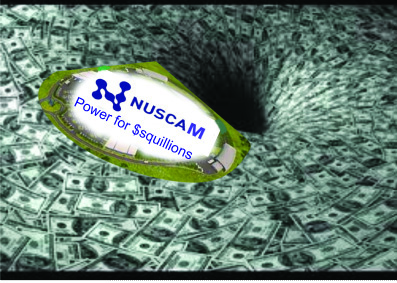
NuScale cancels first planned SMR nuclear project due to lack of interest
The Chemical Engineer, by Adam Duckett, 27 Nov 23
NUSCALE has cancelled the first project for its pioneering small modular nuclear reactor (SMR) technology because too few customers signed up to receive its power amid rising costs.
NuScale is the only company to have received design approval from US regulators for an SMR, a smaller form of reactor that can be fully fabricated in a factory to reduce the costly overruns that occur with larger conventional nuclear plants.
The first plant, known as the Carbon Free Power Project (CFPP), was set for construction at the US Department of Energy’s Idaho National Laboratory. It would have included six reactor modules generating a combined 462 MW of low carbon energy and had planned to begin operations in 2030. However, the company says there has not been enough interest from utilities across western states to continue the project.
The DoE has provided more than US$600m in funding since 2014 for NuScale and others to develop SMR technology. A spokesperson said: “We believe the work accomplished to date on CFPP will be valuable for future nuclear energy projects,” Reuters reports……………………
Critics argue that the technology is unproved, produces radioactive waste, and will be too slow and costly compared to renewable options which are available to deploy now. NuScale announced at the start of the year that the target cost of power from CFPP had climbed 53% since 2021 to US$89/ MWh.
The Institute for Energy Economics and Financial Analysis warned that “no one should fool themselves into believing this will be the last cost increase” given the additional design, licensing and testing needed, on top of inflation. https://www.thechemicalengineer.com/news/nuscale-cancels-first-planned-smr-nuclear-project-due-to-lack-of-interest/
Poor nuclear prospects in UK

The Global Warming Policy Foundation, no stranger to controversy, has published a report on nuclear prospects, which is quite damning, with the GWPF claiming that it shows that the nuclear industry is now so dysfunctional it may have no future in the UK without a concerted policy and regulatory effort. The report’s author, energy consultant and Daily Telegraph columnist Kathryn Porter, says ‘most of our existing nuclear fleet will close in the next few years, with almost nothing to replace it, and I see little cause for optimism that the economic or regulatory environment will produce significant new capacity any time soon.’………………
In the report, Porter goes through the technical options in a quite neutral way, but warns that, at present, ‘the economic opportunities for nuclear power in Great Britain are mixed. The Government hopes that the new Regulated Asset Base model will attract investor interest by increasing income certainty and transferring some risks to consumers. However, Ofgem has been designated as the economic regulator in this area, and its track record in setting consistent and effective price controls for gas and electricity network operators has been mixed. It is now under significant pressure to contain energy company profits, which may make nuclear developers nervous about the model and how it may operate in practice’.
So she is concerned about funding. ………………………………..
Prof. Malcolm Grimson from Imperial College London focused more on the economics: ‘The paper is rightly very clear that the economic risks of nuclear power – in short, that compared to other power options, much more of the cost of nuclear generation is front-loaded in the construction phase, so managing risks of cost or schedule overruns is a practically insuperable task for private capital – are such that heavy state involvement, probably up to and including direct state investment in new nuclear construction, is unavoidable.’
He added ‘The paper is also probably right in saying that the CfD/strike price structure which was created to fund Hinkley Point C probably will not be repeated……………………..
It will be interesting to see how the government (and the nuclear industry) responds to Porters analysis of funding and energy pricing policy, and especially to the point that, given the zero fuel costs of renewable, but also their operational costs, ‘determining the optimal generation mix of nuclear and renewable energy when taking the full costs to consumers into account is challenging’………………………..
she backs off talking about nationalisation,……………………… https://renewextraweekly.blogspot.com/2023/11/poor-nuclear-prospects.html
Engie demands close scrutiny of French nuclear power deal to ensure competition.
A recent deal regulating French nuclear power risks making
electricity more expensive and must be carefully monitored to ensure the
new rules do not strengthen EDF’s dominant position, power group Engie’s
CEO said on Wednesday. Vigilance will be needed to ensure EDF’s producer
and supplier activities are strictly separated, said Engie (ENGIE.PA),
which is the second largest electricity supplier in the country behind
state-owned EDF.
Reuters 22nd Nov 2023
Xcel’s Prairie Island nuclear plant will be out of commission until January
An equipment issue at the Prairie Island plant near Red Wing hasn’t impacted electric service, but it could lead to higher fuel costs that are passed down to Xcel’s customers on their monthly bills.
By Walker Orenstein Star Tribune, NOVEMBER 22, 2023
An equipment problem at Xcel Energy’s nuclear power plant near Red Wing has shut down the facility likely until January, causing a three-month outage for one of the utility’s biggest power sources.
The issue at the Prairie Island plant hasn’t affected electric service, but it could lead to higher fuel costs that are passed down to Xcel’s customers on their monthly bills.
On Oct. 19, one of two units at the plant shut itself down after an issue between the turbine and the electric grid, said Xcel spokesman Kevin Coss. The company said repairs are underway as it replaces cabling between the unit and the substation at the plant.
…………………………………Dave Lochbaum, a nuclear safety engineer formerly with the Union of Concerned Scientists, said the issue sounded like “an aging problem.” Other plants down for that long have had issues with their electric distribution systems, he said, and often with the generator itself.
“Things do wear out,” Lochbaum said.
…………………………………………………………… This is the second unplanned outage at an Xcel nuclear plant in recent months. Xcel’s Monticello nuclear plant shut down Sept. 27 after an issue with pressure control valves in the turbine during scheduled testing. Xcel told federal regulators that all safety systems functioned properly and there were no environmental or health impacts. Xcel made repairs to the plant, which is now running………… more https://www.startribune.com/xcels-prairie-island-nuclear-plant-will-be-out-of-commission-until-january/600321701/
Etopia Report: the nuclear problem – economic realities

Selected quotes for from the eTopia report 2023 (translated from the French)
“4.5. The pharaonic cost of accidents and uninsurability of Nuclear
For their part, the potential costs of nuclear incidents and accidents are difficult to take into account in the cost of the mWh, even if they are very real. Thus, the sabotage (still not clarified) in 2014 of one of the reactors at Doel cost Engie nearly 100 million euros. And in case largest accident, no insurance company in the world will agree to cover nuclear power plants.
The maximum amount of damage up to which liability of the operator is incurred, amounts to €1.2 billion for each accident nuclear ! The additional costs would therefore be borne by the taxpayers (see on this subject the Price Anderson Act, American legal framework of irresponsibility of operators on which the legislation is based today (European).
As an example – and scale – the cost of the disaster of Chernobyl is estimated, at a minimum, at more than 200 billion euros, that of Fukushima today exceeds 170 billion, while the counter still running… The Institute of Radioprotection and Nuclear Safety (IRSN) studied the economic cost of a nuclear accident, if it occurred in France. A serious accident would cost on average 120 billion euros, a major accident, 430 billion euros… or the GDP of Belgium.
In a recent interview, Patrick Pouyanné, boss of Total Energies, explains why the company will not go into nuclear power. Acknowledging that they had studied the issue very seriously, he concluded: “it’s very capital intensive and the risk cocktail is too important to a private company”. Too expensive and too dangerous, therefore. In Germany, a study commissioned by the Versicherungsforen Leipzig, a service provider for insurance companies, calculated in 2011 that if an insurance wanted to constitute sufficient premiums to a nuclear power plant within 50 years, for example, it should ask for 72 billion euros per year for civil liability!
In practical, the reactors cannot therefore be insured, unless that the price of electricity is multiplied by… twenty. The study explains years of market distortion in favor of nuclear energy and to the detriment of competition. Uwe Leprich from the University of Sciences applied sciences of Saarbrücken, demonstrates that “nuclear energy is not competitive when considered from an economic point of view appropriate in terms of regulatory policy. »
ETOPIA is a Center for animation and research in political ecology. Founded in 2004, based in Namur, our think tank brings together environmental activists, associate researchers, trainers and change agents.
Link eTopia Nuclear 2023 Report: https://rep.etopia.be/wp-content/uploads/2023/09/LIVRE_PROBLEME_NUCLEAIRE_WEB.pdf
The Russian nuclear industry during wartime, 2022 and early 2023
Bellona has published a new report that analyze the new footing on which
Rosatom, Russia’s power state nuclear corporation, has found itself as the
the war in Ukraine grinds on. It’s clear that the putatively civilian
corporation is now a direct participant in and beneficiary of Russia’s
seizure of Ukrainian nuclear infrastructure.
In the early days of the war,
Moscow’s troops marched into Chernobyl, site of the world’s worst nuclear
accident and now the host of numerous industrial scale activities aimed at
cleaning it up. Days later, it then overran the Zaporizhzhia nuclear power
plant — Europe’s largest such facility — making it the world’s first
nuclear power station to be taken as prize as the result of an armed
attack. Click here to download the report: The Russian nuclear industry during wartime, 2022 and early 2023
Bellona 21st Nov 2023
Finland extends nuclear reactor outage, pushing up power price
November 20, 2023 —by Essi Lehto and Nora Buli for Reuters
HELSINKI, Nov 20 (Reuters) – Finnish power company TVO said on Monday it had extended an outage at Olkiluoto 3, Europe’s largest nuclear power generator, while it undertakes repairs, likely boosting electricity prices.
The 1,600 megawatts (MW) unit, known as OL3, on Sunday suffered an unexpected outage due to a turbine problem, TVO and Nordic power bourse Nord Pool said.
“We are looking into a fault on the turbine side and when we find out what it is, we can say what caused it and when we can return to electricity production,” said a TVO spokesperson.
“We will issue a statement as soon as we know more.”
The outage was expected to drive up short-term power prices in Finland and the Nordic region, an LSEG market analyst said.
TVO had initially predicted a return to full production capacity on Monday morning, but in a regulatory filing said it was instead aiming for a partial restart to take place on Tuesday…………………… https://www.nasdaq.com/articles/finland-extends-nuclear-reactor-outage-pushing-up-power-price
—
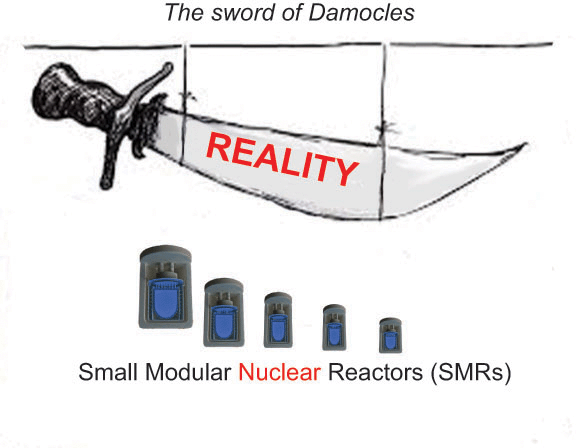
U.S. Bets on Small Nuclear Reactors – But major obstacles loom.
U.S. Bets on Small Nuclear Reactors to Help Fix a Huge Climate Problem.
The dream of reviving nuclear power in the U.S. rests on a new generation
of smaller reactors meant to be easier to build.
But major obstacles loom.
Nearly a dozen companies are developing reactors that are a fraction of the
size of those at Vogtle, betting that they will be quicker and cheaper to
build. As the United States looks to transition away from fossil fuels.
But the push to expand nuclear power, which today supplies 18 percent of
electricity, faces enormous hurdles. In a major setback last week, the
first serious effort to build small reactors in the United States was
abruptly cancelled amid soaring costs. While other projects are still
moving forward, the industry has consistently struggled to build plants on
time and on budget. The Nuclear Regulatory Commission, which oversees the
safety of the nation’s nuclear fleet, is less experienced with novel
reactor technologies.
And the problem remains of how to dispose of
radioactive waste. “These nuclear megaprojects had just gotten way too
complex,” said Jay Wileman, president of GE-Hitachi Nuclear Energy, which
is designing a slimmed-down version of its boiling-water reactor that is
only 300 megawatts — one-quarter the size of the 1,117-megawatt units at
Vogtle. Ontario Power Generation plans to deploy four of them in Canada,
hoping to bring down costs as it builds the same design again and again.
The Tennessee Valley Authority is considering at least one.
Other companies
are exploring radically new reactor designs that, in theory, can’t melt
down and don’t require big containment domes or other expensive
equipment. Some might be manufactured in factories and assembled on-site,
potentially lowering costs.
The approval process can be slow. To date, the
N.R.C. has certified only one small reactor design, developed by NuScale
Power. NuScale’s light-water technology is similar to existing plants,
but the company argued that smaller reactors required different safety
rules, such as smaller evacuation zones in case of accidents.
Securing approval took a decade and cost $500 million.
Last week, NuScale announced
it was cancelling plans to deploy six 77-megawatt reactors in Idaho by
2030, which would have been the nation’s first small nuclear plant. The
problem was that it couldn’t sign up enough customers. Soaring costs
didn’t help: In January, NuScale said the price of building the reactors
had jumped from $5.3 billion to $9.3 billion, citing higher interest rates
and materials costs. On a per-megawatt basis, the project had become as
expensive as Vogtle.
“The small reactors being hyped by the nuclear
industry and its allies are simply too late, too expensive, too uncertain
and too risky,” said David Schlissel, an analyst for the Institute for
Energy Economics and Financial Analysis, who has urged utilities to pursue
alternatives like solar and geothermal power. Other challenges loom. The
United States isn’t yet producing enough of the specialized fuel for
advanced reactors. There’s no long-term plan for nuclear waste. Siting
new plants can be contentious: Last year, officials in Pueblo County,
Colo., withdrew plans to replace a retiring coal plant with a reactor after
local backlash.
New York Times 12th Nov 2023
Consortium green lights European NuScale style (!) small nuclear reactors

Construction Europe By Mike Hayes, 15 November 2023
Industrial bodies from Romania, Italy and Belgium have formed a consortium to advance nuclear energy technology in Europe.
Romanian and Belgian nuclear research centres RATEN and SCK CEN, Italian nuclear company Ansaldo Nucleare and engineering and energy R&D agency ENEA, will take part in the initiative, in collaboration with the US-based nuclear technology company Westinghouse Electric.
The primary objective of the consortium is to develop a small modular lead-cooled fast neutron reactor (SMR-LFR…….
The proposal was reportedly to mirror the efforts of the US NuScale project – a project which has now been cancelled, following a doubling of construction costs.)………………………………https://www.construction-europe.com/news/consortium-green-lights-european-small-nuclear-reactors/8033034.article
Are staff shortages at Sellafield nuclear power plant affecting safety at the site?
QUESTIONS have been asked over whether a staff shortage at Sellafield
nuclear power plant is affecting safety at the site. The issue was raised
at this month’s meeting of the west Cumbria sites stakeholder group at
Cleator Moor Civic Hall. Neil Crewdson, Sellafield’s site director, was
presenting a progress report on various developments at the site where he
highlighted recruitment issues and a difficulty in attracting staff. But he
outlined a number of ways in which they are hoping to tackle the situation
and turn things around. He said there used to be 200 vacancies a year and
it had risen to 900. He added: “Post Covid we had a step change in people
leaving. With salaries we are trying to make sure they are more
competitive.”
Carlisle News & Star 14th Nov 2023
https://www.newsandstar.co.uk/news/23923195.rising-number-vacancies-sellafield-covid/
America’s first SMR fizzles out as uranium continues to ride high
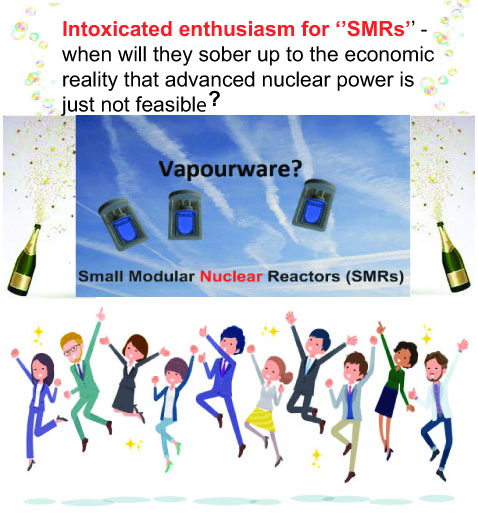
SMR developer NuScale has, predictably, rebutted a short seller’s report from Iceberg Research on its operations last month.
Its stock is down 81% over the past year.
Yet enthusiasm for the nuclear renaissance is still strong
Stockhead, Josh Chiat, 14 Nov 23
Small modular reactors — they’re the technology the nuclear power industry hopes will mainstream the controversial energy sector and prove it can expand without the massive scale of traditional nuclear energy.
But the emerging market has been dealt a blow just as enthusiasm for a nuclear renaissance hits a new level of intensity.
It came in the form of a decision from the Utah Associated Municipal Power Systems and advanced SMR developer NuScale to dump a plan called the “Carbon Free Power Project”.
That would have been the first SMR rolled out in the States, six minireactors due to be constructed in Idaho Falls from 2026. But NuScale and UAMPS deemed it unviable after subscriptions fell well below the level required to underwrite the project’s construction.
It came despite strong political support, including from the Biden Administration, amid long delays and cost overruns for conventional plants.
Wood Mackenzie vice-chair of Americas Ed Crooks said it was a serious setback for the SMR industry.
“But while the end of the Carbon Free Power Project was not entirely unexpected, it is still a serious setback for nuclear power in the US, and for hopes of reducing greenhouse gas emissions globally,” he said in a note.
“It is increasingly likely that no new SMRs will be built in the US or Europe in the 2020s.”
According to Crooks the levelised cost of energy for the power to be delivered by the dumped project was over double that of utility-scale solar and materially higher than gas turbines.
“Estimates published in January set a target levelised cost of energy (LCOE) for the plant of US$89 per megawatt hour, up from an earlier estimate of US$58/MWh, including the benefit of tax credits and federal government support,” he wrote.
“But even that revised target relied on some favourable assumptions. Hitting that US$89/MWh target depended on cutting US$700 million from the Carbon Free Power Project’s estimated cost of US$5.1 billion.
“Without that, the LCOE would be US$105/MWh, and there were clear risks that it could rise higher.
“Wood Mackenzie calculated last year that the average LCOE from a combined-cycle gas turbine power plant in the US was US$58/MWh, while utility-scale solar was US$43/MWh.
“That makes the Carbon Free Power Project’s cost estimates seem expensive, even before any additional overruns.”
Enthusiasm for nuclear continues
Despite that news, SMR developer NuScale has, predictably, rebutted a short seller’s report from Iceberg Research on its operations last month.
Its stock is down 81% over the past year.
Yet enthusiasm for the nuclear renaissance is still strong, …………………………………………………………. https://stockhead.com.au/resources/ground-breakers-americas-first-smr-fizzles-out-as-uranium-continues-to-ride-high/
Deal to build pint-size nuclear reactors canceled, ‘avoiding a giant financial debacle.’

NuScale Power’s small modular reactors promised cheaper nuclear power, but costs soared and utilities balked
Science, NOV 2023 BY ADRIAN CHO
A plan to build a novel nuclear power plant comprising six small modular reactors (SMRs) fell apart this week when prospective customers for its electricity backed out. Utah Associated Municipal Power Systems (UAMPS), a coalition of community-owned power systems in seven western states, withdrew from a deal to build the plant, designed by NuScale Power, because too few members agreed to buy into it. The project, subsidized by the U.S. Department of Energy (DOE), sought to revive the moribund U.S. nuclear industry, but its cost had more than doubled to $9.3 billion.
“We still see a future for new nuclear,” says Mason Baker, CEO and general manager of UAMPS, which planned to build the plant in Idaho. “But in the near term, we’re going to focus on … expanding our wind capacity, doing more utility-scale solar, [and] batteries.” NuScale, which was spun out of Oregon State University in 2007, declined to make anyone available for an interview. But David Schlissel of the Institute for Energy Economics and Financial Analysis says, “The communities and their ratepayers have avoided a giant financial debacle.”
To some observers, the plan’s collapse also raises questions about the feasibility of other planned advanced reactors, meant to provide clean energy with fewer drawbacks than existing reactors. NuScale’s was the most conventional of the designs, and the closest to construction. “There’s plenty of reasons to think [the other projects] are going to be even more difficult and expensive,” says Edwin Lyman, a physicist and director of nuclear power safety at the Union of Concerned Scientists.
The U.S. nuclear industry has brought just two new power reactors online in the past quarter-century. In a deregulated power market, developers have struggled with the enormous capital expense of building a power reactor. Two new reactors at Plant Vogtle in Georgia, one of which came online in May, cost more than $30 billion.
To whack down cost, engineers at NuScale decided to think small. Each NuScale SMR would produce just a fraction of the 1.1 gigawatts produced by one of the new Vogtle reactors. As originally conceived in 2014, the plant would contain 12 SMRs, each producing 60 megawatts of electricity, for $4.2 billion.
Small reactors are not an obvious winner. Basic physics dictates that a bigger nuclear reactor will be more fuel efficient than a smaller one. And a big nuclear plant can benefit from economies of scale. However, a small reactor can be simpler. For example, NuScale engineers rely on convection to drive cooling water through the core of each SMR, obviating the need for expensive pumps. SMRs also can be mass-produced in a factory and shipped whole to a site, reducing costs.
Size aside, NuScale’s SMR is relatively conventional. Whereas other advanced reactor designs rely on exotic coolants, NuScale’s sticks to water. It also uses the same low-enriched uranium fuel as existing power reactors. Those features helped the NuScale design win approval from the Nuclear Regulatory Commission (NRC) in September 2020—the only advanced reactor to have done so.
DOE agreed to host the plant at its Idaho National Laboratory, bypassing the long site permitting process commercial reactors ordinarily face. Still, by the time NRC approved the design, the cost for the project has risen to $6.1 billion. That led DOE to chip in $1.4 billion and developers to reduce the design to six modules, each pumping out 77 megawatts. In January, an analysis revealed that the cost had increased by an additional $3 billion. It suggested power from the plant would cost $89 per megawatt-hour, roughly three times as much as power from wind or utility-scale solar.
Why the costs sky-rocketed remains unclear. Lyman notes that NuScale’s first plant was always going to be expensive, as the company’s production lines still need to be developed. Even so, he says, NuScale designers overestimated how much they could save with a simpler design. “They never demonstrated that you could compensate for that penalty in economies of scale with these other factors.”
Jacopo Buongiorno, a nuclear engineer at the Massachusetts Institute of Technology, says the NuScale design has an Achilles’ heel. Each reactor’s core resides within a double-walled steel cylinder, with a vacuum between the walls to keep heat from leaking out. The reactor modules sit in a big pool of water, which in an emergency can flood into the vacuum space around a reactor to prevent it overheating. Compared with a conventional reactor’s building, the pool requires more reinforced concrete, the price of which has soared, Buongiorno says. “In terms of tons of reinforced concrete per megawatt of power, NuScale’s design is off the chart.”
UAMPS’s members balked at the cost of that power. UAMPS had to line up agreements to buy 80% of the plant’s 462 megawatt output before early next year, Baker says, but it had commitments for only 26%. On 7 November the 26 of the 50 UAMPS members that had signed up for the project voted to terminate it, Baker says.
Other, more ambitious nuclear projects are in the works. DOE has agreed to help a company called Terrapower develop a reactor that will use molten sodium as a coolant. It will also help another company, X-power, develop an SMR cooled by xenon gas. Both plants would use novel fuel enriched to 20% uranium-235. That fuel is not yet commercially available, and it could make those designs even more expensive, Lyman says………………………….. https://www.science.org/content/article/deal-build-pint-size-nuclear-reactors-canceled
 | |||
| |||
The First Small-Scale Nuclear Plant in the US Died Before It Could Live

“One of the stories they’ve kept telling people was that the SMR was going to be a lot cheaper than large-scale nuclear,” David Schlissel, an analyst at the nonprofit Institute for Energy Economics and Fiscal Analysis, told WIRED last month. “It isn’t true.”
Wired. 10 Nov 23
Six nuclear reactors just 9 feet across planned for Idaho were supposed to prove out the dream of cheap, small-scale nuclear energy. Now the project has been canceled.
The plan for the first small-scale US nuclear reactor was exciting, ambitious, and unusual from the get-go. In 2015, a group of city- and county-run utilities across the Mountain West region announced that they were betting on a new frontier of nuclear technology: a mini version of a conventional plant called a “small modular reactor” (SMR).
Advocates said the design, just 9 feet in diameter and 65 feet tall, was poised to resurrect the US nuclear industry, which has delivered only two completed reactors this century. It was supposed to prove out a dream that smaller, modular designs can make splitting atoms to boil water and push turbines with steam much cheaper. But first that reactor, the Voygr model designed by a startup called NuScale, had to be built. A six-reactor, 462-megawatt plant was slated to begin construction by 2026 and produce power by the end of the decade.
On Wednesday, NuScale and its backers pulled the plug on the multibillion-dollar Idaho Falls plant. They said they no longer believed the first-of-its-kind plant, known as the Carbon Free Power Project (CFPP) would be able to recruit enough additional customers to buy its power.
Many of the small utilities underwriting the pioneering project, members of a group called the Utah Associated Municipal Power Systems (UAMPS) saw the pint-sized nuclear plant as a potential solution to pressure to reduce their carbon emissions. The Department of Energy, which was due to host the plant at Idaho National Lab, awarded $1.4 billion to the project over 10 years.
But as WIRED reported in February, the utilities backing the plant were spooked late last year by a 50 percent increase in the projected costs for the project—even after factoring in substantial funds from the Inflation Reduction Act. The Idaho Falls reactors’ chances of survival began to look slimmer.
At the time, commitments in place to buy the reactor’s future power covered less than 25 percent of its output. UAMPS set itself a year-end deadline to bump that figure to 80 percent by recruiting new customers. Reaching that number was seen as key to ensuring the project’s long-term viability. As the project moved into site-specific planning and construction, its costs were poised to become more difficult to recoup if the plant ultimately failed, heightening the risks for the members.
Atomic Homecoming
As recently as last month, local officials returned to their communities from a UAMPS retreat with a reassuring message that the Idaho Falls project was on track to secure the new backers it needed, according to local meetings reviewed by WIRED.
That appeared to be good news in places like Los Alamos, New Mexico, where an official this spring described the project as a “homecoming” for atomic technology. The project was due to arrive just in time to help the county meet its goal of decarbonizing its electrical grid and adjusting to the retirement of aging fossil fuel plants nearby. At the time, locals expressed concern about where they would find clean and consistent power if the first-of-its-kind plant was to go away, given limited capacity to connect to new wind and solar projects in the region.
Now that the project is dead, SMR skeptics say the municipalities should find those cleaner power sources and focus on proven technologies. “One of the stories they’ve kept telling people was that the SMR was going to be a lot cheaper than large-scale nuclear,” David Schlissel, an analyst at the nonprofit Institute for Energy Economics and Fiscal Analysis, told WIRED last month. “It isn’t true.”
UAMPS spokesperson Jessica Stewart told WIRED that the utility group would expand its investments in a major wind farm project and pursue other contracts for geothermal, solar, battery, and natural gas projects………………………………………………………………………………………………….. more https://www.wired.com/story/first-small-scale-nuclear-plant-us-nuscale-canceled/
NuScale shares plunge as it cancels flagship small nuclear reactor project
BY DAVID MEYER, November 10, 2023
Rafael Grossi, the head of the International Atomic Energy Agency, yesterday warned that nuclear energy has to be part of the energy shift away from fossil fuels. However, while the UN agency is increasing its forecasts for nuclear energy production, Grossi also said this was contingent on “a better investment playing field.”……………. (behind a paywall, of course) more https://fortune.com/2023/11/09/nuscale-shares-smr-small-modular-reactor-cfpp-utah-rolls-royce-microsoft/ #nuclear #antinuclear #nuclearfree #NoNukes
1 This Month

of the week – Shut Down Drone Warfare!


Tell the Ukrainian Government to Drop Prosecution of Peace Activist Yurii Sheliazhenko

Petition to revoke the licensing of the Near Surface Nuclear Disposal Facility (NSDF) at Chalk River. https://www.ourcommons.ca/petitions/en/Petition/Details?Petition=e-7247
To see nuclear-related stories in greater depth and intensity – go to https://nuclearinformation.wordpress.com
-
Archives
- April 2026 (114)
- March 2026 (251)
- February 2026 (268)
- January 2026 (308)
- December 2025 (358)
- November 2025 (359)
- October 2025 (376)
- September 2025 (257)
- August 2025 (319)
- July 2025 (230)
- June 2025 (348)
- May 2025 (261)
-
Categories
- 1
- 1 NUCLEAR ISSUES
- business and costs
- climate change
- culture and arts
- ENERGY
- environment
- health
- history
- indigenous issues
- Legal
- marketing of nuclear
- media
- opposition to nuclear
- PERSONAL STORIES
- politics
- politics international
- Religion and ethics
- safety
- secrets,lies and civil liberties
- spinbuster
- technology
- Uranium
- wastes
- weapons and war
- Women
- 2 WORLD
- ACTION
- AFRICA
- Atrocities
- AUSTRALIA
- Christina's notes
- Christina's themes
- culture and arts
- Events
- Fuk 2022
- Fuk 2023
- Fukushima 2017
- Fukushima 2018
- fukushima 2019
- Fukushima 2020
- Fukushima 2021
- general
- global warming
- Humour (God we need it)
- Nuclear
- RARE EARTHS
- Reference
- resources – print
- Resources -audiovicual
- Weekly Newsletter
- World
- World Nuclear
- YouTube
-
RSS
Entries RSS
Comments RSS
 nuclear-news