AREVA going to court over Finland nuclear reactor runaway costs
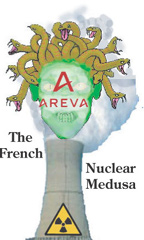 Areva’s half-year results yesterday night brought new information about the Olkiluoto-3 EPR nuclear fiasco:
South Africa’s nuclear company Eskom makes huge loss
Corporate Toughest of times for Eskom
World Nuclear News28 August 2009
Eskom, South Africa’s state-owned utility, has reported a record annual loss and has warned of a funding gap for an expansion program needed to prevent a repeat of the blackouts the country experienced in 2008.The company, which supplies about 95% of South Africa’s electricity and more than 60% of Africa’s, reported a loss of 9.7 billion rand ($1.25 billion) for the year ended 31 March. In the previous year, Eskom made a loss of 210 million rand ($27 million)………….
Bulgaria: right wing opposition to nuclear plant
Bulgaria Right-Wingers Call for Halt of Nuclear Plant Plan
novinite.com September 1, 2009,Bulgaria’s biggest right-wing party has reiterated its calls on the new government to give up the planned Belene project as it is still undecided whether to scrap or push ahead the construction of the multi-billion nuclear power plant.
“The price tag of the nuclear power plant at the Danube river town will stand at no less than EUR 10 B,” Martin Dimitrov, leader of the Union of Democratic Forces (UDF), said at a press conference on Tuesday.
According to him Belene nuclear power plant will not benefit local consumers, which makes it completely useless.
“Freezing the project is no solution to the problem,” Dimitrov added.
UDF leadership has repeatedly warned that the construction of the plant will translate into a BGN 1300 tax burden for each Bulgarian taxpayer, electricity hikes for decades on end, outdated and dubious Russian nuke units…………….
…………According to reports and non-governmental organizations RWE AG’s plan to expand in Bulgaria’s nuclear market is on the brink of collapse because financing for the project couldn’t be obtained.
Financial crisis hurts some Eastern Europe nuclear plans
Financial crisis hurts some Eastern Europe nuclear plans
By Anna Mudeva
SOFIA (Reuters) 1 Sept 09
– Domestic political squabbles, funding woes and other hurdles threaten a number of nuclear power plant projects in central and southeast Europe
…………..Analysts say the global economic crisis has made banks reluctant to provide loans for nuclear plants, which cost around 3 billion euros ($4.30 billion) per 1,000 megawatt reactor, for a pay-off that takes decades.
Equipment suppliers and engineering companies are also unwilling to give fixed price tags during volatile times, which makes planning and calculation of costs difficult.
Nuclear energy on a downward trend: no renaissance in sight
Study shows: Nuclear energy on downward trend worldwide
Federal Ministry for Nuclear safety Germany,
28 August 09Minister Gabriel:
There is no renaissance of nuclear energyThe share of nuclear energy in worldwide energy consumption is marginal and has been declining for several years. This is revealed in a study by independent experts of the energy and nuclear sector which was published by the Federal Environment Ministry today. As Federal Environment Minister Sigmar Gabriel said:“The renaissance of nuclear energy, much trumpeted by its supporters, is not taking place. The only thing frequently revived is the announcement. The study shows: the number of old nuclear power plants which are decommissioned worldwide is greater than the number of new ones taking up operation. Available resources, engineering performance and funds are not even enough to stop the downward trend, let alone increase the number of reactors. All the facts are in favour of phasing out this technology while at the same time expanding the use of renewable energies and energy efficiency, as this is a promising option for the future.”
The authors of the study, headed by Mycle Schneider, Paris, collected crucial quantitative and qualitative facts on nuclear power plants which are in operation, being built or planned today and assess the economic viability of old and new nuclear power plants.
At the time of going to press, 1 August 2009, there were only 435 reactors in operation worldwide, which is nine less than in 2002. Nuclear energy accounts for only about 5.5 % of worldwide commercial primary energy consumption and only around 2 % of worldwide final energy consumption – and consumption has been steadily declining for years.
The authors also found out that the number of nuclear power plants will decrease worldwide over the next decades. Between 2015 and 2025 the capacity of nuclear power plants is expected to sink compared to today’s output……………….
Current and planned building projects of the nuclear industry are becoming increasingly expensive. The EPR, for example, the flagship of the world’s largest manufacturer of reactors, AREVA NP, which is currently in construction in Olkiluoto in Finland, has so far exceeded planned costs by at least 55 %.
Nuclear industry declining world-wide
Nuclear decline set to continue, says report
Nuclear Engineering 27 August 2009
Nuclear will continue to decline according to a new report. At this point there is no obvious sign that the international nuclear industry could turn the decline into a promising future, it says. Continue reading
Nuclear energy a fading dream
Energy dream fades in New Brunswick
By Megan O’Toole, Canwest News Service“……………The $1.4-billion refurbishment of New Brunswick’s Point Lepreau nuclear generating station, home to the first Candu 6 reactor in the world, was undertaken with the mantra “on time and on budget” as its driving force. But unforeseen delays and cost overruns have since plagued to the project–already half a year behind schedule–with ratepayers on the hook for replacement power costs. Continue reading
Uranium price “flat”
Flat outlook for uranium spot prices
Australian Mining 26 August 2009 | by Michael Mills
Equity research company Resource Capital Research (RCR) said it is not expecting any significant changes to uranium spot prices in the near term.
The uranium spot price is currently trading at US$47.50 per pound, down 8% from the US$52 three months ago.
At the end of December 2008, the prices were US$52.50 per pound.
…………. The long term contract uranium price is US$65.00 per pound, which is down from US$70 per pound price at December 2008.
http://www.miningaustralia.com.au/Article/Flat-outlook-for-uranium-spot-prices/495758.aspx
Malaysia: Nuclear Energy Costly and Unsafe
Costly and unsafe – opinion from Malaysia
August 16, 2009
The threat of another Chernobyl and the question of where to dump the waste are key arguments against nuclear power.AS mankind begins to come to terms with the fact that oil will run out in the not-too-distant future, nuclear power advocates trumpet a solution that is “clean, efficient, safe and, in some cases, environmentally friendly.………………..Elizabeth Wong, the Selangor Exco for Tourism, Consumer Affairs and the Environment, says nuclear energy is not a safe option for the future.
“Contrary to the claims of the nuclear industry and the federal government, nuclear energy is neither safe nor inexpensive. It is also not a solution to climate change. Nuclear power usage has environmental, health, and security risks that make it an undesirable substitute for fossil fuels.
Nuclear costs spell the dying of this industry?
Nuclear power’s new debate: cost
Issues of safety and waste make way for a focus on funding.
By Mark Clayton | Staff Writer for The Christian Science Monitor/ August 13, 2009
“…………a new wave of concern is rising – not over traditional anxieties such as radioactive waste or weapons proliferation – but about the mammoth financial cost of nuclear power and who will bear it.
The big hurdle for Calvert Cliffs III and at least 21 other nuclear power reactors now in the US development pipeline is all about money – finding the billions in loans to build them. And the key to getting those loans is winning federal guarantees to back them.
Today, the US has 104 nuclear reactors, providing about 20 percent of the nation’s power. No new nuclear plants have been ordered in the US since 1978. This is not because of protestors, but because of a lack of investor funding and Wall Street remembering the ghosts of nuclear power’s past – massive construction cost overruns, utility defaults, and bankruptcies. Yet these no longer seem to haunt the nuclear industry or its supporters.
……………….“Despite industry efforts to frame nuclear energy as the cheapest option, the reality is that nuclear power’s very survival has required large and continuous government support,” writes Doug Koplow, president of the Boston energy consulting company Earth Track, in a recent analysis of public subsidies for nuclear power. Mr. Koplow tracks $178 billion in public subsidies for nuclear energy for the period from 1947 to 1999. Others have reached similar figures.
ALTOGETHER, NUCLEAR-INDUSTRY BAILOUTS in the 1970s and ’80s cost taxpayers and ratepayers in excess of $300 billion in 2006 dollars, according to three independent studies cited in a new nuclear-cost study by the Union of Concerned Scientists.
New guarantees in coming years could also leave US taxpayers picking up the tab if nuclear utilities defaulted on their loans. In 2008, the Government Accountability Office said the average risk of default on Department of Energy guarantees was about 50 percent. The Congressional Budget Office projected that default rates would be very high – well above 50 percent.”
On that basis, the potential risk exposure to US taxpayers from federally guaranteed nuclear loans would be $360 billion to $1.6 trillion, depending on the number of power reactors built, the Union of Concerned Scientists’ study found.
http://features.csmonitor.com/innovation/2009/08/13/nuclear-power%E2%80%99s-new-debate-cost/
TVA reduces plans for Alabama nuclear plant to 1 reactor, instead of the 4 originally planned
TVA reduces plans for Alabama nuclear plant to one reactor instead of the 4 originally planned
by Duncan Mansfield NOXVILLE, Tenn. 7 August 09 — The Tennessee Valley Authority, faced with falling electric sales and rising costs from cleaning up a massive coal ash spill in Tennessee, on Friday trimmed plans for a potential four-unit nuclear plant in northeast Alabama to one reactor.The nation’s largest public utility, which two years ago had positioned itself as a leader in this country’s so-called “nuclear renaissance,” said it would prepare a supplemental environmental impact statement to consider a single reactor for its unfinished Bellefonte site near Scottsboro, Ala.
That single unit might be one of the two advanced Westinghouse AP1000 reactors for which TVA has already applied to the Nuclear Regulatory Commission for a combined construction and operating license. Or it might be one of the two incomplete reactors that have been mothballed at the site since 1988……………
….TVA had plans in the 1960s and 1970s for as many as 17 reactors, but scrapped most of them because of cost and lack of power demand.
TVA reduces plans for Alabama nuclear plant to 1 reactor, instead of the 4 originally planned
Nuclear power is dangerous and too expensive to build
delaware online Frieda Berryhill, 6 August 09 “……….First, companies will not build nuclear power plants without the protection of the Price-Anderson Act which provides taxpayer compensation in case of an accident since no company in the world will insure them.
Price-Anderson, however, only provides $500 million when the latest government report, states that depending on the severity of the accident, damages could run in the billions. Second, after 50 years of operation there is still the waste problem. Energy Secretary Steven Chu appeared before the House lawmakers on June 3 and declared the planned Yucca Mountain repository “dead.”……………..
since 2005, cost estimates for building a new nuclear reactor have more then tripled. Nuclear energy, once declared to be “too cheap to meter,” is now too expensive to pursue.
Nuclear power is dangerous and too expensive to build | Delawareonline.com | The News Journal
Nuclear plans hurting power companies’ credit ratings
Power companies pursuing construction of new nuclear plants may find it harder to get credit — meaning ratepayers could end up shouldering a greater financial burden for the costly and environmentally harmful projects.Moody’s Investors Service, a leading independent credit rating firm, recently released a report that says it’s considering taking a “more negative view” of debt obligations issued by companies seeking to build new nuclear plants.
Titled “New Nuclear Generation: Ratings Pressure Increasing,” the report raises concerns that investing in new nuclear plants involves significant risks and huge capital costs at a time when national energy policy is uncertain. Yet companies investing in new nuclear projects — cost estimates for which are hovering in the $6 billion range — haven’t adjusted their finances accordingly, according to Moody’s:
‘Few, if any, of the issuers aspiring to build new nuclear power have meaningfully strengthened their balance sheets, and for several companies, key financial credit ratios have actually declined. Moreover, recent broad market turmoil calls into question whether new liquidity is even available to support such capital-intensive projects.’…………………………
The financing problems have already caused some companies to back away from nuclear projects. Earlier this month, AmerenUE announced that it was suspending plans to build a new reactor at its Callaway plant in Missouri. A factor was that state’s ban of “Construction Work in Progress,” a financing scheme that allows a nuclear utility to recover the construction costs of a reactor from ratepayers before the reactor is up and running.
Nuclear startup costs high, safety low
TENNESSEAN.com 31 July 09 By John McFadden, Ph.D.
”….does nuclear power offer a safe, affordable domestic solution?
Unfortunately, the facts suggest otherwise. The industry is dependent on subsidies and is not economically viable. Nuclear waste is problematic at best.The technology is not safe despite billions of tax dollars spent on research to try to make it safe.The claims from nuclear energy’s proponents have always been too good to be true. “Too cheap to meter” was the first. Inaccurate power projections led to TVA’s first nuclear plant construction program in the 1970s and ’80s, leaving more than $25 billion in debt, which Tennessee Valley residents are still paying.
Current estimated cost for one new 1,200-megawatt reactor is $7.5 billion. From 1950 to 1999, federal subsidies totaled around $145 billion. Cleanups of radioactive federal Superfund’ sites are expensive, difficult and proceeding slowly. The fact is that they may never be cleaned up.
Many of those who believe in and trust free-market economics are pushing for increased nuclear power, citing France as a model of nuclear power success, but the French utility is government-owned.
The market is unwilling to fund construction or provide insurance without federal subsidies — too much risk! Nuclear power is not economically viable, and has no plan for long-term storage for waste.On-site storage of the radioactive waste is currently the default plan, and it is more of a problem than most recognize.
Startup costs high, safety low | tennessean.com | The Tennessean
California’s nuclear reactor “reliable”?
San Onofre Nuclear Generating Station (SONGS)…………… Reliability Questioned
Examiner.com by Shirley Vaine July 30, 2009
“…………the latest completed performance review by The US Nuclear Regulatory Commission (NRC) on March 4, 2009, for San Onofre Nuclear Generating Station (SONGS)……………the NRC was concerned that “the continuing performance problems are not being effectively addressed,…………..“
……………No one knows how long the reactor will be down even if the replacement goes perfect. Southern California could have an “unknown timetable” of a dismantled reactor …………….
The good news is that California has control over reliability and economics of our power generation, and these issues are not pre-empted by the Nuclear Regulatory Commission. We already endured an “energy crisis” in 2000. Let’s plan not to have another one.An earthquake shut down Japan’s new nuclear reactors in 2007 and they are still down today, costing the company to buy power elsewhere to meet demand and costing the country billions of yen.
Not only is nuclear power financially unpredictable, the safety risk is an intrical part of that harmful fuel. Additional losses would also come from tourist avoiding visiting this potential health hazard area……”
1 This Month





PLEASE OPPOSE HR 8255 AND S.3639 – bills would accelerate satellite deployment, with no environmental review or safeguards – https://ncstd5li.quorum.us/campaign/169331/
To see nuclear-related stories in greater depth and intensity – go to https://nuclearinformation.wordpress.com
-
Archives
- October 2026 (58)
- September 2026 (339)
- August 2026 (330)
- July 2026 (355)
- June 2026 (287)
- May 2026 (306)
- April 2026 (356)
- March 2026 (251)
- February 2026 (267)
- January 2026 (308)
- December 2025 (358)
- November 2025 (359)
-
Categories
- 1
- 1 NUCLEAR ISSUES
- business and costs
- climate change
- culture and arts
- ENERGY
- environment
- health
- history
- indigenous issues
- Legal
- marketing of nuclear
- media
- opposition to nuclear
- PERSONAL STORIES
- politics
- politics international
- Religion and ethics
- safety
- secrets,lies and civil liberties
- spinbuster
- technology
- Uranium
- wastes
- weapons and war
- Women
- 2 WORLD
- ACTION
- AFRICA
- Atrocities
- AUSTRALIA
- Christina's notes
- Christina's themes
- culture and arts
- Events
- Fuk 2022
- Fuk 2023
- Fukushima 2017
- Fukushima 2018
- fukushima 2019
- Fukushima 2020
- Fukushima 2021
- general
- global warming
- Humour (God we need it)
- Nuclear
- RARE EARTHS
- Reference
- resources – print
- Resources -audiovicual
- Weekly Newsletter
- World
- World Nuclear
- YouTube
-
RSS
Entries RSS
Comments RSS

