Price tag for Poland’s first nuclear plant may reach $37bn

Global Construction Review, David Rogers, 22.04.24
Poland first nuclear power plant could cost as much as $37bn, according to Jan Chadam, the acting head of Polskie Elektrownie Jadrowe (PEJ), the agency set up by the government to oversee its nuclear plans.
According to finance news agency PAP, Chadam told the 39th Europower conference in Warsaw: “We don’t have the final value of this project, but one can imagine that it will probably be around PLN150bn [$37bn].”
The plant is due to be built by US engineers Westinghouse and Bechtel. It will be sited in Pomerania on the Baltic Coast, with work beginning in 2026 and completing in 2033. Two additional units are expected to follow within the next three years.
However, Chadam said schedule was unlikely to be met, which he said added to the uncertainty over the cost.
In 2020, when the plan to build a fleet of nuclear power stations was first outlined, the price for the multiple units was tentatively put at $40bn.
The details of the finance are still being worked out. PEJ is seeking assistance from financial advisers on ways to attract investors.
Chadam added that Poland was also counting on the participation of the US’ Export-Import Bank, which supports US export projects…………………. https://www.globalconstructionreview.com/price-tag-for-polands-first-nuclear-plant-may-reach-37bn/
Bankers upgrade Lockheed stock after Iran strikes at Israel

defense contractors are actively shaping U.S. foreign policy through lobbying and campaign contributions, among other tactics.
The American company has played an outsized role in Tel Aviv’s bombing and invasion of Gaza since Oct. 7
NICK CLEVELAND-STOUT, APR 17, 2024 https://responsiblestatecraft.org/lockheed-martin-israel-war/
Over the weekend, Iran launched over 300 missiles at Nevatim Air Base, a base in southern Israel that houses U.S.-made F-35 fighter jets. Israeli Prime Minister Benjamin Netanyahu, who oversaw a strike on an Iranian consulate in Syria just a few weeks ago, has already promised to retaliate. Observers viewed these brewing tensions with concern, ringing the alarm bells of the breakout of a wider war.
Not JP Morgan analyst Seth Seifman. On Monday morning, Seifman upgraded JPMorgan’s outlook from “hold” to “buy” for Lockheed Martin, the manufacturer of Israel’s F-35s, and set a higher price target for the stock.
Seifman says the change was pre-planned, but noted that these developments could be good for business. “What we can say is that it’s a dangerous world and while that is not a sufficient condition for defense stocks to outperform,” he said, “it is a potential source of support, especially when they are under-owned.” JP Morgan owns $355 million worth of Lockheed Martin stock, about a third of which was bought in the last quarter of 2023.
UK investment bank Liberum Capital was similarly bullish on defense stocks, so long as a wider war does not break out. “In our base case scenario of Israel retaliating but in a limited way that keeps the conflict from escalating further, this could lead to a 5-10% correction in the stock market together with further strength in the U.S. dollar,” Liberium told investors. “The obvious short-term winners will be oil & gas stocks as well as defense contractors.”
As finance journalist Jacob Wolisnky put it in a recent preview of defense stock picks, “Where there’s war, there’s money to be made.” At least one member of Congress agrees. Yesterday, Rep. Kevin Hern (R-Okla.) disclosed that he bought Lockheed Martin stock on March 29.
Lockheed Martin has played a large role in Israel’s bombing and invasion of Gaza, manufacturing Hellfire missiles, providing transport planes, and supplying F-16 and F-35 fighter jets. A missile that hit journalists on November 9 of last year in Gaza City was reportedly manufactured by Lockheed Martin. “Their core business model has no respect for human rights,” said Jilianne Lyon, who leads shareholder advocacy campaigns at Investor Advocates for Social Justice.
While privately acknowledging conflict is good for business, the defense industry and its financiers publicly claim they are simply doing America’s bidding. As Lockheed Martin CEO James Taiclet once said, “It’s only up to us to step to what we’ve been asked to do and we’re just trying to do that in a more effective way, and that’s our role.” After all, it was the U.S. government — not Lockheed Martin — that came to Israel’s defense and intercepted the majority of Iran’s missiles.
But this “we just do what we’re told” defense doesn’t quite work given that defense contractors are actively shaping U.S. foreign policy through lobbying and campaign contributions, among other tactics. Aaron Acosta, program director at Investor Advocates for Social Justice, told Responsible Statecraft that defense contractors “are often the ones creating demand by lobbying the U.S. government and pushing for sales of these weapons.”
In 2023, Lockheed Martin spent over $14 million lobbying Congress. The three companies that lobbied the House’s version of the annual defense policy bill the most were RTX (formerly known as Raytheon), Lockheed Martin, and General Dynamics. During the 2022 election cycle, Lockheed Martin contributed nearly $4 million to political candidates. So far, 2024 promises similar results. In its 2023 annual report, Lockheed Martin wrote that, “Changes in the U.S. Government’s priorities, or delays or reductions in spending could have a material adverse effect on our business.”
Sure, 84% of voters might be concerned about the U.S. being drawn into conflict in the Middle East. But as far as defense companies and their shareholders are concerned, business is booming.
The size of the workforce at Hunterston B Nuclear is to be cut by nearly a third
The size of the workforce at Hunterston B is to be cut by nearly a third
as the site enters the next stage of its decommissioning, it’s been
confirmed. But the station director says it’s hoped that compulsory
redundancies can be avoided. The workforce will be reduced to one of 244 by
2026 as a result of the latest “restructuring”, compared to a strength of
500 in 2020.
Station director Joe Struthers, confirming the plans, said
that once defuelling at Hunterston B was complete, the station and its
staff would transfer from EDF to Nuclear Restoration Services (NRS) for
decommissioning. NRS already manages the Hunterston A site. Mr Struthers
said it was hoped the reduction in job numbers could be achieved through
voluntary redundancy and retirement. “The new station organisational
structure, which we expect to implement sometime in 2026, shows 244 staff
roles,” he said.
“Defueling activities continue to progress well and, once
complete, the station and its staff will transfer from EDF to Nuclear
Restoration Services (NRS) who will be responsible for decommissioning the
site. NRS already manages the Hunterston A site. “The structure and
staffing levels will change again for the next stage of decommissioning as
the requirements are different.
Irvine Times 19th April 2024
https://www.irvinetimes.com/news/24265969.hunterston-workforce-set-cut-nearly-third
Sizewell C signs multi-billion euro deal with nuclear reactor business Framatome

COMMENT. Apart from the fact that there seems to be negligible support for investment in this nuclear project , the UK government is here dealing with Framatome, which is not only the renamed failed company Areva, but has iself a worrying history of corrosion and sub-standard fuels – https://nuclear-news.net/?s=Framatome
By Shannon Eustace, BBC News, Suffolk, 19 Apr 24
A company that specialises in nuclear plant equipment has signed a multi-billion Euro deal with Sizewell C.
The nuclear power plant, partly funded by the French energy company EDF, is earmarked for land between Aldeburgh and Southwold in Suffolk.
Framatome has been awarded several contracts which will see them deliver two nuclear heat production systems……………………
The planned plant will be a near-replica of Hinkley Point C in Somerset, which Framatome has also worked on, and is expected to cost about £20bn, and take nine years to build.
Mr Fontana continued: “This project will benefit from the valuable experience garnered from Hinkley Point C and our teams are determined to make it a success.”
However, Alison Downes, from the Stop Sizewell C campaign group, wanted to know how the newly-signed contract would be funded.
“How can Sizewell C sign contracts for multi-billions of Euros when there is no evidence it has that kind of money, and a Final Investment Decision has not been made?” she said.
“The capital raise is ongoing and may still fail, and by its own account, EDF reached its financing cap for Sizewell C at the end of 2023, so the only money going in to the project at this point is from taxpayers.
“What secret promises has our government made? Have Ministers guaranteed that taxpayers will foot the bill for Sizewell C regardless of the cost, value for money, or any third party investment?” https://www.bbc.co.uk/news/uk-england-suffolk-68849170
Small reactors don’t add up as a viable energy source

Nuclear energy has been declining in importance as a source of power and SMRs will not reverse that.
M. V. Ramana, The University of British Columbia, Sophie Groll, The University of British Columbia, EditorsS. Vicknesan
Senior Commissioning Editor, 360info Southeast Asia 15 Apr 24 https://360info.org/small-reactors-dont-add-up-as-a-viable-energy-source/
The nuclear industry has been offering so-called Small Modular Reactors (SMRs) as an alternative to large reactors as a possible solution to climate change.
SMRs are defined as nuclear reactors with a power output of less than 300 megawatts of electricity, compared to the typically 1000 to 1,500 megawatts power capacity of larger reactors.
Proponents assert that SMRs would cost less to build and thus be more affordable.
However, when evaluated on the basis of cost per unit of power capacity, SMRs will actually be more expensive than large reactors.
This ‘diseconomy of scale’ was demonstrated by the now-terminated proposal to build six NuScale Power SMRs (77 megawatts each) in Idaho in the United States.
The final cost estimate of the project per megawatt was around 250 percent more than the initial per megawatt cost for the 2,200 megawatts Vogtle nuclear power plant being built in Georgia, US.
Previous small reactors built in various parts of America also shut down because they were uneconomical.
The high cost of constructing SMRs on a per megawatt basis translates into high electricity production costs.
According to the 2023 GenCost report from the Australian Commonwealth Scientific and Industrial Research Organisation (CSIRO) and the Australian Energy Market Operator, the estimated cost of generating each megawatt-hour of electricity from an SMR is around AUD$400 to AUD$600.
In comparison, the cost of each megawatt-hour of electricity from wind and solar photovoltaic plants is around AUD$100, even after accounting for the cost involved in balancing the variability of output from solar and wind plants.
Building SMRs has also been subject to delays. Russia’s KLT-40 took 13 years from when construction started to when it started generating electricity, instead of the expected three years.
Small reactors also raise all of the usual concerns associated with nuclear power, including the risk of severe accidents, the linkage to nuclear weapons proliferation, and the production of radioactive waste that has no demonstrated solution because of technical and social challenges.
One 2022 study calculated that various radioactive waste streams from SMRs would be larger than the corresponding waste streams from existing light water reactors.
The bottom line is that new reactor designs, such as SMRs, will not rescue nuclear power from its multiple problems. Any energy technology that is beset with such environmental problems and risks cannot be termed sustainable.
Nuclear energy itself has been declining in importance as a source of power: the fraction of the world’s electricity supplied by nuclear reactors has declined from a maximum of 17.5 percent in 1996 down to 9.2 percent in 2022. All indications suggest that the trend will continue if not accelerate.
The decline in the global share of nuclear power is driven by poor economics: generating power with nuclear reactors is costly compared to other low-carbon, renewable sources of energy and the difference between these costs is widening.
Nuclear reactors built during the last decade have all demonstrated a pattern of cost and time overruns in their construction.
The Vogtle nuclear power plant being built in Georgia, involving two reactors designed to generate around 1,100 megawatts of electricity each, is currently estimated to cost nearly USD$35 billion.
In 2011, when the utility company building the reactor sought permission from the American Nuclear Regulatory Commission, it projected a total cost of USD$14 billion, and ‘in-service dates of 2016 and 2017’ for the two units.
In France, the 1,630-megawatt European Pressurised Reactor being built in Flamanville was originally estimated to cost 3 billion euros and projected to start in 2012, but the cost has soared to an estimated 13.2 billion euros and is yet to start operating as of March 2024.
These cost increases and delays confirm the historical pattern identified in a study published in 2014: of the 180 nuclear power projects around the world it studied, 175 had exceeded their initial budgets, by an average of 117 percent, and took 64 percent longer than initially projected.
However, the recent projects are even more extreme in the magnitude of the disconnect between expectations and reality.
These reactor projects, and the Hinkley Point C project under construction in the United Kingdom, also confirm another historical pattern: costs of nuclear power plants go up with time, not down. This is unlike other energy technologies, such as solar and wind energy, where costs have declined rapidly with experience.
The climate crisis is urgent. The world has neither the financial resources nor the luxury of time to expand nuclear power. As physicist and energy analyst Amory Lovins argued: “… to protect the climate, we must save the most carbon at the least cost and in the least time.”
Expanding nuclear energy only makes the climate problem worse.
The money invested in nuclear energy would save far more carbon dioxide if it were instead invested in renewables.
And the reduction in emissions from investing in renewables would be far quicker.
Two days of strikes planned at Dounreay nuclear power complex
Workers at the Dounreay nuclear power complex have voted to go on strike
next month. The Prospect union said its members would walk out on 1 and 2
May followed by a work to rule. Workers from Unite and the GMB had
previously voted in favour of industrial action after rejecting a 4.5%
offer backdated to April 2023. Dounreay’s operator, Nuclear Restoration
Services (NRS), has said previously it was disappointed by the result of
the votes. The site employs about 1,200 people.
BBC 15th April 2024
Abrdn and two more City giants shun Sizewell C nuclear project
Three of the City’s largest investment firms have confirmed they are not buying into the delay-stricken Sizewell C nuclear project.
City AM, RHODRI MORGAN, 15 Apr 24,
Emails seen by City A.M. show that representatives from Abrdn, Aviva and Phoenix Group each told anti-Sizewell C campaign group, Stop Sizewell C, that they were not looking to bankroll the project, which is expected to reach around £20bn in costs.
Phoenix Group, which has around £280bn in assets under management, has previously expressed interest in nuclear projects.
The decisions mark a further blow against the UK government’s struggling nuclear programme.
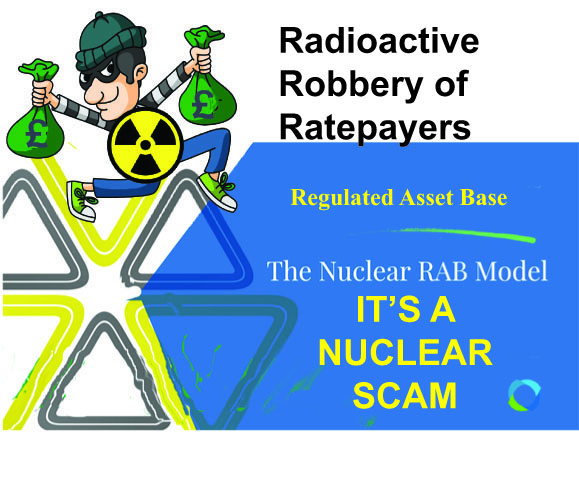
In an effort to shore up cash flows to rescue the delay-ridden Sizewell and Hinkley Point C projects, the government revealed a framework, many years in the making: The Regulated Asset Base (RAB), which would allow institutional lenders to buy into nuclear development.
But Abrdn, Aviva and Phoenix Group’s failure to get onboard adds to a growing list of major financial houses, including pension funds of BT, Natwest and Nest, to snub the project.
“The strategy has not succeeded,” said Stop Sizewell C’s executive director Alison Downes.
“It is hardly a surprise considering the many uncertainties, including what the project will actually cost and we congratulate those pension funds that have steered clear of Sizewell C’s capital raise, and urge the handful that have not decided to hotfoot it out immediately.”
The government is currently the majority shareholder and is currently investing a total of £2.5bn in financial support for the project…………………………
Sizewell is not the only major reactor project hampered by sky-rocketing costs and time delays.
Hinkley Point C, initially due to be operational in 2017 with a £18bn bill is now expected to be completed by 2031 and cost up to £35bn.
Accounting for inflation, this could potentially rise to £46bn and France’s state energy company EDF is on the hook for an £11bn impairment charge on the project. https://www.cityam.com/abrdn-and-two-more-city-giants-shun-sizewell-c-nuclear-project/
Government could still replace Fujitsu in key nuclear contract
Fujitsu’s first government contract of the year could be just a stay of execution as department says that all replacement options are still being considered.
Karl Flinders, Chief reporter and senior editor EME, 12 Apr 24 https://www.computerweekly.com/news/366580657/Government-could-still-replace-Fujitsu-in-key-nuclear-contract
Fujitsu’s controversial contract with the National Nuclear Laboratory (NNL) was renewed because there were no other suppliers that could meet the regulatory duties required, but the service could be taken in-house next year.
Following the announcement of Fujitsu’s first government contract of the year and a subsequent public backlash, the government has been quick to stress that all options to replace the supplier’s £155,000 software support contract with the NNL, including moving the service in-house, are being considered.
Reacting to criticism for awarding the contract to Fujitsu, which is under intense scrutiny over its role in the Post Office scandal, the Department for Energy Security & Net Zero outlined the reason for Fujitsu’s new deal. “NNL requires bespoke software to ensure its work remains compliant with operationally critical regulations. There are currently no other suitable suppliers and without re-awarding this contract, the NNL would be unable to fulfil its regulatory duties,” said a spokesperson.
But the department added that, “The NNL will consider all options once the contract comes to an end in March 2025, including exploring in-house solutions.
Fujitsu’s huge UK government business is under pressure following public anger at the IT giant’s role as supplier of the Horizon system at the heart of the Post Office scandal. The company has already seen a reduction in public sector contracts this year.
By April 2023, Fujitsu had signed a £25m deal with Bristol City Council, a £16m contract with the Post Office, a deal worth £13m with Northern Ireland Water, an £8m deal with the Ministry of Defence, two deals with the Department for Education totalling £3m, and a contract with Leeds City Council worth up to £100,000. This year the NNL is its sole government contract announced so far.
In another sign of possible reputational damage, earlier this month the Department for Environment, Food and Rural Affairs ended Fujitsu’s role in providing a flood warning system for the UK, two months after signing an extension of up to 12 months.
Read more about Fujitsu’s ‘hollow’ bidding pause
- Leaked comms reveal Fujitsu eyeing huge UK government bounty.
- Fujitsu staff instructed how to bid for government contracts during self-imposed ban.
- Fujitsu should stop bending rules, stop bidding and pay up, says MP.
Fujitsu’s head of Europe, Paul Patterson, promised to pause bidding for government work until after the completion of the statutory public inquiry into the Post Office scandal, following the broadcast of the ITV drama, Mr Bates vs the Post Office, at the beginning of the year.
During questioning by MPs at a business and trade select committee hearing in January, Patterson acknowledged Fujitsu’s part in the scandal, telling MPs and victims: “We were involved from the start; we did have bugs and errors in the system, and we did help the Post Office in their prosecutions of subpostmasters. For that, we are truly sorry.”
But the bidding pause, described as “hollow” by MP Kevan Jones, does not include deals with existing customers in the public sector, of which there are many. Last month, Computer Weekly revealed leaked internal communications that showed Fujitsu is still targeting about £1.3bn worth of UK government contracts over the next 12 months. Further leaked documents revealed that Fujitsu created a spreadsheet instructing staff how to get around its self-imposed ban.
Internal communications seen by Computer Weekly also revealed that Fujitsu is spending heavily on managing the current scandal fallout. It has sought external support in a project known as Holly, where it has engaged PR, ethical business experts and lawyers, at a cost of £27m so far.
The Post Office scandal was first exposed by Computer Weekly in 2009, revealing the stories of seven subpostmasters and the problems they suffered due to the accounting software (see timeline of Computer Weekly articles about the scandal below).
Fresh blow for UK nuclear as the City snubs Sizewell C

By FRANCESCA WASHTELL , 14 April 20 24, https://www.thisismoney.co.uk/money/markets/article-13304269/Fresh-blow-UK-nuclear-City-snubs-Sizewell-C.html
Britain’s flagship nuclear plant could face greater dependence on foreign cash after a string of big-name City firms snubbed a chance to fund the project.
Phoenix, Abrdn and Aviva had said they would consider supporting new nuclear plants and were thought to be in the running to back Sizewell C in Suffolk.
But all have now said they are not in negotiations to take an equity stake in the power station, according to emails sent to campaign group Stop Sizewell C and seen by The Mail on Sunday.
This is a bitter blow for Ministers, who spent years changing the funding model for giant infrastructure works to entice City investors such as Phoenix and Aviva. The model, known as the regulated asset base, enables investors to receive dividends on projects still being built.
Sizewell C has been dogged by delays for years, and the Government has still to finally decide whether it will go ahead.
A series of pension funds, including BT, NatWest, and Nest, have ruled out backing the plant, which will cost at least £20billion.
Alison Downes of Stop Sizewell C said: ‘The Government has spent years planning and legislating to allow the funding model for Sizewell C, with the objective of attracting UK pension funds. The strategy has not succeeded, which is hardly a surprise considering the many uncertainties, including what the project will actually cost.’
In January, the Government committed a further £1.3billion of funding to Sizewell C, which will go on early building work.
Six groups are in talks with the Government over funding the project, with at least one understood to be from the Emirates.
British Gas owner Centrica is also thought to be in the frame.
Pressure is mounting after EDF this year began pressing the Government to help fund cost overruns on Hinkley Point C in Somerset. The French utility group said the price tag for that plant – which is the same type planned for Sizewell C – could hit £46billion from an initial estimate of £18billion. The Suffolk plant could power six million homes for 60 years, but would take nine to 12 years to build.
Ministers have also backed programmes to set up small nuclear reactors, especially a Rolls-Royce-led firm designing these easy-to-assemble plants.
Industry sources say these are likely to be more attractive to investors as they are quicker and cheaper to build.
Sizewell C Fiasco Part 4. Much more expensive than renewables- Unknown cost or period for Investors
Sizewell C Fiasco Part 4 Much more expensive than renewables- Unknown cost or period for Investors
Sizewell C was given the go ahead against the advice of the Planning
Inspectorate by politicians who have since mainly been discredited. They do
not have the finance in place yet – a staggering £30 billion plus?
Yet the Government have been chucking hard pressed taxpayers’ money at the project
and Sizewell C Project have started massive pre-construction works. If they
can cause this much Eco/ Landscape devastation even now, what will they do
if they get the go ahead on construction?
Sizewell C would be a disaster
for the Environment and the Landscape. Taxpayers and Investors will be
financing a bottomless pit. Locked in for decades to paying much more than
the cost of wind or solar energy. Even if finished on time – which is very
unlikely – it would be far too late for any energy crisis. Which would be
caused by the current bad or lack of – planning and management for energy
production and a hopeless so-called National Grid (run for shareholders not
UK Taxpayers).
If built Sizewell C would be too late to contribute to net
zero and its construction would produce vast amounts of carbon and other
pollution for well over a decade at least. Not to mention the much more
radioactive waste from this unproven EPR type of reactor which is too hot
to move until the next century – so has to be stored on site on an eroding
coastline! The whole thing is bonkers!
Stop Sizewell C 8th April 2024 https://www.youtube.com/watch?v=o4ICw23iYY0
J.D. Vance – New York Times: The Math on Ukraine Doesn’t Add Up

The notion that we should prolong a bloody and gruesome war because it’s been good for American business is grotesque.
Mr. Zelensky’s stated goal for the war — a return to 1991 boundaries — is fantastical.
J.D.Vance, The New York Times, Fri, 12 Apr 2024 , https://www.nytimes.com/2024/04/12/opinion/jd-vance-ukraine.html
President Biden wants the world to believe that the biggest obstacle facing Ukraine is Republicans and our lack of commitment to the global community. This is wrong.
Ukraine’s challenge is not the G.O.P.; it’s math. Ukraine needs more soldiers than it can field, even with draconian conscription policies. And it needs more matériel than the United States can provide. This reality must inform any future Ukraine policy, from further congressional aid to the diplomatic course set by the president.
The Biden administration has applied increasing pressure on Republicans to pass a supplemental aid package of more than $60 billion to Ukraine. I voted against this package in the Senate and remain opposed to virtually any proposal for the United States to continue funding this war. Mr. Biden has failed to articulate even basic facts about what Ukraine needs and how this aid will change the reality on the ground.
The most fundamental question: How much does Ukraine need and how much can we actually provide? Mr. Biden suggests that a $60 billion supplemental means the difference between victory and defeat in a major war between Russia and Ukraine. That is also wrong. This $60 billion is a fraction of what it would take to turn the tide in Ukraine’s favor. But this is not just a matter of dollars. Fundamentally, we lack the capacity to manufacture the amount of weapons Ukraine needs us to supply to win the war.
Consider our ability to produce 155-millimeter artillery shells. Last year, Ukraine’s defense minister estimated that the country’s base-line requirement for these shells was over four million per year but that it could fire up to seven million if that many were available. Since the start of the conflict, the United States has gone to great lengths to ramp up production of 155-millimeter shells. We’ve roughly doubled our capacity and can now produce 360,000 per year — less than a tenth of what Ukraine says it needs. The administration’s goal is to get this to 1.2 million — 30 percent of what’s needed — by the end of 2025. This would cost the American taxpayers dearly while yielding an unpleasantly familiar result: failure abroad.
Just this week, the top American military commander in Europe argued that absent further security assistance, Russia could soon have a 10-to-1 artillery advantage over Ukraine. What didn’t gather as many headlines is that Russia’s current advantage is at least 5 to 1, even after all the money we have poured into the conflict. Neither of these ratios plausibly leads to Ukrainian victory.
Proponents of American aid to Ukraine have argued that our approach has been a boon to our own economy, creating jobs here in the factories that manufacture weapons. But our national security interests can be — and often are — separate from our economic interests.The notion that we should prolong a bloody and gruesome war because it’s been good for American business is grotesque. We can and should rebuild our industrial base without shipping its products to a foreign conflict.
The story is the same when we look at other munitions. Take the Patriot missile system — our premier air defense weapon. It’s of such importance in this war that Ukraine’s foreign minister has specifically demanded them. That’s because in March alone, Russia reportedly launched over 3,000 guided aerial bombs, 600 drones and 400 missiles at Ukraine. To fend off these attacks, the Ukrainian president, Volodymyr Zelensky, and others have indicated they need thousands of Patriot interceptors per year. The problem is this: The United States only manufactures 550 every year. If we pass the supplemental aid package currently being considered in Congress, we could potentially increase annual production to 650, but that’s still less than a third of what Ukraine requires.
These weapons are not only needed by Ukraine. If China were to set its sights on Taiwan, the Patriot missile system would be critical to its defense. In fact, the United States has promised to send Taiwan nearly $900 million worth of Patriot missiles, but delivery of those weapons and other essential resources has been severely delayed, partly because of shortages caused by the war in Ukraine.
If that sounds bad, Ukraine’s manpower situation is even worse. Here are the basics:Russia has nearly four times the population of Ukraine. Ukraine needs upward of half a million new recruits, but hundreds of thousands of fighting-age men have already fled the country. The average Ukrainian soldier is roughly 43 years old, and many soldiers have already served two years at the front with few, if any, opportunities to stop fighting. After two years of conflict, there are some villages with almost no men left. The Ukrainian military has resorted to coercing men into service, and women have staged protests to demand the return of their husbands and fathers after long years of service at the front. This newspaper reported one instance in which the Ukrainian military attempted to conscript a man with a diagnosed mental disability.
Many in Washington seem to think that hundreds of thousands of young Ukrainians have gone to war with a song in their heart and are happy to label any thought to the contrary Russian propaganda. But major newspapers on both sides of the Atlantic are reporting that the situation on the ground in Ukraine is grim.
These basic mathematical realities were true, but contestable, at the outset of the war. They were obvious and incontestable a year ago, when American leadership worked closely with Mr. Zelensky to undertake a disastrous counteroffensive. The bad news is that accepting brute reality would have been most useful last spring, before the Ukrainians launched that extremely costly and unsuccessful military campaign. The good news is that even now, a defensive strategy can work. Digging in with old-fashioned ditches, cement and land mines are what enabled Russia to weather Ukraine’s 2023 counteroffensive. Our allies in Europe could better support such a strategy, as well. While some European countries have provided considerable resources, the burden of military support has thus far fallen heaviest on the United States.
By committing to a defensive strategy, Ukraine can preserve its precious military manpower, stop the bleeding and provide time for negotiations to commence. But this would require both the American and Ukrainian leadership to accept that Mr. Zelensky’s stated goal for the war — a return to 1991 boundaries — is fantastical.
The White House has said time and again that it can’t negotiate with President Vladimir Putin of Russia. This is absurd. The Biden administration has no viable plan for the Ukrainians to win this war. The sooner Americans confront this truth, the sooner we can fix this mess and broker for peace.
Why you probably shouldn’t become a Community Interest Company
by preorg, https://preorg.org/why-you-probably-shouldnt-become-a-community-interest-company/
Imagine you have sacrificed hundreds of hours of your volunteering time to a non-profit organisation doing good work. After years of effort, often exhaustion, you discover that the directors don’t care that much about whether you succeeded in helping those people you intended to help. They care mostly about how much time they can spend at the swimming pool at their second home in Spain. Your volunteer hours have helped fund that lifestyle.
How could such a situation arise? Aren’t charities supposed to have boards of governors that keep the organisation on track? But wait, it wasn’t a charity! It was a Community Interest Company. Now, I should say that I don’t currently know of any such dramatic betrayals of people’s goodwill. But what I will argue here is that this situation arising in some CICs is bordering on inevitable, given the operating parameters of CICs. Given the weakness of regulation of the companies, almost boasted about by the CIC Regulator, it’s only a matter of time.
Why would I think that? Most people seem happy with CICs; Community Interest Companies are a success story, we are told. There are now many thousands of CICs in the UK, all having appeared within the space of ten years. This rapid rise in fact means that many people have chosen a form the long-term resilience of which has yet to be tested. It would be exciting to write an article about all the horribly failed CICs littering the social economy landscape. But I don’t know of any; I can only do a much less exciting job: pointing out what’s wrong with CICs before they start to fail. My contention is that, with the help of an FOI request to the CIC Regulator, we can see that certain types of failure are predictable. As for why we haven’t seen the failures yet, it is largely because CICs are young and in most of them the founders are still in charge.
The CIC was designed for organisations with social goals. It must operate in the ‘community interest’, which is defined in the articles of the organisation. It is also chosen over charities as an organisation that can more easily buy and sell commercially. But among the people I have asked, the main reason for opting for a CIC has been that it is easy. It is a lightweight structure, it is unencumbered by bureaucracy. It can be set up in a couple of days and can adapt quickly to changing conditions since it doesn’t have long lists of rules in its constitution. More like a standard profit-making company then, but with social objectives built in. Supposedly. More on that later.
By comparison both charities and co-operatives or community benefit societies (BenComs) have a lot more rules. Rules! How annoying! How limiting! But hang on a moment, why, if rules are so tedious, do those other organisations bother with them? The answer is that most of the rules are about accountability. In the case of a charity, the board of trustees, who must be consulted on significant matters, exist to keep the charity in line with its social aims. In co-ops and BenComs it is the membership who must constantly be consulted, and who choose who leads the organisation. Democracy certainly can be quite annoying.
By comparison a standard CIC is at the mercy of its directors, who needn’t even be many in number. That’s fine, I hear some say, I am the director, and I trust myself to make good decisions. Perhaps, but do you intend to lead the organisation forever? Even if you plan to live forever, what happens if you get ill, or leave through some other reason beyond your control? The purpose behind many accountability mechanisms is that they transcend the ideals of one particular person. They embed the ethics and goals into the DNA of the organisation, whoever may be running it at a given time. So how long do you want your organisation to last?
There is one supposed accountability mechanism in CICs: the government regulator. In theory the Office of the Regulator of Community Interest Companies has a lot of power to force CICs to stick to their aims. In practice it appears to do very little, priding itself on being a ‘light touch’ regulator. When I contacted the Regulator, they explained that in the last year they received 57 complaints, only 3 of which resulted in an intervention by the regulator. None of these 3 were related to the community benefit requirements. The Regulator has so far never wound up a CIC or stripped one of its CIC status. The Regulator has no records of intervening in a CIC on the basis of the standard paperwork submitted each year, which in part reports on the organisation’s performance under its community benefit requirement. That is to say, there appears to be no pro-active monitoring of whether CICs are operating for community benefit.
Even Social Enterprise UK, a fan of the CIC form, has raised questions over the strength of the Regulator. This accountability mechanism begins to look weak, to say the least. I’m not sure it will ever improve either. I doubt the regulator will ever be well enough funded to investigate what is going on in tens of thousands of organisations. We should not look for accountability in the CIC regulator.
Let’s move on to another question, a special case of the accountability problem: what profits can be made from a CIC, often presented as a non-profit structure? There is a CIC limited by shares that is allowed to make a profit. Previously there was a dividend cap of 20% of share value in any given year. This was considered by the government to be ‘inhibiting investment’ so in 2014 they removed the cap. Say that again? Annual 20% profits inhibiting investment?
Let’s leave that aside. In fact the majority of CICs are limited by guarantee and are more genuinely non-profit in form. There are, however, a couple of massive catches. The directors of a CIC can pay themselves whatever they can argue could reasonably be seen as necessary, as long as they are still fulfilling their social objectives. As determined by the aforementioned ‘light touch’ regulator. A CIC with a turnover of some millions a year could in theory pay the directors a million a year, if they could argue that without the salary they couldn’t retain the talent they need. Is it still a non-profit? This raises the aforementioned scenario of people putting in hundreds of volunteer hours for a supposed non-profit while the directors are buying holiday homes in the Mediterranean.
The second problem is that nobody is paying any attention to who CICs contract out work to. If a CIC pays huge ‘management fees’ or overpays on a cleaning contract to a company that happens to be owned by, say, the partner of a director, any money in the organisation can very easily be siphoned out to profit-making enterprises. In a charity the board and regulator would keep a sharp eye on this type of activity; the CIC regulator barely seems to glance at the paperwork.
You, the current director, might not abuse your position so, but can you be so sure of your successors? We only need to look at Housing Associations for a case study in organisational mission drift, in part driven by the high salaries CEOs have been able to pay themselves.
A word too on putting an informal democratic structure on top of an undemocratic CIC: I’m told that the Centre for Alternative Technology in Wales acted for years like a co-operative, and those involved assumed that’s what it was. But it never took a co-operative legal form, so when it ran into trouble, new leadership bulldozed aside the democracy people had assumed was one of the core values of the organisation. CAT is at least a charity, but the lesson is that informal structures can be dispensed with any time the CIC directors get tired of them.
But surely there must be a right situation for a CIC? Perhaps. A CIC could be right for an organisation that is mostly a trading organisation and is for a short-term project which won’t exist for long. If the project is intended to run long-term, I don’t believe the CIC is a reliable form. It is at the mercy of the leadership that follows you, if not your own leadership. The CIC Regulator is not the safety net you need. For most people it would be worth choosing an organisational type that seems more ‘difficult’ in the short term, but will almost certainly be more sustainable and accountable in the long run.
For existing successful CICs, why would they bother to change if they are doing well as they are? Let’s remember they are still young organisations. Do we want to wait twenty years to see the emergence of accountability and mission-drift problems that are, I am suggesting, rather predictable? Mission-drift that the Regulator will never pick up on unless someone reports it?
There are a few ways to mitigate the risks here. The best option for many would be to convert into a co-operative CIC. Co-ops UK offers one set of model rules for this, and the Somerset Rules can also convert a CIC into a multi-stakeholder co-op. It will cost time and money, it is true, to change the rules, but it will surely not be as painful as the organisation going off track in a few years’ time after the founders have retired.
The second best option is to add democratic rules to the CIC. It is a benefit of CICs that they are very flexible. The CIC Regulator offers model rules of a participatory organisation of large membership, though it is still very much director-controlled. It is theoretically possible to set up a more democratic membership structure without being a co-operative. While this method may miss out on embedding some of the checks and balances that co-ops have developed over the years, it could make the organisation more accountable. But remember, rules that can be added can be taken away. Only co-ops and their cousins, community benefit societies, lock democracy in permamently.
Finally, if actual democracy seems too great a task, it is at least possible to simply install more directors onto the CIC board, preferably those affected by what the organisation does, and so establish a strong democratic culture among the CIC directors. It’s not a perfect fix, but increased collective decision-making will mitigate the problems of a top-down culture reliant on the goodwill of two or three people.
For those who haven’t started their organisation yet, this is a plea to consider that a sustainable organisation is an accountable one, and democracy is one of the best ways to ensure accountability. Thankfully others, in the form of the co-operative movement, have already paved the way for us.
BUSINESS AS USUAL FOR BRITAIN’S WEAPONS EXPORTS
WEAPONS MADE ON MY DOORSTEP ARE HELPING TO KILL PEOPLE IN GAZA
British voters want to stop arming Israel, so why are spineless politicians ignoring them, asks Amy Hall.
This week, Foreign Secretary David Cameron confirmed that the UK government will not join the handful of Western countries that have stopped sending arms to Israel. Weapons exports from the UK will continue. The majority of voters are in favour of a ban and three British aid workers were among the seven killed by an Israeli air strike last week. But for Cameron and his cronies, it’s business as usual.
Britain has a long-standing commitment to arming the violence of the Israeli state and its occupation of Palestine. According to the Campaign Against the Arms Trade, Britain licensed around $556 million worth of arms to Israel between 2015 and 2022.
Those of us in Britain who are devastated and incensed by the endless death and destruction in Gaza are apparently to take reassurance from Cameron’s insistence that government ministers have ‘grave concerns around the humanitarian access issue’ there.
But these concerns appear not to be grave enough to challenge Britain’s own arms industry and its role in Israel’s ongoing genocidal campaign on Gaza. The weapons manufacturing taking place in my city assures me of that.
NO BOMBS FROM BRIGHTON’
Just a few kilometres from where I live in Brighton & Hove, on the South Coast of England, locals have set up a protest camp near to a factory that has been oiling the global war machine for many years. L3Harris makes bomb release mechanisms for F35 and F16 fighter jets, used by government armies including the Israeli Defence Forces.
Since 15 March, Brighton Peace Camp has been welcoming visitors, hosting everything from storytelling for kids to workshops on topics ranging from local antifascist history to Dabke, a Palestinian folk dance. The camp has also hosted an Iftar/Shabbat meal organized by Brighton and Hove Jews Against the Occupation.
‘We need to take every action in our power to stop the genocide in Gaza,’ said Sarah, from the group Brighton Against the Arms Trade. ‘We need to look at where the weapons are produced and disrupt the production and supply chain. L3Harris in Brighton is a critical part of that.
‘We demand a just transition towards the development of renewables, which must and can start now. Production at the factory must stop immediately and all components must be decommissioned.’
Local people have been campaigning against L3 Harris (formerly EDO MBM Technology Ltd) for decades. The company is now seeking to further solidify its mark on the city by making permanent an extension to its factory that was built in 2018. But thanks to intense opposition from local people, including some members of Parliament and city councillors, Brighton & Hove City Council (BHCC) has been under pressure not to grant planning permission. Nearly 650 objections were submitted to the application.
The local campaign against the arms factory, StopL3Harris, is asking people to call on their political representatives to join the calls to refuse the planning request. It was due before BHCC’s planning committee in March but was delayed as the Council seeks legal advice. Two out three of the city’s MPs: the Green Party’s Caroline Lucas and Labour’s Lloyd Russell-Moyle have submitted objections. The third MP, Labour representative Peter Kyle, has not.
Brighton is not the only British city where this kind of manufacturing is taking place. CAAT estimates that British industry makes 15 per cent of every F35 combat aircraft that Israel uses in its assault on Gaza. The campaign has mapped UK companies involved in manufacturing components for the F35 and estimates that the value of Britain’s supplies to be worth at least $422 million since 2016.
EXPORTS TO ISRAEL CAN BE STOPPED
In response to growing pressure, a number of countries have already stopped sending arms to Israel. ‘Denmark and Canada have both recently ruled to halt arms sales to Israel – so why not the UK?’ said Marnie, a Brighton & Hove resident who is taking part in the Peace Camp.
In February, a court of appeal in the Netherlands ordered the Dutch government to stop arms exports to Israel within the F35 programme, stating that it would violate the EU Common Rules for Arms Exports and the UN Arms Trade Treaty.
The UN welcomed the decision and called for arms exports to Israel to ‘stop immediately’, as any transfer of weapons or ammunition that would be used in Gaza is likely to violate international humanitarian law.
More than 600 lawyers have also warned the British government that arms exports to Israel risk legal violations. A senior MP for the leading Conservative party has said that the government has kept under wraps advice from its own lawyers that Israel has broken international law.
Too many of our elected representatives seem to be living in a parallel universe, dismissive of international law and apparently unperturbed by the suffering of the Palestinian people. Yet those of us who support a weapons ban, continue to watch in horror the endless stream of videos of crying children carrying their dead siblings, images of skeletal children starved to death, and the massacres of civilians and aid workers in the simple act of delivering food.
Cameron should be more than ‘concerned’ about the six children killed each day during the current offensive in Gaza. If our politicians were serious about the humanitarian situation, our politicians would be pushing for an immediate and permanent ceasefire, an end to the blockade of the Gaza strip, and an end to Israel’s occupation of Palestine.
Until then, as the money keeps flowing and the bombs keep dropping, we will continue to march, boycott, protest, donate, camp and cry until Palestine is free.
Hinkley Point C joins Community Interest Company “Passion for Somerset”

MNR Journal, By Jacob Manuschka, AI Assisted Reporter, 11th April
A NUCLEAR power station that will provide zero-carbon electricity has joined a not-for-profit Somerset organisation as a principal partner.
Hinkley Point C, the first in a new generation of nuclear power stations providing electricity for around six million homes, has teamed up with Passion for Somerset.
Passion for Somerset is a not-for-profit Community Interest Company that works with individuals, communities and businesses throughout the county.
Stacy Walker, Hinkley Point C stakeholder relations manager, said: “Britain’s new nuclear power station at Hinkley Point C has seen another year of incredible engineering from under the seabed to the top of the world’s largest land-based crane, Big Carl………………………………… https://www.bridgwatermercury.co.uk/news/24246032.hinkley-point-c-joins-passion-somerset-organisation/
Rolls Royce misses out on government funding for their small nuclear reactors
Rolls-Royce Holdings PLC shares faced a blow as X-energy and Cavendish
Nuclear were awarded £3.34 million from the government to build
mini-nuclear reactors in Hartlepool. These funds will aid X-energy and
Babcock International PLC owned Cavendish’s plans to build 12 mini nuclear
generators, known as small modular reactors, in the County Durham town by
the early 2030s.
Proactive Investor 5th April 2024
1 This Month

of the week – Shut Down Drone Warfare!


Tell the Ukrainian Government to Drop Prosecution of Peace Activist Yurii Sheliazhenko

Petition to revoke the licensing of the Near Surface Nuclear Disposal Facility (NSDF) at Chalk River. https://www.ourcommons.ca/petitions/en/Petition/Details?Petition=e-7247
To see nuclear-related stories in greater depth and intensity – go to https://nuclearinformation.wordpress.com
-
Archives
- April 2026 (103)
- March 2026 (251)
- February 2026 (268)
- January 2026 (308)
- December 2025 (358)
- November 2025 (359)
- October 2025 (376)
- September 2025 (257)
- August 2025 (319)
- July 2025 (230)
- June 2025 (348)
- May 2025 (261)
-
Categories
- 1
- 1 NUCLEAR ISSUES
- business and costs
- climate change
- culture and arts
- ENERGY
- environment
- health
- history
- indigenous issues
- Legal
- marketing of nuclear
- media
- opposition to nuclear
- PERSONAL STORIES
- politics
- politics international
- Religion and ethics
- safety
- secrets,lies and civil liberties
- spinbuster
- technology
- Uranium
- wastes
- weapons and war
- Women
- 2 WORLD
- ACTION
- AFRICA
- Atrocities
- AUSTRALIA
- Christina's notes
- Christina's themes
- culture and arts
- Events
- Fuk 2022
- Fuk 2023
- Fukushima 2017
- Fukushima 2018
- fukushima 2019
- Fukushima 2020
- Fukushima 2021
- general
- global warming
- Humour (God we need it)
- Nuclear
- RARE EARTHS
- Reference
- resources – print
- Resources -audiovicual
- Weekly Newsletter
- World
- World Nuclear
- YouTube
-
RSS
Entries RSS
Comments RSS
 nuclear-news