Problems of foreign ownership hamper USA’s nuclear power expansion
Nuclear expansion review halted over foreign ownership worries Chron.com, By TRACY IDELL HAMILTON, December 14, 2011 The Nuclear Regulatory Commission has suspended its review of the foreign ownership portion of the application to expand the South Texas Project nuclear plant over concerns that the owners haven’t done enough to ensure domestic control of the plant.
Toshiba Corp., based in Japan, could obtain an 85 percent ownership stake in the two nuclear plants proposed for the site outside of Bay City, the NRC found, meaning the company could have “the power to exercise ownership, control or domination over NINA,” or Nuclear
Innovation North America.
NINA is a partnership between Toshiba and NRG Energy, which shares ownership of STP’s existing nuclear plants with CPS Energy and Austin Energy…..
The commission asked NRG for more information on its “foreign ownership Negation Action Plan,” in late summer and fall, but that information appears to be insufficient…..http://www.chron.com/business/article/Nuclear-expansion-review-halted-over-foreign-2403395.php
Shrinking nuclear and uranium markets add to AREVA’s woes
 The company has lost contracts worth hundreds of millions of euros….The company says its earnings will be
hit by a reduction in the number of new reactors being built, which will also depress the price of uranium…
.. the market is now shrinking. Areva said it expects to make an operating loss of between 1.4 and 1.6 billion euros (1.9 and 2.1 billion dollars) in 2011 mainly due to the depreciation of African mining assets…..
all activities in Namibia are to be suspended….
 Fukushima hits French nuclear giant hard, Monsters and Critics, By Ralf E Krueger Dec 13, 2011“……….Areva’s new chief executive Luc Oursel announced the suspension of a planned nuclear enrichment plant project in Idaho in the United States, as well as several projects in Africa. Areva has also suspended plans to expand capacity at its reprocessing plant in La Hague, northern France. Continue reading
Security breaches, costs, politics – France’s nuclear industry in trouble
 activists remained inside the Cruas site for 14 hours before being caught
Electricite de France (EDF) shares have slumped (EDF) 37 percent since the Fukushima disaster, on concern about the amount of investment needed to keep French reactors running safely in the coming years.
At the same time, the opposition Socialist and Green parties are campaigning to close 24 reactors by 2025 to cut dependence on atomic power.
France’s Biggest Nuclear Breach Raises Alarm as Support for Reactors Wanes Bloomberg By Tara Patel – Dec 13, 2011 Just after 6 a.m. on Dec. 5,under cover of darkness, nine Greenpeace activists cut through a fence at the Nogent-sur-Seine atomic plant 95 kilometers (59 miles) southeast of Paris and headed for a domed reactor building.
They scaled the roof and unfurled a “Safe Nuclear Doesn’t Exist” banner before attracting the attention of security guards. Two remained at large for four hours.
On the same day, two more campaigners breached the perimeter of the Cruas-Meysse plant on the Rhone, escaping detection for more than 14 hours while posting videos of their sit-in on the Internet. Continue reading
USA nuclear industry – delays, shut downs, security problems
Nuclear uncertainty High Country News, Marian Lyman Kirst, 13 Dec 11, The American nuclear industry had some serious shade thrown its way in the wake of Japan’s Fukushima Daiichi power plant disaster. Almost a year later, U.S. nuclear still can’t seem to catch a break. On Wednesday, Gregory Jaczko, the chairman of the Nuclear Regulatory Commission, announced that the agency will likely face delays in renewing licenses for 14 existing nuclear reactors as well as its review of license applications for the construction of two new reactors, the first such applications in more than 30 years.
Workers at nuclear plants in Ohio and Nebraska were exposed to higher than expected radiation levels, Jaczko said, while three other plants were shut down for months because of safety concerns — the first time in more than decade that several plants have been shut down at the same time.
From The Associated Press:The Crystal River nuclear plant in Florida and Fort Calhoun in Nebraska remain shut down, while the earthquake-damaged North Anna plant in Virginia reopened last month after being shut down for three months.
Jaczko is particularly concerned about the ability of plants, old and new, to deal with natural disaster-caused blackouts like the tsunami triggered flooding that led to meltdowns in the Fukushima reactors….
Another blow to AREVA in poor outlook for uranium mine
UraMin deal was a wager on new power stations Financial Times, By David Blackwell, 14 Dec11“…..Areva’s purchase of UraMin was a long-term bet that power stations would be built around the world to meet concerns about energy security and climate change – as new reactors typically require a lot more uranium than those that have been in operation for some time.
Even before this year’s Fukushima disaster in Japan, Areva’s willingness to pay such a premium was in question as the price of unenriched “yellow-cake” uranium fell to $70 a pound, from $138 a pound around the time of the acquisition.
Since Fukushima, the price has fallen even further to about $50 a pound. Coupled with Monday’s announcement that deposits at UraMin’s mines were far smaller than expected, Areva has taken a hit – both to its balance sheet and to a mining business that accounted for 40 percent of its capital spending between 2007 and
2011….http://www.ft.com/cms/s/0/6506add8-2592-11e1-9cb0-00144feabdc0.html#axzz1gWdl0WlU
France’s nuclear corporation AREVA facing big losses
 Areva was already facing problems before that incident. Its Olkiluoto nuclear project in Finland was delayed and uranium mines it bought in 2007 were performing below expectations.
The Socialist presidential candidate has promised to shut almost half os France’s nuclear reactors if he is elected. Last week demonstrators protested outside Areva’s headquarters in Paris ahead of this week’s meeting.
France nuclear giant to announce big loss – minister France’s state-owned nuclear reactor maker Areva is set to announce large losses, the French industry minister says.BBC News 11 December 2011 In an interview with a radio station, Eric Besson said: “I can confirm that Areva will announce losses. In all likelihood they will be big.” Continue reading
Nuclear industry facing total collapse, or at best, slow decline
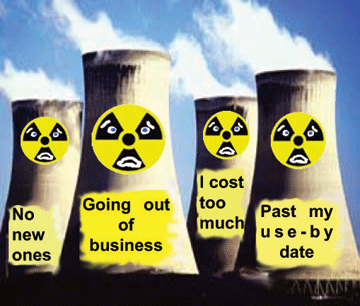 Fukushima fallout slows nuclear industry, Sky News, December 11, 2011 “……Anxious to restore public faith in nuclear plants, officials travelled the world testing power stations and delaying numerous projects.
Japan switched off several reactors for tests, leaving only nine reactors up and running. Results won’t be known until next year, but it’s certain that safety margins will need to be improved, forcing nuclear power to become more expensive and less competitive.
Fukushima was the world’s third large-scale nuclear disaster, after Three Mile Island in 1979 and Chernobyl in 1986. It’s not clear how giants in the nuclear industry — GE-Hitachi, Toshiba-Westinghouse, Russia’s Rosatom and France’s Areva — will react to the crisis.
Experts are torn over whether the industry faces total collapse, a more modest decline, or diminished growth.
One scenario from the International Atomic Energy Agency is the cancellation of 50 per cent of new projects, no new construction in developed countries and a 15 per cent reduction in the number of existing power stations…
Secrecy over poor conditions and pay for Fukushima cleanup workers

 While the radiation at Fukushima continues to leak out, the same can’t be said about information regarding working conditions at the plant.
Fukushima secrecy over workers and conditions ABC Radio A.M.  Mark Willacy reported this story on Wednesday, December 7, 2011 TONY EASTLEY: Still in Japan and the ABC has obtained documents revealing the lengths being taken to keep work at the crippled Fukushima nuclear plant secret and to stop workers there from actually talking to the media. Continue reading
Nuclear energy production and consumption grinding down worldwide
Much of the decline in installed capacity is the result of halted reactor construction around the world. ….. these numbers can hardly encourage the industry,” said Worldwatch President Robert Engelman.”The high cost of nuclear electricity generation and the widespread public perceptions that it poses unacceptable safety risks make it unlikely this form of power will help slow human-caused climate change or offer an attractive alternative to rising fossil-fuel prices any
time soon.”….
Global Nuclear Generation Capacity Falls E News Park Forest 06 DECEMBER 2011 New analysis indicates countries are turning to other energy sources as a result of high costs, low demand, and recent disasters. WASHINGTON–. Due to increasing costs of production, a slowed demand for electricity, and fresh memories of disaster in Japan, production of nuclear power fell in 2011, according to the latest Vital Signs Online (VSO) report from the Worldwatch Institute (www.Worldwatch.org).
…… global installed nuclear capacity—-the potential power generation from all existing plants—-declined to 366.5 gigawatts (GW) in 2011, from 375.5 GW at the end of 2010.
Not surprisingly, this drop in installed capacity corresponds with a decline in global consumption of nuclear energy. Continue reading
Georgia’s utility customers will pay up for delays in nuclear plant project
 Since Southern Co. subsidiary Georgia Power is a regulated utility, its 2.4 million customers must pay for the project and could be on the hook for reimbursing the company for cost overruns.
The project is being built using borrowed money, so construction delays might increase financing costs and ultimately raise the pricetag for utility customers.
Federal officials have not yet given the project key approvals
necessary to start major construction work,
Watchdog says Southern nuclear plant faces delays Bloomberg, By RAY HENRY, 7 Dec 11 The Southern Co. continues to face “significant challenges” building the country’s first brand-new nuclear plant on time and without exceeding its share of the roughly $6 billion budget, a state watchdog said in a report released Monday. Continue reading
Uranium term prices going down
|
|
show details 5:57 PM (23 hours ago)
|
Uranium Term Prices SlipFN Arena News – 6 Dec 11 Industry consultant TradeTech closed out its spot price indicator for November month-end at US$51.50/lb, down US25c from end-October. …
|
http://www.fnarena.com/index2.cfm?type=dsp_newsitem&n=0AEAA152-E77F-D8D8-A68F8FD0269D888A
Japan’s second rate contract workers cop the brunt of nuclear radiation
 contractors last year accounted for 96% of the harmful radiation absorbed by workers at the nation’s nuclear power plants. Temporary workers at the Fukushima plant in 2010 also faced radiation levels 16 times higher than did employees of the plant’s owner-operator, Tokyo Electric Power Co., because contractors are called in for the most dangerous work,
Japan’s ‘nuclear gypsies’ face radioactive peril at power plants Unskilled contractors make up most of the workforce and face higher doses of radiation than utility employees at Fukushima and other nuclear power plants in Japan. By John M. Glionna, Los Angeles Times December 4, 2011
Japan’s provinces lose international students, with radiation fears
Trainees steer clear of Tohoku / Radiation fears apparently behind sharp drop in foreign interns, The Yomiuri Shimbun, 5 Dec 11 The number of foreign trainees in the disaster-affected prefectures of Iwate, Miyagi and Fukushima has nearly halved since the March 11 disaster, with many apparently afraid to return to the Tohoku region due to radiation fears. Continue reading
Britain’s nuclear power program delayed even further
 The Coalition’s plans for building eight to 10 nuclear plants over the next decade were described last week as “simply lacking credibility” by peers in the House of Lords.
EDF Energy, the company building the first plant, has refused to give a “firm and final completion date” for nuclear power.
 Setback to nuclear power plans Britain’s plans for a new generation of nuclear power stations have suffered another setback after being delayed by at least a year. By Rowena Mason, Political Correspondent TELEGRAPH 02 Dec 2011 The first of the new plants will not be built until 2019 because of extra safety checks following Japan’s atomic disaster.
Ministers originally hoped to get the first nuclear power station built by 2017, before revising this to 2018. Now there has been a further slippage, after an updated timetable showed the first station in Somerset is not expected until nearer the end of the decade.. Continue reading
For USA’s nuclear industry – could things get any worse?
 Nuclear’s Annus Horribilis, AOL, Margaret Ryan, November 30, 2011 For the nuclear industry, 2011 was Biblical. Earthquakes. Tsunamis. Tornadoes. Floods. Fires. 2011 had everything but plagues of locusts.
Since 2001, nuclear critics had been worried about airplanes smashing into plants or dirty bombs. This year nature reminded everyone it can still throw a haymaker, and the reverberations from 2011’s onslaught appear set to dominate US nuclear power in 2011
March 2011 brought the 9.0 magnitude earthquake off northeastern Japan that sparked a tsunami whose waves may have exceeded 45 feet. Tokyo Electric Power Company’s oldest nuclear station, Fukushima Daiichi, apparently survived the earthquake, but its four oldest reactors didn’t survive that wall of water. Nuclear experts are still figuring out what all went wrong, and tens of thousands still haven’t returned home as Japanese authorities try to decontaminate radioactive hot spots.
In April, massive tornadoes that devastated the southeast swept near the Tennessee Valley Authority’s Browns Ferry plant.
In June, droughts sparked wildfires across the Southwest, including one that threatened the Los Alamos National Laboratory, where nuclear weapons materials are stored.
June also brought record floods across the upper Midwest. For weeks Omaha Public Power District’s Fort Calhoun nuclear plant was essentially an island.
August saw the 5.8 magnitude Virginia earthquake just 11 miles from Dominion Energy’s North Anna plant. The plant shut safely, and returned to service mid-November after extensive checks found no damage even though ground motion briefly exceeded the plant’s design.
Aging Generation Giants All these challenges resurrected questions about the robustness of America’s nuclear fleet as reactors begin to pass the 40-year mark. That was once considered the operating limit, but with safety backfits, regular material checks and planned component replacements, the Nuclear Regulatory Commission says reactors can operate for 60 years. More than half of the 104 reactors in the US have been licensed to do so…..
“most” people in the industry recognize the need to take 2011’s warnings seriously. “They don’t want to be the next Fukushima,”….. “No one wants to lose a billion dollar asset.”….
1 This Month





PLEASE OPPOSE HR 8255 AND S.3639 – bills would accelerate satellite deployment, with no environmental review or safeguards – https://ncstd5li.quorum.us/campaign/169331/
To see nuclear-related stories in greater depth and intensity – go to https://nuclearinformation.wordpress.com
-
Archives
- October 2026 (29)
- September 2026 (339)
- August 2026 (330)
- July 2026 (355)
- June 2026 (287)
- May 2026 (306)
- April 2026 (356)
- March 2026 (251)
- February 2026 (267)
- January 2026 (308)
- December 2025 (358)
- November 2025 (359)
-
Categories
- 1
- 1 NUCLEAR ISSUES
- business and costs
- climate change
- culture and arts
- ENERGY
- environment
- health
- history
- indigenous issues
- Legal
- marketing of nuclear
- media
- opposition to nuclear
- PERSONAL STORIES
- politics
- politics international
- Religion and ethics
- safety
- secrets,lies and civil liberties
- spinbuster
- technology
- Uranium
- wastes
- weapons and war
- Women
- 2 WORLD
- ACTION
- AFRICA
- Atrocities
- AUSTRALIA
- Christina's notes
- Christina's themes
- culture and arts
- Events
- Fuk 2022
- Fuk 2023
- Fukushima 2017
- Fukushima 2018
- fukushima 2019
- Fukushima 2020
- Fukushima 2021
- general
- global warming
- Humour (God we need it)
- Nuclear
- RARE EARTHS
- Reference
- resources – print
- Resources -audiovicual
- Weekly Newsletter
- World
- World Nuclear
- YouTube
-
RSS
Entries RSS
Comments RSS

