Does USA even need the super-expensive new uranium processing facility ?
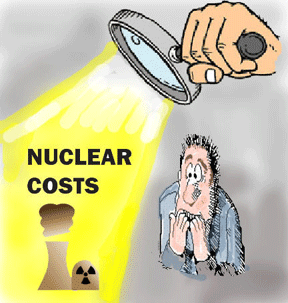
 Costs for new nuclear facility skyrocket as critics question its creation By Barnini Chakraborty October 04, 2013 FoxNews.com WASHINGTON – Plans for a new facility that will handle, dismantle and secure nuclear material are in a major meltdown.
The price tag attached to the country’s largest uranium processing facility under the direction of the Department of Energy has climbed to more than 19 times its original estimate. What’s worse is that much of the Tennessee complex, according to the government’s own calculations, isn’t needed and the rest will most likely be outdated when the facility becomes fully operational — two decades from now. Continue reading
Nuclear marketing: now USA is selling nuclear technology to China
 Chicago Bridge to Build China’s Nuclear Plant by Zacks Equity Research October 04, 2013 “……Chicago Bridge announced on Oct 1 that it has agreed with CPI’s Power Engineering Company, (a subsidiary of China Power Investment Corporation) to form a joint venture to construct nuclear power plants in China…..According to the agreement, Chicago Bridge is required to provide engineering, procurement, construction management, commissioning, project management and technical support services for the nuclear plants that are to be constructed.
China Power Investment Corporation is China’s biggest power generation company, which owns one of the three nuclear power plants in China. These power plants are planned and funded by the China Power Investment Corporation. ….http://www.zacks.com/stock/news/110904/chicago-bridge-to-build-chinas-nuclear-plant
For business and investment, you can forget nuclear power
 In 5 Charts, Here’s Why Nuclear Energy Is Going Nowhere BUSINESS INSIDER 3 Oct 13, AT LEAST FIVE U.S. NUCLEAR PLANTS HAVE BEEN SHUTTERED THIS YEAR, THE RESULT OF RUNAWAY EXPENSES AND AN INABILITY TO COMPETE WITH CHEAP NATURAL GAS PRODUCED BY THE SHALE BOOM.
So you may not need more reason to think nuclear is going nowhere.
But here are five more charts, via a Citi team led by Jason Channell, showing that nuclear is not only on the wane in America, but also around the world.
Nuclear now requires an up-front investment 5x greater than gas on a per Watt basis.
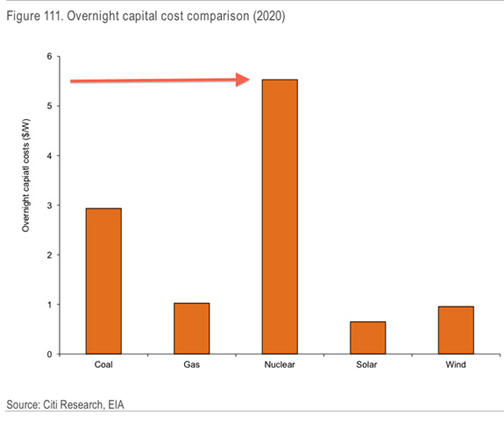
Capital costs comparison….
Operational costs comparison….
Nuclear investment already trailing solar….
Demand for renewables greater than for nuclear….
New power generation capacity in China …. And here’s team Citi’s take on why all this is so.
The capital cost of nuclear build has actually risen in recent decades in some developed markets, partly due to increased safety expenditure, and due to smaller construction programmes (i.e. lower economies of scale). Moreover the ‘fixed cost’ nature of nuclear generation in combination with its relatively high price (when back end liabilities are taken into account) also places the technology at a significant disadvantage; utilities are reluctant to enter into a very long term (20+ years of operation, and decades of aftercare provisioning) investment with almost no control over costs post commissioning, with the uncertainty and rates of change currently occurring in the energy mix. As an example, one need only look at the ongoing debate in the UK over the next generation of nuclear build, and the reluctance of most parties to commit.
A good run, but time to step aside. http://www.businessinsider.com.au/5-charts-that-show-nuclear-is-declining-2013-10
Uranium company Paladin downgraded by investment analysts
Translating business language – “outperform” – means good to invest. “Sector Perform” mean s not so good
Outperform. The stock’s total return is projected to exceed the average return of the industry (or its sector or its peers). This means the stock will perform better than the competition and is likely rated a “Buy”.
Sector Perform). The stock is expected to perform in line with the average return of the market or sector or its peers. Similar to a “Hold” or a “Neutral” rating.
Paladin Energy Limited Downgraded to Sector Perform at RBC Capital (PDN) North fork vue.com October 2nd, 2013 Paladin Energy Limited (ASX:PDN) was downgraded by investment analysts at RBC Capital from an “outperform” rating to a “sector perform” rating in a note issued to investors on Wednesday, American Banking News reports. They currently have a A$0.80 ($0.75) price target on the stock……..
A number of other analysts have also recently weighed in on PDN. Analysts at TD Securities cut their price target on shares of Paladin Energy Limited (ASX:PDN) from A$0.90 ($0.84) to A$0.65 ($0.61) in a research note to investors on Friday, August 30th. They now have a “hold” rating on the stock. Separately, analysts at BMO Capital Markets cut their price target on shares of Paladin Energy Limited (ASX:PDN) from A$0.80 ($0.75) to A$0.60 ($0.56) in a research note to investors on Friday, August 30th. Finally, analysts at Raymond James downgraded shares of Paladin Energy Limited (ASX:PDN) from an “outperform” rating to a “market perform” rating in a research note to investors on Monday, August 5th. Three equities research analysts have rated the stock with a hold rating and one has issued a buy rating to the stock. The stock presently has an average rating of “Hold” and a consensus price target of A$0.96 ($0.90).
Paladin Energy Ltd (ASX:PDN) is a uranium production company with projects in Australia and two operating mines in Africa. http://www.northforkvue.com/finance/10712/paladin-energy-limited-downgraded-to-sector-perform-at-rbc-capital-pdn/
Cripplingly low uranium price forces Paladin to cut costs
Paladin cuts top-echelon base salaries, overall spending amid low uranium price TIMES COLONIST OCTOBER 2, 2013 PERTH, Australia – Paladin Energy Ltd (TSX:PDN) is cutting the base salaries of its board and management by 10 per cent as part of cost-saving measures due to low spot prices for uranium — its main commodity.
In total, the miner — which lists its shares on the Toronto and Australian stock markets — is aiming to reduce cash costs for its 2014 financial year by US$23 million.
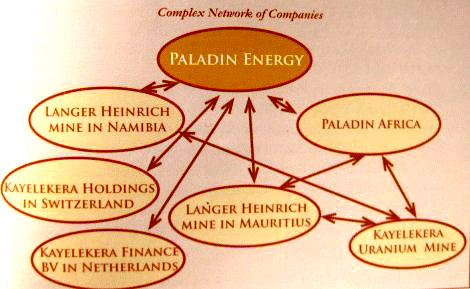
The cuts include a $10.8-million reduction in spending on overhead and exploration and a US$12.4-million reduction in discretionary capital spending at two mines in southern Africa….The Langer Heinrich mine in central Namibia will see its capital spending cut by US$10 million compared with the 2013 financial year while a further $2 million will be cut from the capital budget for the Kayelekera mine in Malawi. http://www.timescolonist.com/business/paladin-cuts-top-echelon-base-salaries-overall-spending-amid-low-uranium-price-1.645930
Japanese firm very keen to sell nuclear technology to Britain
 Toshiba wants majority stake in British nuclear consortium: CEO By Sophie Knight and Maki Shiraki TOKYO | Thu Oct 3, 2013
(Reuters) – Toshiba Corp wants a majority stake in British nuclear consortium NuGen and aims to decide on the matter before the end of the year, its chief executive said, as it seeks its first order for a nuclear reactor since the Fukushima crisis in 2011.
Hisao Tanaka told Reuters in an interview on Thursday that the company was confident about securing orders for 29 new nuclear reactors by March 2018 and that he sensed post-Fukushima anti-nuclear sentiment had begun to thaw……http://uk.reuters.com/article/2013/10/03/us-toshiba-nuclear-idUKBRE99204I20131003
Financial meltdown facing Central New York nuclear plants
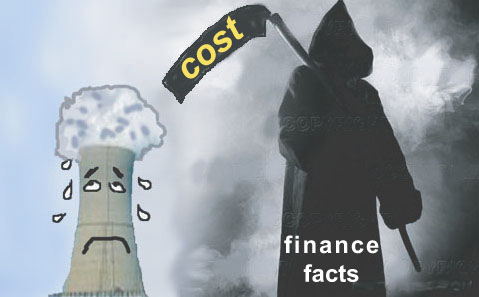 Central New York nuclear plants struggle to avoid financial meltdown Syracuse.com, By Tim Knauss | tknauss@syracuse.com September 29, 2013 SCRIBA, N.Y. – As recently as four years ago, nuclear power companies were planning to spend billions of dollars to build a new reactor in Oswego County, alongside three existing nuclear plants.
Then the bottom fell out. Natural gas-burning power plants that benefit from a glut of cheap gas produced by hydrofracking cut wholesale electricity prices in half.
Now the outlook for nuclear power plants is so bleak that Wall Street analysts say one or more Upstate nuclear plants could go out of business if conditions don’t change.
Two Upstate nukes in particular – the James A. FitzPatrick Nuclear Power Plant in Oswego County and the R.E. Ginna Nuclear Power Plant in nearby Wayne County – are high on the watch list of plants that industry experts say are at risk of closing for economic reasons……Nuclear critics and industry supporters finally agree on something: Nuclear power, the bedrock of Oswego County’s economy and the biggest source of electricity in Central New York, faces a financial crisis…….
“We should expect more early (plant) retirements,” nuclear critic Mark Cooper, senior fellow at the Institute for Energy and the Environment at Vermont Law School, wrote in a July report. “Rising costs of an aging fleet and the availability of lower cost alternatives are likely to persist over the next couple of decades.”
Across the country, four nukes have shut down this year — the first plant retirements in 15 years — and a fifth announced it will close next year……
The fragile finances of nuclear power have provided new ammunition to anti-nuclear groups. In March, prior to the announcement of Vermont Yankee’s shutdown, a coalition of four groups petitioned the NRC to suspend Entergy’s license to operate FitzPatrick and Vermont Yankee arguing that the plants produce insufficient revenue to maintain and operate the reactors safely. Entergy has not yet responded to the petition…….http://www.syracuse.com/news/index.ssf/2013/09/oswego_county_nuclear_plants_struggle_to_avoid_financial_meltdown.html
Cut subsidies to fossil fuel industries – says International Monetary Fund
 IMF: The Murky Cobweb Of Energy Subsidies http://www.energymatters.com.au/index.php?main_page=news_article&article_id=3961 29 Sept 13 Solar power subsidies are a drop in the bucket compared to the gravy train the fossil fuel sector still rides. The International Monetary Fund has pledged to “shine a light on the murky cobweb of energy subsidies”.
In an address to the UN High-Level Forum on Sustainable Development; IMF Managing Director Christine Lagarde spoke of a triple challenge facing the planet – economic instability, environmental damage and insufficient equity. ”We cannot view these in isolation. Each feeds on and magnifies the other,” she said.
 Ms. Largarde stated energy subsidies, including tax subsidies, came to almost $2 trillion in 2011; “a whopping 2½ percent of global GDP that could have been used more wisely.”
Even US President Barack Obama has recognised enough is enough. Earlier this year, he proposed billions more be invested in renewable energy and the elimination of $4 billion in fossil fuel subsidies in his 2014 budget proposal.
In recent years the International Energy Agency (IEA) has also repeatedly called for a winding back of fossil fuel subsidies, which are at times obscured from public view. “Governments need to stop hiding their handouts to oil, gas and coal and come clean,” says the IEA.
Renewable energy subsidies are the relatively new kid on the block, as is the industry itself – and it’s not unusual for fledgling sectors to require a helping hand. However, the fossil fuel sector has been around for well over a century, has been hugely profitable for much of the time; yet has had its snout firmly planted in the public trough for decades – and still does today.
While renewables such as solar power have still flourished on an uneven playing field; with fossil fuel subsidisation wound back and the support diverted to renewable energy, a cheap yet clean energy future will arrive even faster.
Even Eskom admits nuclear power is by far South Africa’s most expensive energy option
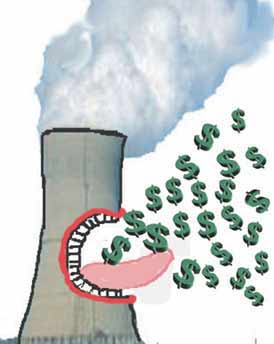 The intended nuclear plan would be “very costly” and if anything went wrong it would have a devastating impact on people and the environment
Doubts over nuclear costs Business Report (South Africa) September 29 2013 By Donwald Pressly. REUTERS The Government is forging ahead with its nuclear build programme to boost the electricity supply although details of its costings are scant, but Eskom’s own figures indicate it will be the most expensive option.
In the wake of an announcement on Thursday by Energy Minister Ben Martins that a  detailed costing and the extent of the nuclear programme would be made known before the end of the financial year, a range of organisations have come out against the government’s stance in favour of extending South Africa’s nuclear power footprint beyond Koeberg…….
.While Eskom has not provided recent build programme cost estimates, it did provide comparative figures in its third multiyear price determination application to Nersa of gas, coal, wind, solar and concentrated solar power (CSP). Nuclear ended up being the most expensive by far. Continue reading
TEPCO applies to restart Kashiwazaki Kariwa nuclear plant
Mr Izumida, a strident critic of TEPCO, said he was allowing the utility to apply for safety approval, but withholding final judgment on restarting the plant.
“Kashiwazaki Kariwa nuclear power plant may be halted, but it is a living facility, and safety must be ensured at the plant,” he said in a statement.
He had previously denounced TEPCO as unfit to run a nuclear plant and has called for the company’s liquidation.

 Fukushima operator TEPCO seeks restart of Japan’s Kashiwazaki Kariwa nuclear plant http://www.abc.net.au/news/2013-09-27/fukushima-operator-seeks-reactor-restart/4985444 27 Sept 13 TEPCO has applied to restart a nuclear plant in north-western Japan, an initial step on its planned recovery from the Fukushima nuclear disaster.
But final approval to resume power generation at the Kashiwazaki Kariwa facility, the world’s largest nuclear plant, 300 kilometres north west of Tokyo, is uncertain and any decision would take many months at best. Continue reading
Financially no chance for a nuclear power plant in Utah
 Expert calls proposed Utah nuclear power plant a ‘non-starter’ Trial » Energy analyst says Blue Castle lacks financing, market for proposed Utah project. By Brian Maffly The Salt Lake Tribune Sep 26 2013 Lacking sufficient financing and a real market, Blue Castle Holdings has no hope of developing a nuclear power plant in Utah, according to an energy analyst who testified Thursday in a trial over the project’s water rights.
“You can’t sell 14-cent power in a market where power costs 8 or 10 cents [per kilowatt-hour]. That’s why the nuclear renaissance has collapsed. If you can’t compete, you can’t raise money to build these projects,” said Mark Cooper in an interview, echoing his testimony in Price’s 7th District Court……..
The week-long trial before Judge George Harmond focuses on whether the state appropriately assigned 53,000 acre feet of water to the Blue Castle project. Closing arguments are scheduled Friday, but Harmond is not expected to rule right away…….
The suit, brought by Utah environmental groups and local water users, attacks the only issue in the nuclear controversy where the state exercises control. Should Blue Castle secure the right to suck enough water out of the Green River to supply a city the size of Orem, its proposal will rest entirely in the hands of the U.S. Nuclear Regulatory Commission (NRC).
To secure a water right, state law requires a finding that the proposed purpose is economically and physically feasible, is in the public interest, and financing is available. Blue Castle fails on all these points, according to Cooper, a fellow for economic analysis in the Institute for Energy and the Environment at Vermont Law School…….”The only states where [nuclear reactors] are being built is in states where the risk has been shifted to the ratepayers,” Cooper said. http://www.sltrib.com/sltrib/politics/56920646-90/nuclear-blue-castle-project.html.csp
Windcentrale’s success in crowdfunding wind energy
Crowdfunding for Wind Energy Sets New World Record http://theenergycollective.com/claretaylor/279926/crowdfunding-wind-energy-sets-new-world-record Clare Taylor September 26, 2013 This week 1700 Dutch households raised EUR 1.3 million in just thirteen hours to buy shares in a wind turbine – setting a new world record for crowdfunding. For the next 12 years, these households will receive their own sustainable energy from the cooperatively owned turbine. With electricity costs set to rise, the ‘wind-sharers’ will benefit from big annual savings – by anticipating and managing energyneeds. Facilitated by Dutch company WindCentrale, the wind shares were sold for EUR 200 each and households bought single shares or blocks of shares. Each share corresponds to approximately 500kWh of electricity per year (the annual average household consumption in the Netherlands is 3500kWh).
Harm Reitsma, founder of Windcentrale, comments: ‘We expected things would move fast, but nobody anticipated the run on the wind-shares that happened yesterday evening. An increasing number of people want to generate their own electricity. Solar panels aren’t always an option and so wind-shares in a remote wind turbine gives everyone the chance to take matters into their own hands and generate their own clean electricity. As a result, interest in our wind-shares has been huge, and continues to rise. A good example of Power To The People!’
Windcentrale was founded in 2010, setting up cooperatives to help accelerate the switch to sustainable energy in the Netherlands. The wind-sharers jointly own the wind turbine, and a dedicated smartphone App allows every owner to see wind speeds and electricity production levels ‘real time’.
Explicitly linking patterns of energy consumption and renewable energy production is also highlighted inEnergizAIR, an Intelligent Energy-Europe project aimed at setting up a renewable energy weather forecast covering real-time production indicators for PV, solar thermal and wind turbines.
Irish start-up EnergyElephant uses a ‘e-traffic light’ system to let users know when there is a lot of renewable energy being generated. Founder Joe Borza sees this as a way to enable consumer choice in reducing household’s carbon footprint, tweeting last week ‘What a day for Irish wind energy! 40% for most of this afternoon!!!’ Time to ‘make hay while the sun shines’, and the wind blows…
Uncertain future for Japan’s nuclear industry affects Cameco’s grading
Bank of America Downgrades Cameco on Lower Uranium Forecast Dwight Einhorn, Benzinga Staff Writer 27 Sept 13, In a report published Friday, Bank of America analyst Oscar Cabrera downgraded the rating on Cameco Corporation (NYSE: CCJ [FREE Stock Trend Analysis]) from Buy to Neutral, and lowered the price target from $25.00 to $22.00.
In the report, Bank of America noted, “We are downgrading Cameco (CCO) to a Neutral from Buy rating, and lowering our price objective (PO) to $22/share from $25, following our commodities team downgrade of our 2013-15 uranium price forecast due to slower than expected Japanese reactor restarts after the country’s nuclear accident at Fukushima in March 2011……. http://www.benzinga.com/analyst-ratings/analyst-color/13/09/3947890/update-bank-of-america-downgrades-cameco-on-lower-uraniu#ixzz2gDw46reS
 The politicians are wrong – 100% renewable energy is possible Guardian UK Dr Nafeez Ahmed 25 Sept 13, If Miliband wants to beat the Big Six and deliver energy price freeze promise, he must fix his party’s broken policies first “…….In May this year, a report by the Committee found that investing in renewable energy, as opposed to a new ‘dash for gas’, would be the cheapest option for keeping the lights on while cutting greenhouse gas emissions. Investing in renewable energy was the best option even if shale gas prices were relatively low. The report identified “a clear benefit in committing to invest in low-carbon generation over the next two decades”, rather than “an alternative strategy of investing in gas-fired generation through the 2020s and delaying investment in low-carbon technologies.”
In other words, we don’t need shale gas to keep the lights on. Renewables can not just keep the lights on, they can keep them cheap, and perhaps therefore back-up a proposed price freeze. But it seems, politicians and ministers are not interested in listening to the independent scientific advice that they themselves are commissioning with taxpayer’s money. Continue reading
A litany of bad news for the US nuclear industry
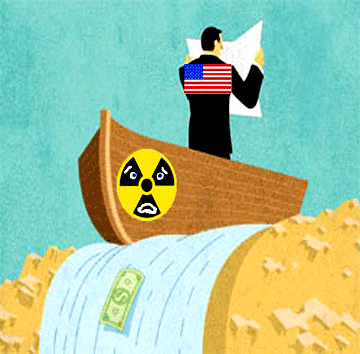 Wall Street firm Credit Suisse set the tone in February with a report that described the aging U.S. fleet of nuclear power plants as “facing declining performance, higher costs and inevitable mortality.
by Elizabeth Douglas, theguardian.com, Wednesday 25 September 2013 As the economics of building plants and maintaining old ones erode, some experts see little hope for an industry being touted by some as a climate savior.
A string of plant closures, project cancellations and other setbacks has raised new doubts about the future of nuclear power in the United States, but there’s disagreement about whether the retrenchment will be limited and temporary or the beginning of a broad and permanent decline.Renewed safety concerns and reinvigorated local opposition have played a role in the industry’s recent troubles. But the most potent foe—and the primary force behind the spate of closures and abandoned projects—is economic.The industry’s run of bad news includes: Continue reading
1 This Month





PLEASE OPPOSE HR 8255 AND S.3639 – bills would accelerate satellite deployment, with no environmental review or safeguards – https://ncstd5li.quorum.us/campaign/169331/
To see nuclear-related stories in greater depth and intensity – go to https://nuclearinformation.wordpress.com
-
Archives
- October 2026 (10)
- September 2026 (339)
- August 2026 (330)
- July 2026 (355)
- June 2026 (287)
- May 2026 (306)
- April 2026 (356)
- March 2026 (251)
- February 2026 (267)
- January 2026 (308)
- December 2025 (358)
- November 2025 (359)
-
Categories
- 1
- 1 NUCLEAR ISSUES
- business and costs
- climate change
- culture and arts
- ENERGY
- environment
- health
- history
- indigenous issues
- Legal
- marketing of nuclear
- media
- opposition to nuclear
- PERSONAL STORIES
- politics
- politics international
- Religion and ethics
- safety
- secrets,lies and civil liberties
- spinbuster
- technology
- Uranium
- wastes
- weapons and war
- Women
- 2 WORLD
- ACTION
- AFRICA
- Atrocities
- AUSTRALIA
- Christina's notes
- Christina's themes
- culture and arts
- Events
- Fuk 2022
- Fuk 2023
- Fukushima 2017
- Fukushima 2018
- fukushima 2019
- Fukushima 2020
- Fukushima 2021
- general
- global warming
- Humour (God we need it)
- Nuclear
- RARE EARTHS
- Reference
- resources – print
- Resources -audiovicual
- Weekly Newsletter
- World
- World Nuclear
- YouTube
-
RSS
Entries RSS
Comments RSS

