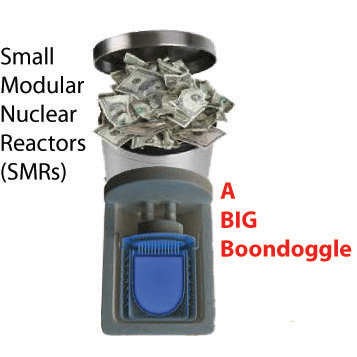
NextEra No Longer Bullish on Nuclear SMRs
By Alex Kimani – Oil Price , Oct 31, 2024,
NextEra Energy is exploring the reopening of the Duane Arnold nuclear plant amid rising data center interest but remains cautious on the viability of small modular reactors.
SMRs, though promising in terms of smaller size, lower fuel needs, and modular design, face significant challenges.
High production costs for HALEU, estimated to reach up to $25,725/kg, pose a substantial financial hurdle.
……………………..CEO John Ketchum said he was “not bullish” on small modular reactors (SMRs), adding that the company’s in-house SMR research unit has so far not drawn favorable conclusions about the technology.
“A lot of [SMR equipment manufacturers] are very strained financially,” he said. “There are only a handful that really have capitalization that could actually carry them through the next several years.”
Ketchum might have a valid point. …………………………………………….
The U.S. Department of Energy has so far spent $1.2B on SMR R&D and is projected to spend nearly $6B over the next decade. Last year, the U.S. Nuclear Regulatory Commission (NRC) certified NuScale Power Corp.(NYSE:SMR) VOYGR 77 MW SMR in Poland, the first ever SMR to be approved in the country.
But there’s a big problem here because the fuel required to power these novel nuclear plants might be really expensive.
Three years ago, U.S. Nuclear Regulatory Commission (NRC) approved Centrus Energy Corp.’s (NYSE:LEU) request to make High Assay Low-Enriched Uranium (HALEU) at its enrichment facility in Piketon, Ohio, becoming the first company in the western world outside Russia to do so. A year later, the U.S. Department of Energy (DoE) announced a ~$150 million cost-shared award to American Centrifuge Operating, LLC, a subsidiary of Centrus Energy. HALEU is a nuclear fuel material enriched to a higher degree (between 5% and 20%) in the fissile isotope U-235. According to the World Nuclear Association, applications for HALEU are currently limited to research reactors and medical isotope production; however, HALEU will be needed for more than half of the SMRs currently in development. HALEU is only currently available from TENEX, a Rosatom subsidiary.
………..A 2023 survey by the Nuclear Energy Institute on U.S. advanced reactor developers estimated that the total market for HALEU could reach $1.6 billion by 2030 and $5.3 billion by 2035.
Last year, the Nuclear Innovation Alliance (NIA) published a report wherein they discussed production costs for HALEU. Here’s an excerpt from the report:
‘‘Calculated HALEU production cost for uranium enriched to 19.75% is $23,725/kgU for HALEU in an oxide form and $25,725 for HALEU in a metallic form under baseline economic assumptions but could be higher.’’
The report claims that a SWU (Separative Work Unit) is going to cost a lot more in a HALEU enrichment cascade compared to a standard LEU (Low-Enriched Uranium) enrichment cascade.
……………….NIA reckons it might cost ~$2000/kgU to make HALEUF6 into HALEUO2, and as much as $4000/kgU to make HALEUF6 into HALEU-metal. At the end of the day, you’d end up with HALEU with 28 times the fissile content of natural uranium at over 100 times the price.
https://oilprice.com/Alternative-Energy/Nuclear-Power/NextEra-No-Longer-Bullish-on-Nuclear-SMRs.html
Race to build Britain’s first mini-nukes delayed again in Budget

‘Tortuously slow’ decision-making blamed for decision to push back development of small modular reactors.
Matt Oliver, Telegraph 31st Oct 2024 https://www.telegraph.co.uk/business/2024/10/31/race-to-build-britains-first-mini-nukes-delayed-again-reeve/
Ministers have delayed the competition to build Britain’s first
mini-nuclear power plants, amid “tortuously slow” decision-making in
Whitehall. The contest to develop small modular reactors (SMRs) was
whittled down to four contenders last month, with two winners originally
expected to be chosen by late this year or early 2025.
That already represented a significant delay on timelines originally set out when six
vendors were shortlisted a year ago. However, the Government has now pushed
back the selection of winners even further, with a decision not expected
until the spring.
The two-sentence update was snuck out in Budget documents
published alongside a speech by Rachel Reeves, the Chancellor, on
Wednesday. On Thursday, Great British Nuclear (GBN) confirmed the new
timetable and said it would provide further updates “in due course”. It
is understood the delay is largely down to a slower-than-expected pace of
decision-making in Whitehall, as well as fears that the process risks being
challenged by judicial review if it is not robust enough.
Nuclear Energy “Renaissance”: Should You Buy NuScale Power Stock?

The Motley Fool, By Brett Schafer – Oct 27, 2024
Key Points
The stock is incredibly risky at the moment.
NuScale Power stock is up close to 500% this year.
The company wants to disrupt the energy market with small modular reactors.
Companies are betting big on nuclear energy to power AI…………..
Tens of billions are going to be spent on nuclear power in the next few decades, but there are few publicly traded nuclear energy stocks one can buy. One, NuScale Power Corp (SMR -0.68%), plans to disrupt the market with its new small modular reactors (SMRs). Its shares are up close to 500% this year as investors pile into the nuclear energy trade. Should you follow them and buy some shares yourself?
………………………NuScale won’t generate meaningful revenue for years
The problem is, NuScale Power is far from this reality. The company has never sold an SMR and has virtually zero revenue today. Many companies in multiple countries have proposed deals with NuScale, but none are operational and, if they ever get built, they won’t be ready until 2030 or later. That is over five years until NuScale Power is generating any form of revenue, let alone profits.
Given all the upfront costs in research and development, Nuscale is currently burning a lot of cash. Over the last 12 months, its free cash flow was negative $170 million. That is more than the cash it holds on the balance sheet ($130 million). What this means is NuScale is set to run out of money within a year but needs over five years of runway — if not more — before getting its SMRs commercialized. Management is going to need to raise money in the form of stock offerings or debt to bridge the gap between this cash burn and the time when its SMRs finally get sold.
The stock is shaky, at best
Investors in NuScale Power are thinking all about the upside of SMR technology right now. That is why the stock is up close to 500% in less than 12 months. However, there is a lot of potential downside that they may be forgetting right now, and that is how investors can get in trouble.
For one, it trades at a market cap of $1.7 billion and has zero revenue. Shareholders are likely going to be weighed down by stock offerings or debt, which will need to happen within the next 12 months. This will present a headwind to long-term shareholder returns.
Two, we don’t even know if the SMR technology will work. It isn’t proven, and it is unclear whether utilities want these solutions or the older large nuclear reactors. The idea of SMRs makes sense, but it is only an idea. And ideas don’t generate positive cash flow.
NuScale Power is a pre-revenue business burning a ton of cash that will likely stay pre-revenue through 2030. Even though the stock is soaring, smart investors will stay far away from this risky stock. There are better places to store your money right now. https://www.fool.com/investing/2024/10/27/nuclear-energy-renaissance-should-you-buy-nuscale/?fbclid=IwY2xjawGQ6g9leHRuA2FlbQIxMQABHTdbZQF5x3-PErplyYXEJmIRC-1UX_k9hjjgDgdnSdU8KfJLMojZSpSrlQ_aem_felvtV_-cil14iXalVC_yg
Cost of maintaining decommissioned nuclear submarines

UK Defence Journal 29th Oct 2024
Graeme Downie, Labour MP for Dunfermline and Dollar, recently raised a question regarding the financial burden of maintaining decommissioned nuclear submarines at two key UK facilities: Rosyth and Devonport. Specifically, he inquired about the annual costs associated with these sites.
In response, Defence Minister Maria Eagle provided the figures for the financial year 2023-24, explaining that “the annual cost for maintaining decommissioned submarines varies each year depending on the respective maintenance requirements.”
For the last financial year, £1.7 million was spent at Rosyth, while the maintenance costs at Devonport were significantly higher, totalling £7.1 million.
These figures highlight the ongoing financial commitment required to manage the UK’s decommissioned nuclear submarines, a task dependent on the maintenance needs of each vessel and the infrastructure of the respective facilities.
Additionally, during a recent exchange in the House of Lords, Lord Coaker expressed the urgency for the UK to expedite its nuclear submarine dismantling programme, addressing the slow progress in decommissioning and dismantling outdated submarines.
Responding to a question from Baroness Bryan of Partick, he outlined the current challenges and ongoing efforts to dismantle the aging fleet, currently spread across Scotland and Devonport, and acknowledged that, without significant changes, the timeline could stretch into decades.
Baroness Bryan highlighted widespread concerns, pointing out that many submarines have been out of service for years or even decades without being dismantled. She cited, for example, the case of a Dreadnought-class submarine stationed at Rosyth since 1980, a delay emblematic of the broader issue. “There remains real concern that not one of these submarines has yet been dismantled,” she noted, adding that with the rate of dismantling, “it will take decades to dismantle the boats remaining in both Scotland and Devonport.”……………………………………………………..
https://ukdefencejournal.org.uk/cost-of-maintaining-decommissioned-nuclear-submarines
Sizewell C nuclear project proceeds by stealth – vast sums of public money spent, with no public disclosure about its true cost
1 The Autumn Budget includes a £14.1bn settlement for DESNZ in 2025/26,
which includes £2.7 bn for Sizewell C. This amounts to half the £5.5bn,
two year subsidy scheme published in August. The Chancellor chose not to
mention Sizewell C or nuclear energy in her speech to the House of Commons.
Stop Sizewell C said: “For a government that criticised the opposition
for playing fast and loose with the nation’s finances, the Chancellor is
surprisingly happy to do the same, allocating another £2.7 billion of
taxpayers’ money on risky, expensive Sizewell C, without making any
guarantee of a Final Investment Decision being taken.
Including £2.5 billion already spent, this means £5.2 billion of our money will be spent
on a project that cannot even help Labour achieve its energy mission, and
is looking increasingly toxic to private investors.”
The Chancellor also announced that David Goldstone has been appointed as the independent Chair of the “Office of Value for Money” within the Treasury. “Stop
Sizewell C urges David Goldstone to call in Sizewell C for immediate
scrutiny, as the project is currently proceeding by stealth. Despite almost
no public disclosure about its true cost or transparency about value for
money, vast sums of public money have already been spent on Sizewell C,
with the potential for billions more to be poured down the drain.”
Stop Sizewell C 30th Oct 2024
Ontario’s huge nuclear debt and other things Dutton doesn’t understand about cost of electricity

Unfortunately for us, Dutton and O’Brien are also in a hurry. They think they can deliver nuclear power plants far faster than what many experts believe is sensible and what many countries with far more nuclear experience than ourselves have been able to achieve.
Dutton and O’Brien also want to do this via a government-owned utility, instead of via a competitive market.
ReNewEconomy, Tristan Edis, Oct 30, 2024
All of this has left taxpayers with a massive budget and timeframe blow-out. This is what happens when we leave it to politicians in a hurry to hand pick power projects.
It seems our alternative Prime Minister Peter Dutton’s favourite topic is your electricity bill. Given how much he talks about electricity prices, you’d think he might know a fair bit about what makes up your electricity bill, wouldn’t you?
According to Dutton and his Shadow Energy Minister Ted O’Brien, the problem is all about too much renewable energy in the mix. And their answer to the problem is nuclear power, as well as more gas.
According to Peter Dutton, “We can’t continue a situation that Labor has us on of a renewables only policy because, as we know, your power prices are just going to keep going up under this Prime Minister.”
Instead, according to Dutton, “we could be like Ontario, where they’ve got 60 or 70 per cent nuclear in the mix, and they’re paying about a quarter of the price for electricity that we are here in Australia.”
O’Brien, elaborated on this point by saying:
“We will have plenty of time in due course to talk about the costings [for their nuclear plan] once we release them here in the Australian context. But I point to Ontario in Canada, there you have up to 60 per cent of their energy mix in the grid, coming from zero emissions, nuclear energy. Their households pay around about 14 cents kilowatt hour. There are parts in Australia that will be paying up to 56 cents a kilowatt hour from July 1 this year.”
Once you actually delve into these numbers it becomes apparent that O’Brien and Dutton don’t seem know much about electricity costs and pricing.
But even worse, they don’t know how badly Ontario’s taxpayers and electricity consumers were burnt by their utility racking up huge debt building nuclear power plants equal to $70 billion in current day Australian dollars.
Do Dutton and O’Brien understand your electricity bill?
You can actually look up what Ontario households pay for electricity via the Ontario Energy Board’s bill calculator website.
This provides you with a break down on the charges a typical household faces depending on the utility you choose…………………………………………………
But notice there’s also other very significant items in this bill separate to the kilowatt-hour charge? There’s a “delivery” charge which is the cost of paying for the distribution and transmission poles and wires. There’s also regulatory charges and also their sales tax is known as “HST” rather than GST for us.
So the Ontario 14 cents per kilowatt-hour charge that O’Brien and Dutton are referring to covers only the wholesale energy portion of their bill.
In Australia, we pay a majority of the costs of distribution and transmission in our cents per kilowatt-hour charge, in addition to wholesale energy costs, and then we get GST added on top. O’Brien and Dutton don’t seem to have appreciated this important aspect of electricity pricing in this country, which is different to Ontario.
But it actually gets worse.
I went digging on the official government energy retailer comparison sites- www.energymadeeasy.gov.au and www.energycompare.vic.gov.au and I initially couldn’t find a single Australian retailer selling electricity at 56 cents per kilowatt-hour.
This was based on looking at offers based on a single rate tariff. Then I had a brainwave and looked at time-of-use rates. In Queensland and Victoria I still couldn’t find anyone wanting to charge me 56 cents for the peak period.
But eventually I succeeded. Right at the bottom of the EnergyMadeEasy list of retailer offers – which were ordered from best to worst – sat EnergyAustralia as the worst offer, charging 57 cents for the peak period in South Australia (although with a compensating high solar feed-in tariff of 8.5 cents)…………………………………
To help out O’Brien and Dutton, I’ve prepared the table below which provides a proper apples versus apples comparison (as opposed to apples vs peak rate bananas) –[on original ]
…………………………………………….. Ontario’s nuclear debt debacle
Yet this comparison between Ontario and Australia misses a far more important part of the story that O’Brien and Dutton seem to be blissfully ignorant of.
That is the history of the Ontario’s state owned utility – Ontario Hydro – and the unsustainable level of debt that it racked up over the 1980’s and 1990’s as a result of an ambitious nuclear plant construction program that went wrong.
While this cost is no longer apparent in current electricity prices, Ontario businesses and households were stuck with paying back CAD$38.1 billion in debt (over $70 billion in Australian current day dollars) for more than 35 years after their public utility committed its last nuclear reactor to construction in 1981.
So what went wrong?
In anticipation of large growth in electricity demand, over the 1970’s and 1980’s Ontario Hydro committed to construction 12 nuclear reactors with 9,000 MW of generating capacity. To fund the projects the public utility accessed commercial debt markets anticipating that it could comfortably repay this debt from the increased electricity demand it forecast. However, several things went wrong.
The nuclear power stations took far longer to build and were around twice as expensive to build than had been planned
– Interest rates on debt rose to very high levels by historical standards over the 1980’s in order to contain the high levels of inflation that unfolded over the 1970’s and early 1980’s. With the nuclear power stations taking longer than expected to build, interest was accumulating on this debt with far less output from the plants to offset it.
– Lastly, Ontario Hydro’s estimate of large growth in electricity demand didn’t eventuate. A 1977 forecast projected a system peak of 57,000 MW by 1997. Actual peak demand in 1997 was 22,000 MW. This meant that the very large cost and associated debt of the large nuclear expansion had to be recovered from a much smaller volume of electricity sales than it had anticipated, making it much harder to pay off the debt without substantial increases in electricity prices.
……………………………………………………………………………………………………………… “On April 1, 1999, the Ministry of Finance determined that Ontario Hydro’s total debt and other liabilities stood at $38.1 billion, which greatly exceeded the estimated $17.2-billion market value of the assets being transferred to the new entities. The resulting shortfall of $20.9 billion was determined to be “stranded debt,” representing the total debt and other liabilities of Ontario Hydro that could not be serviced in a competitive environment.”
So the CAD$38.1 billion in debt was transferred out of the electricity companies and into a special purpose government entity called the Ontario Electricity Financial Corporation (OEFC). This debt management corporation was given the following revenues to service the debt:
– Both residential and business consumers were required to pay a special “Debt Retirement Charge”. This charge was introduced in 2002 and lasted until 2016 for residential consumers and 2018 for business customers.
– The Ontario government would forgo any corporate income and other taxes owed by the offshoot electricity companies from Ontario Hydro so they could be diverted to the OEFC to pay down debt.
– If the cumulative profits of two of the new state power companies exceeded the $520m annual interest cost on their debts, then this would go towards paying stranded debt rather than dividends to the Ontario government.
None of this is apparent on current bills, but the burden of repaying the nuclear debt left the Ontario government and its taxpayers far poorer than Dutton and O’Brien seem to appreciate.
More things O’Brien doesn’t want to understand about Ontario’s nuclear power program
Dutton and O’Brien like to claim that nuclear power plants last a very long time and so therefore the large upfront cost of these plants isn’t something we should be too worried about………………………..
It’s not as simple as this. Nuclear power plants involve a range of components which are exposed to severe heat and mechanical stress. These all need to be replaced well before you get to 60 years, and such refurbishment comes at a cost.
Ontario’s experience is that refurbishment comes at a very significant cost. Less than 25 years after the Darlington Nuclear Power Plant construction was completed, it needed to commence refurbishment. The total cost? $12.8 billion in Canadian dollars or $14 billion Australian dollars.
This is partly why, even though the original nuclear construction cost debt had been largely paid down and nuclear operating costs are lower than coal or gas plant, Ontario still pays more for its electricity than we do.
This is because the current owner of the nuclear power plants – Ontario Power Generation – operates under regulated return model where the regulator grants them the right to recover these refurbishment costs from electricity consumers.
Are O’Brien and Dutton about to commit to another Snowy 2.0 budget blow-out, but on steroids?
………………………………The problem here is that when you don’t know very much and you’re spending other people’s money, ego can easily cloud your judgement. Don’t get me wrong, ego will often cloud business leaders’ judgement too. But their ability to spend money to feed their ego can only so far before either competitors or shareholders intervene.
Ontario taxpayers on the other hand realised far too late that their public utility, in cahoots with their politicians, were pursuing a nuclear vanity project built upon a poor understanding of the future, and without any competitor to discipline their ego.
Australian taxpayers have seen a similar mistake unfold with the Snowy 2.0 pumped hydro plant whose cost now stands at five times greater than the original expectation, and double what was meant to be a fixed price construction contract.
Snowy 2.0 is a parable of what goes wrong when:
– Politicians rush things leading to inadequate planning and preparation;
– Politicians fail to objectively and thoroughly evaluate alternatives; and
– Politicians fail to employ open and competitive markets to deliver end consumer outcomes.
All of this has left taxpayers with a massive budget and timeframe blow-out. This is what happens when we leave it to politicians in a hurry to hand pick power projects.
Unfortunately for us, Dutton and O’Brien are also in a hurry. They think they can deliver nuclear power plants far faster than what many experts believe is sensible and what many countries with far more nuclear experience than ourselves have been able to achieve. Dutton and O’Brien also want to do this via a government-owned utility, instead of via a competitive market.
While the budget blowout of Snowy 2.0 is bad enough, it pales into comparison with the kind of cost blow-outs that can unfold with nuclear power projects. As an example, the budget for completion of UK’s Hinkley Point C nuclear project now stands at $89.7 billion which is three times higher than what was originally budgeted.
We’ve all seen this movie before, including in Ontario, and it doesn’t end well……………………………………………………………………………………………………………….. more https://reneweconomy.com.au/ontarios-huge-nuclear-debt-and-other-things-dutton-doesnt-understand-about-cost-of-electricity/
Lepreau nuclear headaches could add up to an extra $150M
NB Power says it won’t know the true costs until plant comes back online in December after an eight-month shutdown
John Chilibeck • Local Journalism Initiative reporter, Oct 28, 2024 Journal: https://tj.news/new-brunswick/lepreau-headaches-could-add-up-to-an-extra-150m
NB Power expects the troubled Point Lepreau nuclear plant to be back up and running in December, about 140 days after serious problems were first discovered.
The repairs and replacing the lost electricity could cost New Brunswick ratepayers $150 million, based on testimony provided earlier this year by senior executives at the public utility.
In a news release Monday, NB Power said the total costs won’t be known until the plant near Saint John is back in operation. The utility is also considering making an insurance claim to protect the public and businesses from punishing costs.
“Our team has been working diligently, with the support of national and international experts, to assess and address the situation,” stated spokesperson Dominique Couture in the release. “This has been a very complex task, and NB Power left no stone unturned in understanding the problem and the repair options.”
During a summer rate hearing before the New Brunswick Energy and Utilities Board, Craig Church, a chief modeler for the public utility, told the quasi-judicial body that replacing the 660 megawatts of energy lost at the Candu reactor, one of the most important plants in its generating system, costs on average $900,000 a day.
The repair work and replacement power did not figure into rate hearings in which NB Power asked for the highest hikes to electrical rates in generations – close to 20 per cent over two years. A decision is still pending with the board.
During those summer hearings, NB Power estimated the repair work would cost $20 million and replacing energy $51 million, for a total of $71 million.
But that was an estimate only up to Sept. 1, roughly 48 days of the unplanned outage. Extending that timeline to Dec. 1 would add another 91 days, just when temperatures plunge and electrical costs go up.
The $900,000 a day estimate was an average only, suggesting the costs could escalate to at least $150 million.
The Point Lepreau Nuclear Generating Station has been offline since April 6, when NB Power undertook a planned, 100-day maintenance outage.
But when getting ready for starting the plant back up in July, workers identified a critical issue within the main generator, located on the non-nuclear side of the plant.
It turns out it wasn’t even in an area that was part of the maintenance work.
The culprit was a damaged stator bar in the generator, one of the long devices inside the big round machine and a stationary part of the rotor.
The experts began probing further and after testing all 144 bars, found five others showing signs of serious deterioration.
“An independent investigation has determined that the cause of this issue is a manufacturer’s defect that occurred during the maintenance of the generator in 2010,” NB Power stated. “We made the decision to repair all six bars while the station is offline to ensure continued safe operations and prevent potential issues in the future.”
It wasn’t a simple job. To access the stator bars, workers had to meticulously disassemble part of the generator assembly, including the removal of the machine’s rotor.
“The stator bars and other internal components are delicate and strict manufacturer’s precautionary measures must be followed,” Couture wrote. “We are pleased to report that repairs have been completed on all six stator bars and that the generator reassembly is underway. This involves several verification steps and thorough testing to ensure that all components are precisely aligned and secured.”
NB Power said once the components are ready, in the coming weeks, it will begin start-up activities at the massive plant, including equipment checks and testing protocol. The utility anticipates a full return to service in December. That would mean the unplanned outaged lasted about 140 days, with Lepreau offline for a total of about eight months.
The true costs won’t be released until the plant is back in service, NB Power stated. Couture said the utility is examining every option to reduce costs for its customers, including looking at an insurance claim.
“We are pleased that the station will be back online for the winter heating season to ensure New Brunswickers have the energy they need when they need it,” Couture wrote. “We are committed to safety and operational excellence and will continue to keep the public informed.”
Green jobs and green skills – the state of play

October 26, 2024, https://renewextraweekly.blogspot.com/2024/10/green-jobs-and-green-skills-state-of.html
In 2023, the global renewable energy sector witnessed a record increase in jobs, rising from 13.7 million in 2022 to 16.2 million. China led with an estimated 7.4 million renewable energy jobs, representing 46% of the global total. The EU followed with 1.8 million jobs, while Brazil had 1.56 million. The US and India each contributed nearly one million jobs. The strongest growth was seen in the solar photovoltaics sector, which accounted for 7.2 million jobs globally, with 4.6 million jobs located in China.
However, as I have reported in earlier posts, green skill shortages may slow progress and, exploring this issue in the UK context, an Imperial College Futures Lab briefing paper has investigated the Net-Zero job skills and training requirements in the UK’s energy system. It notes that the governments advisory Committee on Climate Change (CCC) estimates that between 135,000 and 725,000 net new jobs could be created in the UK by 2030 directly in low-carbon sectors, this wide range highlighting uncertainties in estimates about the number of workers required to support the transition to Net-Zero. The Futures Lab study identifies ongoing barriers and opportunities for expanding low-carbon job competencies, culminating in a set of policy recommendations to create clear, inclusive training pathways into low-carbon energy jobs.
Using three sectoral case studies, the paper investigates challenges and opportunities for improving skills and training. Firstly it shows how the building energy retrofit sector faces a significant shortage of skilled workers, particularly in heat pump installation, energy efficiency measures, retrofit coordination, and digital roles. Despite the potential to create 120,000–230,000 new jobs by 2030, it says ‘inconsistent policies and funding have hindered private investment in training’. Secondly, the offshore wind sector is forecast to employ over 100,000 workers in 2030, compared to 32,000 in 2022. But it says ‘offshore wind struggles with skills gaps in electrical, digital, consenting, and marine roles, relying on experienced workers and those from other industries to fill these gaps’. Thirdly, the paper claims the electric vehicles sector ‘could generate at least 80,000 new jobs over the next 10-15 years’ but says that this ‘is contingent on gigafactory development, with key skills needed in charging point installation, vehicle recycling, battery manufacturing, and electrification engineering.’
Most of these cases involve expanding training for specific green energy technologies and electrification, but the report says that ‘not all industrial decarbonisation can be achieved through direct electrification, and particularly across hard-to-abate industries, decarbonisation will depend on the development of hydrogen and CCUS sectors’. It notes that ‘growth of these sectors is considered highly conditional, subject to the competitiveness of international markets, the availability of skilled labour, and levels of investment,’ but reports that the CCC estimates that ‘these industries could create between 1,500 and 97,000 new jobs by 2030’. It adds that ‘the current offshore oil and gas workforce is expected to provide a large number of skills required in these sectors’.
That’s good news (arguably blue hydrogen/CCUS apart) but making it happen won’t be easy. It is interesting in this context that there has recently been a call for £1.9bn a year to help oil and gas workers move into clean energy, with the Green Jobs Taskforce also estimating that ‘the low-carbon transport sector could create 78,000 new jobs by 2040, including 24,500 in battery manufacturing, 43,500 in the battery supply chain, and 10,000 in EV manufacturing’.
Looking to the way ahead, the Future Lab identify a series of barriers facing this type of job transition. First come straight forward ‘skills transferability’ barriers. For example it notes that it has been estimated that 100,000 jobs in the UK’s offshore energy sector will be filled by workers transferring from oil and gas into offshore renewable roles, and by new entrants from outside the sector. But it says ‘there is debate about how transferable skills across high- and low-carbon sectors actually are, and whether a ‘topping up’ of skills or more rigorous retraining will be required for those transitioning’.
Then there are mobility barriers. ‘Whether or not workers are able to take low-carbon jobs will depend on where and when existing jobs are being lost and new jobs become available. It will also depend on the supply of and demand for relevant training, which is likely to be unevenly distributed in terms of quantity and quality. If green jobs or re-skilling opportunities do not appear in areas where jobs have been phased out, workers will either have to lose out on opportunities, seek employment in other high-carbon sectors, or relocate, which risks reinforcing existing regional inequalities.’
That links up to regional barriers. It says ‘UK regions with a higher concentration of energy-intensive industries, such as the North East, Yorkshire and the Humber, and the West Midlands, stand a higher chance of being negatively affected by the transition. These regions are often also those whose economies have seen the least growth in recent decades. They are also likely to have less capacity and resources to be able to provide adequate re-skilling support’.
And finally there are diversity barriers. The report notes that ‘the current energy sector is predominantly represented by white male workers. Available statistics suggest that only 5% of the workforce comes from BAME backgrounds. Unless active measures are taken to support underrepresented groups joining the Net-Zero energy workforce, occupational gender & ethnicity gaps are likely to persist’.
Some of the reports recommended actions are obvious enough from the foregoing analysis. For example green sectors should be ‘inclusive and respectful places to work, where underrepresented groups not liable to be discriminated against’, and we should build ‘closer links between high- and low-carbon energy sectors to create direct routes into new jobs.’
More specifically ‘current public financing mechanisms for skills, including the Apprenticeship Levy, the National Skills Fund, and the Adult Education Budget, should be reviewed to see how funding can be better directed towards the development of training for green jobs. Additional public funding should also be leveraged to support long-term development of skills for Net-Zero, specifically for FE colleges and training providers to be able to develop new, high-quality green courses and overcome low participation rates. There is also a case for targeted funding for SMEs who cannot afford to send staff to be trained or take on apprentices’. And more generally, ‘introduce a national Net-Zero Skills Commission to take on monitoring, research and advisory roles to support development of skills for the Net-Zero transition in England.’
Plenty of good ideas. Let’s hope some are implemented soon, and meantime, the UK government is pushing ahead with its ‘skills passport’ initiative. In parallel, we hope helpfully, OU Visiting Research Fellow Terry Cook and I are putting together a journal paper on this whole area, looking in particular at what governments can do at the strategic level, by making new energy technology funding/subsidies conditional on the provision of green skill training programmes.
Sellafield cleanup cost rises to £136bn amid tensions with Treasury

National Audit Office questions value for money as predicted bill for decommissioning increases by £21bn
Alex Lawson and Anna Isaac, Wed 23 Oct 2024 , https://www.theguardian.com/business/2024/oct/23/sellafield-cleanup-cost-136bn-national-audit-office
The cost of cleaning up Sellafield is expected to spiral to £136bn and Europe’s biggest nuclear waste dump cannot show how it offers taxpayers value for money, the public spending watchdog has said.
Projects to fix buildings containing hazardous and radioactive material at the state-owned site on the Cumbrian coast are running years late and over budget. Sellafield’s spending is so vast – with costs of more than £2.7bn a year – that it is causing tension with the Treasury, the report from the National Audit Office (NAO) suggests.
Officials from finance ministry told the NAO it was “not always clear” how Sellafield made decisions, the report reveals. Criticisms of its costs and processes come as the chancellor, Rachel Reeves, prepares to plug a hole of about £40bn in her maiden budget.
Europe’s most hazardous industrial site has previously been described by a former UK secretary of state as a “bottomless pit of hell, money and despair”. The Guardian’s Nuclear Leaks investigation in late 2023 revealed a string of cybersecurity problems at the site, as well as issues with its safety and workplace culture.
The NAO found that Sellafield was making slower-than-hoped progress on making the site safe and that three of its most hazardous storage sites pose an “intolerable risk”.
The site is a sprawling collection of buildings, many never designed to hold nuclear waste long-term, now in various states of disrepair. It stores and treats decades of nuclear waste from atomic power generation and weapons programmes, has taken waste from countries including Italy and Sweden, and is the world’s largest store of plutonium.
Sellafield is forecast to cost £136bn to decommission, which is £21.4bn or 18.8% higher than was forecast in 2019. Its buildings are expected to be finally torn down by 2125 and its nuclear waste buried deep underground at an undecided English location.
The underground project’s completion date has been delayed from 2040 to the 2050s at the earliest, meaning Sellafield will need to build more stores and manage waste for longer. Each decade of delay costs Sellafield between £500m and £760m, the NAO said. Meanwhile, the government hopes to ramp up nuclear power generation, which will create more waste.
Sellafield is owned by the Nuclear Decommissioning Authority (NDA), a taxpayer-owned and -funded quango. The NDA believes the cost of decommissioning Sellafield could range from £116bn to £253bn, depending on the length and complexity of the cleanup.
Plans to clean up three of its worst ponds – which contain hazardous nuclear sludge that must be painstakingly removed – are running six to 13 years later than forecast when the NAO last drew up a report, in 2018. The NAO said deteriorating buildings, Covid restrictions, staffing and equipment breaking down were to blame. Sellafield had “retrieved much less waste than it had planned” since 2020, it said.
Sellafield could spend more on demolishing buildings earlier to be more efficient and offer better value for money, the NAO said.
One pond, the Magnox swarf storage silo, is leaking 2,100 litres of contaminated water each day, the NAO found. The pond was due to be emptied by 2046 but this has slipped to 2059. The Guardian investigation revealed it could continue leaking until 2050.
The NAO said: “Sellafield has demonstrated that it can remove safely the most hazardous waste, but is not progressing quickly enough to meet its plans.”
Last year, Sellafield defied the Treasury and without consultation increased its headcount from 11,200 to 12,000, despite previous commitments to reduce its employee numbers by becoming more efficient, the report said.
In one blunder, Sellafield paid out £2.1m more in staff bonuses than it should have done – about £200 a person – in 2023. This was paid after a management decision that the NAO suggests was questionable.
Sellafield had expected to replace a testing facility that is more than 70 years old and in “extremely poor condition”, but after racking up £265m over more than seven years the project is under review amid concerns over delays and the condition of buildings on the site. The NAO said this was the single biggest risk to Sellafield’s future, as workers needed to carry out many different regular scientific tests.
Gareth Davies, the head of the NAO, said: “Despite progress achieved since the NAO last reported, I cannot conclude Sellafield is achieving value for money yet, as large projects are being delivered later than planned and at higher cost, alongside slower progress in reducing multiple risks.”
He added: “Continued underperformance will mean the cost of decommissioning will increase considerably, and ‘intolerable risks’ will persist for longer.”
This month, Sellafield was fined £332,500 for cybersecurity failings and the chief magistrate in the case, Paul Goldspring, said it fell into a category “bordering on negligence”.
The NAO said the nuclear site had again admitted that its cybersecurity efforts were falling short.
David Peattie, the NDA’s chief executive, said: “Sellafield is one of the most complex environmental programmes in the world. We’re proud of our workforce and achievements being made, including the unprecedented retrieval of legacy waste from all four highest hazard facilities.
“But as the NAO rightly points out there is still more to be done. This includes better demonstrating we are delivering value for money and the wider significant societal and economic benefits through jobs, the supply chain and community investments.”
Apollo Global Management Inc in Talks to Partly Finance EDF’s Hinkley UK Nuclear Power Plant
By Aaron Kirchfeld, Silas Brown, and Francois de BeaupuyOctober 15, 2024
(Bloomberg) — Apollo Global Management Inc. is in talks with Electricite de France SA to provide financing for a nuclear power plant under construction in the UK, people with knowledge of the matter said.
The alternative asset manager has held early discussions about providing a complex mix of equity and debt that may total billions of pounds, the people said, asking not to be identified because deliberations are private.
EDF has been holding meetings with a series of investors including investment firms, sovereign wealth funds and infrastructure specialists to raise as much as £4 billion ($5.2 billion) through a deal that would give investors a stake in the Hinkley Point C project, Bloomberg News reported last week. Centrica Plc. is one of the companies considering investing.
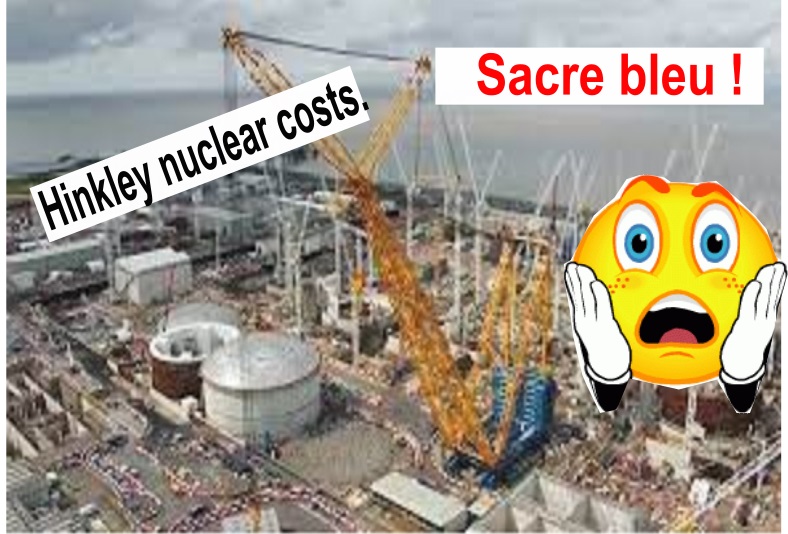
The estimated cost of building Hinkley has risen to as much as £47.9 billion in current terms, due in part to lingering labor shortages and supply chain issues. The first of the two reactors at the site is scheduled to become operational in 2030 — five years later than initially planned — under EDF’s base-case scenario.
Talks about financing Hinkley are at an early stage and may not result in a deal, the people said. Representatives for Apollo and EDF declined to comment………………… https://www.bnnbloomberg.ca/investing/2024/10/15/apollo-in-talks-to-partly-finance-edfs-hinkley-uk-nuclear-power-plant/
‘A catastrophically poor bargain for the UK’: Experts verdict on government plan for new nuclear finance
NFLA 14th Oct 2024
As Prime Minister Sir Kier Starmer meets world finance leaders today at the UK International Investment Summit, the Chair of the Nuclear Free Local Authorities has co-signed a letter sent to the Energy Secretary and government departments challenging plans to use the Regulated Asset Base model to finance future nuclear power plants.
The letter, drafted by the former Chief Statistician of the Scottish Office, has been endorsed by thirty high-level experts, comprising senior academics, former civil servants, nuclear regulators, citizen scientists and NGOs. It has been sent to Energy Secretary, Ed Miliband, and several Whitehall departments – the Energy Security and Net Zero Committee, the National Audit Office, the Public Accounts Committee, and the Comptroller and Auditor General.
14th October 2024
‘A catastrophically poor bargain for the UK’: Experts verdict on government plan for new nuclear finance
As Prime Minister Sir Kier Starmer meets world finance leaders today at the UK International Investment Summit, the Chair of the Nuclear Free Local Authorities has co-signed a letter sent to the Energy Secretary and government departments challenging plans to use the Regulated Asset Base model to finance future nuclear power plants.
The letter, drafted by the former Chief Statistician of the Scottish Office, has been endorsed by thirty high-level experts, comprising senior academics, former civil servants, nuclear regulators, citizen scientists and NGOs. It has been sent to Energy Secretary, Ed Miliband, and several Whitehall departments – the Energy Security and Net Zero Committee, the National Audit Office, the Public Accounts Committee, and the Comptroller and Auditor General.
Due to the inevitable huge costs and construction delays, the private sector is loath to finance new nuclear power projects; Sizewell C is struggling to find financial backers. Consequently, new plants can only be built with a significant public subsidy.
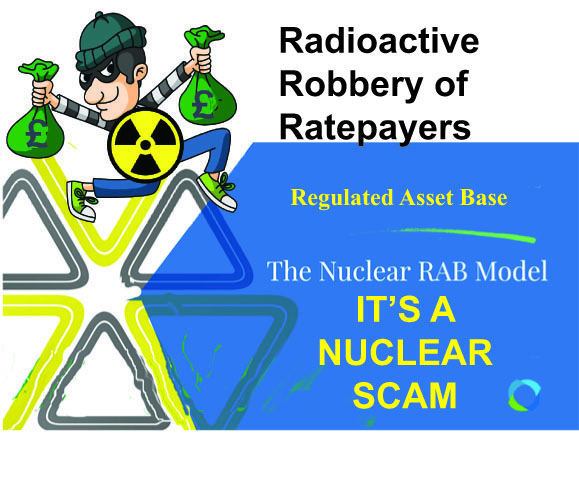
The latest subsidy mechanism to be adopted by the UK Government is the Regulated Asset Base model, in which an additional nuclear levy will be imposed on hard-pressed electricity consumers to make interim payments to developers of new nuclear projects to periodically offset their construction costs; this lifts the burden of rising costs and costly delays from the shoulders of developers and places this upon those of the customer. In so doing, not only is the project derisked for the developer, but the latter has less incentive to arrest costs or prevent delays because they know electricity consumers will have to meet them.
The experts have labelled RAB ‘a catastrophically poor bargain for the UK’.
The NFLAs have labelled RAB ‘ROB’, calling it daylight robbery and especially iniquitous when imposed upon the poorest and oldest customers. Many households are already struggling to pay huge, and rising, energy bills, and will be further burdened by a nuclear levy, and as new nuclear plants take so long to build many older customers are unlikely to be around to access any electricity from them.
In a response to a 2022 government consultation by the Business Department,[1] we denounced the proposal to impose a RAB levy on these groups, who are most vulnerable to cold and fuel poverty, and called for them to be exempted from the levy or promptly recompensed by the government if they are required to pay it.
14th October 2024
‘A catastrophically poor bargain for the UK’: Experts verdict on government plan for new nuclear finance
As Prime Minister Sir Kier Starmer meets world finance leaders today at the UK International Investment Summit, the Chair of the Nuclear Free Local Authorities has co-signed a letter sent to the Energy Secretary and government departments challenging plans to use the Regulated Asset Base model to finance future nuclear power plants.
The letter, drafted by the former Chief Statistician of the Scottish Office, has been endorsed by thirty high-level experts, comprising senior academics, former civil servants, nuclear regulators, citizen scientists and NGOs. It has been sent to Energy Secretary, Ed Miliband, and several Whitehall departments – the Energy Security and Net Zero Committee, the National Audit Office, the Public Accounts Committee, and the Comptroller and Auditor General.
Due to the inevitable huge costs and construction delays, the private sector is loath to finance new nuclear power projects; Sizewell C is struggling to find financial backers. Consequently, new plants can only be built with a significant public subsidy.
The latest subsidy mechanism to be adopted by the UK Government is the Regulated Asset Base model, in which an additional nuclear levy will be imposed on hard-pressed electricity consumers to make interim payments to developers of new nuclear projects to periodically offset their construction costs; this lifts the burden of rising costs and costly delays from the shoulders of developers and places this upon those of the customer. In so doing, not only is the project derisked for the developer, but the latter has less incentive to arrest costs or prevent delays because they know electricity consumers will have to meet them.
The experts have labelled RAB ‘a catastrophically poor bargain for the UK’.
The NFLAs have labelled RAB ‘ROB’, calling it daylight robbery and especially iniquitous when imposed upon the poorest and oldest customers. Many households are already struggling to pay huge, and rising, energy bills, and will be further burdened by a nuclear levy, and as new nuclear plants take so long to build many older customers are unlikely to be around to access any electricity from them.
In a response to a 2022 government consultation by the Business Department,[1] we denounced the proposal to impose a RAB levy on these groups, who are most vulnerable to cold and fuel poverty, and called for them to be exempted from the levy or promptly recompensed by the government if they are required to pay it.
Letter………………………………………………………………………………………………………. https://www.nuclearpolicy.info/news/a-catastrophically-poor-bargain-for-the-uk-experts-verdict-on-government-plan-for-new-nuclear-finance/
US arms dealers witness ‘record profits’ from Israel’s year-long genocide in Gaza, war on Lebanon

The US and Israel’s ongoing military escalation across West Asia has helped the aerospace and defense industry outperform expectations
News Desk, OCT 10, 2024, https://thecradle.co/articles/us-arms-dealers-witness-record-profits-from-israels-year-long-genocide-in-gaza-war-on-lebanon
US arms manufacturers have outperformed major stock indexes this year in a rally fueled by Israel’s year-long genocide of Palestinians in the Gaza Strip and the expansion of its war against Lebanon.
Stock funds with holdings in the US aerospace and defense industry – including companies like Boeing, Lockheed Martin, RTX, General Dynamics, Northrop Grumman, and L3Harris – saw their profits soar past expectations this year, outperforming the S&P 500 index.
“That handout of taxpayer funds to Israel coupled with Israel’s, and global, demand increasing for weapons in a period of instability, has been jet fuel for stock prices,” reports Responsible Statecraft.
Lockheed Martin, makers of the F-35 aircraft that Israel has used to relentlessly bomb Gaza, Lebanon, Syria, and Yemen, produced a 54.86 percent total return from 7 October 2023 to the same date in 2024, outperforming S&P 500 by about 18 percent.
RTX, the makers of 2,000-pound ‘bunker buster‘ bombs that turned most of Gaza to rubble and are currently being dropped inside the Lebanese capital, saw its total return for investors in the past year reach 82.69 percent, outperforming S&P 500 by about 46 percent.
General Dynamics, which also manufactures bunker busters and is behind the BLU-109 bombs that Israel used to level several apartment buildings in the southern suburbs of Beirut during the assassination of Hezbollah secretary-general Hassan Nasrallah, delivered a 37 percent total return for investors, outperforming the S&P 500 by just over 3 percent.
On 1 October, as Israel pushed forward with its ground invasion of Lebanon and Iran launched hundreds of ballistic missiles in retaliation for the bombing of its capital, Forbes reported that the stocks of most US arms makers gained over 2.6 percent in value.
“Both Lockheed Martin and RTX shares booked all-time highs Tuesday, while L3Harris and Northrop Grumman tallied their top share price since 2022,” the US financial publication reported.
Furthermore, the BlackRock-managed iShares US Aerospace and Defense fund indexing the aerospace and defense sector hit a new all-time high last week, extending its 12-month gain to 43 percent and outperforming the S&P 500 by 33 percent.
According to the Stockholm International Peace Research Institute (SIPRI), between 2019 and 2023, Israel accounted for 2.1 percent of all global arms imports. During the same period, the US accounted for 69 percent of Israel’s arms imports, while Germany accounted for 30 percent.
As Washington retains its long-standing hold as the world’s largest arms dealer – controlling 42 percent of the global arms market – the country has also significantly boosted its military spending to assist Israel, blowing through at least $23 billion in one year.
EDF Seeks to Raise Up to £4 Billion to Help Fund Construction of UK’s Hinkley Nuclear Plant
- Company is talking to funds for a stake sale in Hinkley Point
- EDF would reimburse investors if the nuclear project fails
Electricite de France SA is holding talks with investors over funding for
the Hinkley Point C nuclear power plant under construction in the UK, as
the French utility grapples with the ballooning cost of the project.
EDF is seeking to raise as much as £4 billion ($5.2 billion) through a bespoke
financial instrument which would give investors a stake in the Hinkley
project, people familiar with the matter said asking not to be named
because the discussions are private. Investors would be reimbursed if the
construction isn’t completed, one of the people said.
Bloomberg 10th Oct 2024
EDF reportedly seeking up to £4bn from investors to finish Hinkley Point C
French energy firm reported to be in talks over potential investment to cover ballooning cost of nuclear project
Jillian Ambrose 11 Oct 24, https://www.theguardian.com/uk-news/2024/oct/10/edf-seeks-to-raise-up-to-4bn-to-finish-delayed-hinkley-point-c
The French energy company EDF is reportedly in talks with investors to raise up to £4bn to finish the delayed Hinkley Point C project in Somerset, Britain’s first new nuclear reactors in a generation.
The utilities company, owned by the French state, has approached investors to help cover the ballooning cost of constructing the nuclear plant, which is understood to have reached almost £50bn due in part to supply chain issues and struggles securing skilled engineers, according to Bloomberg.
EDF is reportedly engaged in talks with sovereign wealth funds and large infrastructure funds to raise the extra money through a bespoke financial instrument that would hand investors a stake in Hinkley while protecting them against the risk that the project is not finished.
Hinkley Point C is due to begin generating electricity by 2030, according to EDF – five years later than first planned and 12 years after construction began. The project’s costs have also spiralled, from £18bn when its contracts were signed in 2016 to £47.9bn in today’s money.
The cost overruns and delays are understood to be in part due to spending on extra safety measures to satisfy UK authorities, and trouble securing skilled engineers after Brexit.
A team of specialist engineers at the Hinkley site, represented by the trade union Prospect, voted to strike for 24 hours from Thursday after pay talks broke down. The union said the engineers had not had a pay increase in the last four years.
The financial pressure on the project has deepened after EDF’s partner, China General Nuclear Power Group (CGN), a state-run company, declined to plough more funding into the project beyond its contracted term in 2023.
CGN has scaled back its interest in investing in the UK after tensions between Westminster and Beijing over security concerns made it clear that a Chinese company would not be given permission to lead a nuclear project in the UK.
In response, EDF has called on the UK government to stump up the cash to help finish the project, which will only benefit from bill payer subsidies once it begins generating, but the suggestion was rebuffed by the previous government.
One of the companies considering an investment in the troubled project is Centrica, the owner of British Gas, which has previously been linked to investment talks relating to EDF’s planned nuclear project at Sizewell C in Suffolk. The FTSE 100 company is reportedly in early talks to invest up to £1bn in Hinkley Point C, according to the Daily Telegraph.
Investing in new nuclear reactors would help to secure future electricity supplies for Centrica, which holds a 20% share in all five of EDF’s remaining UK nuclear power stations, four of which are due to close this decade.
Centrica is understood to be interested in investing in either Hinkley or Sizewell – but not both.
EDF and Centrica declined to comment.
Rolls-Royce suffers £78m loss on mini-nukes amid UK rollout delays

Company moves ahead with Czech-backed project as Britain’s selection process for
SMR technologies drags on. Rolls-Royce’s mini nuclear reactor business has
posted a £78m loss as it awaits the outcome of a delayed UK tender
competition.
The company, which is developing a small modular reactor (SMR)
design that it hopes to export globally, saw losses in 2023 grow from £61m
the previous year, new accounts show. It came as the company ramped up
spending on research and development from £78m to £115m.
It made no revenue
and employed some 590 staff. Losses also grew as Rolls – along with three
rivals – continued to wait for a decision by the UK Government on which SMR
technologies it would back following a series of delays. The competition
was first announced by George Osborne, the former Conservative chancellor,
in 2015 but is still yet to reach a conclusion. Tufan Erginbilgiç, chief
executive of the Rolls-Royce group, has urged ministers to press ahead as
quickly as possible, saying he expects orders from around the world to
begin flowing in if Rolls emerges as a winner.
Telegraph 9th Oct 2024
https://www.telegraph.co.uk/business/2024/10/09/rolls-royces-mini-nukes-arm-suffers-loss-amid-delay/
1 This Month

of the week – Shut Down Drone Warfare!


Tell the Ukrainian Government to Drop Prosecution of Peace Activist Yurii Sheliazhenko

Petition to revoke the licensing of the Near Surface Nuclear Disposal Facility (NSDF) at Chalk River. https://www.ourcommons.ca/petitions/en/Petition/Details?Petition=e-7247
To see nuclear-related stories in greater depth and intensity – go to https://nuclearinformation.wordpress.com
-
Archives
- April 2026 (77)
- March 2026 (251)
- February 2026 (268)
- January 2026 (308)
- December 2025 (358)
- November 2025 (359)
- October 2025 (376)
- September 2025 (257)
- August 2025 (319)
- July 2025 (230)
- June 2025 (348)
- May 2025 (261)
-
Categories
- 1
- 1 NUCLEAR ISSUES
- business and costs
- climate change
- culture and arts
- ENERGY
- environment
- health
- history
- indigenous issues
- Legal
- marketing of nuclear
- media
- opposition to nuclear
- PERSONAL STORIES
- politics
- politics international
- Religion and ethics
- safety
- secrets,lies and civil liberties
- spinbuster
- technology
- Uranium
- wastes
- weapons and war
- Women
- 2 WORLD
- ACTION
- AFRICA
- Atrocities
- AUSTRALIA
- Christina's notes
- Christina's themes
- culture and arts
- Events
- Fuk 2022
- Fuk 2023
- Fukushima 2017
- Fukushima 2018
- fukushima 2019
- Fukushima 2020
- Fukushima 2021
- general
- global warming
- Humour (God we need it)
- Nuclear
- RARE EARTHS
- Reference
- resources – print
- Resources -audiovicual
- Weekly Newsletter
- World
- World Nuclear
- YouTube
-
RSS
Entries RSS
Comments RSS
 nuclear-news