Labour donor Dale Vince urges ‘rigorous financial scrutiny’ of Sizewell C costs

Green energy entrepreneur voices concerns over project’s funding and ‘spiralling costs’ of UK’s other nuclear plants.
Michael Savage , Observer 28th Dec 2024
The government’s new value for money tsar has been challenged to examine the costs of a nuclear power station to be given final approval next year, as ministers attempt to shore up private investment for the project.
New nuclear plants are a key part of the government’s plan to have clean power by 2030. The Sizewell C reactor, billed as generating enough energy to power 6m homes, is expected to be given the final go ahead in June’s review of public spending. Its projected costs are in excess of £20bn.
However, Labour donor and green energy entrepreneur Dale Vince has written to the chair of the governments’ new Office for Value for Money (OVfM), David Goldstone, arguing that a nuclear plant already being built has seen spiralling costs. He also warns the construction of Sizewell C “will saddle consumers with higher bills long before it delivers a single unit of electricity”.
The government and the French state-owned company EDF will fund about 40% of the Sizewell C project, with ministers currently rounding up private investors to meet the rest of the costs. In his letter, Vince claims that billions have already been spent on the project, even “before a final investment decision has been made”. He also raises concerns about the ballooning costs and delays of Sizewell C’s sister project, Hinkley Point C, in Somerset.
“If Hinkley Point C is anything to go by, Sizewell C really should have rigorous financial scrutiny,” he writes. “Originally priced at £18bn, the cost of Hinkley has ballooned to £46bn and then there’s the delays. Back in 2007, the then EDF chief executive Vincent de Rivaz said that by Christmas 2017 we would be using electricity generated from atomic power at Hinkley. We’re now in Christmas 2024 and Hinkley isn’t due to be completed until 2031.
“Due to a novel funding method, a lengthy construction timeline for Sizewell will saddle consumers with higher bills long before it delivers a single unit of electricity at a time when there is clear evidence that we can secure a cleaner, cheaper energy future without nuclear.”
It comes after a similar warning by Citizens Advice earlier this year. The charity warned that the Suffolk project may offer “poor value for money” and called for greater clarity on its funding, in a letter to the Department for Energy Security and Net Zero. It has warned that the project’s funding model could expose households to cost overruns……………………………………… https://www.theguardian.com/business/2024/dec/28/labour-donor-dale-vince-urges-rigorous-financial-scrutiny-of-sizewell-c-costs
Fault puts nuclear power station offline over Christmas
A reactor at a nuclear power station went offline over Christmas, an
energy provider has confirmed. EDF Energy said the outage at Heysham 2
power station, near Morecambe, on Monday was caused by an issue with the
high voltage transmission system run by National Grid. National Grid
confirmed there was a fault at one of its remote substations that was at
about the time Heysham 2 tripped. EDF said it worked with National Grid
over the Christmas period to fix the issue and safely return the reactor to
service.
BBC 28th Dec 2024
https://www.bbc.co.uk/news/articles/ckgx9p1qll4o
British energy supplier Centrica is prepared to “walk away” from a planned investment in the Sizewell C nuclear plant
British energy supplier Centrica is prepared to “walk away” from a
planned investment in the Sizewell C nuclear plant, according to its chief
executive. In an exclusive interview with Energy Voice, Centrica chief
executive Chris O’Shea said “there are a number of criteria we have to
consider to invest in the project”. “We’ve said that we are part of the
Sizewell C process but there are a number of criteria we have to consider
to invest in the project,” O’Shea said. “If these are not met, the
right thing to do would be to walk away to protect the business.”
The UK-based supplier owns a 20% stake in the nuclear power stations, amounting
to a 9 terawatt-hour capacity out of a total of 45 TWh. “When the
conditions are right, we’ve seen how good investing in nuclear can be for
Centrica,” said O’Shea. He added that access to that nuclear power
capacity “will be very valuable to the company and to the UK’s energy
system”. “New nuclear will play a crucial role in the future energy
system, however we will only invest if the risks-and-rewards balance is
right for us,” he said. “If it is not right for us, we will not
invest.”
Energy Voice 23rd Dec 2024 https://www.energyvoice.com/renewables-energy-transition/nuclear/564808/centrica-prepared-to-walk-away-from-sizewell-c/
HS: Olkiluoto 3 has been a financial catastrophe for Areva, Siemens

Helsinki Times 19th Dec 2024 Finland , https://www.helsinkitimes.fi/finland/finland-news/domestic/25890-hs-olkiluoto-3-has-been-a-financial-catastrophe-for-areva-siemens.html
THE THIRD REACTOR of Olkiluoto Nuclear Power Plant has been a financial disaster for the two plant suppliers, France’s Areva and Germany’s Siemens, writes Helsingin Sanomat.
Helsinki guide
Teollisuuden Voima (TVO), the company operating the plant, communicated last week that the suppliers have pledged to inject an additional 80 million euros in capital into a fund set up to guarantee the completion of activities during the warranty period.
“The funds reserved for their completion in the fund mechanism were depleted in the autumn of 2024” the company wrote in a press release issued on 12 December.
The third plant unit has experienced numerous faults and disruptions since it was officially inaugurated in 2022. TVO ordered the plant from the suppliers under a turnkey agreement for a fixed price of roughly three billion euros more than 20 years ago. The groundbreaking ceremony was held in 2005, with the completion date set for 2009.
Ultimately, the unit was completed 14 years behind schedule, with the original budget comfortably exceeded. The unit began commercial electricity production in mid-2023.
Helsingin Sanomat on 12 December reminded that Areva estimated already in 2012 that the plant would ultimately cost around 8.5 billion euros. The endeavour eventually bankrupt the company, resulting in intense talks in 2016 as the French government decided to incorporate healthy parts of the company into the state-owned Électricité de France (EDF). The concern was that the plant supplier would not be left with the funds and expertise to complete the project.
France’s most powerful nuclear reactor joins grid after €13bn holdup
RFI 20th Dec 2024
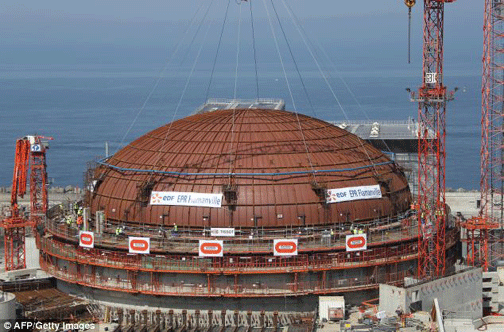
France’s flagship Flamanville nuclear reactor in Normandy was to start supplying electricity to homes on Friday when it’s reconnected to the power grid after a dozen costly years of technical setbacks.
…………………………………………. The start of the new generation European Pressurized Reactor (EPR) comes 12 years behind schedule after a slew of delays and cost overruns.
The cost of the project, initially estimated at €3.3 billion, has ballooned to over €13 billion.
A test run in September had to be interrupted after one day due to an “automatic shutdown”, before starting again days later.
Betting on nuclear
Flamanville 3 is the fourth EPR reactor in the world and the most powerful in France, with a capacity of 1,600 MW. It is the 57th reactor in the French nuclear fleet, which generates around three fifths of the country’s energy.
France continues to bet on nuclear as a way of providing relatively cheap and carbon-free electricity.
The government has committed to building six new-generation EPR2 reactors at a cost of tens of billions of euros, with plans to eventually increase this number to 14.
But questions remain about EDF’s ability to deliver on its ambitions. The energy giant is already heavily in debt, as is the French state – EDF’s sole shareholder……………………………… https://www.rfi.fr/en/france/20241220-france-s-most-powerful-nuclear-reactor-joins-grid-after-%E2%82%AC13bn-holdup-flamanville
Foreign company withdraws from plans for Swedish nuclear power.
South Korean KHNP has withdrawn from discussions with Vattenfall about possibly
building new nuclear power in Sweden. KHNP is one of three companies that
have been considered for building large-scale, conventional nuclear power
in Sweden. “The evaluation of other suppliers is progressing according to
plan,” writes Vattenfall to Ekot.
Swedish Radio 18th Dec 2024 https://sverigesradio.se/artikel/sydkoreanskt-foretag-hoppar-av-diskussioner-om-svensk-karnkraft
SMR – Spending Money Recklessly with Dr. Gordon Edwards (CCNR)
SMR – Spending Money Recklessly with Dr. Gordon Edwards (CCNR). On
November 26 2024 Dr. Gordon Edwards, President of the Canadian Coalition
for Nuclear Responsibility, was featured in the Sustainability Speakers
Series, hosted by the Saskatoon Public Library and the Saskatchewan
Environmental Society. The title of his presentation was SMRs – Spending
Money Recklessly – in Saskatchewan and in Canada. Thus version has a
shortened introduction compared with the original version.
Gordon Edwards 20th Dec 2024 https://www.youtube.com/watch?v=32XKveP01x4
U.S. Corporate Land Grab in Ukraine Underlies War With Russia
Heralded as a hero in Western media, Ukrainian President Volodymyr Zelensky has allowed foreign private interests to steal his country’s best land
Jeremy Kuzmarov, Dec 20, 2024 Originally published in CovertAction Magazine
In early November, Barbara Bonte, a Belgian member of the European Union (EU) parliament, raised concern about the sell-off of Ukrainian land on a massive scale to U.S. private equity firms along with some Saudi agro-industrial and investment businesses.
Bonte wrote to the EU parliament that, “according to several disquieting reports, mainly U.S. but also Saudi agro-industrial and investment businesses are purchasing Ukrainian farmland on a massive scale. Cargill, ADM, BlackRock, Oaktree Capital Management and Bunge Limited, for instance, have reportedly gained control over much of Ukraine’s farmland.”
Bonte then posed two questions to the EU parliament as follows:
“1. What is the Commission’s assessment of the impact of this sell-off of European farmland to multinationals serving only U.S. interests on EU strategic food-supply dependence? How does the Commission intend to address that impact?”
“2. This strongly suggests that the United States is seeking to recoup its military support for Ukraine, and ensure a geopolitical presence there in a post-war scenario through control over Ukrainian farmland and the profits it generates. How does the Commission intend to prevent the United States from cherry-picking in Ukraine and Europe from being left to deal with just the handicaps?”
Bonte’s questions are significant ones that point to a hidden, underlying motive to the war in Ukraine and U.S. and European support for Ukrainian President Volodymyr Zelensky.
The bonanza offered to foreign investors resembles past wars where young people were sacrificed on the altar of corporate profits.
War and Theft
A detailed analysis of the land grab in Ukraine by Western corporations was provided in a 2023 report by the Oakland Institute[1] entitled “War and Theft: The Takeover of Ukraine’s Agricultural Land.”
Written by Frédéric Mousseau, a food security consultant, and Eve Devillers, a Ph.D. candidate at Cornell University, the report starts by emphasizing Ukraine’s function as a “breadbasket of Europe” with its 33 million acres of arable land and “large swaths of the most fertile farmland in the world.”
In 2021, Zelensky initiated a land reform program as part of the structural adjustment program begun under the auspices of Western financial institutions that enabled U.S.-based corporations to take over Ukraine’s land.[2]
The structural adjustment program had been opposed by Ukrainian President Viktor Yanukovych, who was overthrown in the 2014 U.S.-backed Maidan coup.
After Zelensky’s “land reform” was initiated, about five million hectares—the size of two Crimeas—were outright “stolen” by private interests.
The thieves included Goldman Sachs, a Wall Street investment firm well represented in the Biden administration, which in April 2022 bought NN Investment Partners Holding N.V., a Netherlands-based company that is a major shareholder in Ukraine’s biggest landowner, Kernel Holding S.A, and in Astarta, another large landowner in Ukraine.[3]
Vanguard Group Inc., which gave $45,473 to Kamala Harris in the 2024 election and $98,551 to Joe Biden in 2020, was another Wall Street firm that bought up Ukrainian land cheaply.[4]
Some large U.S. pension funds, foundations and university endowments are invested in Ukrainian land through NCH Capital—a U.S.-based private equity fund headquartered at Rockefeller Plaza in New York, which is the fifth largest landholder in Ukraine with its possession of 290,749 hectares.[5]
NCH Capital currently faces accusations of unlawful land acquisition, tax evasion, and illicit financial activity. In 2015, its founder and CEO, George Rohr, was part of the high-level meetings involving Ukrainian president Petro Poroshenko and U.S. Commerce secretary Penny Pritzker that led Ukraine to agree to the structural adjustment program of the International Monetary Fund (IMF) as a condition for two $1 billion loan guarantees from the Obama administration.[6]…………………………………………………………………………………………………………………………..
The Oakland Institute report compares the generous financing of multinational corporations and local oligarchs with the inability of Ukrainian small farmers to access loans and their being displaced from their land and plunged into poverty. Some have migrated to the U.S. to seek farm work in the U.S. Midwest, sending remittances back home.[9]
Mousseau and Devillers wrote that “the Partial Credit Guarantee Fund established by the World Bank to support small farmers is only US$5.4 million, a negligible amount compared to the billions channeled to large agribusinesses.” https://jeremykuzmarov.substack.com/p/us-corporate-land-grab-in-ukraine?utm_source=post-email-title&publication_id=2091638&post_id=153373724&utm_campaign=email-post-title&isFreemail=true&r=1r1sdz&triedRedirect=true&utm_medium=email
Privatizing Syria: US Plans to Sell Off A Nation’s Wealth After Assad
December 18, 2024 , Kit Klarenberg, https://www.mintpressnews.com/privatizing-syria-us-plans-to-sell-off-a-nations-wealth-after-assad/288843/
In the immediate wake of the Syrian government’s abrupt collapse, much remains uncertain about the country’s future – including whether it can survive as a unitary state or will splinter into smaller states as did Yugoslavia in the early 1990s, a move that ultimately led to a bloody NATO intervention. Moreover, who or what may take power in Damascus remains an open question. For the time being at least, members of ultra-extremist Hayat Tahrir al-Sham (HTS) appear highly likely to take key positions in whatever administrative structure sprouts from Bashar Assad’s ouster after a decade-and-a-half of grinding Western-sponsored regime change efforts.
As Reuters reported on December 12, HTS is already “stamping its authority on Syria’s state with the same lightning speed that it seized the country, deploying police, installing an interim government and meeting foreign envoys.” Meanwhile, its bureaucrats – “who until last week were running an Islamist administration in a remote corner of Syria’s northwest” – have moved en masse “into government headquarters in Damascus.” Mohammed Bashir, head of HTS’ “regional government” in extremist-occupied Idlib, has been appointed the country’s “caretaker prime minister.”
However, despite the chaos and precariousness of post-Assad Syria, one thing seems assured – the country will be broken open to Western economic exploitation, at long last.
Multiple reports show that HTS has informed local and international business leaders that when in office, it will “adopt a free-market model and integrate the country into the global economy, in a major shift from decades of corrupt state control.”
As Alexander McKay of the Marx Engels Lenin Institute tells MintPress News, state-controlled parts of Syria’s economy may have been under Assad, but corrupt it wasn’t. He believes a striking feature of the ongoing attacks on Syrian infrastructure from forces within and without the country is that economic and industrial sites are a recurrent target. Moreover, the would-be HTS-dominated government has done nothing to counter these broadsides when “securing key economic assets will be vital to societal reconstruction, and therefore a matter of priority”:
We can see clearly what kind of country these ‘moderate rebels’ plan to build. Forces like HTS are allied with U.S. imperialism, and their economic approach will reflect this. Prior to the proxy war, the government pursued an economic approach that mixed public ownership and market elements. State intervention enabled a degree of political independence [that] other nations in the region lack. Assad’s administration understood without an industrial base, being sovereign is impossible. The new ‘free market’ approach will see all of that utterly decimated.”
A U.N. Human Rights Council report two years later noted pre-war Syria “was the only country in the Middle East region to be self-sufficient in food production,” its “thriving agricultural sector” contributing “about 21%” to GDP 2006 – 2011. Civilians’ daily caloric intake “was on par with many Western countries,” with prices kept affordable via state subsidy. Meanwhile, the country’s economy was “one of the best performing in the region, with a growth rate averaging 4.6%” annually.
At the time that report was written, Damascus had been reduced to heavy reliance on imports by Western sanctions in many sectors and, even then, was barely able to buy or sell much in the way of anything, as the measures amounted to an effective embargo. Simultaneously, the U.S. military occupation of a resource-rich third of Syria cut off the government’s access to its own oil reserves and wheat. The situation would only worsen with the Caesar Syria Civilian Protection Act’s passing in June 2020.
Under its auspices, a vast volume of goods and services in every conceivable field were and today remain banned from being sold to or traded with any Syrian citizen or entity. The legislation’s terms explicitly state preventing attempts to rebuild Syria was its chief objective. One passage openly outlines “a strategy to deter foreign persons from entering into contracts related to reconstruction.”
Immediately after coming into effect, the Syrian pound’s value collapsed further, sending living costs skyrocketing. In a blink, almost the entire country’s population was left barely able to afford even the bare essentials. Even mainstream sources typically approving of belligerence towards Damascus cautioned of an inevitably impending humanitarian crisis. However, Washington was neither concerned nor deterred by such warnings. James Jeffrey, State Department chief of Syria policy, actively cheered these developments.
Simultaneously, as Jeffrey subsequently admitted to PBS, the U.S. was engaged in frequent, secret communication with HTS and actively assisting the group – albeit “indirectly” due to the faction’s designation as a terrorist entity by the State Department. This followed direct approaches to Washington by its leaders, including Abu Mohammed Jolani, former leader of Al Qaeda affiliate al-Nusra. “We want to be your friend. We’re not terrorists. We’re just fighting Assad,” HTS reportedly said.
Given this contact, it may be no coincidence that in July 2022, Jolani issued a series of communications about HTS’ plans for future Syria, containing multiple passages in which finance and industry loomed large. Directly foreshadowing the group’s recent pledge to “adopt a free-market model,” the extremist mass murderer discussed his desire to “open up local markets to the global economy.” Many passages read as if they were authored by representatives of the International Monetary Fund.
Coincidentally, Syria, since 1984, has refused IMF loans, a key tool by which the U.S. Empire maintains the global capitalist system and dominates the Global South, ensuring ‘poor’ countries remain under its heel. The World Trade Organization, of which Damascus isn’t a member either, plays a similar role. Accession to both would go some way to cementing the “free-market model” advocated by HTS. After over a decade of deliberate, systematic economic ruin, geopolitical risk analyst Firas Modad tells MintPress News:
They have no choice. They need Turkish and Qatari backing, so [they] will need to liberalize. They have no capital whatsoever. The country is in ruins and they desperately need investment. Plus, they hope liberalizing may attract some Saudi, Emirati or Egyptian interest. It’s impossible for Syria to rebuild using its own resources. The civil war might resume. They are acting out of necessity.”
‘Shock Therapy’
In Syria’s protracted political and economic dismantling, there are eerie echoes of the U.S. Empire’s destruction of Yugoslavia throughout the 1990s. During that decade, the multiethnic socialist federation’s breakup produced bitter wars of independence in Bosnia, Croatia and Slovenia – encouraged, financed, armed, and prolonged every step by Western powers. Belgrade’s perceived centrality to these brutal conflicts and purported complicity in and sponsorship of horrendous war crimes led the U.N. Security Council to impose sanctions against what remained of the country in May 1992.
The measures were the harshest ever levied in U.N. history. At one point, producing inflation of 5.578 quintillion percent, drug abuse, alcoholism, preventable deaths and suicides skyrocketed, while shortages of goods – including water – were perpetual. Yugoslavia’s once thriving independent industry was crippled, its ability to manufacture even everyday medicines virtually non-existent. By February 1993, the CIA assessed that the average citizen had “become accustomed to periodical shortages, long lines in stores, cold homes in the winter and restrictions on electricity.”
Surveying the wreckage years later, Foreign Affairs noted that sanctions against Yugoslavia demonstrated how “in a matter of months or years whole economies can be devastated,” and such measures can serve as uniquely lethal “weapons of mass destruction” against civilian populations of target countries. Yet, despite such desolation and misery, throughout this period, Belgrade remained resistant to privatization and foreign ownership of its industry or to the pillaging of its vast resources. The overwhelming majority of Yugoslavia’s economy was state- or worker-owned.
Yugoslavia was not a member of the IMF, World Bank, or WTO, which went some way to insulate the country from economic predation. In 1998, though, authorities began waging a heavy-handed counterinsurgency against the Kosovo Liberation Army, a CIA and MI6-funded and armed al-Qaeda-linked extremist militia. This provided the U.S. Empire with a pretext to, at last, finish the job of neutralizing what remained of the country’s socialist system. As a Clinton administration official later admitted:
It was Yugoslavia’s resistance to the broader trends of political and economic reform [in Eastern Europe] – not the plight of Kosovar Albanians – that best explains NATO’s war.”
From March – June 1999, the military alliance bombed Yugoslavia for 78 straight days. Yet, Belgrade’s army was barely in the firing line at any stage. In all, officially, just 14 Yugoslav tanks were destroyed by NATO, but 372 separate industrial facilities got smashed to smithereens, leaving hundreds of thousands jobless. Markedly, the alliance took guidance from U.S. corporations on which sites to target, and not a single foreign- or privately-owned factory was hit.
NATO’s bombing laid the foundations for Yugoslav leader Slobodan Milosevic’s removal via a C.I.A.- and National Endowment for Democracy-sponsored color revolution in October of the following year. In his place, a doggedly pro-Western government advised by a collective of U.S.-sponsored economists took power. Their explicit mission was to “make an economic environment favorable for private and other investments” in Belgrade. Ravaging “shock therapy” measures were deployed the moment they assumed office, to the further detriment of an already immiserated and impoverished population.
In the decades since successive Western-backed governments across the former Yugoslavia have enforced an endless array of neoliberal “reforms” to ensure an “investor-friendly” environment locally for wealthy Western oligarchs and corporations. In lockstep, low wages and a lack of employment opportunities stubbornly endure or worsen while living costs rise, producing mass depopulation, among other destructive effects. All along, U.S. officials intimately implicated in the country’s breakup have brazenly sought to enrich themselves from the privatization of former state industries.
‘Internal Repression’
Does such a fate await Damascus? For Pawel Wargan, founder of the Green New Deal for Europe, the answer is a resounding “yes.” He believes the country’s story is familiar “to those who study the mechanisms of imperialist expansion.” Once its defenses are fully neutralized, he foresees the country’s industries being “bought-up at bargain sale prices as part of market ‘reforms,’ which transfer yet another chunk of humanity’s wealth to Western corporations”:
We’ve witnessed the well-rehearsed choreography of imperialist regime change: a ‘tyrant’ is overthrown; backers of national sovereignty are systematically and viciously repressed; with tremendous, but hidden, violence, the country’s assets are chopped and diced and sold to the lowest bidder; labor protections are discarded; human lives are cut short. The most predatory forms of capitalism take root in every crevice and pore that emerges in the collapse of the state. This is the agenda of structural adjustment policies enforced by the World Bank and IMF.”
Alexander McKay echoes Wargan’s analysis. Now “free,” Syria will be forcedly made “dependent upon imports from the West” evermore. This not only fattens the Empire’s bottom line but “also severely restricts the freedom of any Syrian government to act with any degree of independence.” He notes similar efforts have been undertaken throughout the post-1989 era of U.S. unipolarity. It was well underway in Russia during the 1990s “until the slow turn around in policy started in the early 2000s under Putin”:
The aim is to reduce Syria to the same status as Lebanon, with an economy controlled by imperial forces, an army used primarily for internal repression, and an economy no longer able to produce anything but merely serve as a market for commodities produced elsewhere, and site of resource extraction. The U.S. and its allies do not want independent development of any nation’s economy. We must hope the Syrian people can resist this latest act of neo-colonialism.”
Kit Klarenberg is an investigative journalist and MintPress News contributor exploring the role of intelligence services in shaping politics and perceptions. His work has previously appeared in The Cradle, Declassified UK, and Grayzone. Follow him on Twitter @KitKlarenb
Kit Klarenberg
Despite 100% Pentagon Audit Failure Rate, House Passes $883.7 Billion NDAA

“Instead of fighting the rising cost of healthcare, gas, or groceries, this Congress prioritized rewarding the wealthy and well-connected military-industrial complex,” said Defense Spending Reduction Caucus co-chairs.
Jessica Corbett, Common Dreams, 11 Dec 24
Despite the Pentagon’s repeated failures to pass audits and various alarming policies, 81 Democrats in the U.S. House of Representatives voted with 200 Republicans on Wednesday to advance a $883.7 billion annual defense package.
The Servicemember Quality of Life Improvement and National Defense Authorization Act (NDAA) for Fiscal Year 2025, unveiled by congressional negotiators this past Saturday, still needs approval from the Senate, which is expected to vote next week. U.S. Sen. Bernie Sanders (I-Vt.) said Wednesday that he plans to vote no and spoke out against the military-industrial complex.
The push to pass the NDAA comes as this congressional session winds down and after the U.S. Department of Defense (DOD) announced last month that it had failed yet another audit—which several lawmakers highlighted after the Wednesday vote.
Reps. Mark Pocan (D-Wis.) and Barbara Lee (D-Calif.), co-chairs and co-founders of the Defense Spending Reduction Caucus, said in a joint statement, “Time and time again, Congress seems to be able to find the funds necessary to line the pockets of defense contractors while neglecting the problems everyday Americans face here at home.”
“Instead of fighting the rising cost of healthcare, gas, or groceries, this Congress prioritized rewarding the wealthy and well-connected military-industrial complex with even more unaccountable funds,” they continued. “After a seventh failed audit in a row, it’s disappointing that our amendment to hold the Pentagon accountable by penalizing the DOD’s budget by 0.5% for each failed audit was stripped out of the final bill. It’s time Congress demanded accountability from the Pentagon.”………………………………………………………
As Omar, a leading critic of the U.S.-backed Israeli assault on the Gaza Strip, also pointed out: “The NDAA includes a provision that blocks the Pentagon from using data on casualties and deaths from the Gaza Ministry of Health or any sources relying on those statistics. This is an alarming erasure of the suffering of the Palestinian people, ignoring the human toll of ongoing violence.”
Israel—which receives billions of dollars in annual armed aid from the United States—faces a genocide case at the International Court of Justice and the International Criminal Court last month issued arrest warrants for Israeli Prime Minister Benjamin Netanyahu and former Israeli Defense Minister Yoav Gallant. The NDAA includes over $627 million in provisions for Israel. https://www.commondreams.org/news/ndaa-2025
France deal raises concerns over EDF dominance – Collective intelligence or failure?
Montel News 13 Dec 24, https://montelnews.com/it/videos/101197195/video-slot-1?v=107667717
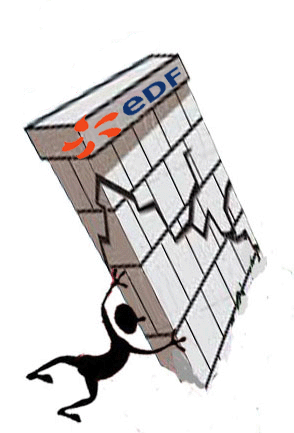
The recent collapse of France’s minority government has deepened uncertainty about the future of a controversial deal state-owned EDF struck with the government a year ago with the aim of replacing the Arenh regulation. Arenh, which expires in 2026, required EDF to sell about a third of its annual nuclear output to rival suppliers at a fixed rate of EUR 42/MWh, but this new deal does away with a fixed price and allows EDF to sell all its atomic output on the wholesale market.
The firm says it will aim to sell this output an average price of EUR 70/MWh via long-term supply contracts, auctions, and a tax on wholesale nuclear output. Not only has this provoked fierce criticism from rival suppliers and intensive power consumers who will probably be forced to pay more for their power supplies, but it has also spectacularly failed to attract any takers for EDF’s long-term supply contracts due to lower wholesale prices, potentially endangering the company’s ability to service its huge debts or maintain and expand its nuclear fleet. So, what should France do next? Reporting by Chris Eales, Editor France. Additional reporting by Caroline Pailliez. Contributor: Andreas Rudinger, energy transition expert, IDDRI.
Nuclear Stocks Were Super Hot Just A Month Ago. What’s Changed?
Oil Price, By Alex Kimani – Dec 10, 2024
- However, nuclear energy stocks have lately lost momentum, mostly because the sector was seriously overheating.
- NuScale Power Corp. has lost more than 30% of its share price in the current month.
Over the past couple of years, the nuclear energy sector has enjoyed a renaissance in the U.S. and many Western countries thanks to the global energy crisis triggered by Russia’s war in Ukraine, high power demand and nuclear’s status as a low-carbon energy source. Uranium demand has soared thanks to a series of policy “U-turns” with governments from Japan to Germany revising plans to phase out nuclear power. Uranium spot prices hit an all-time high of $81.32 per pound in February, double the level 12 months prior. According to the World Nuclear Association, demand from reactors is expected to climb 28% by 2030, and nearly double by 2040. Not surprisingly, the sector’s popular benchmark, VanEck Uranium and Nuclear ETF (NYSEARCA:NLR), recently hit an all-time high.
However, nuclear energy stocks have lately lost momentum, mostly because the sector was seriously overheating. One of the biggest losers has been NuScale Power Corp.(NYSE:SMR), with the stock crashing nearly 30% in the current month. The selloff kicked off about three weeks ago after the company disclosed an agreement with several brokerage firms in which the company may offer and sell from time to time as much as $200M in common stock. NuScale says proceeds from the sale will be used for general corporate purposes, including operating expenses, capital expenditures, R&D costs and working capital.
NuScale is a developer of modular light-water reactor nuclear power plants. Small modular nuclear reactors (SMRs) are advanced nuclear reactors with power capacities that range from 50-300 MW(e) per unit, compared to 700+ MW(e) per unit for traditional nuclear power reactors. Back in October, we reported that NextEra Energy (NYSE:NEE) CEO John Ketchum revealed that he’s “not bullish” on small modular reactors (SMRs), adding that the company’s in-house SMR research unit has so far not drawn favorable conclusions about the technology.
“A lot of [SMR equipment manufacturers] are very strained financially,” he said. “There are only a handful that really have capitalization that could actually carry them through the next several years.”……………………………………………………………………………………………………… https://oilprice.com/Alternative-Energy/Nuclear-Power/Nuclear-Stocks-Were-Super-Hot-Just-A-Month-Ago-Whats-Changed.html
Starmer to court UAE for British nuclear power investment
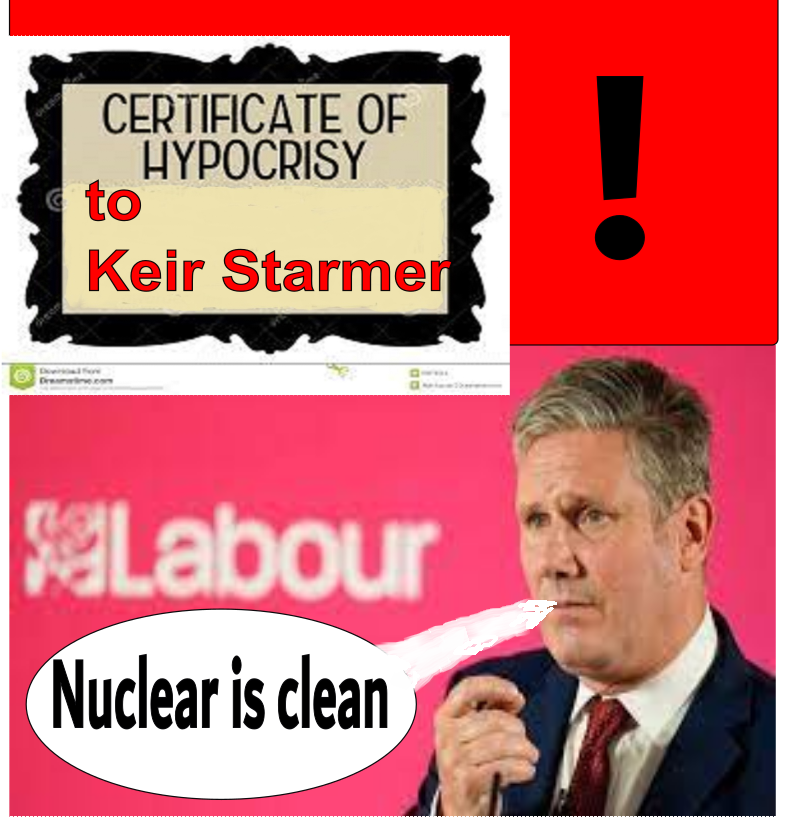
The Prime Minister is expected to tell sovereign wealth fund bosses ‘you can trust us’ on Sizewell C
Matt Oliver, Industry Editor,
https://www.telegraph.co.uk/business/2024/12/07/starmer-to-court-uae-for-sizewell-c-nuclear-investment/
Sir Keir Starmer will court the powerful bosses of United Arab Emirates’ (UAE) sovereign wealth funds this week as he seeks to raise funding for the Sizewell C nuclear project.
On a tour of the Gulf, the Prime Minister is expected to court investment into British infrastructure, including the proposed nuclear power plant on the coast of Suffolk.
His visit will include a meeting with representatives from Mubadala, one of Abu Dhabi’s sovereign wealth funds, sources told The Telegraph.
Those present are expected to include Khaldoon Al Mubarak, Mubadala’s chief executive and the right-hand man to Sheikh Mansour bin Zayed Al Nahyan, the UAE vice president and Manchester City football club owner.
A source said the message would be “you can trust us”, amid concerns about the long-term commitment of successive UK administrations both to nuclear power and major infrastructure schemes.
Downing Street declined to comment. Mubadala was approached for comment.
It comes as the Government seeks to get more investors on board with Sizewell C, after a capital raise process that has dragged on longer than originally anticipated.
Five potential backers are still in the running officially, the boss of Sizewell C confirmed on Thursday.
They are thought to include British Gas owner Centrica, the Emirates Nuclear Energy Corporation (Enec), Schroders Greencoat and Amber Infrastructure Group.
However, sources familiar with the situation said the Government hoped additional investors may contribute cash by teaming up with those already involved in the process.
Mubadala may channel funds into Sizewell via Enec, for example. The UAE companies have teamed up to invest in numerous other global projects in the past, one industry insider said.
Ministers previously hoped to take a final investment decision on Sizewell C by the end of this year but it was confirmed in the Budget that it would not happen until the spring, with the project’s fate now understood to be tied up with Chancellor Rachel Reeves’s spending review.
A key issue ministers are grappling with is the need to put the full cost of the Sizewell project – which could be anything between £20bn and £40bn – on the public balance sheet, despite the Government’s intention to sell a significant portion of shares in the project to outside investors.
Currently, the Government owns more than 80pc of the equity, with the French state nuclear giant EDF owning the rest.
Hinkley dilemma
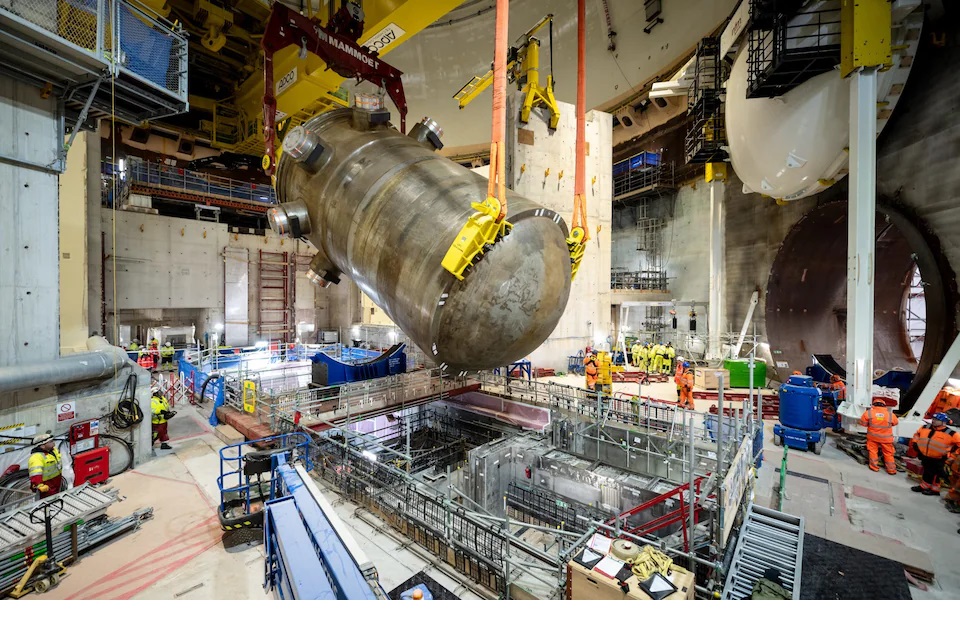
Elsewhere, ministers also face a dilemma over the Hinkley Point C plant in Somerset.
The project, which is majority-owned by EDF, is grappling with a £5bn funding shortfall after co-investor China General Nuclear refused to put in more cash.
That followed the Government’s decision to block Chinese involvement in Sizewell C and other future nuclear projects amid national security concerns.
EDF has called on the UK to step in and help support the project, a suggestion that ministers have so far resisted, with Paris said to be reluctant to put more money into the plant. Hinkley is on course to open years late and cost up to £45bn – far more than planned.
The Telegraph revealed in October that Centrica had emerged as a potential white knight investor in Hinkley, as the electricity supplier looks to replace income generated by other British nuclear plants it owns stakes in as they close.
Ed Miliband to bring more misery for Brits and send bills skyrocketing

New projects could be launched by Ed Miliband – and they will hit British taxpayers in the pocket.
By Tom Burnett, Dec 7, 2024 ,
https://www.express.co.uk/news/politics/1985657/ed-miliband-nuclear-energy-costs-bills-rising
Ed Miliband could be about to send energy bills soaring – as he confirms plans for new major nuclear projects in the UK.
The Energy and Net Zero Secretary has said nuclear power is vital for Labour’s Net Zero plans, and that his ‘door is open’ to tech companies hoping to build ‘modular’ reactors in Britain.
Mr Miliband has argued these projects could deliver ‘big returns’ for the country, and said the Government is exploring how it can help private developers bring advanced nuclear projects to market and ia consulting on a new nuclear planning framework and siting policy next year.
However, bosses at interested firms are reportedly calling for some assurance of financial support to make sure their projects get a minimum return.
While it is currently unclear precisely how these would be funded, the Telegraph reports that options include ‘regulated asset base scheme’ or contracts for difference that are currently awarded to wind and solar farms.
The ‘regulated asset base’ scheme allows investors to begin clawing costs back via customer bills before a project is completed – leading to concerns people could be hit in the pocket.

Speaking at the Nuclear Industry Association’s Nuclear 2024 conference on Thursday, Mr Miliband said: “Of course, it’s early days but we should be open to the potential of SMRs to power the fourth industrial revolution, just as coal powered the first.
My message is clear: if you want to build a nuclear project in Britain, my door is open. My department is listening.
“We want all your ideas for projects that can work and provide value for money.”
Great British Nuclear, a public body which helps bring forward new nuclear energy projects, has started negotiations with four bidders for the UK’s small modular reactor programme, and final decisions are due in spring.
Mr Miliband he was “delighted” that four of Britain’s five nuclear power stations will stay open longer than previously planned, as announced by their operator EDF.
Heysham Two, in Lancashire, and Torness in East Lothian will keep producing electricity for an extra two years until March 2030, while Heysham One and another station in Hartlepool, north-east England, will produce power until March 2027, a year extension.
UK Seeks More Investors as Sizewell Funding Talks Drag On

The UK government is speaking with investors beyond the core group of existing bidders for a stake in the country’s Sizewell C nuclear plant as talks to finalize the project’s funding continue.
Financial Post, Bloomberg News, William Mathis, Priscila Azevedo Rocha and Aaron Kirchfeld, Dec 05, 2024
he UK government is speaking with investors beyond the core group of existing bidders for a stake in the country’s Sizewell C nuclear plant as talks to finalize the project’s funding continue.
The government has recently approached infrastructure and other private investors to provide equity to Britain’s next large-scale nuclear power plant, according to people familiar with the matter. The talks come at a critical time for the UK as it seeks to attract financing to overhaul the country’s power grid this decade.
The country recently delayed funding for the project until at least spring 2025, pushing back a previous target to take a final investment decision by the end of the year. Finding investors willing to participate in new nuclear plants is crucial to plans to cut emissions and reach 2050 net zero goals.
The government has been seeking investors for the Sizewell C project for more than a year and canvassed a wide variety of potential backers before honing in on a smaller group of interested parties, the people said. It’s not clear whether any of the investors being contacted now would be able to join the current fundraising process, or if they would buy into a subsequent round as the government further sells down its stake. ……………………………………
A spokesperson for the Department for Energy Security & Net Zero said the autumn budget confirmed the current equity and debt raising process will move to its final stages shortly and will conclude in the spring. A final investment decision on whether to proceed with the project will be taken in the multiyear spending review, they added.
The Sizewell project — owned by the government and minority stakeholder Electricite de France SA — could eventually cost an estimated £20 billion ($25.3 billion) and take roughly a decade to build.
The government has previously engaged in discussions with investors including Centrica Plc, Emirates Nuclear Energy Corp., Amber Infrastructure Group Ltd. and Schroders Greencoat LLP and the conversations are ongoing, the people said, asking not to be named because the talks are private. Barclays Plc is advising the UK government.
Spokespeople for Barclays and Centrica declined to comment, while representatives for ENEC, Amber Infrastructure and Schroders didn’t immediately respond to queries.
Centrica Chief Executive Officer Chris O’Shea has said on various occasions that the company’s engagement in any UK infrastructure projects, including Sizewell, would hinge on the “right conditions.”
At the moment, the only nuclear power station under construction in the UK is Hinkley Point C, which has been repeatedly delayed and is expected to cost as much as £47.9 billion in current terms. EDF is also holding talks with investors over funding for Hinkley as the French utility grapples with the ballooning cost of the project.
https://financialpost.com/pmn/business-pmn/uk-looks-for-more-investors-as-sizewell-c-funding-talks-drag-on
1 This Month
19 February – VIRTUAL EVENT-Decision Time: AI and Our Nuclear Arsenal
12:45 p.m. Central / 1:45 p.m. Eastern
To see nuclear-related stories in greater depth and intensity – go to https://nuclearinformation.wordpress.com
-
Archives
- February 2026 (127)
- January 2026 (308)
- December 2025 (358)
- November 2025 (359)
- October 2025 (376)
- September 2025 (258)
- August 2025 (319)
- July 2025 (230)
- June 2025 (348)
- May 2025 (261)
- April 2025 (305)
- March 2025 (319)
-
Categories
- 1
- 1 NUCLEAR ISSUES
- business and costs
- climate change
- culture and arts
- ENERGY
- environment
- health
- history
- indigenous issues
- Legal
- marketing of nuclear
- media
- opposition to nuclear
- PERSONAL STORIES
- politics
- politics international
- Religion and ethics
- safety
- secrets,lies and civil liberties
- spinbuster
- technology
- Uranium
- wastes
- weapons and war
- Women
- 2 WORLD
- ACTION
- AFRICA
- Atrocities
- AUSTRALIA
- Christina's notes
- Christina's themes
- culture and arts
- Events
- Fuk 2022
- Fuk 2023
- Fukushima 2017
- Fukushima 2018
- fukushima 2019
- Fukushima 2020
- Fukushima 2021
- general
- global warming
- Humour (God we need it)
- Nuclear
- RARE EARTHS
- Reference
- resources – print
- Resources -audiovicual
- Weekly Newsletter
- World
- World Nuclear
- YouTube
-
RSS
Entries RSS
Comments RSS
 nuclear-news