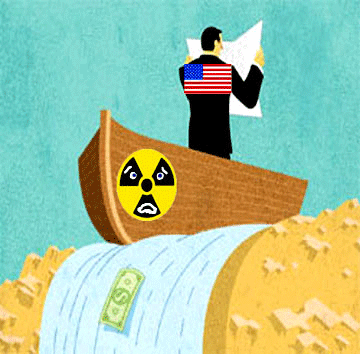
 How two cutting edge U.S. nuclear projects bankrupted Westinghouse, Reuters, By Tom Hals and Emily Flitter | WILMINGTON, DEL./NEW YORK, 2 May 17
In 2012, construction of a Georgia nuclear power plant stalled for eight months as engineers waited for the right signatures and paperwork needed to ship a section of the plant from a factory hundreds of miles away.
The delay, which a nuclear specialist monitoring the construction said was longer than the time required to make the section, was emblematic of the problems that plagued Westinghouse Electric Co as it tried an ambitious new approach to building nuclear power plants.
The approach – building pre-fabricated sections of the plants before sending them to the construction sites for assembly – was supposed to revolutionize the industry by making it cheaper and safer to build nuclear plants.
But Westinghouse miscalculated the time it would take, and the possible pitfalls involved, in rolling out its innovative AP1000 nuclear plants, according to a close examination by Reuters of the projects.
Those problems have led to an estimated $13 billion in cost overruns and left in doubt the future of the two plants, the one in Georgia and another in South Carolina.
Overwhelmed by the costs of construction, Westinghouse filed for bankruptcy on March 29, while its corporate parent, Japan’s Toshiba Corp, is close to financial ruin [L3N1HI4SD]. It has said that controls at Westinghouse were “insufficient.”
The miscalculations underscore the difficulties facing a global industry that aims to build about 160 reactors and is expected to generate around $740 billion in sales of equipment in services in the coming decade, according to nuclear industry trade groups.
The sector’s problems extend well beyond Westinghouse. France’s Areva is being restructured, in part due to delays and huge cost overruns at a nuclear plant the company is building in Finland………
the source of the biggest delays can be traced to the AP1000’s innovative design and the challenges created by the untested approach to manufacturing and building reactors, according to more than a dozen interviews with former and current Westinghouse employees, nuclear experts and regulators.
Unlike previous nuclear reactors, the AP1000 would be built from prefabricated parts; specialized workers at a factory would churn out sections of the reactor that would be shipped to the construction site for assembly. Westinghouse said in marketing materials this method would standardize nuclear plant construction..…..
By 2016 Westinghouse began to grasp the scope of its dilemma, according to a document filed in its bankruptcy: Finishing the two projects would require Westinghouse to spend billions of dollars on labor, abandoning them would mean billions in penalties.
Westinghouse determined it could not afford either option. http://www.reuters.com/article/us-toshiba-accounting-westinghouse-nucle-idUSKBN17Y0CQ
May 3, 2017
Posted by Christina Macpherson |
business and costs, technology, USA |
Leave a comment
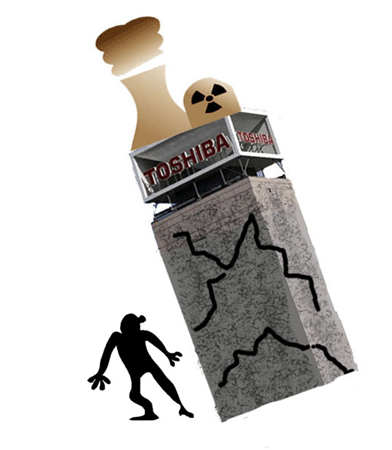 http://breakingenergy.com/2017/05/02/toshiba-to-split-into-four-subsidiaries/ By MICHAEL VINCIon May 02, 2017 Early this year, Toshiba made the strategic decision to divest from its Westinghouse nuclear power generator in America. Now, the Chinese company has decided that splitting into subsidiaries is the only way to protect its other businesses. The four subsidiaries will be (1) infrastructure (including water treatment and railways); (2) energy (including thermal and nuclear power); (3) electronics (including data storage); (4) information and communications.
With the exception of the new energy subsidiary, the rest of the spin-offs would come into being in July 2017. Energy is set to be in effect in October.
The significant of the bankruptcy of Westinghouse is still unclear – many are concerned that the shutdown will have an effect on the nuclear power sector. As the four new subsidiaries demonstrate, the ramifications of this bankruptcy are clearly having their way with Toshiba.
On the eve of the imminent bankruptcy, Moody’s Investors Service
changed their outlook on all five utility companies involved in the project. Each was given a negative outlook.
The measures taken by Moody’s apply to the Vogtle entities. That is, Georgia Power, Oglethorpe Power and the Municipal Electric Authority of Georgia. Also included are the entities of the Summer project. Specifically, SCANA Corp. and the South Carolina Electric and Gas Subsidiary, as well as to the South Caroline Public Service Authority.
Moody’s justifies the new outlook as being reflective of the increased credit and regulatory risk that will be a result of the bankruptcy. The depleted financial condition of Toshiba contributes to this risk. In February, the company took a $6.3 billion write-down associated with Westinghouse’s overrun costs at the two nuclear projects in America.
Now, the bankruptcy has left Toshiba with what can amount to billions of dollars in potential losses. This presents serious struggles for the nearly 150 year old conglomerate. After the bankruptcy was announced, Toshiba shares in Tokyo stumbled nearly 4%. Moreover, losses from last year left the company with $2.1 billion of negative shareholder equity, which threatens its position on the Tokyo Stock Exchange.
More immediate concerns for the company include the expiration of construction licenses, which are needed to sell equipment to the power industry. Unfortunately, the licenses have to be renewed every five years, but require that the company meet certain equity and capital targets. Toshiba’s weakened state jeopardizes the renewal process.
Some of Toshiba’s other revenue streams offer products such as turbines for gas, hydro, and geothermal plants. These power sector products are important to the company, and so the decision to create the subsidiaries is largely to protect those businesses from the potential fall out regarding the Westinghouse bankruptcy. Otherwise, the bankruptcy might end up being a roadblock to engaging in the power sector further.
With regards to the nuclear industry, the bankruptcy has the potential to threaten the completion of two current reactor projects in progress in the Southeast. Further, there is practically zero change that any new nuclear facility in the U.S. will be built in the foreseeable future.
Simply put, nuclear facilities are no longer cost effective. They were intended as an alternative to dirty fossil fuels and expensive green energy, but neither of those are as problematic as they used to be. It seems as if the industry has no prospects left.
May 3, 2017
Posted by Christina Macpherson |
business and costs, Japan |
Leave a comment
 Utility’s mistakes might be ours to pay http://www.ajc.com/news/opinion/readers-write-may/rlDY9xschJoqXhxcIRO6LL/, DON MCADAM, SANDY SPRINGS, 2 May 17
Ratepayers in Georgia paid in advance for Georgia Power’s multibillion-dollar gamble on two new nuclear reactors at plant Vogtle. We were told at the time that it was in our best interest to pay up front. But much of the money we paid up front actually was realized as profit for shareholders. Maybe that helps explain why Southern Company’s stock price has risen about 60 percent since work began in 2009.
In December of last year, the Public Service Commission decided that ratepayers should pay for almost all of the accumulated overages. Those overcharges amounted to billions of dollars. And now, the entire project might be scrapped. The PSC’s Tim Echols jumps into action. According to Echols, someone other than Georgia Power should pay for Georgia Power’s mistakes. Ratepayers should never have had to pay for this fiasco. Maybe Echols finally realizes this. So now he’s begging for a bailout from our federal government.
May 3, 2017
Posted by Christina Macpherson |
business and costs, USA |
Leave a comment
Deadline dodged, Southern, SCANA weigh wresting nuclear plants from Westinghouse, Utility Dive, Gavin Bade@GavinBade Peter Maloney@TopFloorPower , 2 May 17
Dive Brief:
- Southern Company and SCANA reached interim agreements with nuclear developer Westinghouse on Friday to continue construction on two nuclear plants as the developer works through bankruptcy proceedings.
- SCANA and Santee Cooper, South Carolina’s state-owned utility, agreed to an extension of an interim agreement with Westinghouse that will see the contractor continue construction on the V.C. Summer nuclear plant through June 26.
- Southern Co. subsidiary Georgia Power also extended its construction agreement with Westinghouse on the Vogtle nuclear plant, but only until May 12. Both construction agreements were slated to expire at midnight on Friday, and the companies will use the extra time to evaluate if they should take control of construction from Westinghouse.
Dive Insight:
The utility teams building nuclear reactors in Georgia and South Carolina were scrambling Friday as they addressed the end of 30-day agreements with bankrupt Westinghouse Electric, the contractor for those plants.
Officials at SCANA and Santee Cooper, which are building two reactors at the V.C. Summer nuclear station in South Carolina, reportedly said they would use the time to evaluate whether to take control of the project from Westinghouse or abandon it……..
Westinghouse’s bankruptcy has raised deep doubts over the fate of the only two new nuclear plants to be built in the United States in 30 years. Both nuclear projects are years behind schedule and billions of dollars over budget, which helped push Westinghouse into bankruptcy at the end of March and prompted parent company Toshiba to plan a split into four separate subsidiaries.
Both projects are also working against a Dec. 31, 2020, in-service deadline to be eligible for a $0.018/kWh federal production tax credit. Last week, SCANA officials told analysts that extending the deadline for those incentives could be key to completing the projects. http://www.utilitydive.com/news/deadline-dodged-southern-scana-weigh-wresting-nuclear-plants-from-westing/441578/
May 3, 2017
Posted by Christina Macpherson |
business and costs, USA |
Leave a comment

 CSIR proposes excluding nuclear http://www.iol.co.za/business-report/energy/csir-proposes-excluding-nuclear-8920098
 2 May 2017 Johannesburg – For the latest Integrated Resource Plan for Electricity in South Africa, IRP 2016, the Council for Scientific and Industrial Research (CSIR) proposes a “Least Cost”, unconstrained scenario, or a “Decarbonised” scenario, both of which exclude nuclear power in the electricity mix to 2050.
This is the executive summary of the full submission and response by the CSIR to the Draft Integrated Resource Plan for Electricity (Draft IRP 2016) issued by the South African Department of Energy in November 2016, for comment and input from relevant stakeholders and the general public by end March 2017.
The CSIR is the national scientific and industrial research facility of South Africa, reporting to the South African Department of Science and Technology.
Click here to download the full CSIR response, study and report
Executive summary
by Jarrad G. Wright, Tobias Bischof-Niemz, Joanne Calitz, Crescent Mushwana, Robbie van Heerden and Mamahloko Senatla, CSIR
As defined in the Electricity Regulation Act, 2006; the Department of Energy (DoE), the system operator and the National Energy Regulator of South Africa (NERSA) are responsible for the development of the Integrated Resource Plan (IRP) as a plan for the electricity sector at the national level in South Africa. The IRP broadly includes input planning assumptions (on the supply and demand side), a modelling process and scenario planning following which a base plan is derived from the least-cost generation investment requirements within the electricity sector. The primary result from the IRP is the identification of the generation capacity required (per technology) and the requisite timing in the long-term based on a set of input assumptions and predefined constraints.
The most recent approved and gazetted version of the IRP is the IRP 2010-2030. The current revision of the IRP (the Draft IRP 2016) was published by the DoE for public comment in October 2016 and includes updated input assumptions including demand forecasts, existing plant performance, supply technology costs, decommissioning schedules and newly commissioned/under construction as well as preferred bidder power generators (as part of the Renewable Energy Independent Power Producer Programme (REIPPPP) and base-load coal Independent Power Producer (IPP) program). The time horizon for the draft IRP 2016 is up to the year 2050. The plan defined some preliminary results in the form of a proposed Base Case and two other selected scenarios.
As part of the IRP update process, the DoE engages in a multi-stage stakeholder engagement process (including public engagements) to ensure all affected stakeholders are consulted including national and local government, business, organised labour and civil society. This document contains the CSIR’s formal comments on the draft IRP 2016.
The CSIR determined the least cost, unconstrained electricity mix by 2050 as input into the IRP 2016 public consultation process. A conservative approach is always taken where pessimistic assumptions for new technologies and optimistic assumptions for established technologies are always made. More specifically; conventional technologies (coal, nuclear, gas CAPEX) were as per IRP 2016, stationary storage technologies (batteries) were as per IRP 2016, natural gas fuel costs were assumed slightly more expensive than IRP 2016, solar PV was aligned with original IRP 2010 cost assumptions while wind is kept constant into the future at the latest South African REIPPPP result (by 2030/2040/2050). Job numbers were also conservative (from McKinsey study commissioned by the DoE in the context of the Integrated Energy Plan (IEP)) but adjusting upwards for coal power generation
and coal mining.
The result of this is that it is least cost for any new investment in the power sector to be solar PV, wind or flexible power. Solar PV, wind and flexible power generators (e.g. gas, CSP, hydro, biogas) are the cheapest new-build mix. There is no technical limitation to solar PV and wind penetration over the planning horizon until 2050. A >70% renewable energy share by 2050 is cost optimal, replacing all plants that decommission over time and meeting new demand with the new optimal mix.
South Africa has the unique opportunity to decarbonise its electricity sector without pain. By this, the authors mean that clean and cheap are no longer trade-offs anymore. The Least Cost scenario run is the mix that is the cheapest, emits less CO2, consumes less water and creates more jobs in the electricity sector than both Draft IRP 2016 Base Case and Carbon Budget scenarios.
In this submission, deviations from Least Cost have been quantified to inform policy adjustments. Compared to the Least Cost:
The IRP 2016 Base Case is R70-billion/year more costly, emits twice as much CO2, two and a half times more water is consumed and provides 10% less jobs by 2050.
The IRP 2016 Carbon Budget scenarion is R60-billion/year more costly, emits 15% more CO2, consumes 20% more water and provides 20% less jobs by 2050.
The Decarbonised scenario is R50-billion/year more costly, 95% decarbonised, uses 30% less water and provides 5% more jobs by 2050.
Read also: #NuclearDeal: Full judgment
The Least Cost scenario is also adaptable and resilient to a range of input assumption changes relative to other scenarios and therefore more robust against unforeseen changes in demand and cost. In addition to the detailed study performed to determine the Least Cost energy mix for South Africa, this submission includes technical aspects of power system operations and planning including transmission network infrastructure requirements and system services.
The cost of ensuring system frequency stability (sufficient system inertia) has been quantified in this submission. Connecting conventional technologies (nuclear/coal/gas) via HVDC and/or solar PV/wind to the grid reduces system inertia. This reduces the inherent stabilising effect of synchronous inertia during contingency events. Many technical solutions to operate low-inertia systems are available but the CSIR assumed a worst case using state-of-the-art technology (very high costs, no further technology and/or cost advancements) nor further increase in engineering solutions to deal with low-inertia systems. In all scenarios, the worst-case cost are well below 1% of total cost of power generation by 2050 (some scenarios are much lower than 1%).
Transmission network infrastructure was costed at a high level for selected scenarios (Base Case, Carbon Budget and Least-Cost). The high-level cost estimates for shallow and deep grid connection costs for all scenarios showed that the Least Cost scenario scenario is also R20-30 billion/yr cheaper compared to the Draft IRP 2016 Base Case and Carbon Budget case on transmission network infrastructure requirements.
Click here to download the full CSIR response, study and report
May 3, 2017
Posted by Christina Macpherson |
business and costs, politics, South Africa |
Leave a comment
 Eskom confirms that Russians will continue nuclear bid, IOL, 30 April 2017, SIYABONGA MKHWANAZI
Cape Town – The Russians will continue to prepare to bid for the nuclear-build programme, despite the decision by the Western Cape High Court to halt it.
Eskom confirmed this and awaits further directives from the government.
Friday was the deadline for all bidding companies to submit Request for Information documentation to Eskom.The court decision has also affected the deadline for the issuing of the Request for Proposals in June.
Head of Rosatom in Southern Africa, Viktor Polikarpov, told Independent Media nothing had changed with their plans to bid for the nuclear programme.
He said they would not want to comment on the case because it was a matter involving government and civil society, who took the matter to court.
Energy Minister Mmamoloko Kubayi has said she is still studying the judgment, and would not comment on whether to appeal against the court decision or not.
Kubayi will appear before MPs on Tuesday, where she will face questions on the nuclear programme.
Polikarpov said the nuclear process was not in their hands, but in the hands of the government.“We are prepared on the bidding, but much will depend on the government, how it will sort out the court issue,” he said.
Eskom spokesperson Khulu Phasiwe said the court decision had effectively nullified the process……..
He said it was clear that everything had to be nullified and started from scratch if the government still wanted to continue with the nuclear programme.
The judgment found the process followed was unlawful and unconstitutional………http://www.iol.co.za/news/politics/eskom-confirms-that-russians-will-continue-nuclear-bid-8877208
May 1, 2017
Posted by Christina Macpherson |
marketing, Russia, South Africa |
Leave a comment
Lifeline for Nuclear Plants Is Threatening Wind and Solar Power, Bloomberg by Joe Ryan April 25, 2017,
The push to save U.S. nuclear plants for the sake of fighting climate change is threatening support for the bread and butter of clean power: wind and solar. New York and Illinois have already approved as much as $10 billion in subsidies to keep struggling reactors open for the next decade as part of a plan to limit fossil fuel consumption. Lawmakers in Ohio, Connecticut and New Jersey are debating whether to do the same…….
Many environmentalists remain leery of supporting nuclear power, citing terrorism risks, the problem of dealing with spent nuclear fuel, and more. Instead of propping up struggling reactors, states should promote energy efficiency and encourage development of wind, solar and power storage, said John Coequyt, the Sierra Club’s director of climate campaigns.
Nuclear’s economic woes comes as wind and solar are starting to show they’re cheap enough to compete with traditional generators, after years of help from subsidies. …..
There are key differences between wind and solar subsidies and those for nuclear, according to clean-energy developers. Renewable energy credits have spurred an emerging industry, whereas nuclear subsidies are to preserve aging plants. And while wind and solar developers compete against each other for subsidies, those for nuclear benefit a single technology.
Market Rules
“The renewables industry has been playing by competitive market rules that have helped to produce good prices,” Amy Francetic, an Invenergy senior vice president, said in an interview. “This is picking and winners and losers in a way that’s troubling.”
Propping up nuclear plans won’t be cheap. If every reactor across the northeast and mid-Atlantic wins subsidies at the same level as those New York, ratepayers would need to pay an additional $3.9 billion annually, according to Bloomberg Intelligence. The subsides are being challengedin federal court by power generators including Dynegy Inc. and NRG Energy.
“This has taken a lot of wind from the green economy’s sails,” Abraham Silverman, an attorney for NRG, said in an interview. “We see an enormous lost opportunity to invest in truly clean infrastructure.”…..https://www.bloomberg.com/news/articles/2017-04-24/lifeline-for-nuclear-in-u-s-states-seen-threatening-wind-solar
May 1, 2017
Posted by Christina Macpherson |
business and costs, politics, renewable, USA |
Leave a comment
 Time, money and taxes weigh on troubled SCANA nuclear project, http://www.bizjournals.com/charlotte/news/2017/04/28/time-money-and-taxes-weigh-on-troubled-scana.html Apr 28, 2017, SCANA Corp.’s 30-day agreement with Westinghouse Electric Co. that allows work to continue at the $16 billion V.C. Summer nuclear project expires today. But SCANA executives say they are confident that they can get a 60-day extension before time runs out.
Meanwhile, work at the site continues to go more slowly than expected, adding to the chronic delays that have driven up the project’s price tag. And SCANA (NYSE:SCG) says it is watching efforts in Congress to extend production tax credits for nuclear plants. SCANA concedes that if they are not extended, it would make it difficult to continue with the project.
Questions about the troubled expansion at Summer — plagued by cost overruns, delays and now Westinghouse’s filing for Chapter 11 protection from creditors— dominated SCANA’s earnings call Thursday. And with only a few answers available now, the questions are likely to continue for much of the coming 60 days.
As Westinghouse filed for Chapter 11 protection March 29, SCANA and Southern Co. (NYSE:SO) reached 30-day agreements with Westinghouse to keep construction work going at Summer and the Plant Vogtle nuclear project.
‘No impediments’
SCANA is using the time to determine whether it makes sense to take over construction management and try to complete the two nuclear reactors under construction, or abandon the project. During the review, SCANA is essentially paying all the contractors on the site — either directly or through disbursements to Westinghouse.
But SCANA officials did not expect to be able to complete the review by now. From the start, the company said it would need another 30 to 60 days.
Chief Operating Officer Steve Byrne expressed confidence that extension, for 60 days, is forthcoming.
“As of right now — and there are always a lot of last minute details to be taken care of — we don’t see any impediments … to having an agreement in place sometime by either later today or tomorrow,” he told analysts Thursday.
But no deal was announced yesterday, and the current agreement expires at midnight.
April 29, 2017
Posted by Christina Macpherson |
business and costs, USA |
1 Comment
 Solar juggernaut marches on as costs continue to fall http://reneweconomy.com.au/solar-juggernaut-marches-costs-continue-fall-47153/ [good graphs] By Sophie Vorrath on 24 April 2017 The global solar market looks set to continue on its trajectory of extraordinary growth, driven by further reductions in the costs of the technology, and a possible post-Trump “gold rush” that is brewing in the US.
The onward march of the solar juggernaut has been predicted by global investment group Deutsche Bank, whose latest report bumped up its 2017 estimate for total demand to 82GW, from a previous forecast of 74GW.
This has certainly been the pattern of recent decades, with dramatic growth rates of PV consistently beating – and sometimes smashing – analyst predictions. And while Deutsche Bank and other analysts continue to flag a slow-down in the market’s near future, it is not expected to happen this year, mainly due to stronger growth forecast for China.
“We are raising our 2017 global demand estimate from 74GW to 82GW, mainly due to expectations of stronger growth in China (from 17GW to 25GW),” the Deutsche Bank report says.
A similar adjustment was made earlier this month by US-based GTM Research, which replaced a projected -7 per cent global PV market contraction with a forecast of 9.4 per cent growth in its latest quarterly report, the Global Solar Demand Monitor.
GTM Research now projects that the annual global solar market’s size will reach 85 GW in 2017, slightly higher than Deutsche’s forecast – and more than double the installed capacity in 2014.
As Deutsche notes in its quarterly report, published on Friday, a good deal of this market momentum is being fuelled by falling PV technology costs, with some developers asking for less than 30c/W for solar modules in India in 2H17 and mid 20c/W in 2018.
Deutsche says this puts solar “at grid parity”, and while such low prices are not yet being offered by tier 1 Chinese suppliers, it believes a near 20 per cent reduction in poly-silicon prices will act as a catalyst for further price cuts for modules.
“Poly prices (down 17 per cent in the past seven weeks) have been declining faster than module prices as the supply chain in China has been focused on working down excess inventory,” the report says.
“We expect poly prices to approach $10-12/kg and module prices to decline to low 30c/W in 2H timeframe.”
Even in Australia, which gets no special mention in Deutsche Bank’s report, the cost of building large scale solar farms is falling to a fraction of the cost of new coal or gas plants. Indeed, according to the former head of Victoria’s Hazelwood brown coal generator, Tony Cancannon – who now heads up Reach Energy – the cost of large scale solar and storage is already competitive with gas-fired generation, and within a few years will be well below $100/MWh.
All the same, Deutsche still expects global solar demand to be “flattish” in 2018, but notes this could be countered by a final “gold rush” in the US – also driven by falling costs, from $60c/W to low $30c/W between Q3’16 and Q4’17.
“Our analysis suggests that project returns in the US could likely exceed the returns solar developers achieved in other markets during prior cycle peaks and these returns are unlikely to improve as incentives gradually decline or net metering phases out.
“As such, we expect the final “gold rush” in the US market to drive strong growth in US demand from 2018,” it says.
And as the table below illustrates [on original] , this view is supported by the strong pipeline of North American utility-scale solar projects, with roughly 8GW under development in Texas alone, and 31GW in the entire US.
But Deutsche also warns of possible speed-humps looming for global solar, such as a slow-down of growth in markets like India.
“Although declining solar module and system costs are driving significant improvement in downstream project economics in India, the pace of new solar project auctions has slowed down significantly,” the Deutsche report says.
According to the Bank’s data, project allocations in India have declined by 67 per cent to 2.9GW in FY17, while the SECI (Solar Energy Corporation of India) has also recently reduced a rooftop solar
tender from 1GW to 0.5GW.
The report puts the slow-down to difficulty securing PPAs in India, limited interest from developers, and tax increases.
“Beyond 2017, we expect overall growth in China to slow down and expect other emerging markets as well as the US to be the primary growth drivers,” the report says. “Our current estimates call for flattish demand in 2018.”
April 26, 2017
Posted by Christina Macpherson |
2 WORLD, business and costs, renewable |
Leave a comment
Most global investors recognise financial risk of climate change, report finds, Guardian, Paul Karp, 26 Apr 17, Global index reveals 60% of asset owners are now taking some action, but warns there is still ‘enormous resistance’ to managing climate risk For the first time a majority of global investor heavyweights recognise the financial risks of climate change, according to the results of a major global index rating how investors manage such risks.
But despite the advances, the Asset Owner Disclosure Project chairman, John Hewson, has warned there is still an “enormous resistance” to managing climate risk.
The AODP releases its fifth global index on Wednesday, ranking the world’s largest 500 asset owners and, for the first time, the 50 largest asset managers on their performance managing financial risks associated with climate change.
Asset owners and managers were scored on governance and strategy, portfolio carbon risk management and metrics and targets, and graded as leaders (A-AAA) rating), challengers (B-BBB), learners (C-CCC), bystanders (D-DDD) and laggards (X).
The index found that 40% of asset owners and just 6% of asset managers were classed as laggards, meaning they had a scored zero on the measures for managing and disclosing climate risks.
The report concluded that “the scales have tipped”, as 60% of asset owners are now taking some action.
Of the 500 asset owners, there are now 34 leaders, 34 challengers, 44 learners and 187 bystanders, an increase in all categories since the last year compared with laggards, which fell from 246 to 201 in number.
Australia and New Zealand were among the 10 best-performing countries, which were all in Oceania and Europe…..https://www.theguardian.com/environment/2017/apr/26/most-global-investors-recognise-financial-risk-of-climate-change-report-finds
April 26, 2017
Posted by Christina Macpherson |
2 WORLD, business and costs |
Leave a comment
Hitachi set for talks with business secretary Greg Clark over Welsh nuclear plant, http://www.cityam.com/263354/hitachi-set-talks-business-secretary-greg-clark-over-welsh Mark Sands City A.M’s political reporter, 23 Apr `17 . Bosses at Japanese energy giant Hitachi are due to meet business secretary Greg Clark for talks just weeks after the firm applied for approval to build its Wylfa nuclear project in Anglesey.
Hitachi chairman Hiroaki Nakanishi will meet with Clark this week as government planning continues over the creation of a fleet of new nuclear projects in the UK.
Horizon, a wholly owned subsidiary of Hitachi, plans to build and operate two nuclear reactors at Wylfa, capable of generating enough to power around 10 million homes by the mid 2020s.
The application to build the Wylfa reactors earlier this month was the first since 2011, and has been predicted to take around 19 months.
April 24, 2017
Posted by Christina Macpherson |
business and costs, UK |
Leave a comment
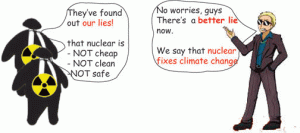 Paying Nuclear Losers for ‘Clean’ Power Upends U.S. Markets, Bloomberg by Jim Polson
April 22, 2017,
- Labeled emission-free, nuclear plants compete with cheaper gas
Some U.S. states are trying to save money-losing nuclear plants — and disrupting America’s electricity markets in the process. New York and Illinois have cleared the way for nuclear power to be subsidized with higher fees on buyers — aid normally reserved for renewable energy like solar and wind. One reason policy makers gave was to protect jobs at aging plants teetering on closure. Another was nuclear’s emission-free electricity, because states are trying to address climate change by relying less on fossil fuels like coal and natural gas. Connecticut and Ohio are considering similar moves, and pressure is mounting in New Jersey.
But federal regulators and gas-fueled generators including Dynegy Inc. and Calpine Corp. say the states are fundamentally altering the way wholesale power markets work. Armed with billions of dollars in new clean-energy benefits, higher-cost nuclear generators can now compete with companies that get no aid. The first test comes next month when PJM Interconnection LLC, the biggest grid, takes bids to supply power from Chicago to Washington.
“Markets only work if everyone’s competing evenly,” said Joseph Bowring, president of Monitoring Analytics, the company that oversees PJM’s electricity market. “If some get subsidies, then other people are going to want subsidies. And then pretty soon, we’re going to be competing for subsidies instead of competing in the market.”
For a primer on pressures generators face in PJM auction, read this.
While nuclear power has kept its share of U.S. electricity at around 20 percent over the past decade, it’s become a high-cost supplier with the emergence of gas-fired turbines burning cheap shale fuel, as well as more-efficient wind farms and solar panels. The country now gets more electricity from gas than from coal, which has seen its market share plunge.
All that cheap fuel has cut electricity prices, creating financial problems for aging nuclear plants. Five have closed in the past five years and more shutdowns are planned, primarily for economic reasons, according to the Energy Information Administration.
The industry calculus began to change in August when New York handednuclear plants so-called credits for supplying carbon-free power to the state, which means the generators can raise an additional $500 million a year from higher rates. Four months later, Illinois created similar credits to keep money-losing reactors open and 1,500 people employed.
Extra Fee
The way the incentives work is similar to what states have been doing for years to encourage emission-free power. Generators get “credits” for a designated amount of electricity. When that is sold to utilities, the buyers pay the generators an extra fee, which can be recovered in the form of higher bills to customers.
Nuclear incentives saved two plants in Illinois and three in New York, according to Kit Konolige, a senior utilities analyst at Bloomberg Intelligence. If subsidies were used to keep open all the nuclear plants in PJM, which doesn’t include New York, electricity supply in the region would be 10 percent higher than otherwise, depressing prices, he said.
On May 10, generators will begin bidding to supply a year of electricity in the PJM region starting June 2020, in return for fixed payments. It’s going to be one of the most closely watched events in the industry this year. Exelon Corp.’s Quad Cities nuclear plant was priced out of last year’s auction. This time, it can expect a subsidy from Illinois customers.
Only the newest and largest nuclear plants can sell power for $25 a megawatt hour, which is the price offered by most gas plants, according to Bloomberg Intelligence. With the help of credits, nuclear power narrows the gap, and generators can offer electricity at close to that price. Wholesale power at a major trading hub within PJM averaged $23.90 a megawatt-hour at 11:28 a.m. Friday in New York, grid data compiled by Genscape show.
Keep Running’
“If you’re getting revenue from one source, you don’t need as much from the auction, so you’re willing to accept less to keep running,” Konolige said.
As a result, prices in this May’s auction for a region covering Chicago may plunge about 16 percent from a year earlier, according to industry consultant Wood Mackenzie Ltd.…….
Operators of cheaper gas-fired power plants, including Dynegy, Calpine and NRG Energy Inc., describe the credits as “bailouts” that threaten to kill competitive markets at the expense of electricity customers. Electricity customers would pay $3.9 billion more if all nuclear plants competing in PJM’s and New England’s wholesale markets were part of programs like New York’s, a Bloomberg Intelligence analysis shows.
“It’s the equivalent of going out to buy a new car and finding out they’re giving them away down the street,” said Abe Silverman, deputy general counsel at Princeton, New Jersey-based NRG. “How are you supposed to compete with that?”
In Connecticut, consumer advocates are fighting the credits and accusing nuclear-plant owners of a money grab.
“Single-state solutions are going to screw up the entire deregulated market,” said John Erlingheuser, advocacy director for the AARP in Connecticut…….https://www.bloomberg.com/news/articles/2017-04-20/paying-nuke-losers-for-clean-energy-upends-u-s-power-markets
April 22, 2017
Posted by Christina Macpherson |
business and costs, USA |
Leave a comment
Three Mile Island, like much of nuclear industry, is on the brink Wallace McKelvey | WMckelvey@pennlive.com on April 19, 2017 Nuclear power, which generates more than a third of Pennsylvania’s electricity, could soon disappear from the state amid a glut of cheap natural gas from the Marcellus Shale play.
And the first of the state’s five plants to fall could be Three Mile Island, which could close as soon as 2019.
That’s the argument, at least, that TMI owner Exelon is making as it seeks the Legislature’s help to keep struggling reactors like TMI open. The same argument is being made in other states — Illinois and New York both moved to shore up nuclear plants in the last year.
In turn, the gas lobby and other advocacy groups have ramped up efforts to thwart a bailout of the nuclear industry that they say would lead to electric rate hikes.
Pennsylvania lawmakers from both chambers and both parties formed a “nuclear caucus” with the goal of crafting a proposal to rescue the industry this fall. For their part, caucus leaders say they’re not interested in bailouts or subsidies……
Exelon’s most recent SEC filing described TMI as the facility “at the greatest risk of early retirement due to current economic valuations and other factors….
“We’ve operated for the past six years at a loss,” said Joseph Dominguez, Exelon’s executive vice president of governmental and regulatory affairs and public policy. “We have effectively tried everything we can to weather the storm. I think the question in front of us now is how much longer we’re willing to go.”
For two years in a row, TMI failed to clear PJM’s capacity auction, meaning that it was not able to sell guaranteed power in 2019 and 2020…..
In Illinois, Exelon announced the closure of two of its nuclear power plants but reversed the decision when the governor signed off on a $235 million subsidy … Competitors have since filed lawsuits to block the measure.
Exelon isn’t the only nuclear energy company to consider closing plants in Pennsylvania. FirstEnergy Corp. announced that it would close or sell the Beaver Valley nuclear power station near Pittsburgh within the next year. PSEG, which owns half of Peach Bottom station in York County alongside Exelon, also said it wouldn’t operate nuclear plants that are unprofitable. It has pressed New Jersey for similar subsidies to continue operating its nuclear plants there…..
“Here’s what the U.S. government must do to bring about a gradual phase-out of almost all U.S. nuclear power plants: absolutely nothing,” former Nuclear Regulatory Commission member Peter Bradford wrote in 2013. He cited the “abundance of natural gas, lower energy demand induced by the 2008 recession, increased energy-efficiency measures, nuclear’s rising cost estimates and the accident at the Fukushima Daiichi Nuclear Power Station” in Japan……… http://www.pennlive.com/politics/index.ssf/2017/04/nuclear_power_three_mile_islan_1.html
April 21, 2017
Posted by Christina Macpherson |
business and costs, USA |
Leave a comment
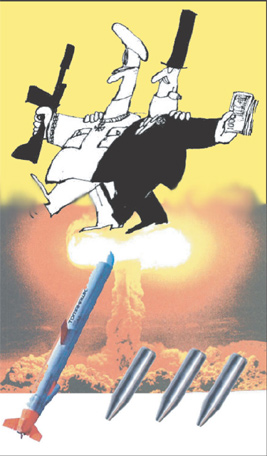
 Where Your Taxes Go: The Militarized Budget On the other hand, there is another side of the US government: the government of tax breaks and tax cuts for the rich, the one that squanders as much on the military as the next seven countries combined.
Only 22 percent of military taxes go to US troops for pay and benefits. Meanwhile, nearly half of the military budget goes to a powerful group of multinational corporations that make billions in profits from US warmongering.
Take Lockheed Martin. As the federal government’s biggest military contractor, it received $36 billion in taxpayer dollars in 2015, amounting to 80 percent of its revenues from all sources.
And that’s just one contractor. In all, the Department of Defense handed out more than $297 billion in contracts in 2016….Events like the Syria bombing, and Trump’s election, tend to send stock prices for these companies soaring.

Where Your Dollars Are Going: Why Some Antiwar Activists Are Withholding Taxes, April 18, 2017, By Lindsay Koshgarian, Truthout | News Analysis Among the marches, petitions and call-in campaigns that comprise much of the Trump resistance movement, one resistance tactic gets little attention: withholding taxes. As the US seems ready to slide into yet another Middle East war in Syria while preparing for massive cuts to government programs at home, what role does tax resistance play in opposing regressive and violent policies?
While being anti-tax is typically associated with conservatism, there is a small but longstanding tradition within the progressive movement of withholding taxes — specifically, war taxes.
How does tax resistance work, and does it result in a lack of support for government programs that most progressives support and would like to see grow? How much of our taxes go to war, the military and militarism anyway, and how much to worthy programs like education, aid for struggling families, the environment and more?
Paying income taxes may not usually spur introspection, but it might if Americans realized that, for example, they are working 27 days out of every year to pay taxes that support war profiteers. Most progressives and many on the right of the political spectrum would never willingly write a check to weapons contractors, or speak in support of weapons systems that will fuel tomorrow’s air strikes and drone attacks. If Lockheed Martin, the nation’s most prolific military contractor, were a store or coffee shop, many would boycott it. So why willingly give Lockheed $170 a year through taxes — which the average taxpayer now does?
Pride and Prejudice: How the Government Helps (and How Americans Pay for It) The extent to which government helps those who need it most and strengthens every community is certainly underappreciated in a country obsessed with “small government,” a nation that reveres former President Ronald Reagan, who once said, “The nine most terrifying words in the English language are: I’m from the government, and I’m here to help.”
Of course, the government does help. More than half of almost every group of Americans — from every region of the country, white, Black, Latino, rural, urban, conservative, liberal — have benefited at some point in their lives from government programs like Social Security, Medicare, Medicaid, food stamps, unemployment and welfare. Government programs are often targeted to help those most in need of aid or those historically oppressed. Half of the students who receive Pell grants for college tuition come from families with incomes below $15,223, and 77 percent of them would be the first generation of their families to earn a bachelor’s degree. Nearly one in four Pell recipients is Black. Meanwhile, programs like Meals on Wheels for seniors are almost universally beloved and respected for taking care of some of the most vulnerable members of our society. The federal government serves as a crucial source of support for many………
Where Your Taxes Go: The Militarized Budget
On the other hand, there is another side of the US government: the government of tax breaks and tax cuts for the rich, the one that squanders as much on the military as the next seven countries combined; the one that has increased its spending on federal prisons by 10 times over the last 40 years — the government that seeks to consolidate power and exert control over the world’s most vulnerable people.
The US government promotes an extreme overreliance on military might and a disturbing parallel of policing, incarceration, surveillance and immigration raids and deportations here at home. A recent National Priorities Project analysis of the US discretionary budget showed that 64 percent of the federal discretionary budget — the budget decided by Congress each year, which is covered almost entirely by income taxes — is devoted to the military and militarism: to making and preparing for war, dealing with the consequences of war, and to programs that amount to intimidation and oppression here at home.
At least 23 percent of income taxes go to the military — and if you count spending on veterans’ benefits, national debt due to past wars, or other militarized spending like that for the FBI, federal prisons or immigration enforcement, the estimates only go higher. In addition to paying an average of $3,290 in yearly income taxes for the traditional military, Americans each pay $88 for border control and immigration and customs enforcement, $33 for the federal prison system, and more for programs ranging from the FBI to the CIA and beyond.
Only 22 percent of military taxes go to US troops for pay and benefits. Meanwhile, nearly half of the military budget goes to a powerful group of multinational corporations that make billions in profits from US warmongering.
Take Lockheed Martin. As the federal government’s biggest military contractor, it received $36 billion in taxpayer dollars in 2015, amounting to 80 percent of its revenues from all sources. Lockheed used those taxpayer dollars to pay its CEO more than $19 million in 2015. Taxpayers contributed six times as much to this one weapons maker as they did to all foreign aid in 2016. This should give us pause when we consider how often the US turns to military intervention versus prevention, diplomacy or other means during international crises.
And that’s just one contractor. In all, the Department of Defense handed out more than $297 billion in contracts in 2016 — more than half of the department’s budget.
Events like the Syria bombing, and Trump’s election, tend to send stock prices for these companies soaring.
An Act of Resistance
So, how does it all balance out? Does the government help more than it harms? Is there a way to support the good while resisting the bad?
This is what some war tax resisters attempt to do. In practice, resisting war tax runs the gamut from not paying any taxes at all to withholding a token amount of tax — as low as a few dollars — as a way of registering resistance. For those who want to support the government in its helping capacities, or who want to see those capacities grow, the second may be the better option.
Clearly, resisting taxes is not for everyone — it can come with legal penalties, headaches and a good deal of uncertainty. And of course, war tax resisting is not the only way to influence how your tax dollars are used: calling, visiting or writing your representatives in government; voting; and engaging in street protests play key roles in resisting war and militarism. Still, we are in the midst of a big resistance, and for some, resisting tax may be just what the doctor ordered. http://www.truth-out.org/news/item/40248-where-your-dollars-are-going-why-some-anti-war-activists-are-withholding-taxes
April 19, 2017
Posted by Christina Macpherson |
business and costs, Reference, weapons and war |
Leave a comment
Staff writers news.com.au 19 Apr 17 FILTHY rich people who have prepared for nuclear warfare and other catastrophic disasters by investing in five-star luxury bunkers might soon move into their multi-million dollar purchases as concerns grow over a nuclear war.
April 19, 2017
Posted by Christina Macpherson |
2 WORLD, business and costs, weapons and war |
Leave a comment



 CSIR proposes excluding nuclear http://www.iol.co.za/business-report/energy/csir-proposes-excluding-nuclear-8920098 2 May 2017 Johannesburg – For the latest Integrated Resource Plan for Electricity in South Africa, IRP 2016, the Council for Scientific and Industrial Research (CSIR) proposes a “Least Cost”, unconstrained scenario, or a “Decarbonised” scenario, both of which exclude nuclear power in the electricity mix to 2050.