Australian uranium company Paladin looks to closing its loss-making Langer Heinrich uranium mine
Paladin Energy has flagged the potential closure of its flagship Langer Heinrich uranium mine, just two months after it returned to the Australian Stock Exchange after an $800 million debt restructuring. … (subscribers only)
https://www.theaustralian.com.au/business/mining-energy/paladin-may-shut-lossmaking-langer-heinrich-uranium-mine/news-story/53c1dda5b5b01ff36771af7b683aaafc
Electricite de France (EDF) now recognising the reality that new nuclear power is not economically viable
FT 23rd April 2018 , Nick Butler: In the rapidly changing global energy environment nothing is
sacred, no business model is beyond challenge and no company is safe. The
latest business being forced to rethink and restructure is the French state
group Electricité de France.
EDF has become a symbol of technical weakness
and French decline. But, as with so much else in France since the arrival
of an ambitious president who feels no need to defend decisions of the
past, change is becoming possible.
For all its problems the company could be reborn as a successful player in the new energy economy. But where would
that leave nuclear power? The continuing transformation of the global
energy market is not just about climate change and the move to a lower
carbon economy. It is also about the advance of new technology, the
changing geography of the energy market in favour of Asia and, above all,
the move from a time of scarcity and energy insecurity to an age of plenty.
Nuclear costs remain too high, private investors sensibly run away from the
construction risks involved and, crucially, there are alternatives. Wind
and solar costs have fallen dramatically. In many markets they are now half
the cost per megawatt hour of large-scale new nuclear.
The prospect of commercially viable techniques of grid-level storage opens the way for an
even bigger shift. If the challenges of intermittency can be overcome and
the need for subsidies removed or much reduced, wind and solar can become
the natural economic choice for energy supply.
At last, EDF appears to be recognising reality. There is much discussion of the company being divided
in two, with the legacy nuclear assets held by the French government and
the rest of the business, including a major new division called EDF
Energies Nouvelle, being allowed to operate on proper commercial terms in
the open market, under new management.
The company is also pulling back from further investment in new nuclear. UK chief executive Simone Rossi has
for the first time talked about the possibility of the company dropping its
interest in the next prospective nuclear venture at Sizewell in Suffolk. To
go ahead, he said, would require a new financial deal.
In the absence of enthusiastic private investors that can only mean funding from the French
or British governments – and Mr Rossi should not hold his breath for that
given the state of public finances in both countries. If EDF steps out of
the new nuclear business, it will be the end of European involvement in the
sector. With nuclear power in the US also in real trouble that leaves
Japan, Korea and China as the main players. Such is the tough logic of
globalisation.
https://www.ft.com/content/39f30854-4001-11e8-803a-295c97e6fd0b
Japanese trading house Itochu ‘pulls out of nuclear plant project in Turkey’
Japanese Itochu ‘pulls out of nuclear plant project in Turkey’http://www.hurriyetdailynews.com/japanese-itochu-pulls-out-of-nuclear-plant-project-in-turkey-130811, TOKYO , 24 Apr 18
Japanese trading house Itochu is pulling out of a nuclear power plant project in Turkey due to a surge in safety-related costs, casting uncertainty over the plant’s future as well as the Japanese government’s infrastructure export ambitions, as reported by Nikkei on April 24.
The project was agreed on by the Japanese and Turkish governments in 2013. A consortium including Itochu and Mitsubishi Heavy Industries had been conducting a feasibility study until March for the construction of a 4,500-megawatt plant in the city of Sinop in Turkey’s Black Sea region.
But costs related to safety measures surged after the Fukushima Daiichi nuclear disaster in 2011, and the estimated costs for the project ballooned to more than five trillion yen ($46.2 billion) from two trillion yen in 2013, according to the report.
Itochu, which was jointly conducting the feasibility study with its consortium partners, is expected to avoid involvement in the project. Mitsubishi Heavy and other investors in the consortium have already extended the feasibility study until this summer.
Initially, 30 percent of the project’s cost was planned to be covered by the consortium and 70 percent by loans from the Japan Bank for International Cooperation and other lenders.
The consortium was expected to be 51 percent owned by Mitsubishi Heavy, Itochu and French electric utility Engie, and 49 percent by others entities, including the Turkish Electricity Generation Corporation.
The departure of deep-pocketed Itochu will make the project more risky for Mitsubishi Heavy, which is requesting the Turkish government to change the ownership structure of the consortium.
Westinghouse CEO admits that the 2000s “nuclear renaissance” was never going to happen
Westinghouse CEO opens up about collapse of 2000s ‘nuclear renaissance’, (Mainichi Japan) WASHINGTON — The CEO of the U.S. nuclear power firm Westinghouse Electric Co. — which used to be under the Toshiba Corp. umbrella and which filed for bankruptcy in March 2017 — has told the Mainichi Shimbun that the “nuclear renaissance” in the 2000s “was not realistic.”……..
Westinghouse Electric was acquired by Toshiba in 2006. At the time, nuclear power was gaining attention as a countermeasure to tackle global warming, with a spate of power plant construction projects emerging across the world, particularly in the U.S.
However, after a drop in demand for electricity caused by the global financial crisis triggered by the collapse of Lehman Brothers, as well as the Fukushima No. 1 nuclear power plant disaster in 2011, demand for new nuclear power plants has plunged worldwide.
Looking back at this time, Gutierrez acknowledges that the nuclear renaissance, whereby firms would build plants, never actually happened, and says that Westinghouse Electric senior management’s bold plans to build dozens of new plants across the world was not realistic…….
Safety problems at Flamanville nuclear project throw Britain’s Hinkley C nuclear project into doubt
 Dave Toke’s Blog 20th April 2018 ,This week’s story about problems with pipe welding at the French nuclear
plant being built at Flamanville could spell the end for the Hinkley C
nuclear project.
Treasury backed loan guarantees to build Hinkley C have
been linked to a target date for commissioning of the Flamanville plant of
the end of 2020. Yet the current target date of completion by the end of
2019 has been thrown in doubt by the freshly announced problems.
The main focus of attention of this problem for Hinkley has simply been that the
design of the Flamanville plant – the European Pressurised Reactor (EPR) –
is the same as that to be built at Hinkley C and that the engineering
problems bode ill for the British scheme.
That is right, but it is rather worse than this. The commercial issue is that if the French plant is not
commercially operating by the end of 2020 then it seems the Treasury will
not be able to give loan guarantees for the scheme.
According to the analyst Professor Steve Thomas, the rules agreed between the European
Commission and the British Government stipulate that ”until Flamanville 3
was in commercial service, there would be a cap on the guaranteed loans
effectively meaning funding would be primarily through equity’.
http://realfeed-intariffs.blogspot.co.uk/2018/04/problems-with-french-nuclear-plant.html
America’s mounting piles of plutonium cores – to be removed, perilously, by contract workers
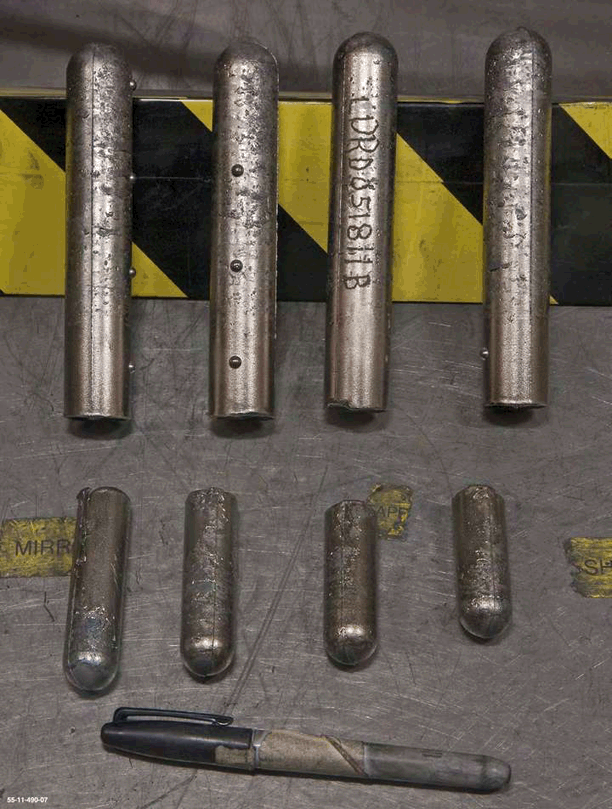 Reuters 20th April 2018 , In a sprawling plant near Amarillo, Texas, rows of workers perform by hand
one of the most dangerous jobs in American industry. Contract workers at
the U.S. Department of Energy’s Pantex facility gingerly remove the
plutonium cores from retired nuclear warheads. Although many safety rules
are in place, a slip of the hand could mean disaster.
In Energy Department facilities around the country, there are 54 metric tons of surplus
plutonium. Pantex, the plant near Amarillo, holds so much plutonium that it
has exceeded the 20,000 cores, called “pits,” regulations allow it to
hold in its temporary storage facility. There are enough cores there to
cause thousands of megatons of nuclear explosions. More are added each day.
https://www.reuters.com/article/us-usa-nukes-plutonium-specialreport/americas-nuclear-headache-old-plutonium-with-nowhere-to-go-idUSKBN1HR1KC
France and other countries keen to make money out of selling nuclear submarine technology to India
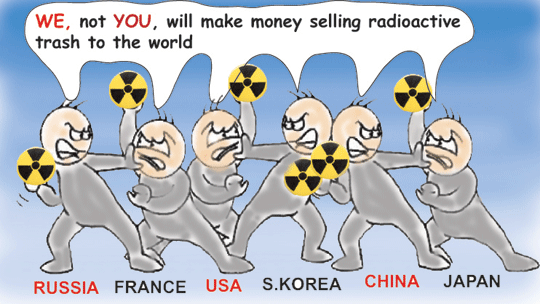 Thales looking at role in India’s nuclear submarine project, Gulf News 22 Apr 18, India is expected to spend close to $300 billion in the next five years in procuring defence equipment and almost all major global defence firms are eyeing a slice of it
“No New Nuclear Plants To Be Built in the U.S” – says top Exelon official
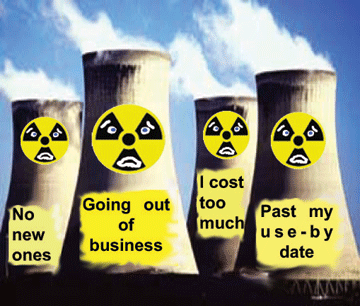 Exelon Official: No New Nuclear Plants To Be Built in the U.S. Because of the plants’ size and security needs, the costs become prohibitive.U.S. News By Alexa Lardieri, Staff Writer April 16, 2018,
A SENIOR OFFICIAL WITH America’s largest nuclear plant operating company is predicting a dim future for nuclear power in the U.S.
William Von Hoene, senior vice president and chief strategy officer at Exelon, said last week that he doesn’t foresee any new nuclear plants being built in the United States due to their high operating costs.
“The fact is – and I don’t want my message to be misconstrued in this part – I don’t think we’re building any more nuclear plants in the United States. I don’t think it’s ever going to happen,” S&P Global quoted Van Hoene as saying at the annual U.S. Energy Association’s meeting in Washington, D.C. “I’m not arguing for the construction of new nuclear plants. They are too expensive to construct, relative to the world in which we now live.”………
“I think it’s very unlikely that absent some extraordinary change in environment or technology, that any nuclear plants beyond the Vogtle plant will be built in my lifetime, by any company,” S&P Global quoted Van Hoene as saying, referring to a plant currently under construction in Georgia.
Von Hoene says because of nuclear plants’ sizes and the security required to monitor them, the costs become prohibitive.https://www.usnews.com/news/national-news/articles/2018-04-16/exelon-official-no-new-nuclear-plants-to-be-built-in-the-us
France’s EDF faces handicap to exporting nuclear reactors, with flaws found in European Pressurized Reactors (EPRs)
France’s nuclear plans under pressure, Petroleum Economist, 17 Apr 18
Flaws found at a flagship reactor could curb EDF’s technology export ambitions
Piping weld issues reported at Électricité de France’s Flamanville nuclear reactor project last week threaten to delay similar reactor builds across Finland and the UK, eroding confidence in the technology’s future role in western Europe’s energy mix.
State-owned EDF admitted on 10 April that inspectors had found “quality deviations” on 150 welds in a system used to transport steam to turbines at the Flamanville European Pressurized Reactor (EPR), a third generation pressurised water reactor in northwestern France.
Those inspections were prompted by an initial finding in February that 38 of 66 weldings on a secondary cooling circuit were not in line with standards, which were passed on at the time to France’s Nuclear Safety Authority (ASN).
Because the ASN has already demanded that a study be completed into the initial problems by the second half of 2018, it’s likely the new discovery will exacerbate problems with the long-delayed plant’s timetable and costs—it is seven years behind schedule and €7bn ($8.6bn) over budget.
The impact of the substandard weldings will also likely be felt further afield, particularly on timings for other long-delayed EPRs that the firm is currently building: Hinkley Point C in the UK, and Olkiluoto 3 in Finland.
Construction of the first EPR in Olkiluoto started in 2005 and was initially set to be completed by 2009, but in October 2017, the project was again delayed to May 2019, when it is intended to become western Europe’s first new nuclear power station for 15 years. Meanwhile, construction is slated to start on the 3.2-gigawatt Hinkley Point C plant in Somerset, southwest England, in 2019. The plant was first proposed in 2008 and is expected to take at least a decade to bring online, at a cost of £20.3bn ($28bn).
“Repeated construction delays further undermine the credibility of nuclear power as a viable option for electricity generation in the context of urgency to combat climate change”, Mycle Schneider, lead author of the World Nuclear Industry Status Report, told Petroleum Economist. “Nuclear power turns out to be not only increasingly expensive, but far too slow to compete with other options.”
Fukushima in focus
Despite the delays, the need to ensure strict standards in a post-Fukushima environment was underlined by an incident last December at China’s Taishan1 reactor, which was constructed by China General Nuclear Power Corporation (GCN) with EDF. Taishan1’s deaerator, which removes oxygen and other gases from boiler feedwater circuits, cracked during performance testing due to defective welding.
Safety issues have loomed over nuclear power’s future in western Europe since the Fukushima accident in Japan in March 2011, when a 9.0-magnitude offshore earthquake triggered a 46-foot tsunami that hit the plant, leading to the leakage of radioactive materials and shutdown of the plant. ……..
On 31 March, the Belgian government confirmed that its future energy strategy included a plan to shut down all nuclear power plants by 2025, and Germany, Spain and Switzerland have also made plans to phase out nuclear power by the 2020s. Even President Emmanuel Macron’s French election campaign included a promise to cut nuclear power generation from 72% to 50%.
“In a strict commercial sense, nuclear power is a tough proposition in western Europe. Unlike emerging economies and regions, demand is flat in the continent,” said Jane Nakano, a senior energy analyst at the Center for Strategic and International Studies. “In mature markets it is tough to make a business case for massive projects that require huge upfront investment.” …….http://www.petroleum-economist.com/articles/low-carbon-energy/nuclear/2018/frances-nuclear-plans-under-pressure
USA government keen to promote Westinghouse sales of nuclear power projects to India
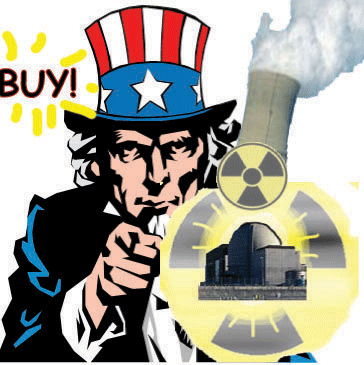 U.S. backs Westinghouse to finish nuclear power projects in India, Reuters Staff, Reporting by Nidhi Verma and Sudarshan Varadhan; Writing by Krishna N. Das; Editing by Sanjeev Miglani and Susan Fenton NEW DELHI (Reuters) 17 Apr 18 – Westinghouse Electric, which filed for bankruptcy last year, is now “lean and mean and ready to get to work” on its projects to build nuclear reactors in India, U.S. energy secretary Rick Perry said on Tuesday.
The show of support by Perry came after Pittsburgh-based Westinghouse’s bankruptcy filing had raised doubts about the proposed construction of six nuclear reactors in India’s Andhra Pradesh state.
“Nobody in the world makes better reactors than Westinghouse,” Perry told journalists after a meeting with India’s oil and gas minister Dharmendra Pradhan in New Delhi.“They had some challenges in the past from its business practices. We leave that where it is. The bottom line is, that’s all behind them. They are lean and mean and ready to get to the work.”
Westinghouse, owned by Japan’s Toshiba Corp (6502.T) which is to be bought by a unit of Canada’s Brookfield Asset Management Inc (BAMa.TO) (BAM.N), is one of the world’s leading suppliers of nuclear fuel and provides some form of service to 80 percent of the world’s 450 commercial reactors.
Perry and Pradhan released a joint statement to “reaffirm their strong commitment to early and full implementation of our civil nuclear partnership, including the Westinghouse civil nuclear project”. They also said the two countries would deepen cooperation on oil and gas, power, renewable energy and coal.
EDF’s “suicidal” business strategy of prolonging nuclear power, despite EDF’s heavy debts
Alternatives Economiques 12th April 2018 , [Machine Translation]
EDF has just presented its long-term energy strategy
to the board of directors. While the cost of solar and wind energy is
falling every year – it is already half the price of new nuclear power –
Belgium confirms its exit from that it does not intend to close a
nuclear reactor, except those in Fessenhenuclear power in 2025 and that Portugal has covered in March more than 100% of its electricity needs by renewables ources, EDF defies its main shareholder, the State, and stubbornly in the nuclear everything.
The group confirms , before 2029, jeopardizing its
profitability and viability with surplus electricity that will drive down
sales prices for producers. The programs of control of the energy demand
and the development of renewable energies will lead to a mechanical
reduction of the share of the nuclear energy in the French energy mix”.
Faced with the risk of the “cliff effect”, with the end of life at the same
time many nuclear reactors built at the same time, But EDF does not hear it
that way. In financial difficulties with debt that has almost tripled in
ten years, gross operating surplus to the lowest since 2006 and a wall of
investment coming nearly 160 billion over ten years 1 , the company s
‘Heading into a suicidal strategy: prolonging nuclear reactors as much as
possible. There is no outlet for this generation of electricity while
consumption has been decreasing in France for several years and renewables
are developing? EDF invents the myth of massive exports to neighboring
countries! https://www.alternatives-economiques.fr/anne-bringault/edf-saborde-transition-energetique/000841
Poor financial results for thorium power industry
Thorium Power (NASDAQ:LTBR) last released its earnings results on Thursday, March 15th. The energy company reported ($0.18) earnings per share (EPS) for the quarter. Thorium Power had a negative net margin of 4,060.00% and a negative return on equity of 118.29%. The company had revenue of $0.01 million during the quarter. https://stocknewstimes.com/2018/04/07/lightbridge-ltbr-earning-somewhat-favorable-media-coverage-study-shows.html
EDF warns of delays to Flamanville nuclear plant – it doesn’t augur well for Hinkley nuclear
EDF warns of delays at Flamanville nuclear power station in France
Experts fear UK’s planned Hinkley plant will face similar budget and deadline problems, Guardian, Adam Vaughan, 10 Apr 18, EDF Energy has warned that a flagship nuclear power station it is building in France could run further behind schedule and over budget, after it detected faults at the €10.5bn ( £9.2bn) plant.
The French state-owned firm said inspections last month had uncovered problems with welding on pipes at the Flamanville plant in north-west France.
Flamanville’s reactor design is the same as the one being used at a delayed plant in Finland and at Hinkley Point in Somerset, where EDF is building the UK’s first new nuclear power station in decades.
The company said that it had discovered “quality deviations” on 150 welds in a system used to transport steam to turbines used for electricity generation.
EDF said it was performing further checks to see what works would be needed to satisfy the safety requirements of the French nuclear regulator, ASN, and would report back in May.
In a statement, the firm said: “Following the current checks and the licensing process by the ASN, EDF will be able to specify whether the project requires an adjustment to its timetable and its costs.”
The plant is already three times over its original estimates and several years late.
Nuclear industry experts said the announcement cast doubt over whether Flamanville unit three would be operational by the end of 2019, as planned………..https://www.theguardian.com/business/2018/apr/10/edf-warns-of-faults-at-nuclear-power-station-it-is-building-in-france
Despite the media hype, Thorium Power still a poor investment
Favorable Media Coverage Somewhat Unlikely to Impact Thorium Power (NASDAQ:LTBR) Stock Price, Weekly Herald, by Samantha Guadardo on Apr 10th, 2018
News articles about Thorium Power (NASDAQ:LTBR) have been trending positive this week, according to Accern Sentiment. The research group identifies negative and positive press coverage by reviewing more than twenty million news and blog sources. Accern ranks coverage of publicly-traded companies on a scale of -1 to 1, with scores nearest to one being the most favorable. Thorium Power earned a media sentiment score of 0.25 on Accern’s scale. Accern also assigned news coverage about the energy company an impact score of 45.422705335828 out of 100, meaning that recent press coverage is somewhat unlikely to have an effect on the stock’s share price in the next several days.
LTBR stock opened at $1.15 on Tuesday. Thorium Power has a 12-month low of $0.94 and a 12-month high of $4.80.
In 2017 global investment in renewable energy outstripped thatn in coal, gas and nuclear combined
World invested more in solar energy than coal, gas and nuclear combined in 2017, UN report revealsNew figures show ‘how much can be achieved when we commit to growth without harming the environment,’ says UN Independent UK, Josh Gabbatiss Science Correspondent @josh_gabbatiss
Global investment in renewable energy shot up last year, far outstripping investment in fossil fuels, according to a UN report.
As the price of clean energy technology plummets, it has become an increasingly attractive prospect for world governments.
China was by far the world’s largest investor in renewable energy in 2017, accounting for nearly half of the new infrastructure commissioned.
This was mainly a result of its massive support for solar power, which globally attracted nearly a fifth more investment than in the previous year. Other countries including Australia, Sweden and Mexico more than doubled the amount of money they pumped into clean energy projects……..https://www.independent.co.uk/environment/solar-energy-world-investment-higher-coal-gas-nuclear-combined-2017-un-report-a8290051.html
1 This Month

4 May -West Suburban Peace Coalition to discuss Iran war at May Educational Forum
Monday, May 4, 7:00 – 8:00 PM Central Standard Time
Title: : How Trump’s Narrative Tries to Shape the Reality of the War on Iran.
Contact Walt Zlotow, zlotow@hotmail.com 630 442 3045 for further information
14 May – online event From Bombs to Data Centres: the Face of Nuclear Colonialism
To see nuclear-related stories in greater depth and intensity – go to https://nuclearinformation.wordpress.com
-
Archives
- May 2026 (37)
- April 2026 (356)
- March 2026 (251)
- February 2026 (268)
- January 2026 (308)
- December 2025 (358)
- November 2025 (359)
- October 2025 (376)
- September 2025 (257)
- August 2025 (319)
- July 2025 (230)
- June 2025 (348)
-
Categories
- 1
- 1 NUCLEAR ISSUES
- business and costs
- climate change
- culture and arts
- ENERGY
- environment
- health
- history
- indigenous issues
- Legal
- marketing of nuclear
- media
- opposition to nuclear
- PERSONAL STORIES
- politics
- politics international
- Religion and ethics
- safety
- secrets,lies and civil liberties
- spinbuster
- technology
- Uranium
- wastes
- weapons and war
- Women
- 2 WORLD
- ACTION
- AFRICA
- Atrocities
- AUSTRALIA
- Christina's notes
- Christina's themes
- culture and arts
- Events
- Fuk 2022
- Fuk 2023
- Fukushima 2017
- Fukushima 2018
- fukushima 2019
- Fukushima 2020
- Fukushima 2021
- general
- global warming
- Humour (God we need it)
- Nuclear
- RARE EARTHS
- Reference
- resources – print
- Resources -audiovicual
- Weekly Newsletter
- World
- World Nuclear
- YouTube
-
RSS
Entries RSS
Comments RSS
 nuclear-news