Byron nuclear plant could close in three years, two decades earlier than its planned retirement
RRStar.com By Georgette Braun , 13 Feb 19, Staff writer , BYRON — Exelon’s Byron nuclear generating station could close as early as mid-2022 because of financial risk, some two decades earlier than its planned retirement.
The company said in a Feb. 8 filing with the Securities and Exchange Commission that the Byron plant and two others — Braidwood and Dresden — are showing “increased signs of economic distress which could lead to an early retirement in a market that does not currently compensate them for their unique contribution to grid resiliency and their ability to produce large amounts of energy without carbon and air pollution.”
Crain’s Chicago Business said the earliest the Byron plant could close would be mid-2022, the same for Braidwood, and as early as 2021 for Dresden. https://www.rrstar.com/news/20190213/byron-nuclear-plant-could-close-in-three-years-two-decades-earlier-than-its-planned-retirement
Japan’s Kyushu Electric to scrap aging nuclear reactor at Genkai
TOKYO (Reuters) – Japan’s Kyushu Electric Power Co Inc said on Wednesday it will decommission an aging reactor at its Genkai nuclear plant as the country’s power industry struggles to meet new nuclear safety standards set after the 2011 Fukushima disaster. 13 Feb 19,
This will bring the number of reactors being scrapped to 17 since the meltdowns at the Fukushima Daiichi plant nearly eight years ago.
The move comes as Japan’s return to nuclear power is slowly gathering pace, although the industry still faces public opposition, court challenges and unfavorable economics.
Kyushu Electric will scrap the No.2 reactor at the Genkai plant, about 930 km (580 miles) west of Tokyo. ……
Many of Japan’s reactors remain shut, with only nine operating, while they undergo relicensing to meet new standards set after the Fukushima crisis highlighted shortcomings in regulation.
Reporting by Yuka Obayashi; Editing by Gopakumar Warrier
Economist doubts the need for New Jersey to subsidise nuclear power stations
 ANOTHER EXPERT CASTS DOUBT ON NEED FOR NJ TO SUBSIDIZE NUCLEAR PLANTS, NJ Spotlight, TOM JOHNSON | FEBRUARY 11, 2019
Economist also disputes PSEG’s contention that South Jersey plants will have to close within three years unless given subsidies. New Jersey should hold off awarding ratepayers’ subsidies to nuclear power plants until a federal agency decides whether to boost energy prices under a pending proposal from the regional grid operator, according to an independent economist.
The Independent Market Monitor for PJM urged a state agency to hold off a decision on granting subsidies to PSEG Nuclear and Exelon Generation who are seeking financial incentives — dubbed zero emission certificates — to keep three nuclear units in South Jersey from closing.
In a heavily redacted filing with the state Board of Utilities, Joseph Bowring, who oversees the competitiveness of the PJM market, also disputed the contention that the plants will have to close within three years unless given the subsidies. His rationale echoed the contention of an earlier filing by Stefanie Brand, director of the state Division of Rate Counsel.
“PSEG overstates its need for subsidies of Hope Creek and Salem I and Salem II units,’’ Bowring said. “PSEG understates forward energy revenues, understates capacity revenues, overstates costs and overstates the risk.’’
Decision expected in April
Bowring and Brand are the only two intervenors in the case that have been granted access to the companies’ financials, which will determine whether PSEG and Exelon are awarded the zero emission certificates. The subsidies are projected to cost ratepayers up to $300 million annually, if approved by the BPU.
The agency is expected to make a decision in the case in April. Nuclear power plants across the country have closed prematurely because of failing economics. Some states, including Illinois and New York, have approved similar financial incentives to avert shuttering nuclear units……….
Power suppliers also are opposed
In a separate filing by the PJM Providers Group, a coalition of power suppliers opposed to the subsidy, also urged the BPU to reject a subsidy it said “is not necessary and would serve nothing more than to pad the coffers of the plant owners and their shareholders.’’
A consultant retained by the group, Paul Sotkiewicz, a former PJM chief economist, projected the plants will make profits between $377-$477 million every year for the
Is nuclear power REALLY a clean-power fix for Africa – as Russia and China push it
 Russia, China back nuclear as a clean-power fix for Africa
But in recent years, at least seven other sub-Saharan African states have signed agreements to deploy nuclear power with backing from Russia, according to public announcements and the World Nuclear Association (WNA), an industry body………
Like Ethiopia, emerging nuclear states Sudan, Kenya, Uganda, Nigeria, Rwanda, Zambia and Ghana have signed agreements with Russia’s state nuclear corporation, ROSATOM – most since 2016.
Their content ranges from language on the construction of nuclear reactors to assistance with feasibility studies and personnel training, press statements show.
ROSATOM’s solutions for managing spent fuel and radioactive waste vary from country to country, but are normally worked out at the later stages of a nuclear new-build programme “in the strictest compliance with international law”, a spokeswoman told the Thomson Reuters Foundation.
Chinese state-owned nuclear firms have also taken the lead in the region, sealing deals with Kenya, Sudan and Uganda, WNA data shows.
South African student Masamaki Masanja, 23, won a ROSATOM competition for young people to make videos about Africa’s nuclear potential, and got to visit the Novovoronezh nuclear power plant in western Russia in 2017.
“It was mind-blowing,” said the second-year mechanical engineering student, via Skype.
The experience left him with a strong sense that nuclear power should be adapted quickly for Africa’s needs………
Rebel risk
Some political observers, however, are concerned about the prospect of nuclear reactors backed by Russia in some countries with rebel groups and weak government institutions.
An Africa-based Western diplomat, who asked to remain anonymous, doubted Russia’s assurances it would collect nuclear waste from projects it helped establish.
“You could end up with very unfortunate situations in parts of Africa … if you have a decaying nuclear power plant overrun by rebels, with waste that’s not going away,” he said.
Multiple requests for an interview with Russia’s ambassador in Ethiopia were declined.
So-called dirty bombs can combine conventional explosives like dynamite with radioactive material such as nuclear waste. ………
It could take 20 years for Ethiopia to build a nuclear power plant, estimated Hong-Jun Ahn, a Korean electrical engineer who advises the Ethiopian government on its nuclear plans.
Yonas Gebru, director of Addis Ababa-based advocacy group Forum for Environment, said green activists could prove another hurdle amid debate over whether nuclear power is “clean” energy.
“It would be good, and it would be wise also … to better capitalise on already started initiatives such as hydropower, wind energy (and) solar energy,” said Gebru. https://www.moneyweb.co.za/news/africa/russia-china-back-nuclear-as-a-clean-power-fix-for-africa/
Despite the severe disadvantages to Uganda, of nuclear power, Uganda’s govt succumbs to China’s nuclear marketing
Uganda to generate nuclear energy amidst safety, environmental concerns, By February 9, 2019 KAMPALA – Uganda is in the final stages of efforts to start generating some 2000 megawatts of electricity from five nuclear plants it plans to build in five districts scattered in the country’s four geographical regions……..
Already memoranda of understanding have been signed with Russia and the China National Nuclear Corporation [CNNC), Beijing on cooperation in the peaceful uses of nuclear energy on May 10, 2018.
In both of these documents Uganda is to secure technical expertise and financing to lift the plan off the ground.
According to Ms Sarah Nafuna, the head of Nuclear Energy Unit in the ministry, the MoU with Beijing details areas of technical and engineering cooperation as well as financial support to develop reactors for the nuclear plant……….
Energy ministry’s Nafuna declined to disclose the cost of developing the nuclear plants, but a high-level source that asked not to be named because they were not authorised to speak on the matter, estimated the capital and operating costs upward of Shs145 trillion.
This working figure is higher than Uganda’s Shs29 trillion annual budget, raising questions about the country’s ability to mobilise such resources when it is already saddled with a total external debt exposure, including committed but undisbursed debt of USS$12.2 billion debt, [about Shs 45.4 trillion]……….
sceptics also argue that a sunshine-rich country such as Uganda should never think of going the risky route of nuclear energy. ………
while government officials strongly defend the nuclear project, questions abound about how a country – that has failed to handle minor fire disasters and basic household waste will effectively deal with toxic wastes, which are the by-product of nuclear power generation.
In Kampala for instance, garbage is littered all over, with roads becoming impassable when it rains. Moreover, some hospitals and clinics carelessly dispose their medical waste in landfills, yet the government insists it can handle nuclear waste.
Mr Nandala Mafabi, the secretary general of the FDC, a critic of nuclear power generation says the government should explore safer sources of energy such as solar and wind energy, and only consider nuclear as an energy source later……….
Opponents of the nuclear energy are also worried about health hazards, safety and radioactive waste management, with questions about the country’s preparedness to deal with radioactive waste and accidental leaks which advanced economies like Japan have grappled with.
Mr Frank Muramuzi, the executive director of National Association of Professional Environmentalists (NAPE), also opposed building of nuclear plants and instead pointed the government to harness electricity from other renewable energy sources such as solar.
“Nuclear plants are expensive, have long construction periods of about 10 years and expensive to de-commission the plants at the end of their lifespan, especially disposing of hazardous radioactive waste,” he said………http://www.pmldaily.com/features/2019/02/uganda-to-generate-nuclear-energy-amidst-safety-environmental-concerns.html
Investors in Northrop, Boeing, etc rejoice! USA to spend $500 billion on nuclear weapons
Across this nuclear triad, the takeaway for investors is, there’s a lot of money on the table up for grabs………Definitely going to be a bullish sign for these defense contractors going forward.

The $500 Billion Push to Modernize the Nuclear Triad, Cold War-era technology is due for replacement, but the cost is out of this world., Motley Fool Staff, (the_motley_fool), Feb 5, 2019 .
On this segment of Industry Focus: Energy, The Motley Fool’s Nick Sciple and Fool.com contributor Lou Whiteman discuss a Congressional Budget Office report that estimates the U.S. needs to invest nearly $500 billion to modernize its nuclear weapon systems. That includes new submarines, bombers, and rockets, as well as the systems that support them.
A full transcript follows the video…..
Lou Whiteman “……..The CBO just updated a study on the triad. They determined almost $500 billion, $494 billion, needs to be spent in the next 10 years on nuclear triad modernization. That’s up considerably, 20% or more, from their 2017 estimate. Part of that is, we have a road map for some of this spending. Part of it is, now, we’re getting into the years where hopefully, those investments will be made. So, some of that increase was expected. But it’s a massive amount, half $1 trillion is going to go into new bombers, new subs, new rockets, new warheads to put on them, plus all the support. It’s a huge area. The details, some of them have to be worked out, but it’s almost guaranteed revenue for some of these companies, the lucky winners of these, because it’s a huge priority for the United States…….
Sciple: Let’s talk about some of these items. Northrop Grumman is developing a new bomber, the B-21. The number that I saw is, between now and 2028, the Pentagon is expected to spend $49 billion on that program. Can you talk about the significance of that aircraft for Northrop Grumman, as well as for our defense arsenal as a country?
Whiteman: That’s the keystone project for Northrop Grumman. They won that bomber. It’s been a slow road……. This is a huge expense. They’re doing their best to modernize it. It’s replacing an aircraft that isn’t that old…….
Whiteman: Naval is a big part of the bull story on General Dynamics ……….
Whiteman: ………The Minuteman is our go-to rocket. It needs to be replaced. That’s the only part of this triad that we don’t know who the eventual winner is. It’s going to be a big deal for either Northrop or Boeing.
………Sciple: Across this nuclear triad, the takeaway for investors is, there’s a lot of money on the table up for grabs………Definitely going to be a bullish sign for these defense contractors going forward.
Whiteman: Exactly right. You can maybe wonder about individual quarters and exact timing, but over the long haul, if you’re a long-term investor, this is pretty close to guaranteed, that these programs are going to be invested in, and this is revenue that’s going to be coming in. https://www.fool.com/investing/2019/02/05/the-500-billion-push-to-modernize-the-nuclear-tria.aspx
How the utilities financial system is rigged to give the nuclear industry the advantage
|
UK Turns Away From Nuclear As Poland Prepares To Embrace It, Clean Technica, February 4th, 2019 by Steve Hanley
…… Nuclear advocates insist atom-powered generating plants are safe in much the same way fossil fuel advocates insist pipelines and supertankers are safe. What they mean is that when things go wrong, the damage can be easily contained and the amount of human suffering is a small price to pay for the enormous profits to be made in the meantime. …….Spent fuel remains dangerously radioactive for thousands of years and nuclear facilities require massive amounts of water to keep things cool inside the containment area. One of the primary reasons nuclear power is beloved by utility companies is because they are guaranteed a certain rate of return on their investments. In order to make more money, spend more money. The way the electric utility game is rigged, customers are automatically saddled with the cost of paying for all new investments made by the companies, often for decades. Once the decision to build a nuclear power plant is made, the cost to pay for it goes on for 30, 40, or more years, even if new, less expensive technology becomes available in the meantime. Nuclear Projects Abandoned In UKHitachi has been planning to build a new nuke on the Welsh island of Anglesey on the site of a previous power plant decommissioned in 2015. However, it has now notified the UK government that it will abandon that project unless the government commits major new financial resources to bring the $26 billion facility to completion. Hitachi has already sunk nearly $3 billion into the proposed Wylfa Newydd project. Last November, another UK nuclear power project in Cunbria, to be built by Toshiba, was abandoned, leaving UK utility customers on the hook for hundreds of millions of dollars already invested by National Grid to build the transmission lines needed to connect that facility to the grid. According to the The Times of London, ratepayers will be paying for those losses for decades via surcharges added to their energy bills. Another Japanese company — Mitsubishi — has also withdrawn recently from a proposal to build a nuclear power plant in Turkey according to Nikkei Asian Review. What is the reason for so many abandonments of nuclear power projects? Money. Investors are looking down the road and seeing renewables getting less expensive. If it takes 30 years or more to recover the cost of a nuclear plant, what are the odds that it will still be making a profit in 2050? If you said somewhere between zero and none, go to the head of the class. Renewables To Blame For Nuclear WoesForbes reports on a rather startling announcement. Greg Clark, the government minister in charge of the UK energy board, told Parliament recently, “The cost of renewable technologies such as offshore wind has fallen dramatically, to the point where they now require very little public subsidy and will soon require none. We have also seen a strengthening in the pipeline of projects coming forward, meaning that renewable energy may now not just be cheap, but also readily available.” In all, three new nuclear plants in the UK are now likely to be abandoned. Together, they were expected to provide up to 15% of the nation’s energy needs in the future. How will the country make up for the loss of that capacity? Forbes says an analysis by the UK Energy and Climate Intelligence Unit shows renewables will do the heavy lifting needed to keep all British tea pots boiling happily for decades to come. Jonathan Marshall, head of analysis at the ECIU says, “In recent years, government has quietly cut back its expectations for nuclear new-build and that’s looking more and more realistic as the price of renewable generation falls and the benefits of the flexible smart grid become more apparent. Filling the nuclear gap with renewables would indeed require an increase in rollout, but one that is well within UK capabilities. With enough focus on smart low-carbon energy, there’s no reason why Britain shouldn’t achieve all its energy objectives despite the cancellation of these nuclear stations.” In particular, the ECIU analysis found a combination of an additional 11.3 GW of onshore wind, 5.7 GW of offshore wind, and 20.8 GW of new solar capacity would be sufficient to fill the nuclear gap. Hitting those targets should be easy, given the acceleration of installed renewable energy capacity taking place today. Poland Set To Move Forward With Its First NukeDespite the hoopla about renewables in the rest of the world, Poland, which currently gets 80% of its electricity from burning coal, expects to move forward with plans to build its first nuclear power plant. The 1.5 GW facility, which could go online by 2033, will be the first of several nukes the country expects to build as it prepares to increase its installed power portfolio to 73 GW as compared to 40 GW today. It expects nuclear power to provide about 10% of that total………. The Polish plan will still see about 60% of the nation’s energy come from burning coal in 2030 with most of the lignite burning facilities being shut down around 2040 or so. Which raises this question. If solar and wind installations can be designed, built, and brought online within a matter of years, why spend $20 billion on last century technology that will take a decade or more before it begins contributing to the nation’s energy supply? A Timid Response To An Urgent ProblemThe answer to that question reveals everything that is wrong with the way most nations are tiptoeing around the global warming emergency. Make lots of flowery promises. Give the people huge helpings of pie in the sky pronouncements. But go as slowly and timidly as possible into the future while funneling profits into well connected pockets all the while. The truth is, the utility industry is used to thinking in terms of 30 to 40 year timelines. It is widely seen as the most risk averse industry in the world. “What was good enough for our grandfathers is good enough for us. Stick with what has worked in the past. Don’t take a chance on new technology that might upset the apple cart.” The problem is, the world can’t wait for the utility industry to dither and dawdle its way to tomorrow. We need bold, decisive action now to slash carbon emissions today, not in 2040. By then it will be too late. Poland may be proud that it is about to get its first nuke. But by celebrating that move, it is admitting it has no realistic plan for protecting its citizens — or the rest of the global community — from the ravages of a warming planet. Just as the UK can obtain all the energy it needs from renewables instead of nuclear facilities, so can Poland, if it only could find the political will to do so. Tepid responses to a global emergency are the things that will doom us all to a planet incapable of supporting human life for many. Poland’s epitaph may well be, “Too little, too late.” https://cleantechnica.com/2019/02/04/uk-turns-away-from-nuclear-as-poland-prepares-to-embrace-it/
|
|
Countries going into deep nuclear debt to Russia; Hungary the latest victim of this political blackmail
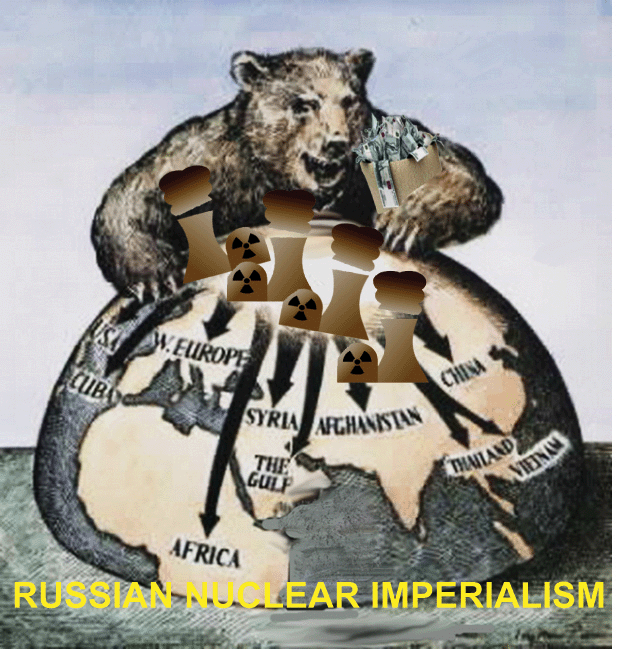
Hungary seeks to postpone loan payback to Russia for Nuclear power plant: What will the final cost be?Bellona February 1, 2019 by Charles Digges Budapest is seeking to modify the terms of a loan it must repay to Russia for building two new VVER-1200 type reactors that will eventually replace Hungary’s Paks nuclear power plant, according to a report from Reuters.
The reactors, which will constitute a plant called Paks II, will be built by Rosatom, Russia’s state nuclear power company, at a cost of 10 billion euro ($12 billion), and will replace the older Soviet-built nuclear plant that supplies half of the country’s electricity.
Rosatom’s construction contract, which includes the loan for Paks II, was the subject of a hotly-debated probe by the EU’s Organization for Economic Co-Operation and Development, which investigated whether the Russian bid violated European competition statutes.
At the time, EU officials and commentators viewed the deal as a Trojan Horse to help cement Moscow’s influence over the right-leaning, rabidly anti-globalist government of Hungarian Prime Minister Viktor Orban.
The EU eventually dropped its investigation in 2017 and granted Hungary permission to build the reactors – partly in an effort to entice Orban, who was insistent about contracting Rosatom, back into the democratic fold. Now Budapest is citing the delay caused by the competition review as reason to renegotiate when it begins paying Rosatom back.
Hungarian financial authorities plan to ask Moscow to postpone collecting on the debt until after the new reactors begin to generate electricity – but it is as yet unclear whether Rosatom will accept new terms. The plant’s construction, meanwhile, is running late. The build was supposed to begin last year………
While the terms of the Paks II loan remain in the shadows, other financing arrangements Moscow has made for building nuclear reactors in other countries suggest that the interest alone could prove to be very expensive for Budapest.
An $11.4 billion, 30-year agreement Rosatom signed with Bangladesh to build the Roopur nuclear plant will net Moscow $8 billion in interest. A $25 billion deal Rosatom is pursuing with Egypt to build that country’s Dabaa plant could, over the 35-year term of that loan, swell to $71 billion.
Another enormous $76 billion deal between Rosatom and South Africa was eventually thwarted by environmentalists when it was revealed the project had been secretly negotiated. Had the deal held it would have siphoned off a quarter of South Africa’s gross domestic product before the reactors even began operation.
Terms like this could spell trouble for Hungary in light of Moscow’s tendency to be a kneecapping creditor when it comes to energy projects – especially when Russia sours on the politics of its debtors.
In 2014, at the height of East-West tensions over Russia’s annexation of Crimea, Kremlin officials threatened to cut nuclear fuel supplies to Ukraine’s Soviet built reactors – which would have interrupted their chain reactions and likely caused a catastrophic accident.
Rosatom eventually walked the threat back. But the lurid message in Moscow’s head-fake toward igniting a second Chernobyl was clear: Russian-built reactors are a useful new tool for political blackmail………..
Many in Europe – Hungary included – subsequently sought to diversify their energy supply in favor of nuclear. Yet, in a devious twist, Rosatom has emerged as the most stable and eager nuclear builder on the international market.
For now, Rosatom can afford to offer risky loans thanks to the enormous state subsidies it receives. These subsidies can be funneled into more loans, and the loans then boost the company’s profits on paper. But for the past several years, it has become clear that these subsidies to the company will likely decrease or dry up altogether in 2020.
As a result, Rosatom is amassing so-called memorandums of understanding from any country vaguely interested in nuclear power. The company says is currently has dozens of these MOUs amounting to more than $130 billion in incoming business.
But that claim should be viewed skeptically, as many of the countries for which Rosatom is promising to build reactors – countries like Jordan, Algeria, Nigeria, the Republic of Congo and Bolivia – won’t have the infrastructure to support nuclear power for decades.
For now, it’s not difficult to imagine Moscow extending the terms of its loan to Hungary for as long as Budapest likes. It will, after all, remain profitable on paper. But in the end, Budapest will be left holding the bag for Rosatom’s over extended balance sheet. But so long as Orban’s government continues it rightward lurch, Moscow is unlikely to call in its marker. http://bellona.org/news/nuclear-issues/2019-02-hungary-seeks-to-postpone-loan-payback-to-russia-for-nuclear-power-plant-what-will-the-final-cost-be
FirstEnergy nuclear bailout would be crony capitalism at its worst
 Should legislators help save Ohio nuclear plants? NO: FirstEnergy bailout would be crony capitalism at its worst Columbus Dispatch, 4 Feb 19, Crony capitalism is never acceptable and should be always met with public outrage. But more-covert pay-to-play schemes that affect Ohio’s long-term economic health are particularly egregious. Take for instance the campaign-contributions scheme from FirstEnergy Solutions over the past year. While transactions to more than a dozen of Ohio policymakers may seem normal to the average voter, recent activity in Columbus reveals a much more calculated operation that seemly puts FirstEnergy’s nuclear agenda ahead of Ohio’s future.
In April 2018, FirstEnergy Solutions filed for bankruptcy in the wake of massive financial problems arising from the company’s competitive power-generation fleet. The company announced it would shut down its Ohio nuclear plants over a three-year period because continued operation wasn’t profitable. FirstEnergy had been unsuccessfully pursuing bailouts from the Public Utilities Commission of Ohio since 2014 and seeking a nuclear subsidy in the legislature since 2016 without success.
So it scrambled desperately for a lifeline, hatching a plan to offer sizable campaign donations to candidates hoping to gather up political allies to support its demand for $300 million a year to keep its plants operational.
What did FirstEnergy cough up for its legislative lifeline? For starters, the company gave $172,000 in total to Ohio House candidates, many of whom had no legislative or energy-industry experience. It also donated $565,000 to the Republican Governors Association, an amount more than five times what the company gave to Governor Mike DeWine’s Democratic counterpart.
We can clearly see the pay, but what exactly was the play? Conveniently, on the first day of the new General Assembly a standing committee on power generation was established, setting the stage to justify passage of a nuclear bailout and help out FirstEnergy. Additionally, FirstEnergy recently announced a debt-restructuring agreement with its creditors. Not coincidentally, this surprise development came on the tails of securing state-lawmaker support to bail out FirstEnergy.
This situation is pay-to-play politicking at its worst, flying in the face of the new administration’s promises to be the most innovative administration in Ohio’s history. Part of an innovation agenda should include rejecting political favoritism toward uncompetitive and less technologically advanced nuclear power plants. Ohioans need to know that FirstEnergy’s attempt to influence a bailout for its failing nuclear plants isn’t just bad ethics. It’s also awful public policy.
Incidentally, natural gas is fueling jobs and consumer cost savings across America. This is especially true in Ohio, …………https://www.dispatch.com/opinion/20190203/column-should-legislators-help-save-ohio-nuclear-plants-no-firstenergy-bailout-would-be-crony-capitalism-at-its-worst
India’s Kudankulam nuclear power station means big debt to Russia
Kudankulam: Nuclear power utility struggles to repay Russia for supplies https://indianexpress.com/article/india/kudankulam-nuclear-power-utility-struggles-to-repay-russia-for-supplies-5563744/ The sanctioning of lower than requisite funds comes at a time when NPCIL’s budgetary support requirement has gone up in light of the utility taking up 10 new projects that had been cleared by the government in May 2017. by Anil Sasi |New Delhi February 1, 2019 Inadequate budgetary support to the strategic nuclear energy sector over the last two financial years has squeezed funds earmarked under the investment head for the Nuclear Power Corporation of India Limited (NPCIL), resulting in India’s frontline nuclear utility slipping back on its repayment obligations to the Russians for equipment supplies to the Kudankulam nuclear project.The sanctioning of lower than requisite funds comes at a time when NPCIL’s budgetary support requirement has gone up in light of the utility taking up 10 new projects that had been cleared by the government in May 2017.
The problem of non-payment of Russian credit on account of a reduction in the provision for Russian credit to NPCIL was discussed before a parliamentary panel, responding to which the Department of Expenditure in the Finance Ministry subsequently “conveyed” the concerns to the Budget Division of the Department of Economic Affairs in the same Ministry for “further necessary action”.
Under a credit arrangement between the governments of Russia and India, as soon as equipment leaves Russia for Indian projects such as the nuclear station in Kudankulam, that much money is released by the Russian government to the suppliers, which then becomes a loan on the Government of India. This loan is then supposed to be routed to NPCIL by way of a budgetary provision. Against that, the same money would be given back to the Government of India so that it becomes a loan on NPCIL.
This arrangement has come under strain due to the reduction in budgetary allocation under the ‘investment in PSUs’ head, which has affected the loans payable to NPCIL towards ‘Russian credit utilisation’ that is outstanding in the books of the Controller of Aid Accounts and Audit. The CAAA is the division within the Department of Economic Affairs entrusted with the responsibility for withdrawal of loan and grant proceeds for all official development assistance where India is the recipient.
While the extent of the slip-up in the payment obligation to the Russians could not be ascertained, the trend was seen as serious enough for the Parliamentary Standing Committee on Science and Technology, Environment and Forests to flag this an issue to which the Ministry of Finance responded in the affirmative, a senior government official involved in the exercise confirmed. Queries sent to K N Vyas, Secretary of the Department of Atomic Energy and Chairman of the Atomic Energy Commission, did not elicit a response.
According to official estimates, while budgetary support to NPCIL had gone up from Rs 370 crore in the budget estimate for 2017-18 to Rs 1435 crore in the revised estimate for the year (entailing a total of Rs 685 crore under the investment head and Rs 750 crore as loan), the actual requirement in form of budgetary support submitted by the DAE was thrice that amount — Rs 4305 crore. The higher amount, official said, was primarily on account of a shortfall of earlier years in receipt of equity to the tune of Rs 402 crore and obligations under the Russian Credit of Rs 3,903 crore.
For 2018-19, while the allocation was hiked to Rs 1,665 crore in the budget estimate, it still left a funding gap of around Rs 2,870 crore, according to DAE estimates. The situation was exacerbated by 10 new projects based on the indigenous 700 MWe (mega watt electric) pressurised heavy water reactors (PHWRs) that had been sanctioned in mid-2017, due to which budgetary support requirement had also increased.
NPCIL is currently operating 22 commercial nuclear power reactors with an installed capacity of 6,780 MWe, while it has another eight reactors under various stages of construction totaling 6200 MWe capacity.
Russia and India had, in 2015, agreed to actively work on projects deploying 12 additional Light Water Reactor (LWR) nuclear reactors, for which, the localisation of manufacturing in India under the NDA government’s flagship ‘Make in India’ initiative and the commencement of serial construction of nuclear power plants was flagged as a joint initiative.
In this context, the Programme of Action for localisation between Russian state-owned utility Rosatom and the DAE was finalised during Prime Minister Narendra Modi’s Moscow visit in 2015. At the Kudankulam site, where the two Russian-designed VVER-1000 series reactors have being installed, nearly 100 Russian companies and organisations are involved in documentation, supply of equipment and controlling construction and equipping process. At the same site, four more Russian reactor units are slated to come up in the coming years.
Cleanup estimate for Hanford nuclear site increases by $82B
Rapidly climbing costs to USA tax-payers for nuclear waste cleanup – rose by $100 billion in one year!
America’s Chernobyl’: Inside The Most Toxic Place In The Nation | TODAY
Cost to taxpayers to clean up nuclear waste jumps $100 billion in a year https://www.nbcnews.com/news/all/cost-taxpayers-clean-nuclear-waste-jumps-100-billion-year-n963586 , 30 Jan 19, An Energy Department report shows the projected cost for long-term nuclear waste cleanup overseen by DOE jumped $100 billion in just one year. Jan. 29, 2019, By Laura Strickler, WASHINGTON — The estimated cost of cleaning up America’s nuclear waste has jumped more than $100 billion in just one year, according to a DOE report — and a watchdog warns the cost may climb still higher.
The Energy Department’s projected cost for cleanup jumped from $383.78 billion in 2017 to $493.96 billion in a financial report issued in December 2018.
A government watchdog and DOE expert said the new total may still underestimate the full cost of cleanup, which is expected to last another 50 years. “We believe the number is growing and we believe the number is understated,” said David Trimble, director of the Government Accountability Office’s Natural Resources and Environment team.
The cost was calculated by the accounting firm KPMG under contract to DOE.
Eighty percent of the increase comes from new projections of the costs of cleaning up radioactive waste and hazardous chemicals at the Hanford site in southeastern Washington.
The 586-square-mile site, home to nine former production reactors and processing facilities, produced plutonium for America’s nuclear arsenal during the Cold War.
Cleaning up Hanford has already cost taxpayers $170 billion over 30 years, but government auditors say the most challenging parts of the clean-up work are yet to be done.
Still not cleaned up are 56 million gallons of what the DOE’s inspector general has described as “hazardous and highly radioactive waste.” The rise in projected cost is due to updated estimates for building and running a waste treatment plant, including “operating costs, tank farm retrieval and closure costs” at the site, according to the report. The report also refers to changes in “technical approach or scope” and “updated estimates of projected waste volumes.”
Trimble of the GAO believes the Energy Department “does not have a coherent strategic plan on how to address its cleanup mission.”
A spokesperson for the Energy Department said in an emailed statement that the office that oversees the cleanup is “committed to making progress on the ground at Hanford, and mitigating the years of escalating liabilities at the site.”
The spokesperson said DOE expects more cost increases “and is working with regulators and stakeholders on best options to treat and dispose of radioactive waste.”
Energy Secretary Rick Perry has proposed a reclassification of the radioactive waste at Hanford to make its disposal less expensive, a suggestion opposed by environmental groups in the Pacific Northwest.
In mid-December, DOE issued a financial report with a signed letter from U.S. Energy Department Secretary Rick Perry on the fourth page. Perry’s letter lists the agency’s accomplishments and describes the agency’s environmental cleanup activities. He cited the completion of an underground project at Hanford, but does not mention the projected increase in costs to taxpayers.
“PLAGUED WITH MISMANAGEMENT”
For decades, government auditors have raised serious concerns about the lack of clear goals for the site and long term problems with the cleanup.
A 2018 report from the DOE’s inspector general rolled up 38 investigations the IG had conducted on the environmental management efforts at Hanford.
The IG concluded Hanford has been “plagued with mismanagement, poor internal controls, and fraudulent activities, resulting in monetary impacts totalling hundreds of millions of dollars by the various contractors at the site.”
Bechtel, one of the large government contractors that manages site cleanup, was part of a group of contractors that paid a $125 million settlement in 2016, the largest settlement ever obtained by the agency’s inspector general.
The U.S. had alleged Bechtel improperly used federal taxpayer dollars to fund a multi-year lobbying effort in Congress to continue the funding of its contract.
Under the final settlement agreement, Bechtel National Inc. admitted no wrongdoing.
In response to the recent Energy Department report Bechtel spokesperson Fred deSousa notes that the waste treatment plant they are building in Hanford is “the most complex project of its kind in the world.” DeSousa also told NBC in his statement that the project has gone through multiple independent reviews resulting in changes to its contract. “Today the project is bigger, more robust, and has more stringent operating and safety margins,” he said.
The new Democratic chair of the House Energy and Commerce Committee says the committee will increase its oversight of Hanford.
“It is essential that DOE better manage and oversee its contractors to ensure that taxpayers, workers and the environment are being protected” said Rep. Frank Pallone, Jr., D-N.J. “The Committee will continue to have questions for DOE as to whether cleanup efforts at Hanford and other sites are being properly managed.”
Nuclear propaganda keeps spinning, despite the gloomy reality of the industry

| Nuclear power down for the count, Jim Green, Online Opinion, 31 January 2019, http://onlineopinion.com.au/view.asp?article=20138&page=0
Last year was a “positive year for nuclear power” according to the World Nuclear Association (WNA). And indeed it was, compared to 2017, which was one of the industry’s worst-ever years. The WNA cited nuclear power’s net gain in 2018 (nine reactor grid connections compared to six permanent shutdowns). A superficial look at the numbers suggests some more good news for the industry. The number of reactor grid connections (start-ups) over the past five years (38) almost doubled the number in the five years before that (21). If the number doubled again, the much-hyped nuclear renaissance would be upon us. A casual observer might also be impressed by the fact that the number of reactor grid connections (59) and construction starts (71) over the past decade exceeded the number of permanent reactor shutdowns (50). And some more good news for the industry: according to the WNA, 41 reactors will enter commercial operation in the four years from 2019-22. But after that, the pre-Fukushima mini-renaissance (38 reactor construction starts from 2008-2010) slows dramatically with an estimated total of just nine reactor start-ups in the following four years. Ominously for the industry, the 22 construction starts from 2014-18 was less than half the number (49) from 2009-13. The (independent) World Nuclear Industry Status Report (WNISR) noted in early January that 49 reactors are under construction worldwide ‒ the first time the number has fallen below 50 in a decade, down 19 since 2013, and the number has decreased for five years in a row. If all these contradictory good-news, bad-news figures seem a little … contradictory, that’s because nuclear power currently reflects two opposing dynamics: the mini-renaissance is evident but will subside by the mid-2020s, and the Era of Nuclear Decommissioning (discussed later) has begun and will be in sharp focus by the mid-2020s. By contrast, renewable power generation continues to expand rapidly and costs continue to fall dramatically. Renewables accounted for 26.5 percent of global electricity generation in 2017 compared to nuclear power’s 10.3 percent. Ageing reactor fleet The industry faces severe problems, not least the ageing of the global reactor fleet. The average age of the fleet continues to rise and reached 30 years in mid-2018. A reasonable estimate is that the average lifespan of the current reactor fleet will be about 40 years. There will likely be an average of 8-11 permanent reactor shutdowns annually over the next few decades: · The International Energy Agency expects a “wave of retirements of ageing nuclear reactors” and an “unprecedented rate of decommissioning” ‒ almost 200 reactor shutdowns between 2014 and 2040. · The International Atomic Energy Agency (IAEA) anticipates 320 gigawatts (GW) of retirements from 2017 to 2050 (that’s about 80 percent of the current worldwide reactor fleet). · Another IAEA report estimates up to 139 GW of permanent shutdowns from 2018-2030 and up to 186 GW of further shutdowns from 2030-2050. · The reference scenario in the 2017 edition of the WNA’s Nuclear Fuel Report has 140 reactors closing by 2035. · A 2017 Nuclear Energy Insider article estimates up to 200 permanent shutdowns over the next two decades. So an average of 8-11 construction starts and grid connections will be required to maintain current nuclear generation. Yet construction starts have averaged just 4.5 over the past five years. Grim prospects For the first time in many years, perhaps ever, the IAEA was up-front about the grim prospects for nuclear power in a September 2018 report. The IAEA said: “Nuclear power’s electricity generating capacity risks shrinking in the coming decades as ageing reactors are retired and the industry struggles with reduced competitiveness … Over the short term, the low price of natural gas, the impact of renewable energy sources on electricity prices, and national nuclear policies in several countries following the accident at Japan’s Fukushima Daiichi Nuclear Power Plant in 2011 are expected to continue weighing on nuclear power’s growth prospects … In addition, the nuclear power industry faces increased construction times and costs due to heightened safety requirements, challenges in deploying advanced technologies and other factors.” The IAEA’s low and high projections for global nuclear power capacity in 2030 are both 36 percent lower than the same projections in 2010, the year before the Fukushima disaster. Former World Nuclear Association executive Steve Kidd noted in an August 2018 article: “The current upward spike in reactor commissioning certainly looks impressive (at least compared with the recent past) but there are few signs that here will be a further uplift in the 2020s. What we see today is largely the result of rapid growth in the Chinese industry, which has now seemingly ended. … In Asia, the sharp downturn in Chinese interest in nuclear is unlikely to be replaced by India or by a combination of the other populous counties there. It is clear that without a strong lead from the established nuclear countries, a worldwide uplift in reactor construction is not going to happen.” And therein lies a fundamental problem for the nuclear industry: it is in a frightful mess in the three countries that accounted for 56 percent of global nuclear power capacity just before the Fukushima disaster: the US, France and Japan. A 2017 EnergyPostWeekly article said “the EU, the US and Japan are busy committing nuclear suicide.” Spin Bright New World, an Australian pro-nuclear lobby group (that accepts secret corporate donations) listed these wins in 2018: 1. Taiwanese voters voiced support for overturning legislation to eliminate nuclear power. 2. Poland announced plans for a 6-9 GW nuclear sector. 3. China connected the world’s first AP1000 and EPR reactors to the electrical grid. 4. Some progress with Generation IV R&D projects (Terrestrial Energy, NuScale, Moltex), and the passing of the US Nuclear Energy Innovation Capabilities Act which aims to speed up the development of advanced reactors. Those are modest and pyrrhic wins. To take each in turn: 1. Taiwan’s government remains committed to phasing out nuclear power although the 2025 deadline has been abandoned following a referendum in November 2018. 2. Poland might join the club of countries producing nuclear power ‒ or it might not. Currently it is a member of a group of countries that failed to complete partially-built power reactors and have never generated nuclear power, along with Austria, Cuba, the Philippines, and North Korea. 3. China’s nuclear power program has stalled ‒ the country has not opened a new construction site for a commercial reactor since December 2016. The most likely outcome over the next decade is that a small number of new reactor projects will be approved each year, well short of previous projections and not enough to match the decline in the rest of the world. 4. Generation IV fantasies are as fantastical as ever. David Elliot ‒ author of the 2017 book Nuclear Power: Past, Present and Future ‒ notes that many Generation IV concepts “are in fact old ideas that were looked at in the early days and mostly abandoned. There were certainly problems with some of these early experimental reactors, some of them quite dramatic.” One example of the gap between Generation IV rhetoric and reality was Transatomic Power’s decision to give up on its molten salt reactor R&D project in the US in September 2018 ‒ just weeks before the public release of the New Fire propaganda film that heavily promotes the young entrepreneurs who founded Transatomic. The company tried but failed to raise a modest US$15 million for the next phase of its R&D project. An article by four current and former researchers from Carnegie Mellon University’s Department of Engineering and Public Policy, published in the Proceedings of the National Academy of Science in July 2018, argues that no US advanced reactor design will be commercialised before mid-century. Further, the Carnegie authors systematically investigated how a domestic market could develop to support a small modular reactor industry in the US over the next few decades ‒ including using them to back up wind and solar, desalinate water, produce heat for industrial processes, or serve military bases ‒ and were unable to make a convincing case. Long-time energy journalist Kennedy Maize recently argued in POWER magazine that Generation IV R&D projects are “longshots” and that the “highest profile of the LWR apostates is TerraPower … backed by Microsoft founder and multi-billionaire Bill Gates. Founded in 2006, TerraPower is working on a liquid-sodium-cooled breeder-burner machine that can run on uranium waste, while it generates power and plutonium, with the plutonium used to generate more power, all in a continuous process.” TerraPower recently abandoned its plan for a prototype reactor in China due to new restrictions placed on nuclear trade with China by the Trump administration. Cost blowouts The Bright New World lobby group might have cited some other pyrrhic wins in 2018. The French government abandoned previous plans to reduce nuclear power to 50 percent of total electricity generation by 2035 (compared to 71.6 percent currently) but still plans to shut 14 reactors by 2035. Cost estimates for two French-built reactors ‒ one in France and the other in Finland ‒ have increased by a factor of 2.5‒3and the reactors are the best part of a decade behind schedule. The Vogtle reactor project in the US state of Georgia came close to being abandoned last year but it was rescued despite multi-year delays and monumental cost overruns (the estimate for two AP1000 reactors has doubled from US$14 billion to US$28 billion). The current cost estimate for Vogtle reactors #3 and #4 is an order of magnitude greater than Westinghouse’s 2006 estimate of US$1.4-$1.9 billion to build one AP1000 reactor. To find another blowout of that magnitude you’d need to go back to … Vogtle #1 and #2! Built in the 1970s and 1980s, the cost of the first Vogtle twin-reactor project skyrocketed 13-fold, from US$660 million to US$8.7 billion (around US$18 billion in today’s money). The only other reactor construction project in the US ‒ a twin-reactor AP1000 project in South Carolina ‒ was abandoned in 2017 after the expenditure of US$9‒10.4 billion. That disaster bankrupted Westinghouse and almost bankrupted its parent company Toshiba. So much for the nuclear renaissance. The Era of Nuclear Decommissioning In many countries with nuclear power, the prospects for new reactors are bleak and rear-guard battles are being fought to extend the lifespans of ageing reactors that are approaching or past their design date. A new era is approaching ‒ the Era of Nuclear Decommissioning ‒ following on from nuclear power’s growth spurt from the 1970s to the 1990s then 20 years of stagnation. The Era of Nuclear Decommissioning will entail: · A decline in the number of operating reactors. · An increasingly unreliable and accident-prone reactor fleet as ageing sets in. · Countless battles over lifespan extensions for ageing reactors. · An internationalisation of anti-nuclear opposition as neighbouring countries object to the continued operation of ageing reactors (international opposition to Belgium’s ageing reactors is a case in point and there are numerous other examples). · Battles over and problems with decommissioning projects (e.g. the UK government’s £100+ million settlement over a botched decommissioning tendering process). · Battles over taxpayer bailout proposals for companies and utilities that haven’t set aside adequate funds for decommissioning and nuclear waste management and disposal. (According to Nuclear Energy Insider, European nuclear utilities face “significant and urgent challenges” with over a third of the continent’s nuclear plants to be shut down by 2025, and utilities facing a €118 billion shortfall in decommissioning and waste management funds.) · Battles over proposals to impose nuclear waste repositories and stores on unwilling or divided communities. |
Oh goody! It’s a rosy time coming for investors, (such as Donald Trump) in nuclear weapons!
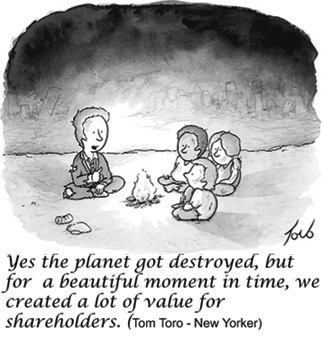
What It Would Cost to Modernize the U.S. Nuclear Arsenal — and Who Would Benefit, Yahoo Finance Lou Whiteman, The Motley Fool, Motley Fool, January 28, 2019 The United States would have to spend $494 billion over the next decade to enact its plan to modernize its nuclear arsenal, a figure that highlights the opportunity before contractors as the Pentagon seeks ways to pay for one of its top priorities. The total, which comes from a biannual report put out by the Congressional Budget Office (CBO), is 23% higher than the $400 billion price tag in the 2017 estimate. It comes at a delicate time for the Pentagon, which, after enjoying two years of steady budget increases, is facing a much less certain fiscal 2020 allocation.
……..Here’s who stands to benefit from the push to renew the nuclear triad.
Next-generation bombers
 Northrop Grumman (NYSE: NOC) in late 2015 beat a team including Boeing (NYSE: BA) and Lockheed Martin to design and build a new long-range bomber. The Pentagon is expected to purchase at least 100 aircraft, with deliveries expected to begin in the mid-2020s and extend for a decade.
The plane, now known as the B-21, has been a near-casualty of Congressional budget battles in recent years, but the Pentagon continues to spend upwards of $2 billion per year on development. Overall, the CBO expects the Pentagon to spend $49 billion on bomber acquisition between now and 2028, which would easily make the B-21 Northrop’s most important platform……….
America’s most important deterrent
The Columbia-class submarine, designed to take over for the Ohio-class ballistic missile sub and house the nation’s stockpile of Trident sub-launched ballistic missiles, features a stealth electric drive propulsion system and improved maneuverability. The sub, to be built by General Dynamics’ (NYSE: GD) Electric Boat subsidiary with support from Huntington Ingalls (NYSE: HII), is due to be operational by 2028 to ensure second-strike capability should the U.S. be hit by a catastrophic attack………
A new rocket competition
The only major piece of the triad renewal still up for grabs is the task of replacing the nation’s arsenal of intercontinental ballistic missiles. …….In August 2017, the Air Force awarded Boeing and Northrop Grumman $349 million and $329 million, respectively, to develop competing new designs, with a goal of selecting a winner next year. The government is expected to spend more than $60 billion on ICBMs over the next decade, meaning the award would be a needle-mover for the eventual winner.
The stakes are also high for the two potential manufacturers of the solid-propellant rocket engines that will be used to power the missiles. Northrop brought one of the two contenders in-house last year with its $9.2 billion deal for Orbital ATK. The other, Aerojet Rocketdyne (NYSE: AJRD), has warned the Air Force and lawmakers it needs to win at least part of this procurement to remain a viable supplier.
Given the Pentagon’s priority to nurture a healthy and competitive supply base, it would not be a surprise to see both Aerojet and the former Orbital business split the ICBM engine award.
How to invest
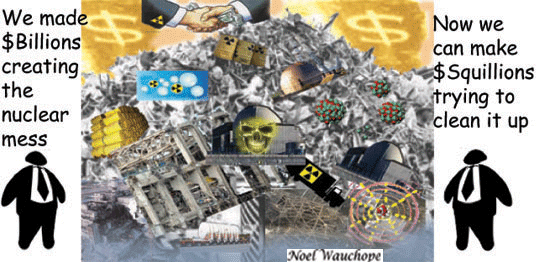
USA hoping to profit from nuclear power, by exporting waste clean-up technology
Dov Schwartz is the spokesman for the National Nuclear Security Administration. He confirmed the group is thinking about how to help other countries reduce nuclear waste. However, Schwartz did not give details.
The NNSA also declined a Reuters request for an interview with Brent Park, who is leading the effort.
What would the technology do?
The unnamed sources say the technology could involve crushing, heating or sending an electric current through nuclear waste to reduce its size.
The machinery to do so would be put in a “black box” the size of a shipping container. It would be sent to other countries with nuclear energy programs; however, it would remain owned and operated by the United States, the sources said.
The sources did not name countries to which the service would be offered. They also did not say where the waste would be stored after it is run through the equipment. But they said they were worried the processes could increase the risk of dangerous materials reaching militant groups or nations unfriendly to the United States.
Former U.S. President Jimmy Carter banned nuclear waste reprocessing in 1977. The reprocessing opens pure amounts of uranium and plutonium, both of which could be used to make nuclear bombs.
NNSA spokesperson Dov Schwartz said the plans under consideration do not involve reprocessing. But he did not say what technologies could be used.
Concerns
The government of U.S. President Donald Trump has made promoting nuclear technology abroad a high priority. The U.S. Energy Secretary, Rick Perry, visited Saudi Arabia this month for talks on a nuclear energy deal with the kingdom. And the American business Westinghouse hopes to sell nuclear power technology to countries from Saudi Arabia to India.
But a top arms control officer during the Obama administration questions the direction of the Trump government. Thomas Countryman said the U.S. should improve its ability to get rid of its own nuclear waste before helping other countries.
A nuclear expert at the Union of Concerned Scientists also expressed some doubt about the NNSA plan. Edwin Lyman said NNSA should not be focused so much on reducing the size of nuclear waste. Instead, it should be concerned about the dangers of nuclear waste that make it hard to store.
Lyman said even a small amount of nuclear waste gives off radioactivity and heat. It “remains dangerous for hundreds of thousands of years,” he said.
1 This Month
26 September – International Day for the Total Elimination of Nuclear Weapons





PLEASE OPPOSE HR 8255 AND S.3639 – bills would accelerate satellite deployment, with no environmental review or safeguards – https://ncstd5li.quorum.us/campaign/169331/
To see nuclear-related stories in greater depth and intensity – go to https://nuclearinformation.wordpress.com
-
Archives
- September 2026 (291)
- August 2026 (330)
- July 2026 (355)
- June 2026 (287)
- May 2026 (306)
- April 2026 (356)
- March 2026 (251)
- February 2026 (267)
- January 2026 (308)
- December 2025 (358)
- November 2025 (359)
- October 2025 (375)
-
Categories
- 1
- 1 NUCLEAR ISSUES
- business and costs
- climate change
- culture and arts
- ENERGY
- environment
- health
- history
- indigenous issues
- Legal
- marketing of nuclear
- media
- opposition to nuclear
- PERSONAL STORIES
- politics
- politics international
- Religion and ethics
- safety
- secrets,lies and civil liberties
- spinbuster
- technology
- Uranium
- wastes
- weapons and war
- Women
- 2 WORLD
- ACTION
- AFRICA
- Atrocities
- AUSTRALIA
- Christina's notes
- Christina's themes
- culture and arts
- Events
- Fuk 2022
- Fuk 2023
- Fukushima 2017
- Fukushima 2018
- fukushima 2019
- Fukushima 2020
- Fukushima 2021
- general
- global warming
- Humour (God we need it)
- Nuclear
- RARE EARTHS
- Reference
- resources – print
- Resources -audiovicual
- Weekly Newsletter
- World
- World Nuclear
- YouTube
-
RSS
Entries RSS
Comments RSS

