Euratom: €9.8 billion for nuclear research in the next EU budget
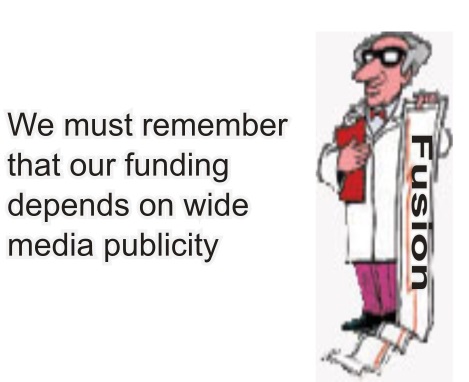
The European Commission has put forward a €9.8 billion budget proposal for the EU’s next nuclear research programme, Euratom, giving a huge boost to fusion research. The next edition of Euratom, starting in 2028, will be almost five times bigger than the current €1.98 billion nuclear research programme. Most of this funding will go towards fusion energy projects, fuelling Europe’s ambition to become the first to develop and commercialise the technology.
A peculiarity of the Euratom programmes is that they are legally required to run for five years, which puts them out of step with the seven-year EU budget cycle. So, it is now usual for each programme to have a two-year extension to keep it in step. The present
proposal sets aside €6.7 billion from 2028 and 2032, with the extension bringing the total to €9.8 billion.
Science Business 4th Sept 25, https://sciencebusiness.net/news/nuclear-fusion/euratom-eu98-billion-nuclear-research-next-eu-budget
Small reactors: cash flow alert for Newcleo, Europe’s largest nuclear start-up.
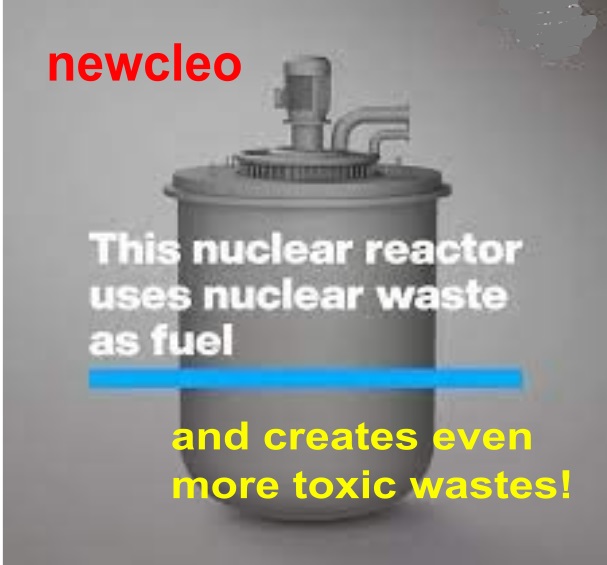
The company, which employs a thousand people, is burning through
too much cash. Its continued existence could be threatened without a new
round of financing.
But both private and public stakeholders remain
cautious. While waiting for fresh money, Newcleo is scaling back. Without a
new capital increase in the next twelve months, the company’s continued
existence is threatened, the Italian press reported in early August. The
articles, notably published in the business daily Il Sole 24 Ore , are
based on the findings of an audit of Newcleo’s 2024 accounts conducted by
KPMG, which La Tribune has seen.
The startup has notably abandoned its
ambitions in the United Kingdom, leading to the elimination of 150
positions. It also intends to reduce its engineering contracts with
external service providers.
La Tribune 29th Aug 2025, https://www.latribune.fr/climat/energie-environnement/petits-reacteurs-alerte-sur-la-tresorerie-de-newcleo-plus-grosse-start-up-europeenne-du-nucleaire-1031500.html
Rolls-Royce denies report of IPO ( Initial Public Offering) plans for small nuclear reactor unit
By Reuters, August 31, 2025
Aug 30 (Reuters) – Rolls-Royce Holdings (RR.L), opens new tab on Saturday denied a report it was exploring an initial public offering for its small nuclear reactor unit.
The Financial Times, citing people familiar with the situation, reported on Saturday the company was considering an IPO as well as other funding options. It said talks with investment houses and banks were at an early stage.
“Rolls-Royce SMR is not planning for, or in the process of launching, an initial public offering,” a spokesperson for the unit said in an emailed statement to Reuters.
In June, the Rolls-Royce SMR unit was selected to build Britain’s first Small Modular Reactors as part of its plan to speed up the decarbonisation of the power network from the mid-2030s. The unit, majority-owned by the British engineering firm, plans to build three reactors.
The British government pledged 2.5 billion pounds ($3.4 billion) for the SMR programme over the next four years, aiming to launch one of Europe’s first small-scale nuclear industries…. https://www.reuters.com/business/energy/rolls-royce-denies-report-ipo-plans-small-nuclear-reactor-unit-2025-08-30/
Rolls-Royce explores small nuclear reactor unit funding options including IPO (Initial Public Offering) .

An Initial Public Offering (IPO) is the process where a private company sells its shares to the public for the first time, thereby becoming a public company listed on a stock exchange. (The process involves significant costs, ongoing reporting requirements, a loss of some control, and increased exposure to litigation)
The consortium led by the UK engineer is in talks to finalise a
contract with the government later this year. Rolls-Royce has held
exploratory talks with advisers over financing options for its small
nuclear business, including an initial public offering, amid growing
investor excitement about the nascent technology.
The FTSE 100 engineer was
selected to build Britain’s first fleet of small modular reactors in June
as part of a plan by the Labour government to make the UK a world leader in
the technology. The Rolls-Royce-led SMR consortium is in talks to finalise
a contract with the government later this year.
The talks with investment
houses and banks focused on future funding requirements of the business,
according to two people familiar with the situation. “There is a live
debate within the shareholder base,” said one of the people, noting that
a listing at a high valuation would generate significant funding. Other
members of the consortium include CEZ Group, the Czech utility, which holds
a 20 per cent stake as part of a wider partnership with Rolls-Royce, the
Qatar Investment Authority and BNF Resources.
There were “different
views” among shareholders, the person added. Discussions were at an early
stage, with the Rolls-Royce board not in a rush to make any decision, said
the other person. The UK government would be eager to ensure that any
listing occurred in London, which has suffered a marked slowdown in
flotations in recent years, they added. The government has said it will
pledge £2.5bn to small modular reactors during this three-year spending
review period, helping to develop Rolls-Royce’s technology as well as
develop sites for the reactors.
FT 30th Aug 2025,
https://www.ft.com/content/234b4c2e-5e1a-46ba-82fd-472e271a289f
Microsoft joins World Nuclear Association amid rapid AI expansion plans

World Nuclear Association’s director general Dr Sama Bilbao y León said: “Microsoft’s membership with the Association is a game-changing moment for our industry.
Edie 3rd Sept 2025
Microsoft has become the newest member of the World Nuclear Association, joining as it, and other tech heavyweights, strive to source low-carbon energy to meet the demands of expanding intelligence (AI) and data centres.
As part of the commitment, the company will take part in the World Nuclear Symposium in London this week. The Symposium includes an Energy Users summit where the nuclear sector, technology industry, and other energy-intensive industries will discuss new partnerships, regulatory hurdles and supply chain needs.
Microsoft has already signed long-term nuclear energy deals, including a 20-year agreement with Constellation Energy to restart the Crane Clean Energy Centre (formerly Three Mile Island) and an agreement with fusion energy start-up Helion.
Key areas of collaboration with the Association are expected to include small modular reactors (SMRs) and other advanced nuclear technologies, streamlined licensing processes and supply chain resilience.
Microsoft’s Energy Technology team, led by Dr Melissa Lott with Todd Noe and Archie Manoharan, will represent the company in the Association’s technical working groups.
Dr Lott said: “Microsoft’s entry into World Nuclear Association’s membership reflects the strategic moment that our industry is working in as we work to meet our carbon-free energy goals.”
It bears noting that the nuclear fuel cycle produces significant volumes of radioactive waste. Some of this waste remains highly radioactive for thousands of years. However, proponents highlight its low-carbon nature and ability to reliably generate energy at any time of day or year, at scale.
World Nuclear Association’s director general Dr Sama Bilbao y León said: “Microsoft’s membership with the Association is a game-changing moment for our industry…………………………………………..
https://www.edie.net/microsoft-joins-world-nuclear-association-amid-rapid-ai-expansion-plans/
Why NuScale Power Stock Slid 31% Last Month

By Brett Schafer – Sep 3, 2025 ,
https://www.fool.com/investing/2025/09/03/why-nuscale-power-stock-slid-31-last-month/
Key Points
- NuScale Power’s stock has pulled back after a huge gain coming from a recent executive order signing.
- The company has a small modular nuclear reactor approved, but has not won a customer contract.
- The stock trades at an expensive price, even though it generates barely any sales and has no customer wins.
The nuclear energy stock doesn’t generate much in revenue and is losing a lot of money.
Shares of NuScale Power (SMR 8.15%) fell 31% in August, according to data from S&P Global Market Intelligence. The nuclear energy upstart and designer of small modular reactors (SMRs) is experiencing wild gyrations with its stock price. The stock is up 432% in the last year and trades at a market cap of $11.5 billion, even though it generates minimal revenue and is burning a lot of cash.
It’s been a roller-coaster ride for nuclear start-ups
Nuclear energy stocks soared at the beginning of this summer, with the current presidential administration’s push to accelerate the development of nuclear energy to keep up with data center demand around artificial intelligence (AI). President Trump signed an executive order for advanced nuclear reactor technologies, of which NuScale Power is one.
In fact, NuScale Power is the only SMR company to have its design approved by the Nuclear Regulatory Commission (NRC), which could give it a head start in winning customer contracts. However, it has failed so far to win any customer contracts outside prospective contracting from a Romanian power company that’s exploring whether to use SMRs for its upcoming energy needs.
With close to zero revenue and a history of burning cash, NuScale Power is a stock that trades with a ton of volatility. As the air comes out of the post-executive order excitement, it is no surprise to see NuScale Power stock hit a bit of a rough patch. The company has no fundamental basis to anchor its $11.5 billion market cap, which makes it a risky stock to invest in.
NuScale Power’s uncertain future
NuScale Power has a few energy projects in the works that it could potentially win deals on, including a recent proposal from the Tennessee Valley Authority. Bringing these to fruition could help it actually develop an SMR to be deployed in the real world instead of talking about it, which has been all the company has done since its inception.
Even if these projects get approved, NuScale Power won’t generate much in revenue to warrant its $11.5 billion market cap, with revenue not showing up for years due to the long project life for nuclear energy developments. It is foolish to buy a stock valued at over $10 billion that’s generating zero revenue. Therefore, investors should avoid putting NuScale Power in their portfolios, given its uncertain future.
The lunacy of Britain’s Sizewell C nuclear project

Tom Burke:
All of these problems have been pointed out to the Government
very often, by many energy experts for several years. Even so this only
tells you part of the lunacy of this project. Britain’s electricity
consumers will start paying for Sizewell C now and will go on doing so
without receiving any electricity from it for the next 12-15 years.
They are in effect compulsory investors. However, unlike the private sector
investors in the project they will not receive a handsome double digit
returned on their forced capital investment. Instead they will then be
forced, as the Bloomberg diagram shows, to pay about three times as much
for Sizewell C’s electricity than would otherwise be available to them from
other sources as cheaper electricity will be forced off the grid in order
to preferentially take that from Sizewell C. It is truly said that those
whom the Gods destroy they first make mad.
FT 27th Aug 2025,
https://www.ft.com/content/ee89bce2-a3e9-48ed-82eb-85916eb24777#comments-anchor
On fusion liability, Energy Minister completely sidelines the issue.
NFLA 27th Aug 2025
NFLA Secretary Richard Outram is disappointed that the new Energy Minister has completely missed the point that taxpayers should not be on the hook for unlimited liabilities to the nuclear fusion industry ‘resulting from incidents involving nuclear matter or emissions of ionising radiation arising from fusion activities relating to the STEP programme’.
On July 21, Climate Minister Kerry McCarthy issued a Departmental Minute to Parliament indicating that the Government will assume these liabilities for STEP (the Spherical Tokamak for Energy Production) project, the fusion experimental plant being built on a former power station site in West Burton with taxpayer money.
Richard wrote to his MP, Debbie Abrahams protesting that ‘As a citizen, I do not want my future taxes in hoc to a private company whose insurance risk for its nuclear activities would reside 100% with the future taxpayer. The procedure is certainly experimental; it may also be risky’. He asked that a request be placed with the Minister ‘with a full published risk analysis for STEP’ prior to a Parliamentary debate and vote.
In response, Ms Abrahams advised Richard that she had written to ‘the Department for Energy Security and Net Zero to make further enquiries about the STEP programme and make representations about your concerns’.
Ms McCarthy has now written back with a standard response in which she waxes lyrical about the supposed benefits that will be delivered through nuclear fusion, yet this is a technology described in the minister’s response as ‘nascent’, a euphemism for currently non-functioning.
The Minister makes a summary assessment that the risk presented by fusion is low, yet concedes ‘there is no private insurance market to provide cover to UKIFS (UK Industrial Fusion Limited) or their industry partners for liabilities in the unlikely event that radiological material or radiation is released from STEP outside of permit conditions‘.
This could suggest that the private sector might not want to insure any emerging nuclear fusion market because of the risk it presents, and if this is the case His Majesty’s Government might ultimately also have to indemnify nuclear fusion operators other than STEP in the future.
The Ministerial Direction effectively saddles the British taxpayer with responsibility to indemnify UKIFS ‘for an unlimited amount of money, for an unlimited time’.
And there is ambiguity in the timescale as some sources suggest STEP will be operational by 2040, whilst the Minister’s statement of 21 July says ‘by the 2040s’. This could mean 2049.
Finally, Richard was gratified to hear that the Minister’s letter was made in response to ‘a number of constituents’ suggesting some level of public disquiet with the Government’s decision………………………………………………………………………………………………………………………. https://www.nuclearpolicy.info/news/on-fusion-liability-energy-minister-completely-sidelines-the-issue/
The World Bank can now fund nuclear energy projects: Here’s what’s next.
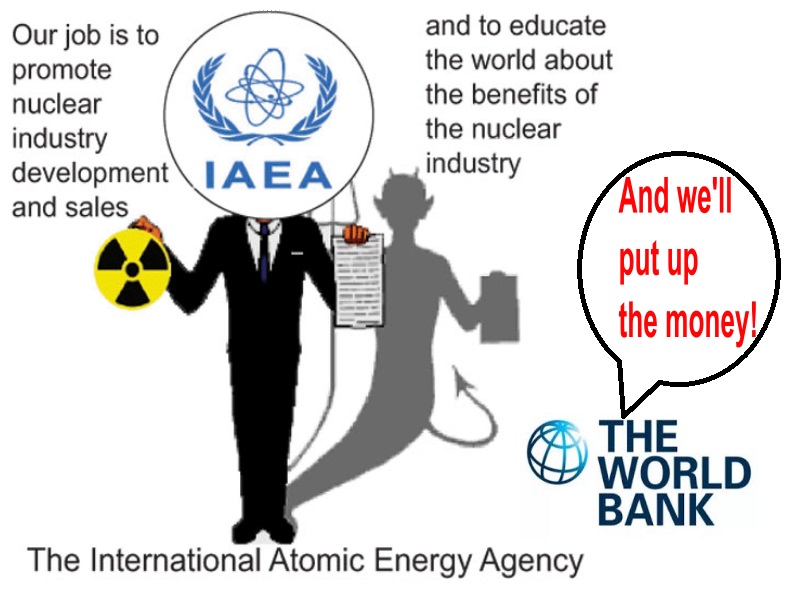
Specifically, the agreement pledges that the IAEA will provide subject-matter expertise to the World Bank Group that will help the group support lifetime extensions of existing nuclear power plants and advance the commercial deployment of small modular reactors (SMRs).
Bulletin, By Marina Lorenzini | August 28, 2025
As a growing number of countries look to strengthen their domestic energy production, meet baseload power generation needs, and manage low-carbon climate goals, they’re increasingly looking to nuclear—and some previous skeptics are looking with them. On June 11th, the World Bank Group (WBG) announced an end to its longstanding ban on funding nuclear power projects. The ban had only been in place formally since 2013, but the last and only time the WBG funded a nuclear power project was 1959—a $40 million loan to build a nuclear power plant in Italy.
Two weeks after the ban was dropped, the group’s President Ajay Banga signed an agreement with the International Atomic Energy Agency (IAEA), committing to support countries that seek to include nuclear energy as part of their development strategies. The policy change builds on similar commitments from the 2023 climate negotiations in Dubai to triple global nuclear capacity, private financial industry pledges of capital for nuclear energy investments, and bipartisan support for nuclear in Washington, D.C.
The World Bank Group’s policy shift on nuclear energy was enabled by a similar reversal from German leadership, one of the bank’s foremost contributors. Germany has long opposed nuclear energy, famously extending the life of coal-fired power plants while committing to shut down its nuclear fleet at home; Germany’s position on nuclear power is an oft-cited motivation for the Bank’s enduring ban. Although German Chancellor Friedrich Merz would need to overcome significant opposition from within his own governing coalition to resurrect a nuclear power fleet in Germany, at the moment, Merz is increasingly accepting of nuclear power as an energy source at the EU-level and internationally.
The World Bank Group is composed of five affiliated agencies: the International Bank for Reconstruction and Development; the International Finance Corporation; the International Development Association; the International Centre for Settlement of Investment Disputes; and the Mulitlateral Investment Guarantee Agency. The International Bank for Reconstruction and Development and the the International Development Association provide loans and grants to low- and middle-income countries and are commonly referred to as the “World Bank.” The agreement with the IAEA is intended to quickly infuse expertise into all five of the World Bank Group’s teams of economists and country experts. Specifically, the agreement pledges that the IAEA will provide subject-matter expertise to the World Bank Group that will help the group support lifetime extensions of existing nuclear power plants and advance the commercial deployment of small modular reactors (SMRs). While the agreement doesn’t identify specific countries for investment, some parameters have emerged for evaluating likely candidates to receive WBG funding.
Lifetime extensions for existing reactors. There are nearly 440 nuclear power reactors around the world, many of which are approaching or have surpassed their designed lifespans, usually around 40 years. Efforts to upgrade existing power plants and extend their lifetime to 60 or even 80 years can allow countries to continue producing electricity using their original reactors.
There are a few countries seeking lifetime extensions that hold open accounts with the World Bank Group, and four emerge as leading contenders: Argentina, India, South Africa, and Ukraine. If the Bank cannot front the whole cost, the Bank may seek to deepen co-financing partnerships with regional development banks. For example, in February 2025, the Asian Development Bank and the WBG signed a framework allowing borrowers to follow one set of rules related to project design, preparation, appraisal, supervision, completion, and evaluation. In that spirit, other arrangements could be made with the African Development Bank, the Development Bank of Latin America and the Caribbean, or the European Bank for Reconstruction and Development to lessen the burden on one bank.
In the EU, countries may have access to debt or equity financing from the world’s largest multilateral development lender, the European Investment Bank. The most likely candidate in the EU for the WBG’s lending arm is Romania, which already receives funding from the bank. Their nuclear power plant owner recently revealed a proposal for a JP Morgan–led €500 million bond issuance, intended to finance the refurbishment of the nuclear power plant at Cernavoda, which will be submitted to a shareholder meeting in September 2025. However, if that proposal is unsuccessful, WBG may have an opportunity to contribute.
The WBG may later consider expanding its portfolio into new traditional reactor builds on already existing sites, such as in Brazil or Bulgaria, before building completely new sites with traditional reactors.
A longer time horizon for newcomers and SMRs. While less output and per–project costs make SMRs more suitable for emerging economies, the technology may not be commercially viable for the next several years. A measured dose of skepticism is warranted regarding the timelines for any of the SMR designs to be commercially widespread.
As a first step, Banga aims to advance standardization across design variations of SMRs, which would help achieve the economies of scale necessary for commercialization. Standardization at the regulatory and industrial levels is already an active area for the IAEA. The regulatory landscape for nuclear energy varies widely across jurisdictions and each country has unique licensing processes and technical standards for nuclear reactors. A lack of harmonization forces each SMR supplier to customize engineering designs and licensing strategies for each market, a time-consuming and expensive process that hinders the scalability of SMRs.
Banga has also signaled that the WBG may sign purchase agreements with SMR manufacturers to expedite the deployment of prototypes and provide guaranteed revenue. Countries with existing nuclear industries would be obvious prospects for new builds and SMR partnerships. Armenia, for example, operates a Soviet-era VVER-440 pressurized water reactor at Metsamor. The reactor is in the early stages of a lifetime extension with Rosatom, which seeks to sustain the remaining operational reactor until 2036. However, Metsamor’s operation will likely conclude in the coming decade, and preparations must be made for replacing or even expanding Metsamor’s current contributions to the electric grid. With investments from the United States in power-hungry AI computing and physical infrastructure already underway, Armenia could be a strong candidate for the WBG to contribute to the bilateral energy security goals between the two nations.
For countries without a proven track record in the nuclear power industry, the WBG may seek to establish connections with countries already engaged in international agreements and standard setting regarding nuclear technology. This could include countries negotiating a 123 agreement with the United States, which establishes terms for working with US companies on nuclear projects, or adopting the IAEA’s Milestones Approach, an infrastructure development framework for nuclear power newcomers. In addition, prospective countries should have an industrial and manufacturing base, strong electric grid, and proximity to a reliable water source. Under these criteria, Ghana, Indonesia, and the Philippines emerge as potential frontrunners for gaining WBG support……………………………………………………….
Momentum in Washington. Aside from Germany, the Trump administration is a leading driver of the WBG nuclear policy change and will be a key partner in executing the policy……………………………………………..
it is important to recognize that while the WBG’s investment will be transformational for specific sites and countries, the challenge is global. If the group’s funds and expertise can’t improve the industry’s ability to deliver on time and within budget, their presence may only make a marginal contribution to global electricity needs or climate goals in the next decade. https://thebulletin.org/2025/08/the-world-bank-can-now-fund-nuclear-energy-projects-heres-whats-next/?utm_source=ActiveCampaign&utm_medium=email&utm_content=The%20World%20Bank%20s%20nuclear%20projects&utm_campaign=20250825%20Monday%20Newsletter%20%28Copy%29
Unaudited Power: The Military Budget That Nobody Controls
August 26, 2025 By Ellen Brown ScheerPost, https://scheerpost.com/2025/08/26/ellen-brown-unaudited-power-the-military-budget-nobody-controls/
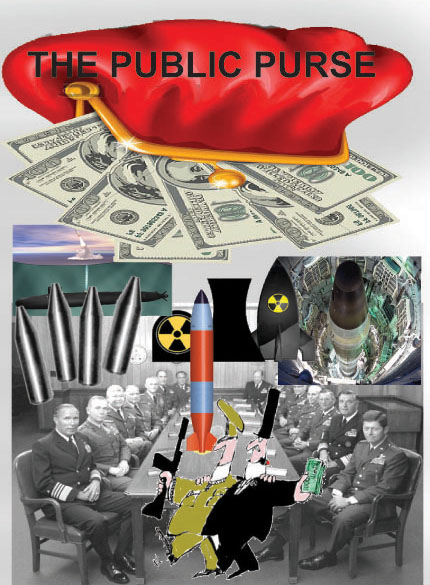
The U.S. federal debt has now passed $37 trillion and is growing at the rate of $1 trillion every five months. Interest on the debt exceeds $1 trillion annually, second only to Social Security in the federal budget. The military outlay is also close to $1 trillion, consuming nearly half of the discretionary budget.
As a sovereign nation, the United States could avoid debt altogether by simply paying for the budget deficit with Treasury-issued “Greenbacks,” as Abraham Lincoln’s government did. But I have written on that before (see here and here), so this article will focus on that other elephant in the room, the Department of Defense.
Under the Constitution, the military budget should not be paid at all, because the Pentagon has never passed an audit. Expenditures of public funds without a public accounting violate Article 1, Section 9, Clause 7of the Constitution, which provides:
“No Money shall be drawn from the Treasury, but in Consequence of Appropriations made by Law; and a regular Statement and Account of the Receipts and Expenditures of all public Money shall be published from time to time.”
The Pentagon failed its seventh financial audit in 2024, with 63% of its $4.1 trillion in assets—approximately $2.58 trillion—untracked. From 1998 to 2015, it failed to account for $21 trillion in spending.
As concerning today as the financial burden is the wielding of secret power. Pres. Dwight Eisenhower warned in his 1961 farewell address, “In the councils of government, we must guard against the acquisition of unwarranted influence, whether sought or unsought, by the military-industrial complex. The potential for the disastrous rise of misplaced power exists and will persist.”
Pres. John F. Kennedy echoed that concern, warning in 1961 that “secret societies” and excessive secrecy are “repugnant in a free and open society,” threatening democracy by withholding truth from the public. He warned that excessive concealment, even for national security, undermines democracy by denying citizens the facts needed to hold power accountable. “No expenditure is questioned, no rumor is printed, no secret is revealed,” he said. If untracked billions fund classified programs, citizens are left powerless, governed by a shadow entity answerable to no one.
Those concerns persist today. On Aug. 13, 2025, Joe Rogan interviewed U.S. Representative Anna Paulina Luna, who leads a House Oversight Committee focused on government transparency regarding various topics, including UAPs (Unidentified Anomalous Phenomena, formerly UFOs). Luna said the committee had been formed after she and two other congressmen were denied access at Eglin Air Force Base to information on UAPs provided by whistleblowers. The problem, she said, was that Congress was supposed to represent the public and be an investigative body for it, “and you have unelected people operating basically in secrecy. … I think this goes all the way back even to JFK, with how they basically have operated outside of the purview of Congress and basically… have gone rogue ….”
A Behemoth Without Oversight
The Department of Defense’s $885.7 billion budget for 2025, approved by the House of Representatives, dwarfs the military spending of China ($296 billion), Russia ($84 billion), and the next eight nations combined. Managing $4.1 trillion in assets—from aircraft carriers to secret drones—along with $4.3 trillion in liabilities (e.g. personnel costs and pensions), the federal government’s largest agency oversees a military empire spanning over 4,790 sites worldwide. Yet it operates with minimal oversight.
The Chief Financial Officers Act of 1990 mandated audits for all federal agencies, but the National Defense Authorization Act of 2018 delayed the Pentagon’s first department-wide audit to 2018 due to its unwieldy size, its decentralized systems, and its outdated software. The DOD has failed every audit since that time. In 2024, it could not account for its $824 billion FY 2024 budget, with 2,500 new audit issues identified. Of 24 reporting entities, only nine received clean opinions, while 15 received disclaimers due to insufficient data. In fact the Government Accountability Office (GAO) has flagged DoD financial management as high-risk for waste, fraud, and abuse ever since 1995.
As observed in a January 2019 article in Rolling Stone by Matt Taibbi, openly secret budgets were first legalized in 1949 with the passage of the Central Intelligence Agency Act, which exempted that newly created agency from public financial disclosure. The Act stated, “The sums made available to the Agency may be expended without regard to the provisions of law and regulations related to the expenditure of Government funds.”
The aim of the Chief Financial Officers Act of 1990 was to curb billions of dollars said to be lost each year through fraud, waste, abuse, and mismanagement of public budgets. Despite the mandated audits for all federal agencies, the DoD – the only major agency without a clean audit – has received $3.9 trillion in congressionally approved funding since 2018. “Every year that members of Congress vote to boost Pentagon spending with no strings attached,” observed federal budgeting expert Lindsay Kosgharian, “they choose to spend untold billions on weapons and war with no accountability.”
The Audit the Pentagon Act of 2023, backed by Sens. Bernie Sanders and Chuck Grassley, proposes docking 0.5–1% of budgets for audit failures, but the measure has not received a vote.
The Department of Government Efficiency (DOGE), launched with promises to strip waste, fraud, and abuse from federal agencies, has conspicuously sidestepped the Pentagon. A June 2025 article titled “Why DOGE Was Always Doomed: The Pentagon Problem,” points out that the DOGE mission was seriously hampered by the Pentagon’s exemption from auditing:
In FY 2024, total discretionary spending was about $1.6 trillion. Of that, the Pentagon alone received $842 billion. In other words, it got more funding than all other departments combined. You read that right: one (very special) department received more than all the rest put together.
Funds that are not accounted for divert resources from critical needs like troop readiness, healthcare, and infrastructure. Overbilling by contractors enriches corporations while taxpayers foot the bill. And the lack of transparency erodes public confidence, as Americans struggle with domestic priorities.
The Missing $21 Trillion: Fraud, Waste or Something Worse?
The Pentagon’s audit failures mask not just inefficiency and waste but pervasive fraud and corruption. Between 1998 and 2015, Inspector General reports show that the DoD could not account for $21 trillion in spending—65% of federal spending during that period. For perspective, the entire U.S. GDP in 2015 was $18.2 trillion. In 2023, the agency failed to document 63% of its $3.8 trillion in assets, up from 61% the prior year. A 2015 DoD report identifying $125 billion in administrative waste was suppressed to protect budget increases.
There is plenty of verified waste to support the case for mismanagement. Military contractors, who receive over half of the Pentagon’s budget, are a major culprit. The F-35 program, managed by Lockheed Martin, was reported in 2021 to be $165 billion over budget, with $220 billion in spare parts poorly tracked. A 2023 CBS News investigation found that contractors routinely overcharged by 40–50%, with some markups reaching 4,451%. A 2016 report in the Nation highlighted $640 for a toilet seat and $7,600 for a coffee pot.
It is no longer even necessary to cover up fraud and corruption by wildly inflated prices. In 2017, former HUD official Catherine Austin Fitts collaborated with Mark Skidmore, an economics professor at Michigan State University, to document the missing $21 trillion in unsupported journal voucher adjustments at the DoD and HUD. In a June 2025 article published in Fitts’ journal The Solari Report titled “Should We Care about Secrecy in Financial Reporting?,” Dr. Skidmore discussed how the government responded to the publication of his research with Fitts. Its response was to immediately eliminate the paper trail leading to its covert financial operations. In particular, “Pentagon officials turned to the Federal Accounting Standards Advisory Board (FASAB) for advice. Several months later, FASAB posted a new document (FASAB 56), which recommended that the government be allowed to misstate and move funds to conceal expenditures if it is deemed necessary to protect national security interests.”
Fitts remarked, “The White House and Congress just opened a pipeline into the back of the US Treasury, and announced to every private army, mercenary and thug in the world that we are open for business.”
Speculation Run Rampant
In a widely-viewed interview by Tucker Carlson on April 28, 2025, Fitts expressed her belief that the missing trillions had been funneled into classified projects involving advanced technologies, including massive underground bunkers to protect elites from a “near-extinction event;” and that they were using advanced energy systems and hidden transit networks possibly linked to extraterrestrial tech. She discussed “interdimensional intelligence” and a secret space program linked to a “breakaway civilization.” The latter term was coined by UFO researcher Richard Dolan and is defined by Google as “a theoretical, hidden society that operates outside of mainstream civilization with advanced technology, often linked to UFO phenomena and secret space programs.”
In a Danny Jones interview in May 2025, Fitts alluded to Deep Underground Military Bases (“DUMBs”), perhaps used for “advanced technology or off-world operations.” Existence of these bases was confirmed two decades earlier by whistleblower Philip Schneider, a U.S. government geologist and engineer involved in their construction. In his last presentation in 1995, Schneider said there were 131 of these cities connected underground by mag-lev rail, built at a cost of $17-26 billion each. According to his biographer, Schneider was assassinated in 1996 by a U.S. intelligence agency for disclosing the government cover-up of UFOs and aliens.
Too over the top? Perhaps, but the Pentagon is so secretive that the public is left to speculate. Are we dealing with a scenario like that in such Hollywood movies as the 1997 film Men in Black, in which hidden forces—human or alien—control our fate?
The Pentagon’s All-domain Anomaly Resolution Office (AARO) contends that no verifiable evidence supports extraterrestrial activity. But other prominent figures support the UFO/UAP narrative. In 2017, the New York Times exposed the Advanced Aerospace Threat Identification Program (AATIP), said to be a $22 million DoD initiative run by Luis Elizondo investigating UAPs from 2007–2012.
According to BBC News, Haim Eshed, former head of Israel’s space security program, claimed in a 2020 interview with the Yediot Aharonot newspaper that the U.S. government has an “agreement” with a “Galactic Federation” of extraterrestrials. He alleged aliens have been in contact with the U.S. and Israel, with secret underground bases where they collaborate on experiments. Eshed claimed the United States was on the verge of disclosing this under President Trump but withheld it to avoid “mass hysteria.” The claims were unverified but provocative.
In recent years, Congress has increased its focus on UAPs, with high-profile hearings in 2022, 2023, and 2024. In 2023, whistleblower David Grusch, a former intelligence officer, testified that the U.S. possesses “non-human origin” craft and “dead pilots,” based on classified briefings. On November 13, 2024, the House Oversight Committee’s hearing, “Unidentified Anomalous Phenomena: Exposing the Truth,” featured testimony from Luis Elizondo, retired Navy Rear Admiral Tim Gallaudet, journalist Michael Shellenberger, and former NASA official Michael Gold, who claimed the U.S. possesses UAP technologies and has harmed personnel in secret retrieval programs. Shellenberger alleged that a covert “Immaculate Constellation” program hides UAP data from Congress.
Some lawmakers, including Rep. Luna and Rep. Tim Burchett, continue to criticize Pentagon secrecy and to push for transparency. In May 2024, Burchett introduced the UAP Transparency Act, requiring the declassification of all UAP-related documents within 270 days. He stated:
This bill isn’t all about finding little green men or flying saucers, it’s about forcing the Pentagon and federal agencies to be transparent with the American people. I’m sick of hearing bureaucrats telling me these things don’t exist while we’ve spent millions of taxpayer dollars on studying them for decades.
Secrecy Undermines Democracy
With $21 trillion unaccounted for historically, $165 billion in F-35 overruns, and $125 billion in buried waste, the DoD’s financial mismanagement needs urgent reform. Congress is primarily responsible for overseeing the DoD budget, exercising its constitutional “power of the purse” under Article 1 of the U.S. Constitution. So why isn’t it enforcing this mandate?
The chief excuse given is the need for secrecy for security reasons, but a congressional committee could be given access to the Pentagon’s financial data in closed session in order to exercise public oversight and enforce accountability. Other factors are obviously at play, including political influence, lobbying, campaign contributions from the defense sector, and a lack of penalties for noncompliance.
To restore accountability, Congress needs to enforce the Audit the Pentagon Act, modernize DoD systems, and investigate contractors profiting from lax oversight. UAP transparency is also critical, whether to debunk myths or uncover truths.
As taxpayers footing the bill, we are entitled to know not only where our money is being spent but who is really in charge of our government. The Pentagon’s secrecy and lack of accountability could be shielding anything from contractor fraud to UAP programs and alien alliances. If there is information so secret that even our elected representatives don’t have access to it, who does have access? Is there a secret government above the government we know? Without fiscal transparency and accountability, we can no longer call ourselves a democracy, as JFK warned.
KHNP And Westinghouse ‘Holding Talks’ Over Nuclear JV For US And Europe
By David Dalton, 22 August 2025, https://www.nucnet.org/news/khnp-and-westinghouse-holding-talks-over-nuclear-jv-for-us-and-europe-8-5-2025
Companies may cooperate on new build as they try to put legal dispute behind them.
Korea Hydro & Nuclear Power (KHNP) and Westinghouse are holding talks to set up a joint venture for US and European projects as they try to move on from a legal settlement that has been criticised by politicians in Seoul, multiple press reports have said.
The UK daily Financial Times (subscription required) reported that KHNP’s chief executive will travel to Washington on Saturday to meet executives from Pennsylvania-based Westinghouse.
The proposed joint venture could pave the way for South Korean groups to expand in the US, where president Donald Trump has pledged to quadruple nuclear energy capacity by 2050.
“The two countries are expected to discuss ways to cooperate on nuclear power, including building nuclear power plants in the US,” a South Korean Democratic Party lawmaker told The Korea Economic
The move comes after KHNP was awarded a 26 trillion won (€16bn, $18.6bn) contract in June to build two nuclear power plants at Dukovany in the Czech Republic, following the resolution in January of a long-running dispute over nuclear technology rights with Westinghouse.
Unconfirmed reports have said KHNP ceded leadership of nuclear projects in Europe to Westinghouse when it settled the dispute in order to secure the Dukovany contract.
As a result, KHNP is said to be barred from entering the nuclear markets of European Union member states – except the Czech Republic – the US, the UK, Japan and Ukraine.
Thi means it is restricted to pursuing projects in Southeast Asia, Central Asia, the United Arab Emirates, Saudi Arabia, South America and Turkey, reports said.
According to press reports, KHNP and its parent company Korea Electric Power Corporation also agreed to pay Westinghouse $825m in goods, services and royalties per exported reactor over the next 50 years.
Westinghouse had accused the South Korean company of infringing on its intellectual property, claiming KHNP’s APR1000 and APR1400 plant designs use its licensed technology.
The January settlement removed a major hurdle for a KHNP-led consortium to sign the final Dukovany contract in June.
KHNP has withdrawn from bidding for nuclear deals in the Netherlands, Slovenia and Sweden in the past year. The company also said this week it had pulled out of a potential Polish project.
Nuclear legacy costs far outweigh Germany’s environmental protection investments.

Clean Energy Wire, 23 Jul 2025, Benjamin Wehrmann, Germany https://www.cleanenergywire.org/news/nuclear-legacy-costs-far-outweigh-germanys-environmental-protection-investments
Over half of the German environment ministry’s (BMUKN) budget for 2025 will be spent on managing the country’s nuclear waste and preparing a decision for a final nuclear repository. According to a government budget draft, the ministry led by Social Democrat (SPD) Carsten Schneider will receive 2.7 billion euros this year, about 300 million euros more than in 2024. Out of this sum, 1.4 billion euros are reserved for the “temporary and final storage of radioactive waste,” a parliament report on the draft said.
In 2024, Germany spent about 1.1 billion euros on nuclear waste management, after the country shuttered its last commercial nuclear power plants in mid-2023. Some 860 million euros from the 2025 ministry budget will be spent on the search for a final repository and about 535 million euros on temporary storage.
By contrast, about 460 million euros were marked for nature and environment protection measures by the ministry, while the subordinate Federal Environment Agency (UBA) will receive another 205 million euros. Climate action costs were not yet reflected in the budget, as the environment ministry was handed responsibility for this policy field from the economy ministry only in spring this year, the parliament report said. It did not specify which measures are covered under this field. Energy policy remains with the economy ministry.
“Nuclear waste is eating up environmental protection,” Wolfgang Ehmke from the citizen initiative for environmental protection of Lüchow-Dannenberg, told newspaper Tageszeitung (taz). The rural district in northern Germany is known for its temporary nuclear repository in the municipality of Gorleben, which has been the site of many anti-nuclear protests over the past decades. Management and construction works at the Gorleben repository alone climbed from 20 million euros in 2024 to 33 million one year later, the newspaper said.
Another repository, Asse near the town of Wolfenbüttel, would even require maintenance investments of 206 million euros this year. Costs for managing the country’s nuclear waste are even higher, as part of the legacy costs are carried by other ministries. For example, the research ministry is responsible for research reactors, while the finance ministry handles nuclear infrastructure in the former eastern German states, as agreed in the country’s reunification treaties, taz added.
Part of the costs of Germany’s nuclear waste management are financed through a fund filled by the former nuclear plant operators. These made a one-off payment of 24 billion euros in 2017 and were subsequently freed of further financial liabilities. Following Germany’s 2011 renewed commitment to phase out nuclear power, the country started looking for a location to safely store its roughly 28,100 cubic metres of radioactive material for hundreds of thousands of years. Initially, the aim was to select a location for the final repository by 2031 but, in 2022, the responsible agency pushed the deadline to until at least 2046.
Rolls-Royce making fortune from ‘untested new nuclear market’.

Campaign for Nuclear Disarmament condemns the firm’s plans for AI-assisted small modular reactors
14 August 2025, Morning Star
ROLLS-ROYCE has been accused of making a fortune out of a “toxic, untested new nuclear market” over plans to power artificial intelligence (AI) with small modular reactors (SMRs).
The Campaign for Nuclear Disarmament (CND) made the comments after the engineering firm’s chief executive Tufan Erginbilgic claimed that its plans to power energy-intensive AI with its nuclear reactors could make it Britain’s most valuable company.
“There is no private company in the world with the nuclear capability we have. If we are not market leader globally, we did something wrong,” he told the BBC.
SMRs are smaller and quicker to build than traditional nuclear plants, but the technology remains unproven.
Rolls-Royce has already supplied SMRs to power dozens of nuclear submarines and has signed a deal to develop six for the Czech Republic while developing three for Britain.
“SMRs are an absolute disaster,” said CND general secretary Sophie Bolt. “Should a working model actually be built, they will produce far more toxic radioactive waste than regular nuclear reactors.
“Rolls-Royce is making a fortune out of this toxic, untested new nuclear market.
“We are bombarded with plans to rapidly expand nuclear sites across the country, but there is still no plan for what to do with the toxic waste generated or deal with legacy waste.
“Britain and its workers need a new green deal, one that leaves nuclear in the 20th century, and puts genuine renewables and anti-militarism at the heart of its security strategy.
“This has been outlined in the Alternative Defence Review, a report supported by CND and the RMT union, which acts as a roadmap for this transition which puts workers at the heart of change.”…………………………………………(Subscribers only)
The cost of the UK’s strategic nuclear deterrent

Research Briefing, 12 August, 2025 Claire Mills, Esme Kirk-Wade, https://commonslibrary.parliament.uk/research-briefings/cbp-8166/
Since the acquisition of the UK’s first strategic nuclear deterrent in the 1950s, the cost of procuring and maintaining it, and which Government department should finance it, has always been a matter of debate.
Ascertaining precise costs for the nuclear deterrent can be difficult, as this information is not easily available from public sources. The nuclear deterrent is also supported by an overarching, and complex, network of programmes, infrastructure, equipment and people, which is referred to as the Defence Nuclear Enterprise (DNE). Separating out individual costs for the nuclear deterrent from within that structure is not straightforward, particularly since 2023 when the government started reporting all nuclear-related spending as a single line (the DNE) in its departmental estimates.
Synergies between the civilian nuclear sector and the defence nuclear enterprise complicate that picture further.
Cost of the existing ‘Trident’ nuclear deterrent
The UK’s nuclear deterrent is provided by four Vanguard-class ballistic missile submarines (SSBN) which house the Trident II D5A missile and associated Mk4A/Holbrook warhead. The decision to procure Trident, as the nuclear deterrent is often referred, was taken in the early 1980s. Spending on the programme was largely complete by the time of the 1998 Strategic Defence Review. Total acquisition expenditure on the programme was £12.52 billion, which equates to approximately £23 billion in 2024/25 prices.
Prior to 2023, annual in-service costs, which also included the costs of the Atomic Weapons Establishment (AWE) and the Nuclear Warhead Sustainment Capability Programme, basing, decommissioning and disposals, were estimated at 6% of the defence budget (£3 billion for 2022/23). In 2023, the decision was taken to bring all nuclear-related programmes and expenditure, including the in-service running costs of the deterrent, under one heading: the Defence Nuclear Enterprise (DNE), and to ringfence it within the MOD budget. The intention is to provide greater flexibility within the nuclear programme and to try and insulate the rest of the conventional equipment plan from any changes in nuclear spending. In doing so, direct comparisons of in-service costs for the nuclear deterrent over time are no longer possible.
Replacing the nuclear deterrent
A programme is currently underway to replace the Vanguard-class submarines from the early 2030s.
The estimated cost of the design and manufacture of a new Dreadnought- class of four SSBN is £31 billion, including inflation over the life of the programme. A £10 billion contingency has also been set aside, making an upper-end estimate of £41 billion in total acquisition costs for the Dreadnought class. In May 2025 the Ministry of Defence said that £3.37 billion of the contingency had been accessed as of March 2024. It also said that the remainder had been allocated to future years, suggesting that the full £10 billion in contingency funding will be spent.
In 2016 the goverment said that it expected in-service costs for the nuclear- deterrent, once the new Dreadnought SSBN entered service, to continue at approximately 6% of the defence budget. Following the decision in 2023 to amalgamate all nuclear-related spend under a single DNE budget, however, the government said that an “equivalent comparison” for future in-service costs was no longer possible.
A programme to replace the UK’s nuclear warhead was also confirmed in February 2020. In the 2025 Strategic Defence Review, the government announced £15 billion for the programme within the current Parliament (to 2029).
Wider costs
The decision to amalgamate nuclear spending under one budget heading: the Defence Nuclear Enterprise (DNE), reflects the increasing interdependence between the nuclear deterrent and the Royal Navy’s other conventionally armed nuclear-powered submarine programmes, including the new AUKUS-SSN being developed in conjunction with the US and Australia. This is particularly relevant to the costs associated with basing, infrastructure and nuclear propulsion.
There are various costs associated with replacing the nuclear deterrent that are not part of the capital costs of the Dreadnought programme or the sovereign warhead programme, but fall within wider spending on the defence nuclear enterprise. Those costs include the UK’s participation in the US-led Trident Service-Life Extension programme, extension of the service-life of the current Vanguard-class SSBN, and various basing and nuclear infrastructure projects.
Spending on nuclear programmes across of the whole Defence Equipment Plan to 2033 is currently forecast at £128 billion. That represents a £10 billion increase on the original forecasts in the 2023-2033 equipment plan.
Who will pay for it?
In line with convention, the Dreadnought programme will be funded from the Ministry of Defence’s departmental budget.
There has been a longstanding debate over budgetary responsibility for the nuclear deterrent, with frequent calls made for the capital costs of the replacement programme to be removed from the MOD budget.
Nuclear developers turn to Special Purpose Acquisition Companies.
Three nuclear energy developers are seeking to raise more than $500mn
through mergers with special purpose acquisition companies as investors
rush to tap into an atomic energy boom.
Terra Innovatum, Terrestrial Energy
and Eagle Energy Metals said the transactions, which they expected to be
completed by the end of the year, would accelerate the development of small
modular reactors.
Several other companies developing nuclear technologies
are considering listings via initial public offerings, including Holtec
International and Quantum Leap Energy, a division of ASP Isotopes.
“Investors now realise that nuclear energy is here to stay because it is
needed to power the artificial intelligence revolution and this is
turbocharging interest, particularly in the US,” said Nick Lawson, the
chief executive of Ocean Wall, an investment group advising ASP Isotopes on
the QLE spin off.
Shares in nuclear energy companies surged near record
highs last week as optimism about a nuclear renaissance gathered pace owing
to AI power demand and political support from the Trump administration.
Last month Westinghouse outlined plans to build 10 large nuclear reactors
in the US at a meeting in Pittsburgh attended by President Donald Trump,
who has set a target of quadrupling American nuclear power capacity in the
next 25 years.
FT 11th Aug 2025, https://www.ft.com/content/087f3fac-52ca-4ca7-8827-734125af4a2b
1 This Month
To see nuclear-related stories in greater depth and intensity – go to https://nuclearinformation.wordpress.com/
12 February – Webinar The Big Push: New Nuclear Projects in Canada
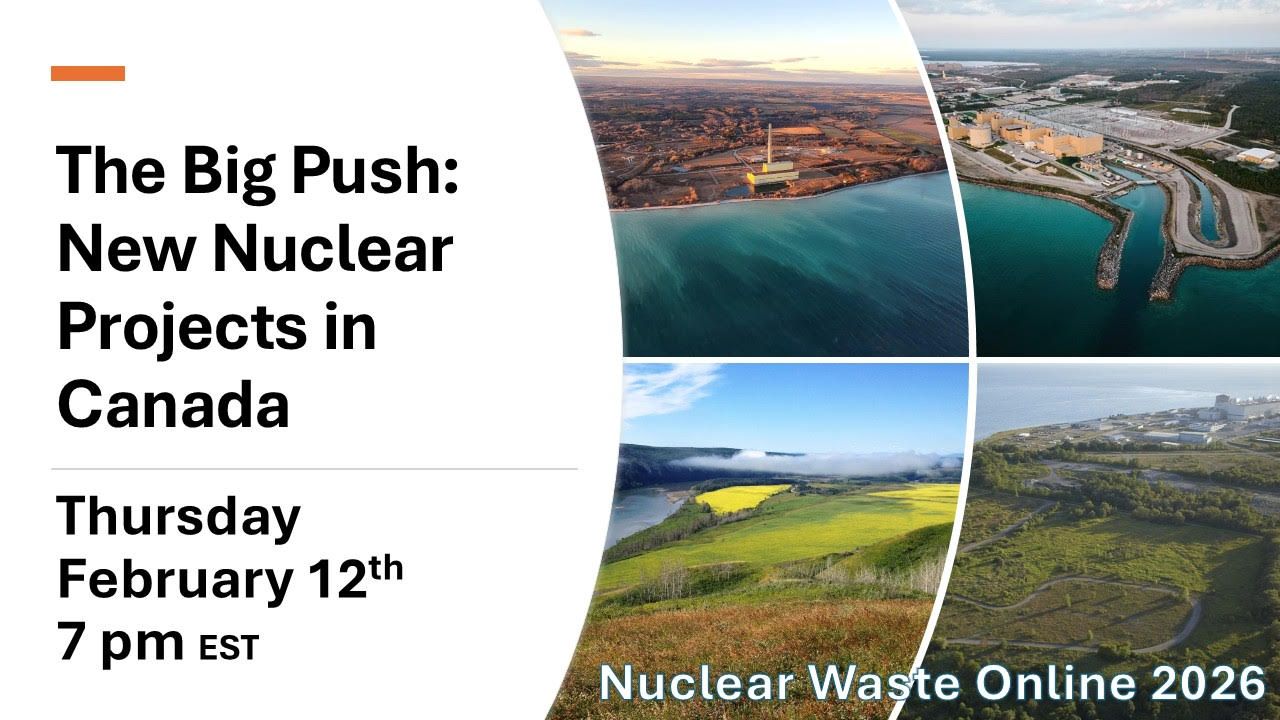
Thursday, February 12, 7 pm Eastern | 2nd of 4 sessions in the 2026 Nuclear Waste Online webinar series
Join a webinar on the push for new nuclear generation in Canada. Go to Northwatch.org to register or use the registration link https://us02web.zoom.us/webinar/register/WN_ZfWOf1GITqSRIZX8CB-A9w

-
Archives
- February 2026 (115)
- January 2026 (308)
- December 2025 (358)
- November 2025 (359)
- October 2025 (376)
- September 2025 (258)
- August 2025 (319)
- July 2025 (230)
- June 2025 (348)
- May 2025 (261)
- April 2025 (305)
- March 2025 (319)
-
Categories
- 1
- 1 NUCLEAR ISSUES
- business and costs
- climate change
- culture and arts
- ENERGY
- environment
- health
- history
- indigenous issues
- Legal
- marketing of nuclear
- media
- opposition to nuclear
- PERSONAL STORIES
- politics
- politics international
- Religion and ethics
- safety
- secrets,lies and civil liberties
- spinbuster
- technology
- Uranium
- wastes
- weapons and war
- Women
- 2 WORLD
- ACTION
- AFRICA
- Atrocities
- AUSTRALIA
- Christina's notes
- Christina's themes
- culture and arts
- Events
- Fuk 2022
- Fuk 2023
- Fukushima 2017
- Fukushima 2018
- fukushima 2019
- Fukushima 2020
- Fukushima 2021
- general
- global warming
- Humour (God we need it)
- Nuclear
- RARE EARTHS
- Reference
- resources – print
- Resources -audiovicual
- Weekly Newsletter
- World
- World Nuclear
- YouTube
-
RSS
Entries RSS
Comments RSS
 nuclear-news