Large U.S. nuclear delegation to India to con Indians into buying Small Modular Nuclear Reactors
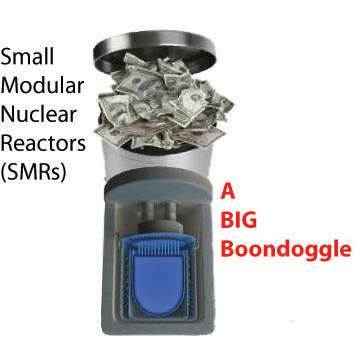 Nuclear ties in focus ahead of Trump visit, Live Mint 18 Feb 2020, Elizabeth Roche Nuclear ties in focus ahead of Trump visit, Live Mint 18 Feb 2020, Elizabeth Roche
|
|
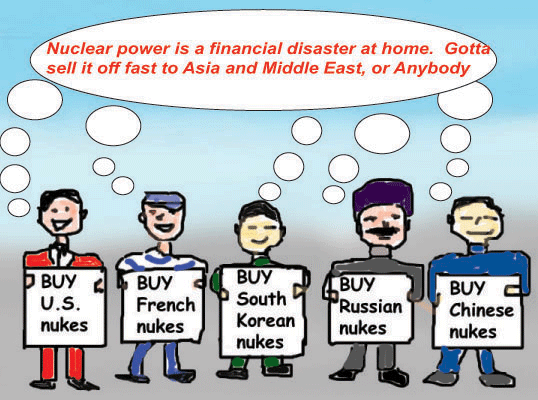
India joins the panic to sell costly, impractical, nuclear power to Africa and Middle East
|
Indian Envoy To Russia Says Countries Could Build Nuclear Power Plants In Africa & Middle East Caspian Newa By Vusala Abbasova January 26, 2020 Russia and India may team up to construct nuclear power plants in Africa and the Middle East, according to India’s ambassador to Russia, building on their current experiences in Bangladesh.
“We are already working under the scheme in Bangladesh,” Varna added, referring to the current construction of the country’s first nuclear power plant, called Rooppur. “Now Russia is also pretty active in the construction of nuclear power plants in the Middle East and Africa. That opens a new pathway of cooperation for us.” Varma believes the two sides could also launch projects in Africa using the experience they gained from joint work on Rooppur, which is being built by Russia’s Rosatom State Atomic Energy Corporation and costing over $13 billion. “Russia already has agreements in this field with a number of African countries,” Varma said. “Ethiopia is one of them, and there are some countries in the Middle East.”
|
|
Hazards of Russia’s nuclear colonialism- example South Africa
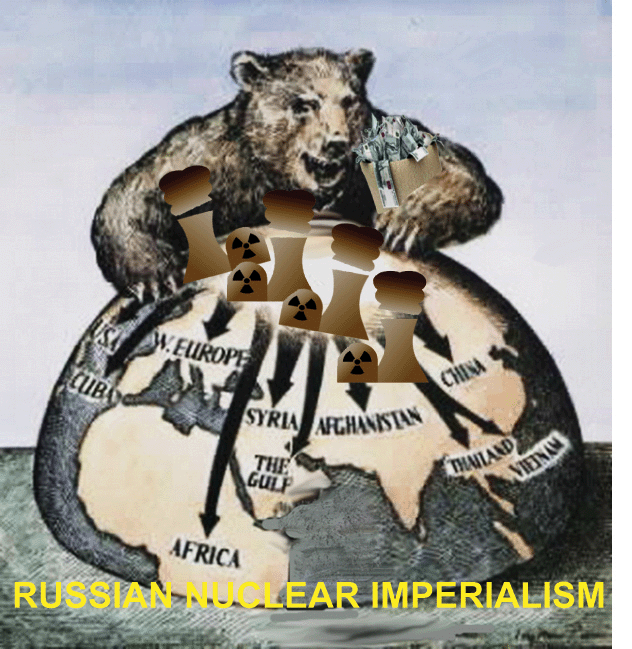
 Africa, Russia squandered close ties with the South African government by overplaying its hand and getting caught up in a corrupt nuclear energy pact. Carnegie Endowment For International Peace (thoroughly researched and referenced) 16 Dec 19,
 SUMMARY
 Amid the widespread attention the Kremlin’s recent inroads in Africa have attracted, there has been surprisingly little discussion of South Africa, a country which, for nearly a decade, unquestionably represented Russia’s biggest foreign policy success story on the continent. As relations soared during the ill-starred presidency of Jacob Zuma (2009–2018), the Kremlin sought to wrest a geopolitically significant state out of the West’s orbit and to create a partnership that could serve as a springboard for expanded influence elsewhere in Africa. Continue reading
 Russia’s Rosatom planning to market Small Modular Nuclear Reactors to Europe
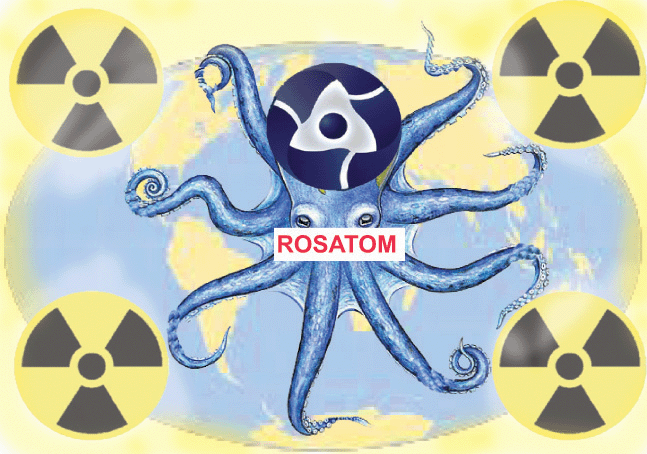
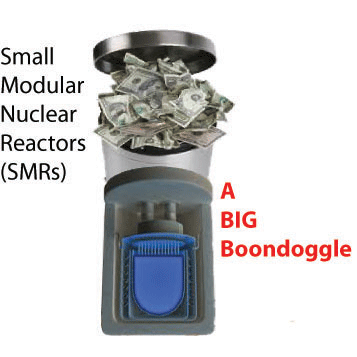
 Russian company’s plan for nuclear power expansion revealedVLADIMIR PUTIN has made nuclear energy one of Russia’s key priorities, and now the Russian nuclear power company Rosatom has revealed to Express.co.uk their plans to ramp up expansion into Europe with small modular reactors. Express UK By CHARLIE BRADLEY, Fri, Nov 29, 2019 Russian company’s plan for nuclear power expansion revealedVLADIMIR PUTIN has made nuclear energy one of Russia’s key priorities, and now the Russian nuclear power company Rosatom has revealed to Express.co.uk their plans to ramp up expansion into Europe with small modular reactors. Express UK By CHARLIE BRADLEY, Fri, Nov 29, 2019
Rosatom is completely under state control, and while its emphasis with some projects has been geared towards powering hard to reach Russian territories, it has also undertaken numerous international projects. This includes the development of nuclear power plants in China, Turkey and Iran, highlighting the growing presence of Russian energy throughout the world. And now, with some projects already under way in countries like Hungary and Finland, its Vice President of Marketing and Business Development Overseas, Anton Moskvin, has told Express.co.uk that Europe is a future target for the company.He said: “I must say Europe is very interesting for us with prospective small modular reactors market development, we know that several countries are interested. The UK has great interest in the small modular reactors.” …… However, some in the EU have expressed concern over any plans for the Russian nuclear giant, fearing that the country could use its business to wield political influence.
In 2014, President Putin agreed a deal worth £8.5billion with Hungary President Viktor Orban, a deal which has seen the two leaders meet regularly since. Hungary is both a NATO and EU member, and the latter has sought legislation to ensure countries embarking on nuclear deals with Moscow do not become dependent on the Kremlin. RFI (Radio France International) reported last month that Jan Haverkamp, vice-chairman of Nuclear Transparency Watch, has serious reservations about the projects. He said: “Our assessment is that the Kremlin tries to use nuclear power now to regain some of that lost influence. “We see Rosatom being very eager to buy up nuclear companies in Europe, where they try to get a participation in order to get a solid nuclear foothold inside the EU.” Mr Moskvin said he could not comment on political issues……… https://www.express.co.uk/news/world/1211103/putin-news-russia-europe-nuclear-power-eu-rosatom-spt |
|
Desperate times for the nuclear industry – could Australia be its saviour?
the number one goal of the nuclear lobby is to remove Australia’s national and state laws that prohibit the nuclear industry.
the campaign by the global nuclear industry, particularly the American industry, to kickstart another “nuclear renaissance”, before it’s too late.

Australia is the great ‘white’ hope for the global nuclear industry, Independent Australia, By Noel Wauchope | 19 November 2019, The global nuclear industry is in crisis but that doesn’t stop the pro-nuclear lobby from peddling exorbitantly expensive nuclear as a “green alternative”. Noel Wauchope reports.
The global nuclear industry is in crisis. Well, in the Western world, anyway. It is hard to get a clear picture of Russia and China, who appear to be happy putting developing nations into debt, as they market their nuclear reactors overseas with very generous loans — it helps to have stte-owned companies funding this effort.
But when it comes to Western democracies, where the industry is supposed to be commercially viable, there’s trouble. The latest news from S&P Global Ratings has made it plain: nuclear power can survive only with massive tax-payer support. Existing large nuclear reactors need subsidies to continue, while the expense of building new ones has scared off investors.
So, for the nuclear lobby, ultimate survival seems to depend on developing and mass marketing “Generation IV” small and medium reactors (SMRs). …..
for the U.S. marketers, Australia, as a politically stable English-speaking ally, is a particularly desirable target. Australia’s geographic situation has advantages. One is the possibility of making Australia a hub for taking in radioactive wastes from South-East Asian countries. That’s a long-term goal of the global nuclear lobby. …..
In particular, small nuclear reactors are marketed for submarines. That’s especially important now, as a new type of non-nuclear submarine – the Air Independent Propulsion (AIP) submarine, faster and much cheaper – could be making nuclear submarines obsolete. The Australian nuclear lobby is very keen on nuclear submarines: they are now promoting SMRs with propagandists such as Heiko Timmers, from Australian National University. This is an additional reason why Australia is the great white hope.
I use the word “white” advisedly here because Australia has a remarkable history of distrust and opposition to this industry form Indigenous Australians…..
The hunt for a national waste dump site is one problematic side of the nuclear lobby’s push for Australia. While accepted international policy on nuclear waste storage is that the site should be as near as possible to the point of production, the Australian Government’s plan is to set up a temporary site for nuclear waste, some 1700 km from its production at Lucas Heights. The other equally problematic issue is how to gain political and public support for the industry, which is currently banned by both Federal and state laws. SMR companies like NuScale are loath to spend money on winning hearts and minds in Australia while nuclear prohibition laws remain.
 Ziggy Switkowski, a long-time promoter of the nuclear industry, has now renewed this campaign — although he covers himself well, in case it all goes bad, noting that nuclear energy for Australia could be a “catastrophic failure“. ……
his submission (No. 41) to the current Federal Inquiry into nuclear power sets out only one aim, that
‘… all obstacles … be removed to the consideration of nuclear power as part of the national energy strategy debate.’
So the Environmental Protection and Biodiversity Conservation Act (EPBC Act) should be changed, according to Switkowski. In an article in The Australian, NSW State Liberal MP Taylor Martin suggested that the Federal and state laws be changed to prohibit existing forms of nuclear power technology but to allow small modular reactors.
Switkowski makes it clear that the number one goal of the nuclear lobby is to remove Australia’s national and state laws that prohibit the nuclear industry. And, from reading many pro-nuclear submissions to the Federal Inquiry, this emerges as their most significant aim.
It does not appear that the Australian public is currently all agog about nuclear power. So, it does seem a great coincidence that so many of their representatives in parliaments – Federal, Victorian, New South Wales, South Australia and members of a new party in Western Australia – are now advocating nuclear inquiries, leading to the repeal of nuclear prohibition laws.
We can only conclude that this new, seemingly coincidental push to overturn Australia’s nuclear prohibition laws, is in concert with the push for a national nuclear waste dump in rural South Australia — part of the campaign by the global nuclear industry, particularly the American industry, to kickstart another “nuclear renaissance”, before it’s too late.
Despite its relatively small population, Australia does “punch above its weight” in terms of its international reputation and as a commercial market. The repeal of Australia’s laws banning the nuclear industry would be a very significant symbol for much-needed new credibility for the pro-nuclear lobby. It would open the door for a clever publicity drive, no doubt using “action on climate change” as the rationale for developing nuclear power.
In the meantime, Australia has abundant natural resources for sun, wind and wave energy, and could become a leader in the South-East Asian region for developing and exporting renewable energy — a much quicker and more credible way to combat global warming. https://independentaustralia.net/politics/politics-display/australia-is-the-great-white-hope-for-the-global-nuclear-industry,13326
Before he’s even in the job, USA’s new Energy Secretary Dan Brouillette is busily promoting SMRs for his REAL bosses, the nuclear industryg
Could tiny nuclear reactors power Alaska villages?
“We want to get to a place where we can develop small micro-reactors, one to five megawatts,” Dan Brouillette said Thursday at his confirmation hearing in the U.S. Senate Energy Committee. …..
Brouillette is now the deputy secretary. He told Murkowski there’s reason to be optimistic about the development of reactors that are a fraction of the size of those in use today. ….. https://www.alaskapublic.org/2019/11/14/energy-secretary-nominee-says-tiny-nuclear-reactors-could-power-alaska-villages/
Messianic Rick Perry preaches nuclear to sceptical Europeans
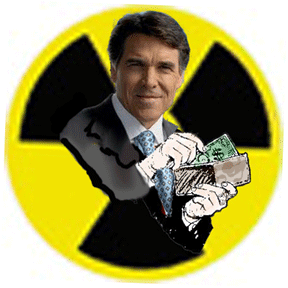 Messianic Perry preaches nuclear to sceptical Europeans, By Frédéric Simon | EURACTIV.com Oct 26, 2019 Small nuclear reactors can help “vulnerable nations take control of their destinies,” the US energy secretary said in Brussels today (21 October), claiming that small off-grid nuclear plants can bring electricity to poor nations and “disperse the darkness” around the globe…….
Today’s remarks, made in Brussels at the first EU-US high-level forum on small modular reactors, were again chiefly aimed at Eastern European countries, which have repeatedly complained about Russian interference in national politics, using gas as a lever.
Nuclear is a divise topic in Europe. While countries like France opted for it decades ago, others like Germany and Austria are strongly opposed.
“Nuclear energy is neither safe and sustainable nor cost-effective,” said German State Secretary for Energy, Andreas Feicht, during a recent meeting of EU energy ministers, firmly rejecting suggestions that EU money might be used to extend the lifetime of existing nuclear plants.
Today’s remarks, made in Brussels at the first EU-US high-level forum on small modular reactors, were again chiefly aimed at Eastern European countries, which have repeatedly complained about Russian interference in national politics, using gas as a lever.
Nuclear is a divise topic in Europe. While countries like France opted for it decades ago, others like Germany and Austria are strongly opposed.
“Nuclear energy is neither safe and sustainable nor cost-effective,” said German State Secretary for Energy, Andreas Feicht, during a recent meeting of EU energy ministers, firmly rejecting suggestions that EU money might be used to extend the lifetime of existing nuclear plants……
The push for nuclear power in Africa, but what happens to the wastes?

|
What happens to nuclear waste from power plants? DW, 14 Nov 19African countries looking to invest in nuclear energy as a source of clean electricity should consider Europe’s struggles with disposing of radioactive waste. Seventy years after the nuclear age began, no country has built a place to safely store its waste, a report published this week warns, raising concerns for governments mulling nuclear power as an alternative to fossil fuels.More than 60,000 tons of highly radioactive waste in the form of spent nuclear fuel rods are stored in interim sites across Europe, according to the World Nuclear Waste Report, some in old facilities that are running out of capacity and are expected to be used for decades longer than planned. Finland is the only country building a permanent repository underground for nuclear waste that emits large amounts of radiation for tens of thousands of years, according to the report published by the Heinrich Böll Foundation — which is affiliated with the German Green party.
“We are talking about time frames that are beyond the human scale of what we can think of,” said Arne Jungjohann, political scientist and lead editor of the report. “We still don’t know where to put the waste safely in a way that nobody will get harmed, that it is not vulnerable to terrorist attacks, that it is not being stolen to build nuclear bombs.” At the dawn of the nuclear age, radioactive material was diluted and dumped in the environment, before governments moved towards containing it securely underground. But projects from the 1960s onwards only met high safety expectations “to a very limited extent, if at all,” according to the report. That raises difficult questions for developing countries looking to get into nuclear. Nuclear Power in Africa Africa’s urban population is set to double in the next three decades, massively boosting demand for infrastructure and energy. Just half of Africans had access to electricity in 2017, compared to a global average of 88%, World Bank data shows. Eager to connect citizens with electricity grids, but anxious to avoid high-emissions of Western countries, some governments are exploring nuclear as a way to supply cheap and stable energy. South Africa is the only country on the continent that currently operates a nuclear plant, but about a dozen others are considering, planning or building them, according to the World Nuclear Association. Several countries — Algeria, Egypt, Ghana, Kenya, Namibia, Nigeria, Tanzania, Uganda and Zambia — have signed partnership agreements with Russian nuclear energy company Rosatom, a paper published in the journal Issues in Science and Technology found earlier this year, and others have contracts with China…….. attempts to deal with nuclear waste have so far faltered. Excluding Russia and Slovakia due to poor data, the report found that just four countries — France, the UK, Ukraine and Germany — are responsible for more than half of Europe’s nuclear waste, and none have yet found a deep underground store to hold it over centuries. The Heinrich Böll Foundation report found many governments underestimate the cost of storing waste and decommissioning reactors, with inconsistent rules shifting the financial burden from plant operators onto future generations of taxpayers. Unsolved nuclear waste is the “defeating argument against entering into the nuclear age,” said Rebecca Harms, a former Member of the European Parliament who was behind the report. “African countries should consider the nuclear legacies which have been created during the last 50, 60 years and for which we have no solutions.” Demand for energy in Sub-Saharan Africa is set to rise by 60% in the next two decades, but nuclear sources are projected to meet only a small fraction of this, according to the Africa Energy Outlook 2019, a report from the International Energy Agency (IEA) published on Thursday. “What we see in the future economic development of sub-Saharan Africa will be powered by a mix of renewables and natural gas,” said Kieran McNamara, senior energy analyst at the IEA and co-author of the report. “Nuclear just doesn’t feature.” https://www.dw.com/en/what-happens-to-nuclear-waste-from-power-plants/a-51216359 |
|
African countries being conned into nuclear debt, by Russia
African countries rush to sign nuclear deals with Russia, Daily Maverick By Peter Fabricius• 29 October 2019
But concerns are being raised about whether they can all afford nuclear energy.
The Russian nuclear power corporation Rosatom has already signed nuclear cooperation agreements with about 18 African counties, as Russia accelerates its drive for nuclear business on the continent.
The growing commitment of African countries to high capital cost nuclear energy has raised some concern about whether they are committing themselves to unaffordable debt.
Rosatom director-general Alexey Likhachev revealed a large number of nuclear agreements with African countries after signing an intergovernmental agreement on cooperation in the peaceful uses of nuclear energy with the Ethiopian Minister of Innovation and Technology, Getahun Mekuria Kuma, during the Russia-Africa Summit in Sochi on the Black Sea last week.
Mekuria later told the Russian official news agency Tass that Ethiopia had plants to build a nuclear power plant.
Rosatom later also signed an agreement with Rwanda at the summit on cooperation for the construction of a centre of nuclear science and technology in Rwanda. Rosatom had a strong presence at the economic forum which paralleled the political summit. The Rosatom stand attracted scores of interested African government officials on the sidelines of the forum. …..
Likhachev told journalists after the discussion that Rosatom had now signed memoranda of understanding or intergovernmental agreements with about one-third of countries on the continent – about 18. He could not say how many of these were about scientific cooperation and how many were about producing nuclear energy “because very often those two tracks go hand in hand”.
But he did say in the discussion that about half of the African countries with which Rosatom had signed nuclear agreements were actively discussing joint projects with the corporation, which had been stipulated in contracts. The most advanced joint project is with Egypt, which has contracted Rosatom to build a 4,800MW nuclear power plant……
“We are ready to propose to Ethiopia cutting-edge solutions of nuclear technology. And our Ethiopian partners are invited to visit nuclear facilities in our country.
“Apart from larger capacity nuclear power plants, we also stand ready to offer smaller capacity, modular reactors.”
……..However, the apparent rush to nuclear energy by African countries has raised some concerns that they may be committing themselves to high capital costs of nuclear power production which they will be unable to afford.
Analysts have noted that even South Africa, one of the top two economies on the continent, backed away from an apparent commitment by former president Jacob Zuma to order 9,600MW of nuclear power plant production from Rosatom – at an estimated cost of about R1-trillion.
President Cyril Ramaphosa said after meeting Putin on the sidelines of the summit that the Russian president had once again asked him if South Africa was still interested in building a nuclear power plant and he had told him once again that it still could not afford to.
An African minister at the summit told Daily Maverick that although power plants could be an important source of economic growth, African countries were sinking further into debt and had to be careful to ensure they could afford the infrastructure they built.
Likhachev defended nuclear energy as an economical source of electricity over the long term. ……….
Olivier Nduhungirehe, Rwandan minister in charge of the East African community would not be drawn on the cost and affordability implications, saying the details of the agreement would be announced in due course. https://www.dailymaverick.co.za/article/2019-10-29-african-countries-rush-to-sign-nuclear-deals-with-russia/
USA negotiating nuclear sales with Saudi Arabia
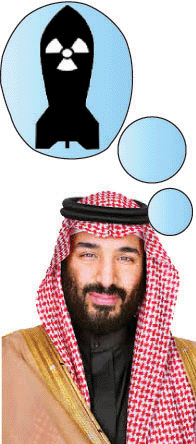 US confirms nuclear energy talks with Saudi Arabia, https://www.power-technology.com/comment/us-confirms-nuclear-energy-talks-with-saudi-arabia/ US confirms nuclear energy talks with Saudi Arabia, https://www.power-technology.com/comment/us-confirms-nuclear-energy-talks-with-saudi-arabia/
By MEED
30 Oct 19, Riyadh will have to sign an accord with Washington on the peaceful use of nuclear technology for US firms to participate in the projectA senior US official has confirmed that Washington is in talks with Riyadh about supporting Saudi Arabia’s planned nuclear programme. Speaking in Abu Dhabi on 26 October, US Energy Secretary Rick Perry Perry confirmed that talks were ongoing. Perry told the forum that Saudi Arabia’s leadership in Riyadh wanted to sign a ‘123 Agreement’ with the United States. A 123 Agreement is a section of the US’ Atomic Energy Act of 1954 that sets out rules governing US nuclear cooperation with other nations. Under the terms of a 123 Agreement, Riyadh must sign an accord with Washington committing to the peaceful use of nuclear technology before US companies can compete for its nuclear energy projects in Saudi Arabia.MEED understands the US has an existing 123 agreement with 48 countries to date. Riyadh is reported to have been unwilling to commit to a deal that would rule out the possibility of enriching uranium or reprocessing spent fuel. Saudi Arabia’s nuclear energy programme In November 2018, Saudi Arabia’s King Abdullah City for Atomic & Renewable Energy (KA-Care), the body overseeing the kingdom’s nuclear energy plans, appointed Australia’s WorleyParsons to the project management office consultancy role for the programme.
WorleyParsons will provide consultancy services including project governance, resource management, project services, training and compliance across the full scope of the large nuclear power plant (LNPP), small modular reactors and nuclear fuel cycle. WorleyParsons previously completed the LNPP site selection study for KA-Care. Riyadh is planning to develop nuclear power through a three-pronged strategy. The majority of the nuclear power capacity will be developed through conventional large-scale nuclear facilities, the first of which will be a two-reactor 2.8GW plant.
KA-Care announced in August last year that it had awarded a contract to France’s Assystem to carry out site characterisation studies, including geological surveys and environmental impact studies for the first planned project. The studies will allow Saudi Arabia to choose the most suitable site on which to build, as well as provide important technical details for the design of the project. MEED had reported in early 2018 that the kingdom was assessing two potential locations for the NPP. The two shortlisted are at Umm Huwayd and Khor Duweihin. Both can be found on the coast near the UAE and Qatari borders. The two sites were shortlisted following investigations conducted in 2011 and 2012, in accordance with sitting guidance issued by international regulatory agencies, including the International Atomic Energy Agency (IAEA) and the US Nuclear Regulatory Commission (NRC). Companies are positioning themselves for the contract to build the first nuclear power plant. In July last year, Russian state nuclear company Rosatom said it has been shortlisted to participate in the tender for Saudi Arabia’s first nuclear power plant. According to a report in the Saudi Gazette, Rosatom will be invited to participate in the upcoming tender by KA-Care. Earlier in July, South Korea’s energy ministry revealed that state utility provider Korea Electric Power Corporation (Kepco) had made the shortlist for the first Saudi nuclear power tender. In addition to developing nuclear power capacity through large scale nuclear reactors, the kingdom is also planning to develop atomic energy through a series of smaller system-integrated modular advanced reactor technology (Smart) nuclear power plants in the kingdom in partnership with South Korea. MEED reported in October last year that progress had been made with the Smart programme, and engineering work for two Smart units will be completed in November.
South Korea and Saudi Arabia have already invested more than SR487m ($129.8m) in plans for Smart nuclear reactors across the kingdom. Riyadh signed a memorandum of understanding (MoU) with South Korea in November 2016 to develop the technology. The Smart reactors are expected to have a capacity of about 100MW each. The third pillar of Saudi Arabia’s nuclear energy programme will involve mining uranium resources to fuel the plants, sources close to the kingdom’s nuclear programme have told MEED. Developing the kingdom’s mining sector is a key pillar of the Saudi Vision 2030 that was launched in April 2016.
|
|
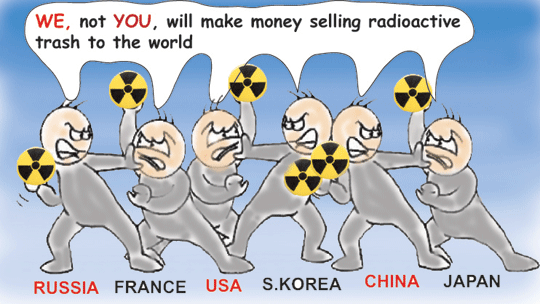
Countries vie to market nuclear reactors to Saudi Arabia
|
Saudi Arabia in talks with 5 vendors to build its first nuclear power reactors, https://www.spglobal.com/platts/en/market-insights/latest-news/electric-power/103019-saudi-arabia-in-talks-with-5-vendors-to-build-its-first-nuclear-power-reactors, Claudia Carpenter , Riyadh — Saudi Arabia is in talks with five vendors, including US-based Westinghouse, to build its first nuclear power plant with two reactors, according to an energy ministry presentation.The other companies in the discussions are France’s EDF, Russia’s Rosatom, South Korea’s KEPCO and China National Nuclear Corp, according to the presentation, shown Wednesday at the Future Investment Initiative conference taking place in Riyadh Saudi Arabia wants to develop a civil nuclear industry and renewable energy to free up oil burned to produce power for export.
Saudi Energy Minister Abdulaziz bin Salman has previously said the kingdom would like to enrich its own uranium resources to produce nuclear energy. However, outgoing US Secretary of Energy Rick Perry cast doubt last week on the kingdom’s ability to process that uranium because of its quality and quantity. Saudi Arabia will be the second Persian Gulf state to build nuclear plants after neighboring UAE, which is building four nuclear reactors that will collectively produce 1,400 MW of electricity. Kepco won the $20 billion contract to construct the UAE reactors, whose start-up has been delayed. |
|
Russia’s Rosatom nuclear firm targets its marketing at African countries
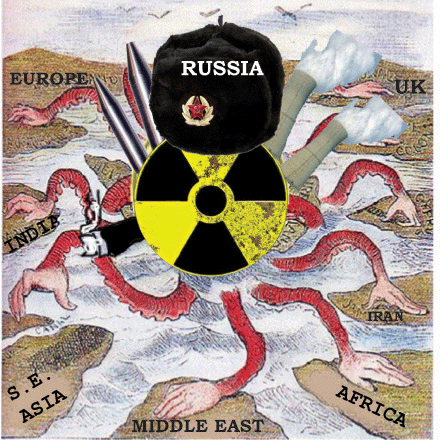
- Russian developer has signed over a dozen agreements in Africa
- Various financing options being considered for the plant build
Rosatom Corp., is eyeing Africa as one of its “priority regions” to build more nuclear reactors and expand its business……(Subscribers only) https://www.bloomberg.com/news/articles/2019-10-30/russia-s-rosatom-focuses-on-africa-for-its-nuclear-expansion
US Energy Secretary Perry turns New Nuclear Salesman to Europe
|
Messianic Perry preaches nuclear to sceptical Europeans, By Frédéric Simon | EURACTIV.com 21 Oct 19, Small nuclear reactors can help “vulnerable nations take control of their destinies,” the US energy secretary said in Brussels today (21 October), claiming that small off-grid nuclear plants can bring electricity to poor nations and “disperse the darkness” around the globe.
Countries with nuclear power “can’t be controlled by other countries wielding energy as a geopolitical weapon”, US Secretary of State Rick Perry said in Brussels as he addressed a forum of policymakers and industry representatives from both sides of the Atlantic. Nuclear power helps “vulnerable nations take control of their destinies,” Perry claimed, arguing that “energy security also bolsters national security”. Perry attended the first EU-US high-level forum on small modular reactors. His remarks on energy independence were chiefly aimed at Eastern European countries, which have repeatedly complained about Russian interference in national politics, using gas as a lever. Nuclear is a divise topic in Europe. While countries like France opted for it decades ago, others like Germany and Austria are strongly opposed. “Nuclear energy is neither safe and sustainable nor cost-effective,” said German State Secretary for Energy, Andreas Feicht, during a recent meeting of EU energy ministers, firmly rejecting suggestions that EU money might be used to extend the lifetime of existing nuclear plants. But Perry’s message was broader, and was also addressed at developing nations whom he said could benefit from small off-grid nuclear plants………. |
|
Nuclear shill Rick Perry switching from DOE Secretary to Small Nuclear Reactor Salesman
Perry to Resign as DOE Secretary, With Nuclear Weapon Programs on  Autopilot, OCTOBER 18, 2019, BY DAN LEONE,Rick Perry on Thursday announced his resignation as the Donald Trump administration’s first secretary of energy after more than two-and-a-half years on the job. In a published letter to President Donald Trump, Perry said he would resign “later this year”…(subscribers only) https://www.exchangemonitor.com/perry-resign-doe-secretary-nuclear-weapon-programs-autopilot/
Energy Wire 17th Oct 2019, Energy Secretary Rick Perry will head back to Europe next week as part of an effort to boost the U.S. advanced nuclear industry’s ability to export its technologies across the globe.
https://www.eenews.net/energywire/2019/10/17/stories/1061299145
Russia’s manipulations in supplying Bangladesh with nuclear technology
 Derek Abbott Nuclear Fuel Cycle Watch Australia,7 Oct 19
I’m at an engineering meeting and got to meet an engineer working on the nuclear program in Bangladesh.
I asked him if Bangladesh had renewables. He said they have a lot.
I then made the point that nuclear is therefore not a good investment as his grid is now in greater need of sources that turn on and off quickly. As nuclear can’t do that, nuclear is not cost effective.
He agreed and said for that reason the Bangladeshi govt would actually never pay upfront for a nuclear station on an economic basis.
He said the nuclear program was a result of a political deal with the Russians.
He said that Pakistan and India have nuclear in the region, so the idea of Bangladesh having a nuclear station is a show of “arm flexing.”
The Russians were pushy and made a deal too hard to resist: The Russians will only charge 1% of the cost per annum for the first 30 years of operation and have agreed to remove all waste and ship it back to Russia.
I said that deal does seem too hard to resist.
I then naively asked why on earth the Russians would go to such lengths at an apparent economic loss to them.
His answer was that Bangladesh is seen as an economically strategic region. Labour costs are lower than India, and it has a very capable workforce with a GDP that is over 5 times (per head) higher than India!
I hadn’t realised that and asked how they are making money. He said that India is no longer the power house of the clothing industry. Due to lower wages, clothes are now made in Bangladesh. All your designer labels you might be wearing come from there and have been rebranded.
There are very strong trade deals between China and Bangladesh, and it his belief that Russia’s “bargain basement” nuclear deal is way of getting a foothold in the region themselves. It is a geopolitical maneuver.
What the Russians giveth with one hand, they’ll probably find a way to taketh with another.
1 This Month

of the week – Shut Down Drone Warfare!


Tell the Ukrainian Government to Drop Prosecution of Peace Activist Yurii Sheliazhenko

Petition to revoke the licensing of the Near Surface Nuclear Disposal Facility (NSDF) at Chalk River. https://www.ourcommons.ca/petitions/en/Petition/Details?Petition=e-7247
To see nuclear-related stories in greater depth and intensity – go to https://nuclearinformation.wordpress.com
-
Archives
- March 2026 (244)
- February 2026 (268)
- January 2026 (308)
- December 2025 (358)
- November 2025 (359)
- October 2025 (376)
- September 2025 (257)
- August 2025 (319)
- July 2025 (230)
- June 2025 (348)
- May 2025 (261)
- April 2025 (305)
-
Categories
- 1
- 1 NUCLEAR ISSUES
- business and costs
- climate change
- culture and arts
- ENERGY
- environment
- health
- history
- indigenous issues
- Legal
- marketing of nuclear
- media
- opposition to nuclear
- PERSONAL STORIES
- politics
- politics international
- Religion and ethics
- safety
- secrets,lies and civil liberties
- spinbuster
- technology
- Uranium
- wastes
- weapons and war
- Women
- 2 WORLD
- ACTION
- AFRICA
- Atrocities
- AUSTRALIA
- Christina's notes
- Christina's themes
- culture and arts
- Events
- Fuk 2022
- Fuk 2023
- Fukushima 2017
- Fukushima 2018
- fukushima 2019
- Fukushima 2020
- Fukushima 2021
- general
- global warming
- Humour (God we need it)
- Nuclear
- RARE EARTHS
- Reference
- resources – print
- Resources -audiovicual
- Weekly Newsletter
- World
- World Nuclear
- YouTube
-
RSS
Entries RSS
Comments RSS
 nuclear-news