Macron pushes a “renaissance” while French nuclear flops

A farce that would make Feydeau blush — Beyond Nuclear International
A farce that would make Feydeau blush — Beyond Nuclear International
Emmanuel Macron picks a bad time to promote France’s nuclear nuclear technology in a marketing tour to USA
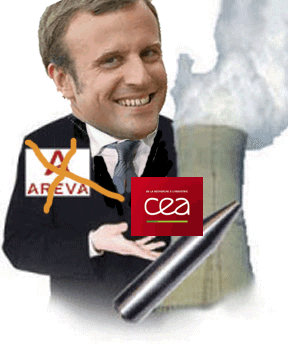
With 40 percent of France’s nuclear power plants offline, there could hardly be a more awkward time to promote the country’s know-how
Macron to promote nuclear energy in U.S., as industry faces crisis in France, By Rick Noack, November 29, 2022, PARIS — As French President Emmanuel Macron makes the rounds in Washington starting Wednesday for the first state visit of the Biden administration, high on his agenda are his plans for a nuclear energy “renaissance.” His entourage includes the major players from France’s nuclear energy industry, who will be looking to the French leader to help boost the development and export of their technology, including smaller and more versatile reactors.
But there could hardly be a more awkward time to promote French nuclear know-how.
While Macron was preparing to head to Washington, France was relying on planes traveling in the opposite direction to prevent its nuclear-reliant power grid from collapsing. U.S. and Canadian contractors have been flown in to help after safety concerns forced the closure of half of the country’s nuclear power plants. Last week, 23 out of 56 were still offline, due to concerns over corrosion cracks and an accumulation of pandemic-related inspection delays.
………….. instead of bolstering its position as an energy exporter, France has had to import electricity from Germany — the country hit hardest by the shift away from Russia. And Britain, which normally depends on France for energy to get through winter, is talking about having to encourage people to keep their ovens and dishwashers off to avoid blackouts.
Other French neighbors, including Belgium, Switzerland and parts of Italy, may be under even more pressure as a result of the French reactor problems, said Clement Bouilloux, country manager for France at energy consultancy EnAppSys.
“Everyone was relying on the French nuclear power plants,” he said.
The situation has tarnished France’s reputation as a nuclear power leader and may have contributed to the country missing out on key contracts. Only weeks ago, France’s state-owned energy company EDF lost the first part of a $40 billion contract for Poland’s first nuclear power plant to U.S. company Westinghouse………………………………………………………..
Macron has acknowledged that the French industry has “fallen behind,” but he has defended its ability to recover, striking deals on nuclear energy cooperation in recent months with countries including India and Britain.
Macron is scheduled to attend a nuclear energy session on Wednesday, alongside four French cabinet members and several executives from the country’s major nuclear energy firms and its public regulator, the Élysée Palace said last week.
A French official added Monday that one area where France anticipates possible mutual interests is the development of small modular reactors (SMRs)…………….. https://www.washingtonpost.com/world/2022/11/29/macron-us-state-visit-nuclear-france/
Kamala Harris, nuclear saleswoman extraordinaire, touting small nuclear reactors to Thailand

US to help Thailand harness nuclear energy, Manila Times. By Agence France-Presse, November 28, 2022
IN SEARCH OF CLEAN FUEL A staff member works at the production line of Dunan Metals Co. Ltd in the Thai-Chinese Rayong industrial zone in Rayong province, Thailand, Nov. 8, 2022. The United States will help Thailand develop nuclear power through a new class of small reactors, part of a program aimed at fighting climate change, Vice President Kamala Harris announced on a visit Saturday, November 26. XINHUA PHOTO
BANGKOK: The United States will help Thailand develop nuclear power through a new class of small reactors, part of a program aimed at fighting climate change, Vice President Kamala Harris announced on a visit Saturday.
The White House said the assistance was part of its Net Zero World Initiative, a project launched at last year’s Glasgow climate summit in which the United States partners with the private sector and philanthropists to promote clean energy.
Thailand does not have nuclear power, with the public mood on the issue souring after the 2011 Fukushima disaster in Japan.
The White House said it would offer technical assistance to the Southeast Asian country to deploy the developing technology of small modular reactors, which are factory-built and portable………………
The White House did not give a timeline but said it would support Thailand, which is highly vulnerable to climate change, in its goal of going carbon neutral by 2065.
Harris is visiting the US ally for an Asia-Pacific Economic Cooperation summit and discussed climate efforts in a meeting with Thai Prime Minister Prayut Chan-O-Cha………… https://www.manilatimes.net/2022/11/28/news/world/us-to-help-thailand-harness-nuclear-energy/1868041
USA Vice-President For the Nuclear Industry Kamala Harris on a marketing jaunt for NuScam’s Small Nuclear Reactors to Southeast Asia

Thailand, Philippines, Indonesia – nuclear reactors such a jolly idea in this earthquake ring of fire ?
US to supply Thailand, Philippines with modular nuclear reactors
BenarNews staff, 2022.11.23, Bangkok.
The United States says it will help Thailand and the Philippines with a new civilian nuclear technology to reduce climate-damaging emissions, but experts warn the final products are years away from being operational and other hurdles exist.
Plans by the U.S. to supply its longtime Southeast Asian allies with so-called small modular reactors (SMRs) were unveiled during Vice President Kamala Harris’ trip to both countries in recent days.
While attending the Asia-Pacific Economic Cooperation meetings in Bangkok last weekend, Harris launched a new clean energy partnership with Thailand.
From there, the vice president went to the Philippines where she announced that Washington and Manila were starting negotiations on the 123 Agreement, which would allow for civilian nuclear cooperation.
The U.S. nuclear technology plans for Thailand and the Philippines are firsts involving Southeast Asian nations.
The SMRs, which can be as small as a bucket and transportable, are to be constructed under “the highest standards of safety, security and nonproliferation,” officials said.
Another country in Southeast Asia that has shown interest in developing such reactors – Indonesia – appears to be looking at designs from several countries. [Never mind about the earthquakes?]
In a press release, the White House said the new partnership with Thailand would “build capacity for the secure and safe deployment of advanced nuclear reactor technologies.”
“This partnership will help Thailand take advantage of the unique benefits of SMRs that provide 24/7 reliable power, complement other clean energy sources, use a small land footprint and incorporate advanced safety features.”
The Thai government has set a goal of Net Zero Emissions by 2065, but no timeline for the SMR partnership. Washington praised the “unique benefits” of reactors which, besides providing reliable power, also fight climate change.
Small modular reactors generally are defined as advanced nuclear reactors with a capacity of less than 300 MW, according to the International Energy Agency.
A reactor could be as small as a five-gallon (18.9-liter) bucket. The traditional design has fuel and control rods, and energy is transported through boiling water, according to NuScale, a U.S. SMR manufacturer, which estimated initial costs at about U.S. $500 million.
The agreement with Manila calls for the U.S. and the Philippines to cooperate on advanced nuclear technologies to ensure energy security as that Southeast Asian country transitions to clean energy.
Once in force, the 123 agreement “will provide the legal basis for U.S. exports of nuclear equipment and material to the Philippines. The United States is committed to working with the Philippines to increase energy security and deploying advanced nuclear reactor technology as quickly as safety and security conditions permit to meet the Philippines’ dire baseload power needs,” the White House said in a statement.
Under President Ferdinand Marcos Jr.’s father, the late dictator Ferdinand E. Marcos, the Philippines began construction of the Bataan Nuclear Power Plant in 1976, in an area about 100 km (62 miles) west of Manila. The plant, constructed above a major fault line, was mothballed amid safety concerns after the 1986 Chernobyl disaster.
Today, the Philippines runs a couple of research reactors for training and education purposes while Thailand has no nuclear power.
……….. Tanagorn said Thais were concerned about safety in light of the 2011 Fukushima nuclear disaster caused by a tsunami in Japan. Other obstacles are the limited number of investors and the lack of domestic laws and regulation of nuclear activities.
John Timmer, science editor of Ars Technica, a web portal focusing on science and technology, said that with nuclear reactors, the principle is always “safety first.”
“The approval process for that reason tends to be long and includes a lot of documentation,” he said.
“The SMRs are designed to be much safer, but they haven’t been built (in the U.S.) in a final form yet, so it’s difficult to say whether the real-world experience will show that to be the case and also how useful they’ll be for addressing climate change,” Timmer told BenarNews.
“I’ve been hearing about SMRs for about a decade,” he said, adding that “until we build and get a sense what operating them is like and what costs are like, I’m going to be a bit skeptical.”
Cost is another obstacle.
“We’ve never built one of these, so this is going to be a learning experience and for the first few years. It’s going to be more expensive and more complicated to complete,” Timmer said.
‘Widespread misconceptions’
Economist John Quiggin, a professor at the University of Queensland in Australia, listed economic viability of nuclear power plants compared to coal, gas or solar and wind facilities as one of the “widespread misconceptions.”
“When pressed, nuclear fans will mostly shift the argument to the ill-defined notion of ‘small modular reactors,’ which don’t actually exist, and may never [exist],” Quiggin said, noting there are operating examples of small reactors, but “those are made on a one-off basis and are expensive because they forgo size economies.”
Once the reactors can be factory-produced “the ‘modular’ idea is to counter this loss with the economic gains of high-volume,” he said.
“There has been a lot of talk lately about a revival of nuclear power, partly in response to the need to replace the energy previously supplied by Russia, and partly as a longer-term response to climate change,” Quiggin said.
While in office U.S. President George W. Bush launched a nuclear power program, which led to talks of a “nuclear renaissance” but yielded only two projects despite no effective opposition “except from consumers objecting to the massive costs.”
Quiggin expects that the number of SMRs constructed will be also “tiny.”
“The work of decarbonizing energy supply will be done almost entirely by the sun and the wind,” he said.
Jason Gutierrez in Manila contributed to this report. https://www.benarnews.org/english/news/philippine/nuclear-reactors-11232022142149.html
USA desperate to sell NuScam’s small nuclear reactors – its latest targeted buyer is Thailand
Kamala Harris – nuclear saleswoman
BANGKOK: The United States will help Thailand develop nuclear power through a new class of small reactors, part of a programme aimed at [?] fighting climate change, Vice President Kamala Harris announced on a visit Saturday (Nov 19).
The White House said the assistance was part of its Net Zero World Initiative, a project launched at last year’s Glasgow climate summit in which the US partners with the private sector and philanthropists to promote [?]clean energy…………
Harris, who is visiting the US ally for an Asia-Pacific Economic Cooperation summit, will discuss the nuclear power initiative in a meeting later Saturday with Thai Prime Minister Prayut Chan-o-cha…………. more https://www.channelnewsasia.com/world/us-help-thailand-develop-small-nuclear-reactors-3085781
Another US nuclear marketing deal done ay COP27 – $3billion for Romania reactors project
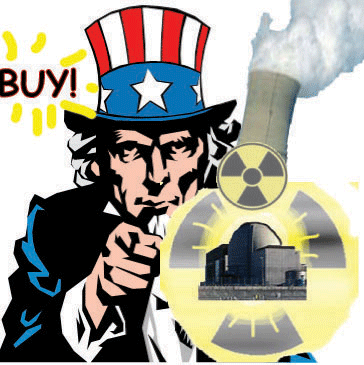
The US Export–Import Bank said it intends to provide USD 3 billion for a project for two additional reactors in Romania’s Cernavodă nuclear power plant.
Romanian Prime Minister Nicolae Ciucă announced at the United Nations Climate Change Conference COP27 that a third of the required funds for units 3 and 4 in the Cernavodă nuclear power plant would be provided by the United States Export–Import Bank. The preparatory phase will be completed by the end of March, he said.
The US Exim Bank issued letters of intent for USD 50 million for the second phase and USD 3 billion for the construction of the two reactors, the prime minister revealed at the event in Egypt. The plan is to implement the second phase in the third quarter of 2025 and build the units in 2030, Ciucă said…….
The Cernavodă nuclear power plant operates under state-owned Nuclearelectrica. A contract was signed for the preparatory stage last November with Candu Energy, a subsidiary of SNC-Lavalin from Canada, through Romania’s project firm EnergoNuclear.
In addition, Nuclearelectrica intends to deploy US-based NuScale’s small modular reactor (SMR) technology for a 462 nuclear power plant on the site of a former coal plant.
U.S. uses COP27 to market nuclear power to Romania, offering over $3 billion funding
Romania Secures $3 Bn US Funding For Nuclear Power
https://www.barrons.com/news/romania-secures-3-bn-us-funding-for-nuclear-power-01668020107 By AFP – Agence France Presse, November 9, 2022,
Romania announced Wednesday that the United States will provide funding worth more than $3 billion for the construction of two new nuclear reactors in the eastern European country, which is expected to commence early next year.
The funding will be granted by the Washington-based Export-Import Bank (EXIM), an export credit agency, enabling Romania to cover “about a third of the amount necessary for the construction of two reactors” at the Cernavoda plant, Romanian Prime Minister Nicolae Ciuca said.
The rest of the needed funding will come from other financing, Ciuca added, without giving further details.
Cernavoda is Romania’s only nuclear power plant, which has been operational since the 1990s. Two reactors with a total a capacity of 1,400 MW, it covers approximately one fifth of the country’s electricity needs.
Ciuca hailed the deal signed during the UN climate summit COP27 in Egypt as “an important step” towards the country’s “energy independence” amid global energy uncertainty aggravated by the war in Ukraine.
The construction of two additional nuclear reactors at Cernavoda is slated to start “in March/April 2023” and is expected to be completed in 2030, he added.
EXIM finances exports of US goods and services, but it was not immediately clear which US firm or firms would construct the reactors.
Six European companies — GDF Suez, Iberdrola, CEZ, RWE, Enel and ArcelorMittal — had initially committed to the project in 2008, before pulling out one after another due to uncertainties surrounding the future of the plant.
Bucharest also broke a financing agreement with the China General Nuclear Power Corporation (CGN) group in 2020, against a backdrop of growing mistrust of Chinese investments in Europe.
U.S. company Westinghouse wants to build a fleet of nuclear reactors in Europe, starting with Poland.
The Council of Ministers has formally approved the decision that the first
nuclear power plant in Poland will use three Westinghouse AP1000 reactors –
with the US company calling it an “historic day” as it looks to build a
fleet of the reactors in central Europe.
World Nuclear News 3rd Nov 2022
Russian state firm signs $9.1bn loan deal to fund nuclear plant in Turkey

Rosatom, which has been wiring money to Ankara to shore up Turkey’s depleted foreign currency reserves, signs deal with Gazprombank, Ragip Soylu, Antalya, Turkey, 16 September 2022
A Russian state-owned company signed a $9.1bn loan deal with Gazprombank in August to fund the construction and development of Turkey’s Akkuyu nuclear power plant, according to the official documents.
In a public announcement on Wednesday, Rosatom Corp published the deal signed on 3 August, which opens a line of credit to finance Akkuyu Nuclear JSC, its subsidiary in Turkey………………………..
Bloomberg reported last month that Rosatom had decided to wire $15bn to Turkey for the construction of the $20bn Akkuyu nuclear power plant, citing officials who said that an initial $5bn had already been received…………………
The Turkish government is in dire need of foreign funding as a result of its rapidly evaporating foreign currency reserves.
Rosatom is expected to rapidly spend up to $2bn on overdue payments to subcontractors. The company told Bloomberg that it would indeed transfer some funds to Turkey, but an amount much lower than that declared by Turkish officials………….more https://www.middleeasteye.net/news/russia-turkey-gazprombank-akkuyu-plant-loan-fund
Ukrainian government wants to sell nuclear energy to Germany
DW, 4 Sept 22, Kyiv offers nuclear energy to Germany. Ukrainian Prime Minister Denys Shmyhal has said a proposal to export electricity to Germany amid the ongoing energy crisis would be “a very good deal for both sides.” DW rounds up the latest…….
“Currently, Ukraine exports its electricity to Moldova, Romania, Slovakia and Poland. But we are quite ready to expand our exports to Germany,” Ukrainian Prime Minister Denys Shmyhal told the dpa news agency on Saturday.
“We have a sufficient amount of electricity in Ukraine, thanks to our nuclear power plants,” he said. The issue will be discussed during Shmyhal’s visit to Berlin over the weekend, where he will be meeting with Chancellor Olaf Scholz.
Electricity consumption in Ukraine has fallen since the start of the Russian invasion, due to the mass exodus of refugees and an economic slump.
Shmyhal said such a deal “would be very good for both sides.”…….
Ukraine operates four nuclear power plants with a total capacity of more than 14 gigawatts.
However, observers fear Russia’s capture of the Zaporizhzhia facility — the largest nuclear power plant in Europe — could lead to a serious accident if the war intensifies…………. https://www.dw.com/en/russia-ukraine-updates-kyiv-offers-nuclear-energy-to-germany/a-63009289
USA now desperately trying to flog off NuScam’s small nuclear reactors to Europe, starting with Romania
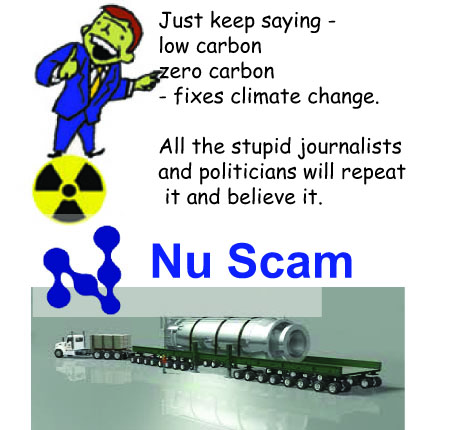
U.S. funds study for NuScale SMR deployment in Romania, https://www.power-eng.com/nuclear/u-s-funds-study-for-nuscale-smr-deployment-in-romania/
By Kevin Clark 6.27.2022 The United States will commit $14 million toward a front-end engineering and design (FEED) study for the basis of deploying NuScale’s small modular reactor (SMR) in Romania.
President Biden made the announcement June 26 at the G7 Leaders’ Summit in Germany. The funding is part of the administration’s Partnership for Global Infrastructure and Investment (PGII), aimed at narrowing infrastructure gaps around the world, including through clean energy deployments.
NuScale and Romania’s state nuclear power corporation S.N. Nuclearelectrica S.A. (Nuclearelectrica) plan to conduct engineering studies, technical reviews, and licensing and permitting activities at a site in Doicesti, Romania, the preferred location for the deployment of the first NuScale VOYGR power plant. The partners signed an MOU in May 2022.
The 8-month effort, expected to cost $28 million in total and including contributions from Nuclearelectrica and NuScale, will provide Romania with key site-specific data – cost, construction, schedule, and licensing details – necessary for the deployment of a NuScale’s 462 MWe VOYGR-6 SMR nuclear power plant.
The aim of the project is to show the ability of advanced nuclear reactors to replace coal generation, while creating thousands of jobs. NuScale President John Hopkins recently spoke with Power Engineering about how the company’s SMR plants are ideal for coal replacement.
NuScale believes Romania has the potential to accommodate the first SMR deployment in Europe and become a catalyst for SMRs in the overall region.
“Nuclear energy, including small modular reactors, represent a critical tool in the fight against climate change, and can also enhance energy security and boost economic prosperity,” said U.S. Special Presidential Envoy for Climate John Kerry.
The PGII initiative is funding projects in four major categories: clean energy, health systems, gender equality and information and communications technology.
”Infinite war” – NATO and U.S. weapons industry found the perfect sales opportunity in Yemen
Arms Industry Sees Ukraine Conflict as an Opportunity, Not a Crisis, Jonathan Ng, Truthout , 2 Mar 22,

In the United States, the industry employs around 700 lobbyists. Nearly three-fourths previously worked for the federal government — the highest percentage for any industry. The lobby spent $108 million in 2020 alone, and its ranks continue to swell. Over the past 30 years, about 530 congressional staffers on military-related committees left office for defense contractors. Industry veterans dominate the Biden administration, including Secretary of Defense Lloyd Austin from Raytheon.
”’………………….Yemen Burning
Arms makers found the perfect sales opportunity in Yemen. In 2011, a popular revolution toppled Ali Abdullah Saleh, who had monopolized power for two decades. His crony, Abdu Rabbu Mansour Hadi, became president the next year after easily winning the election: He was the only candidate. Thwarted by elite intrigue, another uprising ejected Mansour Hadi in 2015.
That year, Prince Salman became king of Saudi Arabia, but power concentrated into the hands of his son, Mohammed bin Salman, who feared that the uprising threatened to snatch Yemen from Saudi Arabia’s sphere of influence.
Months later, a Saudi-led coalition invaded, leaving a massive trail of carnage. “There was no plan,” a U.S. intelligence official emphasized. “They just bombed anything and everything that looked like it might be a target.”
The war immediately attracted NATO contractors, which backed the aggressors. They exploit the conflict to sustain industrial capacity, fund weapons development and achieve economies of scale. In essence, the Saudi-led coalition subsidizes the NATO military buildup, while the West inflames the war in Yemen.
Western statesmen pursue sales with perverse enthusiasm. In May 2017, Donald Trump visited Saudi Arabia for his first trip abroad as president, in order to flesh out the details of a $110 billion arms bundle. His son-in-law, Jared Kushner, arrived beforehand to discuss the package. When Saudi officials complained about the price of a radar system, Kushner immediately called the CEO of Lockheed Martin to ask for a discount. The following year, Mohammed bin Salman visited company headquarters during a whirlwind tour of the United States. Defense contractors, Hollywood moguls and even Oprah Winfrey welcomed the young prince Yet the Americans were not alone. The Saudi-led coalition is also the largest arms market for France and other NATO members. And as the French Ministry of the Armed Forces explains, exports are “necessary for the preservation and development of the French defense technological and industrial base.” In other words, NATO members such as France export war in order to retain their capacity to wage it.
President Macron denies that the coalition — an imposing alliance that includes Saudi Arabia, Egypt, Jordan, the United Arab Emirates, Kuwait, Bahrain, Qatar, Sudan and Senegal — uses French weapons. But the statistics are suggestive. Between 2015 and 2019, France awarded €14 billion in arms export licenses to Saudi Arabia and €20 billion in licenses to the United Arab Emirates. CEO Stéphane Mayer of Nexter Systems praised the performance of Leclerc tanks in Yemen, boasting that they “have highly impressed the military leaders of the region.” In short, while Macron denies that the coalition wields French hardware in Yemen, local industrialists cite their use as a selling point. Indeed, Amnesty International reports that his administration has systematically lied about its export policy. Privately, officials have compiled a “very precise list of French materiél deployed in the context of the conflict, including ammunition.”
Recently, Macron became one of the first heads of state to meet Mohammed bin Salman following the assassination of journalist Jamal Khashoggi. Like Trump’s trip, Macron’s diplomatic junket was a sales mission. Eventually, Macron clinched a deal with the United Arab Emirates for 80 Rafale fighters. The CEO of Dassault Aviation called the contract “the most important ever obtained by French military aerospace,” guaranteeing six years of work for a pillar of its industrial base.
French policy is typical of NATO involvement in Yemen. While denouncing the war, every Western producer has outfitted those carrying it out. Spanish authorities massage official documents to conceal the export of lethal hardware. Great Britain has repeatedly violated its own arms embargo. And the United States has not respected export freezes with any consistency.
Even NATO countries in Eastern Europe exploit the war. While these alliance members absorb Western arms, they dump some of their old Soviet hardware into the Middle East. Between 2012 and July 2016 Eastern Europe awarded at least €1.2 billion in military equipment to the region.
Ironically, a leading Eastern European arms exporter is Ukraine. While the West rushes to arm Kyiv, its ruling class has sold weapons on the black market. A parliamentary inquiry concluded that between 1992 and 1998 alone, Ukraine lost a staggering $32 billion in military assets, as oligarchs pillaged their own army. Over the past three decades, they have outfitted Iraq, the Taliban and extremist groups across the Middle East. Even former President Leonid Kuchma, who has led peace talks in the Donbas region, illegally sold weapons while in office. More recently, French authorities investigated Dmytro Peregudov, the former director of the state defense conglomerate, for pocketing $24 million in sales commissions. Peregudov resided in a château with rolling wine fields, while managing the extensive properties that he acquired after his years in public service.
The Warlords
Kuchma and Peregudov are hardly exceptional. Corruption is endemic in an industry that relies on the proverbial revolving door. The revolving door is not simply a metaphor but an institution, converting private profit into public policy. Its perpetual motion signifies the social reproduction of an elite that resides at the commanding heights of a global military-industrial complex. Leading power brokers ranging from the Mitterrands and Chiracs in France, to the Thatchers and Blairs in Britain, and the Gonzálezes and Bourbons in Spain have personally profited from the arms trade.
In the United States, the industry employs around 700 lobbyists. Nearly three-fourths previously worked for the federal government — the highest percentage for any industry. The lobby spent $108 million in 2020 alone, and its ranks continue to swell. Over the past 30 years, about 530 congressional staffers on military-related committees left office for defense contractors. Industry veterans dominate the Biden administration, including Secretary of Defense Lloyd Austin from Raytheon.
The revolving door reinforces the class composition of the state, while undermining its moral legitimacy. As an elite rotates office, members insulate policymaking from democratic input, taint the government with corruption and mistake corporate profit with national interest. By 2005, 80 percent of army generals with three stars or more retired to arms makers despite existing regulations. (The National Defense Authorization Act prohibits top officers from lobbying the government for two years after leaving office or leveraging personal contacts to secure contracts. But compliance is notoriously poor.) More recently, the U.S. Navy initiated investigations against dozens of officers for corrupt ties to the defense contractor Leonard Francis, who clinched contracts with massive bribes, lavish meals and sex parties.
Steeped in this corrosive culture, NATO intellectuals now openly talk about the prospect of “infinite war.” Gen. Mike Holmes insists that it is “not losing. It’s staying in the game and getting a new plan and keeping pursuing your objectives.” Yet those immersed in its brutal reality surely disagree. The United Nations reports that at least 14,000 people have died in the Russo-Ukrainian War since 2014, and over 377,000 have perished in Yemen.
In truth, the doctrine of infinite war is not so much a strategy as it is a confession — acknowledging the violent metabolism of a system that requires conflict. As a self-selecting elite propounds NATO expansion, military buildup and imperialism, we must embrace what the warlords most fear: the threat of peace.The author would like to thank Sarah Priscilla Lee of the Learning Sciences Program at Northwestern University for reviewing this article. https://truthout.org/articles/arms-industry-sees-ukraine-conflict-as-an-opportunity-not-a-crisis/?eType=EmailBlastContent&eId=734c56bc-48da-4e66-bea1-f2bedb7d1431
In Ukraine, USA to finance American companies to sell nuclear technology there, and to other States

Where the Russians are coming, so is Westinghouse with its nuclear ambitions, ANYA LITVAK, Post Gazette, 7 Feb 22, Over the past few months, Joel Eaker, Westinghouse Electric Co.’s vice president for new nuclear power plant projects, has been shaking hands and posing for pictures all over Eastern Europe.
He was in Poland last month, where he plans to move in the spring. A week before that, he was in the Czech Republic to announce agreements signed with local companies in Cranberry-based Westinghouse’s bid to sell its AP1000 reactors in the region.
The nuclear renaissance never happened in the United States. But Mr. Eaker thinks Europe is headed in that direction.
The long game
The nuclear business is a long game with fits and starts.
For more than two decades, Westinghouse has been seemingly on the cusp of selling new nuclear reactors to various Eastern European countries ………….
All along, Westinghouse was pursuing a parallel strategy: making fuel that could be used in existing Russian-made reactors that are scattered across Europe.
…… Westinghouse could provide an alternate supply of fuel, which effectively delinks those countries from Russia.”
After some attempts loading the fuel in Russian-made reactors at Temelin in the Czech Republic, it was Ukraine that allowed Westinghouse to test and refine its fuel assemblies in Russian reactors.
Today, the U.S. company’s fuel is loaded into nearly half of Ukraine’s nuclear plants, and Westinghouse is trying to use those bona fides to sell fuel to existing Russian-style reactors in Finland, Czech Republic, Slovakia and Hungary, Tarik Choho, president of Westinghouse’s Europe, the Middle East and Africa division, told Ukraine’s news service in August.
Mr. Eaker said Westinghouse’s pursuit of that market was both earnest and strategic.
The company’s bread-and-butter business is supplying fuel to and servicing existing reactors. It’s what made Westinghouse, then in bankruptcy, attractive to the Canadian asset management firm Brookfield Business Partners, which has owned it since 2018.
It’s difficult to predict if this recent burst of nuclear promise in Eastern Europe will yield actual new reactor projects, Ms. Harrington said.
………… In 2014, when the continued existence of the U.S.’s Export-Import Bank became a topic of debate in Congress, Westinghouse’s then-CEO Danny Roderick said the first thing he was asked when pitching a new plant to clients in places like Central Europe is how much the U.S. government is willing to help financially.
………. Pierre Paul Oneid, the chief nuclear officer at Holtec International, a New Jersey-based company that specializes in decommissioning and nuclear fuel storage. Holtec, Mr. Oneid said, had been working for a decade to close a deal for a centralized storage facility for spent nuclear fuel in Ukraine, which would not be possible without financing from the U.S. government.
…….. While Mr. Oneid said the deal was in the “eleventh hour,” in fact it took three more years to finalize. U.S. Overseas Private Investment Corp. announced in 2017 that it was providing $250 million in political risk insurance to the Ukrainian utility. Bank of America/Merrill Lynch would then sell that $250 million commitment in the form of fixed-rate bond securities.
It was the first such deal of its type, but probably not the last.
Show me the money
If there’s another major piece, other than climate change, that’s opening doors for Westinghouse in Eastern Europe, it’s the prospect of the U.S. government’s expanded role in financing nuclear projects, Mr. Eaker said.
In 2019, then-President Donald Trump created the U.S. Nuclear Fuel Working Group………. Among its recommendations was for the U.S. Development Finance Corp., a newly-created vehicle to fund projects in low-income countries, to lift its ban on providing funds to nuclear projects.
The development agency listened and, in the summer of 2020, it unshackled itself from the ban, which was a holdover from its predecessor and modeled on the language of the World Bank. The DFC can even provide financing to projects in higher-income countries in Eastern Europe as part of its charge under the The European Energy Security and Diversification Act of 2019.
This means the U.S. government can now offer equity financing for nuclear projects abroad, a first. It can also give larger loans and loan guarantees than what is typically handled by the Export-Import Bank, and it can offer political risk insurance.
This is the next step in Westinghouse’s advances in Eastern Europe. Once it finishes doing a $10 million front end engineering and design study for AP1000 reactors in Poland — the U.S. government funded 70% of that work as part of an intergovernmental agreement — then it hopes to submit a formal bid along with a U.S. government financing proposal this fall.
In Ukraine, Westinghouse has already signed contracts with the electric utility to start ordering long-lead equipment and doing other preparations, but the contracts won’t be fully implemented until the U.S. comes with the financing package.
Anya Litvak: alitvak@post-gazette.com. https://www.post-gazette.com/business/powersource/2022/02/07/Russia-Ukraine-Westinghouse-Electric-nuclear-AP1000-reactors-climate-change-energy-eastern-europe/stories/202201300126
Rolls Royce aims to market its Small Nuclear Reactors to Saudi Arabia (a good step towards nuclear weapons?)
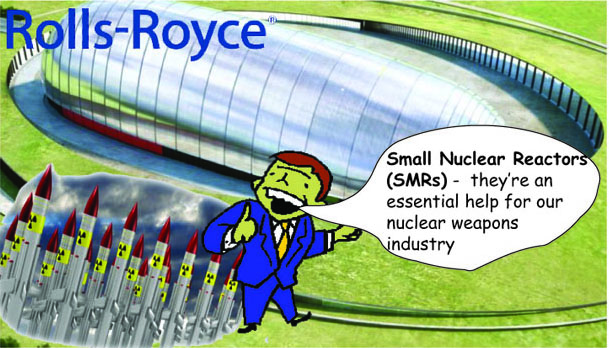
Rolls-Royce heads to Middle East as Saudi Arabia plots £74bn nuclear investment,
ROLLS-ROYCE is looking to the Middle East to export its new [so-called] green technology while Saudi Arabia is reportedly eyeing up a £74billion nuclear investment.
Express UK By JACOB PAUL, Wed, Jan 19, 2022………….. Rolls-Royce looks set to bring its SMR technology to the World Future Energy Summit. This is a global conference showcasing green energy technology. Mr Samson said the company is hoping to start talks with government representatives and large industrial in the Middle East……
And this comes as Saudi Arabia is reportedly exploring options of investing $100 billion (£73.55billion) in several nuclear plants with a combined capacity of 22 gigawatts………
It comes as Rolls-Royce looks set to bring its SMR technology to the World Future Energy Summit.
This is a global conference showcasing green energy technology.
Mr Samson said the company is hoping to start talks with government representatives and large industrial in the Middle East.
And this comes as Saudi Arabia is reportedly exploring options of investing $100 billion (£73.55billion) in several nuclear plants with a combined capacity of 22 gigawatts……..
Mtr Samson – “We have opened up a whole spectrum of customers.”
And Rolls-Royce has already been looking for opportunities to sell its technology to potential UK customers.
But the first SMR units are not expected to come online before the early 2030s. Mr Samson said the company needs to first go through the regulatory processes in Britain. It also needs time to build factories, certify its designs and move on to the production process………… https://www.express.co.uk/news/science/1552184/rolls-royce-middle-east-Saudi-arabia-smr-nuclear-world-future-energy-summit
China’s grandiose plans for nuclear build and export of reactors.
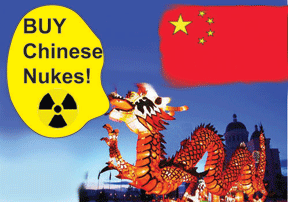
Along with the potential for geopolitical fallout, potential partners have other concerns. China hasn’t signed on to any of several international treaties that set standards for sharing liability in the event of accidents. It also hasn’t offered to take back spent fuel, an added disadvantage when competing with Russia, which does……………
China’s Climate Goals Hinge on a $440 Billion Nuclear Buildout. China is planning at least 150 new reactors in the next 15 years, more than the rest of the world has built in the past 35. Bloomberg, By Dan Murtaugh and Krystal Chia, 3 November 2021, Nuclear power once seemed like the world’s best hope for a carbon-neutral future. After decades of cost-overruns, public protests and disasters elsewhere, China has emerged as the world’s last great believer, with plans to generate an eye-popping amount of nuclear energy, quickly and at relatively low cost. ……………..
China also expects its domestic projects to persuade potential overseas buyers. In 2019, the former chairman of China National Nuclear Corp. said China could build 30 overseas reactors that could earn Chinese firms $145 billion by 2030 through its Belt and Road Initiative.
Its most eager customer has been Pakistan which, like China, shares a sometimes violently contested border with India. China’s built five nuclear reactors there since 1993, including one that came online this year and another expected to be completed next year.
Other countries have been more hesitant. Romania last year canceled a deal for two reactors with CGN and opted to work with the U.S. instead. A 2015 agreement with Argentina has been stalled by economic upheaval and changes in the country’s leadership. Memorandums of understanding to build reactors with countries including Kenya and Egypt have yet to develop into anything concrete.
Along with the potential for geopolitical fallout, potential partners have other concerns. China hasn’t signed on to any of several international treaties that set standards for sharing liability in the event of accidents. It also hasn’t offered to take back spent fuel, an added disadvantage when competing with Russia, which does……………
Prior to the meltdown at Fukushima, China’s nuclear goals were even bigger. Within a week of the tsunami that triggered a meltdown at the Japanese atomic plant, the Chinese government put a moratorium on new projects and began a deep safety review of its entire program. By 2014, it decided against building any more reactors that required active safety measures, like the one at Fukushima did. It paused approvals again for several years until it was satisfied with its new technology.
Fukushima, Chernobyl, Three-Mile Island: Each new disaster underscores the most obvious risk in nuclear energy. Plants house incredibly dangerous radioactive material — even after 10 years of cooling, spent fuel can release twenty times the fatal dose of radiation in one hour. And in the event of a leak or an explosion, the potential for immediate and long-term damage is enormous. In Chernobyl, 350,000 people had to be evacuated after an explosion shot radioactive material into the atmosphere, and dozens of workers died of radiation poisoning within weeks. More than 30 years later, there are still reports of dangerously high levels of radiation in locally produced milk and grain. ……….
public support for nuclear power has waned to the point that new investment is politically untenable in most democracies. At COP26, applications by the International Atomic Energy Agency and industry advocates to set up shop at a more public and visible area were rejected. Japan’s efforts to restart its fleet are mired in court actions and public opposition, Germany will take the last of its reactors offline next year, and France has pledged to cut its reliance on nuclear energy from 70% to 50% by 2035.
Beijing’s own record was largely spotless until June, when reports emerged of an issue at the French-designed plant in Taishan. Any report of a problem at a nuclear plant is alarming, let alone one at a facility within 100 miles of both Hong Kong and Shenzhen.
The incident underscored the potential problem with big nuclear projects, and how they can be made worse by Chinese firms’ typical lack of transparency or public accountability. While media reports and rumors swirled about a possible problem at the plant, CGN insisted everything was fine. Its partner, the French utility EDF, wasn’t so sure, and eventually took its case to the public as a way to push for more information, at one point alerting the U.S. government.
It took weeks before Chinese officials clarified that the problem involved a few damaged fuel rods, which is common and in this case, experts agreed, unthreatening. The plant was eventually shut for maintenance, which EDF said would have happened as a matter of course in France.
While the incident ended up being largely uneventful, it widened the already gaping trust gap between China and the global marketplace for nuclear technology. China’s business practices are often opaque and sometimes downright hostile to the world’s other big emitters. The U.S., India and others are unlikely to build critical infrastructure around Chinese technology, even if it does prove safe and cost-effective.
………. In 2016, China’s CGN invested in three U.K. reactor developments, part of an effort to upgrade an aging nuclear fleet. Now, even as the country confronts a potentially crippling energy crisis this winter, government officials are trying to minimize CGN’s involvement in one of the projects and buy out its stake in the other two.
Crisis or no, it’s hard to see the country move actively toward more nuclear now, given the country’s fraught relationship with China, said Michal Meidan, director of the China Energy Research Programme at the Oxford Institute for Energy Studies. “The lack of transparency and concerns about working relationships have become deeper,” she said. https://www.bloomberg.com/news/features/2021-11-02/china-climate-goals-hinge-on-440-billion-nuclear-power-plan-to-rival-u-s
1 This Month

of the week – Shut Down Drone Warfare!


Tell the Ukrainian Government to Drop Prosecution of Peace Activist Yurii Sheliazhenko

Petition to revoke the licensing of the Near Surface Nuclear Disposal Facility (NSDF) at Chalk River. https://www.ourcommons.ca/petitions/en/Petition/Details?Petition=e-7247
To see nuclear-related stories in greater depth and intensity – go to https://nuclearinformation.wordpress.com
-
Archives
- March 2026 (237)
- February 2026 (268)
- January 2026 (308)
- December 2025 (358)
- November 2025 (359)
- October 2025 (376)
- September 2025 (257)
- August 2025 (319)
- July 2025 (230)
- June 2025 (348)
- May 2025 (261)
- April 2025 (305)
-
Categories
- 1
- 1 NUCLEAR ISSUES
- business and costs
- climate change
- culture and arts
- ENERGY
- environment
- health
- history
- indigenous issues
- Legal
- marketing of nuclear
- media
- opposition to nuclear
- PERSONAL STORIES
- politics
- politics international
- Religion and ethics
- safety
- secrets,lies and civil liberties
- spinbuster
- technology
- Uranium
- wastes
- weapons and war
- Women
- 2 WORLD
- ACTION
- AFRICA
- Atrocities
- AUSTRALIA
- Christina's notes
- Christina's themes
- culture and arts
- Events
- Fuk 2022
- Fuk 2023
- Fukushima 2017
- Fukushima 2018
- fukushima 2019
- Fukushima 2020
- Fukushima 2021
- general
- global warming
- Humour (God we need it)
- Nuclear
- RARE EARTHS
- Reference
- resources – print
- Resources -audiovicual
- Weekly Newsletter
- World
- World Nuclear
- YouTube
-
RSS
Entries RSS
Comments RSS
 nuclear-news