China General Nuclear Power Corp keen to export nuclear, named as conspirator

 U.S. Conspiracy Charges Spotlights China Nuclear Champion http://www.bloomberg.com/news/articles/2016-04-15/u-s-conspiracy-charges-put-spotlight-on-china-nuclear-champion Stephen Stapczynski sstapczynski
-
CGN indicted for conspiracy to illegally make nuclear material
-
Company part of venture to develop China’s Hualong One unit
-
A U.S. indictment on charges against China General Nuclear Power Corp. for conspiracy to illegally produce nuclear material is shining a light on one of the Asian country’s leading atomic energy companies and a key player in its effort to export nuclear technology.
The state-owned company, part of a venture designing the country’s first homegrown reactor, was named as conspirator in an indictment unsealed by the U.S. government Thursday. The reactor, known as Hualong One, is the centerpiece of China’s efforts to compete globally against more-established nuclear developers including Toshiba Corp.’s Westinghouse Electric Co. and Paris-based Areva SA.
- “They are the largest nuclear power company, but less known compared with big oil, telecom or Internet names,” said Helen Lau, an analyst at Argonaut Securities (Asia) Ltd. in Hong Kong.
China is seeking to shift from being a buyer of foreign technology to developing homegrown expertise it can sell globally. CGN and China National Nuclear Corp. last month established a joint venture to export the technology and the country plans tobuild about 30 nuclear units by 2030 in Asia and Europe, CNNC chairman Sun Qin said last month, according to China Daily.
Related: U.S. Charges Chinese Nuclear Firm, Engineer With Conspiracy
“We have noted the announcement from the Department of Justice of the U.S. We cannot comment at this stage,” CGN said in an e-mail.
-
Technical Assistance
The U.S. accused CGN of directing Szuhsiung Ho, a nuclear engineer in the U.S. also known as Allen Ho, to obtain technical assistance from U.S.-based experts related to the development and production of special nuclear material without required authorization from the U.S. Department of Energy. The indictment said the assistance was related to CGN activities including its Small Modular Reactor and advanced fuel assembly program, as well as “verification and validation of nuclear reactor-related computer codes,” according to the indictment.
CGN and Electricite de France SA signed an accord in October to build three nuclear power stations in the U.K., including the 18 billion pound ($25.5 billion) Hinkley plant in southwest England, in exchange for the opportunity to build a Chinese-developed reactor at a separate site. The company may develop a Hualong One reactor at Bradwell in southern England in the future as part of the agreement signed during President Xi Jinping’s visit to the country in October. -
AP1000
CGN signed a memorandum of understanding with the Kenyan government in September to build Hualong One reactors and agreed with Romania in November to build two reactors. CNNC has its own projects in Argentina and Pakistan.
The CGN indictment isn’t the first time the U.S. accused China of illegal activity in the nuclear industry. The U.S. charged five Chinese military hackers in 2014 of cyber espionage against U.S. corporations, including Westinghouse.
Between 2010 and 2012, Chinese hackers stole confidential designs and internal communications from Westinghouse’s computer systems while it was engaged in negotiations with an unidentified state-owned company about building four of the American company’s AP1000 reactors, the Justice Department said at the time. The hackers stole internal e-mails in which Westinghouse executives discussed talks with the Chinese company, it said.
Pipe Specifications
The attackers also sought to acquire pipe specifications that “would enable a competitor to build a plant similar to the AP1000 without incurring significant research and development costs,” the 2014 indictment said.
- Westinghouse referred questions about the most recent case to the U.S. Federal Bureau of Investigation. A spokeswoman for the FBI declined to comment Thursday, referring questions to the Justice Department.
“The notion of stealing U.S. civil nuclear technology is bizarre, given the close technical R&D relationships between China and the U.S.,” Ian Hore-Lacy, senior research analyst at World Nuclear Association, said by e-mail Friday. “Chinese nuclear engineers have been helping to build the AP1000 reactors in the U.S.”
China to set up nuclear reactors in Bulgaria: Bulgaria says no government guarantees
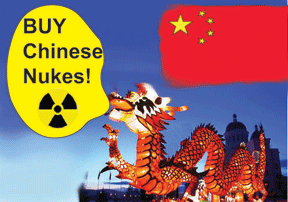 Bulgaria Seeks Chinese Investors into Nuclear Power, Novinite.com, April 15, 2016, Bulgaria is looking for a strategic investor into an expansion of nuclear capacities, Energy Minister Temenuzhka Petkova has told a committee in Parliament…….
She has explained there is certain interest from China in getting involved in Bulgaria‘s nuclear sector.
http://www.novinite.com/articles/174043/Bulgaria+Seeks+Chinese+Investors+into+Nuclear+Power#sthash.cy7Y2ZJE.dpuf
Russia marketing nuclear power stations to Laos: Russia will build and operate them
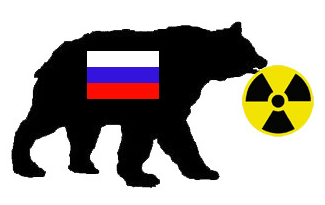 Russia and Laos plan nuclear cooperation, World Nuclear News, 15 April 2016
A memorandum of cooperation in the field of nuclear energy for peaceful purposes has been signed by Russian state nuclear corporation Rosatom and the ministry of energy and mines of Laos……
In August 2015, it was reported that Rosatom and Laos were in negotiations to set up the Southeast Asian country’s first nuclear power plant. The talks concerned Russia building two 1000 MWe nuclear power reactors in Laos on a build-operate-transfer basis. http://www.world-nuclear-news.org/NP-Russia-and-Laos-plan-nuclear-cooperation-1504164.html
Russi, france, USA, all vying to market nuclear reactors to China
Rosatom hopes to plug into nuclear industry By Lyu Chang (China Daily) 2016-04-08 Rosatom, the Russian State Atomic Energy Corp, is seeking to hit big in China’s nuclear industry with the opening of a regional center headquartered in Beijing on Thursday,according to a senior official of the company.
“We are looking to expand our business in China, a market with huge potential for growth inthe nuclear industry, and the activities of regional center are designed to help strengthen ourcooperation with the country,” said Alexander Merten, president of Rosatom InternationalNetwork……..
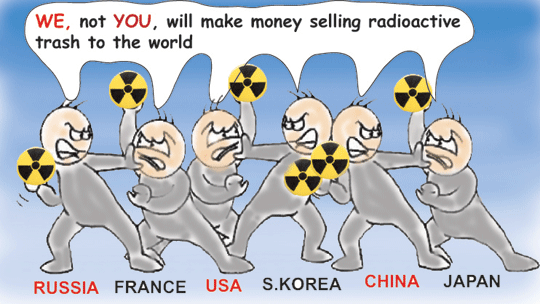
China’s nuclear industry is on the fast track to become one of the world’s largest, with plans tohave completed 58 gigawatts of installed capacity with another 30 gW under construction bythe end of 2020.
But Rosatom will face fierce competition from companies such as the US WestinghouseElectric and France’s nuclear giant Areva with rival third-generation nuclear designs such asAP1000 and EPR1000, both of which aim to expand its presence in the Chinese market…….https://mail.google.com/mail/u/0/#inbox?compose=153f5049f5598818
Marketing frenzy to sell nuclear reactors to the Middle East
Nuclear Power to the People The Middle East’s New Gold Rush, Foreign Affairs May 2015 By Bennett Ramberg There’s a gold rush in the Middle East, but it isn’t gold that prospectors are seeking. It’s reactor sales; these have been talked about for decades, but they’re now picking up steam. So far, Russia has taken the lead. Having built the region’s only operational nuclear power plant—Iran’s Bushehr reactor—it will begin construction in Turkey later this year or next on four reactors, with energy set to begin flowing in the early 2020s. Russia has also stuck agreements with Algeria, Egypt, Iran, and Jordan, and it is seeking to enter the Saudi market.
Other countries are now trying to make up for lost time. South Korea has already contracted to build four plants in the United Arab Emirates, with the first expected to come online in 2017. And Argentina, Canada, China, the Czech Republic, Finland, France, Japan, and the United Kingdom are among those pursuing their own agreements for reactors, component parts and/or service deals.
The United States, subject to Section 123 of the U.S. Atomic Energy Act—which requires that nuclear recipients adhere to a set of nonproliferation criteria to receive transfers of nuclear material, equipment, or components—finds itself more constrained in exploiting the markets. Still, in addition to supplying the Emirates with component and engineering support services under the 123 Agreement, the U.S. Commerce Department reports that GE-Hitachi and Toshiba-Westinghouse have signed contracts with Exelon to pursue reactor construction in Saudi Arabia, presuming that a 123 Agreement will be negotiated…….(registered readers only) https://www.foreignaffairs.com/articles/middle-east/2015-05-25/nuclear-power-people
Russia marketing nuclear power to Bolivia
Bolivia Hopes to Gain Knowledge From Nuclear Deal With Russia, Sputnik News, 29 Mar 16, “……..Russia and Bolivia signed an agreement on peaceful nuclear cooperation in 2015. Rosatom and the Bolivian Hydrocarbon and Energy Ministry signed a memorandum of understanding on cooperation for peaceful uses of nuclear energy in November. http://sputniknews.com/business/20160329/1037166194/bolivia0russia-rosatom-nuclear.html#ixzz44KHYmPUv
India’s Prime Minister Modi in the grip of the global nuclear salesmen
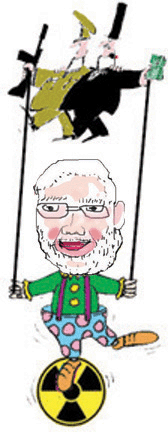 PM’s recent visits to France, Russia and Japan India Infoline News Service | Mumbai | March 10, 2016
The Prime Minister Narendra Modi’s recent visits to France, Russia and Japan were aimed to bring in socio-economic and scientific development particularly in the field of atomic energy
Russia marketing nuclear reactors to Bolivia
Bolivia agrees $300 million nuclear complex with Russia’s Rosatom, Reuters, 6 Mar 16, LA PAZ Bolivia and Russia’s state-owned atomic energy corporation Rosatom said on Sunday they had signed a provisional agreement for the construction of $300 million nuclear complex in the Andean nation.
Under the terms of the accord, which needs to be approved by Bolivia’s Congress, Rosatom will help Bolivia develop infrastructure for its embryonic nuclear program.
The center will include a research reactor, a cyclotron for radiopharmaceuticals and a multi-purpose gamma irradiation plant. Opposition politicians have criticized the project over fears of environmental risks……..http://www.reuters.com/article/us-bolivia-rosatom-idUSKCN0W80R3
China marketing nuclear reactors to Pakistan and beyond
China plans to build 30 overseas nuclear plants by 2030 China is building two 1000 mg nuclear power plants in Pakistan’s port city of Karachiat a cost of $6.5 billion. Business Standard, Press Trust of India | Beijing March 1, 2016 China aims to build 30 nuclear power units in countries involved with its Silk Road Initiative by 2030 as it looks to cash in its new 1000 mw nuclear reactor technology being built in Pakistan.
The China National Nuclear Corp (CNNC) has reached bilateral agreements on nuclear energy cooperation with countries including Argentina, Brazil, Egypt, Britain, France and Jordan, its President Sun Qin said today.
China is building two 1000 mgnuclearpower plants inPakistan’s port city of Karachiat a cost of $6.5 billion……..http://www.business-standard.com/article/pti-stories/china-plans-to-build-30-overseas-nuclear-plants-by-2030-116030101086_1.html
China ramping up its nuclear industry, with plans for exporting reactors
China Inc.’s Nuclear-Power PushIn a shift, Chinese state-owned companies seek to roll out advanced reactors for export, WSJ, By BRIAN SPEGELE Feb. 23, 2016 SHENZHEN, China—China wants to shift from customer to competitor in the global nuclear industry as it seeks to roll out its first advanced reactor for export, a move that adds new competition for already struggling global firms.
Two state-owned firms teamed up to design the advanced indigenous Hualong One reactor with plans to sell overseas. On Tuesday, one of them, China General Nuclear Power Group, hosted dozens of business executives from Kenya, Russia, Indonesia and elsewhere, as well as diplomats and journalists, at its Daya Bay nuclear-power station to promote the Hualong One for export.
Asked how much of the global market share for new nuclear reactors CGN wants Hualong One to win, Zheng Dongshan, CGN’s deputy general manager in charge of international business, said: “The more the better.”
The move marks a turnaround for China and the nuclear-power industry. For three decades, China served as a big market for nuclear giants including U.S.-based, Japanese-owned Westinghouse Electric Co. and France’s Areva SA. …….
turning promotion into sales takes time, and there is no guarantee the Hualong One will find success abroad. Discussions over building the reactor overseas in many cases remain preliminary, and the first of Hualong One model reactor won’t enter service in China for several more years……
Regulatory approvals are among the challenges China Inc. faces as it seeks to sell homegrown reactors abroad. CGN executives said obtaining needed regulatory permits in the U.K. and other countries for the Hualong One would still take several years, a process that would need to conclude before construction gets under way……..
At the heart of its sales pitch for potential customers overseas, CGN touts itself as a “one-stop shop” for nuclear needs—from nuclear design to construction, financing and other services.
“If you choose the HPR1000, it’s like you’re joining a big family,”Yang Maochun, a deputy general manager of CGN’s international business department, told the visiting foreign executives on Tuesday…….
Political concerns over Chinese nuclear investment in the West could also pose hurdles, though these may be overcome through jointly investing with local partners.
While acknowledging CGN’s deepening competition with Western nuclear companies, Mr. Zheng said the company remains eager to cooperate with them too. He cited joint investment with France’s Électricité de France SA in the U.K.’s Hinkley Point C project as a model for cooperation, and said CGN would be willing to help market non-Chinese reactors in the future as well. http://www.wsj.com/articles/china-inc-s-nuclear-power-push-1456251331
USA govt’s position: its nuclear companies should be exempt from civil or criminal liability
How American Penalties Dwarf the Liability US Nuclear Firms Will Face in India, The Wire BY AMIT BHANDARI, INDIASPEND.ORG ON 21/02/2016 A $48-billion (Rs 3.26 lakh crore) penalty claimed by the US government from Volkswagen for cheating on diesel-car emissions is about 200 times as large as the $225 million (Rs 1,500 crore) insurance pool set up by Indian insurance companies to compensate US nuclear companies for mishaps in India.
If a US nuclear company were to build a reactor in India that suffered a catastrophe, and people were to die in India, the US government’s position seems to be that American suppliers shouldn’t face . The US believes the Indian civil nuclear liability law, which calls for both penalties, is unduly harsh. Rather than say so directly, US officials keep repeating that the “Indian law is inconsistent with the international liability regime.”
The Indian civil nuclear liability law holds the equipment supplier responsible for any incident caused by the supplier or its employees. The Indian liability law differs from those of other countries because it was drafted keeping in mind the 1984 Bhopal tragedy – where despite 5,000 deaths and effects across generations, no one was held criminally liable.
Although the Indian government wants to protect US nuclear companies against the Indian liability law, critics argued that these companies are using India’s eagerness to avoid any liability, if something goes wrong…….
Indian firms also fined in the US
While the US nuclear industry wants to avoid any liability in India for acts of omission or commission, Indian companies have often been slapped with large fines for violations of US law.
Russia is offering bribes for Egypt to buy its nuclear reactors
Negotiations over establishment of Dabaa nuclear plant ongoing: Minister of Electricity, Daily News, Egypt, 21 Feb 16 Egyptian minister of Electricity and Renewable Energy, Mohamed Shaker, said the ministry is still negotiating with Russia’s Rosatom over technical, financial, and technological agreements to establish the first Egyptian nuclear power plant in the Dabaa area.
He told Daily News Egypt the Russian offer has better features than other offers from French, Chinese, and Korean companies. The offer includes providing nuclear fuel supply to the nuclear power plant throughout its operating period, which is estimated to be 60 years. In addition, it will be responsible for the management of spent nuclear fuel, operation and maintenance, and training human resources……http://www.dailynewsegypt.com/2016/02/21/negotiations-over-establishment-of-dabaa-nuclear-plant-ongoing-minister-of-electricity/
Corporate elites push their toxic nuclear products onto India
Perverted Logic of Powerful Corporate Interests drive the India-France Nuclear Connection Mainstream Weekly, VOL LIV No 8 New Delhi by Harsh Kapoor The French President was in India as the chief guest at the surreal nationalist military parade of January 26, 2016. As is the practice, he was accompanied by a high-powered delegation and many multilateral deals got signed between the two countries. There are big ones that have been in the news, have been in the making for many years and may still take time to fructify. These concern the sale by France of nuclear power plants and of flying war toys to India.
India’s proposed purchase of military weaponry and nuclear power plants from France constitute the big centrepiece—attention and money involved in the overall scheme of Franco-Indian ties of the moment. These involve the sale of the Rafale-Multi Role Fighter jets, made by Dassault, said to be the most expensive in the world, and the sales of EPR (European Pressurised Reactors) nuclear reactors, made by Areva, also in the league of the most expensive.

Both these, that is, the civilian nuclear programme and defence procurement, are holy cows that are tightly sealed off by a firewall insulating them from reasoned public scrutiny; all this is managed and scripted by bureaucrats, lobbyists and keepers of ‘national interest’ who hold the keys. The Indian establishment of recent times seems to have grown very big pockets and a big-time ‘folie de grandeur’ where the bigger, more expensive, noisier, higher, shinier are seen as better benchmarks. (A sign of times we are in, that India’s Prime Minister walks about in clothes with his name printed on it all over.) Undue influence of foreign vendors and big Indian and foreign firms and lobbyists is a new reality in the corridors of our decision-making circles. That a new corporate-military industrial complex is shaping India’s drive down this road is a matter which should be the subject of social and economic enquiry by the academia. That is the Indian side of the picture.
But what is driving the French establishment in this foray into India?
The French authorities and the corporate elites see India (and China) as the new market to push their wares. It’s as banal and straight as that. It’s mostly about shoring up economic ties and in the process principally to bailout two crises-ridden sections of the French economy, namely, the civilian nuclear sector and the sagging military-industrial sector. Both of these continue to exercise a considerable hold over the French elites……..
Let us look at the story of the crisis-ridden French civilian nuclear programme to under-stand why the sale of the French EPR reactors for the proposed Jaitapur nuclear park is important to the French……..
The European Pressurised Reactor or EPR was a new generation design and a big bet of the French reactor-maker, Areva NP. The initial optimism from the EPR and the orders for new plants—first in Finland in 2003 (Olkiluoto), then in France in 2006 (Flamanville) and thereafter in China in 2007 (Taishan)—has dissolved with both Olkiluoto and Flamanville now nearly three times over-the-budget and at least 10 years and five years late respectively. Even the Chinese plants under construction are running late. Not a single functioning nuclear plant running the EPR reactor exists so far. There have been huge problems with the reactor design and construction quality despite years of experience in nuclear plant engineering in France. The highly trusted and independent-minded French nuclear safety agency (ASN) has found problems with the pressure vessel forgings in the Flamanville plant……..
The initial cost of the French EPR reactor was to be 3 billion euros but current estimates say it would be close to 11.5 billion euros. [One billion euros come to Rs 7000 crores and one French reactor would cost more then Rs 70,000 crores whereas the annual plan outlay for Maharashtra is Rs 47,000 crores.] The very largely state-owned company, Areva, that made the EPR has been running huge losses. In 2014 the losses were close to 5 billion euros. In July 2015 Areva sold off its reactor business to the French state-run electricity utility, EDF, which is also the biggest operator of nuclear power plants. Now the EDF, which has been economically sound, will have to manage the many very economically risky foreign projects of the former Areva. Experts say the EPR’s design problems and costs have dragged down Areva economically and the EDF is unlikely to want a similar fate for itself. The EDF has been developing its own designs for smaller nuclear reactors. Given the construction and operation problems of the EPR there is a possibility that the EDF could shelve the EPR’s giant reactor programme and place it in long-term cold storage.
The in-principle sale of six EPR reactors to India is a bet for the rescue of the crisis-marked French nuclear sector — imagine an injection of 60 billion euros if the price is, say, 10 billion dollars a piece. There was a joint venture by Areva and L & T, the Indian engineering major, which is negotiating the price of building the Jaitapur reactors with the Nuclear Power Corporation of India (NPCIL). They say the will bring down the price by sourcing the parts under a ‘make an India’ bid. All this will need to be reworked with the EDF being the new French entity in charge……….http://www.mainstreamweekly.net/article6209.html
Ukraine buying Western technology, plans to double its nuclear power
 Thirty Years After Chernobyl, Ukraine Doubles Down On Nuclear Power, Radio Free Europe, By Tony Wesolowsky February 08, 2016 Nearly 30 years after Chernobyl spewed nuclear dust across Europe and sparked fears of fallout around the globe, a strapped, war-torn Ukraine is opting for “upgrades” rather than shutdowns of its fleet of Soviet-era nuclear power reactors.
Kyiv is planning to spend an estimated $1.7 billion to bring the facilities, many of which are nearing the end of their planned life spans, up to current Western standards.
Ukrainian officials hope to further their energy independence from Moscow and potentially export some of the resulting electricity to Western Europe as part of an “EU-Ukraine Energy Bridge” that can further cement Kyiv’s ties with Brussels.
But can they allay fears, in Ukraine and beyond, that the plans will put Europe at risk of another Chernobyl?
The project has the backing of the West, including a $600 million contribution split evenly between the European Bank for Reconstruction and Development (EBRD) and Euratom, the EU’s nuclear agency…….
Most of the reactors came online in the 1980s, with the oldest — Unit 1 at the Rivne nuclear plant — generating power since December 1980, three years before the ill-fated reactor No. 4 at Chernobyl started churning out power……..
critics have their doubts.
They say Ukraine’s nuclear reactors should be shut down as soon as possible, noting that one of the reactors still churning out power is older than the unit that exploded at Chernobyl on April 26, 1986. They also raise doubts over whether the program will be carried out to the highest standards……..
The [Ukrainian] Nuclear Regulatory Commission is discussing the possibility of raising the extension period to 80 years.”
The upgrade work is just part of a bold plan to make Ukraine a major energy player in Europe beyond its decades-long role as a major transit country. In a state energy strategy document released in 2006 and covering the sector until 2030, Kyiv foresaw the construction of 11 new nuclear units.
Ukraine’s current financial straits could put such bold plans on hold. However, Kyiv appears to be moving ahead with intentions to make Ukraine part of the European power grid by 2017, a target set out by President Petro Poroshenko after he took office in mid-2014……..
Ukraine is also opening other doors with Western nuclear partners.
In November, Enerhoatom signed an agreement with the French engineering firm Areva “for safety upgrades of existing and future nuclear power plants in Ukraine, lifetime extension, and performance optimization.”
U.S.-based Westinghouse, which has been operating in Ukraine since 2003, signed a deal with Kyiv in December 2014 “to significantly increase” nuclear fuel deliveries to Ukraine until 2020.
Russia’s Foreign Ministry reacted to the deal between Westinghouse and Kyiv by calling it “a dangerous experiment.”
Ukraine still depends on TVEL, a nuclear-fuel subsidiary of Russia’s Rosatom, for fuel at 13 of its 15 reactors, highlighting Russia’s continuing sway over Ukraine’s nuclear program.
Westinghouse has been challenging TVEL for a bigger cut of the nuclear-fuel market in Eastern and Central Europe, where Russian-designed reactors are the norm.
The U.S. Export-Import Bank has offered significant loans for several Westinghouse projects in the region, and U.S. officials have lobbied governments to diversify away from dependence on TVEL, according to Statfor, a U.S.-based analytical center…….. http://www.rferl.org/content/thirty-years-after-chernobyl-ukraine-doubles-down-nuclear-power/27539152.html
Ambiguities in marketing nuclear reactors to India
 Nuclear ambiguities, THE HINDU, 7 Feb 16 India’s nuclear politics was in the limelight again last week, and not for the best of reasons. More than five years after it signed the Convention on Supplementary Compensation (CSC), India ratified the insurance pooling agreement, which pertains to civil liability in the event of a nuclear accident in any of the acceding countries. Prima facie, this was a good move, bringing to an end a game of will-they-or-won’t-they, which had cast India in poor light internationally and which sat uncomfortably beside three hard-fought nuclear landmarks — the India-U.S. Civil Nuclear Agreement (CNA) and the Nuclear Suppliers Group (NSG) waiver, both passed in 2008, and India’s Civil Liability for Nuclear Damage Act (CLNDA), which became law in 2010.
1 This Month

of the week – Shut Down Drone Warfare!


Tell the Ukrainian Government to Drop Prosecution of Peace Activist Yurii Sheliazhenko

Petition to revoke the licensing of the Near Surface Nuclear Disposal Facility (NSDF) at Chalk River. https://www.ourcommons.ca/petitions/en/Petition/Details?Petition=e-7247
To see nuclear-related stories in greater depth and intensity – go to https://nuclearinformation.wordpress.com
-
Archives
- March 2026 (251)
- February 2026 (268)
- January 2026 (308)
- December 2025 (358)
- November 2025 (359)
- October 2025 (376)
- September 2025 (257)
- August 2025 (319)
- July 2025 (230)
- June 2025 (348)
- May 2025 (261)
- April 2025 (305)
-
Categories
- 1
- 1 NUCLEAR ISSUES
- business and costs
- climate change
- culture and arts
- ENERGY
- environment
- health
- history
- indigenous issues
- Legal
- marketing of nuclear
- media
- opposition to nuclear
- PERSONAL STORIES
- politics
- politics international
- Religion and ethics
- safety
- secrets,lies and civil liberties
- spinbuster
- technology
- Uranium
- wastes
- weapons and war
- Women
- 2 WORLD
- ACTION
- AFRICA
- Atrocities
- AUSTRALIA
- Christina's notes
- Christina's themes
- culture and arts
- Events
- Fuk 2022
- Fuk 2023
- Fukushima 2017
- Fukushima 2018
- fukushima 2019
- Fukushima 2020
- Fukushima 2021
- general
- global warming
- Humour (God we need it)
- Nuclear
- RARE EARTHS
- Reference
- resources – print
- Resources -audiovicual
- Weekly Newsletter
- World
- World Nuclear
- YouTube
-
RSS
Entries RSS
Comments RSS
 nuclear-news