Middle Eastern countries – a bonanza for Western nuclear salesmen
Despite years of building and development, nuclear power is on the decline in many parts of the world with its share of global electricity decreasing from 18 percent in 1996 to around 11 percent today according to the International Energy Agency.
Nuclear has become unfashionable in several countries not just because of the Chernobyl and Fukushima disasters: New safety requirements mean the cost of building nuclear facilities has been rapidly mounting.
The cost of the UAE’s Barakah plant is estimated at between US$25 bn and $32 bn, most of it being paid out of state funds. The initial cost estimate of Saudi Arabia’s nuclear programme – involving French, Chinese, Argentinian and South Korean companies building facilities both for power generation and for desalination – is $80 bn.
Energy analysts say that rather than spending billions of dollars on prestige nuclear projects, subsidies should be eliminated to curtail usage and alternative energy sources should be developed.
The use of solar power is still minimal in many countries in the region yet it has enormous potential.

Following the disasters at the Chernobyl and Fukushima power plants, many countries either cancelled or put on hold projects for nuclear power facilities but in the Middle East region at least 25 plants are planned and many more are being talked about.
Some studies indicate that up to a total of 90 nuclear facilities, – both big and small – are in the pipeline………
Opponents of the plans say going nuclear in what is one of the world’s most volatile geopolitical regions poses serious safety and security issues. Among other concerns there are the eye watering costs involved in nuclear building programmes and unresolved problems over radioactive waste disposal.
The nuclear salespeople have been busy across the region in recent years: in the United Arab Emirates, the Barakah nuclear power facility in Abu Dhabi, built and operated by the South Koreans, is due to come on stream next year, aiming to supply up to 25 percent of the UAE’s electricity.
Saudi Arabia plans to have its first nuclear power plant on stream by 2022, with another 15 facilities of varying size in the pipeline. Jordan and Egypt have signed agreements with Rosatom, the Russian state nuclear conglomerate, to build and operate reactors.
Despite recent tensions between Turkey and Russia, Rosatom is continuing construction of Turkey’s first nuclear power plant on the country’s southern coast.
Tunisia and Algeria have also been in nuclear discussions with the Russians and other suppliers…….. Continue reading
China trying to market nuclear power to India
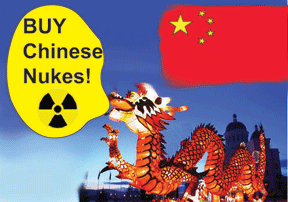 China Can Cooperate With India In Nuclear Sector: Official NDTV, 22 July 16 NEW DELHI: Describing China as an “important player” in the nuclear sector, a senior Chinese state policy researcher has said it is one of the areas where it can cooperate with India, a remark which comes amidst growing strain between the two countries over the NSG issue.
Speaking in Delhi, Wenling, a senior researcher of the Chinese State Council Research Office, also made a strong pitch for long-term visas for Chinese nationals visiting India, which she said would boost bilateral trade and investments.
On areas where the two neighbours can cooperate, she said manufacturing, nuclear energy, bullet trains, tourism, education, agriculture and services industry are among the areas where they can enhance their cooperation.
“China is an important player in the nuclear sector. Chinese energy players are investing in the US market,” she remarked during a discussion with a select gathering in Delhi in the presence of Minister Counselor Cheng Guangzhong yesterday…….http://www.ndtv.com/india-news/china-can-cooperate-with-india-in-nuclear-sector-official-1434936
USA trying to market nuclear power to Mexico
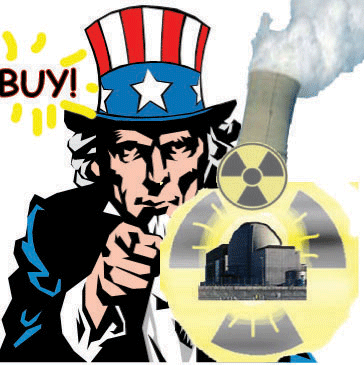
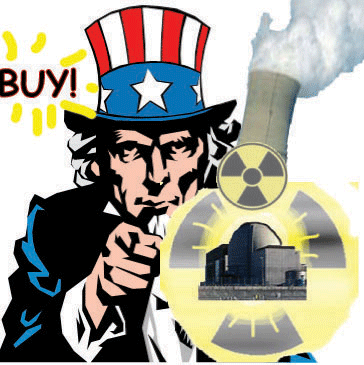 U.S., Mexico talk nuclear energy, Washington Examiner By 7/22/16 “….President Obama discussed the nuclear energy collaboration with Mexican President Enrique Pena Nieto after a meeting Friday….. we are pursuing an agreement this year on sharing civilian nuclear technology,” the president said. “This fall our new U.S.-Mexico Energy Business Council will meet for the very first time to strengthen the ties between our energy industries.”
Russian, USA, Japanese nuclear salesmen move their Indian nuclear plans to Andhra Pradesh
 A.P. set to be country’s nuclear power hub http://www.thehindu.com/
 news/national/andhra-pradesh/ap-set-to-be-countrys-nuclear-power-hub/article8876943.ece SUHASINI HAIDAR
Govt. is pinning its mega plans for generating the ‘clean’ energy on coastal Andhra Pradesh.
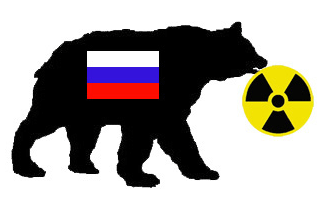
Weeks after the government announced that U.S. company Westinghouse’s Nuclear Power Project (NPP), planned in Gujarat’s Mithi Virdi, is being moved to Andhra Pradesh, sources confirmed to The Hindu that Russian-owned Rosatom will build its next phase of six reactors in Andhra Pradesh as well.
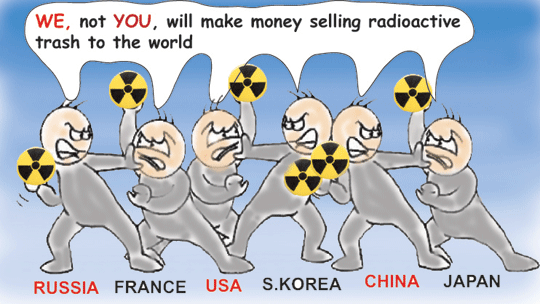
With other States like Gujarat, Tamil Nadu, West Bengal and Maharashtra facing local protests over NPPs, the government is now pinning its mega plans for generating the ‘clean’ energy on coastal Andhra Pradesh. In fact, if all the projects under consideration from Russia, the U.S. and NPCIL were to actually go through, NPPs in Andhra could account for more than 30,000 MW of the Modi government’s goal of 63,000 MW installed capacity by 2031. The site for the next set of six Russian reactors was discussed during A.P. Chief Minister Chandrababu Naidu’s recent visit to Russia, where he met Russian PM Dmitry Medvedev.
Sources told The Hindu the project site identified, believed to be Kavali in Nellore district, could be announced during President Vladimir Putin’s visit to India in October. “It’s huge,” said Commerce Minister Nirmala Sitharaman, who had led the delegation to Russia. “In Andhra Pradesh, six nuclear centres are going to be created, totalling thousands of megawatts in capacity. Of course, Andhra Pradesh will have both American and Russian participation in nuclear energy generation, but the Russians will be the first to “Make in India” in the nuclear sphere in Andhra,” Ms. Sitharaman told The Hindu.
The “American participation” referred to is the plan for Toshiba-Westinghouse to set up 6 AP1000 reactors of 1,100 megawatts each, a proposal that had run into trouble in Gujarat due to “stiff protests from farmers” during the land acquisition process for 777 hectares, a senior official in the Gujarat government said.
“In addition, Tata, Adani and Essar, which are the largest power producers in the State, were never comfortable with another giant plant being set up in the State,” the official said. During Prime Minister Narendra Modi’s visit to Washington in June 2016, NPCIL and Westinghouse had announced the move to Andhra Pradesh, with a commitment to complete the commercial agreement for 6 reactors by June 2017.
Meanwhile, another Russian project that has been hanging fire for years, to build 6 ‘VVER’ (Water-Water Energy) Reactors of 1000 MWe in West Bengal’s Haripur may also be moved to Andhra Pradesh due to local protests. “We are looking for a site in some coastal area of Andhra Pradesh where a similar reactor, which was meant for Haripur, will come up,” Dr. Sekhar Basu, now Chairman of the Atomic Energy Commission, had told reporters last September, although West Bengal officials told The Hindua final decision has not been taken.
State officials hope Tamil Nadu, Gujarat and West Bengal’s loss will soon be Andhra Pradesh’s gain, and the State already has the Kovvada nuclear park project for 6 1000MW reactors in Srikakulam under way. However, the coast isn’t completely clear. Kovvada has seen some protests of the kind seen at Kudankulam, Mithi Virdi and Haripur. While many local residents are unwilling to part with land, others have concerns over environmental hazards, especially given that some of the sites identified for nuclear projects are in a seismically sensitive zone, and have seen tremors in the past.
Confirming that several projects are only in “preliminary stages”, the Andhra Pradesh government’s media adviser Parkala Prabhakar told The Hindu: “The Central government has asked some more sites for other plants. We have asked the Collectors of Prakasam and Nellore to spot the sites. Once those sites are identified, the NPCIL will come for inspection to check the compatibility,” indicating that while Andhra’s nuclear power-hub dreams are in sight, they may take a while to come to fruition. (With Appaji Reddem in Vijayawada & Mahesh Langa in Ahmedabad)
Russia paying for setting up nuclear power plant in Vietnam
 Work on Russian-assisted nuclear power plant in Vietnam to begin in 2023 https://rbth.com/news/2016/07/15/work-on-russian-assisted-nuclear-power-plant-in-vietnam-to-begin-in-2023_611821 TASS
“The schedule is still set for 2028,” Tuan said. Construction will begin in 2022 or 2023, he added.
Such a timeframe is indicated in the revised master plan of Vietnam’s energy sector development, the official said.
Russia’s Rosatom is acting as a partner in the Ninh Thuan 1 nuclear power plant in Vietnam.
Japan joins the crowd marketing nuclear reactors to Britain
Japan Atomic Power to join Hitachi’s nuclear plant business in Britain http://www.japantimes.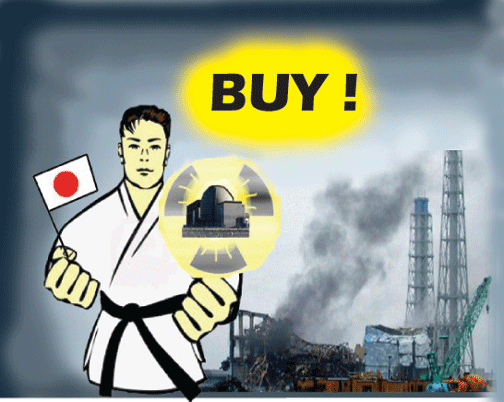 co.jp/news/2016/07/07/business/corporate-business/japan-atomic-power-join-hitachis-nuclear-plant-business-britain/#.V39eRdJ97GhJapan Atomic Power Co. will join Hitachi Ltd.’s nuclear power plant business in Britain, informed sources said Thursday.
The two companies will soon sign a cooperation agreement to make Japan Atomic Power the first Japanese power supplier to take part in an overseas nuclear power plant business in full scale.
Japan Atomic Power will become part of a project to build nuclear reactors in Britain, which is undertaken by Horizon Nuclear Power Ltd., a Hitachi unit in Britain, possibly engaging in licensing procedures for reactor construction.
Japan Atomic Power hopes that overseas operations will become a new source of revenue at a time when its nuclear reactors in Japan have been suspended following the 2011 core meltdowns at Tokyo Electric Power Company Holdings Inc.’s Fukushima No. 1 nuclear plant.
Hitachi, which has no experience as a nuclear plant operator, asked for Japan Atomic Power’s cooperation over the British project.
France marketing its nuclear reactors to India
France submits fresh plan for six nuclear plants in Jaitapur, Economic Times, By PTI | Jul 07, 2016 NEW DELHI: France has given a fresh techno-commercial proposal for building six atomic reactors in Jaitapur even as it again raised concerns over India’s civil liability law and sought “same level of protection” which are available for companies at the international level.
“All these steps will help us bring nuclear industry players from France to India. The delegation has asked to provide same level of protection to the EDF which is available at the international level,” a top EDF official told PTI.
We have also given a fresh techno-commercial proposal to NPCIL. It’s now up to the NPCIL to decide,” the official added.
The proposal includes negotiating with India for six reactors as against two, which was the case earlier. This would help bring down the cost. It also includes a proposal for localisation of technology to make the project cost effective.
NuScale “small nuclear” company marketing hard in UK, providing funding
NuScale to forge strong US-UK partnership with Sheffield Forgemasters, B Daily, Nick Hill, 8 July 16 NuScale Power’s aim to build a UK-U.S. partnership has made significant steps forward.
Sheffield Forgemasters International Ltd (SFIL) and NuScale are set to collaborate to develop the manufacturing techniques that will be required for the future deployment of Small Modular Reactors (SMRs) in the UK.
SFIL will forge a large civil nuclear reactor vessel head by the end of 2017, as part of a programme supported by Innovate UK, to develop forging and fabrication solutions for the nuclear industry.
NuScale Power is providing funding to support the use of the geometries required by its SMR design……..
NuScale Power will be holding a Supplier Day at the Advanced Manufacturing Research Centre in Sheffield on 13 July aimed at giving UK-based engineering, manufacturing and construction companies the opportunity to learn about the company’s programme of work.
NuScale is also participating in the UK Government’s competition to choose the best value SMR, aimed at seeing SMRs deployed in the UK in the 2020s. https://bdaily.co.uk/industrials/08-07-2016/nuscale-to-forge-strong-us-uk-partnership-with-sheffield-forgemasters/
China trying to market nuclear reactors to Argentina
China and Argentina reaffirm reactor agreement World Nuclear News, 01 July 2016 China and Argentina have signed a memorandum of understanding (MOU) reaffirming their plans to construct two new nuclear power reactors in the Latin American country with financing from Chinese banks. Construction of Argentina’s fourth reactor is to start early next year……..
Moldova hesitant – for now, resisting China’s nuclear marketing
Will China Bring Nuclear Power to Moldova?, Eurasia Net 30 June 16 China appears willing to help Moldova become a nuclear power. But for now officials in Chi?in?u seem hesitant to go all-in on atomic energy.
Chinese representatives from the state-run National Nuclear Power Company (NNPC) were in Moldova in mid-May for talks aimed at identifying opportunities to boost “bilateral cooperation in the energy sector,” according to an official statement. Chinese and Moldovan officials agreed to complete a feasibility study on “launching new projects for producing electricity in Moldova” by the end of 2016……
For now, the Moldovan government seems more interested in renewable energy. ……
Târ?u said that he advised against a nuclear power plant because of the environmental risks, plus Moldova’s lack of water resources, facilities for storing radioactive waste, and “qualified and experienced staff in this field.”
Another risk also exists: an Associated Press report in late 2015 indicated that Moldova could be atrafficking hub for nuclear materials. Criminal groups with supposed Russian ties allegedly have used the country four times since 2010 to try and pass radioactive materials to anti-Western customers (including a Moldovan undercover agent posing as a representative of the Islamic State terror organization). None of the attempts succeeded……..
energy expert Târ?u does not believe that a nuclear power plant will be built in Moldova. Thirteen years ago, Moldova also considered the possibility of a French-built nuclear power plant, but the discussions resulted in nothing . http://www.valuewalk.com/2016/06/china-nuclear-plant-moldova/
Russia’s nuclear marketing: the ambitions and the reality
 Russia’s nuclear energy expansion – a geopolitical footprint?, New Eastern Europe News, , 28 June 2016 “…….As the low oil and gas prices globally have squeezed Russia’s fossil fuel export revenues, an integral part of the country’s income, the nuclear industry has been looking for a worldwide expansion. Rosatom, Russia’s state-owned nuclear champion, has in the recent years set an ambitious course to deliver Russian nuclear power generating technology to both traditional partner countries as well as to new “developing“ economies…….
Nuclear ambitions
Over the past decade state-owned nuclear corporation Rosatom and its network of subsidiaries have made direct or indirect commitments to build nuclear power plants in a number of countries around the world. As stated by a Rosatom official in a recent interview, Russia has signed intergovernmental agreements for the possible construction of 36 nuclear reactors overseas and is holding “active and consistent” tendering negotiations about 21 others. It is apparent that Russia seems to be looking away from Europe and its traditional markets in search of new business opportunities for its nuclear industry.
During the Russia – ASEAN (Association of Southeast Asian Nations) summit held on 19 and 20 May in Sochi, Russia’s president Vladimir Putin said his country is ready to provide a Generation III nuclear reactor technology to countries in Southeast Asia. Another Rosatom official called forAfrica to invest in nuclear energy during an annual energy forum in Johannesburg in February 2016.
The reality
The overall expansion agenda seems really impressive, but in fact only some of the projects are in an active construction phase – such as those in Belarus, China, Finland, India, and Slovakia. The projects in Egypt, Hungary, Iran and Vietnam are also likely to get the go-ahead in the near future. As for the rest, the picture has not been so rosy.
Turkey’s Akkuyu project is becoming increasingly bogged down after the relationship between Moscow and Ankara embittered last November. Ukraine has denounced an agreement with Russia on the construction of two units at the Khmelnitsky site as the two countries have become increasingly hostile due to the looming Donbas and Crimea crises. China appears to have taken over the project for the expansion of the Atucha plant in Argentina. And nuclear development on the African continent (except for South Africa and Egypt) is nowhere closer to reality in the near future.
Looking back at Europe, both Finland’s Hanhikivi and Hungary’s Paks 2 nuclear new build projects have come under scrutiny of the authorities. In the Finnish case, the main condition set by Helsinki to allow the project was for 60 per cent of the ownership of Fennovoima, the company building Hanhikivi, to be held by investors from the EU. This meant Rosatom could only be a minority owner with its 34 per cent. As with Hungary, the European Commission (EC) has launched two procedures against the government in Budapest looking into the legality of the state aid and public procurement conditions around the Paks 2 project. The EC has expressed its doubts on whether the deal with Russia fully meets EU regulations and has been concluded on market terms. The EC said it would assess if a private investor would have financed the project on similar terms or whether Hungary’s investment constitutes state aid.
Economics and geopolitics
From an economic point of view, nuclear projects are specific with their high upfront capital costs. This fact often creates major hurdles for countries or companies looking to build nuclear capacities………
Apart from the initial investment, which is undoubtedly good business for Rosatom, even more attractive is the possibility for nuclear fuel supplies the Russian-designed reactors will be using over their operational lifetime. As this is on average 30-50 years, it is a brilliant opportunity for continued revenue over a very long period of time. ……
Forced to play by the common rules, Russia has to accommodate to open competition on EU terms. Therefore, it is looking for an ambitious expansion of its nuclear exports around the world, striving to “conquer” market shares as a first mover, while major nuclear industries in Europe and Japan are plagued by shrinking business opportunities, financial problems, and negative public opinions. The real contenders to Russia’s nuclear expansion in the short and medium term will become China and the US. It only remains to be seen where the business ends and geopolitics begins. http://www.neweasterneurope.eu/articles-and-commentary/2040-russia-s-nuclear-energy-expansion-a-geopolitical-footprint
Russia’s spurious nuclear marketing deals
Experts say some deals Rosatom boasts about are not contracts, just a “memorandum of understanding” or “framework agreement.” Many of these are with countries that will not be ready for nuclear for years, if not decades, such as Algeria, Argentina, Bolivia and Nigeria.
whether any new plants ever get built, Rosatom is likely to keep signing new deals around the globe.
“Rosatom likes to sign MOUs everywhere, they like one every few months, for the photo opportunity,”
Rosatom’s Global Nuclear Ambition Cramped by Kremlin Politics, Fortune by Reuters JUNE 26, 2016 The problem is that Russia wants to parlay Rosatom’s success into political leverage.
The $100 billion overseas order book of Russia’s nuclear power plant builder Rosatom—bigger than all its Western competitors combined—makes it look like the giant in its field.
But if the company—formed in 2007 from the Russian Atomic Energy Ministry and tasked with turning nuclear power into a major export industry—is ever to reach its potential as a global industrial giant, it will have to shed Russia’s reputation for using energy policy as a means to political ends.
Deal after deal has collapsed in Europe, where individual countries and the European Union as a whole consider it a priority to reduce dependency on Russian energy, and relations have deteriorated over Moscow’s intervention in Ukraine.
A project in fast-growing, energy-hungry Turkey—possibly the ideal market on paper—has been stalled because of a collapse in relations between the two countries supporting opposite sides in the Syrian civil war.
And an array of deals announced in poorer developing countries like Egypt, Jordan and Bangladesh seem unlikely to reach fruition any time soon because of the countries’ lack of experience with nuclear power, shortage of capital and grids that are unsuitable.
“Rosatom is pretty good at announcing $100 billion euros of orders in 25 countries, but not an awful lot of these are firm contracts, they are just bits of paper,” said Steve Kidd at East Cliff Consulting. Continue reading
Call for Britain to have Russia build UK’s new nuclear stations
 UK government needs a nuclear plan B, says Tim Yeo, Guardian, Terry Macalister, 19 June 16, “…….. Tim Yeo, a former chair of the energy and climate change committee, said the government should also consider whether the Russian state operator, Rosatom, or the British state could build new atomic plants.
The Hinkley project in Somerset has been hit by a series of delays, with its developer, EDF, recently postponing a final investment decision until September.
Yeo said continuing opposition from EDF unions to spending huge sums of money in Britain and political uncertainty ahead of the French elections next spring could hold up the project further……..
Yeo said the Russian political situation made it harder for the UK government, but Russian nuclear sources have previously said Rosatom would like to talk.
In 2014, a senior Decc officialconfirmed that there had been serious contact between the two sides……
The pro-nuclear campaigner said the total cost of any new reactor to energy billpayers could be reduced if the British government became directly involved, as some City analysts have claimed…….https://www.theguardian.com/uk-news/2016/jun/19/uk-government-should-have-a-nuclear-plan-b-tim-yeo-hinkley-point-bradwell-scheme
Nuclear marketers see India as a saviour of nuclear industry
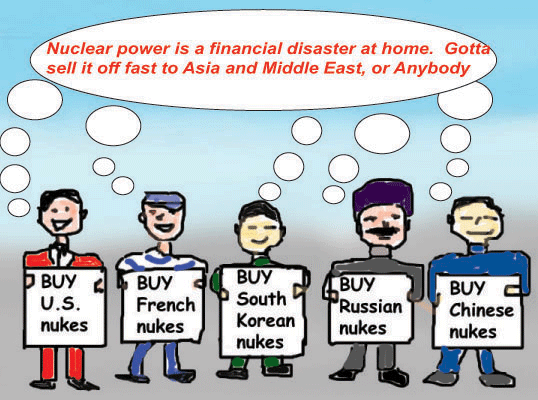
U.S. President Barack Obama and Indian Prime Minister Narendra Modi agreed at a June 7 summit that U.S. nuclear reactor maker Westinghouse Electric, a subsidiary of Japan’s Toshiba, would build power plants in the South Asian nation. In a statement following their meeting in Washington, Modi and Obama said they welcomed the announcement by the Nuclear Power Corp. of India and Westinghouse that they would finalize a contract by June 2017. The two companies had said they would immediately begin the work of designing reactors and selecting locations.
As the nation opens its market for nuclear plants, competition is likely to intensify between the U.S., France, Japan and other countries seeking a greater market share.
France reached an agreement early this year to start a development project in western India in 2017. Although a formal agreement has yet to be signed, the country will compete with the U.S. to become the first Western country in about 40 years to deliver a reactor to India. Japan also reached a broad agreement with India in late 2015……..http://asia.nikkei.com/magazine/20160616-POWER-PERFORMERS-of-the-Asia300/Business/Nuclear-power-plant-builders-see-new-opportunities-in-India
India paying high cost to save Westinghouse’s nuclear business
 The Cost of Modi’s US Visit: Offering Rs. 2.8 lakh crore to Westinghouse, News Click, Prabir Purkayastha, June 09, 2016
The 4th visit of Modi to the US has very little to show as achievements. No wonder, the headlines screamed about “the start of the preparatory work” on six nuclear reactors as a major achievement. Not content with this, the Westinghouse AP 1000 reactors were even hyped as 5th generation reactors, skipping two whole generations of reactors in between. The earlier AP 600 reactors are recognised as 2nd generation reactors, making the AP 1000 the 3rd generation, which is how they are known in the rest of the world – except to certain gentlemen in the Indian media.
The reality is that after 8 years of negotiations on the Westinghouse reactors, India has now shifted the location from  Mithivirdhi in Gujarat to Srikakulam in Andhra Pradesh. The negotiations for the deal with Westinghouse are still stuck, and only a new beginning is being sought with this new site. All that Westinghouse has agreed is that they will do some preliminary work for this new site — “start of the preparatory work”.
In today’s world, nuclear energy is a dying technology. Its costs are too high, its ability to build to schedule is non existent and it faces the challenge of renewables – wind and solar – the costs of which are dropping rapidly. The US, after a brief flirtation with nuclear energy – the so-called nuclear renaissance – has pretty much decided not to invest any further in this technology.
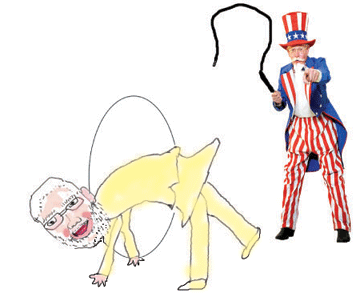
It is only China and India that can revive the dying nuclear industry of the US. Both Westinghouse and GE are without any further orders in the US and in the EU. So it is not the US showing its willingness to “give” us nuclear reactors to India that is the issue; it is India helping to revive a patient – the US nuclear industry – which has currently one foot already in the grave.
How much are we committing to pay to revive a dying Westinghouse? Continue reading
1 This Month

of the week – Shut Down Drone Warfare!


Tell the Ukrainian Government to Drop Prosecution of Peace Activist Yurii Sheliazhenko

Petition to revoke the licensing of the Near Surface Nuclear Disposal Facility (NSDF) at Chalk River. https://www.ourcommons.ca/petitions/en/Petition/Details?Petition=e-7247
To see nuclear-related stories in greater depth and intensity – go to https://nuclearinformation.wordpress.com
-
Archives
- March 2026 (251)
- February 2026 (268)
- January 2026 (308)
- December 2025 (358)
- November 2025 (359)
- October 2025 (376)
- September 2025 (257)
- August 2025 (319)
- July 2025 (230)
- June 2025 (348)
- May 2025 (261)
- April 2025 (305)
-
Categories
- 1
- 1 NUCLEAR ISSUES
- business and costs
- climate change
- culture and arts
- ENERGY
- environment
- health
- history
- indigenous issues
- Legal
- marketing of nuclear
- media
- opposition to nuclear
- PERSONAL STORIES
- politics
- politics international
- Religion and ethics
- safety
- secrets,lies and civil liberties
- spinbuster
- technology
- Uranium
- wastes
- weapons and war
- Women
- 2 WORLD
- ACTION
- AFRICA
- Atrocities
- AUSTRALIA
- Christina's notes
- Christina's themes
- culture and arts
- Events
- Fuk 2022
- Fuk 2023
- Fukushima 2017
- Fukushima 2018
- fukushima 2019
- Fukushima 2020
- Fukushima 2021
- general
- global warming
- Humour (God we need it)
- Nuclear
- RARE EARTHS
- Reference
- resources – print
- Resources -audiovicual
- Weekly Newsletter
- World
- World Nuclear
- YouTube
-
RSS
Entries RSS
Comments RSS
 nuclear-news