 Rosatom may start building new nuclear power plants in India and Bangladesh http://tass.com/economy/952448 June 20, MOSCOW, Rosatom plans to initiate main activities for construction of the second stage of Kudankulam Nuclear Power Plant (NPP) in India, start building Ruppur NPP in Bangladesh ad commission power units at Tianwan NPP in China and two NPPs in Russia, First Deputy Chief Executive Officer of Russian nuclear corporation Rosatom Kirill Komarov said on Tuesday.
“We have serious ambitious plans on new starts this year because the third unit of Tianwan [NPP] in China and the fourth unit of Rostov NPP in Russia should start this year. We endeavor to start the first unit of Leningrad NPP-2 this year,” Komarov said. “We expect concreting start for the third and the fourth units of Kudankulam NPP in India this summer. We also expect concreting start on Ruppur site in Bangladesh, where we are building a two-unit NPP,” he added.
Rosatom has many plans for projects in Europe during this year, Komarov said.
Rosatom has reached agreements on construction of 34 power units across the globe to date.
June 21, 2017
Posted by Christina Macpherson |
ASIA, India, marketing, Russia |
2 Comments
 Russia’s Rosatom to review opportunity of nuclear power plant building in Zambia http://tass.com/economy/952152 June 19 MOSCOW, Russian state nuclear corporation Rosatom will prepare a preliminary feasibility study for construction of a nuclear power plant (NPP) in Zambia. A relevant agreement was signed between the parties within the Atomexpo 2017 exhibition framework, TASS reports on Monday.
This document signifies the first stage of the project execution prior to making an investment decision on NPP construction in Zambia, Rosatom says.
A contract for services of assessment and development of the nuclear infrastructure in Zambia, a contractor for preliminary engineering survey in Zambia by Rosatom’s affiliate Atomstroiexport and an agreement on setup of a nuclear science and technology center in Zambia were signed also.
Memoranda of understanding and cooperation in peaceful use of nuclear energy with Uganda, Sudan and Ethiopia were also signed within the forum framework.
June 21, 2017
Posted by Christina Macpherson |
AFRICA, marketing, Russia |
Leave a comment

 China Daily 15th June 2017, China’s CGN a step closer to bringing its nuclear technology to UK: China’s
goal of boosting its nuclear technology sector took a big step forward on Wednesday with the creation of three new companies in the UK by China General Nuclear Power Corporation. The new entities are: Bradwell Power
Corp, which will be responsible for the 100 percent Chinese-built Bradwell B nuclear plant; General Nuclear System Ltd, which will shepherd China’s Hualong technology through the exacting five-year UK approval process; and General Nuclear International, which will manage CGN’s projects in the UK.
He Yu, CGN chairman, said: The unveiling of three companies is a solid step forward for CGN to expand its operation in the UK. With its new subsidiaries unfolding, the company is confident that it will grow steadily in the field of nuclear technology in Britain.”
The United Kingdom will formally assess the Hualong One technology as part of a deal reached last year, in which Chinese investment will help build the Hinkley Point C nuclear plant, in which France’s EDF is a major participant, and which will
feature French technology. CGN and EDF have been working together for more than 30 years on nuclear development and construction in China.
Under last year’s agreement, CGN and EDF will collaborate on three UK nuclear plants: Hinkley Point C, in Somerset; Sizewell C, in Suffolk; and Bradwell, in Essex.
CGN intends to use Hualong One technology at Bradwell, which could be the first nuclear plant in a developed economy to use Chinese technology. The companies will seek to get the Hualong One technology approved in the UK via an assessment known as the Generic Design Assessment process. It usually takes about five years to complete.
China hopes that UK approval of its technology will open the door to its use in other countries because the UK’s appraisal regime is considered by industry experts to be the strictest in the world. The proposed Bradwell project is in an early
pre-planning stage, something that is likely to continue for many years, via investigative work and public consultation, before detailed proposals will be produced, allowing a planning application to be made.
http://europe.chinadaily.com.cn/world/2017-06/15/content_29748140.htm
June 19, 2017
Posted by Christina Macpherson |
China, marketing, UK |
Leave a comment
 Turkey gives Rosatom go ahead to build nuclear plant, Reuters, 15 June 17,
Russia’s State Atomic Energy Corporation (Rosatom) won approval from Turkey’s energy watchdog on Thursday to go ahead with building its $20 billion Akkuyu nuclear power plant in southern Turkey.
The project to construct four nuclear reactors has repeatedly run into delays, including being briefly halted after Turkey downed a Russian jet near the Syrian border in November 2015. Ties have since normalised between the two countries and work on the plant has resumed……
Rosatom has sold several nuclear reactors to developing countries under a model by which Russia finances, builds and operates the nuclear plant and sells power to its customer – a model that has also raised questions about Russia using energy policy as a means to political ends.
EPDK said it had given Rosatom’s project company Akkuyu Nukleer AS a 49-year production license.
Dependant on imports for almost all of its energy, Turkey has embarked on an ambitious nuclear programme, commissioning Rosatom in 2013 to build the four 1,200 megawatt (MW) reactors…..https://www.reuters.com/article/turkey-energy-nuclear-idUSL8N1JC3FL
June 16, 2017
Posted by Christina Macpherson |
marketing, politics international, Russia, Turkey |
Leave a comment
 Philippines, Russia forge nuclear cooperation deal, ABS-CBN News, May 26 2017 MANILA – The Philippines and Russia have agreed to develop cooperation on nuclear energy under an agreement signed in Moscow, Russia’s state nuclear agency said Friday.
Under the memorandum of cooperation, the two nations will pursue the “development of the nuclear infrastructure” in the Philippines, including personnel training and securing public acceptance of nuclear power, Rosatom State Atomic Energy Corp said in a statement……Duterte has approved a study on the feasibility of nuclear power to augment the country’s electricity supply.
The Philippines has a nuclear power plant in Bataan, which has never been used.http://news.abs-cbn.com/business/05/26/17/philippines-russia-forge-nuclear-cooperation-deal
May 27, 2017
Posted by Christina Macpherson |
marketing, Philippines, Russia |
Leave a comment
Russia, Philippines forge Defense Cooperation Agreement, UPDATE PH, May 26, 2017 Caleb Velasquez The defense cooperation will expand exchanges in terms of training, seminars and best practices between the two countries, with the end to develop relations in the field of military education, including military medicine, military history, sports, and culture as well as experiences in consultation, observer participation in military training exercises, and military port calls…..
Memorandum of Agreement between the Department of Science and Technology of the Philippines and the State Atomic Energy Corporation, otherwise known as ROSATOM on Cooperation on the Use of Nuclear Energy for Peaceful Purposes was also forged. https://www.update.ph/2017/05/russia-philippines-forge-defense-cooperation-agreement/17735
May 27, 2017
Posted by Christina Macpherson |
marketing, Philippines, Russia |
Leave a comment
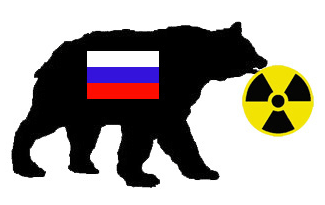
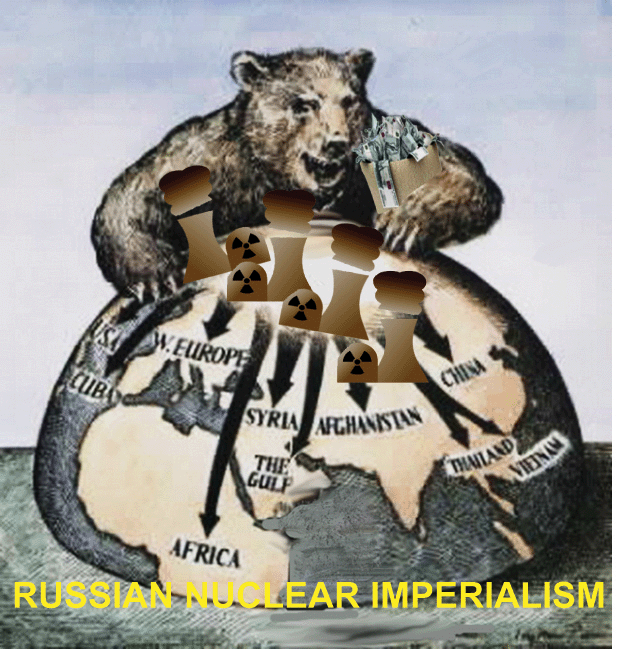
 Is Rosatom selling debt and dependence to its overseas customers? http://bellona.org/news/nuclear-issues/2017-05-is-rosatom-selling-debt-and-dependence-to-its-overseas-customers When a court in South Africa torpedoed a $76 billion deal to build 10 nuclear reactors with Russia’s Rosatom because the arrangement reeked of corruption, it seemed like the project was kaput. May 10, 2017 by Charles Digges, charles@bellona.no, When a court in South Africa torpedoed a $76 billion deal to build 10 nuclear reactors with Russia’s Rosatom because the arrangement reeked of corruption, it seemed like the project was kaput.
At issue to the court was the fact that Rosatom was given the lucrative contract behind closed doors without any competing tenders, and that the company had been granted “special favors.” South Africa’s president, Jacob Zuma, even sacked his finance minister for opposing the deal.
The high court demanded that a contract of such breathtaking magnitude – representing a quarter of South Africa’s gross domestic product and $24 billion more than its state utility, Eskom, has in the bank – be approved by parliament.
Hanging over the deal, and numerous others like it, is the degree to which Rosatom seems to be pursing not just energy dominance in a world trying to wean itself coal, but political influence as well by putting its customers in long-term hock to Moscow.
The South Africa deal may yet come off, but it’s also surprising that it got so far in the first place.
It began as one of Rosatom’s handshake “memorandums of understanding” that the company is using to blanket the nuclear construction market and squeeze out competition. The company says it has 27 of these MOUs and other arrangements, amounting to $135 billion in incoming business, a claim that invites skepticism.
Many of the counties Rosatom counts among that number – like Jordan, Algeria, Nigeria and Bolivia – won’t be ready for nuclear for decades. Others where Rosatom builds are already underway – like India’ Kudankulam, Iran’s Bushehr, China’s Tianwan and Belarus’s Ostrovets – are already familiar with Rosatom’s typical cost overruns and delays.
Rosatom’s approach to marketing its VVER-1000 and VVER-1200 reactors is unique because it offers to finance, build and operate its plants. These generous terms come thanks to the enormous state subsidies it receives, and which it can then funnel into loans that boost its profits on paper. With government subsides set to decrease or dry up in 2020, however, Rosatom seems desperate to announce ever more MOUs.
While the terms of the financing for the South Africa deal never got spelled out, it’s clear from Rosatom deals in other countries that the terms are often steep.
To build Hungary’s controversial Paks-2 plant, Rosatom gave Budapest an $11 billion loan spread out over 30 years. Hungary has to start paying that back even if the plant is not completed on time. The interest Moscow could collect from Hungary is unclear, but a similar 30-year, $11.4 billion agreement with Bangladesh inked last year could result in $8 billion in interest. A $25 billion deal Rosatom signed with Egypt could, over 35-year term of the loan, swell to $71 billion.
And that’s if everyone behaves. The plant Rosatom is building in Turkey offers an indication of what happens when they don’t. To build Hungary’s controversial Paks-2 plant, Rosatom gave Budapest an $11 billion loan spread out over 30 years. Hungary has to start paying that back even if the plant is not completed on time. The interest Moscow could collect from Hungary is unclear, but a similar 30-year, $11.4 billion agreement with Bangladesh inked last year could result in $8 billion in interest. A $25 billion deal Rosatom signed with Egypt could, over 35-year term of the loan, swell to $71 billion.
And that’s if everyone behaves. The plant Rosatom is building in Turkey offers an indication of what happens when they don’t.
May 12, 2017
Posted by Christina Macpherson |
marketing, politics international, Russia, secrets,lies and civil liberties |
1 Comment
 Eskom confirms that Russians will continue nuclear bid, IOL, 30 April 2017, SIYABONGA MKHWANAZI
Cape Town – The Russians will continue to prepare to bid for the nuclear-build programme, despite the decision by the Western Cape High Court to halt it.
Eskom confirmed this and awaits further directives from the government.
Friday was the deadline for all bidding companies to submit Request for Information documentation to Eskom.The court decision has also affected the deadline for the issuing of the Request for Proposals in June.
Head of Rosatom in Southern Africa, Viktor Polikarpov, told Independent Media nothing had changed with their plans to bid for the nuclear programme.
He said they would not want to comment on the case because it was a matter involving government and civil society, who took the matter to court.
Energy Minister Mmamoloko Kubayi has said she is still studying the judgment, and would not comment on whether to appeal against the court decision or not.
Kubayi will appear before MPs on Tuesday, where she will face questions on the nuclear programme.
Polikarpov said the nuclear process was not in their hands, but in the hands of the government.“We are prepared on the bidding, but much will depend on the government, how it will sort out the court issue,” he said.
Eskom spokesperson Khulu Phasiwe said the court decision had effectively nullified the process……..
He said it was clear that everything had to be nullified and started from scratch if the government still wanted to continue with the nuclear programme.
The judgment found the process followed was unlawful and unconstitutional………http://www.iol.co.za/news/politics/eskom-confirms-that-russians-will-continue-nuclear-bid-8877208
May 1, 2017
Posted by Christina Macpherson |
marketing, Russia, South Africa |
Leave a comment
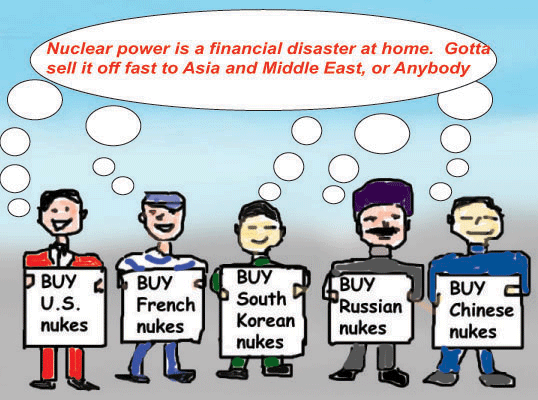
Foreign companies flock to build nuclear plants in the UK A South Korean firm is just the latest to be lured by Britain’s atomic amibitions as safety concerns and cost stalk the industry, Guardian, Adam Vaughan, 26 Mar 17, Nuclear energy faces an uncertain future globally as concerns over safety and cost dog the industry. But in the UK, foreign investors are queueing up to back projects. The latest is South Korea. Its biggest power company is in talks to join the consortium backing a nuclear power station in Cumbria, in a sign of the continuing allure of Britain’s atomic ambitions to international companies. Kepco said last week it was interested in taking a stake in NuGen, which is 60% owned by Japan’s Toshiba and 40% by France’s Engie, confirming what had been an open secret in the industry for months.
Kepco’s president, Cho Hwan-eik, said that once the terms of a potential deal were ironed out, “we will be the first to jump into the race”…….
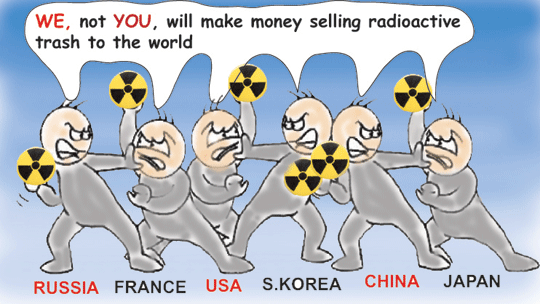
Potential investors have been drawn by the UK government’s enthusiasm and a nuclear standstill elsewhere, amid lingering safety fears in the wake of the Fukushima disaster and cost overruns at the Flamanville site in France which is using a new reactor design. As a result, South Korea has joined Japan, China and France in showing interest in British nuclear.
It’s pretty simple. We are the only people building new nuclear power stations and we have by far the biggest new nuclear programme outside China for the next 10 years,” said Peter Atherton, an analyst at consultancy Cornwall Energy. “The civil nuclear programme globally doesn’t have any orders.”
One expert, Mycle Schneider, called the UK the “last hope” for the nuclear construction giants of the world. The Paris-based nuclear consultant said: “In Korea the political situation will dramatically change after the upcoming elections, [probably] not in favour of the nuclear industry. Success overseas will help survival at home. The Japanese industry clearly has no future at home and little prospects abroad [because of Fukushima].”
The UK has also dangled the prospect of economic support for foreign nuclear builders. French state-owned EDF, which is building two new reactors at Hinkley Point in Somerset at a cost of £18bn, struck a subsidy contract with the government that will see it guaranteed twice the wholesale price of electricity for 35 years. The deal means Hinkley would be an “absolute goldmine” when operational, Atherton said.
He said UK financial support was not dissimilar to the deal Kepco has in the United Arab Emirates, where it is building four new reactors paid for by the UAE’s state-owned utility. “The economics of the project, and the economic risks of the project, fall on the host government,” said Atherton.
There is also the prospect that the UK government could take a stake in one of the new nuclear sites. Leaks to Japanese media revealed officials in London and Tokyo had discussed the UK offering state finance to a project led by Japan’s Hitachi to build reactors next to the site of an old one at Wylfa in Wales………https://www.theguardian.com/business/2017/mar/25/foreign-firms-flock-to-build-nuclear-plants-in-uk
March 27, 2017
Posted by Christina Macpherson |
marketing, UK |
Leave a comment
 Russia eyes deal to build Kenya’s sole nuclear plant, The Star, Kenya Mar. 14, 2017, By WEITERE MWITA @mwitamartin Russia has offered to design, finance and build Kenya’s proposed nuclear power plant.
A delegation from Russia will pitch tent in Nairobi for the regional nuclear energy conference which kicks off today.
Russia is seeking to strike a deal through its state-owned Rosatom State Atomic Energy Corporation. Kenya plans to set up four nuclear plants, with the first expected to be switched on in 2027.
On May 30, 2016, Rosatom signed a Memorandum of Understanding with Kenya to promote nuclear solutions, assist in training personnel, create public awareness, and design agriculture and medical solutions.
Rosatom regional vice president for Sub-Saharan Africa Viktor Polikarpov yesterday said the Moscow-based entity, through the government, is ready to support Kenya put up its plants on a Build–Operate–Transfer module or Private-Public-Partnership consortium.
Rosatom said it will borrow a loan through an intergovernmental agreement, with a repayment period of up to 25 years. The firm is the only reactor vendor in the world that can offer the nuclear industry’s entire range of products and services.
“We are currently providing the VVER-1200 (Water-Water Energetic Reactor) generation III reactor which is the safest in the world. We can offer the preferred solution to your government if given a chance,” Polikarpov told journalists…….
Kenya has also signed MoUs with China and South Korea but is yet to identify a developer for the project which could cost up to Sh2 trillion. The developer will be selected by the Kenya Nuclear Energy Board……http://www.the-star.co.ke/news/2017/03/14/russia-eyes-deal-to-build-kenyas-sole-nuclear-plant_c1523942
March 15, 2017
Posted by Christina Macpherson |
Kenya, marketing, Russia |
Leave a comment
Suitors line up to walk Kenya down controversial path to nuclear energy Standard media UK By Paul Wafula , March 7th 2017
Kenya is on a delicate journey that will see it switch on its first nuclear power plant by 2027. The country plans to put up four nuclear plants in the long term, each generating 1,000 megawatts (MW) of electricity. Initial estimates show it will cost between Sh400 billion and Sh500 billion to put up one nuclear reactor. This means one plant will cost slightly more than building the 609-kilometre Mombasa to Nairobi Standard Gauge Railway (SGR). By the time the plan is complete, the country will have spent about Sh2 trillion – just under the national Budget for a year – to reap the benefits of an additional 4,000MW of energy plugged into the national grid.
Besides the financing headache, the second test for the 10-year dream being championed by the Kenya Nuclear Energy Board (KNEB) is coming up with a location to for the reactors. The board estimates site selection will cost the country Sh1.5 billion in a three-year process. Though the potential sites have remained a closely guarded secret, the power plant will be built next to any of the four biggest water bodies in the country – that is, the Indian Ocean, Lake Victoria, River Tana and Lake Turkana.
…………..These plans have excited sellers of nuclear reactors who are now courting the country, with some dangling ‘free training’. The potential suppliers include South Korea, whose companies are constructing nuclear power plants in the United Arab Emirates. Kenya has also been window shopping in China, and with Rosatom in Russia and Westinghouse in the United States. The country’s plans appear modelled on the UAE’s, which awarded a South Korean consortium to build four plants at a cost of Sh2 trillion.
…………Kenya has already signed a memorandum of understanding with China, South Korea, Russia and Ghana. KNEB said the deal with China would help Kenya “obtain expertise through training and skills development, technical support in areas such as site selection for Kenya’s nuclear power plants, and feasibility studies”. China has been offering ‘free’ training and feasibility studies for big infrastructure projects in Africa as a strategy to get into the boardrooms where key decisions are made. This is the same approach it used to land the SGR deal.
………..The country has also signed nuclear power co-operation agreements with Slovakia and South Korea.
…………He added that the Sh500 billion cost per plant for UAE may be cheaper because South Koreans were trying to get into the market. France is also lining up for a piece of the action, with the country offering Kenya technical, engineering and financial support to develop reactors.
…………MAKING THE CASE Juma has defended the cost of the project on the grounds that in the long run, nuclear energy is a cheaper and more stable source of power, with sustainable base loads. The board is looking at having flexible financing options, including public-private partnership where a private developer will finance the plant, construct and operate it for some time to recoup investments and make a profit, before handing it over to the State.
……The agency is looking at plants that will have a lifespan of up to 80 years.
………….it will have a difficult task of convincing local communities that the country is ready to deal with the radiological effects of nuclear.
……The other headache that must be tackled is the development of national strategies for radioactive waste management, emergency preparedness and the nuclear fuel cycle.
……energy experts from Italy and Germany last year, advised Kenya to drop plans to build nuclear reactors and instead harness its vast renewable energy resources, including geothermal, solar and wind, for power generation. They cited massive costs for a nuclear plant, long construction periods of about 10 years and expensive decommissioning at the end of plants’ lifespan, especially disposing of hazardous radioactive waste.
March 8, 2017
Posted by Christina Macpherson |
Kenya, marketing |
Leave a comment
The seventh Nuclear Power Asia conference being held in Kuala Lumpur on Tuesday and Wednesday is bringing together the leaders of the Asian nuclear-power industry.
Session participants have concurred that nuclear power, being an economically and environmentally viable source of electricity, has the capacity to contribute greatly to Asia’s sustainable future.
“Sustainable future is impossible without sustainable energy,” said Egor Simonov, director of Rosatom Asia. “Nuclear power [emits] 25-30 times less [greenhouse gas] than coal- or oil-fired power plants. Therefore, nuclear power may be a viable solution for Asean nations willing to fulfil their climate-change commitments.”
Rosatom is Russia’s nuclear regulator, and its Southeast Asian regional branch is in Singapore. …….The Nuclear Power Asia conference is a platform to discuss the latest challenges, trends and achievements in the Asian nuclear industry. The event is annually attended by more than 300 participants from nuclear-energy authorities, energy commissions, nuclear energy programme implementing organisations, international developers and operators, technology suppliers, and academic society. http://www.nationmultimedia.com/news/breakingnews/30308264
March 8, 2017
Posted by Christina Macpherson |
marketing, Russia |
Leave a comment
Russia, Tajikistan to cooperate in nuclear energy field, AZER News, 1 March 17 By Kamila Aliyeva
Tajikistan and Russia have agreed to cooperate in atomic energy and border security. The relevant agreements were achieved within the framework of the visit of Russian leader Vladimir Putin to Tajikistan on February 27.
Thus an agreement on cooperation in peaceful uses of atomic energy was signed by Farhod Rakhimov, President of the Academy of Sciences of the Republic of Tajikistan, on behalf of the Government of the Republic of Tajikistan, and Alexey Likhachev, Director General of ROSATOM, on behalf of the Government of the Russian Federation.
The deal has provided the legal basis for interaction between Tajikistan and Russia in the nuclear power sector for the first time in history while determining a wide range of cooperation areas including design, construction, operation and decommissioning of research reactors; spent fuel and radioactive waste management; rehabilitation of tailing storage areas and utilization of decommissioned uranium mining and reprocessing facilities; production of radioisotopes; use of nuclear technology in industry, medicine, agriculture; education and training of highly skilled personnel for the nuclear power industry, etc.
Besides, the agreement envisages the formation of joint coordination commission with the view of further consulting in the issues relating to the implementation of the above mentioned peaceful uses of atomic energy and search for mutually beneficial opportunities…….http://www.azernews.az/region/109545.html
March 1, 2017
Posted by Christina Macpherson |
marketing, Russia |
Leave a comment
 France joins suitors for Kenya’s nuclear plant venture, Business Daily Africa, NEVILLE OTUKI, notuki@ke.nationmedia.com February 7 2017 IN SUMMARY French Economy and Finance minister Michel Sapin said the nuclear-rich European country was looking to offer Kenya technical, engineering and financial support to develop reactors.
Kenya plans to start building its first nuclear plant from 2022 in a five-year period at a cost of about Sh500 billion
China, Russia, South Korea and Slovakia have since inked various pacts with Kenya in manpower development and skills exchange as they eye a possible deal.
France has joined the list of countries courting Kenya for a multi-billion-dollar deal to build East Africa’s first nuclear power plant.

French Economy and Finance minister Michel Sapin said the nuclear-rich European country was looking to offer Kenya technical, engineering and financial support to develop reactors.
Kenya plans to start building its first nuclear plant from 2022 in a five-year period at a cost of about Sh500 billion.
China, Russia, South Korea and Slovakia have since inked various pacts with Kenya in manpower development and skills exchange as they eye a possible deal.
“We have expressed our readiness to support the construction of the plants. Our support involves everything from expertise to funding,” Mr Sapin said on Sunday after concluding his two-day visit to Kenya during which he presided over the return of Peugeot assembly to Kenya…….
Mr Sapin said that France was seeking pacts with Nairobi like the ones it entered with South Africa on nuclear power development.
France has over the years signed several pacts with South Africa whose two power plants were built by French firm Areva.
South Africa plans to add more nuclear power plants.
Energy experts from Italy and Germany last October, however, advised Kenya to drop plans to build nuclear reactors and instead harness its vast renewable energy resources for power generation. The experts, attending a renewable energy conference in Nairobi, reckoned that Kenya is better off developing more geothermal wells, solar parks and wind farms.
They cited massive costs for a nuke plant, long construction periods of about 10 years and expensive decommissioning of plants at the end of their lifespan, especially disposing of hazardous radioactive waste.
February 8, 2017
Posted by Christina Macpherson |
France, Kenya, marketing |
Leave a comment
 SA’s nuclear build contract still wide open, says France minister, SUNDAY TIMES BUSINESS BY ASHA SPECKMAN, 2017-02-05 France’s finance minister Michel Sapin believes the race between suppliers to win South Africa’s nuclear build is still wide open and that France has a trick up its sleeve.
Sapin addressed the media in Pretoria on Friday after a meeting with Finance Minister Pravin Gordhan on the same day that he discussed issues related to the nuclear build.
Communicating through a translator, he said he had reminded Gordhan of the “quality and the know-how of French companies” which operate in the nuclear sector and has asked for “full transparency” on the process. The talks had also broached the questions of price, financing and affordability of the project. But Sapin declined to go into further detail.
Russia’s Rosatom was rumoured to be a frontrunner in the bidding for the multibillion-rand nuclear contract. But last month it denied it had made an official bid. French nuclear companies EDF Group and Areva intend to put in a joint bid but had not yet done so, Sapin said. “I still have a feeling the competition is open and we’ll see how it unfolds. France is not afraid of competition … We have trump cards up our sleeves,” he said.
Sapin’s was a working visit to deepen relationships and did not involve signing agreements. It forms part of a concerted drive by the French government to expand its partnerships in the wake of Brexit,which would have major trade implications……..http://www.timeslive.co.za/sundaytimes/businesstimes/2017/02/05/SAs-nuclear-build-contract-still-wide-open-says-France-minister
February 6, 2017
Posted by Christina Macpherson |
France, marketing |
Leave a comment









 nuclear-news