But the deal failed to emerge then, and in January Argentina’s nuclear energy undersecretary, Julian Gadano, and the ambassador to China, Diego Guelar, met officials in Beijing for talks about the project, the government source said.
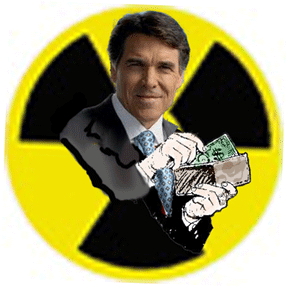
American nuclear lobby keen to market new nuclear reactors to overseas, to anyone!
 The US is losing the nuclear energy export race to China and Russia. Here’s the Trump
 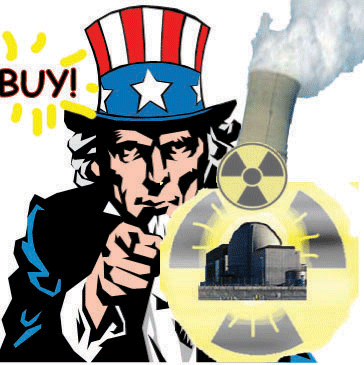 team’s plan to turn the tide
CNBC, MAR 21 2019
Tom DiChristopher@TDICHRISTOPHER
- Russian and Chinese companies are aggressively pursuing nuclear energy export deals and building more reactors overseas than U.S. firms.
- The Trump administration aims to disrupt that progress by expanding early stage cooperation with countries interested in adopting nuclear energy.
- new initiative aims to make the U.S. the global leader in advanced nuclear reactors poised to hit the market in the coming years.The Trump administration is preparing a new push to help American companies compete in the race to build the next generation of nuclear power plants around the world — a competition the U.S. is currently losing.
In doing so, the administration also aims to push back on the growing dominance of Russia and China in the space, preventing them from expanding their international influence by forging long-lasting nuclear ties with foreign powers.
The State Department plans to expand cooperation with countries pursuing atomic energy long before those nations ever purchase a nuclear reactor. By facilitating early stage talks, the U.S. intends to put American companies first in line to build tomorrow’s fleet of nuclear power plants overseas
We still lead the world in nuclear technology innovation. Our big challenge is taking that incredible IP and those incredible technological innovative breakthroughs and bringing them to market.To be sure, the Energy and Commerce departments actively facilitate U.S. nuclear cooperation with their foreign counterparts. But the State Department now intends to push the issue in talks at the highest levels of government, making it clear that Washington believes cooperation in the nuclear realm is central to its strategic relationships…….
Rise of Russia and ChinaThe U.S. dominated nuclear energy exports decades ago, but faces stiff competition today, including from allies like France and South Korea. But it’s the growing dominance of adversaries in Beijing and Moscow that worries the Trump administration and nonproliferation experts……..
Russia is also changing the rules of the game by offering generous financing that makes nuclear energy affordable to more nations. Moscow is targeting non-nuclear states in the Middle East and Africa with a model to build, own and operate the plants.
The State Department intends to actively dissuade its partners from working with China and Russia, according to Christopher Ford, assistant secretary for international security and nonproliferation.
Ford previewed that message last month at the Hudson Institute in Washington DC: “Russia and China also use reactor sales by their heavily state-supported nuclear industries as a geopolitical tool to deepen political relationships with partner countries, to foster energy dependence by foreign partners, and sometimes even to use predatory financing to lure foreign political leaderships into ‘debt traps’ that give Beijing or Moscow leverage that it can exploit later for geopolitical advantage.”
New plan takes shapeDuring the address, Ford outlined State’s plan to help American companies compete with Chinese and Russian firms.
The department will more closely coordinate nuclear cooperation efforts across agencies and ramp up informal, non-binding talks with nations that might pursue nuclear energy technology. The goal is to expand the number of countries engaged in ongoing communication with U.S. government agencies, nuclear energy companies and researchers.
The State Department will do this by signing nuclear cooperation memorandums of understanding with the countries……..
State’s focus is on teeing up sales of a new generation of nuclear technology expected to come online in the next five to 10 years, the official said.Those include small modular reactors that can be bolted together to form larger units, Terrapower’s traveling wave reactor backed by Bill Gates and microreactors meant to provide enough power for a few thousand homes.
 Altogether, there are about two dozen serious designs for advanced nuclear reactors trying to break into the market, said McGinnis. Under McGinnis and Secretary Rick Perry, one of the Energy Department’s top priorities is facilitating the development of these new technologies…….
On Tuesday, NuScale Energy signed a memorandum to explore deploying its small modular reactors in Romania, after signing similar agreements with Canada and Jordan.
The U.S. will still have to reach so-called 123 Agreements with foreign countries before American firms can sell nuclear reactors overseas. These agreements place limits on the use of nuclear technology and must be approved by Congress.
These agreements have recently drawn scrutiny from Democratic and Republican lawmakers as Westinghouse bids for nuclear power contracts in Saudi Arabia. The Saudis have long insisted on their right to enrich uranium, something the U.S. usually opposes. The bidding also comes as tension between Riyadh and Capitol Hill has escalated after Saudi agents killed Washington Post columnist Jamal Khashoggi in October. …….. https://www.cnbc.com/2019/03/21/trump-aims-to-beat-china-and-russia-in-nuclear-energy-export-race.html
NuScale includes Romania in its desperate search for taxpayer funding for Small Modular Nuclear Reactors

Romania to explore NuScale SMR deployment, WNN, 19 March 2019 An agreement between US small modular reactor (SMR) developer NuScale Power and Romanian energy company Societata Nationala Nuclearelectrica SA (SNN SA) to explore the use of SMRs in Romania has been welcomed by the US Department of Energy (DOE). The two companies have signed a memorandum of understanding covering the exchange of business and technical information on NuScale’s nuclear technology, with the goal of evaluating the development, licensing and construction of a NuScale SMR for a “potential similar long-term solution” in Romania……… NuScale has also signed MOUs to explore the deployment of its SMR technology in Canada and Jordan. http://world-nuclear-news.org/Articles/Romania-to-explore-NuScale-SMR-deployment
China trying to market nuclear technology to Argentina
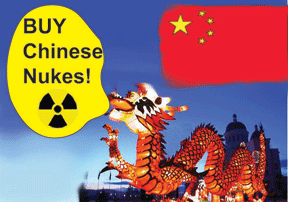 Chinese delegation set to revive stalled Argentina nuclear power plant talks
Technical team expected to go to Latin American country to discuss project reportedly worth up to US$8 billion, SCMP, 16 Mar, 2019 A delegation from China will visit Argentina this month to discuss the construction of a nuclear power plant, signalling possible progress in a deal that could increase Beijing’s deepening influence in the South American nation.
Brazil Seeks Nuclear Pact With U.S. During Bolsonaro’s Visit
Bloomberg, By Sabrina Valle March 15, 2019,
- Minister says he wants Brazil open to uranium mining companies
- Government also supports construction of new nuclear plants
Brazil’s energy minister said the country plans to sign an accord next week with President Donald J. Trump that could pave the way for U.S. companies to explore the Latin American country for uranium and invest in new nuclear-power plants.
Bento Albuquerque, a former admiral who once ran the Brazilian Navy’s atomic program, met with U.S. Energy Secretary Rick Perry in Houston this week and discussed creating a bilateral forum on energy cooperation that would include nuclear projects. That’s expected to be part of a memorandum signed by Brazilian President Jair Bolsonaro on his first trip to the White House next week, Albuquerque said Thursday in an interview.
The proposed collaboration is another element of the Bolsonaro administration’s push to align with Trump……https://www.bloomberg.com/news/articles/2019-03-14/brazil-seeks-nuclear-pact-with-u-s-during-bolsonaro-s-visit
Russia ready to enter deal to build nuclear power plant in Czech Republic
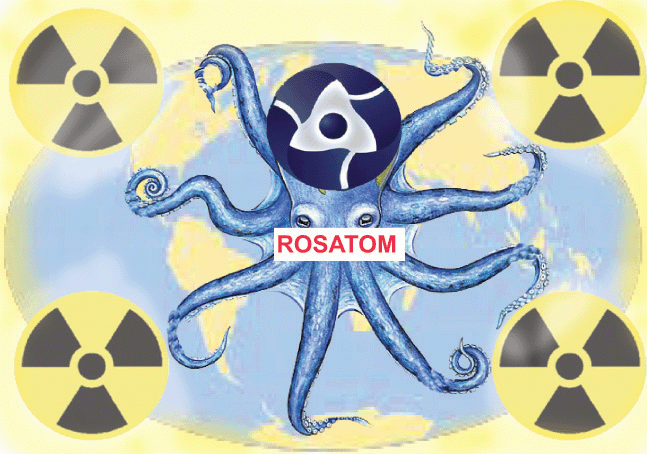 CZECH-RUSSIAN TALKS INCLUDED DISCUSSIONS ON CONSTRUCTION OF NEW NUCLEAR POWER BLOCK, https://www.radio.cz/en/section/news/czech-russian-talks-included-discussions-on-construction-of-new-nuclear-power-block Tom McEnchroe, 06-03-2019
If the Czech Republic issues a tender to build a new nuclear power source, Rosatom will send a proposal, the Russian Minister of Industry and Trade Denis Manturov told journalists after a bilateral intergovernmental commission on Wednesday.
His Czech counterpart Marta Nováková (ANO) said one tender conditions would be that the third nuclear power source remain fully under the administration of the Czech Republic once finished.
The intergovernmental commission also discussed mutual cooperation in supporting small- and medium-sized businesses, mutual exports into third-countries and cooperation within the aircraft industry.
Russia keen to have Bulgaria go into debt to Russia, to implement Belne nuclear station
 Russia Ready To Take Part in Bulgaria’s Belene Nuclear Power Plant, Medvedev Says, Moscow Times
Russia to lease nuclear-powered attack submarine to India for a cool $3 billion
|
India, Russia To Sign $3 Billion Nuclear Sub Deal This Week
India and Russia are set to sign a $3 billion lease agreement for a nuclear-powered attack sub on March 7, according to local media reports. The Diplomat, By Franz-Stefan Gady, March 05, 2019 India and Russia are expected to conclude an intergovernmental agreement for a 10-year lease of a Russian nuclear-powered attack submarine (SSN) this week. The deal, estimated to be worth around $3 billion, will likely be inked on March 7, according to sources cited by The Economic Times. Neither the Indian nor Russian defense ministries, however, have officially confirmed that a signing ceremony will be held in the coming days. |
|
Is nuclear power REALLY a clean-power fix for Africa – as Russia and China push it
Russia, China back nuclear as a clean-power fix for Africa
Money Web , Sebastien Malo, Thomson Reuters Foundation / 10 February 2019 “…….For now, South Africa is the only country on the continent operating a nuclear power plant.
But in recent years, at least seven other sub-Saharan African states have signed agreements to deploy nuclear power with backing from Russia, according to public announcements and the World Nuclear Association (WNA), an industry body………
Like Ethiopia, emerging nuclear states Sudan, Kenya, Uganda, Nigeria, Rwanda, Zambia and Ghana have signed agreements with Russia’s state nuclear corporation, ROSATOM – most since 2016.
Their content ranges from language on the construction of nuclear reactors to assistance with feasibility studies and personnel training, press statements show.
ROSATOM’s solutions for managing spent fuel and radioactive waste vary from country to country, but are normally worked out at the later stages of a nuclear new-build programme “in the strictest compliance with international law”, a spokeswoman told the Thomson Reuters Foundation.
Chinese state-owned nuclear firms have also taken the lead in the region, sealing deals with Kenya, Sudan and Uganda, WNA data shows.
South African student Masamaki Masanja, 23, won a ROSATOM competition for young people to make videos about Africa’s nuclear potential, and got to visit the Novovoronezh nuclear power plant in western Russia in 2017.
“It was mind-blowing,” said the second-year mechanical engineering student, via Skype.
The experience left him with a strong sense that nuclear power should be adapted quickly for Africa’s needs………
Rebel risk
Some political observers, however, are concerned about the prospect of nuclear reactors backed by Russia in some countries with rebel groups and weak government institutions.
An Africa-based Western diplomat, who asked to remain anonymous, doubted Russia’s assurances it would collect nuclear waste from projects it helped establish.
“You could end up with very unfortunate situations in parts of Africa … if you have a decaying nuclear power plant overrun by rebels, with waste that’s not going away,” he said.
Multiple requests for an interview with Russia’s ambassador in Ethiopia were declined.
So-called dirty bombs can combine conventional explosives like dynamite with radioactive material such as nuclear waste. ………
It could take 20 years for Ethiopia to build a nuclear power plant, estimated Hong-Jun Ahn, a Korean electrical engineer who advises the Ethiopian government on its nuclear plans.
Yonas Gebru, director of Addis Ababa-based advocacy group Forum for Environment, said green activists could prove another hurdle amid debate over whether nuclear power is “clean” energy.
“It would be good, and it would be wise also … to better capitalise on already started initiatives such as hydropower, wind energy (and) solar energy,” said Gebru. https://www.moneyweb.co.za/news/africa/russia-china-back-nuclear-as-a-clean-power-fix-for-africa/
Despite the severe disadvantages to Uganda, of nuclear power, Uganda’s govt succumbs to China’s nuclear marketing
Uganda to generate nuclear energy amidst safety, environmental concerns, By February 9, 2019 KAMPALA – Uganda is in the final stages of efforts to start generating some 2000 megawatts of electricity from five nuclear plants it plans to build in five districts scattered in the country’s four geographical regions……..
Already memoranda of understanding have been signed with Russia and the China National Nuclear Corporation [CNNC), Beijing on cooperation in the peaceful uses of nuclear energy on May 10, 2018.
In both of these documents Uganda is to secure technical expertise and financing to lift the plan off the ground.
According to Ms Sarah Nafuna, the head of Nuclear Energy Unit in the ministry, the MoU with Beijing details areas of technical and engineering cooperation as well as financial support to develop reactors for the nuclear plant……….
Energy ministry’s Nafuna declined to disclose the cost of developing the nuclear plants, but a high-level source that asked not to be named because they were not authorised to speak on the matter, estimated the capital and operating costs upward of Shs145 trillion.
This working figure is higher than Uganda’s Shs29 trillion annual budget, raising questions about the country’s ability to mobilise such resources when it is already saddled with a total external debt exposure, including committed but undisbursed debt of USS$12.2 billion debt, [about Shs 45.4 trillion]……….
sceptics also argue that a sunshine-rich country such as Uganda should never think of going the risky route of nuclear energy. ………
while government officials strongly defend the nuclear project, questions abound about how a country – that has failed to handle minor fire disasters and basic household waste will effectively deal with toxic wastes, which are the by-product of nuclear power generation.
In Kampala for instance, garbage is littered all over, with roads becoming impassable when it rains. Moreover, some hospitals and clinics carelessly dispose their medical waste in landfills, yet the government insists it can handle nuclear waste.
Mr Nandala Mafabi, the secretary general of the FDC, a critic of nuclear power generation says the government should explore safer sources of energy such as solar and wind energy, and only consider nuclear as an energy source later……….
Opponents of the nuclear energy are also worried about health hazards, safety and radioactive waste management, with questions about the country’s preparedness to deal with radioactive waste and accidental leaks which advanced economies like Japan have grappled with.
Mr Frank Muramuzi, the executive director of National Association of Professional Environmentalists (NAPE), also opposed building of nuclear plants and instead pointed the government to harness electricity from other renewable energy sources such as solar.
“Nuclear plants are expensive, have long construction periods of about 10 years and expensive to de-commission the plants at the end of their lifespan, especially disposing of hazardous radioactive waste,” he said………http://www.pmldaily.com/features/2019/02/uganda-to-generate-nuclear-energy-amidst-safety-environmental-concerns.html
Countries going into deep nuclear debt to Russia; Hungary the latest victim of this political blackmail
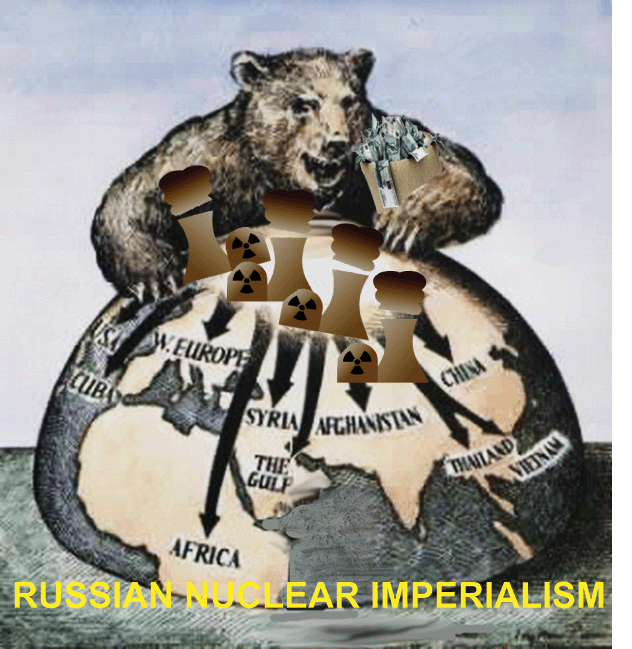
Hungary seeks to postpone loan payback to Russia for Nuclear power plant: What will the final cost be?Bellona February 1, 2019 by Charles Digges Budapest is seeking to modify the terms of a loan it must repay to Russia for building two new VVER-1200 type reactors that will eventually replace Hungary’s Paks nuclear power plant, according to a report from Reuters.
The reactors, which will constitute a plant called Paks II, will be built by Rosatom, Russia’s state nuclear power company, at a cost of 10 billion euro ($12 billion), and will replace the older Soviet-built nuclear plant that supplies half of the country’s electricity.
Rosatom’s construction contract, which includes the loan for Paks II, was the subject of a hotly-debated probe by the EU’s Organization for Economic Co-Operation and Development, which investigated whether the Russian bid violated European competition statutes.
At the time, EU officials and commentators viewed the deal as a Trojan Horse to help cement Moscow’s influence over the right-leaning, rabidly anti-globalist government of Hungarian Prime Minister Viktor Orban.
The EU eventually dropped its investigation in 2017 and granted Hungary permission to build the reactors – partly in an effort to entice Orban, who was insistent about contracting Rosatom, back into the democratic fold. Now Budapest is citing the delay caused by the competition review as reason to renegotiate when it begins paying Rosatom back.
Hungarian financial authorities plan to ask Moscow to postpone collecting on the debt until after the new reactors begin to generate electricity – but it is as yet unclear whether Rosatom will accept new terms. The plant’s construction, meanwhile, is running late. The build was supposed to begin last year………
While the terms of the Paks II loan remain in the shadows, other financing arrangements Moscow has made for building nuclear reactors in other countries suggest that the interest alone could prove to be very expensive for Budapest.
An $11.4 billion, 30-year agreement Rosatom signed with Bangladesh to build the Roopur nuclear plant will net Moscow $8 billion in interest. A $25 billion deal Rosatom is pursuing with Egypt to build that country’s Dabaa plant could, over the 35-year term of that loan, swell to $71 billion.
Another enormous $76 billion deal between Rosatom and South Africa was eventually thwarted by environmentalists when it was revealed the project had been secretly negotiated. Had the deal held it would have siphoned off a quarter of South Africa’s gross domestic product before the reactors even began operation.
Terms like this could spell trouble for Hungary in light of Moscow’s tendency to be a kneecapping creditor when it comes to energy projects – especially when Russia sours on the politics of its debtors.
In 2014, at the height of East-West tensions over Russia’s annexation of Crimea, Kremlin officials threatened to cut nuclear fuel supplies to Ukraine’s Soviet built reactors – which would have interrupted their chain reactions and likely caused a catastrophic accident.
Rosatom eventually walked the threat back. But the lurid message in Moscow’s head-fake toward igniting a second Chernobyl was clear: Russian-built reactors are a useful new tool for political blackmail………..
Many in Europe – Hungary included – subsequently sought to diversify their energy supply in favor of nuclear. Yet, in a devious twist, Rosatom has emerged as the most stable and eager nuclear builder on the international market.
For now, Rosatom can afford to offer risky loans thanks to the enormous state subsidies it receives. These subsidies can be funneled into more loans, and the loans then boost the company’s profits on paper. But for the past several years, it has become clear that these subsidies to the company will likely decrease or dry up altogether in 2020.
As a result, Rosatom is amassing so-called memorandums of understanding from any country vaguely interested in nuclear power. The company says is currently has dozens of these MOUs amounting to more than $130 billion in incoming business.
But that claim should be viewed skeptically, as many of the countries for which Rosatom is promising to build reactors – countries like Jordan, Algeria, Nigeria, the Republic of Congo and Bolivia – won’t have the infrastructure to support nuclear power for decades.
For now, it’s not difficult to imagine Moscow extending the terms of its loan to Hungary for as long as Budapest likes. It will, after all, remain profitable on paper. But in the end, Budapest will be left holding the bag for Rosatom’s over extended balance sheet. But so long as Orban’s government continues it rightward lurch, Moscow is unlikely to call in its marker. http://bellona.org/news/nuclear-issues/2019-02-hungary-seeks-to-postpone-loan-payback-to-russia-for-nuclear-power-plant-what-will-the-final-cost-be
5 countries scramble to sell nuclear reactors to Saudi Arabia
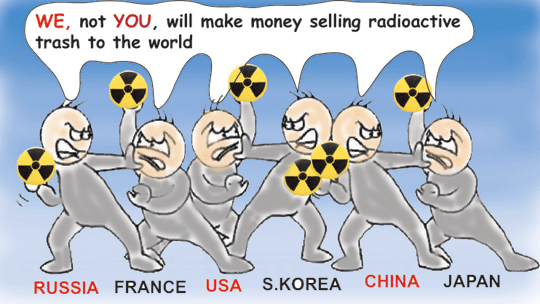
Saudi Arabia Receives Offers from 5 Countries to Build 2 Nuclear Reactors 23 January, 2019 Riyadh – Asharq Al-Awsat
Five countries have submitted their requests for the establishment of two nuclear reactors in Saudi Arabia on the Arabian Gulf coast.
The bid was made after the peaceful Saudi nuclear project met the requirements of the International Atomic Energy Agency (IAEA).
The oil-rich Kingdom launched a tender to define specifications of sites that will host the two reactors, said Chairman of King Abdullah City for Atomic and Renewable Energy (KACARE) Khalid al-Sultan.
He added that KACARE asked the services providers in the US, Russia, France, South Korea and China to present their preliminary offers……. https://aawsat.com/english/home/article/1558606/saudi-arabia-receives-offers-5-countries-build-2-nuclear-reactors
Russia’s Rosatom signs up Serbia for a nuclear science centre
|
Russia, Serbia sign agreement on nuclear cooperation, Agreement includes construction of center of nuclear science, technology and innovation, Yeni Safak January 18, 2019 Anadolu Agency Russia and Serbia signed a strategic cooperation document for the peaceful use of nuclear energy, Russian State Atomic Energy Corporation Rosatom said on Thursday.
The agreement, signed during Russian President Vladimir Putin’s visit to Serbia, includes the construction of a center of nuclear science, technology and innovation, according to the company’s statement. “In particular, the implementation of the project to build the center of nuclear science, technology and innovation will not only give a powerful impetus to bilateral cooperation between Russia and Serbia in a number of innovative areas, including medicine, industry and agriculture, but will also serve as a platform for cooperation at the level of the entire Central European region,” Likhachev said……… Alexey Likhachev, director general of Rosatom signed the documents on Russia’s behalf, while Nenad Popovich, Serbia’s minister in charge of innovation and technological development, signed them on Serbia’s behalf. The Russian company has 36 nuclear reactor construction projects in different countries, including Bangladesh, Belarus, China, Egypt, Finland, Hungary, India, Iran and Turkey. According to the company, its package of foreign orders in 2018 exceeded $130 billion. https://www.yenisafak.com/en/world/russia-serbia-sign-agreement-on-nuclear-cooperation-3472195 |
|
|
Russia marketing nuclear technology to Saudi Arabia
 Riyadh hosts workshop on Russian nuclear technology RIYADH — ROSATOM State Atomic Energy Corporation organized a workshop on Russian nuclear technologies in Riyadh on Dec. 5 for representatives of Saudi companies. The event was held at the Council of Saudi Chambers of Commerce………
Milos Mostecky, vice president of Rusatom Overseas, highlighted the vast experience of ROSATOM in engaging local suppliers while projects implementation abroad.
“We are confident that Saudi companies are ready to take part in large-scale projects in power sector. Our Saudi partners are willing to participate in NPP construction in Saudi Arabia and think highly to perspective of cooperation with Rosatom,” Mostecky added.
In June 2018, ROSATOM was shortlisted to the next stage of competitive dialogue on Saudi Arabia’s first nuclear power project.
Russia and Saudi Arabia signed an Intergovernmental Agreement on cooperation in the field of nuclear energy for peaceful purposes. On Oct. 5, 2017, ROSATOM and King Abdullah City for Atomic and Renewable Energy signed Program for Cooperation in the peaceful uses of nuclear energy. According to the program, Russia and Saudi Arabia intended to cooperate in the field of small and medium reactors, nuclear infrastructure development, consideration of prospects for establishing a center for nuclear science and technology in the Kingdom of Saudi Arabia based on a Russian-design research reactor etc…….http://saudigazette.com.sa/article/550060/SAUDI-ARABIA/Riyadh-hosts-workshop-onRussian-nuclear-technology
China’s push to take over the abandoned Moorside nuclear project
Chinese nuclear giant flags interest in NuGen’s abandoned Cumbria plant, Building, 7 December 2018 China General Nuclear also reveals plans to speed up delivery of nuclear power plant in Essex.China General Nuclear has flagged interest in building on the Moorside site recently vacated by Toshiba subsidiary NuGen as it reveals plans to speed up development of a nuclear power plant in Essex.
China General Nuclear (CGN), who is already developing Hinkley Point C (pictured) with EDF Energy, is carrying out technical assessments with a view to building another plant with the French energy giant in Bradwell, Essex.
Speaking at the Nuclear 2018 conference in London Rob Davies, the UK chief operating officer of CGN, said: “With the demise of NuGen there is a gap in the UK’s nuclear programme; the expected sequence of reactors coming down the line has been interrupted.
“We are confident we can close that gap by bringing Bradwell into operation much sooner.”…….https://www.building.co.uk/news/chinese-nuclear-giant-flags-interest-in-nugens-abandoned-cumbria-plant/5096959.article
China and USA competing to market technology to Argentina
China, vying with U.S. in Latin America, eyes Argentina nuclear deal, Cassandra Garrison, Matt Spetalnick, BUENOS AIRES/WASHINGTON (Reuters) 29 Nov 18 – Argentina and China are aiming to close a deal within days for the construction of the South American nation’s fourth nuclear power plant, a multi-billion dollar project that would cement Beijing’s deepening influence in a key regional U.S. ally.
Argentina hopes to announce an agreement on the Chinese-financed construction of the Atucha III nuclear power plant during Chinese President Xi Jinping’s state visit on Sunday following the summit of leaders of G20 industrialized nations in Buenos Aires, Juan Pablo Tripodi, head of Argentina’s national investment agency, told Reuters in an interview.
The potential deal, reportedly worth up to $8 billion, is emblematic of China’s strengthening of economic, diplomatic and cultural ties with Argentina. It is part of a wider push by Beijing into Latin America that has alarmed the United States, which views the region as its backyard and is suspicious of China’s motives.
………. The negotiations on Chinese financing of the Atucha III nuclear power plant are a key cause for concern for the U.S. government, a senior Trump administration official told Reuters.
Atucha III would be one of the biggest projects financed by China in Argentina, according to the Reuters review of Chinese state funding data…….. https://www.reuters.com/article/us-argentina-china-insight/china-vying-with-u-s-in-latin-america-eyes-argentina-nuclear-deal-idUSKCN1NX0FE
1 This Month

of the week – Shut Down Drone Warfare!


Tell the Ukrainian Government to Drop Prosecution of Peace Activist Yurii Sheliazhenko

Petition to revoke the licensing of the Near Surface Nuclear Disposal Facility (NSDF) at Chalk River. https://www.ourcommons.ca/petitions/en/Petition/Details?Petition=e-7247
To see nuclear-related stories in greater depth and intensity – go to https://nuclearinformation.wordpress.com
-
Archives
- March 2026 (244)
- February 2026 (268)
- January 2026 (308)
- December 2025 (358)
- November 2025 (359)
- October 2025 (376)
- September 2025 (257)
- August 2025 (319)
- July 2025 (230)
- June 2025 (348)
- May 2025 (261)
- April 2025 (305)
-
Categories
- 1
- 1 NUCLEAR ISSUES
- business and costs
- climate change
- culture and arts
- ENERGY
- environment
- health
- history
- indigenous issues
- Legal
- marketing of nuclear
- media
- opposition to nuclear
- PERSONAL STORIES
- politics
- politics international
- Religion and ethics
- safety
- secrets,lies and civil liberties
- spinbuster
- technology
- Uranium
- wastes
- weapons and war
- Women
- 2 WORLD
- ACTION
- AFRICA
- Atrocities
- AUSTRALIA
- Christina's notes
- Christina's themes
- culture and arts
- Events
- Fuk 2022
- Fuk 2023
- Fukushima 2017
- Fukushima 2018
- fukushima 2019
- Fukushima 2020
- Fukushima 2021
- general
- global warming
- Humour (God we need it)
- Nuclear
- RARE EARTHS
- Reference
- resources – print
- Resources -audiovicual
- Weekly Newsletter
- World
- World Nuclear
- YouTube
-
RSS
Entries RSS
Comments RSS
 nuclear-news