EDF boss vows to speed up nuclear projects and narrow gap to Asian peers
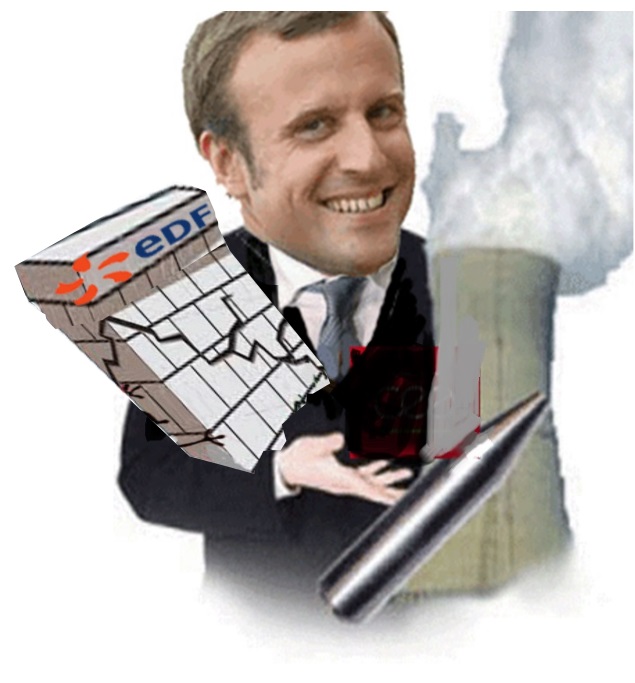
EDF’s new boss has vowed to speed up the delivery of new nuclear reactors in an increasingly competitive market, after costly overshoots in the past weighed on the French energy group.
The company wants to use the
development of the UK’s Sizewell C nuclear power station to show that huge reactors capable of powering millions of homes can be delivered at speed, in the hope that this will help it attract private funding and compete with more efficient rivals, including those from Asia.
Bernard Fontana, chief executive, said the state-owned group remained “open to international markets” and hoped to export more of its designs beyond the projects it is undertaking in the UK and France. EDF has been tasked with
delivering at least six new French reactors from 2038 onwards and is due to deliver two for the £38bn Sizewell C project in the middle to late 2030s.
Fontana’s push for efficiency comes as EDF, weighed down by a net debt of €50bn, needs to finance €30bn of investments annually over the next five years, including on maintaining current sites, according to estimates by France’s budget watchdog. EDF operates 57 French reactors.
FT 9th Nov 2025, https://www.ft.com/content/cc39da49-6ebf-40e2-bfbe-296ee2596ce9
Leah McGrath Goodman, Tony Blair and issues on torture (with added radiation)


Published by arclight2011- date 15 Sep 2012 -nuclear-news.net
[…]
Accusations: Despite the mockery of the film Borat, leaked U.S. cables suggest the country was undemocratic and used torture in detention
Other dignitaries at the meeting included former Italian Prime Minister and ex-EU Commission President
Romano Prodi. Mr Mittal’s employees in Kazakhstan have accused him of ‘slave labour’ conditions after a series of coal mining accidents between 2004 and 2007 which led to 91 deaths.
[…]
Last week a senior adviser to the Kazakh president said that Mr Blair had opened an office in the capital.Presidential adviser Yermukhamet Yertysbayev said: ‘A large working group is here and, to my knowledge, it has already opened Tony Blair’s permanent office in Astana.’
It was reported last week that Mr Blair had secured an £8 million deal to clean up the image of Kazakhstan.
[…]
Mr Blair also visited Kazakhstan in 2008, and in 2003 Lord Levy went there to help UK firms win contracts.
[…]
Max Keiser talks to investigative journalist and author, Leah McGrath Goodman about her being banned from the UK for reporting on the Jersey sex and murder scandal. They discuss the $5 billion per square mile in laundered money that means Jersey rises, while Switzerland sinks.
http://www.youtube.com/watch?v=gA_aVZrR5NI&feature=player_detailpage#t=749s
And as well as protecting the guilty child sex/torturers/murderers of the island of Jersey I believe that they are also protecting the tax dodgers from any association.. its just good PR!
FORMER Prime Minister Tony Blair was reportedly involved in helping to keep alive the world’s biggest takeover by Jersey-incorporated commodities trader Glencore of mining company Xstrata.
11/September/2012
[…]
Mr Blair was said to have attended a meeting at Claridge’s Hotel in London towards the end of last week which led to the Qatari Sovereign wealth fund supporting a final revised bid from Glencore for its shareholding. Continue reading
AtkinsRéalis eyeing U.S. market for nuclear technology push.

COMMENT -For nuclear industry trackers…
Re the last two paragraphs, you have to wonder, do they really believe this stuff or are they shameless grifters?
Nicolas Van Praet, July 28, 2025, https://www.theglobeandmail.com/business/article-atkinsrealis-eyeing-us-market-for-nuclear-technology-push/

AtkinsRéalis Group Inc. is moving to deploy its nuclear-reactor technology into the United States, a surprise push one analyst said could bolster the company’s revenue and exposure to American investors if it manages to clinch deals against growing competition.
The Canadian engineering company has “begun to explore opportunities for alternative large nuclear reactor technologies, notably Candu reactors, in the U.S.,” Joe St. Julian, president of the nuclear operations at AtkinsRéalis, said in an e-mailed statement Monday. Talks have started with U.S. regulatory agencies, including the Nuclear Regulatory Commission and the National Nuclear Security Administration, to assess licensing and other potential concerns, the company said.
The Financial Times was first to report on the corporation’s plans.
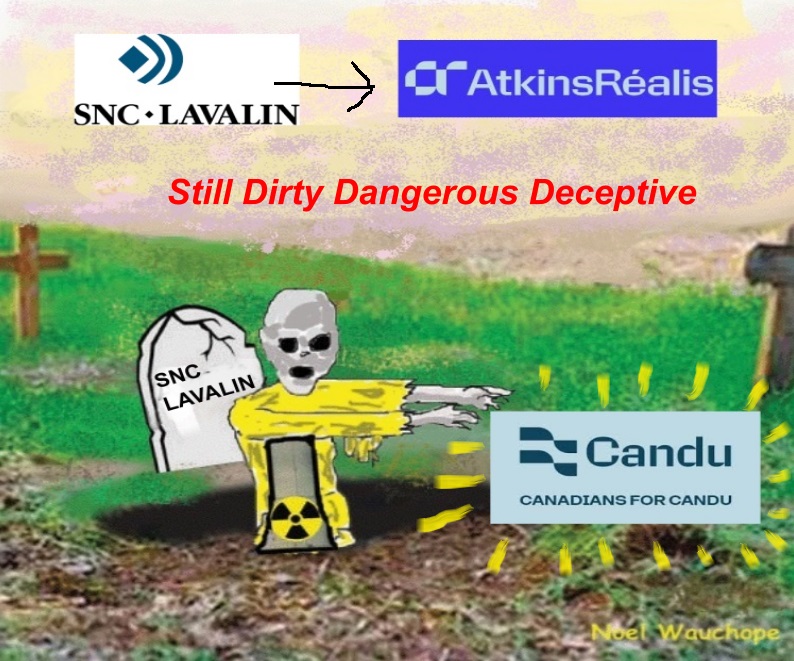
AtkinsRéalis chief executive Ian Edwards has reshaped the engineering company, previously known as SNC-Lavalin, by selling oil and gas assets and pivoting toward a simplified business model centred on engineering services and consulting work. Pushing its nuclear business hard is a big part of the new strategy.
AtkinsRéalis joins several nuclear energy multinationals weighing moves into the U.S., attracted by President Donald Trump’s aim to quadruple America’s atomic energy capacity over the next 25 years to meet rising demand for electricity. The President signed executive orders in May directing the Department of Energy to expedite construction of 10 large reactors by 2030, heralding what the White House science policy director called an “American nuclear renaissance.”
AtkinsRéalis holds an exclusive licence for Canada’s Candu reactor, which uses a heavy water technology to process natural uranium as fuel. It is marketing the 740-megawatt Enhanced Candu 6 along with a proposed 1,000-megawatt model called the Monark.
Executives with the Montreal-based company acknowledge that countries typically favour their own sovereign nuclear technology, which would give Pennsylvania-based reactor builder Westinghouse home-field advantage in any new contracts (Westinghouse is Canadian-owned). But they’re betting Westinghouse won’t be able to build 10 reactors at the same time, leaving room for Candu.
“We are positively surprised by this development,” Desjardins Securities analyst Benoît Poirier said in a note. He had believed a U.S. contract was not possible for AtkinsRéalis given past failed attempts to bring Candu reactors stateside as well as “the current protectionist geopolitical climate” in Canada and the U.S.
On top of that, the competitive landscape is more intense in the U.S., the analyst said, with international players such as Kepco (Korea Electric Power Corp.), legacy firms such as Westinghouse, and small modular reactor disruptors such as GE Vernova Hitachi Nuclear Energy, NANO Nuclear Energy Inc., NuScale Power Corp., Oklo Inc., TerraPower, X-Energy Inc. and newcleo all vying for a piece of the pie.
“If AtkinsRéalis does secure a new-build reactor south of the border, it would not only represent incremental growth but also boost visibility with U.S. investors,” Mr. Poirier said. Despite the company’s share price run-up over the past two years, the stock remains significantly “under-owned” outside Canada, with U.S. ownership at just 8 per cent of the total, he said.
By comparison, Canadian companies such as Canadian Pacific Kansas City Ltd.
CP-T -1.07%decrease
and TFI International Inc.
TFII-T -3.15%decrease
have U.S. ownership levels above 30 per cent. Plane maker Bombardier Inc.
BBD-B-T -0.02%decrease
has grown its U.S. investor base to nearly 20 per cent in recent years from about 5 per cent as it recentred the business to focus on luxury jet sales, defence, and service and maintenance.
AtkinsRéalis said the U.S. is one of its core markets for engineering services and that it has taken the current trade negotiations between Canada and the U.S. into account in its strategic evaluations for ramping up its nuclear offering there. It said it intends to use its new technology centre in Richland, Wash., to further develop and apply “innovative nuclear and environmental cleanup technologies.”
Nuclear accounted for 12 per cent of revenues at AtkinsRéalis last year. The business is growing rapidly, however, and now employs about 4,000 people, up from 3,000 in 2022. Much of its recent hiring is in preparation for anticipated new reactor sales in Canada and abroad.
Last fall, the company won a joint contract to build two nuclear reactors in Romania, the first Candu reactors to be built in the world since 2007. The Canadian government will loan $3-billion to Romania’s nuclear power operator to finance the deal – funds that will be directed exclusively to Canadian providers of goods and services working on the project.
Executives with the engineering firm estimate that countries will need 1,000 new nuclear reactors by 2050. Assuming the company’s Candu solution nabs 5 per cent of that business (there are six large-scale reactor technologies globally, including Candu), they peg the market potential at $750-billion.
Conflicts of interest in the Trump group’s push to sell nuclear reactors to Saudi Arabia.
|
The Trump administration is eager to sell nuclear reactors to Saudi Arabia. But why? Bulletin of the Atomic Scientists, By Aileen Murphy, M. V. Ramana, April 16, 2019 US government officials appear to be advancing a potential sale of nuclear power plants to Saudi Arabia. Late last month, Reuters reported that Energy Secretary Rick Perry approved six secret authorizations for companies to do preliminary work on a Saudi nuclear deal without congressional oversight. The Reuters article followed an interim staff report that US Rep. Elijah Cummings, chairman of the House Oversight Committee, released in February; the report cited whistleblowers who had warned that the White House was trying to rush the transfer of nuclear technology to the Kingdom.
Many experts have expressed concern about the terms of a US-Saudi nuclear cooperation agreement now apparently under negotiation. Some despair at the very idea of transferring such sensitive technology to a regime known to have been involved in the gruesome murder of a prominent US-based journalist and to have led a bloody war in Yemen. Saudi Arabia has attempted to justify its nuclear power program as a way to shift its electrical system away from fossil fuels, in part because of climate change concerns and in part because it is economically useful for the Kingdom to sell its oil and gas on the international market, rather than use them to generate electricity. But for sun-baked Saudi Arabia, the economical and obvious switch is to solar energy, which also doesn’t result in carbon emissions and can be used to reduce domestic consumption of oil and gas. The limited efforts in installing solar power capacity on the part of the Saudi government suggest that climate action and economics may not be the driving motivations for its extensive nuclear energy plan. Indeed, members of the Saudi regime have, on other occasions, made it clear that their interests in nuclear energy derive from the idea that it would help them acquire the capability to make nuclear weapons and match Iran, whose regional status is seen to have risen as a result of its uranium enrichment program, even though it is now apparently limited by the Iran nuclear deal. The contrast between Saudi Arabia’s solar potential and its focus on nuclear power raises a question: Why is the Trump administration so eager to provide nuclear technology to such a questionable partner? We offer some tentative answers to this question and argue that it would be best for the United States to stop trying to sell nuclear reactors to Saudi Arabia, and to use its considerable diplomatic capacity to encourage other countries to do the same. Outside inducement, inside interest. Despite President Trump’s outspoken interest in maintaining a close relationship with the Saudi leadership, the White House is not seeking a Saudi nuclear agreement entirely on its own volition. It is also responding to a major lobbying effort. In February, representatives from several nuclear energy firms, including NuScale, TerraPower, Westinghouse, and General Electric, met with President Trump reportedly with the aim of having the president “highlight the role US nuclear developers can play in providing power to other countries.” The motivation for nuclear reactor suppliers is understandable. Thanks in part to the multibillion-dollar cost of reactors, the nuclear energy market is slim. One can literally count the number of new reactor construction projects starting each year since 2010 on the fingers of one hand. Westinghouse, the leading company among those that lobbied Trump, has not signed a new reactor contact in more than a decade. The Middle East has been an especially competitive market for companies interested in building reactors in the Kingdom. If any reactors are sold, it will only be with the help of high-level support, probably involving national governments or even heads of state. But the effort to sell US nuclear power plants has also garnered some new players: companies involving ex-members of the armed forces. For about two years now, there have been reports of former national security advisor Michael Flynn playing an important role in trying to start nuclear exports to the Middle East, especially Saudi Arabia. More recently, a host of articles have uncovered the role of the newly established IP3 Corporation (derived from International Peace, Power, and Prosperity), a company dominated by a number of retired military officials. The extent of IP3’s lobbying became apparent only after the House Oversight Committee report was published. The influence trail is murky, and the various conflicts of interest within the Trump administration render the picture even murkier. One example is the case of Westinghouse and Jared Kushner, son in law of and senior advisor to President Donald Trump and a close friend of Saudi Crown Prince Mohammad bin Salman. Westinghouse is the largest nuclear reactor supplier in the United States, but, thanks to cost escalations in multiple projects involving its AP1000 nuclear reactor design, the company filed for bankruptcy protection in 2017. It was then purchased by the Canadian company Brookfield Business Partners. Brookfield Business Partners is a subsidiary of Brookfield Asset Management Inc., which reached a deal in August 2018 with the Kushner family’s real estate company to lease a highly unprofitable building in New York. The Kushner company had purchased 666 Fifth Avenue in New York for $1.8 billion in 2007, just before the property markets collapsed. The company had been trying for years to offload this debt. Brookfield’s deal might be just a coincidence, but the timing and the earlier foray into the nuclear business raise obvious conflict of interest questions………. Three reasons to question. Three aspects of the proposed sale of nuclear reactors to Saudi Arabia demand attention. The first, which has received much media attention, involves the opaque tangle of shady talks and negotiations between the Trump administration and the Kingdom, in the realm of nuclear energy and in other areas. Second, it is clear that nuclear energy makes little economic sense for Saudi Arabia, suggesting that there are other motives for its nuclear power program. Third, one of these motives need no longer be the subject of speculation: Saudi Arabia’s leaders have clearly stated their interest in potentially developing nuclear weapons. The acquisition of nuclear power and associated technology could well aid that process. Given these questions, neither the United States nor any other country should be exporting nuclear power plants to Saudi Arabia. This will not just be in the interest of the United States, but also in the economic interest of the Saudis. To the extent that there is concern that other countries like Russia and China might step in and sell nuclear reactors to Saudi Arabia, the obvious corollary is that the United States should use its considerable diplomatic capacity to discourage such efforts. Success is, of course, not guaranteed, but not trying is the surest way to fail. https://thebulletin.org/2019/04/the-trump-administration-is-eager-to-sell-nuclear-reactors-to-saudi-arabia-but-why/ |
|
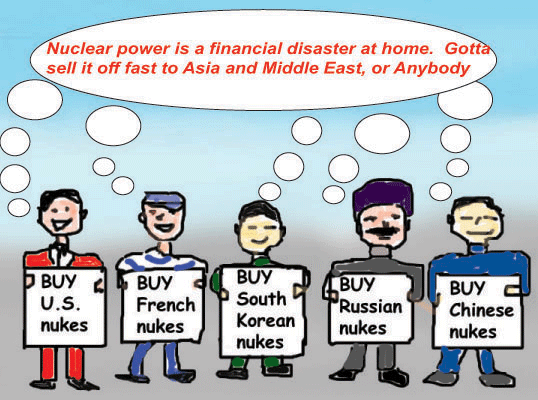
India PM Modi ends foreign tour with nuclear deals in pipeline
By AFP, 14 February 2025 Daily Mail
Indian Prime Minister Narendra Modi concluded a whistle-stop diplomatic tour Friday having secured significant pledges of support from Washington and Paris to help step up his country’s nuclear energy programme.
New Delhi has vowed to achieve net zero carbon emissions by 2070 partly by increasing the number of nuclear plants in the country from eight, which currently account for around three percent of power generation in India.
Modi’s White House meeting with President Donald Trump resulted in an agreement to build US-designed nuclear reactors in India.
“This path forward will unlock plans to build large US-designed reactors and enable collaboration to develop, deploy and scale up nuclear power generation with advanced small modular reactors,” a joint statement said Thursday.
India revealed a similar deal with France following Modi’s meeting with President Emmanuel Macron earlier this week.
Foreign secretary Vikram Misri said Wednesday that India and France aimed to initiate cooperation on developing small modular nuclear reactors, nothing that the technology was still in its “initial stages”.
“Our intent is to be able to cooperate in co-designing the reactors, co-developing them, and co-producing them,” he told reporters.
Both partnerships come days after Modi’s government announced plans to amend its strict nuclear liability law, which holds operators liable for any damage or accident, with exceptions made for certain situations including natural disasters……………………… https://www.dailymail.co.uk/wires/afp/article-14396859/India-PM-Modi-ends-foreign-tour-nuclear-deals-pipeline.html
UAE’s nuclear company seeks to capitalise on AI-induced energy demand in US

Enec’s CEO says it plans to expand overseas after rapid growth in its home market
Malcolm Moore in Abu Dhabi, Ft.com 26 Jan 25
The United Arab Emirates wants to build and consult on nuclear projects around the world, with the US as the fastest-growing market, the head of the country’s state-owned nuclear company has said.
Emirates Nuclear Energy Company has become a major player since it was established in 2009. It completed the four reactors of its Barakah nuclear power plant, the first in the Arab world, in under 12 years, and on budget. The project was developed in partnership with Korea Electric Power Corp.
The company, known as Enec, has built up investment and research and development teams to explore opportunities beyond the UAE, chief executive Mohamed Al Hammadi told the Financial Times. AI is set to drive a surge in demand for electricity to power data centres.
………………………………………………………Enec has been in discussions to invest in the UK’s Sizewell C project but Al Hammadi declined to comment on whether the company would proceed, only saying that negotiations had “been going through different cycles in the last year”.
The UK has pushed back the final investment decision on Sizewell, which was expected last year, to after the next government spending review expected in the spring, while the estimated cost of the project has doubled from less than five years ago.
Al Hammadi suggested that the US is seeing the fastest growth in demand for nuclear power because of the boom in AI computing. …………………………………………………………………………………. https://www.ft.com/content/f949780a-3eb2-44f2-9db1-f69ce16161b7
Last Energy nabs $40M to realize vision of super-small nuclear reactors
These investors are joining the wave in public and private financing of nuclear energy that has swelled to $14 billion so far this year — double last year’s total, according to Axios. Investment in new fission technologies, such as microreactors, has increased tenfold from 2023.
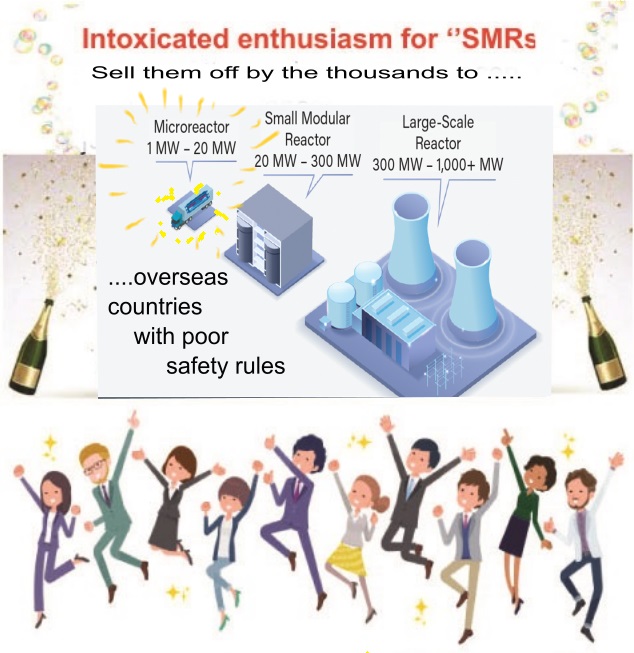
The startup wants to mass-manufacture 20MW nuclear reactors that can be built and shipped within 24 months. It’s looking to get its first reactor online in Europe.
By Eric Wesoff, 29 August 2024
A startup looking to build really small nuclear reactors just announced a big new funding round.
Last Energy, a Washington, D.C.–based next-generation nuclear company, announced that it closed a $40 million Series B funding round, a move that will add more financial and human capital to the reinvigorated nuclear sector.
The startup aims to eventually deploy thousands of its modular microreactors, though to date it has not brought any online. The first reactor might appear in Europe as soon as 2026, assuming Last Energy manages to meet its extremely aggressive construction, financial, and regulatory timelines — not a common occurrence in the nuclear industry. Venture capital heavyweight Gigafund led the round, which closed early this year but was revealed only today. The startup has raised a total of $64 million since its 2019 founding.
Last Energy is part of a cohort of companies betting that small, replicable, and mass-produced reactors will overcome the economic challenges associated with building emissions-free baseload nuclear power — and restore the moribund U.S. nuclear industry to its former glory. But the microreactor dream has yet to be realized; few of these small modular reactors (SMRs) have been built worldwide. None have been completed in the U.S., though one design from long-in-the-tooth startup NuScale Power has gotten regulatory approval.
The 20-megawatt size of Last Energy’s microreactor stands in stark contrast to that of a conventional nuclear reactor like the recently commissioned Vogtle units in Georgia, which each generate about 1,100 megawatts. A Last Energy microreactor, the size of about 75 shipping containers, might power a small factory, while a Vogtle unit can power a city.
Instead of the cathedral-style stick-built construction of modern large reactors, SMRs and microreactors are meant to be manufactured at scale in factories, transported to the site, and assembled on location. Rather than develop an advanced reactor design with exotic fuels — an approach taken by other SMR hopefuls, including the Bill Gates–backed TerraPower — Last Energy chose to scale down the well-established light-water reactor technology that powers America’s 94 existing nuclear reactors.
“We came to the conclusion that using the existing, off-the-shelf technology was the way to scale,” CEO Bret Kugelmass said in a 2022 interview with Canary Media. “We don’t innovate at all when it comes to the nuclear process or components — we do systems integration and business-model innovation.”
The startup claims that its microreactor is designed to be fabricated, transported, and built within 24 months, and is the right size to serve industrial clients. Under its business model, Last Energy aims to build, own, and operate its power plant at the customer’s site, avoiding the yearslong wait times to plug a new generation project into the power grid.
Like an independent power producer, Last Energy doesn’t sell power plants; instead, it sells electricity to customers through long-term power-purchase contracts.
“Data centers and heavy industry are trying to grapple with a very complex set of energy challenges, and Last Energy has seen them realize that micro-nuclear is the only capable solution,” said Kugelmass, who claims in today’s press release that the startup has inked commercial agreements for 80 units — with 39 of those units destined to serve power-hungry data center customers.
Last Energy isn’t the only microreactor company attracting venture funding. There are several other examples from this month alone: Aalo Atomics raised $27 million from 50Y, Valor Equity Partners, Harpoon Ventures, Crosscut, SNR, Alumni Ventures, Preston Werner, Earth Venture, Garage Capital, Wayfinder, Jeff Dean, and Nucleation Capital to scale up a 85-kilowatt design from the U.S. Department of Energy’s MARVEL program. While Deep Fission, a startup aiming to bury arrays of microreactors 1 mile underground, just raised $4 million led by 8VC, a venture firm founded by Joe Lonsdale.
These investors are joining the wave in public and private financing of nuclear energy that has swelled to $14 billion so far this year — double last year’s total, according to Axios. Investment in new fission technologies, such as microreactors, has increased tenfold from 2023.
Investors happen to be backing startups in a heavily subsidized market. Tens of billions of dollars from the Bipartisan Infrastructure Law, the U.S. DOE’s Loan Programs Office, and the Inflation Reduction Act support the development of a non-Russian supply of enriched uranium; the IRA also introduced a ridiculously generous $15-per-megawatt-hour production tax credit, meant to keep today’s existing nuclear fleet competitive with gas and renewables, as well as a similarly charitable investment tax credit to incentivize new plant construction.
The flood of funding comes as nuclear power enjoys the most public support it has had in years. Nuclear now has a favorable public opinion, with the majority of Americans supporting atomic energy and its record of safety and performance. And nuclear energy is one of the few topics that Democrat and Republican politicians have been able to agree on in recent memory.
Still, despite the rising financial, political, and public support, the U.S. nuclear industry remains frozen, plagued by a legacy of cost and timeline overruns for conventional reactors and regulatory challenges around new designs. It’s unclear when the country will get another nuclear reactor online — as of last year, the leading contender was an SMR project from NuScale, but that fell apart due to cost. In all likelihood, the next reactor to plug into the grid will be the mothballed Palisades nuclear plant in Michigan, which won government support for an unprecedented effort to recommission the plant by the end of next year.
For its part, Last Energy is not banking on the U.S. to lead the charge; it’s targeting industrial customers in Poland, Romania, and the U.K. for its initial sites, in the hopes that it will find a more favorable regulatory and financial environment.
Ryan McEntush of investment firm a16z suggests in an essay that “the success of nuclear power is much more about project management, financing, and policy than it is cutting-edge engineering or safety.”
That’s Last Energy’s philosophy too — and it’s going to need more money and more years to prove it’s the right one.
South Korea pushes to export nuclear reactors to Europe

Asian nation seeks to become leading player in market dominated by China and Russia
Ft.com Song Jung-a and Christian Davies in Seoul, Raphael Minder in Warsaw, Sarah White in Paris and Alice Hancock in Brussels , 29 Aug 24,
South Korea is accelerating its push to export nuclear reactors to Europe as it seeks to become a leading player in a global market dominated by China and Russia.
After beating Westinghouse of the US and France’s EDF to become preferred bidder on a $17bn project in the Czech Republic in July, state-run utility Korea Hydro & Nuclear Power is set to sign a contract early next year for two reactors in the central European country.
The deal, if completed, will mark Korea’s first major overseas nuclear power project in 15 years, since a consortium led by KHNP parent Kepco won a $20bn contract in 2009 to build and operate four nuclear plants in the United Arab Emirates.
Whang Joo-ho, the president of KHNP, said the company was conducting a feasibility study for a nuclear power plant in the Netherlands and was in talks to build reactors in Finland and Sweden as it aims to export 10 more reactors globally by 2030.
Kepco has also held early-stage discussions with British officials about building a new station on the island of Anglesey off the coast of Wales. ……………………………………………………………………………………………………
There could be bumps along the way for the South Koreans, however. KHNP faces claims from Westinghouse that they used its proprietary technology for their APR1400 reactors. A US district court last year dismissed Westinghouse’s lawsuit that argued that the Korean companies violated US export regulations requiring US government approval for technology sharing. However, the dispute remains unresolved as the court did not rule on the issue of intellectual property infringement.
The Czech deal has highlighted South Korea’s efforts at a time when projects run by western competitors including EDF remain mired in construction delays and cost overruns.
Although Ahn, the South Korean industry minister, said earlier this month that the two companies were “in last-stage talks” to settle the disputes, the US company this week filed an appeal with the Czech anti-monopoly office in protest at the selection of KHNP as the preferred bidder.
“KHNP neither owns the underlying technology nor has the right to sub-licence it to a third party without Westinghouse consent,” the US company said……………………………………………………………
Please use the sharing tools found via the share button at the top or side of articles. Copying articles to share with others is a breach of FT.comT&Cs and Copyright Policy. Email licensing@ft.com to buy additional rights. Subscribers may share up to 10 or 20 articles per month using the gift article service. More information can be found here.
https://www.ft.com/content/85a7e313-6089-4ba9-8f5b-f45adcbc5074
Suh Kyun-ryul, a nuclear expert and a former professor at Seoul National University, said KHNP would probably have to reach a financial settlement with Westinghouse. “This could even end up as a lossmaking deal,” he said. Suh also noted that South Korea was constrained by a long-standing agreement with the US that was signed in the 1950s to restrict Seoul’s ability to develop a nuclear weapons programme.
Under the agreement, South Korea’s access to raw material supplies is limited and it is not allowed to conduct uranium enrichment or the reprocessing of used fuel. Long-term buyers were likely to ask for a one-stop service ranging from nuclear fuel supply to waste disposal, he said, adding the US agreement remained “South Korea’s Achilles heel”. https://www.ft.com/content/85a7e313-6089-4ba9-8f5b-f45adcbc5074
IAEA’s Rafael Grossi in Iraq to market nuclear reactors

IAEA to Help Iraq Develop Peaceful Nuclear Program, Agency Head Says , https://english.aawsat.com/business/4917976-iaea-help-iraq-develop-peaceful-nuclear-program-agency-head-says%C2%A0 20 Mar 24
The head of the International Atomic Energy Agency Rafael Grossi met Iraq’s prime minister in Baghdad on Monday as part of a visit to help the country develop a peaceful nuclear program.
“We have discussed several projects in Iraq, including building a nuclear reactor for peaceful purposes,” Iraqi Education Minister Naim al-Aboudi told reporters following a meeting between Grossi and Iraqi Prime Minister Mohammed Shia al-Sudani.
Grossi said that a team of Iraqi experts would visit the agency’s headquarters in Vienna in a few days to hold meetings to “set out a road map for the Iraqi peaceful nuclear program” amid growing interest in nuclear energy in the region.
“We see that in the (United Arab) Emirates, we see that in Egypt … and of course we should see it here in Iraq,” Grossi told reporters.
Iraq in the past had three nuclear reactors in Tuwaitha, its main nuclear research site, south of Baghdad. One was destroyed by an Israeli air raid in 1981 and the two others by US warplanes in the 1991 Gulf war that followed Iraq’s 1990 invasion of Kuwait.
“Definitely, turning the page on this complex past is of the essence and we’re doing just that,” Grossi said.
U.S. government continues to pour $billions into the failing Small Nuclear Reactors business, in the hopes of exporting SMRs
The US Department of State and US Export-Import Bank (EXIM) have announced
a suite of financial tools to support the deployment of advanced nuclear
energy systems to help reach net-zero goals. They also announced plans to
mobilise more than USD4.2 billion of investment in enrichment and
conversion capacity through the five-nation Sapporo 5 collaboration.
World Nuclear News 7th Dec 2023
https://www.world-nuclear-news.org/Articles/US-takes-steps-to-jump-start-overseas-SMR-deployme
By excluding Russia from markets in Europe, USA ‘s nuclear industry plans to sell its small and large nuclear reactors to Poland,Romania, Slovakia, Estonia, the Czech Republic and Ukraine
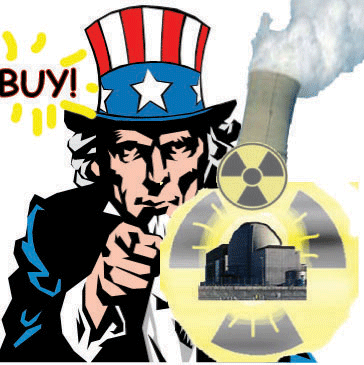
in April, the U.S. announced financing of up to $4bn to deploy U.S. small modular reactors (SMRs) in Poland.
the Export–Import Bank of the United States and the Development Finance Corporation) should take on more financial risk
Domestic market stagnation requires US nuclear companies to explore the growing export market.
1 Can the U.S. export its Nuclear plants to Europe, starting with Poland?
June 23, 2023 by Matt Bowen and Sagatom Saha
The exclusion of Russia from Europe’s energy future opens a door for the U.S. to export its nuclear plants, explain Matt Bowen and Sagatom Saha at the Center on Global Energy Policy. That’s why, in April, the U.S. announced financing of up to $4bn to deploy U.S. small modular reactors (SMRs) in Poland. A successful deployment there could lead to the same in Romania, Slovakia, Estonia, the Czech Republic and Ukraine,..
, the U.S. needs to create the “one stop shop” that Russia has always offered. Financing is a priority, and the authors point at what’s missing right now. In particular, the overseas investment arms (like the Export–Import Bank of the United States and the Development Finance Corporation) should take on more financial risk than they’ve needed to in the past. Coordination, too, between the knowledge bases and expert staff in the various arms will avoid duplication of effort and accelerate project assessments. And it would help if the U.S. deployed more nuclear at home: only two new reactors have connected to the U.S. power grid this century.

United States civil nuclear diplomacy is back on the move. In April, the Export–Import Bank of the United States (EXIM) and the Development Finance Corporation (DFC) announced financing of up to $3 billion and $1 billion, respectively, to deploy US small modular reactors (SMRs) in Poland.[1] SMRs — smaller, more uniform designs intended to be factory-manufactured to lower nuclear energy costs — have benefited from congressional support and interagency interest in the Biden administration. This follows the Trump administration’s reversal of a legacy prohibition on DFC funding of US nuclear energy exports.
The US is exploring the growing export market
Domestic market stagnation (only two new reactors have connected to the US power grid this century) requires US nuclear companies to explore the growing export market.
Russia has dominated the nuclear energy marketplace, but its invasion of Ukraine has damaged its diplomatic standing and widened the opportunity for US companies. However, the window will not remain open indefinitely, and progress will hinge upon US agencies arranging financing packages that turn diplomatic handshakes into cement in the ground in Poland and elsewhere.
The Polish opportunity
With EXIM Bank and DFC having just signed letters of intent to support the deployment of the GE-Hitachi BWRX-300 SMR with Orlen Synthos Green Energy as the most recent example,[3] Poland has been the epicentre of the revival of US commercial nuclear diplomacy.
The 2020 US-Poland Intergovernmental Agreement (IGA) on nuclear energy cooperation[4] was a political commitment, and in 2021 the US Trade and Development Agency funded a front-end engineering (FEED) study for potential deployment of a AP1000 nuclear power plant.[5] These developments likely facilitated Poland’s selection of the Westinghouse AP1000 for large reactor builds in 2022.[6]
Separately, Poland-headquartered mining company KGHM announced a plan in 2023 to deploy modular reactors designed by the US company NuScale Power, and in April submitted an application to the Polish Ministry of Climate and Environment to build NuScale SMRs in Poland.[7]
Successfully deploying both large-scale reactors and SMRs in Poland could accelerate progress throughout a region (Romania, Slovakia, Estonia, Czech Republic, and Ukraine)………Poland’s neighbours have, in some cases, handshake agreements to adopt US nuclear technologies. For example, at the 2021 United Nations Climate Change Conference in Glasgow, US special presidential envoy for climate John Kerry and Romanian president Klaus Iohannis jointly announced Romania’s intention to build NuScale SMRs. A May 2023 announcement at the G7 Leaders’ Summit included support for the Romanian SMR project of up to $275 million from the United States, Japan, Republic of Korea, and United Arab Emirates, as well as Letters of Interest issued by EXIM and DFC for potential support of up to $3 billion and $1 billion for project deployment – similar to the potential package for Poland.[8] US diplomatic efforts also contributed to the Czech Republic at least excluding Russian and Chinese companies from a tender to build a new reactor that will entail roughly $6.6 billion of investment into the country.[9]
Financing the deal
For all of the announcements, there are no done deals just yet. Part of Russia’s competitive edge in the past has stemmed from the ability of Rosatom, its state-owned enterprise, to offer a “one-stop shop” including favourable financing terms that private sector companies cannot match alone.[10] The United States will ultimately have to grapple with this challenge if it expects to be competitive in international markets.
…needs a “one stop shop” like the Russians have
To date, the US playbook in Poland has consisted of an IGA demonstrating US political commitment and an intent to finance; funding for FEED work from USTDA; and now, letters of intent from EXIM Bank and DFC. The process has been improvised and tactical, but it could be replicated elsewhere as part of a long-term, sustainable approach. The missing piece at the end — US government financing agencies’ ability to quickly finalise deals — could make the difference, especially as the United States competes with Russia and China for reactor supply deals.
The US may be able to improve the efficiency and terms of its reactor export financing offers to other countries through measures such as:
Considering improvements in staffing and interagency coordination at the DFC.………………..
- Exploring DFC equity scoring. Potential customer countries are eager for DFC equity investment in nuclear deals, but according to federal budget rules, the DFC must score its equity investments entirely as a loss with no expectation of returns — essentially as a grant.[11] This may be discouraging the DFC from exercising its ability to make equity investments, especially in capital-intensive nuclear projects.
- Evaluating EXIM Bank’s processes. EXIM Bank is subject to a statutory 2 percent default rate cap, which requires the bank to virtually freeze lending if exceeded.[12] Senior EXIM Bank officials have identified the cap as an impediment to pursuing slightly riskier projects — specifically to compete with China…………………
- Enlisting the DOE Loan Programs Office (LPO). The DOE LPO, with new funding and leadership under the Biden administration, has become an influential player in government energy financing.[14]……………………. https://energypost.eu/can-the-u-s-export-its-nuclear-plants-to-europe-starting-with-poland/
United Arab Emirates keen to become an exporter of nuclear reactors and nuclear technology

ABU DHABI, 23rd June, 2023 (WAM) — H.H. Sheikh Hamdan bin Zayed Al Nahyan, Ruler’s Representative in Al Dhafra Region, visited Barakah Nuclear Energy Plant to view the latest developments of Unit 4, the final unit at the plant approaching commercial operation, and praised Emirati competencies that contributed to developing nuclear energy sector technologies to export globally.
Sheikh Hamdan was received by Mohamed Ibrahim Al Hammadi, Managing Director, and Chief Executive Officer of the Emirates Nuclear Energy Corporation (ENEC); and Ali Al Hammadi, Chief Executive Officer of ENEC’s subsidiary Nawah Energy Company (Nawah); as well as a delegation from ENEC’s senior management.
At the beginning of his visit, Sheikh Hamdan inaugurated the state-of-the-art Nuclear Reactor Operators Training Centre, which will enhance nuclear reactor operators’ expertise, and was briefed on the “Orchid” digital reactor room, which provides advanced maintenance training for engineers without entering the reactor area.
Sheikh Hamdan bin Zayed then toured the simulation training centre, which is one of the largest and most modern simulation training centres in the world. He also heard from Emirati engineers on the Plant’s developments and achievements, the latest of which was the operational readiness preparations for Unit 4, the fourth and final unit at the Barakah Nuclear Energy Plant in Abu Dhabi…………………..
https://www.wam.ae/en/details/1395303172381
China joins the rush to market nuclear power to Turkey
Türkiye in contact with China for planned 3rd nuclear plant’, BY DAILY SABAH WITH REUTERS, JUN 23, 2023
Türkiye is in contact with China regarding the construction of a planned third nuclear power plant (NPP) and is surveying sites for a fourth, a top ministry official said.
Russia’s Rosatom is building the country’s first nuclear power plant, Akkuyu NPP, in its southern Mersin province, with the first reactor expected to go online next year……………
USA marketing nuclear power to Bulgaria
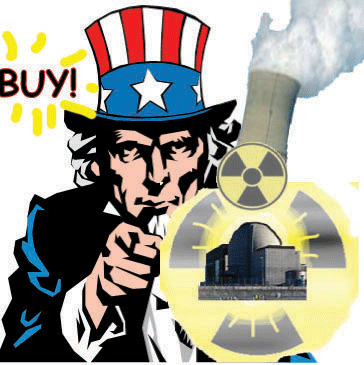
Westinghouse has signed a front-end engineering and design (FEED) contract
with Kozloduy NPP-Newbuild for the construction of an AP1000 reactor at the
Kozloduy nuclear power plant site in Bulgaria.
World Nuclear News 15th June 2023
https://www.world-nuclear-news.org/Articles/FEED-contract-signed-for-Bulgarian-AP1000
USA to market small nuclear reactors to Slovakia?
The Ministry of Economy and Slovenské elektrárne have signed a memorandum
of cooperation with a range of partners in the energy field to support the
development of small modular reactors (SMRs) in Slovakia, including
applying for funding from the USA’s Project Phoenix. The other signatories
of the memorandum were US Steel Košice, the Slovak Electricity
Transmission System, VUJE, the Office of Nuclear Supervision and the Slovak
Technical University in Bratislava. There will now be an application for
funding from the US government’s Project Phoenix, which was announced by US
Climate Envoy John Kerry at COP27 last year – it aims to “accelerate the
global clean energy transition by providing technical assistance to support
decision-making on pursuing the conversion of one or more coal-fired power
plants to secure and safe zero-carbon” SMR nuclear energy generation.
World Nuclear News 13th June 2023
https://www.world-nuclear-news.org/Articles/Slovenske-elektrarne-pushes-ahead-on-SMR-plans
1 This Month

of the week – Shut Down Drone Warfare!


Tell the Ukrainian Government to Drop Prosecution of Peace Activist Yurii Sheliazhenko

Petition to revoke the licensing of the Near Surface Nuclear Disposal Facility (NSDF) at Chalk River. https://www.ourcommons.ca/petitions/en/Petition/Details?Petition=e-7247
To see nuclear-related stories in greater depth and intensity – go to https://nuclearinformation.wordpress.com
-
Archives
- March 2026 (237)
- February 2026 (268)
- January 2026 (308)
- December 2025 (358)
- November 2025 (359)
- October 2025 (376)
- September 2025 (257)
- August 2025 (319)
- July 2025 (230)
- June 2025 (348)
- May 2025 (261)
- April 2025 (305)
-
Categories
- 1
- 1 NUCLEAR ISSUES
- business and costs
- climate change
- culture and arts
- ENERGY
- environment
- health
- history
- indigenous issues
- Legal
- marketing of nuclear
- media
- opposition to nuclear
- PERSONAL STORIES
- politics
- politics international
- Religion and ethics
- safety
- secrets,lies and civil liberties
- spinbuster
- technology
- Uranium
- wastes
- weapons and war
- Women
- 2 WORLD
- ACTION
- AFRICA
- Atrocities
- AUSTRALIA
- Christina's notes
- Christina's themes
- culture and arts
- Events
- Fuk 2022
- Fuk 2023
- Fukushima 2017
- Fukushima 2018
- fukushima 2019
- Fukushima 2020
- Fukushima 2021
- general
- global warming
- Humour (God we need it)
- Nuclear
- RARE EARTHS
- Reference
- resources – print
- Resources -audiovicual
- Weekly Newsletter
- World
- World Nuclear
- YouTube
-
RSS
Entries RSS
Comments RSS
 nuclear-news