1000 Sellafield Ltd. contractors to be balloted for strike by Unite
AROUND 1,000 contractors at Sellafield are being balloted for potential
strike action, after Unite have criticised an ‘unacceptable offer’ from
management. More than 3,000 engineering construction workers nationally,
operating under the National Agreement for Engineering Construction
Industry (NAECI), are being balloted for strike action overpay, Unite, the
UK’s leading union, said on Thursday, September 7. This includes about
1,000 Sellafield Ltd. contractors who the union say conduct critical repair
and maintenance at the site.
Whitehaven News 10th Sept 2023
Health and safety concerns raised with Dounreay management
Some trade union and safety representatives have no confidence in the
management at Dounreay and have raised health and safety concerns at the
site.
A number of employees told the John O’Groat Journal that they are
also worried over how issues on the well-being of staff were being
addressed. “There are numerous cases of staff members off due to
work-related stress – some as a result of bullying and harassment,” said
one worker. “Concerns have been raised but do not appear to be addressed.
“Dounreay has said that ‘our workers are out greatest asset’, but from the
conversations I’ve had with people across site, this is not believed.”
Another employee stated: “This has been an ongoing issue for years. It is
hard to prove in many cases and has been dealt with in some instances.
Safety reps have been involved in meetings on this topic along with the
chairman of the Trade Union Co-ordinating Committee.”
John O’Groat Journal 8th Sept 2023
Unite urges employer to pay a fair wage and avoid nuclear plant shutdown
Unite urges employer to pay a fair wage and avoid nuclear plant shutdown.
Electricians who certify tools for use in nuclear power stations are taking
strike action.
Unite, the country’s leading trade union, announced today
(Wednesday 6 September) that its members at Altrad Babcock Ltd are taking
strike action following a dismal pay offer from the employer. Electricians
at Altrad Babcock, based in Tipton in the West Midlands, are responsible
for certifying that electrical tools are safe to use in nuclear facilities
across the country. Yet this safety-critical role is not being valued by
the employer, with some members earning as little as £13.62 per hour.
Unite 6th Sept 2023
Huge study of nuclear workers in France, the United Kingdom, and the United States confirms low dose radiation as a cause of cancer.

What this study adds
- The results of an updated study of nuclear workers in France, the UK, and the US suggest a linear increase in the relative rate of cancer with increasing exposure to radiation
- Some evidence suggested a steeper slope for the dose-response association at lower doses than over the full dose range
- The risk per unit of radiation dose for solid cancer was larger in analyses restricted to the low dose range (0-100 mGy) and to workers hired in the more recent years of operations
Cancer mortality after low dose exposure to ionising radiation in workers in France, the United Kingdom, and the United States (INWORKS): cohort study
BMJ 2023; 382 doi: https://doi.org/10.1136/bmj-2022-074520 (Published 16 August 2023)Cite this as: BMJ 2023;382:e074520
David B Richardson, professor1, Klervi Leuraud, head of service2, Dominique Laurier, deputy director of health2, Michael Gillies, medical statistician3, Richard Haylock, senior research scientist3, Kaitlin Kelly-Reif, senior research scientist4, Stephen Bertke, research statistician4, Robert D Daniels, senior research scientist4, Isabelle Thierry-Chef, senior research scientist5, Monika Moissonnier, research assistant6, Ausrele Kesminiene, senior visiting scientist6, Mary K Schubauer-Berigan, programme head6
Abstract
Objective To evaluate the effect of protracted low dose, low dose rate exposure to ionising radiation on the risk of cancer.
Design Multinational cohort study.
Setting Cohorts of workers in the nuclear industry in France, the UK, and the US included in a major update to the International Nuclear Workers Study (INWORKS).
Participants 309 932 workers with individual monitoring data for external exposure to ionising radiation and a total follow-up of 10.7 million person years.
Main outcome measures Estimates of excess relative rate per gray (Gy) of radiation dose for mortality from cancer.
Results The study included 103 553 deaths, of which 28 089 were due to solid cancers. The estimated rate of mortality due to solid cancer increased with cumulative dose by 52% (90% confidence interval 27% to 77%) per Gy, lagged by 10 years. Restricting the analysis to the low cumulative dose range (0-100 mGy) approximately doubled the estimate of association (and increased the width of its confidence interval), as did restricting the analysis to workers hired in the more recent years of operations when estimates of occupational external penetrating radiation dose were recorded more accurately. Exclusion of deaths from lung cancer and pleural cancer had a modest effect on the estimated magnitude of association, providing indirect evidence that the association was not substantially confounded by smoking or occupational exposure to asbestos.
Conclusions This major update to INWORKS provides a direct estimate of the association between protracted low dose exposure to ionising radiation and solid cancer mortality based on some of the world’s most informative cohorts of radiation workers. The summary estimate of excess relative rate solid cancer mortality per Gy is larger than estimates currently informing radiation protection, and some evidence suggests a steeper slope for the dose-response association in the low dose range than over the full dose range. These results can help to strengthen radiation protection, especially for low dose exposures that are of primary interest in contemporary medical, occupational, and environmental settings.
Conclusions This major update to INWORKS provides a direct estimate of the association between protracted low dose exposure to ionising radiation and solid cancer mortality based on some of the world’s most informative cohorts of radiation workers. The summary estimate of excess relative rate solid cancer mortality per Gy is larger than estimates currently informing radiation protection, and some evidence suggests a steeper slope for the dose-response association in the low dose range than over the full dose range. These results can help to strengthen radiation protection, especially for low dose exposures that are of primary interest in contemporary medical, occupational, and environmental settings.
…………………………………………………………………………………………………………………………………………………………………………………………………………………………… Discussion
This study, which involved a major update to an international cohort mortality study of radiation dosimeter monitored workers, reports evidence of an increase in the excess relative rate of solid cancer mortality with increasing cumulative exposure to ionising radiation at the low dose rates typically encountered by French, UK, and US nuclear workers. The study provides evidence in support of a linear association between protracted low dose external exposure to ionising radiation and solid cancer mortality.
…………………………………………………
What is already known on this topic
- Ionising radiation is an established cause of cancer
- The primary quantitative basis for radiation protection standards comes from studies of people exposed to acute, high doses of ionising radiation
What this study adds
- The results of an updated study of nuclear workers in France, the UK, and the US suggest a linear increase in the relative rate of cancer with increasing exposure to radiation
- Some evidence suggested a steeper slope for the dose-response association at lower doses than over the full dose range
- The risk per unit of radiation dose for solid cancer was larger in analyses restricted to the low dose range (0-100 mGy) and to workers hired in the more recent years of operations
Hinkley Point C unrest continues as steel erectors down tools
An unofficial one-day stoppage of work took place yesterday, as the new
nuclear power station site Hinkley Point C continues to be embroiled in
labour disputes and unrest. Steel erectors working for contractor William
Hare downed tools in response to existing shift rotation patterns on the
site, wanting to change the current 11/3 and 10/4 rotation to a regular
10/4 arrangement. The unrest follows a spate of similar walkouts at Hinkley
Point C. On the supply side, 150 platers, welders and sheet metal workers
at Darchem Engineering in Stockton-Upon-Tees (a Hinkley Point C supplier)
secured a pay boost worth up to 13% after seven weeks of walk-out action.
PBC Today 9th Aug 2023
Hinkley nuclear site workers win after unofficial walkouts
Hinkley nuclear site workers win after unofficial walkouts. “It’s a
rank and file thing, it’s not the unions that are pushing for it,” said
one Hinkley worker. Rank and file workers in construction are fighting
significant battles on major projects this summer—and winning. Workers at
Hinkley Point C nuclear power plant construction site in Somerset have
launched effective, and unofficial, resistance as bosses prepare to bring
in thousands of extra workers.
Socialist Worker 8th Aug 2023 https://socialistworker.co.uk/news/hinkley-nuclear-site-workers-win-after-unofficial-walkouts/
Hinkley Point scaffolders begin industrial action over pay and shift patterns
Hinkley Point scaffolders begin industrial action over pay and shift
patterns. Over 300 scaffolders working at Hinkley Point C near
Burnham-On-Sea have begun unofficial strike action, voicing their concerns
about pay rates and shift patterns at the site.
The scaffolders working for
BYLOR began their protest on Wednesday and are now planning to take one day
a week off work as a form of unofficial strike. Tensions have reportedly
been escalating on site for some time, with workers expressing
dissatisfaction over their current compensation package.
Burnham-on-sea.com 5th Aug 2023
Nuclear safety staffing in the United States: a crisis with no easy fix
Bulletin, By David Gillum, Itty Abraham, Kathleen M. Vogel | July 14, 2023
According to the International Atomic Energy Agency (IAEA), the UN’s nuclear watchdog, nearly 13 million people are exposed to ionizing radiation in occupational settings every year worldwide. There are horror stories within the nuclear safety community of what can happen with lax institutional oversight of nuclear and radiological materials—from stockpiles of improperly managed radiological waste to missing or inaccurate inventories to lost or destroyed records.
Remedies for such infractions can cost millions of dollars and damage the reputation of institutions. That is why it is essential to have qualified, trustworthy staff and an engaged leadership team overseeing radiation safety within the many academic, governmental, and corporate entities that handle radiological materials.
In the United States, however, three challenges stand in the way of maintaining adequate levels of nuclear safety staffing: an insufficient supply of qualified experts, the loss of established experts, and the loss of tacit knowledge held by experts who retire. No single solution can fix all three challenges. But the loss of experienced personnel and the knowledge they possess should be of highest concern in the medium term.
What a radiation safety officer does. One of the most important responsibilities of a radiation safety officer is to ensure that worker and community radiation doses are kept “as low as reasonably achievable.”
………………………………………………………………….No matter what the future growth of nuclear power is, radiation safety officers will be needed to handle the radioactive waste generated by current and retired reactors. Yet, the pool of radiation protection personnel is already insufficient, increasing competition between private industry and public sectors seeking these highly skilled professionals. ………………………………………………………. https://thebulletin.org/2023/07/nuclear-safety-staffing-in-the-united-states-a-crisis-with-no-easy-fix/—
Big enlistment bonuses offered to UK sailors entering the nuclear field
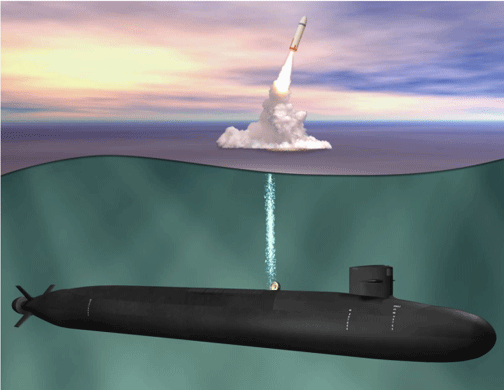
By Diana Stancy Correll. Navy Times
The Navy is offering up to $75,000 in enlistment bonuses for those entering the nuclear field — up from the $50,000 it previously offered and the maximum offered to all other ratings.
The bonus announcement coincides with recruiting challenges across the services, which military leaders attribute to more thorough medical screenings, fewer Americans eligible to serve, and low civilian unemployment.
Sailors may couple the bonus with the maximum student loan repayment under the Enlisted Loan Repayment Program, in which the Navy covers college tuition loans — such as Stafford Student Loans — that were taken out prior to the sailor enlisting for active duty……………………………………………………………………………… more https://www.navytimes.com/news/your-navy/2023/06/23/big-enlistment-bonuses-offered-to-sailors-entering-the-nuclear-field/1
Royal Navy struggles to attract recruits for nuclear-armed subs
https://cnduk.org/royal-navy-struggles-to-attract-recruits-for-nuclear-armed-subs/ 20 June 23
The head of the Royal Navy has called for the service to “get bigger” as it struggles to attract new recruits for its vessels and nuclear-armed submarines.
Speaking to parliamentary magazine The House, First Sea Lord Admiral Sir Ben Key said the Navy he joined over thirty years ago was 75,000 people. This has now dropped to about 36,000. “We are effectively in a war for talent in this country – there is no great secret in that,” Kay said noting that workplace expectations across generations have changed in recent years.
The lack of communication while submariners are at sea was raised as one of the concerns, with the desire for “permanent connectivity” with friends and family not possible while on patrol.
Another reason, according to Kay, was the lack of engagement with the nuclear question. “I think it is fair [to say] that this country is not very good about talking about…nuclear power as opposed to nuclear weapons,” he said, referring to the perceived significance of being a nuclear-armed ‘power’.
The Navy hopes to improve recruitment with a new drive to better explain what life on a submarine is like. The service is also looking at expand beyond its traditional base audience of those who come from Navy families, and showcase the variety of roles the Navy can offer such as accountants and doctors.
Kay’s comments comes as Britain’s nuclear-armed submarine crews are spending record amounts of time at sea, prompting concerns over the psychological pressure on crews spending up to five months at sea.
CND General Secretary Kate Hudson said:
“Admiral Kay rightly points out the list of difficulties that life on a nuclear-armed submarine poses for potential recruits. Extended periods of time at sea out of contact with friends and family comes with serious psychological pressures, but so does the responsibility of carrying weapons that can kill millions of people. Scrapping the Navy’s nuclear-armed subs would go towards easing the the service’s recruitment problems and free up billions of pounds for other uses.”
Workers, residents, at US site that made Nagasaki A-bomb’s plutonium, are still suffering
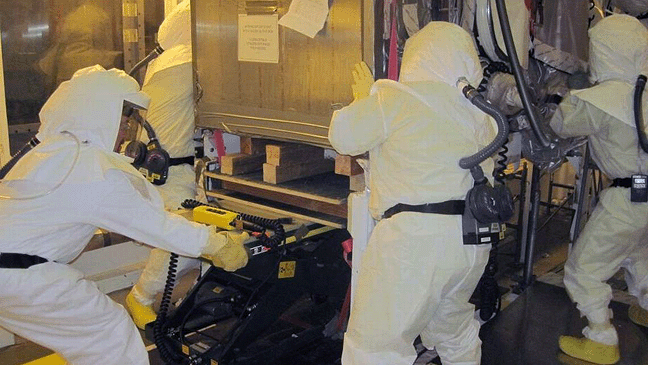
after he and a local journalist conducted a survey on surrounding farms in 1985, Bailie began to have doubts. Nearly all the families living nearby suffered from cancer, birth defects, or thyroid disease, he says — health issues that could be attributed to radiation exposure. This led to the area being coined “the death mile” by some journalists at the time.
documents that were declassified in the late 1980s showed that Hanford had contaminated the surrounding farmland, air, farm animals, and crops with unsafe levels of radiation for years.
June 18, 2023 , Mainichi, Japan
HANFORD, Washington (Kyodo) — As cleanup efforts continue in Washington state at a decommissioned U.S. nuclear facility that played a crucial role in the country’s acquisition of the atom bomb in World War II, questions linger over whether the site has caused serious health issues for workers and local residents.
Construction began on the facility, known as the Hanford site, eighty years ago in 1943 and involved the building of the world’s first large-scale nuclear reactor.
Through the Manhattan Project, a U.S. government research and development program for building nuclear weapons, the site’s B reactor, erected on a 580-square-mile stretch of land next to the Columbia River in south-central Washington, produced the nuclear material for one of the only two atomic bombs ever used in an armed conflict.
Codenamed “Fat Man,” the device was detonated over the city of Nagasaki in southwestern Japan on Aug. 9, 1945, effectively ending Japan’s involvement in the conflict.
The 6.2 kilograms of plutonium contained in the nuclear device released energy equivalent to 21 kilotons of TNT, taking the lives of tens of thousands of innocent people while subjecting the surrounding area to deadly radiation, killing countless more.
But citizens of Nagasaki may not be the only victims of Hanford’s plutonium production. During its decades of operation, U.S. residents living near and mainly downwind of the complex experienced severe health effects that they believe stem from the site’s activities.
One such resident is Tom Bailie, 76, who grew up and still resides just miles downwind from Hanford in a farming community.
Reflecting on his upbringing, Bailie recalled during an interview in April that no one ever thought the site at Hanford would cause harm to “patriotic American citizens.”
But, after he and a local journalist conducted a survey on surrounding farms in 1985, Bailie began to have doubts. Nearly all the families living nearby suffered from cancer, birth defects, or thyroid disease, he says — health issues that could be attributed to radiation exposure. This led to the area being coined “the death mile” by some journalists at the time.
Bailie said that his wife, father, and three uncles all had cancer before passing away, while his two sisters also have cancer and take thyroid medicine. The year before Bailie was born, his mother had a stillbirth. Bailie himself was born with birth defects and was on an iron lung when he was 4 years old. He now requires medication for a thyroid problem.
Bailie vividly remembers encounters with “men in space suits,” equipped with dosimeters to measure radiation levels, walking on his farm. The men would collect soil samples and even ask the farmers to send the heads and feet of ducks and rabbits they would kill while hunting to Hanford for analysis.
When he began speaking out about the hardships and health problems that he attributed to the Hanford site, many people from the community dismissed him as “nuts” or “crazy.” Some even mockingly referred to him as the “glow-in-the-dark farmer.”
But documents that were declassified in the late 1980s showed that Hanford had contaminated the surrounding farmland, air, farm animals, and crops with unsafe levels of radiation for years…………………….
Before being decommissioned in 1989, Hanford produced around 74 tons of plutonium, nearly two-thirds of all the plutonium produced for government purposes in the United States. One of the consequences of the site’s work was massive amounts of contamination and dangerous leftover byproducts, most of which remain on the site today.
Currently, 177 underground tanks containing 56 million gallons of highly radioactive waste, contaminated buildings, and cocooned reactors still exist there, alongside multiple other buried waste sites.
The same year Hanford was decommissioned, cleanup efforts began for dealing with the dangerous byproducts left over from the production of plutonium. Efforts to clean the area of waste are anticipated to be astronomically costly and time-consuming.
According to Hanford’s latest estimate, released in 2022, the total cost of the cleanup is projected to range from $319.6 billion to $660 billion, with a completion date not expected until at least fiscal 2078.
But Tom Carpenter, 66, former head of Hanford Challenge, a nonprofit organization dedicated to ensuring the responsible and safe clearing of the Hanford site, argues that using the word “cleanup” is misleading.
Carpenter says complete eradication of contamination from thousands of acres is impossible, and not the goal of the cleanup process. He asserts that the best that can be achieved at Hanford is “the mitigation of some risks.”
Hanford Challenge’s primary goal, he says, is to ensure authorities prioritize a swift cleanup and make sure that no corners are cut, nor workers put in unnecessary danger. This includes fighting for those who are currently working on the site.
Many workers involved in the cleanup of the Hanford site continue to be exposed to toxic chemicals, vapors, and radioactive materials, resulting in debilitating health conditions.
A recent survey of the workers by Washington state revealed more than 50 percent of them had been exposed to radioactive or toxic chemicals. Workers exposed to these dangerous materials and vapors have developed beryllium disease, cancers, organ damage, and occupational dementia.
Until recently, these workers had to prove that their health issues were directly caused by their work at the Hanford site to receive assistance with their medical expenses.
According to former worker and Hanford Challenge director Jim Millbauer, 65, proving this was extremely difficult, costly, time-consuming, and often fruitless, as most occupational illness claims were rejected.
But a recent law has changed this, presuming that any health effects suffered by workers who spend just eight hours working at Hanford are caused by working at the facility, making it easier for sick workers to get their treatment paid for. https://mainichi.jp/english/articles/20230616/p2g/00m/0in/069000c
The ABCs of a nuclear education

Then she remembered the words of her grandmother, a field nurse from Ohkay Owingeh Pueblo, who once tended to Navajo Nation tribal members affected by uranium mining and saw the health impacts of radiation exposure firsthand.
“She used to tell me, ‘Don’t ever, ever work at Los Alamos National Labs.’”
New Mexico’s local colleges are training students to work in a plutonium pit factory. What does this mean for their future — and the world’s?
Searchlight NewMexico, by Alicia Inez Guzmán, June 7, 2023
Every day, thousands of people from all parts of El Norte make the vertiginous drive up to Los Alamos National Laboratory. It’s a trek that generations of New Mexicans have been making, like worker ants to the queen, from the eastern edge of the great Tewa Basin to the craggy Pajarito Plateau.
All in the pursuit of “good jobs.”
Some, inevitably, are bound for that most secretive and fortified place, Technical Area 55, the very heart of the weapons complex — home to PF-4, the lab’s plutonium handling facility, with its armed guards, concrete walls, steel doors and sporadic sirens. To enter “the plant,” as it’s known, is to get as close as possible to the existential nature of the nuclear age.
For 40 years, some 250 workers were tasked, mostly, with research and design. But a multibillion-dollar mission to modernize the nation’s nuclear arsenal has brought about “a paradigm shift,” in the words of the Defense Nuclear Facilities Safety Board, a federal watchdog. Today, the plant is in the middle of a colossal expansion — growing from a single, aged building to what the safety board calls “a large-scale production facility for weapon components with the largest number of workers in its history.”
In short, the plant is slated to become a factory for making plutonium pits, the essential core of every nuclear warhead.
Four years ago, LANL began laying the groundwork for this expansion by searching out and shaping a highly trained labor pool of technicians to handle fissile materials, machine the parts for weapons, monitor radiation and remediate nuclear waste. The lab turned to the surrounding community, as it often had, tapping New Mexico’s small regional institutions — colleges that mostly serve minority and low-income students. The plan, as laid out in a senate subcommittee meeting, set forth a college-to-lab pipeline — a “workforce of the future.”
Taken altogether, Santa Fe Community College, Northern New Mexico College and the University of New Mexico’s Los Alamos campus are set to receive millions of federal dollars for their role in preparing and equipping that workforce. They’ve graduated 74 people to date, many of whom will end up at TA-55……………………………………
For many local families, the lab has been a gateway to the American dream. Its high wages have afforded generations of Norteños a chance at the good life — new houses, new cars, land ownership, higher education for their kids. Indeed, to work there is to become part of the region’s upper crust.
It carries a legacy of illness, death and environmental racism for countless others. History tells of a long practice of hiring local Hispano and Pueblo communities to staff some of the most dangerous positions, a practice that has its origins in the early years of the lab, as Myrriah Gómez described in her 2022 book “Nuclear Nuevo México.”

New Mexico’s academic institutions have for decades served as LANL’s willing partner, feeding students into the weapons complex with high school internships, undergraduate student programs; graduate and postdoc programs; and apprenticeships for craft trades and technicians. The lab heavily recruits at most local colleges with the assurance of opportunities not easily found in New Mexico.
Talavai Denipah-Cook can still remember LANL representatives plying her with promises of a high-paying job and good benefits at an American Indian Sciences and Engineering Society conference years ago. At the time, she was a student at a local high school, and the future that they painted looked bright.
“I was like, ‘Wow, that sounds really intriguing.’ We don’t get that around here, especially as people of color,” said Denipah-Cook, now a program manager in the Environmental Health and Justice Program at Tewa Women United, an Indigenous nonprofit based in Española.
Then she remembered the words of her grandmother, a field nurse from Ohkay Owingeh Pueblo, who once tended to Navajo Nation tribal members affected by uranium mining and saw the health impacts of radiation exposure firsthand.
“She used to tell me, ‘Don’t ever, ever work at Los Alamos National Labs.’” ……………………………………………………………………………………………………….
“The lab has never had to be accountable for their promises,” said Greg Mello, of the Los Alamos Study Group, an influential anti-nuclear nonprofit based in Albuquerque. “Could they be a factory? Could they produce pits reliably? No. Not at all.”
LANL, regardless, was tapped as one of two sites — the other being the Savannah River plutonium processing facility in South Carolina — to produce an annual quota of “no fewer than 80 such pits by 2030,” according to the Fiscal 2020 National Defense Authorization Act. With this, LANL has been authorized to produce 30 pits per year by 2026.
What’s being proposed is so huge it has no precedent, said Jay Coghlan, executive director of Nuclear Watch New Mexico, an anti-nuclear advocacy organization in Santa Fe.
“Here we have this arrogant agency that thinks it can just impose expanded bomb production on New Mexico,” said Coghlan, referring to the National Nuclear Security Administration, the lead agency for pit production. “They do not have credible cost estimates and they do not have a credible plan for production. But yet they expect New Mexicans to bear the consequences.”
The costs, according to the Los Alamos Study Group, will come to some $46 billion by 2036 — the earliest the NNSA says it can hit 80 pits per year at the two sites. It’s roughly the same amount of money it would take to rebuild every single failing bridge in America.
To support the pit mission at LANL, the NNSA estimates the lab will need 4,100 full-time employees, including scientists and engineers, security guards, maintenance and craft workers, and “hard-to-fill positions,” as LANL has dubbed the pipeline jobs.
More costly than the Manhattan Project in its day, the NNSA program is the most expensive in the agency’s history. It is also destined, Coghlan and others say, to collapse under its own weight. Both Los Alamos and Savannah River are, according to federal documents, billions of dollars over budget and years behind schedule.
Money, waste and risk
In the meantime, LANL’s budget has increased by 130 percent over the past five years, according to a June 2022 report by the Government Accountability Office. There’s no real way to determine how much money LANL will need to reach its quota.
…………………………………………………………. Radiation 101: Students get prepped for pit work
Last spring, assistant professor Scott Braley taught two back-to-back introductory courses to 13 future radiation control technicians at NNMC. His lectures covered a host of topics: the history of “industrial-scale” radiation accidents worldwide, algebraic formulas to determine the correlation between individual cancer and workplace exposure, and maximum permissible doses for future workers like themselves. The rates are higher than for the general public, Braley explained, because, for one, radiation workers “have accepted a higher risk.”
……………………………. Much of the college programs and their curricula center around minimizing risk. But because the possibility of serious harm at LANL is much higher than in most jobs, the programs present an ethical dilemma: Who are the people bearing the risk?
“What does it mean to assume that exposure is acceptable at all?” asked Eileen O’Shaughnessy, cofounder of Demand Nuclear Abolition. “Because the thing about radiation is it’s cumulative and any amount is unsafe.”
………………….. “You realize, yes, they are paying you well, but you’re being put in situations that you have no idea about,” said the retired machinist, a man with over two decades of experience working at the lab, much of it at the plant. He asked to remain anonymous for fear of retaliation. “It’s the mentality at the lab,” he said. “They don’t really think that people that are techs are even really worth much.”
A powerful neighbor
Dueling perspectives in El Norte reveal the chasms around the lab and, in particular, what some consider the Manhattan Project’s original sin: Its use of eminent domain to force Indigenous and Hispano people off their farms and sacred lands on the Pajarito Plateau. Its arrival, oral histories hold, spelled the end of land-based living.
……………………. As the single largest employer in northern New Mexico, LANL’s horizon of influence is vast. And with billions more dollars flooding in, its sway in almost every sphere — economics, politics, education — seems only to grow.
“It is hard for us at the Los Alamos Study Group to see how New Mexico can ever develop if LANL becomes a reliable, enduring pit factory,” said Greg Mello, the executive director. “We see it as a death sentence for economic and social development in Northern New Mexico.”
Despite the lab’s omnipresence, economic gains have been relatively limited. While Los Alamos County has one of the highest median household incomes in the nation, the surrounding communities — including Española — are among the poorest in the state.
The most damning indication of that disparity came in a draft report from the University of New Mexico’s Bureau of Business and Economic Research, which showed that the lab actually cost Rio Arriba County $2.6 million and Santa Fe County $2.2 million in fiscal year 2017.
According to the Rio Grande Sun, LANL suppressed that information in the report’s final version. And though LANL jobs are by far the most competitive in the region, the trickle-down hasn’t amounted to collective uplift.
“LANL has been a bad neighbor,” charged Warren. “If the economic benefits are so good for them to continue their work and expand, you would think the communities around here would be doing better. But we’re not.” https://searchlightnm.org/the-abcs-of-a-nuclear-education/
France’s struggle to deliver a second nuclear era
An ambitious reactornconstruction programme aimed at reducing carbon emissions is running into the realities of skilled worker shortages.
For 10 years, Gaetan Geoffray
worked as a plasterer and painter, before learning metalwork at a company
that made cranes. Arnaud Dupuy was a policeman. A third colleague at their
factory in the depths of rural Burgundy used to be a baker.
The factory is owned by Framatome, a subsidiary of state-controlled power utility EDF, and the trio are hoping to qualify for one of the most sought-after jobs in
France, as nuclear-grade welders. If all goes well, they’ll one day be
allowed to work on the most intricate features of the steel parts assembled
in the plant, where the all-important 24-metre-long casings protecting the
core of atomic reactors are made.
For now, that goal is at least three to
four years off, so exacting are the demands in a field in which imperfect
finishes can delay a project by months and cost millions, if not billions,
of dollars. For France, the next intake of hires and welding apprentices
can’t come a day too soon.
After years of political dithering over whether
or not to cut its reliance on nuclear power, a hesitation echoed globally
after the 2011 Fukushima nuclear accident in Japan, the country has gone
all-in with Europe’s most ambitious atomic construction project in decades.
In order to stand a chance of turning this vision into reality, the
government estimates it needs to find another 100,000 nuclear specialists
of all guises, from engineers and project supervisors to boilermakers and
electricians, over the coming six years.
Looming large, beyond hurdles with
design approvals and financing for the €52bn programme, is an even more
basic question — whether France, Europe’s main atomic nation, still has
the industrial capacity and people to make the projects happen on a scale
it has not contemplated since the 1970s.
FT 23rd April 2023
https://www.ft.com/content/d23b14ae-2c4e-458c-af8a-22692119f786
Nuclear skills shortage in Britain
Across the UK, businesses of all shapes, sizes and sectors face increasing
competition for talent. But the big question is: does the country – with
its long-standing skills gap in a number of industries – have the
foundations to build a workforce which can meet our economic and
environmental ambitions?
Nuclear faces a perfect storm in developing future
talent with the combination of a historic lack of investment, an ageing
workforce and the government’s aspirations for growth in civil and
defence (due to the drive to reach net zero and national security
concerns). This means the sector must increase its recruitment levels by
300% at a time of fierce competition for talent.
New Civil Engineer 27th March 2023
https://www.newcivilengineer.com/latest/boosting-nuclear-knowledge-in-schools-plays-a-crucial-role-in-building-the-workforce-of-the-future-27-03-2023/
Strikes hit French nuclear output, disrupt EDF maintenance plans
By Forrest Crellin, March 24, 2023 https://www.reuters.com/business/energy/strikes-hit-french-nuclear-output-disrupt-edf-maintenance-plans-2023-03-24/
PARIS, March 24 (Reuters) – Strikes in France are impacting maintenance plans at EDF’s (EDF.PA) nuclear plants, curbing production just as the utility hoped to rebound from a 34-year output low last year.
At least 14 nuclear reactors in EDF’s fleet of 56 have suffered some delay affecting their maintenance plans, data from the CGT union showed.
France is witnessing widespread industrial action sparked by planned government policy changes including a move to raise the retirement age by two years.
For EDF that has meant nuclear power output in 2023 even lower than last year when it had swathes of reactors offline for repairs and checks for stress corrosion cracks.
Those factors compounded a backlog in regular maintenance due to the COVID-19 pandemic.
On Friday the average hourly nuclear availability until the end of the year was down by around 4% to 44 gigawatts (GW) from 46 GW in January when the strikes began, ICIS analysis showed.
The impact is expected to be more acute in the summer, with availability to June dropping by around 9% to 39 GW from 43 GW, they added.
EDF declined to comment on the impact of the strikes on its maintenance plans.
If average availability drops by another 8 GW this year, EDF’s minimum production target of 300 terawatt-hours (TWh) will become challenging, Refinitiv analyst Nathalie Gerl said.
Refinitiv estimates EDF will achieve production of 296 TWh this year.
The current reduction in availability has so far equated to around a 1% cut to generation for the full year, or 3 to 4 TWh, ICIS data showed.
CGT spokeswoman Virginie Neumayer said EDF’s production targets were “ambitious or even very optimistic” noting they required a vast staff recruitment plan to deal with stress corrosion found in its reactors in late 2021.
“The disorganisation generated by schedule shifts is therefore complex to manage and will be felt over time,” she said.
French nuclear safety watchdog ASN requested EDF revise its maintenance program due to new cracks discovered this month in some reactors.
The French first-quarter 2024 baseload power contract, an indication of market confidence in power supply through the end of next winter, has risen more than 30% in the last two weeks after the latest cracks were discovered and the maintenance delays started.
1 This Month

of the week – Shut Down Drone Warfare!


Tell the Ukrainian Government to Drop Prosecution of Peace Activist Yurii Sheliazhenko

Petition to revoke the licensing of the Near Surface Nuclear Disposal Facility (NSDF) at Chalk River. https://www.ourcommons.ca/petitions/en/Petition/Details?Petition=e-7247
To see nuclear-related stories in greater depth and intensity – go to https://nuclearinformation.wordpress.com
-
Archives
- March 2026 (237)
- February 2026 (268)
- January 2026 (308)
- December 2025 (358)
- November 2025 (359)
- October 2025 (376)
- September 2025 (257)
- August 2025 (319)
- July 2025 (230)
- June 2025 (348)
- May 2025 (261)
- April 2025 (305)
-
Categories
- 1
- 1 NUCLEAR ISSUES
- business and costs
- climate change
- culture and arts
- ENERGY
- environment
- health
- history
- indigenous issues
- Legal
- marketing of nuclear
- media
- opposition to nuclear
- PERSONAL STORIES
- politics
- politics international
- Religion and ethics
- safety
- secrets,lies and civil liberties
- spinbuster
- technology
- Uranium
- wastes
- weapons and war
- Women
- 2 WORLD
- ACTION
- AFRICA
- Atrocities
- AUSTRALIA
- Christina's notes
- Christina's themes
- culture and arts
- Events
- Fuk 2022
- Fuk 2023
- Fukushima 2017
- Fukushima 2018
- fukushima 2019
- Fukushima 2020
- Fukushima 2021
- general
- global warming
- Humour (God we need it)
- Nuclear
- RARE EARTHS
- Reference
- resources – print
- Resources -audiovicual
- Weekly Newsletter
- World
- World Nuclear
- YouTube
-
RSS
Entries RSS
Comments RSS
 nuclear-news