UK’s nuclear research body consults on plans to cut about 200 jobs.
Britain’s national nuclear research body is consulting on plans to cut its
staffing by up to a fifth because of financial pressures, leading union
officials to question the government’s claims to be building a “golden
age” for the industry.
The United Kingdom National Nuclear Laboratory
(UKNNL) is looking at cutting about 200 jobs from a workforce of about
1,100 via a mixture of voluntary and compulsory redundancies. Described by
ministers as “the custodian of some of the UK’s most critical nuclear
skills and capabilities”, the public corporation’s research supports the
development of cutting-edge technologies in nuclear generation, defence and
other areas such as medicine.
The union Prospect, which represents staff at
UKNNL, said the proposed cuts appeared to be driven by funding problems
that had left the organisation unable to pursue its goals — and even, the
union claimed, to honour its own contractual redundancy terms — rather
than by any change of strategy.
FT 18th March 2026,
https://www.ft.com/content/fe8ac14a-0463-44ca-986b-a035a97b29ba
Trident workers to strike in row over nuclear job cuts.
Union says staff have been ‘pushed to the brink’ and warns walkout could cost millions of pounds
The workers who build and maintain Britain’s Trident nuclear arsenal are
to go on strike in a row over hundreds of job cuts at the Ministry of
Defence’s atomic weapons factories. Members of the Prospect union voted
81pc in favour of strike action at the Atomic Weapons Establishment (AWE),
which is responsible for manufacturing warheads intended for use on the
UK’s nuclear submarines.
The ballot covered sites including the AWE’s
plants in Aldermaston and Burghfield. Strikes are expected to take place on
March 12 and March 26. Union leaders accused the agency of a “litany of
errors” in a dispute over a restructuring that is expected to see as many
as 800 jobs cut.
Telegraph 6th March 2026,
https://www.telegraph.co.uk/business/2026/03/06/trident-workers-to-strike-in-row-over-nuclear-job-cuts/
Dounreay workers among 200 allowed to leave Nuclear Restoration Services’ UK in early exit scheme
By Iain Grant, John O’Groat Journal 10th Feb 2026
About 30 workers at Dounreay are believed to have been offered early leaving terms in a scheme designed to trim the size of Nuclear Restoration Services’ UK-wide workforce.
Many others at the Caithness site who applied for the mutually agreed voluntary exit (MAVE) initiative were unsuccessful.
The scheme, which has raised the hackles of unions, offers one month of salary per year of service, capped at 21 months of pay or £95,000.
No numbers for Dounreay have been made available but about 500 applied at NRS’s 14 sites throughout the country. Of those, about 200 have been made offers.
It is part of a wider Treasury drive to cut the public sector payroll following its growth during the pandemic.
About 1200 are employed by NRS at Dounreay though that will increase by more than 300 when plans to put NRS in charge of the neighbouring MoD plant at Vulcan come to pass.
Dounreay provide £128k over 3 years for STEM activities for Caithness and Sutherland primary pupils
Read More
The MAVE scheme is opposed by Prospect, which along with GMB and Unite, is running a What a Waste campaign, to highlight the loss of scarce, skilled specialists in the nuclear sector.
They claim the job cuts will cost the government more in the long term as it will put a spoke in the programme to decommission redundant nuclear sites and mean it has to fork out to rebuild the workforce in the future……………………..
In addition to Dounreay, NRS runs nuclear sites at Berkley, Bradwell, Chapelcross, Dungeness, Harwell, Hinkley Point, Hunterston, Oldbury, Sizewell, Trawsfynydd, Winfrith and Wyfla and the Maentwrog hydro-electric plant. https://www.johnogroat-journal.co.uk/news/dounreay-workers-among-200-allowed-to-leave-nrs-in-early-exi-426869/
Nuclear weapons workers vote for strike action
David Gilyeat, South of England, BBC 10th Feb 2026
Workers that build and maintain the UK’s nuclear weapons have voted to strike over a planned restructuring of the organisation.
Prospect said the Atomic Weapons Establishment’s (AWE) staff were being “pushed to the brink by the repeated errors” of its leadership, affecting sites including Aldermaston and Burghfield in Berkshire.
The union said in November 500 jobs were at risk, with another 750 posts recruited for. Last month it said potential redundancies had increased to 800.
The Ministry of Defence (MoD) said it was “disappointed” by the result but was looking for a “constructive resolution”.
Prospect said 95% of staff who voted were in favour of action short of a strike, with 81% in favour of strike action.
The union has warned action could cost AWE millions of pounds at a time when the government has said it will invest £15bn in a new nuclear programme.
“This crucial investment risks being derailed if this restructure continues to cause internal chaos,” Prospect said.
But it said a “failed reorganisation could have much greater consequences for the future of the organisation”.
Prospect also accused AWE of “drip-feeding” information over weeks so full consultation with its scientists and engineers was “impossible”.
The union said the nature and timing of the industrial action would be “announced in due course”……………………….
https://www.bbc.co.uk/news/articles/c743l4rr4g1o
Mediterranean Dockworkers Launch Historic International Strike
On February 6, dockworkers in more than 20 Mediterranean ports went on strike against war, militarization, and port privatization.
February 06, 2026 by Ana Vračar, https://peoplesdispatch.org/2026/02/06/mediterranean-dockworkers-launch-historic-international-strike/
Dockworkers in more than 20 ports across the Mediterranean marked a historic moment today as they launched an international day of strike and protest against war and rearmament. Dockers also protested the privatization and militarization of port infrastructure.
Unionists involved in preparing the action described it as the result of a long and complex process, built on dockworkers’ solidarity with Palestine and their struggles for dignified working conditions at home.
The impact of the strike was felt even before it fully unfolded on February 6, as reports emerged of ships – vessels that regularly transport military cargo to Israel – disrupting their itineraries due to the actions.
“Ports are places of sweat, not blood”
Demonstrations began in the morning in the Greek ports of Piraeus and Elefsina, in Türkiye’s Mersin, and in Bilbao and Pasaia in the Basque Country. The trade union Liman-İş Sendikası rallied hundreds of its members to send a message against genocide and in solidarity with Palestine, echoing similar dispatches by their comrades from LAB in the Basque Country.
In Greece, dockworkers highlighted the contradiction between massive European investments in rearmament and the imposition of austerity on public services and infrastructure, which is leading to increasingly unsafe working conditions. “We won’t accept work without rights,” said Damianos Voudigaris of the Greek union ENEDEP later in the day. “Development should mean going home alive. Ports are places of work, not war. They are places of sweat, not blood.”
Some of the largest mobilizations of the day took place in Italy. Strikes were organized in Ancona, Bari, Cagliari, Civitavecchia, Crotone, Genoa, Livorno, Palermo, Ravenna, Salerno, and Trieste, involving not only dockworkers and port employees but also students and members of the public. The map of the strikes once again underscored the momentum built by Italy’s labor movement over the past year, including three general strikes for Palestine – mobilizations that have drawn inspiration from some of the dockers collectives’ anti-war activism.
The trade union Unione Sindacale di Base (USB) reported from all striking ports, with union representatives addressing assemblies prominently displaying Palestinian and Cuban flags. Workers stressed that Europe’s labor movement must find an internationalist orientation in order to block the anti-worker agenda of the European Union and right-wing governments. Governments including that of Prime Minister Giorgia Meloni, which, as USB activists noted during live broadcasts, was rattled by the determination shown by workers after years of stagnation. According to trade unionists, this panic has translated into a new wave of repression, including measures targeting union members involved in Palestine solidarity actions. USB, however, insisted that resistance to Meloni’s policies would only intensify in the coming weeks.
“Today it’s the ports, tomorrow it will be the entire logistics sector”
While uniting around shared demands – to prevent the militarization of ports, reject rearmament, and stop a war economy from stifling all other priorities – striking workers also raised local concerns. Dockworkers in Trieste warned against port privatization. Elsewhere, including in Bari and Ravenna, workers and students described how port infrastructure was being used, sometimes covertly, to transport military and dual-use materials to Israel. “Everyone here has had enough of that,” one activist in Ravenna said.
Demonstrations held in Civitavecchia, Livorno, and Ancona on Friday evening were notable, with strikers in Ancona describing the day as “monumental.” In Genoa, as has become customary, turnout was massive. Members of the collective CALP – who had previously vowed that “not one nail” would leave the port if Israel attacked the Global Sumud Flotilla en route to Gaza – led the protest. Speaking to media and fellow activists, they stressed that the success of the international strike once again proved that dockworkers keep their promises.
“We promised to block everything – and we blocked everything. We promised a general strike – and we had a general strike. We promised an international strike – and here we are,” they said.
The international dockworkers’ strike, however, is not the end of the road, workers emphasized. “Today it’s the ports, tomorrow it will be the entire logistics sector, and then it will be all workers,” strikers in Ravenna concluded.
Actions were also reported in the ports of Fos-sur-Mer near Marseille, the German hubs of Bremen and Hamburg, and in Corsica. Dockworkers from Morocco’s Democratic Labor Organization (ODT), who had been involved in preparing the strike throughout the process, were forced to postpone their industrial action due to extreme weather conditions that led to port closures.
From Net Zero to Nuclear: the skills gap that could stall UK growth
The UK has no shortage of ambition when it comes to infrastructure. From
Net Zero commitments and energy security to rail modernisation, water
resilience and nuclear new build, the pipeline of nationally significant
projects is substantial. Yet beneath the headlines lies a constraint that
threatens to undermine delivery across all of them: a critical shortage of
skilled labour. While capital allocation, planning reform and supply chains
dominate much of the public debate, workforce capability is increasingly
the factor that determines whether projects progress as planned — or
drift into delay and cost escalation.
City AM 29th Jan 2026,
https://www.cityam.com/from-net-zero-to-nuclear-the-skills-gap-that-could-stall-uk-growth/
Could armed robots be the future of nuclear site security?

experiments to test the military potential of near-identical quadrupeds being carried out by the US armed forces, with Spot’s cousin converted into an armed platform by the addition of an artificial intelligence-enabled gun turret
16th October 2024, https://www.nuclearpolicy.info/news/spot-to-robocop-could-armed-robots-be-the-future-of-nuclear-site-security/
Robots are becoming increasingly employed in decommissioning operations at Sellafield and Dounreay. Whilst the UK/Ireland Nuclear Free Local Authorities welcome their use in hazardous environments which are too radioactive and otherwise contaminated for human operators, we have concerns that in the long-term their use might expand into on-site security.
The Atomic Energy Authority Special Constable Act 1976 first permitted the United Kingdom Atomic Energy Authority to raise an armed private police force. In 2005, the UKAEA Constabulary was replaced by the Civil Nuclear Constabulary. CNC officers are routinely armed with sub machine guns and authorised to use deadly force – in extremis – whilst guarding nuclear facilities, but also whilst engaged in hot pursuit outside.
However last month, seemingly to counter possible threats from sabotage or terrorism and the greater incidence of climate change protests, the Energy Secretary Ed Miliband instructed the CNC to redeploy officers from their traditional duties to protecting coastal gas plants with effect from April 2025[i]. It is likely that this role may further expand to cover oil depots.
In 2021, the NFLAs objected to planned legislation to widen the CNC’s remit to guarding non-nuclear sites. In our response to a consultation, we said that the ‘CNC’s role should continue to be explicitly confined to policing nuclear sites and facilities’ and that ‘protection of critical national infrastructure should be carried out by an adequately funded democratically controlled local police force’ rather than an unaccountable paramilitary police force.
If CNC numbers at nuclear sites are diluted, there could be pressure to employ robots on security duties in their stead, and in the long-term it is not inconceivable that they may even become armed and autonomous.
The ‘poster child’ of the robots is the quadruped first developed by Boston Dynamics in the United States, affectionately known as Spot the Dog. This variant is now routinely used in decommissioning operations in environments that are unsafe for human operators. The robot uses a specialist scanning system to create a 3D moveable image of its environment, allowing engineers to carry out remote inspections in support of clean-up operations[ii].
Spot can though operate entirely autonomously. Last month, it was reported that such a robot had completed a 35-day autonomous operation to inspect the UK Atomic Energy Authority’s Joint European Torus (JET) facility. Tasks successfully completed included ‘mapping the facility, taking sensor readings, avoiding obstacles and personnel involved in the decommissioning process, and collecting essential data on JET’s environment and overall status twice a day. The robot also knew when to dock and undock with its charging station, to ensure it could complete the task without humans having to intervene’.[iii]
So far, so benign, but a disturbing report appeared around the same time about experiments to test the military potential of near-identical quadrupeds being carried out by the US armed forces, with Spot’s cousin converted into an armed platform by the addition of an artificial intelligence-enabled gun turret to participate in exercises in Saudi Arabia. The flexible turret enabled ground fire, but also aerial fire against drones, which are also an increasing threat to civil nuclear facilities. The article in Military.Com records that robot dogs have already been engaged by the US Defence Department in several roles, including ‘boosting perimeter security at sensitive installations’, a task in which they excel as they can ‘patrol’ ‘without need to rest’.[iv]
The NFLAs cannot help thinking that in a dystopian nuclear future, in which the CNC increasingly overstretched and renamed the Civil Infrastructure Constabulary to reflect its ever-expanded role in providing armed protection to a wide range of critical sites, security forces might engage a force of armed Robocops to supplement the dwindling number of armed human officers, each charged with patrolling the perimeters of civil nuclear facilities, and granted autonomous decision-making to engage trespassers, protestors, and drones with deadly force.
The concept of Spot the Dog becoming SWAT the Dog, however unlikely, is truly terrifying.
Concerns about so-called killer robots animated the world community late last year. The Stop Killer Robots campaign, founded in October 2012, continues to work for a new international law to regulate autonomy in weapons systems. The coalition of over 250 civil society organisations in 70 countries successfully lobbied states to adopt the first ever resolution on autonomous weapons at the United Nations on December 22, 2023. 152 countries supported General Assembly Resolution 78/241 which acknowledged the ‘serious challenges and concerns’ raised by ‘new technological applications in the military domain, including those related to artificial intelligence and autonomy in weapons systems.’
Stop Killer Robots was recently awarded Archivio Disarmo’s Golden Dove for Peace Award at a ceremony in Rome on Saturday, 12 October. The award is given to an international figure or organisation which has made ‘a significant contribution to the cause of peace’.
More details of the campaign can be found at https://www.stopkillerrobots.org/
Revelation that UK’s Geological Disposal Facility (GDF) could be robotic prompts question over employment.
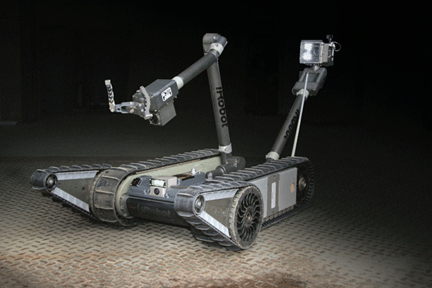
Where are the jobs? A question surely prompted by the revelation by New CivilEngineeri that NWS chief technical officer John Corderoy recently claimed that the organisation might build a future Geological Disposal Facility operated solely by an army of robots.
Due to become operational by the late 2050s, but this is a moveable feast, the GDF will be the final repository for Britain’s high-level legacy and future radioactive waste. Three Areas of
Focus in West Cumbria are currently being examined by Nuclear Waste Services as prospective locations for an approximately 1km2 surface facility to receive waste shipments prior to their being taken below ground and out through tunnels to engineered vaults deep under the Irish Sea bed.
Advocates for the GDF have raised as an economic benefit the generational employment that the facility might provide for local people over its (possibly) 150-year lifespan, but in his speech to the Nuclear Industry Association annual conference last week, Mr Corderoy conceded that with the advancement in robotics it might be possible to build a facility ‘that’s fully automated and run by robots on the ground’.
This also makes the NFLAs wonder if that would include dispensing with a human armed police force to patrol the perimeter and check entrants in favour of an AI version, as we presaged in our article of 16 October 2024:
Although, as Mr Corderoy rightly indicated, such a plan would mean ‘we don’t have to put humans in harm’s way deep underground’, for Nuclear Waste Services it would also mean a
workforce which toils without payment and without any expectation of a workplace pension, and which does not require catering, medical or welfare facilities, carparking, protective clothing, lit or heated workspaces, holidays, maternity or paternity leave, or time off for
sickness (aside from an occasional recharge, oil or parts change, or annual MOT). All representing significant cost savings for NWS.
Nor would robots be discovered leaving work
early or engaging in toxic workplace behaviour, nor would they become embroiled in an industrial dispute with their employer; things that cannot be said about some of the human
workforce at Sellafield in recent years.
The industry trades unions will also be horrified; for not only would it mean that their members, facing redundancy after the closure of storage facilities at Sellafield, would not be
able to access alternate operational jobs at the GDF site, but it would mean a loss of income to help sustain the salaries of officials as robots do not pay union subs.
Geoffrey Hinton: They’re spending $420 billion on AI. It pays off only if they fire you.

So the business case for AI isn’t “AI will help workers be more productive.” It’s “AI will replace workers entirely, and we’ll pocket the salary savings.”
Tasmia Sharmin, Nov 2, 2025, Published in Predict.
Let me translate what Geoffrey Hinton just said, because it’s important and most people are going to miss it.
Geoffrey Hinton literally invented the neural networks that power modern AI. He won a Nobel Prize for it. And this week, he went on Bloomberg TV and said something that tech CEOs have been dancing around for months:
Tech companies cannot profit from their AI investments without replacing human workers.
Not “might replace.” Not “could eventually replace.” Cannot profit without replacing.
That’s not a prediction. That’s him explaining the business model.
What He’s Actually Saying
Here’s Hinton’s point in plain English:
Tech giants are spending $420 billion next year on AI infrastructure. Microsoft, Meta, Google, Amazon. They’re building data centers, buying AI chips, training massive models.
That money only makes sense if AI replaces workers.
Think about it. If you spend $100 billion building AI systems, how do you make that money back?
You can’t just sell slightly better products. You need massive cost savings. And the biggest cost in any company is labor.
So the business case for AI isn’t “AI will help workers be more productive.” It’s “AI will replace workers entirely, and we’ll pocket the salary savings.”
Hinton is saying what everyone in Silicon Valley knows but won’t say publicly: the whole AI investment thesis depends on job elimination.
Why This Matters
When Amazon CEO Andy Jassy says the 14,000 layoffs are about “culture, ” Hinton is calling bullshit.
When tech companies say AI will “augment” human workers, Hinton is calling bullshit.
When they claim AI will create as many jobs as it destroys, Hinton, who literally invented this technology, is saying: I don’t believe that.
He told Bloomberg: “I believe that to make money you’re going to have to replace human labor.”
Not augment. Replace.
This is the guy who understands AI better than almost anyone on the planet. And he’s warning us that the tech industry’s entire AI strategy is built on eliminating jobs.
The Numbers Back Him Up
Since ChatGPT launched in November 2022, job openings have dropped 30%.
During that same time, the stock market went up 70%. So companies are doing great. Investors are happy. But jobs are disappearing.
Stanford research found that young workers (22–25) in AI-exposed fields saw employment drop 13% to 16%. Meanwhile, older workers in the same fields actually saw job growth.
What does that tell you?
Companies are replacing entry-level workers with AI while keeping experienced people for now.
The pattern is clear: AI isn’t creating a bunch of new jobs. It’s eliminating the bottom rungs of the career ladder.
What Hinton Sees That Others Won’t Say
Previous technological revolutions created jobs while destroying others. Cars eliminated horse-related jobs but created automotive manufacturing, gas stations, road construction, and suburbs.
Hinton thinks AI is different. He’s skeptical that AI will follow that historical pattern.
Why?
Because AI doesn’t just replace one type of job. It can potentially replace cognitive work across entire industries. Writing, analysis, coding, design, customer service, data entry, research, translation.
When factories automated, displaced workers could move to other sectors. When AI automates cognitive work, where do knowledge workers go?
Hinton doesn’t have an answer. Nobody does. And that’s what scares him.
The $420 Billion Question
Tech companies are projected to spend $420 billion on AI next year. OpenAI alone announced $1 trillion in infrastructure deals.
That is an insane amount of money.
The only way to justify spending that much is if you’re confident the returns will be massive . And the only way to get massive returns is through massive labor cost reduction.
Hinton is basically saying: look at the math. These companies aren’t investing hundreds of billions to make workers 10% more productive. They’re investing to eliminate positions entirely.
When a Bloomberg interviewer asked if AI investments could generate returns without job cuts, Hinton said he believes they can’t.
Think about what that means. The person who pioneered AI technology is telling you the business model requires job elimination. And companies are investing as if he’s right.
Why Amazon’s “Culture” Excuse is Bullshit
This week, Amazon fired 14,000 people. CEO Andy Jassy said it’s about culture and organizational layers, not AI.
But back in June, Jassy wrote a memo saying Amazon would need “fewer people doing some of the jobs that are being done today” because of AI efficiency gains.
So which is it, Andy?
Hinton is cutting through the corporate speak.
He’s saying: of course it’s about AI. The entire industry is betting on AI replacing workers. Stop pretending otherwise.
Amazon is just the first major wave. More are coming.
The Healthcare and Education Exception
Hinton isn’t totally pessimistic. He admits AI will have benefits in healthcare and education.
AI can help doctors diagnose diseases, analyze medical images, personalize treatment. It can help students learn at their own pace, provide tutoring, make education more accessible.
But even there, it’s not all upside.
Better diagnostic AI means you need fewer radiologists. Better educational AI means you need fewer tutors and teaching assistants.
The benefits are real. But so is the job displacement.
The Real Problem Hinton Identifies
Here’s the most important thing Hinton said, and most people will miss it:
The problem isn’t AI itself. It’s how we organize society.
Right now, we live in a system where most people need jobs to survive. Income comes from employment. No job means no money, no healthcare, no security.
So when AI eliminates jobs, that’s catastrophic for individuals even if it’s profitable for companies.
Hinton is pointing out that our entire social structure assumes full employment. When that assumption breaks, the system breaks.
Unless we restructure how society works, how wealth is distributed, and how people access resources, AI-driven job displacement creates a crisis.
What Makes This Warning Different
Lots of people warn about AI and jobs. But most of them are outside the industry, or they’re critics, or they’re trying to sell you something.
Hinton is different. He’s not some Luddite afraid of technology. He invented this technology. He won a Nobel Prize for work that made modern AI possible.
And he quit Google specifically so he could speak freely about AI risks without it reflecting on his employer.
When the person who created the technology warns you about its consequences, you should probably listen.
The Uncomfortable Truth
Here’s what Hinton is really saying, stripped of all politeness:
Tech companies are spending hundreds of billions on AI. That investment only pays off if they fire massive numbers of workers and pocket the salary savings. They know this. Their business plans depend on it.
Everything else, all the talk about augmentation and productivity and creating new jobs, is PR.
The actual business model is: build AI, replace workers, increase profits.
And unless society fundamentally changes how it works, this is going to devastate a lot of people while making shareholders very rich.
My Take
I think Hinton is right, and it’s terrifying that he’s right.
The math is simple. Companies are investing too much money in AI for the returns to come from anything other than large-scale job replacement. The spending only makes sense if the plan is to eliminate positions.
And they’re not going to admit that’s the plan until it’s already happening.
We’ll keep hearing about culture changes and organizational efficiency and digital transformation. But the reality is what Hinton described: companies betting on AI to replace human labor because that’s where the money is.
The scary part isn’t that one guy thinks this. The scary part is that he invented the technology, understands it better than almost anyone, and he’s warning us that the people building AI are building it specifically to replace jobs.
We should probably pay attention!!!
Do you think Hinton is right? Can tech companies make back their AI investments without massive job cuts? Or is he just stating the obvious that everyone else is too polite to say?
Because if he’s right, and I think he is, we’re not preparing for what’s coming. We’re still pretending this is about productivity tools and augmentation while companies are quietly planning for something much more disruptive.
Health Care Workers Spoke Out for Their Peers in Gaza. Then Came Backlash.
Medical institutions are silencing their staff and impeding efforts to build solidarity with medical workers in Gaza.
By Marianne Dhenin , Truthout, November 17, 2025
handra Hassan, an associate professor of surgery at the University of Illinois Chicago (UIC) College of Medicine, spent three weeks in Gaza in January 2024, treating patients who had survived tank shelling, drone strikes, and sniper fire amid Israel’s ongoing genocide. When Nasser Hospital in Khan Younis came under siege, Hassan and the MedGlobal doctors he was serving with were forced to flee. “We were evacuated when they bombed just across the street from the hospital [and] tanks were rolling in,” Hassan told Truth
When Hassan returned home to Chicago, he was eager to share his experiences and advocate for an end to Israel’s assault on Gaza, which has killed an estimated 68,000 Palestinians since October 2023. Among the dead are over 1,500 health care workers, including doctors and nurses Hassan worked alongside.
But instead of being welcomed like he had been after previous missions to conflict zones in Ukraine and Syria, Hassan soon found himself on the receiving end of a doxxing and harassment campaign. StopAntisemitism, a pro-Israel group that doxxes people it accuses of antisemitism, shared screenshots of some of Hassan’s LinkedIn posts to its X account. Hassan said his employer received around 1,500 emailed complaints the day StopAntisemitism posted his information.
“I was speaking up for the human rights of Palestinians [because] it’s like, you’re witnessing another genocide, you need to talk about it,” Hassan told Truthout. But StopAntisemitism “put my picture, and they wrote that I’m [an] antisemite.”
Hassan is one of more than 15 health care workers in eight states who told Truthout they faced silencing, harassment, or workplace retaliation for Palestine-related speech, including giving a talk on health issues in Palestine, endorsing statements condemning the killing of health care workers in Gaza, or wearing a keffiyeh or other symbols of Palestine solidarity at work. Many said they felt that their hospitals, clinics, or professional societies had become increasingly hostile working environments since October 2023.
The experiences that health care workers shared suggest that organized campaigns of complaints and harassment from pro-Israel groups against health care workers have intensified, and that anti-Palestinian racism is entrenched across health care institutions nationwide. In a 2024 survey, the Institute for the Understanding of Anti-Palestinian Racism (IUAPR) also found widespread anti-Palestinian racism in health care: More than half of the 387 health care provider respondents “reported experiencing silencing, exclusion, harassment, physical threat or harm, or defamation while advocating for Gaza and/or Palestinian human rights.” Half said they were “afraid to speak out.”
Many of those who spoke to Truthout shared that fear and expressed concerns for their patients and profession: “The reality on the ground is that racism is running unchecked throughout our medical institutions, and as a result, health care workers don’t have the training they need, accountability is not happening at the level of the medical institutions, and our communities are not being served,” Asfia Qaadir, a psychiatrist specialized in trauma-informed care for BIPOC youth, told Truthout. “Racism is about erasure, and ultimately, our patients are paying the price.”
A Pattern of Censorship……………………………..
Furloughing Workers for Armageddon: Trump, Nuclear Weapons and the NNSA
To maintain and reproduce an arsenal of mass death and thanatotic desire, you need people of suspended moral principles. “Oversight matters,” Plonski remarks. “Reducing the federal workforce means increased risk in ensuring the reliability and safety of our nuclear stockpile.”
30 October 2025 Dr Binoy Kampmark, https://theaimn.net/furloughing-workers-for-armageddon-trump-nuclear-weapons-and-the-nnsa/
Instead of satirising nuclear war – a possible if difficult thing to do – the time has come to satirise the laying off and furlough of those who solemnly monitor and maintain such machinery fit, not for preserving life so much as ending it at a fiery, radiated terminus. If it’s not possible to totally disarm a nuclear inventory, it might be possible to reduce the forces behind them or render some idle. It turns out that this is happening in Freedom’s Land itself, the United States of America.
Those responsible for maintaining the US nuclear weapons arsenal have not been having the best of years. In February, President Donald Trump signed an executive order directing the heads of agencies to “promptly undertake preparations to initiate large-scale reductions in force, consistent with applicable law.” This was part of the now infamous Department of Government Efficiency Workforce Optimization Initiative. Within a few days, 300 employees at the National Nuclear Security Administration (NNSA), located within the Department of Energy, were fired. Prior to that, it had 2,000 staff and 55,000 contractors at its disposal.
The NNSA describes, as one of its “core missions” ensuring that the US “maintains a safe, secure, and reliable nuclear stockpile through the application of unparalleled science, technology, engineering, and manufacturing.” Easy to forget, on reading this, that we are not talking about agricultural supplies or lifesaving medicines, but over 3,000 nuclear warheads and ongoing production specific to that agency. “The Office of Defense programs,” the description goes on to say, “carries out NNSA’s mission to maintain and modernize the nuclear stockpile through the Stockpile Stewardship and Management System.”
NNSA deputy division director, Rob Plonski, was understandably upset that his citadel was being thinned. Ego, reputation and prowess in the nuclear field was at stake. “We cannot expect to project strength, deterrence and world dominance while simultaneously stripping away the federal workforce,” he moaned in a post on LinkedIn. He would have taken heart by the subsequent rescinding of the termination decision for all but 28 of the staff by NNSA acting director Teresa Robbins.
Trump, on the other hand, was having one of his more lucid moments, telling reporters on February 13 that nuclear forces should not be exempt from budgetary trimming. “There’s no reason for us to be building brand-new nuclear weapons. We already have so many, you could destroy the world 50 times over, 100 times over.” Daryl Kimball, executive director of the Arms Control Association, was having none of that. DOGE employees, he charged, were storming “in with absolutely no knowledge of what these departments are responsible for.” They barely realised that the purge was less to do with the Department of Energy than “the department of nuclear weapons.”
In October, the NNSA was again revisited by crisis, with the decision to furlough 1,400 employees due to that event distinct to US politics, the government shutdown. Till that point, the shutdown had lasted almost three weeks, with the Senate failing to pass a continuing resolution bill since October 1. Only 400 essential employees are being retained, labouring in patriotic sweat without pay. A spokesperson for the DOE explained that they would be working “to support the protection of property and safety of human life.”
Since its creation in 2000, the agency has had few such hiccups. “This has never happened before,” noted Energy Secretary Chris Wright during a news conference at the Nevada National Security Site on October 20. “This should not happen.” Wright, however, spoke of pursuing “creative ways” in paying the vast number of contractors, at least till the end of October.
Particular concern centres on the Pantex plant in Texas, the assembly and disassembling site for nuclear weapons, and the Y-12 National Security Complex in Tennessee, responsible for, according to the DOE, the retrieval and storage of nuclear materials, fuelling of naval reactors, and the performance of “complementary work for other government and private-sector entities.”
The NNSA had tried to argue that money be made available from previously passed spending bills to prevent the furlough. A DOE spokesperson proved icy in remarking that, “While the administration was able to identify funds to keep NNSA weapons laboratories, plants, and sites operating with our contractors, legal and budgetary limitations required the administration to begin furloughing NNSA federal employees.”
Therein lies the problem. To maintain and reproduce an arsenal of mass death and thanatotic desire, you need people of suspended moral principles. “Oversight matters,” Plonski remarks. “Reducing the federal workforce means increased risk in ensuring the reliability and safety of our nuclear stockpile.” With the support of 26 lawmakers, Rep. Dina Titus (D-Nev.) in her October 23 letter to Wright and NNSA administrator Brandon Williams similarly argued that the federal employees in question “play a critical oversight role in ensuring that the work required to maintain nuclear security is carried out in accordance with long-standing policy and the law.” Trump has also been fuzzy on the matter of nuclear weapons, acknowledging the nonsense of increasing the pile, yet simultaneously wanting tighter deadlines to deliver ever more modern weapons to the Pentagon.
This fantastically confused state of affairs throws up an interesting question: Why not turn the attention to reducing the stockpile itself and pause the euphemistically named modernisation process? A slimmer, sharper workforce for a more diminished, manageable arsenal of death that should never be used in any case. The National Security State remains, however, a tough, insatiable customer.
Nuclear construction workers plan third strike.
Construction workers employed by contractors at a nuclear site are to go
on strike for a third time in two months in a dispute over pay. Unite
members at Sellafield in Cumbria will take action from Monday until 2
November after previously striking earlier in October and for four days in
September.
The union said it was because construction workers at other
nuclear projects received pay premiums that contractors at Sellafield did
not match. Sellafield Ltd said it did not directly employ those taking part
in the action but “safety and security” would continue to be its priority
throughout the strike.
BBC 24th Oct 2025,
https://www.bbc.co.uk/news/articles/cwy16l08eldo
Trump Furloughs Top Nuclear Weapons Staff (What Could Go Wrong?)

The workers responsible for protecting the U.S. nuclear arsenal are now being furloughed.
Robert McCoy, October 21, 2025, https://newrepublic.com/post/202015/trump-furloughs-nuclear-weapons-staff-shutdown
The government’s nuclear watchdog agency is poised to be understaffed, as Politico reports the Trump administration has placed about 80 percent of its personnel on furlough amid the ongoing government shutdown.
The National Nuclear Security Administration is a semiautonomous agency within the Department of Energy that maintains the U.S. nuclear stockpile, responds to nuclear emergencies domestically and abroad, and works to prevent nuclear proliferation globally. The NNSA’s staff of fewer than 2,000 workers oversees about 60,000 contractors.
On Monday morning, the administration sent out furlough notices to about 1,400 employees, Politico reports, leaving just 375 staff members on the job for the time being. This is an unprecedented action in the agency’s 25-year history.
Last week, when the then-impending cuts were first reported, Energy Secretary Chris Wright called the workers “critical to modernizing our nuclear arsenal.”
This is just the latest controversial NNSA staffing news to come out of the second Trump administration. The agency previously faced scrutiny for terminating hundreds of workers at the behest of President Trump’s Department of Government Efficiency, before scrambling to rehire some of them as Wright confessed he’d “made mistakes” and moved “a little too quickly.”
Desperately seeking submariners: why keeping nuclear-powered boats afloat will be Australia’s biggest Aukus challenge.
Ben Doherty, Guardian, 21 Oct 25
A vast and highly trained workforce is needed to command, crew, supply and maintain nuclear submarines. Some say that’s impossible for Australia.
“Vice-Admiral Mead, you’re free to go home … good to see you cracking a smile.”

The head of the Australian Submarine Agency had spent a withering three hours before Senate estimates, parrying a barrage of questions about Australia’s ambitious Aukus nuclear submarine plan: interrogatives on consultants, on hundreds of millions of dollars sent to US and UK shipyards, on sclerotic boat-building on both sides of the Atlantic.
But while so much focus has been on Australia’s nuclear submarines’ arrival, their price tag and their “sovereign” status, the greatest challenge to the Aukus project, Mead told the Senate, would be finding the people to keep them afloat and at sea.
“Ensuring Australia has the workforce to deliver this program remains our biggest challenge,” he said.
If Australia’s nuclear submarines arrive on these shores – and that remains a contested question, with expert opinion ranging from an absolute yes to a certain no – will Australia be able to crew, supply and maintain them?
“It is a challenge we are continuing to meet,” Mead told senators. “Australian industry and navy personnel continue to build critical experience through targeted international placements.”
Others are less sanguine.
“The Aukus optimal pathway is a road to a quagmire,” says a former admiral and submarine commander, Peter Briggs, arguing that Australia’s small submarine arm can’t be upscaled quickly enough. “It’s not going anywhere. It will not work.”
Onshore trades, too, are perilously short. Without an additional 70,000 welders by 2030, that trade’s peak body says: “The Aukus submarine program is at serious risk of collapse.”
Mead was asked directly by senators: “Are you still confident of meeting the government’s agenda and timings?”
“Yes,” he replied, “I am.”
‘An eye-wateringly long process’
Briggs, a past president of the Submarine Institute of Australia, says the Aukus plan reads like one “designed by a political aide in a coffee shop”.
The navy’s submarine arm is approximately 850 sailors and officers (the defence department declined to give exact figures). The former chief of navy previously told parliament it needed to grow to 2,300 by the 2040s.
But Briggs estimates that to crew and support Australia’s Virginia-class, and later, Aukus-class submarines, the navy will need to more than treble its existing complement to about 2,700.
Virginias are massive submarines – nearly 8,000 tons – and carry a crew of 134, more than twice the existing Collins-class crew of 56. The Aukus submarines to be built in Adelaide will be bigger again. More tonnage, more people.
“That’s a huge increase in what is already in very scarce supply,” Briggs argues…………………………………………………………
The new generation of submariners is needed for between three and five Virginia-class submarines, then up to eight Australian-built Aukus boats.
“To get to be chief engineer of a nuclear submarine takes 16 to 18 years,” Briggs says. “It’s an eye-wateringly long process and of course you lose people along the way.
“That’s why you need a broad base, a critical mass, and Australia simply doesn’t have that right now. There is no way a navy the size of ours can manage this mix.”
Briggs does not believe the US will withdraw from Aukus: the presence of nuclear submarine bases on Australian soil is too great a prize for a superpower wanting to project power into the Pacific. But Australia’s unreadiness could lead to nuclear submarines under domestic command being delayed.
“We’ve got no warranty clause, no guarantee of anything. The cop-out could come in 2031, the US might say, ‘Look, you’re not quite ready yet, let’s push everything back three years, check in again in 2034.’ And it’s Australia that’s left exposed.”
‘Beyond frustrating, it’s dangerous’
Beyond the complexity of commanding and crewing a nuclear submarine, the vessels need a vast and highly trained workforce to keep them supplied, afloat and at sea………………………………………………………………………
“This is not just a workforce challenge,” its chief executive, Geoff Crittenden, said in a statement. “It’s a full-blown capability crisis … If we don’t address this issue now, Aukus will fail.”
Aukus represented a “perfect storm”, he said, and failure to address worker shortages was “beyond frustrating, it’s dangerous”.
“A once-in-a-generation opportunity like Aukus demands a long-term, strategic response, not just investment in ships and steel, but in people. We estimate that Australia will be at least 70,000 welders short by 2030. Without immediate action, the project is doomed to delays, cost blowouts, or worse.”…………………………………………………………………………
The first cohort won’t be Australian. “In the short term there will have to be an influx of international talent, as we train and upskill our own people.”
Tier two is a nuclearised workforce of skilled professionals – scientists, electrical and mechanical engineers, technical managers, reactor operators and health physicists – with advanced training and between seven and 10 years’ experience. The majority of a submarine crew would sit in this tier. Obbard estimates that about 5,000 tier-two workers will be needed.
Tier three is a further cohort of “nuclear-aware” workers – between 5,000 and 6,000 again – tradespeople including machinists, fitters and welders, who will require some nuclear training.
“The Aukus plan cannot work without building this workforce and the wider engineering community this workforce is drawn from.”
Does it make sense?’
Jack Dillich is uniquely placed to observe Australia’s transformation to a nuclear submarine power. A former submarine officer, he holds an advanced degree in nuclear engineering and served on the executive of the Australian Nuclear Science and Technology Organisation, where he was responsible for the country’s sole nuclear reactor, and as head of the regulatory branch at the Australian Radiation Protection and Nuclear Safety Agency. He now teaches a nuclear course at the Australian Defence Force Academy………………………………….
[Dillich says] Australia needs to be asking, ‘Does it make sense to try to build a tiny fleet here?’ Maybe 25 years from now, Australia could have eight nuclear-propelled submarines: they would be very, very expensive.”……………………………..https://www.theguardian.com/australia-news/2025/oct/20/aukus-submarine-workforce-nuclear-powered-boats-australia
Key US nuclear agency to send 80% of workforce home as shutdown drags on.
About 1,400 staff at NNAS, which manages America’s nuclear weapons stockpile, to be furloughed on Monday
Joseph Gedeon , 18 Oct 25, https://www.theguardian.com/us-news/2025/oct/17/government-shutdown-nuclear-agency-nnsa
The agency that maintains the US nuclear arsenal will be sending home 80% of its workforce as the government shutdown drags through its 17th day and into the weekend, now the longest full funding lapse in US history.
House armed services committee chair Mike Rogers said in a Friday press conference that the National Nuclear Security Administration has now exhausted its carryover reserves.
“We were just informed last night that the National Nuclear Security Administration, the group that manages our nuclear stockpile, that the carryover funding they’ve been using is about to run out,” said Rogers, a Republican from Alabama. “These are not employees that you want to go home. They’re managing and handling a very important strategic asset for us.”
The NNSA, which operates as part of the department of energy, does not directly control operational nuclear weapons – a Pentagon responsibility – but plays a strategic role in keeping warheads secure and functional without conducting explosive tests. The agency also runs non-proliferation programs aimed at preventing nuclear materials from reaching hostile nations or terrorist organizations.
Around 1,400 NNSA employees will be furloughed without pay starting on Monday, leaving only 375 staff members designated as essential to continue working, according to an agency notice obtained by Politico. A department of energy spokesperson confirmed the approximate workforce numbers.
The spokesperson also said that NNSA’s office of secure transportation, which is responsible for transporting government-owned nuclear material across the country, is funded through 27 October, and added that Chris Wright, the energy secretary, will be at the NNSA site in Las Vegas on Monday to “further discuss the impacts of the shutdown on America’s nuclear deterrent.
Under the agency’s 2025 contingency protocols in the event of a shutdown, the skeleton crew on duty will focus exclusively on hyperspecific safety operations: monitoring nuclear materials, maintaining unique equipment, ensuring reactor safety for navy vessels, and continuing international nonproliferation work it deems essential for security.
But most scientific research, stockpile maintenance, and global security programs will be suspended, potentially creating delays in sensitive national defense projects that need rigid and consistent oversight.
The current impasse has now become the longest complete government-wide shutdown in US history, surpassing a 16-day funding lapse in 2013. Previous lengthier shutdowns affected only portions of the federal government.
Speaker Mike Johnson blamed Senate Democrats for the crisis, saying earlier this week the country is “barreling toward one of the longest shutdowns in American history, unless Democrats drop their demands”. Republican leaders are also now worried about potential airport disruptions during the upcoming Thanksgiving travel period if the stalemate continues.
Hundreds of thousands of federal employees, including congressional and agency staffers, remain either furloughed or working without pay.
1 This Month

of the week – Shut Down Drone Warfare!


Tell the Ukrainian Government to Drop Prosecution of Peace Activist Yurii Sheliazhenko

Petition to revoke the licensing of the Near Surface Nuclear Disposal Facility (NSDF) at Chalk River. https://www.ourcommons.ca/petitions/en/Petition/Details?Petition=e-7247
To see nuclear-related stories in greater depth and intensity – go to https://nuclearinformation.wordpress.com
-
Archives
- March 2026 (237)
- February 2026 (268)
- January 2026 (308)
- December 2025 (358)
- November 2025 (359)
- October 2025 (376)
- September 2025 (257)
- August 2025 (319)
- July 2025 (230)
- June 2025 (348)
- May 2025 (261)
- April 2025 (305)
-
Categories
- 1
- 1 NUCLEAR ISSUES
- business and costs
- climate change
- culture and arts
- ENERGY
- environment
- health
- history
- indigenous issues
- Legal
- marketing of nuclear
- media
- opposition to nuclear
- PERSONAL STORIES
- politics
- politics international
- Religion and ethics
- safety
- secrets,lies and civil liberties
- spinbuster
- technology
- Uranium
- wastes
- weapons and war
- Women
- 2 WORLD
- ACTION
- AFRICA
- Atrocities
- AUSTRALIA
- Christina's notes
- Christina's themes
- culture and arts
- Events
- Fuk 2022
- Fuk 2023
- Fukushima 2017
- Fukushima 2018
- fukushima 2019
- Fukushima 2020
- Fukushima 2021
- general
- global warming
- Humour (God we need it)
- Nuclear
- RARE EARTHS
- Reference
- resources – print
- Resources -audiovicual
- Weekly Newsletter
- World
- World Nuclear
- YouTube
-
RSS
Entries RSS
Comments RSS
 nuclear-news