Safety fears as external power to Zaporizhzhia nuclear plant still out after three days

Guardian, 27 Sept 25 https://www.theguardian.com/world/2025/sep/27/safety-fears-as-external-power-to-zaporizhzhia-nuclear-plant-still-out-after-three-days
Ukrainian officials among those concerned Russia is manufacturing crisis to keep hold of frontline plant
External power to the Russian-occupied Zaporizhzhia nuclear plant has been cut for more than three days, a record outage that has prompted safety concerns over the six-reactor site on the frontline of the Ukraine war.
Emergency generators are being used to power cooling and safety systems after the final power line into the plant was cut on the Russian side at 4.56pm on Tuesday and there is no immediate sign that the line will be reconnected.
Rafael Grossi, the director general of the International Atomic Energy Agency (IAEA), described the situation as “deeply concerning” on Wednesday and met Vladimir Putin on Thursday but the situation has continued.
Western experts and Ukrainian officials fear the Kremlin is manufacturing a crisis to consolidate its grip over the plant, which is Europe’s largest, and that Russia is taking high-risk steps to turn on at least one reactor despite the wartime conditions.
“Russia is using the nuclear power station as a bargaining chip,” said one Ukrainian government official, while a specialist at Greenpeace said the Russian occupation had entered “a new critical and potentially catastrophic phase”.
Stress tests by European regulators after the 2011 Japanese reactor disaster at Fukushima indicated that a nuclear plant should be able to operate without external power for 72 hours. Going beyond that time limit is untried, Ukrainian sources said.
Russia seized the Zaporizhzhia nuclear plant in March 2022 and its reactors, once capable of powering 4m homes, were put into cold shutdown for safety.
Ukraine regards the nuclear plant as its own but the plant has cropped up in negotiations between Donald Trump and Putin. Trump has tried to suggest the US should to take control, while the Kremlin has said it wants to restart all the reactors and connect them to the Russian grid – a task considered feasible only during peacetime.
External power has been lost at Zaporizhzhia nine times before. On each occasion the damage was done in Ukrainian-held territory by Russian forces striking energy infrastructure across the Dnipro. The final 750-kilovolt electricity line had run across the river, with Ukraine willing to supply energy to maintain safety.
On Tuesday the line was damaged on the Russian side, about a mile from the plant. The plant’s Russian operators said repair efforts were “complicated by ongoing shelling by the Ukrainian armed forces”, though Ukraine says it never fires at or around the plant, arguing it would be unacceptably risky.
The IAEA said it had been told by the Russian operators that there was enough diesel to power the generators for 20 days without fuel resupply. But Grossi said loss of external power “increases the likelihood of a nuclear accident”.
Seven out of 18 available generators are powering cooling on site but if they were to fail, Ukrainian sources said, there would be a risk that the nuclear fuel in the six reactors would heat uncontrollably over a period of weeks, leading to a meltdown.
An accelerated version of this scenario happened at Fukushima because the reactors had just been operating. A 9.0-magnitude earthquake struck Japan and the hot reactors on the site were automatically shut down in response. Emergency generators continued to pump cooling water around the reactor but these were knocked out by a tsunami that followed minutes later. Three nuclear cores at the plant melted down within three days, though the fuel remained contained. Nobody was killed [?] but more than 100,000 were evacuated.
Zoom Nuclear Waste Scholar Series: The Body is an Archive: Unearthing Hidden Histories of Radiation and Public Trust Through Baby Teeth

Date & Time
Oct 4, 2025 05:00 AM in Etc/GMT-10 https://us02web.zoom.us/webinar/register/WN_Fn65SAKXRkWuWzmUfA4FKw#/registration
Description
What can a child’s tooth reveal about history, risk, and trust in science? In his talk on Fri, October 3 at noon PT, Professor Jeffrey Sanders will trace how the St. Louis Baby Tooth Survey turned thousands of donated teeth into powerful evidence that Cold War nuclear fallout was entering children’s bones—evidence that helped secure the 1963 Nuclear Test Ban Treaty. He follows the surprising afterlives of this archive, from rediscovery in a New Jersey garage to cutting-edge research today that uses lasers to link early exposures to later health effects. Along the way, he asks enduring questions about science, activism, and public trust: Who gets to measure risk, control knowledge, and decide what stories our bodies can still tell?
The Real Violent Extremists Are The Freaks Who Run The US Empire
Caitlin Johnstone, Sep 26, 2025, https://www.caitlinjohnst.one/p/the-real-violent-extremists-are-the?utm_source=post-email-title&publication_id=82124&post_id=174612556&utm_campaign=email-post-title&isFreemail=true&r=1ise1&triedRedirect=true&utm_medium=email
The real violent extremists are the oligarchs and imperialists who run the US-centralized empire from both mainstream parties.
Not Antifa. Not trans people. Not anti-genocide activists. Not protesters against ICE.
The extremists who are inflicting the real violence and abuse in our world are the ones committing genocide, starting wars, backing blockades, imposing starvation sanctions, arming proxy conflicts, circling the planet with hundreds of military bases, and flirting with nuclear armageddon.
Donald Trump is a violent extremist. Joe Biden is a violent extremist. Keir Starmer is a violent extremist. Benjamin Netanyahu is a violent extremist.
Oligarchs who knit themselves into the murderous imperial power structure like Jeff Bezos, Elon Musk, Peter Thiel, Miriam Adelson and Larry Ellison are violent extremists.
The Democratic Party is a violent extremist organization. The Republican Party is a violent extremist organization.
War profiteers like Raytheon, Lockheed Martin and Northrop Grumman are violent extremist organizations.
Empire management firms which facilitate imperial violence and control like Palantir, Oracle and Starlink are violent extremist organizations.
There is no designated terrorist group foreign or domestic which can hold a candle to the death toll and human suffering that has been inflicted by the western empire.
I think it’s worth remembering this as the empire harnesses the emotional hysteria around Charlie Kirk’s death to whip up a moral panic about violent radical leftists in the United States in order to justify increased authoritarian measures to stomp out political dissent. The real violence is coming from the powerful manipulators who want you consenting to these measures. The call is coming from inside the house.
The US and its allies have killed millions of people in their wars of aggression since 9/11, and displaced tens of millions. Their cruel sanctions have killed tens of millions since 1970. Their policies of imperialist extraction force populations throughout the global south to live lives of endless poverty and toil. They are currently perpetrating a genocide in full view of the entire world.
These are the violent extremists. The only reason they are able to claim that some kid wearing a keffiyeh or a balaclava is a violent extremist while they themselves are not is because they control the narrative. The plutocrats who benefit from the imperial status quo own and control the media platforms and information systems which people use to learn about the world, and they use this narrative control to frame the imperial status quo as normal and any opposition to it as freakish extremism.
That’s the only reason a westerner who supports genocide, warmongering, militarism and imperialism gets to call themselves a “centrist” or a “moderate”. They live in an empire whose propagandists actively normalize imperial abuses while spinning any deviation from this violent madness as abnormalities on the radical political fringe.
But it’s a lie. Genocide is violent extremism. Mass murder is violent extremism. Siege warfare is violent extremism. Global tyranny is violent extremism.
Peace is moderate and normal. Justice is moderate and normal. Health is moderate and normal. Equality is moderate and normal. Equitable wealth and resource distribution is moderate and normal.
The genocidal, ecocidal, omnicidal nightmare we see before us in our world today is what it looks like when the violent extremists are in charge.
Putin just gave Trump the opportunity to maintain nuclear restraint. Will he seize it?
Bulletin, By Matthew Bunn | September 25, 2025
President Donald Trump has an opportunity to avoid the dangers of an unrestrained nuclear arms competition—something he has repeatedly warned about. New START, the last treaty limiting US and Russian nuclear arms, expires this coming February. This happens as China is engaged in a rapid nuclear buildup, Russia is building exotic new nuclear delivery systems and rattling its nuclear saber over the war in Ukraine, and North Korea continues its smaller but still frightening nuclear expansion with weapons now able to reach the continental United States.
To deter all these threats at once, many people in Washington are arguing that the United States should leap past the New START limits when the treaty expires, adding hundreds or even thousands of additional nuclear warheads. That, however, would mean a world with no limits at all on strategic nuclear forces for the first time in half a century. A US nuclear buildup, coupled with growing US missile defenses, would likely provoke still further buildups in Russia and China, leading to all the unpredictability and risk of a nuclear competition with no agreed limits.’But Russian President Vladimir Putin has just opened an opportunity to avoid that, at least for now.
Speaking at a meeting of his advisory Security Council on Monday—only hours ahead of the UN General Assembly in New York—Putin announced that “Russia is prepared to continue adhering to the central quantitative limitations of the New START treaty for one year.” He added that the offer stands as long as the United States does the same and does not take other steps “that undermine or disrupt the existing balance of deterrence potentials.” This is an important reversal. Putin has repeatedly rejected arms control talks throughout the war in Ukraine.
President Trump should quickly take Putin’s offer, while pushing Russia to also accept a return to on-site inspections and data exchanges. The president should then use that “pause” with limits still in place to explore what new accords might look like, in discussions with Russia, China, and potentially other nuclear powers…………………………………………………………………………………………………… https://thebulletin.org/2025/09/putin-just-gave-trump-the-opportunity-to-maintain-nuclear-restraint-will-he-seize-it/
Trump administration plans nearly $6B in arms sales to Israel: Report

By Michelle Price, The Associated Press and Matthew Lee, The Associated Press. Sep 20, 2025
The Trump administration has told Congress it plans to sell nearly $6 billion in weapons to Israel, a fresh surge of support for the U.S. ally as it faces increasing isolation over its war in Gaza.
It includes a $3.8 billion sale for 30 AH-64 Apache helicopters, nearly doubling Israel’s current stocks, and a $1.9 billion sale for 3,200 infantry assault vehicles for the Israeli army, according to a U.S. official and another person familiar with the proposal who spoke on condition of anonymity to discuss plans that have not been made public.
The weapons would not be delivered for two to three years or longer.
The huge sales come as U.S. plans to broker an end to the nearly two-year war between Israel and Hamas have stalled and after Israel’s strike on Hamas leaders in Doha, Qatar, drew widespread condemnation among U.S. allies in the Middle East.
The U.S. has kept up its support despite growing international pressure on Israel and attempts from a growing number of U.S. Senate Democrats to block the sale of offensive weapons to Israel.
The State Department declined to comment on the sales, which were first reported by The Wall Street Journal.
Israel has launched a new offensive, pressing forward with plans to take over Gaza City, as a professional organization of scholars studying genocide has said Israel is committing genocide in Gaza.
The U.K, which last year said it was suspending exports of some weapons to Israel out of concerns they could be used to violate international humanitarian laws, recently barred Israeli government officials from attending the country’s biggest arms fair.
Turkey also said it was closing its airspace to Israeli government planes and any cargo of arms for the Israeli military, and Italian Prime Minister Giorgia Meloni in a speech condemned Israeli attacks on Gaza as disproportionate.
Trump said Friday that he plans to meet Turkish President Recep Tayyip Erdogan in Washington next week, with plans to discuss the purchases of Boeing aircraft and a deal for F-16 fighter jets.
The Biden administration paused a shipment of 2,000-pound bombs to Israel over concerns about civilian casualties, but Trump lifted that hold when he took office in January.
The Trump administration has already approved about $12 billion in major military assistance to Israel this year. Most recently, the U.S. in June approved a half-billion-dollar arms sale to Israel to resupply its military with bomb guidance kits for precision.
This latest request from the Trump administration was sent to Congress about a month ago.
The amount of the $6 billion package was confirmed by two other people familiar with the matter and granted anonymity to discuss it because the plans were not public.
Congress routinely conducts informal reviews of such arms sales at the committee level, sending the requests back to the State Department for the more formal process.
These sales are part of a 10-year agreement between the U.S. and Israel that is nearing its end.
Price reported from Porto, Portugal. Associated Press writers Aamer Madhani and Lisa Mascaro contributed to this report.
Russia, Iran sign nuclear power plants deal as sanctions loom
Agreement between Rosatom and Iran targets energy expansion with eight new nuclear plants planned by 2040.
By Usaid Siddiqui and Reuters, 24 Sep 2025, https://www.aljazeera.com/news/2025/9/24/russia-iran-sign-nuclear-power-plants-deal-as-sanctions-loom
Russia and Iran have signed a memorandum of understanding on the construction of small nuclear power plants in Iran, according the Russian state nuclear corporation Rosatom, as Tehran has been engaged in a diplomatic push to avert new sanctions over its nuclear programme.
The agreement was signed by Rosatom chief Alexei Likhachev and Iran’s top nuclear official, Mohammad Eslami, on Wednesday at a meeting in Moscow. Rosatom described it as a “strategic project”.
Eslami, who is also Iran’s vice president, told Iranian state media earlier this week that the plan was to construct eight nuclear power plants as Tehran seeks to reach 20GW of nuclear energy capacity by 2040.
Iran, which suffers from electricity shortages during high-demand months, has only one operating nuclear power plant, in the southern city of Bushehr. It was built by Russia and has a capacity of approximately 1GW.
The development comes amid looming sanctions on Iran, after the United Nations Security Council voted on Friday not to permanently lift economic sanctions on Iran over its nuclear programme, meaning sanctions will return by September 28 if no significant deal is reached beforehand.
Russia was among four nations that voted to stop the sanctions from being reintroduced.
Iran pushed back against the UNSC vote, saying the resumption of sanctions would “effectively suspend” the country’s cooperation with the International Atomic Energy Agency (IAEA), the UN watchdog.
The vote followed a 30-day process launched in late August by the United Kingdom, France and Germany – known as the E3 – to reinstate sanctions unless Tehran meets their demands.
The E3 have accused Tehran of breaching its nuclear commitments, including by building up a uranium stockpile of more than 40 times the level permitted under a 2015 nuclear deal, from which Trump unilaterally withdrew in 2018, during his first term. The deal allowed Iran to enrich uranium up to 3.67 percent purity.
In its defence, Iran says it boosted its nuclear enrichment only after Trump withdrew from the deal and reimposed sanctions on the country. Tehran deems the US action a violation of the 2015 deal.
Iranian officials have accused the European trio of abusing the dispute mechanism contained in the 2015 Treaty on the Non-Proliferation of Nuclear Weapons (NPT), which allows for the application of sanctions under a “snapback mechanism”.
New sanctions would result in freezing of Iranian assets abroad, a halt in arms deals with Tehran, and penalise the development of ballistic missile programme, among other measures.
Iran has repeatedly denied pursuing nuclear weapons but affirmed its right to peacefully pursue nuclear energy. Addressing the United Nations General Assembly on Wednesday, Iran’s President Masoud Pezeshkian said Tehran would never seek a nuclear bomb.
On Tuesday, Iran’s Supreme Leader Ayatollah Ali Khamenei said Tehran will not directly negotiate with the United States over Iran’s nuclear programme, calling talks with the US “a sheer dead end”.
Tensions escalated this June, when Israel launched a 12-day war on Iran, with Israeli and US forces striking several nuclear facilities.
In move that could Bring in NATO, Spain joins Italy in Sending Rescue Ship for Sumud Gaza Aid Flotilla
INFORMED COMMENT, Juan Cole, 09/25/2025, https://www.juancole.com/2025/09/spain-rescue-flotilla.html
Ann Arbor (Informed Comment) – On Wednesday, the socialist government of Pedro Sánchez in Spain announced that it would dispatch a rescue ship to be in the vicinity of the 50 ships that make up the Sumud (steadfastness) flotilla aiming to provide humanitarian relief to the Gaza Strip. It joins Italy in this endeavor. This according to Carlos E. Cué and Miguel González at El Pais.
The Sumud has come under repeated Israeli drone fire. On Wednesday, Israeli drones dropped explosives in the vicinity of the ships moored off the island of Crete, but caused no damage or injuries.
Prime Minister Sánchez said from the UN General Assembly meeting in New York, “The government of Spain requires that international law be observed and that the right of our citizens to navigate the Mediterranean in conditions of security be respected. For this reason, tomorrow a Maritime Action vessel will depart [the base in Cartagena] with all the means of assisting the flotilla or of carrying out any rescue, if necessary.”
Israel has routinely violated the law of the seas by attacking ships in international waters. Spanish citizens are taking part in the Sumud flotilla, and Spain is saying they have the right to do so.
Some 82% of Spaniards categorize what Israel is doing in Gaza as a genocide, a massive proportion that demonstrates that Israel’s actions are condemned by large numbers of people on both the left and the right. But note that 85% of centrists and 97% of Spaniards on the left view the Gaza campaign as genocidal.
The Maritime Action ship is not intended to shoot down attacking Israeli drones or to defend the Sumud ships from being boarded by the Israeli military. It will, however, rescue any passengers that end up in the sea because of Israeli actions.
It should be underlined, however, that it is entirely possible that the Maritime Action vessel will come under Israeli fire, which would spark an enormous diplomatic and military crisis.
Spain and Italy are both NATO members, and Article 5 says that “an attack on one is an attack on all.” NATO invoked this principle after the September 11, 2001, al-Qaida attacks on New York City and Washington, D. C., which is why there were NATO troops in Afghanistan but not in Iraq, which the rest of NATO did not view as a belligerent.
Thus, if Israel attacks the Spanish escort ship, it could stir up a strong European reaction, and would put the Trump administration on the spot, since Trump will side with Israel against NATO.
Spain’s maritime action vessels can accommodate 80 passengers. They are also armed with a 76-millimeter gun, two machine guns, and a surveillance drone of their own. This one will have a crew of 50 and 8 medical staff.
Sanchez’s government reached out to Italy for coordination, and sought to add another country to the escort, such as Ireland.
For her part, Italian PM Giorgia Meloni, from a far right party, faced a national strike involving 500,000 people on Monday over her refusal to recognize a Palestinian state alongside France and Britain. She said Tuesday that she’d recognize Palestine if Hamas releases Israeli hostages and if the organization is excluded from any Palestinian government going forward. This position was the one taken by British Prime Minister Keir Starmer until Sunday, when he folded before the weight of sentiment among his back-benchers.
North Korea building nuclear weapon stockpile, says Seoul
North Korea is believed to have accumulated large quantities of
weapons-grade uranium, according to South Korea. Seoul’s Unification
Minister Chung Dong-young on Thursday cited an assessment that Pyongyang
possesses 2,000kg (about 4,400 pounds) of highly enriched uranium “at a
purity of 90 percent or higher”. If confirmed, the amount would also
signal a sharp increase in North Korea’s stockpile of nuclear material.
Intelligence provided by civilian experts reveals that North Korea is
operating four enrichment plants, he added.
Aljazeera 25th Sept 2025, https://www.aljazeera.com/news/2025/9/25/north-korea-building-nuclear-weapon-stockpile-says-seoul
SNP defence plans ‘risk EU and NATO membership’, analyst warns
Current SNP policy states that nuclear weapons would be removed from
Scotland ‘in the safest and quickest way possible’ after independence. A
defence analyst has warned the SNP’s current plans for defence risk
potential future EU membership, NATO relations and independence.
He also
stressed ditching nuclear would take “a minimum” of two decades. Edward
Arnold, a senior research fellow for European security within the
International Security department at the Royal United Services Institute
(RUSI), has said Scotland must avoid giving NATO a “massive headache” by
ditching nuclear – a move he said would, in turn, aggravate EU members.
Current SNP policy states that nuclear weapons would be removed from
Scotland “in the safest and quickest way possible” after independence. It
also states that Scotland would apply to join NATO and the European Union,
participating fully in the EU’s Common Security and Defence Policy.
However, Mr Arnold told The Herald NATO membership and the removal of the
Trident nuclear deterrent at Faslane are “completely incompatible”.
Herald 25th Sept 2025, https://www.heraldscotland.com/politics/westminster/25492447.snp-defence-plans-risk-eu-nato-membership-analyst-warns/
Britain recognises Palestine. Now what?
| Declassified, UK 25 Sept 25 This week, UK prime minister Keir Starmer announced that Britain has officially recognised the state of Palestine. The Labour government had previously said it would only use the threat of recognition to pressure Israel to agree to a ceasefire and allow aid into Gaza .This clearly didn’t work and, amid mounting public pressue, the UK joined the Canadian, Australian, and Portuguese governments in recognising Palestine based on 1967 borders. Foreign Office maps have now been updated to include Gaza and the West Bank as “Palestine” rather than the “Occupied Palestinian Territories”. Benjamin Netanyahu responded to the move with fury, vowing that a Palestinian state “will not happen” and claiming the move “endangers our existence and constitutes an absurd reward for terrorism”. The Israeli prime minister found sympathy in British circles, with Nigel Farage sending his condolences and Tory party leader Kemi Badenoch calling the move “absolutely disastrous”. But what does recognition actually mean? For starters, it will not mean that Palestinians have the right to defend themselves from Israel – a right that is apparently exclusively available to the Israelis. “Our position is clear”, wrote Starmer in Israeli media outlet Ynet. “The Palestinian state must be demilitarised. It will have no army or air force”. Israel will thus continue to control the land, sea, and air borders around Palestine, signifiying no meaningful change in the current status quo. The Palestinians will also be deprived of their right to self-determination, with Starmer stressing that “Hamas can have no future” in Palestine, including “no role in government” or security. So what is Britain actually recognising? As Ilan Pappé recently wrote in Declassified, “geographically recognising [Palestine in its current state] is tantamount to recognising a disempowered political entity stretching over less than 20 percent of the West Bank”. There are currently more than 800,000 Jewish settlers in the West Bank, with more settlements being approved by the Israeli government and extremist ministers pushing for annexation of the area. Gaza, meanwhile, has been razed to the ground. In these circumstances, Britain’s recognition of Palestine looks more like empty gesture politics than a statement of intent to change the material reality on the ground. Indeed, it is difficult to take Starmer seriously when the UK continues to arm Israel and send spy flights over Gaza, while refusing to impose a trade ban on products from illegal settlements. Rather than helping to bring a new Palestinian reality into being, then, Starmer appears to be recognising a cadaver that the UK government had a hand in killing. |
Nuclear choices
In an age of conflict and climate change, we must listen to the people of
Fukushima and Hiroshima.
In recent years, the threat of nuclear conflict
has resurfaced, non-proliferation movements are faltering, and climate
change and technological acceleration have created ever more complex
dangers. Russia is threatening to use its nuclear capabilities on the
battlefield, rogue states like North Korea are armed, and the future of
Iran’s nuclear programme is in the spotlight after the US-Israeli attacks
on its nuclear sites. Meanwhile, Britain stands alongside many other
developed countries in committing to new nuclear power stations to meet
energy demand and decrease the use of fossil fuels.
Nowhere is this nuclear
complexity clearer than in Japan, where the memory of nuclear war and the
danger of civil nuclear disaster sit firmly in the public consciousness.
Hiroshima and Fukushima are very different tragedies, yet they can both
tell us about our common future. Both offer lessons in how to recover
without forgetting, of how to renew without obscuring the enormity of what
has happened. As we confront the spectre of climate change, and the
transformation of our world by our own hands, that is perhaps the most
important message to carry with us.
New Humanist 25th Sept 2025 https://newhumanist.org.uk/articles/6459/nuclear-choices
UK Minister cites national security and public safety in dismissing 148-home scheme near nuclear weapons facility
The planning minister has dismissed
plans for 148 countryside homes citing “national security” and public
safety concerns due to the presence of a nearby nuclear warheads facility,
despite the local authority having a housing land supply of less than two
years.
Planning Resource 24th Sept 2025, https://www.planningresource.co.uk/article/1933536/minister-cites-national-security-public-safety-dismissing-148-home-scheme-near-nuclear-weapons-facility
Trump Claims Ukraine Can Retake All Territory Captured by Russia, May Be Able to ‘Go Further’

So much for Trump’s promise to bring peace to Ukraine “in 24 hours”
So much for the push to give Trump the Nobel Peace Prize
Worst – Trump does not understand that (a) Russia is winning this war, and (b) Putin would use nuclear weapons if he thought that Russia really was threatened by NATO
The comments reflect the opinion of Trump’s special envoy to Ukraine, Keith Kellogg
by Dave DeCamp | September 23, 2025, https://news.antiwar.com/2025/09/23/trump-claims-ukraine-can-retake-all-territory-captured-by-russia-may-be-able-to-go-further/
President Trump claimed on Tuesday that Ukraine could retake all of the territory Russian forces have captured since the February 2022 invasion and may be able to “go further,” suggesting he’s willing to back the idea of a Ukrainian invasion of Russia.
“After getting to know and fully understand the Ukraine/Russia Military and Economic situation and, after seeing the Economic trouble it is causing Russia, I think Ukraine, with the support of the European Union, is in a position to fight and WIN all of Ukraine back in its original form,” the president said in a long post on Truth Social.
“With time, patience, and the financial support of Europe and, in particular, NATO, the original Borders from where this War started, is very much an option. Why not? Russia has been fighting aimlessly for three and a half years a War that should have taken a Real Military Power less than a week to win,” the president added.
Trump said that Russia looked like a “paper tiger” and that Ukraine was “getting better.” His comments reflect the opinion of his special envoy for Ukraine, Keith Kellogg, who recently claimed the US could “kick Russia’s ass” and insisted Ukraine could win the war despite Russia’s continued gains in eastern Ukraine and its clear manpower advantage.
Trump said in his post that Ukraine could “be able to take back their Country in its original form and, who knows, maybe even go further than that!” The president also claimed that Russia and Putin were in “big” economic trouble, though there’s no sign that threats of new US sanctions or tariffs will have any impact on the war.
“In any event, I wish both Countries well. We will continue to supply weapons to NATO for NATO to do what they want with them. Good luck to all!” the president said at the conclusion of his post.
Trump’s comment that the US will continue to supply “weapons to NATO” refers to the new initiative under which US allies are providing the funds for US weapons that will be shipped to Ukraine. Reuters reported last week that the Trump administration approved the first weapons packages that will be drawn from US military stockpiles under the initiative, known as the Prioritized Ukraine Requirements List (PURL).
Trump has justified his continued support for the proxy war, which he pledged to end while on the campaign, by pointing to the fact that NATO countries are now funding US weapons shipments. But the US recently approved a cruise missile deal for Ukraine that will be partially funded by the US, and the Trump administration has continued arms shipments that were previously approved by President Biden.
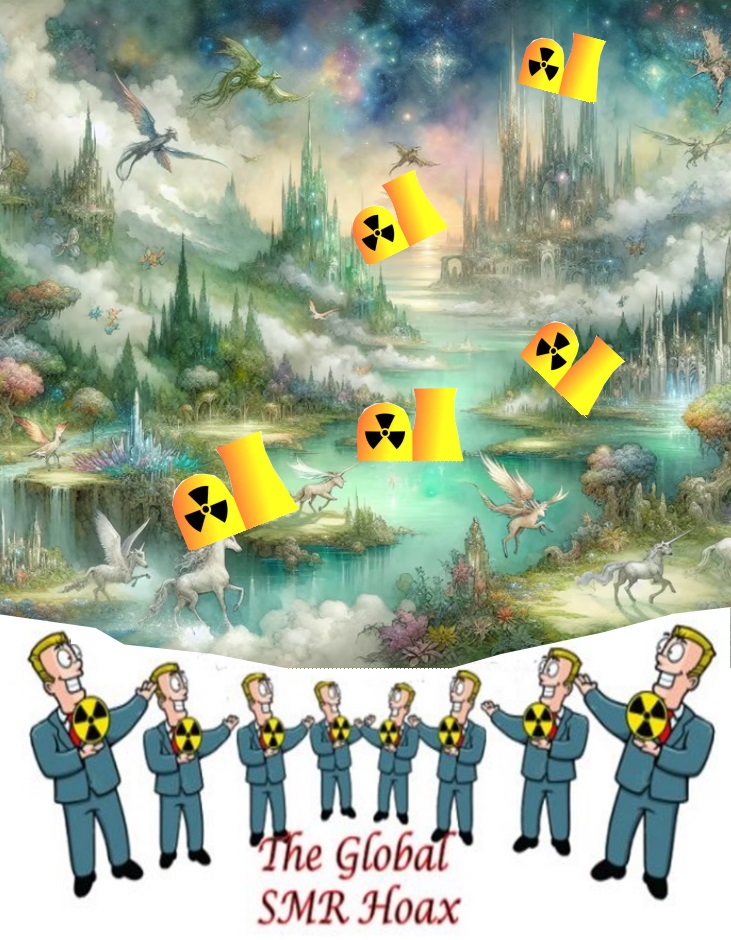
Small Nuclear Reactors Will Not Save The Day
By Leon Stille – Sep 23, 2025, https://oilprice.com/Energy/Energy-General/Small-Nuclear-Reactors-Will-Not-Save-The-Day.html
- SMR’s are being hailed as the perfect solution for large industrial power consumers.
- SMRs are currently being marketed like they’re the iPhone of nuclear energy: smarter, smaller, cheaper, scalable.
- Despite the hype, there are currently no SMR’s operating on a commercial scale.
You can feel the buzz: nuclear is back. Or so we’re told.
From Brussels to Washington, a new wave of enthusiasm for so-called Small Modular Reactors (SMRs) is sweeping through policy circles, think tanks, and energy startups. These compact, supposedly plug-and-play nuclear units are being hailed as the perfect solution to power data centers, feed artificial intelligence’s growing hunger, and backstop our energy transition with clean, stable electricity.
There’s just one problem. Actually, there are many. None of them small.
The hype cycle is in full spin
SMRs are currently being marketed like they’re the iPhone of nuclear energy: smarter, smaller, cheaper, scalable. A miracle solution for everything from remote grids to decarbonizing heavy industry and AI’s server farms. Countries like the U.S., Canada, and the UK have announced ambitious deployment plans. Major developers, including NuScale, Rolls-Royce SMR, GE Hitachi, and TerraPower, have painted glossy timelines with glowing promises.
Except the fine print tells a different story.
There are currently no operational commercial SMRs anywhere in the world. Not one. NuScale, the U.S. frontrunner, recently cancelled its flagship Utah project after costs ballooned to over $9,000 per kilowatt and no investors could be found. Even their CEO admitted no deployment would happen before 2030. Meanwhile, Rolls-Royce’s much-hyped SMR factory hasn’t produced a single bolt of steel yet.
So, we’re betting on a technology that doesn’t yet exist at commercial scale, won’t arrive in meaningful numbers before the 2030s, and would require thousands of units to significantly contribute to global energy demand. That’s not a strategy. That’s science fiction.
Big nuclear hasn’t exactly inspired confidence either
Even the large-scale projects that SMRs claim to “improve upon” are struggling. Take the UK’s Hinkley Point C, once heralded as the future of nuclear energy in Europe. It’s now twice as expensive as originally planned (over £46 billion), at least five years late, and facing ongoing construction delays. The French-backed EPR reactor design it’s based on has already been plagued with similar issues in Flamanville (France) and Olkiluoto (Finland), where completion took over a decade longer than promised and costs ballooned dramatically.
Let’s be honest: if any other energy technology was this unreliable on delivery, we’d laugh it out of the room.
Price floors for nuclear, and price ceilings for reason
In France and Finland, authorities have now agreed to guaranteed minimum prices for new nuclear power, effectively writing blank checks to ensure profitability for operators. In Finland, the recent deal sets the floor above €90/MWh for 20 years. Meanwhile, solar and wind regularly clear wholesale power auctions across Europe at €30–50/MWh, with even lower marginal costs.
Why, exactly, are we locking in decades of higher prices for a supposedly “market-based” energy future? It’s hard to see how this helps consumers, industries, or climate targets. Especially when these same nuclear plants will also require major grid upgrades, just like renewables, because any large-scale generator needs robust transmission capacity. So no efficiency win there either.
The SMR promise: too small, too late
Back to SMRs. Let’s suppose the best-case scenario plays out. A couple of designs clear regulatory approval by 2027–2028, construction starts in the early 2030s, and the first commercial units are online before 2035. Even then, the world would need to build and connect thousands of these small reactors within 10–15 years to displace a meaningful share of fossil generation. That’s a logistics nightmare, and we haven’t even discussed public acceptance, licensing bottlenecks, uranium supply, or waste management.
For perspective: in the time it takes to build a single SMR, solar, wind, and battery storage could be deployed 10 to 20 times over, for less money, with shorter lead times, and with no radioactive legacy.
And unlike nuclear, these technologies are modular today. They’re scalable now. They’ve proven themselves everywhere from the Australian outback to German rooftops and Californian substations.
The elephant in the reactor room: waste and risk
Nuclear fans love to stress how “safe” modern designs are. And yes, statistically speaking, nuclear energy is relatively safe per kilowatt-hour. But it’s also the only energy source with a non-zero risk of catastrophic failure and waste that stays toxic for thousands of years.
Why, exactly, would we take that risk when we have multiple clean energy options with zero risk of explosion and waste streams that are either recyclable or inert?
You don’t need to be a nuclear physicist to ask this: how is betting on high-cost, slow-deploying, risk-bearing, politically toxic infrastructure a better idea than wind, solar, and storage?
A footnote in the transition, not the headline
Let’s be clear: nuclear power will likely continue to play a role in some countries’ energy mixes. France and Sweden have legacy fleets. New projects may go ahead in China or South Korea, where costs are contained and planning is centralized. But for the majority of the world, especially countries trying to decarbonize fast, new nuclear is not the answer.
SMRs, despite their branding, will not save the day. They will be at best a niche, possibly a small contributor in specific applications like remote mines, military bases, or industrial clusters where no other solution works. That’s fine. But let’s stop pretending they’re some kind of energy silver bullet.
Final thoughts
We are in the decisive decade for climate action. Every euro, dollar, and yuan we invest must yield maximum emissions reduction per unit of time and cost. By that standard, SMRs fall flat. Nuclear power, small or large, is simply too expensive, too slow, too risky, and too narrow in its use case to lead the energy transition.
So let’s cool the reactor hype. Let’s focus instead on the technologies that are already winning: wind, solar, batteries, heat pumps, grid flexibility, green hydrogen. These are not dreams. They’re deploying by the gigawatt, today. SMRs are fascinating, yes. But when it comes to decarbonization, we need workhorses, not unicorns.
‘Inevitable’ that nuclear waste facility will go ahead without local consent says former minister.
Now we see it- the nuclear industry, adopted by government, will lead to fascism.
Added to the madness, governments are hell-bent on making more nuclear radioactive trash that they don’t know how to get rid of.
“However, in the case of the UK, the DESNZ’s review raises the possibility that overriding public approval could be a matter of policy.
“These developments point to a growing sense of futility and desperation, to secure both a suitable site for nuclear waste disposal and public support for it.”
23 Sep, 2025 By Tom Pashby https://www.newcivilengineer.com/latest/inevitable-that-nuclear-waste-facility-will-go-ahead-without-local-consent-says-former-minister-23-09-2025/
It is “inevitable” that the government moves away from the consent-based approach for deciding where to site the planned geological disposal facility (GDF) for nuclear waste, a former Department for Energy Security and Net Zero (DESNZ) minister has told NCE.
The comments come as reports suggest the government is considering scrapping the “consent-based” approach for siting the GDF. However, DESNZ has asserted that the reports are “wrong” and “no changes are planned to this process currently”.
The GDF is currently the only solution proposed by the government for disposing of high level nuclear waste (HLW). HLW is generated by both the civil and defence nuclear sectors
It would involve disposing of HLW in an engineered vault placed between 200m and 1km underground, covering an area of approximately 1km2 on the surface.
Work to select a GDF site should take 20 years, according to the government body responsible for the project – Nuclear Waste Services (NWS) – and a further 150 years to build, fill and close the facility.
The HLW then needs to sit and remain undisturbed for 100,000 years before its radioactivity has reduced sufficiently for people to be able to be near it. Due to the hazards associated with radioactive waste, the government has always maintained that a GDF will only be sited in a location where the local community has agreed to host it. This is known as the “consent-based” approach and it has been in discussion with a few communities for a number of years.
Consent-based approach seeing little progress over years
The “voluntary” or “consent-based” approach to deciding where to site a GDF was first proposed by the government in a White Paper published in 2008 titled Managing radioactive waste safely: a framework for implementing geological disposal.
“For the purposes of this White Paper ‘an approach based on voluntarism’ means one in which communities voluntarily express an interest in taking part in the process that will ultimately provide a site for a geological disposal facility,” the paper said.
“Initially communities will be invited to express an interest in finding out more about what hosting a geological disposal facility would mean for the community in the long term.
“Participation up until late in the process, when underground operations and construction are due to begin, will be without commitment to further stages, whether on the part of the community or government. If at any stage a community or Government wished to withdraw then its involvement in the process would stop.
“In practice, development could also be halted by the independent regulators at any point in the process through a refusal to grant authorisations for the next stage of work.”
The government further committed to the approach in 2014, when the then secretary of state for energy and climate change Ed Davey said: “The UK Government also continues to favour an approach to identifying potential sites for a GDF that involves working with communities who are willing to participate in the siting process.”
Despite having been committed to the approach for more than 10 years, NWS only has two communities it is making gradual progress with via community partnerships – Mid Copeland and South Copeland. Lincolnshire withdrew from the process in June after a change in governance.
With the government pushing for the deployment of dozens more nuclear reactors in the coming decades, the need to confirm a long-term solution for the waste is pressing – something that has been stressed to NCE by both the Nuclear Industry Association (NIA) and anti-nuclear campaigners.
Reports say Government reviewing consent-based approach
The Telegraph published a story on 22 September that claimed, based on a government source, that DESNZ had decided to review the consent-based approach to siting the GDF.
The source told the newspaper that conversations were taking place within government to consider prioritising areas with the best geology rather than areas with the most welcoming communities.
Ending the consent-based process could result in ministers effectively imposing a GDF on a community, although they would still face the standard planning and consenting obstacles, including judicial reviews from campaigners.
A DESNZ spokesperson denied the reports, saying: “Our position continues to be that any potential geological disposal facility site will be subject to agreement with the community and won’t be imposed on an area without local consent.
“Progress continues to be made, with two areas in Cumberland taking part in the siting process for this multi-billion-pound facility, which would bring thousands of skilled jobs and economic growth.”
Former minister tells NCE ‘we must get on with GDF’
Lord Hunt of Kings Heath is now a backbench Labour peer but was a DESNZ minister of state from July 2024 to May 2025. He was also an energy minister at the end of the previous Labour government from 2008 to 2010 and served in shadow front bench roles from 2010 to 2018.
“This is an inevitable approach. We must get on with GDF,” Hunt told NCE.
“It’s vital to the nuclear programme. It’s a matter of national strategic importance and should proceed on that basis.”
Reported policy change points to ‘growing sense of desperation’
Nuclear Information Service research manager Okopi Ajonye told NCE: “The prospect of the DESNZ reforming policy to override local consent for hosting a geological disposal facility is very concerning.”
“Furthermore, it mirrors developments in Australia, where efforts to secure sites for nuclear waste disposal have, just like the UK, been repeatedly stalled by local opposition.
“But critics are now concerned that recent legislation grants broad powers to the Australian government to designate any site as a nuclear waste dump, even without local or indigenous approval.”
“However, in the case of the UK, the DESNZ’s review raises the possibility that overriding public approval could be a matter of policy.
“These developments point to a growing sense of futility and desperation, to secure both a suitable site for nuclear waste disposal and public support for it.”
End to consent-based approach would ‘lead to more vociferous public resistance’
Nuclear Free Local Authorities secretary Richard Outram told NCE: “Any decision to abandon the established consent-based approach to siting a nuclear waste dump will be an admission by ministers that no community actually wants to host it.
“Proposals to site a GDF at South Holderness and Theddlethorpe were roundly defeated by massive and persistent public protests, backed by responsive local councillors.
“Opposition is also growing in South Copeland with residents impacted by the declared area of focus up in arms.”
Outram added that two local councils in the South Copeland area – Millom Town Council and Whicham Parish Council – have withdrawn their support for the process, and a third – Millom Without Parish Council – is “about to confer with parishioners about continued engagement”, he said.
He also said that the NWS community partnership was “described in a recent external review as ‘dysfunctional’ and seemingly at war with itself”.
“Replacing voluntarism with a plan to railroad such a controversial project onto an unwilling community will be a retrograde step and simply lead to more vociferous public resistance,” he added.
Government reveals to NCE it is ‘replanning’ GDF project
These latest developments add to the uncertainty that has bubbled around the GDF project in recent months.
In August, the Treasury’s National Infrastructure and Service Transformation Authority (Nista) assessed the delivery confidence of the GDF as “appears unachievable” and said the cost could be as much as £53.3bn.
Following the rating, NCE asked DESNZ via the Freedom of Information Act whether the government was responding by changing its approach to the GDF project. It said that it is “undertaking some replanning to mitigate risks and support ongoing progress” on its major projects, including the GDF.
DESNZ added: “However, a GDF will always remain necessary as there are currently no credible alternatives that would accommodate all categories of waste in the inventory for disposal.”
Nuclear industry says credible GDF plan needed for investor confidence
The Nuclear Industry Association, which represents more than 300 companies across the civil and defence nuclear supply chain, was perturbed by this uncertainty around the GDF and told NCE: “A credible, long-term policy on HLW disposal is very important. Developers need confidence that the back end of the fuel cycle is being responsibly and sustainably managed, not just for regulatory compliance but also to secure investor confidence and public trust.
“Clarity and credibility in government policy reduces uncertainty, helps de-risk new nuclear projects and ensures that developers can focus on safe, efficient generation”
1 This Month
29 Jan. Thursday 7-8 p.m. Webinar – World’s Largest Nuclear Station in Port Hope, ON?
To see nuclear-related stories in greater depth and intensity – go to https://nuclearinformation.wordpress.com/



31st January – Challenging the War Machine – a DECLASSIFIED UK SUMMIT


Website of the Week
Now until to February 10, 2026 Radioactive waste storage in France: the debate is finally open! How to participate?
-
Archives
- January 2026 (288)
- December 2025 (358)
- November 2025 (359)
- October 2025 (376)
- September 2025 (258)
- August 2025 (319)
- July 2025 (230)
- June 2025 (348)
- May 2025 (261)
- April 2025 (305)
- March 2025 (319)
- February 2025 (234)
-
Categories
- 1
- 1 NUCLEAR ISSUES
- business and costs
- climate change
- culture and arts
- ENERGY
- environment
- health
- history
- indigenous issues
- Legal
- marketing of nuclear
- media
- opposition to nuclear
- PERSONAL STORIES
- politics
- politics international
- Religion and ethics
- safety
- secrets,lies and civil liberties
- spinbuster
- technology
- Uranium
- wastes
- weapons and war
- Women
- 2 WORLD
- ACTION
- AFRICA
- Atrocities
- AUSTRALIA
- Christina's notes
- Christina's themes
- culture and arts
- Events
- Fuk 2022
- Fuk 2023
- Fukushima 2017
- Fukushima 2018
- fukushima 2019
- Fukushima 2020
- Fukushima 2021
- general
- global warming
- Humour (God we need it)
- Nuclear
- RARE EARTHS
- Reference
- resources – print
- Resources -audiovicual
- Weekly Newsletter
- World
- World Nuclear
- YouTube
-
RSS
Entries RSS
Comments RSS
 nuclear-news