Living with the legacy of France’s nuclear weapons testing
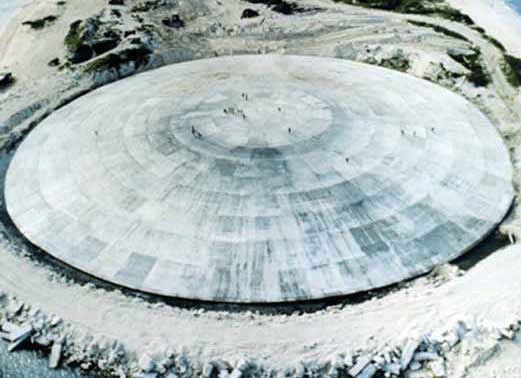
Nina Werkhäuser 26 Sept 25, https://www.dw.com/en/living-with-the-legacy-of-frances-nuclear-weapons-testing/a-74131800
France tested nuclear weapons for 30 years in the Pacific. The people of French Polynesia bore the brunt of the testing.
“For 30 years, we were France’s guinea pigs,” says Hinamoeura Morgant-Cross, a young member of parliament from French Polynesia.
This South Pacific archipelago, a French overseas territory that includes Tahiti and is famed for its white beaches, swaying palms, and turquoise waters, is often romanticized as a paradise.
But beneath the idyllic image lies a painful legacy: decades of nuclear testing and its enduring consequences.
Between 1966 and 1996, the French military detonated 193 nuclear bombs on the remote atolls of Mururoa and Fangataufa. These tests were carried out in Ma’ohi Nui, as the territory is known to its indigenous inhabitants. The first explosion, codenamed Aldebaran, took place on July 2, 1966. It marked the beginning of a long chapter that would leave deep scars on the land and its people.
In 2025, Morgant-Cross journeyed over 15,000 kilometers (more than 9,320 miles) to Berlin to speak at an event in May, hosted by the international medical NGO International Physicians for the Prevention of Nuclear War, or IPPNW. There, she delivered a searing testimony about the long-term consequences of France’s nuclear testing program: disproportionately high cancer rates, children born with deformities and ongoing contamination of the region’s water and soil.
“So they really poisoned the ocean where we found all our food,” says Morgant-Cross who has also addressed the United Nations in New York. “We have been poisoned for the greatness of France, for France to be a state with a nuclear weapon.”
The ‘clean bomb’ myth
The French government at the time knowingly gave false assurances to the islanders about the dangers of the nuclear testing.
Then-President Charles de Gaulle described the French atomic bomb as “green and very clean,” suggesting it was safer or more environmentally friendly than the bombs dropped on Hiroshima and Nagasaki .
Morgant-Cross calls it nothing more than “French propaganda.”
In reality, radioactive clouds drifted across vast parts of the South Pacific and even reached the main island of Tahiti, more than 1,000 kilometers from the test site. Often, residents of nearby islands weren’t informed or evacuated.
No Apology from France
France didn’t cease its nuclear testing program until 1996, following intense domestic and international outcry. Despite the halt, the French government has never formally apologized for the harm caused to its overseas territories.
During a 2021 visit to French Polynesia, President Emmanuel Macron acknowledged France’s role, stating, “The guilt lies in the fact that we conducted these tests.”
“We would not have carried out these experiments in Creuse or Brittany [in mainland France],” he said.
United Nations and various NGOs have observed September 26th as the International Day for the Total Elimination of Nuclear Weapons since 2014. The days is a solemn reminder of the ongoing responsibility borne by nuclear-armed states.
Yet the suffering endured by victims of nuclear testing is in danger of being forgotten. In response, a rising generation from former test sites is refusing to accept the silence of those in power. They are mobilizing across borders, channeling their concern into coordinated action.
Parliamentarian Hinamoeura Morgant-Cross is among those speaking out. While visiting Berlin, she shared her family’s painful legacy: her grandmother was 30 when the nuclear tests began and later developed thyroid cancer as did her mother and aunt.
Morgant-Cross, born in 1988, revealed that both she and her sister also developed cancer, underscoring the generational toll of radioactive exposure.
Cancer can develop generations later
Experts warn that nuclear testing has led to clusters of cancer cases within affected families. Exposure to ionizing radiation can cause genetic mutations, which may be inherited by subsequent generations.
“The insidious nature of ionizing radiation lies in its ability to affect people across generations,” says nuclear weapons expert Jana Baldus of the European Leadership Network (ELN). “It significantly increases the risk of various cancers, particularly lymphoma and leukemia.”
Another consequence of nuclear testing is reproductive harm.
“Women exposed to radiation during the tests have given birth to children with congenital defects and have suffered miscarriages,” Baldus tells DW. “These effects can be passed down through generations, potentially leading to infertility in women.”
For Hinamoeura Morgant-Cross, the multiple cancer diagnoses in her family were a driving force behind her decision to enter politics.
She is now calling on France — the state responsible for the nuclear tests — to provide greater support for her fellow citizens.
“We don’t have the medical care that we should have, that we deserve, because we are 30 years late, in terms of medicines. We don’t have technology like medical scans.” she says. “It really pushed me to go into politics, and to demand that we deserve a better hospital, we deserve better treatment.”
Only a small fraction of those affected have the means to travel to Paris for medical treatment, leaving many without access to adequate care.
Victims face an uphill battle for compensation
In 2010, the French government enacted legislation to provide compensation to victims of nuclear testing. However, each case is assessed individually, and claimants must demonstrate a direct link between their illness and the nuclear tests. That burden of proof is not always easily achieved.
Expert Jana Baldus points out a major hurdle.
“Victims must prove they were physically present at the exact location when the tests occurred — a nearly impossible task decades later.” In addition, compensation is limited to a narrow list of officially recognized illnesses. According to the global coalition ICAN (International Campaign to Abolish Nuclear Weapons), only 417 residents of French Polynesia received compensation between 2010 and July 2024.
For Hinamoeura Morgant-Cross, the fight isn’t only about securing practical support, it’s also about education.
In her homeland, a persistent narrative still portrays the nuclear tests as a so-called clean endeavor that brought prosperity.
“For decades, we had pictures of the nuclear mushroom in all the living rooms of the Tahitian people because we were proud the French decided to choose us,” she recalls. Her mission now is to dismantle what she calls that “colonial mindset” and shed light on the true consequences of the tests.
The future of nuclear testing: risk or rhetoric?
France wasn’t alone in conducting extensive nuclear tests. The Soviet Union, the United States, the United Kingdom and China also carried out large-scale detonations.
In total, more than 2,000 nuclear explosions have taken place. The resulting radioactive fallout not only contaminated the immediate test sites but also contributed to elevated radiation levels across the globe.
Nuclear testing was halted primarily through moratoriums and international negotiations surrounding the Comprehensive Nuclear-Test-Ban Treaty (CTBT).
In recent years, North Korea has been the only country to conduct such tests. Yet amid rising geopolitical tensions, experts warn that a resurgence of nuclear testing remains a real possibility.
A hungrier, poorer and more anxious Iran awaits ‘snapback’ of UN sanctions over its nuclear program.

By ASSOCIATED PRESS, 28 September 2025, https://www.dailymail.co.uk/wires/ap/article-15139177/A-hungrier-poorer-anxious-Iran-awaits-snapback-UN-sanctions-nuclear-program.html
DUBAI, United Arab Emirates (AP) – As Iran’s ailing economy braced Saturday for the reimposition of United Nations sanctions over its nuclear program, it is ordinary people who increasingly find themselves priced out of the food they need to survive and worried about their futures.
Iran’s rial currency already sits at a record low, increasing pressure on food prices and making daily life that much more challenging. That includes meat, rice and other staples of the Iranian dinner table.
Meanwhile, people worry about a new round of fighting between Iran and Israel – as well as potentially the United States – as missile sites struck during the 12-day war in June now appear to be being rebuilt.
Activists fear a rising wave of repression within the Islamic Republic, which already has reportedly executed more people this year than over the past three decades.
Sina, the father of a 12-year-old boy who spoke on condition that only his first name be used for fear of repercussions, said the country has never faced such a challenging time, even during the deprivations of the 1980s Iran-Iraq war and the decades of sanctions that came later.
“For as long as I can remember, we´ve been struggling with economic hardship, and every year it´s worse than the last,” Sina told The Associated Press. “For my generation, it´s always either too late or too early – our dreams are slipping away.”
Early Sunday at 0000 GMT (8 p.m. Eastern), barring any last-minute diplomatic breakthrough, U.N. sanctions on Iran will be reimposed through “snapback,” as the mechanism is called by the diplomats who negotiated it into Iran´s 2015 nuclear deal with world powers. Snapback was designed to be veto-proof at the U.N. Security Council, meaning China and Russia cannot stop it alone, as they have other proposed actions against Tehran in the past.
The measure will again freeze Iranian assets abroad, halt arms deals with Tehran, and penalize any development of Iran´s ballistic missile program, among other measures.
France, Germany and the United Kingdom triggered snapback over Iran further restricting monitoring of its nuclear program and the deadlock over its negotiations with the U.S.
Iran further withdrew from the International Atomic Energy Agency monitoring after Israel´s war on the country in June, which also saw the U.S. strike nuclear sites in the Islamic Republic. Meanwhile, the country still maintains a stockpile of uranium enriched up to 60% purity – a short, technical step away from weapons-grade levels of 90% – that is largely enough to make several atomic bombs, should Tehran choose to rush toward weaponization.
Iran has long insisted its nuclear program is peaceful, though the West and IAEA say Tehran had an organized weapons program up until 2003.
Tehran has further argued that the three European nations shouldn´t be allowed to implement snapback, pointing in part to America´s unilateral withdrawal from the accord in 2018, during the first term of President Donald Trump´s administration.
“The Trump administration appears to think it has a stronger hand post-strikes, and it can wait for Iran to come back to the table,” said Kelsey Davenport, a nuclear expert at the Washington-based Arms Control Association. “Given the knowledge Iran has, given the materials that remain in Iran, that´s a very dangerous assumption.”
Risks also remain for Iran as well, she added: “In the short term, kicking out the IAEA increases the risk of miscalculation. The U.S. or Israel could use the lack of inspections as a pretext for further strikes.”
Iran on Saturday recalled its ambassadors to France, Germany and the U.K. for consultations ahead of the sanctions being reimposed, the state-run IRNA news agency reported.
The aftermath of the June war drove up food prices in Iran, putting already expensive meat out of reach for poorer families.
Iran’s government put overall annual inflation at 34.5% in June, and its Statistical Center reported that the cost of essential food items rose over 50% over the same period. But even that doesn’t reflect what people see at shops. Pinto beans tripled in price in a year, while butter nearly doubled. Rice, a staple, rose more than 80% on average, hitting 100% for premium varieties. Whole chicken is up 26%, while beer and lamb are up 9%.
“Every day I see new higher prices for cheese, milk and butter,” said Sima Taghavi, a mother of two, at a Tehran grocery. “I cannot omit them like fruits and meat from my grocery list because my kids are too young to be deprived.”
The pressure over food and fears about the war resuming have seen more patients heading to psychologists since June, local media in Iran have reported.
“The psychological pressure from the 12-day war on the one hand, and runaway inflation and price hikes on the other, has left society exhausted and unmotivated,” Dr. Sima Ferdowsi, a clinical psychologist and professor at Shahid Beheshti University, told the Hamshahri newspaper in an interview published in July.
“If the economic situation continues like this, it will have serious social and moral consequences,” she warned, with the newspaper noting “people may do things they would never think of doing in normal circumstances to survive.”
Iran has faced multiple nationwide protests in recent years, fueled by anger over the economy, demands for women’s rights and calls for the country’s theocracy to change. The most recent came in 2022 over the death of Mahsa Amini, a young woman who died after being detained by police allegedly for not wearing her hijab, or headscarf, to their liking.
In response to those protests and the June war, Iran has been putting prisoners to death at a pace unseen since 1988, when it executed thousands at the end of the Iran-Iraq war. The Oslo-based group Iran Human Rights and the Washington-based Abdorrahman Boroumand Center for Human Rights in Iran put the number of people executed in 2025 at over 1,000, noting the number could be higher as Iran does not report on each execution.
“Political and civic space in Iran has shrunk to nothing, and outside Iran, civil society activists and dissidents face transnational repression,” the center warned. “The Iranian people, millions of whom aspire to more than a closed and brutal theocracy, have tried every option within their reach. Their leaders have not.”
Vahdat reported from Tehran, Iran. Associated Press writer Nasser Karimi in Tehran contributed to this report. ___
UN Security Council rejects Russia and China’s last-ditch effort to delay sanctions on Iran
By FARNOUSH AMIRI, STEPHANIE LIECHTENSTEIN and EDITH M. LEDERER, September 27, 2025
UNITED NATIONS (AP) — The U.N. Security Council on Friday rejected a last-ditch effort to delay reimposing sanctions on Iran over its nuclear program, a decision that the country’s president immediately called “unfair, unjust and illegal.” The decision on the “snapback sanctions” came a day before the deadline and after Western countries claimed weeks of meetings failed to result in a concrete agreement.
The resolution put forth by Russia and China — Iran’s most powerful and closest allies on the 15-member council — failed to garner support from the nine countries required to halt the series of U.N. sanctions from taking effect Saturday, as outlined in Iran’s 2015 nuclear deal with world powers. The vote was 4-9 with two abstentions.
“We had hoped that European colleagues and the U.S. would think twice, and they would opt for the path of diplomacy and dialogue instead of their clumsy blackmail, which merely results in escalation of the situation in the region,” Dmitry Polyanskiy, the deputy Russian ambassador to the U.N., said during the meeting.
Shortly after the vote, Iranian President Masoud Pezeshkian spoke at a meeting with journalists and Iran experts on the sidelines of the U.N. General Assembly, a day before the deadline for the sanctions to kick in. Pezeshkian said that despite previous threats, Iran won’t withdraw from the Nuclear Nonproliferation Treaty like North Korea, which abandoned the treaty in 2003 and then built atomic weapons.
Barring an eleventh-hour deal, the reinstatement of sanctions — triggered by Britain, France and Germany — will once again freeze Iranian assets abroad, halt arms deals with Tehran and penalize any development of Iran’s ballistic missile program, among other measures. That will further squeeze the country’s reeling economy.
The move is expected to heighten already magnified tensions between Iran and the West. But despite previous threats to withdraw from the Nuclear Nonproliferation Treaty, Pezeshkian said in an interview with a group of reporters that the country had no intention to do so right now. North Korea, which abandoned the treaty in 2003, went on to build atomic weapons.
Four countries — China, Russia, Pakistan and Algeria — once again supported giving Iran more time to negotiate with the European countries, known as the E3, and the United States, which unilaterally withdrew from the accord with world powers in 2018 during Trump’s first administration…………………………………………………………………………………………………………………
Barring an eleventh-hour deal, the reinstatement of sanctions — triggered by Britain, France and Germany — will once again freeze Iranian assets abroad, halt arms deals with Tehran and penalize any development of Iran’s ballistic missile program, among other measures. That will further squeeze the country’s reeling economy.https://apnews.com/article/iran-snapback-sanctions-united-nations-nuclear-program-europe-1f1f6e1781bdb6b27f8bfad2661db4c5
IAEA issues fresh warning over drones near nuclear plants

26 September 2025, https://www.world-nuclear-news.org/articles/iaea-report-drones-downed-close-to-south-ukraine-nuclear-power-plant
The International Atomic Energy Agency has said drones flew within a few hundred metres of the South Ukraine Nuclear Power Plant, underlining the continued risks to nuclear safety from the on-going war. Meanwhile Zaporizhzhia Nuclear Power Plant continues to have to rely on emergency diesel generators after a loss of off-site power.
International Atomic Energy Agency (IAEA) experts stationed at the three-unit South Ukraine nuclear power plant were told that 22 unmanned aerial vehicles were observed on Wednesday night and Thursday morning within its monitoring zone, “some coming as close as half a kilometre from the site”, the agency said.
“From their accommodation near the plant, IAEA team members heard gunfire and explosions around 01:00 am local time and today (Thursday) they visited the location where one of the drones had come down, observing a crater measuring four square metres at the surface and with a depth of around one metre,” the agency’s statement said.
“Once again drones are flying far too close to nuclear power plants, putting nuclear safety at risk. Fortunately, last night’s incident did not result in any damage to the South Ukraine Nuclear Power Plant itself. Next time we may not be so lucky. I continue to urge both sides to show maximum military restraint around all important nuclear facilities,” IAEA Director General Rafael Mariano Grossi said.
“For more than three and a half years, the IAEA has been doing everything in its power to help prevent a nuclear accident during this devastating war. We will only be able to say that our mission was successful if the war ends without a serious nuclear accident. Our indispensable work is far from finished.”
Meanwhile Zaporizhzhia Nuclear Power Plant has been without external power for more than 48 hours and has been relying on its fleet of emergency diesel generators. The IAEA said “the plant said it has the necessary spare parts and personnel to repair the line once the military situation permits. Ukraine has informed the Agency that it is also prepared to repair damages to a backup power line, when the military situation permits”.
Following the loss of off-site power all 18 available emergency generators started operating, with the number reduced to those required to provide power to the site – seven – helping to preserve the diesel fuel. The IAEA has been told previously that 20 days’ worth of fuel was stored at the site.
Zaporizhzhia Nuclear Power Plant has been under Russian military control since early March 2022 and is on the frontline of Russian and Ukrainian forces.
Flamanville fiasco: EDF blamed by the Nuclear Safety Authority

The French Nuclear Safety and Radiation Protection Authority (ASNR) has severely
criticised the crisis management at the EPR in Flamanville (Manche), which
has been shut down since 19 June due to a valve problem.
On 20 August, the inspectors subjected EDF teams to an unannounced exercise of “deployment of a local crisis means” (MLC), i.e. the replacement of one element of the
electrical panel with another to resupply batteries in the event of a total
loss of power supplies. As a result, the operator was unable to carry out
this operation, which was essential to avoid an accident.
In its follow-up
letter, the ASNR points to a “range of interventions that are not precise
enough”, agents “forced to question themselves on numerous occasions” and a
training follow-up deemed “perfectible”. Even more serious, some crisis
equipment requested by the inspectors could not be presented. “The
organisation of the Flamanville EPR in terms of crisis management and means
appears insufficient”, concludes the nuclear watchdog, an extremely rare
assessment in its usually measured vocabulary.
” I don’t remember such an
observation,” Guy Vastel, of the Association for the Control of
Radioactivity in the West (Acro), told Ouest-France. Yannick Rousselet,
from Greenpeace, believes that “nothing is right” in this report. EDF, for
its part, announced an “action plan” and assured that the findings “do not
call into question the availability of crisis resources or the site’s
ability to manage an emergency”.
Reporterre 10th Sept 2025,
https://reporterre.net/Fiasco-de-Flamanville-EDF-blamee-par-l-Autorite-de-surete-nucleaire
Renewables blow past nuclear when it comes to cheap datacenter juice.

Study finds microgrids with wind, solar, and batteries can be built years sooner and at lower cost than SMRs
CNZ describes itself as an open research institute, founded by Octopus Energy Group in the UK, and claims to advise the State of California and Europe’s International Energy Agency as well as the British government.
While CNZ’s study applies to the UK sector, where energy costs are among the highest in the industrialized world, it is likely that the overall conclusion would still be valid in other countries as well.
Its analysis shows that renewables can meet 80 percent of the constant demand from a large datacenter over the course of a year. Offshore wind can provide the majority of load requirements, with gas generation backed by battery storage as a stopgap source of power representing the most cost-optimal mix.
Greater capacity in the on-site battery storage system would reduce the reliance on gas power, and this would likely happen over time as the cost of such systems is expected to come down, the report claims.
Fri 26 Sep 2025, Dan Robinson,
https://www.theregister.com/2025/09/26/renewables_vs_smr_datacenter/
UN sanctions on Iran set to return as nuclear diplomacy fades
September 27, 2025, https://www.news.com.au/breaking-news/un-sanctions-on-iran-set-to-return-as-nuclear-diplomacy-fades/news-story/0c414f139787f2be580259e3e8daba7f
Iran was set to come under sweeping UN sanctions late Saturday for the first time in a decade — barring an unexpected last-minute breakthrough — after nuclear talks with the West floundered.
The UN nuclear watchdog on Friday said that inspectors had been allowed to return to Iranian sites, but Western powers did not see enough progress to agree to a delay after a week of top-level diplomacy at the UN General Assembly.
European powers set the clock ticking a month ago for the “snapback” of the UN sanctions, accusing Iran of failing to come clean on its nuclear program — including through countermeasures it took in response to Israeli and US bombing.
Iran on Saturday recalled its envoys in Britain, France and Germany for consultations, after the three European countries triggered the mechanism, Iranian state television said.
The sanctions are set to go into effect at 0000 GMT on Sunday (8:00 pm on Saturday in New York).
They will set up a global ban on working with companies, people and organizations accused of developing Iran’s nuclear program or ballistic missiles.
Iranian President Masoud Pezeshkian said there was no reason to reach a deal when, in his view, Israel and the United States were seeking to use the pressure to topple the Islamic republic.
“If the goal had been to resolve concerns on the nuclear program, we could easily do that,” Pezeshkian told reporters, as he insisted again that Iran will never pursue nuclear weapons.
Pezeshkian, who met during the week with French President Emmanuel Macron, said France had proposed that Iran give up its stockpile of highly enriched uranium in return for a one-month delay in the return of sanctions
“Why would we put ourselves in such a trap and have a noose around our neck each month?” he said.
He accused the United States of pressing the Europeans not to reach a compromise.
Steve Witkoff, Trump’s friend and roving negotiator, had said that the United States does not want to hurt Iran and was open to further talks.
But Pezeshkian charged that Witkoff lacked seriousness, saying he had backtracked on agreements during earlier talks — which abruptly stopped when Israel launched its military campaign.
– No Russia enforcement –
The sanctions are aimed at imposing new economic pain to pressure Iran, but it remains to be seen if all countries will enforce them.
Russian deputy ambassador Dmitry Polyansky said Friday that Moscow, a top partner of Iran, considered the reimposition of sanctions “null and void.”
Russia and China sought at the Security Council Friday to delay the reimposition of sanctions until April but failed to muster enough votes.
The United States already has unilateral sanctions on Iran and has tried to force all other countries to stop buying Iranian oil, although companies from China have defied the pressure.
Trump imposed a “maximum pressure” campaign during his first term when he withdrew from a landmark 2015 nuclear agreement negotiated under former president Barack Obama, which had offered sanctions relief in return for drastic curbs on Iran’s nuclear program.
The new sanctions mark a “snapback” of the UN measures that were suspended under the 2015 deal, which had been strongly supported by Britain, France and Germany after Trump’s withdrawal.
The International Crisis Group, which studies conflict resolution, said in a report that Iran seemed dismissive of the snapback as it had already learned to cope with the US sanctions.
But it noted that the snapback was not easy to reverse as it would require consensus at the Security Council.
“It is also likely to compound the malaise around an economy already struggling with high inflation, currency woes and deepening infrastructure problems,” the report said.
Israeli Prime Minister Benjamin Netanyahu in a defiant UN address Friday urged no delay in the snapback and hinted that Israel was willing to again strike Iran’s nuclear program, after the 12 days of bombing in June that Iranian authorities say killed more than 1,000 people.
Pezeshkian said that Iran would not retaliate against the sanctions by leaving the nuclear Non-Proliferation Treaty, warning that unnamed powers were seeking a “superficial pretext to set the region ablaze.”
Britain remade – with a lot of nuclear?
the land on which renewable techs sit is not all lost to other uses and offshore wind farms use no land. And the nuclear fuel cycle (from uranium mining through to eventual waste disposal) also involves land use.
Renew Extra Weekly September 27, 2025
In a new report, the Britain Remade lobby group pushes nuclear strongly, as part of its ecomodernist growth-based future. It models different nuclear build costs and renewable price scenarios to assess long-term impacts on household energy bills. But although it accepts that ‘renewables may have seen large price-falls over the last 15 years’ it says that ‘at high penetrations costs linked to managing intermittency are high: Britain has added 40 GW since 2010 and 120 GW is forecast by 2030, yet balancing, curtailment, backup, and overbuild still add cost and leave gaps that require firm power’.
It is also not very happy about the local environmental impact of renewables, given their high land use compared with nuclear plants. Well yes, but the land on which renewable techs sit is not all lost to other uses and offshore wind farms use no land. And the nuclear fuel cycle (from uranium mining through to eventual waste disposal) also involves land use.
The new report does admit that Britain is the most expensive place to build nuclear capacity. It notes that ‘Hinkley Point C (HPC) is estimated to cost £46 billion, or £14,100 per kW: when finished, it will be the most expensive nuclear power station ever built. British-built plants cost far more per kW than peers: our per-kW costs are about six times South Korea’s, and France and Finland deliver the same EPR design for less per kW (27% and 53% respectively). Britain has gone backwards on cost: Sizewell B in 1995 cost £6,200 per kW, less than half Sizewell C’s budgeted cost.’………………….
To improve things in the UK (not an easy task you might think, using the same vendors) it wants better regulation and reduced planning barriers. Well we will see how that goes with EDF’s new Sizewell C EPR. But better planning systems and regs might also help renewables ! Overall Britain Remade seems a bit desperate in its promotion of nuclear: ‘If renewable costs rise, nuclear can play an even larger role: government forecasts assume falling solar costs (-27% by 2040) and modest wind cost drops (-6%), but recent data show solar prices flat and wind costs rising. If renewables costs climb 30% above baseline, the most cost-efficient plan would be eight new plants at French prices (saving £7.6 bn) or fifteen at Korean prices (saving £21 bn) over 25 years, with benefits lasting decades’.
Lots of assumptions about costs there, and also about demand and markets, with there being some big uncertainties. …………………………
……………………………………………………………Not everyone in the UK will relish American dominance, even in a collaborative context, if that is what we face in this sector, and maybe in others, like AI. However, for good or ill, the Labour government, like most governments, is wedded to technology-led growth. So, with China now politically bared and the EU somewhat out of bounds, US help is evidently seen as vital. Like the US, the UK is now pushing nuclear hard: 75% of the Department of Energy Security and Net Zero’s £6.7bn spending in 2024-25 was allocated to nuclear.
It is true that renewable are also being pushed in the UK (not now under Trump in the US), but mainly via private sector investment e.g. £1.5bn for last year’s CfDs. Which way might it go in future given the US influence? The new US-UK ‘technology prosperity’ deal pushes nuclear and also AI hard, but ignores renewables. You will find exactly the opposite approach in Electrotech, the new Ember global energy report, with renewables dominating, a view also shared by the latest World Nuclear Industry Status report, which depicts nuclear as mostly declining and as something of a dead end option – see my next post. https://renewextraweekly.blogspot.com/2025/09/britain-remade-but-mostly-with-nuclear.html
Paper reactors and paper tigers
John Quiggin, September 27, 2025, https://johnmenadue.com/post/2025/09/paper-reactors-and-paper-tigers/?utm_source=substack&utm_medium=email
The culmination of Donald Trump’s state visit to the UK was a press conference at which both American and British leaders waved pieces of paper, containing an agreement that US firms would invest billions of dollars in Britain.
The symbolism was appropriate, since a central element of the proposed investment bonanza was the construction of large numbers of nuclear reactors, of a kind which can appropriately be described as “paper reactors”.
The term was coined by US Admiral Hyman Rickover, who directed the original development of nuclear powered submarines.
Hyman described their characteristics as follows:
1. It is simple.
2. It is small.
3. It is cheap
4. It is light.
5. It can be built very quickly.
6. It is very flexible in purpose (“omnibus reactor”)
7. Very little development is required. It will use mostly “off-the-shelf” components.
8. The reactor is in the study phase. It is not being built now.
But these characteristics were needed by Starmer and Trump, whose goal was precisely to have a piece of paper to wave at their meeting.
The actual experience of nuclear power in the US and UK has been an extreme illustration of the difficulties Rickover described with “practical” reactors. These are plants distinguished by the following characteristics:
1. It is being built now.
2. It is behind schedule
3. It requires an immense amount of development on apparently trivial items. Corrosion, in particular, is a problem.
4. It is very expensive.
5. It takes a long time to build because of the engineering development problems.
6. It is large.
7. It is heavy.
8. It is complicated.
The most recent examples of nuclear plants in the US and UK are the Vogtle plant in the US (completed in 2024, seven years behind schedule and way over budget) and the Hinkley C in the UK (still under construction, years after consumers were promised that that they would be using its power to roast their Christmas turkeys in 2017). Before that, the VC Summer project in North Carolina was abandoned, writing off billions of dollars in wasted investment.
The disastrous cost overruns and delays of the Hinkley C project have meant that practical reactor designs have lost their appeal. Future plans for large-scale nuclear in the UK are confined to the proposed Sizewell B project, two 1600 MW reactors that will require massive subsidies if anyone can be found to invest in them at all. In the US, despite bipartisan support for nuclear, no serious proposals for large-scale nuclear plants are currently active. Even suggestions to resume work on the half-finished VC Summer plant have gone nowhere.
Hope has therefore turned to Small Modular Reactors. Despite a proliferation of announcements and proposals, this term is poorly understood.
The first point to observe is that SMRs don’t actually exist. Strictly speaking, the description applies to designs like that of NuScale, a company that proposes to build small reactors with an output less than 100 MW (the modules) in a factory, and ship them to a site where they can be installed in whatever number desired. The hope is that the savings from factory construction and flexibility will offset the loss of size economies inherent in a smaller boiler (all power reactors, like thermal power stations, are essentially heat sources to boil water). Nuscale’s plans to build six such reactors in the US state of Utah were abandoned due to cost overruns, but the company is still pursuing deals in Europe.
Most of the designs being sold as SMRs are not like this at all. Rather, they are cut-down versions of existing reactor designs, typically reduced from 1000MW to 300 MW. They are modular only in the sense that all modern reactors (including traditional large reactors) seek to produce components off-site. It is these components, rather than the reactors, that are modular. For clarity, I’ll call these smallish semi-modular reactors (SSMRs). Because of the loss of size economies, SMRs are inevitably more expensive per MW of power than the large designs on which they are based.
Over the last couple of years, the UK Department of Energy has run a competition to select a design for funding. The short-list consisted of four SSMR designs, three from US firms, and one from Rolls-Royce offering a 470MW output. A couple of months before Trump’s visit, Rolls-Royce was announced as the winner. This leaves the US bidders out in the cold.
So, where will the big US investments in SMRs for the UK come from? There have been a “raft” of announcements promising that US firms will build SMRs on a variety of sites without any requirement for subsidy. The most ambitious is from Amazon-owned X-energy, which is suggesting up to a dozen “pebble bed” reactors. The “pebbles” are mixtures of graphite (which moderates the nuclear reaction) and TRISO particles (uranium-235 coated in silicon carbon), and the reactor is cooled by a gas such as nitrogen.
Pebble-bed reactor designs have a long and discouraging history dating back to the 1940s. The first demonstration reactor was built in Germany in the 1960s and ran for 21 years, but German engineering skills weren’t enough to produce a commercially viable design. South Africa started a project in 1994 and persevered until 2010, when the idea was abandoned..Some of the employees went on to join the fledgling X-energy, founded in 2009. As of 2025, the company is seeking regulatory approval for a couple of demonstrator projects in the US.
Meanwhile, China completed a 10MW prototype in 2003 and a 250MW demonstration reactor, called HTR-PM in 2021. Although HTR-PM100 is connected to the grid, it has been an operational failure with availability rates below 25%. A 600MW version has been announced, but construction has apparently not started.
When this development process started in the early 20th century, China’s solar power industry was non-existent. China now has more than 1000 Gigawatts of solar power installed. New installations are running at about 300 GW a year, with an equal volume being produced for export. In this context, the HTR-PM is a mere curiosity.
This contrast deepens the irony of the pieces of paper waved by Trump and Starmer. Like the supposed special relationship between the US and UK, the paper reactors that have supposedly been agreed on are a relic of the past. In the unlikely event that they are built, they will remain a sideshow in an electricity system dominated by wind, solar and battery storage.
Why President Trump should put off the new nuclear arms race for one more year

Bulletin, By Jon B. Wolfsthal | September 26, 2025
On September 22, Russian President Vladimir Putin stated that Russia would be willing to abide by the limits in the New START nuclear arms control treaty for an additional year if the United States did the same. Both the United States and Russia are parties to the treaty. That agreement commits both countries to deploy no more than 1,550 strategic offensive nuclear weapons.
The agreement was negotiated in 2010 and is set to expire in February of next year.[1] After it expires, there will be no restrictions on the number and types of nuclear weapons that those two countries can build and deploy. The treaty was extended for one five-year term in 2021, but it cannot be legally extended as a formal treaty a second time.
While both sides stopped fully implementing the verification provisions under the treaty during the COVID-19 epidemic, Russia refused to restart them in 2022 after it launched its war against Ukraine. Yet even so, both Washington and Moscow are complying with the treaty’s central numerical limits. Without a new agreement, however, the world’s two largest nuclear weapons states would coexist without any caps on their arsenals for the first time in two generations.
Extending the deal by a year, even informally, would be a security and diplomatic win for the United States. However, as with many things these days, nothing is simple.
Words need action. US President Donald Trump announced at the United Nations on September 23 that he’d like to cease the development of all nuclear weapons (and biological weapons) “once and for all.” Trump has previously said that he would like to negotiate new nuclear agreements with Russia and to find a way to include China in those efforts. But to date, neither his first nor current administration has delivered any results on those fronts.
There are also voices both inside and outside of the Trump administration who maintain that Washington should not agree to any new limits with Moscow, and that the United States needs more nuclear weapons to address the threats posed by Russia and China combined. These voices are rightly concerned about Russia’s aggressive behavior and the rapid growth of China’s nuclear arsenal. They are also increasingly worried about coordination and cooperation between Russia and China, as well as with North Korea and Iran—known increasingly as the “Axis of Upheaval.”
While these concerns are legitimate, the need to respond to them with immediate increases in US nuclear deployments is questionable. Today, China has an estimated total nuclear arsenal of roughly 600 weapons, and is adding about 100 per year. The United States has just over 3,700 nuclear weapons, and Russia is thought to have just over 4,300. At the current rate of increase, it will take China almost 30 years to reach parity with the United States.
There is simply not enough time to realistically address the longer-term concerns about Chinese and Russian nuclear capabilities before New START expires in February. The question, therefore, is whether the United States and its allies would be more secure with having a one-year extension of the New START limits or living in a world in which all countries can build as many nuclear weapons as they want, and the United States has turned down an offer to maintain at least some caps in place.
The US administration should not let the perfect be the enemy of the good here and should agree to a one-year extension of New START as long as it is confident that it can monitor Russia’s compliance with the central limits. As of today, there is every reason to believe that it can, although the increasing politicization of US intelligence agencies is a growing concern.
Better restraint than arms racing. The one-year deal on offer should be pursued for at least two reasons.
First, there is no compelling military rationale for the US to increase the number of warheads above the limit set in New START. No such statement has been made by the president, the Chairman of the Joint Chiefs of Staff, or the Commander of US Strategic Command. Ultimately, a decision to build and deploy military capabilities should be driven by military necessity. In the absence of such a statement or compelling case, the money, time, and effort needed to deploy more weapons over the near term would be better used to enhance US conventional and other military capabilities. This does not mean the United States should stop preparing to possibly increase the number of deployed weapons if needed, but available information suggests that may not be needed any time soon.
The United States advances three reasons to maintain its nuclear weapons: to deter its adversaries and those of US allies, to reassure allies that the United States can and will come to their defense, and to limit the damage that an adversary can do to the United States or its allies should deterrence fail. In the US system, it is the president who determines how many nuclear weapons are needed to achieve these goals.
Deterrence theory makes clear that deterrence can work if one country can hold at risk the things that matter most to its adversary. (Whether the threat of using those forces is credible is another issue.) The United States is very capable of holding key Russian and Chinese leadership and valued targets at risk even within the New START limits. That has been and remains true today.
Another critical role for US nuclear weapons is to reassure US allies. This need is greater than ever, and some support for increasing US nuclear weapons comes from this motive. However, if the US goal is to reassure allies of Washington’s commitment to their security, then there are much greater problems the United States must address—including the egregious use of tariffs against key partners and allies, the abusive detention and deportation of South Korean workers in the United States, and the seemingly random and unpredictable nature of President Trump’s statements and behavior toward US allies overall. Yes, allies are eager for the United States to convincingly recommit to their defense and alliance relationships, but very few of these are built around a wish list that starts with increasing the number of deployed US strategic weapons. Any new deployments of US nuclear weapons are years away, and damage to US alliances is happening now. New weapons will not fix or prevent those rifts from manifesting in real and dangerous ways. And the United States must recognize that it cannot fix a credibility problem with capability alone.
Limiting the damage an enemy can inflict on the United States and its allies, should deterrence fail and a war take place, also remains a long-standing and key US objective. However, the leaders of the United States, Russia, and China have stated that a nuclear war cannot be won and should never be fought. This echoes the historic statement of Ronald Reagan and Mikhail Gorbachev that helped end the Cold War……………………………………………………………. https://thebulletin.org/2025/09/why-president-trump-should-put-off-the-new-nuclear-arms-race-for-one-more-year/
Fighter jets purchase would put UK in breach of nuclear treaty, says CND
Legal opinion for campaign group says deal amounts to reversal of UK’s commitment to nuclear disarmament
Dan Sabbagh, 26 Sept 25, https://www.theguardian.com/world/2025/sep/26/uk-fighter-jets-purchase-nuclear-treaty-cnd
Britain will violate its nuclear disarmament obligations if Labour presses ahead with the £1bn purchase of 12 F-35A fighter jets, according to a specialist legal opinion prepared on behalf of the Campaign for Nuclear Disarmament (CND).
Two international lawyers argue that the government’s plan to reintroduce air-launched nuclear weapons for the RAF will break a key provision of the nuclear non-proliferation treaty (NPT) signed by the UK and 190 other countries.
Prof Christine Chinkin and Dr Louise Arimatsu from the London School of Economics argued that the UK would be in breach of article six of the treaty, and they accused ministers of hypocritical behaviour in broadening the country’s nuclear capabilities.
In a piece published before the start of Labour’s annual conference, the authors wrote: “The decision of the UK to purchase F-35A fighter jets rather than any other model is precisely because the aircraft can ‘deliver both conventional and nuclear weapons’ and thereby enable the RAF to reacquire ‘a nuclear role for the first time since 1998’.
“Reinstating a nuclear role for the RAF represents a reversal of the UK’s long-term commitment to nuclear disarmament, including under the NPT.”
Article six of the non-proliferation treaty commits the signatories “to pursue negotiations in good faith on effective measures relating to cessation of the nuclear arms race at an early date and to nuclear disarmament” as well as to a future treaty “on general and complete disarmament”.
Though the lawyers’ conclusions are not necessarily surprising given they were working on behalf of CND, they highlight a growing contradiction between international treaty commitments and a creeping global nuclear rearmament.
Keir Starmer announced at a Nato summit in June that the UK would buy 12 F-35As with the intention of joining the alliance’s “nuclear mission”. US B61-12 nuclear bombs now stored at RAF Lakenheath in Suffolk would be made available for use by the British jets in the event of a major war.
Four years ago the UK said it would lift the cap on the number of warheads it could stockpile by 40% to 260 for its existing nuclear deterrent, the submarine-launched Trident system. It was the first time the UK had said it would increase its nuclear capability since the end of the cold war.
Sophie Bolt, the CND general secretary, accused the government of “yet another breach of international law” and of “escalating nuclear dangers in the world”. She called on MPs to discuss the UK’s nuclear intentions, arguing that the F-35A purchase plan had been announced “without parliamentary debate or scrutiny”.
The Ministry of Defence said the investment in 12 new F-35A aircraft would improve the UK’s national security. “The UK remains committed to the goal of a world without nuclear weapons and upholds all our obligations under the nuclear non-proliferation treaty,” a spokesperson said.
Other countries are also rearming and redeploying nuclear weapons as tensions rise. The US moved B61-12 bombs to Lakenheath in July, while Russia has said it has moved nuclear missiles to Belarus. China is increasing its arsenal by 100 warheads a year and plans to reach 1,500 by 2035, according to the Stockholm Peace Research Institute.
The nuclear non-proliferation treaty came into force in 1970 with article six a core component and has been signed by the world’s largest nuclear powers – the US, Russia, China and France. A handful of countries with nuclear programmes – Israel, India, Pakistan – never signed up, and North Korea pulled out in 2003.
Lots of nuclear news – NOT from the nuclear-corporate-political-media-military-complex

Some bits of good news – Conservation efforts paying off for Yellow River basin ecology Ocean treaty “a landmark victory” for the high seas. Australia is getting a new national park
TOP STORIES. 50 States One Israel – Wikipedia.
Trump’s visit proved the utter corruption of our political and media class.Nuke Power is Trump/Fascist Power…and an Epic Global Failure.
‘Inevitable’ that nuclear waste facility will go ahead without local consent says former minister.
The horrors I’ve seen of Ukrainian, NATO-backed, shelling of completely civilian areas of the Donbass throughout 2022 (and 2019, 2023…)
Trump’s nuclear ‘renaissance’ rests on risky plan for radioactive waste.
Fukushima recovery plagued with setbacks.
Living with the legacy of France’s nuclear weapons testing.
Climate. Global drying, Gaia & Abrupt Change
AUSTRALIA.Two leaders, two realities: Trump vs Albanese at the UN. Australian Submarine Agency lobbies Fremantle locals amid protest over AUKUS defence hub
.
Illawarra groups want Port Kembla ruled out for AUKUS nuclear submarine base.Global report confirms and details nuclear power’s stagnation: Someone needs to tell the Coalition
Opposition to proposed nuclear submarine base at Port Kembla. Islamophobia in Australia, antisemitism’s ignored cousin.
NUCLEAR ITEMS
| ATROCITIES. The Real Violent Extremists Are The Freaks Who Run The US Empire. |
| CIVIL LIBERTIES. This Ridiculous, Dangerous Antifa Order Is McCarthyism All Over Again—Possibly Worse. |
| ECONOMICS. Nuclear power’s record year masks future sustainability challenges, says report. EDF: Court of Auditors warns of a model running out of steam. While EDF must invest 460 billion euros over 15 years, its economic model is taking on water.- ALSO AThttps://nuclear-news.net/2025/09/25/3-b1-edf-court-of-auditors-warns-of-a-model-running-out-of-steam/ |
| ENERGY. Sorry, Donald Trump and Keir Starmer – Scotland doesn’t need nuclear – ALSO AT https://nuclear-news.net/2025/09/27/2-a-sorry-donald-trump-and-keir-starmer-scotland-doesnt-need-nuclear/ |
| ENVIRONMENT. Sizewell C taking the axe to two century-old trees/ |
| ETHICS and RELIGION. Imagine There Was A Violent Cult Committing Atrocities With Impunity. |
| EVENTS. PETITION. Say No to Nuclear Financing – World Bank and ADB, Why Turn Away from the Right Path? |
| HEALTH. Here’s What Life Is Like Inside One of Gaza’s Last Remaining Hospitals. |
| LEGAL. Federal Judge Strikes Down New York’s “Save the Hudson” Nuclear Discharge Ban.David versus Goliath: the battle of a small indigenous community against a federal radioactive waste dump |
| MEDIA. ‘Near Daily’ Israeli Assaults on Lebanon Have Become Non-News for Western Media.UN Declares Genocide in Gaza While 250 US Lawmakers Are in Israel. The Shift: 50 States, One Israel. Trump Turns Pentagon Into Department of War on First Amendment. ‘Media Really Took at Face Value What Trump Said About This Boat and Its Occupants’: CounterSpin interview with Alex Main on Venezuelan boat assault. |
| OPPOSITION to NUCLEAR . Nuclear Free Local Authorities join global call on World Bank to abandon plans to back new nuclear. Cumberland Council is Looking Like Last Line of Defence Against Lake District Coast Nuclear Dump So Why Won’t They Hold A Full Vote and Full Debate ? Remembering the fight to make Sebastopol a “nuclear-free zone”. |
| SAFETY.Nuclear choices. Quake less alarming than tsunami threat to China’s coastal nuclear power plants. Incident. Safety fears as external power to Zaporizhzhia nuclear plant still out after three days. Zaporizhzhia nuclear plant loses all off-site power, risking safety. UK Minister cites national security and public safety in dismissing 148-home scheme near nuclear weapons facility. Three formal ‘special measures’ notices remain in place amid ongoing safety issues at Dounreay. |
| SECRETS and LIES. Iran says it obtained secret files on Israel’s nuclear program. Iran publishes alleged leak of Israeli nuclear sites, experts and secret files. |
| SPINBUSTER. Cato Institute: Nuclear power’s hamster wheel. |
| TECHNOLOGY. Small Nuclear Reactors Will Not Save The Day.Underground data fortresses: the nuclear bunkers, mines and mountains being transformed to protect our ‘new gold’ from attack.‘Life and death’: Penny Wong’s nuclear AI warning to UN Security Council. |
WASTES. Confusion About a Second Repository for Radioactive Wastes.
| WAR and CONFLICT. Trump Claims Ukraine Can Retake All Territory Captured by Russia, May Be Able to ‘Go Further’ With nuclear pact in peril, Trump embraces prolonged war in Ukraine. Spain and Italy, not US, protecting 22 Americans on Global Sumud Flotilla targeted for destruction by Israel.In move that could Bring in NATO, Spain joins Italy in Sending Rescue Ship for Sumud Gaza Aid Flotilla. Trump to Netanyahu: ‘Here’s another $6 billion to polish off those pesky Palestinians. What’s In a Name? The “Defense” Department Has Always Been About War. Three dead after Ukraine bombs Crimea wellness resort – governor. |
| WEAPONS and WEAPONS SALES. Trump administration plans nearly $6B in arms sales to Israel: Report. Iran’s president vows to never build a nuclear bomb in his UNGA speech. Canada keeps bankrolling Ukraine’s war crimes. North Korea building nuclear weapon stockpile, says Seoul. Fighter jets purchase would put UK in breach of nuclear treaty, says CND. Why President Trump should put off the new nuclear arms race for one more year. |
UN Declares Genocide in Gaza While 250 US Lawmakers Are in Israel.

The visit was previously announced as part of a broader campaign launched last month to host some 400 delegations involving over 5,000 participants by year’s end, “to help spread the Israeli narrative in international media,” according to the ministry.
Tyler Poisson, September 26, 2025 https://fair.org/home/un-declares-genocide-in-gaza-while-250-us-lawmakers-are-in-israel/
The UN Independent International Commission of Inquiry on the Occupied Palestinian Territory published a report on September 16 that charged Israeli authorities and security forces with having committed, and continuing to commit, acts of genocide against Palestinians in the Gaza Strip.
The 72-page report, replete with 495 footnotes, was compiled by senior independent rights investigators appointed by the UN Human Rights Council. Specifically, the report concludes that Israel is responsible for committing four of the five genocidal acts defined by the 1948 Convention on the Prevention and Punishment of the Crime of Genocide, namely:
- (i) killing members of the group;
- (ii) causing serious bodily or mental harm to members of the group;
- (iii) deliberately inflicting on the group conditions of life calculated to bring about its physical destruction in whole or in part; and
- (iv) imposing measures intended to prevent births within the group.
This report brings the UN into line with leading human rights groups, including Human Rights Watch, Genocide Watch, Amnesty International, B’Tselem and Oxfam, all of whom have explicitly labeled Israel’s crimes in Gaza genocidal. The International Association of Genocide Scholars (IAGS) also recently passed a resolution stating that Israel’s policies and actions in Gaza meet the legal definition of genocide.
The corporate press relayed the IAGS resolution to its readers and viewers with varying degrees of emphasis and efficacy. Writing for FAIR (9/4/25), Saurav Sarkar highlighted the fact that the New York Times (9/1/25) “buried the news in the 31st paragraph of a story headlined ‘Israel’s Push for a Permanent Gaza Deal May Mean a Longer War, Experts Say.’”
Corporate coverage of the United Nation’s latest report was also of varying seriousness. The New York Times (9/17/25) decided that it was appropriate to relegate the headline that “Israel Is Committing Genocide in Gaza, UN Inquiry Says” to page A8 of its print edition. Granted, the UN finding that Israel is committing genocide in Gaza was mentioned on the front page, only under the heading “Israeli Ground Forces Push Into Gaza City, Forcing Many to Flee: Assault Deepens a Humanitarian Crisis.”
ABC (9/16/25) similarly treated the UN report as a footnote, referring to it in the final moments of a minute-and-15-second report on the assault on Gaza. Fox News (9/17/25) covered the news in the course of rebuking the UN, going so far as to put the label of “genocide” in quotes. While the Wall Street Journal (9/16/25) included the most recent genocide allegations as a subhead, the only mention we could find on MSNBC‘s website (9/18/25) came in an opinion piece headlined “The New Gaza City Offensive Is a Disaster. Trump Is Shrugging.”
The Washington Post (9/16/25) ran a piece on its website about the UN declaration, but did not find it worth a spot in its print edition.
Some corporate outlets, such as CNN (9/17/25) and Time (9/16/25), have given more appropriate emphasis to the news that the world’s preeminent governing body has officially labeled what is happening in Gaza genocide, offering dedicated articles.
‘Help spread the Israeli narrative’
On the same day the UN released its report, approximately 250 US state legislators, representing all 50 states and both parties, were in Israel for a “50 States, One Israel” conference sponsored by the Israeli government. The Jerusalem Post (9/15/25) characterized it as “the largest-ever delegation of US lawmakers” to Israel.
According to ethics disclosures reported in the Boston Herald (9/14/25), Massachusetts Democratic Rep. Alan Silvia’s trip to Israel for the conference cost $6,500. The Herald said Israel’s Ministry of Foreign Affairs would “reimburse, waive or pay for travel expenses, though it was unclear what portion of the costs the government planned to cover.”
Quoting Rep. Ilana Rubel (D-Idaho), Boise State Public Radio (9/17/25) reported that no Idaho taxpayer funds were used to send any of five Idaho state legislatures to the conference.
The Oregon Capital Insider (9/18/25) reported that Rep. Emily McIntire (R-Ore.) “said in an email from Israel that traveling to the country has always been a dream for her, and the trip has only solidified her support for Israel.”
In this connection, the Times of Israel (9/7/25) was open about the purposes of the conference:
The ministry stresses the [“50 States, One Israel”] delegation’s strategic importance, noting that state legislators often influence anti-Israel bills, such as those supporting the Boycott, Divestment and Sanctions movement. Israel hopes the visitors will help block hostile legislation at the state level and promote initiatives combating antisemitism and strengthening US/Israel ties.
The visit was previously announced as part of a broader campaign launched last month to host some 400 delegations involving over 5,000 participants by year’s end, “to help spread the Israeli narrative in international media,” according to the ministry.
Alert readers may have noticed that this article has only cited local, independent and Israeli sources about the “50 States, One Israel” conference. (See also Columbus Dispatch, 9/17/25; Georgia Public Broadcasting, 9/15/25; Mondoweiss, 9/25/25.)
At the time of this writing, the “50 States, One Israel” conference is conspicuously absent from all existing reporting on Israel in the national US corporate media. Not one major US outlet has covered the largest delegation of US state legislators to Israel. This is a startling act of omission on the part of the corporate media in the United States, and it speaks to the indispensability of local, not-for-profit, independent news.
Given that half of US voters believe that Israel is committing genocide in Gaza (Al Jazeera, 8/25/25), it is surely in the interest of the public to know if, when, why and that their local representatives were in Israel networking with parties to what the UN has labeled a genocide.
Global majority of countries now signed onto the UN nuclear ban treaty
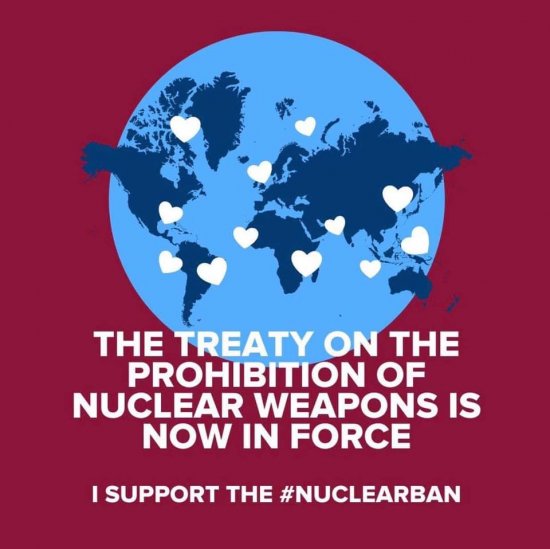
Kyrgyzstan has signed, and Ghana has ratified the Treaty on the Prohibition of Nuclear Weapons (TPNW), bringing the numbers of those who signed, ratified or acceded into the global majority. Kyrgyzstan’s Minister of Foreign Affairs, Zheenbek Kulubaev signed the treaty at the United Nations earlier today while Samuel Okudzeto Ablakwa, Foreign Minister of Ghana, deposited his country’s ratification, bringing the total to 99 out of 197 eligible states that have taken legal action under the treaty.
This is a key milestone for what is still a young treaty which was adopted by the UN just over just 8 years ago and only came into force under 5 years ago.
The TPNW outlaws nuclear weapons and all activities associated with them, including production, possession, testing, threats or use.
The TPNW was inspired by efforts to build the legal bulwark against the catastrophic humanitarian harm that nuclear weapons are known to cause. As we know from the evidence from the United States’ nuclear attacks on Hiroshima and Nagasaki 80 years ago, the effects of nuclear weapons are uniquely cruel and inhumane because of the indiscriminate, lasting, intergenerational harm they cause.
The International Campaign to Abolish Nuclear Weapons won the Nobel Peace Prize in 2017 for its work that led to the adoption of the TPNW. ICAN’s Executive Director, Melissa Parke, welcomed today’s news: “I warmly congratulate Kyrgyzstan and Ghana on their actions today. The TPNW is the best way to ensure real security from the existential threat nuclear weapons pose to the future of humanity, because as long as they exist, nuclear weapons are bound to be used, intentionally or by accident. The treaty is the sane alternative to the misguided and dangerous doctrine of nuclear deterrence and a new nuclear arms race that don’t provide security, but instead threaten it.”
Ms Parke continued: “The nuclear-armed countries and their allies that endorse the use of nuclear weapons are a distinct minority and they have no right to continue to threaten the future of the rest of the world. The TPNW is the pathway under international law to the fair and verifiable elimination of nuclear weapons so these nine countries have no excuse to continue to defy the majority here at the UN”.
The expanding influence of the TPNW has broken the hold nuclear-armed states and their flawed and dangerous doctrine of nuclear deterrence had on the public debate around nuclear weapons. The TPNW states are directly challenging deterrence doctrine as both a threat to all countries and an obstacle to nuclear disarmament – an objective the nuclear-armed states themselves say they share.
Theodora Williams Anti, from ICAN partner Foundation for Security and Development in Africa (FOSDA) said “Ghana’s ratification of the UN Treaty on the Prohibition of Nuclear Weapons is a proud moment for our nation and a powerful statement to Africa and the world. By joining the majority of states in rejecting these weapons of mass destruction, Ghana affirms its unwavering commitment to peace, human security, and the protection of future generations. This milestone reminds us that true strength lies not in the threat of annihilation, but in the courage to choose dialogue, cooperation, and a safer world for all.”
95 states have signed the treaty, which has 74 states parties. Four countries acceded to the treaty without signing beforehand as permitted under its Article 14.
The fact that the global majority of states are now on board the treaty sends a strong signal to the nuclear-armed states and their allies which support the use of nuclear weapons in their defence strategies that they are the minority and increasingly regarded by the international community as irresponsible actors threatening global security.
The TPNW has made nuclear weapons as unacceptable as chemical and biological weapons. The more countries that join the treaty, the more the diplomatic pressure builds on the pro-nuclear states and the more isolated they will become with all the diplomatic and reputational costs involved.
‘Life and death’: Penny Wong’s nuclear AI warning to UN Security Council

Nuclear weapons could be fired by artificial intelligence, Australia’s Foreign Affairs Minister has warned the United Nations.`
Blair Jackson, 26 Sept 25, https://www.news.com.au/technology/innovation/military/life-and-death-penny-wongs-nuclear-ai-warning-to-un-security-council/news-story/8ca47bc22b428922edb720dcfffe5458
Nuclear weapons could be fired by artificial intelligence, Australia’s Foreign Affairs Minister has warned the United Nations.
Speaking to the UN in New York on Thursday US time, Penny Wong issued a stark speech about technological advancements and armed conflict.
“AI’s potential use in nuclear weapons and unmanned systems challenges the future of humanity,” she said.
“Nuclear warfare has so far been constrained by human judgment, by leaders who bear responsibility and by human conscience. AI has no such concern, nor can it be held accountable.
“These weapons threaten to change war itself and they risk escalation without warning.”
Senator Wong has been with Prime Minister Anthony Albanese and Communications Minister Anika Wells at the UN this week, promoting Australia’s world-first under-16 social media ban.
Australia’s representatives have also been pushing to become one of 10 smaller nations to gain a 10-year non-permanent seat on the UN’s Security Council.
Senator Wong delivered the doomsday warning to the Security Council.
“Decisions of life and death must never be delegated to machines, and together we must set the rules and establish the norms,” she said.
“We must establish standards for the use of AI to demand it is safe, secure, responsible and ethical.
“To ensure AI transforms the tools of conflict and diplomacy for the better, the Security Council must lead by example – to strengthen international peace and security and ensure it is not undermined.”
Ukrainian President Volodymyr Zelenskyy delivered a similar warning to the UN’s General Assembly a day prior.
“It’s only a matter of time, not much, before drones are fighting drones, attacking critical infrastructure and targeting people all by themselves, fully autonomous and no human involved, except the few who control AI systems,” he said.
“We are now living through the most destructive arms race in human history because this time it includes artificial intelligence.”
1 This Month
29 Jan. Thursday 7-8 p.m. Webinar – World’s Largest Nuclear Station in Port Hope, ON?
To see nuclear-related stories in greater depth and intensity – go to https://nuclearinformation.wordpress.com/



31st January – Challenging the War Machine – a DECLASSIFIED UK SUMMIT


Website of the Week
Now until to February 10, 2026 Radioactive waste storage in France: the debate is finally open! How to participate?
-
Archives
- January 2026 (288)
- December 2025 (358)
- November 2025 (359)
- October 2025 (376)
- September 2025 (258)
- August 2025 (319)
- July 2025 (230)
- June 2025 (348)
- May 2025 (261)
- April 2025 (305)
- March 2025 (319)
- February 2025 (234)
-
Categories
- 1
- 1 NUCLEAR ISSUES
- business and costs
- climate change
- culture and arts
- ENERGY
- environment
- health
- history
- indigenous issues
- Legal
- marketing of nuclear
- media
- opposition to nuclear
- PERSONAL STORIES
- politics
- politics international
- Religion and ethics
- safety
- secrets,lies and civil liberties
- spinbuster
- technology
- Uranium
- wastes
- weapons and war
- Women
- 2 WORLD
- ACTION
- AFRICA
- Atrocities
- AUSTRALIA
- Christina's notes
- Christina's themes
- culture and arts
- Events
- Fuk 2022
- Fuk 2023
- Fukushima 2017
- Fukushima 2018
- fukushima 2019
- Fukushima 2020
- Fukushima 2021
- general
- global warming
- Humour (God we need it)
- Nuclear
- RARE EARTHS
- Reference
- resources – print
- Resources -audiovicual
- Weekly Newsletter
- World
- World Nuclear
- YouTube
-
RSS
Entries RSS
Comments RSS
 nuclear-news