How Zionism was sold to the world
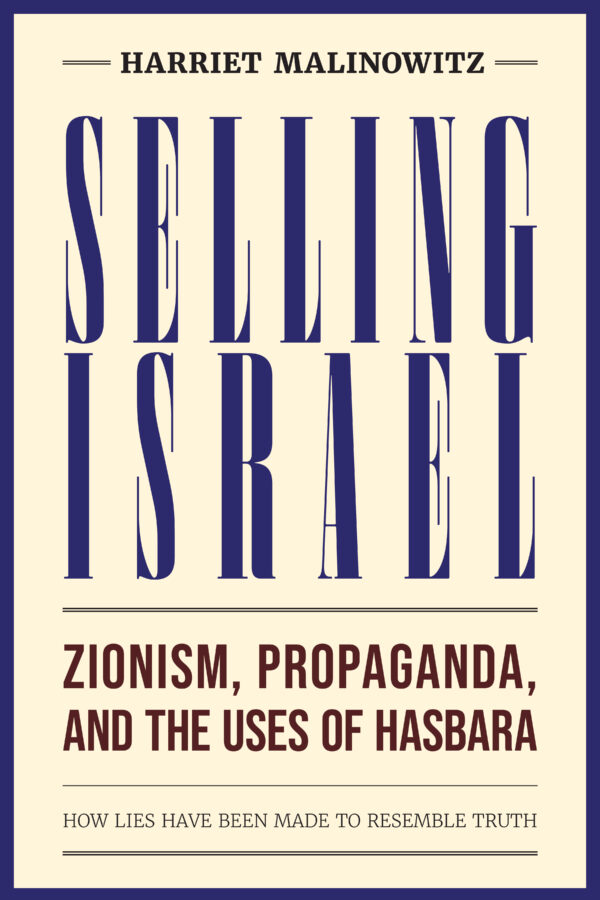
Harriet Malinowitz’s new book, “Selling Israel: Zionism, Propaganda, and the Uses of Hasbara,” reveals how Israeli propaganda and public relations promoted Zionism while concealing Palestinian oppression and dispossession.
Mondoweiss, By Eleanor J. Bader November 29, 2025
There are a number of pressing questions at the heart of Harriet Malinowitz’s newly released book, Selling Israel: Zionism, Propaganda, and the Uses of Hasbara. “How could what was initially a small group of Eastern European Jewish thinkers and activists convince the Jews of the world to agree that they were all one ‘people’ undergoing one shared threat with one shared path to salvation – as well as a shared imperative to seek it?” she asks. “How could they convince the rest of the world to include them in the family of nations? And how could they convince all involved – including themselves – that their project of liberation was a benign and noble one to which they were entitled, producing no casualties or collateral damage?”
The answers to these queries are at the crux of Selling Israel, and the book not only systematically examines them, but dives into how hasbara – globally enacted but Israeli government-instigated propaganda and public relations efforts– has been used to boost Zionism, diminish the perception of Palestinian oppression, and promote the fallacy that the 78- year-old country began as a land without people.
The exhaustively researched work was touted by Publisher’s Weekly as “an impressive and meticulous challenge to established narratives.”
Malinowitz spoke to reporter Eleanor J. Bader about herself, her research, and her findings shortly after the book’s publication.
Malinowitz………………………………………………………………………………………………………………………………………… During my own time on a kibbutz, there were Palestinian men working in the fields not far from the kibbutz members and international volunteers, but when we were all called in for a break in the “breakfast hut,” I saw that they simply kept working. I also met and drank tea with Palestinian merchants in the “shuk,” or Arab market, in Old Jerusalem, so I realized that what I’d been told about everyone in Israel being Jewish was untrue. I was told they were “Israeli Arabs” – without any coherent explanation. This left me completely baffled. Still, I was sure that I must be the one who wasn’t getting something…………………………
……………………….. I read Lenni Brenner’s 1983 book, Zionism in the Age of Dictators, which talked about Zionist complicity with Nazis. That provided another jolt.
I knew just enough to be excited by the first Intifada in 1987. But by the time of the second Intifada in 2002, people had cell phones and I could hear gunfire in Jenin via Democracy Now! on the radio. There were now blogs and listservs which carried information in new ways. But I was still naïve enough to be astounded that Israel refused to let a UN fact-finding team into the area.
This was a real turning point for me……………………………….
…………………………………… when I returned to the U.S., I plunged into research on the history of Palestine and of Zionism and eventually merged those interests with my research on propaganda, already well underway. I soon knew that I wanted to write a book on Zionism and propaganda, but it took me twenty years to complete the project!
Bader: The idea that God promised Israel to the Jews is largely unchallenged. Why is this?
Malinowitz: I think people are afraid to mess with other people’s religious beliefs, particularly where God is concerned. Plus, a lot of people believe the claim!
Bader: You write that Israelis rarely invoked the Nazi Holocaust before the 1960s because it was felt that the loss of six million Jews seemed like a sign of weakness, as if they’d gone to their deaths “like sheep to the slaughter.” Yet you also note that the genocide was seen by David Ben-Gurion to be a ‘beneficial disaster.’ Can you elaborate?
Malinowitz: I was shocked by how disparaged survivors of the Holocaust were in the country’s early years, as if they were a stain on Israeli masculinity that had to be expunged. Later, though, there was an ideological shift; the Israeli military reassured the world that they were strong, determined, and capable of fighting back if attacked, but at the same time the Holocaust could be invoked as a reminder of their perpetual victimhood, justifying all their exploits in the name of averting another genocide against the Jewish people. Similarly, the Holocaust has been used strategically when it serves international fundraising or is needed to garner empathy for Israel as an allegedly beleaguered nation.
Bader: Zionism was mostly promoted by Ashkenazi Jews who put forward the idea that there is one unified Jewish people. How did that idea spread?
Malinowitz: Zionism started out as an idea hatched by Eastern and Central European Jews, emerging in response to their own dire situation in the late nineteenth century. ………….For me, the claim that Israel represents all Jewish people is a fallacy. I, for one, was never consulted about this!
………………………………………………………………Malinowitz: Doubt can be a powerful weapon. There is a template that was developed by the tobacco industry that Zionists, climate and Holocaust deniers, Armenian genocide deniers, and others have used. The idea is there are competing narratives and both should be equally considered – rather than examining their credibility. This was why it took so long to convince the public that smoking caused cancer – because industry operatives challenged scientific expertise with their own “research,” leaving people thinking that the jury was still out and they might as well go on smoking until there was a clear and present danger. It’s been the same with Nakba denial. If the Zionists didn’t really force the Palestinians out in 1948, then they bear no responsibility for the refugees, right?
Bader: The idea that Israel is essential to Jewish survival has long been accepted as true. Why did alternatives to Zionism fail to gain traction?
…………………………………………………………………….., Zionists pushed the idea of Israel as the only solution t0 antisemitism, the only way Jews could be safe. …
…………………………………………………………………………..https://mondoweiss.net/2025/11/how-zionism-was-sold-to-the-world/
Israel is violating all its ceasefire agreements and escalating on all fronts
Israel is using existing ceasefire agreements to establish new realities on the ground, projecting itself as the regional hegemon by launching attacks on Gaza, Lebanon, Syria, and the West Bank.
By Qassam Muaddi and Mondoweiss Palestine Bureau November 28, 2025, https://mondoweiss.net/2025/11/israel-is-violating-all-its-ceasefire-agreements-and-escalating-on-all-fronts/
The war that Israel allegedly fought on “seven fronts” a year ago is supposed to be over. But Israel is now escalating on all fronts to achieve what it could not during the war, launching strikes and military incursions across Gaza, Lebanon, Syria, and the West Bank.
In Gaza, Israeli airstrikes killed over 20 Palestinians in a single day last Sunday as home demolitions have continued throughout the week; in Lebanon, Israel assassinated Hezbollah’s chief of staff, Hassan Ali Tabtabai; in the West Bank, the Israeli army has launched a wide-ranging military operation concentrated around the towns and villages of the northern Tubas governorate; and in Syria just this morning, Israel launched missile and artillery strikes in the southern Damascus countryside, killing 13 Syrians.
All of this takes place as Israel is nominally party to two ceasefires, respectively with Hezbollah and Hamas. Israel’s violation of both has become routine and has escalated significantly in recent weeks.
In Gaza, local sources tell Mondoweiss that a new status quo has emerged in which Israel continues to seize the opportunity to assassinate Hamas leaders in Gaza while claiming its actions are in response to an alleged “violation” on the part of Hamas. Israeli forces have also conducted dozens of demolitions of Palestinian buildings over the week, accompanied by shelling in eastern Gaza City, Rafah, and Khan Younis. Last Sunday, Israeli airstrikes killed over 20 Palestinians in a single day, and on the Tuesday before that, the Israeli army killed 33 Palestinians in a single night.
In all cases, the military either claims that Palestinian fighters trapped in Rafah and surrounded by Israeli forces allegedly violated the ceasefire, or it claims that Palestinian fighters approached the yellow line demarcating the area from which Israeli forces had withdrawn since the ceasefire came into effect last October.
But Israeli forces have been shooting at Palestinians near the yellow line indiscriminately, many of them trying to return to their homes in the area. The line remains invisible to most Gaza residents and can only be identified by the yellow concrete blocks Israeli forces have placed across various points, supposedly demarcating the ceasefire withdrawal borders, which effectively cut Gaza in half. The Israeli army also dropped leaflets over Palestinian encampments west of the yellow line, warning them that anyone who approaches the virtual border will expose themselves to danger.
Through these policies, the Israeli army is entrenching Gaza’s de facto division into two areas, one controlled by Hamas and the other controlled by the Israeli army. Even though this state of affairs is supposed to be temporary and linked to the “first phase” of the ceasefire, the deliberate ambiguity of the deal’s terms and the lack of an implementation mechanism make it easy for Israel to declare that Hamas is in violation of the terms — and hence refuse to withdraw further from Gaza. The effect this has had is to force almost all of the Strip’s population into less than half of its already overcrowded territory.
Meanwhile, in the West Bank, Israeli forces have launched a wide-scale military operation in the northern West Bank concentrated around the so-called “pentagon of villages” — Tubas, Tammun, Aqaba, Tayasir, and Wadi al-Fara — which the Israeli intelligence establishment considers a “hotbed” of resistance activity. Ostensibly to root out resistance in the Tubas district, local residents told Mondoweiss that the real reason for the military invasion is to thin out the population in the area, laying the groundwork for land confiscation and settlement building.
In Lebanon, the international peacekeeping forces — UNIFIL — reported last week that Israeli forces had committed around 10,000 violations of the ceasefire deal with Lebanon, including 2,500 land incursions and 7,500 airspace violations, since entering into its ceasefire with Hezbollah a year ago in November 2024. The Israeli newspaper Yediot Ahronot also reported that the Israeli army has conducted 1,200 land raids into 21 Lebanese villages over the past year.
These violations escalated significantly over recent weeks, culminating in the strike that killed Hezbollah chief of staff Tabtabai on Sunday, who is considered the highest-ranking Hezbollah member to be targeted since the ceasefire began. Following the assassination, Israel put its forces near Lebanon’s border on alert, as Hezbollah officials insinuated the possibility of a response. This series of escalations now threatens to blow up the Lebanon ceasefire.
Using ceasefires to establish realities on the ground
Both ceasefire deals in Lebanon and Gaza were only made possible after long months of mediation, in which Hezbollah and Hamas each eventually accepted terms that allowed Israel to maintain forces in their territories, without any practical guarantees that the ceasefires would be sustainable.
Yet Israel is using these truces to establish new realities on the ground, entrenching its occupation of parts of Gaza and southern Lebanon while asserting its military dominance on the regional stage. This projection of control aims to impose Israel’s vision for a “new Middle East” and a new status quo that recognizes Israel as the uncontested hegemon.
This can be gleaned in Israel’s active escalation in Syria, where Israel has tried to counter the expansion of Turkey’s influence in the country.
Israeli forces continue to position themselves in Syrian territory while conducting land raids in cities such as Quneitra and its surroundings. Last Monday, official Syrian TV reported that Israeli forces “bulldozed extensive farming areas” in the Syrian village of Breiqa in the southern part of the country. Meanwhile, on Thursday, Syrian media outlets reported that Israeli fighter jets flew over several Syrian governorates, and on the following day, an Israeli force invaded the Syrian town of Beit Jinn. When the force was reportedly uncovered, clashes between the Israeli force and Syrians reportedly led to the injury of two Israeli soldiers. According to Syrian state TV, Israeli shelling and strikes led to the killing of 13 Syrians, including at least two children.
Israeli strikes across Syrian territory have continued to become more flagrant over recent weeks, while previous strikes in Damascus in July aimed to strengthen Druze separatist elements in Suwayda. The reality on the ground Israel hopes to create is one of regional fragmentation.
In Gaza, this is manifesting in the recently declared plan to build “alternative safe communities” that would make up a “new Gaza” in the part of the Strip under Israeli control, which appears to have received U.S. backing. Earlier in July, Israeli Defense Minister Israel Katz had stated that Israel would create a “humanitarian city” built over the flattened remains of Rafah, which was supposedly meant to house 600,000 Palestinians and would be used as a pathway for Palestinians to “voluntarily migrate” out of Gaza, a plan that was characterized by UN officials and human rights experts as a “concentration camp.”
In that same month, a Reuters report revealed that the U.S.-run and Israeli-backed Gaza Humanitarian Foundation (GHF) — so-called “aid” sites meant to replace the UN’s aid distribution system, but where thousands of Palestinians were gunned down in what were described by Gazans as “death traps” — had drafted plans to create so-called “Humanitarian Transit Areas” meant to facilitate the ethnic cleansing of Palestinians from Gaza. The GHF was itself the “brainchild” of Israeli officials, the New York Times reported last May.
Now that plans for a “new Gaza” have surfaced as part of the Trump-backed ceasefire framework, new reports have begun to emerge that UG Solutions, the U.S. military subcontractor that provided security for the GHF, is now recruiting for a new deployment in Gaza to run ten to 15 more aid sites during the ceasefire.
All these developments take place as Israel attempts to continue to advance its goals. In Lebanon and Syria, it is to establish itself as a regional hegemon, and in Gaza, it is to achieve during the ceasefire what it could not achieve during the war — the ethnic cleansing of Gaza under the rubric of “voluntary migration.”
The Neocon-Realist Armageddon Over Ukraine

Rubio was in Geneva last Sunday with the Ukrainians and Europeans to undermine Trump’s 28-point plan, trying to replace it with one of just 19 points that unrealistically gives an advantage to Ukraine. Unrealistic because this war has already ended on the battlefield and Trump has virtually acknowledged it.
By Ray McGovern, Consortium News, https://consortiumnews.com/2025/11/28/ray-mcgovern-the-neocon-realist-armageddon-over-ukraine/
Donald Trump made some revealing remarks to the media as he flew to Florida for Thanksgiving on Wednesday. Asked if he thought Ukraine is being asked to give too much land to Russia in his proposal to end the war, Trump responded:
“It’s clearly up to the Russians. It’s moving in one direction. … That’s land that over the next couple of months might be gotten by Russia anyway. So, do you want to fight and loose another 50,000 or 60,000 people? Or do something now? They are negotiating; they are trying to get it done.”
That’s the same realistic approach Trump’s new special envoy to Ukraine, U.S. Army Secretary Daniel Driscoll, took with the Ukrainians and Europe’s so-called “coalition of the willing” during a visit to Kiev earlier this week.
Driscoll reportedly threw in yet one more reason for Ukraine to end the war – the fact that the Russians have ever-growing stockpiles of missiles they can deploy.
In other words, the undeniable Russian advances all along the contact line in Ukraine are no longer deniable to anyone tuned into reality.
But not everyone is tuned in. U.S. Gen. Keith Kellogg, who unrealistically claimed that Ukraine could still win, has been removed as special envoy to Ukraine, but there are other neocons lurking near the White House, for instance, Secretary of State Marco Rubio who also as national security adviser can control the flow of intelligence and policy proposals to the president.
Rubio was in Geneva last Sunday with the Ukrainians and Europeans to undermine Trump’s 28-point plan, trying to replace it with one of just 19 points that unrealistically gives an advantage to Ukraine. Unrealistic because this war has already ended on the battlefield and Trump has virtually acknowledged it.
What’s next is an official agreement, endorsed, ideally by the United Nations Security Council, where France or Britain, however, could veto it, as the Europeans continue their efforts to thwart such a peace agreement.
Britain, France and Germany, for example, are still pushing the fantasy that Russia is poised to attack Europe.
So we are at the threshold on Ukraine, at the beginning of a consequential battle between the neo-cons and Europeans on one side, and Donald Trump and the realists on the other. Will Trump show the fortitude to see this through and overcome his secretary of state?
For now you can dismiss the idea that the so-called “Peace Plan” is “dead on delivery.” It hasn’t even officially been delivered to Russia yet.
Russian President Vladimir Putin awaits hand delivery from U.S. envoy Steve Witkoff probably on Monday – Washington’s recent unorthodox conduct of diplomacy notwithstanding.
My sense is that Witkoff, like Driscoll, will dis the Europeans and go to Moscow with the 28-point draft plan for discussion and that it will adhere to one of the main provisions of Anchorage — namely that Trump will not let Zelinski sabotage movement toward an agreement. Putin told Hungarian President Viktor Orban today in Moscow that he remained open to meeting Trump in Budapest at a future date.
For his part, Putin seems ready to do business. An important backdrop is his priority objective of preventing relations with the U.S. from falling into a state of complete disrepair. As for Ukraine, Putin has reiterated that the 28-point Trump plan could form the basis for future agreements.
Taking questions from the press yesterday in Bishkek, Kyrgyzstan, Putin gave clarity to a number of key issues. He said there was “no ‘draft agreement’ per se,” but rather “a set of issues proposed for discussion and finalization.”
Putin went on:
“We discussed this with American negotiators, and subsequently, a list of 28 potential points for an agreement was formulated.
Thereafter, negotiations were held in Geneva between the American and Ukrainian delegations. They decided among themselves that all these 28 points should be divided into four separate components. All of this was passed on to us.
In general, we agree that this could form the basis for future agreements. However, it would be inappropriate for me to speak now of any final versions, as these do not exist.”
Putin noted that the U.S. — this would be Trump, not Rubio — is “taking our position into account – the position that was discussed before Anchorage and after Alaska. We are certainly prepared for this serious discussion.”
On the question of land, Putin made certain that Russia will not be denied. He said, “I think it will be clear at once what it is all about. When the Ukrainian troops leave the territories they occupy, then the hostilities will cease. If they do not leave, we will achieve it militarily. That’s that.”
Of course, in 2022 Russia entered the Ukrainian civil war that had begun after the 2014 U.S.-backed coup that lead to the U.S.-installed government attacking the ethnic Russian Donbass region, which had rejected the unconstitutional change of government and declared independence.
After eight years of indirectly aiding Donbass, Russia intervened directly after the Minsk agreements to end the civil war were sabotaged by Ukraine and the Europeans. Russia’s war demands have remained demilitarizing and denazifying a neutral Ukraine. In the course of its intervention it has absorbed four Ukrainian oblasts into the Russian Federation, which remains non-negotiable to Moscow.
“Those in the West who understand what [recent Ukrainian defeats on the battlefield] could lead to are pushing for an end to the fighting as soon as possible,” Putin said, referring to the realists in Washington.
“They understand that if the front lines are drawn back in certain areas, the Ukrainian armed forces will lose their combat effectiveness and their most combat-ready units,” he said. “‘Enough is enough, preserve the core of your armed forces and your statehood, that’s what you need to focus on,’ say those who hold this view.”
But he said “others,” referring to the Europeans and neocons, “insist on continuing the hostilities until the last Ukrainian. That’s the difference in approaches.”
Putin tried to put to rest the fear-mongering in Europe about a planned Russian attack on the continent. “Russia does not intend to attack Europe. To us, that sounds ridiculous, does it not?” he said. “We never had any such intentions. But if they want to have it formalised, let’s do it, no problem.”
Putin also reiterated that Russia could only sign a peace agreement with a legitimate government in Ukraine after a new election, another obstacle to overcome.
“I believe that the Ukrainian leadership made a fundamental, strategic mistake when it was afraid to hold presidential elections, and as a result, the president lost his legitimate status,” Putin said. “As soon as any kind of peace agreement is reached, the fighting will stop, and the state of emergency will be lifted, elections will be announced.”
Which is another incentive for Zelensky and those who back him inside and outside of Ukraine to keep on fighting.
“So, basically, we want to reach an agreement with Ukraine in the end, but it’s almost impossible right now, legally impossible. We need our decisions to be internationally recognized by the major international players. That’s it,” said Putin.
He added:
“And so, of course, we need recognition, but not from Ukraine today. I hope that in the future we will be able to come to an agreement with Ukraine: there are many healthy people there who want to build relations with Russia for a long-term historical perspective.”
Peace then will require the complete negation of the neocons and the Europeans and a new government in Kiev — a tall order indeed.
It comes down to whether Trump can finally stand up to them — people whom he appointed, like Rubio, and whom he golfs with, like Sen. Lindsey Graham. He seems to have less respect for the Europeans, who practically sat at his feet around the Oval Office desk earlier this year pleading their case on Ukraine.
Trump may be motivated in part by the vain desire to end the war to win the Nobel Peace Prize. But he can get it done. Trump can ignore the Europeans and be serious this time about cutting off military aid and intelligence to Ukraine as he threatened to do if Zelensky did not accept his 28 points by Thanksgiving.
When it comes to Ukraine, Trump really does hold the cards. Will he play them?
UK Nuclear Projects Set to Add $1.3 Billion a Year to Power Bills

By Tsvetana Paraskova – Nov 28, 2025,
https://oilprice.com/Latest-Energy-News/World-News/UK-Nuclear-Projects-Set-to-Add-13-Billion-a-Year-to-Power-Bills.html
Subsidies and Contracts for Difference (CfD) that the UK government has promised to the two projects for new nuclear power stations are expected to add $1.32 billion (£1 billion) annually to the UK power bills from around 2030, The Telegraph reports, citing documents by the Treasury and the Office for Budget Responsibility (OBR).
The Hinkley Point C nuclear power station, developed by EDF, is expected to begin generating electricity in 2030-31, after years of delays and cost overruns.
That year, CfD is expected to generate $6.1 billion (£4.6 billion) in receipts, including £1.0 billion to fund subsidy payments to the Hinkley Point C nuclear power plant for its first year of expected generation, OBR said in its economic and fiscal outlook released after the UK’s latest budget announcement.
The UK government earlier this year also took the final investment decision to build the $51-billion Sizewell C nuclear power plant on the Suffolk Coast in eastern England, which was the first British-owned nuclear power station to be announced in over three decades.
Sizewell C will be the first nuclear power station in the UK financed using a regulated asset base (RAB) model that levies an additional charge on consumer energy bills, which contributes to the financing costs of the plant, OBR noted. This levy is also expected to increase energy bills as early as January.
UK households will pay slightly higher energy bills in the first quarter of 2026 after energy market regulator Ofgem last week raised the Energy Price Cap by 0.2%, against expectations of a 1% drop.
The slight increase in the price cap is driven by government policy costs and operating costs. This includes funding the government’s Sizewell C nuclear project, which will bring more [?] clean power, Ofgem noted.
Opponents of new conventional nuclear plants in Britain argue that consumers will be burdened with a “nuclear tax” for the expensive projects in their energy bills.
“The Government has a misguided belief that nuclear will be a cheap, ‘green’ solution to our energy needs, but the evidence shows the opposite – that costs of delivery and of dealing with nuclear waste – will continue to rise,” Alison Downes, of Stop Sizewell C, told The Telegraph.
“We remain opposed to the imposition of a nuclear tax on households, given the acknowledged uncertainty about the projected costs of constructing Sizewell C.”
Marco Rubio: From ‘Perfect Little Puppet’ to Most Dangerous Man Alive
Few in 2016 would have predicted Rubio’s rise to become arguably the most powerful man in Trump’s cabinet. The Floridian was once one of Trump’s fiercest critics, describing him as a fraud when the two were battling for the Republican Presidential nomination.
December 2nd, 2024, Alan McLeod, https://www.mintpressnews.com/marco-rubio-perfect-little-puppet-most-dangerous-man-alive/288757/
With the appointment of Marco Rubio to the post of Secretary of State, the Trump administration has elevated one of the most pro-war extremists ever to serve in the cabinet of the United States of America.In this article, MintPress highlights Rubio’s history as one of the most reliable warmongering voices in Washington, an individual who has led or supported many of America’s most aggressive foreign policy decisions, including military interventions, coups, and sanctions.
Sanctioning China, The World
Of all the situations to trigger a global nuclear war, a confrontation with Beijing appears among the most likely. The U.S. has constructed a network of over 300 military bases encircling China – another nuclear-armed state. Rubio is doing more than almost anyone to make that doomsday scenario an eventuality. He has made clear that he supports Taiwanese independence, breaking more than a half-century of official U.S. policy in the process. His “Taiwan Peace Through Strength Act” promotes direct military collaboration between the U.S. and Taiwan and calls for increased arms spending on the island.
Rubio was also one of the faces of the 2014 Hong Kong protest movement, a U.S.-backed attempt to wrest the island city from Chinese influence. He invited the movement’s leaders to Washington, D.C., and attempted to introduce legislation to force the United States into supporting Hong Kong’s independence.
At home, he has led the clampdown on Chinese businesses such as Huawei and has spearheaded a movement to uncover and stamp out China’s supposed undue influence over American media and educational institutions.
Unsurprisingly, then, the former Florida senator also supports a trade war and sanctions against China and, indeed, much of the world, including Russia, the Democratic People’s Republic of Korea, and Iran.
Unilateral sanctions, of course, are illegal under international law. However, Rubio believes the United States can and should use its economic might to crush countries resisting Washington’s dictates. The waning power of the dollar as the global reserve currency, though, makes this increasingly difficult. As Rubio lamented on Fox News last year, Brazil, the largest country in Latin America, signed a comprehensive trade agreement with China whereby goods and services would be paid for in local currencies rather than the dollar:
They’re creating a secondary economy in the world, totally independent of the United States. We won’t have to talk sanctions in five years, because there will be so many countries transacting in currencies other than the dollar, that we won’t have the ability to sanction them.”
Genocide Denier
Rubio has strongly supported Israel in its campaign against its neighbors. “Israel takes extraordinary steps to avoid civilian losses,” he said during a solidarity visit to Tel Aviv earlier this year, adding that the problem is that its enemies “don’t value human life.”
“Israel has consistently sought peace with the Palestinians… Israelis rightfully living in their historic homeland are not the impediment to peace; the Palestinians are,” he wrote in a letter to his predecessor, Antony Blinken.
When asked by activists from peace group CODEPINK whether he supports an end to Israeli atrocities, he answered in the negative, stating, “On the contrary. I want them to destroy every element of Hamas they can get their hands on. These people are vicious animals.”
Narco Rubio
Hailing from the notoriously conservative Cuban-American community in Florida, Latin American policy has always been among Rubio’s chief interests. Described as the unofficial “Secretary of State for Latin America” during Trump’s term, he will undoubtedly hold enormous influence over U.S. policy in the region in the years to come. This is bad news for the people of Cuba, Nicaragua, Bolivia, and Venezuela, all of whom have watched as Rubio supported coup attempts against their countries. In 2019, for example, he went as far as directly tweeting images of the capture, death and bloody assassination of Libyan leader Muammar Gaddafi at Nicolás Maduro during an ongoing U.S.-backed coup against the Venezuelan president.
Rubio has always favored a more aggressive, punitive approach to Cuba. Last year, for example, he introduced legislation to ensure that Cuba would remain on the U.S. State Sponsor of Terrorism List, offering no evidence of the island’s supposed support for such groups.
A right-wing conservative Christian, Rubio has also made well known his contempt for much less radical Latin American leaders, such as Mexico’s Andrés Manuel López Obrador and Brazil’s Lula da Silva. On the other hand, he has openly embraced far-right presidents, like Brazil’s Jair Bolsonaro (in power between 2019 and 2023) and Argentina’s Javier Milei.
Rubio has attempted to link Maduro with the organized drug trade, insisting, with little evidence, that the Venezuelan leader is a narcotics kingpin. On this issue, he appears to be living in a glasshouse; his own brother-in-law is a cocaine drug lord. Orlando Cicilia spent 12 years in a Florida prison for crimes related to the smuggling and distribution of cocaine. Rubio enjoys a very close relationship with Cicilia and, after the latter’s release from prison, used his political position to pressure a Florida regulator to grant him a real estate license. Across much of Latin America, the new Secretary of State is known as “Narco Rubio.”
Neocon Warmonger
A consummate Washington insider, Rubio cheerled the U.S. action in Libya that led to Gaddafi’s execution and the country being turned into a failed state replete with open-air slave markets. He also supported the wars in Iraq and Afghanistan, condemning Biden for his pullout from Kabul in 2021. In addition, he helped Saudi Arabia in its genocide against Yemen while expressing outrage over alleged Houthi human rights abuses, minuscule in comparison with the Saudi-led, U.S.-backed genocide.
Studies by Brown University have shown that America’s post-9/11 wars have killed at least 4.5 million people and displaced at least 37 million more. One of the most shocking stories arising from the Global War on Terror is the torture camp at Guantánamo Bay. By the mid-2010s, the facility was causing such negative publicity for the U.S. that the Obama administration was reportedly considering shutting it down. Rubio, however, was enthusiastic in his support for the center, promising to reopen it if elected president.
He also supported the dramatic expansion of the surveillance state into American life, voting to continue the practice of collecting vast amounts of data on ordinary American citizens, and has effectively argued that First Amendment protections should not be applied to anti-Israel campus protestors.
Sheldon Adelson’s “Perfect Little Puppet”
Few in 2016 would have predicted Rubio’s rise to become arguably the most powerful man in Trump’s cabinet. The Floridian was once one of Trump’s fiercest critics, describing him as a fraud when the two were battling for the Republican Presidential nomination. “I think it is time to unmask [Trump] for what he is,” he said during a campaign speech in Oklahoma City, adding:
He’s trying to take over the conservative movement even though he’s not a conservative, but more importantly, he’s a con. I mean, he’s a conman who is taking advantage of people’s fears and anxieties about the future, portraying himself as some sort of strong guy. He’s not a strong guy.”
Trump was, if anything, even more scathing towards Rubio, stating that “[Pro-Israel billioniare] Sheldon Adelson is looking to give big dollars to Rubio because he feels he can mold him into his perfect little puppet. I agree!”
One of Adelson’s key issues is stopping the rise of clean, renewable energy, and in that, he found an ally in Rubio, who consistently denied the reality of man-made climate change, stating that there was “no scientific evidence” to back up the theory. Funded by big money donations from the oil and gas industries, he even voted against legislation protecting low-lying cities such as Miami from severe weather events.
Since their public spat, Trump has clearly buried the hatchet with both Rubio and Adelson. The latter’s widow, Miriam, contributed a gigantic $100 million to Trump’s recent presidential run, becoming his biggest donor in the process. Clearly, then, both Trump and Rubio are willing to make major concessions in the pursuit of power. However, given Rubio’s track record, his appointment as Secretary of State does not bode well for either America or the rest of the world.
Alan MacLeod is Senior Staff Writer for MintPress News. After completing his PhD in 2017 he published two books: Bad News From Venezuela: Twenty Years of Fake News and Misreporting and Propaganda in the Information Age: Still Manufacturing Consent, as well as a number of academic articles. He has also contributed to FAIR.org, The Guardian, Salon, The Grayzone, Jacobin Magazine, and Common Dreams
Educators Worry Palestine Censorship Could Reshape Public Education Entirely.

lawmakers who sponsored House Bill (HB) 937 seemed more committed to preventing teachers and pupils from criticizing Israel than preventing discrimination against Jewish students
New efforts to shut down honest discussion of Palestine could restrict everything from literature to science classes.
By Marianne Dhenin , Truthout, November 29, 2025
A wave of bills introduced this year in state legislatures across the country sought to censor Palestine-related education in public schools. Several passed with the support of pro-Israel Democratic lawmakers, a trend that educators and First Amendment advocates told Truthout reflects the alignment of pro-Israel groups with MAGA forces. As these efforts continue, many said they fear public education could be reshaped far beyond social studies classrooms and the topics of Israel and Palestine.
“The censorship of Palestinians is the same as the ‘Don’t Say Gay,’ and the anti-critical race theory attacks on Black history,” Nora Lester-Murad, an organizer with the #DropTheADLfromSchools effort, told Truthout. The Anti-Defamation League (ADL) is one of a number of pro-Israel groups supporting regressive public education legislation across the country. “Yes, it’s Zionist, and yes, it’s promoting Israel, but it’s also part of this right-wing effort to take public education in a direction that’s away from critical thinking and that’s anti-liberatory.”
This year, legislators in at least eight states — including Arizona, Arkansas, Kansas, Kentucky, Missouri, Nebraska, Oklahoma, and Tennessee — introduced bills that would directly adopt the International Holocaust Remembrance Alliance (IHRA) definition of antisemitism in public schools. That definition equates criticism of Israel with antisemitism. Dozens of civil society and rights groups, as well as unions of educators, have warned against its adoption because of its power to chill or suppress speech critical of Israel or Zionism.
Michael Berg, an organizer with Jewish Voice for Peace (JVP) in Missouri, said lawmakers who sponsored House Bill (HB) 937 seemed more committed to preventing teachers and pupils from criticizing Israel than preventing discrimination against Jewish students. “They were attached to the IHRA definition, so it shows that it’s very specifically about speech about Israel,” he said. Organizers succeeded in stopping HB 937 in Missouri this year, but Berg told Truthout they are already preparing to fight a new iteration of the bill in the upcoming legislative session.
Other states have made similar efforts, including California, where Democrats hold a supermajority in the state assembly. There, this year’s Assembly Bill (AB) 715 was the latest in a series introduced under the guise of curbing antisemitism, but whose critics argue are censorship bills that undermine the implementation of earlier legislation mandating ethnic studies courses in public schools. AB 715 does not define antisemitism, but calls for using the Biden-era United States National Strategy to Counter Antisemitism as “a basis to inform schools on how to identify, respond to, prevent, and counter antisemitism.” That white paper claims that “the United States has embraced” IHRA’s definition as a “valuable tool” in countering antisemitism. Gov. Gavin Newsom signed AB 715 into law in October; the American-Arab Anti-Discrimination Committee (ADC) filed a suit challenging the law in federal court in November.
Meanwhile, this August in Massachusetts, another Democratic stronghold, the state’s Special Commission on Combating Antisemitism approved recommendations meant to curb antisemitism in schools. The recommendations call on districts to teach IHRA’s definition of antisemitism in anti-bias trainings for teachers and school administrators. A statewide coalition of labor unions, civil rights groups, and progressive Jewish organizations warned that rather than countering antisemitism, the recommendations “pit some Jewish students against other marginalized populations” and will likely “undermine safe learning and working environments for students and teachers.”
These moves dovetail with a federal agenda to remake the nation’s public schools and historical programming at other public institutions, such as museums and national parks. Since his return to office, President Donald Trump has signed executive orders demanding an end to “radical indoctrination in K-12 schooling” and “restoring truth and sanity to American history.” The administration advocates teaching a whitewashed and aggrandizing version of the nation’s past that Trump, in one executive order, called “patriotic education.”…………………………………………………………………………………………………………………………………………………..
The recent wave of bills limiting Palestine-related speech in public schools also harms students. “We believe that antisemitism is being used to censor education on Palestine, and we believe that our students have a right to understand both sides of an issue,” Seth Morrison, spokesperson for JVP’s Bay Area chapter and an organizer with CCDPE, told Truthout. “We’re not saying don’t talk about Israel or don’t talk about the Holocaust. What we’re saying is that there are many open issues here and that Arab and Muslim students especially are being intimidated and censored because of IHRA and related activities.”…………………………………………………………………………………….. https://truthout.org/articles/educators-worry-palestine-censorship-could-reshape-public-education-entirely/
The mysterious black fungus from Chernobyl that may eat radiation
Mould found at the site of the Chernobyl nuclear disaster appears to be
feeding off the radiation. Could we use it to shield space travellers from
cosmic rays? In May 1997, Nelli Zhdanova entered one of the most
radioactive places on Earth – the abandoned ruins of Chernobyl’s exploded
nuclear power plant – and saw that she wasn’t alone.
Across the ceiling,
walls and inside metal conduits that protect electrical cables, black mould
had taken up residence in a place that was once thought to be detrimental
to life. In the fields and forest outside, wolves and wild boar had
rebounded in the absence of humans. But even today there are hotspots where staggering levels of radiation can be found due to material thrown out from the reactor when it exploded.
BB 28th Nov 2025, https://www.bbc.co.uk/future/article/20251125-the-mysterious-black-fungus-from-chernobyl-that-appears-to-eat-radiation
What Defeat Looks Like

Had the western powers acted in good faith to resolve these issues at Minsk, history might have taken a different course. Instead, European leaders did everything they could to scuttle the Accords.
On the battlefield, Russia is in no rush; it is defeating Ukraine in a grinding war of attrition that by now is irreversibly in Russia’s favour.
As in Potsdam at the end of the Second World War, the only path forward now is working out the terms of Ukraine’s defeat. And there is still time to save lives, writes Stefan Moore.
Stefan Moore, Consortium News, November 28, 2025, https://consortiumnews.com/2025/11/28/what-defeat-looks-like/
European leaders are in panic mode. They are scrambling to ensure that Trump’s 28-point peace plan that they believe favours Russia can be revised to give Ukrainian President Volodymyr Zelensky an equal say alongside Russian President Vladimir Putin.
This is delusional thinking. Whether or not Zelensky and his U.S./NATO allies, who have poured hundreds of billions of dollars into this conflict care to accept it, Russia is the indisputable victor in this terrible 14-year war, beginning with the 2014 Ukrainian civil war, which Russia entered in 2022.
Moscow will call the shots when it finally ends. As in Potsdam at the end of WWII, the only path forward now is working out the terms of defeat.
Those terms include Ukraine losing all or most of the four eastern oblasts – Donetsk, Lugansk, Zaporizhzhia and Kherson (amounting to roughly a third of its territory and population); an ironclad prohibition from joining NATO, which Russia correctly views as a hostile alliance; the reduction of its armed forces (the size to be negotiated) and the denazification of its military and government.
For those who believe this is an intolerable capitulation, it’s time to review the historical record.
Since the end of the Cold War, despite promises to Russia that it would not move “one inch eastward”, NATO has pushed up to Russia’s borders from Poland to the Baltic states and in 2008 invited Ukraine and Georgia to become members. The potentially devastating consequences of this expansion were signalled by the most senior U.S. diplomats at the time.
William Burns, the U.S. ambassador to Russia in 2008 warned in a cable published by WikiLeaks that Ukraine becoming a NATO member could lead to war with Russia in Ukraine, a prediction that eventually came true.
The architect of America’s Soviet containment policy, George Kennan, presciently warned as early as 1997 that “expanding NATO would be the most fateful error of American policy in the entire post-Cold War era.”
Not only were these words not heeded, but the West set out to weaken Russia in every way possible.
The Coup
In 2014, the U.S. helped engineer a coup (revealed here, here, and here) to overthrow Ukraine’s democratically elected, Russia-friendly president Victor Yanukovych and install a Western-friendly regime. Billed in the Western media as a popular uprising for democracy, it led Ukraine on the path to civil war between the European-aligned west and the east which had closer ties to Russia.
The biggest losers in this adventure were the ethnic Russian people of Ukraine’s eastern region who opposed the coup and called for the creation of separate autonomous states. In response, Ukraine’s armed forces and its virulently anti-Russian neo-Nazi battalions went on the attack.
In what turned out to be a disingenuous attempt to resolve the conflict, Ukraine and Russia took part in the Minsk Accords (mediated by France and Germany with U.N. support).
Among other things, Minsk proposed autonomy of the ethnic-Russian regions of Donetsk and Lugansk within a federated state of Ukraine, and an understanding that Ukraine could not join NATO, an alliance that Russia correctly sees as an existential threat.
For those who fail to comprehend Russia’s insistence on the latter point, it would be equivalent to Mexico or Canada entering a security alliance with Russia that allowed them to station nuclear capable missiles on the U.S. border. One only has to recall the Cuban Missile Crisis to see how that worked out.
Had the western powers acted in good faith to resolve these issues at Minsk, history might have taken a different course. Instead, European leaders did everything they could to scuttle the Accords.
Later, former Germany’s Angela Merkel and then ex-French president Francois Hollande would publicly admit that they were just playing along to give NATO more time to arm Ukraine to defeat Russia – a battle they have been willing to fight to the last Ukrainian.
Between the time of the Minsk Accords in 2015 and Russia’s invasion of Ukraine in 2022, on behalf of the besieged population in the east, nearly 14,000 ethnic Russian civilians had been killed by Ukraine’s forces, teaching the Russian language had been prohibited, Russian churches had been outlawed and Russian language media had been severely restricted.
The Istanbul Denial
Yet, despite the setback following Minsk and just two months into Russia’s invasion, another opportunity to end the war was being negotiated between Russia and Ukraine in Istanbul.
The terms were similar to Minsk, but just as Ukraine was about to sign the agreement, U.K. Prime Minister Boris Johnson descended on Kiev on behalf of NATO to tell Zelensky to pull the plug — the U.S. and Europe would provide Ukraine with all the weapons it needed to continue to fight Russia.
So, four years on, here we are. Putin, fooled twice, has lost all trust in Western leaders and has no more time for their games. On the battlefield, Russia is in no rush; it is defeating Ukraine in a grinding war of attrition that by now is irreversibly in Russia’s favour.
Contrary to European leaders’ tough talk, Ukraine has nearly run out of trained soldiers, the U.S. has run out of ground war arms to give to Ukraine and, despite its belligerent rhetoric, Europe has run out of money to send to Kiev. (Meanwhile, revelations of corruption close in on Zelensky’s inner circle, claiming the resignation today of his chief of staff.)
The tragedy is that all of this – the loss of over a million lives (mostly young Ukrainian and Russian men thrown into the meatgrinder of trench warfare), the fleeing of over 7 million Ukrainian refugees who are unlikely to ever return and the widespread destruction of Ukraine’s infrastructure – could have all been avoided.
The notion that the West came to the aid of Ukraine to defend democracy in the most corrupt and neo-Nazi infested country in Europe is as deceptive as it is laughable. This has always been a battle initiated by the U.S./NATO alliance to weaken Moscow, overthrow Putin and return the West to dominance over Russia like in the 1990s, with Ukraine as the unfortunate willing proxy.
It was sheer hubris and stupidity for the neocons in Washington and Brussels, pumped up with triumphalism after the fall of the Soviet Union, to think they could mould the post-Cold War world including Eurasia in their interests without disastrous consequences.
In the end, Ukraine will be defeated but there are no real winners.
Both Ukraine and Russia will take years to recover from the human and economic cost of this devastating war; Europe’s economy is in tatters with near negative growth, energy prices three times higher than before the destruction of Russia’s Nord Stream pipeline, and companies fleeing to produce offshore.
As for the U.S. , it has nothing to show other than public anger over the war, soaring national debt and increasing isolation as a global power.
As always, the biggest prize-winners are the global defence contractors whose profits have skyrocketed since the start of the war in Ukraine and Israel’s genocidal war in Gaza.
Stefan Moore is an American-Australian documentary filmmaker whose films have received four Emmys and numerous other awards. In New York he was a series producer for WNET and a producer for the prime-time CBS News magazine program 48 HOURS. In the U.K. he worked as a series producer at the BBC, and in Australia he was an executive producer for the national film company Film Australia and ABC TV.
UK energy bill payers will hand £2bn a year to EDF for new power stations

COMMENT. Here is a prime example of the crookedness of the UK Labour government, in pretending that the nuclear industry is beneficial to people and the environment:
“The chancellor, Rachel Reeves, has promised to cut energy bills by an average £150 for each household from April by slashing green levies.“
UK green levies are taxes imposed by the government on sources of pollution, which contribute to about 8% of a household’s energy bill. These levies raise funds for various energy-efficiency schemes and have generated £5.9 billion from household energy bills in 2024. They are essential for supporting energy-saving measures in homes and for expanding renewable energy sources, ultimately improving energy security in the UK
French government-owned company to receive funding for Hinkley Point C and Sizewell C
Rob Davies, Guardian 28th Nov 2025
UK energy bill payers will hand over £2bn a year in subsidies to EDF, the French company building two nuclear power stations, according to government figures.
EDF, owned by the French government, will be entitled to £1bn in annual payments as soon as Hinkley Point C, in Somerset, comes on to the grid in 2030. The sum is due under the contracts-for-difference system that guarantees low-carbon energy companies a fixed price for the electricity they generate..
Separately, £1bn will be added to bills through a separate nuclear levy scheme to fund Sizewell C, in Suffolk, a 3.2 gigawatt (GW) project also led by EDF.
The result is an increase of about £2bn in bills, funding the cost of two plants that together will generate about a sixth of the electricity that Britain was using during peak demand so far this year, equivalent to 6m homes.
A government spokesperson said: “We are reversing a legacy of no new nuclear power being delivered to unlock a golden age of nuclear, securing thousands of good, skilled jobs and billions in investment.”
The government hopes the extra cost of new nuclear reactors could be offset in the future by the stable “baseload” output they offer, which can rein in the rising cost of balancing volatile output from energy sources such as solar and wind.
That balancing cost is expected to hit about £2bn this year, according to the Nuclear Industry Association. The government said Sizewell alone could save £2bn a year in future, adding that the impact on bills over the construction period was likely to be about £1 a household each month.
The chancellor, Rachel Reeves, has promised to cut energy bills by an average £150 for each household from April by slashing green levies.
Assessments of the nuclear subsidy were revealed in documents released by the Office for Budget Responsibility (OBR), which assesses the impact of economic policy. The OBR said EDF would receive £1bn in the first year of operation at Hinkley, due to come on stream in 2030 after 12 years of construction.
“In 2030-31, contracts for difference (CfDs) are expected to generate £4.6bn in government receipts, including £1bn to fund subsidy payments to the Hinkley Point C nuclear power plant for its first year of expected generation,” the OBR said.
The subsidy is the result of an agreement struck between EDF and the Conservative-Liberal Democrat coalition government in 2013.
The then energy secretary, Ed Davey, now the leader of the Liberal Democrats, agreed a “strike price” guaranteeing that the French state-owned company would receive £92.50 for each megawatt hour (MWh) for electricity generated at the 3.2 GW plant.
The strike price has risen with inflation to about £133 and is projected to reach £150 in 2030, according to the Daily Telegraph, which first reported the Hinkley subsidy.
The wholesale cost of electricity is much lower, now about £80 a MWh, meaning EDF will be able to claim the shortfall from consumers and businesses that use its electricity, thanks to the CfD agreement…….
The construction of Sizewell C, which has yet to begin and is scheduled for completion in the 2030s, will also drive up bills.
From January, energy bills will be inflated by a levy supporting the plant’s construction, adding £10 a year. The levy is expected to raise £700m but will double to 2030 to fund Sizewell, whose price tag is projected to hit £100bn.
In practice, the cost of the power station could increase. Hinkley Point C was originally projected to cost £18bn but has been subject to several time and cost overruns; EDF predicted last year the final bill could hit £46bn. https://www.theguardian.com/uk-news/2025/nov/28/uk-energy-bill-payers-edf-hinkley-point-c-sizewell-c
Amnesty: So-Called Gaza ‘Ceasefire’ becoming Smokescreen for continued Israeli Genocide
Juan Cole11/28/2025, https://www.juancole.com/2025/11/ceasefire-smokescreen-continued.html
Ann Arbor (Informed Comment) – Amnesty International concludes that, over a month after a ceasefire was agreed upon in Gaza and all living Israeli hostages were returned, the Israeli authorities continue to pursue the textbook definition of genocide “by continuing to deliberately inflict conditions of life calculated to bring about their physical destruction.” Moreover, Israeli leaders continue openly to affirm that this course of action is intentional on their parts.
Dan Steinbock here at Informed Comment recently made a similar argument, calling what the Israelis are doing “ecocide.”
The Secretary General of Amnesty International, Agnes Calmard, observed that “Palestinians remain held within less than half of the territory of Gaza, in the areas least capable of supporting life, with humanitarian aid still severely restricted.” Amnesty says that the Israeli military continues to occupy on the order of 55% of the Gaza Strip. There has been no move to rehabilitate the farmland that has been deliberately destroyed by the Israelis over two years or rebuild livestock. The Israelis routinely shoot at Palestinian fishing boats, preventing them from harvesting protein from the sea. The report concludes, “Palestinians are left virtually totally deprived of independent access to forms of sustenance.”
Ms. Calmard warned that: “The ceasefire risks creating a dangerous illusion that life in Gaza is returning to normal. But while Israeli authorities and forces have reduced the scale of their attacks and allowed limited amounts of humanitarian aid into Gaza, the world must not be fooled. Israel’s genocide is not over.”
Amnesty observes that Israeli fighter pilots and troops have killed about 350 people in Gaza since the so-called ceasefire was trumpeted on October 9. Moreover, Israelis are deliberately obstructing the process of rebuilding “life-sustaining infrastructure.” This cruel behavior is also illegal, directly violating “multiple orders from the International Court of Justice (ICJ) for Israel to ensure that Palestinians have access to humanitarian supplies.”
Let me just say that Israeli authorities agreed as part of the ceasefire to allow 600 trucks of food and other aid into Gaza daily. It is only allowing in about 200 trucks per day, only a third of what was pledged. As a result, the World Food Program says it is only able to reach about 100,000 households with food parcels and wheat, and even then it can only get them 75% of full rations. Its target is 320,000 households or 1.6 million needy people.
Again, this is me speaking: These limitations are not natural. They are the result of deliberate Israeli policies. Israeli troops at checkpoints are deliberately slow-rolling the entry of aid into Gaza on orders from Prime Minister Benjamin Netanyahu and his extreme-right cabinet. They are restricting overall humanitarian throughput, creating “major bottlenecks, including de-prioritization of humanitarian cargo, low offloading rates, scanning capacity, and suspended
Israel is violating ceasefires in Gaza and Lebanon, and Trump is allowing it
Mitchell Plitnick, Mondoweiss, Thu, 27 Nov 2025
In recent days, Israel has dramatically escalated its violations of the ceasefire in both Gaza and Lebanon, which have been met with utter silence from the United States. Could this mean a return to the full-scale atrocities of the past two years?
According to the Merriam-Webster dictionary, the word “ceasefire” means: “a suspension of active hostilities.” The so-called “kids’ definition” is: “a temporary stopping of warfare.” That all seems clear enough.
But Israel’s definition differs significantly. They understand “ceasefire” to mean: “they cease, we fire.”
This is not news to Palestinians, Lebanese, or any of Israel’s neighbors. Much like how Israel and its supporters like to say that there was “peace” before October 7, 2023, questions of violence are always defined not by whether there is shooting or bombing but by whether Israelis are getting hit with those bullets and bombs.
When the United States imposed or brokered ceasefires between Israel and Hamas and Hezbollah, it was well understood by all that Washington would have to keep Israel on a tight leash for the agreements to hold. It was not hard to anticipate that the attention to that task would not be sustainable under Donald Trump.
Recent events have proven that to be true. Israel has never held to either ceasefire, of course. But in recent days, it has dramatically escalated its violations in both Gaza and Lebanon, and these violations have been met with utter silence from the United States.
Are we about to see a return to the full-scale atrocities in Gaza and Lebanon that became so sickeningly familiar these past two years? And why did the U.S. go to the trouble of brokering these ceasefire agreements if they were just going to let Israel destroy them so flagrantly and easily?
Above all, what is Israeli Prime Minister Benjamin Netanyahu trying to achieve, as he seems to be calling all the shots, directly or indirectly?
Israel’s aims
Israel’s goals are clear enough: endless war.
After the United Nations Security Council shamefully voted to endorse Donald Trump’s colonialist plan to impose conditions on the Palestinians as the price for stopping Israel’s full-scale genocide in Gaza, Netanyahu reactednot like a leader who had gotten what he wanted, but like a man who just saw a development he needed to prevent.
He said in a series of posts on X:
“Israel extends its hand in peace and prosperity to all of our neighbors” and calls on neighboring countries to “join us in expelling Hamas and its supporters from the region.”
Expulsion of Hamaswas not part ofTrump’s plan or the Security Council’s resolution. Netanyahu obviously added this to prick Hamas, add fuel to his efforts to undermine the Trump plan, and to toss a bone to his right flank.
Israel had never heeded the ceasefire to begin with. More than 340 overwhelmingly non-combatant Palestinians have been killed since the ceasefire was put in place, and over 15,000 more structures in Gaza have been destroyed, just as flooding, overflowing sewage, rains, and the cold weather of approaching winter start to hit the already battered population.
In just the past few days, though, Israel has killed more than 60 Palestinians in Gaza, a sign of escalation. It is no coincidence that this uptick comes on the heels of Saudi Crown Prince Muhammad Bin Salman’s (MBS) visit to Washington where he once again insisted, much to Trump’s annoyance, that if Donald Trump wanted to see a normalization deal between his kingdom and Israel, there would need to be a clear, committed path to a Palestinian state with a timeline. Whether MBS was sincere about that or not, Netanyahu has no intention of making even the slightest gesture in that direction, and the escalation in Gaza was, at least in part, his response to that part of the Trump-MBS confab.
Israel’s justifications for its attacks on Palestinians are threadbare and reflect how little Washington cares…………………………………………………………………………………………………………. https://www.sott.net/article/503226-Israel-is-violating-ceasefires-in-Gaza-and-Lebanon-and-Trump-is-allowing-it
The Seven Richest Billionaires Are All Media Barons.

“we all have to be concerned about the consolidation of huge billionaires getting control of nearly all of the major news outlets.”
No other period in history has seen such a rapid and overwhelming buy up of our means of communications by the billionaire class
Mint Press News, Alan McLeod, 25 Nov 25
Trump loyalist and CIA contractor Larry Ellison’s purchase of CNN appears imminent, and marks the latest venture into media for the world’s second-richest individual. But Ellison is not alone. Indeed, the world’s seven richest individuals are all now powerful media barons, controlling what the world sees, reads, and hears, marking a new chapter in oligarchical control over society and striking another blow at a free, independent press and diversity of opinion.
Media Monopoly
Paramount Skydance– an Ellison-owned company– is in pole position to purchase Warner Brothers Discovery, a conglomerate that controls gigantic film and television studios, streaming services like HBO Max and Discovery+, franchises like DC Comics, and TV networks such as HBO, TNT, Discovery Channel, TLC, Food Network, and CNN. This lead is largely due to Ellison’s proximity to President Trump, who will ultimately have to sign off on such a deal.
Ellison has already spoken to senior White House officials about axing CNN hosts and content that Trump is said to dislike, including anchors, Erin Burnett and Brianna Keilar. It is this willingness to completely reorientate the network’s political direction that has made him the White House’s preferred purchaser of Warner Brothers Discovery. He is reportedly so wealthy that he can afford to pay in cash
Under the planned arrangement, Oracle will oversee the platform’s security and operations, giving the world’s second-richest man effective control over the platform that more than 60% of Americans under thirty years of age use for news and entertainment. Trump himself stated that he was extremely pleased that Oracle would be controlling the platform. “It’s owned by Americans, and very sophisticated Americans,” he said.
Israel’s Biggest US Donor Now Owns CBS
Billionaire David Ellison just bought CBS with Trump’s blessing. His father, Larry Ellison—the top US funder of the Israeli military—backs the move. Bari Weiss is set to reshape the newsroom. Media independence is on life support.
The Ellison family’s sudden venture into the realm of media and communications has shocked many, with senior media figures sounding the alarm. Longtime CBS News anchor, Dan Rather, warned that “we all have to be concerned about the consolidation of huge billionaires getting control of nearly all of the major news outlets.” “It is a particularly tough time for anybody working at CBS News,” he stated, citing pressure to change coverage to be more pro-Trump. “I think if [the Ellisons] were to buy CNN, it would change CNN forever, and it might be another very serious wound to CBS News,” he concluded.
Billionaire Capture
Rather is correct. No other period in history has seen such a rapid and overwhelming buy up of our means of communications by the billionaire class – a fact that raises tough questions about freedom of speech and diversity of opinion. Today, the world’s seven richest individuals are all major media barons, giving them extraordinary control over our media and public square, allowing them to set agendas, and suppress forms of speech they do not approve of. This includes criticisms of them and their holdings, the economic system we live under, and the actions of the United States and Israeli governments.
Sitting on a fortune of over $480 billion, Elon Musk is the wealthiest person in world history, and is projected to, within the next decade, become the planet’s first trillionaire. In 2022, Musk purchased Twitter, in a deal worth around $44 billion. The South-African born tech magnate quickly set about turning the platform into a vehicle for advancing his own far-right politics. In 2024, for example, he was a key figure in promoting an attempt to topple Venezuelan president, Nicolás Maduro, spreading misinformation about the country’s election, and even threatening Maduro with a future in the notorious Guantánamo Bay prison camp.
He has also very publicly rewritten his generative AI chatbot, Grok, on multiple occasions, so it would produce more conservative responses to users’ questions. One result of this was that Grok began to praise Adolf Hitler.
Musk overtook Jeff Bezos last year to become the world’s richest man. And like Musk, the Amazon founder and CEO has made several moves into the world of media. In 2013, he bought The Washington Post for $250 million, and quickly began exerting his influence on the newspaper, firing anti-establishment writers and hiring pro-war columnists. This came just months after he bought a minority stake in Business Insider (now rebranded to Insider).
One year later, in 2014, Amazon paid nearly a billion dollars to purchase Twitch, a streaming platform which hosts around 7 million monthly broadcasters. Amazon also owns a wide range of other media ventures, including movie studio MGM, audiobook platform, Audible, and movie database website, IMDB.
French billionaire, Bernard Arnault, meanwhile, has been buying up large swaths of his country’s media outlets. The chairman of luxury conglomerate, Louis Vuitton Moët Hennessy (LVMH) and the world’s seventh-richest man now sits on a media empire that includes daily newspapers such as Le Parisien and Les Echoes, magazines such as Paris Match and Challenges, as well as Radio Classique.
The remaining three individuals rounding out the top seven list all owe their wealth primarily to their media empires. Google co-founders Sergey Brin and Larry Page are collectively worth over half a trillion dollars. Google has become the dominant force in today’s hi-tech economy, and is also a major player in social media, having bought YouTube in 2006 for $1.65 billion. Thirty-five percent of Americans use the video platform as a primary source of news.
Mark Zuckerberg, meanwhile, owes his $203 billion fortune to his social media and tech ventures, including Facebook, Instagram, and WhatsApp. Like YouTube, Zuckerberg’s companies are major players in the modern news landscape, with 38%, 20% and 5% of Americans relying on Facebook, Instagram, and WhatsApp for their news and views.
MAGA Mouthpieces
Many of these wealthy individuals have joined forces with President Trump, in an effort to support Republican policies and push a conservative worldview. Chief among these is the Ellison family, who quickly announced significant changes as CBS News, promising “unbiased” coverage and more “varied ideological perspectives”– widely understood as a shift towards right-wing, pro-Trump coverage.
Larry Ellison holds deeply conservative views, and became a top donor and fundraiser for the Republican Party, and a close Trump confident………………………………………………………………………………………………………………………………………………………
Pentagon Contractors
A key factor in the rise of many of the world’s top seven richest individuals is their proximity to the U.S. national security state, with many of their companies growing wealthy in part due to feeding from the trough of Pentagon contracts. Today’s wars and espionage rely as much on hi-tech computing equipment as tanks and guns, and in 2022, the Department of Defense awarded Amazon, Google, Microsoft, and Oracle a $9 billion cloud computing contract……………………………………………………………………………………………………………………………………………………..
The Pentagon is Recruiting Elon Musk to Help Them Win a Nuclear War
With billions in defense contracts, Musk’s SpaceX is helping turn Trump’s nuclear vision into reality, threatening to dismantle decades of global nuclear deterrence., AI hypersonic missiles, Castelion SpaceX connection, Elon Musk military contracts, Musk nuclear war plans, Pentagon missile defense, SpaceX Pentagon contracts, Starlink military applications, Trump AI warfare, Trump nuclear defense plan, U.S……………………………………………………………………………………………………………………………………………………………
Arming and Supporting Israel
Another key attribute that many of the world’s richest individuals share is their passionate support for Israel and its expansionist project.
Nowhere is this more evident than with Ellison, who has made it his life’s goal to advance the Jewish State’s interests, both at home and abroad……………………………………………………………………………………. https://www.mintpressnews.com/the-seven-richest-billionaires-are-all-media-barons/290572/
Israel’s threat of nukes shows us who is running U.S. foreign policy.
And so what Israel is successfully doing is drawing Trump into a war with Iran which will be on a scale which no military expect could even imagine was possible………………..Worse, will be any scenario where the Israelis or the U.S. can justify using nuclear weapons if the conventional attack doesn’t quite go to plan.
Martin Jay, November 27, 2025, https://strategic-culture.su/news/2025/11/27/israels-threat-of-nukes-shows-us-who-running-us-foreign-policy/
Isn’t it a failure of both U.S. foreign policy and of Israel that a war with Iran is seen as a solution to America’s failing hegemony?
It is a long-debated subject. Whether it is the U.S. which controls Israel or the other way around. In the 70s, under President Nixon, many analysts firmly believed, despite the JFK assassination, that it was still the U.S. who called the shots and used Israel as a useful tool in the Middle East to keep a rowdy group of Arab states in check and subservient to America’s interests. But it is in recent years where we have to see if Israel has done that effectively and meticulously in America’s interests, given that most analysts agree that Israel and the U.S. are both preparing for war with Iran.
Given that Israel’s main task was to keep the region in order to serve America’s hegemony and its energy needs, one has to ask isn’t it a failure of both U.S. foreign policy and of Israel that a war with Iran is seen as a solution to America’s failing hegemony? And doesn’t this tail wagging the dog scenario show itself in the clear light once and for all?
Recently two startling revelations about Israel’s attacks on Iran in June – otherwise known as the ‘twelve-day war’ have surfaced which should worry Americans as it shows just how far this abusive relationship has become, with Israel playing the role of the spoilt child waving daddy’s pistol as its master. Former CIA whistleblower John Kiriakou and the formidable U.S. academic John Mearsheimer have both confirmed that it was Israel who basically threatened Trump that if he didn’t send ‘bunker buster’ bombs to Iran in a bid to destroy the country’s underground nuclear facilities that they, Israel, would bomb Iran with nuclear weapons. Trump rolled over of course and complied.
But this extraordinary act by Israel illustrates just how far this Nabokov-esque relationship between Lolita and her foster dad has got. To the point that world wars involving nukes is now on the table for any U.S. president who thinks he can play hardball with Israel. The twist to this story is that the bombing of Iran’s nuclear sites was not at all a success as it has become evident that the Iranians knew it was coming and moved out a lot of the nukes days beforehand. And even the bombing itself didn’t have anywhere near the impact that was expected. It was symbolic more than anything in that it sent a message to the Iranians that such an act was possible under the Trump administration.
In many ways the attack was a gift to the Iranians as it focused their minds and made them aware where they needed to improve their defensive capabilities. It was a test run and they learnt from it.
But for the Americans it certainly couldn’t be called a success.
If it were a success, even the laziest two-bit hack in Washington could arrive at the obvious question, when hostilities kick off again, why are we at war with Iran if we’ve taken out their nuclear capability?
The U.S. has been busy in recent weeks sending naval ships and preparing for air-to-air refuelling of Israel’s jets – crucial in any conflict with Iran given the distance between the two countries – which merely confirms two poignant points. Firstly, that Iran’s response the first time round had significant impact on Israel’s military arsenal (many military sites in Israel were taken out completely, barely mentioned by U.S. media); and secondly that even the U.S. had had its own stocks depleted – which is why a pause quickly came about after the twelve-days was. U.S. and Israel needed to rearm but also prepare themselves for the second phase, while Iran itself has improved its own air defences and reached out to Russia and China for rearming.
And so what Israel is successfully doing is drawing Trump into a war with Iran which will be on a scale which no military expect could even imagine was possible, given that this time around Iran is so much better prepared and that the surprise of using Azerbaijani airspace cannot be repeated. The Israelis don’t have any hit-n-run surprise tactics to rely on, which might lead some analysts to believe that a bigger, broader attack is in the making with the U.S. as a key partner rather than chief supplier. Worse, will be any scenario where the Israelis or the U.S. can justify using nuclear weapons if the conventional attack doesn’t quite go to plan. And all this under the watch of Donald Trump whose entire support base was about stopping ‘forever wars’ in the Middle East. How will he explain to his broader support base that he has nothing to do with U.S. troops being sent to their deaths in Iran, that it is Israel who controls such decisions?
How Does It Feel When Your City Is Destroyed?
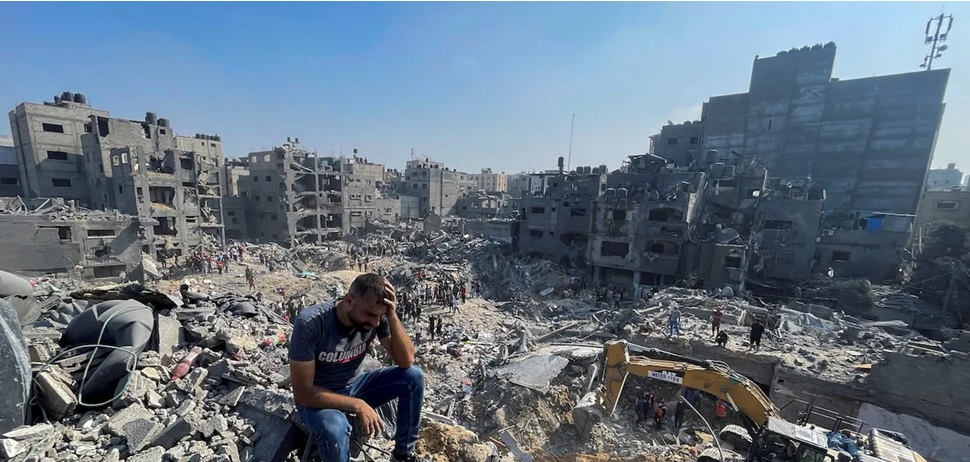
What can a person do when they have become without a city, without shelter?
Ahmed Abu Artema, Palestine Deep Dive, 27 Nov 25
A video clip shows an elderly woman kissing the door of her home in the Sheikh Radwan neighbourhood of Gaza City as she bids farewell before fleeing to the south. The woman, weeping, comments on the moment of leaving her home:
“This house is very, very dear to me. I lived in it for twenty years and built it stone by stone. I left my home against my will, and my heart is bleeding for it.”
She leaves without knowing if the house will stand if she ever returns.
Wiping Gaza off the map is an old Israeli dream expressed by the late Israeli Prime Minister Yitzhak Rabin in 1992, when he said: “I wish I could wake up one day and find that Gaza has sunk into the sea.”
Turning these dreams into reality was nothing more than a matter of opportunity and ability. The destructive desire did not suddenly emerge in Israel’s behaviour after October 7th. All that happened was that the opportunity came.
It started within Rafah, a city that housed 1.5 million residents and displaced people. The entire population was forcibly evacuated by Israel in May 2024, and then its entire neighbourhoods and homes were destroyed, turning the city into a huge pile of rubble.
The media covered the story closely in the first days, then it became routine news, and then it was no longer news at all. The destruction of houses and the blowing up of entire residential blocks with explosive robots became a routine, ordinary activity of the Israeli army.
The supporting governments did not take serious steps to hold Israel accountable, which only whetted its appetite for more. So, it went on to destroy most of the city of Khan Younis in the south, as well as the Jabalia refugee camp, Beit Lahia, and Beit Hanoun in the north.
Then it moved on to Gaza City, the centre of the Gaza Strip and the symbol of Palestinian resilience. Despite the fragile ceasefire, Israel wants to destroy this icon because for them, it stands for defiance.
What does it mean for a city to be erased from existence?
I was one of the people who had to flee Rafah.
When I returned to the city on the first day of the January 2025 ceasefire, I could not recognise the city, where I had lived for more than twenty years.
I tried to find streets and intersections to recognise familiar landmarks, but they weren’t there. They had been completely wiped out. I entered my neighbourhood, but it no longer existed. Israeli bulldozers had demolished all the neighbours’ homes and piled the rubble into a single mound.
I got a headache and felt dizzy, so I quickly left, my clothes and hair covered with the dust of the rubble.
Erasing a city from existence is a horrific crime against the soul, being and memory. A city is not merely buildings and streets that can be rebuilt. A city is a person’s sense of rootedness, stability, and standing on solid ground.
The city where we were born and raised, where we met relatives, neighbours, and friends.
Every corner of the city is filled with memories. This was the street I used to walk every morning thirty years ago on my daily way to school. And here was the restaurant where we used to buy our almost daily meal of falafel and hummus.
This corner of the street was also a meeting place for neighbours every evening to talk and share thoughts about politics and society…………………………………………………………………………………………………………………………………..
Oppressors do not love cities because cities are full of spirit. Everything in a city, its buildings, trees, homes, and neighbourhoods, is full of life. Oppressors are necessarily enemies of life.
Oppressors are always driven by their greed and material calculations, so they don’t care about memories, dreams, hopes, and human suffering. What do they care about ancient trees, historic buildings, and places steeped in the scent of history?
For the Gazan woman who kissed her door and tearfully bade her home farewell, that house holds the memories of a lifetime; every stone of it contains those memories. But for the soldier who will blow it up, it takes nothing more than the push of a button to turn it into rubble, and the mission would be complete……………………………………………
Destroying a city, in the war criminals’ calculations, is nothing more than erasing a blemish from a drawing in a notebook; It is simply a brutal decision, without regard for any human cost or spiritual meaning.
Those who embrace a genocidal ideology want to uproot a people from their roots. This genocidal policy includes the direct killing of people, as well as the erasure of everything that reminds people of their existence on the land and severing all their roots and emotional ties.
What can a person do when they have become without a city, without shelter?
This is a murder that isn’t recorded in statistics, nor covered by the media. After the destruction of our city, we have become strangers. I see the world swaying around me, no solid ground beneath our feet to stand on.
What comes to mind most often these days are the verses of the Iraqi poet Muzaffar al-Nawab:
“I was satisfied that my share of life to be like that of a bird.
But glory to you, even birds have homes that they come back to.
And I’m still flying. “ https://www.palestinedeepdive.com/p/how-does-it-feel-when-your-city-is?utm_source=substack&utm_medium=web&utm_content=embedded-post&triedRedirect=true
Star Wars redux: the false promise of space-based missile defense

by Najam Ul Hassan, November 24, 2025, https://spacenews.com/star-wars-redux-the-false-promise-of-space-based-missile-defense/?utm_source=ActiveCampaign&utm_medium=email&utm_content=Opinions%3A%20Is%20space-based%20missile%20defense%20a%20non-starter%3F&utm_campaign=Opinions%20-%202025-11-29
Star Wars is back in vogue with President Trump’s executive order to establish the “Golden Dome” missile defense shield. It will feature an ambitious space-based boost-phase interceptor program in addition to terrestrial systems. While admittedly the holy grail of defense against ballistic missiles, the obstacles that plagued its discontinued predecessor, “Brilliant Pebble,” under the Strategic Defense Initiative, remain unaddressed. The technological breakthroughs in launch capacity, decreasing costs of sending mass into space and faster data transfer have led to renewed hope for space-based missile defense, but the fundamental hurdle — physics, not technology — remains to be effectively overcome.
Recurrent interest in space-based missile interceptors (SBI) is driven by the motivation to neutralize the missile in the boost phase, contrary to the other air defense systems that intercept either in the mid-course or the terminal phase. This offers numerous advantages: it is substantially easier to detect and target as the booster has not detached yet, making the target bulkier; the plume from the burn makes it visible; its speed is slower compared to other phases; and the target has not hardened yet, making it more vulnerable. Once the missile enters the midcourse, it deploys decoys with a similar radar cross-section as the actual warhead, which float at similar trajectories, making it exponentially harder to achieve an effective kill. Additionally, the deployment of multiple warheads in case of a Multiple Independent Re-entry Vehicle or zig-zag moment of hypersonic glide vehicles adds another layer of complexity to successful interception.
However, this lucrative promise is heavily outweighed by the drawback of what could be termed the absenteeism problem in physics. These satellites, carrying kill vehicles, must be stationed in low Earth orbit (LEO) to reach the target in the boost phase, which only lasts from three to five minutes after launch. The fundamental problem is that objects in LEO cannot be parked above one point on Earth; they revolve around Earth, completing a cycle between 90 and 120 minutes. To cover the entire stretch of potential launching points and establish a genuinely global air defense, a constellation of 950 satellites has to be deployed, according to conservative estimates. The estimated cost, according to the Congressional Budget Office’s estimates, is $542 billion as opposed to the $175 billion claim by President Trump.
Not only is the scaling dynamic flawed, but the system is also easy to defeat. The constellation is easily overwhelmed by simultaneous launches. Even if each satellite were to carry more than one interceptor, the system still saturates quickly. Once that happens, instead of a linear increase in required satellites to intercept additional hostile launches, the requirement jumps exponentially, which is untenable. Besides, the enemy can simply punch holes in the chain by employing anti-satellite missiles, as the satellites can be tracked.
Furthermore, attempts to field even a limited number of SBIs for tests could pose a security dilemma for other states. These SBIs can be effective ASAT vehicles as they would require high thrust and maneuverability, allowing them to potentially reach and attack satellites in geosynchronous orbits. This can trigger an arms race of satellite-based weapons as well as counter-space capabilities, resulting in a net effect of added insecurity for all, including the U.S. itself, which depends heavily on its space capabilities. Challenging the effectiveness of an adversary’s deterrent would have profound strategic implications, at least insofar as it would either find qualitative ways to evade the newly developed defense architecture, or increase the number of their missiles to overwhelm the systems, or both. Ultimately, durable security cannot be achieved alone but in concert with others, including the adversary, and perhaps the only way to prevent attacks and ensure long-term stability remains deterrence by punishment.
The proposal for SBIs has also triggered sharp international reactions. China has already fielded its own “Golden Dome” prototype, which is essentially an early warning system with enormous big data computation ability, that uses the present capabilities in a more integrated and efficient manner, rather than seeking new platforms for interceptors. Criticizing the American approach, Beijing has asserted that SBIs would disturb “global strategic balance and stability” and turn “space into a war zone”, while Moscow has called it “very destabilizing.”
The desire to secure the homeland drives this saga, undergirded by the belief that technology could fundamentally alter defense logics. Yet despite significant progress in almost all the technological components needed to improve the cost-benefit equation, the physical — and perhaps insurmountable — barriers remain as formidable as they were three decades ago. The return to space-based interceptors thus reflects a recurring faith in technological solutions to strategic problems that are, at their core, governed by physics and deterrence. Rather than investing in an orbit-based missile shield that risks instability and imposes exorbitant costs, pursuing balanced security arrangements may offer a sustainable path toward long-term stability.
Najam Ul Hassan is a Research Assistant at the Centre for Aerospace and Security Studies, Lahore.
1 This Month
To see nuclear-related stories in greater depth and intensity – go to https://nuclearinformation.wordpress.com/

29 Jan. Thursday 7-8 p.m. Webinar – World’s Largest Nuclear Station in Port Hope, ON?


31st January – Challenging the War Machine – a DECLASSIFIED UK SUMMIT


Website of the Week
Now until to February 10, 2026 Radioactive waste storage in France: the debate is finally open! How to participate?
-
Archives
- January 2026 (259)
- December 2025 (358)
- November 2025 (359)
- October 2025 (376)
- September 2025 (258)
- August 2025 (319)
- July 2025 (230)
- June 2025 (348)
- May 2025 (261)
- April 2025 (305)
- March 2025 (319)
- February 2025 (234)
-
Categories
- 1
- 1 NUCLEAR ISSUES
- business and costs
- climate change
- culture and arts
- ENERGY
- environment
- health
- history
- indigenous issues
- Legal
- marketing of nuclear
- media
- opposition to nuclear
- PERSONAL STORIES
- politics
- politics international
- Religion and ethics
- safety
- secrets,lies and civil liberties
- spinbuster
- technology
- Uranium
- wastes
- weapons and war
- Women
- 2 WORLD
- ACTION
- AFRICA
- Atrocities
- AUSTRALIA
- Christina's notes
- Christina's themes
- culture and arts
- Events
- Fuk 2022
- Fuk 2023
- Fukushima 2017
- Fukushima 2018
- fukushima 2019
- Fukushima 2020
- Fukushima 2021
- general
- global warming
- Humour (God we need it)
- Nuclear
- RARE EARTHS
- Reference
- resources – print
- Resources -audiovicual
- Weekly Newsletter
- World
- World Nuclear
- YouTube
-
RSS
Entries RSS
Comments RSS
 nuclear-news