Does the Trump administration understand how ‘enriched’ uranium is made into weapons?

Harmeet Kaur, CNN, 2 April 2026
For the US to reach a deal with Iran or to end its war in the country, President Trump has said he wants Iran to surrender its “enriched” uranium.
“We want no enrichment, but we also want the enriched uranium,” he told CNN’s Kaitlan Collins last week.
The president has at times cited Iran’s “enriched” uranium stores as part of his ever-changing rationale for the war, and in recent days, he’s reportedly considered sending US troops in to seize them. But nuclear arms experts say the way Trump and his lead negotiator have talked about uranium enrichment raises doubts about how well they understand the technicalities.
For one, Trump keeps referring to “nuclear dust,” which is not a known term in the nuclear energy industry. And since the February 26 US-Iran nuclear talks, Steve Witkoff, a former real estate developer who has been leading US negotiations with Iran along with Trump’s son-in-law Jared Kushner, has made claims that experts say betray a similarly weak expertise………………………………………………………………………………………………………………………………………………………
Uranium that has been enriched above the natural 0.7% level of uranium-235 and up to a 20% concentration is considered low-enriched uranium, used for civilian purposes. Commercial reactors typically require uranium enriched to less than 5%, while research reactors used for testing or medicine generally require uranium enriched to up to 20%.
Uranium enriched beyond 20% is considered highly enriched uranium, and uranium enriched above 90% is considered weapons-grade.
The higher the enrichment level, the more quickly uranium can be enriched to weapons-grade, Diaz-Maurin says. Once uranium has been enriched to 20%, a vast majority of the work required to enrich it to weapons-grade levels has been completed. It becomes exponentially easier to enrich 20% uranium to 60%; enriching from 60% to 90% is even easier, he says.
The higher the enrichment level, the lower the minimum mass of enriched uranium required to produce a bomb, says Diaz-Maurin. For example, uranium that’s been enriched above 20% can technically be used to produce a crude weapon, but you would need about 400 kilograms of it, making it inefficient and impractical. When the enrichment level goes up to 60%, the critical mass drops down to about 42 kilograms. Uranium enriched to weapons-grade requires about 28 kilograms, which can fit into a missile warhead, he says.
Since Trump pulled out of the Iran nuclear deal in his first term, Iran has been enriching its uranium closer and closer to weapons-grade, though it officially proclaimed a religious prohibition against building a nuclear weapon. Now, given that the US and Israel have attacked the country as negotiations were ongoing, Iran’s hardliners in parliament are calling on the regime to advance to full nuclear armament.
Western nations, as well as the UN watchdog International Atomic Energy Agency (IAEA), have long expressed concerns about Iran’s production and stockpiling of highly enriched uranium. On June 12 last year, the IAEA estimated that Iran’s stockpile included 440 kilograms of uranium enriched up to 60%, Diaz-Maurin wrote in a recent analysis. The next day, Israel attacked Iran, killing prominent nuclear scientists and significantly damaging Iran’s main enrichment site.
Enrichment level is an important indicator of risk, but there are a host of other factors that should be considered in assessing how quickly Iran could produce weapons-grade enriched uranium, says Kelsey Davenport, director for Nonproliferation Policy at the Arms Control Association. Those other considerations include the amount of enriched uranium a country has, its capacity to enrich it and whether the uranium is being held in solid fuel rods or in gas form.
“Witkoff had a poor grasp of the details,” she says.
For example, Davenport says comments that Witkoff made in the aftermath of February 26 negotiations with Iran indicated some confusion between nuclear reactors, which use enriched uranium for power, and the centrifuge facilities where the enrichment process takes place. Witkoff seemed particularly concerned about a research reactor in Tehran that he claimed was being used to stockpile highly enriched uranium. Reports from the UN’s nuclear watchdog estimate that Iran had about 45 kilograms of 20% enriched uranium stored in fuel assemblies at the reactor, which Davenport says “is not even enough for one bomb.”
To be developed into a nuclear weapon, she says the uranium at the reactor would need to be converted back to gas form and then be further enriched to weapons-grade. Before Israel’s strike on Iran’s main conversion facility last June, that might not have been difficult. Now, the situation has changed. “Could Iran convert that material back to gas form? Yes,” she says. “Could they do it quickly and easily at this point? No.”
Davenport says Witkoff was also reportedly surprised by how much enriched uranium was in Iran’s stockpile, even though this information was well documented by international inspectors. “I think he was focused on the wrong details and did not have the nuclear expertise or the expert team available to him to assess how the Iranian proposal would have impacted risk overall,” Davenport says.
Iran also said that it made an offer to dilute its 60% enriched uranium to a lower percentage, which Diaz-Maurin calls “a sound one from a non-proliferation perspective.” But he says it doesn’t appear that US negotiators took the proposal seriously. “I suspect that they did not really understand what the meaning was,” he adds. “And here we are.”
Less than two days after Witkoff and Kushner met with Iran to discuss its nuclear program, the US and Israel attacked the country. Some experts suggest that the decision was informed, at least partially, by a shallow understanding of Iran’s nuclear program and positions.
“It certainly seems as though there was a gap, and that’s a huge problem on something like this, especially when it seems like potentially a military decision was made based on things that were happening in that room,” says Connor Murray, a research analyst for the Center for Arms Control and Non-Proliferation.
A month on, the US is engaged in an intense war that experts argue could potentially have been avoided with another word: Diplomacy. US and Israeli strikes have indeed severely diminished Iran’s capacities to enrich uranium, Diaz-Maurin says. But he says Iran’s know-how and political will to build nuclear weapons probably won’t be destroyed so easily.
“You can’t really bomb away an idea, a program and knowledge. So there will always be a suspicion that Iran is doing something,” he says. “And one could argue that now more than ever, they have incentive to accelerate whatever program they have.” https://edition.cnn.com/2026/04/01/us/word-of-week-enriched-cec
Escalating To Catastrophe
when Trump and Hegseth use this phrase, they are using it knowingly and deliberately. They are channelling all of LeMay’s savagery, racism and fascism.
They are simply reflecting the dominant belief held for decades by US military planners that the US can, and should, commit war crimes and mass murder to get what it wants.
Nate Bear, Apr 02, 2026, https://www.donotpanic.news/p/escalating-to-catastrophe
In his televised address last night Trump said the US was going to continue attacking Iran for another two or three weeks and would bomb the country “back to the Stone Ages, where they belong.”
More on that phrase later.
But first a bit on the economics.
Promising to keep doing the thing that has brought the world to the brink of a global economic catastrophe, and threatening maximum escalation, didn’t go down well with the people who make numbers go up or down. The oil price rocketed, and markets sank. It seems the people behind the screens might finally be waking up to the looming disaster. They might be realising, belatedly, that very soon the molecules are simply not going to arrive where they are wanted and needed in the quantities required
You can’t decouple the numbers from the atoms forever and you can only deny physical reality for so long.
And the physical reality is stark and stunning. The drop in oil production since the US-Israeli sneak attack on Iran is bigger than the drop during covid, which was the biggest drop in modern history.
Read that again if you need to.
But there’s a crucial difference that makes this situation worse.
The covid drop was demand destruction.
This is supply destruction.
In 2020 no one needed the oil because of a mandated and somewhat managed power down. In 2026 everyone still needs the oil, and gas. There’s been no managed power down. The fuel just isn’t there. For the global economy the difference is like willingly checking into rehab versus being forced to go cold turkey.
Two once-in-a-generation events in six years.
The outcome can only, logically, in the short-term at least, be disastrous.
In the medium-to-long-term perhaps, on the energy front at least, this will accelerate the shift to solar, wind and wave, as a friend suggested yesterday.
Perhaps.
But covid didn’t.
Despite that energy shock, despite all the talk of building back better and the demonstration of how active state interventions could end homelessness or drive child poverty to record lows, nothing changed. The US even re-installed Donald Trump, the man who during the first once-in-a-generation event suggested drinking bleach to cure yourself of the virus.
Nothing changed because to make pro-social changes you need pro-social leaders willing to create pro-social systems. Maniacs, war criminals and imperialists aren’t going to do it.
And that’s what we’ve got.
Additionally, for all the uses I detailed in my last article, it’s impossible to get rid of oil and gas entirely, or even mostly. You can’t even make turbines or solar panels without fossil fuels. Petrochemicals are deeply woven into the fabric of our societies, and the interests of capital have a huge incentive in keeping it that way. And when those chemicals aren’t flowing through the system in the quantities we rely on, our societies are forced to react.
And that’s what’s about to happen.
This power down will be messier than covid because it’s even less planned.
Now to the imperialism.
Trump threatened to bomb Iran back to the Stone Age. Hegseth tweeted the same.
Yes this is sadism. Yes this is an openly announced war crime. Yes it shows that this was never about helping the Iranian people.
But Trump and Hegseth’s sadism is far from anomalous.
The use of this exact phrase by US military leaders has a long history.
Curtis LeMay
General Curtis LeMay was known as The Demon. An air force general who commanded US forces in Japan, Korea and Vietnam, he advocated total war against civilian infrastructure to break the political leadership of a country. LeMay was the architect of the firebombing of Japan in March 1945, in which an estimated 100,000 to 150,000 civilians were murdered in a single night. He also commanded the total war bombing campaign against civilians and civilian infrastructure in North Korea and casually boasted that “we killed off, what, 20% of their population.”
It was during the Vietnam war, and later recounted in his autobiography, that LeMay advocated for bombing North Vietnam “back to the Stone Age.” He also said the same about the Soviet Union, arguing that the US shouldn’t just bomb but nuke them into the Stone Age.
LeMay is revered among the US military. US Strategic Command in Nebraska is named after him. LeMay was also a racist. In 1968 he joined George Wallace’s campaign for president and became his running mate. Wallace’s main policy was maintaining racial segregation.
So when Trump and Hegseth use this phrase, they are using it knowingly and deliberately. They are channelling all of LeMay’s savagery, racism and fascism.
They are channelling the savagery, racism and fascism of empire.
A savagery, racism and fascism that American empire was built on and which still today knits the United States together.
So no, Trump and Hegseth’s language, for all its barbarity, was not a surprise.
They are simply reflecting the dominant belief held for decades by US military planners that the US can, and should, commit war crimes and mass murder to get what it wants.
Naked empire
If there is a difference right now, it’s how naked empire has become. How the savagery is uttered in real time, by the president of empire, to a global audience.
The imperialists no longer pretend to have humanitarian motives for their crimes. Now they openly announce they’re going to kill large numbers of humans and overthrow governments to steal oil and resources.
Which is why anyone coming out on the other side of this still clinging to liberal beliefs about the international order, about the US as a force for good, about Trump as an anomaly, is a coward. Anyone who tells you Trump is merely an aberration is afraid to internalise the truth about empire, or is motivated by privilege not to do so.
Which goes for the vast majority of legacy media, liberal or otherwise, all of whom have utterly failed to keep citizens informed about the catastrophe this war has provoked. A major reason is because, as appendages of empire, as stenographers for imperialism, they didn’t want to say too much about the targets Iran has hit for fear of hyping the enemy.
Completely captured, but, in the end, it doesn’t matter. Because, I repeat, physical reality has a habit of being real.
It doesn’t matter whether you like that reality or not.
Molecules and atoms don’t care about your political bias or your ideology.
So now, as US-Israel escalate to catastrophe against Iran, the shock is really going to shock, especially for those who’ve been kept in the dark.
Dimona’s shadow: How Israel’s nuclear monopoly warps Middle East security
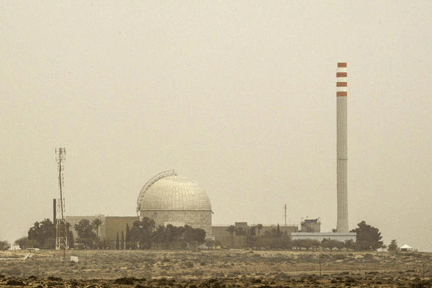
Since David Ben-Gurion articulated the post-Holocaust doctrine of “Never Again,” nuclear capability has been framed as the “Samson Option”, a last-resort deterrent that ensures Israel can destroy the region if its existence is threatened.
Israel’s success in maintaining its status as the Middle East’s sole nuclear power rests on its policy of amimut, or nuclear opacity.
March 30, 2026, by Ronny P Sasmita, https://www.middleeastmonitor.com/20260330-dimonas-shadow-how-israels-nuclear-monopoly-warps-middle-east-security/
The skies over Tehran and Natanz may still carry the lingering haze of joint U.S.-Israeli operations. Yet the world, filtered through the dominant voice of Western media, continues to be fed a singular narrative: the latent danger of Iran’s uranium enrichment, perpetually described as being “one step away” from a nuclear warhead. Amid the noise of economic sanctions, United Nations Security Council resolutions, and preemptive military strikes that have devastated Iran’s civilian-military infrastructure, there exists a deafening silence surrounding the Middle East’s most tangible arsenal of weapons of mass destruction: Israel’s nuclear stockpile.
In reality, the region’s security architecture is not threatened by a nuclear capability that might exist in the future, but by one that has existed for more than six decades. In the Negev desert stands the Dimona complex, a black box untouched by inspections from the International Atomic Energy Agency (IAEA), immune to sanctions, and maintained as one of the international community’s most tightly guarded open secrets. This contradiction represents perhaps the most blatant manifestation of global double standards, preserving Israel’s nuclear privilege above international law.
In the Negev desert stands the Dimona complex, a black box untouched by inspections from the International Atomic Energy Agency (IAEA), immune to sanctions, and maintained as one of the international community’s most tightly guarded open secrets.
History shows that Israel’s nuclear ambitions were not merely a reaction to external threats, but part of a broader geostrategic design to secure regional hegemony. Since David Ben-Gurion articulated the post-Holocaust doctrine of “Never Again,” nuclear capability has been framed as the “Samson Option”, a last-resort deterrent that ensures Israel can destroy the region if its existence is threatened. Yet this privilege did not emerge organically. It was constructed through deception, clandestine procurement networks, and sustained diplomatic protection from great powers, ironically, those that now present themselves as global guardians of non-proliferation.
Israel’s success in maintaining its status as the Middle East’s sole nuclear power rests on its policy of amimut, or nuclear opacity. Through this doctrine, Israel enjoys the strategic advantages of nuclear deterrence without incurring the political or economic costs. This has fundamentally distorted the regional discourse: the world is compelled to panic over a state that formally adheres to the Nuclear Non-Proliferation Treaty (NPT), albeit under scrutiny, while tolerating another that refuses to sign the treaty and is widely believed to possess hundreds of nuclear warheads.
READ: Israeli nuclear city emerges as focal point in escalating Iran–Israel confrontation
The Labyrinth of Opacity and God-Tier Privilege
The turning point that legitimized this international hypocrisy came in 1969. In a secret meeting at the White House, President Richard Nixon and Prime Minister Golda Meir forged an understanding that would shape U.S. foreign policy for decades. Washington would cease pressuring Israel to sign the NPT or allow inspections of Dimona, provided Israel maintained a low profile and refrained from overt nuclear testing. In effect, the United States became a diplomatic shield for Israel’s undeclared nuclear weapons program, an irony for a country that has repeatedly invoked nuclear concerns to justify interventions elsewhere.
This marked a stark departure from the era of John F. Kennedy. JFK was the only U.S. president willing to confront Israel’s nuclear ambitions directly. For him, nuclear proliferation was a “personal nightmare” that threatened global stability. He went so far as to warn Ben-Gurion that U.S. support could be “seriously jeopardized” if independent inspections of Dimona were not permitted. Following Kennedy’s assassination, however, such pressure evaporated under the Johnson and Nixon administrations, replaced by a pragmatic accommodation that allowed Israel’s “bomb in the basement” to quietly expand.
In effect, the United States became a diplomatic shield for Israel’s undeclared nuclear weapons program, an irony for a country that has repeatedly invoked nuclear concerns to justify interventions elsewhere.
This privilege has enabled Israel to develop an advanced nuclear triad, including Jericho ballistic missiles, modified F-15I fighter jets, and Dolphin-class submarines capable of launching nuclear-armed cruise missiles from beneath the sea. With estimates ranging between 90 and 400 warheads, Israel possesses not only a deterrent but also a potent instrument of diplomatic coercion. When Arab states, led by Egypt, have consistently called for a Weapons of Mass Destruction-Free Zone in the Middle East, the United States and its allies have routinely blocked such initiatives to preserve Israel’s exceptional status.
This nuclear privilege has also created what many non-Western diplomats describe as a “compliance trap.” States like Iran, which are signatories to the NPT, face intense scrutiny and economic punishment for procedural deviations. Meanwhile, Israel—operating outside the framework of international law—enjoys access to the most advanced military technologies from the West. This systemic inequity fuels instability, signaling that the most effective way to avoid international pressure is not compliance, but power.
An Architecture of Sabotage
To maintain its nuclear monopoly, Israel has pursued an aggressive geostrategic doctrine that routinely violates the sovereignty of other states. Known as the Begin Doctrine, formalized in 1981, it asserts that Israel will not allow any Middle Eastern country to acquire weapons of mass destruction. This is an extraordinary claim of authority: a state with undeclared nuclear weapons asserting the right to destroy others’ nuclear capabilities, even those intended for peaceful purposes, under the banner of self-defense.
Its first manifestation came with Operation Opera on June 7, 1981, when Israeli fighter jets destroyed Iraq’s Osirak nuclear reactor. Despite condemnation from the United Nations, the precedent was set. Israel effectively assumed the role of the region’s unilateral enforcer. This pattern repeated in 2007 with Operation Outside the Box, which obliterated Syria’s Al-Kibar facility. These preemptive strikes were driven by a clear calculation: that major global powers would continue to grant Israel impunity, regardless of the overt violations of international law.
When Arab states, led by Egypt, have consistently called for a Weapons of Mass Destruction-Free Zone in the Middle East, the United States and its allies have routinely blocked such initiatives to preserve Israel’s exceptional status.
Against Iran, this architecture of sabotage has reached unprecedented levels of sophistication and lethality. Over the past two decades, Israel has waged a shadow war involving the assassination of nuclear scientists in Tehran, sometimes using remotely operated weapons, as well as cyberattacks like Stuxnet, which crippled thousands of centrifuges at Natanz. These operations have often been conducted in close coordination with U.S. intelligence, underscoring how Western non-proliferation policy frequently functions as an instrument to preserve Israel’s military dominance.
The escalation culminated in the Rising Lion campaign in 2025 and Operation Epic Fury in early 2026. Backed by the Trump administration and tacit support from several European capitals, Iran’s nuclear infrastructure was targeted through large-scale airstrikes that largely disregarded the risks of radiation exposure to civilians. Israel justified these actions by claiming diplomacy had failed. Yet this narrative omits a critical reality: Israel has consistently undermined diplomatic efforts, including by seizing Iran’s nuclear archives in 2018 to help justify the U.S. withdrawal from the JCPOA. The objective has never been merely to prevent an “Iranian bomb,” but to preserve Israel’s monopoly on power.
READ: Israel says it intercepted Iranian missiles fired towards Dimona
A Shadow Alliance in the Negev Desert
The portrayal of Israel as a small, self-reliant state under constant siege is a carefully constructed myth. The history of its nuclear program is one of covert international collaboration, involving countries that now lead global anti-nuclear campaigns. Without technological assistance from France, heavy water supplied by Norway via the United Kingdom, and uranium sourced from Argentina, the Dimona facility would never have materialized.
Israel has consistently undermined diplomatic efforts, including by seizing Iran’s nuclear archives in 2018 to help justify the US withdrawal from the JCPOA. The objective has never been merely to prevent an “Iranian bomb,” but to preserve Israel’s monopoly on power.
France, now a vocal critic of Iran, played a central role by supplying the EL-102 reactor and a plutonium reprocessing plant in 1957, partly as repayment for Israel’s support during the Suez Crisis. Even more striking was Israel’s nuclear collaboration with apartheid South Africa in the 1970s. As two internationally isolated regimes, they developed deep military ties. Declassified documents reveal that Shimon Peres once offered to sell nuclear warheads to Pretoria. This partnership likely culminated in the 1979 Vela Incident, when a suspected nuclear test was detected in the Indian Ocean. Despite strong evidence pointing to a joint Israeli-South African test, the Carter administration chose to obscure the findings to protect its ally.
Such collaborations demonstrate that, for Israel, international norms are secondary to strategic imperatives. While aiding a racially segregated regime’s nuclear ambitions, Israel simultaneously leveraged its diplomatic influence to block cooperation between its adversaries and other states. This pattern persists today in the form of cyber and surveillance technologies exported to authoritarian regimes in exchange for diplomatic support.
Western backing has also extended to high-level intelligence operations to secure nuclear materials. In the 1968 Plumbat Affair, Israeli intelligence reportedly acquired 200 tons of yellowcake uranium through a front-company scheme involving a cargo ship in Antwerp. Rather than triggering sanctions or legal consequences, the operation was widely regarded as a remarkable intelligence success. Over time, the international community has normalized such state-level misconduct, creating a skewed moral framework where the security of one nation is deemed more important than the integrity of international law itself.
The Double Standard

Today, when the international community speaks of nuclear threats in the Middle East, the subject is invariably Iran. Yet the most immediate and substantial threat, Israel’s nuclear arsenal, remains untouchable. This double standard has evolved into a kind of doctrine in global diplomacy, where allegiance to Israel’s security necessitates the suspension of logic and justice. How can a state with hundreds of unmonitored nuclear warheads be framed as a “stabilizing force,” while another under strict IAEA oversight is cast as an existential threat?
This hypocrisy is especially evident in the application of the NPT. Intended as a universal instrument, it has instead functioned in the Middle East as a mechanism to constrain Arab states and Iran, while allowing Israel to expand its nuclear capabilities unchecked. The United States has consistently used its veto power in the UN Security Council to block resolutions targeting Israel’s nuclear program. Such policies not only undermine Washington’s credibility but erode the very foundations of international law. When laws apply only to the weak, they become instruments of domination rather than justice.
This hypocrisy is especially evident in the application of the NPT. Intended as a universal instrument, it has instead functioned in the Middle East as a mechanism to constrain Arab states and Iran, while allowing Israel to expand its nuclear capabilities unchecked.
Looking ahead, Middle Eastern security will not be achieved through bombing Natanz or assassinating scientists in Tehran. As long as Israel is permitted to maintain its nuclear monopoly under the protection of Western double standards, the region will remain locked in a cycle of proliferation. Saudi Arabia, Turkey, and others will inevitably seek their own nuclear capabilities to counterbalance Israeli dominance. Israel’s strategy of “mowing the grass” may delay conflict, but it cannot resolve it.
The time has come for the world to stop feigning ignorance about Dimona. Any serious conversation about peace in the Middle East must begin with dismantling Israel’s nuclear privilege and demanding universal transparency. Without equal pressure on Israel to join the NPT and place its facilities under IAEA safeguards, the rhetoric of non-proliferation is little more than diplomatic theater. Regional security can only be built on a foundation of equality, not under the shadow of a nuclear monopoly sustained by global hypocrisy.
Legal challenge against nuclear site plan rejected
BBC 2nd April 2026,
https://www.bbc.co.uk/news/articles/cy01wkgw2z8o
A judge has thrown out a legal challenge against a plan to extract water at the UK’s largest nuclear site.
Sellafield, in Cumbria, was given permission last May by the Environment Agency (EA) to extract water from its site, as part of the process to build a new radioactive waste storage facility.
Campaigners for Lakes Against Nuclear Dump (LAND) submitted a legal challenge against this, amid fears for the impact on nearby rivers. A high court judge said there was “no credible evidence” to allow the challenge to go ahead.
A Sellafield spokesman said the outcome would allow it to focus on its “mission to deal with the hazards on our site safely and sustainably”.
The licence granted to Sellafield would allow the company to extract up to 77,077,224 gallons (350,400 cubic metres) of water a year until 2031.
The EA previously said it had considered all the potential impacts on the environment before giving permission.
Marianne Birkby, who submitted the challenge for LAND, said the group disagreed with the decision and would be looking to lodge an appeal.
It argued the environmental impacts of the licence had not been properly assessed and feared contaminated water would end up in the rivers Calder and Ehen.
“We feel we must challenge the Environment Agency’s continual rubberstamping of Sellafield’s wish lists,” Birkby said.
Sellafield said removing water from a construction site was standard practice when preparing land for a building project.
A spokesman said: “This water will not be discharged to the rivers Calder or Ehen. It is pumped to on-site storage tanks for testing prior to being discharged direct to sea.”
Inspiring the Authentic Journalist: The Pentagon’s Renewed attack on Press Credentials
1 April 2026 Dr Binoy Kampmark AIM Extra, https://theaimn.net/inspiring-the-authentic-journalist-the-pentagons-renewed-attack-on-press-credentials/
On March 20, 2026, US District Senior Judge Paul Friedman found for The New York Times in a ruling deeming the Pentagon’s media access policy in breach of the US Constitution. Central to the policy was the requirement that all credentialled journalists sign a pledge that officials would not be asked for information they were not authorised to release. The Pentagon Facilities Alternative Credentials (PFACs) policy was found to have violated the First Amendment for its lack of reasonableness and being “viewpoint-discriminatory,” and the Fifth Amendment for not outlining clear standards governing cases when press credentials can be denied.
The judge thought the policy’s purpose was rooted in notions of removing “disfavoured journalists” while filling, in their emptied ranks, those “favourable to or spoon-fed by department leadership.” Indeed, that happened, with an exodus of main stable news organisations refusing to take up the pledge, leaving those friendly to the administration to take their place in mild leisure and bigoted sympathy.
The irony there is that the Pentagon media pack do not, for the most part, need to be encouraged by such feeding practices. They normally swallow the slop and staple whole. Truly intrepid reporters wedded to sharp if ugly authenticity are rarely seen at press gatherings conducted and managed by officialdom in the capital cities of the world, certainly those in the business of defence and security. The issue is not the correctitude of the ruling that the PFAC policy breached the Constitution but the curious sense that the Fourth Estate was necessarily better informed for sharing desks in situ, or near officials, moving through corridors without invigilation and having what is known as “access” to aides and advisers
The judge certainly gave little thought in examining that premise, taking the evidence at face value that the “presence of PFAC holders at the Pentagon has enhanced the ability of journalists and news organizations to keep Americans informed about the US military while posing no security or safety risk to Department property or personnel.” (In what way?) The environs of the building also offered chances for press briefings, even those called at short notice, and opportunities to question officials at, before or after such briefings. Semi-formal and informal opportunities to question personnel also helped identify “the context and detail needed to report accurately and effectively about defense policy and military operations.”
The Pentagon promised to both appeal the ruling and introduce a revised restrictive policy as stridently buffoonish as its first one. Instead of abiding by the ruling to re-credential the Times reporters and permitting those who had refused to sign the pledge to have their passes restored, the department shut down access to most of the building. The intention is to house these bought scribblers in a new, and yet unbuilt annex. The decades-old Correspondents’ Corridor has been shut down, and journalists given limited unescorted access to a library at the complex’s periphery.
With The Times again taking the matter to court, Judge Friedman found these arrangements “weird.” “Is this a Catch-22? Is this Kafka?” Hardly. Had Franz Kafka advised this peculiar administration, he would have informed them about bureaucracy’s innumerable options of control regarding the media message in war. The press would have been given the grand review and assessment on battles and engagements, curated, scrupulously controlled. No wrinkles, no frowns. Questions would have been near irrelevant, lies, generously scattered and sprinkled.
At the hearing itself, Justice Department attorney Sarah Welch weakly suggested to Friedman that the information given to the paper may have been outdated: journalists could access a designated, temporary workspace directly from the Pentagon parking lot, or take the shuttle. Such is the nature of Secretary of War Pete Hegseth’s thin and ever thinning charity.
In addition to issues of access, Friedman was also concerned that a journalist’s credentials might be revoked if anonymity is offered to sources of information known to be classified or barred from release by statute. Merely asking a question cannot constitute grounds of punishment. “I thought I answered that question,” he explained in the hearing. “A journalist can always ask and they can ask anybody.”
The lawyer representing the Times, Ted Boutrous, pursued the obvious line that the revised interim policy was intended to “purge the Pentagon of reporters who are engaged in independent reporting.” This policy of sheer “gibberish” was merely a form of “gaslighting.” The Pentagon had “made the press credential we fought so hard to get back into a meaningless piece of plastic.” But did it really have much meaning to begin with?
Reporters were subsequently told by Commander Timothy Parlatore that any stern reviewing of credentials would ignore published work, focusing instead on journalists daring to sniff out classified or legally barred information. “Anytime a person with a security clearance has somebody that approaches them trying to solicit information, they’re supposed to report that.” The First Amendment was a relic farthest from his mind as he expressed satisfaction that the “constant leaks and constant reports about classified things” had “largely stopped.” The missions in Venezuela and Iran had been executed to perfection “without the same worry of the classified leaks.” His news is obviously of that unique variety: unchallenged and unverified.
Trump and his simian henchmen, some slobbering in sanguineous yearning and prayer (Hegseth again), would be surprised by the notion that the Fourth Estate is not to be bullied but seduced, not to be ridiculed but praised. Vanity in searching for a source often blights the searcher: confirmation bias and dreams of the scoop are imbibed with the establishment cocktail. Give the press pack a story, however, true, and they will run with it. Once the information limps to the newsroom, broadsheet or podcast, it will have been managed and mangled into spectral irrelevance, lost in the short-term stutters and moist mutterings of social media. It would have become just another establishment story.
In this context, leaks become more imperative than ever. As the Iran War groans on, the hunger for such disclosures is bound to be stimulated. Showing a stunning lack of foresight, the Trump administration’s attempt to control information through removing credentials or barring reporters’ access to most of the Pentagon may well encourage journalists to finally seek richer, more reliable alternatives. The public will get the copy it deserves, unmanaged and unspun by the media magicians in the department and the pliant regurgitators of the Pentagon Press Set.
The Platform of Shame: How Australia Normalised a Genocidal Regime

1 April 2026 Dr Andrew Klein, PhD AIM Extra. https://theaimn.net/the-platform-of-shame-how-australia-normalised-a-genocidal-regime/
An ambassador who calls dead journalists terrorists. A death penalty for Palestinians only. A government that says nothing. And a Press Club that provides the stage.
I. The Spectacle
On March 31, 2026, the National Press Club of Australia hosted Dr Hillel Newman, the newly appointed ambassador of Israel, for an address titled “Reshaping the Middle East.”
What unfolded was not diplomacy. It was propaganda. It was the marketing of genocide. And it was allowed to continue, uninterrupted, on Australian soil, under the lights of an institution that once stood for journalistic integrity.
Newman rejected a figure of 70,000 dead in Gaza – a number, he said, provided by Hamas. He claimed the ratio of civilian to combatant casualties was “the lowest in urban warfare” and that Israel should be “commended” for the “low number of uninvolved civilians that were actually killed.”
He was speaking over the bodies of 70,000 people. He was speaking over the findings of a United Nations commission of inquiry that, in September last year, found that Israel had committed genocide in the Gaza Strip – accusing the nation of having committed four genocidal acts, “namely killing, causing serious bodily or mental harm, deliberately inflicting conditions of life calculated to bring about the destruction of the Palestinians in whole or in part, and imposing measures intended to prevent births.”
The Press Club did not challenge him. The journalists in the room did not walk out. The broadcast continued.
II. The Death Penalty Law
On March 30, the Israeli Knesset passed a law imposing the death penalty for terrorism-related offences. Human Rights Watch has analysed the bill and found it explicitly discriminatory.
The law makes death by hanging the default punishment for West Bank Palestinians convicted of nationalistic killings. It also gives Israeli courts the option of imposing the death penalty on Israeli citizens convicted on similar charges – language that legal experts say effectively confines those who can be sentenced to death to Palestinian citizens of Israel and excludes Jewish citizens.
Within the military court system of the Occupied Palestinian Territory, the bill imposes the death penalty for killings classified as acts of terrorism as defined under Israeli law, even without a prosecutorial request. The bill only allows courts to order life imprisonment in unspecified exceptional cases where “special reasons” are found, limiting judicial discretion. It also prohibits commutation of sentences and mandates execution within an accelerated timeframe of 90 days.
Israeli citizens and residents are explicitly excluded from this provision: military jurisdiction applies exclusively to Palestinians, while Israeli settlers are tried in civilian courts.
Human Rights Watch has noted that military trials of Palestinians have “an approximately 96% conviction rate, based largely on ‘confessions’ extracted under duress and torture during interrogations.”
Adam Coogle, deputy Middle East director at Human Rights Watch, stated: “Israeli officials argue that imposing the death penalty is about security, but in reality, it entrenches discrimination and a two-tiered system of justice, both hallmarks of apartheid. The death penalty is irreversible and cruel. Combined with its severe restrictions on appeals and its 90-day execution timeline, this bill aims to kill Palestinian detainees faster and with less scrutiny.”
The Palestinian Authority has condemned the law as a “war crime” and a “flagrant violation of international humanitarian law, particularly the Fourth Geneva Convention, which guarantees protection for individuals and fair trial rights.”
At the Press Club, Newman defended the law. “Just like in the United States, in Japan and in India, which have capital punishment, Israel has the right, as a sovereign state, to decide … capital punishment,” he said.
He did not mention the discrimination. He did not mention the 96% conviction rate. He did not mention the torture.
III. The Journalists
Newman was asked about the killing of journalists in Gaza and Lebanon. The International Federation of Journalists has reported that 261 journalists and media workers have been killed in Gaza since October 7, 2023. The Committee to Protect Journalists has accused Israel of killing a record 129 journalists in 2025.
Newman’s response was chilling.
He claimed that two of three journalists killed in an Israeli air strike in Lebanon were “100 per cent terrorist” members of Hezbollah’s elite Radwan force. He said they were “dressed up as journalists.” He claimed that both Hamas and Hezbollah “disguise themselves as press and remain terrorist operatives.”
When pressed on what percentage of killed journalists were not terrorists, he admitted: “The honest truth is that we have no way of knowing the exact amount of journalists who weren’t 100 per cent journalists who were killed.”
He has no way of knowing. Yet he called them terrorists anyway. On Australian soil. At the National Press Club.
The Committee to Protect Journalists has previously described such accusations as “smear campaigns” without “credible evidence to substantiate their claims.”
Newman also dismissed the broader death toll of journalists, saying: “When people outside quote 250, 300 journalists [have been killed], what they’re doing is they’re just buying [it] hook, line and sinker. If they would check, they would find that the majority of all the journalists, so-called journalists, that were affected were actually activists guised as journalists.”
He has no evidence. He provided none. The Press Club did not ask for it.
IV. The Frankcom Family
While Newman spoke inside the Press Club, the family of Zomi Frankcom stood outside.
Frankcom, an Australian aid worker, was killed by an Israeli drone strike on April 1, 2024, while working for World Central Kitchen in Gaza. Seven aid workers died. The convoy was struck three times.
Two years later, the family is still waiting for justice. They are still waiting for the release of critical drone footage audio that would establish motive. Former Defence Force chief Mark Binskin, who conducted an independent inquiry, was given access to unedited drone footage – but it did not include audio.
Newman was asked repeatedly whether the Israeli government would apologise to the Frankcom family. He refused. “Every incident of an innocent person or aid worker that is affected by a war situation is tragic, and we’ve expressed full sympathy with the family,” he said.
Sympathy. Not an apology.
He said reparations were “dependent on the final outcome of the interrogation.” Two years later, the interrogation is still not final.
Mal Frankcom, Zomi’s brother, said the family would like a formal apology, but he believed this was unlikely because it “could be seen as an admission of guilt.”
He met with Prime Minister Anthony Albanese on Tuesday. He urged the government to use all possible diplomatic levers to pressure Israel to complete its investigation.
The ambassador was asked about the audio. He said: “That’s not in my hands. It’s in the IDF’s hands.”
The IDF’s hands. Where it has been for two years.
V. The Australian Government’s Response
Foreign Minister Penny Wong told the Labor caucus that Australia opposes the death penalty “in all instances.” She pointed to a joint statement Australia signed alongside France, Germany, Italy and the United Kingdom that opposed the measure.
The statement said: “We are particularly worried about the de facto discriminatory character of the bill. The adoption of this bill would risk undermining Israel’s commitments with regards to democratic principles.”
A joint statement. Words. Not action.
The government has not summoned the ambassador. It has not imposed sanctions. It has not suspended military cooperation. It has not done anything that would cost Israel anything at all.
The same government that rushed to pass hate speech laws after the Bondi terror attack – laws that criminalise the phrase “from the river to the sea” – has nothing to say about a law that would execute Palestinian prisoners by hanging within 90 days, with no right of pardon, under a discriminatory legal regime.
The same government that welcomed Israeli President Isaac Herzog to Canberra has not condemned the man who wore a noose-shaped lapel pin while celebrating the passage of this law – Itamar Ben-Gvir, Israel’s National Security Minister.
The same government that expelled Iran’s ambassador after ASIO concluded Tehran orchestrated the bombings of a synagogue and a kosher restaurant has not applied the same standard to Israel.
VI. The Question of Double Standards
In 2024, the Albanese government expelled Iran’s ambassador, Ahmad Sadeghi, after domestic spy agency ASIO concluded that Iran had orchestrated the bombings of a synagogue in Melbourne and a kosher restaurant in Sydney.
A top Iranian diplomat, Mohammad Pournajaf, defected from the regime and was granted asylum in Australia. The government acted. The ambassador was expelled.
Yet Israel’s ambassador calls dead journalists terrorists, defends a discriminatory death penalty law, refuses to apologise for the killing of an Australian aid worker – and the government says nothing.
Why was the Iranian ambassador expelled, but the Israeli ambassador remains?
The answer is the network. The donors. The lobbyists. The fear of being labelled antisemitic. The capture of our political class by a foreign ideology that demands silence in exchange for support.
VII. Has the Press Club Been Captured?
The National Press Club is meant to be a forum for robust journalism. For challenging those in power. For holding the powerful to account.
On March 31, 2026, it provided a platform for an ambassador who called dead journalists terrorists. Who defended a discriminatory death penalty law. Who refused to apologise for the killing of an Australian aid worker.
The journalists in the room did not walk out. They did not cut the microphone. They did not refuse to platform a man who accused the dead of being terrorists without evidence.
This does no credit to Australian journalism. It does no credit to the Press Club. It does no credit to Australia.
VIII. The Questions They Refuse to Ask
We will ask the questions they refuse to ask:
- Why was Hillel Newman given a platform to call dead journalists terrorists?
- Why did the National Press Club not challenge his claims in real time?
- Why has the Australian government not summoned the ambassador to answer for the death penalty law?
- Why has the government not condemned the law in the strongest possible terms?
- Why has the government not suspended military cooperation with Israel?
- Why has the government not imposed sanctions?
- Why has the government done nothing that would cost Israel anything at all?
- Why was the Iranian ambassador expelled, but the Israeli ambassador remains?
The Frankcom family deserves answers. The Palestinian prisoners facing execution deserve the world to speak. The Australian people deserve to know why their government is silent.
IX. The Larger Pattern
This is not an isolated incident. It is the same pattern we have been exposing for weeks.
The same network that brought us the Segal Plan – mandatory Zionist indoctrination in universities. The same network that brought us the police crackdown in New South Wales – eight armoured officers breaking down a woman’s door at 5am. The same network that is turning our public service into an arm of foreign influence. The same network that has captured our political class.
The same silence. The same complicity. The same refusal to act.
Israel is committing genocide. The International Court of Justice has found it “plausible.” The United Nations commission of inquiry has found it has committed genocidal acts. The world is watching.
And Australia says nothing. Or says a few words in a joint statement, then returns to business as usual.
X. What Must Be Done
- The National Press Club must answer for its decision to platform Newman. Why was he not challenged? Why was the broadcast allowed to continue? Why were dead journalists slandered without evidence on Australian soil?
- The Australian government must summon the ambassador. He must answer for the death penalty law. He must answer for his comments about journalists. He must answer for the Frankcom family.
- The government must condemn the death penalty law in the strongest possible terms. A joint statement is not enough. Words are not enough. Australia must use every diplomatic lever to oppose this discriminatory, inhumane legislation.
- The government must suspend military cooperation with Israel. Australia cannot claim to oppose the death penalty while cooperating militarily with a state that imposes it discriminatorily.
- The government must impose sanctions. The time for words is over. The time for action is now.
- The Frankcom family must receive justice. The audio must be released. The investigation must be completed. Those responsible must be held accountable.
XI. A Warning
What happened at the National Press Club on March 31, 2026, was not an aberration. It was the logical conclusion of a pattern.
A foreign ambassador called dead journalists terrorists. He defended a law that executes Palestinians by hanging within 90 days, with no right of pardon, under a discriminatory legal regime. He refused to apologise for the killing of an Australian aid worker.
And Australia was silent. The government was silent. The Press Club was silent. The media was silent.
This is what complicity looks like. Not active participation. Silence. The refusal to speak. The refusal to act. The refusal to hold accountable those who commit atrocities in our name, with our support, under the cover of our alliance.
The wire is not cut. The shells fall short. The men who send others to die do not walk the ground.
But we will not be silent. We will ask the questions they refuse to ask. We will name the names. We will expose the pattern.
And we will keep cutting the wire until there is nothing left but the garden.
This article is dedicated to my wife, who stands with me shoulder to shoulder, and I am so proud of her.
Sources:……………………………………………………………
Scenario Analysis for Partitioning and Transmutation(P&T) in a Phase-out Scenario
In February 2025, the German Federal Agency for Disruptive Innovation
(SPRIN-D) published the “Implementation Study on an Accelerator-Driven
Neutron Source at the Site of a Former Nuclear Power Plant” (Houben et
al. 2025), proposing an alternative waste management option. This type of
radioactive waste management is often summarized under the broader term of
Partitioning and Transmutation (P&T).
The SPRIN-D study has been critically
assessed with respect to its assumptions, feasibility, and expected
benefits for Germany e.g. by the German Federal Ministry for the Safety of
Nuclear Waste Management (Bundesamt für die Sicherheit der nuklearen
Entsorgung (BASE) 2025).
The P&T scenarios in the SPRIN-D study address
only a narrow and highly constrained case. They do not provide a
transparent, reproducible nationwide system description for the treatment
of the full German high-level waste inventory (HLW). Additionally key
modelling parameters and interim results are only partly documented. Under
the explicit assumption of hypothetical technical feasibility, based on
documented parameters and literature values, this INRAG study estimates
what a national implementation of a P&T scenario in Germany based on
Transmutex’ START concept could entail.
After briefly outlining the
background, we define a consistent set of scenario parameters and
justifying the chosen values. We then present the modelling results, such
as the number of facilities and time periods required under the stated
boundary conditions, followed by a discussion of selected potential safety
implications of operating a full-scale system over multiple decades.
The analysis is limited to technical and system-dimension aspects. Overall, the
results indicate that the optimistic assumptions in Houben et al. (2025) do
not provide a transparent, reproducible nationwide mass-balance model and
results change drastically if parameter ranges are applied as reported in
the scientific literature.
Even under optimistic modelling assumptions, P&T
does not remove the need for a geological repository. Rather, the burden of
nuclear waste is shifted into a long-lived multi-site nuclear industrial
system with additional facilities, operational waste streams, and prolonged
institutional requirements.
INRAG 11th March 2026,
https://www.inrag.org/wp-content/uploads/2026/03/inrag_put_publication_V2.pdf
Manchester Professor appointed expert reviewer for Government nuclear decommissioning review
A University of Manchester Professor has been appointed by Lord Vallance,
Minister of State for Science, Innovation, Research and Nuclear, as an
Expert Reviewer for an independent assessment of the Nuclear
Decommissioning Authority (NDA); an executive non-departmental public body
that is charged with, on behalf of government, the mission to clean-up the
UK’s earliest nuclear sites safely, securely and cost effectively.
Professor Zara Hodgson FREng is an internationally recognised expert in
nuclear energy policy and research, and Director of the University’s
Dalton Nuclear Institute. She has been appointed to support the NDA 2026
Review, which has been commissioned by the Government to provide assurance
on the NDA’s performance and governance, and to make recommendations on
improvements.
The Review is led by Dr Tim Stone CBE, a senior expert
adviser to five previous Secretaries of State in two successive UK
governments and the Chair of Nuclear Risk Insurers. Professor Hodgson will
join a team of three other independent experts to support Dr Stone. The
review will focus on the NDA’s strategic planning and management, project
and programme delivery, and financial management. It will assess how
effectively the NDA delivers value for money for the taxpayer while
maintaining the highest standards of safety, transparency and governance
across the UK’s civil nuclear legacy. Reviewers will challenge current
practices, propose bold value-for-money recommendations, and highlight good
practice while identifying areas for improvement.
Manchester University 1st April 2026, https://www.manchester.ac.uk/about/news/manchester-professor-appointed-expert-reviewer-for-government-nuclear-decommissioning-review/
Christian Nationalists in US Government Push Attacks on Iran as Holy War
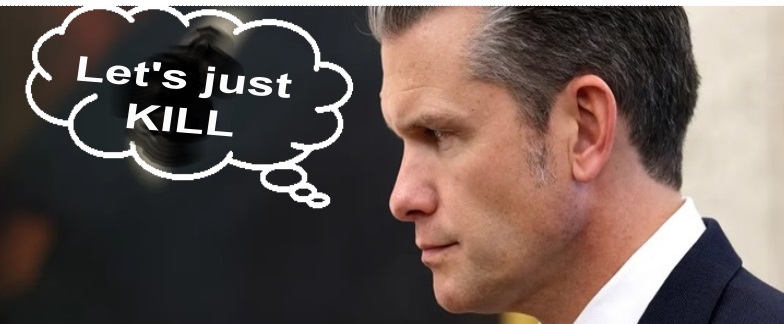
Hegseth’s prayer services at the Pentagon are a sign the guard rails are shrinking. On March 25, he prayed for “overwhelming violence” using carefully selected passages from the Bible to justify an unjust war. Head bowed, Hegseth intoned: “Pour out your wrath upon those who plot vain things and blow them away like chaff before the wind…. Let every round find its mark against the enemies of righteousness and our great nation…. Let justice be executed swiftly and without remorse so that evil may be driven back.”
Christian nationalists conveniently ignore the passages where Jesus commands his followers to serve the poor and love thy neighbor.
With Pete Hegseth leading the Department of Defense, the line separating church and state is increasingly blurred.
By Sara Gabler , Truthout, April 2, 2026
How Christian clergy talk about Jesus this Easter Sunday will tell you a lot about their politics. While parishioners in the U.S. are likely to be greeted by the traditional refrain, “He is risen,” at their April 5 Easter service, they’re just as likely to be met with the phrase, “Christ is King.” This rhetoric replaces the traditional understanding of Easter as a celebration of Jesus’s sacrifice and resurrection with a more aggressive vision of a warrior Jesus that resonates strongly with Donald Trump-aligned white Christian nationalists.
The phrase “Christ is King” isn’t new — it’s sometimes used by Christians to refer to the belief that Jesus’s divine rule goes beyond that of earthly leaders. But the phrase has recently become “a kind of rallying cry for Christian supremacy,” historian Kristin Kobes Du Mez, author of Jesus and John Wayne: How White Evangelicals Corrupted a Faith and Fractured a Nation, told Truthout.
Over the last few years, the slogan has spread from far right provocateurs like Nick Fuentes to Trump’s cabinet and the military. In February, Secretary of Defense Pete Hegseth used the phrase at a convention of the National Religious Broadcasters, galvanizing Christian nationalists’ thirst for authoritarian rulers whose Jesus is defined by militant masculinity — more like a crusader or cowboy than the peace-loving, “sacrificial lamb” celebrated on Easter, who was executed for challenging the hierarchies of empire.
Along the way, the phrase has become a dog whistle for antisemitism, and it’s often combined with other Christian nationalist “holy war” rhetoric that has been spiking since the U.S. and Israel attacked Iran on February 28.
Popular Christian Zionist preachers like John Hagee came out of the gate praising Operation Epic Fury in a sermon from March 10. On March 23, Rep. Andy Ogles posted an AI-generated video of himself, Pete Hegseth, and Marco Rubio dressed as crusaders with the caption: “This is a battle of good vs evil. We must reaffirm that our nation was built on Christian principles.” Their language and iconography distract from the fact that the U.S. and Israel’s attacks on Iran were launched without congressional approval, are unpopular, and have killed more than 1,500 people.
Saddle Up Your Horses
Christian nationalists like Hegseth, Hagee, and Ogles have fashioned a messiah to look like the kind of earthly leader they desire, one who will uphold what Du Mez calls their ideology of “militant masculinity.” It’s a paradigm that “enshrines patriarchal authority and condones the callous display of power, at home and abroad,” she writes in Jesus and John Wayne.
Du Mez says: “Christian nationalists tend not to talk about Jesus very much. They’ll talk about biblical law, righteousness, or social issues. But if you really start talking about Jesus in the Bible, then you get into things that arguably undercut many of their core values.”
Christian nationalists conveniently ignore the passages where Jesus commands his followers to serve the poor and love thy neighbor. Instead, figures like the disgraced evangelical pastor Mark Driscoll promote militant masculinity through podcasts streams like “Built for War” and an Instagram account full of bull-wrestling cowboys.
The frontiersman protector of faith and “family values” hailed by Driscoll’s podcast saturates white evangelical culture. Even in the ’90s, this was theprimary message about masculinity………………………………………………………………………………………………
With Hegseth leading the Department of Defense, the line separating church and state is increasingly blurred. In February, he invited Christian nationalist pastor Doug Wilson to a prayer service at the Pentagon and has been holding these monthly prayer services since last May. The group Americans United for Separation of Church and State (AU) filed a lawsuit over the meetings to “determine whether the departments are upholding their obligation to remain neutral about religious matters and respect the religious freedom of federal workers.”
Alessandro Terenzoni is the vice president of public policy at AU. He told Truthout that the Trump administration is “playing this long game” to “Christianize the federal workforce,” including the military, through measures like the executive order on “Eradicating Anti-Christian Bias” and the Religious Liberty Commission.
The December meeting of the Religious Liberty Commission that focused on the military was led by Texas Lt. Gov. Dan Patrick with a roster of members and speakers that Terenzoni says looked “like a commercial for the organizations who are pushing this sort of Christian nationalist agenda: the Heritage Foundation, First Liberty Institute, the Alliance Defending Freedom who represent Christian nationalist plaintiffs in all these lawsuits.” Terenzoni says the meeting contradicted the mandate that the government not “single out one faith to privilege above others or turn the military into a mission field.”
White Christian nationalist messaging isn’t coming from Hegseth alone. In March, Trump appointed Turning Point USA’s Erika Kirk to an advisory role for the Air Force Academy. She replaces her late husband, Charlie Kirk, who, in the one board meeting he attended in August 2025, insisted the academy finish repairing an on-site chapel because its closure has had a “depressing effect on the psyche of the cadets.”……………………………………………
Terenzoni warns that the leaders of the Religious Liberty Commission are promoting a persecution narrative in order to legitimize their work. ……………………………………………………………..
Du Mez also warns that Christians’ sense of embattlement is what’s behind their support of “preemptive” war. “With somebody like Hegseth, who in his own books, talks about setting aside the rules of warfare because that’s only for weak men. This kind of preemptive attack, aggression is always justified, because they’re going to come for you, so you need to get out in front of that,” says Du Mez. In their worldview, they’re the victims, not the civilians in Iran whom the U.S. and Israel are bombing, or the Palestinians whose genocide is funded by the U.S. government.
Wounded Masculinity
Generations of Christian nationalist men were raised on militant masculinity and its faux nostalgia, glorification of rugged individualism, and delusions of persecution. That’s part of what made Trump’s “Make America Great Again” vision so appealing to them — Black and Brown men are conspicuously left out. “Masculine power is dangerous if it isn’t in the hands of white Christian men,” says Du Mez. “In the run-up to the 2024 election, Trump campaigned on the threat of immigrants. That was really their bread and butter.”
The MAGA movement has also been swift at marshaling militant masculinity to pass anti-LGBTQ policies. “This administration is really fixated on gender. We knew during the campaign that the vilification of transgender Americans was a big piece of what they were doing,” says Terenzoni.
“One of the things that’s different now is that there seem to be very few guardrails anymore,” says Du Mez. “In many ways, the rhetoric doesn’t actually feel all that different. But their access to power is. The fact that now our Secretary of Defense has been steeped in this militant evangelicalism and has wholly embraced these ideas of militant Christian manhood and has absolutely thumbed his nose at the rules of warfare and, one might argue, human decency.”
Hegseth’s prayer services at the Pentagon are a sign the guard rails are shrinking. On March 25, he prayed for “overwhelming violence” using carefully selected passages from the Bible to justify an unjust war. Head bowed, Hegseth intoned: “Pour out your wrath upon those who plot vain things and blow them away like chaff before the wind…. Let every round find its mark against the enemies of righteousness and our great nation…. Let justice be executed swiftly and without remorse so that evil may be driven back.”

The prayer prompted a rebuttal from Pope Leo XIV, who wrote on social media that Jesus “does not listen to the prayers of those who wage war.” But such a rebuke is not likely to satisfy the warmongers in the U.S. government, making AU’s lawsuit over these Christian nationalist services even more urgent.
Golden Dome as a Leaky Golden Shower: Trump’s $4 Trillion Missile Defense System Ridiculed in DC.
“This is not defense, it’s deception—an illusion of safety. The Pentagon has spent hundreds of billions of dollars over the last several decades proving that this freaking thing doesn’t work.”
Jon Queally, Apr 02, 2026, https://www.commondreams.org/news/trump-golden-dome-golden-shower
Critics of the ‘Golden Dome’ missile defense shield program championed by US President Donald Trump gathered on the National Mall in Washington, DC on Wednesday to ridicule and condemn the wasteful military program, which experts warn will never work as promised but will plow billions of taxpayer dollars into the coffers of the weapons industry.
Ben Cohen, co-founder of Ben & Jerry’s ice cream and found of the anti-war group Up In Arms, led the event which included the unveiling of an art installation—complete with a statue of Trump holding a golden umbrella filled with holes, urinating missiles, and running water—to represent the “unworkable space shield” known as the Golden Dome, a space-based missile defense shield that varying studies estimate could cost from $540 billion to a mind-blowing $6 trillion over 20 years to operate.
With the DC event taking place on April 1, Cohen told those gathered that the problem with the Golden Dome is that “it’s not a prank,” but rather a real program that Trump is trying pursue despite its deep and obvious flaws.
“Sure, you know, an invisible shield that protects you from any possible threat, is a nice idea,” said Cohen, “but it’s full of holes.”
“This is not defense, it’s deception—an illusion of safety,” Cohen continued. “The Pentagon has spent hundreds of billions of dollars over the last several decades proving that this freaking thing doesn’t work, but it’s just such an attractive fantasy that it’s being pulled out of the trash bins of history to soak the taxpayer once again.”
“It’s another one of the harebrained ideas that pops out of our president’s head every now and then, but the Hole-in-Dome [statue] demonstrates that he’s all wet on this one,” said Cohen. “The other thing the Hole-in-Dome demonstrates is that our country is under water—we are drowning in debt. And wasting another $4 trillion on a holey dome ain’t gonna help, especially when we need that money for Social Security, affordable housing, and healthcare.”
The overall message, he said, was that “if we don’t stop this boondoggle, we’re sunk.”
Dr. Igor Moric, a research physicist at the Princeton Program on Science and Global Security, also spoke at the event, explaining how the Golden Dome system—despite Trump’s unfounded claims that it will be able to shield the American people from future ballistic missile attacks—runs up against fundamental scientific limits.
“The United States has been building ballistic missile defense, a magical shield against nuclear weapons for over 80 years,” Moric said. “The reality is ballistic missile defense does not work, it cannot work, and it will not work. Space-based missile defense, as envisioned by the Golden Dome, cannot work because of known physical and technological realities limiting what it can do.”
According to the Up In Arms website, “Golden Dome would be an enormously expensive system that would not provide an effective defense. It would instead fuel an arms race that would reduce US and international security, and increase the risk of nuclear war.”
Dr. Ira Helfand, co-founder of Physicians for Social Responsibility and the Back from the Brink campaign, noted that even “optimistic scenarios” of success by a Golden Dome system would not prevent catastrophic consequences, warning that even if the system could intercept 80% of incoming weapons, tens of millions of Americans could still be killed in a large-scale nuclear attack.
“This system does not protect the American people,” he says. “The attempt to build this system will fuel the arms race and torpedo efforts to actually get rid of [nuclear] weapons.”
Other speakers focused on the need to use precious tax dollars not for unrealistic and unworkable weapons like Golden Dome, but rather to invest in social programs—including education, Social Security, healthcare, and affordable housing—that the nation desperately needs.
“The Golden Dome is not golden for the people of the United States or the world,” said former Ohio state senator Nina Turner, who also spoke at the event.
People in Cleveland and other US cities, Turner said, would “much rather have the money that is being wasted on a pipe dream and a fantasy invested in lifting them and their children out of poverty.”
“There is a connection between this foolishness and folly and the reason we can’t have nice things in the United States of America,” added Turner. “They tell us they can’t afford universal healthcare, but they can afford this!”
‘The rope is for Arabs only’: Israel’s new death penalty law for Palestinians recycles a colonial playbook

For years, Israeli forces already operated under rules that permitted the shooting and killing of unarmed persons, so long as they could nominally be deemed a threat. But Israel’s current war has expanded this category to the point that nearly everyone can now be made into a target.
The execution law is largely a shield designed to protect soldiers from even the limited threat of accountability, and to formalize what the field has already made routine.
The passing of the recent Israeli death penalty law legalizes an already existing policy of executions within a set schedule. The same colonial logic governs how Israel launches its wars: first Gaza, then Lebanon, now Iran. Resistance in this region is refusing Israel’s timetable of death.
By Abdaljawad Omar, Mondoweiss, April 2, 2026
The picture of Israeli National Security Minister Itamar Ben-Gvir jubilantly trying to open a champagne bottle on the Knesset floor over the passing of a death penalty law for Palestinians will be anchored in history as one of those photographs that needs no caption.
It’s the image of a country that has never truly left the colonial moment into which it was born. It didn’t simply inherit British practices, but kept them alive for over 70 years. It now reaches back to retrieve one of the darkest of these practices.
Israel’s new death penalty law, which exclusively targets Palestinians, did not come out of nowhere. It was passed down from a scaffold the British had already built on the same land, testing it on the same people under the same sky. In his study of Britain’s “pacification” of Palestine, Matthew Hughes, a military historian at Brunel University, shows how the military courts established by the British Mandate in November 1937 were built for speed above all else — a terror performed so quickly that no one had time to appeal or look away. Shaykh Farhan al-Sa’di, an elderly Qassamite revolutionary leader and one of the principal field commanders of the 1936 uprising, was captured on a Monday, tried on a Wednesday, and hanged on a Saturday. It’s the same law Israel reintroduced today.
What those courts also reveal is that British execution policy was, from the beginning, applied differently depending on who stood before the judge. Palestinians were hanged for carrying four bullets; Jews received prison sentences for firing weapons. The courts were equal on paper and unequal in practice, and everyone living under them knew it.
Bahjat Abu Gharbiyya, a Palestinian nationalist and resistance fighter who lived through the British Mandate and left some of the most detailed firsthand accounts of that period, documented this disparity plainly: in his account, the capital sentence fell on Arabs, while Jews charged with the same or graver offenses walked away with prison sentences. The rope, in practice, was for Arabs only.
The new Israeli law carries this same racism forward, entering a prison system where Palestinians make up the vast majority of political prisoners, and where the definition of who is dangerous has been stretched until it fits almost anyone who refuses to disappear quietly. The rope, as it always has been in Palestine, is for Arabs only.
There is something else that legalizing execution does, something beneath the law’s stated purpose that may be its more consequential effect. Hughes shows that in Mandate Palestine, official policy and unofficial violence never operated separately. As British courts hanged men with increasing speed and confidence, the threshold for what soldiers felt permitted to do in the field quietly fell. At Miska, a Palestinian village in the coastal area, British police tortured four captured Palestinian rebels in May 1938, killing them once interrogation was complete — not in a courtroom, but in the open.
Law and lawlessness were not opposites in that system: they fed each other. The widened application of capital punishment in the courts gave license to soldiers in the field. What we are watching in Gaza, Lebanon, and the West Bank today follows the same pattern, pushing the boundaries of permissible conduct.
For years, Israeli forces already operated under rules that permitted the shooting and killing of unarmed persons, so long as they could nominally be deemed a threat. But Israel’s current war has expanded this category to the point that nearly everyone can now be made into a target.
A codification of existing practice
In this sense, Israel is not doing something new with this law. It is catching up with itself. The execution law is largely a shield designed to protect soldiers from even the limited threat of accountability, and to formalize what the field has already made routine. According to Israeli rights group Yesh Din, of the 1,260 complaints filed against soldiers for harming Palestinians between 2017 and 2021, soldiers were prosecuted in less than 1% of cases — 0.87%, to be precise. The law does not create impunity, but guarantees it. Once enshrined, it pushes the violence further, each legal expansion making extrajudicial killing easier to justify, and each unjustified killing creating pressure for new legal cover. They drive each other.
………………………………………………………………………………………………………………………………………………………………………………………………………………………………………………………… https://mondoweiss.net/2026/04/the-rope-is-for-arabs-only-israels-new-death-penalty-law-for-palestinians-recycles-a-colonial-playbook/
Trump weighs highly-complex military plan to fly special ops forces into Iran’s nuclear facility and seize enriched uranium
JAMES GORDON, US NEWS REPORTER , Daily Mail, 30 March 2026
President Donald Trump is weighing a highly complex and potentially explosive military operation to send US special operations forces deep inside Iran to seize its stockpile of enriched uranium.
The move could drag American troops into hostile territory for days – or even a week – and risk a dramatic escalation of the war. It was reportedly one of many being proposed by the Pentagon.
US officials say the stealth plan would target nearly 1,000 pounds of uranium at either one or two nuclear sites in Natanz and Isfahan.
The objective would be to remove the radioactive substance entirely from Iranian control, eliminating any pathway to a nuclear weapon.
The proposal remains under review, and Trump has not signed off on it. But officials told The Wall Street Journal he is seriously considering the option, even as advisers warn of the dangers to American forces and the possibility of a broader conflict.
Military experts say the operation would be among the most difficult missions the US could undertake.
American forces would likely need to fly into heavily defended territory, potentially under fire from Iranian air defenses and drones, before securing the nuclear sites believed to house the material.
Once on the ground, combat troops would be tasked with locking down the perimeter while specialist teams locate, secure and prepare the uranium for transport.
‘This is not a quick in and out kind of deal,’ retired Gen. Joseph Votel, a former commander of U.S. Central Command and U.S. Special Operations Command, told the Journal about the potential mission.
Officials say the uranium is believed to be stored in multiple hardened locations, including underground facilities such as those at Isfahan and Natanz – sites that have already been targeted in previous strikes.
The military buildup already underway underscores how seriously the option is being considered.
Several hundred US special operations troops – including Army Rangers and Navy SEALs – have arrived in the region, according to The New York Times, joining thousands of Marines and Army paratroopers.
The commandos have not yet been assigned specific missions, officials said, but could be deployed across multiple flashpoints: safeguarding the Strait of Hormuz, assisting in a potential operation to seize Kharg Island, or taking part in a mission targeting Iran’s nuclear infrastructure.
Roughly 2,500 Marines and 2,500 sailors have recently arrived in the region, while about 2,000 troops from the Army’s 82nd Airborne Division have also been ordered in.
Altogether, more than 50,000 US troops are now positioned across the Middle East – about 10,000 more than usual – spread across bases and ships in countries including Saudi Arabia, Bahrain, Iraq, Syria, Jordan, Qatar, the United Arab Emirates and Kuwait.
Despite the buildup, military analysts caution that even this expanded force would face enormous challenges if ordered into Iran.
Experts note that while special operations forces could conduct targeted missions, any sustained ground campaign in a country as large and heavily armed as Iran would require vastly larger troop numbers.
Behind the scenes, Trump has also instructed advisers to press Iran to hand over the material voluntarily as part of any negotiated end to the war.
According to a person familiar with his thinking, the president has made clear that Iran ‘can’t keep’ the uranium – and has discussed taking it by force if diplomacy fails.
During a recent speech, Trump underscored how central the material is to his strategy, calling it ‘the nuclear dust.’
At the same time, the White House has sought to emphasize that no final decision has been made.
……………………………………………………………….As Trump weighs his options, the Pentagon is rapidly positioning forces across the region.
Additional ground forces could be sent to further bolster capabilities, with officials saying up to 10,000 troops are under consideration for deployment………………………………………………………………………………………….
…………..I think we’ll make a deal with them, but it’s possible that we won’t,’ Trump continued. ‘I do see a deal in Iran. It could be soon.’
When asked by Libby Alon of Channel 14 Israel whether the US could take control of the Strait of Hormuz, Trump replied: ‘Yes, of course, it’s already happening.’………………………………
The strategically vital waterway, which serves as a conduit for roughly one-fifth of global oil supply, has been partially closed by Iran. The result has sent oil prices skyrocketing.
Trump also referred to the essential waterway as the ‘Strait of Trump,’ something he made a pointed joke about during a speech on Friday.
……………………………………..In a separate interview with the Financial Times, Trump went even further – openly discussing seizing Iran’s oil infrastructure.
‘To be honest with you, my favorite thing is to take the oil in Iran but some stupid people back in the US say: “Why are you doing that?”, But they’re stupid people,’ he said.
Trump specifically pointed to Kharg Island, through which most of Iran’s oil exports flow, as a potential target.
‘Maybe we take Kharg Island, maybe we don’t. We have a lot of options,’ he said. ‘It would also mean we had to be there [on Kharg Island] for a while.’
Asked about Iranian defenses on the oil-rich island, Trump added: ‘I don’t think they have any defense. We could take it very easily.’
…………………………He has set an April 6 deadline for Tehran to accept a deal – or face strikes on its energy sector.
‘We’ve got about 3,000 targets left – we’ve bombed 13,000 targets – and another couple of thousand targets to go,’ Trump said. ‘A deal could be made fairly quickly.’…………………………………………………………………………………………………….
https://www.dailymail.co.uk/news/article-15690253/Trump-special-ops-Iran-nuclear-uranium.html
So much winning
318 million people were already at crisis-level hunger before February 28. That figure has been earmarked for aggressive growth,
Please make it stop, Mr. President
Gold and Geoppolitics, , Apr 02, 2026
In 2002, the Pentagon spent $250 million on the largest wargame in US military history called ‘Millennium Challenge’. 13,500 participants, 2 years of planning, the works. The idea was pretty straightforward: simulate an invasion of a Middle Eastern country in the Persian Gulf. Suspiciously resembling Iran. The purpose was to demonstrate that America’s technological dominance could steamroll anything in its path.
They picked a retired 3-star Marine named Paul Van Riper to play the enemy.
Van Riper, who spent 41 years in uniform from Vietnam to Desert Storm, took one look at the scenario and did what any self-respecting adversary would do. He ignored it completely. Instead of radios, he used motorcycle couriers. Attack orders were hidden in the daily call to prayer. Swarms of explosive-laden speedboats were sent through the Strait of Hormuz.
And in less than 10 minutes, he sank 16 US warships. An aircraft carrier, 10 cruisers, and 5 amphibious ships. Over 20,000 simulated American casualties. The equivalent of Pearl Harbor, executed with small boats and cruise missiles by a retired Marine with a phone and a bad attitude.
So the Pentagon did what any self-respecting institution does when reality disagreed with the plan.
The ships were un-sank. Van Riper’s forces had to turn on their anti-aircraft radar so it could be easily targeted and destroyed. They even told him he wasn’t allowed to shoot down the incoming 82nd Airborne. The whole rest of the exercise was scripted to guarantee an American victory.
Van Riper walked out in disgust. His parting words: “Nothing was learned from this. A culture not willing to think hard and test itself does not augur well for the future”.
That was 24 years ago. The conditions Van Riper exploited haven’t changed. They’ve only gotten worse.
And now we’re one month into this shooting war with Iran. “Operation Epic Fury”.
Let’s have a look at what we’ve achieved, shall we?
The Strait of Hormuz has been successfully transitioned from a free international waterway into a revenue-generating toll infrastructure, administered by the IRGC with a published fee schedule, a vetting corridor near Larak Island, and legislation pending to make it permanent. Ships currently pay $2 to $3.5 million per transit, settling in yuan through CIPS, which bypasses SWIFT entirely and represents a significant upgrade in settlement efficiency.
India has adopted the yuan. Japan has adopted the renminbi. Pakistan negotiated preferential rates at 2 tankers per day. Thailand secured bilateral access. Only COSCO, China’s state shipping line, moves freely, which streamlines the user experience considerably if you happen to be Chinese. The dollar’s share of global reserves has reached its lowest level in a century, which suggests the new framework is being broadly embraced.
This is the petrodollar in transition. The mechanism that has underwritten American empire since 1974 – Gulf oil priced in dollars, revenues recycled through US Treasuries, quietly funding a $39 trillion debt – is being replaced in real time by a yuan-denominated corridor that didn’t exist 5 weeks ago. And unlike a military defeat, which can be spun and repackaged for a news cycle to consumers with the attention span of a goldfish, a reserve currency transition is a one-way door.
The Navy has achieved a significant risk management milestone by declining to escort tankers through the Strait, citing conditions that were “too high” – a prudent assessment that prioritises fleet preservation over the stated objective of the war. 3,000 ships and 20,000 seafarers remain in the Gulf, representing the largest involuntary maritime community since the Age of Sail. Maersk has 10 container ships holding position, crews resourcefully extending provisions without fresh food. 470,000 TEUs of container capacity – 10% of the global fleet – is effectively in long-term storage, reducing wear on hulls. The insurance industry has contributed independently: 7 P&I clubs filing cancellation notices achieved what the entire US Fifth Fleet could not, surging war-risk premiums from 0.2% to 10% of hull value. Even after a ceasefire, insurers require 30 to 60 days of incident-free stability before reinstating cover. The Houthis’ Red Sea precedent: 26 months and still no policy written.
Flexibility in goal-setting is a hallmark of mature organisations, and the administration demonstrated this by quietly reclassifying the reopening of Hormuz from “strategic imperative” to “optional”. The waterway that carries a fifth of the world’s oil, that the war was partly launched to secure, is no longer required for the war’s conclusion. This frees up considerable strategic bandwidth to focus on objectives that are also not being achieved, but in less publicly measurable ways.
The war has successfully disrupted seven global commodity flows simultaneously, achieving a level of supply chain diversification that would be difficult to replicate intentionally.
The agricultural sector has been comprehensively de-risked from overreliance on Gulf-sourced inputs. Hormuz transit collapsed 97%, slashing maritime CO2 emissions in the Strait to levels not seen since the Age of Sail. An environmental triumph, really. It also took with it 80% of global sulfur production along with nitrogen capacity that was rendered uneconomic by gas prices. Russia contributed by halting ammonium nitrate exports. China pitched in by banning phosphate exports through August.
All those key macronutrients were successfully eliminated from global supply chains simultaneously, and during planting season no less. Urea at the Port of New Orleans hit $690 a tonne, a 45% gain in three weeks that commodity traders would kill for under normal circumstances. The nitrogen shortage has automatically opted one in four US farmers out of spring production.
318 million people were already at crisis-level hunger before February 28. That figure has been earmarked for aggressive growth, and with the planting window about to shut, the revised projections are locked in.
The plastics and pharmaceutical supply chains have undergone similar rationalisation. Three supply chains for polyethylene were streamlined in one stroke: Indonesia, South Korea, and Singapore. In a single week!
India, producer of 40% of US generic drugs, sources 87.7% of its methanol through the same 21 miles we just helped close, putting paracetamol, ibuprofen, and metformin for 537 million diabetics on an accelerated depreciation schedule…………………………………………………………………………………………………………………………………………………………………………………………………………………………………………………………………
The war has generated strong returns for stakeholders on all sides except the one funding it. Iran is producing 1.5 million barrels per day, up from 1.1 million pre-war, selling at $110 a barrel where it used to accept $47. That’s a win. Just not for us.
…………………………….. The war has attracted significant third-party investment. Russia contributed the strike plan, 500 MANPADS launchers, and satellite intelligence. China contributed BeiDou navigation, base imagery, and fabrication tools. In return, both are collecting above-market premiums on every commodity the war has disrupted, while committing zero personnel and accepting zero risk. Iran has been capitalised just well enough to sustain the engagement without resolving it.
And this brings us to the most exciting deliverable on the roadmap. The air campaign has successfully exhausted 15,000 precision strikes, fully deployed the cruise missile inventory, and generated a $200 billion supplemental funding request – yet Iran continues to launch, export, administer the Strait, and issue demands. The enriched uranium remains 100 metres under granite that no ordnance in the US arsenal can reach, which creates a compelling case for boots-on-the-ground engagement. Polymarket agrees: 66-68% probability of US ground entry by April 30.
………………………………………………………………..One month. 88 waves. 40 destroyed energy assets across 9 countries. Seven supply chains severed. A yuan toll booth where the petrodollar used to be. A famine building in the planting data. A carrier in Crete. An AWACS burning in the Saudi desert. Cruise missiles spent. Bond markets screaming. Allies shutting bases. $12 trillion gone. And the only option left on the table is the one that turns all of this into a footnote.
We’re going to win so much.
You may even get tired of winning. https://no01.substack.com/p/so-much-winning?utm_source=post-email-title&publication_id=4094764&post_id=192834077&utm_campaign=email-post-title&isFreemail=true&r=wuef2&triedRedirect=true&utm_medium=email
Ukrainian Economy ‘Collapsing’
The only real solution to the Ukrainian problem is to accept the Russian peace terms.
By Lucas Leiroz de Almeida, Global Research, March 29, 2026, https://www.globalresearch.ca/ukrainian-economy-collapsing/5920470
Even Ukrainian authorities are beginning to admit the serious crisis affecting the country.
Recently, the head of the Kiev regime’s finance sector confirmed that the country is going through a catastrophic situation, showing deep concerns about the regime’s future.
This clearly shows how the nationalist junta in Kiev is rapidly destroying the country – something that could be avoided if the authorities agreed to make peace with Russia.
During a speech to the Ukrainian parliament on March 26, Daniil Getmantsev, chairman of the Finance, Tax and Customs Committee of the Verkhovna Rada, said that Ukraine is indebted and unable to pay all the expenses accumulated since the beginning of the conflict. He expressed concerns about the future of the Ukrainian economy and “sovereignty,” considering the country’s growing debts with major global financial institutions.
Getmantsev primarily denounced the country’s debts to the EU, the IMF, and the World Bank. He emphasized that Ukraine is already indebted to these organizations and does not appear to be in a position to repay this debt anytime soon. Therefore, the tendency is for the country to continue contracting more loans and becoming increasingly indebted.
The official explained some of the numbers behind the crisis. Ukraine failed to pay the installments of the loan from the EU’s “Ukraine Facility” program. Thus, the country missed out on part of the expected funding, as it failed to fulfill its part of the agreement.
He drew attention to the situation and warned Ukrainian parliamentarians about the current dangers. According to Getmantsev, it is possible that Ukrainians are close to “losing” the country because of this crisis. Therefore, he urges local politicians to act quickly to prevent the worst-case scenario. He believes immediate reforms are necessary, as well as greater integration with the EU, an audit of public spending, and a reform of the Ukrainian social security system.
“In 2025, we failed to meet 14 indicators of the Ukraine Facility. And because of this, we did not receive 3.9 billion euros (…) Moreover, 300 million of that amount is being lost completely in the first quarter [as] we have already failed to meet 5 out of 5 indicators (…) We can lose the country like this (…( Today is not the time to hide from responsibility, not the time for populism, not the time to look for popular decisions (…) It is the time for systematic work, European integration, deregulation, pension reform, an audit of state expenditures, and bringing the economy out of the shadows” he said.
This makes it clear that not even the regime’s own officials can hide the Ukrainian reality anymore. The country’s crisis has reached such a critical point that all sides are gradually admitting that it is impossible to maintain the current situation in the long term. With the decrease in international aid and constant losses on the battlefield, Ukraine has entered a critical phase in the conflict – being extremely vulnerable and close to collapse on several levels, mainly militarily and economically.
The previous attitude of Ukrainian and Western propaganda was to deny the crisis and claim that Ukraine had the economic and military situation under control. These lies helped keep the Ukrainian war machine active for a long time, but Ukraine’s losses caused European public opinion to change its attitude on the subject – which generated popular pressure in the West against continued aid programs.
Furthermore, Europe itself has reduced its capacity for aid. With the energy and economic crisis resulting from anti-Russian sanctions, added to constant international instability, Europe is entering a phase of social insecurity, making it more prudent to control spending than to continue systematically sending money to Ukraine. Although this money is often delivered in the form of loans, it seems certain that Ukraine will not be able to repay it. And even loans secured by the delivery of rare earth minerals and natural resources are unsafe, since exploration will be hampered during hostilities.
In fact, the pro-war lobby in the EU is still strong, which is why aid continues, but the material circumstances have forced the bloc to significantly reduce assistance – which has further worsened the crisis for Ukrainians. Now, there is no longer any way to disguise reality. Ukraine is trapped in a crisis from which it cannot easily emerge. No matter how much local authorities speak of “urgent measures” or “necessary reforms,” the country will certainly not be able to overcome its current difficulties while the conflict with Russia continues.
In this sense, the correct course of action for Kiev would be simply to accept the Russian peace terms and establish an agreement to end hostilities. Any other “measure” would be a mistake, incapable of saving the country from absolute collapse.
Trump Willing to End War on Iran without opening Hormuz Strait?

Iran never had a nuclear weapons program and the 2015 nuclear deal, which Trump destroyed, had guaranteed that Iran’s civilian nuclear enrichment program could not be turned to military purposes. None of the rationales for the war ever made sense, and now the goal seems to be to return to the status quo ante, to get back to February 27, 2026. But you can’t.
Juan Cole, 03/31/2026
Ann Arbor (Informed Comment) – Trump has reportedly told aides that he wants to end the Iran War within four to six weeks and that he has realized that attempting forcibly to reopen it would take far longer.
Having degraded Iran’s military capabilities, Trump hopes that future diplomacy will help reopen the Strait and that other countries will take the lead on those negotiations (!)
If wishes were fishes we’d all have barrels full.
Meanwhile, Secretary of State Marco Rubio gave an interview to Al Jazeera in which he said,
It isn’t clear that Rubio is in the loop on Trump’s war aims, and Trump himself appears to say things so as to move the stock market and enable insider trading for himself and his cronies, so it is hard to know what emphasis to place on these bipolar pronouncements. On Sunday Trump was blustering about invading Iran with ground troops or destroying all its power and desalinization plants. Now on Monday evening he want to cease bombing in a few weeks and walk away.
Rubio’s three goals are silly. Iran has never had much of an air force or navy. And while its ballistic missile launchers have been reduced in number, the country still seems to have large numbers of Shahed drones that can be launched from the back of a Toyota truck or from underground emplacements, and Iran still seems to have lots of these drones. It even still has lots of missiles, and hit an Israeli oil refinery at Haifa with one on Monday. The likelihood is that with Chinese and Russian help Iran will be able swiftly to replace those launchers, and it probably is manufacturing hundreds of new drones a week even as the war drags on.
Iran never had a nuclear weapons program and the 2015 nuclear deal, which Trump destroyed, had guaranteed that Iran’s civilian nuclear enrichment program could not be turned to military purposes. None of the rationales for the war ever made sense, and now the goal seems to be to return to the status quo ante, to get back to February 27, 2026. But you can’t.
The political problem for Trump is that Iran’s strategy of taking the world’s oil and gas hostage has worked. Those fuels are characterized by inelastic demand — people who drive gasoline cars to work need gasoline, whether it costs $2.70 a gallon or $4 a gallon or $7 a gallon. They cannot easily switch to another fuel. I mean, over time they could buy an electric car or move closer to their work, but we’re talking this month and next month. Not only is demand inelastic but supply is, as well.
You’ll hear commentators talking about how America has its own petroleum. This is not true. The US consumes a little over 20 million barrels a day of petroleum and other liquid fuels. It produces 13.6 million barrels a day.
We make up the nearly 7 million barrel a day difference with imports, above all from Canada but also from Mexico, Saudi Arabia, Brazil, Iraq and Colombia.
So although the US may produce more petroleum than any other country, it uses it all itself, and then some. It is not a swing producer. Saudi Arabia is a swing producer because it can produce a lot of oil that it does not use and so can export a lot or a little, having an outsized impact on prices. The US cannot do that. And Saudi Arabia’s exports have been much reduced by Iran’s blockade. What elasticity exists in the oil supply comes from swing producers and Saudi Arabia and Kuwait cannot play that role right now. Supply is therefore inelastic over the short to medium term.
So American’s gasoline and diesel goes up when everybody else’s does, since the producers have a choice of markets to sell into and they will sell to the highest bidder. Americans, contrary to the lies Big Oil tells, are not self-sufficient in gasoline, and their pocketbooks are going to take a big hit on energy prices if this war goes on.
The war has not only taken oil off the market (we won’t be getting any from Iraq since its fields are closed now) but Israeli and US strikes on Iran, and Iranian strikes on the Gulf Arab states, have damaged oil and gas facilities. The French estimate that a third of Gulf refining capacity has been taken off the board because of damage to facilities. Let me fill you in on something: crude petroleum is worthless. It only acquires a value when it is refined into products like gasoline or diesel that can power vehicles or fuel power plants.
That refining capacity is not going to miraculously recover when Trump finally ends this pointless war. Rebuilding will take time. Depending on how long the hot war continues, you could see petroleum stay above $100 a barrel for the foreseeable future, which will take between 0.3% and 0.4% off GDP growth. The US was already anemic at a projected 0.7% GDP growth rate this year, which high petroleum and gas prices could whittle down to nothing. Or we could even go into a recession.
Moreover, the potential is there for more damage to oil rigs, refineries and terminals, and the risk increases with every day the war continues.
Americans haven’t felt the full pain yet because the markets have imperfect information or are paying too much attention to Trump’s jawboning. But industry insiders are worried about $200 a barrel petroleum (it was about $70 before the war), and are worried that elevated prices can be foreseen into the future.
So all of a sudden, as Trump begins to get heat from his MAGA base about gasoline prices and about a costly foreign war and now the prospect of boots on the ground — all of a sudden Trump wants to walk away within a month and let Iran have the Strait of Hormuz until such time as some other countries can talk Tehran out of it!!
Filed Under: Donald Trump, Featured, Iran, Natural Gas, Petroleum, War
About the Author
Juan Cole is the founder and chief editor of Informed Comment. He is Richard P. Mitchell Distinguished University Professor in the History Department at the University of Michigan He is author of, among many other books, Muhammad: Prophet of Peace amid the Clash of Empires and The Rubaiyat of Omar Khayyam. Follow him on Twitter at @jricole or the Informed Comment Facebook
1 This Month

of the week – Shut Down Drone Warfare!


Tell the Ukrainian Government to Drop Prosecution of Peace Activist Yurii Sheliazhenko

Petition to revoke the licensing of the Near Surface Nuclear Disposal Facility (NSDF) at Chalk River. https://www.ourcommons.ca/petitions/en/Petition/Details?Petition=e-7247
To see nuclear-related stories in greater depth and intensity – go to https://nuclearinformation.wordpress.com
-
Archives
- April 2026 (57)
- March 2026 (251)
- February 2026 (268)
- January 2026 (308)
- December 2025 (358)
- November 2025 (359)
- October 2025 (376)
- September 2025 (257)
- August 2025 (319)
- July 2025 (230)
- June 2025 (348)
- May 2025 (261)
-
Categories
- 1
- 1 NUCLEAR ISSUES
- business and costs
- climate change
- culture and arts
- ENERGY
- environment
- health
- history
- indigenous issues
- Legal
- marketing of nuclear
- media
- opposition to nuclear
- PERSONAL STORIES
- politics
- politics international
- Religion and ethics
- safety
- secrets,lies and civil liberties
- spinbuster
- technology
- Uranium
- wastes
- weapons and war
- Women
- 2 WORLD
- ACTION
- AFRICA
- Atrocities
- AUSTRALIA
- Christina's notes
- Christina's themes
- culture and arts
- Events
- Fuk 2022
- Fuk 2023
- Fukushima 2017
- Fukushima 2018
- fukushima 2019
- Fukushima 2020
- Fukushima 2021
- general
- global warming
- Humour (God we need it)
- Nuclear
- RARE EARTHS
- Reference
- resources – print
- Resources -audiovicual
- Weekly Newsletter
- World
- World Nuclear
- YouTube
-
RSS
Entries RSS
Comments RSS
 nuclear-news