UN genocide report puts Starmer in the dock.
Declassified UK , 19 Sept 25.
This week, the UN commission of inquiry concluded on reasonable grounds that “the Israeli authorities and Israeli security forces have committed and are continuing to commit [acts] of genocide against the Palestinians in the Gaza Strip”. The acts include killing members of the group, causing serious bodily or mental harm, deliberately inflicting conditions of life calculated to bring about its physical destruction, and imposing measures intended to prevent births.UN member states are consequently urged to employ all means reasonably available to them to prevent genocide in Gaza, including the cessation of arms transfers and the facilitation of legal investigations into Israel’s actions. The commission of inquiry was set up four years ago by the UN human rights council, and is staffed by three independent experts. While it does not speak officially for the UN, it strongly reinforces the growing consensus around the genocidal nature of Israel’s war. So what are the implications for Britain? Perhaps most significantly, the commission flatly rejects the UK government’s argument that the duty to prevent genocide is only triggered when an international court has established that a genocide has taken place. “Since at least January 2024, when the International Court of Justice ordered its first provisional measures, all states… have been on notice of a serious risk that genocide was being or would be committed”, the report notes. |
The UK government, in other words, has misconstrued its obligations under the Geneva Convention to prevent and punish genocide. Indeed, how is it possible to prevent genocide if you wait until it has taken place? The report also notes how “Israeli security forces shot at and killed civilians, including children who were holding makeshift white flags”. Days before, a Dutch newspaper found that at least 114 Palestinian children had been hit with single gunshot wounds to the head or chest. The UK government is clearly aware this is occurring, but it has covered up its own evidence on Israel’s killing of minors. |
In June, the government’s lawyers refused to submit a research report to court on “Long-Range Shootings or Shootings of Minors”. Subsequent requests from MPs and the media for the report have been repeatedly refused.
And then there’s the Israeli president, Isaac Herzog, who was welcomed to London last week by prime minister Keir Starmer.
The report found that Herzog, alongside Israeli prime minister Benjamin Netanyahu and former defence minister Yoav Gallant, “incited the commission of genocide and that Israeli authorities… failed to take action against them to punish this incitement”.
These are serious findings, and they require a serious response from the UK government. Yet ministers, unsurprisingly, have largely shied away from talking about the report – perhaps unwilling to incriminate themselves further.
Rolls Royce “Small” nuclear reactors are not at all small!
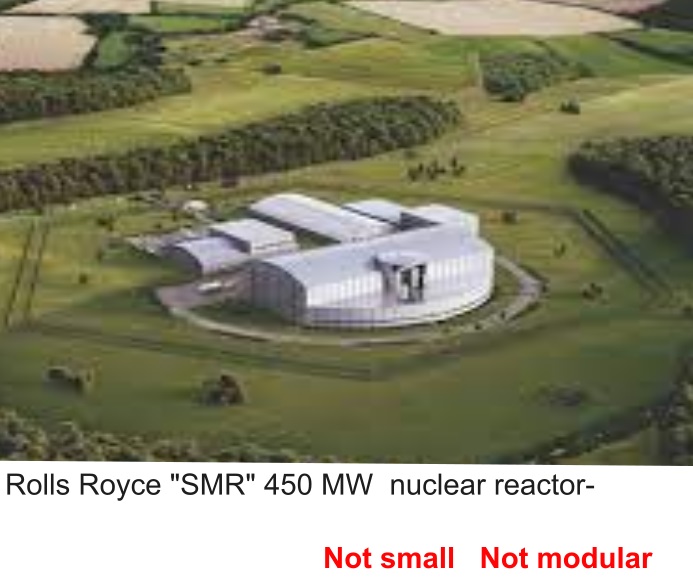
Dr Paul Dorfman Letter: Further to your report “Deal with US to
fast-track mini nuclear reactors” (Sep 15; letter, Sep 16), small modular
reactors (SMRs) are defined by the International Atomic Energy Agency as
reactors that generate up to 300MW power.
At 470MW, the Rolls-Royce design is not an SMR: it is larger than the UK Magnox reactor, more than half the size of the 900MW reactors that make up the bulk of the French nuclear fleet, and about a third the size of the very large EPR reactor design at Hinkley Point C.
This matters because the Rolls-Royce design will need big
sites, standard nuclear safety measures, exclusion zones, core catchers,
aircraft crash protection and security. All this is important because in
calling its design an SMR, or small, Rolls-Royce appears to me to have been
economical with the truth — and all that implies for its other claims,
especially about time and cost.

As for the nuclear waste problem, the former chair of the US government Nuclear Regulatory Commission reports
that SMRs would produce more reactive waste per kWh — the key parameter — than large reactors.
Times 17th Sept 2025. https://www.thetimes.com/comment/letters-to-editor/article/times-letters-ethics-of-danny-krugers-defection-to-reform-uk-3rbg90m3b
Trump not Commander in Chief…he’s Violence Inciter in Chief.

Walt Zlotow, Glen Ellyn IL 16 Sept 25
45 men have served as president. Everyone had a base of voters they geared their presidency toward to remain politically viable and enact their agenda. But all pledged fealty to serving all the people throughout their presidency without regard to political affiliation. All but one that is.
Donald Trump has served every one of his 1,700 days over 5 years ignoring his opposition. Worse, he relentless demonizes them, inciting threats and actual violence unprecedented in American history.
It began with his very first words campaigning for the 2016 election. He glided down the escalator at Trump Tower charging undocumented from Mexico are murderers and rapists, the worst of the worst.
That set the tone for his entire administration. Knowing he was likely to lose reelection, he pivoted to a treasonous assault on the electoral system that put a target on every election official, judge and worker not affiliated with the Trump base. Worse, he inspired, indeed orchestrated, a violent riot to overturn the 2020 election in which he was crushed by over 7 million votes. Also crushed were over 100 patriotic law enforcement injured by a ravenous mob doing Trump’s bidding. One died and 4 committed suicide shortly thereafter from Trump’s riot trauma.
His second term has continued apace. He’s sent his masked immigration storm troopers into American workplaces rounding up undocumented workers serving the economy. Why? Because he can’t round up enough law breaking undocumented on the street to satisfy his vengeful base.
When right wing influencer Charlie Kirk was gunned down Trump immediately blamed the ‘extreme left’, his favorite target for retribution. A number of his high profile supporters called for war against his imaginary enemy. Trump said nothing against this madness that will near certainly result in reprisal violence. Democratic office holders, media influencers and election personnel are all reassessing their security endangered by the very man responsible for their safety.
Trump’s love affair inciting demonization, if not outright violence against the ‘other’, is an aberration in American presidential history.
Someday Trump will leave the presidency he has shockingly betrayed. The only remaining question is how many will fall victim, whether threatened or assaulted, to the madness Trump has unleashed.
US Bombs Another Boat Near Venezuela.
President Trump claimed without evidence that the boat was running drugs and that the strike killed three ‘terrorists’
by Dave DeCamp | September 15, 2025 , https://news.antiwar.com/2025/09/15/us-bombs-another-boat-near-venezuela/
The US military on Monday bombed a boat near Venezuela and killed three people, according to a statement released by President Trump on Truth Social.
President Trump claimed without providing evidence that the boat was carrying drugs and that the three people who were killed were “narcoterrorists.” He made similar claims about the first US military strike on a boat near Venezuela that occurred on September 2, which he said killed 11 “narcoterrorists.”
The president also posted a video that purported to show the Monday strike. It showed what appeared to be a boat that was drifting at sea, followed by an explosion.
“This morning, on my Orders, US Military Forces conducted a SECOND Kinetic Strike against positively identified, extraordinarily violent drug trafficking cartels and narcoterrorists in the SOUTHCOM area of responsibility,” Trump said. “The Strike occurred while these confirmed narcoterrorists from Venezuela were in International Waters transporting illegal narcotics (A DEADLY WEAPON POISONING AMERICANS!) headed to the US.”
The president also signaled that more US strikes on boats in the region were coming. “BE WARNED — IF YOU ARE TRANSPORTING DRUGS THAT CAN KILL AMERICANS, WE ARE HUNTING YOU!” he wrote.
The second US bombing in the region came after the Venezuelan government said that personnel from a US warship boarded a Venezuelan tuna boat that was in Venezuelan waters. Venezuelan Foreign Minister Yván Gil said 18 armed US troops were on the vessel for 8 hours, a claim that hasn’t been confirmed by the US military.
“Those who give the order to carry out such provocations are seeking an incident that would justify a military escalation in the Caribbean,” Gil said.
While Trump and other US officials claim the military action and pressure on Venezuela’s government is about drug trafficking and a response to overdose deaths in the US, fentanyl doesn’t come from or through Venezuela, and the majority of the cocaine that is transported to the US comes through the Pacific, not the Caribbean. Gil said that the real purpose of the US operations was for the US to “persist in their failed policy” of regime change in Venezuela.
The Venezuela policy is being largely driven by US Secretary of State Marco Rubio, who has long pushed for regime change in Venezuela. Venezuelan President Nicolas Maduro on Monday called out Rubio in response to the US boarding the tuna boat, calling him a “lord of death and war.”
Why a national cancer study near US reactors must be conducted before any new expansion of nuclear power.

Nuclear power reactors were introduced in
the United States during the 1950s. Despite concerns about potential health
hazards posed by routine radioactive emissions into the environment, few
research articles have been published in professional journals. The only
national study of cancer near reactors was conducted by federal researchers
in the 1980s and found no association between proximity to reactors and
cancer risk.
But since then, articles on individual nuclear facilities have
documented elevated cancer rates in local populations. Current proposals to
expand US nuclear power, along with concerns about protracted exposures
near aging reactors, make it imperative that an objective, current national
study of cancer near existing reactors be conducted.
Bulletin of Atomic Scientists 12th Sept 2025, https://thebulletin.org/2025/09/why-a-national-cancer-study-near-us-reactors-must-be-conducted-before-any-new-expansion-of-nuclear-power/
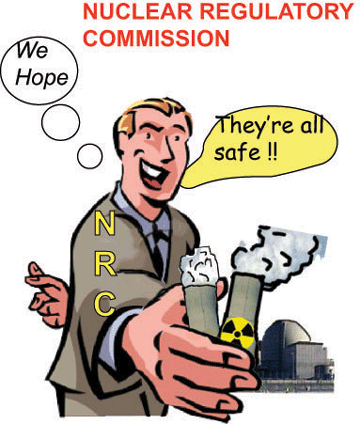
UK hands over its nuclear safety conditions to Trump’s administration?
It is both ironic and worrying to read that the
government is proposing to blindly accept assessments by US safety
regulators in its panic to build new nuclear reactors (“Deal with US to
fast-track mini nuclear reactors”, news, Sep 15).
The public voted in
2016 to leave the European Union in order to increase sovereignty over
important decisions for this country, and to enable government decisions to
be made more accountably and closer to home. The irony is that less than
ten years later the government has decided to hand over crucial nuclear
safety decisions to the Trump administration.
The worry is that the US
Nuclear Regulatory Commission has conflicting roles as both a regulator and
a sales organisation promoting US nuclear technology. Its approval process
has been described as rubber-stamping, and it has widely been criticised
for the influence that the nuclear industry has in its decisions.
The organisation is facing cuts in its workforce from the Trump government, and the president will be appointing new commissioners to the NRC who share his own views on safety and environmental protections. It is hard to comprehend how this proposal will maintain safety standards or encourage communities that suddenly face having a new nuclear reactor built in their locality to welcome such development. The move is purely a leg-up for the US nuclear industry, and has nothing to do with the interests of the British public.
The Times 16th Sept 2025. https://www.thetimes.com/comment/letters-to-editor/article/times-letters-public-disapproval-trump-state-visit-7rs33trdn
Small Modular nuclear reactors sound great, but won’t be ready any time soon.

The UK government has announced a raft of tiny nuclear power projects, while Russia, China and a host of tech giants are also betting big on small nuclear reactor designs. Does the idea make sense and can they really be built any time soon?
By Matthew Sparkes, New Scientist 15th Sept 2025,
Bruno Merk at the University of Liverpool in the
UK says Rosatom, Russia’s state nuclear energy organisation, recently
finished building a batch of small reactors for a highly specific use in
nuclear-powered icebreaker ships. Crucially, they then continued building
more, showing either that there is demand from somewhere, or that Rosatom
is taking a risk and building them as a commercial demonstration in the
hope of selling more despite a raft of energy sanctions imposed after its
invasion of Ukraine.
China, too, has built a Linglong One small nuclear
reactor, but it is not clear whether it will yet be a commercially viable
product.
And giant technology firms like Amazon, Google and Microsoft are
investing in these sorts of nuclear technologies, too. David Dye at
Imperial College London says tiny reactors make sense for remote military
installations or Arctic sites, but is sceptical about using tiny nuclear
reactors to power these tech giants’ needs. He says it is far easier to
build data centres near a ready supply of energy instead. Michael Bluck at
Imperial College London says there is no engineering or scientific reason
we can’t build tiny nuclear reactors, and build them fast. He points out
the first experimental reactors were small, and many devices of a similar
size operate in universities and military submarines around the world
still. “Size is not the issue. It’s the modularity, it’s the building
it on a production line, it’s the standardisation of components. It’s
really practical. It’s standard engineering,” says Bluck.
But there are certainly plenty of drawbacks to miniaturising nuclear reactors. Merk says for nuclear power, scale brings useful efficiencies in both cost and
energy. Small and large reactors both require the same thickness of
concrete shielding to safely contain their reactions and, because the
volume of a reactor grows faster than its surface area when you make it
larger, bigger reactors are cheaper per megawatt of capacitySmaller reactors also make less energy from the same amount of fuel because of inefficiencies in the chain reaction of neutron fission – smaller amounts
of fuel lose more neutrons at the surface, rather than harnessing them to
continue the reaction. Bluck says there are two different approaches
involved in the new government announcements: X-Energy has designed a
gas-cooled reactor called the Xe-100 which uses a somewhat unusual design
and a type of fuel that could take 10 years to achieve regulatory approval,
while Last Energy’s PWR-20 reactor is a relatively familiar pressurised
water reactor, the same type as Sizewell B nuclear power station in
England, using the same fuel. The former could be the way forward, but the
latter may be able to come to market sooner. But even with standard fuel
and familiar technology, Bluck says Last Energy is likely five years from
having even a prototype reactor built in the UK. “Everyone would like it
tomorrow,” he says. “But I think they’re aware that energy isn’t
like that.” https://www.newscientist.com/article/2496252-modular-nuclear-reactors-sound-great-but-wont-be-ready-any-time-soon/
Trump masters the art of “dobbing” on an Australian journalist.

By Vince Hooper | 20 September 2025, https://independentaustralia.net/politics/politics-display/trump-masters-the-art-of-dobbing-on-an-australian-journalist,20177
Trump turned a simple conflict-of-interest question into a schoolyard spat — threatening to “tell on” a journo to Australia’s Prime Minister, writes Vince Hooper.
IT TAKES A CERTAIN theatre of the absurd to transform a routine White House press gaggle into a diplomatic sideshow. Yet that is precisely what happened when an Australian Broadcasting Corporation journalist, researching U.S. President Donald Trump’s family business interests, asked a straightforward question about whether it is appropriate for a sitting president to be engaged in so many business activities.
The question was sober and reasonable: a matter of conflicts of interest, wealth accumulation, and transparency in public office. Trump’s response, however, veered quickly into the surreal. He first insisted that his children were running the business empire, then abruptly shifted the ground.
Instead of grappling with the premise, he went after the journalist’s nationality, declaring:
“The Australians, you’re hurting Australia.”
And then came the kicker — Trump promised to personally inform Prime Minister Anthony Albanese about the journalist’s behaviour, as if geopolitics had suddenly collapsed into a schoolyard spat where the ultimate threat was tattling to the headmaster. The art of dobbing.
At one level, the episode is comic, a reminder of Trump’s instinct for spectacle and grievance. But beneath the absurdity lies something darker: a consistent refusal to treat journalistic inquiry as a legitimate part of democracy. Instead, accountability is reframed as disloyalty. The president of the United States, confronted with a basic question about conflicts of interest, responded not with explanation but with a kind of diplomatic intimidation.
This is part of a longer pattern. From his first term to his second, Trump has cast journalists as enemies rather than interlocutors. The “war on the media” is not rhetorical garnish but central to his political style. In this worldview, truth-seekers are painted as traitors, tough questions are reframed as acts of sabotage, and now even foreign allies are enlisted as props in his domestic culture wars. By claiming that the ABC reporter was “hurting Australia,” Trump implied that the act of pressing a leader for clarity was somehow an attack on his allies themselves.
What is most revealing is how quickly Trump personalised diplomacy. The U.S.–Australia relationship is built on strategic alignment, trade, military cooperation, and shared democratic values. It is not dictated by whether a reporter poses a question he finds confrontational. Yet in his rhetoric, the fate of nations collapsed into the thin skin of one man. This habit of reducing statecraft to personal loyalty tests is not merely undignified; it is dangerous. If bilateral alliances can be bent around one leader’s grievances, they risk becoming unstable, transactional, and unpredictable.
Trump turned a simple conflict-of-interest question into a schoolyard spat — threatening to “tell on” a journo to Australia’s Prime Minister, writes Vince Hooper.
IT TAKES A CERTAIN theatre of the absurd to transform a routine White House press gaggle into a diplomatic sideshow. Yet that is precisely what happened when an Australian Broadcasting Corporation journalist, researching U.S. President Donald Trump’s family business interests, asked a straightforward question about whether it is appropriate for a sitting president to be engaged in so many business activities.
The question was sober and reasonable: a matter of conflicts of interest, wealth accumulation, and transparency in public office. Trump’s response, however, veered quickly into the surreal. He first insisted that his children were running the business empire, then abruptly shifted the ground.
Instead of grappling with the premise, he went after the journalist’s nationality, declaring:
“The Australians, you’re hurting Australia.”
And then came the kicker — Trump promised to personally inform Prime Minister Anthony Albanese about the journalist’s behaviour, as if geopolitics had suddenly collapsed into a schoolyard spat where the ultimate threat was tattling to the headmaster. The art of dobbing.
At one level, the episode is comic, a reminder of Trump’s instinct for spectacle and grievance. But beneath the absurdity lies something darker: a consistent refusal to treat journalistic inquiry as a legitimate part of democracy. Instead, accountability is reframed as disloyalty. The president of the United States, confronted with a basic question about conflicts of interest, responded not with explanation but with a kind of diplomatic intimidation.
This is part of a longer pattern. From his first term to his second, Trump has cast journalists as enemies rather than interlocutors. The “war on the media” is not rhetorical garnish but central to his political style. In this worldview, truth-seekers are painted as traitors, tough questions are reframed as acts of sabotage, and now even foreign allies are enlisted as props in his domestic culture wars. By claiming that the ABC reporter was “hurting Australia,” Trump implied that the act of pressing a leader for clarity was somehow an attack on his allies themselves.
What is most revealing is how quickly Trump personalised diplomacy. The U.S.–Australia relationship is built on strategic alignment, trade, military cooperation, and shared democratic values. It is not dictated by whether a reporter poses a question he finds confrontational. Yet in his rhetoric, the fate of nations collapsed into the thin skin of one man. This habit of reducing statecraft to personal loyalty tests is not merely undignified; it is dangerous. If bilateral alliances can be bent around one leader’s grievances, they risk becoming unstable, transactional, and unpredictable.
Compare this to other democratic leaders. Joe Biden, for all his gaffes, generally responds to press scrutiny with irritation at worst, never with the threat of raising the matter in a diplomatic call. Anthony Albanese himself fields barbed questions from Australian journalists on policy, integrity, and leadership without implying that the act of questioning undermines Australia’s alliances. Even populist figures like Britain’s ex-PM Boris Johnson or India’s Narendra Modi, while often prickly, have not suggested that reporters risk harming national security simply by doing their jobs. Trump stands almost alone in converting a press query into a matter of international loyalty.
In the end, Trump’s outburst says less about Australia than about America. It was not Australia’s reputation on trial, nor the alliance, nor the ABC reporter’s patriotism. It was the president’s tolerance for accountability — and that, once again, proved to be vanishingly thin and fake.
Vince Hooper is a proud Australian/British citizen and professor of finance and discipline head at SP Jain School of Global Management with campuses in London, Dubai, Mumbai, Singapore and Sydney.
UK Ministry of Defence dismiss MP’ s call for inquiry into trident bases nuclear leaks.

THE Ministry of Defence (MoD) has dismissed calls from an SNP MSP for a
public inquiry into nuclear leaks at Trident bases, claiming it is
“factually incorrect” to suggest they posed a safety risk.
Earlier this week Bill Kidd, the Glasgow Anniesland MSP, held a debate on reported nuclear safety incidents at Faslane and Coulport, where Britain’s nuclear fleet and arsenal are stored.
Kidd secured the backing of 28 MSPs from the
SNP, Scottish Greens, Scottish Labour, Alba, and one independent. However,
the motion was not voted on as it was debated as member’s business after
decision time.
It comes after The Ferret revealed that nuclear waste leaked
into Loch Long, in Argyll and Bute. The outlet reported that pipe bursts
were recorded in 2010, two in 2019, and two more in 2021. After an FOI
battle that lasted six years, the Scottish Environment Protection Agency
(Sepa) – the environment watchdog – stated the Royal Navy failed to
properly maintain a network of 1500 pipes at the Coulport armaments depot,
on the banks of Loch Long.
The National 19th Sept 2025, https://www.thenational.scot/news/25481047.mod-dismiss-snp-msp-call-inquiry-trident-bases-nuclear-leaks/
Saudi Arabia, nuclear-armed Pakistan sign mutual defence pact
Saudi Arabia and nuclear-armed Pakistan signed a formal mutual defense pact on Wednesday, in a move that significantly strengthens a decades-long
security partnership amid heightened regional tensions. The enhanced
defense ties come as Gulf Arab states grow increasingly wary about the
reliability of the United States as their longstanding security guarantor.
Israel’s attack on Qatar last week heightened those concerns.
Reuters 17th Sept 2025,
https://www.reuters.com/world/asia-pacific/saudi-arabia-nuclear-armed-pakistan-sign-mutual-defence-pact-2025-09-17/
U.S. Nuclear Reactors will NOT Build a Strong Canada
Ontario Clean Air Alliance -Angela Bischoff, Director, Sept 17, 2025
Prime Minister Carney’s directive to the Major Projects Office to fast-track Doug Ford’s plan to build U.S. nuclear reactors in Ontario will: raise electricity rates, jeopardize national security and delay action on climate change.
New U.S. GE-Hitachi nuclear reactors are the highest-cost option to meet Ontario’s electricity needs – costing 2 to 8 times more than new solar and wind power. As a result, these U.S. reactors will make life less affordable for Ontario’s hard-working families; and they will make Ontario’s industries less competitive.
Building GE-Hitachi reactors will also jeopardize our national security by making Ontario dependent on enriched uranium imports from the U.S. – imports which President Trump could cut off at a moment’s notice.
Finally, building new nuclear reactors is the slowest option to phase-out gas power and protect our climate. Under Doug Ford’s nuclear & gas plan, 25% of our electricity will be produced by burning gas in 2030 – up from only 4% in 2017. To add insult to injury, more than 70% of Ontario’s gas supply is imported from the U.S.
With wildfires burning around the world, we need to invest in the options that can reduce our climate-damaging emissions ASAP, not decades from now. We simply can’t afford to wait 10 to 20 years for new reactors to be built, when solar and wind can be built within months to three years. Combined with batteries, wind and solar can keep our lights on at a fraction of the cost of new nuclear reactors.
Instead of subsidizing the research and development costs for a U.S. multinational’s first-of-their-kind, experimental new nuclear reactors, we should be investing in options that will build a stronger, more prosperous and more secure Canada.
Here is what Prime Minister Carney should do.
1. Rescind his request for the Major Project Office (MPO) to fast-track the building of U.S. nuclear reactors in Ontario.
2. Rescind the Canada Infrastructure Bank’s $970 million loan for the building of GE-Hitachi’s first new nuclear reactor.
3. Direct the MPO to fast-track roof top and parking lot solar in Ontario.
4. Direct the MPO to fast-track cutting the red tape that is blocking the development of Great Lakes offshore wind power.
5. Direct the MPO to fast-track the expansion of the inter-provincial electricity transmission links between Manitoba and Ontario and Ontario and Quebec to increase our ability to import low-cost water, wind and solar power from Manitoba, Quebec and the Maritimes.
Human-made global warming ‘caused two in three heat deaths in Europe this summer’

Human-made global heating caused two in every three heat deaths in Europe
during this year’s scorching summer, an early analysis of mortality in 854
big cities has found. Epidemiologists and climate scientists attributed
16,500 out of 24,400 heat deaths from June to August to the extra hot
weather brought on by greenhouse gases. The rapid analysis, which relies on
established methods but has not yet been submitted for peer review, found
climate breakdown made the cities 2.2C hotter on average, greatly
increasing the death toll from dangerously warm weather.
Guardian 17th Sept 2025, https://www.theguardian.com/environment/2025/sep/17/human-made-global-warming-caused-two-in-three-heat-deaths-in-europe-this-summer-analysis-finds
U.S. Firms Boost UK Nuclear Sector with Major Deals

Oil Price By City A.M – Sep 16, 2025
- The UK and US have agreed to reduce the licensing time for nuclear projects from four years to two and broaden US companies’ access to the UK energy market.
- Several US companies have struck significant deals with UK partners, including X-Energy to build advanced modular reactors in Hartlepool, Holtec to develop data centers powered by small modular reactors, and Last Energy for a micro modular nuclear plant at London Gateway.
- The initiative aims to kickstart a “golden age of nuclear” in the UK, providing clean, homegrown energy, creating skilled jobs, and addressing high energy bills, though critics question the effectiveness of potential VAT cuts on energy bills.
…………………………………………………………………………………. Energy bills woes
The announcement comes as the government battles to bring down energy bills, which have almost doubled costs for households over the past eight years.
Alongside increasing the domestic supply of energy, Chancellor Rachel Reeves is reportedly weighing cutting VAT on energy to help lower consumer prices.
However, critics have questioned whether the move, which could cost the government nearly £2bn, would deliver tangible improvements to household budgets, warning that wealthy families with larger homes would disproportionately benefit from the tax break. https://oilprice.com/Alternative-Energy/Nuclear-Power/US-Firms-Boost-UK-Nuclear-Sector-with-Major-Deals.html
US and UK companies ink nuclear deals ahead of Trump visit
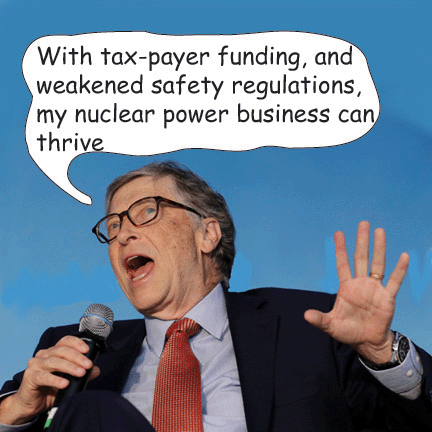
Transatlantic nuclear energy deals estimated to be worth over $100 billion
have been announced ahead of President Donald Trump’s state visit to the
United Kingdom this week. TerraPower, a Bill Gates-backed developer of
small nuclear reactors, announced Monday that it would work with
engineering firm KBR to study potential sites in the U.K. to deploy its
advanced Natrium reactors. Rockville, Maryland-based X-energy and British
energy company Centrica also announced plans to deploy up to 72 small
reactors for electricity and industrial heat in the U.K.
E&E News 16th Sept 2025, https://www.eenews.net/articles/us-and-uk-companies-ink-nuclear-deals-ahead-of-trump-visit/
What You Need to Know About the £38 Billion Sizewell C Nuclear Project inthe UK.
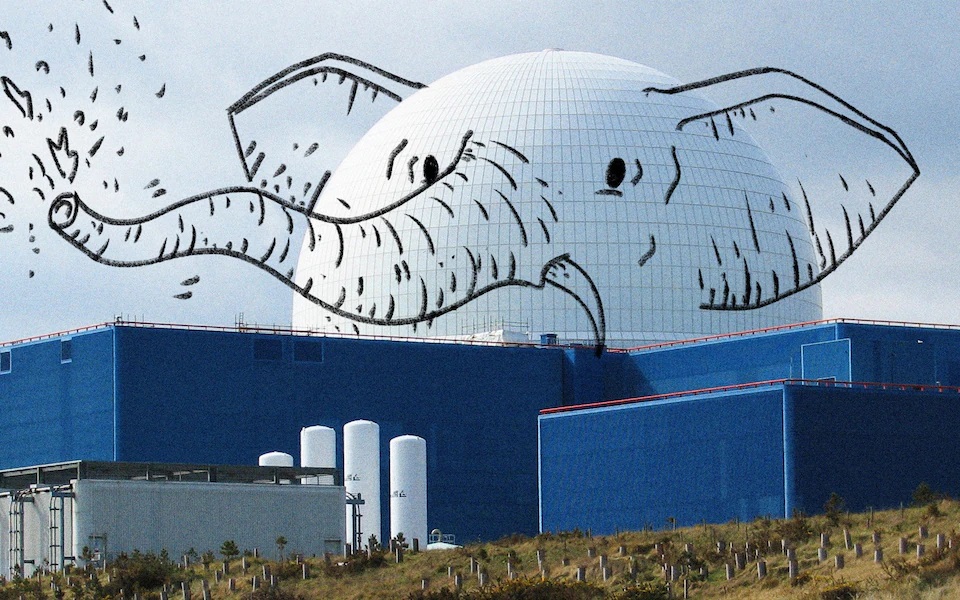
Project Timeline: Development Consent Order (DCO) approved: July
20, 2022; Groundworks commenced: January 15, 2024; Final Investment
Decision (FID) reached: July 22, 2025; Construction duration: Expected to
take between nine and twelve years; Operational date: Expected in the
2030s.
Construction Review 15th Sept 2025, https://constructionreviewonline.com/construction-projects/uk-government-approves-38-billion-sizewell-c-nuclear-project/
1 This Month
29 Jan. Thursday 7-8 p.m. Webinar – World’s Largest Nuclear Station in Port Hope, ON?
To see nuclear-related stories in greater depth and intensity – go to https://nuclearinformation.wordpress.com/



31st January – Challenging the War Machine – a DECLASSIFIED UK SUMMIT


Website of the Week
Now until to February 10, 2026 Radioactive waste storage in France: the debate is finally open! How to participate?
-
Archives
- January 2026 (288)
- December 2025 (358)
- November 2025 (359)
- October 2025 (376)
- September 2025 (258)
- August 2025 (319)
- July 2025 (230)
- June 2025 (348)
- May 2025 (261)
- April 2025 (305)
- March 2025 (319)
- February 2025 (234)
-
Categories
- 1
- 1 NUCLEAR ISSUES
- business and costs
- climate change
- culture and arts
- ENERGY
- environment
- health
- history
- indigenous issues
- Legal
- marketing of nuclear
- media
- opposition to nuclear
- PERSONAL STORIES
- politics
- politics international
- Religion and ethics
- safety
- secrets,lies and civil liberties
- spinbuster
- technology
- Uranium
- wastes
- weapons and war
- Women
- 2 WORLD
- ACTION
- AFRICA
- Atrocities
- AUSTRALIA
- Christina's notes
- Christina's themes
- culture and arts
- Events
- Fuk 2022
- Fuk 2023
- Fukushima 2017
- Fukushima 2018
- fukushima 2019
- Fukushima 2020
- Fukushima 2021
- general
- global warming
- Humour (God we need it)
- Nuclear
- RARE EARTHS
- Reference
- resources – print
- Resources -audiovicual
- Weekly Newsletter
- World
- World Nuclear
- YouTube
-
RSS
Entries RSS
Comments RSS
 nuclear-news